
Walter Cronkite (1916–2009)
Author of A Reporter's Life
About the Author
Walter Cronkite was born in St. Louis, Missouri on November 4, 1916. As a teenager, he got a job with The Houston Post as a copy boy and cub reporter. In college, he worked part-time for the Houston Press, a paper he joined full-time after leaving the University of Texas in 1935. From 1940 to 1949, show more he reported for the United Press wire service. One of the first journalists accredited to cover World War II, Cronkite accompanied Allied forces into North Africa, reported on the Normandy invasion and the Battle of the Bulge. At the end of the war, he became UP's bureau chief in Moscow and then its chief correspondent at the Nuremburg war crimes trials. After returning to the United States in 1948, he covered Washington, D.C., for a group of radio stations before joining CBS, where he remained for the rest of his career, first working on various news programs and then, in 1962, becoming anchor of the CBS Evening News. Over the years, Cronkite covered such events as the assassination of President John F. Kennedy, the moon landing of Apollo II (staying on the air 24 hours to do so), the Vietnam War, and the Watergate scandal. He twice visited Vietnam during the war, and, after the Tet offensive in 1968, candidly questioned the rationale for American involvement and the U.S. military's prospects for victory. He won numerous awards including several Emmy Awards, the Peabody Award in 1962, the William A. White Journalism Award in 1969, the George Polk Award in 1971, and the Presidential Medal of Freedom in 1981. After his retirement in 1981, Cronkite continued to work on special projects for CBS and wrote his autobiography A Reporter's Life in 1996. He died from was complications of dementia on July 17, 2009 at the age of 92. (Bowker Author Biography) show less
Works by Walter Cronkite
Walter Cronkite Selects: The 60 Greatest Old-Time Radio Shows That Transitioned to TV (20 cassettes, 30 hours) (2001) 3 copies
Fail Safe [Region 2] 1 copy
War and Civilization 1 copy
Cronkite Remembers 1 copy
Man on the moon 1 copy
The United States Constitution: U.S. Constitution, the Bill of Rights, and Additional Amendments/Audio Cassettes (1987) 1 copy
American Milestones: 55 Events That Shook The Nation - 1850-2000 Original News Coverage From The New York Times Introduction By Walter Cronkite — Introduction — 1 copy
Texas: The State of Springs 1 copy
Greatest Shows of the 20th Century; the Life of Riley, Father's Day 06-19-48 (2000 Publishing, 20061948) (2000) 1 copy
Scandinavia 1 copy
Great Speeches of Abba Eban 1 copy
War In The Pacfic 1 copy
Associated Works
Reporting Vietnam: American Journalism 1959-1969, Volume 1 (1998) — Contributor — 348 copies, 3 reviews
First Into Nagasaki: The Censored Eyewitness Dispatches on Post-Atomic Japan and Its Prisoners of War (2006) — Foreword — 268 copies, 8 reviews
The Complete Peanuts Box Set: 1950-1954 [1950] (2004) — Introduction, some editions — 240 copies, 2 reviews
Into the Buzzsaw: Leading Journalists Expose the Myth of a Free Press (2002) — Foreword, some editions — 189 copies, 3 reviews
Ruth Bell Graham: Celebrating an Extraordinary Life (2003) — Narrator, some editions — 107 copies, 1 review
Architects of Peace: Visions of Hope in Words and Images (2000) — Foreword; Foreword — 54 copies, 1 review
Memories of World War II: Photographs from the Archives of the Associated Press (2004) — Introduction — 26 copies
How to Succeed in Business Without Really Trying: Original 1995 Broadway Cast Recording (1962) — Narrator — 13 copies
A Tour of the White House with Mrs. John F. Kennedy [1962 TV movie] — Commentary — 9 copies
NOVA: Secret of the Wild Child: The Revealing Story of Genie [1994 TV episode] (2006) — Narrator — 7 copies
Liberty's Kids - Give Me Liberty — Actor — 6 copies
Reader's Digest Young Families: Liberty's Kids Midnight Ride [video] (2003) — Narrator — 4 copies, 1 review
Dream to Fly: Howard Hughes & The Flying Boat [2005 film] — Narrator — 3 copies
Nixon in China [1988 TV episode] — Host — 2 copies
Lucky Man, Memories of a Life in Communication, with a foreword by Walter Cronkite — Foreword — 1 copy
The United States Constitution Volume II The Constitution the Bill of Rights and Additional Ammendments narrated by Walter Cronkite 4 audio cassettes and booklet 54 pgs (1987) — Narrator, some editions — 1 copy, 1 review
Tagged
Common Knowledge
- Other names
- CRONKITE, Walter
- Birthdate
- 1916-11-04
- Date of death
- 2009-07-17
- Gender
- male
- Education
- University of Texas
- Occupations
- journalist
editor
news anchor - Organizations
- CBS
- Awards and honors
- Presidential Medal of Freedom (1981)
Peabody Award (1962 ∙ 1981)
William A. White Award for journalistic merit (1969)
George Polk Journalism Award (1971)
Gold Medal, International Radio and Television Society (1974)
Alfred I. DuPont-Columbia University Award in Broadcast Journalism (1978 ∙ 1981) (show all 7)
Bellarmine Medal - Relationships
- Cronkite, Kathy (daughter)
- Nationality
- USA
- Birthplace
- St. Joseph, Missouri, USA
- Places of residence
- St. Joseph, Missouri, USA (birth)
Kansas City, Missouri, USA
Houston, Texas, USA
Oklahoma City, Oklahoma, USA
New York, New York, USA - Place of death
- New York, New York, USA
- Burial location
- Kansas City, Missouri, USA
- Associated Place (for map)
- USA
Members
Reviews
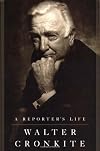
I grew up getting a good portion of my news from Walter Cronkite. The chief impression one gets from his on-air style is one of trust: You want to believe that he's telling you what he knows to be true. To the extent that you can believe an autobiography, that impression is borne out here, although he does admit to a couple of peccadilloes in the early days of his radio career that would get any newbie fired nowadays. "Uncle Walter" comes across here as an earnest man who takes journalism show more and its responsibilities seriously. The self-deprecating style here shows an occasional amusement that middle America takes him just as seriously. Of most interest to me was Cronkite's recollections of the major stories that he and his team informed America about, many of which I remember seeing him report. Being in elementary school, I missed his announcement of JFK's death; now I'll have to find it online. Cronkite wasn't above using his influence to shape the news. His negative comments about the course of the Vietnam war helped influence LBJ's decision not to seek re-election. And he was instrumental in getting Anwar Sadat to sit down and talk peace with Menachim Begin. Cronkite was a giant of American electronic journalism who contributed, albeit with regret, to the dominance of TV news over newspaper reporting. And he seems like a genuinely decent man, worthy of the trust that America bestowed upon him every night for years. show less
Walter Cronkite’s autobiography fascinates on at least two levels: 1. the storied life of a well-traveled and internationally acclaimed television journalist; 2. the prominent figures that played a part in his life due to his position and popularity.
One anecdote involves the discovery of shady dealings. He worked for a newspaper and made the mistake of changing something on a page he didn’t usually work on. The firestorm that followed shocked him, until he learned that the numbers on the show more page were communicating the winning numbers in the Mafia’s Numbers Racket.
Cronkite was a radio announcer and was famous for being able to fill in details when the communications went down during a football game. He could make up plays and then smoothly dovetail his made up events with the actual progress when the communications came back online.
One of Cronkite’s first brushes with celebrity was the coronation of Queen Elizabeth II in 1953. Due to the limitations of technology at the time, some of the interesting anecdotes involve the ways they had to improvise to get film from the live event to the studio in time to show footage during the evening broadcast. This was especially challenging getting footage from England to New York on the same day.
TV made Cronkite the famous figure that he became. So it is with some irony that he marks the end of democracy with the beginning of TV. Politicians and political conventions suddenly became sanitized and dishonest when cameras were trained on them. The exposure of the democratic process could appear ugly to the untrained eye. It’s like some dishes, they are excellent, but it’s not a good idea to watch the chef create it.
By sanitizing the process itself, the end product became sanitized. The end product is the political reality today. The goal was to look polished for the camera, not to honestly work the process to the best possible outcome. “The conventions were reduced to marketing tools. From that day forward, the image on the tube has been the most important aspect of a political campaign, and politics and television have gone skipping hand in hand down this primrose path” (182–183).
Despite the demise of democracy, Cronkite remained an optimistic personality and a revered leader, or at least an accurate reflection, of mainstream American public values. His many decades of journalistic writing gave him a way with words that shows in the present autobiography. It’s an exciting travelogue through the figures and events of the twentieth century, which he covered so well for the CBS Evening News. show less
One anecdote involves the discovery of shady dealings. He worked for a newspaper and made the mistake of changing something on a page he didn’t usually work on. The firestorm that followed shocked him, until he learned that the numbers on the show more page were communicating the winning numbers in the Mafia’s Numbers Racket.
Cronkite was a radio announcer and was famous for being able to fill in details when the communications went down during a football game. He could make up plays and then smoothly dovetail his made up events with the actual progress when the communications came back online.
One of Cronkite’s first brushes with celebrity was the coronation of Queen Elizabeth II in 1953. Due to the limitations of technology at the time, some of the interesting anecdotes involve the ways they had to improvise to get film from the live event to the studio in time to show footage during the evening broadcast. This was especially challenging getting footage from England to New York on the same day.
TV made Cronkite the famous figure that he became. So it is with some irony that he marks the end of democracy with the beginning of TV. Politicians and political conventions suddenly became sanitized and dishonest when cameras were trained on them. The exposure of the democratic process could appear ugly to the untrained eye. It’s like some dishes, they are excellent, but it’s not a good idea to watch the chef create it.
By sanitizing the process itself, the end product became sanitized. The end product is the political reality today. The goal was to look polished for the camera, not to honestly work the process to the best possible outcome. “The conventions were reduced to marketing tools. From that day forward, the image on the tube has been the most important aspect of a political campaign, and politics and television have gone skipping hand in hand down this primrose path” (182–183).
Despite the demise of democracy, Cronkite remained an optimistic personality and a revered leader, or at least an accurate reflection, of mainstream American public values. His many decades of journalistic writing gave him a way with words that shows in the present autobiography. It’s an exciting travelogue through the figures and events of the twentieth century, which he covered so well for the CBS Evening News. show less

An inside look at the US from the 1920's to the end of the twentieth century, and great insight into what made Walter Cronkite the most trusted man in the country in the 1960's and 1970's. I thoroughly enjoyed this story and that surprised me, as I thought I would be reading another somewhat boring "look at me" type of book. His time overlaps my time, having grown up in the sixties, so I am sure I have a bias here. It is one of the few books of the thousands that I have read that I would show more revisit. Excellent writing style, very engaging. show less
Walter Cronkite’s life chronicles the rise and fall of news reporting, in my opinion. He started as a delivery and errand boy, then news gatherer and writer, then into radio news and the wire services and finally into TV in its infancy. He loved being a newspaperman and always considered himself that even when he was an anchor. He says he tried to keep the news he presented factual and impartial, whatever his personal opinion. I grew up with his broadcasts and admired his integrity. His show more book covers most of the major stories of his career, but I found his retirement and subsequent overview of the news industry to be a profound look at what is happening. His kind of news philosophy is sadly gone. We must gleen our information from sound bites and photo ops or miniscule newspaper reports from conglomerate news chains interested in the bottom line. Great book from a major representative of a bygone era. show less
Lists
Awards


You May Also Like


Associated Authors
Statistics
- Works
- 82
- Also by
- 33
- Members
- 2,209
- Popularity
- #11,610
- Rating
- 4.1
- Reviews
- 17
- ISBNs
- 92
- Languages
- 3
- Favorited
- 1
