
Suzanne Mettler
Author of The Submerged State: How Invisible Government Policies Undermine American Democracy
About the Author
Suzanne Mettler is the Clinton Rossiter Professor of American Institutions at Cornell University. Her most recent book is Soldiers to Citizens: The G.I. Bill and the Making of the Greatest Generation.
Works by Suzanne Mettler
The Submerged State: How Invisible Government Policies Undermine American Democracy (2011) 92 copies, 3 reviews
Degrees of Inequality: How the Politics of Higher Education Sabotaged the American Dream (2014) 72 copies, 2 reviews
Tagged
Common Knowledge
Members
Reviews
The Submerged State: How Invisible Government Policies Undermine American Democracy (Chicago Studies in American Politics) by Suzanne Mettler
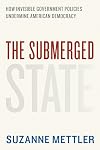
It doesn't take a pundit to know that American politics are screwed up beyond measure. Congress is stuck in gridlock, the economy is stalled, elections are decided by culture war attack ads, and politics itself is derided as a pursuit for lying hustlers. Everybody has a a scapegoat, but Mettler actually has some evidence backing her theory.
The key issue is not the government we see, but the government we don't, the vast tangle of tax breaks, public-private partnerships, and incentives that show more Mettler deems 'the submerged state'. The size of the submerged state is astounding, 8% of the GDP, or half the the size of the visible state (Medicare, social security, Medicaid, the military, servicing the debt, and the relatively minuscule discretionary funding that covers everything else the government does, from transportation to education to NASA and foreign aid).
Mettler deploys economic and social statistics to show that for all it's expense, the submerged state is a failure on nearly every level. Whatever your politics, there is something to dislike about the submerged state. It represents a transfer of wealth from the poor to the wealthy, when most Americans abstractly support reducing inequality. It is a distortionary government influence on the workings of the free market, without even the relativity clarity of direct purchases or regulations. It often fails to accomplished stated policy goals of improving access to education, healthcare, or housing. It leads to civic disengagement, as those who benefit fail to see how the government has helped them, or how they can meaningfully impact politics through voting. And above all, it is corrupt, as it replaces broad public participation with the lobbying of narrowly constituted wealthy interests groups.
This book is not perfect. Mettler is a liberal political scientist, and she has the biases of her profession: that conservatives are responsible for much of what's gone wrong with America over the past 30 years (disclosure: I agree), and that citizens would vote 'better' (I.e. for liberals) is they were just better informed. She is also not quite up to the task of sinking the submerged state. But these are minor quibbles. In the social sciences, I evaluate theories on their explanatory power, and Mettler has provided a powerful lens for seeing many divergent policies as part of a unitary whole.
In a just and reasonable world, the 2012 Presidential campaign would about Mettler's book. Unfortunately, we're still living on Earth, and so it's going to be about Obama's socialism and Romney's tax returns. show less
The key issue is not the government we see, but the government we don't, the vast tangle of tax breaks, public-private partnerships, and incentives that show more Mettler deems 'the submerged state'. The size of the submerged state is astounding, 8% of the GDP, or half the the size of the visible state (Medicare, social security, Medicaid, the military, servicing the debt, and the relatively minuscule discretionary funding that covers everything else the government does, from transportation to education to NASA and foreign aid).
Mettler deploys economic and social statistics to show that for all it's expense, the submerged state is a failure on nearly every level. Whatever your politics, there is something to dislike about the submerged state. It represents a transfer of wealth from the poor to the wealthy, when most Americans abstractly support reducing inequality. It is a distortionary government influence on the workings of the free market, without even the relativity clarity of direct purchases or regulations. It often fails to accomplished stated policy goals of improving access to education, healthcare, or housing. It leads to civic disengagement, as those who benefit fail to see how the government has helped them, or how they can meaningfully impact politics through voting. And above all, it is corrupt, as it replaces broad public participation with the lobbying of narrowly constituted wealthy interests groups.
This book is not perfect. Mettler is a liberal political scientist, and she has the biases of her profession: that conservatives are responsible for much of what's gone wrong with America over the past 30 years (disclosure: I agree), and that citizens would vote 'better' (I.e. for liberals) is they were just better informed. She is also not quite up to the task of sinking the submerged state. But these are minor quibbles. In the social sciences, I evaluate theories on their explanatory power, and Mettler has provided a powerful lens for seeing many divergent policies as part of a unitary whole.
In a just and reasonable world, the 2012 Presidential campaign would about Mettler's book. Unfortunately, we're still living on Earth, and so it's going to be about Obama's socialism and Romney's tax returns. show less

I had high hopes for this book - I was disappointed. The author(s) accurately and completely describe the divide, and then completely skim over reasons for it: the rise of the religious right, the culture wars, the stoking of racism and Nixon's Southern Strategy. This is classic data driven, poll driven, focus group reading. And their solution? Democrats just need to talk more policy to rural voters! There are a few insights here, but you really gotta dig for them. Save your money.
The Submerged State: How Invisible Government Policies Undermine American Democracy (Chicago Studies in American Politics) by Suzanne Mettler
Mettler's idea of the submerged state is definitely an interesting one, but her execution on explaining it makes it less so. Her argument is basically that many of the benefits Americans receive are hidden within tax codes and through subsidized market/private-sector forces, obscuring the government's role in providing these benefits. I also feel that her solution to the problem of the submerged state is sub-par. She suggests politicians need to reveal it through their own public speeches, show more so that people know about the submerged state, which assumes that ordinary Americans are devoted to learning policy from politicians (they're not). In this regard she should have focused more so on media, but instead used political speeches as an easy out from further research on news broadcasts or online articles. Obviously citizens should know about the hidden benefits they reap in order to make more sound political judgments, but in no regard will this be conducive to revealing the submerged state. I'd instead argue that it is the corruption obscuring this system of benefits that must be erased. Specifically, powerful lobbying groups swaying politicians who then siphon billions to corporate subsidies and tax breaks for the wealthiest individuals. Mettler argues that the submerged state is a matter of invisibility rather than, to put it frankly, a corrupt political system built against working-class interests. An important solution Mettler alludes to but refrains from clarifying is that people need to organize to combat these powerful interests and oust the spineless politicians letting corporations control democracy, or at the very least hold them accountable.
Overall, I'd argue that there are important takeaways from this book and that people interested in welfare should read it and form their own opinions. show less
Overall, I'd argue that there are important takeaways from this book and that people interested in welfare should read it and form their own opinions. show less
Degrees of Inequality: How the Politics of Higher Education Sabotaged the American Dream by Suzanne Mettler
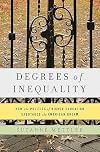
An excellent overview of higher education and the issues which face it today, with particular focus on for-profit institutions and the politics which effect colleges and universities. Mettler provides a good analysis, places post-secondary education in a historical context, and presents a compelling argument for change. A good read for anyone interested in higher education.
Lists
Awards


You May Also Like


Associated Authors
Statistics
- Works
- 9
- Members
- 332
- Popularity
- #71,552
- Rating
- 3.2
- Reviews
- 6
- ISBNs
- 23
- Languages
- 1