

Madeleine Albright (1937–2022)
Author of Fascism: A Warning
About the Author
Madeleine Korbelová Albright was born May 15, 1937 in the Smíchov district of Prague, Czechoslovakia. She attended Wellesley College, in Wellesley, Massachusetts, on a full scholarship, majoring in political science and graduated in 1959. Her senior thesis was written on Czech Communist Zdenek show more Fierlinger Her PhD is from Columbia University. She holds honorary degrees from Brandeis University; the University of Washington; Smith College; University of Winnipeg; the University of North Carolina at Chapel Hill , and Knox College. Albright worked as an intern for The Denver Post and as a picture editor for Encyclopædia Britannica. She was invited to organize a fund-raising dinner for the 1972 presidential campaign of U.S. Senator Ed Muskie of Maine.This association with Muskie led to a position as his chief legislative assistant in 1976. However, after the 1976 U.S. presidential election of Jimmy Carter, Albright's former professor Brzezinski was named National Security Advisor, and recruited Albright from Muskie in 1978 to work in the West Wing as the National Security Council's congressional liaison. Albright joined the academic staff at Georgetown University in Washington, D.C., in 1982, specializing in Eastern European studies. In 1992, Bill Clinton returned the White House to the Democratic Party, and Albright was employed to handle the transition to a new administration at the National Security Council. In January 1993, Clinton nominated her to be U.S. Ambassador to the United Nations. Albright soon took office as the 64th U.S. Secretary of State on January 23, 1997 and she became the first female U.S. Secretary of State and the highest-ranking woman in the history of the U.S. government. Albright now serves as a Professor of International Relations at Georgetown University's Walsh School of Foreign Service. Her title Prague Winter: A Personal Story of Remembrance and War, 1937-1948 made The New York Times Best Seller list for 2012. Her most recent book is Fascism: A Warning. (Bowker Author Biography) show less
Image credit: Madeleine Albright during The Center for the Advancement of Women's 10th Anniversary Gala at The Waldorf Astoria in New York City, New York, 7 septembre 2005
Works by Madeleine Albright
The Mighty and the Almighty: Reflections on America, God, and World Affairs (2006) 689 copies, 9 reviews
Memo to the President Elect: How We Can Restore America's Reputation and Leadership (2008) 241 copies, 7 reviews
Associated Works
Leading from Within: Poetry That Sustains the Courage to Lead (2007) — Foreword, some editions — 114 copies, 3 reviews
History Strikes Back: How States, Nations, and Conflicts Are Shaping the Twenty-First Century (2007) — Preface, some editions — 30 copies
50 Ways to Improve Women's Lives: The Essential Women's Guide for Achieving Equality, Health, and Success (Inner Ocean Action Guide) (2005) — Afterword, some editions — 29 copies
Women Empowered: Inspiring Change in the Emerging World (2007) — Foreword, some editions — 25 copies, 1 review
Tagged
Common Knowledge
- Canonical name
- Albright, Madeleine
- Legal name
- Albright, Madeleine Korbel
- Other names
- Korbelova, Marie Jana (birth name)
Albright, Madeleine K. - Birthdate
- 1937-05-15
- Date of death
- 2022-03-23
- Gender
- female
- Education
- Wellesley College (BA|1959)
Columbia University (MA|1968|Ph.D|1976)
Johns Hopkins School of Advanced International Studies - Occupations
- professor
diplomat
political scientist - Organizations
- United States Department of State (Secretary of State, 1997-2001)
Georgetown University (professor)
Center for National Policy - Awards and honors
- Presidential Medal of Freedom (2012)
Sylvanus Thayer Award (2013)
Distinguished Public Service Award (2016)
Grand Order of Queen Jelena (2000)
Portrait of a Nation Prize (2017)
H. John Heinz III Award for Greatest Public Service (2001) (show all 8)
National Women's Hall of Fame (1998)
Colorado Women's Hall of Fame (2010) - Relationships
- Albright, Joseph (spouse)(divorced 1983)
Korbel, Josef (father) - Short biography
- The first woman to serve as U.S. Secretary of State.
- Cause of death
- cancer
- Nationality
- Czechoslovakia (birth)
USA (citizenship|1957) - Birthplace
- Prague, Czechoslovakia
- Places of residence
- Prague, Czechoslovakia
Belgrade, Yugoslavia
London, Middlesex, England, UK
Washington, D.C., USA - Place of death
- Washington, D.C., USA
Members
Reviews
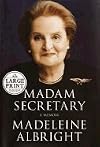
I've read a few political autobiographies because a former boss gifted them to her staff each year. She must have been a Republican because they were written by Colin Powell and Donald Rutherford. Despite being a Democrat, I found these books easy to read and enjoyable. But Madeleine Albright's Madam Secretary stands head and shoulders above both of these others in its deft balancing of the personal and the political and the often self-deprecating humor she brings to bear. Madeleine Albright show more was the first female Secretary of State, a remarkable achievement, made all the more impressive by the fact that she was born in Prague and immigrated to the United States as a young girl. Her father was an intellectual diplomat who sought asylum here because he was an ardent anti-communist. While he obtained a university job in Colorado Madeleine nevertheless did not grow up privileged or wealthy (though she did marry into wealth). She always worked very hard to get good grades and ended up getting a full scholarship to Vassar. The book covers her entire career, including her first jobs, but focuses on the last two, namely U.S. Representative to the United Nations and later Secretary of State under Clinton and the major issues in foreign policy during those years including events in Haiti, Rwanda, Somalia, Kosovo, Serbia, China, Russia, and the Middle East. She discusses her friendships and rivalries with other diplomats and heads of state and is honest about her failures as well as her successes. Her discovery, at age 60, that her parents were born Jewish and three of her grandparents perished in the Holocaust is really fascinating. She openly discusses her failed marriage to Joseph Albright and the warmth she feels for her children and grandchildren and friends and colleagues is palpable. You learn a lot about what happened in those years and why certain political decisions were made. And just as importantly, you grow to truly appreciate and feel a kinship with this modest, funny and brilliant woman who achieved so much for herself and the world and gave her best efforts to all she undertook. show less
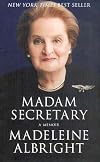
A highly interesting and candid memoir from a woman who made her way from the destruction of post-Second World War Europe to one of the highest governmental positions in the United States. Albright recounts her achievements and involvements in an engaging, forceful, and funny manner; while I don't agree with all her political stances or methods (she's perhaps a little one-size-fits-all in her advocacy of American-style democracy throughout the globe), I love that what she wants to be show more remembered for having taught her generation of women that you could get somewhere if you pushed hard enough, and for having showed to younger women the power of interrupting. Her descriptions of the negotiations in which she took part during her tenure as Secretary of State are lively and evocative, and give the sense of what it's like to be at the heart of such things, rather than on the outside looking in. Well worth the read if you have any interest in US foreign policy in the late twentieth century. show less

Madeleine Albright served in Bill Clinton’s administration as UN Ambassador and Secretary of State – the first female ever in that role. Since Clinton was especially active in international diplomacy, she held a front-row seat and observed many international characters and diplomatic ventures. Further, her career broke the glass ceiling for women in government, and she did it while being a doting mother, grandmother, and even a divorcee. Finally, along with her birth family, she was a show more Czech refugee after World War II and thus exhibited many noble characteristics of the American Dream of an immigrant’s building a life.
This memoir starts by delving into her family’s background. Her Czech father was a diplomat and an outspoken advocate for democracy in mid-century Europe. That position made his family personae non gratae in a Warsaw Pact country after the rise of communism. He was able to find asylum in America and a teaching position at the University of Denver. Obviously, his daughter Madeleine functioned as one of his premier students, but he also counted Condeleezza Rice, the second female Secretary of State, on his list of one-time students. Madeleine’s affinities for diplomacy and democracy thus grew as parts of a family affair.
Albright’s perspectives on the failed Middle East peace process also receive special attention in this memoir. As in Bill Clinton’s memoirs, she is able to capture unique scenes and personalities that drove negotiations oh-so-close to success. She also details why it failed in her view and what future rounds need to change. She is finally able to foresee early steps accounting for the process’s ultimate, unfortunate collapse. Along with other attendees at Camp David, her account deserves a prominent place in the historical record.
It’s hard to criticize someone’s unique account of historical matters. Obviously, some will disagree with her political perspective as a Democrat. And just as obviously, future historians will debate the strengths and weaknesses of her approach and decisions. In fact, she herself does that to her own record in the conclusion and epilogue! Her tale is well-constructed and elegantly articulated. She is relatively fair even to those she disagreed with and does not comport herself as vindictive. I was a teenager consumed with school activities when she was in the cabinet, so I enjoyed getting to know the history of the 1990s at a deeper level than I grasped then. This book also taught me deeper roots of some current geopolitical problems. For both of those benefits, I am grateful to have read this book. show less
This memoir starts by delving into her family’s background. Her Czech father was a diplomat and an outspoken advocate for democracy in mid-century Europe. That position made his family personae non gratae in a Warsaw Pact country after the rise of communism. He was able to find asylum in America and a teaching position at the University of Denver. Obviously, his daughter Madeleine functioned as one of his premier students, but he also counted Condeleezza Rice, the second female Secretary of State, on his list of one-time students. Madeleine’s affinities for diplomacy and democracy thus grew as parts of a family affair.
Albright’s perspectives on the failed Middle East peace process also receive special attention in this memoir. As in Bill Clinton’s memoirs, she is able to capture unique scenes and personalities that drove negotiations oh-so-close to success. She also details why it failed in her view and what future rounds need to change. She is finally able to foresee early steps accounting for the process’s ultimate, unfortunate collapse. Along with other attendees at Camp David, her account deserves a prominent place in the historical record.
It’s hard to criticize someone’s unique account of historical matters. Obviously, some will disagree with her political perspective as a Democrat. And just as obviously, future historians will debate the strengths and weaknesses of her approach and decisions. In fact, she herself does that to her own record in the conclusion and epilogue! Her tale is well-constructed and elegantly articulated. She is relatively fair even to those she disagreed with and does not comport herself as vindictive. I was a teenager consumed with school activities when she was in the cabinet, so I enjoyed getting to know the history of the 1990s at a deeper level than I grasped then. This book also taught me deeper roots of some current geopolitical problems. For both of those benefits, I am grateful to have read this book. show less

Albright takes us through the history of anti-democratic political movements in the twentieth century, trying to isolate the things they have in common, and then explores the ways in which those elements can and can't be mapped onto the rhetoric and actions of the current crop of (would-be) authoritarian leaders. Obviously, her main goal is to alert her US readers to the possible danger to democracy posed by Trump's rants against judges, legislators and journalists, but there's also a lot show more here that can help us understand some of the things going on in Europe and elsewhere.
The book is written for readers who are assumed to know nothing about world history outside the US, which is probably a good thing, but makes it a bit frustrating for the rest of us as we go at what often feels like a snail's pace through the familiar stories of how Mussolini, Hitler, Franco et al. came to power. It gets much more interesting as she advances to the late 20th century and to leaders she dealt with face to face in her own long career in international relations, including Milosevic, Putin, Chavez and Kim Jong-Il.
But we have to pay attention throughout, because she is picking up a lot of crucial points along the way: how most authoritarian leaders come to power in the first place by constitutional means (but often without majority support); how power is entrenched by "necessary reforms" to constitutions and by control of the media; the "Mussolini-model" where the leader refuses to delegate and increasingly overrates his own competence until everything collapses around him, versus the "Hitler-model" where the leader delegates as much as possible to competing subordinates and distances himself from unpopular decisions ("If the Führer only knew").
Albright — despite the title of this book — is very wary about how she uses words like nationalism, populism and fascism. She maintains that the first two are positive qualities, to be admired in liberal democracies. Politicians who don't have the interests of the nation at heart or who don't seek popular support for what they do are clearly going wrong somewhere. And fascism is a term she only wants to apply to leaders who claim to speak for the people without giving the people the chance to comment or contradict, who disregard the rights of minorities, and who impose their ideas inside and outside their country by violence without democratic or judicial controls. The only current fascist state, by her definition, is North Korea. On the other hand, she sees plenty of other leaders who appear to have some of the characteristics of fascism and give reason to fear that they might go further, especially with the examples of impunity Trump and Putin give them.
Obviously the chief interest of the book is that it is written by someone with exceptional practical and theoretical knowledge of how relations between countries work (and personal experience of being a refugee from first Hitler and then Stalin). And a communicator who is very good at making us feel that we can understand very complex questions, even whilst she warns us that the ability to reduce complex questions to simple answers is a strong indicator of anti-democratic rhetoric. Needless to say, there are no simple recipes provided for cooking up democracy at home, other than a warning to stay vigilant. show less
The book is written for readers who are assumed to know nothing about world history outside the US, which is probably a good thing, but makes it a bit frustrating for the rest of us as we go at what often feels like a snail's pace through the familiar stories of how Mussolini, Hitler, Franco et al. came to power. It gets much more interesting as she advances to the late 20th century and to leaders she dealt with face to face in her own long career in international relations, including Milosevic, Putin, Chavez and Kim Jong-Il.
But we have to pay attention throughout, because she is picking up a lot of crucial points along the way: how most authoritarian leaders come to power in the first place by constitutional means (but often without majority support); how power is entrenched by "necessary reforms" to constitutions and by control of the media; the "Mussolini-model" where the leader refuses to delegate and increasingly overrates his own competence until everything collapses around him, versus the "Hitler-model" where the leader delegates as much as possible to competing subordinates and distances himself from unpopular decisions ("If the Führer only knew").
Albright — despite the title of this book — is very wary about how she uses words like nationalism, populism and fascism. She maintains that the first two are positive qualities, to be admired in liberal democracies. Politicians who don't have the interests of the nation at heart or who don't seek popular support for what they do are clearly going wrong somewhere. And fascism is a term she only wants to apply to leaders who claim to speak for the people without giving the people the chance to comment or contradict, who disregard the rights of minorities, and who impose their ideas inside and outside their country by violence without democratic or judicial controls. The only current fascist state, by her definition, is North Korea. On the other hand, she sees plenty of other leaders who appear to have some of the characteristics of fascism and give reason to fear that they might go further, especially with the examples of impunity Trump and Putin give them.
Obviously the chief interest of the book is that it is written by someone with exceptional practical and theoretical knowledge of how relations between countries work (and personal experience of being a refugee from first Hitler and then Stalin). And a communicator who is very good at making us feel that we can understand very complex questions, even whilst she warns us that the ability to reduce complex questions to simple answers is a strong indicator of anti-democratic rhetoric. Needless to say, there are no simple recipes provided for cooking up democracy at home, other than a warning to stay vigilant. show less
Lists
Awards


You May Also Like


Associated Authors
Statistics
- Works
- 16
- Also by
- 8
- Members
- 5,501
- Popularity
- #4,532
- Rating
- 4.0
- Reviews
- 121
- ISBNs
- 159
- Languages
- 16
- Favorited
- 1


