
Daron Acemoglu
Author of Why Nations Fail: The Origins of Power, Prosperity and Poverty
About the Author
Works by Daron Acemoglu
Power and Progress: Our Thousand-Year Struggle Over Technology and Prosperity (2023) 240 copies, 2 reviews
Political Economy 1 copy
Varför är inte hela världen rik? : om makt, framsteg och teknik : genom historien och i framtiden (2025) 1 copy
Economía versus política: Peligros de las medidas que los economistas aconsejan a los políticos (2025) 1 copy
Tagged
Common Knowledge
- Canonical name
- Acemoglu, Daron
- Legal name
- Acemoglu, Kamer Daron
- Other names
- Acemoğlu, Kamer Daron
- Birthdate
- 1967-09-03
- Gender
- male
- Education
- University of York (BA - Economics)
London School of Economics (MS, Phd - Economics) - Occupations
- professor
economist - Organizations
- Massachusetts Institute of Technology
Turkish Academy of Sciences - Awards and honors
- John Bates Clark Medal (2005)
John von Neumann Medal (2007)
Erwin Plein Nemmers Prize in Economics (2012)
Nobel Memorial Prize in Economic Sciences (2024) - Nationality
- Turkey
USA - Birthplace
- Istanbul, Turkey
- Places of residence
- Istanbul, Turkey
London, England, UK
Cambridge, Massachusetts, USA - Associated Place (for map)
- Istanbul, Turkey
Members
Reviews
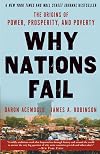
The authors argue that national success or failure (disintegration, revolution, civil war) depends on two correlated factors, economically extractive class relations and political openness. Extractive economies where the few reap the rewards of the efforts of the many can’t stay democratic very long; economically open societies that protect property rights have trouble staying politically repressive because economically successful people seek enough political representation to prevent all show more the cream being skimmed from their efforts. What it means to protect property rights is never fully defined, which is a weakness of the book, but at a minimum it seems to mean protecting property from uncompensated expropriation and transfer to another private party; it’s not clear if the property has to be held legitimately in the first place to meet their standards. This isn’t The End of History because (1) the authors acknowledge the effects of contingency and luck that create path-dependent outcomes, such as slight differences between medieval England and Russia that turned into huge differences, and (2) the authors argue that nothing is guaranteed—both forms can flip if a great imbalance develops, particularly if an economic imbalance develops. Their confidence that the American South got rid of segregation (economically extractive) and became democratic seems overblown given Ferguson and the industrial-prison complex, but the South still fits their model pretty well, it seems to me. Interesting read; they don’t think democracy in China is inevitable, but they think that’s because the elites will be motivated to choke off growth to preserve their own power as has happened in other countries, primarily in Africa. It’s impossible to tell whether those elites will succeed but it’s definitely not enough to be confident that economic growth will inevitably lead to democracy. Combined with Piketty, it’s pretty darn depressing. show less
There’s something appealing about the core idea: inclusive institutions foster prosperity, extractive ones breed stagnation. Acemoglu and Robinson lay this out cleanly and back it with historical contrasts—North vs. South Korea, U.S. vs. Mexico, Botswana vs. Zimbabwe. At first, it’s compelling. Then it gets repetitive. Different story, same conclusion. The structure becomes predictable, and the analysis feels more like a thesis being defended than a question being explored.
The book’s show more biggest flaw is its simplicity. It presents institutions as neutral and inclusive systems as inherently virtuous. But it doesn’t grapple with internal inequalities—who’s included, and on what terms? It skips over how race, gender, and class shape access to power. Colonialism is acknowledged but quickly waved away, with little attention to how it still shapes global systems.
Its economic logic is suspiciously tidy. Get the right institutions, and progress follows? Maybe. But capitalism doesn’t always reward fairness or innovation—sometimes it just consolidates wealth and fuels crises. And then there’s China: the authors confidently predict its failure due to authoritarianism, but offer little room to consider alternative models of development.
Why Nations Fail is bold, polished, and eager to explain. But in a messy, contradictory world, its need for neat answers leaves too much unsaid. show less
The book’s show more biggest flaw is its simplicity. It presents institutions as neutral and inclusive systems as inherently virtuous. But it doesn’t grapple with internal inequalities—who’s included, and on what terms? It skips over how race, gender, and class shape access to power. Colonialism is acknowledged but quickly waved away, with little attention to how it still shapes global systems.
Its economic logic is suspiciously tidy. Get the right institutions, and progress follows? Maybe. But capitalism doesn’t always reward fairness or innovation—sometimes it just consolidates wealth and fuels crises. And then there’s China: the authors confidently predict its failure due to authoritarianism, but offer little room to consider alternative models of development.
Why Nations Fail is bold, polished, and eager to explain. But in a messy, contradictory world, its need for neat answers leaves too much unsaid. show less

In “The Narrow Corridor: States, Societies, and the Fate of Liberty,” authors Daron Acemoglu and James A. Robinson assemble an astounding collection of political histories to persuade us that to survive in our age political liberty requires a strong state and a citizenry engaged in politics.
And they almost have me convinced.
They not only employ the histories of states who have significant liberties built into their systems, but many states who do not, and a few who seem to be on the show more way.
They show how China is a tyranny today and why it got that way. They show how Argentina’s and Columbia’s bureaucracies and Lebanon’s Parliament do their best at sitting on their hands.
And they develop a convincing argument that societies with roots in community discussion and debate lay the groundwork for freedom-loving democracies in Europe, America, and Africa.
I can hear the howls of the American Right complaining that government is just too big for its own good, and the Brexiters saying that Bruxelles was just one government too many.
Acemoglu and Robinson lost me a little bit when they claimed that what societies need is more higher education and an acknowledgement from the people that mass surveillance is really in their own best interests.
Excuse me if I lean on Yuval Harari a little bit, but machines are telling us over and over today that there really is a finite limit to the productivity of humans, no matter how much education you pile on them.
That political compromise is anathema to the new politics and that there is so much inertia built into government today that we are piling laws on top of laws that nobody really care a damn about.
As I sit here today waiting out a global pandemic just to begin thinking about climate change once again, I am wondering where is the political will to save us from ourselves.
The authors write a peon to bills of rights, but nowhere do they acknowledge that rights have no benefit without equal and opposite obligations to the body politic. That political discourse on its own doesn’t make people put up or shut up.
That political mobilization makes little sense in a place like America where more believe in fairy tales than science. Present administrations NOT EXCEPTED!
Do we believe in a fair wage economy? Not unless you believe that the care of children, and the sick, and elderly at home account for no economic value to society. Not in our liberal states and not in our illiberal states.
Our liberal states continue to be extractive in the literal as well as metaphorical sense. And we haven’t figured a way out of the extractive logic. show less
And they almost have me convinced.
They not only employ the histories of states who have significant liberties built into their systems, but many states who do not, and a few who seem to be on the show more way.
They show how China is a tyranny today and why it got that way. They show how Argentina’s and Columbia’s bureaucracies and Lebanon’s Parliament do their best at sitting on their hands.
And they develop a convincing argument that societies with roots in community discussion and debate lay the groundwork for freedom-loving democracies in Europe, America, and Africa.
I can hear the howls of the American Right complaining that government is just too big for its own good, and the Brexiters saying that Bruxelles was just one government too many.
Acemoglu and Robinson lost me a little bit when they claimed that what societies need is more higher education and an acknowledgement from the people that mass surveillance is really in their own best interests.
Excuse me if I lean on Yuval Harari a little bit, but machines are telling us over and over today that there really is a finite limit to the productivity of humans, no matter how much education you pile on them.
That political compromise is anathema to the new politics and that there is so much inertia built into government today that we are piling laws on top of laws that nobody really care a damn about.
As I sit here today waiting out a global pandemic just to begin thinking about climate change once again, I am wondering where is the political will to save us from ourselves.
The authors write a peon to bills of rights, but nowhere do they acknowledge that rights have no benefit without equal and opposite obligations to the body politic. That political discourse on its own doesn’t make people put up or shut up.
That political mobilization makes little sense in a place like America where more believe in fairy tales than science. Present administrations NOT EXCEPTED!
Do we believe in a fair wage economy? Not unless you believe that the care of children, and the sick, and elderly at home account for no economic value to society. Not in our liberal states and not in our illiberal states.
Our liberal states continue to be extractive in the literal as well as metaphorical sense. And we haven’t figured a way out of the extractive logic. show less
Reviewing this book is painful and sad. This book, the authors state, is "the culmination of fifteen years of collaborative research". Many reviewers have stated that Acemoglu and Robinson's academic work is top notch. This book, unfortunately, isn't. It is atrociously bad. It fails on multiple levels.
The first level of failure is the breath-taking numbers of howlers small and large. Fukuyama's statement that "Like many other works making use of history but written by economists, the show more Acemoglu and Robinson volume contains some pretty problematic facts and interpretations." must be parsed as the two authors' outdoing "Bill & Ted's Excellent Adventure" in regard to historical accuracy. From small mistakes (such as speaking of the Roman "princep" instead of "princeps" or allocating Switzerland to Austria), to historical ignorance (thinking of medieval Strasbourg as a French city or unaware of Cracow's prominence as a center of learning) to dubious pronouncements (the Lancastrians winning the War of the Roses), the book is littered with false statements that any diligent reader or editor with access to Wikipedia could have averted. Random House Crown's executive editor John Mahaney, thanked for his efforts in the acknowledgments, seems to be a Dubya type of executive.
The second level of failure is methodological: The authors ditch their statistical model approach for a Gladwellian and Friedmaneque anecdote approach. While a well selected anecdote can help illustrate a phenomenon, such an inductive approach can only falsify a theory. The authors further weaken their case by their failure to properly doing research for their cases. Many of their assertions simply aren't true. When they state that Napoleon's emancipation of the Jews allowed the Rothschild's "to supply grain to the Austrian army, something they would previously not have been allowed to do.", they simply ignore men like Samuel Oppenheimer and Samson Wertheimer who precisely did what Acemoglu and Robinson claim was not possible. Faulty as an anecdote based approach is to present a framework, it utterly collapses as many anecdotes are not true or fail to include important information.
The third level of failure is the lack of operationalization of their key terms "extractive" and "inclusive". The "I know it when I see it" approach lets the authors get away in using the terms differently as it suits them. "Extractiveness" includes a wide range of misbehaviors from the American robber barons exploiting their customers to public and private corruption to onerous taxes to bureaucracy etc. Reducing the complexity of life to a Manichean good and bad offers little input for managerial improvement. The more so as their Manichean concept breaks down as "inclusive" and "extractive" aren't opposites. Democratic Rome and the US South were perfectly willing to exploit their slaves. Even today, the supposedly inclusive United States of America acts hugely extractive towards its poor. The author's implicit criterion of inclusiveness, the right to vote, isn't very powerful to prevent extractive practices. Less inclusive forms such as paternalism seem to generate better results. All is futile, though, as long as the dark horse in the discussion, the sources and use of power may not be discussed. The British government did not enlarge the franchise out of their love for inclusiveness but because they feared French state of affairs. "Why nations fail" is a result of an unsavory distribution of political and economic power. The authors neglect the dynamic component of power as they do path dependency.
The fourth failure of this book is its ideological bias. Reality has a well-known liberal bias which doesn't mesh with the authors' conservative libertarianism. The book is filled with a crude world view (Communism bad; USA good) that fails to acknowledge the involvement of white men in world affairs. The two authors, in a Colbertian way, don't see color. They see the profitable fields of the white South African farmers and wonder why the black farmers do not follow their example. They ignore the US interventions in Central and South America, deploring crime in Mexico without acknowledging the failed War on Drugs with such heinous practices as supplying arms to drug cartels. The two authors do not act as academics, they are keen ideologues willing to chuck facts to preserve and promote their world view. While they may not be proper racists, their willingness to ignore aspects of race in their examples and discussion makes their "separate but equal" position difficult to distinguish from the first group.
Within the US context, this shows itself in a highly anti-Democratic selection of examples. Executive overreach is repeatedly attributed to FDR. The vile Strom Thurmond, the majority of whose career was as an influential Republican politician, is only referred to as a Democrat. The Democrats are also allocated responsibility for the Southern racists without once noting that today, thanks to the Republican Southern strategy, these voters are solid Republicans. The extractive practices of the Reagan revolution could have been the poster case for this book. Instead, their ideological blinders lead them to skirt the topic. Those willing to parse the fine print may read the few bad words about the robber barons as a veiled critique of today. Brave, the two authors aren't.
Overall, the book can serve as an excellent example how nations fail. Praised by their cronies, the authors provide a shoddy product that glorifies the American ruling class of white old men. Further praise of the naked emperors is just what the market demands. Acemoglu and Robinson are willing servants. show less
The first level of failure is the breath-taking numbers of howlers small and large. Fukuyama's statement that "Like many other works making use of history but written by economists, the show more Acemoglu and Robinson volume contains some pretty problematic facts and interpretations." must be parsed as the two authors' outdoing "Bill & Ted's Excellent Adventure" in regard to historical accuracy. From small mistakes (such as speaking of the Roman "princep" instead of "princeps" or allocating Switzerland to Austria), to historical ignorance (thinking of medieval Strasbourg as a French city or unaware of Cracow's prominence as a center of learning) to dubious pronouncements (the Lancastrians winning the War of the Roses), the book is littered with false statements that any diligent reader or editor with access to Wikipedia could have averted. Random House Crown's executive editor John Mahaney, thanked for his efforts in the acknowledgments, seems to be a Dubya type of executive.
The second level of failure is methodological: The authors ditch their statistical model approach for a Gladwellian and Friedmaneque anecdote approach. While a well selected anecdote can help illustrate a phenomenon, such an inductive approach can only falsify a theory. The authors further weaken their case by their failure to properly doing research for their cases. Many of their assertions simply aren't true. When they state that Napoleon's emancipation of the Jews allowed the Rothschild's "to supply grain to the Austrian army, something they would previously not have been allowed to do.", they simply ignore men like Samuel Oppenheimer and Samson Wertheimer who precisely did what Acemoglu and Robinson claim was not possible. Faulty as an anecdote based approach is to present a framework, it utterly collapses as many anecdotes are not true or fail to include important information.
The third level of failure is the lack of operationalization of their key terms "extractive" and "inclusive". The "I know it when I see it" approach lets the authors get away in using the terms differently as it suits them. "Extractiveness" includes a wide range of misbehaviors from the American robber barons exploiting their customers to public and private corruption to onerous taxes to bureaucracy etc. Reducing the complexity of life to a Manichean good and bad offers little input for managerial improvement. The more so as their Manichean concept breaks down as "inclusive" and "extractive" aren't opposites. Democratic Rome and the US South were perfectly willing to exploit their slaves. Even today, the supposedly inclusive United States of America acts hugely extractive towards its poor. The author's implicit criterion of inclusiveness, the right to vote, isn't very powerful to prevent extractive practices. Less inclusive forms such as paternalism seem to generate better results. All is futile, though, as long as the dark horse in the discussion, the sources and use of power may not be discussed. The British government did not enlarge the franchise out of their love for inclusiveness but because they feared French state of affairs. "Why nations fail" is a result of an unsavory distribution of political and economic power. The authors neglect the dynamic component of power as they do path dependency.
The fourth failure of this book is its ideological bias. Reality has a well-known liberal bias which doesn't mesh with the authors' conservative libertarianism. The book is filled with a crude world view (Communism bad; USA good) that fails to acknowledge the involvement of white men in world affairs. The two authors, in a Colbertian way, don't see color. They see the profitable fields of the white South African farmers and wonder why the black farmers do not follow their example. They ignore the US interventions in Central and South America, deploring crime in Mexico without acknowledging the failed War on Drugs with such heinous practices as supplying arms to drug cartels. The two authors do not act as academics, they are keen ideologues willing to chuck facts to preserve and promote their world view. While they may not be proper racists, their willingness to ignore aspects of race in their examples and discussion makes their "separate but equal" position difficult to distinguish from the first group.
Within the US context, this shows itself in a highly anti-Democratic selection of examples. Executive overreach is repeatedly attributed to FDR. The vile Strom Thurmond, the majority of whose career was as an influential Republican politician, is only referred to as a Democrat. The Democrats are also allocated responsibility for the Southern racists without once noting that today, thanks to the Republican Southern strategy, these voters are solid Republicans. The extractive practices of the Reagan revolution could have been the poster case for this book. Instead, their ideological blinders lead them to skirt the topic. Those willing to parse the fine print may read the few bad words about the robber barons as a veiled critique of today. Brave, the two authors aren't.
Overall, the book can serve as an excellent example how nations fail. Praised by their cronies, the authors provide a shoddy product that glorifies the American ruling class of white old men. Further praise of the naked emperors is just what the market demands. Acemoglu and Robinson are willing servants. show less
Lists
Awards


You May Also Like


Associated Authors
Statistics
- Works
- 29
- Members
- 4,282
- Popularity
- #5,868
- Rating
- 3.8
- Reviews
- 76
- ISBNs
- 164
- Languages
- 17
- Favorited
- 2