
Dionysius the Areopagite
Author of Pseudo-Dionysius: The Complete Works
About the Author
Works by Dionysius the Areopagite
Theologia Mystica: Being The Treatise Of St. Dionysius, Pseudo-Areopagite, On Mystical Theology, Together With The First And Fifth Epistles (2011) 5 copies
JERARQUIA CELESTIAL, LA - LA JERARQUIA ECLESIASTICA - LA TEOLOGIA MISTICA (Spanish Edition) (2008) 4 copies, 1 review
De los nombres divinos : Dionisio, sacerdote, a Timoteo, también sacerdote (1901) 3 copies, 1 review
The Angelic Hierarchy 2 copies
The Works of Dionysius the Areopagite Part I: Divine Names, Mystic Theology, Letters ,etc (2014) 2 copies
Dionysius the Areopagite 2 copies
Dionysius Areopagita: Schriften, ausgewählt und kommentiert von Gerhard Wehr (Die Mystiker) (2013) 1 copy
Pseudo 1 copy
The Collective Works of St. Dionysius the Areopagite: By Dionysius the Areopagite, and translated by Rev. John Parker (2022) 1 copy
Teologia Mística 1 copy
Dionysius the Areopagite; The Divine Names; and The Mystical Theology by C. E. Rolt (1992-01-01) 1 copy
Corpus Dionysiacum. 1 copy
Associated Works
The Sheed and Ward Anthology of Catholic Philosophy (A Sheed & Ward Classic) (2005) — Contributor — 33 copies
Every Man an Artist: Readings in the Traditional Philosophy of Art (Library of Perennial Philosophy) (2005) — Contributor, some editions — 15 copies
Tagged
Common Knowledge
- Canonical name
- Dionysius the Areopagite
- Other names
- Pseudo-Dionysius
Pseudo-Dionysius the Areopagite
Pseudo-Denys - Birthdate
- 5th CE
- Date of death
- 6th CE
- Gender
- male
- Organizations
- Roman Catholic Church
- Short biography
- Pseudo-Dionysius the Areopagite (Greek: Διονύσιος ὁ Ἀρεοπαγίτης), also known as Pseudo-Denys, was a Christian theologian and philosopher of the late 5th to early 6th century (writing before 532), probably Syrian, the author of the set of works commonly referred to as the Corpus Areopagiticum or Corpus Dionysiacum. The author pseudonymously identifies himself in the corpus as "Dionysios", portraying himself as the figure of Dionysius the Areopagite, the Athenian convert of St. Paul mentioned in Acts 17:34.
- Nationality
- Byzantium
Roman Empire
Syria - Map Location
- Greece
Members
Reviews
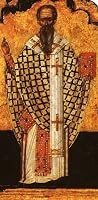
Any consideration or exploration of contemplative spirituality, mystical spirituality, or spirituality in general in Christianity will eventually point back to Pseudo-Dionysius the Areopagite. His writings have proven incredibly influential.
In The Works of Dionysius the Areopagite, you can consider his writings for yourself.
The historical Dionysius the Areopagite was the man mentioned in Acts 17:34 as having been converted in Athens by Paul’s preaching around 51. While there are many who show more wish to believe the historical Dionysius the Areopagite was responsible for the works preserved under his name, they all betray a far more developed Christology and comfort with Neoplatonic philosophy than would be expected from such a first century convert.
Instead, by common confession, the works preserved in this compilation - On Divine Names, Mystical Theology, Liturgy, On the Heavenly Hierarchy, Ecclesiastical Hierarchy, and the Letters - come from likely a Syrian monk in the fifth (or perhaps early sixth) century well versed in the theology and Christology of the time and the Neoplatonic philosophy of Plotinus and Proclus. Thus we speak of him as Pseudo-Dionysius the Areopagite.
In Mystical Theology, the author would come to emphasize what is known as apophatic theology, approaching God more by negation of what is not God rather than affirmation of what God is. In this way the author becomes the first to really lay out a mystical approach to theology. Moderns find his books on hierarchies taxing, but they provided comfort and assurance to previous generations in understanding where everyone fit and how one might draw near to God. He was no doubt a major synthesizer of the Christian and Hellenistic traditions, giving a Neoplatonic voice and framework to Christian theology.
So much of Pseudo-Dionysius’ thought would become incorporated into Christian theology, East and West, that it can be hard to appreciate him fully. What he has said you can find explicated in greater detail elsewhere. Even though he claimed to be honoring and popularizing the instruction of “Hierotheus” his master, it is he and his works which have become most popular and continually quoted and referenced ever since the middle of the sixth century. He is worth considering on account of that heritage of popularity alone. show less
In The Works of Dionysius the Areopagite, you can consider his writings for yourself.
The historical Dionysius the Areopagite was the man mentioned in Acts 17:34 as having been converted in Athens by Paul’s preaching around 51. While there are many who show more wish to believe the historical Dionysius the Areopagite was responsible for the works preserved under his name, they all betray a far more developed Christology and comfort with Neoplatonic philosophy than would be expected from such a first century convert.
Instead, by common confession, the works preserved in this compilation - On Divine Names, Mystical Theology, Liturgy, On the Heavenly Hierarchy, Ecclesiastical Hierarchy, and the Letters - come from likely a Syrian monk in the fifth (or perhaps early sixth) century well versed in the theology and Christology of the time and the Neoplatonic philosophy of Plotinus and Proclus. Thus we speak of him as Pseudo-Dionysius the Areopagite.
In Mystical Theology, the author would come to emphasize what is known as apophatic theology, approaching God more by negation of what is not God rather than affirmation of what God is. In this way the author becomes the first to really lay out a mystical approach to theology. Moderns find his books on hierarchies taxing, but they provided comfort and assurance to previous generations in understanding where everyone fit and how one might draw near to God. He was no doubt a major synthesizer of the Christian and Hellenistic traditions, giving a Neoplatonic voice and framework to Christian theology.
So much of Pseudo-Dionysius’ thought would become incorporated into Christian theology, East and West, that it can be hard to appreciate him fully. What he has said you can find explicated in greater detail elsewhere. Even though he claimed to be honoring and popularizing the instruction of “Hierotheus” his master, it is he and his works which have become most popular and continually quoted and referenced ever since the middle of the sixth century. He is worth considering on account of that heritage of popularity alone. show less

The introductions, usually a big draw in the Classics of Western Spirituality series, were a disappointment. The translations, though, seemed a cut above another resource I used.

This particular work has been re-edited and segments are annotate by Essential; Questions, Essential objectives and essential perspectives, which faciliate the reader's understanding of this over-whelming work.
Lists
You May Also Like


Associated Authors
Statistics
- Works
- 53
- Also by
- 4
- Members
- 1,347
- Popularity
- #19,100
- Rating
- 4.2
- Reviews
- 19
- ISBNs
- 92
- Languages
- 13
- Favorited
- 5
