
W. Brian Arthur
Author of The Nature of Technology: What It Is and How It Evolves
About the Author
W. Brian Arthur is an External Professor at the Santa Fe Institute and a Visiting Researcher at PARC (Palo Alto Research Center). Formerly he was Morrison Professor of Economics and Population Studies at Stanford University. One of the pioneers of complexity theory, he also formulated the show more influential "theory of increasing returns," which offered a paradigm-changing explanation of why some high-tech companies achieve breakaway success. Arthur is the recipient of the International Schumpeter Prize in Economics and the inaugural Lagrange Prize in Complexity Science. He lives in Palo Alto, California. show less
Works by W. Brian Arthur
Increasing Returns and Path Dependence in the Economy (Economics, Cognition, and Society) (1994) 60 copies
Complexity Economics: Proceedings of the Santa Fe Institute's 2019 Fall Symposium (2020) — Editor — 18 copies
Complexity Economics 2 copies
Economics in Nouns and Verbs 1 copy
La natura della tecnologia 1 copy
Tagged
Common Knowledge
- Gender
- male
- Organizations
- Santa Fe Institute
- Nationality
- USA
Ireland
Members
Reviews
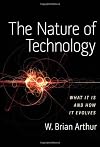
I first read this book in 2010, the summer before I started a PhD in science and technology studies. I remember picking it up at Kramerbooks in Dupont Circle, grabbing a beer at Afterwords, and then staying up all night reading it. Since then, I've read countless pages and megabytes of theory and history about technology, innovation, and the entanglements of politics and things. If anything, The Nature of Technology holds up even better than it did then.
Arthur offers a simple, yet powerful, show more model for understanding technology. A technology is one or more physical phenomenon captured to fulfill human needs. Technologies exhibit modular structure, from the literal nuts and bolts that fasten sub-units together, to a global transportation system that lets you airmail a package from Washington to Ulan Bator with a simple address. Physical principles are like veins of ore in the Earth, exposed and made ready for use by science, and grouped into domains by similarity (the electrical phenomenon, the thermal phenomenon, etc). Engineers gain fluency in the design principles of a domain, which they use to extend the range and power of technology.
Innovation is based around combinatorial evolution, a statement backed up by experiments on circuit design using genetic algorithms and NAND gates. Technologies become instantiated in modules, which are hooked up in different configurations. Innovation is accelerating, because modules are cheaper and easier to connect than before. Gradual evolution is punctuated by transitions to new domains, radical redefinition of technology that blow past previous limits, once the initial bugs are worked out.
There is some fuzziness around the nature of domains, and the links between science and technology, and the actual structure of innovation, but Arthur gets closer to capturing these processes on paper than other writer that I know. show less
Arthur offers a simple, yet powerful, show more model for understanding technology. A technology is one or more physical phenomenon captured to fulfill human needs. Technologies exhibit modular structure, from the literal nuts and bolts that fasten sub-units together, to a global transportation system that lets you airmail a package from Washington to Ulan Bator with a simple address. Physical principles are like veins of ore in the Earth, exposed and made ready for use by science, and grouped into domains by similarity (the electrical phenomenon, the thermal phenomenon, etc). Engineers gain fluency in the design principles of a domain, which they use to extend the range and power of technology.
Innovation is based around combinatorial evolution, a statement backed up by experiments on circuit design using genetic algorithms and NAND gates. Technologies become instantiated in modules, which are hooked up in different configurations. Innovation is accelerating, because modules are cheaper and easier to connect than before. Gradual evolution is punctuated by transitions to new domains, radical redefinition of technology that blow past previous limits, once the initial bugs are worked out.
There is some fuzziness around the nature of domains, and the links between science and technology, and the actual structure of innovation, but Arthur gets closer to capturing these processes on paper than other writer that I know. show less
Brian Arthur's treatise is somewhat ponderous in its beginning (and in truth, throughout) but all the same is most encouraging in its epistemological disposition - assuming as it does the recursivity of society and technology, rather than toting the (conventional) view that one is strictly a product of the other. This points you towards a path-dependent model for not just technology, but society and indeed knowledge itself.
But for some, this is dangerous stuff. It leads in turn to show more uncomfortable conclusions (at least for the neo-enlightenment brigade) which open the door to all that crazy post-modern stuff.
Because he doesn't have to, Arthur doesn't go there, but he does cast a kindly glance at Thomas Kuhn. (I like people who cast kindly glances at Thomas Kuhn: these days they're few and far between).
Arthur doesn't have to go there (at first) because technology, as implemented, is almost by definition infra-paradigmatic: if "science" is its philosophical principle, technology is its practical implementation - very much the sort of thing Nancy Cartwright would call a "nomological machine": a construction designed to give a dependable result in a constrained set of circumstances, where the machine not only prescribes the parameters for a "successful" result, but constrains the environment and operating circumstances in which outcomes are generated to ensure the result is within those parameters, and then, reliably, forces that outcome. (A technology that is unable to force an outcome within its own parameters for a successful result is simply a machine that doesn't work).
But this leaves a gap. If technology is merely the practical implementation of "normal science", it has a hard time explaining innovation. As Arthur puts it:
"Combination [of existing technologies] cannot be the only mechanism behind technology's evolution. If it were, modern technologies such as radar or magnetic resource imaging ... would be created out of bow-drills and pottery firing techniques, or whatever else we deem to have existed at the start of technological time."
The problem, which Arthur specifically sets out to address, is how to account for the "onward" development of technology. Arthur is clear that it is path-dependent ("had we uncovered phenomena over historical times in a different sequence, we would have developed different technologies") but even this insight, I think, risks undercooking the importance of the narrative conversation: it is not just that combinations of technologies through time let us further uncover existing theories and give us better and more powerful and enabling answers to our original questions; they prompt completely new questions: they afford new ways of looking at the world. New ways of looking generate new opportunities, and new problems.
This is a significant point.
For example: prior to the digital age, categorisation of information was a difficult and inherently limited (and, actually, biased) thing: the physical nature of information storage (books) dictated a single taxonomy and a single hierarchy, and required commitment to a single filing taxonomy (without owning more than one copy of a book, you can't file it in two places). Digitisation changed that forever: the Dewey Decimal system - brilliant in its design though it undoubtedly was - solves a problem we no longer have, but at the cost of forcing our hand in a way we no longer need. Digital technology has enabled us to entirely re-evaluate what information really is.
As he goes on, Arthur explicitly keeps in mind two "side issues" that constantly recur in writings about technology: the analogy to Darwin's program of evolution, on one hand, and the analogy to Kuhn's theories of scientific revolution on the other. But these are, to my mind, different articulations of the same idea: that "questions" and "answers" (whether you characterise these as "environmental features" and "biological adaptations which evolve to deal with them", or "observational conundrums" and "scientific theories which purport to explain them") are, to a large extent, interdependent: something is only a conundrum if it appears to contradict the prevailing group of theories. What both Darwin and Kuhn suggest is that "linear progress" - insofar as it implies a predetermined goal to which an evolutionary algorithm is progressing - is a misconceived idea. Evolutionary development is better characterised as a move *away* from the status quo, rather than a move *toward* anything (in hindsight, both will seem the same; to confuse them is a fundamental error).
Yet, and while Arthur clearly recognises this, he does continue to frame his explanatory theory in terms of "forward progress", as if that is the "conundrum" to be solved. The thing is, even our traditional conception of it has this the wrong way round: "the invention of the jet engine" wasn't what was going on; it was "the invention of a way to fly in thinner air". The jet engine was the first solution arrived at that met that purpose (as, in a totally different context, Richard Susskind elegantly points out, when you shop for a Black & Decker, it isn't a drill you want; it's a hole). Technology (and science, and biology) isn't an end, it's a means. The more means you have, the more ends are available to you.
I had therefore wondered whether Arthur had missed a trick in his account of technology - the fact that any novel solution to an old problem creates *new questions* that we did not think - or need - to ask previously. But as his book closes and he views technology through the prism of the economy (on his theory the two are independent; the former is not merely the handmaiden of the latter), he nails this, too:
"The coming of novel technologies does not just disrupt the status quo by finding new combinations that are better versions of the goods and methods we use. It sets up a train of technological accommodations and of new problems, and in doing so it creates new opportunity niches that call forth fresh combinations which in turn introduce further technologies - and further problems."
The implications of this are striking. They completely undermine the idea of technology as a "forwardly moving" phenomenon. It recalibrates to our changing needs and perceptions, just as we recalibrate to the changing perspectives and vistas it affords us. That is a million miles away from Ray Kurzweil's carefully plotted (and in this reviewer's opinion, absurd) logarithmic charts of technological progress that will see machines - and, on Kurzweil's account, eventually the cosmos itself - "wake up".
Even if there were no other reasons (and there are many), one reason for favouring Arthur's less ambitious (but actually more radical) view is its humanity. Arthur closes the book with a neat bit of lit crit: the forces of good and evil in Star Wars, he observes, can be differentiated by their relationship with technology: the Empire's clinical, cold, efficient, androidal heartlessness - against the temperamental, jury rigged, cantankerous and fallible technology of the rebels: in one case technology is our weapon: it relies on us, on our skill, on our judgment and our humanity: we are the necessary homunculus; in the other the humans are, more or less, the "necessary evil" - the impediment to the technology achieving its ends.
Recognising that the special sauce in technology is, for the time being at least, the bit supplied by the meatware, is a comforting thought. show less
But for some, this is dangerous stuff. It leads in turn to show more uncomfortable conclusions (at least for the neo-enlightenment brigade) which open the door to all that crazy post-modern stuff.
Because he doesn't have to, Arthur doesn't go there, but he does cast a kindly glance at Thomas Kuhn. (I like people who cast kindly glances at Thomas Kuhn: these days they're few and far between).
Arthur doesn't have to go there (at first) because technology, as implemented, is almost by definition infra-paradigmatic: if "science" is its philosophical principle, technology is its practical implementation - very much the sort of thing Nancy Cartwright would call a "nomological machine": a construction designed to give a dependable result in a constrained set of circumstances, where the machine not only prescribes the parameters for a "successful" result, but constrains the environment and operating circumstances in which outcomes are generated to ensure the result is within those parameters, and then, reliably, forces that outcome. (A technology that is unable to force an outcome within its own parameters for a successful result is simply a machine that doesn't work).
But this leaves a gap. If technology is merely the practical implementation of "normal science", it has a hard time explaining innovation. As Arthur puts it:
"Combination [of existing technologies] cannot be the only mechanism behind technology's evolution. If it were, modern technologies such as radar or magnetic resource imaging ... would be created out of bow-drills and pottery firing techniques, or whatever else we deem to have existed at the start of technological time."
The problem, which Arthur specifically sets out to address, is how to account for the "onward" development of technology. Arthur is clear that it is path-dependent ("had we uncovered phenomena over historical times in a different sequence, we would have developed different technologies") but even this insight, I think, risks undercooking the importance of the narrative conversation: it is not just that combinations of technologies through time let us further uncover existing theories and give us better and more powerful and enabling answers to our original questions; they prompt completely new questions: they afford new ways of looking at the world. New ways of looking generate new opportunities, and new problems.
This is a significant point.
For example: prior to the digital age, categorisation of information was a difficult and inherently limited (and, actually, biased) thing: the physical nature of information storage (books) dictated a single taxonomy and a single hierarchy, and required commitment to a single filing taxonomy (without owning more than one copy of a book, you can't file it in two places). Digitisation changed that forever: the Dewey Decimal system - brilliant in its design though it undoubtedly was - solves a problem we no longer have, but at the cost of forcing our hand in a way we no longer need. Digital technology has enabled us to entirely re-evaluate what information really is.
As he goes on, Arthur explicitly keeps in mind two "side issues" that constantly recur in writings about technology: the analogy to Darwin's program of evolution, on one hand, and the analogy to Kuhn's theories of scientific revolution on the other. But these are, to my mind, different articulations of the same idea: that "questions" and "answers" (whether you characterise these as "environmental features" and "biological adaptations which evolve to deal with them", or "observational conundrums" and "scientific theories which purport to explain them") are, to a large extent, interdependent: something is only a conundrum if it appears to contradict the prevailing group of theories. What both Darwin and Kuhn suggest is that "linear progress" - insofar as it implies a predetermined goal to which an evolutionary algorithm is progressing - is a misconceived idea. Evolutionary development is better characterised as a move *away* from the status quo, rather than a move *toward* anything (in hindsight, both will seem the same; to confuse them is a fundamental error).
Yet, and while Arthur clearly recognises this, he does continue to frame his explanatory theory in terms of "forward progress", as if that is the "conundrum" to be solved. The thing is, even our traditional conception of it has this the wrong way round: "the invention of the jet engine" wasn't what was going on; it was "the invention of a way to fly in thinner air". The jet engine was the first solution arrived at that met that purpose (as, in a totally different context, Richard Susskind elegantly points out, when you shop for a Black & Decker, it isn't a drill you want; it's a hole). Technology (and science, and biology) isn't an end, it's a means. The more means you have, the more ends are available to you.
I had therefore wondered whether Arthur had missed a trick in his account of technology - the fact that any novel solution to an old problem creates *new questions* that we did not think - or need - to ask previously. But as his book closes and he views technology through the prism of the economy (on his theory the two are independent; the former is not merely the handmaiden of the latter), he nails this, too:
"The coming of novel technologies does not just disrupt the status quo by finding new combinations that are better versions of the goods and methods we use. It sets up a train of technological accommodations and of new problems, and in doing so it creates new opportunity niches that call forth fresh combinations which in turn introduce further technologies - and further problems."
The implications of this are striking. They completely undermine the idea of technology as a "forwardly moving" phenomenon. It recalibrates to our changing needs and perceptions, just as we recalibrate to the changing perspectives and vistas it affords us. That is a million miles away from Ray Kurzweil's carefully plotted (and in this reviewer's opinion, absurd) logarithmic charts of technological progress that will see machines - and, on Kurzweil's account, eventually the cosmos itself - "wake up".
Even if there were no other reasons (and there are many), one reason for favouring Arthur's less ambitious (but actually more radical) view is its humanity. Arthur closes the book with a neat bit of lit crit: the forces of good and evil in Star Wars, he observes, can be differentiated by their relationship with technology: the Empire's clinical, cold, efficient, androidal heartlessness - against the temperamental, jury rigged, cantankerous and fallible technology of the rebels: in one case technology is our weapon: it relies on us, on our skill, on our judgment and our humanity: we are the necessary homunculus; in the other the humans are, more or less, the "necessary evil" - the impediment to the technology achieving its ends.
Recognising that the special sauce in technology is, for the time being at least, the bit supplied by the meatware, is a comforting thought. show less
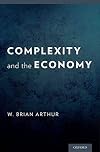
What makes microeconomics so odd is that although it is relatively simple to predict the distribution of actions among a large number of consumers/firms, it is devilishly difficult to predict the action of an individual consumer/firm. This book argues that the underlying assumptions of standard economics are chosen for analytical convenience – rather than actually being useful. It notes that the economy is comprised of dispersed, heterogeneous agents acting in parallel and also responding show more to their own collective action.
The concept harkens back to my degree in agricultural science, which considers how nature and natural resources systems are the result of a massive number of component parts, such that one cannot understand the system simply by understanding the components individually. A parallel is made to how someone who understands every aspect of subatomic particles, cannot with this knowledge explain a salt crystal. show less
The concept harkens back to my degree in agricultural science, which considers how nature and natural resources systems are the result of a massive number of component parts, such that one cannot understand the system simply by understanding the components individually. A parallel is made to how someone who understands every aspect of subatomic particles, cannot with this knowledge explain a salt crystal. show less
After a shallow start, Arthur gets into some insightful analysis of the essence of _techne_ as opposed to _phusis_. (Hey, it isn't every day that I get to throw my virtually nonexistent knowledge of Greek around.) He aims to provide a metatheory of technology analogous to Thomas Kuhn's metatheory of science. The style isn't deeply philosophical, though. Nor is there any mention of Moore's law or whether a mid-century singularity is in store.
Lists
You May Also Like


Associated Authors
Statistics
- Works
- 11
- Members
- 491
- Popularity
- #50,319
- Rating
- 3.6
- Reviews
- 7
- ISBNs
- 21
- Languages
- 2