
Bradley M. Gottfried
Author of The Maps of Gettysburg: An Atlas of the Gettysburg Campaign, June 3 - July 13, 1863
About the Author
Dr. Bradley M. Gottfried is President of Sussex County Community College in New Jersey. He is the author of three Civil War books
Image credit: White Mane Press
Series
Works by Bradley M. Gottfried
The Maps of Gettysburg: An Atlas of the Gettysburg Campaign, June 3 - July 13, 1863 (2007) 236 copies, 4 reviews
Brigades of Gettysburg: The Union and Confederate Brigades at the Battle of Gettysburg (2002) 147 copies
The Maps of First Bull Run: An Atlas of the First Bull Run (Manassas) Campaign, including the Battle of Ball's Bluff, June-October 1861 (2009) 78 copies, 1 review
The Maps of the Wilderness: An Atlas of the Wilderness Campaign, Including all Cavalry Operations, May 2-6, 1864 (Savas Beatie Military Atlas Series) (2016) 54 copies
The Maps of Fredericksburg: An Atlas of the Fredericksburg Campaign, Including all Cavalry Operations, September 18, 1862 - January 22, 1863 (2018) 41 copies
Lincoln Comes to Gettysburg: The Creation of the Soldiers’ National Cemetery and Lincoln’s Gettysburg Address (Emerging Civil War Series) (2021) 27 copies
Brigades of Antietam: The Union and Confederate Brigades during the 1862 Maryland Campaign: The Union and Confederate Brigades (2021) — Editor — 12 copies
Hell Comes to Southern Maryland: The Story of Point Lookout Prison and Hammond General Hospital (2018) 5 copies
Grant & Meade: An Uneasy Alliance 2 copies
Tagged
Common Knowledge
- Gender
- male
Members
Reviews
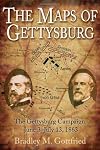
There are several fine books out about the Battle of Gettysburg, most notable being Edwin Coddington’s superb one volume work, The Gettysburg Campaign and Harry Pfanz’s exhaustive 3 volume study. But like just about every book on the Civil War, the maps are barely adequate. The maps in Coddington’s book are good but there is just one single map showing the movements of both armies from June 3rd, when Lee began pulling out from Fredericksburg to June 30th, when both armies began show more concentrating in the Gettysburg area. To say that following the movements of the armies is tedious is understating the case. But graphics are expensive to reproduce in a book, and require a different type of attention to detail. It is no wonder that so many books fall short.
Books of maps--atlases--exist, but usually these are just one-page affairs of a particular battle with a very brief summary of the battle itself. Ghettysburg was the most complex battle of the Civil War, and one-page maps do not even begin to cover the numerous individual engagements which together made up the three days of fighting.
In The Maps of Gettysburg, Gottfried pioneered a new format. He broke down the entire campaign--from the start on June 3rd to the end of Lee’s retreat on July 14--into sections. Each section--sometimes covering one or more days’ of marching, sometimes just a few hours of fighting--has two pages; the left-hand page is text summarizing the action portrayed on the right hand page, which is a map,
The format works beautifully. The text is by necessity a stripped-down, concise summary of events, but that’s no problem; Gottfried is a fine writer. Gottfried has done a wonderful job with both maps and text. There are errors, but they are pretty obvious in most cases, and should not detract from the overall enjoyment of this very fine work. I for one found that for the first time, I understood the movements of both armies from Virginia to Gettysburg.
In addition, there is information on some aspects of the campaign that receive very little attention in works about the battle, such as the short but decisive engagement of Second Winchester on June 10-12 and the cavalry fights that occurred on July 3rd. Lee’s retreat to Virginia is well covered.
Highly recommended. show less
Books of maps--atlases--exist, but usually these are just one-page affairs of a particular battle with a very brief summary of the battle itself. Ghettysburg was the most complex battle of the Civil War, and one-page maps do not even begin to cover the numerous individual engagements which together made up the three days of fighting.
In The Maps of Gettysburg, Gottfried pioneered a new format. He broke down the entire campaign--from the start on June 3rd to the end of Lee’s retreat on July 14--into sections. Each section--sometimes covering one or more days’ of marching, sometimes just a few hours of fighting--has two pages; the left-hand page is text summarizing the action portrayed on the right hand page, which is a map,
The format works beautifully. The text is by necessity a stripped-down, concise summary of events, but that’s no problem; Gottfried is a fine writer. Gottfried has done a wonderful job with both maps and text. There are errors, but they are pretty obvious in most cases, and should not detract from the overall enjoyment of this very fine work. I for one found that for the first time, I understood the movements of both armies from Virginia to Gettysburg.
In addition, there is information on some aspects of the campaign that receive very little attention in works about the battle, such as the short but decisive engagement of Second Winchester on June 10-12 and the cavalry fights that occurred on July 3rd. Lee’s retreat to Virginia is well covered.
Highly recommended. show less
The Maps of First Bull Run: An Atlas of the First Bull Run (Manassas) Campaign, including the Battle of Ball's Bluff, June-October 1861 by Bradley M. Gottfried
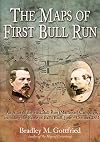
The battle of First Bull run (or First Manassas) was the first major engagement of the US Civil War. Compared to later battles, it was more like a skirmish; “only” 3000+ casualties. But it had a major psychological impact on both sides and was a harbinger of much that was to come. In its way, it was the first battle of modern warfare.
Gottfried has found his niche as a Civil War historian in a new format which he pioneered in Maps of Gettysburg. The book is laid out so that the left hand show more page contains text of a particular portion of the battle while the right hand page displays a map of the terrain and troop movements. The result is that it is incredibly easy to follow the course of the battle. What is truly wonderful for those of us who have the hankering, at times it is possible, thanks to the layout, to follow movements of individual companies, where relevant.
In The Maps of First Bull Run, Gottfried has improved these maps over his Gettysburg book by increased numbering of position of different regiments during time segments of the battle contained in a single map. It makes for fewer maps and a much more coherent rendering of that part of the engagement.
In addition, we meet for the first time many of those who would go on to be legends: "Stonewall Jackson" (he got his nickname at this battle), James Longstreet, William Sherman--as well as a few who would go down in notoriety, such as Ambrose Burnsides. There is an excellent summation of the battle, which gives what are the standard reasons for the Union defeat
Also included in the book is the relatively minor but important engagement at Ball’s Bluff three months later. And there I have my only quibble with the book. There is some confusion about the movements of the 8th VA, movements which were critical to the battle, and I had some trouble understanding what the Union plan for breaking out of the Confederate encirclement was because of it. However, it is decipherable and worth the effort. I was delighted with the inclusion of this engagement, because Ball’s Bluff was too small a battle to deserve a book of its own and yet it was not insignificant. For the first time, I understood the course of the battle,what the problems were, and why it turned out the way it did--another major Union defeat.
Excellent for those who want detailed understanding of an important battle. Highly recommended. show less
Gottfried has found his niche as a Civil War historian in a new format which he pioneered in Maps of Gettysburg. The book is laid out so that the left hand show more page contains text of a particular portion of the battle while the right hand page displays a map of the terrain and troop movements. The result is that it is incredibly easy to follow the course of the battle. What is truly wonderful for those of us who have the hankering, at times it is possible, thanks to the layout, to follow movements of individual companies, where relevant.
In The Maps of First Bull Run, Gottfried has improved these maps over his Gettysburg book by increased numbering of position of different regiments during time segments of the battle contained in a single map. It makes for fewer maps and a much more coherent rendering of that part of the engagement.
In addition, we meet for the first time many of those who would go on to be legends: "Stonewall Jackson" (he got his nickname at this battle), James Longstreet, William Sherman--as well as a few who would go down in notoriety, such as Ambrose Burnsides. There is an excellent summation of the battle, which gives what are the standard reasons for the Union defeat
Also included in the book is the relatively minor but important engagement at Ball’s Bluff three months later. And there I have my only quibble with the book. There is some confusion about the movements of the 8th VA, movements which were critical to the battle, and I had some trouble understanding what the Union plan for breaking out of the Confederate encirclement was because of it. However, it is decipherable and worth the effort. I was delighted with the inclusion of this engagement, because Ball’s Bluff was too small a battle to deserve a book of its own and yet it was not insignificant. For the first time, I understood the course of the battle,what the problems were, and why it turned out the way it did--another major Union defeat.
Excellent for those who want detailed understanding of an important battle. Highly recommended. show less
The maps of Gettysburg : an atlas of the Gettysburg campaign, June 3-July 13, 1863 by Bradley M. Gottfried
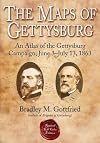
This book is a fine addition to the Gettysburg corpus, as well as the inaugural volume in a fine new series by Savas Beatie. It consists of a series of maps, on the right-hand pages, and a description of the maps on the left-hand pages. The maps are usually tactical in nature, although some, describing the advance to and (Confederate) retreat from Gettysburg, cover a larger area. There are some minor omissions, none serious. The one truly annoying flaw is the depiction of terrain elevations show more in gross terms only. As a result, some significant terrain is ignored. show less
A noted Civil War historian has infamously suggested that we don’t need any more books on Gettysburg (apologies if I’ve misreported you Gazza, but I haven’t seen any clarification of those comments yet). Well, if the people at Savas Beatie had listened to him, we’d have missed out on two splendid books in the last year – Eric Wittenberg and J D Petruzzi’s “Plenty of Blame to Go Around” and Brad Gottfried’s “The Maps of Gettysburg” – both of which have helped this show more Civil War enthusiast to better understand this most famous of all battles.
Brad is well known in the Civil War community, having written five books, including “The Brigades of Gettysburg”, and the maps book is a credit to him and his publisher. He has 144 detailed full-page maps, each with an accompanying page of text and they together describe the campaign from its beginning on June 3 1863 to the final escape of Lee’s troops on 14 July. Add to that comprehensive endnotes and a fine bibliography and you have a book that will complement any Gettysburg collection.
I’ll be packing it for my next visit to the Burg. show less
Brad is well known in the Civil War community, having written five books, including “The Brigades of Gettysburg”, and the maps book is a credit to him and his publisher. He has 144 detailed full-page maps, each with an accompanying page of text and they together describe the campaign from its beginning on June 3 1863 to the final escape of Lee’s troops on 14 July. Add to that comprehensive endnotes and a fine bibliography and you have a book that will complement any Gettysburg collection.
I’ll be packing it for my next visit to the Burg. show less
Awards
You May Also Like


Associated Authors
Statistics
- Works
- 28
- Members
- 1,004
- Popularity
- #25,689
- Rating
- 4.2
- Reviews
- 5
- ISBNs
- 48