
Eric Toensmeier
Author of Perennial Vegetables
About the Author
Works by Eric Toensmeier
Paradise Lot: Two Plant Geeks, One-Tenth of an Acre, and the Making of an Edible Garden Oasis in the City (2013) 173 copies, 6 reviews
The Carbon Farming Solution: A Global Toolkit of Perennial Crops and Regenerative Agriculture Practices for Climate Change Mitigation and Food Security (2016) 63 copies, 1 review
Associated Works
Edible Forest Gardens, Volume 1: Ecological Vision and Theory For Temperate Climate Permaculture (2005) 239 copies
The New American Landscape: Leading Voices on the Future of Sustainable Gardening (2011) — Contributor — 44 copies, 1 review
Tagged
Common Knowledge
- Birthdate
- 20th c CE
- Gender
- male
- Places of residence
- Holyoke, Massachusetts, USA
- Map Location
- USA
Members
Reviews
Paradise Lot: Two Plant Geeks, One-Tenth of an Acre, and the Making of an Edible Garden Oasis in the City by Eric Toensmeier
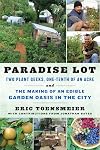
I really enjoyed this book — the optimism of cohousing and planting is a heady combination, and I learned a lot about community and permaculture. I found the explanation of concepts kind of mind-blowing, actually, from the idea of building in deliberate time for harvesting, to the concept that this country was managed forest gardens that Indigenous people cared for before colonization. It’s such a different mindset than anything I’ve learned before. Fascinating, compelling, accessible.
The Carbon Farming Solution: A Global Toolkit of Perennial Crops and Regenerative Agriculture Practices for Climate Change Mitigation and Food Security by Eric Toensmeier
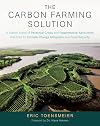
Did you know that fully half of global warming emissions come from our food system? Or that only 1.5% of carbon is held within our atmosphere, when soils hold 5% and could hold much more?
How do we adapt our agricultural methods so that they will have a future in an era that will see severe weather volatility, rising sea-levels, and sky-rocketing atmospheric CO2 levels? In his book, "The Carbon Farming Solution," (Chelsea Green, 2016) internationally-renown permaculture scholar Eric show more Toensmeier presents a deeply stirring and exhaustively researched proposal: shift global production of staple crops over to regeneratively-managed perennials. This elegant solutions solves the two-fold bind we’re in; carbon farming simultaneously is our most promising avenue to sequester carbon where it belongs—in the soil—while moving to an agricultural model that better withstands the hazards of wild swings in temperature and precipitation. Throughout this narrative, Toensmeier deftly weaves a thread of social justice. For those working in food systems in our times, I can’t think of a more vital text.
The book begins with a broad-strokes introduction to climate change and carbon farming. The bulk of the book is dedicated to highlighting specifics crops that hold promise—first in staple crops: looking at starches, carbohydrates, proteins, oils, sugar, and then in industrial crops: biomass, starch, oil, hydrocarbon, fiber, and miscellaneous. All of these are perennial, and non-destructively harvested (allowing for ongoing carbon sequestration and alleviating the need for tillage).
Although all of the book was fascinating, I found the section on industrial crops to be the most interesting. Until the advent of the synthetics industry fueled with petroleum feedstocks, almost all of our industrial feedstocks came from living organisms. Even today, a quarter of pharmaceuticals are developed from plants.
There's no avoiding the fact that, if the civilization project is going to continue for another century or more, we will need to vastly reduce our resource use. If we converted all of our carbohydrate and sugar crops into electricity, we could only meet 40% of global demand. If we were to convert all of our oilseed production into fuel, it would only replace 10% of the diesel we use. 12% of all petroleum production is used directly as feedstocks for plastics, lubricants, chemicals, and other synthetic materials. Ultimately, petroleum is just concentrated biological material from millions of years ago. It's very possible to switch over to real-time production of these resources and still be way into "overshoot," and ecological collapse. In many ways, shifting our industrial production to agriculture will further stress our natural systems, unless we dramatically reduce resource consumption.
Toensmeier reiterates numerous times throughout the book that there are no "miracle" plants. Any species can be used on an industrial scale in oppressive ways, or can be integrate into ecological and just methods of production (via polycultures, cooperatives, decentralization, et cetera). Hopefully his repeated words of warning in this regard are taken to heart by those that read this book with large-scale implementation in mind. Some may want to forget that some of the largest humanitarian disasters in history (such as slavery and cotton in the United States) revolved around agricultural production of commodity crops. We need to scale up carbon farming, but we should also take this opportunity to do so in an ethical way.
Our author has gone on to be the Senior Fellow of Land Use Solutions at Project Drawdown—an amazing initiative and recently-published book—but in many ways, "The Carbon Farming Solution" is a more impressive work! show less
How do we adapt our agricultural methods so that they will have a future in an era that will see severe weather volatility, rising sea-levels, and sky-rocketing atmospheric CO2 levels? In his book, "The Carbon Farming Solution," (Chelsea Green, 2016) internationally-renown permaculture scholar Eric show more Toensmeier presents a deeply stirring and exhaustively researched proposal: shift global production of staple crops over to regeneratively-managed perennials. This elegant solutions solves the two-fold bind we’re in; carbon farming simultaneously is our most promising avenue to sequester carbon where it belongs—in the soil—while moving to an agricultural model that better withstands the hazards of wild swings in temperature and precipitation. Throughout this narrative, Toensmeier deftly weaves a thread of social justice. For those working in food systems in our times, I can’t think of a more vital text.
The book begins with a broad-strokes introduction to climate change and carbon farming. The bulk of the book is dedicated to highlighting specifics crops that hold promise—first in staple crops: looking at starches, carbohydrates, proteins, oils, sugar, and then in industrial crops: biomass, starch, oil, hydrocarbon, fiber, and miscellaneous. All of these are perennial, and non-destructively harvested (allowing for ongoing carbon sequestration and alleviating the need for tillage).
Although all of the book was fascinating, I found the section on industrial crops to be the most interesting. Until the advent of the synthetics industry fueled with petroleum feedstocks, almost all of our industrial feedstocks came from living organisms. Even today, a quarter of pharmaceuticals are developed from plants.
There's no avoiding the fact that, if the civilization project is going to continue for another century or more, we will need to vastly reduce our resource use. If we converted all of our carbohydrate and sugar crops into electricity, we could only meet 40% of global demand. If we were to convert all of our oilseed production into fuel, it would only replace 10% of the diesel we use. 12% of all petroleum production is used directly as feedstocks for plastics, lubricants, chemicals, and other synthetic materials. Ultimately, petroleum is just concentrated biological material from millions of years ago. It's very possible to switch over to real-time production of these resources and still be way into "overshoot," and ecological collapse. In many ways, shifting our industrial production to agriculture will further stress our natural systems, unless we dramatically reduce resource consumption.
Toensmeier reiterates numerous times throughout the book that there are no "miracle" plants. Any species can be used on an industrial scale in oppressive ways, or can be integrate into ecological and just methods of production (via polycultures, cooperatives, decentralization, et cetera). Hopefully his repeated words of warning in this regard are taken to heart by those that read this book with large-scale implementation in mind. Some may want to forget that some of the largest humanitarian disasters in history (such as slavery and cotton in the United States) revolved around agricultural production of commodity crops. We need to scale up carbon farming, but we should also take this opportunity to do so in an ethical way.
Our author has gone on to be the Senior Fellow of Land Use Solutions at Project Drawdown—an amazing initiative and recently-published book—but in many ways, "The Carbon Farming Solution" is a more impressive work! show less
Paradise Lot: Two Plant Geeks, One-Tenth of an Acre, and the Making of an Edible Garden Oasis in the City by Eric Toensmeier
In 2004, two “plant nerds” (the primary and contributing authors) bought a duplex on a 1/10 acre lot of “urbanite” soil in Holyoke MA, with a plan to bring permaculture into an urban context. This is the story of their garden through seasons and years, with background of how each came to permaculture as a vocation, and bits of entwined life as both men marry and their wives introduce ideas and expertise. It is useful for its scale (it does not assume multiple acres and ample space show more for trees), its attitude (despite relevant education, much trial and error was involved, and the garden remains a work in progress), and its results (an appendix of mostly edible perennials that can make it through a New England winter). They advise a year of preparation, observing sunny and shady areas, testing (and amending) the soil; by this method (sketches are included), they determined the one location suitable for a greenhouse, and a microclimate where tropical plants could survive. The emphasis is on sustainable polyculture, low maintenance (perennials and self-seeding annuals, spreading but not invasive) and high density (multiple layers and multiple edible parts), attractive to wildlife (at least far more so than the average city yard), native when plausible but not ideologically purist. Not great literature, but informative and encouraging.
(read 13 Jul 2013) show less
(read 13 Jul 2013) show less
Perennial Vegetables: From Artichokes to Zuiki Taro, A Gardener's Guide to Over 100 Delicious and Easy to Grow Edibles by Eric Toensmeier
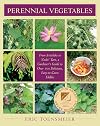
Can you name a perennial vegetable? You probably know about asparagus. Another? Maybe you know artichokes are perennial (I didn't!) Another? Is rhubarb a vegetable?
This book has over 100 perennial vegetables. There are familiar and semi-familiar things I didn't know were perennial, like chayote and runner beans and shallots. There are lots of aquatic vegetables, with info on how to grow them -- water chestnuts, watercress, and lotus root among them. There are things I've never heard of -- show more South American greens and root vegetables, edible weeds, air potatoes. (Yes, I said "air potato"!) Some of them are kind of off-putting -- potentially invasive, poisonous if you pick or prepare them wrong, or described as "gelatinous" or "musky". I don't think I'm going to grow many of these things, though shallots and runner beans have piqued my interest, and I flirted with the idea of sunchokes. But if you're a plant geek and/or food geek, it's a fascinationg read.
There's a section on growing techniques, lots and lots of plant profiles, and some resource listings. Check it out! show less
This book has over 100 perennial vegetables. There are familiar and semi-familiar things I didn't know were perennial, like chayote and runner beans and shallots. There are lots of aquatic vegetables, with info on how to grow them -- water chestnuts, watercress, and lotus root among them. There are things I've never heard of -- show more South American greens and root vegetables, edible weeds, air potatoes. (Yes, I said "air potato"!) Some of them are kind of off-putting -- potentially invasive, poisonous if you pick or prepare them wrong, or described as "gelatinous" or "musky". I don't think I'm going to grow many of these things, though shallots and runner beans have piqued my interest, and I flirted with the idea of sunchokes. But if you're a plant geek and/or food geek, it's a fascinationg read.
There's a section on growing techniques, lots and lots of plant profiles, and some resource listings. Check it out! show less
Lists
Awards

You May Also Like


Associated Authors
Statistics
- Works
- 7
- Also by
- 3
- Members
- 513
- Popularity
- #48,355
- Rating
- 4.0
- Reviews
- 11
- ISBNs
- 10