
Naomi Stadlen (1942–2025)
Author of What Mothers Do Especially When It Looks Like Nothing
Works by Naomi Stadlen
Tagged
Common Knowledge
- Birthdate
- 1942-11-25
- Date of death
- 2025-06-06
- Gender
- female
- Education
- Town and Country School, Hampstead
North London Collegiate School
University of Sussex (MA|History)
Goldsmiths, University of London - Occupations
- social worker
occupational therapist
book editor
existential therapist
breastfeeding counsellor - Organizations
- Penguin Books
Hutchinson
Mothers Talking group, Active Birth Centre, London
Belsize Square Synagogue
New School of Psychotherapy and Counselling, London
University of North East London (show all 7)
Birkbeck College, London - Relationships
- Jacoby, H J (parent)
- Nationality
- UK
- Birthplace
- London, England, UK
- Associated Place (for map)
- England, UK
Members
Reviews
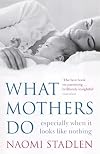
This book sets out with two admirable goals: 1) to articulate and make visible the really complex activities and processes of what's generally called "mothering" and 2) to honor those activities and processes as far more than 'doing nothing' (as in, 'I've been home with my baby, I'm exhausted, and yet I've feel like I've done nothing all day'). I absolutely agree that we need to pay far more nuanced attention to parents' (and specifically mothers') experiences, which are extremely show more interesting and valuable. I just don't like how Stadlen goes about pursuing those aims.
Over and over, she makes a universal-sounding claim and lists a bunch of quotations that back it up, while I'm thinking, no; that just leaves so many people I know out. More importantly, I'm troubled by the book’s treatment of socioeconomic class (often I'm thinking, er, excuse me but your privilege is showing ...), its ongoing not-so-subtle implication that really the goal is for mothers to stay home full-time with their babies and young children (and apparently we all secretly want to anyway, once we meet our babies); relatedly, its insistence that the mother is REALLY always ultimately/primarily responsible for the baby, and that the father (female partners seem to be nowhere in sight, alas) can only ever 'look after' his child; and a strain of mother-blaming that’s totally contrary to the good intentions of the project.
It feels as though this book is actually speaking to a very specific audience (financially-secure women who are the primary/responsible parents in their families ... and, it seems to me, are heterosexually partnered, well-educated and used to high-powered office-based jobs, etc.) without admitting it. I also wish it would acknowledge structural and culturally-constructed constraints rather than solely emphasizing self-help strategies and acting as though a mother is ultimately, solely responsible for how her child experiences the world and turns out as an adult.
I found chapters 6 ("I Get Nothing Done All Day," on some of the subtle processes of growth and communication that happen as we interact with babies) and 10 ("I Was Surprised that I Still Had the Same Name," on some of the intellectual and ethical challenges [in a good sense] of taking care of babies) more interesting and nuanced than the others, so I developed a bit more fondness for the book in this second half. But the universalizing thing and the judgmental-while-claiming-never-to-judge thing would keep me from recommending this book to a friend. show less
Over and over, she makes a universal-sounding claim and lists a bunch of quotations that back it up, while I'm thinking, no; that just leaves so many people I know out. More importantly, I'm troubled by the book’s treatment of socioeconomic class (often I'm thinking, er, excuse me but your privilege is showing ...), its ongoing not-so-subtle implication that really the goal is for mothers to stay home full-time with their babies and young children (and apparently we all secretly want to anyway, once we meet our babies); relatedly, its insistence that the mother is REALLY always ultimately/primarily responsible for the baby, and that the father (female partners seem to be nowhere in sight, alas) can only ever 'look after' his child; and a strain of mother-blaming that’s totally contrary to the good intentions of the project.
It feels as though this book is actually speaking to a very specific audience (financially-secure women who are the primary/responsible parents in their families ... and, it seems to me, are heterosexually partnered, well-educated and used to high-powered office-based jobs, etc.) without admitting it. I also wish it would acknowledge structural and culturally-constructed constraints rather than solely emphasizing self-help strategies and acting as though a mother is ultimately, solely responsible for how her child experiences the world and turns out as an adult.
I found chapters 6 ("I Get Nothing Done All Day," on some of the subtle processes of growth and communication that happen as we interact with babies) and 10 ("I Was Surprised that I Still Had the Same Name," on some of the intellectual and ethical challenges [in a good sense] of taking care of babies) more interesting and nuanced than the others, so I developed a bit more fondness for the book in this second half. But the universalizing thing and the judgmental-while-claiming-never-to-judge thing would keep me from recommending this book to a friend. show less
You May Also Like


Statistics
- Works
- 5
- Members
- 166
- Popularity
- #127,844
- Rating
- 4.1
- Reviews
- 1
- ISBNs
- 11
- Languages
- 2