
Amy Shields
Author of National Geographic Little Kids First Big Book of Why
About the Author
Works by Amy Shields
Animals of Africa Nature Series 21 copies
Animal Friendship! Collection: Amazing Stories of Animal Friends and the Humans Who Love Them (2015) — Contributor — 19 copies
Trains. NGK 1 copy
Trains level 1 1 copy
Tagged
Common Knowledge
- Gender
- female
Members
Reviews
National Geographic Kids Chapters: Best Friends Forever: And More True Stories of Animal Friendships (NGK Chapters) by Amy Shields
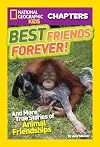
I read this for my Bookaneers book club last spring. I have a whole bunch of these nonfiction chapters, but they don't check out as often as I think they should - I think the kids don't see them back in the nonfiction or are daunted that they'll be too long when they do find them. Personally, I'm not a fan of sentimental "animal friends" stories, but parents and kids (when they find them) looooove them.
This collects the stories of four animal pairs. Roscoe and Suryia, pictured on the cover, show more are an orangutan and stray dog. They live on an animal sanctuary and enjoy many activities together, including swimming, something orangutans don't normally do in the wild. Koko is the famous gorilla who loved kittens and this is a bittersweet story as his first kitten was killed in a car accident. Jasmine was a rescued greyhound who became the unofficial "mother" of an animal rescue in England and bonded specially with a fawn, Bramble. Owen and Mzee is a well-known story of a baby hippo who adopted a tortoise as his mother until he was able to be reintroduced to a hippo family. I appreciated that the final chapter pointed out that, although people were upset that Owen and Mzee didn't stay together, he was better off with his natural family and Mzee was facing potential injury by staying with the hippos.
A section at the end previews another National Geographic Kids Chapters book and an index and resources for more information are also included. Each chapter is bordered with a different color and pattern, making it easy to find your place. The chapters include sidebars and pages of information about the animals in the wild and "did you know?" factoids. There are photographs every couple of pages and the text is written in a simple, easy to read format. Pronunciation guides for more vocabulary likely to be unfamiliar are included directly in the text.
This turned out to be a popular choice for book club and the kids were eager to read more of the stories. The two kids who got the books were able to read them even though one of them was not a highly accomplished reader, and at the end of the semester I gave some paperbacks away for their free book to take home and the kids were very excited.
Verdict: I recommend having at least some of this series in your library. I think I haven't done a really good job of promoting them and they'll have more circulation when kids realize that they're accessible and interesting. Recommended.
ISBN: 9781426309540; Published 2013 by National Geographic; Purchased for the library show less
This collects the stories of four animal pairs. Roscoe and Suryia, pictured on the cover, show more are an orangutan and stray dog. They live on an animal sanctuary and enjoy many activities together, including swimming, something orangutans don't normally do in the wild. Koko is the famous gorilla who loved kittens and this is a bittersweet story as his first kitten was killed in a car accident. Jasmine was a rescued greyhound who became the unofficial "mother" of an animal rescue in England and bonded specially with a fawn, Bramble. Owen and Mzee is a well-known story of a baby hippo who adopted a tortoise as his mother until he was able to be reintroduced to a hippo family. I appreciated that the final chapter pointed out that, although people were upset that Owen and Mzee didn't stay together, he was better off with his natural family and Mzee was facing potential injury by staying with the hippos.
A section at the end previews another National Geographic Kids Chapters book and an index and resources for more information are also included. Each chapter is bordered with a different color and pattern, making it easy to find your place. The chapters include sidebars and pages of information about the animals in the wild and "did you know?" factoids. There are photographs every couple of pages and the text is written in a simple, easy to read format. Pronunciation guides for more vocabulary likely to be unfamiliar are included directly in the text.
This turned out to be a popular choice for book club and the kids were eager to read more of the stories. The two kids who got the books were able to read them even though one of them was not a highly accomplished reader, and at the end of the semester I gave some paperbacks away for their free book to take home and the kids were very excited.
Verdict: I recommend having at least some of this series in your library. I think I haven't done a really good job of promoting them and they'll have more circulation when kids realize that they're accessible and interesting. Recommended.
ISBN: 9781426309540; Published 2013 by National Geographic; Purchased for the library show less
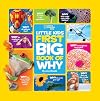
A fun book for several reasons, the First Big Book of Why asks many of the great questions that occur to children, but grownups never ponder. "Why can I see myself in a mirror?" "Why do the stairs seem to disappear on an escalator?" "Why does the moon change shape?"
In addition, it's a great title to booktalk or share on school visits. Just read a few pages and kids will want to know more.
And, it's a great browsing book. Just leave it out and someone will find something interesting show more inside.
The questions are highlighted by large font in colored text boxes and the pages are brightly colored with photos of kids and the things which keep them wondering. The answers are short and sweet with bold font for the most important points,
"Why does Grandma have wrinkles?
Skin grows and stretches as you grow from baby size to adult. When you've been an adult for a while, skin stops growing and stretching. It gets a little tired and a little less elastic.
The lines you make when you smile today are where your wrinkles will be when you are old. A lifetime of laughter helps your skin wrinkle very nicely."
Nicely put!
Although this is a great browsing book, it is divided into four themed chapters, Amazing Me, How Things Work, Animals All Around and Wonders of the World. In addition to the questions and answers, there are scattered text boxes and insets with interesting facts and experiments. Little Kids' First Big Book of Why has a Table of Contents, a Glossary (albeit a very small one), Parent Tips, and Additional Resources.
Want to know why doughnuts have holes and why your toes get wrinkly in the tub? You'll have to read it to find out! Nonfiction fun for lower elementary school grades.
www.shelf-employed.blogspot.com show less
In addition, it's a great title to booktalk or share on school visits. Just read a few pages and kids will want to know more.
And, it's a great browsing book. Just leave it out and someone will find something interesting show more inside.
The questions are highlighted by large font in colored text boxes and the pages are brightly colored with photos of kids and the things which keep them wondering. The answers are short and sweet with bold font for the most important points,
"Why does Grandma have wrinkles?
Skin grows and stretches as you grow from baby size to adult. When you've been an adult for a while, skin stops growing and stretching. It gets a little tired and a little less elastic.
The lines you make when you smile today are where your wrinkles will be when you are old. A lifetime of laughter helps your skin wrinkle very nicely."
Nicely put!
Although this is a great browsing book, it is divided into four themed chapters, Amazing Me, How Things Work, Animals All Around and Wonders of the World. In addition to the questions and answers, there are scattered text boxes and insets with interesting facts and experiments. Little Kids' First Big Book of Why has a Table of Contents, a Glossary (albeit a very small one), Parent Tips, and Additional Resources.
Want to know why doughnuts have holes and why your toes get wrinkly in the tub? You'll have to read it to find out! Nonfiction fun for lower elementary school grades.
www.shelf-employed.blogspot.com show less
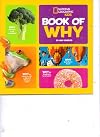
The National Geographic's "Book of Why", written by Amy Shields, focuses on satisfying young children’s curiosity and need to know “why.” The central message of this book is to provide young readers with answers and explanations to a variety of questions many children seem to be interested in. I found this book to be very enjoyable to read and I liked it for a few different reasons.
First, the author uses different literary tools to answer commonly asked questions in a fun and exciting show more way. For example, throughout the text, the author puts certain words and sentences in bold to highlight the key words and important information. Along with this, the author presents the information in a variety of ways that keeps the reader interested and engaged. For example, almost every page that has a new question is written in a different layout and format. Some questions come with “did you know” bubbles, while others provide step-by-step instructions for readers to create their own experiments that go along with certain questions.
Another literary tool that the author used to convey the message was language and word choice. Throughout the book, many questions, such as “Why do seeds grow up?” usually come with in-depth explanations involving complex words that can be difficult to comprehend. The author effectively brings the language down to the level of the readers to ensure they understand the content and information presented and to ensure they stay engaged. Also, the author frequently presents the reader with questions involving the topic of discussion to give readers the opportunity to gauge their understanding and learning.
This easy to read, brightly colored informational text is extremely well written and enjoyable to read. The authors use of pictures, page layout and design, conventions, language and word choice, and opportunities for the reader to self-evaluate their learning provides young readers with an interesting and exciting way to discover answers to a variety of frequently asked questions by children. show less
First, the author uses different literary tools to answer commonly asked questions in a fun and exciting show more way. For example, throughout the text, the author puts certain words and sentences in bold to highlight the key words and important information. Along with this, the author presents the information in a variety of ways that keeps the reader interested and engaged. For example, almost every page that has a new question is written in a different layout and format. Some questions come with “did you know” bubbles, while others provide step-by-step instructions for readers to create their own experiments that go along with certain questions.
Another literary tool that the author used to convey the message was language and word choice. Throughout the book, many questions, such as “Why do seeds grow up?” usually come with in-depth explanations involving complex words that can be difficult to comprehend. The author effectively brings the language down to the level of the readers to ensure they understand the content and information presented and to ensure they stay engaged. Also, the author frequently presents the reader with questions involving the topic of discussion to give readers the opportunity to gauge their understanding and learning.
This easy to read, brightly colored informational text is extremely well written and enjoyable to read. The authors use of pictures, page layout and design, conventions, language and word choice, and opportunities for the reader to self-evaluate their learning provides young readers with an interesting and exciting way to discover answers to a variety of frequently asked questions by children. show less
National Geographic Kids First Big Book of Why (National Geographic Little Kids First Big Books) by Amy Shields

Our copy had a whole section of duplicate pages and missing a section listed on the table of contents.
Other than that, great book with easy experiments for the kids, connection ideas for the parents and even some books to read.
Other than that, great book with easy experiments for the kids, connection ideas for the parents and even some books to read.
Lists
Sonlight Books (1)
You May Also Like


Associated Authors
Statistics
- Works
- 16
- Members
- 3,764
- Popularity
- #6,733
- Rating
- 4.1
- Reviews
- 14
- ISBNs
- 81
- Languages
- 5