
J. B. Lightfoot (1828–1889)
Author of Philippians (The Crossway Classic Commentaries)
About the Author
Image credit: Joseph Barber Lightfoot as portrayed in the anonymous, late nineteenth century biography called Bishop Lightfoot.
Series
Works by J. B. Lightfoot
The Epistle of St. Paul to the Galatians: With Introductions, Notes and Dissertations (Classic Commentary Library) (1957) 504 copies, 2 reviews
The Apostolic Fathers: Revised Greek Texts with Introductions and English Translations (1984) 55 copies
Lightfoot's Apostolic Fathers in English 32 copies
The Apostolic Fathers: A Revised Text With Introductions, Notes, Dissertations, and Translations, Volume 2, part 1 (2009) 27 copies
Lightfoot's Apostolic Fathers in Greek 27 copies
The Epistles of 2 Corinthians and 1 Peter: Newly Discovered Commentaries (The Lightfoot Legacy Set) (2016) 26 copies, 1 review
The Apostolic Fathers, Part II, Vol. II: S. Ignatius, S. Polycarp: Introductions, Notes, Dissertations (2010) 19 copies
The Apostolic Fathers: A Revised Text with Introductions, Notes, Dissertations, and Translations, Volume 1, part 1 (2010) 18 copies
Saint Paul's Epistle to the Galatians. a Revised Text with Introduction, Notes, and Disserations By the Late J. B. Lightfoot (1896) 3 copies
Knowing God 2 copies
The Epistles of St Paul 2 copies
S. Clement of Rome: An Appendix containing the Newly Recovered Portions with introductions, notes, and translations (2009) 2 copies
The Journal of Classical and Sacred Philology (Cambridge Library Collection - Classic Journals) (Volume 4) (2012) 1 copy
The Journal of Classical and Sacred Philology (Cambridge Library Collection - Classic Journals) (Volume 2) (2012) 1 copy
Apostolic Fathers: 003 1 copy
SAINT PAUL'S EPISTLES TO THE COLOSSIANS AND TO PHILEMON. A Revised Text. A Zondervan Commentary. 1 copy
Tagged
Common Knowledge
- Canonical name
- Lightfoot, J. B.
- Legal name
- Lightfoot, Joseph Barber
- Birthdate
- 1828-04-13
- Date of death
- 1889-12-21
- Gender
- male
- Education
- King Edward's School, Birmingham, England, UK
Trinity College, Cambridge (BA|1850) - Occupations
- Anglican priest
bishop (Durham)
President of the Co-operative Congress
theologian - Organizations
- Church of England
Cambridge University - Nationality
- UK
- Birthplace
- Liverpool, Merseyside, England, UK
- Places of residence
- Cambridge, Cambridgeshire, England, UK
Durham, England, UK - Place of death
- Bournemouth, England, UK
- Burial location
- Durham Cathedral, Durham, England, UK
- Associated Place (for map)
- England, UK
Members
Reviews
The Epistles of 2 Corinthians and 1 Peter: Newly Discovered Commentaries (Lightfoot Legacy Set) by J. B. Lightfoot
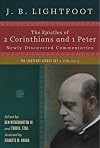
This is quite an eclectic collection of works by J. B. Lightfoot. It includes two (both to some degree incomplete)commentaries , one on 2 Corinthians and the other on 1 Peter, and five lectures/sermons/essays by Lightfoot as appendices. You get quite a bit of content in this volume.
The Commentaries in this book are unfinished/incomplete, but you still get a good deal to work with. There is an editor's introduction at the beginning of the book that presents an interesting look at the show more production of this book and the discovery of the 'lost' writings of Lightfoot, as well as bit of info on Lightfoot's life, scholarship and some of his method of writing commentaries. I particularly liked to see it pointed out that Lightfoot was a stickler for context, James D. G. Dunn is quoted in the book as saying, "time and again Lightfoot 'clearly demonstrates the importance of reading a historical text within its historical context, that the meaning of a text does not arise out of the text alone, but out of the text read in context and that the original context and intention of the author is a determinative and controlling factor in what may be read or heard from a text…'"
Next in the book comes the 2 Corinthians section, starting with a sort of historical look/critique of Paul's life and the dating of his letters. 2 Corinthians is then broken down into sections, mostly as chapters, but at times the chapters are divided. At the beginning of some of the sections is a paraphrase of the texts to be dealt with, (apparently composed by Lightfoot himself), next comes a section dealing with textual issues for various verses in the passage and lastly commentary on the text itself(which also includes some textual criticism). The commentary on 2 Corinthians basically ends at chapter 11 (though even that chapter only has a few notes on some textual issues for that chapter.
Then comes 1 Peter, which, though divided by chapter, it does not have textual critical commentary separate from the regular interpretative commentary, rather it is interspersed throughout the commentary.
There is a good deal of useful commentary on 2 Corinthians and 1 Peter in this book, despite their unfinished form. Some verses have more notes than others, and some verses don't have any commentary at all, but I still think that the many notes that are here would be of use. It is very scholarly, there is much quotation of the Greek and a good deal of analyzing of various texts, and specific words within verses. I find it rather amusing that Lightfoot has no hesitation in pointing out errors in translation in the English version of the Bible (frankly stating "E.V. is wrong…or graciously conceding that, "E.V. not unaccountably wrong") , and he also critiques the views of other commentators on certain passages, again, often with no qualms about stating their wrongness very bluntly.
I've found that he has some very interesting thoughts/insights on some of the passages, for instance part of his comments on 2 Corinthians 3: vs. 18 (Paul speaking of how we Christians contemplate the Lord's glory with unveiled faces and are transformed) read thus, "This transformation is what is called elsewhere ' putting on Christ' (Rom 13:14( what is spoken of in Gal 4:19 as Christ being formed in us (here he quotes the Greek)… But this transformation is not sudden, the change is gradual. We advance from one grade of glory to a higher one. The glory on Moses; face faded away each time as he left the presence of the Lord and had to be renewed again; but with us it is different. We are constantly in His sight, and so instead of the reflected brightness which is coming and going, it is ever becoming more and more bright, i.e. more and more like the image from which it is reflected - Christ himself."
After the 2 Peter section come the Appendixes, Appendix A being, "The Mission of Titus to the Corinthians", Appendix B "St. Paul's Preparation for the Ministry", Appendix C, "The Letter Killeth, But the Spirit Giveth Life", Appendix D, "Lessons From the Cradle of Christianity", Appendix E, "The Christian Ministry" and Appendix F., "J. B. Lightfoot as Biblical Commentator". Many of these essays are very interesting, though I found the section on the Mission of Titus to the Corinthians rather boring, but that's simply because that topic does not interest me at the moment. I especially liked sections of the "lessons of History from the Cradle of Christianity", particularly Lightfoot's Critique of Philo. One flaw in particular that was noted about Philo was his tendency impose allegory upon the Scriptures and even history, "The facts to him were meaningless except so far as he could extract from them a series of allegories, indeed sometimes even denying the facts themselves…" That statement seems to fit well in describing some of today's popular methods of preaching.
Overall, I think that this is a good and useful collection of works to own, the editors did a good job of putting it together.
Many thanks to the folks at Intervarsity Press for sending me a free review copy of this book (my review did not have to be favorable) show less
The Commentaries in this book are unfinished/incomplete, but you still get a good deal to work with. There is an editor's introduction at the beginning of the book that presents an interesting look at the show more production of this book and the discovery of the 'lost' writings of Lightfoot, as well as bit of info on Lightfoot's life, scholarship and some of his method of writing commentaries. I particularly liked to see it pointed out that Lightfoot was a stickler for context, James D. G. Dunn is quoted in the book as saying, "time and again Lightfoot 'clearly demonstrates the importance of reading a historical text within its historical context, that the meaning of a text does not arise out of the text alone, but out of the text read in context and that the original context and intention of the author is a determinative and controlling factor in what may be read or heard from a text…'"
Next in the book comes the 2 Corinthians section, starting with a sort of historical look/critique of Paul's life and the dating of his letters. 2 Corinthians is then broken down into sections, mostly as chapters, but at times the chapters are divided. At the beginning of some of the sections is a paraphrase of the texts to be dealt with, (apparently composed by Lightfoot himself), next comes a section dealing with textual issues for various verses in the passage and lastly commentary on the text itself(which also includes some textual criticism). The commentary on 2 Corinthians basically ends at chapter 11 (though even that chapter only has a few notes on some textual issues for that chapter.
Then comes 1 Peter, which, though divided by chapter, it does not have textual critical commentary separate from the regular interpretative commentary, rather it is interspersed throughout the commentary.
There is a good deal of useful commentary on 2 Corinthians and 1 Peter in this book, despite their unfinished form. Some verses have more notes than others, and some verses don't have any commentary at all, but I still think that the many notes that are here would be of use. It is very scholarly, there is much quotation of the Greek and a good deal of analyzing of various texts, and specific words within verses. I find it rather amusing that Lightfoot has no hesitation in pointing out errors in translation in the English version of the Bible (frankly stating "E.V. is wrong…or graciously conceding that, "E.V. not unaccountably wrong") , and he also critiques the views of other commentators on certain passages, again, often with no qualms about stating their wrongness very bluntly.
I've found that he has some very interesting thoughts/insights on some of the passages, for instance part of his comments on 2 Corinthians 3: vs. 18 (Paul speaking of how we Christians contemplate the Lord's glory with unveiled faces and are transformed) read thus, "This transformation is what is called elsewhere ' putting on Christ' (Rom 13:14( what is spoken of in Gal 4:19 as Christ being formed in us (here he quotes the Greek)… But this transformation is not sudden, the change is gradual. We advance from one grade of glory to a higher one. The glory on Moses; face faded away each time as he left the presence of the Lord and had to be renewed again; but with us it is different. We are constantly in His sight, and so instead of the reflected brightness which is coming and going, it is ever becoming more and more bright, i.e. more and more like the image from which it is reflected - Christ himself."
After the 2 Peter section come the Appendixes, Appendix A being, "The Mission of Titus to the Corinthians", Appendix B "St. Paul's Preparation for the Ministry", Appendix C, "The Letter Killeth, But the Spirit Giveth Life", Appendix D, "Lessons From the Cradle of Christianity", Appendix E, "The Christian Ministry" and Appendix F., "J. B. Lightfoot as Biblical Commentator". Many of these essays are very interesting, though I found the section on the Mission of Titus to the Corinthians rather boring, but that's simply because that topic does not interest me at the moment. I especially liked sections of the "lessons of History from the Cradle of Christianity", particularly Lightfoot's Critique of Philo. One flaw in particular that was noted about Philo was his tendency impose allegory upon the Scriptures and even history, "The facts to him were meaningless except so far as he could extract from them a series of allegories, indeed sometimes even denying the facts themselves…" That statement seems to fit well in describing some of today's popular methods of preaching.
Overall, I think that this is a good and useful collection of works to own, the editors did a good job of putting it together.
Many thanks to the folks at Intervarsity Press for sending me a free review copy of this book (my review did not have to be favorable) show less
For hundreds of years Christendom has been blessed with Bible commentaries written by great men of God highly respected for their godly walk and their insight into spiritual truth. The Crossway Classic Commentaries present the very best work on individual Bible books, carefully adapted for maximum understanding and usefulness for today's believers. Many Christians consider the apostle Paul's letter to the Philippians a special treasure. Its grand themes of spiritual joy and vitality, the show more self-humbling Savior who gave His life for us, the good news of a salvation that is superior to the boastings of the flesh—these and other gems still nurture followers of Jesus Christ today. This classic commentary will deeply encourage all who long to draw closer to God. show less
Dr. Lightfoot's book is first of all scholarly, yet because of the very nature of the author's treatment of it, it is devotional as well, thus making it of interest even to lay readers. His work is set forth in such a way as to make it meaningful and profitable for all readers. To make the volume of even greater use to Bible students, advanced or beginner, the volume is exhaustively indexed and has helpful marginal notes throughout.
Conjunto de relatos escritos a principios del siglo II por Hermas, un escritor cristiano que, según la tradición de la Iglesia Ortodoxa Rusa, formó parte de los 70 discípulos que Jesucristo envió - de dos en dos - a una misión de predicación (Lc 10:1-24) Según esta tradición, el autor habría sido uno de aquellos discípulos o alguno de sus alumnos.
La obra es de carácter alegórico y de ella se desprenden profundas enseñanzas de carácter teológico y moral. Se tratan temas como show more el sufrimiento, la enfermedad, el pecado, la salvación y el arrepentimiento entre otras. Todo ello bajo el contexto de la Iglesia de los primeros cristianos. El lenguaje empleado es antiguo y en ocasiones su lectura puede resultar poco fluida... pero merece la pena.
Más opinión en este artículo de mi blog. show less
La obra es de carácter alegórico y de ella se desprenden profundas enseñanzas de carácter teológico y moral. Se tratan temas como show more el sufrimiento, la enfermedad, el pecado, la salvación y el arrepentimiento entre otras. Todo ello bajo el contexto de la Iglesia de los primeros cristianos. El lenguaje empleado es antiguo y en ocasiones su lectura puede resultar poco fluida... pero merece la pena.
Más opinión en este artículo de mi blog. show less
You May Also Like


Statistics
- Works
- 66
- Members
- 3,564
- Popularity
- #7,115
- Rating
- 3.9
- Reviews
- 16
- ISBNs
- 197
- Languages
- 5
- Favorited
- 1