
Kevin Maguire
Author of Justice League International, Volume One
About the Author
Image credit: Luigi Novi
Series
Works by Kevin Maguire
The Adventures of Captain America: Sentinel of Liberty, Book 1 (1991) — Illustrator — 14 copies, 1 review
The Adventures of Captain America: Sentinel of Liberty, Book 4 (1992) — Illustrator — 10 copies, 1 review
Elektra Assassin 10 copies
The Adventures of Captain America: Sentinel of Liberty, Book 3 (1991) — Illustrator — 10 copies, 1 review
The Adventures of Captain America: Sentinel of Liberty, Book 2 (1991) — Illustrator — 8 copies, 1 review
My Greatest Adventure #5 1 copy
Strikeback! # 1 — Illustrator — 1 copy
Penthouse Max # 1 — Illustrator — 1 copy
Worlds' Finest #1 1 copy
Supergirl (2016) #23 1 copy
Associated Works
The Big Book of Little Criminals: 63 True Tales of the World's Most Incompetent Jailbirds! (1996) — Illustrator — 102 copies
Minor Threats, Vol. 1: A Quick End To A Long Beginning (2023) — Illustrator, some editions — 27 copies, 2 reviews
L.E.G.I.O.N. (1989) #01 — Cover, some editions — 2 copies
L.E.G.I.O.N. (1989) #10 — Penciler, Cover, some editions — 2 copies
L.E.G.I.O.N. (1989) #13 — Penciler, Cover, some editions — 1 copy
L.E.G.I.O.N. (1989) #34 — Penciler, Cover, some editions — 1 copy
L.E.G.I.O.N. (1989) #38 — Penciler, Cover, some editions — 1 copy
L.E.G.I.O.N. (1989) #04 — Penciler, Cover, some editions — 1 copy
Tagged
Common Knowledge
There is no Common Knowledge data for this author yet. You can help.
Members
Reviews

Access a version of the below that includes illustrations on my blog in three parts here, here, and here.
I wouldn't have gotten into Justice League Europe if Bob Greenberger hadn't lost his job.
Back in the mid-2000s, I was in college and just getting into comic books; my main entry point was Star Trek and Star Wars, seeking stories I'd read about, but were not contained in the novels I'd been reading since childhood. At that time, Bob got fired from DC Comics and needed to raise money, fast, show more so he auctioned off his comics collection. I bid on a lot of stuff, mostly Star Trek (this is where my runs on Starfleet Academy and Early Voyages come from), but other stuff I'd heard of, too, like Green Lantern/Green Arrow (the 1980s prestige format reprints). In particular, there were two series I picked up just because the basic premises tickled my fancy: Alpha Flight and Justice League Europe. Canada's premiere superhero team! The Justice League... but in Europe! Something about the very American concept of superheroes being transposed into other countries very much amused and intrigued me.
I can't claim to be a big Alpha Flight fan, but I fell in love with Justice League Europe. Character-driven and funny, it's everything I want from an ongoing narrative, and it's thanks to JLE that Elongated Man is my favorite DC superhero.
I hadn't known when buying it that JLE was a spin-off of Justice League International, or that it was intertwined with Justice League America, but I soon figured that out when I got to crossover events like The Teasdale Imperative and Breakdowns, which were largely incomprehensible because I was only getting half the story; even outside of that, this series clearly continued character threads begun in the earlier series. Additionally, JLE continued beyond what I had, just under another title: issues #51-68 were retitled Justice League International.
So I've long intended to read the whole of the JLI era, with both series intertwined and all the various side stories and spin-offs. Well, it finally made it to the top of my reading list, so it's time to dive in.
Justice League vol. 1 #1-4, Justice League Annual vol. 1 #1, Justice League vol. 1 #5-6, and Justice League International vol. 1 #7
Like many ongoing titles, Justice League takes a bit to find its footing. I'm not saying it's bad—I'm just saying it's not what it would later become. The first four issues especially are pretty serious in terms of plot, with terrorists attacking the UN, looming nuclear meltdowns in Soviet Russia, people escaping dead worlds, and a fairly desperate fight between Booster Gold and the Royal Flush Gang. The comedy, such as it is, mostly comes from two things.
First, Keith Giffen's breakdowns, J. M. DeMatteis's scripts, and Kevin Maguire's pencils lean into the character interplay and highlight the differences between these various characters. To me, this is always the pleasure of a team book: the premises of, say, Batman and Booster Gold, make for fairly different approaches to superheroics, and it's just fun to have them butt up against each other here. In particular, Batman kind of becomes the cranky straight man to the other characters, as one of the only experienced JL members, and certainly the most serious... though not averse to cracking a joke on occasion. The other character who really stands out here is Guy Gardner, who's full-on in his boorish asshole characterization here. Captain Marvel is in his "holey moley" mode, which is fun too.
Second, as much as they put people in danger, there is a slight hint of comedy to the machinations of the League's mysterious benefactor, Maxwell Lord. Obviously being toyed with by forces beyond your comprehension can be frightening, but it can also be the set-up for some good jokes. So, the the first four issues are decent enough. The visual storytelling is top-notch, as it always is when Giffen is doing breakdowns or layouts.
These are followed by Justice League Annual #1, which I thought was okay but a bit long-winded. Some of Ted "Blue Beetle" Kord's employees are infected by a mind-controlling virus, which spreads around the world; it's not really interesting enough to see a bunch of mind-controlled superheroes to justify the double-length story. And, unfortunately, the next story (the "Gray Man" one from JL #5-6) is also about mind-controlled superheroes. This is probably the weakest story in the whole book; I found the conflict about an ancient servant of the Lords of Order who rises up to bedevil Doctor Fate kind of long-winded and hard to care about. That said, JL #5 is the issue with the infamous "one punch" moment where Batman lays out Guy once and for all.
After this, the book was retitled from Justice League to Justice League International with issue #7; as you might imagine from the new title, this is also the story where the JL officially gets UN sanction. The Gray Man plot is wrapped up quickly, and the issue focuses on Lord manipulating the League and the press... but we also get some of the series's initial forays into more overt comedy, with Guy getting the bump on the head that turns him into an obnoxiously pleasant sap. On the other hand, there are nice moments of characterization, too, such as when J'onn "Martian Manhunter" J'onnz reflects on how the League itself is his home on Earth, the one place where he can be himself.
Justice League International vol. 1 #8-12
The rest of the first year of JLI sets up the series's new status quo, involves the characters in the Millennium crossover, and wraps up the subplot about Maxwell Lord manipulating the League while something else manipulates Maxwell Lord. Issue #8, "Moving Day," is comics perfection as far as I'm concerned. No superheroics, just character interplay as the JLI moves into their new UN-provided "embassies" around the world. Lots of great jokes, like Booster trying to hit on women and Mister Miracle not realizing that every superhero headquarters has a roof up to landing a shuttle on it.
"Seeing Red" and "Soul of the Machine" focus on battling the Manhunters; part of the premise of Millennium is that characters from every book would be revealed as evil alien Manhunters, but unfortunately the character picked here is Rocket Red, who literally joined the team one issue earlier, so it's not much of a shock reveal! In "Soul of the Machine," the League is suddenly in space (I did read Millennium, but over a decade ago, so my memory is foggy); I was surprised to actually enjoy the appearance of Gnort, the nepo baby Green Lantern. In the past, I have found the a little bit of the character to be far too much, but I guess it shouldn't be much of a surprise that Giffen, DeMatteis, and Maguire would handle him better than their many imitators.
To be honest, I found a lot of the reveals about Maxwell Lord pretty confusing, but I did kind of feel like the creative team was trying to wrap up this plot sooner rather than later so it wouldn't drag on too long.
There are also some backup stories here; in particular, we see the UN shutting down the Global Guardians, which had been their sanctioned superhero team before the JLI (as established in Infinity, Inc.)... but which never had America or Russia as participants. These stories are okay on their own but will end up having several different ramifications for the main series.
Justice League International vol. 1 #13, Suicide Squad vol. 1 #13, and Justice League International vol. 1 #14-15
The first story of JLI's second year is a crossover with Suicide Squad: the Suicide Squad decides to free one of their members from a Russian prison; in order to prevent an international incident, the JLI is sent in to stop them. I enjoyed it even if I am very unfamiliar with Suicide Squad. Apparently Captain Atom is dating one of its members; the gag about how they pretended to fight but were actually tickling each other was a good one. The best part, though, was when J'onn J'onzz runs into one of his old Justice League Detroit teammates, Vixen, now a Suicide Squad member. Vixen says he must have seen her and her version of the league as a joke, but he confesses how important they were to him. It's a great moment.
Weirdly, the story ends with Batman declaring his frustrations with the JLI, calling everyone a moron, and quitting. It doesn't feel quite in character... but also in later stories, he's still a member!
After this, we have the first two parts of an eight-part story about the alien Cluster coming to Earth to trade... or compel it to trade by blowing it up. While there has been lots of character-interaction comedy so far, Lord Manga Khan and his sidekick robot, L-RON, are the first overtly comic villain characters we've seen, with lots of goofy back-and-forth and even some metatextual jokes. ("Please, L-RON--you sound like a contrived plot summary." "Sorry, m'lord.") I enjoy their interplay a lot.
In addition, Gnort returns (so far so good but I'm worried there will be a point I max out on Gnort comedy), and the Green Flame and Icemaiden, formerly of the Global Guardians (who appeared in some backups earlier in the series), finagle their way into joining the shorthanded JLI.
Justice League International Annual vol. 1 #2 and Justice League International vol. 1 #16-18
Justice League Annual #2 takes place in a nonexistent gap because Fire and Ice are on the team and Colonel Harjavti still rules Bialya, but Mister Miracle, Martian Manhunter, and Big Barda are not in space. The omnibus places it before issue #14, but I think it reads better after #15 since otherwise the presence of the Green Flame and Icemaiden is completely random even if there's not an actual gap for it to fit in.
Anyway, this is a goofy story about the Joker teaming up with Colonel Harjavti while Booster and Beetle try to make extra money by doing repossessions, which leads to them running afoul of the criminal gang the Thousand; meanwhile, Big Barda and Mister Miracle are preparing to host a barbecue... and while Scott Free can rewire a mother box, a gas grill may prove beyond his ken. I enjoyed this a lot, particularly all the Booster/Beetle stuff and the Scott/Barda stuff. Mister Miracle has been part of JLI from the beginning, but I'm happy to see the increased inclusion of Big Barda, who is also a great character.
After this, we get the next three parts of the Cluster storyline, though it also incorporates a story about Colonel Harjavti and Bialya. It reads a little weirdly to have the JLI infiltrating Bialya again if you've read JLA: Incarnations, but there's nothing that says they haven't done this before. This one, again, has some fun stuff, with Batman pretending to be Bruce Wayne (!), Booster and Beetle being Wayne's hired help, and the Green Flame getting into a number of improbable escapades. It all ends, though, in the death of Colonel Harjavti, replaced by his consort "Queen Bee" as ruler of Bialya... as well as the reveal of Bialya's own super team, made up of the alien superheroes from JL #2-3 and rejects from the Global Guardians.
Meanwhile in space, Martian Manhunter and Big Barda do their best to liberate Scott; Lord Manga Khan hires Lobo to take them down. Lobo is a character who is often misused... but here he's in the hands of cocreator Keith Giffen and thus on great form, particularly in the sequence where he's accidentally sent to JLI embassy on Earth.
There's also a backup story here called "Raising the Roof"; Scott and Barda's home is accidentally blown up, so they move into the JLI embassy. Barda does housework to earn her keep but is terrible at it, so the other JLI members decide to rebuild their home to get her out... only they do a bad job of it. I have no idea where this story might fit chronologically, if at all, but I enjoyed it. Will Scott and Barda still live in the embassy in future stories? I guess I will see when we finally get there.
Justice League International vol. 1 #19-21
These finally bring an end to the ongoing Cluster storyline, with Manga Khan trying to sell Scott Free to Darkseid on Apokolips, while Barda summons the whole JLI to help her battle. Lots of great stuff in this one... particularly Darkseid being above it all! Barda is awesome. Also, Guy Gardner turns into an asshole again and throws down with Lobo.
Also during this stretch of issues, the original Hawkman and Hawkgirl briefly (re)join the League. Hawkman is depicted as an obnoxious old fogey who doesn't like how thew League has become more irreverent. At one point, he complains about how their cursing shows a lack of decorum, which causes Beetle to tease him by calling him a Republican. Funny to think that thirty-five years ago it was the Republicans who were the party of public decorum!
Justice League International vol. 1 #22-25, Justice League Europe #1-3, Justice League America #26-30, Justice League Europe #4-6, and Justice League International Annual vol. 1 #3
Here, we hit the era where Justice League International was doing so well that it was split into two titles. In JLI #24, Max and Oberon decide to add more members to the group, but also to move half of them to the JLI's Paris embassy. Existing JLI members Captain Atom and Rocket Red are put on the new Paris team, joined by new members such as Metamorpho the Element Man, the Elongated Man, Animal Man, Power Girl, and the Flash. Thus, with issue #26, Justice League International is retitled Justice League America, in time for the debut of Justice League Europe. Like JLA, JLE has plot and breakdown by Keith Giffen with scripts by J. M. DeMatteis; Bart Sears pencils with Pablo Marcos on inks.
As I said above, I read JLE back when I was in college, but at the time I had not read any other JLI titles. So I got a big glow of nostalgia returning to these characters after twenty years... but also now bits of it make a lot more sense to me, like who "Queen Bee" is and why Jack O'Lantern is so mad at the JLE!
I did tweak the reading order in this part; the omnibus places JLE #1-6 almost at the very end, after JLA #30, but I recommend reading JLE #1-3 after JLI #25, since JLE #1-3 and JLA #26-29 occur simultaneously.
The first two issues are are tie-ins to Invasion!, where an alliance of aliens invades the Earth. Most of the JLI is summoned to help Wonder Woman on an island in the South Pacific, while Booster Gold and Oberon mind the shop back at the New York embassy. The highlight of the first issue is definitely its opening pages, where the aliens send in an miniaturized strike force that immediately knocks out Booster, meaning Oberon must save the day. The second issue is set after the invasion, when the JLI comes up against the group of largely incompetent criminals who have branded themselves the Injustice League. My favorite is their leader, Major Disaster, who goes on about how failing political science caused him to miss his destiny... becoming a borough president in New York!
After this, we get issue #24, which is an oversized issue that contains three stories, and the key one that splits the team into three groups. The first two stories are fun, particularly the second, a Maxwell Lord one where he gets taken hostage, but by the end, the hostage-takers are working for him, and they've paid Booster and Beetle enough to install a nice big tv in the JLI headquarters, but the third is a hoot. In this one, a bunch of prospective heroes are invited to a soiree at the JLI embassy... at the exact same time the miniaturized strike force Oberon imprisoned in some roach motels returns to normal size. Too many heroes all in a big group try to take them down, just getting in each others' ways.
Last in this sequence is a Beetle and Booster–focused issue, where they once again undertake their repossession business (see Justice League International Annual #2). It has lots of good jokes... and then gets surprisingly serious. Well done stuff.
As alluded to above, I had a warm glow of nostalgia reading the JLE issues, especially #1, which mostly focuses on the character interactions on moving day. I love these characters, and I love the way they play off each other; obviously Kevin Maguire is a great artist, but Bart Sears and Pablo Marcos are also great in their own way, a bit cartoonier, but strongly expressive. The actual story here is fine, but what makes it all work are the character moments, particularly those revolving around Ralph and Sue Dibny. So many good jokes! You can feel the writers finding their way into what works for some of these characters (e.g., Metamorpho, Power Girl), but the Elongated Man and his wife click right from the off, and Rocket Red is starting to come into his own.
The work of genius here, though, is of course the issue where both the JLE and the Injustice League end up enrolled in the night school French class and cause a diplomatic incident.
In the stretch of JLA issues collected here, the Blue-Beetle-attacks-Max-Lord subplot is surprisingly dark for this series often painted as a "sitcom," but I particularly enjoyed the story about a teenage street punk getting hold of Big Barda's mega rod... and being seduced by the call of Apokolips. Again, it's pretty dark, showing a side of Barda that's easy to miss—every time she goes into battle, she's resisting the power of this horrific weapon. Also we get a couple appearances of the Helen Bertinelli Huntress, before her retooling as a Gotham scion, when she battled gangsters on the streets of New York. I liked that series, and so was glad to see her here. We also get Ice's attempt to find the nice side of Guy by going on a date with him... which ends in dismal failure. (My favorite part of this was the crook who got out of the supervillain game, but then thinks Guy is after him when it's actually a total coincidence.)
Lastly, we get JLI Annual #3, which has two stories. One is focused on the Martian Manhunter and his trauma, but I felt like this didn't quite come off even if I liked the idea. The other is good fun, though; the JLI tours their embassies around the world, while Martian Manhunter tries to catch up to them with a delegation from a tropical island. Hilarity ensues, of course, but I particularly enjoyed the jokes about how all the tropical islanders had gone to the U.S. for college. show less
I wouldn't have gotten into Justice League Europe if Bob Greenberger hadn't lost his job.
Back in the mid-2000s, I was in college and just getting into comic books; my main entry point was Star Trek and Star Wars, seeking stories I'd read about, but were not contained in the novels I'd been reading since childhood. At that time, Bob got fired from DC Comics and needed to raise money, fast, show more so he auctioned off his comics collection. I bid on a lot of stuff, mostly Star Trek (this is where my runs on Starfleet Academy and Early Voyages come from), but other stuff I'd heard of, too, like Green Lantern/Green Arrow (the 1980s prestige format reprints). In particular, there were two series I picked up just because the basic premises tickled my fancy: Alpha Flight and Justice League Europe. Canada's premiere superhero team! The Justice League... but in Europe! Something about the very American concept of superheroes being transposed into other countries very much amused and intrigued me.
I can't claim to be a big Alpha Flight fan, but I fell in love with Justice League Europe. Character-driven and funny, it's everything I want from an ongoing narrative, and it's thanks to JLE that Elongated Man is my favorite DC superhero.
I hadn't known when buying it that JLE was a spin-off of Justice League International, or that it was intertwined with Justice League America, but I soon figured that out when I got to crossover events like The Teasdale Imperative and Breakdowns, which were largely incomprehensible because I was only getting half the story; even outside of that, this series clearly continued character threads begun in the earlier series. Additionally, JLE continued beyond what I had, just under another title: issues #51-68 were retitled Justice League International.
So I've long intended to read the whole of the JLI era, with both series intertwined and all the various side stories and spin-offs. Well, it finally made it to the top of my reading list, so it's time to dive in.
Justice League vol. 1 #1-4, Justice League Annual vol. 1 #1, Justice League vol. 1 #5-6, and Justice League International vol. 1 #7
Like many ongoing titles, Justice League takes a bit to find its footing. I'm not saying it's bad—I'm just saying it's not what it would later become. The first four issues especially are pretty serious in terms of plot, with terrorists attacking the UN, looming nuclear meltdowns in Soviet Russia, people escaping dead worlds, and a fairly desperate fight between Booster Gold and the Royal Flush Gang. The comedy, such as it is, mostly comes from two things.
First, Keith Giffen's breakdowns, J. M. DeMatteis's scripts, and Kevin Maguire's pencils lean into the character interplay and highlight the differences between these various characters. To me, this is always the pleasure of a team book: the premises of, say, Batman and Booster Gold, make for fairly different approaches to superheroics, and it's just fun to have them butt up against each other here. In particular, Batman kind of becomes the cranky straight man to the other characters, as one of the only experienced JL members, and certainly the most serious... though not averse to cracking a joke on occasion. The other character who really stands out here is Guy Gardner, who's full-on in his boorish asshole characterization here. Captain Marvel is in his "holey moley" mode, which is fun too.
Second, as much as they put people in danger, there is a slight hint of comedy to the machinations of the League's mysterious benefactor, Maxwell Lord. Obviously being toyed with by forces beyond your comprehension can be frightening, but it can also be the set-up for some good jokes. So, the the first four issues are decent enough. The visual storytelling is top-notch, as it always is when Giffen is doing breakdowns or layouts.
These are followed by Justice League Annual #1, which I thought was okay but a bit long-winded. Some of Ted "Blue Beetle" Kord's employees are infected by a mind-controlling virus, which spreads around the world; it's not really interesting enough to see a bunch of mind-controlled superheroes to justify the double-length story. And, unfortunately, the next story (the "Gray Man" one from JL #5-6) is also about mind-controlled superheroes. This is probably the weakest story in the whole book; I found the conflict about an ancient servant of the Lords of Order who rises up to bedevil Doctor Fate kind of long-winded and hard to care about. That said, JL #5 is the issue with the infamous "one punch" moment where Batman lays out Guy once and for all.
After this, the book was retitled from Justice League to Justice League International with issue #7; as you might imagine from the new title, this is also the story where the JL officially gets UN sanction. The Gray Man plot is wrapped up quickly, and the issue focuses on Lord manipulating the League and the press... but we also get some of the series's initial forays into more overt comedy, with Guy getting the bump on the head that turns him into an obnoxiously pleasant sap. On the other hand, there are nice moments of characterization, too, such as when J'onn "Martian Manhunter" J'onnz reflects on how the League itself is his home on Earth, the one place where he can be himself.
Justice League International vol. 1 #8-12
The rest of the first year of JLI sets up the series's new status quo, involves the characters in the Millennium crossover, and wraps up the subplot about Maxwell Lord manipulating the League while something else manipulates Maxwell Lord. Issue #8, "Moving Day," is comics perfection as far as I'm concerned. No superheroics, just character interplay as the JLI moves into their new UN-provided "embassies" around the world. Lots of great jokes, like Booster trying to hit on women and Mister Miracle not realizing that every superhero headquarters has a roof up to landing a shuttle on it.
"Seeing Red" and "Soul of the Machine" focus on battling the Manhunters; part of the premise of Millennium is that characters from every book would be revealed as evil alien Manhunters, but unfortunately the character picked here is Rocket Red, who literally joined the team one issue earlier, so it's not much of a shock reveal! In "Soul of the Machine," the League is suddenly in space (I did read Millennium, but over a decade ago, so my memory is foggy); I was surprised to actually enjoy the appearance of Gnort, the nepo baby Green Lantern. In the past, I have found the a little bit of the character to be far too much, but I guess it shouldn't be much of a surprise that Giffen, DeMatteis, and Maguire would handle him better than their many imitators.
To be honest, I found a lot of the reveals about Maxwell Lord pretty confusing, but I did kind of feel like the creative team was trying to wrap up this plot sooner rather than later so it wouldn't drag on too long.
There are also some backup stories here; in particular, we see the UN shutting down the Global Guardians, which had been their sanctioned superhero team before the JLI (as established in Infinity, Inc.)... but which never had America or Russia as participants. These stories are okay on their own but will end up having several different ramifications for the main series.
Justice League International vol. 1 #13, Suicide Squad vol. 1 #13, and Justice League International vol. 1 #14-15
The first story of JLI's second year is a crossover with Suicide Squad: the Suicide Squad decides to free one of their members from a Russian prison; in order to prevent an international incident, the JLI is sent in to stop them. I enjoyed it even if I am very unfamiliar with Suicide Squad. Apparently Captain Atom is dating one of its members; the gag about how they pretended to fight but were actually tickling each other was a good one. The best part, though, was when J'onn J'onzz runs into one of his old Justice League Detroit teammates, Vixen, now a Suicide Squad member. Vixen says he must have seen her and her version of the league as a joke, but he confesses how important they were to him. It's a great moment.
Weirdly, the story ends with Batman declaring his frustrations with the JLI, calling everyone a moron, and quitting. It doesn't feel quite in character... but also in later stories, he's still a member!
After this, we have the first two parts of an eight-part story about the alien Cluster coming to Earth to trade... or compel it to trade by blowing it up. While there has been lots of character-interaction comedy so far, Lord Manga Khan and his sidekick robot, L-RON, are the first overtly comic villain characters we've seen, with lots of goofy back-and-forth and even some metatextual jokes. ("Please, L-RON--you sound like a contrived plot summary." "Sorry, m'lord.") I enjoy their interplay a lot.
In addition, Gnort returns (so far so good but I'm worried there will be a point I max out on Gnort comedy), and the Green Flame and Icemaiden, formerly of the Global Guardians (who appeared in some backups earlier in the series), finagle their way into joining the shorthanded JLI.
Justice League International Annual vol. 1 #2 and Justice League International vol. 1 #16-18
Justice League Annual #2 takes place in a nonexistent gap because Fire and Ice are on the team and Colonel Harjavti still rules Bialya, but Mister Miracle, Martian Manhunter, and Big Barda are not in space. The omnibus places it before issue #14, but I think it reads better after #15 since otherwise the presence of the Green Flame and Icemaiden is completely random even if there's not an actual gap for it to fit in.
Anyway, this is a goofy story about the Joker teaming up with Colonel Harjavti while Booster and Beetle try to make extra money by doing repossessions, which leads to them running afoul of the criminal gang the Thousand; meanwhile, Big Barda and Mister Miracle are preparing to host a barbecue... and while Scott Free can rewire a mother box, a gas grill may prove beyond his ken. I enjoyed this a lot, particularly all the Booster/Beetle stuff and the Scott/Barda stuff. Mister Miracle has been part of JLI from the beginning, but I'm happy to see the increased inclusion of Big Barda, who is also a great character.
After this, we get the next three parts of the Cluster storyline, though it also incorporates a story about Colonel Harjavti and Bialya. It reads a little weirdly to have the JLI infiltrating Bialya again if you've read JLA: Incarnations, but there's nothing that says they haven't done this before. This one, again, has some fun stuff, with Batman pretending to be Bruce Wayne (!), Booster and Beetle being Wayne's hired help, and the Green Flame getting into a number of improbable escapades. It all ends, though, in the death of Colonel Harjavti, replaced by his consort "Queen Bee" as ruler of Bialya... as well as the reveal of Bialya's own super team, made up of the alien superheroes from JL #2-3 and rejects from the Global Guardians.
Meanwhile in space, Martian Manhunter and Big Barda do their best to liberate Scott; Lord Manga Khan hires Lobo to take them down. Lobo is a character who is often misused... but here he's in the hands of cocreator Keith Giffen and thus on great form, particularly in the sequence where he's accidentally sent to JLI embassy on Earth.
There's also a backup story here called "Raising the Roof"; Scott and Barda's home is accidentally blown up, so they move into the JLI embassy. Barda does housework to earn her keep but is terrible at it, so the other JLI members decide to rebuild their home to get her out... only they do a bad job of it. I have no idea where this story might fit chronologically, if at all, but I enjoyed it. Will Scott and Barda still live in the embassy in future stories? I guess I will see when we finally get there.
Justice League International vol. 1 #19-21
These finally bring an end to the ongoing Cluster storyline, with Manga Khan trying to sell Scott Free to Darkseid on Apokolips, while Barda summons the whole JLI to help her battle. Lots of great stuff in this one... particularly Darkseid being above it all! Barda is awesome. Also, Guy Gardner turns into an asshole again and throws down with Lobo.
Also during this stretch of issues, the original Hawkman and Hawkgirl briefly (re)join the League. Hawkman is depicted as an obnoxious old fogey who doesn't like how thew League has become more irreverent. At one point, he complains about how their cursing shows a lack of decorum, which causes Beetle to tease him by calling him a Republican. Funny to think that thirty-five years ago it was the Republicans who were the party of public decorum!
Justice League International vol. 1 #22-25, Justice League Europe #1-3, Justice League America #26-30, Justice League Europe #4-6, and Justice League International Annual vol. 1 #3
Here, we hit the era where Justice League International was doing so well that it was split into two titles. In JLI #24, Max and Oberon decide to add more members to the group, but also to move half of them to the JLI's Paris embassy. Existing JLI members Captain Atom and Rocket Red are put on the new Paris team, joined by new members such as Metamorpho the Element Man, the Elongated Man, Animal Man, Power Girl, and the Flash. Thus, with issue #26, Justice League International is retitled Justice League America, in time for the debut of Justice League Europe. Like JLA, JLE has plot and breakdown by Keith Giffen with scripts by J. M. DeMatteis; Bart Sears pencils with Pablo Marcos on inks.
As I said above, I read JLE back when I was in college, but at the time I had not read any other JLI titles. So I got a big glow of nostalgia returning to these characters after twenty years... but also now bits of it make a lot more sense to me, like who "Queen Bee" is and why Jack O'Lantern is so mad at the JLE!
I did tweak the reading order in this part; the omnibus places JLE #1-6 almost at the very end, after JLA #30, but I recommend reading JLE #1-3 after JLI #25, since JLE #1-3 and JLA #26-29 occur simultaneously.
The first two issues are are tie-ins to Invasion!, where an alliance of aliens invades the Earth. Most of the JLI is summoned to help Wonder Woman on an island in the South Pacific, while Booster Gold and Oberon mind the shop back at the New York embassy. The highlight of the first issue is definitely its opening pages, where the aliens send in an miniaturized strike force that immediately knocks out Booster, meaning Oberon must save the day. The second issue is set after the invasion, when the JLI comes up against the group of largely incompetent criminals who have branded themselves the Injustice League. My favorite is their leader, Major Disaster, who goes on about how failing political science caused him to miss his destiny... becoming a borough president in New York!
After this, we get issue #24, which is an oversized issue that contains three stories, and the key one that splits the team into three groups. The first two stories are fun, particularly the second, a Maxwell Lord one where he gets taken hostage, but by the end, the hostage-takers are working for him, and they've paid Booster and Beetle enough to install a nice big tv in the JLI headquarters, but the third is a hoot. In this one, a bunch of prospective heroes are invited to a soiree at the JLI embassy... at the exact same time the miniaturized strike force Oberon imprisoned in some roach motels returns to normal size. Too many heroes all in a big group try to take them down, just getting in each others' ways.
Last in this sequence is a Beetle and Booster–focused issue, where they once again undertake their repossession business (see Justice League International Annual #2). It has lots of good jokes... and then gets surprisingly serious. Well done stuff.
As alluded to above, I had a warm glow of nostalgia reading the JLE issues, especially #1, which mostly focuses on the character interactions on moving day. I love these characters, and I love the way they play off each other; obviously Kevin Maguire is a great artist, but Bart Sears and Pablo Marcos are also great in their own way, a bit cartoonier, but strongly expressive. The actual story here is fine, but what makes it all work are the character moments, particularly those revolving around Ralph and Sue Dibny. So many good jokes! You can feel the writers finding their way into what works for some of these characters (e.g., Metamorpho, Power Girl), but the Elongated Man and his wife click right from the off, and Rocket Red is starting to come into his own.
The work of genius here, though, is of course the issue where both the JLE and the Injustice League end up enrolled in the night school French class and cause a diplomatic incident.
In the stretch of JLA issues collected here, the Blue-Beetle-attacks-Max-Lord subplot is surprisingly dark for this series often painted as a "sitcom," but I particularly enjoyed the story about a teenage street punk getting hold of Big Barda's mega rod... and being seduced by the call of Apokolips. Again, it's pretty dark, showing a side of Barda that's easy to miss—every time she goes into battle, she's resisting the power of this horrific weapon. Also we get a couple appearances of the Helen Bertinelli Huntress, before her retooling as a Gotham scion, when she battled gangsters on the streets of New York. I liked that series, and so was glad to see her here. We also get Ice's attempt to find the nice side of Guy by going on a date with him... which ends in dismal failure. (My favorite part of this was the crook who got out of the supervillain game, but then thinks Guy is after him when it's actually a total coincidence.)
Lastly, we get JLI Annual #3, which has two stories. One is focused on the Martian Manhunter and his trauma, but I felt like this didn't quite come off even if I liked the idea. The other is good fun, though; the JLI tours their embassies around the world, while Martian Manhunter tries to catch up to them with a delegation from a tropical island. Hilarity ensues, of course, but I particularly enjoyed the jokes about how all the tropical islanders had gone to the U.S. for college. show less

Access a version of the below that includes illustrations on my blog.
Well, this was a delight. While Batman's away on Justice League business and her father's out of town, Barbara Gordon decides to nick her father's case notebook to see if he has any secret identity suspicions she should be worried about-- only for Catwoman to steal it from her. Despite getting his name in the title, Batman is a minor presence here, as this is a tussle between Batgirl and Catwoman for possession of the show more notebook.
My only previous familiarity with Fabian Nicieza is from his terrible run on Alpha Flight (though "terrible run" is redundant when it comes to Alpha Flight), so I was surprised how much I liked this. He does a good job with the sometime-overused "dueling narrations" device, as both Batgirl and Catwoman give their perspectives on the unfolding events. This is definitely one of those stories with the structure of a well-told joke, as things just keep escalating and escalating, a structure at once both humorous and suspenseful, as Batgirl makes a series of incremental small choices that soon land her in the situation of battling the Riddler in Arkham Asylum! (As is obligatory for these early Batgirl tales, there's a nod to her future confrontation with the Joker. There's also some nice nods to earlier stories from this readthrough, including Batgirl: Year One and even Catwoman: When in Rome.)
Kevin Maguire is an obvious pairing for Nicieza on this story: no one does facial expressions, comedy, and (tasteful) cheesecake quite as well as he does, except for maybe Amanda Conner. Barbara and Selina's chase through the Gotham nudist club is a hilarious, and Barbara's building frustration through the whole thing is palpable-- but Maguire demonstrates his dramatic chops, too, with the Batgirl-in-Arkham sequence.
Like I said, Batman isn't in this very much... but his appearance is perfectly timed and made me laugh out loud. Like the rest of the book, it is a delight.
Batman "Year One" Stories: « Previous in sequence | Next in sequence » show less
Well, this was a delight. While Batman's away on Justice League business and her father's out of town, Barbara Gordon decides to nick her father's case notebook to see if he has any secret identity suspicions she should be worried about-- only for Catwoman to steal it from her. Despite getting his name in the title, Batman is a minor presence here, as this is a tussle between Batgirl and Catwoman for possession of the show more notebook.
My only previous familiarity with Fabian Nicieza is from his terrible run on Alpha Flight (though "terrible run" is redundant when it comes to Alpha Flight), so I was surprised how much I liked this. He does a good job with the sometime-overused "dueling narrations" device, as both Batgirl and Catwoman give their perspectives on the unfolding events. This is definitely one of those stories with the structure of a well-told joke, as things just keep escalating and escalating, a structure at once both humorous and suspenseful, as Batgirl makes a series of incremental small choices that soon land her in the situation of battling the Riddler in Arkham Asylum! (As is obligatory for these early Batgirl tales, there's a nod to her future confrontation with the Joker. There's also some nice nods to earlier stories from this readthrough, including Batgirl: Year One and even Catwoman: When in Rome.)
Kevin Maguire is an obvious pairing for Nicieza on this story: no one does facial expressions, comedy, and (tasteful) cheesecake quite as well as he does, except for maybe Amanda Conner. Barbara and Selina's chase through the Gotham nudist club is a hilarious, and Barbara's building frustration through the whole thing is palpable-- but Maguire demonstrates his dramatic chops, too, with the Batgirl-in-Arkham sequence.
Like I said, Batman isn't in this very much... but his appearance is perfectly timed and made me laugh out loud. Like the rest of the book, it is a delight.
Batman "Year One" Stories: « Previous in sequence | Next in sequence » show less
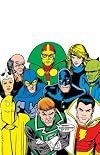
There's a lot to like in these early issues. Despite how many people think of the book and what it would eventually become, this is not a comedy book at this point. It's played with a light touch, but it's a straight forward superhero book at this point. It's got two strong things going for it: Kevin Maguire's amazing art and one of the most interesting groups of costumed heroes ever assembled. I love this roster, and one of the book's biggest weaknesses is that it spends way too much time show more on Guy Gardner and Batman and ignores really interesting characters (particularly Black Canary). Still, it's a strong start to a very good time for the Justice League. show less

Access a version of the below that includes illustrations on my blog.
This books reunites Blue Beetle and Booster Gold... in the hands of Booster Gold's original creator, Dan Jurgens! I was a bit trepidatious about this going in because it seemed to me that Jurgens treated Booster more seriously during his JLA run than Giffen and DeMatteis did in their run that created the duo. Could he recreate their dynamic when he hadn't been particularly interested in the original version of it to begin show more with?
Well, I need not have worried. He very much leans into the goofier version of the characters—but in a good way. Here, they have decided to form a superhero team accessible to "regular" people, unlike the Justice League up in space (very much like in a previous JLI reunion book). But with Ted no longer in command of the Kord Industries money (he loses it here; I didn't know he had ever got it back, though, because last time I heard he had lost them... though admittedly that was the late 1980s!), they need to find crowdfunding!
It's a fun way to reinvent the fame- and money-obsessed Booster Gold for the twenty-first century. The book is peppered with comments from people watching the livestream of the duo, and I enjoyed this a lot; there's a lot of good interaction and cute hijinks. Some hope they do well, some think it's all faked, some are women stanning for one character or the other, some hope they die... and one is Guy Gardner just there to say mean things about them! But the book is not as cynical as some takes on Booster and Beetle have been, even ones penned by Giffen and DeMatteis. The two bicker, but they fundamentally get along; they seek fame, but it doesn't make them craven or obsessed with money. At their root, they're people trying to do good, and the book leans into that.
Maybe a little too much; I didn't want the book to put them through the wringer per se but it seemed to me it didn't quite challenge them to the extent it might have. But that's clearly not what Jurgens is up to here. The book is obviously meant to just be a light and charming return of some classic characters, and it succeeds perfectly at that.
Overall, I enjoyed the art by Ryan Sook and various others. Sook has a light, expressive style that communicates character very well, which is perfectly suited to Jurgens's writing. But why did Ted suddenly acquire black hair? This is redhead erasure! (Also on the collected edition, Kevin Maguire gets cover credit for drawing one-third of one issue. Nice work if you can get it, I guess.)
The first five issues weave in and out of one big story, about Ted and Michael fighting an alien warlord who has an ancient claim on the Earth. There's lots of room for side stuff, though, like a fun issue where Ted and Michael retell the story of how they first worked together, and they have very different memories of it. And it turns out that Guy Gardner of all people knows how things actually went down! (This is the story Maguire helps draw; he does the Beetle-narrated flashbacks while Jurgens himself does the Booster ones. Perfection. They've both still got it of course.)
After this, we get a shorter story about them going up against "Black Beetle." One thing that annoyed me was that throughout the series, there would be explanatory footnotes pointing you to issues you'd literally just read (e.g., "see Blue and Gold #2!" when reading issue #3) but when Black Beetle turns up, the characters talk about encountering him before... but I'd never encountered this guy before. I looked him up later, and he previously appeared in Booster's late 2000s ongoing... a comic from fifteen years prior. Why didn't that get a footnote? show less
This books reunites Blue Beetle and Booster Gold... in the hands of Booster Gold's original creator, Dan Jurgens! I was a bit trepidatious about this going in because it seemed to me that Jurgens treated Booster more seriously during his JLA run than Giffen and DeMatteis did in their run that created the duo. Could he recreate their dynamic when he hadn't been particularly interested in the original version of it to begin show more with?
Well, I need not have worried. He very much leans into the goofier version of the characters—but in a good way. Here, they have decided to form a superhero team accessible to "regular" people, unlike the Justice League up in space (very much like in a previous JLI reunion book). But with Ted no longer in command of the Kord Industries money (he loses it here; I didn't know he had ever got it back, though, because last time I heard he had lost them... though admittedly that was the late 1980s!), they need to find crowdfunding!
It's a fun way to reinvent the fame- and money-obsessed Booster Gold for the twenty-first century. The book is peppered with comments from people watching the livestream of the duo, and I enjoyed this a lot; there's a lot of good interaction and cute hijinks. Some hope they do well, some think it's all faked, some are women stanning for one character or the other, some hope they die... and one is Guy Gardner just there to say mean things about them! But the book is not as cynical as some takes on Booster and Beetle have been, even ones penned by Giffen and DeMatteis. The two bicker, but they fundamentally get along; they seek fame, but it doesn't make them craven or obsessed with money. At their root, they're people trying to do good, and the book leans into that.
Maybe a little too much; I didn't want the book to put them through the wringer per se but it seemed to me it didn't quite challenge them to the extent it might have. But that's clearly not what Jurgens is up to here. The book is obviously meant to just be a light and charming return of some classic characters, and it succeeds perfectly at that.
Overall, I enjoyed the art by Ryan Sook and various others. Sook has a light, expressive style that communicates character very well, which is perfectly suited to Jurgens's writing. But why did Ted suddenly acquire black hair? This is redhead erasure! (Also on the collected edition, Kevin Maguire gets cover credit for drawing one-third of one issue. Nice work if you can get it, I guess.)
The first five issues weave in and out of one big story, about Ted and Michael fighting an alien warlord who has an ancient claim on the Earth. There's lots of room for side stuff, though, like a fun issue where Ted and Michael retell the story of how they first worked together, and they have very different memories of it. And it turns out that Guy Gardner of all people knows how things actually went down! (This is the story Maguire helps draw; he does the Beetle-narrated flashbacks while Jurgens himself does the Booster ones. Perfection. They've both still got it of course.)
After this, we get a shorter story about them going up against "Black Beetle." One thing that annoyed me was that throughout the series, there would be explanatory footnotes pointing you to issues you'd literally just read (e.g., "see Blue and Gold #2!" when reading issue #3) but when Black Beetle turns up, the characters talk about encountering him before... but I'd never encountered this guy before. I looked him up later, and he previously appeared in Booster's late 2000s ongoing... a comic from fifteen years prior. Why didn't that get a footnote? show less
Awards


You May Also Like
Associated Authors
Statistics
- Works
- 40
- Also by
- 20
- Members
- 1,664
- Popularity
- #15,432
- Rating
- 3.7
- Reviews
- 47
- ISBNs
- 66
- Languages
- 5