
Joe Nocera
Author of All the Devils Are Here: The Hidden History of the Financial Crisis
About the Author
Joseph Nocera is a contributing editor of Fortune magazine and a business analyst for NPR's "Weekend Edition."
Works by Joe Nocera
Good Guys and Bad Guys: Behind the Scenes with the Saints and Scoundrels of American Business (and Everything in Between) (2008) 45 copies, 1 review
The Big Fail: What the Pandemic Revealed About Who America Protects and Who It Leaves Behind (2023) 38 copies, 2 reviews
The Big Fail: What the Pandemic Revealed About Who America Protects and Who It Leaves Behind 2 copies
The Shrink Next Door 1 copy
Associated Works
Tagged
Common Knowledge
- Canonical name
- Nocera, Joe
- Birthdate
- 1952-05-06
- Gender
- male
- Education
- Boston University (BS|Journalism)
- Occupations
- journalist
columnist - Organizations
- Washington Monthly
Newsweek
New England Monthly
Texas Monthly
Esquire
GQ (show all 8)
Fortune
The New York Times - Agent
- Liz Darhansoff
- Nationality
- USA
- Places of residence
- New York, New York, USA
- Associated Place (for map)
- New York, USA
Members
Reviews
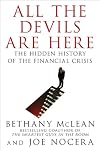
McLean and Nocera have written a gripping book, which is saying something when the subject is financial markets. Having read other books about the financial crisis, like Lewis' The Big Short, I was frustrated by treatments that only looked at one piece of the overall financial system without answering the big question: how did we get here? All the Devils does exactly that, explaining who did what and what motivated them to do it. On an abstract level, it upsets me because I can see the show more disaster brewing as the narrative progresses. My immediate experience of reading, however, is one of fascination at a case study of systemic complexity, unintended consequences and unexamined models.
An example of what satisfies me: people like Nassim Taleb rail against the folly of models like the Value at Risk (VoR) metrics developed by J. P. Morgan in the early 1990s because they discounted low probability, high impact events. That makes sense, as far as it goes. However, despite Taleb's blustering about how stupid people are, the folks at J. P. Morgan weren't idiots. They were extremely aware of the limits of the VoR model. It wasn't intended to be a stand-alone tool for assessing all risk. As others adopted the model, however, awareness of these limits eroded. It was a gradual process. If you pick up Taleb or Lewis' books, however, all you get is a snapshot of the end state of the system, where things have become extremely irrational and the heroes are pointing this out. Such accounts beg the question of how such an irrational system could develop in the first place, and All the Devils are Here does the best job of answering that question of anything that I've read. show less
An example of what satisfies me: people like Nassim Taleb rail against the folly of models like the Value at Risk (VoR) metrics developed by J. P. Morgan in the early 1990s because they discounted low probability, high impact events. That makes sense, as far as it goes. However, despite Taleb's blustering about how stupid people are, the folks at J. P. Morgan weren't idiots. They were extremely aware of the limits of the VoR model. It wasn't intended to be a stand-alone tool for assessing all risk. As others adopted the model, however, awareness of these limits eroded. It was a gradual process. If you pick up Taleb or Lewis' books, however, all you get is a snapshot of the end state of the system, where things have become extremely irrational and the heroes are pointing this out. Such accounts beg the question of how such an irrational system could develop in the first place, and All the Devils are Here does the best job of answering that question of anything that I've read. show less
The Big Fail: What the Pandemic Revealed About Who America Protects and Who It Leaves Behind by Joe Nocera
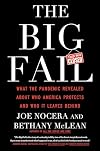
Nocera is not a fan of any pandemic mandates. He praises Ron DeSantis in his dealing with the pandemic in Florida saying he got it just right, protect the older people and let the younger ones do what they want. Later he compares the Florida death rate with California where Newsom enforces all the mandates. He says sure California comes off better, but if you subtract the older people, Florida does just great. So, in contrast with his original idea, I guess Nocera is saying to just let the show more virus do what it does and if we lose old people, that's the cost of doing business. I believe many GOP politicians expressed this exact idea. Oops, then he shows what a great job San Francisco did in protecting its older population. This was because, due to the need to react to the AIDS epidemic, San Francisco knew how to manage health care. So evidently what we needed was good health care management, not to throw up our hands and say, "Go, have fun." He does say he wonders if maybe San Francisco could have done just as good a job without all the mandates. Guess we'll never know, but they sure worked where they worked.
His analysis of the privatization of health care and the concept of "just in time" business management though, was right on point. Yes, it's more expensive to have staff and supplies on hand even when everything is going well, but it saves lives (and customers) in the end. show less
His analysis of the privatization of health care and the concept of "just in time" business management though, was right on point. Yes, it's more expensive to have staff and supplies on hand even when everything is going well, but it saves lives (and customers) in the end. show less
Once upon a time, not so long ago, really — it was 1999 — there was a group of three exceedingly smart men whom Time Magazine called The Committee to Save the World. In fact, these three men — Alan Greenspan, Larry Summers, and Robert Rubin — seemed to think they were the smartest people in the whole wide world. Together, they had put in place the economic policies of the Clinton Administration, and, boy, did things look rosy then, back in 1999, with a big budget surplus and the Dow show more Jones averages heading for Neptune!
So, here we are, in the closing days of 2010 — a good time to reassess those three men in light of the economic events of the past three years. The result, of course, is that they don’t look so smart anymore. But, guess what? Larry Summers has yet to exit the Obama White House, where he’s been the driving force behind this Administration’s economic policymaking — and Robert Rubin is reported to be on the short list to replace him!
Of the three men, only Alan Greenspan, now retired as head of the Federal Reserve Bank after serving under Ronald Reagan, Bill Clinton, and two generations of Bushes, has actually apologized after a fashion for his stubborn refusal to face economic facts that were obvious at the time to anyone well versed in finance who wasn’t blinded by greed, willful incompetence, stupidity, or right-wing ideology. The other two men? Well, we haven’t heard so much as a hint of an admission of responsibility from them.
So, what did “The Committee to Save the World” do to lay the foundations for the 2008 financial crisis? As best I can tell, collectively they made three fateful errors:
1. they engineered the repeal of consumer protections put in place during the Great Depression (the Glass-Steagall Act);
2. they routinely deferred to Wall Street when shaping economic policy, paying special attention to the effect of their actions on the bond market (where the really big money is to be found); and
3. they stubbornly refused to recognize the dangers in the alarming growth of the unregulated “derivatives” market. (If you don’t understand what a derivative is, don’t sweat it. Nobody else does, either, not really.)
Not so incidentally, these same three geniuses were also instrumental in fashioning “The Washington Consensus” that guided the work of the International Monetary Fund and the World Bank and caused tens of millions of people to starve in dozens of developing nations over the last decade and a half. But back to Topic A: the financial crisis.
We’ve identified three of the principal culprits. But, in fairness to Greenspan, Summers, and Rubin, there were many other characters who played leading roles in this still-unfolding tragedy. Some of their actions merely reflected changes set in motion years before. And nobody in any government position, including the Oval Office, calls all the shots. But the buck stops . . . somewhere. When it comes to the public policy that foreshadowed the financial crisis, the committee that “saved” the world bears a lot of the blame.
Now about those other leading characters in this modern immorality play. Chief among them, as best I can tell, were a mixed bag of people both in and out of government:
* On Wall Street, there were dozens of senior executives at such financial powerhouses as Goldman Sachs, Merrill Lynch, Lehman Brothers, Bear Stearns, AIG, Citibank, and many others whose shared delusion that money is life’s greatest good helped set the course for economic ruin. Some of these men (and a very few women) were brilliant and found ways to make lots of money even when conditions were really, really bad. Others were — well, not to put too fine an edge on things — downright stupid. Their firms (principally, Bear Stearns, Lehman, AIG, and Merrill Lynch) either disappeared entirely in a whirlwind of worthless paper or took refuge under someone else’s wing. By contrast, the champion money-maker, Goldman Sachs, racked up billions in profits by victimizing some of its biggest clients. Being Goldman Sachs, of course, none of its partners faced criminal charges, as they clearly would have done in a marketplace guided by reason and fairness.
* On Main Street, there were also dozens of co-conspirators. For the most part, these were the people who ran the “non-bank financial companies” like Countrywide and other firms that sold mortgages to people who couldn’t possibly afford them. Some were outright crooks running fly-by-night operations, many of them classic bucket-shops, others simply self-deluding or (again that word) stupid. Most of them got filthy rich, though, at least for a time. Dozens should have gone to jail, but did they? What do you think?
* Back in our nation’s capital, two institutions unfamiliar to most of the American public found themselves in the middle of the maelstrom: the two quasi-private mortgage repositories, Fannie Mae and Freddie Mac. Don’t feel sorry for them, though, because, to cop a phrase from an earlier practitioner of misdirection, “mistakes were made.” The leadership of both institutions grabbed at opportunities to make a quick buck. They succeeded, for a time, but only until the profits disappeared — and we taxpayers are now footing the bill to the tune of hundreds of billions of dollars.
* Don’t forget George W. Bush. The decider-in-chief may not have played a meaningful role in economic decision-making (if only because it’s highly doubtful he had a clue about what was going on). But, dazzled by the argument that the “free market” would regulate the financial sector all by itself, Bush II deliberately appointed to key regulatory positions such world-class ignoramuses as Christopher Cox to head the Securities and Exchange Commission. It wasn’t enough that the regulatory agencies’ teeth had dulled considerably over the years and that the powers-that-were in the Clinton Administration had refused to sharpen them. No, George W. Bush insisted on appointing financial regulators whose stated intention was not to do their jobs.
So, what does all this bloviating have to do with All the Devils Are Here? This is, after all, (ostensibly) a book review. It’s simple, really: Bethany McLean and Joe Nocera’s superb book brought into high relief the roots of the financial crisis like no other book I’ve read and made it possible for me to untangle in my mind the complex interrelationships among Wall Street, Main Street, the Fed, and the Treasury Department. In previous months, I’d read Too Big to Fail: The Inside Story of How Wall Street and Washington Fought to Save the Financial System–and Themselves by Andrew Ross Sorkin, The Big Short: Inside the Doomsday Machine by Michael Lewis, The Devil’s Casino: Friendship, Betrayal, and the High Stakes Games Played Inside Lehman Brothers by Vicky Ward, and others, all of them excellent books. But McLean and Nocera’s treatment of the crisis from a long-term perspective, with its roots in the evolution of housing policy as well as greed and excess on Wall Street, put the whole question into perspective. If you’re looking for the best way to begin understanding the financial meltdown of 2007-2008 that came close to tanking the global economy, start with All the Devils Are Here. show less
So, here we are, in the closing days of 2010 — a good time to reassess those three men in light of the economic events of the past three years. The result, of course, is that they don’t look so smart anymore. But, guess what? Larry Summers has yet to exit the Obama White House, where he’s been the driving force behind this Administration’s economic policymaking — and Robert Rubin is reported to be on the short list to replace him!
Of the three men, only Alan Greenspan, now retired as head of the Federal Reserve Bank after serving under Ronald Reagan, Bill Clinton, and two generations of Bushes, has actually apologized after a fashion for his stubborn refusal to face economic facts that were obvious at the time to anyone well versed in finance who wasn’t blinded by greed, willful incompetence, stupidity, or right-wing ideology. The other two men? Well, we haven’t heard so much as a hint of an admission of responsibility from them.
So, what did “The Committee to Save the World” do to lay the foundations for the 2008 financial crisis? As best I can tell, collectively they made three fateful errors:
1. they engineered the repeal of consumer protections put in place during the Great Depression (the Glass-Steagall Act);
2. they routinely deferred to Wall Street when shaping economic policy, paying special attention to the effect of their actions on the bond market (where the really big money is to be found); and
3. they stubbornly refused to recognize the dangers in the alarming growth of the unregulated “derivatives” market. (If you don’t understand what a derivative is, don’t sweat it. Nobody else does, either, not really.)
Not so incidentally, these same three geniuses were also instrumental in fashioning “The Washington Consensus” that guided the work of the International Monetary Fund and the World Bank and caused tens of millions of people to starve in dozens of developing nations over the last decade and a half. But back to Topic A: the financial crisis.
We’ve identified three of the principal culprits. But, in fairness to Greenspan, Summers, and Rubin, there were many other characters who played leading roles in this still-unfolding tragedy. Some of their actions merely reflected changes set in motion years before. And nobody in any government position, including the Oval Office, calls all the shots. But the buck stops . . . somewhere. When it comes to the public policy that foreshadowed the financial crisis, the committee that “saved” the world bears a lot of the blame.
Now about those other leading characters in this modern immorality play. Chief among them, as best I can tell, were a mixed bag of people both in and out of government:
* On Wall Street, there were dozens of senior executives at such financial powerhouses as Goldman Sachs, Merrill Lynch, Lehman Brothers, Bear Stearns, AIG, Citibank, and many others whose shared delusion that money is life’s greatest good helped set the course for economic ruin. Some of these men (and a very few women) were brilliant and found ways to make lots of money even when conditions were really, really bad. Others were — well, not to put too fine an edge on things — downright stupid. Their firms (principally, Bear Stearns, Lehman, AIG, and Merrill Lynch) either disappeared entirely in a whirlwind of worthless paper or took refuge under someone else’s wing. By contrast, the champion money-maker, Goldman Sachs, racked up billions in profits by victimizing some of its biggest clients. Being Goldman Sachs, of course, none of its partners faced criminal charges, as they clearly would have done in a marketplace guided by reason and fairness.
* On Main Street, there were also dozens of co-conspirators. For the most part, these were the people who ran the “non-bank financial companies” like Countrywide and other firms that sold mortgages to people who couldn’t possibly afford them. Some were outright crooks running fly-by-night operations, many of them classic bucket-shops, others simply self-deluding or (again that word) stupid. Most of them got filthy rich, though, at least for a time. Dozens should have gone to jail, but did they? What do you think?
* Back in our nation’s capital, two institutions unfamiliar to most of the American public found themselves in the middle of the maelstrom: the two quasi-private mortgage repositories, Fannie Mae and Freddie Mac. Don’t feel sorry for them, though, because, to cop a phrase from an earlier practitioner of misdirection, “mistakes were made.” The leadership of both institutions grabbed at opportunities to make a quick buck. They succeeded, for a time, but only until the profits disappeared — and we taxpayers are now footing the bill to the tune of hundreds of billions of dollars.
* Don’t forget George W. Bush. The decider-in-chief may not have played a meaningful role in economic decision-making (if only because it’s highly doubtful he had a clue about what was going on). But, dazzled by the argument that the “free market” would regulate the financial sector all by itself, Bush II deliberately appointed to key regulatory positions such world-class ignoramuses as Christopher Cox to head the Securities and Exchange Commission. It wasn’t enough that the regulatory agencies’ teeth had dulled considerably over the years and that the powers-that-were in the Clinton Administration had refused to sharpen them. No, George W. Bush insisted on appointing financial regulators whose stated intention was not to do their jobs.
So, what does all this bloviating have to do with All the Devils Are Here? This is, after all, (ostensibly) a book review. It’s simple, really: Bethany McLean and Joe Nocera’s superb book brought into high relief the roots of the financial crisis like no other book I’ve read and made it possible for me to untangle in my mind the complex interrelationships among Wall Street, Main Street, the Fed, and the Treasury Department. In previous months, I’d read Too Big to Fail: The Inside Story of How Wall Street and Washington Fought to Save the Financial System–and Themselves by Andrew Ross Sorkin, The Big Short: Inside the Doomsday Machine by Michael Lewis, The Devil’s Casino: Friendship, Betrayal, and the High Stakes Games Played Inside Lehman Brothers by Vicky Ward, and others, all of them excellent books. But McLean and Nocera’s treatment of the crisis from a long-term perspective, with its roots in the evolution of housing policy as well as greed and excess on Wall Street, put the whole question into perspective. If you’re looking for the best way to begin understanding the financial meltdown of 2007-2008 that came close to tanking the global economy, start with All the Devils Are Here. show less
To declare a minor special interest in this story, I was a Spanish real estate broker through this period and can attest to the similarity of experience between the US and Spain. Conversations from the late 1990's onwards revolved around property values since people were surprised to find that they could double their salaries each year by investing in apartments.
The authors of this excellent book explain the supply side of mortgage financing and its regulatory framework but don't explore the show more demand side at any great length. They show that a property bubble needs a large volume of buyers and sellers and that it needs to be "enabled" by knocking out regulatory and financing obstacles, aspects that are brilliantly illustrated, although they could have added the contribution of the public in its mad rush for the free money. I'm thinking about the property flippers who were just as anxious to get their extra $100.000 as the Wall St. banks were to get their extra $1.000.000.000.
The book could possibly have benefited from more historical context, ie. putting the Sub-Prime Crisis alongside other historic speculative bubbles, since there are remarkable similarities. A good reference in this respect is Edward Chancellor 's "Devil Take the Hindmost" showing for example the City in the 1720's exhausting its possibilities of lending against South Sea Company stock and the South Sea Company itself exhausting the possibilities of lending to its own buyers - sounds familiar?
The contrast between early and later Sub Prime could have had greater emphasis. In the early stages it should have been possible to halt the bad practices, and the authors show that some regulators did in fact try, most notably in 1994, James Bothwell of the General Accounting Office and in 1998 Brooksley Born, chairwoman of the Commodity Futures Trading Commission. Bothwell underwent a brutal attack by Congress with the SEC, Treasury and Fed refusing to give him support, and Born received a screaming telephone call from Deputy Treasury Secretary, Larry Summers saying that bankers were threatening to move their business to London. As she says, "There was so much pressure. The derivatives dealers did not want their market looked at - at all. For some of them, derivatives trading made up 40% of their profits."
In the later stages there was nothing to be done and the authors show the Sub Prime behemoth taking over the US financial system. Under Clinton, Treasury Secretary Rubin and Deputy Secretary Summers provided this special market with top level political protection and at the Fed, Chairman Greenspan prioritized deregulation and actually lauded the market efficiency of derivatives in apportioning risk. An interesting secondary question is whether they actually believed this, or were they were just protecting a valuable new investment game run by friends. McLean and Nocera equivocate on this point, seeming to partially accept both arguments.
The authors show that creating junk mortgages is one thing and selling them is quite another.
Selling CDOs (collateralized debt obligations) required tranches (slicing up the debt) so that parts of it could receive an AAA rating (equivalent to treasury bonds) from ratings agencies, thereby allowing conservative investment by heavily controlled pension fund type capital. It thus became a game of investors "buying ratings" ie. receiving a higher yield on supposedly AAA type risk. The big profits came from manufacturing AAA rated securities and the authors show the complicity of the ratings agencies, quoting from 2007 Josh Anderson, the manager of asset backed securities at PIMCO saying, "Moody's doesn't stand up to Wall St. ... its mistakes are so obvious". S&P, Moody's and Fitch all knew about the rising early defaults rate on sub prime but were clearly afraid to downgrade.
So how did it all happen? McLean and Nocera interestingly show how Wall St. had for some time wished to avoid dealing with the GSE's (Government Sponsored Enterprises, Fannie Mae and Freddie Mac) and eventually found a way round them by directly securitizing sub prime mortgages from non bank lenders. The real risks were hidden under AAA ratings while simultaneously a group of extreme free market activists (strangely similar to Russia's Bolsheviks using communism) were grabbing power under cover of the new ideology.
As with the Bolsheviks, most of the leaders were Jewish (Greenspan, Rubin, Summers, Bernanke + a majority of Goldman Sachs), a fact that isn't mentioned in the book although the authors are happy to go at some length into the Italian background of Mozilo, and the African background of O'Neal and Raines.
It's also probably not a coincidence that after the collapse, the same Goldman team in government arranged for the highly favourable bailout of Wall St investment banks at enormous taxpayer expense, with the prime beneficiary of course being Goldman Sachs itself. Heads we win, tails you lose.
This is the best book I've read so far about the Debt Crisis (Grand Theft), especially for the dateline after 17th June 2007 when Merrill Lynch seized $850 million of Bear Stearns CDOs only to discover that nobody wanted to buy them. show less
The authors of this excellent book explain the supply side of mortgage financing and its regulatory framework but don't explore the show more demand side at any great length. They show that a property bubble needs a large volume of buyers and sellers and that it needs to be "enabled" by knocking out regulatory and financing obstacles, aspects that are brilliantly illustrated, although they could have added the contribution of the public in its mad rush for the free money. I'm thinking about the property flippers who were just as anxious to get their extra $100.000 as the Wall St. banks were to get their extra $1.000.000.000.
The book could possibly have benefited from more historical context, ie. putting the Sub-Prime Crisis alongside other historic speculative bubbles, since there are remarkable similarities. A good reference in this respect is Edward Chancellor 's "Devil Take the Hindmost" showing for example the City in the 1720's exhausting its possibilities of lending against South Sea Company stock and the South Sea Company itself exhausting the possibilities of lending to its own buyers - sounds familiar?
The contrast between early and later Sub Prime could have had greater emphasis. In the early stages it should have been possible to halt the bad practices, and the authors show that some regulators did in fact try, most notably in 1994, James Bothwell of the General Accounting Office and in 1998 Brooksley Born, chairwoman of the Commodity Futures Trading Commission. Bothwell underwent a brutal attack by Congress with the SEC, Treasury and Fed refusing to give him support, and Born received a screaming telephone call from Deputy Treasury Secretary, Larry Summers saying that bankers were threatening to move their business to London. As she says, "There was so much pressure. The derivatives dealers did not want their market looked at - at all. For some of them, derivatives trading made up 40% of their profits."
In the later stages there was nothing to be done and the authors show the Sub Prime behemoth taking over the US financial system. Under Clinton, Treasury Secretary Rubin and Deputy Secretary Summers provided this special market with top level political protection and at the Fed, Chairman Greenspan prioritized deregulation and actually lauded the market efficiency of derivatives in apportioning risk. An interesting secondary question is whether they actually believed this, or were they were just protecting a valuable new investment game run by friends. McLean and Nocera equivocate on this point, seeming to partially accept both arguments.
The authors show that creating junk mortgages is one thing and selling them is quite another.
Selling CDOs (collateralized debt obligations) required tranches (slicing up the debt) so that parts of it could receive an AAA rating (equivalent to treasury bonds) from ratings agencies, thereby allowing conservative investment by heavily controlled pension fund type capital. It thus became a game of investors "buying ratings" ie. receiving a higher yield on supposedly AAA type risk. The big profits came from manufacturing AAA rated securities and the authors show the complicity of the ratings agencies, quoting from 2007 Josh Anderson, the manager of asset backed securities at PIMCO saying, "Moody's doesn't stand up to Wall St. ... its mistakes are so obvious". S&P, Moody's and Fitch all knew about the rising early defaults rate on sub prime but were clearly afraid to downgrade.
So how did it all happen? McLean and Nocera interestingly show how Wall St. had for some time wished to avoid dealing with the GSE's (Government Sponsored Enterprises, Fannie Mae and Freddie Mac) and eventually found a way round them by directly securitizing sub prime mortgages from non bank lenders. The real risks were hidden under AAA ratings while simultaneously a group of extreme free market activists (strangely similar to Russia's Bolsheviks using communism) were grabbing power under cover of the new ideology.
As with the Bolsheviks, most of the leaders were Jewish (Greenspan, Rubin, Summers, Bernanke + a majority of Goldman Sachs), a fact that isn't mentioned in the book although the authors are happy to go at some length into the Italian background of Mozilo, and the African background of O'Neal and Raines.
It's also probably not a coincidence that after the collapse, the same Goldman team in government arranged for the highly favourable bailout of Wall St investment banks at enormous taxpayer expense, with the prime beneficiary of course being Goldman Sachs itself. Heads we win, tails you lose.
This is the best book I've read so far about the Debt Crisis (Grand Theft), especially for the dateline after 17th June 2007 when Merrill Lynch seized $850 million of Bear Stearns CDOs only to discover that nobody wanted to buy them. show less
Awards


You May Also Like


Associated Authors
Statistics
- Works
- 10
- Also by
- 2
- Members
- 1,103
- Popularity
- #23,300
- Rating
- 3.9
- Reviews
- 29
- ISBNs
- 27