
Mark Alan Arnold
Author of Borderland: Between the Elflands and the World is a Place Where Magic Runs Amok
Series
Works by Mark Alan Arnold
Borderland: Between the Elflands and the World is a Place Where Magic Runs Amok (1986) — Editor — 455 copies, 5 reviews
Tagged
Common Knowledge
- Gender
- male
Members
Reviews

Even though this book is a slim volume, and contains only four short stories, it serves as an excellent introduction to the shared world of Bordertown created by Terri Windling and Mark Alan Arnold. I’ve previously read many of the later volumes set in the magical town which straddles the border between the normal world and the recently-returned faerieland (the small print run of this early urban fantasy book makes it tricky to find at the public library), so I was delighted to finally get show more a chance to read the originating stories after picking up the book on a recent trip through Calgary.
Of all of the four stories contained in this book, the first story is the one which I like the least. Not that it’s an uninteresting story or poorly written, but more so because it’s more predictable and expected within the fantasy (and urban fantasy) genre. The opening scene sees our protagonist, a guitar player of famous repute (apparently reformed from his bad rock & roll ways), playing his guitar on a lonely mountaintop close to the border between Bordertown and Faerieland and creating/controlling magical shapes in the air through his music. From the get-go it was obvious that this kind of skill is one which is tenuous at best and dangerous at its worst, so I was completely unsurprised when the central conflict of the story occurred when his long-time girlfriend leaves him (for being lazy essentially, another wtf moment) and he goes to the mountain again, this time creating a monster of the magical shapes that has a will only for devouring the person who has wronged him. Then he has to confront the monster and defeat it with his own music, therefore emerging from the conflict a changed man and ready to contribute to the well-being of his relationship. Exciting though it may be, this storyline has been done a million times, so I expected better from the likes of Bordertown!
The second story in the collection was one that I felt was really part of a much bigger tale. The story shares perspective between Gray (a human who is cursed to shape-change into a cat) and Wicker (an elf who was born and raised in Bordertown and makes her way as a tempestuous singer), who essentially spend the story circling unknowingly around each other before Gray’s secret is discovered and the two agree to try to cross into the Faerielands together. I’m not sure if their story is continued in the later Bordertown anthologies, but I sure hope that it is, because it sounds rather interesting. Then again, if they cross into Faerie, chances are that story wouldn’t be part of the Bordertown tales since it’s not actually set in Bordertown...
I was delighted to find that my favourite author, Charles de Lint, had contributed to the origins of Bordertown with a climactic story that introduces readers to the “halfie” (half elf, half human) population of Bordertown, Stick & his dancing ferret Lubin (residents of the Bordertown museum and all-around badasses with golden hearts), and the Horn Dance (the only positively motivated gang in Bordertown). All three of these subjects come up many times in later Bordertown collections, so the discovery that de Lint had played a hand in their creation is one of which I am exceedingly proud. It’s not surprising that de Lint tackled these types of characters and conflicts in Bordertown, since his other novels often deal with themes of prejudice, social justice, and mythic traditions based around music, and doing so here sets the tone for many of the larger social forces within Bordertown. The town straddles the border between the known and unknown, relying on a unique mix of magic and technology to survive, and blending a myriad of cultures to create probably the most cosmopolitan (and potentially problematic) social situation ever created - and de Lint is certainly a master of setting up and working within these unique boundaries (or lack thereof).
The final story in the book treads the realms of an expected fairytale - a human having to rescue a man (in this case an elfin lord) from the high lady of faerie - but Ellen Kushner puts a decidedly Bordertown spin on the tale. Instead of the rescue being in the name of true love (or even “right”) as it generally is in the original tales, the challenge is falsely set by some meddling elves from Faerieland as a means of dividing the human and elvin political factions in Bordertown who they deem to be growing too close. Bordertown has a myriad of gangs (elfin, human, and mixed) and social groups who are common plot devices and characters in the stories, so Kushner’s brief foray into more traditional politics within Bordertown makes for an interesting tale. I don’t recall any other stories which centre on this group of people, and I can’t blame most authors from steering clear of a topic that could easily make a Bordertown story quite mundane (politics are old hat, especially traditional ones), but that doesn’t detract from Kushner’s story. show less
Of all of the four stories contained in this book, the first story is the one which I like the least. Not that it’s an uninteresting story or poorly written, but more so because it’s more predictable and expected within the fantasy (and urban fantasy) genre. The opening scene sees our protagonist, a guitar player of famous repute (apparently reformed from his bad rock & roll ways), playing his guitar on a lonely mountaintop close to the border between Bordertown and Faerieland and creating/controlling magical shapes in the air through his music. From the get-go it was obvious that this kind of skill is one which is tenuous at best and dangerous at its worst, so I was completely unsurprised when the central conflict of the story occurred when his long-time girlfriend leaves him (for being lazy essentially, another wtf moment) and he goes to the mountain again, this time creating a monster of the magical shapes that has a will only for devouring the person who has wronged him. Then he has to confront the monster and defeat it with his own music, therefore emerging from the conflict a changed man and ready to contribute to the well-being of his relationship. Exciting though it may be, this storyline has been done a million times, so I expected better from the likes of Bordertown!
The second story in the collection was one that I felt was really part of a much bigger tale. The story shares perspective between Gray (a human who is cursed to shape-change into a cat) and Wicker (an elf who was born and raised in Bordertown and makes her way as a tempestuous singer), who essentially spend the story circling unknowingly around each other before Gray’s secret is discovered and the two agree to try to cross into the Faerielands together. I’m not sure if their story is continued in the later Bordertown anthologies, but I sure hope that it is, because it sounds rather interesting. Then again, if they cross into Faerie, chances are that story wouldn’t be part of the Bordertown tales since it’s not actually set in Bordertown...
I was delighted to find that my favourite author, Charles de Lint, had contributed to the origins of Bordertown with a climactic story that introduces readers to the “halfie” (half elf, half human) population of Bordertown, Stick & his dancing ferret Lubin (residents of the Bordertown museum and all-around badasses with golden hearts), and the Horn Dance (the only positively motivated gang in Bordertown). All three of these subjects come up many times in later Bordertown collections, so the discovery that de Lint had played a hand in their creation is one of which I am exceedingly proud. It’s not surprising that de Lint tackled these types of characters and conflicts in Bordertown, since his other novels often deal with themes of prejudice, social justice, and mythic traditions based around music, and doing so here sets the tone for many of the larger social forces within Bordertown. The town straddles the border between the known and unknown, relying on a unique mix of magic and technology to survive, and blending a myriad of cultures to create probably the most cosmopolitan (and potentially problematic) social situation ever created - and de Lint is certainly a master of setting up and working within these unique boundaries (or lack thereof).
The final story in the book treads the realms of an expected fairytale - a human having to rescue a man (in this case an elfin lord) from the high lady of faerie - but Ellen Kushner puts a decidedly Bordertown spin on the tale. Instead of the rescue being in the name of true love (or even “right”) as it generally is in the original tales, the challenge is falsely set by some meddling elves from Faerieland as a means of dividing the human and elvin political factions in Bordertown who they deem to be growing too close. Bordertown has a myriad of gangs (elfin, human, and mixed) and social groups who are common plot devices and characters in the stories, so Kushner’s brief foray into more traditional politics within Bordertown makes for an interesting tale. I don’t recall any other stories which centre on this group of people, and I can’t blame most authors from steering clear of a topic that could easily make a Bordertown story quite mundane (politics are old hat, especially traditional ones), but that doesn’t detract from Kushner’s story. show less
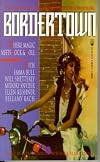
Here's the thing about Bordertown: it's more than it appears on the surface. As a shared world project, it's a solid one - the premise is interesting (for new arrivals: Fairyland has returned, causing various calamities and upheavals, and creating a 'border' region between the two worlds, where neither human machines nor elven magic work reliably), the writers work well together, and the voices were fresh and compelling at the time. They still are, more or less, but that's not why we love it show more so much.
When I was young, we didn't have Youtube, much less anything like the "It gets better" project. Yeah, ok, we had zines and we had records, and sometimes you could travel to a bigger town and mingle with a larger group of freaks, but we didn't have a lot of older freaks to tell us the things we desperately needed to hear. In the Bordertown anthologies, the original writers - a mix of queer folk and musicians and former street kids and other assorted weirdos - found a way to reach us. They told us that sometimes running away is ok, depending, but that you still have to make a home out of wherever you end up - it's not enough to just survive, though survival comes first. They told us that it was great to be strange, and that we didn't have to outgrow it if we didn't want to, that we could go on to be weird adults and be proud and happy, if maybe totally broke as well. They told us that we had to take care of each other, and that the families we chose were as real and important as the ones we were born with. Most importantly, they told us that the million small acts of creativity and self-sufficiency that we practiced every day - making our own clothes, baking bread, growing food, making music, telling stories - were as vital and as magical as anything any Elfland could ever produce.
Bohemia is always changing and always the same, but like any other culture, it needs a certain amount of continuity. The Bordertown books gave us that sense of solidarity, and they still seem to - which is why you find them creased and bent all to hell, passed around from person to person to person, and why people will shell out as much as fifty bucks for an old paperback copy. They're a lifeline and a beacon and a map. Like the best books for young people, they show us how to navigate the route between childhood and adulthood and arrive in one piece. I hope they bring comfort to the strange - young and old - for many more years to come. show less
When I was young, we didn't have Youtube, much less anything like the "It gets better" project. Yeah, ok, we had zines and we had records, and sometimes you could travel to a bigger town and mingle with a larger group of freaks, but we didn't have a lot of older freaks to tell us the things we desperately needed to hear. In the Bordertown anthologies, the original writers - a mix of queer folk and musicians and former street kids and other assorted weirdos - found a way to reach us. They told us that sometimes running away is ok, depending, but that you still have to make a home out of wherever you end up - it's not enough to just survive, though survival comes first. They told us that it was great to be strange, and that we didn't have to outgrow it if we didn't want to, that we could go on to be weird adults and be proud and happy, if maybe totally broke as well. They told us that we had to take care of each other, and that the families we chose were as real and important as the ones we were born with. Most importantly, they told us that the million small acts of creativity and self-sufficiency that we practiced every day - making our own clothes, baking bread, growing food, making music, telling stories - were as vital and as magical as anything any Elfland could ever produce.
Bohemia is always changing and always the same, but like any other culture, it needs a certain amount of continuity. The Bordertown books gave us that sense of solidarity, and they still seem to - which is why you find them creased and bent all to hell, passed around from person to person to person, and why people will shell out as much as fifty bucks for an old paperback copy. They're a lifeline and a beacon and a map. Like the best books for young people, they show us how to navigate the route between childhood and adulthood and arrive in one piece. I hope they bring comfort to the strange - young and old - for many more years to come. show less

Four stories by four different authors, all set in the same shared universe: a seedy borderland between the ordinary human world and an inexplicably returned fairy realm. The stories are all decent and readable enough, although I didn't find any of them particularly memorable or compelling. And unfortunately the setting, while it has a certain amount of potential, never feels terribly well fleshed out and, at least in this collection, never really rises above the level of vaguely interesting show more gimmick.
I have no idea what the actual genesis of this shared world is, but I can't help imagining a group of fantasy authors getting drunk together somewhere when one of them suddenly comes out with, "You know what would be awesome? Rock and roll elves!" At which point they spend the rest of the night discussing how you could go about building a setting that would let you have lots of rock and roll elves. And then someone still thought it was a good idea in the morning and talked the rest into participating. The thing is, I strongly suspect that "rock and roll elves" is one of those ideas that really needs to be done absolutely brilliantly or not at all. I seem to remember Emma Bull doing it surprisingly effectively in War for the Oaks, so it is possible, but whatever that book had, this one somehow lacks.
I also think that part of the problem is that the elves here are just not alien enough. They're not even as much so as your generic Tolkien-clone elves. Mostly, they're just normal people with pointed ears and random magical abilities. show less
I have no idea what the actual genesis of this shared world is, but I can't help imagining a group of fantasy authors getting drunk together somewhere when one of them suddenly comes out with, "You know what would be awesome? Rock and roll elves!" At which point they spend the rest of the night discussing how you could go about building a setting that would let you have lots of rock and roll elves. And then someone still thought it was a good idea in the morning and talked the rest into participating. The thing is, I strongly suspect that "rock and roll elves" is one of those ideas that really needs to be done absolutely brilliantly or not at all. I seem to remember Emma Bull doing it surprisingly effectively in War for the Oaks, so it is possible, but whatever that book had, this one somehow lacks.
I also think that part of the problem is that the elves here are just not alien enough. They're not even as much so as your generic Tolkien-clone elves. Mostly, they're just normal people with pointed ears and random magical abilities. show less

In this anthology of Bordertown, the mythology is deeper as the authors fill out the world that they created and other authors join in. Bordertown is full of art and music as well as elves with their complex society. A theme that moves through Bordertown is the idea of how do you know where you belong and who you are. In each of the stories, the characters struggle with understanding the choices they must make to be where they fit. From dealing with a murder mystery to a rich, young woman show more who takes a foolish risk that could end up badly instead becomes a lesson. These anthologies are great reads for the what the authors do with Bordertown and seeing their styles change and grow. show less
Lists
Awards

You May Also Like
Associated Authors
Statistics
- Works
- 5
- Members
- 1,226
- Popularity
- #20,943
- Rating
- 4.2
- Reviews
- 13
- ISBNs
- 7