
James Clear
Author of Atomic Habits
About the Author
Image credit: Author's website.
Works by James Clear
The Atomic Habits Workbook: Official Companion to the #1 Worldwide Bestseller (2025) 63 copies, 1 review
Transform Your Habits 19 copies
Mastering Creativity 12 copies
Foundations of Strength 3 copies
原子習慣: 細微改變帶來巨大成就的實證法則 1 copy
Diario de hábitos 1 copy
James Clear Atomic Habits 1 copy
Tagged
Common Knowledge
- Birthdate
- 20th century
- Gender
- male
- Nationality
- USA
- Associated Place (for map)
- USA
Members
Reviews
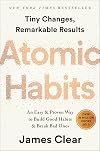
Most of the advice in Atomic Habits may seem like common sense but really it is the advice that you don't think to take. There are a myriad of tricks you can use to get ahead in life. Clear makes it abundantly easy to adopt many of them and he writes in a tone that is easy going and never didactic (he even throws in a Game of Thrones reference). Here are some of my favorites: think of getting ahead as a game, complete with competitive strategies and a well-defined playbook; reframe your why show more (saying "I do not smoke." instead of "I am trying to quit.") and you can learn a great deal by watching other successful people (what are their habits?). This last Clear advice is probably my favorite because I have always believed in what I call the Particle Theory. I honestly believe people come into your life for a very specific reason. When they leave your life as they often will, it is because you have used up their purpose or that reason for being in your life; you have gotten all that you could out of that relationship. I believe you will unconsciously pick up habits and personality traits from the people closest to you, whether you like it or not. How influential that person is to your life determines how steadfast the habit or trait will be.
If you are short on time, Clear also includes chapter summaries that are well thought out and detailed. show less
If you are short on time, Clear also includes chapter summaries that are well thought out and detailed. show less

As I believe I’ve mentioned in other reviews, I have a deep aversion to most books that fall within the “self-help” genre, largely for theological reasons that are too difficult to explain here. That and the fact that most books in this genre seem boring, repetitive, and, at the end of the day, not all that helpful. However, I feel that Clear’s book proves to be an exception to all those objections. It was enjoyable, fresh, and above all truly helpful.
Obviously, a book on the power show more of habit to shape our lives and how to shape our habits is not plowing any new ground in the “self-help” world. In fact, throughout the book, Clear gives credit to his forebears in the field, showing both how he builds on and moves beyond others’ work. (At the end of the book, he helpfully provides a “For Further Reading” section.) The unique strength of Clear’s work is his combination of behavioral modification and cognitive psychology approaches. He does a very good job of not simply explaining how habits work but why habits work in that way. One thing that I particularly appreciated (given my research interests in other areas) was the way that he accounts for the role of emotion in our decision-making processes.
The core insight is obvious. True and lasting improvement happens not all at once but in dozens, hundreds—even thousands—of incremental steps. Our daily habits are the “atoms” of our life and identity. Clear’s goal is to prove that the goal is not RADICAL change but MEANINGFUL change, change that moves you closer to the person that you desire to be.
Perhaps one of the reasons I enjoyed this work more than others is that it was a fast read. Let’s just say that Clear’s style lives up to his name. His prose is easy; each brief chapter follows the same template; he keeps lists to four items or less; he maintains a near-perfect balance between “fact/idea” and “meaning/application.” He includes fascinating details from the burgeoning field of neuroscience and brain studies as well as providing helpful illustrations (many of them personal).
As a theologian/working pastor, I couldn’t help but make continual applications to Christian spiritual formation. The so-called “spiritual disciplines” (e.g., prayer, meditation, fasting, etc) are, at the end of day, habits. Discipleship is really a process of developing spiritual habits. However, this similarity highlights one HUGE difference between Clear’s approach and a Christian view. I reject Clear’s claim that the pursuit of good habits is rooted in our PRIDE in our identity. For Christians, our pursuit of good habits must be ultimately rooted in our humble pursuit of being identified with Christ. We are not trying to develop our OWN identity but to assume HIS identity.
As surprised as I am to say this (given some of my earlier unrecorded comments while passing through the “Self-Help” section of my local Barnes & Noble), this was a genuinely good book. Perhaps not quite a great book but genuinely informative, enlightening, and helpful. In fact, it was good enough that I’ve added a “Personal Growth” section to my own annual reading log; Clear helped me recognize that this category of writing, when done with the level of skill and relevance he demonstrates throughout, is valuable. Reading books like his is a habit I need to develop. show less
Obviously, a book on the power show more of habit to shape our lives and how to shape our habits is not plowing any new ground in the “self-help” world. In fact, throughout the book, Clear gives credit to his forebears in the field, showing both how he builds on and moves beyond others’ work. (At the end of the book, he helpfully provides a “For Further Reading” section.) The unique strength of Clear’s work is his combination of behavioral modification and cognitive psychology approaches. He does a very good job of not simply explaining how habits work but why habits work in that way. One thing that I particularly appreciated (given my research interests in other areas) was the way that he accounts for the role of emotion in our decision-making processes.
The core insight is obvious. True and lasting improvement happens not all at once but in dozens, hundreds—even thousands—of incremental steps. Our daily habits are the “atoms” of our life and identity. Clear’s goal is to prove that the goal is not RADICAL change but MEANINGFUL change, change that moves you closer to the person that you desire to be.
Perhaps one of the reasons I enjoyed this work more than others is that it was a fast read. Let’s just say that Clear’s style lives up to his name. His prose is easy; each brief chapter follows the same template; he keeps lists to four items or less; he maintains a near-perfect balance between “fact/idea” and “meaning/application.” He includes fascinating details from the burgeoning field of neuroscience and brain studies as well as providing helpful illustrations (many of them personal).
As a theologian/working pastor, I couldn’t help but make continual applications to Christian spiritual formation. The so-called “spiritual disciplines” (e.g., prayer, meditation, fasting, etc) are, at the end of day, habits. Discipleship is really a process of developing spiritual habits. However, this similarity highlights one HUGE difference between Clear’s approach and a Christian view. I reject Clear’s claim that the pursuit of good habits is rooted in our PRIDE in our identity. For Christians, our pursuit of good habits must be ultimately rooted in our humble pursuit of being identified with Christ. We are not trying to develop our OWN identity but to assume HIS identity.
As surprised as I am to say this (given some of my earlier unrecorded comments while passing through the “Self-Help” section of my local Barnes & Noble), this was a genuinely good book. Perhaps not quite a great book but genuinely informative, enlightening, and helpful. In fact, it was good enough that I’ve added a “Personal Growth” section to my own annual reading log; Clear helped me recognize that this category of writing, when done with the level of skill and relevance he demonstrates throughout, is valuable. Reading books like his is a habit I need to develop. show less
Habits aren't hard to understand. They're things you keep doing. James Clear tries to make them complex with graphs showing "results" on a curve. There's no evidence that self-improvement is anything but linear, but no matter. His tenets are simple: Make a routine easy, obvious, attractive and satisfying and it becomes habit-forming. Chain simple things together to do a complex thing; find an immediate payoff and you'll stick with it. All useful in finding discipline or making good things show more happen. show less
My wife sent me a picture of a stack of books from a post that called them “20 Books To Read In Your 20s”.
(the picture, for those reading this in the mobile app)
I’d read three already (and can only really recommend one of those, McRaven’s Make Your Bed), so I decided to see if there was any merit to the rest of the stack. I tried to imagine what a twenty-something me would take away, and of course, the current me informs how I read it now.
This one is a Yes. I'm going to ding Mr. show more Clear on two points* but I still recommend this. I think it would have been valuable to me in my 20s. Even if I didn't listen, the seeds would have been planted for when I could make use of some of the concepts.
Clear observes “Changing our habits is challenging for two reasons: (1) we try to change the wrong thing and (2) we try to change our habits in the wrong way.” And, “Over the long run, however, the real reason you fail to stick with [good] habits is that your self-image gets in the way. This is why you can’t get too attached to one version of your identity. Progress requires unlearning. Becoming the best version of yourself requires you to continuously edit your beliefs, and to upgrade and expand your identity.” That's good advice period, for more than just changing habits.
So, he's created " Four Laws of Behavior Change" which he says “ are a simple set of rules we can use to build better habits. They are (1) make it obvious, (2) make it attractive, (3) make it easy, and (4) make it satisfying.”
A lot of habit change is managing expectations upfront: “We often expect progress to be linear. [What we think should happen] At the very least, we hope it will come quickly. In reality, the results of our efforts are often delayed. It is not until months or years later that we realize the true value of the previous work we have done. This can result in a “valley of disappointment” where people feel discouraged after putting in weeks or months of hard work without experiencing any results. However, this work was not wasted. It was simply being stored. It is not until much later that the full value of previous efforts is revealed.”
And
“Unfortunately, the slow pace of transformation also makes it easy to let a bad habit slide.”
Clear says, “The fields I draw on—biology, neuroscience, philosophy, psychology, and more—have been around for many years. What I offer you is a synthesis of the best ideas smart people figured out a long time ago as well as the most compelling discoveries scientists have made recently.” He did his research and it shows. Well composed, easily read - the segments/chapters are short, well presented - he summarizes at the end of each chapter and his end of summaries build on the previous sections. There is much here to take in and think about. I will likely return to it again to cull more ideas.
* My beefs: He uses definite articles - "the" process, "the" x number of steps. I get it, he's selling a book and a website. But as with all of these books, there are ... all these books. I will always give a nudge or two more respect to those who know that whatever they are selling/sharing and use indefinite articles. "A" suggested approach, "an" illuminating epiphany... one size does not fit all.
And... Clear uses what I call "unnoted notes". These show up after the full text, are never noted in-text, so the readers are surprised that there are notes (okay, not if they read the TOC.) They will have a sentence tying the note to one in the main text. I'm expected to go back and find it and the context and that always hisses me off. A simple superscript does not interrupt the flow and tells me there is more information that I can check if I want to or not. This is a pet peeve. But doesn't diminish the messages in this book.
Too many notes. And I expect there will be more and different next read. So, curated selections:
“
- Habits are the compound interest of self-improvement. Getting 1 percent better every day counts for a lot in the long-run.
- Habits are a double-edged sword. They can work for you or against you, which is why understanding the details is essential.
- Small changes often appear to make no difference until you cross a critical threshold. The most powerful outcomes of any compounding process are delayed. You need to be patient.
- An atomic habit is a little habit that is part of a larger system. Just as atoms are the building blocks of molecules, atomic habits are the building blocks of remarkable results.
- If you want better results, then forget about setting goals. Focus on your system instead.
- You do not rise to the level of your goals. You fall to the level of your systems.”
Simple concepts
“But the true question is: “Are you becoming the type of person you want to become?” The first step is not what or how, but who. You need to know who you want to be. Otherwise, your quest for change is like a boat without a rudder. And that’s why we are starting here.”
“Your current habits are not necessarily the best way to solve the problems you face; they are just the methods you learned to use. ”
Sometimes the obvious is hidden, and needs to be uncovered.
“Small changes in context can lead to large changes in behavior over time.”
Again, obvious, but... this is defines "atomic habits."
“To make your habits even more attractive, you can take this strategy one step further.
Join a culture where (1) your desired behavior is the normal behavior and (2) you already have something in common with the group.”
“One of the most common questions I hear is, “How long does it take to build a new habit?” But what people really should be asking is, “How many does it take to form a new habit?” That is, how many repetitions are required to make a habit automatic?”
Open the eyes that ye might see.
“Similar to other animals on the African savannah, our ancestors spent their days responding to grave threats, securing the next meal, and taking shelter from a storm. It made sense to place a high value on instant gratification. The distant future was less of a concern. And after thousands of generations in an immediate-return environment, our brains evolved to prefer quick payoffs to long-term ones.”
Strange that he doesn’t talk much about the draw of social media, news, internet information for instant gratification. Has the ubiquity inured us or has have things changed that much in the five years since this was published?
“The most proven scientific analysis of personality traits is known as the “Big Five,” which breaks them down into five spectrums of behavior.
Openness to experience: from curious and inventive on one end to cautious and consistent on the other.
Conscientiousness: organized and efficient to easygoing and spontaneous.
Extroversion: outgoing and energetic to solitary and reserved (you likely know them as extroverts vs. introverts).
Agreeableness: friendly and compassionate to challenging and detached.
Neuroticism: anxious and sensitive to confident, calm, and stable.”
He notes that all five have biological underpinnings. This section has too much to summarize here (that's a note for myself.)
“Pick the right habit and progress is easy. Pick the wrong habit and life is a struggle.
How do you pick the right habit? The first step is something we covered in the 3rd Law: make it easy. In many cases, when people pick the wrong habit, it simply means they picked a habit that was too difficult.”
“In short: genes do not determine your destiny. They determine your areas of opportunity. As physician Gabor Mate notes, “Genes can predispose, but they don’t predetermine.” The areas where you are genetically predisposed to success are the areas where habits are more likely to be satisfying.”
Hmmm
“The only way to become excellent is to be endlessly fascinated by doing the same thing over and over. You have to fall in love with boredom.”
Academics? Pro athletes? I have thought of myself a a jack of many trades because I try to learn much about things I am interested in, and I am interested in a lot. But I find repetition to be numbing and I look to learn something new about something else, not minutiae about the same thing.
“In the words of investor Paul Graham, “keep your identity small.” The more you let a single belief define you, the less capable you are of adapting when life challenges you. If you tie everything up in being the point guard or the partner at the firm or whatever else, then the loss of that facet of your life will wreck you. If you’re a vegan and then develop a health condition that forces you to change your diet, you’ll have an identity crisis on your hands. When you cling too tightly to one identity, you become brittle. Lose that one thing and you lose yourself.”
I've seen this first hand. My then-vegan step-grandson had Wilson disease (prevents the body from excreting copper) and the liver was gone, needed a transplant. The vegan diet tends to be high in copper. Wouldn't give up even when it meant sure death without the transplant. (No longer vegan, which makes family get-togethers much easier.)
“The holy grail of habit change is not a single 1 percent improvement, but a thousand of them. It’s a bunch of atomic habits stacking up, each one a fundamental unit of the overall system.” show less
(the picture, for those reading this in the mobile app)
I’d read three already (and can only really recommend one of those, McRaven’s Make Your Bed), so I decided to see if there was any merit to the rest of the stack. I tried to imagine what a twenty-something me would take away, and of course, the current me informs how I read it now.
This one is a Yes. I'm going to ding Mr. show more Clear on two points* but I still recommend this. I think it would have been valuable to me in my 20s. Even if I didn't listen, the seeds would have been planted for when I could make use of some of the concepts.
Clear observes “Changing our habits is challenging for two reasons: (1) we try to change the wrong thing and (2) we try to change our habits in the wrong way.” And, “Over the long run, however, the real reason you fail to stick with [good] habits is that your self-image gets in the way. This is why you can’t get too attached to one version of your identity. Progress requires unlearning. Becoming the best version of yourself requires you to continuously edit your beliefs, and to upgrade and expand your identity.” That's good advice period, for more than just changing habits.
So, he's created " Four Laws of Behavior Change" which he says “ are a simple set of rules we can use to build better habits. They are (1) make it obvious, (2) make it attractive, (3) make it easy, and (4) make it satisfying.”
A lot of habit change is managing expectations upfront: “We often expect progress to be linear. [What we think should happen] At the very least, we hope it will come quickly. In reality, the results of our efforts are often delayed. It is not until months or years later that we realize the true value of the previous work we have done. This can result in a “valley of disappointment” where people feel discouraged after putting in weeks or months of hard work without experiencing any results. However, this work was not wasted. It was simply being stored. It is not until much later that the full value of previous efforts is revealed.”
And
“Unfortunately, the slow pace of transformation also makes it easy to let a bad habit slide.”
Clear says, “The fields I draw on—biology, neuroscience, philosophy, psychology, and more—have been around for many years. What I offer you is a synthesis of the best ideas smart people figured out a long time ago as well as the most compelling discoveries scientists have made recently.” He did his research and it shows. Well composed, easily read - the segments/chapters are short, well presented - he summarizes at the end of each chapter and his end of summaries build on the previous sections. There is much here to take in and think about. I will likely return to it again to cull more ideas.
* My beefs: He uses definite articles - "the" process, "the" x number of steps. I get it, he's selling a book and a website. But as with all of these books, there are ... all these books. I will always give a nudge or two more respect to those who know that whatever they are selling/sharing and use indefinite articles. "A" suggested approach, "an" illuminating epiphany... one size does not fit all.
And... Clear uses what I call "unnoted notes". These show up after the full text, are never noted in-text, so the readers are surprised that there are notes (okay, not if they read the TOC.) They will have a sentence tying the note to one in the main text. I'm expected to go back and find it and the context and that always hisses me off. A simple superscript does not interrupt the flow and tells me there is more information that I can check if I want to or not. This is a pet peeve. But doesn't diminish the messages in this book.
Too many notes. And I expect there will be more and different next read. So, curated selections:
“
- Habits are the compound interest of self-improvement. Getting 1 percent better every day counts for a lot in the long-run.
- Habits are a double-edged sword. They can work for you or against you, which is why understanding the details is essential.
- Small changes often appear to make no difference until you cross a critical threshold. The most powerful outcomes of any compounding process are delayed. You need to be patient.
- An atomic habit is a little habit that is part of a larger system. Just as atoms are the building blocks of molecules, atomic habits are the building blocks of remarkable results.
- If you want better results, then forget about setting goals. Focus on your system instead.
- You do not rise to the level of your goals. You fall to the level of your systems.”
Simple concepts
“But the true question is: “Are you becoming the type of person you want to become?” The first step is not what or how, but who. You need to know who you want to be. Otherwise, your quest for change is like a boat without a rudder. And that’s why we are starting here.”
“Your current habits are not necessarily the best way to solve the problems you face; they are just the methods you learned to use. ”
Sometimes the obvious is hidden, and needs to be uncovered.
“Small changes in context can lead to large changes in behavior over time.”
Again, obvious, but... this is defines "atomic habits."
“To make your habits even more attractive, you can take this strategy one step further.
Join a culture where (1) your desired behavior is the normal behavior and (2) you already have something in common with the group.”
“One of the most common questions I hear is, “How long does it take to build a new habit?” But what people really should be asking is, “How many does it take to form a new habit?” That is, how many repetitions are required to make a habit automatic?”
Open the eyes that ye might see.
“Similar to other animals on the African savannah, our ancestors spent their days responding to grave threats, securing the next meal, and taking shelter from a storm. It made sense to place a high value on instant gratification. The distant future was less of a concern. And after thousands of generations in an immediate-return environment, our brains evolved to prefer quick payoffs to long-term ones.”
Strange that he doesn’t talk much about the draw of social media, news, internet information for instant gratification. Has the ubiquity inured us or has have things changed that much in the five years since this was published?
“The most proven scientific analysis of personality traits is known as the “Big Five,” which breaks them down into five spectrums of behavior.
Openness to experience: from curious and inventive on one end to cautious and consistent on the other.
Conscientiousness: organized and efficient to easygoing and spontaneous.
Extroversion: outgoing and energetic to solitary and reserved (you likely know them as extroverts vs. introverts).
Agreeableness: friendly and compassionate to challenging and detached.
Neuroticism: anxious and sensitive to confident, calm, and stable.”
He notes that all five have biological underpinnings. This section has too much to summarize here (that's a note for myself.)
“Pick the right habit and progress is easy. Pick the wrong habit and life is a struggle.
How do you pick the right habit? The first step is something we covered in the 3rd Law: make it easy. In many cases, when people pick the wrong habit, it simply means they picked a habit that was too difficult.”
“In short: genes do not determine your destiny. They determine your areas of opportunity. As physician Gabor Mate notes, “Genes can predispose, but they don’t predetermine.” The areas where you are genetically predisposed to success are the areas where habits are more likely to be satisfying.”
Hmmm
“The only way to become excellent is to be endlessly fascinated by doing the same thing over and over. You have to fall in love with boredom.”
Academics? Pro athletes? I have thought of myself a a jack of many trades because I try to learn much about things I am interested in, and I am interested in a lot. But I find repetition to be numbing and I look to learn something new about something else, not minutiae about the same thing.
“In the words of investor Paul Graham, “keep your identity small.” The more you let a single belief define you, the less capable you are of adapting when life challenges you. If you tie everything up in being the point guard or the partner at the firm or whatever else, then the loss of that facet of your life will wreck you. If you’re a vegan and then develop a health condition that forces you to change your diet, you’ll have an identity crisis on your hands. When you cling too tightly to one identity, you become brittle. Lose that one thing and you lose yourself.”
I've seen this first hand. My then-vegan step-grandson had Wilson disease (prevents the body from excreting copper) and the liver was gone, needed a transplant. The vegan diet tends to be high in copper. Wouldn't give up even when it meant sure death without the transplant. (No longer vegan, which makes family get-togethers much easier.)
“The holy grail of habit change is not a single 1 percent improvement, but a thousand of them. It’s a bunch of atomic habits stacking up, each one a fundamental unit of the overall system.” show less
Lists
Awards


You May Also Like


Associated Authors
Statistics
- Works
- 15
- Members
- 10,964
- Popularity
- #2,157
- Rating
- 4.1
- Reviews
- 207
- ISBNs
- 88
- Languages
- 29
- Favorited
- 3
