
Abraham Flexner (1866–1959)
Author of The Usefulness of Useless Knowledge
About the Author
Image credit: Credit: Edward Klauber, circa 1890-1910
(LoC Prints and Photographs Division,
LC-USZ62-104223)
(LoC Prints and Photographs Division,
LC-USZ62-104223)
Works by Abraham Flexner
Associated Works
Tagged
Common Knowledge
- Birthdate
- 1866-11-13
- Date of death
- 1959-09-21
- Gender
- male
- Education
- Johns Hopkins University (BA 1886)
Harvard University (AM, 1906)
University of Berlin - Occupations
- educator
medical education reformer - Organizations
- Institute for Advanced Study (founding director, 1930-1939)
- Awards and honors
- Legion of Honor (commander, 1926)
- Relationships
- Flexner, Eleanor (daughter)
Flexner, Anne Crawford (wife)
Kantorowicz, Ernst H. (friend, colleague) - Short biography
- Abraham Flexner was born in Louisville, Kentucky, and was the first in his family to complete high school and go on to college. In 1886, at age 19, he completed a B.A. in classics at Johns Hopkins University after only two years. In 1905, he pursued graduate studies in psychology at Harvard University and the University of Berlin. Becoming a prominent figure in American and Canadian education reform, Flexner had a profound impact on many areas, especially medical education, where his influence can be seen even today in the training of medical professionals, physician culture, and the relationship between medical research and practice. More than any other single individual, it was Flexner who developed the idea for the Institute for Advanced Study at Princeton, serving as founding Director from 1930 to 1939.
- Nationality
- USA
- Birthplace
- Cave Hill Cemetery, Louisville, Kentucky, USA
- Places of residence
- Louisville, Kentucky, USA
Berlin, Germany - Place of death
- Falls Church, Virginia, USA
- Associated Place (for map)
- USA
Members
Reviews
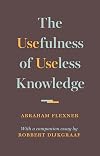
This little monograph gives us two related essays. The first essay is contemporary and written by Robbert Dijkgraaf, the present director of the Institute of Advanced Studies. In this essay he serves up a history lesson of sorts, giving us some autobiographical detail on Abraham Flexner, the founding director of the Institute of Advanced Studies. He goes into the Flexner’s beliefs which was the founding principles of the Institute as well as its role in the history of American innovation show more as the place where creativity and research into basic and fundamental research takes place. He goes into how the founding belief in the meaning of the title forms the guiding principle of the institution. He very nicely frames Flexner’s basic belief. We are then given Flexner’s original essay on why seemingly useless knowledge is more important than just practical knowledge; indeed, should be the bedrock principles of scientific and humanities research in the United States.
You can read the passion and purpose in Flexner’s essay, he resolutely defends his idea against every plausible objection anyone can raise in opposition. It is inspirational to read this essay, written in 1939, it demonstrates just how prescient Flexner was in insisting that the Institute of Advanced Studies be the exception to the pragmatic tendencies of American science and resist the commercial bent of the American mindset.
Dijkgraaf skillfully demonstrates, with the examples from the Institute’s history, of just how the useless knowledge being pursued by the researchers at the Institute end up contributing to the applied knowledge of the world. In a way, the contemporary essay serves as vindication of Flexner’s conviction.
This book will be read many times, as a beacon for myself when my belief for basic research is faltering. show less
You can read the passion and purpose in Flexner’s essay, he resolutely defends his idea against every plausible objection anyone can raise in opposition. It is inspirational to read this essay, written in 1939, it demonstrates just how prescient Flexner was in insisting that the Institute of Advanced Studies be the exception to the pragmatic tendencies of American science and resist the commercial bent of the American mindset.
Dijkgraaf skillfully demonstrates, with the examples from the Institute’s history, of just how the useless knowledge being pursued by the researchers at the Institute end up contributing to the applied knowledge of the world. In a way, the contemporary essay serves as vindication of Flexner’s conviction.
This book will be read many times, as a beacon for myself when my belief for basic research is faltering. show less
This is a fascinating paper about the importance of curiosity in fundamental discoveries. The pursuit of utility limits human curiosity and the freedom of scientists to explore. Flexner believed that scientists should not be bothered to produce utility but instead pursue problems out of sheer curiosity and eventually utility could be derived from their findings. He also pleads for the abolition of the word 'Use' when it comes to fundamental science. He believes that scientists should be free show more to focus on the problems that they find interesting without needing to worry about the immediate applicability of their discoveries. Science should be made for the sheer purpose of satisfying one’s curiosity.
"Thus it becomes obvious that one must be wary in attributing scientific discovery wholly to anyone person."
Almost all scientific discoveries are the fruition of the work of multiple people along several decades.
- Gauss’s “Non-Euclidian Geometry” seemingly had no practical application at the time. His work was essential to Einstein’s work on relativity without which we would not have satellites orbiting the earth today.
From Gauss to Einstein, to the practical use of satellites several centuries went by. This is one of the great examples that goes to show that major advancements in science, although they seem not to have immediate applicability, are able to completely change human lives several decades later.
- This paper was written in 1939 previous to the launch of the atomic bombs on August 6 and 9 of 1945. The atomic bomb was developed by a team of scientists, amongst the brightest minds at the time.
This is a very interesting video of Feynman discussing the "morality" of his contributions to the 'The Manhattan Project':
show less
"Thus it becomes obvious that one must be wary in attributing scientific discovery wholly to anyone person."
Almost all scientific discoveries are the fruition of the work of multiple people along several decades.
- Gauss’s “Non-Euclidian Geometry” seemingly had no practical application at the time. His work was essential to Einstein’s work on relativity without which we would not have satellites orbiting the earth today.
From Gauss to Einstein, to the practical use of satellites several centuries went by. This is one of the great examples that goes to show that major advancements in science, although they seem not to have immediate applicability, are able to completely change human lives several decades later.
- This paper was written in 1939 previous to the launch of the atomic bombs on August 6 and 9 of 1945. The atomic bomb was developed by a team of scientists, amongst the brightest minds at the time.
This is a very interesting video of Feynman discussing the "morality" of his contributions to the 'The Manhattan Project':
show less
This is a fascinating paper about the importance of curiosity in fundamental discoveries. The pursuit of utility limits human curiosity and the freedom of scientists to explore. Flexner believed that scientists should not be bothered to produce utility but instead pursue problems out of sheer curiosity and eventually utility could be derived from their findings. He also pleads for the abolition of the word 'Use' when it comes to fundamental science. He believes that scientists should be free show more to focus on the problems that they find interesting without needing to worry about the immediate applicability of their discoveries. Science should be made for the sheer purpose of satisfying one’s curiosity.
"Thus it becomes obvious that one must be wary in attributing scientific discovery wholly to anyone person."
Almost all scientific discoveries are the fruition of the work of multiple people along several decades.
- Gauss’s “Non-Euclidian Geometry” seemingly had no practical application at the time. His work was essential to Einstein’s work on relativity without which we would not have satellites orbiting the earth today.
From Gauss to Einstein, to the practical use of satellites several centuries went by. This is one of the great examples that goes to show that major advancements in science, although they seem not to have immediate applicability, are able to completely change human lives several decades later.
- This paper was written in 1939 previous to the launch of the atomic bombs on August 6 and 9 of 1945. The atomic bomb was developed by a team of scientists, amongst the brightest minds at the time.
This is a very interesting video of Feynman discussing the "morality" of his contributions to the 'The Manhattan Project':
(Click on this image to watch the video)
show less
"Thus it becomes obvious that one must be wary in attributing scientific discovery wholly to anyone person."
Almost all scientific discoveries are the fruition of the work of multiple people along several decades.
- Gauss’s “Non-Euclidian Geometry” seemingly had no practical application at the time. His work was essential to Einstein’s work on relativity without which we would not have satellites orbiting the earth today.
From Gauss to Einstein, to the practical use of satellites several centuries went by. This is one of the great examples that goes to show that major advancements in science, although they seem not to have immediate applicability, are able to completely change human lives several decades later.
- This paper was written in 1939 previous to the launch of the atomic bombs on August 6 and 9 of 1945. The atomic bomb was developed by a team of scientists, amongst the brightest minds at the time.
This is a very interesting video of Feynman discussing the "morality" of his contributions to the 'The Manhattan Project':
(Click on this image to watch the video)
show less
Thought provoking paper with one star deducted for pretentiousness that registered off the charts.
Lists
You May Also Like


Associated Authors
Statistics
- Works
- 14
- Also by
- 1
- Members
- 216
- Popularity
- #103,223
- Rating
- 3.8
- Reviews
- 4
- ISBNs
- 24
- Languages
- 2