
Lee Goldman (1)
Author of Goldman-Cecil Medicine
For other authors named Lee Goldman, see the disambiguation page.
Works by Lee Goldman
Too Much of a Good Thing: How Four Key Survival Traits Are Now Killing Us (2015) 64 copies, 5 reviews
Tagged
Common Knowledge
There is no Common Knowledge data for this author yet. You can help.
Members
Reviews
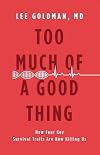
What an irresistibly interesting contradiction—four traits that evolved in early humans to increase survival are killing modern humans.
This book goes heavy on genetics, statistics and medical studies. If you enjoy science books that dig deep into a subject and logically lay out arguments and supporting evidence, you’ll enjoy this. The writing is clear and concise, and there isn’t much obscure terminology, so even if you don’t consider yourself scientifically minded but find your show more curiosity piqued, you should give it a go. It’s a lot of information to absorb, so it’s not a quick read (took me over a week to finish), but, hey, info laden books aren’t meant to be devoured in only one or two sittings.
Goldman’s explanation of how four evolutionary traits couldn’t keep up with the sudden and drastic changes in our environment and society over the past few hundred years and now work “too well” in such a way to be detrimental really made me look at modern diseases and health problems in a whole different light. I think one of the book’s most important takeaways is that some of today’s health problems aren’t a result of people being weak and lazy, but a result of the way our bodies evolved thousands of years ago. That isn’t to say the health problems are solely to blame on genetics, but we should be compassionate with the understanding that our genes make getting certain health problems under control an uphill battle.
Although the prognosis seems pretty grim, the book does end on a hopeful note by discussing how we treat diseases and health problems today, and what treatments the future may hold. show less
This book goes heavy on genetics, statistics and medical studies. If you enjoy science books that dig deep into a subject and logically lay out arguments and supporting evidence, you’ll enjoy this. The writing is clear and concise, and there isn’t much obscure terminology, so even if you don’t consider yourself scientifically minded but find your show more curiosity piqued, you should give it a go. It’s a lot of information to absorb, so it’s not a quick read (took me over a week to finish), but, hey, info laden books aren’t meant to be devoured in only one or two sittings.
Goldman’s explanation of how four evolutionary traits couldn’t keep up with the sudden and drastic changes in our environment and society over the past few hundred years and now work “too well” in such a way to be detrimental really made me look at modern diseases and health problems in a whole different light. I think one of the book’s most important takeaways is that some of today’s health problems aren’t a result of people being weak and lazy, but a result of the way our bodies evolved thousands of years ago. That isn’t to say the health problems are solely to blame on genetics, but we should be compassionate with the understanding that our genes make getting certain health problems under control an uphill battle.
Although the prognosis seems pretty grim, the book does end on a hopeful note by discussing how we treat diseases and health problems today, and what treatments the future may hold. show less
This book was enjoyable but only told me what I already knew in a lot of cases (I am dieting right now in an attempt to lose weight, so I do know a bit about all of this). The book explains how the survival traits of hunger, thirst, fear, and blood clotting are more detrimental to us in the modern age. They used to be traits that helped us to survive and live long enough to mate and reproduce, thereby spreading along our genes. Since the Industrial Era, we have needed these evolutionary show more advantages less and less. This has resulted in skyrocketing rates of obesity, hypertension, depression, and vascular diseases.
When it comes to solutions, Dr. Goldman isn't exactly putting his trust in human willpower. This makes sense, given the numbers of obese people that try to lose weight but fail. Changing a habit is really difficult to do seeing as how so many people yo-yo their weight back and forth. So another thing he suggests is that medical science will have to step up to the plate. As he says, we have survived for around 200,000 years before, and we can adapt to take care of it. So I suppose you could say it ends on a positive note. show less
When it comes to solutions, Dr. Goldman isn't exactly putting his trust in human willpower. This makes sense, given the numbers of obese people that try to lose weight but fail. Changing a habit is really difficult to do seeing as how so many people yo-yo their weight back and forth. So another thing he suggests is that medical science will have to step up to the plate. As he says, we have survived for around 200,000 years before, and we can adapt to take care of it. So I suppose you could say it ends on a positive note. show less
Evolution adapted us to survive in a harsh environment...at least long enough to reproduce. But we don't live in that environment any more. Our world is less violent, food and water are readily available (for most of us), childbirth is far safer, and we're less likely to die prematurely from injury or disease. The genetic adaptations that once helped protect us from starving or bleeding to death are now contributing to obesity, high blood pressure, stroke, heart attack, and (the author show more argues) anxiety, and depression. In this book, Lee Goldman points out some genetic traits that are now seemingly maladaptive and what we can do to live with them. It's well-written and informative. show less
Beyond dull and I'm not sure who the audience is. Full of very obvious points. I recommend "The Wild Life of Our Bodies" by Rob Dunn which covers much of the same territory but is infinitely more lively.
You May Also Like


Associated Authors
Statistics
- Works
- 12
- Members
- 581
- Popularity
- #43,162
- Rating
- 4.0
- Reviews
- 7
- ISBNs
- 87
- Languages
- 3