

John Ibbitson
Author of Empty Planet: The Shock of Global Population Decline
Works by John Ibbitson
Open and Shut: Why America Has Barack Obama, and Canada Has Stephen Harper (2009) 14 copies, 1 review
Tagged
Common Knowledge
- Birthdate
- 1955
- Gender
- male
- Education
- University of Toronto
- Occupations
- journalist
Political columnist - Organizations
- The Globe and Mail
- Awards and honors
- Governor General's Literary Award
Geoffrey Bilson Award for Historical Fiction for Young People - Nationality
- Canada
- Birthplace
- Gravenhurst, Ontario, Canada
- Places of residence
- Toronto, Ontario, Canada
Ottawa, Ontario, Canada - Associated Place (for map)
- Ontario, Canada
Members
Reviews

In Empty Planet: The Shock of Global Population Decline, Darrell Bricker, alongside co-author John Ibbitson, challenges the entrenched belief that humanity’s future will be one of rapid population growth. Instead, he argues that the world may be heading toward a future characterized by demographic decline.
From the opening pages, Empty Planet reads like a detective story—a search for clues hidden in decades of census data, economic trends, and sociological studies. Bricker guides the show more reader through the historical context of population trends, tracing humanity’s explosive growth during the twentieth century, only to reveal that past patterns give way to a new and unsettling reality. The book’s narrative unfolds methodically, combining hard data with engaging anecdotes that bring the numbers to life. I was surprised by his evidence: declining fertility rates in regions once considered the engines of relentless growth, shifts in cultural attitudes toward family size, and the subtle yet unavoidable impact of modern lifestyles on reproductive choices.
What makes Empty Planet compelling is its statistics and willingness to confront the implications of a shrinking global population. Bricker explores such a trend's societal, economic, and political ramifications. As I read, I could envision a future where aging populations, labor shortages, and possible adjustments to immigration policies compel nations to rethink long-held economic models. Indeed, many countries will be re-evaluating their immigration policies to buttress a declining population. The book serves as both a call to action and a forecast—a warning that many systems we take for granted are built on the shaky assumption of perpetual growth.
Yet, even as Bricker’s arguments gain momentum, the book doesn't avoid controversy. Critics might suggest that the interplay of culture, technology, and policy could lead to unexpected reversals of the trends Bricker outlines. Indeed, he acknowledges these possibilities, though he remains convinced that a downward trajectory is not only plausible but increasingly likely. This balance—presenting a strong thesis while recognizing the unpredictability of human behavior—adds an element of intellectual honesty to the narrative. Yes, it can get repetitive, and I would have liked to see more citations.
The style of Empty Planet is accessible, making complex demographic trends understandable to a broad audience. I appreciated how the book integrated personal stories, historical analysis, and policy critique into a cohesive narrative.
Empty Planet is both a cautionary tale and an invitation to reexamine our assumptions about progress. While the prospect of a declining population might seem alarming—especially in a world where more is often equated with better—Bricker challenges us to consider how such a shift might lead to new forms of societal organization and environmental stewardship. The narrative imparts a sense of urgency: we must prepare for a future that may be radically different from our past and present. show less
From the opening pages, Empty Planet reads like a detective story—a search for clues hidden in decades of census data, economic trends, and sociological studies. Bricker guides the show more reader through the historical context of population trends, tracing humanity’s explosive growth during the twentieth century, only to reveal that past patterns give way to a new and unsettling reality. The book’s narrative unfolds methodically, combining hard data with engaging anecdotes that bring the numbers to life. I was surprised by his evidence: declining fertility rates in regions once considered the engines of relentless growth, shifts in cultural attitudes toward family size, and the subtle yet unavoidable impact of modern lifestyles on reproductive choices.
What makes Empty Planet compelling is its statistics and willingness to confront the implications of a shrinking global population. Bricker explores such a trend's societal, economic, and political ramifications. As I read, I could envision a future where aging populations, labor shortages, and possible adjustments to immigration policies compel nations to rethink long-held economic models. Indeed, many countries will be re-evaluating their immigration policies to buttress a declining population. The book serves as both a call to action and a forecast—a warning that many systems we take for granted are built on the shaky assumption of perpetual growth.
Yet, even as Bricker’s arguments gain momentum, the book doesn't avoid controversy. Critics might suggest that the interplay of culture, technology, and policy could lead to unexpected reversals of the trends Bricker outlines. Indeed, he acknowledges these possibilities, though he remains convinced that a downward trajectory is not only plausible but increasingly likely. This balance—presenting a strong thesis while recognizing the unpredictability of human behavior—adds an element of intellectual honesty to the narrative. Yes, it can get repetitive, and I would have liked to see more citations.
The style of Empty Planet is accessible, making complex demographic trends understandable to a broad audience. I appreciated how the book integrated personal stories, historical analysis, and policy critique into a cohesive narrative.
Empty Planet is both a cautionary tale and an invitation to reexamine our assumptions about progress. While the prospect of a declining population might seem alarming—especially in a world where more is often equated with better—Bricker challenges us to consider how such a shift might lead to new forms of societal organization and environmental stewardship. The narrative imparts a sense of urgency: we must prepare for a future that may be radically different from our past and present. show less
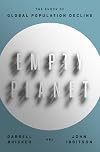
The authors are Canadian white male journalists, who seem to think that they understand some history and social science. They seem to think that their globe-trotting has given them real insight, too.
But the purported point of the book, that the fertility rate and the birth rate (which they admit to using as interchangeable terms) are falling, is a straw man fallacy. Yes, it's true that the number of humans on the planet is soon to plateau and then fall. Yes, that's going to take some show more adjustment. Anybody who is paying attention already knows that.
But it's undeniably a *good* thing! We are *already* far too many. Consider the authors' proposal that, to be green, we should all move to the cities, (and apparently) let the robots do the farming. Because then we can heat our homes more efficiently, as we'll share walls with our neighbors. Um, what about cooling our homes? What about our mental health due to nature deprivation and due to crowding? Of course 'gentleman farmers' and 'commuters' are less 'green' but the solution is not to have bigger cities, it's to have a lower population!
We need more people who keep buying stuff to keep the economy moving?! Wtf! No! Stuff is what is not green. We need to accept that eventually we will have a lower population and that our society will look much different than it does today. Either we'll make the adjustments ourselves as we go along, or plagues will help hasten our decline and make the adjustments more difficult.
My proposals to ease the adjustment include 1. easing the labor shortage in low-skilled work by having fewer franchises... eg we don't need eleven fast-food restaurants in a town of 30K. 2. raising the retirement age to match what longevity it was intended to reflect. 3. letting people choose their time of exit.* Oh, and getting more people to read speculative fiction to stretch their imaginations as to what kind of future they might be able to help shape, or at least expect to possibly share.
Anyway, to the book. I do admit that I did not read every word. I got to p. 63, trying really hard to find actual insights. And I read the epilogue. And I read the index, following the few leads that suggested that they'd point to something notable (they didn't), and noticing lack of mention of labor shortage, or racism, or much of anything else. And of course Covid's changed a heck of a lot and will absolutely continue to do so.
It does seem that the real purpose of the book is to persuade governments, especially those of countries like Japan and those in western Europe with rapidly aging populations, to welcome more immigrants and refugees. Of course I agree completely with them on this one. What made America great? Lots and lots of "huddled masses" of course.
But stupid statements like "progress only goes in one direction" just frustrate me. Look at the elimination of all but one abortion clinic in Missouri, and the attempts to overturn Roe v. Wade in Texas. Or "7 billion? We're chugging along with that number right now."
And on pp.61-2 there's a discussion of France v. Germany, ending with the statement that "Reduced fertility can be a mortal threat to national security." Implied, but tactfully left unsaid, is the suggestion that we have more babies so they'll grow up to be soldiers. Argh! Again, I say, better to work on adjusting a smaller population of humans to be less interested in war! **
*eg everyone in my family and most of my doctors know that nursing homes are bad places, even the more expensive ones, and sitting around in them waiting for mercy is a miserable experience all around. Kevorkian was def. on the right track.
**Note that this was published before Putin's invasion of the Ukraine. I sort of wonder what they say to that. Anyway, what I say is that it seems likely that if the Russian people were healthier and better educated and less impoverished they wouldn't have let Putin become powerful enough to do this.
---
tldr: I really wanted it to be an enlightening book, but the authors' limited understandings and perspectives made it just about worthless to me, and, I suspect, to most of you. I suspect that the high ratings from some of my GR friends are due to those friends believing that other people need to read it. I will move on to science books about the anthropocene and about a post-human planet. If I can find any by scientists.
https://www.theguardian.com/books/2021/aug/16/the-best-books-about-the-post-huma...
March 2022 show less
But the purported point of the book, that the fertility rate and the birth rate (which they admit to using as interchangeable terms) are falling, is a straw man fallacy. Yes, it's true that the number of humans on the planet is soon to plateau and then fall. Yes, that's going to take some show more adjustment. Anybody who is paying attention already knows that.
But it's undeniably a *good* thing! We are *already* far too many. Consider the authors' proposal that, to be green, we should all move to the cities, (and apparently) let the robots do the farming. Because then we can heat our homes more efficiently, as we'll share walls with our neighbors. Um, what about cooling our homes? What about our mental health due to nature deprivation and due to crowding? Of course 'gentleman farmers' and 'commuters' are less 'green' but the solution is not to have bigger cities, it's to have a lower population!
We need more people who keep buying stuff to keep the economy moving?! Wtf! No! Stuff is what is not green. We need to accept that eventually we will have a lower population and that our society will look much different than it does today. Either we'll make the adjustments ourselves as we go along, or plagues will help hasten our decline and make the adjustments more difficult.
My proposals to ease the adjustment include 1. easing the labor shortage in low-skilled work by having fewer franchises... eg we don't need eleven fast-food restaurants in a town of 30K. 2. raising the retirement age to match what longevity it was intended to reflect. 3. letting people choose their time of exit.* Oh, and getting more people to read speculative fiction to stretch their imaginations as to what kind of future they might be able to help shape, or at least expect to possibly share.
Anyway, to the book. I do admit that I did not read every word. I got to p. 63, trying really hard to find actual insights. And I read the epilogue. And I read the index, following the few leads that suggested that they'd point to something notable (they didn't), and noticing lack of mention of labor shortage, or racism, or much of anything else. And of course Covid's changed a heck of a lot and will absolutely continue to do so.
It does seem that the real purpose of the book is to persuade governments, especially those of countries like Japan and those in western Europe with rapidly aging populations, to welcome more immigrants and refugees. Of course I agree completely with them on this one. What made America great? Lots and lots of "huddled masses" of course.
But stupid statements like "progress only goes in one direction" just frustrate me. Look at the elimination of all but one abortion clinic in Missouri, and the attempts to overturn Roe v. Wade in Texas. Or "7 billion? We're chugging along with that number right now."
And on pp.61-2 there's a discussion of France v. Germany, ending with the statement that "Reduced fertility can be a mortal threat to national security." Implied, but tactfully left unsaid, is the suggestion that we have more babies so they'll grow up to be soldiers. Argh! Again, I say, better to work on adjusting a smaller population of humans to be less interested in war! **
*eg everyone in my family and most of my doctors know that nursing homes are bad places, even the more expensive ones, and sitting around in them waiting for mercy is a miserable experience all around. Kevorkian was def. on the right track.
**Note that this was published before Putin's invasion of the Ukraine. I sort of wonder what they say to that. Anyway, what I say is that it seems likely that if the Russian people were healthier and better educated and less impoverished they wouldn't have let Putin become powerful enough to do this.
---
tldr: I really wanted it to be an enlightening book, but the authors' limited understandings and perspectives made it just about worthless to me, and, I suspect, to most of you. I suspect that the high ratings from some of my GR friends are due to those friends believing that other people need to read it. I will move on to science books about the anthropocene and about a post-human planet. If I can find any by scientists.
https://www.theguardian.com/books/2021/aug/16/the-best-books-about-the-post-huma...
March 2022 show less
"Soylent Green is people!" a horrified New York detective, played by Charleton Heston, shouts in warning. A global population of eighty billion has ravaged the environment, leaving only a plankton-based food produced by the Soylent Corporation to sustain humanity. At least everyone *thought* it was plankton.
Soylent Green, released in 1973, was set in the year 2022. It was one of the long list of films, books, documentaries, and other entertainments based on the notion that overpopulation is show more destroying the planet's environment and outstripping the food supply, which must inevitably lead to an apocalypse.
The premise of this book, which my father-in-law loaned me, is that within the 21st century, the world's population will begin to decline, because birthrates have declined in not only "developed" but also "developing" nations. The authors support this hypothesis with statistics and anecdotal information from around the globe. They interviewed representative groups of young people, both educated and not, in a city on every continent. Brussels represents Europe; Seoul represents Asia; Nairobi represents Africa; Sao Paulo represents South America. Australia gets a brief shout-out, which is mostly focused on Indigenous populations. China & India share a chapter; the U.S. and Canada each get their own chapters.
As the world becomes more urban, birthrates drop. On a farm, children are an asset. In the city, they are a costly liability. Female education also leads to decreased birthrates, as women learn more about birth control and want to do more with their lives than just raise children. Again and again, the authors make their point, which I find completely believable. The global population will not continue to grow exponentially.
The question they don't answer is WHAT DOES THIS ALL MEAN? Several times, they hit on the point that an aging population is not sustainable (see Japan). Younger people are needed to make the money and pay for the services that support the old, especially with the retirement age reflecting an outdated life expectancy in many countries. Their solution? Do what Canada does!* They advocate selectively allowing immigration to lower the average age and increase the skilled working population. However, they acknowledge that this isn't practical in many countries (i.e. South Korea), where ethnicity is part of the cultural identity. What they don't address is how this policy affects the rest of the planet. If Canada is taking all the brightest young people from other countries, what happens to those countries?
They also don't really address the issue of climate change or depletion of resources. Here's the half-assed answer:
The world's oceans are also under tremendous stress. Overfishing, pollution of coastal waters from agricultural and urban runoff, and a host of other human abuses are disrupting the food chain. The damage extends from bleached coral to endangered whales. The sooner we act to limit the warming of the air, the better it will be for our oceans. But ultimately, reducing the size of the human population is the best prescription for protecting the seas. Fewer mouths to eat fish.
Fewer mouths to eat fish. Wow. And this:
The solution to producing less carbon dioxide might ultimately be producing fewer humans.
We might predict a future in which much of a shrinking humanity lives in high-rise apartment buildings in large cities, with much of the land between cities gone back to bush. Tropical rainforests and northern boreal forests will expand, capturing carbon and contributing oxygen. Renewable forms of energy will lessen and ultimately eliminate the need for fossil fuels. Urbanization, innovation, and depopulation might be the best solution to halting the march of climate change. With any luck, a baby born today--or at worst one born a decade or two from now--will reach middle age in a cleaner, healthier world.
Okay, fewer people and little luck and the world will just heal itself. Sweet!
But what about those aging populations stuck in the countries where climate change complicates matters even more? Beside a lack of answers, there's a lack of global empathy that I find disturbing.
*Both authors are Canadian. Darrell Bricker is the CEO of "the world's leading social and public opinion research firm." John Ibbitson is a playwright/author/journalist whose non-fiction seems to focus primarily on politics.
Book #3 for Nonfiction November 2020 show less
Soylent Green, released in 1973, was set in the year 2022. It was one of the long list of films, books, documentaries, and other entertainments based on the notion that overpopulation is show more destroying the planet's environment and outstripping the food supply, which must inevitably lead to an apocalypse.
The premise of this book, which my father-in-law loaned me, is that within the 21st century, the world's population will begin to decline, because birthrates have declined in not only "developed" but also "developing" nations. The authors support this hypothesis with statistics and anecdotal information from around the globe. They interviewed representative groups of young people, both educated and not, in a city on every continent. Brussels represents Europe; Seoul represents Asia; Nairobi represents Africa; Sao Paulo represents South America. Australia gets a brief shout-out, which is mostly focused on Indigenous populations. China & India share a chapter; the U.S. and Canada each get their own chapters.
As the world becomes more urban, birthrates drop. On a farm, children are an asset. In the city, they are a costly liability. Female education also leads to decreased birthrates, as women learn more about birth control and want to do more with their lives than just raise children. Again and again, the authors make their point, which I find completely believable. The global population will not continue to grow exponentially.
The question they don't answer is WHAT DOES THIS ALL MEAN? Several times, they hit on the point that an aging population is not sustainable (see Japan). Younger people are needed to make the money and pay for the services that support the old, especially with the retirement age reflecting an outdated life expectancy in many countries. Their solution? Do what Canada does!* They advocate selectively allowing immigration to lower the average age and increase the skilled working population. However, they acknowledge that this isn't practical in many countries (i.e. South Korea), where ethnicity is part of the cultural identity. What they don't address is how this policy affects the rest of the planet. If Canada is taking all the brightest young people from other countries, what happens to those countries?
They also don't really address the issue of climate change or depletion of resources. Here's the half-assed answer:
The world's oceans are also under tremendous stress. Overfishing, pollution of coastal waters from agricultural and urban runoff, and a host of other human abuses are disrupting the food chain. The damage extends from bleached coral to endangered whales. The sooner we act to limit the warming of the air, the better it will be for our oceans. But ultimately, reducing the size of the human population is the best prescription for protecting the seas. Fewer mouths to eat fish.
Fewer mouths to eat fish. Wow. And this:
The solution to producing less carbon dioxide might ultimately be producing fewer humans.
We might predict a future in which much of a shrinking humanity lives in high-rise apartment buildings in large cities, with much of the land between cities gone back to bush. Tropical rainforests and northern boreal forests will expand, capturing carbon and contributing oxygen. Renewable forms of energy will lessen and ultimately eliminate the need for fossil fuels. Urbanization, innovation, and depopulation might be the best solution to halting the march of climate change. With any luck, a baby born today--or at worst one born a decade or two from now--will reach middle age in a cleaner, healthier world.
Okay, fewer people and little luck and the world will just heal itself. Sweet!
But what about those aging populations stuck in the countries where climate change complicates matters even more? Beside a lack of answers, there's a lack of global empathy that I find disturbing.
*Both authors are Canadian. Darrell Bricker is the CEO of "the world's leading social and public opinion research firm." John Ibbitson is a playwright/author/journalist whose non-fiction seems to focus primarily on politics.
Book #3 for Nonfiction November 2020 show less

This coming-of-age story really captures (I think) life in a small, cottage town. While some people settle quite happily into a life of seasonal work where everyone knows you and your family, others (like our protagonist) struggle to realize their dreams or ambitions. Mr. Ibbitson has given us an intriguing look at how a summer cottages influences the life of a young man.
Lists
Awards


You May Also Like


Associated Authors
Statistics
- Works
- 18
- Members
- 491
- Popularity
- #50,319
- Rating
- 3.6
- Reviews
- 18
- ISBNs
- 60
- Languages
- 3