
John Boileau
Author of Old Enough to Fight: Canada's Boy Soldiers in the First World War
About the Author
Image credit: thechronicleherald.ca
Works by John Boileau
Too Young to Die: Canada's Boy Soldiers, Sailors and Airmen in the Second World War (2016) 9 copies, 1 review
Samuel Cunard: Nova Scotia's Master of the North Atlantic (Formac Illustrated History) (2006) 7 copies
Fastest in the World: The Saga of Canada's Revolutionary Hydrofoils (Formac Illustrated History) (2004) 6 copies
Canada's Soldiers in South Africa: Tales from the Boer War, 1899-1902 (Amazing Stories) (2011) 5 copies
Historic Eastern Passage: Including Imperoyal, Shearwater, South East Passage, Cow Bay, McNab's Island, Lawlor's Island and Devil's Island (2007) 4 copies
Amazing Atlantic Canadian Kids: Awesome Stories of Bravery and Adventure (Amazing Atlantic Canadians) (2019) 4 copies, 1 review
Tagged
Common Knowledge
- Gender
- male
- Occupations
- historian
Colonel, Canadian Forces - Organizations
- Canadian Army
- Short biography
- JOHN BOILEAU is a retired Canadian army colonel and author of ten books and nearly 300 articles. He is a frequent commentator on military issues for radio and television and a lecturer to service organizations and historical societies. In 2010 the Minister of National Defence appointed him Honorary Lieutenant-Colonel of the Halifax Rifles. He lives in Nova Scotia.
- Nationality
- Canada
- Places of residence
- Halifax, Nova Scotia, Canada
- Associated Place (for map)
- Nova Scotia, Canada
Members
Reviews
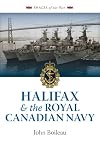
If someone would have suggested to me that a history of Halifax OR the Royal Canadian Navy could even be remotely contained within 198 pages, I would have scoffed at them. Yet, that is exactly what former soldier and military historian John Boileau has achieved in Halifax & the Royal Canadian Navy (Nimbus 2010).
Boileau takes us from the very humble beginnings of Canada’s naval service to the acquisition of the Halifax class patrol frigates and the Victoria class submarines. He also touches show more on women in the navy and the vital role they have played in its history.
By focusing on the main events throughout the navy’s history and expounding on those where necessary, we are taken on a historic voyage of discovery witnessing the birth and coming of age of the Royal Canadian Navy and its symbiotic relationship with Halifax, Nova Scotia.
Canada’s lead in submarine hunting, invention of the bear trap allowing heavy helicopters to operate from impossibly small destroyers in almost all weather, and the important role played by the navy’s men and women during the Cuban missile crises (in spite of the Prime Minister’s wishes) are all well documented. For most readers, this will be their first taste of the Canadian Navy’s actions then.
We are also shown the navy from a personal perspective. John shows us how the lives of sailors changed over the decades, and how history and politicians affected the life of everyone, from lowly seaman to admiral.
Boileau does not hide his contempt for unification, nor should he, but on a happy note, his wish that ‘with a stroke of a pen’ the Conservative government had re-established the historic names of the Royal Canadian Navy and Royal Canadian Air Force, was granted, albeit too late to be included in his book.
Well researched, well written and peppered with quality images, Halifax & the Royal Canadian Navy belongs on every Canadian’s book shelf as a reminder that in some things, Canada was and still is a world leader. For those who seek further information on the history of the navy and Halifax, Boileau has included a lengthy Bibliography in its usual place at the back of the book and to add even further to an already great work, the author has thoughtfully included a chapter titled ‘Naval Nomenclature for the Novice’ at the front of the book. Bravo Zulu Mr. Boileau!
With the new ship building program well on the way, and HMCS Victoria’s recent live firing of a torpedo, finally establishing the ‘new’ submarines as an operational part of it, the future does indeed seem bright for Canada’s navy.
www.daniellittle.com show less
Boileau takes us from the very humble beginnings of Canada’s naval service to the acquisition of the Halifax class patrol frigates and the Victoria class submarines. He also touches show more on women in the navy and the vital role they have played in its history.
By focusing on the main events throughout the navy’s history and expounding on those where necessary, we are taken on a historic voyage of discovery witnessing the birth and coming of age of the Royal Canadian Navy and its symbiotic relationship with Halifax, Nova Scotia.
Canada’s lead in submarine hunting, invention of the bear trap allowing heavy helicopters to operate from impossibly small destroyers in almost all weather, and the important role played by the navy’s men and women during the Cuban missile crises (in spite of the Prime Minister’s wishes) are all well documented. For most readers, this will be their first taste of the Canadian Navy’s actions then.
We are also shown the navy from a personal perspective. John shows us how the lives of sailors changed over the decades, and how history and politicians affected the life of everyone, from lowly seaman to admiral.
Boileau does not hide his contempt for unification, nor should he, but on a happy note, his wish that ‘with a stroke of a pen’ the Conservative government had re-established the historic names of the Royal Canadian Navy and Royal Canadian Air Force, was granted, albeit too late to be included in his book.
Well researched, well written and peppered with quality images, Halifax & the Royal Canadian Navy belongs on every Canadian’s book shelf as a reminder that in some things, Canada was and still is a world leader. For those who seek further information on the history of the navy and Halifax, Boileau has included a lengthy Bibliography in its usual place at the back of the book and to add even further to an already great work, the author has thoughtfully included a chapter titled ‘Naval Nomenclature for the Novice’ at the front of the book. Bravo Zulu Mr. Boileau!
With the new ship building program well on the way, and HMCS Victoria’s recent live firing of a torpedo, finally establishing the ‘new’ submarines as an operational part of it, the future does indeed seem bright for Canada’s navy.
www.daniellittle.com show less
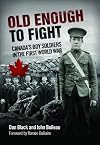
In 2014, the 100th anniversary of the start of WWI, I researched the war for a term paper and a museum display. Much information came to light of little known stories of the war. Of those stories I was particularly drawn to the ones about the underage soldiers who found a way to enlist and fight. A particularly poignant story was that of Herbert Bradley who joined up and fought until he was sent back home after it was discovered that he was underage. After all that, he died in 1918 of the show more Spanish flu at age 16.
As I was already interested in the stories of underage soldiers, I picked up "Old Enough to Fight" in part to see if the soldiers from Port Coquitlam were mentioned (they weren’t) but also in part to see how wide spread underage service was in WWI. According to Black and Boileau there were many boy soldiers who fought and the writers show us how prevalent they were as they take us through the battles that Canada fought by naming the teenagers who were there, many of whom died.
This book is not a mere catalogue of names; it shows us the boys in action, paying tribute to their contributions to the war effort. It also tells the story of Canada’s (and Newfoundland’s) war and the effect that the war had on the people of Canada and a whole generation. Canada matured as a country during the course of the war and the boys who joined matured as well. As Romeo Dellaire writes in his forward to the book, “The children involved in Canada’s War effort may have entered as innocent boys looking for adventure, honour, and purpose, but they underwent a maturation that many would not have originally anticipated.” show less
As I was already interested in the stories of underage soldiers, I picked up "Old Enough to Fight" in part to see if the soldiers from Port Coquitlam were mentioned (they weren’t) but also in part to see how wide spread underage service was in WWI. According to Black and Boileau there were many boy soldiers who fought and the writers show us how prevalent they were as they take us through the battles that Canada fought by naming the teenagers who were there, many of whom died.
This book is not a mere catalogue of names; it shows us the boys in action, paying tribute to their contributions to the war effort. It also tells the story of Canada’s (and Newfoundland’s) war and the effect that the war had on the people of Canada and a whole generation. Canada matured as a country during the course of the war and the boys who joined matured as well. As Romeo Dellaire writes in his forward to the book, “The children involved in Canada’s War effort may have entered as innocent boys looking for adventure, honour, and purpose, but they underwent a maturation that many would not have originally anticipated.” show less
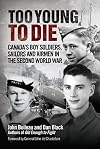
When Canada went to war in 1939, many teenage males attempted to join up. Some succeeded by forging documents, lying about their age, trying again in different cities when turned down or in the case of seamen, joining the merchant marine which had no age restrictions. This resulted in some Canadian soldiers dying in combat at the age of 15 and 16 years of age. Donald Fowler of Kingston enrolled in the Army at the age of 14. Private Alexander Rose enlisted at age 16 and was fighting in Italy show more when he was 17. When his parents tried to have him sent home because he was under age and had three brothers in fighting units, red tape delayed action on his case and he was killed before he could be sent home.
The book is loaded with case histories like this one. Despite the tough topic, the book is very readable. show less
The book is loaded with case histories like this one. Despite the tough topic, the book is very readable. show less
2.5 stars
This followed kids that were too young, officially, to volunteer to fight in World War I (mostly 14 to 17 years old or so), and it included both Canadian soldiers as well as soldiers from Newfoundland (as Newfoundland was not yet part of Canada).
My low rating is primarily because of the automated computer listening, so it was difficult to focus. And so there were so many gaps that I missed. There were also plenty of pictures included that I really didn’t get to look at. I suspect show more I would have rated it much higher had I actually read it, and I would like to re-read it in November for Remembrance Day. show less
This followed kids that were too young, officially, to volunteer to fight in World War I (mostly 14 to 17 years old or so), and it included both Canadian soldiers as well as soldiers from Newfoundland (as Newfoundland was not yet part of Canada).
My low rating is primarily because of the automated computer listening, so it was difficult to focus. And so there were so many gaps that I missed. There were also plenty of pictures included that I really didn’t get to look at. I suspect show more I would have rated it much higher had I actually read it, and I would like to re-read it in November for Remembrance Day. show less
Awards

Statistics
- Works
- 16
- Members
- 120
- Popularity
- #165,355
- Rating
- 3.4
- Reviews
- 7
- ISBNs
- 20