
Robert Jungk (1913–1994)
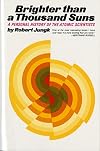
Author of Brighter than a Thousand Suns: A Personal History of the Atomic Scientists
About the Author
Works by Robert Jungk
Brighter than a Thousand Suns: A Personal History of the Atomic Scientists (1956) 456 copies, 10 reviews
Giovanni Boccaccio 1313 bis Christoph Columbus um 1451 : 14. - 15. Jahrhundert (1977) — Contributor — 3 copies
Und Wasser bricht den Stein : streitbare Beiträge zu drängenden Fragen der Zeit (1986) 2 copies, 1 review
Der Jahrtausendmensch: Bericht aus den Werkstätten der neuen Gesellschaft (German Edition) (2016) 2 copies
Die Zukunft hat schon begonnen / Heller als tausend Sonnen / Strahlen aus der Asche — Author — 2 copies
Technologie der Zukunft 1 copy
O Futuro Já Começou 1 copy
Svetlejše od tisoč sonc 1 copy
Damit wir nicht untergehen 1 copy
L'onda pacifista 1 copy
El Estado nuclear 1 copy
Associated Works
Das Science Fiction Jahr 1994. Ein Jahrbuch für den Science Fiction Leser (1994) — Contributor — 10 copies
Tagged
Common Knowledge
- Canonical name
- Jungk, Robert
- Legal name
- Baum, Robert
- Other names
- Pierhal, Jean
Lefèvre, F.
Stael, Arnold de
Oz, Bert
Jungk-Weyer, Robert
Baum-Jungk, Robert - Birthdate
- 1913-05-11
- Date of death
- 1994-07-14
- Gender
- male
- Education
- University of Berlin
Sorbonne
University of Zurich - Occupations
- journalist
writer
Holocaust survivor
social activist
autobiographer
historian (show all 7)
peace campaigner - Awards and honors
- Right Livelihood Award (1986)
- Relationships
- Jungk, Peter Stephan (son)
Weiss, Peter (# 1, friend) - Short biography
- Robert Jungk, né Baum, was born to a Jewish family in Berlin, Germany. His parents were actors Elli Branden (Sara Bravo) and Max Jung (David Baum). Robert studied philosophy at the University of Berlin in 1932-1933. In February 1933, one day after the Reichstag fire, he was arrested by the Nazis. He was released shortly, but realizing that Germany was now too dangerous for him, he moved to Paris. There he studied psychology and sociology at the Sorbonne, and then went in 1938 to the University of Zurich, where he worked on a doctorate in philology. During World War II, Jungk wrote for the clandestine anti-Nazi press under various pseudonyms as well as for Swiss publications. In 1945, threatened with deportation back to Germany, Jungk fled with the help of friends to the USA. There he launched a career as a current affairs and science writer for American and European newspapers and book author. His first book, The Future Has Begun, was published in 1952 (he later described himself as a futurologist). His 1956 book Brighter than a Thousand Suns: A Personal History of the Atomic Scientists, was an international bestseller. In 1957, Jungk moved to Austria with his wife Ruth Suschitzky. He received the Right Livelihood Award in 1986 for "struggling indefatigably on behalf of peace, sane alternatives for the future and ecological awareness." In 1992, he ran unsuccessfully for president of Austria as the Green Party candidate.
- Nationality
- Austria
USA - Birthplace
- Berlin, Germany
- Places of residence
- Paris, France
Prague, Czechoslovakia
Berlin, Germany
Zurich, Switzerland
Washington, D.C., USA
Los Angeles, California, USA - Place of death
- Salzburg, Austria
- Burial location
- Salzburg, Austria
Members
Reviews
An extremely fascinating read. Published over 60 years ago, it has the quality of feeling both like a historical document and a work written with time to contemplate the consequences of the atomic bomb. It is both riveting and sobering. The storytelling skill of the author kept me intellectually and emotionally involved from start to finish. I originally read it as an undergrad roughly thirty years ago. Back then, I was more awed by the lives of the young scientists but this time I was more show more struck by the hubris of scientists and government officials. The recent release of the film about Oppenheimer drew me back to this book. While I highly recommend the book, I would suggest both to myself and others to follow up this reading with some equally well written account published another twenty or more years later. show less

Jungk is a fine writer and "spiritual" voice. He was a 19-year old student in Berlin when Hitler became Chancellor. He shows prescience; but not recognizable methodology or historical perspective. As if materialism was a deformity. He is a great journalist, and utterly betrayed by The West. Now, a science-phobe in a vacuum, forgetting "nature" in his nostalgia for what never was. Of course, secularism IS a form of suicide; he offers great hope, although no one will open that door.
One of the New Scientist Top 25 Most Influential Popular Science Books (all of which I plan to read eventually), and mentioned in a recent read by Martin Gardner.
Fascinating. Part history, part biography, part political commentary, part social commentary, and part melodrama ("But Teller was not made to march with the rank and file.") unkind to Oppenheimer, but then the times and history were unkind...an unkindness that unfortunately passed to his children, or at least his daughter.
Jungk show more seemed at times in this English translation full of adoration for these scientists and at other times condemning. I wonder if the German (Jungk was Austrian) original was as lyrical, poetic, or dramatic as the translation. Though I took German in high school, I remember near none and have no intention of reading this in its original language, so must be content with this. Again, fascinating...and as a young man, I might have read it with less of a skeptical eye. Still, an enjoyable read. show less
Fascinating. Part history, part biography, part political commentary, part social commentary, and part melodrama ("But Teller was not made to march with the rank and file.") unkind to Oppenheimer, but then the times and history were unkind...an unkindness that unfortunately passed to his children, or at least his daughter.
Jungk show more seemed at times in this English translation full of adoration for these scientists and at other times condemning. I wonder if the German (Jungk was Austrian) original was as lyrical, poetic, or dramatic as the translation. Though I took German in high school, I remember near none and have no intention of reading this in its original language, so must be content with this. Again, fascinating...and as a young man, I might have read it with less of a skeptical eye. Still, an enjoyable read. show less

This book focuses on the bombing of Hiroshima and the aftermath and rebuiding of the city and all the social problems. It features quite a lot of personal accounts and is told through the stories of particular survivors as well as setting out the tangled political and economic problems that beset Hiroshima afterwards. As with all books about the atomic bombs dropped on Japan, it is a harrowing and saddening read.
Lists
Awards

You May Also Like


Associated Authors
Statistics
- Works
- 48
- Also by
- 4
- Members
- 732
- Popularity
- #34,694
- Rating
- 3.9
- Reviews
- 17
- ISBNs
- 69
- Languages
- 11
- Favorited
- 1