
Stephen Krensky
Author of Christopher Columbus (Step into Reading)
About the Author
Stephen Krensky is the author of more than 100 books for children, including DK Biography: Benjamin Franklin, DK Biography: Barack Obama, and works on George Washington and the Wright brothers. He lives in Lexington, Massachusetts, with his wife, Joan, and their family.
Series
Works by Stephen Krensky
Children of the Earth and Sky: Five Stories About Native American Children (1992) 801 copies, 2 reviews
Arthur and the Crunch Cereal Contest: A Marc Brown Arthur Chapter Book 4 (1998) 747 copies, 6 reviews
Children of the Wind and Water: Five Stories About Native American Children (1994) — Author — 562 copies, 1 review
Arthur and the Perfect Brother: A Marc Brown Arthur Chapter Book 21 (Arthur Chapter Books) (2000) 297 copies, 1 review
The Sweet Story of Hot Chocolate!: Ready-to-Read Level 3 (History of Fun Stuff) (2014) 98 copies, 1 review
Striking It Rich: Ready-To-Read Level 3: The Story Of The California Gold Rush (1996) 80 copies, 2 reviews
Arthur and the 1,001 Dads: A Marc Brown Arthur Chapter Book 28 (Arthur Chapter Books) (2003) 54 copies
Lionel in the Winter: Puffin Easy-to-Read Level 3 (Easy-to-Read, Puffin) (1994) 47 copies, 2 reviews
Arthur Loses His Marbles: A Marc Brown Arthur Chapter Book 31 (Marc Brown Arthur Chapter Books) (2004) 46 copies, 2 reviews
Comic Book Century: The History of American Comic Books (People's History) (2008) 32 copies, 1 review
What Do You See?: A Lift-the-Flap Book About Endangered Animals (Little Green Books) (2009) 11 copies
Lizzie Newton and the San Francisco Earthquake (History Speaks: Picture Books Plus Reader's Theater) (2010) 10 copies
The Bedtime Book of Magical Creatures: An Introduction to More than 100 Creatures from Legend and Folklore (The Bedtime Books) (2024) 9 copies, 2 reviews
The Absolute Worst Vacation Ever 7 copies
Filbert and the Tiger 5 copies
Seasick 5 copies
All about Snow and Ice 4 copies
Cookie, The 4 copies
Hide and Seek 4 copies
My Lazy Cat, Henrietta 4 copies
Amazing Annie: The Spectacular and Mostly True Adventures of Annie Kopchovsky (2025) 4 copies, 2 reviews
Explorers on the Move 3 copies
Christopher Columbus (Step into Reading, Step 3, Grades 1-3) by Stephen Krensky (2009-06-18) 3 copies
On My Own Folklore:Calamity Jane 2 copies
Aurthur and the Race to Read 2 copies
Authur and the No-Brainer 2 copies
Authur and the Crunch Cereal Contest 2 copies
Binky Rules 1 copy
Bears First Winter Audio CD 1 copy
Lionel and Louise 1 copy
Scrunch the Caterpillar 1 copy
Home Sweet Home 1 copy
The Great Detective 1 copy
El meu primer llibre de criatures fantàstiques: Descobreix els secrets de més de 100 éssers màgics i llegendaris (2025) 1 copy
Arthur and the World Recordf 1 copy
TIME for Kids: Money and Finance Field Guide: A How-To Book on Earning, Saving, and Spending Money (2025) 1 copy
Vegetables 1 copy
Eeyore Has a Birthday 1 copy
Associated Works
Cricket Magazine, Vol. 5, No. 10, June 1978 — Contributor — 3 copies
Tagged
Common Knowledge
- Legal name
- Krensky, Stephen Alan
- Birthdate
- 1953-11-25
- Gender
- male
- Education
- Hamilton College
- Occupations
- children's book author
- Nationality
- USA
- Birthplace
- Boston, Massachusetts, USA
- Places of residence
- Lexington, Massachusetts, USA
- Associated Place (for map)
- Massachusetts, USA
Members
Reviews

A little evergreen tree, somewhat hunched and missing a few branches, longs to be taken home from the Christmas tree lot by someone who loves the holiday as much as it does in this sweet seasonal tale from author Stephen Krensky and illustrator Pascal Campion. As the other trees on the lot disappear, our arboreal hero keeps hoping, until eventually it stands alone—the last tree, solitary and forlorn, offered to the public for free. Snoozing in the falling snow on Christmas Eve, it is show more unprepared when someone arrives who does indeed love the holiday as much as it does...
Picked up on a whim from the Christmas display in my public library's children's room, largely because I was drawn to the cover, and to the hint of melancholy in the title, The Last Christmas Tree pairs a heartwarming story with bright, colorful illustrations. Stories about evergreens and their experiences as Christmas trees are not so uncommon in the world of children's letters. From stories like Ursula Moray Williams' The Good Little Christmas Tree, in which the eponymous arboreal hero attempts to provide all the holiday delights for its family, to Annie Silvestro's The Christmas Tree Who Loved Trains, about a pine tree with a fondness for locomotives, such stories abound! That said, Krensky's tale was the first I've seen in which a tree is selected bySanta , specifically because both hold Christmas in their hearts. In any case, I found the conclusion here very sweet, and thought that the artwork, created digitally, captured the sense of motion and the frenzy of colors and lights around the tree, both when it was standing still, and when it was also in motion. Recommended to picture book audiences who enjoy holiday stories about homeless creatures finding a home and a happy ending. show less
Picked up on a whim from the Christmas display in my public library's children's room, largely because I was drawn to the cover, and to the hint of melancholy in the title, The Last Christmas Tree pairs a heartwarming story with bright, colorful illustrations. Stories about evergreens and their experiences as Christmas trees are not so uncommon in the world of children's letters. From stories like Ursula Moray Williams' The Good Little Christmas Tree, in which the eponymous arboreal hero attempts to provide all the holiday delights for its family, to Annie Silvestro's The Christmas Tree Who Loved Trains, about a pine tree with a fondness for locomotives, such stories abound! That said, Krensky's tale was the first I've seen in which a tree is selected by

This book is appropriately shelved in the "Holiday" section of my local public library because it is much more holiday fable than history. It is two fables in one, first a story of a Polish soldier at Valley Forge celebrating Hanukkah, and then the Hanukkah story that the soldier tells to a passing General Washington, which improves the general's mood somewhat.
I checked it out for the illustrations by Greg Harlin, which are very good. There are nine very wide landscape paintings which occupy show more all of one page and over half of its opposite page as well as two instances where there are separate paintings on each page. Where the story is about Valley Forge, the page background is blue and conveys a wintry feeling; for the Hanukkah story the page background is warmly golden as befits a sunny, mostly desert country.
One page depicts a battle between the continental army and the British regulars, the next page depicts the Greek soldiers facing off against the rebellious Maccabee army. Because this is a children's picture book, the battle scenes are dramatic but carnage-free. There is a great deal of attention to period detail, as is characteristic of Harlin's work, but the soldiers in both illustrations are cleaner and more uniformly dressed than they would have really been.
In one painting, Harlin uses shading to juxtapose the present with the past. General Washington is sitting down opposite the Polish soldier; in between the two foreground figures in full color is an image of the recent past in muted browns and yellows only as the soldier hopefully steps off a ship seeking a life free of religious persecution.
When I was young, I believed that all of the stories of the Old Testament came from a pre-historic past. But the story of the Maccabees is from a thousand years after the story of Moses. In this time, the empire of Alexander of Macedon had fractured into several fragment empires which fought among themselves as well as against the encroaching power of Rome in the West and various enemies in the East. The Hanukkah story, although wrapped up in legend, is also definitely part of history, as is the story of Valley Forge.
I think that the illustrations of the Hanukkah story are, perhaps, not so historically accurate as the illustrations of the Valley Forge part. The Greek soldiers in the battle scene are correctly depicted, I think: the cavalry lack stirrups, the infantry are wearing linen body armor and carrying the very long pikes that soldiers in the Macedonian army would have carried. But in the scene in which some Jews are being forced to worship a Greek deity, the soldiers are wearing uncovered metal armor which seems an impractical choice given the blazing sun. The illustrations of the Greek sculpture are good, but the victorious Jews are depicted dragging a slightly broken sculpture of Athena out of the Jewish temple. Why Athena? The only explanation I can come up with is that the most famous of all Greek temples, the Parthenon, was dedicated to Athena, and the illustrator thought that young children might be familiar with pictures of the Parthenon sculpture.
On the other hand, the Valley Forge illustrations are as close to reality as practicable in this story book. The soldiers are ragged. The small fires do not look like they yield much warmth. General Washington is either powdering his hair or wearing a wig and he wears the pale blue sash which distinguishes him as the Commander-in-Chief.
I enjoy the extraordinary occurrences of legend. Even the most mundane and convenient things like the goats of Thor, which Thor can slaughter and eat every evening, but which come to life the next day to pull his chariot, are pretty exciting. But miracles, the suspension of the natural law by a serious god for some divine purpose, never thrill me. In the Hanukkah story, the oil for keeping the candles alight lasts 8 times as long as it would have without a miracle. This is a shop keeper's dream, and not very glorious to me. If only the same were to happen to my natural gas supply this winter, that would really be worth celebrating.
While this story has no very strong support in the historical record it is true in spirit. George Washington was brought up in a Christian household and knew his Old Testament; he would have readily seen parallels between the story of the Maccabee rebellion and his own. Thomas Jefferson wished to put an image of the Israelites crossing the Red Sea to escape the Egyptian army under its tyrant Pharaoh on the Great Seal of the United States. Clearly he saw a Biblical parallel in the revolt of the colonies and their establishment of a separate country.
And finally, it is notable that an organization of Jewish businessmen sent a letter to the Constitutional Convention asking, politely, that the framers refrain from making them second-class citizens in the new country by establishing a national religion which would, perforce, exclude them. There is no test act in the Constitution, and the Bill of Rights includes an article prohibiting the establishment of a national religion. So our possibly apocryphal Polish soldier was permitted by law to practice his religion in peace, assuming he survived the war. show less
I checked it out for the illustrations by Greg Harlin, which are very good. There are nine very wide landscape paintings which occupy show more all of one page and over half of its opposite page as well as two instances where there are separate paintings on each page. Where the story is about Valley Forge, the page background is blue and conveys a wintry feeling; for the Hanukkah story the page background is warmly golden as befits a sunny, mostly desert country.
One page depicts a battle between the continental army and the British regulars, the next page depicts the Greek soldiers facing off against the rebellious Maccabee army. Because this is a children's picture book, the battle scenes are dramatic but carnage-free. There is a great deal of attention to period detail, as is characteristic of Harlin's work, but the soldiers in both illustrations are cleaner and more uniformly dressed than they would have really been.
In one painting, Harlin uses shading to juxtapose the present with the past. General Washington is sitting down opposite the Polish soldier; in between the two foreground figures in full color is an image of the recent past in muted browns and yellows only as the soldier hopefully steps off a ship seeking a life free of religious persecution.
When I was young, I believed that all of the stories of the Old Testament came from a pre-historic past. But the story of the Maccabees is from a thousand years after the story of Moses. In this time, the empire of Alexander of Macedon had fractured into several fragment empires which fought among themselves as well as against the encroaching power of Rome in the West and various enemies in the East. The Hanukkah story, although wrapped up in legend, is also definitely part of history, as is the story of Valley Forge.
I think that the illustrations of the Hanukkah story are, perhaps, not so historically accurate as the illustrations of the Valley Forge part. The Greek soldiers in the battle scene are correctly depicted, I think: the cavalry lack stirrups, the infantry are wearing linen body armor and carrying the very long pikes that soldiers in the Macedonian army would have carried. But in the scene in which some Jews are being forced to worship a Greek deity, the soldiers are wearing uncovered metal armor which seems an impractical choice given the blazing sun. The illustrations of the Greek sculpture are good, but the victorious Jews are depicted dragging a slightly broken sculpture of Athena out of the Jewish temple. Why Athena? The only explanation I can come up with is that the most famous of all Greek temples, the Parthenon, was dedicated to Athena, and the illustrator thought that young children might be familiar with pictures of the Parthenon sculpture.
On the other hand, the Valley Forge illustrations are as close to reality as practicable in this story book. The soldiers are ragged. The small fires do not look like they yield much warmth. General Washington is either powdering his hair or wearing a wig and he wears the pale blue sash which distinguishes him as the Commander-in-Chief.
I enjoy the extraordinary occurrences of legend. Even the most mundane and convenient things like the goats of Thor, which Thor can slaughter and eat every evening, but which come to life the next day to pull his chariot, are pretty exciting. But miracles, the suspension of the natural law by a serious god for some divine purpose, never thrill me. In the Hanukkah story, the oil for keeping the candles alight lasts 8 times as long as it would have without a miracle. This is a shop keeper's dream, and not very glorious to me. If only the same were to happen to my natural gas supply this winter, that would really be worth celebrating.
While this story has no very strong support in the historical record it is true in spirit. George Washington was brought up in a Christian household and knew his Old Testament; he would have readily seen parallels between the story of the Maccabee rebellion and his own. Thomas Jefferson wished to put an image of the Israelites crossing the Red Sea to escape the Egyptian army under its tyrant Pharaoh on the Great Seal of the United States. Clearly he saw a Biblical parallel in the revolt of the colonies and their establishment of a separate country.
And finally, it is notable that an organization of Jewish businessmen sent a letter to the Constitutional Convention asking, politely, that the framers refrain from making them second-class citizens in the new country by establishing a national religion which would, perforce, exclude them. There is no test act in the Constitution, and the Bill of Rights includes an article prohibiting the establishment of a national religion. So our possibly apocryphal Polish soldier was permitted by law to practice his religion in peace, assuming he survived the war. show less
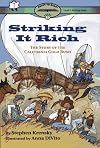
Stephen Krensky wrote this nonfiction Gold Rush story with
simple, but engaging prose: "During the summer of 1848, the news spread slowly eastward. It rode across the prairie on horseback. It paddled up the Mississippi River on steamboats. It blew around South America on sailing ships." Although part of the "Ready to Read" series, the author did not skimp on either humor or historical information. For example, when writing about the lawlessness of the time, Krensky stated "Laws seemed to show more change every day, and when people shook hands on a deal, they counted their fingers afterward to make sure none were missing". "The Dust Settles" and "The Country Moves On" chapters address the huge impact the Gold Rush had on native people and the state as a whole. Anna DiVito's cartoonish, but informative illustrations are on almost every page. Students who love a true, easy to read, adventure story should enjoy this book. show less
simple, but engaging prose: "During the summer of 1848, the news spread slowly eastward. It rode across the prairie on horseback. It paddled up the Mississippi River on steamboats. It blew around South America on sailing ships." Although part of the "Ready to Read" series, the author did not skimp on either humor or historical information. For example, when writing about the lawlessness of the time, Krensky stated "Laws seemed to show more change every day, and when people shook hands on a deal, they counted their fingers afterward to make sure none were missing". "The Dust Settles" and "The Country Moves On" chapters address the huge impact the Gold Rush had on native people and the state as a whole. Anna DiVito's cartoonish, but informative illustrations are on almost every page. Students who love a true, easy to read, adventure story should enjoy this book. show less

Intriguing world-building and characters, unsatisfying ending. A stronger writer could have given it more depth and made it popular enough to justify a sequel or two. Just too slight for me to recommend, unless you can get it easily (kindle unlimited does have it free I see) and have an hour to spare.
Lists
Awards


You May Also Like


Associated Authors
Statistics
- Works
- 246
- Also by
- 3
- Members
- 28,122
- Popularity
- #719
- Rating
- 3.8
- Reviews
- 302
- ISBNs
- 1,032
- Languages
- 6
- Favorited
- 1
