
Walt Simonson
Author of X-Men: Mutant Massacre
About the Author
Image credit: Luigi Novi
Series
Works by Walt Simonson
Marvel and DC Present #1: The Uncanny X-Men and the New Teen Titans (1983) — Illustrator — 25 copies, 1 review
Michael Moorcock's Elric: The Making of a Sorcerer #1 - The First Dream: Bargains in Blades (2004) — Illustrator — 13 copies
Avengers, Vol. 2 #11 — Author — 4 copies
Thor, Vol. 1, # 349 4 copies
Thor, Vol. 1, # 354 4 copies
Marvel Masterworks, Volume 388: The Mighty Thor Volume 24 [#349-359 + Annual #13 + Marvel Graphic Novel #15] (2025) 4 copies
Michael Moorcock's Elric: The Making of a Sorcerer #2 - The Second Dream: The Sea-King's Sister (2004) — Illustrator — 4 copies
Thor, Vol. 1, # 343 3 copies
Thor, Vol. 1, # 351 3 copies
Superman 1 3 copies
Michael Moorcock's Elric: The Making of a Sorcerer #3 - The Third Dream: The South Wind's Soul (2006) — Illustrator — 3 copies
Thor, Vol. 1, # 359 3 copies
Avengers, Vol. 2 #12 — Author — 3 copies
Thor, Vol. 1, # 347 3 copies
World of Warcraft #14 3 copies
Fantastic Four [1961] #336 — Author — 3 copies
Thor, Vol. 1, # 344 3 copies
Thor, Vol. 1, # 350 3 copies
Thor, Vol. 1, # 346 3 copies
Thor, Vol. 1, # 368 3 copies
Thor, Vol. 1, # 367 3 copies
Thor, Vol. 1, # 348 3 copies
Fantastic Four [1961] #349 3 copies
Thor, Vol. 1, # 345 3 copies
Michael Moorcock's Elric: The Making of a Sorcerer #4 - The Fourth Dream: Dragon Lord's Destiny (2006) — Illustrator — 2 copies
Thor, Vol. 1, # 355 2 copies
Thor, Vol. 1, # 382 2 copies
Thor, Vol. 1, # 357 2 copies
Thor, Vol. 1, # 358 2 copies
Thor, Vol. 1, # 360 2 copies
Thor, Vol. 1, # 361 2 copies
Thor, Vol. 1, # 362 2 copies
Thor, Vol. 1, # 376 2 copies
Thor, Vol. 1, # 381 2 copies
Thor, Vol. 1, # 378 2 copies
Thor, Vol. 1, # 379 2 copies
Thor, Vol. 1, # 364 2 copies
Thor, Vol. 1, # 365 2 copies
Thor, Vol. 1, # 380 2 copies
Thor, Vol. 1, # 372 2 copies
Star Slammers #2 — Author — 2 copies
Thor, Vol. 1, # 375 2 copies
Tarzan Versus Predator: At the Earth's Core #2 By Edgar Rice Burroughs February 1996 (1996) 2 copies
Conan: The Hyborian Age 2 copies
Balder the Brave #1 2 copies
Star Slammers # 1 — Author — 2 copies
Fantastic Four [1961] #346 — Author — 2 copies
Fantastic Four [1961] #345 2 copies
Avengers, Vol. 2 #9 — Author — 2 copies
Avengers, Vol. 2 #8 — Author — 2 copies
World of Warcraft #16 2 copies
World of Warcraft #10 2 copies
World of Warcraft #15 (DC Comics) 2 copies
World of Warcraft #11 2 copies
Balder the Brave #4 2 copies
World of Warcraft #0 2 copies
Thor Annual # 7 1 copy
World of Warcraft #0 1 copy
Jurassic Park #0 1 copy
World of Warcraft #6 1 copy
Thor (1966-1996) #361 1 copy
Thor (1966-1996) #360 1 copy
Weapon Zero mini and ongoing (Walt Simonson, Marc Silvestri, Joe Benitez, Victor Llamas.) (1995) 1 copy
Thor (1966-1996) #339 1 copy
Conan Saga #52 1 copy
Balder The Brave #2 1 copy
Thor (1966-1996) #340 1 copy
Thor (1966-1996) #341 1 copy
Thor (1966-1996) #343 1 copy
Thor (1966-1996) #344 1 copy
Thor (1966-1996) #345 1 copy
Thor (1966-1996) #346 1 copy
Thor (1966-1996) #348 1 copy
Thor (1966-1996) #349 1 copy
Thor (1966-1996) #350 1 copy
Thor (1966-1996) #359 1 copy
Ragnarok #4 1 copy
Ragnarok #5 1 copy
Weapon Zero/Silver Surfer #1 1 copy
Balder The Brave #3 1 copy
Hawkgirl (2006-) #51 1 copy
Orion #1 (Orion, #1) 1 copy
Balder The Brave #2 1 copy
Fantastic Four [1961] #343 1 copy
World of Warcraft #12 1 copy
World of Warcraft #13 1 copy
World of Warcraft #18 1 copy
Star Slammers # 3 — Author — 1 copy
Star Slammers # 4 — Author — 1 copy
RoboCop vs. Terminator 1 copy
The Art of The Mighty Thor 1 copy
X-Factor [1986] #13 - Ghosts! — Illustrator — 1 copy
Fantastic Four [1961] #341 1 copy
The Avengers #295 (CB) 1 copy
World of Warcraft No. 10 1 copy
O Poderoso Thor por Walter Simonson — Author — 1 copy
Ragnarök. O Último Deus — Author — 1 copy
The Avengers #291 (CB) 1 copy
The Avengers #292 (CB) 1 copy
The Avengers #294 (CB) 1 copy
The Avengers #296 (CB) 1 copy
The Avengers #297 (CB) 1 copy
The Avengers #298 (CB) 1 copy
The Avengers #299 (CB) 1 copy
The Avengers #300 (CB) 1 copy
The Judas Coin (2012) #1 HC 1 copy
Associated Works
Hellboy: The Troll Witch and Other Stories (2007) — Introduction, some editions — 521 copies, 13 reviews
9-11: The World's Finest Comic Book Writers & Artists Tell Stories to Remember (2002) — Illustrator — 256 copies, 1 review
Teenage Mutant Ninja Turtles: The IDW Collection, Vol. 01 (2015) — Illustrator — 154 copies, 3 reviews
Thor: God of Thunder, Vol. 3: The Accursed (2014) — Illustrator, some editions — 139 copies, 4 reviews
Marvel Treasury Edition #28, Featuring Superman and Spider-Man (1981) — Illustrator — 38 copies, 2 reviews
Heroes: The World's Greatest Super Hero Creators Honor The World's Greatest Heroes 9-11-2001 (2001) — Illustrator — 25 copies, 1 review
Black Panther Epic Collection: Panther's Prey (2021) — Contributor; Illustrator — 16 copies, 1 review
Marvel & Disney: What if…? Donald Duck Became Thor #1 (2024) — Cover artist, some editions — 3 copies
Wonder Woman, Vol. 2 #200 — Illustrator — 3 copies
True Believers: Wolverine -- Save the Tiger #1 — Cover artist — 1 copy
Tagged
Common Knowledge
- Canonical name
- Simonson, Walt
- Legal name
- Simonson, Walter
- Birthdate
- 1946-09-02
- Gender
- male
- Relationships
- Simonson, Louise (wife)
- Nationality
- USA
- Birthplace
- Knoxville, Tennessee, USA
- Associated Place (for map)
- Tennessee, USA
Members
Reviews

Access a version of the below that includes illustrations on my blog.
Volume 1 of The Mighty Thor ended with a somewhat complicated plot about elves and food and an old guy who looked young and Wild Hunt and cops? Something like that. To my surprise, this plotline blossoms in volume 2 and turns out to be the payoff to what was an ongoing thread in volume 1: a mysterious weapon being forged outside of time and space. Well, Malekith's dark elves are after the Casket of Ancient Winters, so they show more can deploy it in aid of Surtur, Ruler of Muspelheim, an ancient evil that once battled Thor's father Odin and his brothers. Odin's brother's sacrificed themselves to seal Surtur in Muspelheim, but now he's back, and he threatens all of the Nine Realms, especially Asgard and Midgard.*
What delights me about Thor, both on screen and now in these comics, is how it uses a heightened style: everything about these comics is always on the next level from our mere mortal existence. The gods of Asgard are always speaking in dramatic pronouncements; I loved how Odin's story of his first encounter with Surtur ended, with proclamations like, "THUS WAS BORN THE ODIN-POWER, THE BIRTHRIGHT OF THE SONS OF BOR!"
In volume 1, Odin obtained intelligence that the final battle was coming, and so mustered the forces of Asgard throughout this volume, meaning that when Thor encounters the forces of Muspelheim on Midgard, Asgard is ready, having summoned not only the warriors of Valhalla and Beta Ray Bill and Lady Sif, but also many of the former enemies of Asgard who do not wish to see the Nine Realms burn. What follows is a four-issue battle between Asgard and Muspelheim, and it is incredible. I wouldn't have thought that I would like such a thing-- it occupies almost 100 pages, yet is never dull. The forces of Asgard cross the Rainbow Bridge to make a stand in New York City, assisted by the Avengers and the Fantastic Four and suchlike. The whole setup actually make me think somewhat of the first Avengers film, with alien demons swarming from a portal atop a New York tower. Deliberate or coincidence?
Anyway, Surtur devastates New York City, his effectiveness enhanced by his opponents having to flight through a worldwide glacier. Thor calls a rain from Asgard to stifle the flames of Surtur-- but Surtur uses the link to Asgard to travel there himself, where only Odin and Heimdall stand to protect the City of the Gods. Beta Ray Bill takes command of the Asgard forces while Thor follows Surtur, but Thor is too slow: Surtur defeats Heimdall and destroys the Rainbow Bridge. The scene were its pieces rain down on New York City is ominous.
Basically, it's lots of fighting: Beta Ray Bill, Sif, and the Fantastic Four vs. the demons of Muspelheim on Midgard, and Odin and Thor vs. Surtur in Asgard. Simonson has a good grasp of character throughout; Bill and Sif keep the Midgard battle anchored, stopping it from becoming sheer overwhelming spectacle. I also liked Roger Willis, the Korean War vet whose mysterious father passed to him the task of guarding the Casket of Ancient Winters. He's an ordinary guy caught up in extraordinary events who does his best to do the right thing.
Things in Asgard get epic when Loki turns up, too; Simonson has a great panel of Odin and son leaping into battle, where Odin cries, "FOR ASGARD!", Thor cries "FOR MIDGARD!", and Loki "FOR MYSELF!"
There's also a nice subplot about Frigga, mother of Thor, getting the children of Asgard to safety. Simonson never forgets to leaven the seriousness. On all fronts, this is everything a giant superhero battle should be-- would it that they were all so good. Sadly, it all ends in the death of Odin.
The whole thing is followed by a nice pair of aftermath issues. The destruction of the Rainbow Bridge means that the forces of Asgard are trapped in New York City; they decide to bivouac in Central Park. (Sif has the power to transport herself through spacetime, and I assume Beta Ray Bill can use his hammer, but otherwise they're all trapped.) The Warriors Three go to Macy's. I am of course looking forward to more culture-clash hijinks in volume 3. Meanwhile, Death herself turns up to collect Odin's soul, but can't find it. Thor lays the smackdown on Death, in what has to be one of my favorite scenes in any superhero comic.
Insisting his father is still alive, Thor heads out on a mystical quest (as you do). I look forward to seeing where this all goes in volume 3 as well. Simonson's run on Thor is clearly cyclical; as one big story cycles down, another one begins to cycle up in turn, and I'm sure this is all going somewhere new and exciting.
A final note: Simonson always pepper his stories with humor, which I appreciate. My favorite moment comes when (in a subplot I haven't had the space to mention in this review because this book is chock-full of them) Roger Willis doesn't buy Thor's girlfriend's explanation of how she saw through the disguise of Thor's secret identity of Sigurd Jarlson. She claims that "anybody would have known. You're just too big to hide behind a pair of glasses and an Izod shirt." But Roger is genre-savvy enough to know it doesn't work that way.
I also enjoy the running gag about Sigurd's boss at the construction company where he works when he's not battling demon hordes (he doesn't come to work very much, to be honest) trying to guess which superhero he is. He's never right.
* Earth. show less
Volume 1 of The Mighty Thor ended with a somewhat complicated plot about elves and food and an old guy who looked young and Wild Hunt and cops? Something like that. To my surprise, this plotline blossoms in volume 2 and turns out to be the payoff to what was an ongoing thread in volume 1: a mysterious weapon being forged outside of time and space. Well, Malekith's dark elves are after the Casket of Ancient Winters, so they show more can deploy it in aid of Surtur, Ruler of Muspelheim, an ancient evil that once battled Thor's father Odin and his brothers. Odin's brother's sacrificed themselves to seal Surtur in Muspelheim, but now he's back, and he threatens all of the Nine Realms, especially Asgard and Midgard.*
What delights me about Thor, both on screen and now in these comics, is how it uses a heightened style: everything about these comics is always on the next level from our mere mortal existence. The gods of Asgard are always speaking in dramatic pronouncements; I loved how Odin's story of his first encounter with Surtur ended, with proclamations like, "THUS WAS BORN THE ODIN-POWER, THE BIRTHRIGHT OF THE SONS OF BOR!"
In volume 1, Odin obtained intelligence that the final battle was coming, and so mustered the forces of Asgard throughout this volume, meaning that when Thor encounters the forces of Muspelheim on Midgard, Asgard is ready, having summoned not only the warriors of Valhalla and Beta Ray Bill and Lady Sif, but also many of the former enemies of Asgard who do not wish to see the Nine Realms burn. What follows is a four-issue battle between Asgard and Muspelheim, and it is incredible. I wouldn't have thought that I would like such a thing-- it occupies almost 100 pages, yet is never dull. The forces of Asgard cross the Rainbow Bridge to make a stand in New York City, assisted by the Avengers and the Fantastic Four and suchlike. The whole setup actually make me think somewhat of the first Avengers film, with alien demons swarming from a portal atop a New York tower. Deliberate or coincidence?
Anyway, Surtur devastates New York City, his effectiveness enhanced by his opponents having to flight through a worldwide glacier. Thor calls a rain from Asgard to stifle the flames of Surtur-- but Surtur uses the link to Asgard to travel there himself, where only Odin and Heimdall stand to protect the City of the Gods. Beta Ray Bill takes command of the Asgard forces while Thor follows Surtur, but Thor is too slow: Surtur defeats Heimdall and destroys the Rainbow Bridge. The scene were its pieces rain down on New York City is ominous.
Basically, it's lots of fighting: Beta Ray Bill, Sif, and the Fantastic Four vs. the demons of Muspelheim on Midgard, and Odin and Thor vs. Surtur in Asgard. Simonson has a good grasp of character throughout; Bill and Sif keep the Midgard battle anchored, stopping it from becoming sheer overwhelming spectacle. I also liked Roger Willis, the Korean War vet whose mysterious father passed to him the task of guarding the Casket of Ancient Winters. He's an ordinary guy caught up in extraordinary events who does his best to do the right thing.
Things in Asgard get epic when Loki turns up, too; Simonson has a great panel of Odin and son leaping into battle, where Odin cries, "FOR ASGARD!", Thor cries "FOR MIDGARD!", and Loki "FOR MYSELF!"
There's also a nice subplot about Frigga, mother of Thor, getting the children of Asgard to safety. Simonson never forgets to leaven the seriousness. On all fronts, this is everything a giant superhero battle should be-- would it that they were all so good. Sadly, it all ends in the death of Odin.
The whole thing is followed by a nice pair of aftermath issues. The destruction of the Rainbow Bridge means that the forces of Asgard are trapped in New York City; they decide to bivouac in Central Park. (Sif has the power to transport herself through spacetime, and I assume Beta Ray Bill can use his hammer, but otherwise they're all trapped.) The Warriors Three go to Macy's. I am of course looking forward to more culture-clash hijinks in volume 3. Meanwhile, Death herself turns up to collect Odin's soul, but can't find it. Thor lays the smackdown on Death, in what has to be one of my favorite scenes in any superhero comic.
Insisting his father is still alive, Thor heads out on a mystical quest (as you do). I look forward to seeing where this all goes in volume 3 as well. Simonson's run on Thor is clearly cyclical; as one big story cycles down, another one begins to cycle up in turn, and I'm sure this is all going somewhere new and exciting.
A final note: Simonson always pepper his stories with humor, which I appreciate. My favorite moment comes when (in a subplot I haven't had the space to mention in this review because this book is chock-full of them) Roger Willis doesn't buy Thor's girlfriend's explanation of how she saw through the disguise of Thor's secret identity of Sigurd Jarlson. She claims that "anybody would have known. You're just too big to hide behind a pair of glasses and an Izod shirt." But Roger is genre-savvy enough to know it doesn't work that way.
I also enjoy the running gag about Sigurd's boss at the construction company where he works when he's not battling demon hordes (he doesn't come to work very much, to be honest) trying to guess which superhero he is. He's never right.
* Earth. show less

Access a version of the below that includes illustrations on my blog.
I found vols. 3-4 of Walter Simonson's run on Thor less interesting than vols. 1-2 (Frog Thor story aside, obvs), so I was a little worried going into vol. 5, but Simonson definitely turns it around, bringing things to an excellent and appropriate climax.
Sort of. Some comics creators tell one long story, but Simonson pursues a style of serialization that I prefer, where each story has some small hint or component that sets show more up the next story, so that the whole thing reads continuously, but the story being told at the beginning is not the story being told by the end. Like, way back in vol. 1 the whole thing started with Beta Ray Bill taking Thor's hammer. But in a series of natural progressions we're now reading about a Thor cursed by Hela (the goddess of death, and Thor's niece, not his sister like in Thor: Ragnarok) to experience great weakness but never die. And meanwhile Balder is ruling Asgard, and there are some human orphans from Midgard* being integrated into Volstagg's family.
The opening stories are okay, but things really come to life when Thor forges himself a new suit of armor to deal with his increasingly frail body, leading to a melodramatic showdown with the Frost Giants. I love it when Thor shouts about how awesome he is. No one ever accused him of modesty.
In retribution, the Frost Giants try to send Jormungand, the Midgard Serpent (a giant dragon... also Loki's child???), after Thor, but end up sending comedy dragon Fin Fang Foom after him instead. Before they fight, Thor and Fin Fang Foom have a nice chat in a Brooklyn park. Fin Fang Foom is an erudite, honorable opponent, who ruminates on his relationship with humanity, and even lets Thor fight him in the wilderness so no bystanders will be hurt. It's a great little story featuring a great villain...
...who actually turns to be the Midgard Serpent after all! Simsonson comes back to the penciller's chair one last time during his run, drawing the issue where Thor fights Jormungan, and it is a tour-de-force. I mean, Simonson is always great on art, but here he excels himself: each page is its own panel. Sometimes this can be a cheap move (I wasn't too into it in The Death of Superman), but here it gives the fight weight and grandeur.
And its consquences are great, too: Thor become nothing but a pulp in a suit of armor, but he cannot die! Then the Destroyer turns up and all sorts of shenanigans ensue.
The run does feel slightly curtailed: Thor's supporting cast in New York City don't appear in this volume at all, for example, and there's a subplot about poison in Asgard that goes underexplained. Bu overall Simonson goes out almost as strong as he came in. I loved reading this imagining Chris Hemsworth doing the voices, and I look forward to tracking down more Thor comics.
* Earth. show less
I found vols. 3-4 of Walter Simonson's run on Thor less interesting than vols. 1-2 (Frog Thor story aside, obvs), so I was a little worried going into vol. 5, but Simonson definitely turns it around, bringing things to an excellent and appropriate climax.
Sort of. Some comics creators tell one long story, but Simonson pursues a style of serialization that I prefer, where each story has some small hint or component that sets show more up the next story, so that the whole thing reads continuously, but the story being told at the beginning is not the story being told by the end. Like, way back in vol. 1 the whole thing started with Beta Ray Bill taking Thor's hammer. But in a series of natural progressions we're now reading about a Thor cursed by Hela (the goddess of death, and Thor's niece, not his sister like in Thor: Ragnarok) to experience great weakness but never die. And meanwhile Balder is ruling Asgard, and there are some human orphans from Midgard* being integrated into Volstagg's family.
The opening stories are okay, but things really come to life when Thor forges himself a new suit of armor to deal with his increasingly frail body, leading to a melodramatic showdown with the Frost Giants. I love it when Thor shouts about how awesome he is. No one ever accused him of modesty.
In retribution, the Frost Giants try to send Jormungand, the Midgard Serpent (a giant dragon... also Loki's child???), after Thor, but end up sending comedy dragon Fin Fang Foom after him instead. Before they fight, Thor and Fin Fang Foom have a nice chat in a Brooklyn park. Fin Fang Foom is an erudite, honorable opponent, who ruminates on his relationship with humanity, and even lets Thor fight him in the wilderness so no bystanders will be hurt. It's a great little story featuring a great villain...
...who actually turns to be the Midgard Serpent after all! Simsonson comes back to the penciller's chair one last time during his run, drawing the issue where Thor fights Jormungan, and it is a tour-de-force. I mean, Simonson is always great on art, but here he excels himself: each page is its own panel. Sometimes this can be a cheap move (I wasn't too into it in The Death of Superman), but here it gives the fight weight and grandeur.
And its consquences are great, too: Thor become nothing but a pulp in a suit of armor, but he cannot die! Then the Destroyer turns up and all sorts of shenanigans ensue.
The run does feel slightly curtailed: Thor's supporting cast in New York City don't appear in this volume at all, for example, and there's a subplot about poison in Asgard that goes underexplained. Bu overall Simonson goes out almost as strong as he came in. I loved reading this imagining Chris Hemsworth doing the voices, and I look forward to tracking down more Thor comics.
* Earth. show less
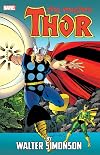
Have to admit, I didn't enjoy this collection anywhere near as much as the previous ones. Feels like Simonson's tank was running dry.
First, we're treated to only a few issues of Simonson's art, then it switches over to the competent, but nowhere near as wondrous art of Sal Buscema (also known as "the artist that can get it drawn in time if the book's running late" artist). He does all right, but every panel screams "what would Walt have drawn?"
And the storylines? They're uncharacteristically show more dull. Simonson needs sprawling epics. As soon as he centres on the mundane villain of the week stuff, it becomes weak stuff. Thug. Justice Peace. Zaniac. Frog Thor. All rather anticlimactic after the wonders of the first three volumes.
In fact, if I had to choose my favourite storyline here, it'd likely be Simonson's reinvention of Volstagg from fat, cowardly eating and drinking machine to caring father with hidden depths of love and empathy that Simonson has carefully built over multiple storylines.
To be honest, with fare like this, I'm kind of glad there's only one more set to go. show less
First, we're treated to only a few issues of Simonson's art, then it switches over to the competent, but nowhere near as wondrous art of Sal Buscema (also known as "the artist that can get it drawn in time if the book's running late" artist). He does all right, but every panel screams "what would Walt have drawn?"
And the storylines? They're uncharacteristically show more dull. Simonson needs sprawling epics. As soon as he centres on the mundane villain of the week stuff, it becomes weak stuff. Thug. Justice Peace. Zaniac. Frog Thor. All rather anticlimactic after the wonders of the first three volumes.
In fact, if I had to choose my favourite storyline here, it'd likely be Simonson's reinvention of Volstagg from fat, cowardly eating and drinking machine to caring father with hidden depths of love and empathy that Simonson has carefully built over multiple storylines.
To be honest, with fare like this, I'm kind of glad there's only one more set to go. show less

Access a version of the below that includes illustrations on my blog.
Thor is, I kid you not, my favorite of the Marvel film series (well, though Guardians of the Galaxy may dethrone it). It's goofy, it has space aliens, it has lots of jokes, it has people stealing spaceships, it has mythology: it's basically everything I demand from cinematic entertainment. The actors who play Thor and the Warriors Three seem as if they really do come from a fantasy realm.
Since seeing the first one, I've show more been curious about the comics, and when it comes to Thor comics, it seems like all roads lead to Walter Simonson. Simonson's one of those people whose work I more know of than actually know. I own his Orion Omnibus and his Star Wars work but haven't actually read it; what I have read is limited to small contributions to things like World Without a Superman, 52: The Companion, and Batman: Strange Apparitions. But Simonson's Thor work is spoken of in hushed tones, and what I knew lead me to expect cosmic mythology, the exact register I would hope for.
Vol. 1 of The Mighty Thor did not disappoint. The whole thing is premised on Walter Simonson being the first writer to look at the inscription on Thor's Hammer, "WHOSOEVER HOLDS THIS HAMMER, IF HE BE WORTHY, SHALL POSSESS THE POWER OF THOR," and wonder, who would be worthy? Answer: Beta Ray Bill, warrior cyborg of an alien race. I like Simonson's answer; though being worthy is at least in part about moral purity, it must also be about warrior spirit-- something I would argue that, say, Captain America does not possess. The first four issues here are jam-packed, as Thor is drafted by Nick Fury, Thor goes into space after Bill's spaceship, Thor fights Bill, Bill seizes the hammer and acquires the power of Thor, Odin forces Thor and Bill to fight each other again, a warrior arrives in Asgard to challenge Balder the Brave only to be sat upon by Volstagg, Loki schemes with Lorelei, Lady Sif goes on a quest to the land of the dwarves, a new hammer called Storm Breaker is forged, Thor travels with Sif and Bill to battle alien demons, and Odin redistributes everyone's powers.
And after that there's still five issues to go! They don't make them like that any more. (This is why the mid-1980s are a peak era for comics: more sophisticated storytelling, but bloated decompression and gratuitous darkness haven't yet set in.) Like Jack Kirby, Simonson has the talent of packing in an incredibly large number of ideas into a small space, and casting them with a mythological tone that makes them feel even bigger than they are, and like Jack Kirby, he combines his command of word and image to achieve total comic book excellence. The Beta Ray Bill stories are definitely the best part of this collection, the rest of it being much more day-in-the-life-of-Thor-as-superhero-on-Midgard* stuff. He fights sea monsters, is wooed by a woman (who is really Lorelei is disguise), works as a construction worker, and gets involved in some kinda complicated plot involving people who can't eat food that I guess I have to wait for Vol. 2 to fully understand.
It's not without its charms: hunky Thor trying to hide his might while working construction, Thor answering the call of the last scion of a Viking line in Antarctica, Thor running into Clark Kent and Lois Lane but no one recognizes each other because of the glasses. And Simonson is one of those writers who keeps a number of running subplots on the boil that come to the forefront in turn, my favorite being that of Balder the Brave who has forsworn killing, and the tragic moment where Loki forces him to confront that choice. Poor guy.
Like I said, Simonson's art is amazing; his scripting may remind one of Kirby, but he has a bold visual style all his own, stopping this from feeling like pastiche. And John Workman provides some of the best lettering I've ever seen in a comic book, perfectly integrating with the image to drive home the scale of the cosmic events we're seeing. I never thought I'd write a sentence like that!
* Earth. show less
Thor is, I kid you not, my favorite of the Marvel film series (well, though Guardians of the Galaxy may dethrone it). It's goofy, it has space aliens, it has lots of jokes, it has people stealing spaceships, it has mythology: it's basically everything I demand from cinematic entertainment. The actors who play Thor and the Warriors Three seem as if they really do come from a fantasy realm.
Since seeing the first one, I've show more been curious about the comics, and when it comes to Thor comics, it seems like all roads lead to Walter Simonson. Simonson's one of those people whose work I more know of than actually know. I own his Orion Omnibus and his Star Wars work but haven't actually read it; what I have read is limited to small contributions to things like World Without a Superman, 52: The Companion, and Batman: Strange Apparitions. But Simonson's Thor work is spoken of in hushed tones, and what I knew lead me to expect cosmic mythology, the exact register I would hope for.
Vol. 1 of The Mighty Thor did not disappoint. The whole thing is premised on Walter Simonson being the first writer to look at the inscription on Thor's Hammer, "WHOSOEVER HOLDS THIS HAMMER, IF HE BE WORTHY, SHALL POSSESS THE POWER OF THOR," and wonder, who would be worthy? Answer: Beta Ray Bill, warrior cyborg of an alien race. I like Simonson's answer; though being worthy is at least in part about moral purity, it must also be about warrior spirit-- something I would argue that, say, Captain America does not possess. The first four issues here are jam-packed, as Thor is drafted by Nick Fury, Thor goes into space after Bill's spaceship, Thor fights Bill, Bill seizes the hammer and acquires the power of Thor, Odin forces Thor and Bill to fight each other again, a warrior arrives in Asgard to challenge Balder the Brave only to be sat upon by Volstagg, Loki schemes with Lorelei, Lady Sif goes on a quest to the land of the dwarves, a new hammer called Storm Breaker is forged, Thor travels with Sif and Bill to battle alien demons, and Odin redistributes everyone's powers.
And after that there's still five issues to go! They don't make them like that any more. (This is why the mid-1980s are a peak era for comics: more sophisticated storytelling, but bloated decompression and gratuitous darkness haven't yet set in.) Like Jack Kirby, Simonson has the talent of packing in an incredibly large number of ideas into a small space, and casting them with a mythological tone that makes them feel even bigger than they are, and like Jack Kirby, he combines his command of word and image to achieve total comic book excellence. The Beta Ray Bill stories are definitely the best part of this collection, the rest of it being much more day-in-the-life-of-Thor-as-superhero-on-Midgard* stuff. He fights sea monsters, is wooed by a woman (who is really Lorelei is disguise), works as a construction worker, and gets involved in some kinda complicated plot involving people who can't eat food that I guess I have to wait for Vol. 2 to fully understand.
It's not without its charms: hunky Thor trying to hide his might while working construction, Thor answering the call of the last scion of a Viking line in Antarctica, Thor running into Clark Kent and Lois Lane but no one recognizes each other because of the glasses. And Simonson is one of those writers who keeps a number of running subplots on the boil that come to the forefront in turn, my favorite being that of Balder the Brave who has forsworn killing, and the tragic moment where Loki forces him to confront that choice. Poor guy.
Like I said, Simonson's art is amazing; his scripting may remind one of Kirby, but he has a bold visual style all his own, stopping this from feeling like pastiche. And John Workman provides some of the best lettering I've ever seen in a comic book, perfectly integrating with the image to drive home the scale of the cosmic events we're seeing. I never thought I'd write a sentence like that!
* Earth. show less
Lists
Awards


You May Also Like


Associated Authors
Statistics
- Works
- 399
- Also by
- 74
- Members
- 4,163
- Popularity
- #6,046
- Rating
- 3.8
- Reviews
- 106
- ISBNs
- 258
- Languages
- 9
- Favorited
- 7