
Simone Weil (1909–1943)
Author of Waiting for God
About the Author
Born in Paris, Weil came from a highly intellectual family. After a brilliant academic career at school and university, she taught philosophy interspersed with periods of hard manual labor on farms and in factories. Throughout her life she combined sophisticated and scholarly interests with an show more extreme moral intensity and identification with the poor and oppressed. A twentieth-century Pascal (see Vol. 4), this ardently spiritual woman was a social thinker, sensitive to the crises of modern humanity. Jewish by birth, Christian by vocation, and Greek by aesthetic choice, Weil has influenced religious thinking profoundly in the years since her death. "Humility is the root of love," she said as she questioned traditional theologians and held that the apostles had badly interpreted Christ's teaching. Christianity was, she thought, to blame for the heresy of progress. During World War II, Weil starved herself to death, refusing to eat while victims of the war still suffered. (Bowker Author Biography) show less
Disambiguation Notice:
Do not combine with Simone Veil (born 1927), French lawyer and politician.
Image credit: Ashford Borough Council
Works by Simone Weil
The Need for Roots: Prelude to a Declaration of Duties Towards Mankind (1949) 884 copies, 13 reviews
Love in the Void: Where God Finds Us (Plough Spiritual Guides: Backpack Classics) (2018) 91 copies, 9 reviews
Two moral essays : draft for a statement of human obligations and human personality (1981) 43 copies, 2 reviews
Selected Essays, 1934-1943: Historical, Political, and Moral Writings (Simone Weil: Selected Works) (2015) 26 copies
Seventy Letters: Personal and Intellectual Windows on a Thinker (Simone Weil: Selected Works) (1965) 17 copies
Simone Weil on Colonialism: An Ethic of the Other (After the Empire: The Francophone World and Postcolonial France) (2003) 9 copies
Œuvres complètes (tome IV, volume I) : Écrits de Marseille (Philosophie, Sciences, Religion, Questions Politiques et Sociales (1940 - 1942)) (2008) 7 copies
Œuvres complètes (tome II, volume I) : Écrits historiques et politiques (L'engagement syndical (1927-juillet 1934)) (1988) 6 copies
Œuvres complètes (tome II, volume III) : Écrits historiques et politiques (Vers la guerre (1937-1940)) (1988) 4 copies
Dharma and Detachment: Writings on Indian and Tibetan Thought: Writings on Indian and Tibetan Philosophy (2025) 3 copies
Œuvres complètes (tome V, volume I): Écrits de New York et de Londres (Questions politiques et religieuses (1942-1943)) (2019) 3 copies
Œuvres complètes (tome VI, volume I) : Cahiers (tome VI, volume I) (1933 - Septembre 1941) (1994) 3 copies
De l'attention - Réflexions sur le bon usage des études scolaires en vue de l'amour de Dieu (2018) 3 copies
Œuvres complètes (tome V, volume II): Écrits de New York et de Londres (L'Enracinement (1943)) (2013) 2 copies
À porta do farol faz escuro 2 copies
Sobre el padrenuestro 2 copies
002: Notebooks of Simone Weil 2 copies
Kẻ Lạ ở Thiên Đường 1 copy
Ami személyes, és ami szent 1 copy
Trepet in poslusnost 1 copy
conversation avec trotski 1 copy
Duchovná autobiografia : Výber z textov (s úvodnými textami a poznámkami Florence de Lussy) (2006) 1 copy
A Experiência de Deus 1 copy
TOW MORAL ESSAYS 1 copy
Europa heeft bezieling nodig 1 copy
O enraizamento. Preludio a uma declaracao dos deveres para com o ser humano (Em Portugues do Brasil) 1 copy
Quaderni vol.3 1 copy
La rivelazione indiana 1 copy
Warten auf Gott 1 copy
Autobiographie spirituelle 1 copy
O Pai Nosso 1 copy
Oceans of Air 1 copy
Poesie e altri scritti 1 copy
Roma 1 copy
Wybór pism, tom II 1 copy
Weil, Simone Archive 1 copy
Personne et le sacré (La) 1 copy
Associated Works
Tagged
Common Knowledge
- Canonical name
- Weil, Simone
- Legal name
- Weil, Simone Adolphine
- Other names
- Emile Novis
- Birthdate
- 1909-02-03
- Date of death
- 1943-08-24
- Gender
- female
- Education
- Lycée Henri IV, Paris, France
École Normale Supérieure (diplôme d'études supérieures|1931) - Occupations
- philosopher
writer
social activist - Relationships
- Weil, André (brother)
- Short biography
- Simone Weil was born into a wealthy Parisian Jewish family originally from the Alsace region. She suffered from ill-health but was a brilliant student, excelling in languages, philosophy, literature, and science. After graduation from the École Normale Supérieure in 1931, she taught at several rural academies, and wrote articles for socialist journals. She was a political idealist, and took a leave of absence to work in a Renault factory in order to become more closely connected with the French working class. She went to Spain in 1936 to fight for the Republic against fascism in the Civil War, but was injured in a cooking fire and also contracted tuberculosis. Weil became heavily involved in Catholicism, having a series of mystical experiences. She traveled to the United States with her family and eventually resettled in England. She died aged only 34, apparently having starved herself to death "whilst the balance of her mind was disturbed." Simone Weil’s books were all published posthumously.
- Cause of death
- cardiac failure
- Nationality
- France
- Birthplace
- Paris, France
- Places of residence
- New York, New York, USA
- Place of death
- Ashford, Kent, England, UK
- Burial location
- Bybrook Cemetery, Ashford, Kent, England
- Disambiguation notice
- Do not combine with Simone Veil (born 1927), French lawyer and politician.
Members
Reviews
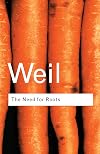
There is a Zen Buddhist saying or proverb which dictates that when hungry, eat and when thirsty, drink. It is with this sort of concrete, un-layered reality that Simone Weil presents her take on Christianity to us in The Need for Roots. We are advised to remain in the here and now, the geometric realm of reality and leave the layered, abstract and algebraic dimensions alone. Weil believes the hungry have a right to food and it is our obligation to feed them; it’s as simple as that. No show more algebra needed. I found The Need of Roots a clear presentation of her philosophical bent; more so than the over-hyped Grace & Glory which I found poorly edited, to say the least.
Weil is the Honey Badger of actively melding philosophy and religion into something that reflects a universal higher being and still remains true to our concrete human obligations to each other. To Weil, all we have are each other and only in our interpersonal conduct do we mimic the good of heaven. Weil is less interested in the Being-for-Itself, in-Itself mishmash that Heidegger and Sartre toy with, and is instead more concerned with Nazi’s and how a moral philosophy steeped in a Goodness (imagine a Being-for-Good, or Being-in-Good) might impel her fellow countrymen to rebuild their country less philosophically and morally vulnerable to the next foreign incursion.
The first part of the book, the introduction of the fourteen, seemingly conflicting, rights of the human soul, could stand as a tome on its own. The contrasting rights, like Order and Liberty, Risk and Security, bring together opposites in a direct reflection of the actual cross itself. The soul requires balance. Both sides are critical.
I want to believe that if I read this book a few more times, I may begin to approach the level of human responsibility laid out in this book as a goal for us all. show less
Weil is the Honey Badger of actively melding philosophy and religion into something that reflects a universal higher being and still remains true to our concrete human obligations to each other. To Weil, all we have are each other and only in our interpersonal conduct do we mimic the good of heaven. Weil is less interested in the Being-for-Itself, in-Itself mishmash that Heidegger and Sartre toy with, and is instead more concerned with Nazi’s and how a moral philosophy steeped in a Goodness (imagine a Being-for-Good, or Being-in-Good) might impel her fellow countrymen to rebuild their country less philosophically and morally vulnerable to the next foreign incursion.
The first part of the book, the introduction of the fourteen, seemingly conflicting, rights of the human soul, could stand as a tome on its own. The contrasting rights, like Order and Liberty, Risk and Security, bring together opposites in a direct reflection of the actual cross itself. The soul requires balance. Both sides are critical.
I want to believe that if I read this book a few more times, I may begin to approach the level of human responsibility laid out in this book as a goal for us all. show less
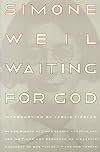
Does the voice of every mystic teeter on the edge of sanity? If so, Simone passes the test.
By turns I shook my head in disbelief and nodded in understanding as she extolled the necessity of personal suffering (no, thank you) and spun sentences of such truth and beauty I almost gasp.
This title is the last of three I carried on travels this summer. Talk about a strange literary cocktail: [b:Lady Chatterley's Lover|32049|Lady Chatterley's Lover|D.H. show more Lawrence|https://d2arxad8u2l0g7.cloudfront.net/books/1215571713s/32049.jpg|3249302], [b:The Art of Work|21548935|The Art of Work|Jeff Goins|https://d2arxad8u2l0g7.cloudfront.net/books/1428094389s/21548935.jpg|40883782], and [b:Waiting for God|561999|Waiting for God|Simone Weil|https://d2arxad8u2l0g7.cloudfront.net/books/1387736445s/561999.jpg|1617979]. Simone has taken the longest to digest; she certainly has more original thoughts than the other two combined.
I am not the intended audience and yet Simone often spoke to me:
"It is not my business to think about myself. My business is to think about God. It is for God to think about me."
"...perhaps God likes to use castaway objects, waste, rejects."
"Never in any case whatever is a genuine effort of attention wasted."
"The intelligence can only be led by desire. For there to be desire, there must be pleasure and joy in the work. The intelligence only grows and bears fruit in joy. The joy of learning is as indispensable in study as breathing is in running."
"God has provided that when his grace penetrates to the very center of a man and from there illuminates all his being, he is able to walk on water without violating any of the laws of nature."
Here is crazy, haunting writing rising from a soul of raw candor and deep intellect as it searches for truth. "If there is a real desire, if the thing desired is really light, the desire for light produces it." show less
By turns I shook my head in disbelief and nodded in understanding as she extolled the necessity of personal suffering (no, thank you) and spun sentences of such truth and beauty I almost gasp.
This title is the last of three I carried on travels this summer. Talk about a strange literary cocktail: [b:Lady Chatterley's Lover|32049|Lady Chatterley's Lover|D.H. show more Lawrence|https://d2arxad8u2l0g7.cloudfront.net/books/1215571713s/32049.jpg|3249302], [b:The Art of Work|21548935|The Art of Work|Jeff Goins|https://d2arxad8u2l0g7.cloudfront.net/books/1428094389s/21548935.jpg|40883782], and [b:Waiting for God|561999|Waiting for God|Simone Weil|https://d2arxad8u2l0g7.cloudfront.net/books/1387736445s/561999.jpg|1617979]. Simone has taken the longest to digest; she certainly has more original thoughts than the other two combined.
I am not the intended audience and yet Simone often spoke to me:
"It is not my business to think about myself. My business is to think about God. It is for God to think about me."
"...perhaps God likes to use castaway objects, waste, rejects."
"Never in any case whatever is a genuine effort of attention wasted."
"The intelligence can only be led by desire. For there to be desire, there must be pleasure and joy in the work. The intelligence only grows and bears fruit in joy. The joy of learning is as indispensable in study as breathing is in running."
"God has provided that when his grace penetrates to the very center of a man and from there illuminates all his being, he is able to walk on water without violating any of the laws of nature."
Here is crazy, haunting writing rising from a soul of raw candor and deep intellect as it searches for truth. "If there is a real desire, if the thing desired is really light, the desire for light produces it." show less

Summary: Weil’s correspondence with her mentor and four essays on her religious thought focused around loving and attending to God.
Simone Weil is a “one off” figures. She struggled with migraine headaches. She worked tirelessly while paying little heed to her own nourishment or her worsening tuberculosis. Weil struggled with her intellectual inferiority to her brother, the mathematician Andre Weil, mostly because she struggled with geometry while producing profound religious and show more philosophic insight. She died young, at the age of 34.
Waiting for God captures the essence of her spiritual journey and insights into one’s relationship with the transcendent God. The title captures a theme running through the correspondence and essays that make up this book. In “The Love of God and Affliction” she writes:
“How are we to seek him? how are we to go toward him? Even if we were to walk for hundreds of years, we should do no more than go round and round the world. Even in an airplane we could not do anything else. We are incapable of progressing vertically. We cannot take a step toward the heavens. God crosses the universe and comes to us.”
Life consists of waiting for God to come to us in love and stir in us love for him. And in her spiritual autobiography written to her priestly mentor, Father Perrin, she describes how during prayer at Assisi and in reciting George Herbert’s poem, “Love,” “Christ himself came down and took possession of me.” Yet despite this profound encounter, she never felt she could enter the church.
Her letters to Father Perrin that make up the first part of this collection, explain her reasoning. Part of her answer is that she does not believe she loves God enough to deserve the grace of baptism. Another aspect is that while she loves the saints and liturgy, she does not love the church. Instead, she fears the flawed influence it might have upon her as a social structure, Thus, she anticipates many of the objections of the “nones” who would describe themselves as spiritual but not religious. While her intellectual integrity prevents her from entering the church, she takes great pains to express her gratitude to Father Perrin. At one point, she writes,
“In gaining my friendship by your charity (which I have never met anything to equal), you have provided me with a source of the most compelling and pure inspiration that is to be found among human things. For nothing among human things has such power to keep our gaze fixed ever more intensely upon God, than friendship for the friends of God.
What a friend Father Perrin must have been!
Then the second part of the book turns to her essays. First is her essay on school studies. Having worked in student ministry, this essay was worth the price of admission. Specifically, Weil draws the connection between prayer and study in the act of attention. In particular, the “lower attention” given to disciplined study develops this faculty in prayer. But I also found myself wondering whether attention in our prayers also may make us attentive in our studies.
From here she discusses “The Love of God and Affliction.” She speaks of the corrosive effects of enduring affliction on the soul and how help may only be found at the foot of the cross. Only by grace may we enter into an apprenticeship of obedience that awaits the coming of God to us.
Her longest essay is “Forms of the Implicit Love of God.” The essay is divided into sections on the love of neighbors, the order of the world, religious practices, friendship, and implicit and explicit love. In contrast to the clarity of her shorter letters, I found this essay more difficult to follow. Perhaps the best way to describe it is that it read a bit like the Pensees with her thoughts grouped under the subheadings.
However, she concludes on a high note in a line by line meditation upon the “our Father.” As have many others she concludes that the prayer “contains all possible petitions; we cannot conceive of any prayer not already contained in it.”
This is but one of the many works she produced, most published posthumously. I differ with her at points. For example, we will never deserve grace, in baptism or anything else. Yet hers is a voice that comes from outside of our echo chambers. Above all, her insight that life consists in waiting for and attending to God captures the heart of Christian devotion. show less
Simone Weil is a “one off” figures. She struggled with migraine headaches. She worked tirelessly while paying little heed to her own nourishment or her worsening tuberculosis. Weil struggled with her intellectual inferiority to her brother, the mathematician Andre Weil, mostly because she struggled with geometry while producing profound religious and show more philosophic insight. She died young, at the age of 34.
Waiting for God captures the essence of her spiritual journey and insights into one’s relationship with the transcendent God. The title captures a theme running through the correspondence and essays that make up this book. In “The Love of God and Affliction” she writes:
“How are we to seek him? how are we to go toward him? Even if we were to walk for hundreds of years, we should do no more than go round and round the world. Even in an airplane we could not do anything else. We are incapable of progressing vertically. We cannot take a step toward the heavens. God crosses the universe and comes to us.”
Life consists of waiting for God to come to us in love and stir in us love for him. And in her spiritual autobiography written to her priestly mentor, Father Perrin, she describes how during prayer at Assisi and in reciting George Herbert’s poem, “Love,” “Christ himself came down and took possession of me.” Yet despite this profound encounter, she never felt she could enter the church.
Her letters to Father Perrin that make up the first part of this collection, explain her reasoning. Part of her answer is that she does not believe she loves God enough to deserve the grace of baptism. Another aspect is that while she loves the saints and liturgy, she does not love the church. Instead, she fears the flawed influence it might have upon her as a social structure, Thus, she anticipates many of the objections of the “nones” who would describe themselves as spiritual but not religious. While her intellectual integrity prevents her from entering the church, she takes great pains to express her gratitude to Father Perrin. At one point, she writes,
“In gaining my friendship by your charity (which I have never met anything to equal), you have provided me with a source of the most compelling and pure inspiration that is to be found among human things. For nothing among human things has such power to keep our gaze fixed ever more intensely upon God, than friendship for the friends of God.
What a friend Father Perrin must have been!
Then the second part of the book turns to her essays. First is her essay on school studies. Having worked in student ministry, this essay was worth the price of admission. Specifically, Weil draws the connection between prayer and study in the act of attention. In particular, the “lower attention” given to disciplined study develops this faculty in prayer. But I also found myself wondering whether attention in our prayers also may make us attentive in our studies.
From here she discusses “The Love of God and Affliction.” She speaks of the corrosive effects of enduring affliction on the soul and how help may only be found at the foot of the cross. Only by grace may we enter into an apprenticeship of obedience that awaits the coming of God to us.
Her longest essay is “Forms of the Implicit Love of God.” The essay is divided into sections on the love of neighbors, the order of the world, religious practices, friendship, and implicit and explicit love. In contrast to the clarity of her shorter letters, I found this essay more difficult to follow. Perhaps the best way to describe it is that it read a bit like the Pensees with her thoughts grouped under the subheadings.
However, she concludes on a high note in a line by line meditation upon the “our Father.” As have many others she concludes that the prayer “contains all possible petitions; we cannot conceive of any prayer not already contained in it.”
This is but one of the many works she produced, most published posthumously. I differ with her at points. For example, we will never deserve grace, in baptism or anything else. Yet hers is a voice that comes from outside of our echo chambers. Above all, her insight that life consists in waiting for and attending to God captures the heart of Christian devotion. show less

Even after reading and reviewing this collection of essays, it is difficult to reconcile the ideas of Weil the political theorist with Weil the christian mystic. And yet, I think there is a way to unite those concerns around the concern for the dignity of the individual.
Man of the political essays in this collection propound ideas about organized society and how this might look, in which the value of collectives are recognized but carefully managed by valuing the individuals that make up show more those collectives. Part of this project is in shifting attention from the collective to the individual, noting that collectives have no obligations to individuals but individuals have obligations to collectives, which is an imbalance that can engender exploitation, especially when the needs of individuals are subsumed in an over-valuation of the collective. The trick is that the individuals by themselves are not enough to bring about positive change and dignity for all, the organizational force of the collective is needed. However, collectives need to be carefully designed to provide for the needs of individuals. Individuals may need equality and liberty and property but those needs must be harmonized with each other to produce order and social good through obedience and punishment (where needed). These seemingly contradictory "needs of the soul" can bring about the ideal good for all. It is a tantalizing but highly idealized view of politics and equally hard to envision how an idealized vision like this ever gets going. Although perhaps in post WWII Europe the civilized world seemed so pounded into dust that a new order could take shape.
So how to reconcile this with the later work on detachment, beauty, poetry, and aesthetics in an individual connections to God through prayer? I'm honestly not entirely sure, but I think one way may be to recognize that idealized political constructivism does not happen in a vacuum. Our existing systems of civil and political and economic organization are exploitative in part because of our attachments to the world. We see the world and other people in it as means to ends but those ends are often just the effort to secure additional means (e.g., not acquiring money to purchase or do some good but to gain more money) and as long as we see the world through the lens of our attachments to it and through our motives then we never will pay enough attention to everyone else and their motives. Detachment, which we can achieve through education (it's only real purpose according to Weil) is a luxury, however, for those of us who do not work for subsistence, whose work does not allow them to get ahead but only to barely hang on to what they have. However, detachment and attention to the other is not outside of their reach either. It must be focused, though, through the recognition of what is, apart from our motives, and what is because other things are. And this access to the divine is an outlet to some kind of contemplative recognition of how one's work contributes to the world. It is a basic, undeniable dignity, equivalent (I think) to Descartes recognition that the "thinking I" is the foundation of the whole rationalist enterprise. Individual dignity recognized as "my" undeniable participation in the ideal is the moral foundation upon which to build civic order in a non-competitive and non-destructive way.
At first, I was a little disappointed with this collection because it felt that I had just a teasing look at Weil's ideas about politics, God, attachments, and attention. There are so many tantalizing ideas in this selection of essays that you might feel, as I did, that there is not enough there to sustain enough understanding of any one of them. That's probably true, but this hodge-podge of essays is suggestive of a broader coherence worth pursuing with more reading. show less
Man of the political essays in this collection propound ideas about organized society and how this might look, in which the value of collectives are recognized but carefully managed by valuing the individuals that make up show more those collectives. Part of this project is in shifting attention from the collective to the individual, noting that collectives have no obligations to individuals but individuals have obligations to collectives, which is an imbalance that can engender exploitation, especially when the needs of individuals are subsumed in an over-valuation of the collective. The trick is that the individuals by themselves are not enough to bring about positive change and dignity for all, the organizational force of the collective is needed. However, collectives need to be carefully designed to provide for the needs of individuals. Individuals may need equality and liberty and property but those needs must be harmonized with each other to produce order and social good through obedience and punishment (where needed). These seemingly contradictory "needs of the soul" can bring about the ideal good for all. It is a tantalizing but highly idealized view of politics and equally hard to envision how an idealized vision like this ever gets going. Although perhaps in post WWII Europe the civilized world seemed so pounded into dust that a new order could take shape.
So how to reconcile this with the later work on detachment, beauty, poetry, and aesthetics in an individual connections to God through prayer? I'm honestly not entirely sure, but I think one way may be to recognize that idealized political constructivism does not happen in a vacuum. Our existing systems of civil and political and economic organization are exploitative in part because of our attachments to the world. We see the world and other people in it as means to ends but those ends are often just the effort to secure additional means (e.g., not acquiring money to purchase or do some good but to gain more money) and as long as we see the world through the lens of our attachments to it and through our motives then we never will pay enough attention to everyone else and their motives. Detachment, which we can achieve through education (it's only real purpose according to Weil) is a luxury, however, for those of us who do not work for subsistence, whose work does not allow them to get ahead but only to barely hang on to what they have. However, detachment and attention to the other is not outside of their reach either. It must be focused, though, through the recognition of what is, apart from our motives, and what is because other things are. And this access to the divine is an outlet to some kind of contemplative recognition of how one's work contributes to the world. It is a basic, undeniable dignity, equivalent (I think) to Descartes recognition that the "thinking I" is the foundation of the whole rationalist enterprise. Individual dignity recognized as "my" undeniable participation in the ideal is the moral foundation upon which to build civic order in a non-competitive and non-destructive way.
At first, I was a little disappointed with this collection because it felt that I had just a teasing look at Weil's ideas about politics, God, attachments, and attention. There are so many tantalizing ideas in this selection of essays that you might feel, as I did, that there is not enough there to sustain enough understanding of any one of them. That's probably true, but this hodge-podge of essays is suggestive of a broader coherence worth pursuing with more reading. show less
Lists
Awards


You May Also Like


Associated Authors
Statistics
- Works
- 220
- Also by
- 7
- Members
- 7,496
- Popularity
- #3,265
- Rating
- 3.9
- Reviews
- 107
- ISBNs
- 559
- Languages
- 22
- Favorited
- 32


