
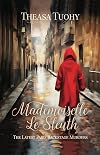
Paris in this novel is not a postcard. It is lit glass, damp stone, crowded theaters, museum bones, café tables, and the sudden red flare of a child’s raincoat where no child’s raincoat should feel innocent.
The way the book lets comedy and menace occupy the same narrow room. Sarah is absurd, theatrical, often impossible, and yet the danger around her is not softened by her brightness. If anything, her grand gestures make the darker things sharper. She keeps reaching for Sarah Bernhardt, for Shakespeare, for the stage as a kind of shelter, while the world around her keeps proving that performance cannot keep blood off the floor.
Miranda could easily have become a trick. Instead, she gives the book its strangest pressure. She is funny, willful, too young to understand the violence she keeps brushing against, and somehow clearer eyed than many of the adults. Her detective playfulness makes the murders feel more disturbing, not less, because the book keeps reminding us how quickly children absorb the weather of adult fear.
The images linger. The red mackintosh. The flowers left like coded threats. The skeletons at the Jardin des Plantes. The backstage mirror lit around a murder scene. The small theater seems to become a trap, but so does Paris itself, with every beautiful corner offering another possible clue.
Underneath the mystery, this is a book about acting as survival. Sarah performs because that is how she steadies herself. Miranda investigates because that is how she show more makes chaos bearable. Together they give the story its odd, memorable pulse. show less
The way the book lets comedy and menace occupy the same narrow room. Sarah is absurd, theatrical, often impossible, and yet the danger around her is not softened by her brightness. If anything, her grand gestures make the darker things sharper. She keeps reaching for Sarah Bernhardt, for Shakespeare, for the stage as a kind of shelter, while the world around her keeps proving that performance cannot keep blood off the floor.
Miranda could easily have become a trick. Instead, she gives the book its strangest pressure. She is funny, willful, too young to understand the violence she keeps brushing against, and somehow clearer eyed than many of the adults. Her detective playfulness makes the murders feel more disturbing, not less, because the book keeps reminding us how quickly children absorb the weather of adult fear.
The images linger. The red mackintosh. The flowers left like coded threats. The skeletons at the Jardin des Plantes. The backstage mirror lit around a murder scene. The small theater seems to become a trap, but so does Paris itself, with every beautiful corner offering another possible clue.
Underneath the mystery, this is a book about acting as survival. Sarah performs because that is how she steadies herself. Miranda investigates because that is how she show more makes chaos bearable. Together they give the story its odd, memorable pulse. show less
If you like dark fantasy with heart, secrets, and complicated characters, this is so worth reading.
This was such a strange, absorbing surprise. Sheever’s Journal follows Me’acca Mysuth Sheever, a poison master hiding in plain sight as a cook among people he considers his enemies. Through his private journal, we watch his secrets, guilt, exile, and loneliness slowly unravel as he gets pulled into the messy lives around him.
I loved how readable this was, even with such a layered world. Sheever’s voice is sharp, bitter, funny, and weirdly tender when he least wants to be. Honestly, that was the best part for me. The pacing is slow in places, and some of the world details take patience, but they also make the story feel lived in.
Was it perfect? No. Did it stay with me? Absolutely.
This was such a strange, absorbing surprise. Sheever’s Journal follows Me’acca Mysuth Sheever, a poison master hiding in plain sight as a cook among people he considers his enemies. Through his private journal, we watch his secrets, guilt, exile, and loneliness slowly unravel as he gets pulled into the messy lives around him.
I loved how readable this was, even with such a layered world. Sheever’s voice is sharp, bitter, funny, and weirdly tender when he least wants to be. Honestly, that was the best part for me. The pacing is slow in places, and some of the world details take patience, but they also make the story feel lived in.
Was it perfect? No. Did it stay with me? Absolutely.
Grow Together is a practical and experience-rich gardening guide that explores how thoughtful crop pairing and no-dig principles can significantly improve productivity, soil health, and overall garden efficiency. Charles Dowding draws on over four decades of horticultural expertise to present a clear and accessible approach to growing vegetables in harmony with natural systems.
At the heart of the book is the concept of “growing together,” where crops are intentionally combined to maximize space, reduce pests, and enhance yields. Rather than treating gardening as a series of isolated plantings, Dowding encourages readers to think in terms of plant communities—dynamic systems where each crop contributes to the success of others.
One of the book’s strongest features is its practical structure. Dowding provides 50 specific planting combinations, offering detailed guidance on timing, spacing, and harvesting techniques. Examples such as carrots with lettuces, garlic with coriander, and cucumbers interplanted with peas and strawberries illustrate how diverse crops can coexist productively within the same space.
The book also expands beyond traditional companion planting by introducing related techniques such as succession planting, catch-cropping, cover cropping, and multi-sowing. These methods are explained in a straightforward manner, making them accessible to both beginner and experienced gardeners. Dowding’s emphasis on timing and seasonal awareness helps readers show more align their gardening practices with natural cycles.
Another key strength is the book’s focus on soil health and ecological balance. Rooted in no-dig principles, it highlights how minimal soil disturbance can support long-term fertility and reduce labor while improving plant resilience. This systems-based approach encourages gardeners to think holistically rather than mechanically.
The writing style is clear, instructional, and grounded in real-world experience. Dowding avoids unnecessary complexity, instead prioritizing actionable advice that can be applied directly in the garden.
Grow Together is an insightful and highly practical guide for anyone interested in productive, sustainable gardening. It will particularly appeal to those seeking to maximize yield, improve soil health, and develop a deeper understanding of how plants interact within shared growing environments. show less
At the heart of the book is the concept of “growing together,” where crops are intentionally combined to maximize space, reduce pests, and enhance yields. Rather than treating gardening as a series of isolated plantings, Dowding encourages readers to think in terms of plant communities—dynamic systems where each crop contributes to the success of others.
One of the book’s strongest features is its practical structure. Dowding provides 50 specific planting combinations, offering detailed guidance on timing, spacing, and harvesting techniques. Examples such as carrots with lettuces, garlic with coriander, and cucumbers interplanted with peas and strawberries illustrate how diverse crops can coexist productively within the same space.
The book also expands beyond traditional companion planting by introducing related techniques such as succession planting, catch-cropping, cover cropping, and multi-sowing. These methods are explained in a straightforward manner, making them accessible to both beginner and experienced gardeners. Dowding’s emphasis on timing and seasonal awareness helps readers show more align their gardening practices with natural cycles.
Another key strength is the book’s focus on soil health and ecological balance. Rooted in no-dig principles, it highlights how minimal soil disturbance can support long-term fertility and reduce labor while improving plant resilience. This systems-based approach encourages gardeners to think holistically rather than mechanically.
The writing style is clear, instructional, and grounded in real-world experience. Dowding avoids unnecessary complexity, instead prioritizing actionable advice that can be applied directly in the garden.
Grow Together is an insightful and highly practical guide for anyone interested in productive, sustainable gardening. It will particularly appeal to those seeking to maximize yield, improve soil health, and develop a deeper understanding of how plants interact within shared growing environments. show less
Dark, rain washed, and quietly luminous, this collection feels like standing at the edge of a cold sea while something ancient breathes underneath it.
Stranger to the Beautiful is not a plot driven book, but a passage through winter, tide, stone, forest, age, prayer, and return. Don Hynes writes as if the landscape is alive beside him, not scenery but witness, judge, shelter, and altar.
The atmosphere is the strongest spell here. Wet gray dawns, crows, owls, roots, moonless nights, sea wind, hidden stones. The poems keep circling darkness, but not in a theatrical way. This is quieter dread, the kind that comes with aging, grief, silence, and the knowledge that beauty does not rescue us so much as ask us to kneel and look again. The Pacific Northwest mood is heavy in the best sense, soaked into every page.
A few poems lean so closely into the same sacred earth imagery that the intensity softens in places, and I wanted sharper variation at times. Still, the emotional clarity is real. This is a meditative, shadowed, deeply felt collection about surrendering to the dark and finding, somehow, that it has been holding light all along.
Stranger to the Beautiful is not a plot driven book, but a passage through winter, tide, stone, forest, age, prayer, and return. Don Hynes writes as if the landscape is alive beside him, not scenery but witness, judge, shelter, and altar.
The atmosphere is the strongest spell here. Wet gray dawns, crows, owls, roots, moonless nights, sea wind, hidden stones. The poems keep circling darkness, but not in a theatrical way. This is quieter dread, the kind that comes with aging, grief, silence, and the knowledge that beauty does not rescue us so much as ask us to kneel and look again. The Pacific Northwest mood is heavy in the best sense, soaked into every page.
A few poems lean so closely into the same sacred earth imagery that the intensity softens in places, and I wanted sharper variation at times. Still, the emotional clarity is real. This is a meditative, shadowed, deeply felt collection about surrendering to the dark and finding, somehow, that it has been holding light all along.
Notes from the Brand Stand: Thoughts on Emotional Branding from Someone Who Has Fought for Consumer Attention and Won by Warren Kornblum

This is one of those business books that feels less like a lecture and more like a very caffeinated conversation with someone who has actually been in the room where the brand decisions happen.
Kornblum’s whole argument is that strong brands do not just win attention, they win trust, emotion, and what he calls share of heart. The book moves through ideas, using a lot of real brand examples to show how companies either build belief or slowly lose it. It is very readable, very direct, and honestly kind of energizing if you enjoy books that make you want to underline half the page
What I liked most is that it does not feel obsessed with empty marketing jargon. The tone is practical, but there is a real human core to it. Again and again, it comes back to care, clarity, and follow through, which sounds simple until you realize how many brands completely fumble that.
Still, if you love branding, leadership, or books about why people care, this is absolutely worth it. It left me weirdly energized about clarity, which is not a sentence I say every day.
Kornblum’s whole argument is that strong brands do not just win attention, they win trust, emotion, and what he calls share of heart. The book moves through ideas, using a lot of real brand examples to show how companies either build belief or slowly lose it. It is very readable, very direct, and honestly kind of energizing if you enjoy books that make you want to underline half the page
What I liked most is that it does not feel obsessed with empty marketing jargon. The tone is practical, but there is a real human core to it. Again and again, it comes back to care, clarity, and follow through, which sounds simple until you realize how many brands completely fumble that.
Still, if you love branding, leadership, or books about why people care, this is absolutely worth it. It left me weirdly energized about clarity, which is not a sentence I say every day.

Expected wayyy to much from this book i guess...
First of all, not loving the ending and some part is just so so annoying. To be honest most people in this book is just dumb and doesn't make any sense. Then again it's just my opinion but I'm just not loving this, it could be better.
First of all, not loving the ending and some part is just so so annoying. To be honest most people in this book is just dumb and doesn't make any sense. Then again it's just my opinion but I'm just not loving this, it could be better.