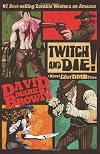
Dark goings-on are afoot in David Mark Brown’s alternate-history Texas. Actually a lot of them are going on *under*foot because the twitcher outbreak that’s the focus of this story takes place in a mining community. If you’re claustrophobic, you might find some of the underground scenes tricky — best seek medical advice before reading this novel.
Several different forces are at work here in this novel, each with their own agenda, with alliances and betrayals enough to keep you on your toes, but not enough to confuse you. The various parties are sucked into the outbreak of a strange disease in a mining town. Supposedly dead people look suspiciously similar to the ‘twitchers’ who have infested the town (or possibly liberated it, depending on your point of view).
I read an earlier book in the series: A Fistful of Reefer. I thoroughly enjoyed that book with its wide-open vistas and possibilities. Twitch and Die! has more of a close-up feel. The characters are dark and brooding; there’s a little less sense of wild adventure and more hopelessness. Dark it might be, but the author still has plenty of scenes of humor, exuberance and even romance, without them feeling tacked on.
This is a fully standalone novel, and yet I enjoy the big picture in the background: big ideas and long-running plot- and character-development. There are many more stores in this series, and one is bundled with this book: McCutchen’s Bones, which is a novella from the perspective of the Texas show more Ranger character, or ex-ranger by the time of the story. It’s a good tale in its own right and illustrates how the author is adept at taking his setting and his principal characters and using them to write very different tales. show less
Several different forces are at work here in this novel, each with their own agenda, with alliances and betrayals enough to keep you on your toes, but not enough to confuse you. The various parties are sucked into the outbreak of a strange disease in a mining town. Supposedly dead people look suspiciously similar to the ‘twitchers’ who have infested the town (or possibly liberated it, depending on your point of view).
I read an earlier book in the series: A Fistful of Reefer. I thoroughly enjoyed that book with its wide-open vistas and possibilities. Twitch and Die! has more of a close-up feel. The characters are dark and brooding; there’s a little less sense of wild adventure and more hopelessness. Dark it might be, but the author still has plenty of scenes of humor, exuberance and even romance, without them feeling tacked on.
This is a fully standalone novel, and yet I enjoy the big picture in the background: big ideas and long-running plot- and character-development. There are many more stores in this series, and one is bundled with this book: McCutchen’s Bones, which is a novella from the perspective of the Texas show more Ranger character, or ex-ranger by the time of the story. It’s a good tale in its own right and illustrates how the author is adept at taking his setting and his principal characters and using them to write very different tales. show less
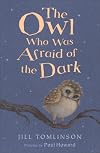
Delightful illustrations. Timeless. Slightly twee and predictable but enjoyable to read as an adult. Of course, it's not really aimed at grown-ups and this was adored by my 5yo boy, especially when we got to go EEEEK!

I found the writing lazy, clichéd, and lacking passion from the author, as if this were one of a batch of novels mass produced on autopilot. Some of the world-building and the faerie politics could have been very interesting, but I couldn't work through the contrived scenes of erotica and romance to actually enjoy them.
I guess Laurell K. Hamilton is just not right for me. Plenty of people seem to like her and perhaps you're one of them.
I guess Laurell K. Hamilton is just not right for me. Plenty of people seem to like her and perhaps you're one of them.

Some of the stories in this collection of short stories might appear old-fashioned or missing real technological trends. The quality of writing, though, shines through undimmed.
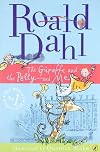
One of the simplest, shortest, and lightest Dahl books. It's easy-going fun with illustrations on every page. The language is simpler too. My 5-yr-old is having a go at reading it himself.
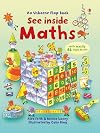
Since buying this book, my 5-yr-old son doesn't want to watch TV before going to school; he wants to 'play' (his words) with his maths book instead.
An enjoyable bout of sillyness but with some real emotional backbone. My copy says 9+ and I think that's right. The ending is tinged with sadness.

I found this by far the best Dad's book. My copy has been on loan to three other fathers.
The most intense opening to any novel I've ever read. The rest doesn't quite match the quality of the beginning but still a great read, if a little old fashioned. For example, I enjoyed the way the government tried to cut a fugitive off from his funds by declaring a bank holiday. But taken on its own terms, a great novel.

Challenging and provocative. A little heavy-going but steadily blasts away at some well-established but lazy Great War myths.

Out of date now, to some degree. But this got me fascinated with science, and particularly the science behind military sci fi. For me this was a seminal book.
I read this some years ago from Project Guttenberg, which I was mining for contemporary pre-Great War novels. In that context, I thought this was a fascinating and enjoyable read. This is the German equivalent of the 1903 novel The Riddle of the Sands by Erskine Childers.
In the same way, Niemann's novel feels at times heavy handed and overly keen to tell the reader how much the British deserve to be punished for their arrogance. Or should that be the English? Like a lot of contemporary non-British writers, Niemann fails to distinguish between English and British. Despite these flaws, I found some of the spy scenes genuinely exciting. Scripted well, this would make a good film.
One of the most peculiar aspects of this novel is the point of view shift at the end. I can't really explain without giving away the ending. But you'll know what I mean when you read it!
If you're interested in the Great War and its origins, this is well worth a read.
In the same way, Niemann's novel feels at times heavy handed and overly keen to tell the reader how much the British deserve to be punished for their arrogance. Or should that be the English? Like a lot of contemporary non-British writers, Niemann fails to distinguish between English and British. Despite these flaws, I found some of the spy scenes genuinely exciting. Scripted well, this would make a good film.
One of the most peculiar aspects of this novel is the point of view shift at the end. I can't really explain without giving away the ending. But you'll know what I mean when you read it!
If you're interested in the Great War and its origins, this is well worth a read.

If you liked Star Trek NG, you’ll like this
I found the book got better as I went along, and by the end I was glad I'd read it.
Overall, I've got mixed feelings. There was a lot of exposition towards the beginning and some felt contrived. On the other hand, a fair chunk of the exposition was about military ship technology and tactics, and I have to say this was well thought out -- far better than the average Star Trek clone. And there was a lot less contrived dialogue than most SF TV shows.
Except for the few bad apples, who are the exceptions to prove the rule, naval officers and crew in the Royal Manticore Navy are all shining examples of decency and honour. There's never any question about who the good guys are and who needs to be shot. Hopefully that gets muddied in later books as I would find that would grate after a while, but I was happy enough to go along with that for this book.
For me, the section that swung it for me to give a good rather than middling review was the ship chase and battle at the end. Tense and felt realistic.
In conclusion, this book does what it intends to very well.
I found the book got better as I went along, and by the end I was glad I'd read it.
Overall, I've got mixed feelings. There was a lot of exposition towards the beginning and some felt contrived. On the other hand, a fair chunk of the exposition was about military ship technology and tactics, and I have to say this was well thought out -- far better than the average Star Trek clone. And there was a lot less contrived dialogue than most SF TV shows.
Except for the few bad apples, who are the exceptions to prove the rule, naval officers and crew in the Royal Manticore Navy are all shining examples of decency and honour. There's never any question about who the good guys are and who needs to be shot. Hopefully that gets muddied in later books as I would find that would grate after a while, but I was happy enough to go along with that for this book.
For me, the section that swung it for me to give a good rather than middling review was the ship chase and battle at the end. Tense and felt realistic.
In conclusion, this book does what it intends to very well.
I'd heard of this book and spent several years chasing down a second-hand copy (the year before it came out in SF Masterworks!). I wasn't disappointed. It's a journey at breakneck speed through mankind's future history. By the end, the last men are far removed from our petty concerns. I've seen Well's film of The Shape of Things to Come. Last and First Men feels like that (partly with the pre-war feel) except imagine the film keeps rolling on and on into the distant future.
Great as the scope of this book is, Stapledon's Star Maker makes it look parochial.
Great as the scope of this book is, Stapledon's Star Maker makes it look parochial.
Odd John is an early and great entrant into the 'homo-superior emerges' sub-genre. Somewhat like Slan but without the sense of pulp adventure. More British, perhaps.
Sirius is a fine book too.
Sirius is a fine book too.
If you ever come my way you'll know you're near my house because my WiFi network is called 'Olaf Stapledon'. Star Maker is the main reason for that. It is a page-turner of breathtaking imagination.
Be warned, though, this book has no room for plot or characters except for the most flimsy of framing devices. It doesn't need them. It has ideas.
Be warned, though, this book has no room for plot or characters except for the most flimsy of framing devices. It doesn't need them. It has ideas.
My favourite book! A collection of short fiction that explores the width and depth of the author's Xeelee Sequence. As individual stories (considered independently of the Xeelee context), some are good, some excellent, and some merely okay. What makes me re-read this book is the breathtaking scale of Baxter's vision.
I have been reading science fiction for several decades now. Of the hundreds of books and magazines I must have read, none conveys as much sense of wonder as Resplendent.
For maximum effect, I recommend reading some of the novels from the Xeelee Sequence and/or Destiny's Children series first.
I have been reading science fiction for several decades now. Of the hundreds of books and magazines I must have read, none conveys as much sense of wonder as Resplendent.
For maximum effect, I recommend reading some of the novels from the Xeelee Sequence and/or Destiny's Children series first.