Down a Street that Wasn’t There
Marie Brennan
This anthology is allegedly “urban fantasy” which apparently means “speculative fiction in a modern setting” as not all of these take place in a city. I particularly liked “La Molejera” and “The Genius Prize.” “La Molejera” is an intriguing sort of suspense story based on Meso-American folklore with a bunch of made-up elements. As I say, I liked it, but I am white and so is Brennan as far as I know; it’s generally considered a bit risky to use the folklore of other cultures as basis for your fantasy story. Brennan has apparently done quite a lot of research in preparation for writing it. “The Genius Prize” is, in the end, about mechas and kaiju (with controllers) fighting each other, and has a high body count, but it is quite fun to read although I do not normally like mechas or kaiju; the "high-school robotics/bioengineering competition" spin in this one worked for me. There’s also an amusing faux-academic paper on how best to kill werewolves —a highly necessary study that is conducted by a very unethical researcher, —a deconstruction of Twilight-style vampires, another of Peter Pan, a slightly outdated account of “Coyotaje” or crossing the southern border into the United States with (IMHO very obvious SPOILER)shapeshifters , and the tale of a heartless developer who’s caught the attention of something he’d rather not. Brennan writes well and I was entertained enough to read all of the show more stories at once (it isn’t a very long book overall), but I doubt I’ll return to most of them a second time. show less
Marie Brennan
This anthology is allegedly “urban fantasy” which apparently means “speculative fiction in a modern setting” as not all of these take place in a city. I particularly liked “La Molejera” and “The Genius Prize.” “La Molejera” is an intriguing sort of suspense story based on Meso-American folklore with a bunch of made-up elements. As I say, I liked it, but I am white and so is Brennan as far as I know; it’s generally considered a bit risky to use the folklore of other cultures as basis for your fantasy story. Brennan has apparently done quite a lot of research in preparation for writing it. “The Genius Prize” is, in the end, about mechas and kaiju (with controllers) fighting each other, and has a high body count, but it is quite fun to read although I do not normally like mechas or kaiju; the "high-school robotics/bioengineering competition" spin in this one worked for me. There’s also an amusing faux-academic paper on how best to kill werewolves —a highly necessary study that is conducted by a very unethical researcher, —a deconstruction of Twilight-style vampires, another of Peter Pan, a slightly outdated account of “Coyotaje” or crossing the southern border into the United States with (IMHO very obvious SPOILER)
 This review was written for LibraryThing Early Reviewers.
Rural Voices: 15 Authors Challenge Assumptions about Small-Town America
Nora Shalaway Carpenter, ed.
I haven’t thought enough about the issues this book addresses, but I wanted to read it because I’m interested. I don’t know very much about life in rural areas, aside from what I’ve read in other books (Sarah Black’s gay romances usually have very well-done rural settings, for instance). Editor Nora Shalway Carpenter states that the intention of Rural Voices is to dispel the myth—resurgent after the 2016 general election—that all people in rural areas are alike and have similar values. I grew up in the suburbs. I want to move to a rural area if I can—some of the stories and essays here mention the excellent reasons why the authors or characters like where they grew up, or where they live now, so I don’t need to explain further. But when I mention my desire to people, they say things like, “Don’t move to someplace like Wyoming, it isn’t safe for you there” because I’m trans and in a same-gender marriage. Or I hear from a queer male friend, “If I went back to the town where my uncle lives in the South, I would be shot.” I don’t know if that’s true or not. He’s the one who knows people there, not me, and it wouldn’t take more than a few trigger-happy vigilantes…. And then I have certain friends who tell stories—the same ones, repeatedly—about when they drove through a rural area, or stopped in one for gas or food, or made a show more delivery, the point of which is to mock the way the people spoke to them and make amusing comparisons to Children of the Corn and such for entertainment value. If I say it isn’t funny, I am told “They marry 14-year-old girls, you’re defending them?” Which is a dirty debating tactic. But, like Carpenter says, some city people do, apparently, assume that all rural people are to blame for whatever bad things happen in rural areas.
So, there are several stories in Rural Voices about queer people. I especially liked Tirzah Price’s “Best in Show,” about a queer girl who raises hogs and goes on her first same-sex date. In Carpenter’s own story, “Close Enough,” the protagonist is straight, but she has a queer best friend and she feels she doesn’t fit in because she wasn’t born and raised in West Virginia. (I can identify with feeling rootless; I’m sure many others can as well.) And some of the characters are not rootless: many of the pieces have a wonderful sense of place. My favorite is Estelle Laure’s “Home Waits” about a girl who’s been sent to boarding school but is homesick for Taos, New Mexico. I don’t want to live in Taos, because I need my trees and clouds and rain, but I can see why she does. There are poems as well, such as Ashley Hope Pérez’s memorable “Home Is,” David Bowles’ “A Border Kid Comes of Age” (another story of a queer person), and Joe Bruchac’s mingled prose/poetry reminiscences (I had never heard of a wringer washer before!). A few tales have supernatural elements, and Randy DuBurke and Veeda Bybee contribute illustrated stories.
Some of the stories are uplifting. Most of them have a theme or lesson of some kind. Christianity is often pervasive in the background, because it is a huge part of rural America, but in this book it is rarely engaged with and especially not in a constructive or positive way. Perhaps this is because the characters are all children and teens? A few of them are quite dark in tone and not very nice to read. But many people in rural areas ARE poor or have bad things happen to them; the point of the anthology is to illuminate a variety of perspectives on rural life, not to paint an unrealistically rosy picture. As S. A. Cosby says in his author’s note: Poverty in the country is more complex, more implacable than in the city… and few of these stories are about wealthy people. All in all, I feel it’s a valuable anthology in which there’s a good variety of rural settings, young protagonists, and narrative styles to keep a reader’s interest.
(There are some minor editing issues, but I am reviewing an ARC, they may be fixed in the final edition.) show less
Nora Shalaway Carpenter, ed.
I haven’t thought enough about the issues this book addresses, but I wanted to read it because I’m interested. I don’t know very much about life in rural areas, aside from what I’ve read in other books (Sarah Black’s gay romances usually have very well-done rural settings, for instance). Editor Nora Shalway Carpenter states that the intention of Rural Voices is to dispel the myth—resurgent after the 2016 general election—that all people in rural areas are alike and have similar values. I grew up in the suburbs. I want to move to a rural area if I can—some of the stories and essays here mention the excellent reasons why the authors or characters like where they grew up, or where they live now, so I don’t need to explain further. But when I mention my desire to people, they say things like, “Don’t move to someplace like Wyoming, it isn’t safe for you there” because I’m trans and in a same-gender marriage. Or I hear from a queer male friend, “If I went back to the town where my uncle lives in the South, I would be shot.” I don’t know if that’s true or not. He’s the one who knows people there, not me, and it wouldn’t take more than a few trigger-happy vigilantes…. And then I have certain friends who tell stories—the same ones, repeatedly—about when they drove through a rural area, or stopped in one for gas or food, or made a show more delivery, the point of which is to mock the way the people spoke to them and make amusing comparisons to Children of the Corn and such for entertainment value. If I say it isn’t funny, I am told “They marry 14-year-old girls, you’re defending them?” Which is a dirty debating tactic. But, like Carpenter says, some city people do, apparently, assume that all rural people are to blame for whatever bad things happen in rural areas.
So, there are several stories in Rural Voices about queer people. I especially liked Tirzah Price’s “Best in Show,” about a queer girl who raises hogs and goes on her first same-sex date. In Carpenter’s own story, “Close Enough,” the protagonist is straight, but she has a queer best friend and she feels she doesn’t fit in because she wasn’t born and raised in West Virginia. (I can identify with feeling rootless; I’m sure many others can as well.) And some of the characters are not rootless: many of the pieces have a wonderful sense of place. My favorite is Estelle Laure’s “Home Waits” about a girl who’s been sent to boarding school but is homesick for Taos, New Mexico. I don’t want to live in Taos, because I need my trees and clouds and rain, but I can see why she does. There are poems as well, such as Ashley Hope Pérez’s memorable “Home Is,” David Bowles’ “A Border Kid Comes of Age” (another story of a queer person), and Joe Bruchac’s mingled prose/poetry reminiscences (I had never heard of a wringer washer before!). A few tales have supernatural elements, and Randy DuBurke and Veeda Bybee contribute illustrated stories.
Some of the stories are uplifting. Most of them have a theme or lesson of some kind. Christianity is often pervasive in the background, because it is a huge part of rural America, but in this book it is rarely engaged with and especially not in a constructive or positive way. Perhaps this is because the characters are all children and teens? A few of them are quite dark in tone and not very nice to read. But many people in rural areas ARE poor or have bad things happen to them; the point of the anthology is to illuminate a variety of perspectives on rural life, not to paint an unrealistically rosy picture. As S. A. Cosby says in his author’s note: Poverty in the country is more complex, more implacable than in the city… and few of these stories are about wealthy people. All in all, I feel it’s a valuable anthology in which there’s a good variety of rural settings, young protagonists, and narrative styles to keep a reader’s interest.
(There are some minor editing issues, but I am reviewing an ARC, they may be fixed in the final edition.) show less
This review was written for LibraryThing Early Reviewers.
Sleep darkly…. Ever since their mother and father disappeared into the silver grass seven years ago, Mayhap Ballastian, now twelve, and her sisters, Winnow and Pavonine, have followed their parents’ last instructions—a letter found in the lap of a porcelain doll—to wait for them inside Straygarden Place. The house magically provides for all their daily needs, except sleep. One day, Mayhap’s older sister Winnow goes walking in the grass, and Mayhap follows. That night, Winnow’s behavior changes ominously, even as her dark eyes and creamy skin begin to turn silver and the grass grows more threatening. Determined to cure Winnow, Mayhap ventures ever further into the house’s mysterious places as she works to untangle the web of magic, secrets, and lies that have for so long enveloped her home and family. Redolent with themes of loneliness, love, and belonging, this compact, almost poetic tale captivates with its impressive wordcraft, intriguing setting, page-turning suspense, and emotional impact. Straygarden seems a place apart from the world, though details of clothing, food, and furnishings evoke a 19th or 20th century Anglo milieu. Invented words feel intuitive; for example, black-furred dogs called droomhunds crawl into Ballastians’ minds so that they can sleep, and flowering wanderroot trees float above house-high silver grass. Tension from the unfolding mystery, atmospheric language, and references to past tragedy give the book a creepy feel, but show more on-page violence is minimal. As in her previous novel, The Turnaway Girls, Chewins deftly employs vivid, often ornate prose that could be distracting in lesser hands. Well-chosen similes pull the reader into each scene and create the appropriate mood, while skillful plotting and pacing engage readers all the way to a fairy-tale ending—satisfying, slightly heartbreaking, and intensely beautiful.
~~~
(Less formally – I loved it, I cried buckets and then went and read Hayley Chewins’ other novel, which I also loved. And they don’t have unhappy endings.) show less
~~~
(Less formally – I loved it, I cried buckets and then went and read Hayley Chewins’ other novel, which I also loved. And they don’t have unhappy endings.) show less
This review was written for LibraryThing Early Reviewers.
How far would you go to feel loved and powerful? Beth Soames, a white, working-class Brit, feels like a lifelong loser at 18, already worn down from coping with her dysfunctional family and a lifetime of microaggressions from a world with little tolerance for “fugly” (fat and ugly) women—as Beth identifies herself. Fettered by social anxiety, Beth hesitantly befriends Amy, a beautiful, outgoing university student; at the same time, she daily spends hours online trolling conventionally attractive women on Instagram to punish them for their supposed vanity and contempt for people like her. As Beth’s Internet sweetheart, Tori, urges her to new heights of virtual villainy, Beth is initially exhilarated but subsequently horrified by the real-life fallout from her malicious actions. As Beth tries to cut ties with Tori, Tori’s growing malevolence threatens Beth’s family and her new friends, forcing Beth to overcome her fears to protect those she loves. Overall, the book sends a fat-positive message, and Waller convincingly depicts Internet hazards such as catfishing and hacking; readers will come away with valuable information about online safety. For all her flaws and cynicism, Beth is a sympathetic and relatable protagonist. Waller’s use of intimate, first-person narration occasionally falters, such as when the author contrives to hide Beth’s knowledge from the reader for the sake of a later twist, creating scenes where perplexity undermines suspense. show more Similarly, Beth demonstrates consistent attraction to women rather than to men, apparently without realizing it—the story implies a journey from denial to acceptance of her sexuality but does not clearly engage this issue from Beth’s perspective, potentially leaving readers confused. While gripping, this book suffers from relentless negativity. Few pleasant scenes occur before the end, and most of those emanate a sense of dread. Despite its flaws, an entertaining and worthwhile read. show less
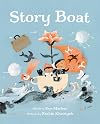
Here we are. So opens this evocative journey story of two young, brown-skinned children and their small black cat. With a changeable group of other travelers in coats and scarves, the three play, rest, and wander through ever-shifting landscapes—both real and imaginary—softly rendered in slate-blue, apricot, coral, white, grey, and porcelain colored pencils and paints. In Maclear’s poem, here is a flower, a lamp, a song, “a cup / old and fine, warm as a hug.” As the travelers finally meet with friends in a seaside town, the characters’ identities and homes are defined neither by the rows of identical, white tents midway through the book, nor by the quaint, warmly-lit buildings at the end. By the time the repeated phrase here we are closes the journey, here seems less important than we. A marvelous, nuanced work of beauty reminiscent of Wendy Meddour and Daniel Egnéus’ Lubna and Pebble, this story subtly invites a connection to recent migrant narratives, especially the travelers’ voyage in what appears to be a crowded and less than seaworthy vessel. The characters’ nationality, race, and ethnicity, as well as the geographic details of their route, remain ambiguous. Poetic, often figurative words join expressive pictures to shape a basic narrative that does not dwell on the migrants’ hardships: an adult weeps in one scene, but the focus stays on the two children’s day-to-day experiences and fertile imaginations, as cup, blanket, lamp, and flower show more become a home, a sail, a lighthouse, and a ladder. Between the wealth of detail in Kheiriyeh’s illustrations and the depth of Maclear’s text, engaged readers will make further discoveries over multiple perusals. show less
This review was written for LibraryThing Early Reviewers.Oh, No, Octavius!: Octavius Guy and the Case Of the Quibbliing Cleric (Send For Octavius Guy Book 4) by Michael Gallagher
This book was interesting enough that I read the entire thing, although it is longer than it needs to be. It is too long because detailed information arising out of the author’s impressive background research, as well as episodes that primarily relate to the main character’s previous adventures, are included even when they do not serve to develop the present narrative.
The plot is very convoluted. I was disappointed to find that the method of the murder, as well as the murderer’s motivations, were both impossible for me to credit and (in the case of the latter) offensive. I can’t go into more detail on those points without revealing spoilers.
The characterization detracted very much from my enjoyment of the book. The main character is unlikable (arrogant, self-absorbed, and manipulative, even when there is no good reason for it aside from his own amusement), while the rest of the characters appear to exist solely for the main character’s benefit. They lack agency (their personal motivations are all stereotypical, nonsensical, and/or revolve around the main character). The female characters in particular suffer from stereotyping and an inability to think or act without focusing on men in some manner. All of the characters are unrealistically respectful and even deferential to the main character, who is for all intents and purposes a sly, smug, know-it-all teenage boy (a type many people in real life find at least a little bit intolerable).
I spent quite some time show more trying to figure out exactly why I did not like this book in particular while I do like several other books with arrogant, crafty teenage male characters. I concluded that it is because in those other books the characters who are not the protagonist have enough substance and will of their own to be interesting in themselves (not in relation to the protagonist) and to seriously challenge and engage the main character in ways that he cannot always control, and the main character exhibits some evidence of personal growth in unexpected directions from time to time. show less
The plot is very convoluted. I was disappointed to find that the method of the murder, as well as the murderer’s motivations, were both impossible for me to credit and (in the case of the latter) offensive. I can’t go into more detail on those points without revealing spoilers.
The characterization detracted very much from my enjoyment of the book. The main character is unlikable (arrogant, self-absorbed, and manipulative, even when there is no good reason for it aside from his own amusement), while the rest of the characters appear to exist solely for the main character’s benefit. They lack agency (their personal motivations are all stereotypical, nonsensical, and/or revolve around the main character). The female characters in particular suffer from stereotyping and an inability to think or act without focusing on men in some manner. All of the characters are unrealistically respectful and even deferential to the main character, who is for all intents and purposes a sly, smug, know-it-all teenage boy (a type many people in real life find at least a little bit intolerable).
I spent quite some time show more trying to figure out exactly why I did not like this book in particular while I do like several other books with arrogant, crafty teenage male characters. I concluded that it is because in those other books the characters who are not the protagonist have enough substance and will of their own to be interesting in themselves (not in relation to the protagonist) and to seriously challenge and engage the main character in ways that he cannot always control, and the main character exhibits some evidence of personal growth in unexpected directions from time to time. show less
This review was written for LibraryThing Early Reviewers.
The Nine Lands: a rich, expansive fantasy world glimpsed through the eyes of seven (or so) of its diverse inhabitants, people who live and die according to their circumstances—soldier, traveler, king, shaman, and more. For all of the magic, music, manners, and warfare, these are really stories about people and their choices. Because the characters are relatable, none of the stories feel inaccessible despite taking place in an unfamiliar fantasy setting of which the reader has no background knowledge. The stories do not absolutely wallow in gore, although there is some gruesome violence in several of the tales. Brennan has, per the author’s notes in this book, done a considerable amount of world-building for the Nine Lands setting—enough to support an epic fantasy—but resists any temptation to digress from the point of each story in order to show off the world. There are clear connections between some of the stories (relationships between certain ethnic groups in particular), but it is not clear whether the stories are presented in setting-specific chronological order. They are certainly not all simultaneous; “Kingspeaker” and “The Legend of Anahata” take place on opposite sides of an imperial conquest, which gives a proper sense of history to the reader’s overall impression of the Nine Lands. All of these stories seem to have been written early in Brennan’s career. I have not yet read any of the author’s other work, but I am favorably impressed by show more this anthology and so I will definitely move A Natural History of Dragons up my TBR list.
I received the ebook version of The Nine Lands through the Early Reviewers program. The ebook is conveniently laid out for purpose of reading the stories in order; links within the book are arranged so that it is easy to read the author’s story notes either after each story or at the end (or beginning) of the book. show less
I received the ebook version of The Nine Lands through the Early Reviewers program. The ebook is conveniently laid out for purpose of reading the stories in order; links within the book are arranged so that it is easy to read the author’s story notes either after each story or at the end (or beginning) of the book. show less
This review was written for LibraryThing Early Reviewers.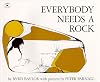
A low-key, dryly funny book of sensible advice on how to choose your very own rock. I'm not sure it has much to do with geology, other than celebrating the diversity of size, shape, texture, smell, and appearance in the rocks you find as you search, but it's a lovely, slow, solitary sort of book. People who hate solitude will likely find it boring and empty, but I find it redolent of nostalgia (I used to spend a lot of time looking for rocks) and replete with possibility (I may well look for rocks again in the future).

A Brave Knight and an Evil Princess live in a castle together; the castle, accordingly, is not a peaceful place. The siblings have their own rooms, but they both prefer one another’s company to comparatively dull solitude. Naturally, the two don’t get along very well—the Evil Princess plays evil tricks, the Brave Knight retaliates, the Magic Mirror is exasperated, and the manky cat has no peace—but sometimes that’s just how life is in a castle!
A new collaboration between the rival Holm siblings of Babymouse fame, this book portrays an energetic sister and brother who find moments of sympathy now and then, their near-perpetual state of feud notwithstanding. Simple but spirited pencil-and-watercolor illustrations bring the unruly pair to life; Holm’s use of color is harmonious and striking without being garish. Since the Knight presents as black while the Princess appears Asian, the story also serves to validate and normalize racially mixed families. The book ends on a note of more quarreling, rather than reconciliation, but could anyone really believe that a pair like this would allow calm to prevail for long? Balance must be restored to the kingdom!
This book is an entertaining, lighthearted story that suggests families can still be strong even though they may not be wholly harmonious. Readers with annoying siblings will find the characters refreshingly familiar, but those who lack a sense of humor may wish to look elsewhere for more serious reading fare.
A new collaboration between the rival Holm siblings of Babymouse fame, this book portrays an energetic sister and brother who find moments of sympathy now and then, their near-perpetual state of feud notwithstanding. Simple but spirited pencil-and-watercolor illustrations bring the unruly pair to life; Holm’s use of color is harmonious and striking without being garish. Since the Knight presents as black while the Princess appears Asian, the story also serves to validate and normalize racially mixed families. The book ends on a note of more quarreling, rather than reconciliation, but could anyone really believe that a pair like this would allow calm to prevail for long? Balance must be restored to the kingdom!
This book is an entertaining, lighthearted story that suggests families can still be strong even though they may not be wholly harmonious. Readers with annoying siblings will find the characters refreshingly familiar, but those who lack a sense of humor may wish to look elsewhere for more serious reading fare.
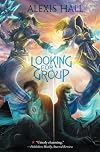
Drew, a nineteen-year-old college student with a perfectly normal, well-rounded social life, likes hanging out with friends for movie and board game nights and only plays Heroes of Legend (HOL) online a few nights per week. When Drew falls for a girl in his new HOL guild, his friends suggest that she is probably a guy, which turns out to be true. The guy’s name is Kit, and he is another college student who lives nearby. Drew still really likes him; however, Drew worries that Kit spends too much time playing HOL and hanging out with friends online. It doesn’t seem healthy, and people online aren’t real anyway, so why won’t Kit just spend more time with Drew and his friends in real life? Is there something wrong with him? Or is Drew the one who’s missing something?
In this fun, satisfying contemporary romance, Drew’s third-person narrative alternates with gameplay logs and a good portion of the action takes place inside of a massively multiplayer online game—similar to World of Warcraft—which is so well done that any reader familiar with that environment will feel right at home. (Hall even includes a helpful glossary of gaming terminology for readers who are not gamers.) The book’s themes of friendship and first love will resonate with young readers while they join Drew, Kit, and their lively circle of online and offline friends in some quite complex examinations of identity, gender, personal fulfillment, and the nature of various interpersonal show more relationships.
An outstanding addition to queer-inclusive collections, this novel will please readers who enjoy stories like Becky Albertalli’s Simon vs. the Homo Sapiens Agenda . While Hall is best known for his adult LGBTQ romance novels, this book does not contain explicit sexual content, although there is profanity in some of the dialogue. show less
In this fun, satisfying contemporary romance, Drew’s third-person narrative alternates with gameplay logs and a good portion of the action takes place inside of a massively multiplayer online game—similar to World of Warcraft—which is so well done that any reader familiar with that environment will feel right at home. (Hall even includes a helpful glossary of gaming terminology for readers who are not gamers.) The book’s themes of friendship and first love will resonate with young readers while they join Drew, Kit, and their lively circle of online and offline friends in some quite complex examinations of identity, gender, personal fulfillment, and the nature of various interpersonal show more relationships.
An outstanding addition to queer-inclusive collections, this novel will please readers who enjoy stories like Becky Albertalli’s Simon vs. the Homo Sapiens Agenda . While Hall is best known for his adult LGBTQ romance novels, this book does not contain explicit sexual content, although there is profanity in some of the dialogue. show less
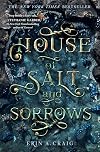
As Eulalie, the fourth of her sisters, is laid to rest in the family mausoleum, Annaleigh Thaumas wonders whether their line is indeed cursed, as people say. Urged by her remaining sisters to leave her grief in the past, Annaleigh instead resolves to find the truth behind Eulalie’s death. In the company of a visiting childhood friend, Annaleigh’s sisters soon venture through a mysterious door into a world of lavish, magical parties, sneaking out to dance every night away. While his young, pregnant wife consumes her father’s attention, Annaleigh copes with growing household responsibilities, a budding romance with a young man who seems to know more than he should, and her sisters’ obsessions, all while horrifying visions of the dead haunt her with increasing frequency. After several more deaths, the disturbing truth begins to emerge: due to an ill-advised supernatural bargain, a nightmarish foe is manipulating the family ever deeper into madness. Annaleigh and her gentleman friend must sort reality from illusion and break the deadly deal before the survivors can claim their happy ending.
An imaginative retelling of “The Twelve Dancing Princesses,” this tale focuses on Annaleigh and her sisters instead of on a male suitor. Craig depicts an old-fashioned, maritime, European-flavored culture in which all major characters are uniformly heterosexual and are either nobles or exceptional beings; commoners and servants remain almost entirely in the background. The show more decadent, aquatic-themed cover art presages the first half of this well-balanced and unpredictable narrative, in which details of plot and background emerge gradually amidst luxuriantly detailed scene-setting and slow-building horror. Heightened suspense and macabre violence characterize the second half, in which the pace accelerates towards a reasonably satisfying climax. Fans of atmospheric suspense and updated fairy tales will likely be pleased with this book. show less
An imaginative retelling of “The Twelve Dancing Princesses,” this tale focuses on Annaleigh and her sisters instead of on a male suitor. Craig depicts an old-fashioned, maritime, European-flavored culture in which all major characters are uniformly heterosexual and are either nobles or exceptional beings; commoners and servants remain almost entirely in the background. The show more decadent, aquatic-themed cover art presages the first half of this well-balanced and unpredictable narrative, in which details of plot and background emerge gradually amidst luxuriantly detailed scene-setting and slow-building horror. Heightened suspense and macabre violence characterize the second half, in which the pace accelerates towards a reasonably satisfying climax. Fans of atmospheric suspense and updated fairy tales will likely be pleased with this book. show less

A series of vignettes concerning various persons connected to a small London weekly paper. Sometimes mildly amusing, other times appallingly racist. Some interesting gender-play: Tommy on first appearance, and being around twelve years old, does not know if "it" is a boy or a girl. Doctor checks and says girl, but Tommy continues to behave in a gender-ambiguous manner throughout the book, except maybe at the very end (which is sudden and makes little sense--Jerome is much better at vignettes than at plotting.) There is also a chapter about a man who dresses up convincingly as a woman and has humorous misadventures in this state, but that isn't too out of the ordinary for British humor.

This book is doubtless meant for those who are already familiar with all of the other books and major characters in the Cut & Run and Sidewinder series. It is entirely character-based, with no thriller plot and romantic elements that are continued from developments in previous books. It would not make much sense to a new reader. For somebody who is a fan, it is a good addition to the previous books and not a waste of time.

I enjoyed this book quite a bit; it moved along nicely and made me want to keep reading, and it has characters that I cared about (main characters and others). It also is probably the most positive view of (consensual, responsible) sex work that I have encountered in a romance, although there may well be others I am not aware of. What I mean is (vague spoiler alert?) that every other book I have read that features a sex worker seemed to me to be implying that it is not a very good type of work to be doing and it would be best for the main character to stop doing that work as soon as possible, and definitely if they have fallen in love with someone, even if they have been engaging in sex work wholly of their own accord and the characters who are sex workers are generally portrayed positively. This book isn't like that, and I find it refreshing.

This is a total fairy tale--no magic, all fantasy--and as such I don't demand historical accuracy or any kind of realism whatsoever. It is a fun read.

This review refers to an Early Reviewers e-ARC.
I enjoyed this book, despite several problems. I wasn't bored, which is the main thing I look for in my light reading. I read a lot of queer romance novels and speculative fiction, and some that overlap, like this one; I wasn't sure where on the spectrum it would fall, but I think it is somewhere near the middle, on the romance side. The main character is mostly likable, although his love interest is a little flat (this could be because the story is told entirely in the first person). The plot is somewhat clichéd, but not entirely predictable. World-building is fairly thorough (it doesn't feel like something thrown together to make an exotic, but thin, setting for a basic romance novel). In fact, there is quite a lot of plot outside of the romance/erotica, which could be another reason why the love interest is not the most well-developed character; however, the way the story is structured appears to prioritize the romance over the other plot(s). The ending is rather sudden, but is not a cliffhanger. It leaves room for one or more potential sequels.
I didn't quite like the imaginary society in which the story is set, because it treats women somewhat unfortunately. There exists a 100 to 1 male/female ratio, which in this case results in women being essentially breeding resources and not treated as people or in any way integrated into society--women's families control what appear to be breeding rights (often short-term marriage show more contracts) and even male children are not kept with their mothers after the first year, instead being raised by eunuchs or their fathers. The idea of females having their own sexuality seems to be surprising and/or perverted. The main character has no problem with this, which is fairly understandable since he was raised to believe that it is just the way things are and should be, but the only way the situation is problematized at all is the fact that other cultures are mentioned to have somewhat different arrangements (a society that allows some social mixing of the sexes is considered perverse by the main character's people.) The main reason for this book to be set in a society like this seems to be the creation of an environment where male homosexuality is the norm and heterosexuality (for pleasure) is perverse, instead of the opposite that we are more accustomed to. I don't object to this aim, in principle, but I think it could have been done differently.
The slavery issue, which is separate, I have less of a problem with as far as this book is concerned, although anybody who dislikes reading a book in which slavery is an unquestioned fact of life should avoid this one. It raises dubious consent/potential rape issues in the main relationship, although these are fairly minimal (your mileage may vary, obviously) and there is no violence involved.
The writing was engaging and occasionally quite good. There are asides to the reader from time to time which are a bit jarring, and sometimes (pretty rarely) exclamation points appear in the narrative, which does not seem very professional and is distracting to me personally. There is also a slight problem with the ebook (my version at least) in that there are hyphens in the middle of random words. show less
I enjoyed this book, despite several problems. I wasn't bored, which is the main thing I look for in my light reading. I read a lot of queer romance novels and speculative fiction, and some that overlap, like this one; I wasn't sure where on the spectrum it would fall, but I think it is somewhere near the middle, on the romance side. The main character is mostly likable, although his love interest is a little flat (this could be because the story is told entirely in the first person). The plot is somewhat clichéd, but not entirely predictable. World-building is fairly thorough (it doesn't feel like something thrown together to make an exotic, but thin, setting for a basic romance novel). In fact, there is quite a lot of plot outside of the romance/erotica, which could be another reason why the love interest is not the most well-developed character; however, the way the story is structured appears to prioritize the romance over the other plot(s). The ending is rather sudden, but is not a cliffhanger. It leaves room for one or more potential sequels.
I didn't quite like the imaginary society in which the story is set, because it treats women somewhat unfortunately. There exists a 100 to 1 male/female ratio, which in this case results in women being essentially breeding resources and not treated as people or in any way integrated into society--women's families control what appear to be breeding rights (often short-term marriage show more contracts) and even male children are not kept with their mothers after the first year, instead being raised by eunuchs or their fathers. The idea of females having their own sexuality seems to be surprising and/or perverted. The main character has no problem with this, which is fairly understandable since he was raised to believe that it is just the way things are and should be, but the only way the situation is problematized at all is the fact that other cultures are mentioned to have somewhat different arrangements (a society that allows some social mixing of the sexes is considered perverse by the main character's people.) The main reason for this book to be set in a society like this seems to be the creation of an environment where male homosexuality is the norm and heterosexuality (for pleasure) is perverse, instead of the opposite that we are more accustomed to. I don't object to this aim, in principle, but I think it could have been done differently.
The slavery issue, which is separate, I have less of a problem with as far as this book is concerned, although anybody who dislikes reading a book in which slavery is an unquestioned fact of life should avoid this one. It raises dubious consent/potential rape issues in the main relationship, although these are fairly minimal (your mileage may vary, obviously) and there is no violence involved.
The writing was engaging and occasionally quite good. There are asides to the reader from time to time which are a bit jarring, and sometimes (pretty rarely) exclamation points appear in the narrative, which does not seem very professional and is distracting to me personally. There is also a slight problem with the ebook (my version at least) in that there are hyphens in the middle of random words. show less
This review was written for LibraryThing Early Reviewers.
This book was dull in some places, actively offensive in others, and sometimes both at once. I disliked all of the characters, especially that ghoulish true-crime writer. Does he seriously think people will be buying his books out of sympathy for the victims? It seems to me that people like him pretend to be compassionate and then sell a lot of books because people like to drool over probably quite lurid depictions of real-life sex and violence. Also, the author appears to have an exceedingly warped sense of "justice." I am not sure why I gave it one star, instead of half a star, when I read it, because I do not remember anything positive about it, except perhaps that most of the words are spelled correctly.

This book (novella-length) is available for free; it is related to the author's Prosperity books, but it can be read whenever, because it stands on its own. The setting is alternate history/steampunk, although the latter elements are not much in evidence here (except for the "carnivorous mechanical horse.") The plot, which is lovely, is pretty much pure romance. There are one or two things peripheral to the romance that seem important but are not really followed up here, although they may be in some of the other stories. However, the romance is quite satisfying. It is also the first and only romance I have read and enjoyed that involves M/F content, which I usually avoid and/or dislike intensely because apparently I have issues, but I didn't have issues with this book, so make of that what you will. It also has M/M content, of course, and in my view it manages to handle both without any repressed misogyny or homophobia bubbling to the surface. The characters are believable and lovable without being anachronistic (that is, they don't think and act like 21st-century people, at least not without having good reasons for it). I might have preferred having viewpoint chapters from all three of them, but I think I can see why the author did it this way, and it works, so it isn't a problem. Anyway, this is definitely well worth reading. It is a lot better than some of the books I paid money for in the past year. I actually would have paid for this one, except it's free.

This is a fairly competent mystery, and I enjoyed it reasonably well. The mystery plot is sufficiently puzzling for me, with lots of potential suspects, although I think more could have been done with some of them--there is one person at least who is barely mentioned after the first few scenes. However, it seems the story as a whole (including the romance and characterization) failed to draw me in or win me over quite as much as it should have, because I noticed a lot of typos, which I don't so much in a really good book, even if they are present, and also had issues with various things, most of which are problems not unique to this book and/or which would require spoilers to explain and so I will not get into them here.
I was a little bothered by some of the wording, which I think it is reasonable to bring up (after all, one of the main characters seems to have a case of PTSD regarding words applied to him when he was little--it is enough to interfere with his job and personal life, and he should probably see a therapist or something. It is interesting that he is so touchy about words when it comes to his own experiences, but is careless about words applied to other people by him or in his presence.) One male character casually refers to a female witness, who is not present, as "stupid cow" because she concealed a detail from the police that turned out to be relevant and could potentially get her killed, except of course she wouldn't know that as she is not privy to show more everything the police know about motivations by that time, and has no particular reason to suspect the murderer of being capable of murder. I believe that at this point the police are very frustrated because of many witnesses lying and not mentioning things, but couldn't they use a gender-neutral insult? "Bloody idiot" perhaps? This seems like careless misogyny on the author's part, as opposed to consciously writing a character who talks like that for a good reason. (Earlier, one of the characters had referred to herself as a stupid cow, which was understandable in context, but it strikes me as too vicious this time. Also, repetitive.) show less
I was a little bothered by some of the wording, which I think it is reasonable to bring up (after all, one of the main characters seems to have a case of PTSD regarding words applied to him when he was little--it is enough to interfere with his job and personal life, and he should probably see a therapist or something. It is interesting that he is so touchy about words when it comes to his own experiences, but is careless about words applied to other people by him or in his presence.) One male character casually refers to a female witness, who is not present, as "stupid cow" because she concealed a detail from the police that turned out to be relevant and could potentially get her killed, except of course she wouldn't know that as she is not privy to show more everything the police know about motivations by that time, and has no particular reason to suspect the murderer of being capable of murder. I believe that at this point the police are very frustrated because of many witnesses lying and not mentioning things, but couldn't they use a gender-neutral insult? "Bloody idiot" perhaps? This seems like careless misogyny on the author's part, as opposed to consciously writing a character who talks like that for a good reason. (Earlier, one of the characters had referred to herself as a stupid cow, which was understandable in context, but it strikes me as too vicious this time. Also, repetitive.) show less

This one is quite funny. Although I fail to see what it has to do with celluloid. The photographs? They are obviously digital. And there is no filming whatsoever. It is the first story about a private investigator I've read which isn't a mystery. It is a romance. The protagonist has an awesome lesbian best friend. I have read a lot of romances and this one is just ok, as far as the romance plot goes, but those two characters make it worth reading.

I didn't find it especially boring. It was funny and clever and satirical and even made me a little choked up once or twice. I liked it a lot more than I thought I would. Of course, it could be that I was just in the right mood or something.

Sure, the relationship is a bit 'different' (and more realistic) from what I see in a lot of M/M romances, in that Kim isn't good at interpersonal communication (like a lot of real people) and prefers not to bottom at all (it isn't necessarily a character flaw or an expression of some personal issues, sometimes it's just a preference). I liked the plot, and wish there had been more plot/relationship drama or fewer sex scenes, they got in the way somewhat, but it was still worth reading.

I just read this for a second time (after almost a year) and I must write something here this time, although I am not terribly eloquent. If you haven't read any Harper Fox yet, please do; she has published six books in less than two years, all excellent, and is one of the best in the M/M genre. This one is a well-plotted, beautifully written coming-of-age story (and romance), which tells of a sheltered teenager from a wealthy family, who is also a talented actor, and a homeless, mysterious Romani boy after they meet in a London street one cold winter night.

This book is way too sappy, the romantic scenes are unoriginal, the characters refer to each other as "my darling love" and similar entirely too often, and the premise is quite unbelievable, but it does at least have an actual story and was not difficult to finish.

Too long for the amount of plot, not enough uncomfortable coming-out scenes for what seems to be a coming-out story, characters are very sweet but story is not very interesting.

I wanted to like the story better, but it was too predictable and the main character is an idiot. (The fact that he acknowledges this himself does not really help.) I liked the other characters. It would be nice if there were a more satisfying resolution, or a sequel; I suppose it is a fine ending for the main couple, but I was quite disturbed by some of the other elements in the book and they weren't really dealt with. Anyway, I guess what I'm saying is that if Levi weren't an idiot and the book were longer, it could be quite good, and I wish it were.
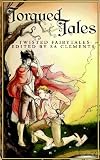
Three of these in particular I really liked: Tiger, Tiger by Laney Cairo, Locks of Love by Jordan Castillo Price, and The Nature of the Beast by Kara Larson. Two or three more are terrible (either very annoying or very very boring), which drags down my rating of the book as a whole. Most of the stories are decent to very good (erotic) re-imaginings of old stories.