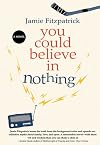
Jamie Fitzpatrick’s debut novel is, on the face of it, a book about an early-middle-aged man who plays recreational hockey and who is dealing with a number of personal crises. Since I am none of those things, the book didn’t instantly shout “read me,” despite the fact that, like me, Fitzpatrick hails from Newfoundland.
So the book sat with me for a while. Then recently, I was grading papers until midnight and I was tired, but because I have to read before I can sleep, I pulled out my Kobo to finish the Steve Jobs biography. The Kobo was dead. Then I spied You Could Believe in Nothing (Vagrant), sitting unhappily unread in a corner. The good old print book.
Once I’d picked it up, though, it was difficult to put down. Which I did at four a.m., and only then because the book fell on my face. You Could Believe in Nothing is simply a great piece of writing. The cadence of the dialogue, the stomach-clenching evocations of loss and shame, the simplicity of words in conversations loaded with meaning all undeniably and seamlessly collide in the main character, Derek’s, unraveling life.
There is a frankness, a sharpness in the banter between the recreational hockey players that extend into the relationships within Derek’s somewhat dysfunctional, but probably more normal than not, family.
Fitzpatrick’s keen ear for nuances in conversation and even keener eye for the backdrops of life, take the reader into places they probably would not have chosen to visit on their own, show more but are better off having experienced.
This is not just a book about men playing hockey in dark, dank arenas during the unpredictable March winds in St. John’s, even though, through Fitzpatrick’s descriptions, you want to pull your coat a little tighter. This is a book that will touch the part of you that gets up in the morning and carries on like any other day, but also the part that is just a little weary of family and relationship drama, the part that uncomfortably relates to Derek’s life.
The secret is that no one is normal. No family is typical and no relationship is simple. And the snippets of Derek’s life that the author shares with us, reassure us and tells us we all have family secrets, dysfunctions and craziness. It is what makes us human and it is how we keep on moving forward, seeking the ideal we will never — and secretly probably don’t want to — find that makes life the interesting journey it is. show less
So the book sat with me for a while. Then recently, I was grading papers until midnight and I was tired, but because I have to read before I can sleep, I pulled out my Kobo to finish the Steve Jobs biography. The Kobo was dead. Then I spied You Could Believe in Nothing (Vagrant), sitting unhappily unread in a corner. The good old print book.
Once I’d picked it up, though, it was difficult to put down. Which I did at four a.m., and only then because the book fell on my face. You Could Believe in Nothing is simply a great piece of writing. The cadence of the dialogue, the stomach-clenching evocations of loss and shame, the simplicity of words in conversations loaded with meaning all undeniably and seamlessly collide in the main character, Derek’s, unraveling life.
There is a frankness, a sharpness in the banter between the recreational hockey players that extend into the relationships within Derek’s somewhat dysfunctional, but probably more normal than not, family.
Fitzpatrick’s keen ear for nuances in conversation and even keener eye for the backdrops of life, take the reader into places they probably would not have chosen to visit on their own, show more but are better off having experienced.
This is not just a book about men playing hockey in dark, dank arenas during the unpredictable March winds in St. John’s, even though, through Fitzpatrick’s descriptions, you want to pull your coat a little tighter. This is a book that will touch the part of you that gets up in the morning and carries on like any other day, but also the part that is just a little weary of family and relationship drama, the part that uncomfortably relates to Derek’s life.
The secret is that no one is normal. No family is typical and no relationship is simple. And the snippets of Derek’s life that the author shares with us, reassure us and tells us we all have family secrets, dysfunctions and craziness. It is what makes us human and it is how we keep on moving forward, seeking the ideal we will never — and secretly probably don’t want to — find that makes life the interesting journey it is. show less
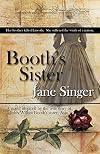
Every now and then, if you are lucky, you will come across a book on a topic you never knew you wanted to explore.
Booth’s Sister by Jane Singer is one. Being Canadian I had an interest, certainly, in American history and politics, but no driving urge to know more about the John Wilkes Booths or Lee Harvey Oswalds. Much of what you hear about the latter swirls around conspiracy theories and yawn, government cover-up. This has never really whetted my appetite.
I knew nothing of Booth, other that he shot a pivotal figure during the Civil War and was subsequently caught and killed.
I think the credibility of this book centers on the author and her credentials as an historian. But bearing in mind that this was a work of historical fiction and not non-fiction, I did find myself becoming more and more involved and by the end of the book, I was wanting more.
I wanted more of what it was that inspired and influenced John Wilkes Booth during his childhood. How does one grow up in a house of thought and people dedicated to anti-slavery and pro-union, and with such close a relationship to a sibling (as to border on adulation), diverge so greatly in social philosophy and political ideology?
Given what is happening in the US today since the election of a black president, I drew many parallels while reading this book. The polarization in politics, the fanatical and fundamentalist beliefs and the vitriol being hurled in America today is reflected in this book set over 150 years ago.
It show more actually made me nervous for the realities of today as I watched the manifestation of an obsessive belief in the assassination of Abraham Lincoln.
Singer takes considerable literary licence and that is not necessarily a bad thing in Booth’s Sister. It adds colour and gives the reader a real sense of being an insider in this home. Structurally, a few sections were a bit disjointed and some of the transitions in time and reality were slightly confusing, but overall I enjoyed reading this book. I will certainly read the published memoir of Asia Booth. show less
Booth’s Sister by Jane Singer is one. Being Canadian I had an interest, certainly, in American history and politics, but no driving urge to know more about the John Wilkes Booths or Lee Harvey Oswalds. Much of what you hear about the latter swirls around conspiracy theories and yawn, government cover-up. This has never really whetted my appetite.
I knew nothing of Booth, other that he shot a pivotal figure during the Civil War and was subsequently caught and killed.
I think the credibility of this book centers on the author and her credentials as an historian. But bearing in mind that this was a work of historical fiction and not non-fiction, I did find myself becoming more and more involved and by the end of the book, I was wanting more.
I wanted more of what it was that inspired and influenced John Wilkes Booth during his childhood. How does one grow up in a house of thought and people dedicated to anti-slavery and pro-union, and with such close a relationship to a sibling (as to border on adulation), diverge so greatly in social philosophy and political ideology?
Given what is happening in the US today since the election of a black president, I drew many parallels while reading this book. The polarization in politics, the fanatical and fundamentalist beliefs and the vitriol being hurled in America today is reflected in this book set over 150 years ago.
It show more actually made me nervous for the realities of today as I watched the manifestation of an obsessive belief in the assassination of Abraham Lincoln.
Singer takes considerable literary licence and that is not necessarily a bad thing in Booth’s Sister. It adds colour and gives the reader a real sense of being an insider in this home. Structurally, a few sections were a bit disjointed and some of the transitions in time and reality were slightly confusing, but overall I enjoyed reading this book. I will certainly read the published memoir of Asia Booth. show less
 This review was written for LibraryThing Early Reviewers.