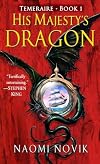
The premise for this book is immensely creative and I'm surprised that I liked it as little as I did. The setting is the Napoleonic Wars, but instead of just fighting with army and navy, both sides also have an arial corps composed of dragons. Here is where the strength of the book becomes a weakness. The relationship that one has with dragons in Novik's world is a mixture of the relationship one would have with a dog and the relationship of a spouse as idealized by a teenager. The lead character confides all of his secrets to his dragon, wants to spend every waking hour with his dragon and trusts him completely. At the same time the dragon is completely faithful, always obedient, eager to a fault and not the brightest crayon in the box. An a result, this book is lacking in drama; what could have been an engrossing cross species conflict, instead is a predictable set of interactions. The plot is propelled by tension with the faceless French whom we only meet in battle scenes. Characters in general lack dimension; good guys are good, scoundrels are scoundrels and England must be saved at all cost.
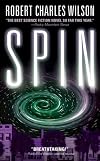
Spin was an excellent speculative science fiction novel that I finished in record time. The novelty and imaginative depth of the setting of this story reminded me of the wonder of reading several of Arthur C. Clark's novels for the first time. The protagonist is heroic without being more than human and as a result is extremely relatable. Wilson uses this as a platform to explore moral and philosophical themes while propelling the reader in an engaging story.
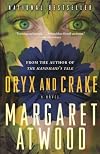
Atwood imagines a future where genetic engineering has turned the planet into a wasteland and the idealized humans that are a product of the engineering are a commentary on humanity as a result of what they lack. I felt that her vision of the future was overly one dimensional and a lack of insight into the trajectory of technology made it hard for me to immerse myself in her world and take what she had to say seriously. A prime example that in a world where the best parts of raccoons and skunks have been put into a new creature, kids still have collections of violent video games on CDs. I found her emphasis on genetic engineering to be preachy at times and the ethics of the story lacked any moral grey area, which made the whole book seem like a cautionary nursery tale.
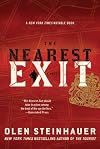
The Nearest Exit picks up where The Tourist left off. The novelty of a spy who'd rather not be a spy has worn off by this time, but Steinhauer has replaced it with Weaver's struggles to return to a family that has been torn apart by the lack of trust that goes along with his profession. It's a well woven story that doesn't have as many surprises as I recall in The Tourist, but still an enjoyable read.
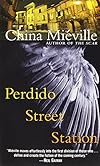
After getting any more than 50 pages into this book, I dare you to explain to someone what is going on. I tried and found it very hard to explain the extremely creative wold that Mieville dreamt up in any coherent fashion that didn't sound ridiculous. At times however, I feel that he took it too far. Towards the end of the book, it was difficult to follow the plot or have any sense of surprise at the actions of the characters because the alien-ness of the wold leaves one numb. For anyone looking to escape to another world only to discover the complexity of human nature in our own, this is a good read.
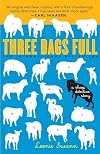
The gimmick of this book is quite creative: what if we tried to see the world through the eyes of sheep? This leads to a number of humorous situations, as when the sheep are left pondering why the humans are so interested in finding the "grass" that some characters have been withholding when they are surrounded by grass in the meadow. While the characters are lively and loveable, Swann didn't take the creative core of the story places that I wished she would go. The plot isn't particularly gripping (it's about sheep after all) and the exposition lacked philosophical depth that could have been used to leave readers with something to chew on.
The Devil in the White City: Murder, Magic, and Madness at the Fair that Changed America by Erik Larson
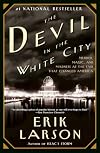
I loved the way that Larson intertwined two stories; one of men daring to accomplish the seemingly impossible task of putting on the greatest worlds fair to date and one of a man methodically plotting to undertake revolting crimes. The juxtaposition of the narratives begged the reader to reflect on the roots of evil present in everyone. A wonderful told tale that caused me to be inspired, transfixed and repulsed.
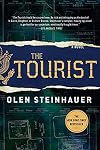
When I picked up this book, I was expecting a change of pace from what I've been reading recently, but I had no hopes for it being a novel I truly enjoyed. I remarked to myself early on that it was decently interesting, but that I'd likely steadily plod through it for a month or so. A day later, I realized that I had finished nearly a third of it and soon after it became difficult to put down. Unlike other spies that I've read about or seen on the screen, Milo Weaver has no super powers (mental or otherwise), and you can almost see how one could be in his position if circumstances lined up and they had the will to do so. Steinhauer walks that fine line between believability and intrigue that enables you to connect with the characters, yet still be surprised at the turn of the chapter. I didn't expect Milo Weaver to take me anywhere, but I may just yet follow him into another book.
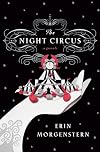
This book is steeped in descriptions so rich and wonderful, you can almost smell the caramel apples wafting on a night wind. The Night Circus is well paced without being a page turner, which allows you to savor every encounter with Morgenstern's magical world. The only drawback to this book is that in the drama of the plot, some of the leading characters change relatively little (though perhaps this is purposeful, given the nature of the story). Connoisseurs of magical realism or those that enjoy a mix of light fantasy with historical settings will certainly enjoy this book.
A.H.W.O.S.G. is a well written memoir, it just was not for me. At its core there is a protagonist that is shaped by tragedy, decides to live his life trying to escape the consequences and responsibilities that life brings his way. As the book unfolded, I realized that I neither admired the main character nor connected with his mistakes and overall cared little about him one way or another. While individual paragraphs were witty and amusing, I soon found myself skimming chapters wondering when I could start another book.
I began this book thinking that it would retell the Oz tale from a different perspective. It had a lot of potential and honestly I enjoyed reading it, but in the end it did not live up to my expectations. Other characters and subplots were introduced, but the nature of the interplay with the core of the story felt a little forced and contrived.
I felt that I owed this book a chance, so I forced myself to see it through to the end. Highlights include a rich historical setting that captured my imagination. This was offset by a cast of characters that were not well developed and so it was difficult for me to keep them all straight as I could never figure out who was on whose side and their motivations for their actions. When I got to the end and the full tale of the labyrinth was unraveled, everyone's actions leading up to that point didn't seem quite as plausible as they did earlier.
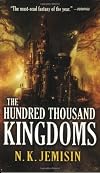
The Hundred Thousand Kingdoms grabbed me from the beginning and I found myself reading snatches of it any chance I got. Jemisin has created a unique world and mythology that is familiar enough to be accessible, yet inventive enough to be exciting. The book is well paced and keeps you on your toes throughout. I'm looking forward to the next book in the series.
I enjoyed this book, but it was definitely not a page turner and I'm not sure whether its a story I will want to read over and over again. The language took some getting used to and while the author's style forced me to read more slowly, it also helped me appreciate the cinematic imagery.