I felt this book didn't fully satisfy. A mix of narrative and poetry that did not blend well enough for me. I was definitely more interested in the narrative elements and was at times engrossed in the story - but the poetical elements did not flow or add to the story as well as the narrative. I was not overly compelled to finish it but did so, so I could write this review.
 This review was written for LibraryThing Early Reviewers.
While it is always interesting to read an alternative view to the high carbs/low fat diet argument, I found this book rather stultifying in style and disconertingly extremist in content. It did not sway me from the mantra of "... all things in moderation."
This review was written for LibraryThing Early Reviewers.
With the new movie Disgrace about to start in Australia I finally got around to reading the novel that it is based on by J.M. Coetzee. I had not read any Coetzee before but having finished Disgrace I will be very much open to reading some more by him - always a good sign! There were two things on constant visual playback in my mind as I read this book. The first was John Malcovich as the lead character (based on the fact that I had seen his name and picture attached to the movie advertising) and secondly, scenes from my own visit to South Africa with my husband in 1995. I am sure both these things impacted on my reading of the novel. As I was reading it was like a movie was simultaneously playing in my head, the intensity of which rarely happens when I read a book.
While our trip to South Africa was pleasantly spent staying with locals and visiting their large cities and game parks I always had a sense of the underlying tension present in day-to-day life there. Even though we were actively shielded from the violence and uncertainty there I could still feel it about us and it was ultimately very unsettling. I felt this same presence in Disgrace even though the main action deals with a professor's infidelity and its aftermath as he escapes to his daughter's farm. I had a great conversation with my husband about this book, an indication that its themes were playing on my mind. I found the book to be very realistic with excellent dialogue and descriptions. Ultimately, for me, show more the book wasn't so much about an older man taking advantage of a younger woman (which he openly admits to and which is wrong in and of itself) but more about his lack of understanding of the motivations and longings of his daughter (and women in general) and most importantly, that every girl is someones daughter and should be accorded due respect. show less
While our trip to South Africa was pleasantly spent staying with locals and visiting their large cities and game parks I always had a sense of the underlying tension present in day-to-day life there. Even though we were actively shielded from the violence and uncertainty there I could still feel it about us and it was ultimately very unsettling. I felt this same presence in Disgrace even though the main action deals with a professor's infidelity and its aftermath as he escapes to his daughter's farm. I had a great conversation with my husband about this book, an indication that its themes were playing on my mind. I found the book to be very realistic with excellent dialogue and descriptions. Ultimately, for me, show more the book wasn't so much about an older man taking advantage of a younger woman (which he openly admits to and which is wrong in and of itself) but more about his lack of understanding of the motivations and longings of his daughter (and women in general) and most importantly, that every girl is someones daughter and should be accorded due respect. show less
A Year without "Made in China": One Family's True Life Adventure in the Global Economy by Sara Bongiorni
I was ultimately disappointed with this book. I feel an opportunity to really explore the underlying issues concerning the ramifications of the world's dependence on cheap, low quality, Chinese manufactured goods was lost. So too was a discussion of its impact locally, in China, and most specifically, on its people and environment. The book simply devolved into a play-by-play account of how the author went about replacing Chinese goods with others, also mostly sourced from overseas and while this was interesting for a couple of chapters, it could not support a whole book. It seemed Bongiorni was actively avoiding offending anyone and was boycotting Chinese goods for a year simply to see if it could be done. So what?

Like Ball's last book, Eucalyptus, The Pages is rather an ephemeral read. Nothing much seems to happen on the surface - but if you concentrate on the passing landscape and what is not said as opposed to what is, you start to get a feel for this novel. I usually avoid this type of novel, writing them off as too much hard work, but in the hands of Bail it is worth the effort. He has the ability to conjure an image that will stop you in your tracks and stay with you for some time (just wait for the analogy between an old lady's neck and the roots of a Moreton Bay Fig tree!). My biggest crticism of this novel is that I found some of the dialogue unbelievable, promting me to ask myself "... would someone really say that in that situation?" Maybe they would - but I was not completely convinced all the time. Also, it is a beautifully made book - definitely one to buy in hardback.
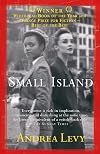
This book sat languishing on my shelves for some time until I was prompted to read it for my bookclub (having been chosen by another member!) Why oh why did it take me this long to read this wonderful book? I thoroughly enjoyed this book from start to finish. It moves between four main characters, skillfully mixing their pre-war histories with their post-war interactions. As each character's back story commenced I was concerned I was not going to be as "involved" with their story as the last - but I need not have worried. Each had an important and interesting contribution to make. Through her four main characters, Levy puzzles out the age old questions of race, tolerance and lack thereof, war and its aftermath, disillusionment, sex and sexism, and much, much more - highlighting the contradictions and hypocrisy usually found in all human beings. It also contained some genuinely laugh out loud moments. While this was rather a long book, my attention rarely wavered - a highy fulfilling read.

I was alternately in awe then frustrated by this novel! I really enjoyed the historical aspects within. It had me researching the Haggadah (and to a lesser extent the confict in Bosnia) on the internet which is always a good sign of my interest level. Also, I could have just read a whole book on the materials used to paint the Haggadah - I think I will have to find a book on this topic alone. But (and unfortunately it is a big, but) I found the relationship between Hannah and her mother completely two dimensional - "cardboard cut-out" style as opposed to the more nuanced portrayal of the historical characters. The further the book went along the less I wanted to read anything about Hannah Heath! And without including a detailed spoiler - I found the ending stretched the bounds of credibility. (In this way, I also found the ending to her first novel, A Year of Wonders, poor. Though her novel March is a most excellent novel, all around.) Anyway, this led me to score the book 8 out of 10 rather than 8.5 or 9 out of 10.

What can I say other than, I love this book! It has opened my eyes even further to issues around the world as they pertain to food, its production, its distribution, etc - basially whom are the haves and the have-nots and whom is doing the most damage to their own health and the health of our planet. Read it in conjuction with Hungry Planet and you can easily see who the "over-consumers" of this world are! I see there is a new edition out soon - I may have to purchase it to get the latest info - I am a bit of a statistics junkie too. Check out the publishers website for some other great publications: http://www.earthscan.co.uk/Default.aspx.

After a somewhat confusing start to the novel (first 70 pages or so) - I became accustomed to the multiple strands of the narrative; mainly flipping backward then forward in time and place. As such, I do not feel it is a novel to dip in and out of - once you start you should stick with it until the end. But following this confusing period, the narrative pace does pick up, making for more compelling reading.
Also, I questioned:
1) how the main character, being such a sick woman, could undertake some of the things she did throughout the novel, and
2) her rather blase attitude toward her own death.
These anomalies were somewhat satisfactorily explained in the second half of the novel though they came a bit too late in the narritive for my liking.
I have read a number of interviews with Debra Adelaide about this novel and also saw her in person at the recent Sydney Writer's Festival (May 2008) - in all these forums she has stated that her intention, in part, was to write a humorous novel despite the subject matter. I do have to say that I did not find this novel at all funny; but neither was it overly morbid or melancholy. I think the chapter endings, which included some reprintings of the main character's advice columns, were meant to inject some levity into the novel but I found them superfluous.
Overall, I liked this novel well enough - average to good rather than great. Also, I felt the ending helped make up for some of the novel's weaker points.
Also, I questioned:
1) how the main character, being such a sick woman, could undertake some of the things she did throughout the novel, and
2) her rather blase attitude toward her own death.
These anomalies were somewhat satisfactorily explained in the second half of the novel though they came a bit too late in the narritive for my liking.
I have read a number of interviews with Debra Adelaide about this novel and also saw her in person at the recent Sydney Writer's Festival (May 2008) - in all these forums she has stated that her intention, in part, was to write a humorous novel despite the subject matter. I do have to say that I did not find this novel at all funny; but neither was it overly morbid or melancholy. I think the chapter endings, which included some reprintings of the main character's advice columns, were meant to inject some levity into the novel but I found them superfluous.
Overall, I liked this novel well enough - average to good rather than great. Also, I felt the ending helped make up for some of the novel's weaker points.
Under Pressure: Rescuing Our Children From The Culture Of Hyper-Parenting: Rescuing Our Children from the Culture of Hyp by Carl Honoré
As Honore makes clear throughout this book it is not meant to be read as a parenting manifesto or guide. What it is, is a wonderfully erudite questioning of our current mania for speed in all aspects of our lives and in particular as to how we are raising our children. Children tend to copy our actions more than our words as parents and as such it is as important to question our own actions as it is to question theirs. I enjoyed this book immensely and while it raised a number of issues I am already investigating/doing, there was still alot of ideas that were new for me to ponder. Like Honore says, all families are different and as such any book that gives strict "parenting advice" is susceptible to only imparting more dogma. This book gives the reader some great ideas and practical, working examples - what one does with it is simply and most importantly up to them and their children.