1rocketjk
Last year I read 58 books, the year before 60, and the year before that 49. That averages 55.66667 books per year. So, with a bookstore to begin running this year, I don't want to be too optimistic. I'll just work on improving my 3-year average by one third of a book. So that's 56.
In addition to the books I read straight through, I like to read anthologies, collections and other books of short entries one story/chapter at a time instead of straight through. I have a couple of stacks of such books from which I read one story/chapter each between the books I read from cover to cover (novels and histories, mostly). So I call these my "between books." When I finish a "between book," I add it to my yearly list.
Master List (Touchstones included with individual listings below):
1: Love Me To Death by Allison Brennan
2: Lord Jim by Joseph Conrad
3: Haunch Paunch and Jowl by Samuel Ornitz
4: War is Beautiful: An American Ambulance Driver in the Spanish Civil War by James Neugass
5: A Book of Common Prayer by Joan Didion
6: Zoetrope: All-Story, Summer 2003 - Vol. 7, No. 2 edited by Tamara Straus
7: The Dream Palace of the Arabs: A Generation's Odyssey by Fouad Ajami
8: When the Light Goes by Larry McMurtry
9: Nine Lives by Bernice Rubens
10: Twilight of the Male Ego by klipschutz
11: The Soprano State: New Jersey's Culture of Corruption by Bob Ingle and Sandy McClure
12: Still Life with June by Darren Greer
13: The Hanging of Lucky Bill by Michael J. Makley
14: Kidnapped by Robert Lewis Stephenson
15: The Pope and Me at Yankee Stadium: My Life as the Beer Man & Stand-Up Comic by Steve Lazarus
16: Death of a Salesperson and Other Untimely Exits by Robert Barnard
17: In the Time of the Butterflies by Julia Alvarez
18: Memo to a Firing Squad by Frederick Hazlitt Brennan
19: The Pale Criminal by Philip Kerr
20: All Creatures Great and Small by James Herriot
21: New Short Novels edited by Mary Louise Aswell
22: When She Was Good by Philip Roth
23: A Whole Different Ballgame: The Sport and Business of Baseball by Marvin Miller
24: Caught by Harlan Coben
25: The Ballad of the Sad Cafe and Other Stories by Carson McCullers
26: "I Heard You Paint Houses": Frank "the Irishman" Sheeran and the Inside Story of the Mafia, the Teamsters, and the Last Ride of Jimmy Hoffa by Charles Brandt
27: Rules of the Wild by Francesca Marciano
28: The Marine Corpse by William G. Tapply
29: Killing Floor by Lee Child
30: The Need of Change by Julian Street
31: The Company of Players by Victor Chapin
32: And Wait for the Night by John William Corrington
33: The Reminiscences of Carl Schurz, Volume Three 1863-1869 by Carl Schurz
34: Dragonmede by Rona Randall
35: Grass Roots of Anderson Valley by Blanche Brown
36: Diplomat by Charles W. Thayer
37: Twenty Thousand Roads: the Ballad of Gram Parsons and his Cosmic American Music by David N. Meyer
38: Bury My Heart at Wounded Knee by Dee Brown
39: Dragons at the Gate by Robert L. Duncan
40: Footprints: an Early History of Fort Bragg, California and the Pomo Indians by Bonni Grapp
In addition to the books I read straight through, I like to read anthologies, collections and other books of short entries one story/chapter at a time instead of straight through. I have a couple of stacks of such books from which I read one story/chapter each between the books I read from cover to cover (novels and histories, mostly). So I call these my "between books." When I finish a "between book," I add it to my yearly list.
Master List (Touchstones included with individual listings below):
1: Love Me To Death by Allison Brennan
2: Lord Jim by Joseph Conrad
3: Haunch Paunch and Jowl by Samuel Ornitz
4: War is Beautiful: An American Ambulance Driver in the Spanish Civil War by James Neugass
5: A Book of Common Prayer by Joan Didion
6: Zoetrope: All-Story, Summer 2003 - Vol. 7, No. 2 edited by Tamara Straus
7: The Dream Palace of the Arabs: A Generation's Odyssey by Fouad Ajami
8: When the Light Goes by Larry McMurtry
9: Nine Lives by Bernice Rubens
10: Twilight of the Male Ego by klipschutz
11: The Soprano State: New Jersey's Culture of Corruption by Bob Ingle and Sandy McClure
12: Still Life with June by Darren Greer
13: The Hanging of Lucky Bill by Michael J. Makley
14: Kidnapped by Robert Lewis Stephenson
15: The Pope and Me at Yankee Stadium: My Life as the Beer Man & Stand-Up Comic by Steve Lazarus
16: Death of a Salesperson and Other Untimely Exits by Robert Barnard
17: In the Time of the Butterflies by Julia Alvarez
18: Memo to a Firing Squad by Frederick Hazlitt Brennan
19: The Pale Criminal by Philip Kerr
20: All Creatures Great and Small by James Herriot
21: New Short Novels edited by Mary Louise Aswell
22: When She Was Good by Philip Roth
23: A Whole Different Ballgame: The Sport and Business of Baseball by Marvin Miller
24: Caught by Harlan Coben
25: The Ballad of the Sad Cafe and Other Stories by Carson McCullers
26: "I Heard You Paint Houses": Frank "the Irishman" Sheeran and the Inside Story of the Mafia, the Teamsters, and the Last Ride of Jimmy Hoffa by Charles Brandt
27: Rules of the Wild by Francesca Marciano
28: The Marine Corpse by William G. Tapply
29: Killing Floor by Lee Child
30: The Need of Change by Julian Street
31: The Company of Players by Victor Chapin
32: And Wait for the Night by John William Corrington
33: The Reminiscences of Carl Schurz, Volume Three 1863-1869 by Carl Schurz
34: Dragonmede by Rona Randall
35: Grass Roots of Anderson Valley by Blanche Brown
36: Diplomat by Charles W. Thayer
37: Twenty Thousand Roads: the Ballad of Gram Parsons and his Cosmic American Music by David N. Meyer
38: Bury My Heart at Wounded Knee by Dee Brown
39: Dragons at the Gate by Robert L. Duncan
40: Footprints: an Early History of Fort Bragg, California and the Pomo Indians by Bonni Grapp
2rocketjk
Book 1: Love Me To Death by Allison Brennan

I picked this up in the airport in Ft. Lauderdale on my way home from vacation. It is billed as "Romantic Suspense," a sub-genre, as I understand it, of Romance novels. Since the store I'm buying has a large supply of romance novels and, I'm told, a large group of regulars who read and buy them, I thought I ought to begin educating myself on the various types.
This book was a very enjoyable thriller of the "serial rapist menaces our hero" sort. Well plotted and well written, with pretty good characters. The only thing that makes it "Romantic" suspense, as far as I could tell, was that the protagonist was a woman and she had, you know, a romance during the course of the story. But in no way does the romance overwhelm the suspense element of the book. So I'm thinking the "Romantic Suspense" tag is about 90% marketing.
At any rate, I don't see a need to quibble about that. More an interesting side note than anything else. I found the ending predictable but still well done. This is a good though not great thriller, whatever the genre tag.

I picked this up in the airport in Ft. Lauderdale on my way home from vacation. It is billed as "Romantic Suspense," a sub-genre, as I understand it, of Romance novels. Since the store I'm buying has a large supply of romance novels and, I'm told, a large group of regulars who read and buy them, I thought I ought to begin educating myself on the various types.
This book was a very enjoyable thriller of the "serial rapist menaces our hero" sort. Well plotted and well written, with pretty good characters. The only thing that makes it "Romantic" suspense, as far as I could tell, was that the protagonist was a woman and she had, you know, a romance during the course of the story. But in no way does the romance overwhelm the suspense element of the book. So I'm thinking the "Romantic Suspense" tag is about 90% marketing.
At any rate, I don't see a need to quibble about that. More an interesting side note than anything else. I found the ending predictable but still well done. This is a good though not great thriller, whatever the genre tag.
3rocketjk
Book 2: Lord Jim by Joseph Conrad

For years I have been going around saying that Lord Jim is my favorite novel, ever, even though I hadn't read the book since grad school, more than 20 years ago. I have read Heart of Darkness several times since and it always stands up. And I am most gratified to learn that Lord Jim likewise remains stunning to me in every respect.
I get that not everyone cares for Conrad. C'est la vie. But for me, Conrad's language, storytelling, imagery and insights into human nature and Western culture remain, well, again I have to say stunning.
I don't think anybody needs another synopsis of Jim and his travails. At what point does a person's insistence upon strict adherence to an ethical code, or more specifically insistence upon bearing the scars of a failure to live up to that code, stop being admirable and become, instead, tragic? When do morals subside and ego take over, or are the two even really mutually exclusive? If you care for an investigation of these issues, Conrad, through Marlow and Jim, is your man.

For years I have been going around saying that Lord Jim is my favorite novel, ever, even though I hadn't read the book since grad school, more than 20 years ago. I have read Heart of Darkness several times since and it always stands up. And I am most gratified to learn that Lord Jim likewise remains stunning to me in every respect.
I get that not everyone cares for Conrad. C'est la vie. But for me, Conrad's language, storytelling, imagery and insights into human nature and Western culture remain, well, again I have to say stunning.
I don't think anybody needs another synopsis of Jim and his travails. At what point does a person's insistence upon strict adherence to an ethical code, or more specifically insistence upon bearing the scars of a failure to live up to that code, stop being admirable and become, instead, tragic? When do morals subside and ego take over, or are the two even really mutually exclusive? If you care for an investigation of these issues, Conrad, through Marlow and Jim, is your man.
4rocketjk
Book 3: Haunch Paunch and Jowl by Samuel Ornitz

Although originally published in 1923 as "An Anonymous Autobiography," Haunch, Paunch and Jowl is a stream-of-consciousness novel, set in the teeming Lower East Side of late 19th-early 20th century New York City, amid the struggling Jewish immigrant community.
The novel takes us through the life and times of Meyer Hersch. We first see him as a 9-year old in a crowded tenement house with a father dying from the diseases of the garment sweat shops and an uncle with dreams of overcoming their oppressive environment. As Meyer grows through teens and into manhood, always with the eye on the main chance and none too fastidious about how he gets ahead, we are taken on a tour of this world of the streets and get to listen in as anarchist argues with Socialist who argues with capitalist and so forth. Corruption and violence are accepted parts of life here, but there is beauty and occasionally high mindedness, as well.
The writing is quick and engaging, sometimes quite entertaining indeed. There's a bit of dimension to the protagonist, as well. And while I've read of Ornitz described as sort of a Jewish Upton Sinclair, this book is nowhere near as graphic as The Jungle. While this book doesn't go into great depth, the picture it draws is a very interesting one, all in all. Ornitz's own story, as you can see below, is quite interesting, as well.
I picked up this book in goodness knows what thrift store or antique shop somewhere along the line (my LT entry date for the volume is May 2008) just because it was a cool old book (my edition is a Sixth Printing: March 1924) and pulled it off my shelf to read this week mostly at random. I started doing some online research about the book, and found an essay about the book and its author by none other than Harvey Pekar published on the website Metroactive.com in 1997.
Pekar's column begins thusly:
"IF ANYONE remembers Samuel Ornitz at all today, it's as a screenwriter who was one of the Hollywood 10; his reputation as a novelist didn't survive the 1920s. Despite the neglect, Ornitz is a significant literary figure whose work deserves to be kept in print and read by anyone who cares about the evolution of the American novel.
Born in 1890, Ornitz is a link between Yiddish-speaking, foreign-born American novelists such as Anzia Yezierska and Abraham Cahan, who were mainstream stylists, and the daring Jewish fiction writers of the 1930s: Daniel Fuchs, Nathanael West and Henry Roth.
Ornitz belonged to a forgotten avant-garde movement that employed stream-of-consciousness techniques before the 1922 publication of James Joyce's Ulysses brought the method to general attention."
The rest of the column in here: http://www.metroactive.com/papers/metro/08.14.97/cover/lit6-9733.html
It's quite interesting!

Although originally published in 1923 as "An Anonymous Autobiography," Haunch, Paunch and Jowl is a stream-of-consciousness novel, set in the teeming Lower East Side of late 19th-early 20th century New York City, amid the struggling Jewish immigrant community.
The novel takes us through the life and times of Meyer Hersch. We first see him as a 9-year old in a crowded tenement house with a father dying from the diseases of the garment sweat shops and an uncle with dreams of overcoming their oppressive environment. As Meyer grows through teens and into manhood, always with the eye on the main chance and none too fastidious about how he gets ahead, we are taken on a tour of this world of the streets and get to listen in as anarchist argues with Socialist who argues with capitalist and so forth. Corruption and violence are accepted parts of life here, but there is beauty and occasionally high mindedness, as well.
The writing is quick and engaging, sometimes quite entertaining indeed. There's a bit of dimension to the protagonist, as well. And while I've read of Ornitz described as sort of a Jewish Upton Sinclair, this book is nowhere near as graphic as The Jungle. While this book doesn't go into great depth, the picture it draws is a very interesting one, all in all. Ornitz's own story, as you can see below, is quite interesting, as well.
I picked up this book in goodness knows what thrift store or antique shop somewhere along the line (my LT entry date for the volume is May 2008) just because it was a cool old book (my edition is a Sixth Printing: March 1924) and pulled it off my shelf to read this week mostly at random. I started doing some online research about the book, and found an essay about the book and its author by none other than Harvey Pekar published on the website Metroactive.com in 1997.
Pekar's column begins thusly:
"IF ANYONE remembers Samuel Ornitz at all today, it's as a screenwriter who was one of the Hollywood 10; his reputation as a novelist didn't survive the 1920s. Despite the neglect, Ornitz is a significant literary figure whose work deserves to be kept in print and read by anyone who cares about the evolution of the American novel.
Born in 1890, Ornitz is a link between Yiddish-speaking, foreign-born American novelists such as Anzia Yezierska and Abraham Cahan, who were mainstream stylists, and the daring Jewish fiction writers of the 1930s: Daniel Fuchs, Nathanael West and Henry Roth.
Ornitz belonged to a forgotten avant-garde movement that employed stream-of-consciousness techniques before the 1922 publication of James Joyce's Ulysses brought the method to general attention."
The rest of the column in here: http://www.metroactive.com/papers/metro/08.14.97/cover/lit6-9733.html
It's quite interesting!
5rocketjk
Book 4: War is Beautiful: An American Ambulance Driver in the Spanish Civil War by James Neugass

James Neugass was a New Orleans native who was one of the thousands of Americans who went to Spain to fight in the Spanish Civil War against Franco's fascist forces. Neugass was a published poet and his writing reflects this, as it is evocative and moving. The boredom and the horrors of war, the appalling poverty of the Spanish peasants, and even the occasional beauty and humor, are all strikingly depicted in Neugass' journal entries.
Neugass got to Spain in time to drive his ambulance in support of the Lincoln-Washington Brigade in the battles of Tereul and Segura, and to reel away from the ultimate fascist onslaught in the heartbreaking Ebro retreat. Neugass describes the day-to-day lives of the combatants and medical teams, and particularly gives an idea of what its like to drive a full ambulance along a bomb-cratered road while being attacked from the air.
Here is a passage that gives a pretty good example of the level of writing:
By midnight, the Major and I were again on the road, headed south fo Albacete.
The road was as clean of trucks as the sky was of planes. Not one ounce of lead or a single soldier's footprints had poisoned this landscape; and here we lay in the khaki filth of our executioner's apparel, stew-eyed on groaning nerves, impatient to reach the next theatre of war before the curtain should go up on the latest most stream-lined slaughter. For how many year will we who hate war as no pacifist ever hated war have to fight, and love to kill?
"It is very beautiful here," said the Major, breaking the silence in which we had traveled for eleven hours. Neither of us likes to talk while we are on the road. There is no need for talking. The human voice is an organ whose use is the planning of campaigns and the giving of orders.
"Yes," I answered, "it's a nice spot for a Classification Post." There were trees for camouflage, ditches deep enough to use for trenches when the planes came over and the ground was soft enough for the quick digging of graves. People are sometimes stupid enough to die in places where a pickaxe has to be used.
I can't remember a book I've read that gives a clearer, more immediate, more human picture of the stress endured by combatants in a war zone.

James Neugass was a New Orleans native who was one of the thousands of Americans who went to Spain to fight in the Spanish Civil War against Franco's fascist forces. Neugass was a published poet and his writing reflects this, as it is evocative and moving. The boredom and the horrors of war, the appalling poverty of the Spanish peasants, and even the occasional beauty and humor, are all strikingly depicted in Neugass' journal entries.
Neugass got to Spain in time to drive his ambulance in support of the Lincoln-Washington Brigade in the battles of Tereul and Segura, and to reel away from the ultimate fascist onslaught in the heartbreaking Ebro retreat. Neugass describes the day-to-day lives of the combatants and medical teams, and particularly gives an idea of what its like to drive a full ambulance along a bomb-cratered road while being attacked from the air.
Here is a passage that gives a pretty good example of the level of writing:
By midnight, the Major and I were again on the road, headed south fo Albacete.
The road was as clean of trucks as the sky was of planes. Not one ounce of lead or a single soldier's footprints had poisoned this landscape; and here we lay in the khaki filth of our executioner's apparel, stew-eyed on groaning nerves, impatient to reach the next theatre of war before the curtain should go up on the latest most stream-lined slaughter. For how many year will we who hate war as no pacifist ever hated war have to fight, and love to kill?
"It is very beautiful here," said the Major, breaking the silence in which we had traveled for eleven hours. Neither of us likes to talk while we are on the road. There is no need for talking. The human voice is an organ whose use is the planning of campaigns and the giving of orders.
"Yes," I answered, "it's a nice spot for a Classification Post." There were trees for camouflage, ditches deep enough to use for trenches when the planes came over and the ground was soft enough for the quick digging of graves. People are sometimes stupid enough to die in places where a pickaxe has to be used.
I can't remember a book I've read that gives a clearer, more immediate, more human picture of the stress endured by combatants in a war zone.
6rocketjk
Book 5: A Book of Common Prayer by Joan Didion

I found the joys of A Book of Common Prayer to be more in the writing and storytelling than in the story itself. Perhaps that was intentional. Set in the fictional Central American country of Boca Grande, A Book of Common Prayer is written as a narrative by a woman, soon to die of cancer, who has lived most of her adult life entwined by marriage in the country's ruling classes, observing the periodic coups that change the individuals wielding power but precious little else. But mostly, the story involves our narrator telling the story of another woman, a seemingly oblivious American woman, Charlotte, who arrives in Boca Grande and is soon also ensconced among the narrator's family circle.
Charlotte seems to be a woman to whom life happens, a woman with seemingly precious little real awareness of her immediate surroundings, until, intermittently, some small stark occurrence breaks this perception. Still, as the narrator puts in late in the novel . . .
"I know how to make models of life itself, DNA, RNA, helices double and single and squared, but I try to make a model of Charlotte Douglas's 'character' and I see only a shimmer.
Like the shimmer of the oil slick on the boulevards after rain . . . "
It's a tough challenge, I think, to create a narrative centering around a character who only appears as a shimmer. Because the woman seems not wholly there, it becomes very hard to really care about her story. More interesting is the narrator herself, of course, and as all good first person narratives, this one in the end centers back to become as much, or more, our narrator's story than Charlotte's.
There is more to the story than I've described here, but while I very much enjoyed this book in the reading due mostly to Didion's rewarding facility for the fine turn of a phrase and, often, humor, I was frequently aware that I was reading a story about characters not wholly developed. There is, no doubt, a relatively strong picture of how a dying person might see the world and her memories (the book sort of reminded me of The Blind Assassin in that way), but otherwise I never really got the feeling that I was reading about real people, other than the narrator. Maybe that was the point.
Anyway, very much worth reading, but I honestly haven't quite figured out why yet.

I found the joys of A Book of Common Prayer to be more in the writing and storytelling than in the story itself. Perhaps that was intentional. Set in the fictional Central American country of Boca Grande, A Book of Common Prayer is written as a narrative by a woman, soon to die of cancer, who has lived most of her adult life entwined by marriage in the country's ruling classes, observing the periodic coups that change the individuals wielding power but precious little else. But mostly, the story involves our narrator telling the story of another woman, a seemingly oblivious American woman, Charlotte, who arrives in Boca Grande and is soon also ensconced among the narrator's family circle.
Charlotte seems to be a woman to whom life happens, a woman with seemingly precious little real awareness of her immediate surroundings, until, intermittently, some small stark occurrence breaks this perception. Still, as the narrator puts in late in the novel . . .
"I know how to make models of life itself, DNA, RNA, helices double and single and squared, but I try to make a model of Charlotte Douglas's 'character' and I see only a shimmer.
Like the shimmer of the oil slick on the boulevards after rain . . . "
It's a tough challenge, I think, to create a narrative centering around a character who only appears as a shimmer. Because the woman seems not wholly there, it becomes very hard to really care about her story. More interesting is the narrator herself, of course, and as all good first person narratives, this one in the end centers back to become as much, or more, our narrator's story than Charlotte's.
There is more to the story than I've described here, but while I very much enjoyed this book in the reading due mostly to Didion's rewarding facility for the fine turn of a phrase and, often, humor, I was frequently aware that I was reading a story about characters not wholly developed. There is, no doubt, a relatively strong picture of how a dying person might see the world and her memories (the book sort of reminded me of The Blind Assassin in that way), but otherwise I never really got the feeling that I was reading about real people, other than the narrator. Maybe that was the point.
Anyway, very much worth reading, but I honestly haven't quite figured out why yet.
7rocketjk
Book 6: Zoetrope: All-Story Summer 2003 - Vol. 7, No. 2

Francis Ford Coppolla used to (or maybe still does, for all I know) publish this very nice short story quarterly magazine. My copy was in a stack of old magazines in my office I'm trying to slowly go through. At any rate, the theme of this edition was "Foreign Affairs" and the magazine contains some very good stories set in many different locales and cultures and written by authors representing them. In fact, the only dreary story in the bunch was the American story, written by Dave Eggers.

Francis Ford Coppolla used to (or maybe still does, for all I know) publish this very nice short story quarterly magazine. My copy was in a stack of old magazines in my office I'm trying to slowly go through. At any rate, the theme of this edition was "Foreign Affairs" and the magazine contains some very good stories set in many different locales and cultures and written by authors representing them. In fact, the only dreary story in the bunch was the American story, written by Dave Eggers.
8rocketjk
Book 7: The Dream Palace of the Arabs: A Generation's Odyssey by Fouad Ajami

Scholar Fouad Ajami published this survey of the political, cultural and religious issues that have permeated the Arab world in 1999. That means it's a look inside that world just on the cusp of 9/11 and the second American war against Iraq.
Ajami seeks to show how the Arab world, while interconnected, is much more segmented than the average Westerner might suppose. The generation of the title is that generation which came of age just after World War II. The central theme of the book is the aborted and probably doomed attempts by the intellectuals of that generation to create more modern, secularized societies. In his survey, Ajami focuses in turn on the downward spiral of violence that wracked Lebanon in the 70s and 80s, events in Egypt through the Nasser, Sadat and (the first two decades of) Mubarak eras, the overthrow of the Shah of Iran and establishment of a Moslem state and the unrelenting resistance among intellectuals throughout the Arab world to any compromise peace with Israel.
Fascinating stuff, and I learned a lot, especially as I was reading the section on Egypt as the Egyptian people were in the streets changing their political world. Also interesting is that, in many cases, Ajami makes liberal use of the words and views of the various regions' most prominent poets in describing the views of those societies.

Scholar Fouad Ajami published this survey of the political, cultural and religious issues that have permeated the Arab world in 1999. That means it's a look inside that world just on the cusp of 9/11 and the second American war against Iraq.
Ajami seeks to show how the Arab world, while interconnected, is much more segmented than the average Westerner might suppose. The generation of the title is that generation which came of age just after World War II. The central theme of the book is the aborted and probably doomed attempts by the intellectuals of that generation to create more modern, secularized societies. In his survey, Ajami focuses in turn on the downward spiral of violence that wracked Lebanon in the 70s and 80s, events in Egypt through the Nasser, Sadat and (the first two decades of) Mubarak eras, the overthrow of the Shah of Iran and establishment of a Moslem state and the unrelenting resistance among intellectuals throughout the Arab world to any compromise peace with Israel.
Fascinating stuff, and I learned a lot, especially as I was reading the section on Egypt as the Egyptian people were in the streets changing their political world. Also interesting is that, in many cases, Ajami makes liberal use of the words and views of the various regions' most prominent poets in describing the views of those societies.
11rocketjk
Book 8: When the Light Goes by Larry McMurtry

I gulped this relatively short book down in about three sittings. When the Light Goes is the 4th entry in Larry McMurtry's Thalia, Texas, series. The series' best known book is its first, The Last Picture Show. In Light, Duane Moore, who was in high school in Picture Show, is, at 64, at loose ends. Two years a widower, Duane has also recently turned over his oil business to his son, Dickie. As the book begins, Duane, recently returned from a trip to see the Pyramids, starkly sees Thalia, where he has spent his life, for what it has become, a small and shrinking oil town, soon to erode wholly into inconsequentiality
The book takes up Duane's struggles to set himself on a path that will allow him a avoid simply drifting through the rest of his life.
What seems a bleak story was rendered actually enjoyable and compelling for me by McMurtry's wonderful and often humorous prose and by his keen insights into Duane's character and his dilemma.
I'm looking forward to the final installment in the series, Rhino Ranch.

I gulped this relatively short book down in about three sittings. When the Light Goes is the 4th entry in Larry McMurtry's Thalia, Texas, series. The series' best known book is its first, The Last Picture Show. In Light, Duane Moore, who was in high school in Picture Show, is, at 64, at loose ends. Two years a widower, Duane has also recently turned over his oil business to his son, Dickie. As the book begins, Duane, recently returned from a trip to see the Pyramids, starkly sees Thalia, where he has spent his life, for what it has become, a small and shrinking oil town, soon to erode wholly into inconsequentiality
The book takes up Duane's struggles to set himself on a path that will allow him a avoid simply drifting through the rest of his life.
What seems a bleak story was rendered actually enjoyable and compelling for me by McMurtry's wonderful and often humorous prose and by his keen insights into Duane's character and his dilemma.
I'm looking forward to the final installment in the series, Rhino Ranch.
12rocketjk
Book 9: Nine Lives by Bernice Rubens

Nine Lives is a dark (very dark) comedy set in relatively modern-day London. The tale is told via three alternating viewpoints. First we have Donald Dorricks, a serial killer who is, for reasons of his own, garroting psychotherapists one by one. We enter his mind through his diary, as he describes the killings. His stated goal is to dispatch nine shrinks. He doesn't tell us why, but little by little we begin to guess. The next viewpoint is the detective trying to catch this killer, who never leaves a clue and is willing to wait months, sometimes more than a year, to commit his next crime. Third is Dorricks' wife, Verry. Her first person accounts take place later in time, as we listen to her talk through her experiences visiting her husband in prison.
So, this is, really a book about obsession. Dorricks is obsessed with his "mission," the inspector is obsessed with his case, and Verry is, for reasons she describes, too obsessed with her husband and her dependence on him to cut him loose, although he has confessed to the killings (we read this at the very beginning of the book) and is serving a life sentence.
All of these viewpoints make for good readng, although the killer's, not surprisingly, is very dark. By far the most effective and most interesting is that of Verry. What keeps her going back to this monster of a man? The rendering of this question seems quite human and quite real.

Nine Lives is a dark (very dark) comedy set in relatively modern-day London. The tale is told via three alternating viewpoints. First we have Donald Dorricks, a serial killer who is, for reasons of his own, garroting psychotherapists one by one. We enter his mind through his diary, as he describes the killings. His stated goal is to dispatch nine shrinks. He doesn't tell us why, but little by little we begin to guess. The next viewpoint is the detective trying to catch this killer, who never leaves a clue and is willing to wait months, sometimes more than a year, to commit his next crime. Third is Dorricks' wife, Verry. Her first person accounts take place later in time, as we listen to her talk through her experiences visiting her husband in prison.
So, this is, really a book about obsession. Dorricks is obsessed with his "mission," the inspector is obsessed with his case, and Verry is, for reasons she describes, too obsessed with her husband and her dependence on him to cut him loose, although he has confessed to the killings (we read this at the very beginning of the book) and is serving a life sentence.
All of these viewpoints make for good readng, although the killer's, not surprisingly, is very dark. By far the most effective and most interesting is that of Verry. What keeps her going back to this monster of a man? The rendering of this question seems quite human and quite real.
13cushlareads
Just found your thread over here to see what you thought of Dream Palace of the Arabs, and am adding it to my wishlist - thanks!
15rocketjk
Book 10: Twilight of the Male Ego by klipschutz

It didn't take me very long to get through this relatively slim but enjoyable volume of poetry. klipschutz is the pen name of San Francisco-based poet Kurt Lipschutz. This is the first of his three (according to the online bio I found) published collections. The poems are skillfully done, pleasing and accessible.
Here is a line I liked from a poem entitled "Off-season"
Up and down the block, cash registers
with expired service contracts undercharge.

It didn't take me very long to get through this relatively slim but enjoyable volume of poetry. klipschutz is the pen name of San Francisco-based poet Kurt Lipschutz. This is the first of his three (according to the online bio I found) published collections. The poems are skillfully done, pleasing and accessible.
Here is a line I liked from a poem entitled "Off-season"
Up and down the block, cash registers
with expired service contracts undercharge.
16rocketjk
Book 11: The Soprano State: New Jersey's Culture of Corruption by Bob Ingle and Sandy McClure

While the title of this book is, obviously, a reference to the HBO show about a mob family, the bulk of The Soprano State describes the corruption and graft within the New Jersey state political system itself. New Jersey government, from municipalities through the county machines and up into the statewide levels and including the judicial system and the governor's mansion, is in one way or another crooked through and through in a way that costs taxpayers billions of dollars every year. Union leadership is implicated as well, and, yes, there really is a serious amount of mob influence in the Garden State.
The history is all laid out here by Ingle and McClure, long-time corruption hunting New Jersey journalists. The book is, in some ways, not that compelling reading, because it is essentially a recitation of one faulty, corrupt system and politician after another. But the shear size and pervasiveness of the problem after awhile becomes fascinating and horrifying at the same time. I suppose this is all really only of interest to people with a direct interest in the life of New Jersey. Although I now live in California, I am a Jersey native, so I'm in that camp.
Interestingly, one of the few public figures who comes off well in this book is U.S. prosecutor Chris Christie, who is shown to be intent in rooting out and prosecuting the corruption whenever he can make a case. Christie is now the state's governor, one of the recent spate of hard-line right wing politicians to take office across the U.S. Whether he is now waging the same battle against corruption from the governor's office that he did as a DA, or whether he has followed the lead of previous governors who joined the patronage party once gaining office, I have no idea from this far remove.

While the title of this book is, obviously, a reference to the HBO show about a mob family, the bulk of The Soprano State describes the corruption and graft within the New Jersey state political system itself. New Jersey government, from municipalities through the county machines and up into the statewide levels and including the judicial system and the governor's mansion, is in one way or another crooked through and through in a way that costs taxpayers billions of dollars every year. Union leadership is implicated as well, and, yes, there really is a serious amount of mob influence in the Garden State.
The history is all laid out here by Ingle and McClure, long-time corruption hunting New Jersey journalists. The book is, in some ways, not that compelling reading, because it is essentially a recitation of one faulty, corrupt system and politician after another. But the shear size and pervasiveness of the problem after awhile becomes fascinating and horrifying at the same time. I suppose this is all really only of interest to people with a direct interest in the life of New Jersey. Although I now live in California, I am a Jersey native, so I'm in that camp.
Interestingly, one of the few public figures who comes off well in this book is U.S. prosecutor Chris Christie, who is shown to be intent in rooting out and prosecuting the corruption whenever he can make a case. Christie is now the state's governor, one of the recent spate of hard-line right wing politicians to take office across the U.S. Whether he is now waging the same battle against corruption from the governor's office that he did as a DA, or whether he has followed the lead of previous governors who joined the patronage party once gaining office, I have no idea from this far remove.
17rocketjk
Book 12: Still Life with June by Darren Greer

I picked this book from the shelves of a local used bookstore more or less at random and I'm really glad I did. Still Life with June is a well-told story, a novel filled with humor, insight and heart.
Cameron Dodds is pushing 30, a struggling writer, a gay man, a "loser who knows he's a loser" working at a halfway house/recovery center for drug and alcohol abusers so that he can "steal the stories" of the clients. He attends a writers' group full of hack writers at Big Bad Bookstore so that he can "steal their stories," too. As Cameron slowly makes friends with his arch-enemy in the readers' group, and becomes more and more obsessed with the life story of one of the residents at the halfway house, we begin to see that this is a novel about identity and about the inter-connectedness between seemingly disconnected people.
Greer, a Canadian who set this story in a somewhat disguised version of Halifax, has a keen eye for the human condition and an extremely effective touch with serious situations. Metaphorically speaking, I found that he uses a simple guitar melody where other writers would lay on an army of violins and cellos.
There are places where Cameron's narration is a bit too mannered, too purposefully idiosyncratic, but not by much, and not enough to scuttle ship or even spring a leak.
This is a good book.

I picked this book from the shelves of a local used bookstore more or less at random and I'm really glad I did. Still Life with June is a well-told story, a novel filled with humor, insight and heart.
Cameron Dodds is pushing 30, a struggling writer, a gay man, a "loser who knows he's a loser" working at a halfway house/recovery center for drug and alcohol abusers so that he can "steal the stories" of the clients. He attends a writers' group full of hack writers at Big Bad Bookstore so that he can "steal their stories," too. As Cameron slowly makes friends with his arch-enemy in the readers' group, and becomes more and more obsessed with the life story of one of the residents at the halfway house, we begin to see that this is a novel about identity and about the inter-connectedness between seemingly disconnected people.
Greer, a Canadian who set this story in a somewhat disguised version of Halifax, has a keen eye for the human condition and an extremely effective touch with serious situations. Metaphorically speaking, I found that he uses a simple guitar melody where other writers would lay on an army of violins and cellos.
There are places where Cameron's narration is a bit too mannered, too purposefully idiosyncratic, but not by much, and not enough to scuttle ship or even spring a leak.
This is a good book.
18rocketjk
Book 13: The Hanging of Lucky Bill

Western Nevada was a very rough and dangerous place in the 1850s according to this short history of a notorious hanging that took place in Carson Valley, in the eastern Sierra Nevada foothills very close to the Nevada/California border in 1858. William "Lucky Bill" Thorington, so named because of his invariable success as a gambler, was lynched by a vigilante group after a kangaroo court trial for supposedly taking part in a murder he actually had nothing to do with.
While the story of Lucky Bill and his sad fate is an interesting one, what's even more interesting is the picture of the time and place painted by the author, who does a good job of setting the scene and providing background and history.
I bought this slim, locally published volume last year when my wife and I spent time in Markleeville, a small town in Sierra County, CA, close to Carson Valley. The book, signed by the author, was on sale at the local history museum. I finally got around to reading it this week.

Western Nevada was a very rough and dangerous place in the 1850s according to this short history of a notorious hanging that took place in Carson Valley, in the eastern Sierra Nevada foothills very close to the Nevada/California border in 1858. William "Lucky Bill" Thorington, so named because of his invariable success as a gambler, was lynched by a vigilante group after a kangaroo court trial for supposedly taking part in a murder he actually had nothing to do with.
While the story of Lucky Bill and his sad fate is an interesting one, what's even more interesting is the picture of the time and place painted by the author, who does a good job of setting the scene and providing background and history.
I bought this slim, locally published volume last year when my wife and I spent time in Markleeville, a small town in Sierra County, CA, close to Carson Valley. The book, signed by the author, was on sale at the local history museum. I finally got around to reading it this week.
19rocketjk
Book 14: Kidnapped by Robert Lewis Stephenson

(Note: For some reason the touchstones don't work for this book.)
Stevenson's "boy's tale" about the adventures of young David Balfour's adventures in the Scottish Highlands of the 18th century is a lot of fun, indeed. Sometimes a straight out adventure yarn of the 19th-century variety is just what the doctor ordered!

(Note: For some reason the touchstones don't work for this book.)
Stevenson's "boy's tale" about the adventures of young David Balfour's adventures in the Scottish Highlands of the 18th century is a lot of fun, indeed. Sometimes a straight out adventure yarn of the 19th-century variety is just what the doctor ordered!
20rocketjk
Book 15: The Pope and Me at Yankee Stadium: My Life as the Beer Man & Stand-Up Comic by Steve Lazarus

This is the self-published memoir of Steve Lazarus, who was a vendor at the old Yankee Stadium for around 30 years and along the way also became a stand-up comedian. Lazarus also chronicles his gambling addiction and the schemes he and his pal came up with to try to get out from under their gambling debts. While the book does read like a self-published work, the book is interesting overall, especially when Lazarus is describing some of the characters he worked with at the Stadium as well as the horrendous working conditions the Yankees foisted on the vendors.

This is the self-published memoir of Steve Lazarus, who was a vendor at the old Yankee Stadium for around 30 years and along the way also became a stand-up comedian. Lazarus also chronicles his gambling addiction and the schemes he and his pal came up with to try to get out from under their gambling debts. While the book does read like a self-published work, the book is interesting overall, especially when Lazarus is describing some of the characters he worked with at the Stadium as well as the horrendous working conditions the Yankees foisted on the vendors.
21rocketjk
Book 16: Death of a Salesperson and Other Untimely Exits by Robert Barnard

Read as a "between book" (see first post), this is a collection of murder mystery short stories. Barnard has a sly, wicked sense of humor, making these stories quite a lot of fun.

Read as a "between book" (see first post), this is a collection of murder mystery short stories. Barnard has a sly, wicked sense of humor, making these stories quite a lot of fun.
22rocketjk
Book 17: In the Time of the Butterflies by Julia Alvarez

In the Time of the Butterflies is Julia Alvarez's fictionalized account of the life of the four Mirabel sisters, who lived in the Dominican Republic during the 40s and 50s. Three of the sisters, Minerva, Patria and Maria Teresa, became iconic figures for the parts they played in the underground struggle against the murderous Dominican dictator, Trujillo, and for their martyrdom at Trujillo's hands. The fourth, Dede, survived to provide a living testimony to her sisters' lives. The Mirabel sisters were, and are, known as the Butterflies, las Mariposas, their collective revolutionary code name.
Alvarez attests in her afterward that she is not a biographer, that rather than attempting a traditional fictionalized biography, she is instead offering a novelist's imagining of what the sisters' lives might have been like and who they might have been as individuals.
The narrative jumps from sister to sister, some stories told in first person and some in third, all wrapped in Dede's memories as she looks back at her long-ago life while entertaining an interviewer.
The writing is fine, and the stories are certainly interesting. But there are times, especially during the book's second quarter, where the book dragged for me. As we are taken through four separate coming of age accounts, the story bogs down. And while we are given a disturbing account of the fear and tragedy that comprised everyday life in the Trujillo regime, much of that is in the form of telling rather than showing, I thought. And for much of the book, almost all of the sisters' revolutionary activity takes place "off stage." I also thought that, while I came away with a fairly well formed idea of the life and culture of the time and place, Alvarez's need to cover four different lives necessitated her to forgo some of the richness of detail that might have intensified that aspect of the story.
But as the book moves into its second half, and especially its final third, the action intensifies and we are brought directly into events. The book's final section is detailed, disturbing and affecting, without being maudlin, and is quite well done overall.
So while there was a period when I was wondering just why I was reading this book and debating whether to continue, in the end I was glad I stuck with it.

In the Time of the Butterflies is Julia Alvarez's fictionalized account of the life of the four Mirabel sisters, who lived in the Dominican Republic during the 40s and 50s. Three of the sisters, Minerva, Patria and Maria Teresa, became iconic figures for the parts they played in the underground struggle against the murderous Dominican dictator, Trujillo, and for their martyrdom at Trujillo's hands. The fourth, Dede, survived to provide a living testimony to her sisters' lives. The Mirabel sisters were, and are, known as the Butterflies, las Mariposas, their collective revolutionary code name.
Alvarez attests in her afterward that she is not a biographer, that rather than attempting a traditional fictionalized biography, she is instead offering a novelist's imagining of what the sisters' lives might have been like and who they might have been as individuals.
The narrative jumps from sister to sister, some stories told in first person and some in third, all wrapped in Dede's memories as she looks back at her long-ago life while entertaining an interviewer.
The writing is fine, and the stories are certainly interesting. But there are times, especially during the book's second quarter, where the book dragged for me. As we are taken through four separate coming of age accounts, the story bogs down. And while we are given a disturbing account of the fear and tragedy that comprised everyday life in the Trujillo regime, much of that is in the form of telling rather than showing, I thought. And for much of the book, almost all of the sisters' revolutionary activity takes place "off stage." I also thought that, while I came away with a fairly well formed idea of the life and culture of the time and place, Alvarez's need to cover four different lives necessitated her to forgo some of the richness of detail that might have intensified that aspect of the story.
But as the book moves into its second half, and especially its final third, the action intensifies and we are brought directly into events. The book's final section is detailed, disturbing and affecting, without being maudlin, and is quite well done overall.
So while there was a period when I was wondering just why I was reading this book and debating whether to continue, in the end I was glad I stuck with it.
23richardderus
::GUILT:: I completely and totally forgot this group existed! *blush* Well, here I am now, and I certainly understand your attitude towards the Alvarez book. I gave up when I was on the third coming-of-age (I think) because, frankly, I just did not care any more.
24rocketjk
Book 18: Memo to a Firing Squad by Frederick Hazlitt Brennan

What could be cooler than a WWII espionage novel written during World War Two when the outcome of the war, or at least the specific form the endgame would take, was still in doubt? Especially if the novel is fast-paced and the dialogue snappy?
Stephen McGibbs is a foreign correspondent in Europe during the rising tide of Nazism. Working in France during the German invasion, he is fired and therefore stripped of his protective press credentials for too fervently calling for American involvement in the war before it's too late. His bacon is saved only by the anti-Fascist underground, who smuggle him into "neutral" Portugal. There he becomes a semi-willing but not quite trusted member of this organization.
And that's where we're at as the story opens. It is a story of counter-intrigue against Nazi machinations in Lisbon, very enjoyably told.
I mean, how can you not love a spy thriller in which the would-be femme fatale tells the protagonist, "You're an irreligious and immoral man. Why won't you behave like one?"
I guess you could call this an espionage-noir. It's a period piece, certainly, but what a fascinating period!

What could be cooler than a WWII espionage novel written during World War Two when the outcome of the war, or at least the specific form the endgame would take, was still in doubt? Especially if the novel is fast-paced and the dialogue snappy?
Stephen McGibbs is a foreign correspondent in Europe during the rising tide of Nazism. Working in France during the German invasion, he is fired and therefore stripped of his protective press credentials for too fervently calling for American involvement in the war before it's too late. His bacon is saved only by the anti-Fascist underground, who smuggle him into "neutral" Portugal. There he becomes a semi-willing but not quite trusted member of this organization.
And that's where we're at as the story opens. It is a story of counter-intrigue against Nazi machinations in Lisbon, very enjoyably told.
I mean, how can you not love a spy thriller in which the would-be femme fatale tells the protagonist, "You're an irreligious and immoral man. Why won't you behave like one?"
I guess you could call this an espionage-noir. It's a period piece, certainly, but what a fascinating period!
25richardderus
Four stars! Wow! And I thumbs-upped your review, too.
26rocketjk
To be honest, the four stars are not because it's such a great book, in terms of its depth of writing or character, but because it was, for me, such an enjoyable diversion and such an interesting artifact: a book about World War Two espionage written during the war.
27rocketjk
Book 19: The Pale Criminal by Philip Kerr

This is the second book of the original Berlin Noir trilogy featuring German private detective Bernie Gunther. At least the first two of the trilogy are set in pre-WW2 Nazi Germany. As the Pale Criminal opens, it is 1938, and the German army is on the verge of marching into the Sudetenland. But in Berlin itself, someone is murdering teenaged girls. And not just any young girls, but blond-haired Aryan beauties. Bernie Gunther, who had once been a Berlin policeman but left the force when the Nazi influence polluted the organization, is brought back by none other than Reinhard Heydrich (the real life Nazi murderer who was later to be known as the Butcher of Prague and the Hangman) to prevent a panic in Berlin. While watching Gunter progress his way through his investigation, we also get a fascinating recreation of the vicious infighting among the Nazi high command as they jockey for power on the eve of war. We also see the horrors of day-to-day life in Nazi-run Berlin.
Gunther is an interesting character and there are times when Kerr's writing is very good indeed. It's interesting that Kerr does not let Gunther off the hook completely, either. While the detective has nothing but contempt for the Nazi mentality and philosophy, implicit throughout the book is the character's daily acceptance of the status quo.
Anyway, this is a very good detective yarn, set in a fascinating time and told with flair and imagination.

This is the second book of the original Berlin Noir trilogy featuring German private detective Bernie Gunther. At least the first two of the trilogy are set in pre-WW2 Nazi Germany. As the Pale Criminal opens, it is 1938, and the German army is on the verge of marching into the Sudetenland. But in Berlin itself, someone is murdering teenaged girls. And not just any young girls, but blond-haired Aryan beauties. Bernie Gunther, who had once been a Berlin policeman but left the force when the Nazi influence polluted the organization, is brought back by none other than Reinhard Heydrich (the real life Nazi murderer who was later to be known as the Butcher of Prague and the Hangman) to prevent a panic in Berlin. While watching Gunter progress his way through his investigation, we also get a fascinating recreation of the vicious infighting among the Nazi high command as they jockey for power on the eve of war. We also see the horrors of day-to-day life in Nazi-run Berlin.
Gunther is an interesting character and there are times when Kerr's writing is very good indeed. It's interesting that Kerr does not let Gunther off the hook completely, either. While the detective has nothing but contempt for the Nazi mentality and philosophy, implicit throughout the book is the character's daily acceptance of the status quo.
Anyway, this is a very good detective yarn, set in a fascinating time and told with flair and imagination.
28GCPLreader
Hi Rocket-- I think you recommended some Philip Roth for me so I stopped by to congratulate you on Roth's honor from Booker. I've always enjoyed reading his novels, so I think he deserved it. :o)
29richardderus
>27 rocketjk: Oooh creepy! Will have to check out Philip Kerr again. He did some not-very-good book about the near future back in the 90s and I left him behind. Can't even remember the title....
30rocketjk
Richard, I can only speak to the first two books of the Gunther series, March Violets and The Pale Criminal. Both are excellent.
31rocketjk
Book 20: All Creatures Great and Small by James Herriot

An enjoyable account of a veterinarian's life in rural 1930s Yorkshire, England. The description of the people and the countryside are excellent and Herriot (I know it's a pseudonym but I'm too lazy to look up his real name right now) as a nice, engaging voice. I must admit that after a while I found a sameness to the anecdotes, and I especially tired of Herriot's boss. But still, a very fine and relaxing reading experience, enough so that I expect to read the two following books in the series sometime over the next few months.

An enjoyable account of a veterinarian's life in rural 1930s Yorkshire, England. The description of the people and the countryside are excellent and Herriot (I know it's a pseudonym but I'm too lazy to look up his real name right now) as a nice, engaging voice. I must admit that after a while I found a sameness to the anecdotes, and I especially tired of Herriot's boss. But still, a very fine and relaxing reading experience, enough so that I expect to read the two following books in the series sometime over the next few months.
32rocketjk
Book 21: New Short Novels edited by Mary Louise Aswell

Read as a "between book" (see top post), this is a collection of four novellas published in paperback only in 1954. The authors are Shelby Foote, Jean Stafford, Elizaeth Etnier and Clyde Miller. Foote is the only writer I'd heard of. He was a very young writer when this collection was published and his entry is the only one of the four that does not satisfy. The other three works are quite lovely.
Interestingly, while doing an internet search for the other authors, I came upon this original Time Magazine review of the collection from February, 1954: http://www.time.com/time/magazine/article/0,9171,936237,00.html. The unnamed reviewer begins by speculating on the then uncertain future of the "original paperback" as a publishing entity. Other than that, the reviews of each story are, in my opinion, right on, so I'll make no attempt to add my own reviews.

Read as a "between book" (see top post), this is a collection of four novellas published in paperback only in 1954. The authors are Shelby Foote, Jean Stafford, Elizaeth Etnier and Clyde Miller. Foote is the only writer I'd heard of. He was a very young writer when this collection was published and his entry is the only one of the four that does not satisfy. The other three works are quite lovely.
Interestingly, while doing an internet search for the other authors, I came upon this original Time Magazine review of the collection from February, 1954: http://www.time.com/time/magazine/article/0,9171,936237,00.html. The unnamed reviewer begins by speculating on the then uncertain future of the "original paperback" as a publishing entity. Other than that, the reviews of each story are, in my opinion, right on, so I'll make no attempt to add my own reviews.
33richardderus
Very interesting review of the book in TIME! I've never heard of Etnier or Clyde Miller. Nothing else surfaced for Clyde on ABEBooks. This sort of thing fascinates me!
34rocketjk
Yeah, Richard, me too. That's why I love to pick up and occasionally read these old volumes, paperback or otherwise.
35rocketjk
Book 22: When She Was Good by Philip Roth

This was Roth's second full-length novel, published in 1966. Roth is a huge literary hero of mine. I've read almost all of his works and decided to go back and read one of the four remaining Roth books still awaiting me.
This is a tough book to get through. The protagonist, if that word can be used for a character so unpleasant, is Lucy Nelson, child of an alcoholic and abusive father who goes through life with fists clenched, trying with all her might to control her family and friends in order to push them to live up to her impossible standards of morality and propriety. Her husband, well-meaning but ineffectual, is unfortunately made of much less noble stuff.
Less skillfully than he would in his later career, Roth plays with narrative time, giving us in particular one important piece of the storyline out of order, shifting point of view so that we see aspects of the action from several perspectives. This all might be very cool, except that Lucy herself is wound so tight and is, most of the time, so unforgiving and unpleasant, that the book is often very hard to get through.
In the end, I would recommend When She Was Good to Roth completists only. As a glimpse into the novelist in transition, beginning to work out issues of theme and form that he would later conquer so brilliantly (a matter of opinion, I know), the book is interesting. Purely as a reading experience, though, probably not a valuable enough experience for most readers. As such, this book was a step back from Roth amazing debut, the novella Goodbye Columbus, and even, if I remember right (I read it very long ago), his first full-length novel, Letting Go.
Roth's next at bat produced the explosively funny Portnoy's Complaint. After that, Roth was, mostly, off and running for a long, long time.

This was Roth's second full-length novel, published in 1966. Roth is a huge literary hero of mine. I've read almost all of his works and decided to go back and read one of the four remaining Roth books still awaiting me.
This is a tough book to get through. The protagonist, if that word can be used for a character so unpleasant, is Lucy Nelson, child of an alcoholic and abusive father who goes through life with fists clenched, trying with all her might to control her family and friends in order to push them to live up to her impossible standards of morality and propriety. Her husband, well-meaning but ineffectual, is unfortunately made of much less noble stuff.
Less skillfully than he would in his later career, Roth plays with narrative time, giving us in particular one important piece of the storyline out of order, shifting point of view so that we see aspects of the action from several perspectives. This all might be very cool, except that Lucy herself is wound so tight and is, most of the time, so unforgiving and unpleasant, that the book is often very hard to get through.
In the end, I would recommend When She Was Good to Roth completists only. As a glimpse into the novelist in transition, beginning to work out issues of theme and form that he would later conquer so brilliantly (a matter of opinion, I know), the book is interesting. Purely as a reading experience, though, probably not a valuable enough experience for most readers. As such, this book was a step back from Roth amazing debut, the novella Goodbye Columbus, and even, if I remember right (I read it very long ago), his first full-length novel, Letting Go.
Roth's next at bat produced the explosively funny Portnoy's Complaint. After that, Roth was, mostly, off and running for a long, long time.
36rocketjk
Book 23: A Whole Different Ballgame: The Sport and Business of Baseball by Marvin Miller

This is Marvin Miller's fascinating account of the rise of the Major League Baseball Players Association, a.k.a. the major league players' union, and his own role in that rise as the union's executive director. Miller's book provides an insider's view of this history of player/owner relations, the development of the players' power to defend their rights and enhance their own earning power. The book also details clearly the causes and issues involved in each of the player strikes and owner lockouts over the years. The owners don't come off too well in this chronicle to put it mildly. Miller does not try to hide the fact that this is a subjective account, but he still makes a compelling case for the bone-headedness and greed of the owners and especially of Bowie Kuhn, who was commissioner during much of the early labor activities within the industry. Really, I now consider this a must-read for anyone interested in baseball on any level deeper than the on-the-field exploits of the players. Miller is also a decent writer and the narrative moves along nicely.

This is Marvin Miller's fascinating account of the rise of the Major League Baseball Players Association, a.k.a. the major league players' union, and his own role in that rise as the union's executive director. Miller's book provides an insider's view of this history of player/owner relations, the development of the players' power to defend their rights and enhance their own earning power. The book also details clearly the causes and issues involved in each of the player strikes and owner lockouts over the years. The owners don't come off too well in this chronicle to put it mildly. Miller does not try to hide the fact that this is a subjective account, but he still makes a compelling case for the bone-headedness and greed of the owners and especially of Bowie Kuhn, who was commissioner during much of the early labor activities within the industry. Really, I now consider this a must-read for anyone interested in baseball on any level deeper than the on-the-field exploits of the players. Miller is also a decent writer and the narrative moves along nicely.
37richardderus
Need to get me that one. Yeup yeup shorely do.
38rocketjk
Book 24: Caught by Harlan Coben

TV reporter Wendy Tynes exposes youth counselor Dan Mercer as a pedophile, but is he guilty? And what does Mercer have to do with the recent disappearance of a teenage girl? Naturally, there is more to the whole thing than meets the eye. Hey, I enjoyed this book. The plot moves a long nicely, with some artful twists, the characterizations are relatively well done, with cliches occasionally approached without being embraced, and the ending is satisfying in both conception and execution. While I am not compelled to read any more Coben immediately, eventually I probably will do so. A fun mystery.

TV reporter Wendy Tynes exposes youth counselor Dan Mercer as a pedophile, but is he guilty? And what does Mercer have to do with the recent disappearance of a teenage girl? Naturally, there is more to the whole thing than meets the eye. Hey, I enjoyed this book. The plot moves a long nicely, with some artful twists, the characterizations are relatively well done, with cliches occasionally approached without being embraced, and the ending is satisfying in both conception and execution. While I am not compelled to read any more Coben immediately, eventually I probably will do so. A fun mystery.
39rocketjk
Book 25: The Ballad of the Sad Cafe and Other Stories by Carson McCullers

As you can see by my posted image, my copy of this collection of wonderful stories was published as Seven. Anyway, these are exquisite, memorable tales about isolation, otherness and the strange inexplicable impulses to love and, with any luck, be loved. The title novella is worth rereading every year or so, and that's, basically, what I do.

As you can see by my posted image, my copy of this collection of wonderful stories was published as Seven. Anyway, these are exquisite, memorable tales about isolation, otherness and the strange inexplicable impulses to love and, with any luck, be loved. The title novella is worth rereading every year or so, and that's, basically, what I do.
40rocketjk
Book 26: "I Heard You Paint Houses": Frank "the Irishman" Sheeran and the Inside Story of the Mafia, the Teamsters, and the Last Ride of Jimmy Hoffa by Charles Brandt

Frank Sheeran grew up a tough working class kid, learned how to kill in Italy during World War II and continued killing as a Teamsters Union official and frequent mob hit man. Along the way, he became an intimate of Jimmy Hoffa and many of the high ranking mobsters who had a hand in running the teamsters. Former prosecutor Charles Brandt spent several years interviewing Sheeran during the latter's final years. The result was this book, which is about two-thirds "as told to" memoirs, with the remaining third historical perspective about Jimmy Hoffa and his legal troubles (especially with Bobby Kennedy) written by Brandt.
"I Heard You Paint Houses" were, according to Sheeran, the first words Jimmy Hoffa ever spoke to him ("Painting houses" being a mob euphemism for killing). This book is horrifying, fascinating and extremely readable. Sheeran's testimony is very matter of fact and understated, and he doesn't waste any time pandering for sympathy. Whether this was Sheeran's own attitude or Brandt's editing is hard to tell. Along the way in this book, Sheeran lays out circumstantial evidence about the mob's involvement in the Bay of Pigs and the JFK assassination (and their reasons for both) as well as intimate details about Hoffa's murder and disappearance. If Sheeran is to be believed (and Brandt makes a pretty strong case that he is), all these mysteries were cleared up when this book was published in 2004. I haven't done an online search to see if there has been any sort of refutation of this testimony, however.
At any rate, I highly recommend this book to anyone interested in reading an "inside baseball" account of organized crime and the mob's influence on unions in general and the Jimmy Hoffa case in particular. The key to the book's success, as I mentioned earlier, is that it's really quite readable and, despite the subject matter, enjoyable.

Frank Sheeran grew up a tough working class kid, learned how to kill in Italy during World War II and continued killing as a Teamsters Union official and frequent mob hit man. Along the way, he became an intimate of Jimmy Hoffa and many of the high ranking mobsters who had a hand in running the teamsters. Former prosecutor Charles Brandt spent several years interviewing Sheeran during the latter's final years. The result was this book, which is about two-thirds "as told to" memoirs, with the remaining third historical perspective about Jimmy Hoffa and his legal troubles (especially with Bobby Kennedy) written by Brandt.
"I Heard You Paint Houses" were, according to Sheeran, the first words Jimmy Hoffa ever spoke to him ("Painting houses" being a mob euphemism for killing). This book is horrifying, fascinating and extremely readable. Sheeran's testimony is very matter of fact and understated, and he doesn't waste any time pandering for sympathy. Whether this was Sheeran's own attitude or Brandt's editing is hard to tell. Along the way in this book, Sheeran lays out circumstantial evidence about the mob's involvement in the Bay of Pigs and the JFK assassination (and their reasons for both) as well as intimate details about Hoffa's murder and disappearance. If Sheeran is to be believed (and Brandt makes a pretty strong case that he is), all these mysteries were cleared up when this book was published in 2004. I haven't done an online search to see if there has been any sort of refutation of this testimony, however.
At any rate, I highly recommend this book to anyone interested in reading an "inside baseball" account of organized crime and the mob's influence on unions in general and the Jimmy Hoffa case in particular. The key to the book's success, as I mentioned earlier, is that it's really quite readable and, despite the subject matter, enjoyable.
41rocketjk
Book 27: Rules of the Wild by Francesca Marciano

The back of jacket description of this book tells us, " . . . Francesca Marciano evokes the startlingly exotic world of contemporary expatriates living in Nairobi." And while this novel's locales of Nairobi and the Kenyan countryside are certainly exotic to this northern California small town boy, I have to admit that not once was I startled by this factor while reading. But maybe that's my bad.
Our heroine, Esme, is young, beautiful and Italian. Her father, a moderately famous poet, has recently died, leaving her with a apparently adequate inheritance. She goes to Kenya where she is transfixed by the ex-pat lifestyle, the culture of whites more or less floating on the surface of the real, shabby and brutal Africa, and stays. She becomes involved with a handsome safari guide and begins spending time with him out in the wild. Some of the book's best writing, in fact, involves Marciano's descriptions of this world, both in terms of her physical descriptions of the countryside and wallop of alienation the beauty and shear expansiveness this world delivers to a city person trying to find her bearings.
The sense of excitement and dread seems heightened by the fact that many of Esme's friends are European journalists who, from the home base in Nairobi, go into the horrors of the Somalian war and, worse, the genocide in Rwanda, then return to report on the carnage. These events are often well and chillingly described to Esme by these men, but mostly these tales seem to serve Esme as a marker for the meaninglessness of her own life. Sadly, they work that way for the reader, as well.
Mostly, Esme does a lot of hand wringing over the fact that she can't have the man she wants. And so, while there a lot of good writing and some compelling situations in this book (mostly taking place "off stage," unfortunately), the bottom line is that this is at it's core a book about a rather self-absorbed young woman gazing at her own naval. I would have warmed to the book more if the heroine weren't so young and beautiful and her love interests so handsome and dashing. And I always wonder about the motivation of an author who chooses to provide his/her protagonist with enough independent wealth to preclude the need for the character to work for a living. It strikes me as a mark of laziness, as if it's too much effort to mix the need to support him/herself into the character's daily activities.
At any rate, the book is worth reading, and I might give Marciano another chance, too. But somehow I was hoping to be startled.

The back of jacket description of this book tells us, " . . . Francesca Marciano evokes the startlingly exotic world of contemporary expatriates living in Nairobi." And while this novel's locales of Nairobi and the Kenyan countryside are certainly exotic to this northern California small town boy, I have to admit that not once was I startled by this factor while reading. But maybe that's my bad.
Our heroine, Esme, is young, beautiful and Italian. Her father, a moderately famous poet, has recently died, leaving her with a apparently adequate inheritance. She goes to Kenya where she is transfixed by the ex-pat lifestyle, the culture of whites more or less floating on the surface of the real, shabby and brutal Africa, and stays. She becomes involved with a handsome safari guide and begins spending time with him out in the wild. Some of the book's best writing, in fact, involves Marciano's descriptions of this world, both in terms of her physical descriptions of the countryside and wallop of alienation the beauty and shear expansiveness this world delivers to a city person trying to find her bearings.
The sense of excitement and dread seems heightened by the fact that many of Esme's friends are European journalists who, from the home base in Nairobi, go into the horrors of the Somalian war and, worse, the genocide in Rwanda, then return to report on the carnage. These events are often well and chillingly described to Esme by these men, but mostly these tales seem to serve Esme as a marker for the meaninglessness of her own life. Sadly, they work that way for the reader, as well.
Mostly, Esme does a lot of hand wringing over the fact that she can't have the man she wants. And so, while there a lot of good writing and some compelling situations in this book (mostly taking place "off stage," unfortunately), the bottom line is that this is at it's core a book about a rather self-absorbed young woman gazing at her own naval. I would have warmed to the book more if the heroine weren't so young and beautiful and her love interests so handsome and dashing. And I always wonder about the motivation of an author who chooses to provide his/her protagonist with enough independent wealth to preclude the need for the character to work for a living. It strikes me as a mark of laziness, as if it's too much effort to mix the need to support him/herself into the character's daily activities.
At any rate, the book is worth reading, and I might give Marciano another chance, too. But somehow I was hoping to be startled.
42rocketjk
Book 28: The Marine Corpse by William G. Tapply

This is the fourth in Tapply's very entertaining Brady Coyne mystery series, written during the 1980s and set in what was then contemporary Boston. Tapply is an attorney, mostly for the rich, who solves crimes. Of course. The writing is crisp, the protagonist appealing and the endings are never telegraphed. Someone is killing people with an ice pick to the ear. This someone makes the mistake of killing two of Brady's friends. These books are fun. I've now read the first four and will definitely be reading the fifth. There are a lot of them, however, and I'll have to see how many more I want to delve into after that. All in all, good quick fun.

This is the fourth in Tapply's very entertaining Brady Coyne mystery series, written during the 1980s and set in what was then contemporary Boston. Tapply is an attorney, mostly for the rich, who solves crimes. Of course. The writing is crisp, the protagonist appealing and the endings are never telegraphed. Someone is killing people with an ice pick to the ear. This someone makes the mistake of killing two of Brady's friends. These books are fun. I've now read the first four and will definitely be reading the fifth. There are a lot of them, however, and I'll have to see how many more I want to delve into after that. All in all, good quick fun.
43rocketjk
Book 29: Killing Floor by Lee Child

OK, so I've finally read a Jack Reacher novel. Actually, I've finally re-read one, as I realized on page 140 that I'd read this book before. Well, no matter. That was a long time ago and I didn't remember anything about the plot, so no harm, no foul there.
Anyway, I enjoyed this book, the first of the Reacher series. Good main character and a good, compelling story. There was, however, one thing that nearly ruined the experience for me. That was Child's habit of stringing together sentence fragments in a way that was supposed to represent, I guess, Reacher's gruff way of speaking. But while I was reading, I found this practice distracting in the extreme. Hated it. Wished he wouldn't do it. Prayed it would stop. Thought it was contrived and unconvincing. Almost stopped reading. Had to force myself to keep going.
Otherwise fun, but I'm not sure I will rush out to read any more Lee Child books any time soon.

OK, so I've finally read a Jack Reacher novel. Actually, I've finally re-read one, as I realized on page 140 that I'd read this book before. Well, no matter. That was a long time ago and I didn't remember anything about the plot, so no harm, no foul there.
Anyway, I enjoyed this book, the first of the Reacher series. Good main character and a good, compelling story. There was, however, one thing that nearly ruined the experience for me. That was Child's habit of stringing together sentence fragments in a way that was supposed to represent, I guess, Reacher's gruff way of speaking. But while I was reading, I found this practice distracting in the extreme. Hated it. Wished he wouldn't do it. Prayed it would stop. Thought it was contrived and unconvincing. Almost stopped reading. Had to force myself to keep going.
Otherwise fun, but I'm not sure I will rush out to read any more Lee Child books any time soon.
44rocketjk
Book 30: The Need of Change by Julian Street

A very short humorous tale that I raced through in one sitting. Julian Street was a journalist, reviewer and humorist around the turn of the 20th century. He first published The Need of Change in 1909, and it must have been pretty popular in its time, as my copy is the twentieth edition, printed in 1920.
Joseph Wooley and his wife Janet are Americans on vacation in Europe, where they meet the Denbys, a seemingly middle-class British couple. But upon agreeing to visit the Denby's in their home, they discover that the Denby's home is an honest-to-goodness castle! Unprepared in every way for a sojourn with the British upper crust, Joseph more or less panics. The bulk of the tale describes Joseph's state of terror over his interactions with the rather perplexed valet assigned to him by his hosts. Gentle satire and quick fun.
My copy is inscribed in fountain pen, "Best wishes for a right merry Xmas." The signature is not legible, but the year inscribed is 1922.

A very short humorous tale that I raced through in one sitting. Julian Street was a journalist, reviewer and humorist around the turn of the 20th century. He first published The Need of Change in 1909, and it must have been pretty popular in its time, as my copy is the twentieth edition, printed in 1920.
Joseph Wooley and his wife Janet are Americans on vacation in Europe, where they meet the Denbys, a seemingly middle-class British couple. But upon agreeing to visit the Denby's in their home, they discover that the Denby's home is an honest-to-goodness castle! Unprepared in every way for a sojourn with the British upper crust, Joseph more or less panics. The bulk of the tale describes Joseph's state of terror over his interactions with the rather perplexed valet assigned to him by his hosts. Gentle satire and quick fun.
My copy is inscribed in fountain pen, "Best wishes for a right merry Xmas." The signature is not legible, but the year inscribed is 1922.
45rocketjk
Book 31: The Company of Players by Victor Chapin

An entertaining novel, written in 1959, about a touring theater company performing Death and the Maiden. We follow the exploits of young Ben Blake as he comes of age both as an actor and as a man. The characterizations of the various company members are nicely done. People act and react, for the most part, in realistic fashion (which is a big deal for me). Additionally, I felt like I was really seeing the concerns and oddities of actors as they try to make/maintain careers in this very difficult field. Also, the pressures involved in throwing a small group of creative people (egos included) together and sending them across the country over an extended period are explored nicely as well. Perhaps most interestingly, this book is more than a little ahead of its time in terms of social/gender issues. The female characters, mostly quite strong, demand, with frequent (but not universal) success, to be accepted on their own terms, and all the power within the company flows from the leading actress and main star. The issue of homosexuality is included, briefly but realistically.
Jim Crow is addressed as well when the company moves South. Ben and the young actress Felice, at her insistence, attempt to ride in their train's Jim Crow car as a protest. When this gesture fails (the conductor simply stops the train and tells them everybody will wait until they agree to leave the car), the two character discuss the attempt:
"Why did I do that," {Felice} asked. "Was I showing off?"
"No, I'm glad you did it."
"You are? Why?"
"Because it's something lots of people want to do but nobody ever does."
"Yes," said Felice sadly. "If we all did it, there would be nothing they could do . . . But we won't do it. They'll have to do it themselves."
Pretty interesting writing for 1959.
The timing of the book is important, as well, in the discussions of how, or whether, theater in general is going to be able to survive the coming onslaught of television.
Chapin, the author, was an actor himself who later became a literary agent. His brief NYTimes obit is here: http://www.nytimes.com/1983/03/12/obituaries/victor-chapin.html
As I mentioned in another post, this book is only in one LT library other than mine, and that's the legacy library of Newton "Bud" Flounders, co-owner of the Walt Whitman Bookshop, one of the first gay/lesbian bookshops in San Francisco.
I don't know why this book disappeared so thoroughly. Maybe it's because it was ahead of its time. There's even some frank, though not graphic, sex involved. Anyway, I basically picked this book up at random in a St. Petersburg, Fla, bookstore during my recent visit to that town, and I'm quite glad I did.

An entertaining novel, written in 1959, about a touring theater company performing Death and the Maiden. We follow the exploits of young Ben Blake as he comes of age both as an actor and as a man. The characterizations of the various company members are nicely done. People act and react, for the most part, in realistic fashion (which is a big deal for me). Additionally, I felt like I was really seeing the concerns and oddities of actors as they try to make/maintain careers in this very difficult field. Also, the pressures involved in throwing a small group of creative people (egos included) together and sending them across the country over an extended period are explored nicely as well. Perhaps most interestingly, this book is more than a little ahead of its time in terms of social/gender issues. The female characters, mostly quite strong, demand, with frequent (but not universal) success, to be accepted on their own terms, and all the power within the company flows from the leading actress and main star. The issue of homosexuality is included, briefly but realistically.
Jim Crow is addressed as well when the company moves South. Ben and the young actress Felice, at her insistence, attempt to ride in their train's Jim Crow car as a protest. When this gesture fails (the conductor simply stops the train and tells them everybody will wait until they agree to leave the car), the two character discuss the attempt:
"Why did I do that," {Felice} asked. "Was I showing off?"
"No, I'm glad you did it."
"You are? Why?"
"Because it's something lots of people want to do but nobody ever does."
"Yes," said Felice sadly. "If we all did it, there would be nothing they could do . . . But we won't do it. They'll have to do it themselves."
Pretty interesting writing for 1959.
The timing of the book is important, as well, in the discussions of how, or whether, theater in general is going to be able to survive the coming onslaught of television.
Chapin, the author, was an actor himself who later became a literary agent. His brief NYTimes obit is here: http://www.nytimes.com/1983/03/12/obituaries/victor-chapin.html
As I mentioned in another post, this book is only in one LT library other than mine, and that's the legacy library of Newton "Bud" Flounders, co-owner of the Walt Whitman Bookshop, one of the first gay/lesbian bookshops in San Francisco.
I don't know why this book disappeared so thoroughly. Maybe it's because it was ahead of its time. There's even some frank, though not graphic, sex involved. Anyway, I basically picked this book up at random in a St. Petersburg, Fla, bookstore during my recent visit to that town, and I'm quite glad I did.
46richardderus
I have never heard of Chapin asd an author; I've never heard of this novel; and you're right, I am the target audience. How does this happen, I wonder? Things of little intrinsic merit survive quite handily (Hemingway leaps to mind) and things of seeming interest simply...vanish, submerge, defenestrate themselves. Huh. Thanks for bringing this one to light for me, Jerry!
47richardderus
" First we have Donald Dorricks, a serial killer who is, for reasons of his own, garroting psychotherapists one by one."
Substitue "Republicans" in that sentence, and Dorricks gets my support for sainthood!
But Jerry...this review is from MARCH...how can you feel abandoned?! Been here as recently as you have! :-P
How's tricks in the Ukiah book world?
Substitue "Republicans" in that sentence, and Dorricks gets my support for sainthood!
But Jerry...this review is from MARCH...how can you feel abandoned?! Been here as recently as you have! :-P
How's tricks in the Ukiah book world?
48rocketjk
And yet you didn't remember Patrice Reubens? Had never heard of her? You mean you're not memorizing my posts, here?
Things are good here. There's still an intense amount of work to be done on the store, and progress is slow, but it is happening. And sales are up since I bought the place, mildly but noticeably. Still not to the point where we need to be, but, with luck, on the way.
Last night I stayed late and finally got the Poetry and Books on Writing sections organized. Still a bunch more sections to go, though.
Thanks for asking.
Things are good here. There's still an intense amount of work to be done on the store, and progress is slow, but it is happening. And sales are up since I bought the place, mildly but noticeably. Still not to the point where we need to be, but, with luck, on the way.
Last night I stayed late and finally got the Poetry and Books on Writing sections organized. Still a bunch more sections to go, though.
Thanks for asking.
49richardderus
I don't visit Facebook much anymore...I really, really hate the new look and organization...so I haven't seen any posts from Village Books. I got to wonderin'.
It truly is the labor of Sisyphus to keep some handle on the organization of a customer-centered space. One reason I hated retail!
It truly is the labor of Sisyphus to keep some handle on the organization of a customer-centered space. One reason I hated retail!
50rocketjk
Book 32: And Wait for the Night by John William Corrington

My last book read showed a total of 2 LT postings, and this book a total of 3, both including me. Seems like I'm on a run of obscure books!
At any rate, And Wait for the Night is a very absorbing book about the Reconstruction Era south, specifically Shreveport, LA. Whether Corrington picked Shreveport for its symbolic value (it was the last Southern city to surrender and so the final major location over which the flag of the Confederacy flew in earnest) or not I don't know, but it doesn't matter. This is a book clearly of the 1960s, in that it is a "Novel" with a capital "N," detailed and long, with lots of characters. After an opening, action-packed, section portraying the seige and surrender of Vicksburg, the next 30% or so of the book introduces these characters and provides their back-stories. Then we get on with the story of the Northern occupation of Shreveport and the forces at work that produce the tragedy that is Reconstruction and its lasting, frightful legacies, including the birth of the Klan.
This book is very well written, with some exquisite passages about nature, both human and otherwise, and lots of great dialogue, too. If some of the characters seem too much archetypes (the Northern colonel bent on revenge against the whole of Southern society, even to the point of purposefully provoking bloodshed, the Southern major who stands on his points of honor even past the point that his own people have had enough of him, the young man so twisted by his four years of killing that he has become little more than a walking vessel of hatred), we forgive this, because those archetypes are so skillfully drawn.
I suspect that this novel was shoveled under and forgotten because the writing is raw and conclusion decidedly untidy. In other words, perhaps a bit ahead of its time. But for anyone interested in the Civil War and especially Reconstruction, I heartily recommend trying to unearth a copy of this book somewhere and reading it with attention.

My last book read showed a total of 2 LT postings, and this book a total of 3, both including me. Seems like I'm on a run of obscure books!
At any rate, And Wait for the Night is a very absorbing book about the Reconstruction Era south, specifically Shreveport, LA. Whether Corrington picked Shreveport for its symbolic value (it was the last Southern city to surrender and so the final major location over which the flag of the Confederacy flew in earnest) or not I don't know, but it doesn't matter. This is a book clearly of the 1960s, in that it is a "Novel" with a capital "N," detailed and long, with lots of characters. After an opening, action-packed, section portraying the seige and surrender of Vicksburg, the next 30% or so of the book introduces these characters and provides their back-stories. Then we get on with the story of the Northern occupation of Shreveport and the forces at work that produce the tragedy that is Reconstruction and its lasting, frightful legacies, including the birth of the Klan.
This book is very well written, with some exquisite passages about nature, both human and otherwise, and lots of great dialogue, too. If some of the characters seem too much archetypes (the Northern colonel bent on revenge against the whole of Southern society, even to the point of purposefully provoking bloodshed, the Southern major who stands on his points of honor even past the point that his own people have had enough of him, the young man so twisted by his four years of killing that he has become little more than a walking vessel of hatred), we forgive this, because those archetypes are so skillfully drawn.
I suspect that this novel was shoveled under and forgotten because the writing is raw and conclusion decidedly untidy. In other words, perhaps a bit ahead of its time. But for anyone interested in the Civil War and especially Reconstruction, I heartily recommend trying to unearth a copy of this book somewhere and reading it with attention.
51richardderus
Thumbs-upped and wishlisted, drat your eyes.
52rocketjk
Book 33: The Reminiscences of Carl Schurz, Volume Three 1863-1869 *
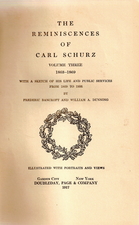
Carl Schurz led an interesting life, all right, and he is one of those figures who was very well known and influential on a national scale in his own time, but is mostly forgotten, except, I guess, by historians, in our own.
I've sketched his life before during my discussions of the first two volumes of this work, but, briefly, Schurz was a German native who took part in the revolutions in Germany in 1848, after which he was obliged to escape to the U.S. Due to his skills as an orator, his connections in the German-American community here and his reputation as a revolutionary hero, Schurz quickly became an influential speaker among the sizable German speaking population in the U.S. He became a fervent abolitionist and spoke much on the subject. He campaigned for Lincoln and became an associate of and sometime adviser to that famous figure. His descriptions of his meetings and conversations with Lincoln are among the highlights of these memoirs' second volume. At the outbreak of war, Schurz became a Major General in the Union army, leading a regiment of German-Americans. There is evidently some controversy about how well (or poorly) these troops performed, and Schurz spends some time trying to refute his regiment's poor reputation. At any rate, his descriptions of his war experiences are quite interesting, as you'd imagine.
This third volume opens with the Battle of Gettysburg and continues through 1869, at which point in his writing ill health caused Schurz to put down his pen. He passed away shortly thereafter in 1906. (Historians Frederic Bancroft and William Dunning pick up the narrative and continue the story of Schurz's life fron 1869 through 1906, working from their subject's voluminous correspondences and publications.) The book's original copyright is 1908. My volume was published in 1917.
The most fascinating part of this volume is Schurz's description of years immediately after the war. At the behest of Andrew Johnson, Schurz toured the southern states just a year after the cessation of the fighting to gather a report for the president of conditions on the ground. Schurz's narrative of what he saw there, and the attitudes he heard from those he spoke with during his three-month sojourn are riveting. He talks about the fact that many Southern whites were completely at a loss as to how to proceed without slavery, upon which they depended for their labor force. The keenest necessity for all involved was to get a crop into the ground quickly, but many land owners simply didn't believe that their former slaves would work at all without being physically forced. They had no confidence that blacks would work for pay. Additionally, many thought that once the Union troops left, they'd be once again free to handle this situation however they wanted, up to and including the re-institution of slavery. (Interestingly, at least to me, this all points up a glaring weakness in And Wait for the Night, the novel about Reconstruction I read just before this book, which, in an evident attempt to whitewash the era, glosses over this issue entirely.)
Schurz, who was soon became a Senator from Missouri, then provides an in-depth account of (what he considered) Johnson's wrong-headed and ultimately disastrous policies toward reconstruction. After that, we get a similarly up-close picture of the horrid Grant administration.
In addition, Schurz reports on his meetings and lengthy conversations with Bismark upon Schurz's return to Germany as, now, a traveling diplomat. These conversations take up many interesting pages, but I was particularly struck by the following:
"And {Bismark} seemed to be much struck when I brought out the apparent paradox that in a democracy with little government things might go badly in detail but well on the whole, while in a monarchy with much and omnipresent government, things might go very pleasingly in detail but poorly on the whole. He saw that with such views I was an incurable democrat; but would not, he asked, the real test of our democratic institutions come when after the disappearance of the exceptional opportunities springing from our wonderful natural resources which were in a certain sense common property, our political struggles became--which they surely would become--struggles between the poor and the rich, between the few who have, and the many who want? Here we entered upon a wide field of conjecture."
The book becomes less compelling, although still intellectually interesting, once Schurz's biographers take over the narrative, as one would imagine. There's a bit too much hero worship. Plus, the issues Schurz threw himself into, including the reform of the Civil Service system (which was rife with corruption and cronyism, especially under Grant) and various currency issues (gold vs. "greenbacks" -- Schurz was for gold), while vital at the time, seem less urgent a century and a half later.
I recommend this volume of Carl Schurz's memoirs very highly indeed for readers interested in Reconstruction in particular, and the American politcal scene in the second half of the 19th century in general. Taken together, the three volumes of Schurz's memoirs provide a wonderful look at a fascinating life and mind, lived during interesting times, indeed.
* Oddly, the touchstone for this book works in Preview, but then disappears when I hit Submit. At any rate, the book's main page is here: http://www.librarything.com/work/10440733/book/64897516
Carl Schurz led an interesting life, all right, and he is one of those figures who was very well known and influential on a national scale in his own time, but is mostly forgotten, except, I guess, by historians, in our own.
I've sketched his life before during my discussions of the first two volumes of this work, but, briefly, Schurz was a German native who took part in the revolutions in Germany in 1848, after which he was obliged to escape to the U.S. Due to his skills as an orator, his connections in the German-American community here and his reputation as a revolutionary hero, Schurz quickly became an influential speaker among the sizable German speaking population in the U.S. He became a fervent abolitionist and spoke much on the subject. He campaigned for Lincoln and became an associate of and sometime adviser to that famous figure. His descriptions of his meetings and conversations with Lincoln are among the highlights of these memoirs' second volume. At the outbreak of war, Schurz became a Major General in the Union army, leading a regiment of German-Americans. There is evidently some controversy about how well (or poorly) these troops performed, and Schurz spends some time trying to refute his regiment's poor reputation. At any rate, his descriptions of his war experiences are quite interesting, as you'd imagine.
This third volume opens with the Battle of Gettysburg and continues through 1869, at which point in his writing ill health caused Schurz to put down his pen. He passed away shortly thereafter in 1906. (Historians Frederic Bancroft and William Dunning pick up the narrative and continue the story of Schurz's life fron 1869 through 1906, working from their subject's voluminous correspondences and publications.) The book's original copyright is 1908. My volume was published in 1917.
The most fascinating part of this volume is Schurz's description of years immediately after the war. At the behest of Andrew Johnson, Schurz toured the southern states just a year after the cessation of the fighting to gather a report for the president of conditions on the ground. Schurz's narrative of what he saw there, and the attitudes he heard from those he spoke with during his three-month sojourn are riveting. He talks about the fact that many Southern whites were completely at a loss as to how to proceed without slavery, upon which they depended for their labor force. The keenest necessity for all involved was to get a crop into the ground quickly, but many land owners simply didn't believe that their former slaves would work at all without being physically forced. They had no confidence that blacks would work for pay. Additionally, many thought that once the Union troops left, they'd be once again free to handle this situation however they wanted, up to and including the re-institution of slavery. (Interestingly, at least to me, this all points up a glaring weakness in And Wait for the Night, the novel about Reconstruction I read just before this book, which, in an evident attempt to whitewash the era, glosses over this issue entirely.)
Schurz, who was soon became a Senator from Missouri, then provides an in-depth account of (what he considered) Johnson's wrong-headed and ultimately disastrous policies toward reconstruction. After that, we get a similarly up-close picture of the horrid Grant administration.
In addition, Schurz reports on his meetings and lengthy conversations with Bismark upon Schurz's return to Germany as, now, a traveling diplomat. These conversations take up many interesting pages, but I was particularly struck by the following:
"And {Bismark} seemed to be much struck when I brought out the apparent paradox that in a democracy with little government things might go badly in detail but well on the whole, while in a monarchy with much and omnipresent government, things might go very pleasingly in detail but poorly on the whole. He saw that with such views I was an incurable democrat; but would not, he asked, the real test of our democratic institutions come when after the disappearance of the exceptional opportunities springing from our wonderful natural resources which were in a certain sense common property, our political struggles became--which they surely would become--struggles between the poor and the rich, between the few who have, and the many who want? Here we entered upon a wide field of conjecture."
The book becomes less compelling, although still intellectually interesting, once Schurz's biographers take over the narrative, as one would imagine. There's a bit too much hero worship. Plus, the issues Schurz threw himself into, including the reform of the Civil Service system (which was rife with corruption and cronyism, especially under Grant) and various currency issues (gold vs. "greenbacks" -- Schurz was for gold), while vital at the time, seem less urgent a century and a half later.
I recommend this volume of Carl Schurz's memoirs very highly indeed for readers interested in Reconstruction in particular, and the American politcal scene in the second half of the 19th century in general. Taken together, the three volumes of Schurz's memoirs provide a wonderful look at a fascinating life and mind, lived during interesting times, indeed.
* Oddly, the touchstone for this book works in Preview, but then disappears when I hit Submit. At any rate, the book's main page is here: http://www.librarything.com/work/10440733/book/64897516
53rocketjk
Book 34: Dragonmede by Rona Randall

This is a Victorian romance, set in 1880s Sussex, England. Our heroine, Eustacia, marries into an aristocratic family living in the impressive yet gloomy mansion of the title. She soon begins to realize that all is not as it seems (is it ever?) with her dashing husband, his family or even her own past. Mysteries, and soon physical danger, begin to swirl around her.
I enjoyed this book. The characterizations were fine, within the expectations of the genre. The plot twists were interesting, usually neither telegraphed nor too abrupt. The plot's culmination is kind of rushed and the developments within the falling action, mercifully brief, can be forecast a mile away. Those are relatively small gripes, however. I'm certainly no expert on this genre, but for anyone who finds these old time romances (this one was written in 1972) to be fun to read from time to time, this one, while perhaps not at the very top of the craft, is at any rate good, relaxing fun.

This is a Victorian romance, set in 1880s Sussex, England. Our heroine, Eustacia, marries into an aristocratic family living in the impressive yet gloomy mansion of the title. She soon begins to realize that all is not as it seems (is it ever?) with her dashing husband, his family or even her own past. Mysteries, and soon physical danger, begin to swirl around her.
I enjoyed this book. The characterizations were fine, within the expectations of the genre. The plot twists were interesting, usually neither telegraphed nor too abrupt. The plot's culmination is kind of rushed and the developments within the falling action, mercifully brief, can be forecast a mile away. Those are relatively small gripes, however. I'm certainly no expert on this genre, but for anyone who finds these old time romances (this one was written in 1972) to be fun to read from time to time, this one, while perhaps not at the very top of the craft, is at any rate good, relaxing fun.
54rocketjk
Book 35: Grass Roots of Anderson Valley by Blanche Brown

Read as a "between book," (see first post). I read Grass Roots of Anderson Valley as part of my ongoing project to learn the history of this relatively remote section of Mendocino County, about 100 miles north of San Francisco, where my wife and I bought a house about 5 years ago and moved full-time three years ago. Blanche Brown was born in the valley in the late 1880s and published this book when she was in her 70s. She relied upon not only her own memory, but correspondence with her own relatives, who provided her with letters and diaries of their parents, aunts and uncles, and grandparents. They also did research at the local historical societies. In other words, they were still, at that time, able to attain written memories of people who remembered some of the earliest settlers in the area.
The book contains several very brief chapters, each describing an early Anderson Valley family, their activities and their geneologies. There are also two or three fascinating longer descriptions of early valley life, such as one description of the Native American inhabitants who were still living relatively traditional lives and making annual migrations from the mountains to the ocean and back into the early 20th Century. Missing here, however, as in almost every history of the area I've ever read, is any sort of description of the usually one-sided violent interactions between natives and whites during the 19th century. Regardless, a very interesting book for anyone interested in the history of this valley in particular, or in Northern California in general.

Read as a "between book," (see first post). I read Grass Roots of Anderson Valley as part of my ongoing project to learn the history of this relatively remote section of Mendocino County, about 100 miles north of San Francisco, where my wife and I bought a house about 5 years ago and moved full-time three years ago. Blanche Brown was born in the valley in the late 1880s and published this book when she was in her 70s. She relied upon not only her own memory, but correspondence with her own relatives, who provided her with letters and diaries of their parents, aunts and uncles, and grandparents. They also did research at the local historical societies. In other words, they were still, at that time, able to attain written memories of people who remembered some of the earliest settlers in the area.
The book contains several very brief chapters, each describing an early Anderson Valley family, their activities and their geneologies. There are also two or three fascinating longer descriptions of early valley life, such as one description of the Native American inhabitants who were still living relatively traditional lives and making annual migrations from the mountains to the ocean and back into the early 20th Century. Missing here, however, as in almost every history of the area I've ever read, is any sort of description of the usually one-sided violent interactions between natives and whites during the 19th century. Regardless, a very interesting book for anyone interested in the history of this valley in particular, or in Northern California in general.
55rocketjk
Book 36: Diplomat by Charles W. Thayer

Thayer was a long-time member of the U.S. diplomatic service who also served in the OSS. His most memorable posts were in Kabul during WWII and, for many years, in the Soviet Union.
Diplomat, published in 1959, is a non-fiction work, describing the in's and out's of life in the diplomatic corps, with a history of international diplomacy worked in throughout, as well as a history of American diplomatic efforts, the attitudes of Congress towards the U.S. foreign service, an the evolution of the infighting between the different civilian service branches and how they affected American diplomacy. A lot of this book is interesting, though the details about things like protocol and rankings became tedious. I believe that was intentional, a way of demonstrating the frequent tedium and absurdity of the life of the diplomat. Thayer's attitude is that it's the ambassador on the ground who can gather the most useful information and get the most diplomacy done, and that high ranking government officials swooping in to conduct negotiations may end up doing more harm than good. At any rate, as I mentioned, this book is usually interesting, though not always fascinating.
Thayer does offer plenty of personal anecdotes, observations and opinions, which make the reading more lively. One recurrent theme is that lawyers and businessmen, contrary to popular belief, do not make good diplomats, because they are used to living in a world where contracts are enforceable. What you need, says Thayer, perhaps not surprisingly, are trained, professional diplomats:
Diplomacy mediates not between right and wrong but between conflicting interests. It seeks to compromise not between legal equities but between national aspirations. Among nations, despite the efforts of statesmen since Grotius, no ordered system with a unified process of law enforcement exists. Furthermore, a nation's interests, aspirations, and the power to satisfy them vary from year to year, indeed from day to day. What yesterday was satisfactory may tomorrow be intolerable and unenforceable.
Thayer gives as an example the treaty arranged with Germany after World War II when the U.S. wanted to return national sovereignty to Germany. A treaty was negotiated by a team extremely lawyer-heavy on the U.S. side in which "The abolition of cartels, the guarantees of democratic government, the punishment of war criminals, and a thousand other details were negotiated by a host of lawyer and legal experts as though a system of law existed into which the agreements might fit. . . . (but) by granting West Germany sovereignty, the treaty fundamentally altered the power relationship of the signatories. The limitations that it sought to impose upon the Germans became meaningless because the power to enforce them no longer existed. Those obligations the German government assumed which corresponded with her national interests remained in force. The rest, in a matter of a few years, vanished all but unnoticed." The point being, of course, that experienced professional diplomats would have seen this coming and worked the treaty otherwise to make it more binding.
What is fascinating is Thayer's own story. A quick look at Wikipedia reveals that by the time this book was written, Thayer was six years past being hounded out of the foreign service by McCarthy and Hoover for supposed Communist sympathies and, horror of horrors, homosexuality. Here's the link to the bio: http://en.wikipedia.org/wiki/Charles_W._Thayer. Thayer's papers are in the Truman Library: http://www.trumanlibrary.org/hstpaper/thayerc.htm
I love to read relatively obscure books written in another era and describing an aspect of that era from within. This books fits that well, despite its frequent dry patches, which lower the overall rating to 3 1/2 stars.

Thayer was a long-time member of the U.S. diplomatic service who also served in the OSS. His most memorable posts were in Kabul during WWII and, for many years, in the Soviet Union.
Diplomat, published in 1959, is a non-fiction work, describing the in's and out's of life in the diplomatic corps, with a history of international diplomacy worked in throughout, as well as a history of American diplomatic efforts, the attitudes of Congress towards the U.S. foreign service, an the evolution of the infighting between the different civilian service branches and how they affected American diplomacy. A lot of this book is interesting, though the details about things like protocol and rankings became tedious. I believe that was intentional, a way of demonstrating the frequent tedium and absurdity of the life of the diplomat. Thayer's attitude is that it's the ambassador on the ground who can gather the most useful information and get the most diplomacy done, and that high ranking government officials swooping in to conduct negotiations may end up doing more harm than good. At any rate, as I mentioned, this book is usually interesting, though not always fascinating.
Thayer does offer plenty of personal anecdotes, observations and opinions, which make the reading more lively. One recurrent theme is that lawyers and businessmen, contrary to popular belief, do not make good diplomats, because they are used to living in a world where contracts are enforceable. What you need, says Thayer, perhaps not surprisingly, are trained, professional diplomats:
Diplomacy mediates not between right and wrong but between conflicting interests. It seeks to compromise not between legal equities but between national aspirations. Among nations, despite the efforts of statesmen since Grotius, no ordered system with a unified process of law enforcement exists. Furthermore, a nation's interests, aspirations, and the power to satisfy them vary from year to year, indeed from day to day. What yesterday was satisfactory may tomorrow be intolerable and unenforceable.
Thayer gives as an example the treaty arranged with Germany after World War II when the U.S. wanted to return national sovereignty to Germany. A treaty was negotiated by a team extremely lawyer-heavy on the U.S. side in which "The abolition of cartels, the guarantees of democratic government, the punishment of war criminals, and a thousand other details were negotiated by a host of lawyer and legal experts as though a system of law existed into which the agreements might fit. . . . (but) by granting West Germany sovereignty, the treaty fundamentally altered the power relationship of the signatories. The limitations that it sought to impose upon the Germans became meaningless because the power to enforce them no longer existed. Those obligations the German government assumed which corresponded with her national interests remained in force. The rest, in a matter of a few years, vanished all but unnoticed." The point being, of course, that experienced professional diplomats would have seen this coming and worked the treaty otherwise to make it more binding.
What is fascinating is Thayer's own story. A quick look at Wikipedia reveals that by the time this book was written, Thayer was six years past being hounded out of the foreign service by McCarthy and Hoover for supposed Communist sympathies and, horror of horrors, homosexuality. Here's the link to the bio: http://en.wikipedia.org/wiki/Charles_W._Thayer. Thayer's papers are in the Truman Library: http://www.trumanlibrary.org/hstpaper/thayerc.htm
I love to read relatively obscure books written in another era and describing an aspect of that era from within. This books fits that well, despite its frequent dry patches, which lower the overall rating to 3 1/2 stars.
56rocketjk
Book 37: Twenty Thousand Roads: the Ballad of Gram Parsons and his Cosmic American Music by David N. Meyer

I grew up listening to country-rock music, and Gram Parsons was one of my musical heroes. And while I knew he'd died young and that he'd been a heavy drug user, I was never really aware just how influential he really was, how sad a life he had and how energetic he was in pushing away success and wasting his considerable talent and charm.
Parsons hit the big time when, after gaining a bit of notice with his International Submarine Band in L.A., he joined the Byrds and helped steer that band from psychedelia towards country, recording the now iconic Sweetheart of the Rodeo album. Then it was on to co-leading the the even more influential Flying Burrito Brothers and the sound that spawned a million imitators. Meyer also chronicles the friendship between Parsons and Keith Richards that helped push the Stones towards country and the sound that would produce Exile on Main Street but also helped bury Parsons even deeper into the vortex of hard drug use.
The "tragic, sensitive artist as his own worst enemy" story has been told a million times, of course, but Meyer, with a writing style that flows nicely and seemingly deep and impeccable research, really does succeed in making Parson's story a compelling one. We don't see Parsons as a hero or as a tragic victim. We see him as a man who brought about his own demise, and yet earned his iconic status in American music history. We also get an interesting, close-up look at the rock world of the late 60s and early 70s.

I grew up listening to country-rock music, and Gram Parsons was one of my musical heroes. And while I knew he'd died young and that he'd been a heavy drug user, I was never really aware just how influential he really was, how sad a life he had and how energetic he was in pushing away success and wasting his considerable talent and charm.
Parsons hit the big time when, after gaining a bit of notice with his International Submarine Band in L.A., he joined the Byrds and helped steer that band from psychedelia towards country, recording the now iconic Sweetheart of the Rodeo album. Then it was on to co-leading the the even more influential Flying Burrito Brothers and the sound that spawned a million imitators. Meyer also chronicles the friendship between Parsons and Keith Richards that helped push the Stones towards country and the sound that would produce Exile on Main Street but also helped bury Parsons even deeper into the vortex of hard drug use.
The "tragic, sensitive artist as his own worst enemy" story has been told a million times, of course, but Meyer, with a writing style that flows nicely and seemingly deep and impeccable research, really does succeed in making Parson's story a compelling one. We don't see Parsons as a hero or as a tragic victim. We see him as a man who brought about his own demise, and yet earned his iconic status in American music history. We also get an interesting, close-up look at the rock world of the late 60s and early 70s.
57rocketjk
Book 38: Bury My Heart at Wounded Knee by Dee Brown

Goodness, this is a tough book to read, a long dissertation of heartless murder, cruelty and broken promises. It's extremely well written, in simple, direct prose that allows the story to tell itself and the full power of the tragedy of the Europeans'/Americans' mistreatment of the Native American tribes, over hundreds of years, and the deliberate, heartless destruction of the Indians' cultures. It's hard to read, all right, but essential information. Every adult American, at the very least, should read it.

Goodness, this is a tough book to read, a long dissertation of heartless murder, cruelty and broken promises. It's extremely well written, in simple, direct prose that allows the story to tell itself and the full power of the tragedy of the Europeans'/Americans' mistreatment of the Native American tribes, over hundreds of years, and the deliberate, heartless destruction of the Indians' cultures. It's hard to read, all right, but essential information. Every adult American, at the very least, should read it.
58richardderus

mistletoe smooches!
60rocketjk
Book 39: Dragons at the Gate by Robert L. Duncan

In this 1970s spy thriller that centers around missing Japanese gold and U.S.-Japanese trade negotiations, the CIA is an agency off its hinges, ready to "sacrifice" loyal agents in the name of geo-political expediency. This is a good, fun, paranoid ride. Ah, yes. The good old days, when our biggest worry was the global economic threat from a super-heated Japan. Anyway, I enjoyed this book. The writing was pretty good and the plot moved along nicely.

In this 1970s spy thriller that centers around missing Japanese gold and U.S.-Japanese trade negotiations, the CIA is an agency off its hinges, ready to "sacrifice" loyal agents in the name of geo-political expediency. This is a good, fun, paranoid ride. Ah, yes. The good old days, when our biggest worry was the global economic threat from a super-heated Japan. Anyway, I enjoyed this book. The writing was pretty good and the plot moved along nicely.
61rocketjk
Book 40: Footprints: an Early History of Fort Bragg, California and the Pomo Indians by Bonni Grapp

A short history of this Mendocino coast town that I read as part of my ongoing effort to read as much as I can of the history of Mendocino County, where my wife and I have lived since 2008. Nicely written and informative, for all its brevity. The Pomos' lifestyle is pretty well described, but their ultimate fate, being moved off their ancestral coastal land onto a small, inland, reservation, is, to put it mildly, brushed over with only scant mention.

A short history of this Mendocino coast town that I read as part of my ongoing effort to read as much as I can of the history of Mendocino County, where my wife and I have lived since 2008. Nicely written and informative, for all its brevity. The Pomos' lifestyle is pretty well described, but their ultimate fate, being moved off their ancestral coastal land onto a small, inland, reservation, is, to put it mildly, brushed over with only scant mention.
62rocketjk
Well, I tried to get a 41st book read before the end of '11 but didn't make it, so 40 is a wrap for this year. Well below my stated goal, obviously. Not too much of a surprise, though, given the huge enterprise I took on in February of this year, the purchase of a used bookstore. Also, I went from having an office about a 2-minute drive from my house to having a 40-minute commute each way to the store. Also, previously, I could sit and read during lunch. Now I just power through lunch, eating as I work. At any rate, now that I've got things in hand with my business a little, maybe I can up the reading pace again. Anyhow . . .
On to 2012!
On to 2012!

