This topic is currently marked as "dormant"—the last message is more than 90 days old. You can revive it by posting a reply.
1labwriter
This is my thread for Summer.

Here's the essence of a summer morning. This fat old bumblebee staggering out of my Blue Satin hibiscus is an early morning worker.
Here's thread #5
Here's thread #4
Here's thread #3
Here's thread #2
Here's thread #1

Books Finished (or Abandoned) in June, 2011
1. Andersonville, by MacKinlay Kantor. 4 stars
2. Against All Enemies, by "Tom Clancy." 1/2 star (because I couldn't give it negative stars). Abandoned after reading 400 pages. Not only abandoned, but shipped back to Amazon for a refund.
3. My Own Country, a memoir by Abraham Verghese. 4 stars
4. The Peabody Sisters, by Megan Marshall. 3 stars
June has been one of those months where I'm reading several large books at once. Consequently, I don't have many in the "finished" column for June. Also, my reading time has been slashed due to other priorities. Even so, it looks like I'm on track to finish my 75 for the year--although frankly, because of the moster size of so many of these books, if I don't finish 75, I honestly won't be surprised.
Books Finished in July, 2011
1. White Heat The Friendship of Emily Dickinson and Thomas Wentworth Higginson, by Brenda Wineapple. 5 stars
2. Lives Like Loaded Guns: Emily Dickinson and Her Family's Feuds, by Lyndall Gordon. 4 stars
3. Wild Fire, by Nelson DeMille. 4 stars
4. Portrait of a Spy, by Daniel Silva. 4 stars
5. Hawthorne: A Life, by Brenda Wineapple. 4 stars
Oh woe, is it possible that I finished only five books in July? I guess so.
Books Finished in August, 2011
1. The Woods, by Harlan Coben. Audio book. The narrator was ridiculous, which caused me to give the book 2.5 stars.
Here's the essence of a summer morning. This fat old bumblebee staggering out of my Blue Satin hibiscus is an early morning worker.
Here's thread #5
Here's thread #4
Here's thread #3
Here's thread #2
Here's thread #1

Books Finished (or Abandoned) in June, 2011
1. Andersonville, by MacKinlay Kantor. 4 stars
2. Against All Enemies, by "Tom Clancy." 1/2 star (because I couldn't give it negative stars). Abandoned after reading 400 pages. Not only abandoned, but shipped back to Amazon for a refund.
3. My Own Country, a memoir by Abraham Verghese. 4 stars
4. The Peabody Sisters, by Megan Marshall. 3 stars
June has been one of those months where I'm reading several large books at once. Consequently, I don't have many in the "finished" column for June. Also, my reading time has been slashed due to other priorities. Even so, it looks like I'm on track to finish my 75 for the year--although frankly, because of the moster size of so many of these books, if I don't finish 75, I honestly won't be surprised.
Books Finished in July, 2011
1. White Heat The Friendship of Emily Dickinson and Thomas Wentworth Higginson, by Brenda Wineapple. 5 stars
2. Lives Like Loaded Guns: Emily Dickinson and Her Family's Feuds, by Lyndall Gordon. 4 stars
3. Wild Fire, by Nelson DeMille. 4 stars
4. Portrait of a Spy, by Daniel Silva. 4 stars
5. Hawthorne: A Life, by Brenda Wineapple. 4 stars
Oh woe, is it possible that I finished only five books in July? I guess so.
Books Finished in August, 2011
1. The Woods, by Harlan Coben. Audio book. The narrator was ridiculous, which caused me to give the book 2.5 stars.
2labwriter
Here's what I'm currently reading, as June comes to a slow close.
The Paper: The Life and Death of the New York Herald Tribune, by Richard Kluger. This is a comprehensive history of the Tribune. One of these days I'm going to set everything else aside and actually finish this one. I think I started this one in March.
Battle Cry of Freedom, by James M. McPherson. This is an excellent one-volume history of the Civil War. I haven't given this much time, so I'm not very far into it yet. He starts the book somewhere in the 1820s, so I haven't even gotten to the actual war days yet. I was interested in reading this one after I read Oldtown Folks by Harriet Beecher Stowe.
God Is Not Great by Christopher Hitchens. I'm reading this one on my Kindle, trying to make progress on it by reading something in it every Sunday. I can't say that I particularly like anything he has to say; it's simply my effort to understand Hitchens' point of view. Another slow go.
The Peabody Sisters by Megan Marshall. Another book that I picked up because of the HBS book that I read. This is one huge biography; it's published in a teeny font and is 800-some pages long. Marshall is one of those biographers who couldn't resist putting in every fact she found. The information about these sisters and the time in which they lived is fascinating, and it goes along with my effort to read more American Literature in 2011. The sisters were born in the early 19th century and lived mainly in the Boston area.
White Heat: The Friendship of Emily Dickinson and Thomas Wentworth Higginson, by Brenda Wineapple. This is a book I'm reading with Lucy that we are posting about in the "Book Talk" group. Anyone is welcome to join. We both seem to have gotten off to a slow start on this one, and then we slowed down a bit, so if you haven't started yet, it will be no great trick to catch up.
Books I'd like to read soon:
My Wars Are Laid Away in Books: The Life of Emily Dickinson by Alfred Habegger. This biography about Dickinson was published in 2001 and has received excellent reviews.
Margaret Fuller: From Transcendentalism to Revolution, by Paula Blanchard. Blanchard is an excellent biographer, having written about one of my favorites, Sarah Orne Jewett.
I'd like to find some good, brainless fiction. That shouldn't be too hard, right?
The Paper: The Life and Death of the New York Herald Tribune, by Richard Kluger. This is a comprehensive history of the Tribune. One of these days I'm going to set everything else aside and actually finish this one. I think I started this one in March.
Battle Cry of Freedom, by James M. McPherson. This is an excellent one-volume history of the Civil War. I haven't given this much time, so I'm not very far into it yet. He starts the book somewhere in the 1820s, so I haven't even gotten to the actual war days yet. I was interested in reading this one after I read Oldtown Folks by Harriet Beecher Stowe.
God Is Not Great by Christopher Hitchens. I'm reading this one on my Kindle, trying to make progress on it by reading something in it every Sunday. I can't say that I particularly like anything he has to say; it's simply my effort to understand Hitchens' point of view. Another slow go.
The Peabody Sisters by Megan Marshall. Another book that I picked up because of the HBS book that I read. This is one huge biography; it's published in a teeny font and is 800-some pages long. Marshall is one of those biographers who couldn't resist putting in every fact she found. The information about these sisters and the time in which they lived is fascinating, and it goes along with my effort to read more American Literature in 2011. The sisters were born in the early 19th century and lived mainly in the Boston area.
White Heat: The Friendship of Emily Dickinson and Thomas Wentworth Higginson, by Brenda Wineapple. This is a book I'm reading with Lucy that we are posting about in the "Book Talk" group. Anyone is welcome to join. We both seem to have gotten off to a slow start on this one, and then we slowed down a bit, so if you haven't started yet, it will be no great trick to catch up.
Books I'd like to read soon:
My Wars Are Laid Away in Books: The Life of Emily Dickinson by Alfred Habegger. This biography about Dickinson was published in 2001 and has received excellent reviews.
Margaret Fuller: From Transcendentalism to Revolution, by Paula Blanchard. Blanchard is an excellent biographer, having written about one of my favorites, Sarah Orne Jewett.
I'd like to find some good, brainless fiction. That shouldn't be too hard, right?
3sibylline
I'm totally with you on the Fuller bio! I'll scamper off and find me a copy. Not that there is any rush at the snail's pace we are going w/ the ED.
Forgot to say -- new thread! I'm the first visitor!
Forgot to say -- new thread! I'm the first visitor!
4Whisper1
I love your opening photo! A few years ago I attended a publication conference in St. Louis. The students and I went to the museum and found it fascinating. None of us wanted to go up in the arch because the week before we arrived, people were stuck in the arch for what must have felt to them a VERY long time.
St. Louis is an area seeped in history. Sadly, there is a high rate of crime in the city, particularly in the area near the arch. The hotel personnel told us man times not to walk anywhere and to be sure to take a cab.
While we were in the hotel a lot attending the workshop sessions, we still had the opportunity to get out and see the city and I came away with very fond memories.
St. Louis is an area seeped in history. Sadly, there is a high rate of crime in the city, particularly in the area near the arch. The hotel personnel told us man times not to walk anywhere and to be sure to take a cab.
While we were in the hotel a lot attending the workshop sessions, we still had the opportunity to get out and see the city and I came away with very fond memories.
5LizzieD
Happy New Thread! Wonderful picture!!
And I should say that you do need some mindless fiction!!!! (You can look at my year's reading list and find plenty if you're out of suggestions for yourself.)
And I should say that you do need some mindless fiction!!!! (You can look at my year's reading list and find plenty if you're out of suggestions for yourself.)
6labwriter
>4 Whisper1:. Hi Linda, I don't think St. Louis is too much different from other large cities with a large poor population. Sadly, there's a lot of black on black crime here. I hope no one will flame me for saying that--it's simply a fact. You do need to know where you're going when you're downtown, because you can very quickly go from a nice area where there are restaurants, hotels, conferences, etc. into an area where you have no business going. When I was new here, I didn't understand that, since Denver is not like St. Louis in that way. I actually went downtown to use the library, like I would have in Denver, and my St. Louis friends were horrified--no, you don't do that, you go to the county library. But that was 20 years ago, and I do think that things have gotten better.
What really is a shame here in St. Louis is that we're at least 20 or 30 years (or more) behind other cities in terms of downtown revitalization. Some things are happening, slowly, but we are very much behind the curve. So I'm sure for people who come here from cities where things are "happening" in their downtown spaces, St. Louis must look like 1960. It's all about leadership, and St. Louis has had some really lousy mayors, at least since I've lived here.
There are efforts being made to work on the grounds around the Arch, although with the economy being what it is, I don't know how far they've gotten (or ever will get) with this. It's a shame, since it could be such a nice area.
Hi Sib & Peggy.
I was just outside doing some work in my gardens, since it's rather unseasonably cool here today. Well, "cool" or not, a couple of hours out there in the sun is enough. DH wants to go downtown {{rolls eyes}} and see what happening for Marine Week. I would so much rather not, but he doesn't ask me to do much, so I would feel like a real wet blanket if I didn't go with him. So...later. Wish me luck.
What really is a shame here in St. Louis is that we're at least 20 or 30 years (or more) behind other cities in terms of downtown revitalization. Some things are happening, slowly, but we are very much behind the curve. So I'm sure for people who come here from cities where things are "happening" in their downtown spaces, St. Louis must look like 1960. It's all about leadership, and St. Louis has had some really lousy mayors, at least since I've lived here.
There are efforts being made to work on the grounds around the Arch, although with the economy being what it is, I don't know how far they've gotten (or ever will get) with this. It's a shame, since it could be such a nice area.
Hi Sib & Peggy.
I was just outside doing some work in my gardens, since it's rather unseasonably cool here today. Well, "cool" or not, a couple of hours out there in the sun is enough. DH wants to go downtown {{rolls eyes}} and see what happening for Marine Week. I would so much rather not, but he doesn't ask me to do much, so I would feel like a real wet blanket if I didn't go with him. So...later. Wish me luck.
7qebo
2: You might be interested in the discussion of Battle Cry of Freedom that occurred on this blog about a year ago. (The site search isn't great, no simple way to get the complete sequence.) I was paying only peripheral attention at the time, but have kept the book in mind. I just ordered it (though I already have too many books stacked up for July), will be interested in your comments.
8labwriter
Thanks, quebo, for that link to the discussion of Battle Cry of Freedom.
9labwriter
I'm tired today for some reason, and I'd love to kick back and read, but even better my son is coming for Sunday dinner. I made a trip to the farmer's market on Wednesday, and we're having some summer-good food: jerk-style chicken on the grill, summer tomato, bean, corn, and avocado salad, and fresh peach cobbler. Oooh boy. Simple food, good food.
Why don't I remember this kind of stuff from when I was a kid? Why didn't my mother cook with fresh summer vegetables? Dunno. I guess it just wasn't something she would have thought to do.
Why don't I remember this kind of stuff from when I was a kid? Why didn't my mother cook with fresh summer vegetables? Dunno. I guess it just wasn't something she would have thought to do.
10sibylline
That sounds like a wonderful dinner, esp the dessert.
We ate out tonight at a good local restaurant and had an 'all strawberry' meal -- I ended up with strawberries foster w/ vanilla icecream. When I got home I did make sure to waddle up and down the road a mile or so before it got dark and now I feel a little bit better......
The 50's and vegetables -- a strange strange decade. 60's weren't much better until toward the end. My mother became obsessed with growing lettuce and spinach and peas and fresh herbs in her garden in the late 60's. And little tomatoes. So things improved then.
We ate out tonight at a good local restaurant and had an 'all strawberry' meal -- I ended up with strawberries foster w/ vanilla icecream. When I got home I did make sure to waddle up and down the road a mile or so before it got dark and now I feel a little bit better......
The 50's and vegetables -- a strange strange decade. 60's weren't much better until toward the end. My mother became obsessed with growing lettuce and spinach and peas and fresh herbs in her garden in the late 60's. And little tomatoes. So things improved then.
11LizzieD
My ma always cooked the good stuff, but then, she had two grandmothers showing her how. I am the one who has wandered from the gold of fresh food over the years as doing what I used to do at school in 7 hours came to take 8 and then 9. In retirement I'm doing a little better especially since the veggies are so wonderful and so plentiful around here.
12labwriter
If anyone is interested, Lucy and I have made a pretty good start on the Emily Dickinson/Thomas Higginson book by Brenda Wineapple. The thread is in the "Book Talk" group, here.
13labwriter
>11 LizzieD:. Yeah, Peggy, I understand how work eats into the energy and focus needed to make good food. I was the same way for 20 years or more. I had my standard recipes, and I rarely strayed from those. I'm enjoying these days of finding new, good recipes. My son said to me the last time he was here, "Mom, don't take this wrong, but you're a lot better cook than you used to be." {grin}
>10 sibylline:. I'm with you, Sib. The Fifties was a strange decade in a lot of ways. A lot less "Leave-it-to-Beaverish" than people realize who weren't there.
>10 sibylline:. I'm with you, Sib. The Fifties was a strange decade in a lot of ways. A lot less "Leave-it-to-Beaverish" than people realize who weren't there.
14sibylline
I do have the feeling though, that in the 50's a lot of people were quite good at things to do with cooking meat -- My mother made wickedly good roasts and such -- the sides were always just afterthoughts to the piece de resistance. Nowadays I think there is a more 'whole meal' approach, that the whole thing matters, that you don't just plop rice or potatoes and a few peas or something with your central meat dish. Of course, I do in fact cook rice and peas a lot......... but I often doll up the the rice and make it 'match' the mood of the meat dish -- gingery or whatever. Frozen peas though, those are my fall back veg since everyone seems to like them. If I can't find anything fresh I like the look of.....
And B. is right we are finally really moving along a bit more steadily in the Dickinson bio -- it is a very very good book.
And B. is right we are finally really moving along a bit more steadily in the Dickinson bio -- it is a very very good book.
15labwriter
Oh absolutely, everything, particularly at a Sunday dinner, revolved around "the meat." Roast, fried chicken, pork roast--my mother rotated those three meals. I can't think of a single thing she cooked that I would describe as "wickedly good"--although wickedly bad, yes, I can think of those meals. Particularly her roasts--always overdone. I don't know what cut of meat she used, but it was always the same one and always reminded me of shoe leather. Thankfully she did make good gravy, so that's when I got in the habit of drowning the meat and everything else with gravy. I was such a skinny little thing (with 3 brothers at the dinner table), that the extra calories from the gravy were necessary. DH laughs at me when I describe Sunday chicken dinner at our house when I was a kid: one chicken for six people. It didn't seem to occur to my mother that she could make more than one chicken. And everyone was assigned their particular piece. I got a wing. Yes, a wing. Haha.
16sjmccreary
Becky, I've finally caught up with after discovering that I missed an entire thread. As always, I love the discussions here. However, you've distressed me a little with the talk about St Louis being an unsafe place to walk around downtown. I've been there many times and have never felt threatened or unsafe in any way walking around - even after dark. Just call me Oblivious. But I refuse to become one of those people who are afraid to go anywhere or do anything. I will admit to being just a little nervous in March waiting for the metro-link train at the stop across from the baseball stadium about 11:30 on a Saturday night. Very quiet, very dark, very isolated. And some of the young guys who came along after us were very drunk. But no problems, and it was worth it after the fun evening we had, good food and wonderful live jazz music. St Louis is still our 1st choice for a weekend get-away.
Have starred the new thread and will try to keep up from here on out.
Have starred the new thread and will try to keep up from here on out.
17labwriter
I'm sorry to have distressed you with my post about downtown St. Louis. I guess I was responding to Linda's post (#4) and how she experienced downtown St. Louis. Coincidentally, I was on the Arch grounds just a day or so after I made that post, and I was thinking about what I had written. Things here have improved a great deal in the 20 years or so since I moved here. The Arch and the Cardinals' ball park are within a couple of blocks of each other. When I was walking around there on Saturday, I was trying to figure out why someone at one of the hotels would tell a guest not to walk anywhere and be sure to take a cab. I've never felt unsafe in that area, particularly in the summer when people tend to be out and about.
DH and I took the metro from the exact place that you describe--across from the baseball stadium. I hope you were with a group of friends when you were waiting for the train, because at that time of night I would be a little nervous about standing there, depending on who was with me. (If DH was with me, no problem. No one would mess with him--seriously. Ha.)
I imagine the jazz music you heard was somewhere on Laclede's Landing? That's a really wonderful, fun place, and again, I wouldn't be concerned about being down there at night. Like anywhere else, you want to be situationally aware, but I wouldn't have any problem going there. In fact, when my SIL and her husband were here for the first time last year, that was one of the places that was a "must see." They went there with us for lunch, and then they walked back there after dark from their hotel.
I'm just guessing, but I'm wondering if Linda's description of her trip here might have been several years ago? Anyway, I heartily endorse the area as a great place to come and visit. But just be aware, because it is possible to rather quickly get yourself into a rough neighborhood. If you're walking, have a plan and know where you're going--don't just wander. And have fun! I'm with you, I refuse to be someone who is fearful.
DH and I took the metro from the exact place that you describe--across from the baseball stadium. I hope you were with a group of friends when you were waiting for the train, because at that time of night I would be a little nervous about standing there, depending on who was with me. (If DH was with me, no problem. No one would mess with him--seriously. Ha.)
I imagine the jazz music you heard was somewhere on Laclede's Landing? That's a really wonderful, fun place, and again, I wouldn't be concerned about being down there at night. Like anywhere else, you want to be situationally aware, but I wouldn't have any problem going there. In fact, when my SIL and her husband were here for the first time last year, that was one of the places that was a "must see." They went there with us for lunch, and then they walked back there after dark from their hotel.
I'm just guessing, but I'm wondering if Linda's description of her trip here might have been several years ago? Anyway, I heartily endorse the area as a great place to come and visit. But just be aware, because it is possible to rather quickly get yourself into a rough neighborhood. If you're walking, have a plan and know where you're going--don't just wander. And have fun! I'm with you, I refuse to be someone who is fearful.
18sjmccreary
That puts my mind at ease a little - I really wasn't too worked up and would not have hesitated to make another trip downtown. I agree with you, though, that I can't imagine a hotel employee discouraging a guest from walking around in the area. And your caution about being aware and careful should go without saying - no matter where you are.
Laclede's Landing is a fun place, but I've never been there in the evening. That night in March we went to a place called BB's on the east side of the baseball stadium. A hole in the wall kind of place, the music was fabulous and we had a wonderful time. I was with my husband, whose size might be intimidating until you got a good look at his totally un-fearsome face. But I know he would do anything to protect me, or anyone else, from any kind of attack. And, in fact, he did stand up for a couple of single college girls who were being harassed by those drunk guys at the metro stop.
Laclede's Landing is a fun place, but I've never been there in the evening. That night in March we went to a place called BB's on the east side of the baseball stadium. A hole in the wall kind of place, the music was fabulous and we had a wonderful time. I was with my husband, whose size might be intimidating until you got a good look at his totally un-fearsome face. But I know he would do anything to protect me, or anyone else, from any kind of attack. And, in fact, he did stand up for a couple of single college girls who were being harassed by those drunk guys at the metro stop.
19labwriter
I'm still plowing my way through The Peabody Sisters by Megan Marshall. The book is certainly a comprehensive biog of the sisters and their time and place. The information is very good, but it's another biography where it's something of a chore to get through--"plodding" is how I would describe the writing. I'm at 364/452, so I am actually progressing through this thing. Never mind that I started it on the 2nd of May. Heh. Interestingly, even though I have less than 100 pages left in the book, Elizabeth, the oldest sister, is only 34 years old. So evidently the biographer's real interest in these women (and really, the biog is about Elizabeth, not the other two sisters) is the early years.
There's a book I'm finally going to have to read, and I should read it fairly soon--The Bostonians, by Henry James. Evidently his character in the novel, Miss Birdseye, is a killing satire of Elizabeth Peabody. Never having known in the past who Miss Peabody was, it didn't do me much good to know who Miss Birdseye was based on. Now that I know Elizabeth, I'm sure I would appreciate the James book more. It was also believed by some that the portrait of his two main characters in the book, a Boston feminist and her young protege, were the couple of the well-known "Boston marriage" of Annie Fields and Sarah Orne Jewett (or perhaps his sister Alice and her friend Katharine Loring, although that relationship may have been a red herring to cover up the "scandal" of writing about Mrs. Fields and Jewett).
From following the threads here, I know that some people read and actually like James. For me, and I've had to read a lot of his work in school, he's just not an author I would normally willingly sit down and read. I know I'm "supposed" to like his stuff, but I don't. Like Mark Twain, "I would rather be damned to John Bunyan's heaven than read {almost anything James wrote}." But now that I know Elizabeth Peabody, I'm going to have to try (again--I've started it a couple of times and never gotten very far) to read The Bostonians.
There's a book I'm finally going to have to read, and I should read it fairly soon--The Bostonians, by Henry James. Evidently his character in the novel, Miss Birdseye, is a killing satire of Elizabeth Peabody. Never having known in the past who Miss Peabody was, it didn't do me much good to know who Miss Birdseye was based on. Now that I know Elizabeth, I'm sure I would appreciate the James book more. It was also believed by some that the portrait of his two main characters in the book, a Boston feminist and her young protege, were the couple of the well-known "Boston marriage" of Annie Fields and Sarah Orne Jewett (or perhaps his sister Alice and her friend Katharine Loring, although that relationship may have been a red herring to cover up the "scandal" of writing about Mrs. Fields and Jewett).
From following the threads here, I know that some people read and actually like James. For me, and I've had to read a lot of his work in school, he's just not an author I would normally willingly sit down and read. I know I'm "supposed" to like his stuff, but I don't. Like Mark Twain, "I would rather be damned to John Bunyan's heaven than read {almost anything James wrote}." But now that I know Elizabeth Peabody, I'm going to have to try (again--I've started it a couple of times and never gotten very far) to read The Bostonians.
20labwriter
Well, I really am so pleased with myself that I finally finished something: The Peabody Sisters by Megan Marshall. I'm giving this biography only 3.5 stars because it was pretty much of a slog to get through, although the information was good. Let's just say that the writing was "serviceable."
Another reason for the low rating (and maybe it should be only 3 stars) is that I have a distinct sense that the biographer whitewashed the character of Elizabeth Peabody. I think this woman was someone with a completely overblown personality who frequently rubbed people the wrong way, yet throughout the book I had the impression that Marshall was doing everything she could do to "normalize" the woman. Maybe she saw her book as a corrective to other biographies that have made Elizabeth out to be a rather ludicrous buffoon.
I came away from the biog wanting to know more, despite the fact that it took me about 8 weeks to read this thing. I'm particularly interested in Nathaniel Hawthorne, married to Sophia, one of the Peabody sisters. He seems to have come from an odd but interesting family, which included a sister living as a "recluse" pretty much the same time that Emily Dickinson was living her life the same way. Evidently he was engaged to Sophia for three years, yet didn't tell his mother or sisters about Sophia until days before the wedding. I think next I'm going to read a biography about him by Edwin Haviland Miller, Salem Is My Dwelling Place. I read this one when it first came out (1991), but I know so much more about the time and place now than I did back then, that I think it would mean a lot more to me this time around.
I have a note in the Miller book that Sophia Peabody Hawthorne left behind something like 1500 letters written in "screamingly overblown prose." So here's another case where I don't think the Peabody biographer really got to the heart of the woman's personality. I think, unfortunately, her book was something of a whitewash overall. I don't know why biographers do that. "Real" biographers don't, but unfortunately, lots of people write one-off biographies, like the Peabody book, because "anybody" can write a biography--right? No.
Another reason for the low rating (and maybe it should be only 3 stars) is that I have a distinct sense that the biographer whitewashed the character of Elizabeth Peabody. I think this woman was someone with a completely overblown personality who frequently rubbed people the wrong way, yet throughout the book I had the impression that Marshall was doing everything she could do to "normalize" the woman. Maybe she saw her book as a corrective to other biographies that have made Elizabeth out to be a rather ludicrous buffoon.
I came away from the biog wanting to know more, despite the fact that it took me about 8 weeks to read this thing. I'm particularly interested in Nathaniel Hawthorne, married to Sophia, one of the Peabody sisters. He seems to have come from an odd but interesting family, which included a sister living as a "recluse" pretty much the same time that Emily Dickinson was living her life the same way. Evidently he was engaged to Sophia for three years, yet didn't tell his mother or sisters about Sophia until days before the wedding. I think next I'm going to read a biography about him by Edwin Haviland Miller, Salem Is My Dwelling Place. I read this one when it first came out (1991), but I know so much more about the time and place now than I did back then, that I think it would mean a lot more to me this time around.
I have a note in the Miller book that Sophia Peabody Hawthorne left behind something like 1500 letters written in "screamingly overblown prose." So here's another case where I don't think the Peabody biographer really got to the heart of the woman's personality. I think, unfortunately, her book was something of a whitewash overall. I don't know why biographers do that. "Real" biographers don't, but unfortunately, lots of people write one-off biographies, like the Peabody book, because "anybody" can write a biography--right? No.
21labwriter
Another book I might try is one I haven't read, Emerson Among the Eccentrics by Carlos Baker. Baker also wrote a biography about Hemingway that I read years ago. This one was the last book Baker completed before he died, and is billed as a "group portrait." Maybe I should read this one next instead of the Hawthorne, since this is one I haven't read.
I just noticed a stamp in this book: "Property of Lunenburg Correctional Center." Heh. It was checked out 6 times, which seems sort of amazing.
Just looking through the Baker book, I get the impression that he knew a whole lot more about the period and the people than Marshall did. I really think I ought to change the rating for her book to 3 stars.
I just noticed a stamp in this book: "Property of Lunenburg Correctional Center." Heh. It was checked out 6 times, which seems sort of amazing.
Just looking through the Baker book, I get the impression that he knew a whole lot more about the period and the people than Marshall did. I really think I ought to change the rating for her book to 3 stars.
22Whisper1
Good Morning.
The conference I attended with students in ST. Louis was in the summer of 2007. Not only did the hotel personel tell us about the danger, but when I asked a few cab drivers why it was dangerous and we shouldn't walk around the arch or near the hotel, one of the cab drivers went into a very racist diatribe about seedy elements who have taken over the city and destroyed it....
When I came home I searched google to find that the crime and murder rate were very high that year in comparison to other US cities.
It is great to have a different perspective.
The conference I attended with students in ST. Louis was in the summer of 2007. Not only did the hotel personel tell us about the danger, but when I asked a few cab drivers why it was dangerous and we shouldn't walk around the arch or near the hotel, one of the cab drivers went into a very racist diatribe about seedy elements who have taken over the city and destroyed it....
When I came home I searched google to find that the crime and murder rate were very high that year in comparison to other US cities.
It is great to have a different perspective.
23labwriter
Hi Linda. Well, I'm sure that if I was visiting in a city I didn't know well and the hotel personel told me of the danger of the neighborhood and not to walk, but only to take cabs, then I would certainly be inclined to take their advice. What else can you do? But what you describe hasn't been my experience of that area.
And yes, I understand what you're saying about the murder rate. When I first moved here to St. Louis, I was amazed because it seemed that every morning when I turned on the local news, there was news of yet another murder in the city. This sort of thing was not something I was used to, and you wouldn't exactly call Denver a small town. It does seem to have improved somewhat since I moved here 20 years ago, but that's anecdotal and not backed up by statistics.
I'm sorry you had such a negative experience of St. Louis.
From your reply, it sounds like I offended you. If I did, I certainly didn't mean to, and I'm sorry about that too.
And yes, I understand what you're saying about the murder rate. When I first moved here to St. Louis, I was amazed because it seemed that every morning when I turned on the local news, there was news of yet another murder in the city. This sort of thing was not something I was used to, and you wouldn't exactly call Denver a small town. It does seem to have improved somewhat since I moved here 20 years ago, but that's anecdotal and not backed up by statistics.
I'm sorry you had such a negative experience of St. Louis.
From your reply, it sounds like I offended you. If I did, I certainly didn't mean to, and I'm sorry about that too.
24sibylline
I do think that locals have a different 'take' on the dangers of their cities. I drove around parts of Philly that many other people avoided as I became aware that these were not dangerous neighborhoods at all, just diverse and different in look and feel. The problem w/being a tourist or a visitor though is that you don't know where you are or what is what and that makes you vulnerable, even in a very good neighborhood that can make you a mark, no?
Congrats on finishing the Peabody!
I have the Baker bio and am very much looking forward to reading it!
I like James a lot, but I understand why he would be just too darned much for most folks. The action? Well, what action? Everything is just hinting and verbosity. He can be a pompous nitwit. I think those stories -- The Figure in the Carpet and the one where he meets the self he might have been, forget the title, on a visit to NYC. are beyond brilliant. Also some of the shorter novels.
I think The Bostonians is one of the more readable ones. How interesting that Miss Birdseye is modeled on E. Peabody.
Congrats on finishing the Peabody!
I have the Baker bio and am very much looking forward to reading it!
I like James a lot, but I understand why he would be just too darned much for most folks. The action? Well, what action? Everything is just hinting and verbosity. He can be a pompous nitwit. I think those stories -- The Figure in the Carpet and the one where he meets the self he might have been, forget the title, on a visit to NYC. are beyond brilliant. Also some of the shorter novels.
I think The Bostonians is one of the more readable ones. How interesting that Miss Birdseye is modeled on E. Peabody.
25labwriter
Hi Sib. Yeah, I agree with you on locals vs. visitors.
Thanks re your words about the Peabody--I feel so happy with myself to have finished that book. These people are simply fascinating, which is why I'm looking forward to Baker's book about Emerson, et al. Evidently this book was his "masterpiece," since he had studied and taught the people and writers of the American Renaissance throughout his career. He died before the book went to publication, but someone obviously finished it for him--work described as "finishing touches." I hope so.
As far as James is concerned, it's possible that I was reading him at a time when I was hugely bogged down with other work--who knows. I have all of his stuff on my shelf, and I intend to give him another try one of these years. I remember asking for the Library of America edition of The Bostonians for Christmas one year, so I guess on some level I appreciated his work. I love Henry James and his whole family. I devoured the multi-volume set of the Leon Edel biography of him, and when I was finished I felt as close to him as I would a favored old uncle.
I just put some pork loin into the crock pot to make one of my favorite meals, Chalupa. Good grief, the pork loin cost me $6.79/lb. today. The last time I made it, which wasn't all that long ago, it cost me about $3.50/lb, which I though was high. Funny, I somehow don't remember my income doubling in the pat few months--ha.
Thanks re your words about the Peabody--I feel so happy with myself to have finished that book. These people are simply fascinating, which is why I'm looking forward to Baker's book about Emerson, et al. Evidently this book was his "masterpiece," since he had studied and taught the people and writers of the American Renaissance throughout his career. He died before the book went to publication, but someone obviously finished it for him--work described as "finishing touches." I hope so.
As far as James is concerned, it's possible that I was reading him at a time when I was hugely bogged down with other work--who knows. I have all of his stuff on my shelf, and I intend to give him another try one of these years. I remember asking for the Library of America edition of The Bostonians for Christmas one year, so I guess on some level I appreciated his work. I love Henry James and his whole family. I devoured the multi-volume set of the Leon Edel biography of him, and when I was finished I felt as close to him as I would a favored old uncle.
I just put some pork loin into the crock pot to make one of my favorite meals, Chalupa. Good grief, the pork loin cost me $6.79/lb. today. The last time I made it, which wasn't all that long ago, it cost me about $3.50/lb, which I though was high. Funny, I somehow don't remember my income doubling in the pat few months--ha.
26Chatterbox
Definitely agree with Lucy on the locals v. tourists. I know when something feels a bit "off" in my borderline neighborhood, and thus to switch to the other side of the street. I also know where I'm going, am alert and walk briskly. I'm not ambling around, looking up in the air.
I read The American by James last year, and liked it; that has prompted me to at least ponder trying some of his other novels. I can't count the number of his novels that I've tried and failed to get v. far in. I'm intrigued by the plot of The Aspern Papers, now that I know it's actually based on the true story of Claire Clairmont and letters from her brief affair with Byron.
I read The American by James last year, and liked it; that has prompted me to at least ponder trying some of his other novels. I can't count the number of his novels that I've tried and failed to get v. far in. I'm intrigued by the plot of The Aspern Papers, now that I know it's actually based on the true story of Claire Clairmont and letters from her brief affair with Byron.
27labwriter
I'm trying to think what James I've read that I thought was readable. I never liked Daisy Miller or Portrait of a Lady. I'm thinking I might read Washington Square--it's short, and I've never read it.
"A bit off"--yes, and that's something it takes some familiarity with a place to recognize.
"A bit off"--yes, and that's something it takes some familiarity with a place to recognize.
28sibylline
I liked The Aspern Papers a lot! I was going to mention Washington Square as one that seemed more focussed and readable than some.
29labwriter
How did it get to be July 1?
Here's my first-of-the-month reading roundup, and frankly it's getting to be pretty embarrassing that I can't seem to finish some of these books.
The Paper: The Life and Death of the New York Herald Tribune, by Richard Kluger. I've been reading this book since the beginning of March, and I'm at 270/745. The font is tiny and the details are dense. I wish he'd had a better editor who would have slashed some of the repetitive examples. I don't normally skim books, but I think I'm going to have to skim parts of this one if I ever want to finish the thing.
God Is Not Great, by Christopher Hitchens. Neither is this book. It isn't even good. In fact, it's a huge disappointment. If there's a book that I'm going to abandon this month, it will be this one. Frankly, I don't know why I haven't done it already. Or maybe I have and I just haven't admitted it yet.
Battle Cry of Freedom by James M. McPherson. I started this one in the middle of May, and I'm at 172/862. So far he's only gotten as far as the Dred Scott decision, 1852. For a one-volume treatment of the Civil War, I'm surprised he's spending so much of the book on the lead up to the War. This book is really excellent; I just haven't given it the time it deserves.
White Heat: The Friendship of Emily Dickinson and Thomas Wentworth Higginson, by Brenda Wineapple. I'm reading this one with Lucy. I'm at 136/322. This may be the only book I have half a chance of finishing in July--ha.
Books I'd like to read next:
Emerson Among the Eccentrics by Carlos Baker. This is a group portrait of people who were part of the American Renaissance. The book about the Peabody Sisters got me interested in these people, and Baker has a huge reputation for scholarship in this period. This goes along with my "read more AmLit" goal for 2011.
Salem Is My Dwelling Place, by Edwin Haviland Miller. This is a biography about Nathaniel Hawthorne. He was one of the most interesting characters, IMO, in the Peabody Sisters book.
Full Dark, No Stars, by Stephen King. This is a recent collection of five short works by King. I've found that he tends to be at his best when "writing short."
Wild Fire by Nelson DeMille. He's one of my favorite writers, and somehow I managed to miss this one. He's another one with a long career whose quality is up and down. I haven't read any reviews of this one, so I don't know where it fits on that spectrum. Unlike Tom Clancy, however, I think he writes his own stuff--although who knows, these days. One guy who does write his own stuff is Stephen King--love him or hate him, it's his.
Oh, I notice I didn't add The Bostonians--heh. Somehow that seems more like a winter book.
July 1--who can believe it?
Here's my first-of-the-month reading roundup, and frankly it's getting to be pretty embarrassing that I can't seem to finish some of these books.
The Paper: The Life and Death of the New York Herald Tribune, by Richard Kluger. I've been reading this book since the beginning of March, and I'm at 270/745. The font is tiny and the details are dense. I wish he'd had a better editor who would have slashed some of the repetitive examples. I don't normally skim books, but I think I'm going to have to skim parts of this one if I ever want to finish the thing.
God Is Not Great, by Christopher Hitchens. Neither is this book. It isn't even good. In fact, it's a huge disappointment. If there's a book that I'm going to abandon this month, it will be this one. Frankly, I don't know why I haven't done it already. Or maybe I have and I just haven't admitted it yet.
Battle Cry of Freedom by James M. McPherson. I started this one in the middle of May, and I'm at 172/862. So far he's only gotten as far as the Dred Scott decision, 1852. For a one-volume treatment of the Civil War, I'm surprised he's spending so much of the book on the lead up to the War. This book is really excellent; I just haven't given it the time it deserves.
White Heat: The Friendship of Emily Dickinson and Thomas Wentworth Higginson, by Brenda Wineapple. I'm reading this one with Lucy. I'm at 136/322. This may be the only book I have half a chance of finishing in July--ha.
Books I'd like to read next:
Emerson Among the Eccentrics by Carlos Baker. This is a group portrait of people who were part of the American Renaissance. The book about the Peabody Sisters got me interested in these people, and Baker has a huge reputation for scholarship in this period. This goes along with my "read more AmLit" goal for 2011.
Salem Is My Dwelling Place, by Edwin Haviland Miller. This is a biography about Nathaniel Hawthorne. He was one of the most interesting characters, IMO, in the Peabody Sisters book.
Full Dark, No Stars, by Stephen King. This is a recent collection of five short works by King. I've found that he tends to be at his best when "writing short."
Wild Fire by Nelson DeMille. He's one of my favorite writers, and somehow I managed to miss this one. He's another one with a long career whose quality is up and down. I haven't read any reviews of this one, so I don't know where it fits on that spectrum. Unlike Tom Clancy, however, I think he writes his own stuff--although who knows, these days. One guy who does write his own stuff is Stephen King--love him or hate him, it's his.
Oh, I notice I didn't add The Bostonians--heh. Somehow that seems more like a winter book.
July 1--who can believe it?
31LizzieD
Whew. Congratulations on making it through the Peabodys. I wish that you had found a better book about them that you could recommend ----- Mitfords, Peabodys ------- what is it with sisters?
And did we talk about both of us having read the Edel volumes on James with great pleasure? Unlike you, I read and enjoyed a bunch of the big novels first. James is almost a guilty pleasure for me. It's just hard to get back to him with all the suggestions for new stuff here at LT. I'm wondering whether to buy a cheap copy of the Baker. It's no little book either. Enjoy something light; I don't believe I see but two.
And did we talk about both of us having read the Edel volumes on James with great pleasure? Unlike you, I read and enjoyed a bunch of the big novels first. James is almost a guilty pleasure for me. It's just hard to get back to him with all the suggestions for new stuff here at LT. I'm wondering whether to buy a cheap copy of the Baker. It's no little book either. Enjoy something light; I don't believe I see but two.
32labwriter
Hello ladies. The Baker looks good, Peggy, but I haven't started it yet, so I can't say for sure. I remember enjoying a biography he wrote about Hemingway--Hemingway: The Writer as Artist--but that was sometime back in the 1970s, so I honestly can't say I remember anything about his style.
I think the Nathaniel Hawthorne biog has quite a bit about the Peabody sisters--Salem Is My Dwelling Place, by Miller. I also bought a book of Elizabeth Peabody's correspondence that looks quite good--Letters of Elizabeth Palmer Peabody ed. by Bruce A. Ronda. He also wrote a biog of Elizabeth that looks serious and "scholarly," but I've only thumbed through the book, so who knows?--Elizabeth Palmer Peabody: A Reformer on Her Own Terms.
I enjoyed the Edel biog of James so much, although I wonder if I would have as much patience to wade through all those volumes these days that I once had? Dunno. I was reading that at a time in my life when I wasn't keeping any sort of reading journal; I could kick myself for that.
I think the Nathaniel Hawthorne biog has quite a bit about the Peabody sisters--Salem Is My Dwelling Place, by Miller. I also bought a book of Elizabeth Peabody's correspondence that looks quite good--Letters of Elizabeth Palmer Peabody ed. by Bruce A. Ronda. He also wrote a biog of Elizabeth that looks serious and "scholarly," but I've only thumbed through the book, so who knows?--Elizabeth Palmer Peabody: A Reformer on Her Own Terms.
I enjoyed the Edel biog of James so much, although I wonder if I would have as much patience to wade through all those volumes these days that I once had? Dunno. I was reading that at a time in my life when I wasn't keeping any sort of reading journal; I could kick myself for that.
33labwriter
Well, we are pretty much stuck here at home for the holiday. DH works for a company that writes software for machines that deliver radiation therapy--so if the software doesn't work, people don't get their treatment. They're having problems with a recent release of an update to the software, so it's "all hands on deck" over the weekend to fix the problem. Consequently, it looks as though I'll be getting some reading done--heh. I'm just glad we didn't have huge, expensive plans for going out of town, because I would definitely be going alone. Can you imagine that I'm used to this? Yep, it happens a lot. His boss is spending 2 weeks in Spain, but he's been working this problem far more than he's been sitting on the beach.
Anywho, enough holiday whining. I'm working on The Paper: The Life and Death of the New York Herald Tribune, and I think I actually managed to get 10 pages read in it yesterday. At this rate it will take me about 5 years to finish the thing--ha.
The high point of my reading these days is the Emily Dickinson book about her relationship with Thomas Wentworth Higginson, White Heat. Lucy & I are reading that together.
So, happy weekend everyone, and good reading or whatever else you happen to be doing.
Anywho, enough holiday whining. I'm working on The Paper: The Life and Death of the New York Herald Tribune, and I think I actually managed to get 10 pages read in it yesterday. At this rate it will take me about 5 years to finish the thing--ha.
The high point of my reading these days is the Emily Dickinson book about her relationship with Thomas Wentworth Higginson, White Heat. Lucy & I are reading that together.
So, happy weekend everyone, and good reading or whatever else you happen to be doing.

35Eat_Read_Knit
#29 How did it get to be July 1?
Becky, I think someone stole at least a week of June when we weren't looking. It's the only plausible explanation. ;)
ETA - 10 pages of that book sounds like quite an achievement!
Becky, I think someone stole at least a week of June when we weren't looking. It's the only plausible explanation. ;)
ETA - 10 pages of that book sounds like quite an achievement!
36labwriter
Thanks for the encouraging words, Catherine.
Oh well, I think my good intentions for the day about the Kluger book are DOOMED. I just received Brenda Wineapple's biog of Nathaniel Hawthorne: Hawthorne: A Life. Wineapple is the author of the book about Dickinson/Higgenson that Lucy and I are reading. I can't say enough about how good her writing is--her research, her assessments of what is going on based on her good research, her lively images. So being interested about Hawthorne after having read the Peabody Sisters book, and after finding out, by coincidence, that W'apple recently published a biog of Hawthorne, it became the most natural thing I could imagine to order the book.
I ordered this thing from the Amazon.used site at about 1:30 yesterday afternoon, doing something I rarely do which was to pay extra ($3.00) for overnight shipping, since they said otherwise I wouldn't receive it until Wednesday. So I paid $1.67 for a used copy of the book (that frankly looks like it has never been read) and the extra shipping--under $5.00 total (that's because I pay for Amazon Prime, so all my regular "two day" shipping doesn't cost me extra--I make up the initial outlay for that, and then some). This book was delivered to my front door this morning by Fed Ex at--9:00 a.m.!! Wow, that kind of service just blows my mind.
P.S. Apropos of a post up above re: DH and work this weekend: there is nothing happier than a programmer whose stuff is working. He just looked at me and said, "What's the coolest thing I've ever done?" (I had to shrug--dunno--since I knew he was talking about work and not our son.) Evidently the "coolest thing" is to write code that writes code, which is what he's doing now--sort of akin to metadata in literature, so I can relate to it that way. Such a happy man, doing the Snoopy happy-dance. Life is good, and you have to grab those moments, because living with a programmer whose stuff isn't working is THE PITS. Heh.
Oh well, I think my good intentions for the day about the Kluger book are DOOMED. I just received Brenda Wineapple's biog of Nathaniel Hawthorne: Hawthorne: A Life. Wineapple is the author of the book about Dickinson/Higgenson that Lucy and I are reading. I can't say enough about how good her writing is--her research, her assessments of what is going on based on her good research, her lively images. So being interested about Hawthorne after having read the Peabody Sisters book, and after finding out, by coincidence, that W'apple recently published a biog of Hawthorne, it became the most natural thing I could imagine to order the book.
I ordered this thing from the Amazon.used site at about 1:30 yesterday afternoon, doing something I rarely do which was to pay extra ($3.00) for overnight shipping, since they said otherwise I wouldn't receive it until Wednesday. So I paid $1.67 for a used copy of the book (that frankly looks like it has never been read) and the extra shipping--under $5.00 total (that's because I pay for Amazon Prime, so all my regular "two day" shipping doesn't cost me extra--I make up the initial outlay for that, and then some). This book was delivered to my front door this morning by Fed Ex at--9:00 a.m.!! Wow, that kind of service just blows my mind.
P.S. Apropos of a post up above re: DH and work this weekend: there is nothing happier than a programmer whose stuff is working. He just looked at me and said, "What's the coolest thing I've ever done?" (I had to shrug--dunno--since I knew he was talking about work and not our son.) Evidently the "coolest thing" is to write code that writes code, which is what he's doing now--sort of akin to metadata in literature, so I can relate to it that way. Such a happy man, doing the Snoopy happy-dance. Life is good, and you have to grab those moments, because living with a programmer whose stuff isn't working is THE PITS. Heh.
38labwriter
So what, my dear Lucy, is going on that you need a laugh? Remember, I'm the one stuck at home in the "middle west" as the eastern cultural elites used to call it in the 1930s. You are the one on vaycay at the Cape. So what gives?
(of course you don't have to answer--I'm just being nosy--or concerned, if concern is warranted, which I hope it is not)
(of course you don't have to answer--I'm just being nosy--or concerned, if concern is warranted, which I hope it is not)
39labwriter
So now anyone wanting to read an obituary from the online archives of The New York Times is invited to pay $3.95 per each. "Expletive deleted."
40qebo
36: Well, once stuff _is_ working, you move on to something that _isn't_ working. So programming is long stretches of frustration with brief moments of glory. But the frustration is compelling. It's _almost_ working, and the ways that things find not to work can be quite entertaining, and it's so satisfying to narrow down the source of trouble, or to add complexities to a simple foundation, and... Writing code to write code is way cool, so I am appreciating the happy dance from afar.
41labwriter
>40 qebo:. You just nailed my life with DH. I love the "almost" working and the "quite entertaining" parts--wow, that seems so true. At least DH seems to be quite entertained by his work, most of the time. Most days I have to remind him to move, at least once every three or four hours. He's just recently started working about 95% from home, and it's an adjustment, to be sure. For me, not for him--he doesn't seem to see any reason for me to feel that my life has changed, not a bit. Ha-ha.
42jeanned
My own DH is a software designer as well, and he worked from home since we got married. The children totally understand and appreciate bug warnings. Even worse, though, are bad hardware days.
43labwriter
{{grin}} Well, I think it's still going to take awhile to get used to him being home almost all the time, but we're getting there. This has been since March and I haven't killed him so far. Heh.
44Chatterbox
Ha, that description of writing code is uncannily similar to writing words. When you get something working, you have to move onto the bit that isn't working and fix IT. And repeat, ad infinitum!!
45labwriter
You're right, Suzanne, there's a real creative component to writing code that a lot of people don't get.
OK, so I'm throwing in the towel on my current Sunday read, the book by Christopher Hitchens: God Is Not Great. I'm afraid that I have too many irons in the fire to do it justice--or maybe it's a book I would never like. At this point, I can't tell, and I'm tired of having the thing on my "currently reading" list. Maybe another time. I guess, fundamentally, I wish he had written a different book. I do recommend it for all of the other references he brings into his text. The man is extremely well-read. However, I never did get very far in the thing. It feels right to let it go.
OK, so I'm throwing in the towel on my current Sunday read, the book by Christopher Hitchens: God Is Not Great. I'm afraid that I have too many irons in the fire to do it justice--or maybe it's a book I would never like. At this point, I can't tell, and I'm tired of having the thing on my "currently reading" list. Maybe another time. I guess, fundamentally, I wish he had written a different book. I do recommend it for all of the other references he brings into his text. The man is extremely well-read. However, I never did get very far in the thing. It feels right to let it go.
46ffortsa
Ah code, I remember writing code. It can be the most absorbing, maddening, thrilling game imaginable. These days I don't do that much, but I do write technical specifications, which are almost as good, since I can leave the boring bits to the actual programmer. It's one of the only activities that I've ever been able to sit down and do for days on end.
47sibylline
Good for you, I think it is so important to know when to let a book go, especially when there are so many that will give you more pleasure.
I didn't read any ED today, et -- although it does look like they will finally meet face to face in this one! Maybe I'll read a little of it before sleep takes over.
I didn't read any ED today, et -- although it does look like they will finally meet face to face in this one! Maybe I'll read a little of it before sleep takes over.
48Whisper1
Message #23...HI Becky...No, no, you did not offend me in any way.
I merely was trying to say that I was taken aback by the reactions of the hotel personnel and the cab driver. I did not have a negative impression of ST. Louis ta all. The students and I had a very positive experience.
I merely was trying to say that I was taken aback by the reactions of the hotel personnel and the cab driver. I did not have a negative impression of ST. Louis ta all. The students and I had a very positive experience.
49labwriter
>36 labwriter:. I reported about receiving the Hawthorne biog in the mail. A lot of books that I'm currently reading fall into the "less than halfway" category; however, I decided to start this one anyway just to see if Brenda Wineapple's writing is as good as it is in White Heat: The Friendship of Emily Dickinson and Thomas Wentworth Higginson, the book Lucy and I are reading together. W'apple does not disappoint in Hawthorne: A Life. However, I'm not very far along in this one--only about 40 pages or so. I mainly wanted to see if the writing style was as appealing in this one as in the book about ED.
This Hawthorne is a full biography and may be the best biog about him in a generation. The reviews of this thing are excellent. Wineapple is very good, and completely willing to go out on a limb and make actual assessments about people based on her research. One would think that this would be the job of any biographer, but it's surprising how many people who attempt to write biography don't get this aspect of the work.
One of my reading goals this year was to read more AmLit, which I continue to do. It seems as if through these biographies I've stumbled into the period called the American Renaissance. I think my next AmLit read is going to be something of Hawthorne's, maybe House of the Seven Gables, sinnce I've never read that one. The only Hawthorne we read in school was the one everyone reads, The Scarlet Letter. I've also read some of his short stories which I remember as being quite odd--"Young Goodman Brown" comes to mind. I do imagine that having some context for his stories will help.
This Hawthorne is a full biography and may be the best biog about him in a generation. The reviews of this thing are excellent. Wineapple is very good, and completely willing to go out on a limb and make actual assessments about people based on her research. One would think that this would be the job of any biographer, but it's surprising how many people who attempt to write biography don't get this aspect of the work.
One of my reading goals this year was to read more AmLit, which I continue to do. It seems as if through these biographies I've stumbled into the period called the American Renaissance. I think my next AmLit read is going to be something of Hawthorne's, maybe House of the Seven Gables, sinnce I've never read that one. The only Hawthorne we read in school was the one everyone reads, The Scarlet Letter. I've also read some of his short stories which I remember as being quite odd--"Young Goodman Brown" comes to mind. I do imagine that having some context for his stories will help.
50sibylline
H of 7 Gables is v. good, but I like Hawthorne -- Scarlet is my least favorite, sort of the way Ethan Frome is my least favorite Wharton. -- the most 'fun' Hawthorne is The Blithedale Romance which I am going to quickly reread soon. Dau. read it this year. It's v. autobiographical, btw, portraits of Bronson Alcott and various transcendentalists making a go of communal living.
I have to scamper off and finish up Ch 9.
I have to scamper off and finish up Ch 9.
51labwriter
>50 sibylline:. Thanks for the recommendation, Sib. I do feel a bit sorry for these kids being made to read Hawthorne in high school. I'm sitting here looking at the copy of the book my son used in high school when he read Hawthorne's stuff--it's the Riverside edition, The Scarlet Letter and Other Tales of the Puritans. I'm looking at things he scribbled in the book--oh dear--"custom house, 5-6, theory of act of writing a novel." Other things I can't repeat here--haha.
I want to report PROGRESS on the book I'm reading by Richard Kluger, The Paper: The Life and Death of the New York Herald Tribune. I've read about 30 pages since I last posted, bringing me to 314/745.
I'm finally up to the late Thirties, a time when the paper was considered to be the best-written paper in New York. Its only rival (and it was a formidable one) was The New York Times. The editors at the Tribune knew that they couldn't "outman" the Times, "but they could damned well outwrite and outedit" their rival.
We know what's coming--the Tribune died. So what happened? It's a very interesting story. I only wish that Kluger could have been persuaded to make it about 250 pages shorter. Then the publisher could have actually made the book readable by publishing the thing in a font bigger than 6. Meh.
Added: OK, I just bought The Blithedale Romance for $0 on my Kindle. Neat.
I want to report PROGRESS on the book I'm reading by Richard Kluger, The Paper: The Life and Death of the New York Herald Tribune. I've read about 30 pages since I last posted, bringing me to 314/745.
I'm finally up to the late Thirties, a time when the paper was considered to be the best-written paper in New York. Its only rival (and it was a formidable one) was The New York Times. The editors at the Tribune knew that they couldn't "outman" the Times, "but they could damned well outwrite and outedit" their rival.
We know what's coming--the Tribune died. So what happened? It's a very interesting story. I only wish that Kluger could have been persuaded to make it about 250 pages shorter. Then the publisher could have actually made the book readable by publishing the thing in a font bigger than 6. Meh.
Added: OK, I just bought The Blithedale Romance for $0 on my Kindle. Neat.
53laytonwoman3rd
It's a very interesting story. I only wish that Kluger could have been persuaded to make it about 250 pages shorter. A common gripe of mine with non-fiction, be it history or biography. Some of these authors just don't know when to quit, and no editor has the sense to say "we could leave out some of this DETAIL and still have a fine offering here". That's what skimming is for, I guess. We shouldn't feel guilty when we resort to that in such instances.
54sibylline
I've become an accomplished skimmer. But then you have to slow yourself back down for a good book, not always easy to change the gears back and forth!
55alcottacre
Checking in, Becky. I am very behind again :(
56Chatterbox
What defines the American Renaissance, in both time and ideas? I suppose if I were asked to name some people blindly who might belong in AN American Renaissance, I'd throw in the usual names, including Thoreau and Emerson. But is there a school or tradition or themes? I'm realizing that I'm far more conversant with European literature, and more with the 20th century than the 19th, and that my own reading hasn't led me in any other directions. Yes, James & Wharton, but beyond that I'm 20th century all the way. Have read Walden and The Scarlet Letter but shamefully little else. Hence the query...
57sibylline
Whoa! Big question! I am reasonably well read in Am Lit (at least, I think I am, I could be wrong!) and I've never thought in terms of anything like an American Renaissance -- not the Re - part anyway. The Transcendentalists are important for fielding the first fresh 'American' voice(s) and viewpoint about nature, man, meaning ..... that is, they were 'contenders', taken seriously by European intellectuals, and this paved the way for the next generation of American writers to take themselves seriously and move ahead confidently. Emily Dickinson, Henry James, Edith Wharton, Willa Cather and on and on, as writers gradually emerged from all parts of the continent. In a way that process might not yet be complete.
58labwriter
There's a classic book by F.O. Matthiessen that describes this period: American Renaissance: Art and Expression in the Age of Emerson and Whitman, first published in 1941 but still in print. He covers Emerson, Thoreau, Hawthorne, Melville, and Whitman. It basically refers to the period from the 1830s to the end of the Civil War, and mainly in New England, and of course Matthiessen's list is only (white) men. It could also be called American Romanticism. The New England Transcendentalists were inspired by the this romantic movement--started in Europe, as Sib says. And I think her reference to "not the Re - part anyway" refers to what some people call this period, the American Naissance. As Ruland and Bradbury point out in their book, From Puritanism to Postmodernism: A History of American Literature (1991), Matthiessen's work was "groundbreaking," but his term "Renaissance" was imperfect, since it wasn't a rebirth but a new beginning. Call it what you will, in my own experience most people will know what you mean if you say American Renaissance. You could also add to the list Harriett Beecher Stowe and Margaret Fuller. Also Poe, but he was outside of what he called the "Boston Frogpondium." And then also Longfellow & James Russell Lowell. Emily Dickinson fits the time period, but of course her work doesn't look like anything that anyone else was doing at that time--except maybe Emily Bronte, who was a big influence on Dickinson...but I digress.
After that period there was a turn to Realism, considered to be the period from after the Civil War to just before WWI--1865 to 1914, with Twain, William Dean Howells, Stephen Crane, Henry James, Edith Wharton, Sarah Orne Jewett, Theodore Dreiser, Jack London--and others.
Then there's a period called by most "Between the Wars" literature, which I'm sure you're familiar with if you're conversant with 20th century AmLit--1914 to somewhere in the early 1940s. That's where you'll find Willa Cather, Amy Lowell (one of my favs, both for her work and her outlandish personality--wonderful woman!), Gertrude Stein, Frost, F. Scott Fitzgerald, Dos Passos, Faulkner, Hemingway, Thomas Wolfe (if anyone reads him any more) Steinbeck, Richard Wright, etc.
I think these are conventions and there's nothing necessarily set in stone and there are also periods within periods, but I think this is a pretty standard approach to AmLit.
After that period there was a turn to Realism, considered to be the period from after the Civil War to just before WWI--1865 to 1914, with Twain, William Dean Howells, Stephen Crane, Henry James, Edith Wharton, Sarah Orne Jewett, Theodore Dreiser, Jack London--and others.
Then there's a period called by most "Between the Wars" literature, which I'm sure you're familiar with if you're conversant with 20th century AmLit--1914 to somewhere in the early 1940s. That's where you'll find Willa Cather, Amy Lowell (one of my favs, both for her work and her outlandish personality--wonderful woman!), Gertrude Stein, Frost, F. Scott Fitzgerald, Dos Passos, Faulkner, Hemingway, Thomas Wolfe (if anyone reads him any more) Steinbeck, Richard Wright, etc.
I think these are conventions and there's nothing necessarily set in stone and there are also periods within periods, but I think this is a pretty standard approach to AmLit.
59alcottacre
Becky, did you ever read Louis Menand's The Metaphysical Club? Just curious. If you did, what did you think of it?
60labwriter
>59 alcottacre:. No, I haven't, but it looks very interesting. Have you read it?
61sibylline
Beautifully laid out Becky -- I am in awe!
I have The Metaphysical Club languishing on a shelf somewhere, I think, I hope? I've been meaning to read it for years.... ha ha......
I have The Metaphysical Club languishing on a shelf somewhere, I think, I hope? I've been meaning to read it for years.... ha ha......
62alcottacre
#60: Yes, I read it some 5-6 years ago. I thought it was very good.
63Whisper1
I love to visit Concord, MA. It is an area rich in history and American literature.

The Old Manse was rented by Emerson to Nathaniel Hawthorne and his wife Sophia Peabody for a $100 a year. When I toured the house a few years ago, the guide noted that Nathaniel and Sophia had etched sentiments into the windows. They remain today.
Considering the cost of windows at the time, I'm sure Emerson was most upset. Apparently Hawthorne was not a considerate tenant. He wrote The Blithedale Romance while living in the Old Manse.
And, nearby Salem, MA holds a lure to me. If you have never visited the House of Seven Gables, I encourage you all to do so.
Supposedly it is haunted.

http://www.graveaddiction.com/sevengab.html

The Old Manse was rented by Emerson to Nathaniel Hawthorne and his wife Sophia Peabody for a $100 a year. When I toured the house a few years ago, the guide noted that Nathaniel and Sophia had etched sentiments into the windows. They remain today.
Considering the cost of windows at the time, I'm sure Emerson was most upset. Apparently Hawthorne was not a considerate tenant. He wrote The Blithedale Romance while living in the Old Manse.
And, nearby Salem, MA holds a lure to me. If you have never visited the House of Seven Gables, I encourage you all to do so.
Supposedly it is haunted.

http://www.graveaddiction.com/sevengab.html
64sibylline
For some reason we were all obsessed, as children, with the idea of the ghosts in the House of the Seven Gables -- we made a pilgrimage especially there and I remember, at aged ten or so, feeling that the house was indeed spooky and haunted. I wasn't disappointed!
65qebo
61: I have The Metaphysical Club languishing on a shelf somewhere, I think, I hope? I've been meaning to read it for years...
Heh. Me too. Though I know exactly where mine is. And it has a dogeared page in chapter 2, though I have no memory of when I might've read it.
Heh. Me too. Though I know exactly where mine is. And it has a dogeared page in chapter 2, though I have no memory of when I might've read it.
66labwriter
Thanks, Linda. Great stuff. I've never been to Salem or Concord. Those are "must sees" for me one of these days.
67labwriter
I seem to have less and less time for reading these days, and I don't necessarily see that changing in the near future. So I'll give a short report on what I'm doing and let it go at that. I could almost paste in last week's report, since not all that much has changed.
I'm close to being finished with the Brenda Wineapple book about Emily Dickinson/Thomas Wentworth Higginson that Lucy and I are reading together: White Heat: The Friendship of Emily Dickinson and Thomas Wentworth Higginson. I'm spending a lot of time on Dickinson, proportionally, so I really don't have too much to say about the other books.
I'm making slow and steady progress on the Richard Kluger history of the New York Herald Tribune--around 10 to 20 pages per day, which means I'll finish sometime around Christmas--haha. Right now I'm reading about the 1940 presidential election between FDR and Wendell Willkie. Although he was married, Willkie had a "woman on the side," and although people in journalism in New York knew about it, the affair was never reported--imagine that. The woman involved was Irita Van Doren, the editor of the Books section of the Tribune. More importantly, she was also a close friend of Helen Reid, the wife of the owner of the Tribune, Ogden Reid. The Tribune was solidly in Willkie's camp, according to Kluger. It sounds as though, in its own way, journalism was as screwed up back then as it is now.
I haven't read a word of the Carlos Baker biog of Emerson, Emerson Among the Eccentrics, but that's where I'm headed next, along with the Hawthorne biog by Brenda Wineapple, the same woman who wrote the Dickinson book I'm reading now.
Happy Sunday, everyone.
I'm close to being finished with the Brenda Wineapple book about Emily Dickinson/Thomas Wentworth Higginson that Lucy and I are reading together: White Heat: The Friendship of Emily Dickinson and Thomas Wentworth Higginson. I'm spending a lot of time on Dickinson, proportionally, so I really don't have too much to say about the other books.
I'm making slow and steady progress on the Richard Kluger history of the New York Herald Tribune--around 10 to 20 pages per day, which means I'll finish sometime around Christmas--haha. Right now I'm reading about the 1940 presidential election between FDR and Wendell Willkie. Although he was married, Willkie had a "woman on the side," and although people in journalism in New York knew about it, the affair was never reported--imagine that. The woman involved was Irita Van Doren, the editor of the Books section of the Tribune. More importantly, she was also a close friend of Helen Reid, the wife of the owner of the Tribune, Ogden Reid. The Tribune was solidly in Willkie's camp, according to Kluger. It sounds as though, in its own way, journalism was as screwed up back then as it is now.
I haven't read a word of the Carlos Baker biog of Emerson, Emerson Among the Eccentrics, but that's where I'm headed next, along with the Hawthorne biog by Brenda Wineapple, the same woman who wrote the Dickinson book I'm reading now.
Happy Sunday, everyone.
68alcottacre
#67: Was Irita Van Doren any relation to Carl Van Doren or Mark Van Doren? Just curious.
69labwriter
Hi Stasia. Yes, she was Carl's wife, divorcing him in 1935. She worked on the Herald Tribune book review section for 37 years--editor for 35 of those years. She was quite a force in the New York publishing world from about 1926 to 1963.
70sibylline
I find that summer is hard on my reading time ..... but if I don't get enough I get weird. Print does something good to my mind..... soothing.....
71labwriter
I just finished my first book for July, the one I was reading here with Lucy: White Heat: The Friendship of Emily Dickinson and Thomas Wentworth Higginson, by Brenda Wineapple. This was a focused biography of Dickinson that dealt mostly with her friendship with Higginson, the man she wrote to for 25 years and who was one of her primary readers. Dickinson needed an audience for her poetry, so she would befriend people through letters to whom she would send poems as part of her correspondence. Wineapple's research was strong and her analysis intelligent. Lucy & I both gave this one a 5-star rating. I have another one of her biogs on my desk, a full biography of Hawthorne: Hawthorne: A Life that I plan to read soon.
72Chatterbox
Thanks for the descriptions, Becky! I had never really thought of fitting American literature into "schools" in this way. I'm familiar with the Transcendatalists (although I seem to have trouble spelling the name tonite, I think the laptop is overheated), but hadn't really been conscious of them fitting into a group larger than that. I did read a rather so-so book about the era and characters, but it was a meh read for me and so I've handily deleted the title from my memory bank! I've read more late 19th/early 20th century lit. It's interesting that although James & Wharton are seen as so prototypically American in many ways, both chose to live much of their lives in Europe, and authors like Hemingway and Fitzgerald (plus Stein and a few others) really built their careers based on some of their work done in Paris. I read my first Faulkner this year, and will leap into Willa Cather soonish.
Congrats on finishing a book -- hope that will help with the frustration of the interminable newspaper book. Is it really worth it??
Congrats on finishing a book -- hope that will help with the frustration of the interminable newspaper book. Is it really worth it??
73sibylline
Suz -- the Carlos Baker that B and I plan to read in a couple of weeks is 'said' to be a truly great book on the T-ists Emerson Among the Eccentrics.
74alcottacre
#71: My local library does not have any of Wineapple's books. Rats.
75markon
Becky, thanks for that quick outline of American literature. I had an AmLit class in high school, but I didn't like it, and am not conversant with the historical periods, so it's helpful to me to see it laid out. Now if I could just figure out how to bookmark that post!
77phebj
You click on "More" under the message you want to save, then on "Add to Favorites."
When you want to go back to it, click on "Talk" and then look on the left side of the screen towards the bottom and click on "Favorite messages."
When you want to go back to it, click on "Talk" and then look on the left side of the screen towards the bottom and click on "Favorite messages."
79labwriter
>72 Chatterbox:. Is it worth it? Yes. I'm a cultural history junkie. I've always been that way. I got on a jag of the history of New York newspapers, magazines, etc. last year. One of my research interests is women of the Thirties in New York and the jobs they held. Helen Reid of the Herald Tribune comes up all the time--married to Ogden Reid, owner of the paper. I wanted to know how much influence she had, what her role was on the paper, was she a figurehead or did she have a lot of clout? Her story is pretty interesting, although at times Richard Kluger's misogyny shows, and I get completely out of patience with him. I wish someone would write Helen's biography.
Tonight I'm reading a gossipy, extremely readable and fun biog about the family feuds that surrounded Emily Dickinson: Lives Like Loaded Guns by Lyndall Gordon, an English biographer who has written about Mary Wollstonecraft and Virginia Woolf. She is very skilled at taking a boatload of details and using them to create a seamless, fascinating narrative. Even if you've never read another Emily Dickinson biography, she gives you enough context for her life that you feel like you know what's going on. I think that one reason she wrote this book was to rehabilitate the horrible reputation that still hangs on Susan Gilbert Dickinson, wife of Emily's brother, Austin. This is a ripping good fast read--just what I was looking for.
I also started Brenda Wineapple's biog of Nathaniel Hawthorne. It seems all the rage in biography these days, evidently, to present every known detail about the subject, including childhood. Yawn. Once I get through this early stuff, I'm hoping the biog will improve.
And when my brain can't take one more minute of biography, then I'm reading one of my favorite authors, Nelson DeMille's Wild Fire. I have a feeling I started this one and then set it aside for some reason, probably because something else caught my attention. It's pretty good. At least he writes his own stuff. The protagonist is John Corey, a smart-aleck retired New York cop working for the feds. It's a perfect summer too-hot-to-think read.
P.S. This is for you, Lucy, in case you read this: Austin Dickinson was a horrible man.
Tonight I'm reading a gossipy, extremely readable and fun biog about the family feuds that surrounded Emily Dickinson: Lives Like Loaded Guns by Lyndall Gordon, an English biographer who has written about Mary Wollstonecraft and Virginia Woolf. She is very skilled at taking a boatload of details and using them to create a seamless, fascinating narrative. Even if you've never read another Emily Dickinson biography, she gives you enough context for her life that you feel like you know what's going on. I think that one reason she wrote this book was to rehabilitate the horrible reputation that still hangs on Susan Gilbert Dickinson, wife of Emily's brother, Austin. This is a ripping good fast read--just what I was looking for.
I also started Brenda Wineapple's biog of Nathaniel Hawthorne. It seems all the rage in biography these days, evidently, to present every known detail about the subject, including childhood. Yawn. Once I get through this early stuff, I'm hoping the biog will improve.
And when my brain can't take one more minute of biography, then I'm reading one of my favorite authors, Nelson DeMille's Wild Fire. I have a feeling I started this one and then set it aside for some reason, probably because something else caught my attention. It's pretty good. At least he writes his own stuff. The protagonist is John Corey, a smart-aleck retired New York cop working for the feds. It's a perfect summer too-hot-to-think read.
P.S. This is for you, Lucy, in case you read this: Austin Dickinson was a horrible man.
80labwriter

I just finished a biog about Emily Dickinson: Lives Like Loaded Guns: Emily Dickinson and Her Family's Feuds, by Lyndall Gordon. I'm calling this book "uneven" and giving it 4 stars.
For whatever reason, the first half of the book seems to be better written, as if the two halves of the book were written by two different people. My guess is that Gordon simply gave the first half more attention--why is anybody's guess. The second half diverges from the smooth narrative found in the first half, often reading like a draft that needed more work.
The author, Lyndall Gordon, is an English biographer, and (thankfully!) she evidently feels no constraints about presenting Emily Dickinson as a real human being, instead of the ethereal myth of so many of the biographies. Frankly, from Emily's letters, some of which are quoted at greater length than in other biogs, we learn that Emily was not always a very nice person. She definitely had trouble with social conventions and "boundaries," particularly when it came to married men and their wives. Gordon believes the reason for Dickinson's reclusiveness was physical--she had epilepsy, a sickness that determined a homebound life. Gordon also goes into great detail about the adulterous relationship between Emily's brother, Austin Dickinson, and his married lover, Mabel Loomis Todd. Her details are frank rather than lurid, showing how the relationship affected the lives of both families, including the next generation.
Dickinson dies about halfway through the book, and the second half covers her literary heirs and the feuds between the houses over the papers Dickinson leaves behind: Emily's sister Lavinia and Mabel Todd (first editor of the poems and letters) at the Homestead vs. Sue Dickinson at The Evergreens. The feud is continued into the next generation by the daughters: Millicent, daughter of Mabel Loomis Todd and Mattie Dickinson, Sue's daughter.
English majors everywhere studying Dickinson will be fascinated to follow the story of how Dickinson's papers and other artifacts ended up at both Harvard and at Amherst College, plus Todd's papers at Yale. She makes clear how Richard Sewall, the writer of the first major biography of Dickinson, The Life of Emily Dickinson came to be Millicent's literary executor and how he was influenced by Millicent's campaign to "set the whole network of Dickinson tensions in proper perspective" (394). Gordon shows how Sewall's biography is colored by Millicent's agenda, presenting the affair "from the lovers' point of view. What appears as corroborating evidence is the archive that mother and daughter had constructed and preserved over the course of ninety years" (394). Gordon asserts how in every instance during her taped interviews with Sewall, Millicent comes across as objective and informed, while at every turn making the Todds into victims of the Dickinsons. "To hear the tapes is to understand her impact on a biographer," writes Gordon; she believes that Sewall got a lot of things wrong in his 1974 biography, based on Millicent Todd's influence. "As the standard biography it was a long-term victory for the Todd camp, shaping opinion for decades to come" (395).
I'm not sure how much patience the general reader is going to have with the details of the paper trail that make up the second half of the book, but I found Gordon's book to be fascinating and her conclusions compelling--an important addition to the Dickinson bookshelf.
81sibylline
Thank you for that summary as I am fairly sure I won't read it. The Todd family is, I believe, what one calls 'a piece of work'!!!!
82phebj
Great review of Lives Like Loaded Guns Becky and a big thumb up from me. Where does that phrase come from? Is it from one of ED's poems?
83LizzieD
Great Review, for sure, Becky! If I live long enough, I might read it, but I'd have to read a bio first and that isn't happening.
84labwriter
Sib, Pat, Peggy--Hi! Yes, Pat, the title comes from one of ED's poems, one that begins like this:
My Life had stood - a Loaded Gun -
In Corners - till a Day
The Owner passed - identified -
And carried Me away -
I don't pretend to "get" a whole lot of Dickinson's poetry. When I read a discussion of it, then it usually makes perfect sense, but to try to puzzle it out on my own--shrug--I don't often get what she's doing.
Peggy, I understand perfectly what you're saying.
And Sib: The Todds - were odd -
My Life had stood - a Loaded Gun -
In Corners - till a Day
The Owner passed - identified -
And carried Me away -
I don't pretend to "get" a whole lot of Dickinson's poetry. When I read a discussion of it, then it usually makes perfect sense, but to try to puzzle it out on my own--shrug--I don't often get what she's doing.
Peggy, I understand perfectly what you're saying.
And Sib: The Todds - were odd -
85alcottacre
Nice review of Lives Like Loaded Guns, Becky. I will see if my local library has a copy.
86labwriter
After trying and failing to get through Christopher Hitchens' book, God Is Not Great, I had almost given up on my Sunday read. Today I'm going to revive that practice with a book that's been on my shelf for a long time: The Solace of Fierce Landscapes, by Belden C. Lane. The subtitle is Exploring Desert and Mountain Spirituality.
From the back of the book: "In the tradition of Kathleen Norris (one of my favs), Terry Tempest Williams (unknown to me), and Thomas Merton (Seven Story Mountain, among lots of others), Beldon Lane explores the impulse that has drawn seekers into the wilderness for centuries and offers eloquent testimony to the healing power of mountain silence and desert indifference."
From the back of the book: "In the tradition of Kathleen Norris (one of my favs), Terry Tempest Williams (unknown to me), and Thomas Merton (Seven Story Mountain, among lots of others), Beldon Lane explores the impulse that has drawn seekers into the wilderness for centuries and offers eloquent testimony to the healing power of mountain silence and desert indifference."
87alcottacre
I read and enjoyed Terry Tempest Williams' Leap several years ago, but have not read any of her other books.
I will be interested in seeing what you think of your Sunday read, Becky. I may join you in this practice as I have several books along that line that I need to get read.
I will be interested in seeing what you think of your Sunday read, Becky. I may join you in this practice as I have several books along that line that I need to get read.
88sibylline
Terry Tempest Williams is terrific -- I've read several, including a memoirish one on her Mormon heritage that was utterly riveting. Her books on 'nature' are all excellent, I've never read a thing of hers that didn't leave an impression. Seven Story Mountain is another very fulfilling read.
89phebj
I think the first time I heard of Terry Tempest Williams was when we were doing the Stegner GR of Where the Bluebird Sings to the Lemonade Springs. I still haven't read anything by her but someday . . . . I've also never heard of Belden Lane but the book sounds interesting and the idea of a Sunday read is growing on me too.
91labwriter
No reading yesterday because I was cooking, so I'll report on my newest favorite cookbook, Power Foods, 150 delicious recipes with the 38 healthiest foods. This is from the editors of Whole Living magazine, so if you're familiar with that, which I'm not, then you'll have a sense of these recipes.
I'm not a "foodie," and I'm still not really sure what that is, but I also don't really care. I'm also certainly no vegan, octo-lavo, or semi-vegetarian. One of the things that gets my goat just about as fast as anything is people who have some idea of moral superiority about what they eat or how much (or how little) they weigh. For a huge dose of that BS, try going to a grocery store in Fort Collins, Colorado. You literally will not see a fat person; what you will see are a lot of people in their Birkenstocks wearing shorts in the dead of winter to show off their muscled, tanned legs. Boring. I don't mean to necessarily pick on FC, but that's where my SIL & BIL live, and I simply find the town to be totally obnoxious. Don't even ask me to go down the road to Boulder. DH & I both were there at the U of Colorado, in the freaky-deaky time of the early 1970s, but somehow we managed to escape from the place with our psyches intact. Not so SIL & BIL. But I digress...
But all of the morally superior nonsense aside, throughout my Fifties I've found myself gradually gaining weight, and one day I realized that if I kept on the same path, there would be literally no end in sight to the weight gain. So I decided to change my ways, and part of that was to return to Weight Watchers. If you have no need for or experience of that group, I'll just say this: it's not a diet so much as it is a way of learning how to eat in a way that's healthy. They evidently changed their program in January, and now they put an emphasis on power foods. Having no real clue what those were, I bought this cookbook to see if I could work on intentionally getting more of them into what I eat. I like this cookbook, mainly because most of the recipes are "normal" enough that I can slip them into the menu without people ("people" meaning DH) saying, "What the h_e_l_l is this?"
Oh, and P.S. What are power foods? I guess some feel that the term "health food" has gotten a bad rap as being boring or whatever, so some marketing guru came up with this term for food that is centered around (quoting from the Introduction) "seasonal produce, lean proteins, and whole grains"--the kind of stuff my great-grandmother used to cook every day of her life--heh.
I'm not a "foodie," and I'm still not really sure what that is, but I also don't really care. I'm also certainly no vegan, octo-lavo, or semi-vegetarian. One of the things that gets my goat just about as fast as anything is people who have some idea of moral superiority about what they eat or how much (or how little) they weigh. For a huge dose of that BS, try going to a grocery store in Fort Collins, Colorado. You literally will not see a fat person; what you will see are a lot of people in their Birkenstocks wearing shorts in the dead of winter to show off their muscled, tanned legs. Boring. I don't mean to necessarily pick on FC, but that's where my SIL & BIL live, and I simply find the town to be totally obnoxious. Don't even ask me to go down the road to Boulder. DH & I both were there at the U of Colorado, in the freaky-deaky time of the early 1970s, but somehow we managed to escape from the place with our psyches intact. Not so SIL & BIL. But I digress...
But all of the morally superior nonsense aside, throughout my Fifties I've found myself gradually gaining weight, and one day I realized that if I kept on the same path, there would be literally no end in sight to the weight gain. So I decided to change my ways, and part of that was to return to Weight Watchers. If you have no need for or experience of that group, I'll just say this: it's not a diet so much as it is a way of learning how to eat in a way that's healthy. They evidently changed their program in January, and now they put an emphasis on power foods. Having no real clue what those were, I bought this cookbook to see if I could work on intentionally getting more of them into what I eat. I like this cookbook, mainly because most of the recipes are "normal" enough that I can slip them into the menu without people ("people" meaning DH) saying, "What the h_e_l_l is this?"
Oh, and P.S. What are power foods? I guess some feel that the term "health food" has gotten a bad rap as being boring or whatever, so some marketing guru came up with this term for food that is centered around (quoting from the Introduction) "seasonal produce, lean proteins, and whole grains"--the kind of stuff my great-grandmother used to cook every day of her life--heh.
92Chatterbox
Isn't it ironic, Becky?? If we had stuck to eating like our grandparents and great-grandparents did, emphasizing seasonal foods and the quantities necessary for us according to our energy levels, we'd certainly be a lot healthier. That said, my g-grandmother, a farm wife who worked every day of her life, who never ate fast food or junk (it didn't exist!) and yet was very heavy by the time she was middle-aged. I'd be tempted to say that it was the 10 children that she had that accounted for that, except that a great- great-grandmother had at least a dozen children and looks like an emaciated stick figure in a series of photos taken over 20 years of her later life. Both had v. similar lives in v. similar parts of the world. So, genetics??
I admire people who lead v. active and healthy lives. It's got to be easier to do that in Colorado, where cycling doesn't mean taking your life in your hands on city streets. A friend of mine works as a librarian in Boulder, is a runner (about to compete in a marathon) and one of the least smug people I know, I just want to add! People who want to view their food/eating choices as making them more moral drive me absolutely crazy; however, I know a lot of people who have changed their diets for health reasons (eg gluten allergies) and who feel so much better and talk about how much better they feel that if I don't stop and remember why they are doing it (relief/euphoria) I'd get v. annoyed by them!
I am very wary of any company that makes its money from dieting, given all the studies showing that diets don't work over the long haul. It's a bit of a weird situation -- Weight Watchers and others have a responsibility to make money for shareholders, which means they have a built-in incentive to keep people signed up on their program and buying their food as long as possible. I wonder how much of what works on their program can be emulated just through common sense?
The Emily Dickinson book sounds like a great exercise in forensic literary research! That bit might appeal to me just as much as the bio, actually...
I admire people who lead v. active and healthy lives. It's got to be easier to do that in Colorado, where cycling doesn't mean taking your life in your hands on city streets. A friend of mine works as a librarian in Boulder, is a runner (about to compete in a marathon) and one of the least smug people I know, I just want to add! People who want to view their food/eating choices as making them more moral drive me absolutely crazy; however, I know a lot of people who have changed their diets for health reasons (eg gluten allergies) and who feel so much better and talk about how much better they feel that if I don't stop and remember why they are doing it (relief/euphoria) I'd get v. annoyed by them!
I am very wary of any company that makes its money from dieting, given all the studies showing that diets don't work over the long haul. It's a bit of a weird situation -- Weight Watchers and others have a responsibility to make money for shareholders, which means they have a built-in incentive to keep people signed up on their program and buying their food as long as possible. I wonder how much of what works on their program can be emulated just through common sense?
The Emily Dickinson book sounds like a great exercise in forensic literary research! That bit might appeal to me just as much as the bio, actually...
93labwriter
Everyone who lives in Boulder is a runner about to compete in a marathon. Trust me. Unless they're about to compete in a triathalon--or an extreme triathalon--and on it goes...
Of course you're right, that in some places it's a whole lot easier to "live healthy." I'm thinking of Denver and the system of bike paths that connects many, many small parks. You can literally bike on a safe path path from one end of the city to another, thanks to Saco Reink DeBoer, a Dutchman who was Denver City planner in the 1920s. How very unfortunate that St. Louis had no visionaries like Mr. DeBoer to create a similar bike path system a couple of generations ago. St. Louis has to be one of the most bike unfriendly places in the country; they could start today to change that, and it would take at least a couple of generations--but that doesn't mean they shouldn't make a start.
Weight Watchers is a business, and as such they're out to make money. No question. However, this is the one system that's worked for me of the three or four that I've tried. I was thin all of my childhood and most of my adult life, so I simply had no idea on my own how to cope when I started gaining weight in my Fifties. WW isn't a diet in the way that you mean "diet." It's not meant to be something that you do for X number of weeks or months and then go back to your bad old ways and regain all the weight and more, although lots of people do just that. It can be a life-changing way of learning to eat differently, which involves a plan for weight loss and for maintenance. WW does have their own line of food, but I rarely buy any of it, and it certainly isn't a required part of the program. On WW I eat "normal" foods; I can literally eat any kind of food I want to eat, even when I'm losing weight--it's just a matter of planning ahead for a particular food or event. If I know in advance that I'm going to a birthday party, like I did this weekend, for example, where there's bound to be too much food, then I have a set of strategies I can use to keep me from overeating and from eating food that isn't particularly healthy. But also, if I want cake, I can have it, although "cake" is a rare event for me now, and it's something that I find myself craving less and less. People abuse the WW system just like they abuse anything else, but I've found when I use it the way it's meant to be used, then I lose weight, and this time I plan to continue with maintenance when I get there, because this time I know that getting the weight off isn't the real trick--it's keeping it off.
I'm sure there are a whole lot of weight-appropriate people who would look at WW, shrug, and call it "common sense." For me it's been something of a godsend.
And P.S. I know that for lots of people, the issue of how much they weigh isn't all that big of a deal, and I absolutely respect that. But for whatever reason, and maybe it's some sort of mental pathology, for all I know, but internally my body image is that of a thin person, so when I put on weight and I look at myself in the mirror, I say, "That's not me." When I get to a certain weight, then I become a very unhappy person. Would I be better off if I could get rid of my weight obsession? Undoubtedly. However, since that's just basically the way I roll, I know that if I can get some of this weight off I will be a much happier person. It's not about the number on the scale, it's about what's in my head. DH has already commented on how much happier I seem to be with myself these days.
Of course you're right, that in some places it's a whole lot easier to "live healthy." I'm thinking of Denver and the system of bike paths that connects many, many small parks. You can literally bike on a safe path path from one end of the city to another, thanks to Saco Reink DeBoer, a Dutchman who was Denver City planner in the 1920s. How very unfortunate that St. Louis had no visionaries like Mr. DeBoer to create a similar bike path system a couple of generations ago. St. Louis has to be one of the most bike unfriendly places in the country; they could start today to change that, and it would take at least a couple of generations--but that doesn't mean they shouldn't make a start.
Weight Watchers is a business, and as such they're out to make money. No question. However, this is the one system that's worked for me of the three or four that I've tried. I was thin all of my childhood and most of my adult life, so I simply had no idea on my own how to cope when I started gaining weight in my Fifties. WW isn't a diet in the way that you mean "diet." It's not meant to be something that you do for X number of weeks or months and then go back to your bad old ways and regain all the weight and more, although lots of people do just that. It can be a life-changing way of learning to eat differently, which involves a plan for weight loss and for maintenance. WW does have their own line of food, but I rarely buy any of it, and it certainly isn't a required part of the program. On WW I eat "normal" foods; I can literally eat any kind of food I want to eat, even when I'm losing weight--it's just a matter of planning ahead for a particular food or event. If I know in advance that I'm going to a birthday party, like I did this weekend, for example, where there's bound to be too much food, then I have a set of strategies I can use to keep me from overeating and from eating food that isn't particularly healthy. But also, if I want cake, I can have it, although "cake" is a rare event for me now, and it's something that I find myself craving less and less. People abuse the WW system just like they abuse anything else, but I've found when I use it the way it's meant to be used, then I lose weight, and this time I plan to continue with maintenance when I get there, because this time I know that getting the weight off isn't the real trick--it's keeping it off.
I'm sure there are a whole lot of weight-appropriate people who would look at WW, shrug, and call it "common sense." For me it's been something of a godsend.
And P.S. I know that for lots of people, the issue of how much they weigh isn't all that big of a deal, and I absolutely respect that. But for whatever reason, and maybe it's some sort of mental pathology, for all I know, but internally my body image is that of a thin person, so when I put on weight and I look at myself in the mirror, I say, "That's not me." When I get to a certain weight, then I become a very unhappy person. Would I be better off if I could get rid of my weight obsession? Undoubtedly. However, since that's just basically the way I roll, I know that if I can get some of this weight off I will be a much happier person. It's not about the number on the scale, it's about what's in my head. DH has already commented on how much happier I seem to be with myself these days.
94labwriter
Appropos to post #92. Last summer my high school class had our 40th reunion, but there was no way I was going to attend. No way. My year-long strategy of weight loss through exercise had worked in reverse; instead of losing weight with my spinning classes, I had gained. So, because of my weight, and that really was the only reason, I didn't go to my reunion.
Of course these days photos of events like this are plastered on one or another website on the internet, so I was able to see pics of my classmates who did attend. One in particular really caught my eye, and I've thought a lot about her since last summer. Her name is Sandy, and she was one of those class darlings--popular, a cheer leader, dance queen, on every other page of the yearbook--you know they type. Well, I was very surprised to see that Sandy had gained what looked to be in excess of 100 pounds. She was, quite simply and no two ways about it, "huge." Considering my own obsession with my weight and the fact that my extra pounds kept me away from the reunion, I wondered how in heck it was that Sandy was able not to have that issue--or at least to overcome that issue--and go to the reunion? I'm sure the way she looked was part of the catty after-party "talk" of the reunion, and yet there she was, big big smile, and actually looking like a million bucks. So obviously some people don't have my same issues with their weight; however, I think the only way I could truly get rid of mine would be to pay for some serious psychiatry, and that's not something I'm going to do. Easier just to lose the weight. But anyway, here's to you, Sandy!
Of course these days photos of events like this are plastered on one or another website on the internet, so I was able to see pics of my classmates who did attend. One in particular really caught my eye, and I've thought a lot about her since last summer. Her name is Sandy, and she was one of those class darlings--popular, a cheer leader, dance queen, on every other page of the yearbook--you know they type. Well, I was very surprised to see that Sandy had gained what looked to be in excess of 100 pounds. She was, quite simply and no two ways about it, "huge." Considering my own obsession with my weight and the fact that my extra pounds kept me away from the reunion, I wondered how in heck it was that Sandy was able not to have that issue--or at least to overcome that issue--and go to the reunion? I'm sure the way she looked was part of the catty after-party "talk" of the reunion, and yet there she was, big big smile, and actually looking like a million bucks. So obviously some people don't have my same issues with their weight; however, I think the only way I could truly get rid of mine would be to pay for some serious psychiatry, and that's not something I'm going to do. Easier just to lose the weight. But anyway, here's to you, Sandy!
95markon
Belated thanks to Pat (#77) for cluing me in on marking a post as a favorite. As an added bonus, I think I now know how to link to a particular post in my thread!
96alcottacre
#91: I wish my local library had a copy of that one. While I am a vegetarian, I live with several other people who are not and am always striving to find the right balance in food for all of our sakes.
97Chatterbox
Good for Sandy! Obviously, what she had going for her in high school was more than just looks, but a boatload of self confidence and personality. I sometimes wonder about those teenage beauties at age 50 -- how do they get used to the fact that age isn't just a number?
I do think it's a matter of how you see/feel about yourself. No one in their mind would call me "weight appropriate", but the closer I get to what docs think I should weigh, the more miserable I am because it's simply not sustainable. To maintain that weight, I need to exercise about 15 hours a week and consume no more than abt 1,300 calories -- really not a good idea. But I can sustain a weight about 25 pounds above that comfortably, and feel good about myself to boot. 25 pounds above that, and I'm just as cranky, for the opposite reason. So I'll never be svelte.
I have a few friends whom I've known since I was about 20, all of whom are now succumbing to middle-aged spread. They are doing exactly what they have always done -- and it's their bodies & metabolisms that have changed. In two cases, they have one child; the third friend is childless. So I don't think it's just having a kid that has made the difference.
I don't think I'd ever skip a reunion because of my weight. There was a big one this summer, but it was in Belgium, which was a bit too pricey, so that didn't happen. Besides, the people from high school that I want to see, mostly I see anyway. Personality wins out over weight every time, I think. Suspect that any catty remarks directed at Sandy were probably out of envy that she seemed so happy with her life -- that is far more rare even than perfect bodies at 50 plus! I would skip a reunion if it seemed likely to be filled with people that I didn't care that much about seeing again. Like the teacher who thought I'd never amount to much. *grin*
I do think it's a matter of how you see/feel about yourself. No one in their mind would call me "weight appropriate", but the closer I get to what docs think I should weigh, the more miserable I am because it's simply not sustainable. To maintain that weight, I need to exercise about 15 hours a week and consume no more than abt 1,300 calories -- really not a good idea. But I can sustain a weight about 25 pounds above that comfortably, and feel good about myself to boot. 25 pounds above that, and I'm just as cranky, for the opposite reason. So I'll never be svelte.
I have a few friends whom I've known since I was about 20, all of whom are now succumbing to middle-aged spread. They are doing exactly what they have always done -- and it's their bodies & metabolisms that have changed. In two cases, they have one child; the third friend is childless. So I don't think it's just having a kid that has made the difference.
I don't think I'd ever skip a reunion because of my weight. There was a big one this summer, but it was in Belgium, which was a bit too pricey, so that didn't happen. Besides, the people from high school that I want to see, mostly I see anyway. Personality wins out over weight every time, I think. Suspect that any catty remarks directed at Sandy were probably out of envy that she seemed so happy with her life -- that is far more rare even than perfect bodies at 50 plus! I would skip a reunion if it seemed likely to be filled with people that I didn't care that much about seeing again. Like the teacher who thought I'd never amount to much. *grin*
98labwriter
>97 Chatterbox:. Oh come on now, of course you'd like to see that teacher who thought you'd never amount to much--heh. Well, call me shallow, but I've been to other reunions with these people, and it's always a time-warp right back into the freaky-deaky nightmare that was high school. No way was I well enough put together to face those people at last year's weight. Many of the people who come to the reunions are the ones for whom high school was the highlight of their lives. Fun. "Let's relive the glory days." Really?
I'm back to reading Hawthorne: A Life by Brenda Wineapple after a brief break with some fiction by Nelson DeMille--Wild Fire. It was a pretty good read and I gave it four stars. I also just bought Daniel Silva's newest: Portrait of a Spy, but I'm going to try to save that one for a few days.
I'm sixty pages into the Hawthorne. Like Longfellow, H. was a graduate of Bowdoin in what was then Massachusetts but very soon became Maine. I guess I didn't realize Longfellow and Hawthorne were contemporaries, probably because L. lived quite a bit longer than H. Or more probably because I just wasn't paying attention.
W'apple makes the interesting point that when Hawthorne made the decision to begin writing fiction, there was precious little American fiction to pattern his work after. He wrote some early stuff that seems to have been inspired by Washington Irving's Sketch Book. We also know when he was at Bowdoin he "devoured" the work of John Neal {who?}, a writer of sensationalist novels who "banged the drum for American literature without frills, a literature of democratic spunk," writing that it was American books that were wanted by people in America, not English books, not books made in America by Englishmen, and not by writers "who are a sort of bastard English." W'apple also tells us that Neal was the first to praise the work of Edgar Allen Poe. So when we read Hawthorne's fiction, as well as the writing of Longfellow and of James Fenimore Cooper, for example, it should be with some thought in mind that they were responding to this call for native writers, making stories out of local history and legend.
I'm also continuing to make snail-like progress through The Paper: The Life and Death of the New York Herald Tribune. Broken record.
I'm back to reading Hawthorne: A Life by Brenda Wineapple after a brief break with some fiction by Nelson DeMille--Wild Fire. It was a pretty good read and I gave it four stars. I also just bought Daniel Silva's newest: Portrait of a Spy, but I'm going to try to save that one for a few days.
I'm sixty pages into the Hawthorne. Like Longfellow, H. was a graduate of Bowdoin in what was then Massachusetts but very soon became Maine. I guess I didn't realize Longfellow and Hawthorne were contemporaries, probably because L. lived quite a bit longer than H. Or more probably because I just wasn't paying attention.
W'apple makes the interesting point that when Hawthorne made the decision to begin writing fiction, there was precious little American fiction to pattern his work after. He wrote some early stuff that seems to have been inspired by Washington Irving's Sketch Book. We also know when he was at Bowdoin he "devoured" the work of John Neal {who?}, a writer of sensationalist novels who "banged the drum for American literature without frills, a literature of democratic spunk," writing that it was American books that were wanted by people in America, not English books, not books made in America by Englishmen, and not by writers "who are a sort of bastard English." W'apple also tells us that Neal was the first to praise the work of Edgar Allen Poe. So when we read Hawthorne's fiction, as well as the writing of Longfellow and of James Fenimore Cooper, for example, it should be with some thought in mind that they were responding to this call for native writers, making stories out of local history and legend.
I'm also continuing to make snail-like progress through The Paper: The Life and Death of the New York Herald Tribune. Broken record.
99sibylline
Love the info about Hawthorne. I've read a couple of 'early' novelists, one is Charles Brockden Brown who wrote strange stuff set in Philadelphia, some of it eerily prescient. I have to go check his dates, but he is one of the early earlies too. Never heard of Neal so now I have to go check him out. I am aware though that these early fiction writers felt a responsibility as 'the first' to write fiction about Americans, as Americans, and in an American manner.
Thoreau and Twain strike me as the most huge and authentically new voices in writing -- others are fabulous -- and in thinking you could say Emerson and William James and a few others like them brought some new ideas to the table, for sure. Dickinson is just out there, of course, but she maybe could only have happened IN America.... and so on, I'm blathering!
Thoreau and Twain strike me as the most huge and authentically new voices in writing -- others are fabulous -- and in thinking you could say Emerson and William James and a few others like them brought some new ideas to the table, for sure. Dickinson is just out there, of course, but she maybe could only have happened IN America.... and so on, I'm blathering!
100sibylline
Separate post about how much I appreciated your confidence in us telling about not going to your reunion.... (awkward sentence, I know, I know). I've been to a few, I liked my high school enormously, but many of the people I liked the best were not in my class, so that is frustrating to me to be stuck with my exact peer group. I get a little weirded out about whether I have 'achieved' enough but if I can keep that in perspective I think what i like the best about reunions is when I connect with someone 'new' or learn something interesting about someone -- a bit like seeing how your Sandy has evolved.
101sibylline
I'm freaking out! I keep writing posts that don't post! Urk!
Anyhow. Great post on Hawthorne. I've read some of the early earlies, Charles Brockden Brown comes to mind, and they were very very conscious of being 'new' and of having something to prove.
Interesting how much 'supernatural' stuff started up so early in Am lit -- Brown, Poe, Hawthorne etc.
Anyhow. Great post on Hawthorne. I've read some of the early earlies, Charles Brockden Brown comes to mind, and they were very very conscious of being 'new' and of having something to prove.
Interesting how much 'supernatural' stuff started up so early in Am lit -- Brown, Poe, Hawthorne etc.
102sibylline
Second post -- I want to say I appreciate your candor about why you didn't go to your reunion. I've gone to a few of mine, and it's usually unsettling. I struggle with feeling like a 'failure'. Stupid stupid. The best part has always been connecting with someone unexpected, someone I never knew much about before, or saw differently, like your Sandy.
103labwriter
Sib, your posts got caught in this morning's slow grind at the LT site. Hooray that they fixed it. I thought I had lost my Hawthorne post, and I was too disgusted to rewrite it--and then it showed up.
I've been to a couple of my hs reunions. The most memorable line from any of them was at my 20th when some guy I sort of remembered said to me, "How did I miss you?" Dude--the story of my life in hs. Heh.
We knew ahead of time last year who would be coming to the reunion because it was all posted on a website. I think maybe that actually hurt the turnout, since almost all of the people who ended up attending were from the same group of jocks who ruled the world when they were in hs. People in drama or music or art, etc. pretty much didn't show up. Maybe next time, if there is one. The same guy (Head Boy) keeps leading the group who puts it on, and every year it seems like the group of people who attend gets more and more homogenous, since I guess he makes no effort to reach out to people who haven't attended in the past. It's turned into a beer bust for him and his 100 best friends, with the same "girls" attending who hung around those guys in hs. Dragons! It's hilarious, really, and I'm just not sure it's worth trying to change things for our 50th. Good Lord--50th!
I've been to a couple of my hs reunions. The most memorable line from any of them was at my 20th when some guy I sort of remembered said to me, "How did I miss you?" Dude--the story of my life in hs. Heh.
We knew ahead of time last year who would be coming to the reunion because it was all posted on a website. I think maybe that actually hurt the turnout, since almost all of the people who ended up attending were from the same group of jocks who ruled the world when they were in hs. People in drama or music or art, etc. pretty much didn't show up. Maybe next time, if there is one. The same guy (Head Boy) keeps leading the group who puts it on, and every year it seems like the group of people who attend gets more and more homogenous, since I guess he makes no effort to reach out to people who haven't attended in the past. It's turned into a beer bust for him and his 100 best friends, with the same "girls" attending who hung around those guys in hs. Dragons! It's hilarious, really, and I'm just not sure it's worth trying to change things for our 50th. Good Lord--50th!
104labwriter
Sib, you've actually read Charles Brockden Brown, "the first professional author in America"? W'apple mentions him, but doesn't say much about him other than that he "died penniless." Son of Pennsylvania Quakers--OK, that makes sense. I guess I've heard of Wieland, but the guy isn't on my radar, otherwise. The Library of America has published an edition that includes three of his novels: Wieland, Arthur Mervyn, and Edgar Huntly. Gothic.
105phebj
Hi Becky. I thought you might be interested in this article from the Times about the importance of the types of food you eat: http://www.nytimes.com/2011/07/19/health/19brody.html?emc=eta1.
I'm glad WW is going in this direction because in the past when I've done their program the message was eat whatever you want just watch the portion sizes. Ultimately that didn't work for me because too many of my calories came from low fat sweets which made me hungry and eventually I went back to eating too much.
I can't find your exact comment at the moment but I thought you mentioned something about maintaining a healthy weight being the key. I couldn't agree more. I've lost weight in the past but have always had trouble maintaining it and so here I am trying to lose unwanted pounds again.
I also agree with Suzanne's comment about how individual it is as to what a healthy weight is. I no longer want to weigh my "ideal" weight because it's too hard to maintain.
I'm glad WW is going in this direction because in the past when I've done their program the message was eat whatever you want just watch the portion sizes. Ultimately that didn't work for me because too many of my calories came from low fat sweets which made me hungry and eventually I went back to eating too much.
I can't find your exact comment at the moment but I thought you mentioned something about maintaining a healthy weight being the key. I couldn't agree more. I've lost weight in the past but have always had trouble maintaining it and so here I am trying to lose unwanted pounds again.
I also agree with Suzanne's comment about how individual it is as to what a healthy weight is. I no longer want to weigh my "ideal" weight because it's too hard to maintain.
106LizzieD
Lots going on here! I actually own Wieland, but you know ......
About high school reunions and being 66 and heading towards the big 50th next October, I found at our last one 4 years ago, that I have more in common with the people I wasn't friends with back when than I do with almost anybody else I meet in RL. We have endured, and we are all precious. It's a pretty good place to be.
As to weight. Oh dear. I was such a skinny person until my 50's. Now I'm not, and I don't eat very responsibly but responsibly enough. I have simply looked at the genetic picture - that would be my mother who had a pretty big stomach when she was down to less than 120 pounds with a major heart valve malfunction. That plus osteoporosis is not going to let me get back into real woman shape. As I said on somebody else's thread, I maintain. I think I weigh too much, but it's not something I'm willing to fix right now. And I'm buoyed up by a dear young doctor who said, "You're just like my wife! {Absolutely not!! But how kind!}. She's always working on losing 10 pounds; it's sort of a hobby with her."
About high school reunions and being 66 and heading towards the big 50th next October, I found at our last one 4 years ago, that I have more in common with the people I wasn't friends with back when than I do with almost anybody else I meet in RL. We have endured, and we are all precious. It's a pretty good place to be.
As to weight. Oh dear. I was such a skinny person until my 50's. Now I'm not, and I don't eat very responsibly but responsibly enough. I have simply looked at the genetic picture - that would be my mother who had a pretty big stomach when she was down to less than 120 pounds with a major heart valve malfunction. That plus osteoporosis is not going to let me get back into real woman shape. As I said on somebody else's thread, I maintain. I think I weigh too much, but it's not something I'm willing to fix right now. And I'm buoyed up by a dear young doctor who said, "You're just like my wife! {Absolutely not!! But how kind!}. She's always working on losing 10 pounds; it's sort of a hobby with her."
107markon
Becky, I've only been to one high school reunion (my 20th), and while there were several people there I enjoyed seeing and talking with, my overall impression was, "I'm so glad high school is over!"
My parents have loved their reunions, saying that the cliques have fallen away and don't seem to matter. But because I live 1000 miles from where I went to high school, and no one in my family lives in that town anymore, it's just not worth the time and money and effort for me to find out whether that's true for my class at this point.
Thanks for your commentary on Hawthorne. I'm getting quite an education here, and it's fun too!
My parents have loved their reunions, saying that the cliques have fallen away and don't seem to matter. But because I live 1000 miles from where I went to high school, and no one in my family lives in that town anymore, it's just not worth the time and money and effort for me to find out whether that's true for my class at this point.
Thanks for your commentary on Hawthorne. I'm getting quite an education here, and it's fun too!
108ffortsa
I've given up on the HS reunions. The 25th was pretty interesting, the next one not so much.
But this fall is my 40th college reunion. I'm undecided - haven't been to any of the others, and didn't keep up with anyone from that time in my life (being a bit of a mouse in those years, didn't have a crowd). Still, Rochester is beautiful in October, so it would be nice to see the campus, and as I recall the speakers are interesting. And, since I wasn't exactly a social butterfly, no one will notice that I've gained 20 lbs in the interim.
My cousin, on the other hand, who has seen me exactly twice in 12 years, looked at me a few weeks ago and poked me gently in the belly, saying 'you didn't have that last time we met'. How true it is. She wasn't criticizing, by the way. We're in the same boat.
But this fall is my 40th college reunion. I'm undecided - haven't been to any of the others, and didn't keep up with anyone from that time in my life (being a bit of a mouse in those years, didn't have a crowd). Still, Rochester is beautiful in October, so it would be nice to see the campus, and as I recall the speakers are interesting. And, since I wasn't exactly a social butterfly, no one will notice that I've gained 20 lbs in the interim.
My cousin, on the other hand, who has seen me exactly twice in 12 years, looked at me a few weeks ago and poked me gently in the belly, saying 'you didn't have that last time we met'. How true it is. She wasn't criticizing, by the way. We're in the same boat.
109labwriter
Hi Judy, Ardene, Peggy, & Pat. Oh {{shudder}}, how did I get off onto both the subject of hs reunions and weight? Good grief!
Oh dear, I do so hate to say this, but the Brenda Wineapple biog of Hawthorne--Hawthorne: A Life is...boring. I think if someone is going to write a biography of a subject others have written about, then there ought to be a reason for it--like new information has come to light, or the information is being treated in a new way, or something. A much superior biog of Hawthorne was written by Edwin Haviland Miller, Salem Is My Dwelling Place: A Life of Nathaniel Hawthorne, published in 1991. He does a much better job of giving the reader a sense of the time and place. In W'apple's book, she all but ignores both, which is inexplicable. I find myself wishing I had spent the time re-reading Miller's book. Meh.
I do remember thinking that Miller had really done a job in his book about Hawthorne on Elizabeth Peabody, the rather eccentric woman who was the main subject of a biography of the three sisters that I read recently. But now that I've had a chance to read the book written about the three sisters, and I've also thumbed through the book of Elizabeth's letters, I'm of the mind that EP really was a hilarious figure and Miller has her right whereas Megan Marshall more or less whitewashed her rather nutty personality.
I suppose I'll push on with the W'apple. It's actually surprisingly short, and I'm already at 110/382.
Oh dear, I do so hate to say this, but the Brenda Wineapple biog of Hawthorne--Hawthorne: A Life is...boring. I think if someone is going to write a biography of a subject others have written about, then there ought to be a reason for it--like new information has come to light, or the information is being treated in a new way, or something. A much superior biog of Hawthorne was written by Edwin Haviland Miller, Salem Is My Dwelling Place: A Life of Nathaniel Hawthorne, published in 1991. He does a much better job of giving the reader a sense of the time and place. In W'apple's book, she all but ignores both, which is inexplicable. I find myself wishing I had spent the time re-reading Miller's book. Meh.
I do remember thinking that Miller had really done a job in his book about Hawthorne on Elizabeth Peabody, the rather eccentric woman who was the main subject of a biography of the three sisters that I read recently. But now that I've had a chance to read the book written about the three sisters, and I've also thumbed through the book of Elizabeth's letters, I'm of the mind that EP really was a hilarious figure and Miller has her right whereas Megan Marshall more or less whitewashed her rather nutty personality.
I suppose I'll push on with the W'apple. It's actually surprisingly short, and I'm already at 110/382.
110alcottacre
#109: I will look to see if my local library has the Miller book rather than the Wineapple biography of Hawthorne. Thanks for the heads up, Becky.
111labwriter
Welcome, Stasia. I don't want to complain about the heat, when I know that other places have it worse than we do, but honestly, I think this heat is making me nuts. I'm beyond bored, bored, bored with everything I'm reading, so I put A Fatal Grace on my Kindle, and I'm going to go hide somewhere cool and read.
112labwriter
So instead of starting the Louise Penny, I decided to trying to get in another hour or so on the Hawthorne, hoping it might improve, since W'apple did a good job on the Emily Dickinson book. I guess it has. Good grief, Wineapple certainly has nothing good to say about Sophia Peabody, Elizabeth's sister, who (eventually, but not yet where I am in this book) marries Hawthorne. Oh my. Maybe I'll post about that later.
Anyways, "virtue" has been rewarded, because I just received Daniel Silva's newest novel, Portrait of a Spy, with one of my favorite characters in a continuing series, Gabriel Allon. Oh happy day. I think I said something about "saving" this book--well, forget that one.
Anyways, "virtue" has been rewarded, because I just received Daniel Silva's newest novel, Portrait of a Spy, with one of my favorite characters in a continuing series, Gabriel Allon. Oh happy day. I think I said something about "saving" this book--well, forget that one.
113sibylline
Well, I have enjoyed all this from reunions to the weight stuff (that is a good article, thank you Janet) - of course -- I eat pretty much only the 'good' foods and I still put on some weight last year, but I think it was from moving from the city where I not only exercised but walked or biked everywhere -- the irony in VT is that I drive more........ ugh!
Sorry the Hawthorne is dull -- that happens -- the biographer thinks, oh what an interesting person, gets half-way in, and nothing clicks, but they go ahead anyway.... something like that/
I've read Wieland (at least, I think it was Wieland, I need to go check out all his titles, because it might have been a different one) and it is SERIOUSLY WEIRD but very very interesting. It has this prophetic image of what the area around Independence Hall will look like in a couple of hundred years (surrounded by buildings reaching up in to the sky, etc.) and of course, that is exactly how it is. I can't recommend the Brown except to those determined to read early Am lit and/or are interested in Philadelphia fiction. -- I read it for that reason, btw. The Philly connection.
OH NO BLEEP BLEEP CORRECTION NECESSARY......
I am thinking of George Lippard for the SERIOUSLY WEIRD gothic novel called The Monks of Monk Hall -- Wieland. Wieland is set somewhere or other, I can't remember, not Philadelphia and was not a pleasant read -- it was kind of a bumpy ride as I recall. Everything explained in the end by what we would call pseudo-science, but was probably the latest sort of thing back then..... This is definitely niche-reading.....
Sorry the Hawthorne is dull -- that happens -- the biographer thinks, oh what an interesting person, gets half-way in, and nothing clicks, but they go ahead anyway.... something like that/
I've read Wieland (at least, I think it was Wieland, I need to go check out all his titles, because it might have been a different one) and it is SERIOUSLY WEIRD but very very interesting. It has this prophetic image of what the area around Independence Hall will look like in a couple of hundred years (surrounded by buildings reaching up in to the sky, etc.) and of course, that is exactly how it is. I can't recommend the Brown except to those determined to read early Am lit and/or are interested in Philadelphia fiction. -- I read it for that reason, btw. The Philly connection.
OH NO BLEEP BLEEP CORRECTION NECESSARY......
I am thinking of George Lippard for the SERIOUSLY WEIRD gothic novel called The Monks of Monk Hall -- Wieland. Wieland is set somewhere or other, I can't remember, not Philadelphia and was not a pleasant read -- it was kind of a bumpy ride as I recall. Everything explained in the end by what we would call pseudo-science, but was probably the latest sort of thing back then..... This is definitely niche-reading.....
114alcottacre
#112: I look forward to your review of Portrait of a Spy. I do not own that one yet.
115labwriter
>113 sibylline:. Well, Sib, I think I can skip Wieland without losing any sleep.
The Daniel Silva book is great, Portrait of a Spy. I keep waiting for him to run out of steam with this Gabriel Allon character, but that hasn't happened yet, even though this is book #11 or something with this character. Silva keeps to a brutal schedule. He writes a book a year, and they always come out in July. He does a good amount of research for his books as well, since the settings are usually interesting cities in Europe or somewhere. They're very well-written for this spy/mystery/thriller genre. I have only one complaint about this guy, and he's done it again in this novel: I'm on page 70 and he's used the word "atop" seven times--ha. But where it used to annoy me, now I'm amused--yep, there it is again. Daniel Silva's "atop" drinking game.
I said I would post something about Wineapple's view of Sophia Peabody who eventually became Hawthorne's wife. Hawthorne is a strange duck--let's put that on the table straight away. Not from nowhere did his seriously odd stories come from.
When Wineapple introduces Sophia, we learn pretty clearly exactly how very little sympathetic understanding W'apple wants us to have for her, mainly from her word choices when she's writing about her. This is a woman who fawns over her sisters, yet she is willful and insecure, resenting them both. She is sanctimonious, staking out the territory of "goodness" for herself. When she has a headache, the clank of the silverware sends her rushing upstairs, and for her headaches she is "doused" with leeches, ether, mercury, and carbonate of iron. Sophia was stultified, and "took to the couch like a female Job." She struck visitors as perfectly well unless they stayed too long: "Suffering was morally magnificent."
Wineapple goes on like this about Sophia every time she shows up in the book, so I'm not sure how we're supposed to think of Hawthorne as anything but a dolt for marrying her, but I haven't gotten that far yet so I'll have to see what she does with that. Wineapple certainly creates a differently slanted portrait of Sophia Peabody than the quite sympathetic one created by Megan Marshall in The Peabody Sisters. She clearly has no patience for the woman and doesn't like her--not one bit.
The Daniel Silva book is great, Portrait of a Spy. I keep waiting for him to run out of steam with this Gabriel Allon character, but that hasn't happened yet, even though this is book #11 or something with this character. Silva keeps to a brutal schedule. He writes a book a year, and they always come out in July. He does a good amount of research for his books as well, since the settings are usually interesting cities in Europe or somewhere. They're very well-written for this spy/mystery/thriller genre. I have only one complaint about this guy, and he's done it again in this novel: I'm on page 70 and he's used the word "atop" seven times--ha. But where it used to annoy me, now I'm amused--yep, there it is again. Daniel Silva's "atop" drinking game.
I said I would post something about Wineapple's view of Sophia Peabody who eventually became Hawthorne's wife. Hawthorne is a strange duck--let's put that on the table straight away. Not from nowhere did his seriously odd stories come from.
When Wineapple introduces Sophia, we learn pretty clearly exactly how very little sympathetic understanding W'apple wants us to have for her, mainly from her word choices when she's writing about her. This is a woman who fawns over her sisters, yet she is willful and insecure, resenting them both. She is sanctimonious, staking out the territory of "goodness" for herself. When she has a headache, the clank of the silverware sends her rushing upstairs, and for her headaches she is "doused" with leeches, ether, mercury, and carbonate of iron. Sophia was stultified, and "took to the couch like a female Job." She struck visitors as perfectly well unless they stayed too long: "Suffering was morally magnificent."
Wineapple goes on like this about Sophia every time she shows up in the book, so I'm not sure how we're supposed to think of Hawthorne as anything but a dolt for marrying her, but I haven't gotten that far yet so I'll have to see what she does with that. Wineapple certainly creates a differently slanted portrait of Sophia Peabody than the quite sympathetic one created by Megan Marshall in The Peabody Sisters. She clearly has no patience for the woman and doesn't like her--not one bit.
116sibylline
Interesting stuff indeed. I wonder where and why W'apple developed this antipathy??? W'apple doesn't like histrionics much.
117alcottacre
I absolutely hate when authors let their antipathy for a subject leak through to their writing. If Wineapple cared so little for Sophia, she should have chosen another subject other than Hawthorne for a biography IMHO.

119alcottacre
LOL!
120labwriter
Wineapple vs. Hawthorne: the continuing saga.
Well, I guess we are supposed to view Hawthorne as a dolt. W'apple almost requires that we snigger at Hawthorne during his courtship and early marriage of Sophia Peabody: "To Thomas Higginson--preacher, writer, soldier, activist, and a confidant of Emily Dickinson--the Hawthorne marriage represented nothing more than narcissism a deux: ecstatic, domestic, imprisoning."
Hawthorne kept his engagement a secret, even from his family (or maybe, especially from his family--mother and two sisters) for three years. Here's an interesting assessment from W'apple: "Hawthorne bemoaned his alienation especially when he wrote to Sophia from Salem {where Sophia was living}, where the secrecy of the engagement must have bothered or titillated him the most." Interesting, that word "titillated."
I like it when a biographer gives us "warts and all" about a subject, but I as a reader I also want to feel that the biographer has a sympathetic understanding for her subject. This is starting to feel like an agenda and some sort of "payback." But as she says, We shall see. Now I have to keep reading just to find out if Wineapple ever gets to a point where she likes these people.
Well, I guess we are supposed to view Hawthorne as a dolt. W'apple almost requires that we snigger at Hawthorne during his courtship and early marriage of Sophia Peabody: "To Thomas Higginson--preacher, writer, soldier, activist, and a confidant of Emily Dickinson--the Hawthorne marriage represented nothing more than narcissism a deux: ecstatic, domestic, imprisoning."
Quoting from Higginson: Both Mr. and Mrs. Hawthorne came to each from a life of seclusion; he had led it by peculiarity of nurture, she through illness; and when they were united, they simply admitted each other to that seclusion, leaving the world almost as far off as before.Asks W'apple: "Wedded bliss or blanketed self-absorption? We shall see."
Hawthorne kept his engagement a secret, even from his family (or maybe, especially from his family--mother and two sisters) for three years. Here's an interesting assessment from W'apple: "Hawthorne bemoaned his alienation especially when he wrote to Sophia from Salem {where Sophia was living}, where the secrecy of the engagement must have bothered or titillated him the most." Interesting, that word "titillated."
I like it when a biographer gives us "warts and all" about a subject, but I as a reader I also want to feel that the biographer has a sympathetic understanding for her subject. This is starting to feel like an agenda and some sort of "payback." But as she says, We shall see. Now I have to keep reading just to find out if Wineapple ever gets to a point where she likes these people.
121sibylline
Oh , I love that photo! I've whined over on my thread, so I won't go on, but it is hot hot hot here too -- too hot to think about going to bed in an non-a/c house.
I'm trying to remember what Higginson thought of Hawthorne?
I'm trying to remember what Higginson thought of Hawthorne?
122labwriter
The perfect summer read, Daniel Silva's Portrait of a Spy. What amazes me about Silva is that his writing keeps getting better. I'm surprised by that because of the brutal schedule he keeps to. Seeing him in interviews this year, compared to seeing him in person last year, he looks completely exhausted, which he has every right to be.
Silva's last 11 books all center around the same cast of characters, the main character being Gabriel Allon, an Israeli, an agent/spy, and an art restorer. It's not necessary to read the books in order; particularly with this one, it could easily be read as a stand-alone. Silva gives enough back story about the characters to orient new readers without being too repetitious for his loyal fans. I think that's something he's really worked on in this book, because I can remember when reading past novels in the series that there was a lot of time spent on recursive rambling.
For those who like to read about how writers write, he has an interview at Amazon. Well, I tried to insert a link but it didn't work--not sure why, so I'll add a quote from the interview here:
I'm about halfway through and I'll be devasted when I'm finished. With his books I'm always torn between reading them slowly to "save" them or sitting and reading the thing all day until I'm done. With this heat, I ain't going anywhere, so chances are I'll be finished sooner rather than later.
Silva's last 11 books all center around the same cast of characters, the main character being Gabriel Allon, an Israeli, an agent/spy, and an art restorer. It's not necessary to read the books in order; particularly with this one, it could easily be read as a stand-alone. Silva gives enough back story about the characters to orient new readers without being too repetitious for his loyal fans. I think that's something he's really worked on in this book, because I can remember when reading past novels in the series that there was a lot of time spent on recursive rambling.
For those who like to read about how writers write, he has an interview at Amazon. Well, I tried to insert a link but it didn't work--not sure why, so I'll add a quote from the interview here:
Before going any further, let us stipulate that, much like the hero of my novels, the art restorer and spy Gabriel Allon, I am something of a creature of habit. I work seven days a week, from early in the morning until six thirty in the evening, when I stop to watch the evening news. My work clothing never varies: gray sweatpants by Russell Athletic, a long-sleeve T-shirt by L.L. Bean, fleece Acorn moccasins, and discount cotton socks from Marks & Spencer in England. Occasionally, visitors to our house will catch a glimpse of this outfit, but, for the most part, my wife and children tend to shield me from public view. As a rule, I don’t answer the telephone—unless it is a family emergency of some sort—and I don’t read e-mail. I nibble rather than eat. Portrait of a Spy, like all the Gabriel Allon novels, was fueled largely by McVitie’s digestive biscuits.And I would add, not only does his wife "shield him from view," but she obviously keeps the family going while he writes--since somebody has to answer the phone, the emails, pay the bills, schlep the kids to wherever they need to go, etc. His wife is Jamie Gangel, a very likeable reporter for NBC.
I'm about halfway through and I'll be devasted when I'm finished. With his books I'm always torn between reading them slowly to "save" them or sitting and reading the thing all day until I'm done. With this heat, I ain't going anywhere, so chances are I'll be finished sooner rather than later.
123labwriter
Since I'm trying to stay indoors as much as possible, I'm getting more reading done and therefore making progress on the Hawthorne biog by Brenda Wineapple. I've been critical of her biog of Hawthorne here on my thread, but I have to give her credit as well. The very things I've criticized her for (her attitude towards Sophia, particularly) are also her strengths, since she's not afraid to reveal what contemporaries thought of her subject, even when the view is unflattering. I like this critique of Hawthorne's stories, Mosses from an Old Manse from Poe:
Fuller {that's Margaret Fuller, and she didn't pull any punches in her review of H'thorne either} wasn't alone in criticizing Hawthorne's work. Edgar Allan Poe liked Hawthorne's precision and fluency but not the hermetic, rarified quality of the stories. Scorning the New England drawing rooms and the dainty prose applauded there, Poe tendered his advice: 'Get a bottle of visible ink, come out from the Old Manse, cut Mr. Alcott, hang (if possible) the editor of The Dial, and throw out of the window to the pigs all his odd numbers of The North American Review.'Great quote!
124labwriter
You know, I take back everything bad I said about Brenda Wineapple. The woman is hilarious.
After being evicted for non-payment of rent from the house in Concord, Hawthorne was finally able to obtain a job at the Salem Custom House. This was 1846 when he had one small child and another one on the way; he wasn't writing much and the family was practically destitute, so the job came at the right time. Here's W'apple's description, which cracks me up:
After being evicted for non-payment of rent from the house in Concord, Hawthorne was finally able to obtain a job at the Salem Custom House. This was 1846 when he had one small child and another one on the way; he wasn't writing much and the family was practically destitute, so the job came at the right time. Here's W'apple's description, which cracks me up:
Each morning, Hawthrone entered the arched doorway at about ten o'clock, looked at the morning papers, and swapped stories with the custom officers, chairs tipped back, until the ships arrived. He liked his new life....Ellery Channing came to visit, watching in awe as Hawthorne tread the docks, proof glass in hand, and tested the strength of the rum to be exported to the African coast....The officers hung around, talking, smoking, reading the papers. Hawthorne might write a couple of letters until one o'clock, when he descended the Custom House steps and walked home {to his mother's house, again} to Herbert Street.Why did she choose to write H'thorne's biog? I have no idea. But stay tuned to see if she rehabilitates the man.
125labwriter
I'm finally getting around to my new Sunday read, The Solace of Fierce Landscapes: Exploring Desert and Mountain Spirituality, by Belden C. Lane. This one has been on my shelf for a long time. It will probably take me at least the rest of the year to finish the book, but that's OK. Lane is Professor of Theological Studies and American Studies at St. Louis University. "St. Louie U" as it's often referred to here, is a Jesuit institution of excellent reputation. Lane himself is a Presbyterian pastor.
Lane is writing from the Christian apophatic tradition, known as the via negativa, a tradition in spirituality that rejects all analogies of God as ultimately inadequate. "God is greater than any language we might ever use to speak of God." I've heard it put another way: the God you don't believe in is too small. Gregory of Nyssa and Thomas Merton are two writers who we would also place in this apophatic tradition.
Lane says he writes as a self-identified Christian, "though one burned out (like a lot of people) on shallow religion," and he says in this book he draws on the teaching authority of "those on the margins--persons who are dying, residents of nursing homes, the poor, people who trace the edges of sanity and despair. These are the ones whose experience of limit, desperation, and persistent hope authenticates as genuine their bold reading and living of the truth."
In Chapt. 1, "Connecting Spirituality and the Environment," Lane quotes from The English Patient, by Michael Ondaatje: "A man in a desert can hold absence in his cupped hands knowing it is something that feeds him more than water."
Lane references D.H. Lawrence: "'The spirit of place' has an undeniable effect upon all of the ideas, as well as art and literature of a people." Then he mentions Tony Hillerman, best known for his Navajo tribal police novels: "One cannot imagine Tony Hillerman writing detective stories from the ambience of a New England village. The Joe Leaphorn Mysteries, by Tony Hillerman.
Another writer he mentions that sounds quite interesting: Deborah Tall, From Where We Stand: Recovering a Sense of Place, a book which analyzes the Finger Lakes region of western New York: "She reads the land through the eyes of the Iroquois, the raiding army of General Sullivan after the Revolutionary War, the long succession of farmers and merchants that followed. Yet she interprets all this from a very personal horizon of meaning, concerned to grasp the significance of her own dwelling in that place."
Another book Lane mentions that seems worth looking at: Wisdom Sits in Places: Landscape and Language among the Western Apache, by Keith H. Basso.
Lane is writing from the Christian apophatic tradition, known as the via negativa, a tradition in spirituality that rejects all analogies of God as ultimately inadequate. "God is greater than any language we might ever use to speak of God." I've heard it put another way: the God you don't believe in is too small. Gregory of Nyssa and Thomas Merton are two writers who we would also place in this apophatic tradition.
Lane says he writes as a self-identified Christian, "though one burned out (like a lot of people) on shallow religion," and he says in this book he draws on the teaching authority of "those on the margins--persons who are dying, residents of nursing homes, the poor, people who trace the edges of sanity and despair. These are the ones whose experience of limit, desperation, and persistent hope authenticates as genuine their bold reading and living of the truth."
In Chapt. 1, "Connecting Spirituality and the Environment," Lane quotes from The English Patient, by Michael Ondaatje: "A man in a desert can hold absence in his cupped hands knowing it is something that feeds him more than water."
Lane references D.H. Lawrence: "'The spirit of place' has an undeniable effect upon all of the ideas, as well as art and literature of a people." Then he mentions Tony Hillerman, best known for his Navajo tribal police novels: "One cannot imagine Tony Hillerman writing detective stories from the ambience of a New England village. The Joe Leaphorn Mysteries, by Tony Hillerman.
Another writer he mentions that sounds quite interesting: Deborah Tall, From Where We Stand: Recovering a Sense of Place, a book which analyzes the Finger Lakes region of western New York: "She reads the land through the eyes of the Iroquois, the raiding army of General Sullivan after the Revolutionary War, the long succession of farmers and merchants that followed. Yet she interprets all this from a very personal horizon of meaning, concerned to grasp the significance of her own dwelling in that place."
Another book Lane mentions that seems worth looking at: Wisdom Sits in Places: Landscape and Language among the Western Apache, by Keith H. Basso.
126alcottacre
#125: The Lane book sounds like it is going to be an interesting read, Becky.
127Whisper1
Hi there Becky!
July was a crazy month. I hope August will be better and that I'll have more time to visit your wonderful thread. Happy Sunday to you!
July was a crazy month. I hope August will be better and that I'll have more time to visit your wonderful thread. Happy Sunday to you!
128qebo
Huh. I just skimmed the Wikipedia article on the apophatic tradition out of curiosity. Not the sort of thing that grabs me deeply, my interest is more peripheral, sort of a pleasure that some people are thinking this way. I really like "The God you don't believe in is too small.", which gets at the essence of my trouble with Richard Dawkins' The God Delusion, though alas the God other people DO believe in is too small also, and this causes all manner of trouble.
129phebj
I'm going to have to try something by Daniel Silva. I liked your description of his books and of him. And I'm glad I don't have to worry about reading them in order.
The Belden Lane book continues to sound interesting. Like qebo, I just skimmed the Wikipedia entry on the "apophatic tradition" since I didn't have a clue what that was. I also was struck by that statement "The God you believe in is too small." Something to think about.
Hope you have a great day reading and that some cool weather is on it's way.
The Belden Lane book continues to sound interesting. Like qebo, I just skimmed the Wikipedia entry on the "apophatic tradition" since I didn't have a clue what that was. I also was struck by that statement "The God you believe in is too small." Something to think about.
Hope you have a great day reading and that some cool weather is on it's way.
130LizzieD
Peace, and a smile for your Sunday and Lane.
Do you know, I bought a Daniel Silva last year on your word, and there it sits with (ahem) several other purchases as yet unread. I live in hope.
Do you know, I bought a Daniel Silva last year on your word, and there it sits with (ahem) several other purchases as yet unread. I live in hope.
131labwriter
No, Pat, that's "The God you don't believe in is too small.
Great day to you all as well. It's actually cloudy and breezy this afternoon, so there's hope. Hope there's hope for everyone else as well!
Great day to you all as well. It's actually cloudy and breezy this afternoon, so there's hope. Hope there's hope for everyone else as well!
132laytonwoman3rd
#131...but qebo said "the God other people DO believe in is too small also" . I thought that was a thought-provoking statement, too.
Recent interview with Daniel Silva on the Today show. I've never read him. I liked him in the interview, but spy novels have never been my thing.
Recent interview with Daniel Silva on the Today show. I've never read him. I liked him in the interview, but spy novels have never been my thing.
133phebj
Interesting screw up on my part. I was skimming the wikipedia entry as well as qebo's post I guess. I agree with Linda that it's a thought-provoking statement either way. Glad your weather is better.
134sibylline
I've added the Tall to my wishlist since I did a good bit of my growing up in the Finger Lakes region.....
135labwriter
Still plowing through the Hawthorne by Wineapple: Hawthorne: A Life. Now we're into 1850-51 (The Scarlett Letter, and The House of the Seven Gables.

At the same time, Hawthorne's good friend Herman Melville was working on Moby-Dick. Hawthorne was living in Berkshire, and as he wrote to Sophia, visiting family elsewhere, "I hate Berkshire with my whole soul, and would joyfully see its mountains laid flat." He was hoping for financial success with his books and the possibility of buying a home on or near the ocean. For a man in his late 40's, he was still living an unsettled life.

At the same time, Hawthorne's good friend Herman Melville was working on Moby-Dick. Hawthorne was living in Berkshire, and as he wrote to Sophia, visiting family elsewhere, "I hate Berkshire with my whole soul, and would joyfully see its mountains laid flat." He was hoping for financial success with his books and the possibility of buying a home on or near the ocean. For a man in his late 40's, he was still living an unsettled life.
136sibylline
Arrowhead is the name of the farm where Melville lived. It's worth the pilgrimage -- he could look at Mt Greylock out of his window as he sat writing Moby. He and Hawthorne and maybe climbed Monument Mountain together one summer day - In fact -- in a couple of weeks look what's on offer:
http://www.thetrustees.org/things-to-do/berkshires/hawthorne-melville-hike-aug7....
and here is another tidbit I just found:
http://query.nytimes.com/mem/archive-free/pdf?res=F30812FE3A5A1A738DDDAC0894D040...
I'll do anything in order not to sit at the desk and pay bills.......
http://www.thetrustees.org/things-to-do/berkshires/hawthorne-melville-hike-aug7....
and here is another tidbit I just found:
http://query.nytimes.com/mem/archive-free/pdf?res=F30812FE3A5A1A738DDDAC0894D040...
I'll do anything in order not to sit at the desk and pay bills.......
137markon
Becky, I love your "photo" of the St. Louis Arch! And the Solace of fierce landscapes sounds fascinating.
138labwriter
Hi markon. Thanks for the links, Sib. One of these days I certainly hope to get back to the NE, and when I do I'll do the whole circuit.
139sibylline
I suppose to Hawthorne it felt like being in Siberia, but I always am charmed by the Berkshires.
140labwriter
Continuing on with Hawthorne--Hawthorne: A Life by Brenda Wineapple. People with passing familiarity of Hawthorne's life usually know that he had some sort of job working at the customs house in Salem. These kinds of jobs were political appointments, and contrary to popular belief, that Hawthorne was miserable working in these jobs, on the contrary, he seems to have enjoyed them and sought them out. When his lifelong friend Franklin Pierce became president in 1853, Hawthorne was appointed to be the U.S. consul in Liverpool. He had been looking forward to going to England, but, true to form, it didn't take him long to become homesick for America in his new job. For whatever reason, this guy seems never to have been happy, wherever he lived, always yearning for some other place.
Here's what I find fairly astounding. This description is from a letter that Hawthorne wrote to someone back home. One would think, exposed to all of this, that H'thorne would have used these experiences in his writing, but he doesn't seem to have used any of it, since it would be another seven years before he published anything: "The duties of the office carried me to prisons, police-courts, hospitals, lunatic asylums, coroner's inquests, death-beds, funerals, and brought me in contact with insane people, criminals, ruined speculators, wild adventurers, diplomatists, brother-consuls, and all manner of simpletons and unfortunates, in greater number and variety than I had ever dreamed of as pertaining to America."
After four years in the job in Liverpool, Hawthorne & family went to live in Italy where the exchange rate was favorable. It was from his experiences in Italy that he wrote The Marble Fawn. Published in 1860, it would be his last novel.
By this time, H'thorne was homesick for America, so after seven years, he & the fam returned once more to Concord. He had written in the preface to his newest novel that America was a place "where there is no shadow, no antiquity, no mystery, no picturesque and gloomy wrong, nor anything but a common-place prosperity, in broad and simple daylight." His sister-in-law, Mary Peabody Mann (married to Horace Mann), took exception: "How could he say in his beautiful preface that his country had no wrong to mourn over?" What about slavery? And why didn't he write about it?
On the issue of slavery, Hawthorne was out of step with the abolitionists who were all around him, both in his family and his community. After one of her frequent letter-sermons on abolition, Hawthorne wrote back to Elizabeth Peabody and asked that he quit "bothering" his wife about it: "No doubt it seems the truest of truth to you, but I do assure you that, like every other Abolitionist, you look at matters with an awful squint, which distorts everything within your line of vision." On the question of slavery, Hawthorne counseled inaction. When the literary people around him like Holmes, Emerson, and Stowe were early contributors in the antislavery, anti-Pierce-biased new literary periodical the Atlantic Monthly, Hawthorne was declining to write for that magazine, owned and published by his own publisher and friend, James Fields.
With his good friend and publisher Fields now editor with the magazine, it was inevitable that Hawthorne would eventually start writing for him. The publisher of Hawthorne's books, Fields believed in him, encouraged him, and was able like no one else to get writing out of him. When the war started, Hawthorne put away a novel he was working on; however, in the next two years he published nine essays in the Atlantic.
Here's what I find fairly astounding. This description is from a letter that Hawthorne wrote to someone back home. One would think, exposed to all of this, that H'thorne would have used these experiences in his writing, but he doesn't seem to have used any of it, since it would be another seven years before he published anything: "The duties of the office carried me to prisons, police-courts, hospitals, lunatic asylums, coroner's inquests, death-beds, funerals, and brought me in contact with insane people, criminals, ruined speculators, wild adventurers, diplomatists, brother-consuls, and all manner of simpletons and unfortunates, in greater number and variety than I had ever dreamed of as pertaining to America."
After four years in the job in Liverpool, Hawthorne & family went to live in Italy where the exchange rate was favorable. It was from his experiences in Italy that he wrote The Marble Fawn. Published in 1860, it would be his last novel.
By this time, H'thorne was homesick for America, so after seven years, he & the fam returned once more to Concord. He had written in the preface to his newest novel that America was a place "where there is no shadow, no antiquity, no mystery, no picturesque and gloomy wrong, nor anything but a common-place prosperity, in broad and simple daylight." His sister-in-law, Mary Peabody Mann (married to Horace Mann), took exception: "How could he say in his beautiful preface that his country had no wrong to mourn over?" What about slavery? And why didn't he write about it?
On the issue of slavery, Hawthorne was out of step with the abolitionists who were all around him, both in his family and his community. After one of her frequent letter-sermons on abolition, Hawthorne wrote back to Elizabeth Peabody and asked that he quit "bothering" his wife about it: "No doubt it seems the truest of truth to you, but I do assure you that, like every other Abolitionist, you look at matters with an awful squint, which distorts everything within your line of vision." On the question of slavery, Hawthorne counseled inaction. When the literary people around him like Holmes, Emerson, and Stowe were early contributors in the antislavery, anti-Pierce-biased new literary periodical the Atlantic Monthly, Hawthorne was declining to write for that magazine, owned and published by his own publisher and friend, James Fields.
With his good friend and publisher Fields now editor with the magazine, it was inevitable that Hawthorne would eventually start writing for him. The publisher of Hawthorne's books, Fields believed in him, encouraged him, and was able like no one else to get writing out of him. When the war started, Hawthorne put away a novel he was working on; however, in the next two years he published nine essays in the Atlantic.
141labwriter
I think this is hilarious. Evidently there was no love lost between the Hawthornes, living at the Wayside, and the Alcotts, living next door at Orchard House (called "Apple Slump" by Hawthorne). Here's a description of Sophia Hawthorne by Louisa May Alcott: "Mrs. H. is as sentimental and muffing as of old, wears crimson silk jackets, a rosary from Jerusalem, fire-flies in her hair and the dirty white skirts with sacred mud of London still extant thereon."
Quoting from Wineapple: "The Alcotts, except Bronson, were generally churlish on the subject of their neighbors. 'Una {Hawthorne} is a stout English looking sixteen year old with the most ardent hair and eyebrows, Monte Bene airs and graces and no accomplishments but riding,' said Louisa. She was wrong. Una's accomplishment was anger, aggrieved and ferocious." Oh my, what a "happy house" that must have been. Louisa Alcott said that Una was "in a high state of wrath and woe" because her father wouldn't allow her to attend the coeducational Concord school.
I've read in Alcott biographies that Hawthorne was something of a hermit during this time when he was living next door to the Alcotts. Wineapple says that he deliberately avoided Bronson Alcott: "The Sage of Apple Slump was a chronic talker, and Hawthorne was likely dodging an hour's harangue."
Quoting from Wineapple: "The Alcotts, except Bronson, were generally churlish on the subject of their neighbors. 'Una {Hawthorne} is a stout English looking sixteen year old with the most ardent hair and eyebrows, Monte Bene airs and graces and no accomplishments but riding,' said Louisa. She was wrong. Una's accomplishment was anger, aggrieved and ferocious." Oh my, what a "happy house" that must have been. Louisa Alcott said that Una was "in a high state of wrath and woe" because her father wouldn't allow her to attend the coeducational Concord school.
I've read in Alcott biographies that Hawthorne was something of a hermit during this time when he was living next door to the Alcotts. Wineapple says that he deliberately avoided Bronson Alcott: "The Sage of Apple Slump was a chronic talker, and Hawthorne was likely dodging an hour's harangue."
142sibylline
Hawthorne does sound .... not just eccentric but irritating, which, of course, is a characteristic of true eccentrics. Have you gotten a sense of him, really? What is posing and what is real? Or maybe he simply didn't know himself? He doesn't seem tormented exactly -- say -- like Poe. From what you write I can see why Brenda W-A has found writing about H. a mixed experience. He isn't an attractive person, ultimately?
143labwriter
Hawthorne's son Julian said that he never found any peace anywhere he lived: "Partly necessity or convenience, but partly also, his own will, drove him from place to place; always wishing to settle down finally, but never lighting upon the fitting spot." I think it would be very tedious to live with such a person--always thinking the last spot was better, or the next. He had a special tower built for himself at the Wayside in Concord after he came home from Italy, but it was "too hot" in winter and "too cold" in summer.
I think one of Hawthorne's biggest problems during the late 1850s to early 1860s was that he was so out of step with the people around him about the issue of slavery. There's no reason to think that his thoughts about slavery were a pose, and yet so many around him were abolitionists, and radical abolitionists at that. In 1859, living in Concord, Louisa Alcott wrote this to a close friend:
He seems sometimes to have been of two minds about the war, and also always restless and anxious: he told his publisher he would volunteer if he were younger, yet he also confessed that he didn't understand "what we are fighting for or what definite result can be expected." In a "corrosively funny" (that's W'apple) essay he wrote for the Atlantic, "Chiefly About War Matters by a Peaceable Man," Hawthorne shows he's fed up with the political gamesmanship from both sides: summarizes W'apple, "War spills blood, despoils the landscape, sends bumpkins into battle unaware of any noble cause, if noble it is, given the country's prodigality in 'sacrificing good institutions to passionate impulses and impracticable theories.'"
On sending in his essay to Ticknor & Fields, Hawthorne wrote to Ticknor: "The politics of the Magazine suit Massachusetts tolerably well (and only tolerably) but it does not fairly represent the feeling of the country at large." When Fields slashed Hawthorne's description of Lincoln (homely, coarse, and unkempt), Hawthorne wrote back, "What a terrible thing it is to try to let off a little bit of truth into this miserable humbug of a world," warning Fields that if he collected the article into a book, he would expect it to be printed "in all its original beauty."
Evidently most of the Atlantic readers were offended by the article--and interestingly, they were offended because he was unequivocally antiwar, since at the time, his neighbors said, the war was being fought for a "moral good." It was at this same time that Hawthorne seems to have become increasingly emotionally unavailable to his family. Even though he complained of his tower, still it sounds as though he spent a good deal of his time there. He was writing the articles for Fields, for which he was recieving $100 for 10 pages and another $10 per page for anything more than that--at a time when a nice house could be bought for $3,000. Another of his "issues" was his absolute loyalty to Franklin Pierce. He wanted to dedicate his volume of sketches to Pierce, against the advice of his publisher, at a time when the little reputation Pierce had had (he was considered the "worst president ever") was destroyed by a speech he gave in Concord on July 4, 1862. He and Pierce were called Copperheads--what Republicans called "rabid" peace Democrats. Even Elizabeth Peabody got into the act, pleading with Hawthorne to retract the dedication. Hawthorne wrote back to her, "There is a certain steadfastness and integrity with regard to a man's own nature (when it is such a peculiar nature as that of Pierce) which seems to me the more sacred and valuable than the faculty of adapting one's self to new ideas, however true they may turn out to be." He told her he was not proslavery, but that he did believe that disunion now seemed the only viable alternative.
Hawthorne's publisher stood by him, the same way H'thorne stood by Pierce. He told Fields, if the dedication was enough to scuttle the book, the more reason to stand by him. "I can only say that I would gladly sacrifice a thousand or two dollars rather than retain the good will of such a herd of dolts and mean-spirited scoundrels."
I'm not finished with this part of the story yet. Hawthorne only lives another couple of years. His loyalty to Pierce and his antiwar views were called "monstrous," he "talked like a cannibal"; daily he was villified in letters or reviews, and Wineapple says the tribute to Pierce "ruffled most every feather." Charles Eliot Norton, Stowe, Emerson--all were indignant. W'apple reports that Hawthorne was "startled" by the hostility. W'apple believes that had he lived, Hawthorne might have become one of the new class of American journalists, pointing out that the "Chiefly About War Matters" essay signaled a new style and direction.
Sorry for the length of this post. Love him or hate him, I think he was definitely an interesting guy, and I'm sorry that her biog of him is so relatively short, since I think it doesn't give her the room to expound on her interesting assertions.
Gotta go swim. Wish I could sit & finish the book.
I think one of Hawthorne's biggest problems during the late 1850s to early 1860s was that he was so out of step with the people around him about the issue of slavery. There's no reason to think that his thoughts about slavery were a pose, and yet so many around him were abolitionists, and radical abolitionists at that. In 1859, living in Concord, Louisa Alcott wrote this to a close friend:
What are your ideas on the Harpers Ferry matter? If you are my Dolphus you are full of admiration for old Brown's courage & pity for his probable end. We are boiling over with excitement here for many of our people (Anti Slavery I mean) are concerned in it. We have a daily stampede for papers, & a nightly indignation meeting over the wickedness of our country, & the cowardice of the human race. I'm afraid mother will die of spontaneous combustion if things are not set right soon.The politics of the issue were bitter. Lincoln was elected president with less than 40% of the popular vote and without a single southern state. Emerson, living half a mile away from Hawthorne & Alcott, called the Republican victory "sublime, the pronunciation of the masses of America against Slavery." The town of Concord sent four dozen young men off to war after Fort Sumter was fired on. Julian Hawthorne was too young to be sent off to war, but not too young to practice marching with the troops. Hawthorne had been working on a new novel, but he set it aside, and I'm wondering if it was because it seemed to him at the start of the war to be irrelevant--he knew the war would change everything, that the days of "romance" in literature were numbered.
He seems sometimes to have been of two minds about the war, and also always restless and anxious: he told his publisher he would volunteer if he were younger, yet he also confessed that he didn't understand "what we are fighting for or what definite result can be expected." In a "corrosively funny" (that's W'apple) essay he wrote for the Atlantic, "Chiefly About War Matters by a Peaceable Man," Hawthorne shows he's fed up with the political gamesmanship from both sides: summarizes W'apple, "War spills blood, despoils the landscape, sends bumpkins into battle unaware of any noble cause, if noble it is, given the country's prodigality in 'sacrificing good institutions to passionate impulses and impracticable theories.'"
On sending in his essay to Ticknor & Fields, Hawthorne wrote to Ticknor: "The politics of the Magazine suit Massachusetts tolerably well (and only tolerably) but it does not fairly represent the feeling of the country at large." When Fields slashed Hawthorne's description of Lincoln (homely, coarse, and unkempt), Hawthorne wrote back, "What a terrible thing it is to try to let off a little bit of truth into this miserable humbug of a world," warning Fields that if he collected the article into a book, he would expect it to be printed "in all its original beauty."
Evidently most of the Atlantic readers were offended by the article--and interestingly, they were offended because he was unequivocally antiwar, since at the time, his neighbors said, the war was being fought for a "moral good." It was at this same time that Hawthorne seems to have become increasingly emotionally unavailable to his family. Even though he complained of his tower, still it sounds as though he spent a good deal of his time there. He was writing the articles for Fields, for which he was recieving $100 for 10 pages and another $10 per page for anything more than that--at a time when a nice house could be bought for $3,000. Another of his "issues" was his absolute loyalty to Franklin Pierce. He wanted to dedicate his volume of sketches to Pierce, against the advice of his publisher, at a time when the little reputation Pierce had had (he was considered the "worst president ever") was destroyed by a speech he gave in Concord on July 4, 1862. He and Pierce were called Copperheads--what Republicans called "rabid" peace Democrats. Even Elizabeth Peabody got into the act, pleading with Hawthorne to retract the dedication. Hawthorne wrote back to her, "There is a certain steadfastness and integrity with regard to a man's own nature (when it is such a peculiar nature as that of Pierce) which seems to me the more sacred and valuable than the faculty of adapting one's self to new ideas, however true they may turn out to be." He told her he was not proslavery, but that he did believe that disunion now seemed the only viable alternative.
Hawthorne's publisher stood by him, the same way H'thorne stood by Pierce. He told Fields, if the dedication was enough to scuttle the book, the more reason to stand by him. "I can only say that I would gladly sacrifice a thousand or two dollars rather than retain the good will of such a herd of dolts and mean-spirited scoundrels."
I'm not finished with this part of the story yet. Hawthorne only lives another couple of years. His loyalty to Pierce and his antiwar views were called "monstrous," he "talked like a cannibal"; daily he was villified in letters or reviews, and Wineapple says the tribute to Pierce "ruffled most every feather." Charles Eliot Norton, Stowe, Emerson--all were indignant. W'apple reports that Hawthorne was "startled" by the hostility. W'apple believes that had he lived, Hawthorne might have become one of the new class of American journalists, pointing out that the "Chiefly About War Matters" essay signaled a new style and direction.
Sorry for the length of this post. Love him or hate him, I think he was definitely an interesting guy, and I'm sorry that her biog of him is so relatively short, since I think it doesn't give her the room to expound on her interesting assertions.
Gotta go swim. Wish I could sit & finish the book.
144labwriter
Before I can read the Hawthorne, I have to start dinner for tonight. This is an easy recipe, but it takes a long time in a 250 degree oven--about 2.5 hours. So I had to get it started early.
We have gobzillions of fresh peaches right now, so the challenge is to find great ways to use them. This recipe comes from the Aug 2011 issue of Cooking Light mag. It's full of really great recipes using seasonal produce.
Grilled Chicken with Bourbon Peach Butter
1.5 lbs. coursely chopped peeled peaches (abt 5 medium)
1/4 cup fresh lemon juice (2 large lemons, approx.)
3 Tbsp water
1/2 cup bourbon
1/3 cup packed dark brown sugar
3/4 tsp salt, divided
1/2 tsp freshly ground pepper
6 (6 oz.) skinless, boneless chicken breast halvess
cooking spray
1. Preheat oven to 250.
2. Combine the first 3 ingredients in a saucepan. Bring to a boil; cover, reduce heat, simmer 30 minutes. Combine peach mixture, bourbon, brown sugar, and 1/4 tsp salt in a food processor or blender and process for 1 minute or until smooth. Transfer peach mixture to a 13x9-inch glass or ceramic baking dish. Bake at 250 for 2 hours and 15 minutes or until thickened.
3. Preheat grill to medium-high heat.
4. Sprinkle remaining 1/2 tsp salt and pepper evenly over chicken. Place chicken on a grill rack coated with cooking spray; grill 6 min. on each side or until done. Serve with sauce.
Yield: 6 servings (1 breast and 1/4 cup sauce). I'm serving mine with brown basmati rice and a mixed green and avocado salad. Oh baby!
P.S. This was delicious--a real hit! I plan to make this peach butter ahead of time, since I'm sure it would keep in the refrigerator for quite some time. I also think it could be nicely frozen and then used with stir-fry.
We have gobzillions of fresh peaches right now, so the challenge is to find great ways to use them. This recipe comes from the Aug 2011 issue of Cooking Light mag. It's full of really great recipes using seasonal produce.
Grilled Chicken with Bourbon Peach Butter
1.5 lbs. coursely chopped peeled peaches (abt 5 medium)
1/4 cup fresh lemon juice (2 large lemons, approx.)
3 Tbsp water
1/2 cup bourbon
1/3 cup packed dark brown sugar
3/4 tsp salt, divided
1/2 tsp freshly ground pepper
6 (6 oz.) skinless, boneless chicken breast halvess
cooking spray
1. Preheat oven to 250.
2. Combine the first 3 ingredients in a saucepan. Bring to a boil; cover, reduce heat, simmer 30 minutes. Combine peach mixture, bourbon, brown sugar, and 1/4 tsp salt in a food processor or blender and process for 1 minute or until smooth. Transfer peach mixture to a 13x9-inch glass or ceramic baking dish. Bake at 250 for 2 hours and 15 minutes or until thickened.
3. Preheat grill to medium-high heat.
4. Sprinkle remaining 1/2 tsp salt and pepper evenly over chicken. Place chicken on a grill rack coated with cooking spray; grill 6 min. on each side or until done. Serve with sauce.
Yield: 6 servings (1 breast and 1/4 cup sauce). I'm serving mine with brown basmati rice and a mixed green and avocado salad. Oh baby!
P.S. This was delicious--a real hit! I plan to make this peach butter ahead of time, since I'm sure it would keep in the refrigerator for quite some time. I also think it could be nicely frozen and then used with stir-fry.
145laytonwoman3rd
Oh baby is right! I can't wait to try that. It will be a while before there are fresh peaches here, but I'll be ready!
146labwriter
At the end of his life (and Wineapple believes that Hawthorne knew he was going to die--soon--Hawthorne was working on a ms, Septimus. From W'apple: "Writing meant everything to Hawthorne and yet cost everything. It was his heart of darkness, an isolation no one could fathom or relieve; it was a source of shame as much as pleasure and a necessity he could neither forgo nor entirely approve."
At this point, Hawthorne was agonizing about his physical strength and about money. He told Ticknor, Fields's partner, that he expected to die in the alms house. He felt old. Death was everywhere. Five thousand men died at Antietam, with eighteen thousand wounded or missing. At Gettysburg the casualties had totaled more than forty thousand. "Life, which seems such a priceless blessing, is made a jest, emptiness, delusion, a flout, a farce, by this inopportune Death."
By 1863, he gave up the Septimus ms. "The Present...has proved too potent for me....it takes away my desire for imaginative composition." Hawthorne fell ill, and his symptoms drained Sophia's patience. He groused about his pens, his writing paper, the weather, the war, and the broken fence on the roadside. "I am tired of my own thoughts and fancies," he wrote, "and my own mode of expressing them."
No one knew what to do; no one knew what was wrong. A brain tumor? Hawthorne was unable to walk or write without shaking. But he also had a boring pain in his stomach. Ulcerative colitis? Dysentery? The developing stages of syphilis? Oddly enough, Hawthorne's symptoms resembled those of his uncle Richard Manning.
Emerson came to visit; Hawthorne was too weak to pull on his boots. His illness, whatever it was, had entered a terminal stage.
Hawthorne went on a trip with his friend Franklin Pierce. Allowing him to do this, Sophia was either naive or desperate. Gossips concluded that Hawthorne & Pierce consumed too much alcohol the night Hawthorne died. "His death was a mystery," Ellery Channing wrote. Elizabeth Peabody believed that he very much wanted to die before he turned 60. He was 59. Hawthorne chose his old friend for his deathbed companion. Pierce undoubtedly knew it. On the day Hawthorned died, Pierce wrote, "I need not tell you how lonely I am, and how full of sorrow."
At this point, Hawthorne was agonizing about his physical strength and about money. He told Ticknor, Fields's partner, that he expected to die in the alms house. He felt old. Death was everywhere. Five thousand men died at Antietam, with eighteen thousand wounded or missing. At Gettysburg the casualties had totaled more than forty thousand. "Life, which seems such a priceless blessing, is made a jest, emptiness, delusion, a flout, a farce, by this inopportune Death."
By 1863, he gave up the Septimus ms. "The Present...has proved too potent for me....it takes away my desire for imaginative composition." Hawthorne fell ill, and his symptoms drained Sophia's patience. He groused about his pens, his writing paper, the weather, the war, and the broken fence on the roadside. "I am tired of my own thoughts and fancies," he wrote, "and my own mode of expressing them."
No one knew what to do; no one knew what was wrong. A brain tumor? Hawthorne was unable to walk or write without shaking. But he also had a boring pain in his stomach. Ulcerative colitis? Dysentery? The developing stages of syphilis? Oddly enough, Hawthorne's symptoms resembled those of his uncle Richard Manning.
Emerson came to visit; Hawthorne was too weak to pull on his boots. His illness, whatever it was, had entered a terminal stage.
Hawthorne went on a trip with his friend Franklin Pierce. Allowing him to do this, Sophia was either naive or desperate. Gossips concluded that Hawthorne & Pierce consumed too much alcohol the night Hawthorne died. "His death was a mystery," Ellery Channing wrote. Elizabeth Peabody believed that he very much wanted to die before he turned 60. He was 59. Hawthorne chose his old friend for his deathbed companion. Pierce undoubtedly knew it. On the day Hawthorned died, Pierce wrote, "I need not tell you how lonely I am, and how full of sorrow."
147labwriter
>144 labwriter:, 145. As this stuff is cooking, I can smell the peaches and the bourbon. I'm making the brown basmati rice right now, which also smells wonderful--like "real food," as my brother says. Heh.
148labwriter
In the Land of Invisible Women: A Female Doctor's Journey in the Saudi Kingdom, by Qanta Ahmed. This is a book recommended by Daniel Silva. "For fans of Portrait of a Spy, please meet Dr. Qanta Ahmed who wrote Invisible Women, one of the books that helped inspire Nadia (a character in Silva's book)." It is about her real life experiences as a doctor in Saudi Arabia.
150sibylline
Between the peaches and the deathbed scene my head is spinning! I will definitely try this recipe.
I wrote you an email this aft. that got lost -- it was full of questions but what they were about, I can no longer remember -- oh -- one was whether he was a pacifist or just thought it wasn't something worth fighting about -- although one suspects maybe he was a contrarian at heart - never wanting to do anything that many others are doing.
I wrote you an email this aft. that got lost -- it was full of questions but what they were about, I can no longer remember -- oh -- one was whether he was a pacifist or just thought it wasn't something worth fighting about -- although one suspects maybe he was a contrarian at heart - never wanting to do anything that many others are doing.
151alcottacre
Love all the info about Wineapple's book, Becky. Thanks for sharing.
I am adding the Ahmed book to the BlackHole.
I am adding the Ahmed book to the BlackHole.
152labwriter
I don't know if I would call Hawthorne a pacifist--that is, against all war. He may have been, but I think it's important in understanding Hawthorne to know that he was specifically against this war--the War between the States.
It's hard to imagine from our vantage point how much that stance would have isolated him from his neighbors. His attitude would have been considered treasonous--and also morally bankrupt, since his neighbors believed the war was being fought to end slavery. Rebecca Harding Davis (Life in the Iron Mills) visited him at his home in Concord where Alcott and Emerson were also guests that day, and recalled thinking he was a stranger, even in his own home--a "Banquo's ghost among the thanes."
Evidently Wineapple had access to family letters that haven't been available to other biographers. They were privately held when she used them, and have since been sold to Stanford. For five years before publishing the biography, she also wrote the annual essay about Hawthorne in American Literary Scholarship (1997-2001) which she said taught her a great deal about Hawthorne scholarship. I think she wrote this biography because she had a different "take" on Hawthorne, although, since I haven't read that much of the scholarship about him, that's just a surmise on my part.
As an aside, the American Literary Scholarship series, an annual effort still edited by David Nordloh, I believe, is a fascinating resource put out by Duke University. The major authors are assigned a chapter, as well as the major periods. The scholar assigned to write the chapter then goes through all the scholarly writing about that author for the year, summarizing the articles and books as well as assessing the trends in scholarship for that author or period.
What constitutes a "major author" gives you a fascinating look at how AmLit is viewed in the academy in 2011 (or in any given year, for that matter). Take 10 or so of these books, flip through the TOC's, and you'll see who is on the rise and who is on the decline--fascinating. Hawthorne has his own chapter in the latest book, so that's a good indication that his reputation is intact (and maybe on the rise) within the academy. Ditto Melville. Whitman and Dickinson are paired, as are Wharton and Cather. The good thing about the Cather chapter is that I see that it's been written by Robert Thacker, one of the most respected Cather scholars around--so she's in good hands. Faulkner has his own; Fitzgerald and Hemingway are paired. I also notice that "Emerson, Thoreau, Fuller, and Transcendentalism" are all of one piece. These books can be found in any decent university library.
It's hard to imagine from our vantage point how much that stance would have isolated him from his neighbors. His attitude would have been considered treasonous--and also morally bankrupt, since his neighbors believed the war was being fought to end slavery. Rebecca Harding Davis (Life in the Iron Mills) visited him at his home in Concord where Alcott and Emerson were also guests that day, and recalled thinking he was a stranger, even in his own home--a "Banquo's ghost among the thanes."
Evidently Wineapple had access to family letters that haven't been available to other biographers. They were privately held when she used them, and have since been sold to Stanford. For five years before publishing the biography, she also wrote the annual essay about Hawthorne in American Literary Scholarship (1997-2001) which she said taught her a great deal about Hawthorne scholarship. I think she wrote this biography because she had a different "take" on Hawthorne, although, since I haven't read that much of the scholarship about him, that's just a surmise on my part.
As an aside, the American Literary Scholarship series, an annual effort still edited by David Nordloh, I believe, is a fascinating resource put out by Duke University. The major authors are assigned a chapter, as well as the major periods. The scholar assigned to write the chapter then goes through all the scholarly writing about that author for the year, summarizing the articles and books as well as assessing the trends in scholarship for that author or period.
What constitutes a "major author" gives you a fascinating look at how AmLit is viewed in the academy in 2011 (or in any given year, for that matter). Take 10 or so of these books, flip through the TOC's, and you'll see who is on the rise and who is on the decline--fascinating. Hawthorne has his own chapter in the latest book, so that's a good indication that his reputation is intact (and maybe on the rise) within the academy. Ditto Melville. Whitman and Dickinson are paired, as are Wharton and Cather. The good thing about the Cather chapter is that I see that it's been written by Robert Thacker, one of the most respected Cather scholars around--so she's in good hands. Faulkner has his own; Fitzgerald and Hemingway are paired. I also notice that "Emerson, Thoreau, Fuller, and Transcendentalism" are all of one piece. These books can be found in any decent university library.
153labwriter
The Hawthorne book makes me want to focus again on a book that's been on my "currently reading" list for quite some time: Battle Cry of Freedom, by James M. McPherson. The book is a highly acclaimed one-volume history of the Civil War era. I got bogged down in a long discussion around page 174/862 of the Dred Scott Decision of 1857. I'm going to give it another go and try to make progress on the book.
154Donna828
Hi Becky. Thanks for the Peach Butter recipe. This looks delicious and could be used in any number of ways. We don't have peach trees but my husband passes several peach orchards on his way to and from work; perhaps he could be persuaded to stop if I promised grilled chicken!
Speaking of DH, he got Silva's The Rembrandt Affair for his birthday which we'll both enjoy reading. I'll get the audio version of Portrait of a Spy for our next road trip after we get caught up. Just came back from a whirlwind trip to CO (we flew) but must have left the dry air behind. This has been a ridiculously hot summer this year - even by Missouri standards.
That was a very interesting recap of literary scholarship in a "who's in - who's out" kind of way. I'll have at the latest in the ALS series when I'm on campus this fall. It will give me an excuse to spend some time in the Missouri State library. I love that place even though it intimidates me!
Speaking of DH, he got Silva's The Rembrandt Affair for his birthday which we'll both enjoy reading. I'll get the audio version of Portrait of a Spy for our next road trip after we get caught up. Just came back from a whirlwind trip to CO (we flew) but must have left the dry air behind. This has been a ridiculously hot summer this year - even by Missouri standards.
That was a very interesting recap of literary scholarship in a "who's in - who's out" kind of way. I'll have at the latest in the ALS series when I'm on campus this fall. It will give me an excuse to spend some time in the Missouri State library. I love that place even though it intimidates me!
155LizzieD
Becky, I dreamed about your chicken in brandied peach butter. I hope the eating was as good as the reading!
You know, I don't think I'm going to get into even one volume of S. Foote this summer, but I do want to nod to the Civil War (or the War Between the States, as I was taught) (or the War of Northern Aggression as die-hards still proclaim it). When were you thinking of starting Battle Cry of Freedom? Maybe I could join you?
And I've read your Hawthorne material with interest AND your observations about who's who in AmLit right now.
You know, I don't think I'm going to get into even one volume of S. Foote this summer, but I do want to nod to the Civil War (or the War Between the States, as I was taught) (or the War of Northern Aggression as die-hards still proclaim it). When were you thinking of starting Battle Cry of Freedom? Maybe I could join you?
And I've read your Hawthorne material with interest AND your observations about who's who in AmLit right now.
156labwriter
Hi Donna. I'm driving to Denver next week to see an old friend and two of my brothers. I hate-hate-hate the drive, but I hate to fly even more. "Driving to Denver" has been a particular curse of ours for the past 20 years, ever since we moved to Missouri. The whole family (both sides--DH's & mine) has the attitude that there's "no reason" to come to Missouri (??), and since we were the ones who moved out here, then we're the ones who have to travel back to Denver. As the years go by and since our son is grown, that's happening less and less. I've started telling them that the road goes both ways, and we're sort of done with always spending our vacays driving through Kansas--heh.
I heard Silva was just at the Tattered Cover last week--I wish I could have seen that! I saw him when he was here last year at the St. Louis Co. library. He's very entertaining and seems like a thoroughly nice person.
I heard Silva was just at the Tattered Cover last week--I wish I could have seen that! I saw him when he was here last year at the St. Louis Co. library. He's very entertaining and seems like a thoroughly nice person.
157labwriter
Hi Peggy. Well, I've been reading McPherson's book for awhile now, just not making much progress in it. As of today I'm at page 180. Yes--the War Between the States--that's pretty much what I've settled on too. I'm reading this thing very slowly. This is the first day in July that I've picked it up. Would love it if you could read along.
The peach butter and chicken was excellent. I was thinking I could make the peach butter ahead of time and freeze it. I think it would make a tasty base for stir-fry.
The peach butter and chicken was excellent. I was thinking I could make the peach butter ahead of time and freeze it. I think it would make a tasty base for stir-fry.
158labwriter
In conjunction with Battle Cry of Freedom, the one-volume hx of the Civil War era, I'm also reading The Real Lincoln: A New Look at Abraham Lincoln, His Agenda, and an Unnecessary War. This is from an LT review of the book:
This well reseached and documented book helps to get through the hype of Lincoln as God to the factual Lincoln as man material. What did he say, what did he write, what did he actually believe is often quite different than the legend that has arisen around him. Despite personal prejudices of readers, all that admire or despise Lincoln should read this book so that they have a more even and rounded sense of the society in which he lived shaping the things he believed, did, and said. The man is far more interesting than the myth, and perhaps more falliable. Like most people that were made into popular legends, the legend often lost sight of the real person.I am coming around to the opinion that that horrible war, with 620,000 deaths, which would be roughly the equivalent of 5 million deaths if standardized for today's population, need never have been fought. We are the ONLY country that fought a war to emancipate the slaves. If Lincoln's only agenda in fighting that war was to "free the slaves," then why didn't he simply end slavery peacefully and support a compensated emancipation? In Chapt. 1, DiLorenzo writes,
Between 1800 and 1860, dozens of countries, including the entire British Empire, ended slavery peacefully; only in the United States was a war involved. It is very likely that most Americans, had they been given the opportunity, would have gladly supported compensated emancipation as a means of ending slavery, as opposed to the almost unimaginable costs of the war: 620,000 deaths, thousands more maimed for life, and the near total destruction of approximately 40 percent of the nation's economy.Interesting and provocative stuff.
159alcottacre
I cannot wait to see what you think of the book when you are done with it. Interesting and provocative stuff indeed!
160sjmccreary
#158 The civil war was indeed a terrible tragedy. I'm currently in the middle of Team of Rivals by Doris Kearns Goodwin, about the way that Lincoln was able to bring together his political rivals into a cohesive team which served as his cabinet during the war. That book definitely gives the impression that Lincoln only fought the war because he was forced to take action to prevent the permanent division of the union. As regards to slavery and abolition, he repeatedly stated, beginning long before he was elected president, that he didn't believe the government had the right to abolish slavery in the states where it had existed at the time the consititution was ratified. He interpreted the constitution to protect the rights of slave holders in those places. But he was adament that slavery should not be allowed to spread into the territories or be permitted in the new states. Of course, he also stated that he didn't believe that the nation could survive with half slave and half free states - it must go one way or the other or collapse. He supported just such a compensated emancipation plan as you mentioned but was never in a position to garner enough support to get it passed. Once he became president, the war had already begun (for all intents and purposes). According to ToR, there were several occasions when union generals issued statements that slaves were to be freed in territory that the union was able to capture and control, and Lincoln quashed every one of them. Later, he justified the Emancipation Proclamation as a military strategy - the slaves were an asset that enabled the Confederacy to continue their war effort, so he would take them away - much as he would capture or destroy their weapons and infrastructure. The fact that the slaves were to be set free was just icing on the cake. At least that is my take on it.
161labwriter
>160 sjmccreary:. Hi Sandy. Thanks for the report on the Goodwin book. I'm only as far as the introduction into the DiLorenzo book on Lincoln. I have a couple of other books from the same period that I hope are also going to be interesting. I don't know that I'm going to read all of them, but we'll see, I guess--it sort of depends on what the rest of the summer brings. One is Charles Sumner and the Coming of the Civil War, by David Herbert Donald; the other is The Approaching Fury, 1820-1861, by Stephen B. Oates.
162sibylline
Great summary Sandy -- that is more or less the same takeaway I had from reading about it (never in an organized way, mind you).
163labwriter
>160 sjmccreary:, 162. That book definitely gives the impression that Lincoln only fought the war because he was forced to take action to prevent the permanent division of the union.
But that begs the question, did a state have the right to secede? People may not have liked the reasons the southern states wanted to secede, but that misses the point: did they have the right?
I'm at the point in McPherson's book where's he's describing the aftermath of the 1860 election. He spends one paragraph on the question, "Was secession constitutional? He admits that the Constitution is "silent" on this question. He goes on to say that most secessionists believed in the legality of their action because they believed state sovereignty had preceded national sovereignty. McPherson doesn't give an opinion on that assertion one way or another in any meaningful way in his one paragraph discussion; he then quickly goes on to argue the other question which he evidently feels more comfortable with, Was secession of a State an act of revolution?
In contrast to the one paragraph, McPherson spends 12 pages on the issues surrounding the firing on Fort Sumter.
I found this quotation in DiLorenzo's book on Lincoln, The Real Lincoln, dated 12 January 1848:
But that begs the question, did a state have the right to secede? People may not have liked the reasons the southern states wanted to secede, but that misses the point: did they have the right?
I'm at the point in McPherson's book where's he's describing the aftermath of the 1860 election. He spends one paragraph on the question, "Was secession constitutional? He admits that the Constitution is "silent" on this question. He goes on to say that most secessionists believed in the legality of their action because they believed state sovereignty had preceded national sovereignty. McPherson doesn't give an opinion on that assertion one way or another in any meaningful way in his one paragraph discussion; he then quickly goes on to argue the other question which he evidently feels more comfortable with, Was secession of a State an act of revolution?
In contrast to the one paragraph, McPherson spends 12 pages on the issues surrounding the firing on Fort Sumter.
I found this quotation in DiLorenzo's book on Lincoln, The Real Lincoln, dated 12 January 1848:
Any people anywhere, being inclined and having the power, have the right to rise up and shake off the existing government, and form a new one that suits them better. This is a most valuable, a most sacred right--a right which we hope and believe is to liberate the world. Nor is this right confined to cases in which the whole people of an existing govenrment may choose to exercise it. Any portion of such people, that can, may revolutionize, and make their own of so much of the territory as they inhabit.
--Abraham Lincoln
164sjmccreary
That's an interesting question, Becky. And an interesting quotation from Lincoln. Does DiLorenzo disclose the context of that comment? I don't recall anything in the Goodwin book that would indicate that Lincoln had any conflict about whether or not the rebellion should be put down and the union preserved. That leads me to suspect that the 1848 comment was really about something else (maybe the Revolution?), or that Lincoln felt so strongly that his mandate from the public was to resist the rebellion that any personal feelings to the contrary were not to be considered. Goodwin paints Lincoln as a man who would actually do such a thing.
I'm going to be very interested in your comments as you continue reading both books.
I'm going to be very interested in your comments as you continue reading both books.
165LizzieD
I will be too, Becky. Upon looking at McPherson and seeing how far you are ahead of me, I think I'll postpone until I finish my much-neglected Mayflower.
166labwriter
>165 LizzieD:. Peggy--I think I remember you saying you would eventually read Shelby Foote's books. Maybe we can read those together.
>164 sjmccreary:. Sandy--
The quotation was from a speech given by Congressman Lincoln on Jan. 12, 1848, in the U.S. House of Representatives. He was discussing the secession of Texas from Mexico.
>164 sjmccreary:. Sandy--
The quotation was from a speech given by Congressman Lincoln on Jan. 12, 1848, in the U.S. House of Representatives. He was discussing the secession of Texas from Mexico.
167LizzieD
>166 labwriter: That's a deal, ma'am.
168labwriter
It's 6:00 a.m., 80 degrees, and 97% humidity--and of course not a drop of rain in sight for weeks. I was just outside for 10 minutes with my dogs and came in a mass of miserable sweat. Yesterday my next-door neighbor was out in the midday sun working in her garden. Her face was bright red, and I said to her, "Karla, you need to watch yourself in this heat." Well, Karla is 40, has an English PhD, and she thinks I'm old and stupid. She also knows everything--just ask her--and today she knows a whole lot more about heat stroke than she probably ever wanted to, first-hand, not from a book. So be careful out there, everyone! This heat is brutal.
169alcottacre
Yes, it is!
170labwriter
Continuing on with the Lincoln discussion, working in Battle Cry of Freedom by James M. McPherson and The Real Lincoln, by Thomas J. DiLorenzo. As I reported, McPherson asks the question, Was secession constitutional? and then gives a rather unsatisfactory minimalist discussion that says nothing much. His other question, Was it an act of revolution?
I've given Lincoln's quotation (above, #163) about the "sacred right" of revolution, as it pertained to Texas leaving Mexico in 1848. In May of 1861, two months after his inauguration, Lincoln said this: No government "ever had provision in its organic law for its own termination….No state, upon its own mere motion, can lawfully get out of the Union….They can only do so against law, and by revolution." Revolution was a "moral right, when exercised for a morally justifiable cause," wrote Lincoln. But "when exercised without such a cause revolution is no right, it is simply a wicked exercise of power."
You can see here Lincoln making the distinction--yes, revolution was a right, but only if done for a "morally justifiable" cause. What a slippery slope that one is! And I would submit that that was Lincoln the lawyer speaking. One of the myths put out about Lincoln was the myth of Honest Abe. "I presume you know who I am," said Lincoln in 1832. "I am humble Abraham Lincoln. I have been solicited by many friends to become a candidate for the legislature. My politics are short and sweet, like the old woman's dance."
The truth is that Lincoln was a highly skilled lawyer who, from 1837 to 1860, tried literally thousands of cases. According to DiLorenzo, Lincoln was one of the top lawyers in the Midwest; by the 1850s his income averaged about $5,000 per year, three times what the governor of Illinois was paid. He tried all kinds of cases and he argued before the Illinois Supreme Court dozens of times. DiLorenzo argues that Lincoln was a master politician and a master of rhetoric as well. He was a consummate politician, a "master wirepuller," said Lincoln biographer David Donald*, "who operated the Illinois state political organization first of the Whig Party and, after its decay, that of the Republicans." Murray Rothbard, a Libertarian economist (1926-1995) was more forthright in his assessment: "Lincoln was a master politician, which means that he was a consummate conniver, manipulator, and liar."
Some people are put off by the word "liar"; DiLorenzo puts it another way: {Lincoln's} actions frequently belied his beautiful prose; and, like most successful politicians, he was not above saying one thing to one audience and the opposite to another. Lincoln's speeches and writings offer support for both sides of many issues."
*David Donald's book of essays: Lincoln Reconsidered: Essays on the Civil War Era, published in 1961--third edition, revised and updated, published in 2001. His Pulitzer Prize-winning biography, published 1996: Lincoln.
I've given Lincoln's quotation (above, #163) about the "sacred right" of revolution, as it pertained to Texas leaving Mexico in 1848. In May of 1861, two months after his inauguration, Lincoln said this: No government "ever had provision in its organic law for its own termination….No state, upon its own mere motion, can lawfully get out of the Union….They can only do so against law, and by revolution." Revolution was a "moral right, when exercised for a morally justifiable cause," wrote Lincoln. But "when exercised without such a cause revolution is no right, it is simply a wicked exercise of power."
You can see here Lincoln making the distinction--yes, revolution was a right, but only if done for a "morally justifiable" cause. What a slippery slope that one is! And I would submit that that was Lincoln the lawyer speaking. One of the myths put out about Lincoln was the myth of Honest Abe. "I presume you know who I am," said Lincoln in 1832. "I am humble Abraham Lincoln. I have been solicited by many friends to become a candidate for the legislature. My politics are short and sweet, like the old woman's dance."
The truth is that Lincoln was a highly skilled lawyer who, from 1837 to 1860, tried literally thousands of cases. According to DiLorenzo, Lincoln was one of the top lawyers in the Midwest; by the 1850s his income averaged about $5,000 per year, three times what the governor of Illinois was paid. He tried all kinds of cases and he argued before the Illinois Supreme Court dozens of times. DiLorenzo argues that Lincoln was a master politician and a master of rhetoric as well. He was a consummate politician, a "master wirepuller," said Lincoln biographer David Donald*, "who operated the Illinois state political organization first of the Whig Party and, after its decay, that of the Republicans." Murray Rothbard, a Libertarian economist (1926-1995) was more forthright in his assessment: "Lincoln was a master politician, which means that he was a consummate conniver, manipulator, and liar."
Some people are put off by the word "liar"; DiLorenzo puts it another way: {Lincoln's} actions frequently belied his beautiful prose; and, like most successful politicians, he was not above saying one thing to one audience and the opposite to another. Lincoln's speeches and writings offer support for both sides of many issues."
*David Donald's book of essays: Lincoln Reconsidered: Essays on the Civil War Era, published in 1961--third edition, revised and updated, published in 2001. His Pulitzer Prize-winning biography, published 1996: Lincoln.
171sibylline
Reading w/interest, B -- Lincoln seems to be one of those characters who, the more you examine the more he recedes from your grasp. Leaders who simply 'love' being powerful are generally easier to get a handle on, but the Lincoln types (rarer) -- who seem to both like 'the game', but (maybe) have agenda of an ethical kind are very hard to get. Sometimes, it seems too, that there are leaders who find another 'gear' when they are put into a hard place. Sort of like Becket, say. I'm just blahing. Anyway -- I'm enjoying your exegesis. (phew, big word, but it is the right one!).
172labwriter
That's OK, sib, you can use big words on my thread. I think Lincoln is more like an onion: peel back one layer and you find another one.
Lincoln was an extremely ambitious man, and DiLorenzo says that Lincoln's idol and role model was Kentucky slaveowner Henry Clay: "During my whole political life I have loved and revered Henry Clay as a leader and teacher." Lincoln delivered Clay's eulogy in 1852, where he said this: "I can express all my views on the slavery question by quotations from Henry Clay." DiLorenzo summarizes his position: "opposition to slavery in principle, toleration of it in practice, and a vigorous hostility toward the abolition movement."
Lincoln was bitterly denounced by abolitionist William Lloyd Garrison because, in part, of his views on colonization (that is, Lincoln was pro-colonization, a plan to send all blacks back to Africa, or, if not that, then to Haiti, Central America--anywhere but the United States). Lincoln, in Garrison's eyes, "had not a drop of anti-slavery blood in his veins." In his first inaugural address, Lincoln announced that "I have no purpose, directly or indirectly to interfere with the institution of slavery in the States where it exists. I believe I have no lawful right to do so, and I have no inclination to do so." What he wanted to do was to stop the extension of slavery into new territories, and it's DiLorenzo's thesis that he held this view not out of some sort of "ethical" opposition against slavery, but because the extension of slavery into the new territories would exacerbate an already existing congressional imbalance in favor of the Democrat party, which is why he led the Republican opposition to it--an opposition to slavery, but not on "moral" grounds. ("Lincoln the politician," remember.)
Lincoln was an extremely ambitious man, and DiLorenzo says that Lincoln's idol and role model was Kentucky slaveowner Henry Clay: "During my whole political life I have loved and revered Henry Clay as a leader and teacher." Lincoln delivered Clay's eulogy in 1852, where he said this: "I can express all my views on the slavery question by quotations from Henry Clay." DiLorenzo summarizes his position: "opposition to slavery in principle, toleration of it in practice, and a vigorous hostility toward the abolition movement."
Lincoln was bitterly denounced by abolitionist William Lloyd Garrison because, in part, of his views on colonization (that is, Lincoln was pro-colonization, a plan to send all blacks back to Africa, or, if not that, then to Haiti, Central America--anywhere but the United States). Lincoln, in Garrison's eyes, "had not a drop of anti-slavery blood in his veins." In his first inaugural address, Lincoln announced that "I have no purpose, directly or indirectly to interfere with the institution of slavery in the States where it exists. I believe I have no lawful right to do so, and I have no inclination to do so." What he wanted to do was to stop the extension of slavery into new territories, and it's DiLorenzo's thesis that he held this view not out of some sort of "ethical" opposition against slavery, but because the extension of slavery into the new territories would exacerbate an already existing congressional imbalance in favor of the Democrat party, which is why he led the Republican opposition to it--an opposition to slavery, but not on "moral" grounds. ("Lincoln the politician," remember.)
173labwriter
OK, this picture is for Peggy, who asked me for a picture in my hat that is supposed to keep off the sun when I'm gardening. I was outside for an hour today working in the garden because it was somewhat overcast--and I came in dying from the heat. This heat is making me crazy! It's a great hat, although not exactly like the one I lost last year on the train going from Washington, D.C. to St. Louis.

174ffortsa
Great picture! and great hat!
t's past 91 degrees here in NYC today, but Jim and I are going to the theater in the park anyway - it will cool down enough, and besides, I won tickets!
I must clue Jim (magicians_nephew) in about this thread - he's an avid reader of Civil War and Lincoln.
t's past 91 degrees here in NYC today, but Jim and I are going to the theater in the park anyway - it will cool down enough, and besides, I won tickets!
I must clue Jim (magicians_nephew) in about this thread - he's an avid reader of Civil War and Lincoln.
175LizzieD
Many thanks for the picture! Lovely Becky! Cute hat!
104° last time I looked at the thermometer. I'm afraid to look again. Nothing to do but stay inside and read ---- awwwww.
I'm enjoying the Lincoln posts which pretty much bear out my conclusions from reading Gore Vidal's Lincoln several years ago. Vidal didn't paint him quite so strongly as a politician, but his dealing with the slavery issue seems to be in line with what you're reading. I'm glad. I'd hate to have to revise my mental portrait yet again.
104° last time I looked at the thermometer. I'm afraid to look again. Nothing to do but stay inside and read ---- awwwww.
I'm enjoying the Lincoln posts which pretty much bear out my conclusions from reading Gore Vidal's Lincoln several years ago. Vidal didn't paint him quite so strongly as a politician, but his dealing with the slavery issue seems to be in line with what you're reading. I'm glad. I'd hate to have to revise my mental portrait yet again.
177alcottacre
I am avidly reading the posts about your Lincoln reading, Becky. Thanks for sharing.
Nice pic!
Nice pic!
178labwriter
Sib, Judy, Peggy, qebo, Stasia--thanks for visiting.
If it's Sunday, it must be The Solace of Fierce Landscapes, by Belden C. Lane. This book is very oddly organized. It goes, Chapt. 1, then Part 1, but there's no part 2. Oh well, I'll just read the darned thing. I made it through the first part last week, which I guess was an introduction: "Connecting Spirituality and the Environment." The next is "Part 1: Purgation."
"The significance of desert and mountain is not who resides here, but what we ourselves have left behind in coming. --David Douglas, Wilderness Sojourn: Notes in the Desert Silence.
She discusses the healing capacity of fierce terrain. An eight-day hiking trip into the Sinai wilderness gave her an insight into the way the desert (in this sense, the literal desert) "invited me out of myself, out of my fears and need for control, out of a self-absorption wary of opening itself to intimacy."
Lane quotes from A Habit of Being: Letters of Flannery O'Connor: "sickness is more instructive than a long trip to Europe." O'Connor died after a prolonged and agonizing experience with lupus at the age of 39. Another quote: "Sickness before death is a very appropriate thing and I think those who don't have it miss one of God's mercies." And Lane replies, as she watches her 80-year-old mother dying from bone cancer and Alzheimer's: "It would take me a long time to grasp the meaning of this strange truth. But gradually I came to find a peculiar, unanticipated comfort in the grotesque world of O'Connor's fiction, mirroring as it did the baroque character of my mother's illness."
"The art of the grotesque"--like O'Connor's characters or like the sideshow freaks and dwarfs photographed with compassion by Diane Arbus. I have a biog of Arbus that I'd really like to get to one of these days, Diane Arbus: A Biography, by Patricia Bosworth.

"The art of the grotesque, in literature and life, can suggest, for those who embrace it, a healing spirituality of brokenness.
I've been calling Lane a "she"--it's he.
During the first weeks of his mother's dying, when she went into the nursing home, Lane says this: "Guilt and hurt were mixed with love, a crazy humor pervading it all. My mother's hallucinations were sometimes hilarious; we often knew laughter through tears."
"Why are we drawn to the grotesque, to those freakish ambiguities that set our lives on edge?"
"The paradox of the grotesque is that it summons those who are whole to be broken and longs for those who are broken to be made whole."
If it's Sunday, it must be The Solace of Fierce Landscapes, by Belden C. Lane. This book is very oddly organized. It goes, Chapt. 1, then Part 1, but there's no part 2. Oh well, I'll just read the darned thing. I made it through the first part last week, which I guess was an introduction: "Connecting Spirituality and the Environment." The next is "Part 1: Purgation."
"The significance of desert and mountain is not who resides here, but what we ourselves have left behind in coming. --David Douglas, Wilderness Sojourn: Notes in the Desert Silence.
She discusses the healing capacity of fierce terrain. An eight-day hiking trip into the Sinai wilderness gave her an insight into the way the desert (in this sense, the literal desert) "invited me out of myself, out of my fears and need for control, out of a self-absorption wary of opening itself to intimacy."
Lane quotes from A Habit of Being: Letters of Flannery O'Connor: "sickness is more instructive than a long trip to Europe." O'Connor died after a prolonged and agonizing experience with lupus at the age of 39. Another quote: "Sickness before death is a very appropriate thing and I think those who don't have it miss one of God's mercies." And Lane replies, as she watches her 80-year-old mother dying from bone cancer and Alzheimer's: "It would take me a long time to grasp the meaning of this strange truth. But gradually I came to find a peculiar, unanticipated comfort in the grotesque world of O'Connor's fiction, mirroring as it did the baroque character of my mother's illness."
"The art of the grotesque"--like O'Connor's characters or like the sideshow freaks and dwarfs photographed with compassion by Diane Arbus. I have a biog of Arbus that I'd really like to get to one of these days, Diane Arbus: A Biography, by Patricia Bosworth.

"The art of the grotesque, in literature and life, can suggest, for those who embrace it, a healing spirituality of brokenness.
I've been calling Lane a "she"--it's he.
During the first weeks of his mother's dying, when she went into the nursing home, Lane says this: "Guilt and hurt were mixed with love, a crazy humor pervading it all. My mother's hallucinations were sometimes hilarious; we often knew laughter through tears."
"Why are we drawn to the grotesque, to those freakish ambiguities that set our lives on edge?"
"The paradox of the grotesque is that it summons those who are whole to be broken and longs for those who are broken to be made whole."
179alcottacre
Wish I could say I knew who Diane Arbus even is. . .
180labwriter
I keep finding her referenced in various things, Stasia. I think originally I found her when I looked her up after reading a quote: "like a Diane Arbus photograph." She sounds like she was a fascinating and probably troubled soul. Her photographs are very odd. Her dates: 1923-1971. Evidently she committed suicide.
181alcottacre
Hmm, I checked my local library and it does not carry the biography you mentioned. I will have to look further afield. I like learning about people of whom I have never heard.
182sibylline
All very good stuff B. And it makes perfect sense.
Insight through suffering -- I'm not sure that is true for everyone - not everyone has the strength and resolve. Sounds like a good read though. Good Sunday fare.
Insight through suffering -- I'm not sure that is true for everyone - not everyone has the strength and resolve. Sounds like a good read though. Good Sunday fare.
183ffortsa
Stasia, I'll suggest you check your library for a book of Arbus's photographs before you read the biography. She's enough in the center of American 'art' photography to show up in the art section. She had great technique, and a calling to photograph people who were in some ways odd or whose attitude toward each other was odd. For instance, aside from several pictures of twins, and circus people, I recall a photo of a suburban couple on a wide expanse of grass, each in his or her own lawn chair, far enough apart to drive a bulldozer between. To me, and evidently to others, it gives a weird sense of suburban isolation, and maybe even condemnation. Many of her pictures are oddly uncomfortable to see, although no one is naked or in a compromising pose. Recent criticism accuses her of exploitation, but she was clearly psychologically wounded in some way, so perhaps what she felt was kinship.
Arbus was married to Alan Arbus for a while (I'm pretty sure) - an actor who played the psychiatrist on MASH. And I believe her brother was Howard Nemirov, the poet.
Arbus was married to Alan Arbus for a while (I'm pretty sure) - an actor who played the psychiatrist on MASH. And I believe her brother was Howard Nemirov, the poet.
184labwriter
Hi Judy--thanks for the Diane Arbus info and good suggestion about finding a book of her photographs. There's an online portfolio of her photographs (and yes, some of them are naked--oh, my eyes--heh) that will give you an excellent idea of what her work was about.
Here's the link.
Here's the link.
185labwriter
I'm definitely on a Civil War kick these days--or, as some people prefer, the War Between the States. I picked up another one that's been on my shelf forever, The Approaching Fury: Voices of the Storm, 1820-1861, by Stephen B. Oates. It seems a little bit "gimmicky," although it might work. Oates has taken 13 principal characters from this time in history and created first-person monologues, using their letters, speeches, etc. to create their characters. I've had trouble before with things written by Oates, particularly a biog he wrote of Clara Barton, A Woman of Valor that was unintentionally hilarious; some biographers aren't very good at getting into the head of the opposite sex, and I think that might have been his problem with the Barton biography. I opened it to a random page, and found a sentence that's typical of the writing throughout:
One of the reasons I'm reading this book, other than the fact that it's on my shelf and has been for years, is that one of Oates's players is Henry Clay. Since Clay is something of a mentor for Lincoln, I thought that it would be useful to understand more about Clay.
Clara could not believe this letter. She had been ordered off the island. She spotted the evil hand of Dr. Green in the reference to 'the Medical Officer in charge of the hospital.' How she detested that mendacious and mean-spirited man. That Gillmore should side with Green against her was more than she could bear. After all she had done for the army and its medical service, this was the thanks she got? {I'm rolling my eyes, here, remembering how I tried to get through this thing.}Frankly, I'm not sure that Oates is skilled enough to bring off personal monologues of 13 different people. His prose is just so junior-highish at times. Former professor of History at Amherst, he's billed as an expert in the field of 19th century American history, particularly of the Civil War era, having written books about Lincoln, Nat Turner, etc.
One of the reasons I'm reading this book, other than the fact that it's on my shelf and has been for years, is that one of Oates's players is Henry Clay. Since Clay is something of a mentor for Lincoln, I thought that it would be useful to understand more about Clay.
187LizzieD
>185 labwriter: Isn't it a sad thing that being a professor at Amherst doesn't assure the reader of mature prose within? I just hate that it ain't so.
188labwriter
>187 LizzieD:. I think he was trying for something like Clara Barton's "voice," and I just don't think it worked. That's the only thing I can figure. I'm about 30 pages into The Approaching Fury, and I'm enjoying it much more than I expected to. It seems like some reader along the line who previewed the ms of the Barton book should have said something like--"You know, you might want to consider a TOTAL REWRITE of this book." Haha.
Thanks, Ardene!
Thanks, Ardene!
189Chatterbox
Most excellent hat, Becky!!
I have to admit I didn't love that book by Qanta Ahmed about being a doc in Saudi Arabia -- waaay too much ersatz ingenue-like behavior (or if it wasn't ersatz, she is woefully uninformed about the world) -- and nothing really revelatory. I also have to admit I'm less and less of a fan of Daniel Silva; I loved his first five or six books, but this series has been going on waaay too long; he needs to find a new character or theme, IMO. There aren't many characters who can sustain nearly two dozen books, and Gabriel Allon's character traits are starting to look like personality tics rather than anything of real interest. I used to buy, now I borrow them.
Just got my advance copy of Tony Horwitz's new book -- more civil war for you! It's a look at John Brown's attempted coup (or whatever) at Harper's Ferry.
I have to admit I didn't love that book by Qanta Ahmed about being a doc in Saudi Arabia -- waaay too much ersatz ingenue-like behavior (or if it wasn't ersatz, she is woefully uninformed about the world) -- and nothing really revelatory. I also have to admit I'm less and less of a fan of Daniel Silva; I loved his first five or six books, but this series has been going on waaay too long; he needs to find a new character or theme, IMO. There aren't many characters who can sustain nearly two dozen books, and Gabriel Allon's character traits are starting to look like personality tics rather than anything of real interest. I used to buy, now I borrow them.
Just got my advance copy of Tony Horwitz's new book -- more civil war for you! It's a look at John Brown's attempted coup (or whatever) at Harper's Ferry.
190labwriter
Hi Suzanne. Yes, I agree with you, Gabriel Allon is getting to be a bit long in the tooth. You must be totally done with him if you're remembering two dozen books. I think there have been "only" 11.
I hugely liked this last one, Portrait of a Spy, probably better than I liked some in the middle of the series. I guess I'm just a sucker for a series like this, probably because of all my third-grade reading of Nancy Drew and Judy Bolton. I even like the alphabet series with Kinsey Millhone by Sue Grafton--so I'm obviously hopeless. For me, these kinds of books are like comfort food--familiar and homely is what I'm looking for, just plain old mac & cheese.
The reviews look good for the Horwitz book--I'll be interested to see what you think.
I hugely liked this last one, Portrait of a Spy, probably better than I liked some in the middle of the series. I guess I'm just a sucker for a series like this, probably because of all my third-grade reading of Nancy Drew and Judy Bolton. I even like the alphabet series with Kinsey Millhone by Sue Grafton--so I'm obviously hopeless. For me, these kinds of books are like comfort food--familiar and homely is what I'm looking for, just plain old mac & cheese.
The reviews look good for the Horwitz book--I'll be interested to see what you think.
191labwriter
I'm leaving on a car trip tomorrow--driving to Denver to visit a friend and two of my brothers. I've made this trip between St. Louis & Denver, driving, maybe 40 or so times in the last 20 years. It's hard to know what's the most boring part of the trip--I guess actually, the whole thing is dreadful. One of the reasons I'm driving is because I also plan to do some genealogy work and I want to take my notebooks with me. The other reason is because I don't want to be tied to an airline schedule. I might stay longer--or come home sooner--depending on how the trip goes. If I have an airplane ticket for a particular day and I want to come home sooner, I can get pretty wiggy. DH will stay home to take care of the dogs, which he can do now since he works mostly from home. I've spoiled these dogs terribly, though, so I imagine it's going to feel something like boot camp for them while I'm gone--ha.
So since I'm driving, I can take as many books with me as I want, within reason. I'm putting together the ones I want to take. More often than not I end up taking 10 books and reading maybe 2 of them. Books that look great at home don't always have the appeal on the road that I think they will.
So since I'm driving, I can take as many books with me as I want, within reason. I'm putting together the ones I want to take. More often than not I end up taking 10 books and reading maybe 2 of them. Books that look great at home don't always have the appeal on the road that I think they will.
192Chatterbox
You're right -- I vividly remember the first one, which I thought was fab -- I mean The Unlikely Spy. I also loved The Marching Season. And the first few Allons were good, also. But it's so predictable...
Silva's books should be must-buys for me -- I devour this kind of book as if it were candy. But I get irritated when I feel that an author isn't stretching to deliver something fresh. I feel like he's retreading old ground, with just a twist in the superficial plot elements. I'm just fatigued and even bored. When Shamron comes on the scene, I can almost predict what Silva will have him say or do. And Chiara feels like wish fulfillment on the author's part.
The authors I really enjoy in this space are ones that really reject formulas and superheros (whether disillusioned idealists, like Allon, or diehard loyalists, doesn't matter) and find new ways to surprise the reader and inject life into their books. Silva is cruising, methinks.
ETA: I'm also annoyed by the lack of nuance. It's like reading the Helen MacInnes books in the 70s -- the Commies were always the bad guys. Allon always ends up saving the planet and Israel at the same time. Contrast that to a book I'm reading now (OK, unfair comparison), Limassol by Yishai Sarid, which deals squarely with some of the complexities of what saving Israel involves. Silva pretends those issues simply aren't there. One of the things I liked about David Ignatius's new thriller, Bloodmoney, is the way the author handled that kind of issue -- never letting it weigh down the narrative but really exploring the shades of grey.
Silva's books should be must-buys for me -- I devour this kind of book as if it were candy. But I get irritated when I feel that an author isn't stretching to deliver something fresh. I feel like he's retreading old ground, with just a twist in the superficial plot elements. I'm just fatigued and even bored. When Shamron comes on the scene, I can almost predict what Silva will have him say or do. And Chiara feels like wish fulfillment on the author's part.
The authors I really enjoy in this space are ones that really reject formulas and superheros (whether disillusioned idealists, like Allon, or diehard loyalists, doesn't matter) and find new ways to surprise the reader and inject life into their books. Silva is cruising, methinks.
ETA: I'm also annoyed by the lack of nuance. It's like reading the Helen MacInnes books in the 70s -- the Commies were always the bad guys. Allon always ends up saving the planet and Israel at the same time. Contrast that to a book I'm reading now (OK, unfair comparison), Limassol by Yishai Sarid, which deals squarely with some of the complexities of what saving Israel involves. Silva pretends those issues simply aren't there. One of the things I liked about David Ignatius's new thriller, Bloodmoney, is the way the author handled that kind of issue -- never letting it weigh down the narrative but really exploring the shades of grey.
193labwriter
Well, Silva may be cruising, but he's got a best seller on his hands. Is that a bad thing? Dunno, I guess it depends on what a writer is going for. Certainly Silva isn't aiming at writing great literature, although I do think his writing is better-than-average for the genre. I didn't have the impression in this book that he's resting on his laurels. I think publishers like formulaic if it's a formula that sells. Is Silva selling out? I don't think so. Would I like to see him stretch himself? Sure. Have you read the new book?
ETA: Maybe Silva's politics annoy you?
Thanks for the tip about the David Ignatius book, Bloodmoney. I'll give it a try. One of the things that annoys me about many authors in this genre is that they seem to assume that all of their readers have a somewhat leftist political bent. Silva is one of the very few who does not, which is probably another reason I like him. Does he go into the kind of detail about Israeli nuanced politics that Yishai Sarid apparently does? Well, no. But I guess I'm not particularly disappointed that he doesn't.
ETA: Maybe Silva's politics annoy you?
Thanks for the tip about the David Ignatius book, Bloodmoney. I'll give it a try. One of the things that annoys me about many authors in this genre is that they seem to assume that all of their readers have a somewhat leftist political bent. Silva is one of the very few who does not, which is probably another reason I like him. Does he go into the kind of detail about Israeli nuanced politics that Yishai Sarid apparently does? Well, no. But I guess I'm not particularly disappointed that he doesn't.
194labwriter
I went to the little town library yesterday, the one I rarely go to, but I had to physically go there in order to pay my 20 cent fine so that they would take the block off of my internet access. Ahem. Anywho, while I was there I picked up three audio books for my trip, all fiction. I didn't have a whole lot to choose from, so I did the best that I could, but there's a definite theme here: A Fatal Grace by Louise Penny; The Sweetness at the Bottom of the Pie, by Alan Bradley; and The Woods, by Harlen Coben. I've read the first book by Penny; the other two authors I haven't read anything by, although I guess Pie is Bradley's first novel. I enjoy listening to audio books when I'm on a long trip by myself, but only up to a point. I find that 3 or 4 hours of anything is pretty much my limit, so I'll try to mix up the books with some music and maybe a little bit of radio (Laura Inghraham if I can find her).
195LizzieD
Dear Becky, drive safely, enjoy family, find exactly what you were hoping for in your genealogy research, and decide that you took exactly the right books along!
196qebo
191: What's the genealogy research? (Everything I've done is via internet or mail. I've never ventured to the relevant places.)
197Chatterbox
Good questions, but...
It's when people buy a book because it's "the new Gabriel Allon" rather than a new novel that is good that it kind of irks me. Hey, it obviously works -- look at all the writers who churn out formula books, even two a year. But most of them can't do better; Silva can. And I'm not trying to compare Silva to literary thrillers, but rather his current books to his prior books. It just feels as if he's not pushing himself. I haven't read this book, but am basing this on the last four or five I have read; as mentioned, I won't spend $$ to buy the new book and it will be another few weeks before I get a library copy. He works hard, writes competently, so I wouldn't (and don't think I did) say he's selling out. It's just that, relative to what he wrote when he was still trying to establish himself, he's dialing it in, IMO. You know sometimes when you are reading and you have to turn a page mid-sentence, and your mind moves ahead of you to finish the sentence before you've seen the words, because the phrase is so familiar? That's what I have felt with reading Silva's newer books, but with respect to plot rather than to turns of phrase -- very little has surprised me, unless it's a really out-of-the-blue plot twist.
Do I dislike his politics? Nope, don't think that's it. To push the analogy I used previously, Helen MacInnes (McInnes?) got on my nerves because it was always hammered heavily home, always black and white and never nuanced, and sometimes took up too space -- there were moments where the novels felt like message novels that happened to be suspense/mystery thrillers. In comparison. Evelyn Anthony, who certainly shared the same political biases, was a writer I always enjoyed. Sure, her POV was always obvious in her plotting, characterization, etc., but it was more nuanced and didn't get in the way of the story. That's an apples-to-apples comparison, I think, as both were writing virtually the same kinds of books for the same audience. In one case, the political message was tolerably delivered; in the other it became an irritant. And I think that would be true even of a political or other message that I subscribed to 127%. For instance, give me a book that is about someone running a nonprofit clearing land mines and saving lives, and trying to steer a path between political extremes and build national reconciliation in a post-conflict society, etc. etc. and I'm going to want that person to be a convincing character, in a convincing plot.
It's when people buy a book because it's "the new Gabriel Allon" rather than a new novel that is good that it kind of irks me. Hey, it obviously works -- look at all the writers who churn out formula books, even two a year. But most of them can't do better; Silva can. And I'm not trying to compare Silva to literary thrillers, but rather his current books to his prior books. It just feels as if he's not pushing himself. I haven't read this book, but am basing this on the last four or five I have read; as mentioned, I won't spend $$ to buy the new book and it will be another few weeks before I get a library copy. He works hard, writes competently, so I wouldn't (and don't think I did) say he's selling out. It's just that, relative to what he wrote when he was still trying to establish himself, he's dialing it in, IMO. You know sometimes when you are reading and you have to turn a page mid-sentence, and your mind moves ahead of you to finish the sentence before you've seen the words, because the phrase is so familiar? That's what I have felt with reading Silva's newer books, but with respect to plot rather than to turns of phrase -- very little has surprised me, unless it's a really out-of-the-blue plot twist.
Do I dislike his politics? Nope, don't think that's it. To push the analogy I used previously, Helen MacInnes (McInnes?) got on my nerves because it was always hammered heavily home, always black and white and never nuanced, and sometimes took up too space -- there were moments where the novels felt like message novels that happened to be suspense/mystery thrillers. In comparison. Evelyn Anthony, who certainly shared the same political biases, was a writer I always enjoyed. Sure, her POV was always obvious in her plotting, characterization, etc., but it was more nuanced and didn't get in the way of the story. That's an apples-to-apples comparison, I think, as both were writing virtually the same kinds of books for the same audience. In one case, the political message was tolerably delivered; in the other it became an irritant. And I think that would be true even of a political or other message that I subscribed to 127%. For instance, give me a book that is about someone running a nonprofit clearing land mines and saving lives, and trying to steer a path between political extremes and build national reconciliation in a post-conflict society, etc. etc. and I'm going to want that person to be a convincing character, in a convincing plot.
198sjmccreary
Have a safe trip, Becky. I hope your car is in good condition for the long hot drive - it sounds like you are! I also enjoy audio books when I'm driving alone, and sometimes even when hubby and I are traveling together, if we can agree on something. I loved the Bradley book, but not everyone else has - I'll be interested in your reaction. As long as they're not too ridiculous, I enjoy the stories where the hero is a child saving the day when the grown-ups are just too thick to see the truth. They remind me of the joy in reading I first discovered as a kid, where anything is possible in a book. Your Coben book was the first one I ever read by him and it hooked me. I went from there to his Myron Bolitar series (which is silly but entertaining) and have come back to his stand-alone books. I hope you will like it.
Will you be online during the trip, or will we have to wait until you get back home to hear from you again?
Will you be online during the trip, or will we have to wait until you get back home to hear from you again?
199markon
Ah, a road trip. I'm planning one of my own at the end of August, and am (mostly) looking forward to it. I've hit the point where a plane ticket doesn't save me any money, and I'd prefer to spend the extra time for the road trip in exchange for:
1. having control of when I stop & start
2. having control of what I listen to (music, audiobook, no Muzak or blaring news, or, gasp! silence!)
3. my dog Milo may get to come!
My sound track will include Mary Chapin Carpenter's The way I feel
Hope you have fun & stay safe Becky!
edited for grammar, punctuation
1. having control of when I stop & start
2. having control of what I listen to (music, audiobook, no Muzak or blaring news, or, gasp! silence!)
3. my dog Milo may get to come!
My sound track will include Mary Chapin Carpenter's The way I feel
I'm heading out without a tear
I'm heading out without a fight
Nothing like this empty road
To take some trouble off my mind
Had enough of sad days
Had enough of sleepless nights
I only need a tank of gas
Babe I'm going for a ride
Cause when I'm all alone on a midnight highway
There's nothing like two hands on the wheel
And the radio playing I Won't Back Down
Baby that's about the way I feel
Might be gone a couple of hours
Might be gone a couple of days
I won't know til I turn around
We'll have to see just how it plays
Hope you have fun & stay safe Becky!
edited for grammar, punctuation
200labwriter
Oh wow, Ardene, I love the Carpenter. And yes, the hassle of the airplane ride plus the cost vs. driving plus gas is getting to be a real no-brainer. The TSA with their airport patdowns can go shove it, as far as I'm concerned.
Sandy, I just had the AC recharged & the oil changed. I think I'm set. I love driving my car, a Jeep Liberty. I just wish I could skip driving through Kansas (apologies to all those who love Kansas).
Whew, Susanne. Well, I guess as I indicated above (#190), I like serials, which by definition are formula books. Honestly, I think you should give this new Silva a try, but that's your call. I put Bloodmoney on my Kindle for the trip--looking forward to it.
quebo, I'm going to the town where my ggrandmother lived most of her adult life--LaJunta, Colorado. She was evidently quite a character. If she asked you what you wanted for Sunday dinner and you said, "Chicken," then she would go outside, pick the next one in line, and wring its neck. She was a joiner--Eastern Star, that kind of thing--so I'm hoping to find some records of the clubs and also the church she belonged to. If they have the newspaper archives, then I might also find blurbs about her and the family "doings." I could probably find most of this stuff on microfilm at the Colorado Historical Society, but I want to visit LaJunta to get a feel for the place.
Thanks for your good wishes, Peggy!
Sandy, I just had the AC recharged & the oil changed. I think I'm set. I love driving my car, a Jeep Liberty. I just wish I could skip driving through Kansas (apologies to all those who love Kansas).
Whew, Susanne. Well, I guess as I indicated above (#190), I like serials, which by definition are formula books. Honestly, I think you should give this new Silva a try, but that's your call. I put Bloodmoney on my Kindle for the trip--looking forward to it.
quebo, I'm going to the town where my ggrandmother lived most of her adult life--LaJunta, Colorado. She was evidently quite a character. If she asked you what you wanted for Sunday dinner and you said, "Chicken," then she would go outside, pick the next one in line, and wring its neck. She was a joiner--Eastern Star, that kind of thing--so I'm hoping to find some records of the clubs and also the church she belonged to. If they have the newspaper archives, then I might also find blurbs about her and the family "doings." I could probably find most of this stuff on microfilm at the Colorado Historical Society, but I want to visit LaJunta to get a feel for the place.
Thanks for your good wishes, Peggy!
201sibylline
Adding my good vibes for a safe journey. I was a little put off for the first few minutes by the narrator's voice of the Bradleys -- but then I began to love it and felt Entwhistle was perfect at being a convincing 11 yr old smartypants.
Have fun with your researches too.
Have fun with your researches too.
202labwriter
Thank you so much, Sib. It's good to know not to worry about the narrator's voice--it's a long trip and I'm going to need these books! I listened to a few minutes of the narrator for the Louise Penny book--kinda goofy, but I think he'll grow on me.
203Chatterbox
I'm not a big audiobook fan, but I listened to the second of the Bradley mysteries and really loved it -- the narrator is fab. I actually think the books worked better for me as audiobooks than as written books, which is extremely rare, and I wonder if it's because the narrator's voice is better than the author's?? What a horrible thought!
I'm curious -- do you ever feel that mystery series just go on too long, past the point where they have died a natural death? I felt that way about the Scarpetta mysteries by Patricia Cornwell, to the point that I've stopped reading them altogether. One of the few authors who continues to hold my attention after lo, these many decades is Elizabeth George. Perhaps (theory!) it's because she has an ensemble cast, and their lives can change dramatically over the course of several books -- there is real evolution in the characters, not just another puzzle for the same folks to solve in the same way. Sometime soon I'll read what will probably be my final book in another long-running mystery series, the Wesley Peterson mysteries of Kate Ellis. Cozy mysteries are not my fave, perhaps for this reason. And I do prefer shorter series; Rennie Airth's three books featuring John Madden are WONDERFUL; I like Martin Edwards' novels (five so far), and David Downing's four to date set in Berlin in the 1930s and 1940s (Zoo Station, et al.; was delighted to learn there will be two more in the series.) One thing I like about Ann Cleeves is that she seems ready to move on to a fresh set of characters while the old ones are still fresh to us. I admit I'd rather miss the old ones than get bored by them or irritated by them! The new P.D. James novel will NOT be a Dalgliesh book...
I should put together a list of overlooked/obscure but fave mystery series. The novels by Staynes and Storey, aka Susannah Stacey, would definitely be on there...
I'm curious -- do you ever feel that mystery series just go on too long, past the point where they have died a natural death? I felt that way about the Scarpetta mysteries by Patricia Cornwell, to the point that I've stopped reading them altogether. One of the few authors who continues to hold my attention after lo, these many decades is Elizabeth George. Perhaps (theory!) it's because she has an ensemble cast, and their lives can change dramatically over the course of several books -- there is real evolution in the characters, not just another puzzle for the same folks to solve in the same way. Sometime soon I'll read what will probably be my final book in another long-running mystery series, the Wesley Peterson mysteries of Kate Ellis. Cozy mysteries are not my fave, perhaps for this reason. And I do prefer shorter series; Rennie Airth's three books featuring John Madden are WONDERFUL; I like Martin Edwards' novels (five so far), and David Downing's four to date set in Berlin in the 1930s and 1940s (Zoo Station, et al.; was delighted to learn there will be two more in the series.) One thing I like about Ann Cleeves is that she seems ready to move on to a fresh set of characters while the old ones are still fresh to us. I admit I'd rather miss the old ones than get bored by them or irritated by them! The new P.D. James novel will NOT be a Dalgliesh book...
I should put together a list of overlooked/obscure but fave mystery series. The novels by Staynes and Storey, aka Susannah Stacey, would definitely be on there...
204ffortsa
Oh, please put that list together - I'd love it, as would a few of my f2f friends who are running out of mysteries (retirement seems to do that to people).
I feel the same way about the Cornwell books, with the same result. They just got too wierd for me, and too dramtically repetitive.
I feel the same way about the Cornwell books, with the same result. They just got too wierd for me, and too dramtically repetitive.
205markon
Suzanne, I second the request to put overlooked mysteries together! I found the Airth books and Tana French here on LT, but I'm sure there are more out there that I'd love.
206labwriter
I'm in Hays, Kansas tonight at the hotel, screaming over the letters of Flannery O'Conner. Has anyone read her? I can't remember reading anything of hers. I think I had her confused with Carson McCullers (Member of the Wedding). This book is Letters of Flannery O'Connor: Habit of Being. If I weren't so tired from driving, I'd write out some examples. The drive was super-easy this time for some reason. I drove for 9 hours and then quit, stopping here in Hays. I went to Walmart to get some fruit, H2O, etc., and noted that at least 50% of the people I saw would be considered morbidly obese. This is not a shot across the bow at Hays in particular; it's just me finally getting out a little bit and noticing that everyone in this country is fat. And no, no alcohol was involved in this post. I have had no time to read the other threads, what with the O'Connor book and doing some walking around to try to counteract today's long stint of sitting/driving. I listened to one of my audio books for about seven hours today--The Woods by Harlan Coben. More on that later, perhaps, although tomorrow after I get to Denver I will be helping my friend Laura take care of her three grandchildren--ages 6, 8, 10. Probably therefore not much time for posting until Monday or so, but who knows, since I tend not to sleep much when I'm not in my own environment. Bye for now!
207Chatterbox
Will do, Judy & Ardene! Will put it up on my blog over the weekend and (if Becky doesn't mind the thread hijack) will post a link here as well as my thread.
I've got a bunch of Harlan Coben books on Kindle still to read... Do you like his Bolitar series, Becky? I've been ambivalent about trying that as I'm not a sports junkie.
I've got a bunch of Harlan Coben books on Kindle still to read... Do you like his Bolitar series, Becky? I've been ambivalent about trying that as I'm not a sports junkie.
208alcottacre
Safe travels, Becky!
209labwriter
Thanks, Stasia. Suzanne, this is the first Coben I've "read." Oh please do, feel free to hijack away.
On the road again. Today will be a busy day, since at the end of the trip is my friend & her 3 grandkids. Ah well, wish me luck. I think my idea of being the cook is probably my best strategy for the next four days. I plan to be as helpful (and "cheerful") as possible, since my friend is quite depressed these days, but I am not the kind who "plays" with children. I'll read to them and I'll cook for them and I'll drive them to the pool. But I won't sit and amuse them 24/7. I don't understand adults who feel like they must do that, although I'm afraid my friend may fall into the category of someone who believes that's necessary. Did her grandmother "play" with her when she went to visit her when she was a child? I think not. But I know for a fact that when she was 10 years old she taught her how to knit. Anyway, I'm blathering on, when I should be loading up the car & getting on the road.
On the road again. Today will be a busy day, since at the end of the trip is my friend & her 3 grandkids. Ah well, wish me luck. I think my idea of being the cook is probably my best strategy for the next four days. I plan to be as helpful (and "cheerful") as possible, since my friend is quite depressed these days, but I am not the kind who "plays" with children. I'll read to them and I'll cook for them and I'll drive them to the pool. But I won't sit and amuse them 24/7. I don't understand adults who feel like they must do that, although I'm afraid my friend may fall into the category of someone who believes that's necessary. Did her grandmother "play" with her when she went to visit her when she was a child? I think not. But I know for a fact that when she was 10 years old she taught her how to knit. Anyway, I'm blathering on, when I should be loading up the car & getting on the road.
210sibylline
Safe driving -- Your idea to be the cook is brilliant!
Flannery O'Connor was a wry and observant soul -- I have that book in my shack, which means it is an 'important book'. There is an aspect not totally unlike our Emily D.
Flannery O'Connor was a wry and observant soul -- I have that book in my shack, which means it is an 'important book'. There is an aspect not totally unlike our Emily D.
211LizzieD
I'm another who confused Flannery with Carson, and I haven't read anything to straighten them out. Hope this leg of your journey is pleasant, and I also think you're a smart cookie. (Pun intentional. Sorry.) I wonder whether they live in so dangerous a place that the kids can't get outside to play?
(Back to >197 Chatterbox: Helen MacInnes and Evelyn Anthony! Oh my. Those were the days.)
(Back to >197 Chatterbox: Helen MacInnes and Evelyn Anthony! Oh my. Those were the days.)
212markon
Don't know about these kids, but if someone had come to our house when I was that age and offered a ride to the pool, we would have been ecstatic - it was 12 miles away and we got to go 1-2 times a summer (not counting family reunions). (Do I sound like an old fart or what?)
Safe travels and good reading.
Safe travels and good reading.
213Chatterbox
Have a fab time, Becky! When I was very little (toddlerish) my grandparents played with me. I remember my paternal grandfather pretending that the lion on a little rug in my room was alive and roared, and that a bee on my headscarf would go buzz while my back was turned, and my maternal grandmother playing "store" with the contents of her larder. But later on, I'd play cribbage with my maternal grandfather, or go to the library or a bookshop, bake cookies with my maternal grandmother -- not playing as much as doing things together that interested us both. I've not had kids, so can't comment, but I think the small children that I've known over the years kind of like being treated as real people, not small beings that must be entertained. Reading to them, getting them to "help" you cook, or introducing them to board games and stuff would probably be great -- I would have loved it! I would rather have "played" with my friends, anyway, rather than grandparents or older people.
214sjmccreary
Becky, glad to hear the trip has gotten off to a good beginning. I love Kansas, but will agree with you that driving across it from end to end is brutal. And how interesting about the prevalence of obesity - I've been noticing the same thing lately and mentally comparing myself to the people I see around me.
Good luck with the kids - love Suzanne's suggestions. Hope to hear from you again soon.
Good luck with the kids - love Suzanne's suggestions. Hope to hear from you again soon.
215qebo
200: Oh, so cool that you can go there. I have not-too-distant ancestry in a small town in Illinois, and I've found a fair amount of information online, but there's no substitute for seeing the actual place.
213: the small children that I've known over the years kind of like being treated as real people, not small beings that must be entertained Exactly. The kids may find a visitor exotic enough. Conversation and playful moments while doing mundane tasks can be more entertaining than entertainment.
213: the small children that I've known over the years kind of like being treated as real people, not small beings that must be entertained Exactly. The kids may find a visitor exotic enough. Conversation and playful moments while doing mundane tasks can be more entertaining than entertainment.
216Chatterbox
Just posted a blog entry featuring some thoughts on overlooked mystery series:
http://uncommonreading.blogspot.com/2011/08/mystery-monday-overlooked-and.html
In addition to these:
Michael Gilbert
Martin Walker
Staynes & Storey (aka Susannah Stacey)
Lesley Horton
Kate Ross
Susan Moody (the Cassie Swann bridge series)
And already discovered by many LTers but still not that widely known:
John Harvey
Susan Hill
Andrew Taylor
Kate Atkinson
Julia Spencer-Fleming
Jason Goodwin
http://uncommonreading.blogspot.com/2011/08/mystery-monday-overlooked-and.html
In addition to these:
Michael Gilbert
Martin Walker
Staynes & Storey (aka Susannah Stacey)
Lesley Horton
Kate Ross
Susan Moody (the Cassie Swann bridge series)
And already discovered by many LTers but still not that widely known:
John Harvey
Susan Hill
Andrew Taylor
Kate Atkinson
Julia Spencer-Fleming
Jason Goodwin
217labwriter
I'm back, and all I want to say about the trip is that I am so happy to be home! I was glad to be able to help out my friend so that she could see her grandkids before they move to Atlanta; I had a profitable research trip at my great-grandmother's town, La Junta, Colorado; but I am doing the happy-dance about being home again. I spent 7 hours yesterday driving in a rainstorm down I-70, sometimes in such hard rain that all I could do was pull over to the side of the road. Exhausting. DH was glad to have me home, I think. He found that taking care of the dogs, making meals every day, and watering enough so that the plants don't die took a lot of time out of his day--heh. The dogs are pretty spoiled, and I admit that with their health "issues," they're a handful. He was a good man to stay home and take care of them--but that's the way he rolls, a good guy. The internet connection at my friend's house was slow, and since I have no patience with such, I didn't even try.
Books? Reading? Not much. Naturally I took a whole pile of books, but the only one I read was The Habit of Being: Letters of Flannery O'Connor. What a fascinating woman she is and also quite admirable. She had more reason to feel sorry for herself than most people do. She had lupus and she was also on crutches for years because of a diseased bone in her hip that they didn't seem to be able to do anything about. For the last 10 or so years of her life (she died at the age of 39) she lived with her mother on the farm in Millidgeville, Georgia. When she wasn't writing (she found that she could write only 2 or 3 hours a day), she raised peahens with the aim of selling them. She was a devout Catholic, which informed all of her work. I said she had reason to feel sorry for herself, but there isn't one ounce of self-pity in any of the letters.
She wrote many short stories during her lifetime and two novels (one took her 5 years and the second one 7--she wrote slowly, didn't have the energy to spend very much time at it per day, and was big into re-writing). The novel I want to read is The Violent Bear it Away. I also might try her short stories. There's a 1965 collection titled Everything that Rises Must Converge.
I wish I could find a photo of her dressed the way she would normally have dressed for the day on the farm. But here she is with her peacocks and crutches. She called the crutches "my aluminum legs."
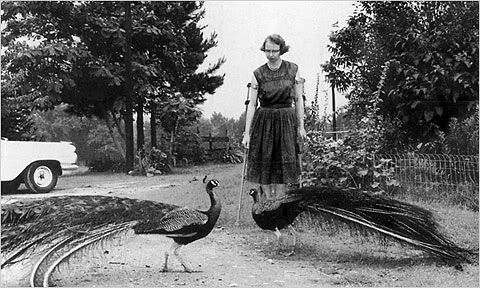
Books? Reading? Not much. Naturally I took a whole pile of books, but the only one I read was The Habit of Being: Letters of Flannery O'Connor. What a fascinating woman she is and also quite admirable. She had more reason to feel sorry for herself than most people do. She had lupus and she was also on crutches for years because of a diseased bone in her hip that they didn't seem to be able to do anything about. For the last 10 or so years of her life (she died at the age of 39) she lived with her mother on the farm in Millidgeville, Georgia. When she wasn't writing (she found that she could write only 2 or 3 hours a day), she raised peahens with the aim of selling them. She was a devout Catholic, which informed all of her work. I said she had reason to feel sorry for herself, but there isn't one ounce of self-pity in any of the letters.
She wrote many short stories during her lifetime and two novels (one took her 5 years and the second one 7--she wrote slowly, didn't have the energy to spend very much time at it per day, and was big into re-writing). The novel I want to read is The Violent Bear it Away. I also might try her short stories. There's a 1965 collection titled Everything that Rises Must Converge.
I wish I could find a photo of her dressed the way she would normally have dressed for the day on the farm. But here she is with her peacocks and crutches. She called the crutches "my aluminum legs."
218labwriter
Here's a picture I took driving home--Highway 50 near the Colorado/Kansas border. If you've never been in this part of the country, you simply can't imagine the bleakness and absolute flatness of it all. You could take a 360-degree shot of this area, and all of it would look just like this. Car radio reception was zilch at this point, so I was very glad I had my book on tape to listen to. Otherwise, it's pretty darned lonely driving through this country with no one else in the car. People in my great-grandmother's day (1920s, 1930s) traveled between these towns by train, so they weren't so islolated as they might seem. As a widow of a railroader, she had a lifetime free pass, so I imagine she spent quite a bit of her time traveling to visit her 9 children. I followed the train tracks for miles and miles.


219labwriter
Report of my books on tape.
The Woods, by Harlan Coben. I can't help but think I would have enjoyed this book more if I'd been reading it rather than listening to it. By the end of the book (actually, pretty much by about halfway), I found the narrator to be tedious and unnecessarily dramatic. He also read far too s.l.o.w.l.y. Good story; tedious narrator. Here's my review.
The Sweetness at the Bottom of the Pie, by Alan Bradley. I liked this book very much, but by the time I got to it I was burned out on books on tape (see above), and I also had radio reception, so I didn't get too far in this one. I enjoyed the narrator and also the story itself; I wish I had listened to this one first. I plan to abandon the book on tape and read the book.
The Woods, by Harlan Coben. I can't help but think I would have enjoyed this book more if I'd been reading it rather than listening to it. By the end of the book (actually, pretty much by about halfway), I found the narrator to be tedious and unnecessarily dramatic. He also read far too s.l.o.w.l.y. Good story; tedious narrator. Here's my review.
The Sweetness at the Bottom of the Pie, by Alan Bradley. I liked this book very much, but by the time I got to it I was burned out on books on tape (see above), and I also had radio reception, so I didn't get too far in this one. I enjoyed the narrator and also the story itself; I wish I had listened to this one first. I plan to abandon the book on tape and read the book.
220labwriter
A few last thoughts about my trip. I found out a good deal about my mother's paternal grandmother and her family. Obituaries from the 1920s through 1930s in small-town newspapers tend to be a gold mine for people doing genealogy. Also, a lot can be learned by going to the cemetery--who was buried with whom, who is missing, what can be inferred from the gravestones, etc.
Also, I came back determined to put some order into the crazy disorder that exists in some of the rooms in my house--like clean out all those "catch-all" drawers, get rid of clothes that I haven't worn for years, and also give to Goodwill so much of the junk that collects over the years that I simply don't care about and yet for whatever reason have hung onto. My friend Laura, along with everything else, is a hoarder. Probably the only rooms in her house that are able to be used the way they're intended are the bathrooms. I found this to be hugely disturbing, and it made me want to come home and work on my own house and get things tidy.
Lastly, I didn't gain any weight while I was gone--whoohoo!--which frankly took a lot of planning ahead and discipline, since I spent four solid days sitting in the car and also most of four days at Laura's house sitting around with her and the kids. The kids did things--like swimming--while we sat and watched. Horrible, but that was all my friend was able to do. So while I didn't lose anything, I take it as a positive that I didn't gain, and I can hardly wait to get back in the pool and back on my bike.
Also, I came back determined to put some order into the crazy disorder that exists in some of the rooms in my house--like clean out all those "catch-all" drawers, get rid of clothes that I haven't worn for years, and also give to Goodwill so much of the junk that collects over the years that I simply don't care about and yet for whatever reason have hung onto. My friend Laura, along with everything else, is a hoarder. Probably the only rooms in her house that are able to be used the way they're intended are the bathrooms. I found this to be hugely disturbing, and it made me want to come home and work on my own house and get things tidy.
Lastly, I didn't gain any weight while I was gone--whoohoo!--which frankly took a lot of planning ahead and discipline, since I spent four solid days sitting in the car and also most of four days at Laura's house sitting around with her and the kids. The kids did things--like swimming--while we sat and watched. Horrible, but that was all my friend was able to do. So while I didn't lose anything, I take it as a positive that I didn't gain, and I can hardly wait to get back in the pool and back on my bike.
221labwriter
I was just spending a few minutes reading the Flannery O'Connor correspondence before I go outside to work in my garden. I came across this--heh.
(O'Connor had just returned from a trip to the U of Notre Dame where she was invited to make a speech.) I got back by myself without assistance. I am back at work with a vengeance. Trips at least do that for me. I am so glad to get back that I go to work at once with real gusto....Bye for now--gotta get to work.
222Donna828
Ha! That's just cheating stopping for the night. You don't get the full effect of the road trip across Kansas to Denver unless you do it in one day! Actually, this is my DH channeling through me... I would love to stop at the midway point or a bit beyond when we make this road trip. I think the worst part of the trip is eastern Colorado. Great picture of that bleak landscape. Look at that blue sky. I think the Flint Hills region of eastern Kansas is lovely, and the wind farms make the central part of Kansas interesting. We flew the last time, and I must say, the fare was worth it in terms of time saved.
Glad you are home safely. I wonder if it was your DH or the dogs who were the most happy to see you. It sounds like your genealogy research went well, too.
I loved the back-and-forth banter about the Daniel Silva books. I read the first few and I've listened to a few on road trips with my hubby who is a big fan. I don't mind them, and he loves them, so that's what we listen to.
Finally, thanks for that list from Suzanne. I'll be checking out some of those authors after I get caught up in the C.J. Samson and Laurie R. King series that I've started.
Glad you are home safely. I wonder if it was your DH or the dogs who were the most happy to see you. It sounds like your genealogy research went well, too.
I loved the back-and-forth banter about the Daniel Silva books. I read the first few and I've listened to a few on road trips with my hubby who is a big fan. I don't mind them, and he loves them, so that's what we listen to.
Finally, thanks for that list from Suzanne. I'll be checking out some of those authors after I get caught up in the C.J. Samson and Laurie R. King series that I've started.
223labwriter
Hi Donna, thanks for visiting. From St. Louis it's about 14 hours to Denver, depending on how much road construction we run into on I-70. But this time I was driving by myself. When DH & I drive it together, we spell each other and drive straight through--so I know the full effect of the trip across Kansas, boy do I--ha. I have a soft spot for eastern Colorado, because my dad was born in a little farming community near Burlington. Otherwise I wouldn't be a big fan of eastern Colorado either.
224LizzieD
Glad to have you back, Becky! And glad that we don't have more of you back than left!! I think that's a real achievement. You probably worried a pound or two away in that rainstorm. Wish we could have one here.
The coastal plain of N.C. is flat, but that shot of yours is downright depressing. I find beauty in sand and swamp, so I'm glad that Donna finds it in Kansas.....reminds me of an Elinor Wilie (my favored poet in high school) poem, "Wild Peaches":
"Down to the Puritan marrow of my bones
There's something in this richness that I hate.
I love the look , austere, immaculate,
Of landscapes drawn in pearly monotones. " (It took me forever to dredge out the title, but I do like the feeling for one's own land.
The coastal plain of N.C. is flat, but that shot of yours is downright depressing. I find beauty in sand and swamp, so I'm glad that Donna finds it in Kansas.....reminds me of an Elinor Wilie (my favored poet in high school) poem, "Wild Peaches":
"Down to the Puritan marrow of my bones
There's something in this richness that I hate.
I love the look , austere, immaculate,
Of landscapes drawn in pearly monotones. " (It took me forever to dredge out the title, but I do like the feeling for one's own land.
225sibylline
Welcome home! And cheers for not gaining weight. I know exactly how hard that can be!!!!
Good luck with the cleansing project. I live with a pack rat and my tendency, toward less is more, is completely overwhelmed. In our old house in PH I had gradually gotten things down to a manageable level, but now, I'm back to square one, as I've had to try to absorb not only the stuff from our house in PH, but stuff from both my mil and my mother's house.
No one who visits me believes that I don't like being surrounded by tons of stuff - but I haven't had any choice my whole married life. One great thing in this house is that my husband's side of the bedroom is easy to ignore, and if it ever gets unbearable I could even put up a curtain!
Good luck with the cleansing project. I live with a pack rat and my tendency, toward less is more, is completely overwhelmed. In our old house in PH I had gradually gotten things down to a manageable level, but now, I'm back to square one, as I've had to try to absorb not only the stuff from our house in PH, but stuff from both my mil and my mother's house.
No one who visits me believes that I don't like being surrounded by tons of stuff - but I haven't had any choice my whole married life. One great thing in this house is that my husband's side of the bedroom is easy to ignore, and if it ever gets unbearable I could even put up a curtain!
226labwriter
Hi Peggy! Oh, that's a wonderful poem. Thanks for finding it. We didn't get any rain where I live, either. I can't figure out how it missed us. We really need some, it's so dry.
That flat, flat land is hard to take, I think, unless you grow up with it. Most people who only visit think "mountains" when they think Colorado. Much of the eastern part of the state looks just like this. The thing about Colorado I simply can't take anymore is the intense sun. The altitude and the lack of humidity combine to make the sun absolutely too intense, at least for me. That's why 90 degrees in Colorado, even without the humidity, is uncomfortably hot--the sun beats down relentlessly. I've gotten used to the haze and humidity of Missouri.
On the upside, the area around La Junta where I was and especially a town called Rocky Ford grows the best watermelons and cantaloupes of any I've ever eaten. We used to get Rocky Ford cantaloupes in the Denver stores when I was a kid. There's something about the hot, hot sun during the day and the cool nights (and maybe also the soil, I don't know) that makes the melons the sweetest ever. I bought one from a truck farmer selling them by the highway and brought it home to DH. Oh, it's just the best!
That flat, flat land is hard to take, I think, unless you grow up with it. Most people who only visit think "mountains" when they think Colorado. Much of the eastern part of the state looks just like this. The thing about Colorado I simply can't take anymore is the intense sun. The altitude and the lack of humidity combine to make the sun absolutely too intense, at least for me. That's why 90 degrees in Colorado, even without the humidity, is uncomfortably hot--the sun beats down relentlessly. I've gotten used to the haze and humidity of Missouri.
On the upside, the area around La Junta where I was and especially a town called Rocky Ford grows the best watermelons and cantaloupes of any I've ever eaten. We used to get Rocky Ford cantaloupes in the Denver stores when I was a kid. There's something about the hot, hot sun during the day and the cool nights (and maybe also the soil, I don't know) that makes the melons the sweetest ever. I bought one from a truck farmer selling them by the highway and brought it home to DH. Oh, it's just the best!
227labwriter
Hi Sib. I understand about the packrat thing. DH and I both tend in that direction. What he does is fill "a box" with stuff, and I'll bet he has about 20 such boxes stored here and there. However, what I saw with my friend was something that tips towards pathology--like maybe she has some kind of OCD component going on or something. Of course I'm no psychiatrist, but I'm pretty sure this was more than just clutter. She literally can't use her dining room to eat in, can't use her kitchen to cook in, can't use her desk to work at--you get what I mean. I find this so sad. She's a very talented pianist, and the magnificent Steinway grand piano that she's played since she was a child is in her living room piled with laundry and papers and junk. Oh woe.
228sibylline
Oh that is woeful -- I worry that would happen to my DH if I wasn't here. He wouldn 'mean' for it to happen, but it would all the same. And then you can't have anyone (including yourself) clean anything after it gets to a certain point, so it takes on (literally) a life of its own!
I've never lived anywhere seriously flat or dry. I'm sure I wouldn't last a week.
I've never lived anywhere seriously flat or dry. I'm sure I wouldn't last a week.
229phebj
Hi Becky. Welcome back! Thanks for that picture of the Colorado/Kansas border. I remember the first time I went to Colorado. The drive from the airport to Boulder was so flat in the beginning. It was not what I was expecting, which was lots of mountains.
My mother tended to be a hoarder. She just couldn't throw anything away and it got really bad when she got Alzheimer's. It was a major effort to go through all her things when we moved my parents out to Arizona. By the end, we just gave up and started throwing things out without looking at them.
My husband and I were amazed at how much stuff we threw out when we moved from NY to Idaho 4 years ago. At least two huge dumpster's worth. We lived in our house in NY for 18 years and just kept putting things in the basement over the years when we didn't know what to do with things. My husband luckily can be merciless when it comes to getting rid of things. It balances out my tendency to want to keep things "just in case."
My mother tended to be a hoarder. She just couldn't throw anything away and it got really bad when she got Alzheimer's. It was a major effort to go through all her things when we moved my parents out to Arizona. By the end, we just gave up and started throwing things out without looking at them.
My husband and I were amazed at how much stuff we threw out when we moved from NY to Idaho 4 years ago. At least two huge dumpster's worth. We lived in our house in NY for 18 years and just kept putting things in the basement over the years when we didn't know what to do with things. My husband luckily can be merciless when it comes to getting rid of things. It balances out my tendency to want to keep things "just in case."
230labwriter
Hi Pat & Sib. Oh Pat, isn't that so true--"stuff" just accumulates, or at least it does in my house. About 10 years ago, after taking many loads to Goodwill, we rented a dumpster and filled it up with junk that had accumulated from 15 years of living in the same house. I need to do that again. My closets are packed with things I haven't worn in years. Now if I had a big attic, I can see myself hanging onto old clothes. However, the reality is that I could really use the closet space, if for nothing more than just "space." I don't like to put on garage sales, but that doesn't keep me from giving the stuff away. Time to get at it.
Well, Sib, you grow where you're planted, if you know what I mean. A flat and dry landscape was my reality for the first 20 years of my life. But I do think it's a landscape that is easier to live in if you're born to it. Imagine those women who traveled from the East to the Western frontier. There's a wonderful book, Pioneer Women: Voices from the Kansas Frontier, by Joanna L. Stratton, made up of letters and diaries of women who made the treck from East to West. My g-grandmother moved by wagon train with seven children (and another one on the way) from a farm in Kansas to La Junta, Colorado, in 1893. It took them a month, according to the account left by her daughter who was a little girl when she made the trip with the family. Tough people, that's for sure.
Well, Sib, you grow where you're planted, if you know what I mean. A flat and dry landscape was my reality for the first 20 years of my life. But I do think it's a landscape that is easier to live in if you're born to it. Imagine those women who traveled from the East to the Western frontier. There's a wonderful book, Pioneer Women: Voices from the Kansas Frontier, by Joanna L. Stratton, made up of letters and diaries of women who made the treck from East to West. My g-grandmother moved by wagon train with seven children (and another one on the way) from a farm in Kansas to La Junta, Colorado, in 1893. It took them a month, according to the account left by her daughter who was a little girl when she made the trip with the family. Tough people, that's for sure.
231labwriter
Oh, and how could I forget. The stars that you can see from the "middle of nowhere" in Kansas or eastern Colorado are not to be believed! Star-gazing itself is worth the trip. Seriously.
232LizzieD
I believe you. My husband's favorite professor moved here because of the sky........
I am a pack rat married to a pack rat, both of us coming from great lines of pack rats. I should let him throw away my stuff and vice versa, but divorces have been built on less than that. I think I've said: we live on the top layer of his dead sister's stuff, his parents' stuff, and his grandmother's stuff. I have told our nieces that when we're both dead, they should go through the place quickly once and then torch it. (We do have an attic. There are a lot of books up there!)
I am a pack rat married to a pack rat, both of us coming from great lines of pack rats. I should let him throw away my stuff and vice versa, but divorces have been built on less than that. I think I've said: we live on the top layer of his dead sister's stuff, his parents' stuff, and his grandmother's stuff. I have told our nieces that when we're both dead, they should go through the place quickly once and then torch it. (We do have an attic. There are a lot of books up there!)
233labwriter
Peggy--what a great line--we live on the top layer of his dead sister's stuff... I think if I had an attic, I would be doomed--heh.
234sjmccreary
Glad to have you back safe and sound, Becky. I love the picture from the KS-CO border. I've been there many times but never fail to notice just how desolate it is. I grew up in S Kansas which isn't quite as flat and dry as E Colorado, but I still find myself feeling more comfortable in that landscape than one with lots of trees and water. I felt nearly claustrophobic last year driving up Michigan's lower peninsula with so many tall trees so close upon each other and the road. The sunshine barely reached the ground. Missouri is a pretty good compromise, I think.
My husband and I both tend to clutter, as well. Plus we bring out the worst in each other, so that when I am ready for a purge, he is hedging by telling me how we might need that someday, and visa versa. With 4 kids to launch, we never got rid of a single stick of furniture or set of dishes. They just piled up in the basement. I was pretty upset after getting 3 of them moved out only to have them all back in again last winter. Nothing approaching a serious condition of hoarding, though. Have you seen that show on - hmm - Lifetime network, I think, where they go into the homes of hoarders and try to get them to clean their stuff out. Some of those places were disgusting, and the stories of those families were pitifully sad.
My husband and I both tend to clutter, as well. Plus we bring out the worst in each other, so that when I am ready for a purge, he is hedging by telling me how we might need that someday, and visa versa. With 4 kids to launch, we never got rid of a single stick of furniture or set of dishes. They just piled up in the basement. I was pretty upset after getting 3 of them moved out only to have them all back in again last winter. Nothing approaching a serious condition of hoarding, though. Have you seen that show on - hmm - Lifetime network, I think, where they go into the homes of hoarders and try to get them to clean their stuff out. Some of those places were disgusting, and the stories of those families were pitifully sad.
235alcottacre
Glad you are back home safe and sound, Becky! I hope you get some rest after your travels.
236sibylline
I have heard of the hoarding program but since we don't have teev I haven't seen it -- but it does sound pathological. Interesting to ponder is when does a 'tendency' or a 'penchant' or whatever polite word we want to use become a problem.
Neither my mil nor my mother were hoarders and yet it was unbelievable undoing their houses -- and I can relate to what happened, Pat, with your ma's house - Towards the end when my ma had had a lot of these mini-strokes she would buy a bottle of sherry EVERY TIME she left the house, some remnant of the 'just in case people stop in' mind set. My brother and I must have poured twenty bottles of mid-grade to bad sherry down the kitchen sink. She wasn't a huge drinker or anything but in her time she had always been a sociable and welcoming person, always had enough of everything to make everyone happy. She also had bought (I am not kidding) about 50 bags of cough drops and hid them everywhere.
OK tmi -- off I go.
Neither my mil nor my mother were hoarders and yet it was unbelievable undoing their houses -- and I can relate to what happened, Pat, with your ma's house - Towards the end when my ma had had a lot of these mini-strokes she would buy a bottle of sherry EVERY TIME she left the house, some remnant of the 'just in case people stop in' mind set. My brother and I must have poured twenty bottles of mid-grade to bad sherry down the kitchen sink. She wasn't a huge drinker or anything but in her time she had always been a sociable and welcoming person, always had enough of everything to make everyone happy. She also had bought (I am not kidding) about 50 bags of cough drops and hid them everywhere.
OK tmi -- off I go.
237labwriter
Hi Sandy & Sib. And thanks, Stasia. Sandy, I know exactly what you're saying about the claustrophobia of other places. When I moved to Missouri from Denver, it wasn't the mountains that I missed the most, although I missed them a lot. What I really missed was being able to see the horizon. Annie Proulx is originally from the East, and she talks in a Paris Review interview about about her Wyoming home and being able to see that long sightline:
Sib, my mother told all of us FOR TWENTY YEARS that she was cleaning out her house "so you kids won't have to do it." After many falls and broken bones around her house, she moved into an independent living facility. When my brother sold her house, although she kept everything in perfect shape (she loved "housework" above all else, I think), he found "stuff" packed absolutely everywhere. It was clear that while she wanted to get rid of things, she never really did. I need to work on my own issues about hanging onto things, for real. That's going to be the fall/winter major project around here, I do believe.
Sandy, where did you grow up? My mom is from Hutchinson. My great-aunt (her aunt) is from Newton. We used to visit there when I was a kid.
Added: The way I wrote it, it sounds like my mother's broken bones were scattered around the house. Heh.
once you’ve gotten used to wide plains and long sightlines, it’s annoying to have everything folded in on you. Boxlike shrubbery and cloistering trees. Clawing, leafy, shade-producing, sight-obliterating things that are everywhere. It makes me uneasy.I know exactly what she means, although after 20+ years in Missouri, I am getting to the point where I enjoy the trees.
Sib, my mother told all of us FOR TWENTY YEARS that she was cleaning out her house "so you kids won't have to do it." After many falls and broken bones around her house, she moved into an independent living facility. When my brother sold her house, although she kept everything in perfect shape (she loved "housework" above all else, I think), he found "stuff" packed absolutely everywhere. It was clear that while she wanted to get rid of things, she never really did. I need to work on my own issues about hanging onto things, for real. That's going to be the fall/winter major project around here, I do believe.
Sandy, where did you grow up? My mom is from Hutchinson. My great-aunt (her aunt) is from Newton. We used to visit there when I was a kid.
Added: The way I wrote it, it sounds like my mother's broken bones were scattered around the house. Heh.
238labwriter
Anywho, just want to report that I'm doing almost no reading now. The horrible brain-boiling heat has lifted here and we're into the 80s, which means that I can work outside in my poor neglected gardens. Bye for now.
240ffortsa
i have to add my stories to the hoarding discussion. When we moved my mother to a senior residence, it was incredible how much stuff she had in the small townhouse. We had a good laugh over the suitcase full of single socks (just in case the dryer returned a few), and a good cry over some things.
But what surprised me was dismantling my late father's office. He always campaigned to throw things way, was grumpy when my mother kept things she didn't need, and in general was very neat. BUT - I found checkbooks of blank checks from bank accounts closed 30 years before, every imaginable kind of stationary item that he no longer needed once he got a computer, out of date software he'd long ago replaced, and, in general, stuff tucked in every available corner, most of which we tossed. It was a bit of a shock to see what he felt he had to hold on to.
I'm something of a 'keeper', myself, which is why I have a rented storage unit to hold those 'things I might need' in addition to out of season clothes and tax returns and 6 years of New Yorker issues. But I like the shelves and closets in my home to be neat. Jim is more overtly messy: he, like my sister, seems to like to see things out, where I like to tuck them in a drawer or closet or box.
I'm campaigning to let go of more of my old books - after all, it's reading them, not capturing them, that's important, and I'd like more wall space - but it's slow going. And I have all the family photos in a section of my closet. If I ever send them to be scanned, I can get the space back, which we could really use.
But what surprised me was dismantling my late father's office. He always campaigned to throw things way, was grumpy when my mother kept things she didn't need, and in general was very neat. BUT - I found checkbooks of blank checks from bank accounts closed 30 years before, every imaginable kind of stationary item that he no longer needed once he got a computer, out of date software he'd long ago replaced, and, in general, stuff tucked in every available corner, most of which we tossed. It was a bit of a shock to see what he felt he had to hold on to.
I'm something of a 'keeper', myself, which is why I have a rented storage unit to hold those 'things I might need' in addition to out of season clothes and tax returns and 6 years of New Yorker issues. But I like the shelves and closets in my home to be neat. Jim is more overtly messy: he, like my sister, seems to like to see things out, where I like to tuck them in a drawer or closet or box.
I'm campaigning to let go of more of my old books - after all, it's reading them, not capturing them, that's important, and I'd like more wall space - but it's slow going. And I have all the family photos in a section of my closet. If I ever send them to be scanned, I can get the space back, which we could really use.
241sibylline
Interesting about the bank stuff and stationery -- I think we all have blind spots.... and I love the suitcase full of singleton socks. I would just really really really like to know where all those socks go. It is the best argument for alternate universes that I know of.
I'm fairly sure my desk is full of paper items I'll never use.... sigh. Although I am keeping a small amount of carbon paper as a historical document...... But I did throw out all those kinds of bank things when we left PH last year -- we actually hired one of those shredding trucks for 1/2 hour (it really only took fifteen minutes, which was a bit anticlimactic) to dump our old stuff and the mil's stuff in. Even so, it was a staggering amount of paper!
I'm fairly sure my desk is full of paper items I'll never use.... sigh. Although I am keeping a small amount of carbon paper as a historical document...... But I did throw out all those kinds of bank things when we left PH last year -- we actually hired one of those shredding trucks for 1/2 hour (it really only took fifteen minutes, which was a bit anticlimactic) to dump our old stuff and the mil's stuff in. Even so, it was a staggering amount of paper!
242ffortsa
I remember when my sister was moving from State College, and had tons of paper to dispose of. She was in some despair, since certain noises, like those a shredder makes, are intolerable to her. So I suggested just what you did (she thought I was a genius) and her 27 boxes of unwanted papers were shredded in no time, preserving her tender ears.
243labwriter
I love the idea of the shredding truck. That's what it's going to take, I believe, to relieve this house of some of the clutter. And Judy, like you, I think I'm about ready to let go of some of the books I have on my shelves. I never thought I'd say that, but I'm at least working in that direction.
I'm doing about zero-minus reading these days, since I'm working on a writing project. My one book right now is still Letters of Flannery O'Connor, ed. by Sally Fitzgerald. FO is definitely a person worth hanging around with.
I'm doing about zero-minus reading these days, since I'm working on a writing project. My one book right now is still Letters of Flannery O'Connor, ed. by Sally Fitzgerald. FO is definitely a person worth hanging around with.
I lectured at Wesleyan College in Macon last year and as a result some of their students who have a vague urge to "express themselves" began to come regularly to see me. When they appear, they do all the talking and they have fantastic but very positive ideas about how everything is and ought to be; and they are mighty sophisticated on the outside. The visits leave me exhausted and yearning to go sit with the chickens.
245labwriter
It's looking as though I'm going to need a new thread soon, so in the interest of doing this before rather than after it needs to be done, here is my new thread.
246LizzieD
I have never, ever, been so exhausted that I thought of sitting with chickens as a relief! Ms. O'C definitely didn't know the chickens that I have known!!!!!!!
247labwriter
That's hilarious, Peggy. She also cultivated peacocks (peahens) which I can only imagine made the most annoying racket. For some reason she seems to have had a high tolerance for such things. I remember being around one peacock somewhere, and the noise of that thing made me want to run screaming down the road. And she had 20 or 30 of them. Strange!

