
Cosmographie de peterkein
Talk Le Salon Littéraire du Peuple pour le Peuple
Join LibraryThing to post.
This topic is currently marked as "dormant"—the last message is more than 90 days old. You can revive it by posting a reply.
1PeterKein
Wherein by nods and winks, hints and intimations - a fuller picture emerges.
Brazenhead Books
http://www.youtube.com/watch?v=TftrFONX5qU
punk as f%$K
Brazenhead Books
http://www.youtube.com/watch?v=TftrFONX5qU
punk as f%$K
2copyedit52
Good start, Peter.
4absurdeist
I don't have sound where I'm at presently, so I didn't catch where the bookshop is located. It's beautiful.
5PeterKein
Before the end of today, might most beneficially start at the beginning -
Schediasma de Bibliotheca Adami
And oh, in a similar vein,
The Invisible Library
Discussion/reference to Calvino, Borges and Lem can rightfully enter the discussion
Schediasma de Bibliotheca Adami
And oh, in a similar vein,
The Invisible Library
Discussion/reference to Calvino, Borges and Lem can rightfully enter the discussion
6slickdpdx
In Darconville's Cat there is a chapter that is a list of works that are misogynist in reality or by reputation that I think was rattled off by Crucifer. (His library? I don't recall.) In addition to many tangible works, there are a few less tangible.
Nazi Literature in the Americas.
Nazi Literature in the Americas.
7QuentinTom
oh fantastic! I love the invisible library: spurious books! totally my thing.
Where's Choco, someone tell her.
http://thelectern.blogspot.com/2009/07/fragment-4709.html
Where's Choco, someone tell her.
http://thelectern.blogspot.com/2009/07/fragment-4709.html
8PeterKein
#7, The good professor Faraway may be interested in learning of a text titled 'The Natural Science of Stupidity' written in what I believe was the pubertal ascension of the Age of Stupidity - tracing what may be considered the indirect, or instead fundamental, 'seeds' in the former Ages of Enlightenment and Reason.
Edwin Carpenter has a nice article on imaginary libraries titled 'Some Libraries We Have Not Visited' in which he makes reference to the fictitious Library of St. Victor as outlined in Gargantua and Pantagruel which he identifies to the best of his knowledge as the first imaginary library.
The library is dissected by Paul Lacroix in his Catalogue de la bibliothèque de l'abbaye de Saint-Victor au seizième seècle, rédigé par François Rabelais / commenté par le bibliophile Jacob (pseud.) ; et suivi d'un Essai sur les bibliothèques imaginaires, par Gustave Brunet.
Edwin Carpenter has a nice article on imaginary libraries titled 'Some Libraries We Have Not Visited' in which he makes reference to the fictitious Library of St. Victor as outlined in Gargantua and Pantagruel which he identifies to the best of his knowledge as the first imaginary library.
The library is dissected by Paul Lacroix in his Catalogue de la bibliothèque de l'abbaye de Saint-Victor au seizième seècle, rédigé par François Rabelais / commenté par le bibliophile Jacob (pseud.) ; et suivi d'un Essai sur les bibliothèques imaginaires, par Gustave Brunet.
9QuentinTom
ah yes, Professor Faraway. Yes, I think the Library of St Victor is the earliest. Don't forget the imaginary library in The Name of the Rose as well. Thanks for the headsup on Lacroix and Carpenter. Lots to follow up on there.
11Poquette
Probably too pedestrian for this crowd, but the Book of the Nine Doors of the Kingdom of Shadows (De Umbrarum Regni Novem Portis) printed in 1666 by Aristide Torchia, complete with illustrations, and Baroness Ungern's Naked Isis from Arturo Pérez-Reverte's The Club Dumas are tantalizingly missing from the Invisible Library — unless I failed to find them.
12absurdeist
Cousin of The Invisible Library, are phony books that sell millions of copies.
13ChocolateMuse
Been meaning to say - all this is awesome.
14PeterKein
A must read is Walter Blumenthal's delightful piece titled Imaginary Books and Phantom Libraries.
A few tidbits from that article include (with links):
A Unique Collection by Coggeshall Macy where we are told "All the books on this wall are reputed lost" We find copies of Pepy's 'Love a Cheate' as well as some canti, of a divine work, written in Latin before being jettisoned by the author in favor of his more familiar vernacular. On another shelf.. "These are the books not written themselves, but written about in other books".
In a similar vein, is The Sigismund Inheritance where the death of a rival book collector and the opportunity of a grand acquisition (including the first book, Leyden, 1405, "published long before (the first) Gutenberg", of which he also has a copy) by one M. Guillemard is derailed from beyond the grave.
Another well-worn tradition is the bibliographic catalog of not-quite-as-real-in-the-sense-you-might-be-thunkin' books.
Thomas Browne's Bibliotheca Abscondita
Gustave Brunet's Fantasies Bibliographiques
A few tidbits from that article include (with links):
A Unique Collection by Coggeshall Macy where we are told "All the books on this wall are reputed lost" We find copies of Pepy's 'Love a Cheate' as well as some canti, of a divine work, written in Latin before being jettisoned by the author in favor of his more familiar vernacular. On another shelf.. "These are the books not written themselves, but written about in other books".
In a similar vein, is The Sigismund Inheritance where the death of a rival book collector and the opportunity of a grand acquisition (including the first book, Leyden, 1405, "published long before (the first) Gutenberg", of which he also has a copy) by one M. Guillemard is derailed from beyond the grave.
Another well-worn tradition is the bibliographic catalog of not-quite-as-real-in-the-sense-you-might-be-thunkin' books.
Thomas Browne's Bibliotheca Abscondita
Gustave Brunet's Fantasies Bibliographiques
15QuentinTom
I had not realised the extent to which unreal books and libraries formed a discrete genre.
you are a mine of arcane and extraordinary information. Thank you for this!
you are a mine of arcane and extraordinary information. Thank you for this!
16PeterKein
Truthfully, the power of internet searches, library catalogs and tagging allows an intellectual pauper to hide behind those with deep learning viz. I came to 'know of' but do not fully 'know' the material in these works. If this fascinates you, then you really need to track down the Blumenthal article.
I put here a few pages I stumbled across as I looked for an online version of Blumenthal to no avail (Google translation.. I praise thee.... )
Bibliofilia dell'assurdo
GLI PSEUDOBIBLIA
CATALOGHI DI LIBRI IMMAGINARI
I put here a few pages I stumbled across as I looked for an online version of Blumenthal to no avail (Google translation.. I praise thee.... )
Bibliofilia dell'assurdo
GLI PSEUDOBIBLIA
CATALOGHI DI LIBRI IMMAGINARI
17Porius
We have mistook you all this while.
http://www.youtube.com/watch?v=YWyCCJ6B2WE
No sweat PK we all have a bit of the mountebank in us, don't we?
http://www.youtube.com/watch?v=YWyCCJ6B2WE
No sweat PK we all have a bit of the mountebank in us, don't we?
18PeterKein
Ah, well to the extent that the flames and smoke have meaning, then the man behind the curtain - in bringing them to light - is essential, no? The power here is not found within the secret but within the ability...
In a post-informational world, where everything exists as bits of potential information, will "having knowledge" be indistinguishable from "being able to access knowledge"? (N.B. I distinguish knowledge from wisdom considerably but, alas, refuse to define either). Where does the human fit into all of this? (no fear, it would seem at least one (maybe two, at max) would have to be kept around ensure that 'meaning' has meaning).
I don't know what all of this means, as it was my keyboard typing not me - but I do know (I, not my keyboard) that linking to Chapter 14 'In the Library of Form' of Kevin Kelly's book 'Out of Control' will end this necessarily incomplete exposition of books lost or imagined by asking - In the Borgean Library where all books exist (as Possibility until picked off the shelf), where is the necessary demarcation on the other side of which exists the 'imaginary'?
****************************************************************************
In a post-informational world, where everything exists as bits of potential information, will "having knowledge" be indistinguishable from "being able to access knowledge"? (N.B. I distinguish knowledge from wisdom considerably but, alas, refuse to define either). Where does the human fit into all of this? (no fear, it would seem at least one (maybe two, at max) would have to be kept around ensure that 'meaning' has meaning).
I don't know what all of this means, as it was my keyboard typing not me - but I do know (I, not my keyboard) that linking to Chapter 14 'In the Library of Form' of Kevin Kelly's book 'Out of Control' will end this necessarily incomplete exposition of books lost or imagined by asking - In the Borgean Library where all books exist (as Possibility until picked off the shelf), where is the necessary demarcation on the other side of which exists the 'imaginary'?
****************************************************************************
19Porius
Would you expand on that first sentence PK. Abilities without secrets. What was Peter Hurkos's ability, his secret for that matter. Did the rung give away? Did the ladder slip on a banana peel?What?
20PeterKein
Well I was tying it into the Wiz - the simple analysis is that any power he had came from the deception/secrecy involved in residing behind the curtain. (Although another way to consider it is that his real power came from giving people what they wanted- if the smoke, fire and flashing lights was meaningful enough to the tin man and his ilk then the Wiz wouldn't have been pronounced a humbug). In the present case however, where or how the material was unearthed matters little since here the smoke, fire and lights (i.e. the materials themselves) was the focus of meaning- rather than me- the purported montebank, aka the man behind the curtain aka the real slimshady.
But on a completely different scale - the metaphor works like this
We are all (wo)men behind the curtain - busily manipulating symbols in building meaningful interpretations that violently play out on the stage of reality and not without a bit of charlatanry. It works best when everyone is busy pulling levers. But, once you catch a glimpse of what exactly is being done by all of us...
oof.
But on a completely different scale - the metaphor works like this
We are all (wo)men behind the curtain - busily manipulating symbols in building meaningful interpretations that violently play out on the stage of reality and not without a bit of charlatanry. It works best when everyone is busy pulling levers. But, once you catch a glimpse of what exactly is being done by all of us...
oof.
21QuentinTom
...and the Veil of Maya is rent.
Nice picture. Schwitters?
Nice picture. Schwitters?
22PeterKein
indeed. Actually, it is from this univers font study by the talented Rachel Galindo
univers/universe each pierced and crumble?

univers/universe each pierced and crumble?

24PeterKein
#23 I am too dense to identify the implication .. however in general the 'man at his desk' is certainly a rich theme in the history of arts and letters, no? Arching way back at least to images of the medieval scriptorium...
Calamus tribus digitis continetur, totum corpus laborat.
(Three fingers hold the pen, but the whole body toils.)
Calamus tribus digitis continetur, totum corpus laborat.
(Three fingers hold the pen, but the whole body toils.)

26QuentinTom
the package's function is not to protect in space, but to postpone in time...to find the object which is in the package or the signified which is in the sign is to discard it....
Roland Barthes
Empire of Signs
Roland Barthes
Empire of Signs
27PeterKein
nice. With Origata- the package as sign, does more than signify the object within. It is in this way that it is elevated to Art. I do wish there was more available on it - origata more so than origami which is rather ubiquitous. I do have Gift Wrapping: Creative Ideas from Japan.
28PeterKein
Hut of the Phantom Dwelling
...to be rid of the "detritus of my bourgeois lifestyle" (Ken Gordon)
As a clock strikes midnight, well, on with the unmasking, as Kierkegaard says. I am an academic who has come to disdain much of what is (and probably always was) the Academy.
"In omnibus requiem quaesivi, et nusquam inveni nisi in angulo cum libro" (attrib. Thomas a Kempis)
and while separated by space and time, not sentiment...
"Reading is not a disabling affliction. I have done what people do, my life makes a reasonable showing. Can I go back to my books now?" (Lynne Sharon Schwartz).
Where I turn, there I have to resist what has become the dominant epistemology of the western, if not the entire, world - analytic, dualistic and mechanistic- bound to Heidegger's 'calculative thinking' viz.
"(Calculative thinking's) peculiarity consists in the fact that whenever we plan, research, and organize, we always reckon with conditions that are given. We take them into account with the calculated intention of their serving specific purposes. Thus we can count on definite results. This calculation is the mark of all thinking that plans and investigates. Such thinking remains calculation even if it neither works with numbers nor uses an adding machine or computer. Calculative thinking computes. It computes ever new, ever more promising and at the same time more economical possibilities. Calculative thinking races from one prospect to the next. Calculative thinking never stops, never collects itself. Calculative thinking is not meditative thinking, not thinking which contemplates the meaning which reigns in everything that is."
All this as prolegomena to the next entry in my cosmographie- my fascination with the simple hermitic hut, and the life of contemplatives of all types.
...to be rid of the "detritus of my bourgeois lifestyle" (Ken Gordon)
As a clock strikes midnight, well, on with the unmasking, as Kierkegaard says. I am an academic who has come to disdain much of what is (and probably always was) the Academy.
"In omnibus requiem quaesivi, et nusquam inveni nisi in angulo cum libro" (attrib. Thomas a Kempis)
and while separated by space and time, not sentiment...
"Reading is not a disabling affliction. I have done what people do, my life makes a reasonable showing. Can I go back to my books now?" (Lynne Sharon Schwartz).
Where I turn, there I have to resist what has become the dominant epistemology of the western, if not the entire, world - analytic, dualistic and mechanistic- bound to Heidegger's 'calculative thinking' viz.
"(Calculative thinking's) peculiarity consists in the fact that whenever we plan, research, and organize, we always reckon with conditions that are given. We take them into account with the calculated intention of their serving specific purposes. Thus we can count on definite results. This calculation is the mark of all thinking that plans and investigates. Such thinking remains calculation even if it neither works with numbers nor uses an adding machine or computer. Calculative thinking computes. It computes ever new, ever more promising and at the same time more economical possibilities. Calculative thinking races from one prospect to the next. Calculative thinking never stops, never collects itself. Calculative thinking is not meditative thinking, not thinking which contemplates the meaning which reigns in everything that is."
All this as prolegomena to the next entry in my cosmographie- my fascination with the simple hermitic hut, and the life of contemplatives of all types.
29absurdeist
The hermetic hut ... the life of contemplatives of all types.
More please ...
More please ...
30QuentinTom
yes, eagerly awaiting more, and I absolutely agree with the piece on calculative thinking, although it's very Western. Eastern thought is quite different, as you know (I've been browsing your Buddhist books). At least here, in my situation, I can say that even calculative thinking is better than no thinking at all.....
31PeterKein
alas this is going to have to wait a bit, NEH deadline that I will most likely miss, but for now I plan on submitting.
32PeterKein
I find myself irritable at language today. So, I will treat it severely.
Contemplative Psychology by Han F. de Wit in a world with more books than readers, both brilliant and necessary.
Four Huts - brings together some of the classic eremetic tales of the East.
Stephen Tobin's photography in The Cistercians is mesmerizing.
Heidegger's Hut may be of interest to some.
In terms of pure information, there is no reason for me to write more, given http://www.hermitary.com/
Contemplative Psychology by Han F. de Wit in a world with more books than readers, both brilliant and necessary.
Four Huts - brings together some of the classic eremetic tales of the East.
Stephen Tobin's photography in The Cistercians is mesmerizing.
Heidegger's Hut may be of interest to some.
In terms of pure information, there is no reason for me to write more, given http://www.hermitary.com/
33PeterKein
And I will add, before disappearing for awhile in a puff of smoke...
Only in a hut built for the moment can one live without fears
- Kamo no Chomei
Only in a hut built for the moment can one live without fears
- Kamo no Chomei
34Macumbeira
There is a fantastic book about anchorites or hermits in French : "Les hommes ivres de dieu" ( men intoxicated by god ) by Jacques Lacarriere. It is a fascinating study of the first hermits living in Egypt and Palestina in 200 BC. A sure recommendation!
35anna_in_pdx
33 - how very, very true.

38theaelizabet
>37 zenomax: What Zeno said.
39QuentinTom
what they said.
40Macumbeira
and how they said it..
42PeterKein
Thank you for the kind words, all. A new colleague of mine did her doctorate work on monastic architecture .. I hope to have some interesting tidbits to share.
On another note, I have found this to be interesting... as I sat here entering some new codes- the obvious question finally did rise....
http://www.isbn.org/standards/home/isbn/international/html/usm4.htm
On another note, I have found this to be interesting... as I sat here entering some new codes- the obvious question finally did rise....
http://www.isbn.org/standards/home/isbn/international/html/usm4.htm

44Macumbeira
Wow , love it
45slickdpdx
42: Thanks for that link. I've pondered it many times but not ever taken the trouble of looking it up.
46QuentinTom
fantastic.
49absurdeist
43> Peter, would you happen to be familiar at all with William H. Gass' Willie Master's Lonesome Wife? What he does in that very slim novella doesn't quite match the originality of what you've posted here, but there's certainly the germ of the idea present. Just curious, and looking to spread my love for Gass around.
50PeterKein
>49 absurdeist: I am not- I have not read any of WHG although I do have In the Heart of the Heart of the Country in a re-purposed address book which I carry with me to used bookstores as I have learned not to rely on my memory alone -- to which I will now add Willie as it looks quite interesting.
51PeterKein
Thesauri often do not get close to synonymy! I rail at my students sometimes- at myself other times (the only thing I find worse than sentences constructed by thesaurus is sentences constructed by Human Resources departments).
Anyhow - the (Google books fulltext link) Introductory Matter to Webster's Dictionary of Synonyms is in itself a wonderful introduction to the history and approach to synonymy. If you like words, and if you like how shadows of words mingle with one another- that is, if you can read a dictionary for fun, then I would urge you to read it. And, if you do not own a copy- then find one (I have to admit to buying stray copies I find cheaply- because I cannot bear to seem them languish).
Older, but with its own flavor is (also googlebooks) Crabb's English Synonymes which is discussed at length in the Introductory matter above.
Anyhow - the (Google books fulltext link) Introductory Matter to Webster's Dictionary of Synonyms is in itself a wonderful introduction to the history and approach to synonymy. If you like words, and if you like how shadows of words mingle with one another- that is, if you can read a dictionary for fun, then I would urge you to read it. And, if you do not own a copy- then find one (I have to admit to buying stray copies I find cheaply- because I cannot bear to seem them languish).
Older, but with its own flavor is (also googlebooks) Crabb's English Synonymes which is discussed at length in the Introductory matter above.
52PeterKein
and, if that has tickled your logophilia - then perhaps I can interest you in David Foster Wallace's essay (which I know as 'Authority and American Usage' but which seems to have gone under the title "Democracy, English and the Wars over Usage" - which on the pretext of reviewing Garner's Dictionary of Modern Usage along with some other language texts, ranges widely on the descriptive vs. prescriptive approaches to grammar and much else. In the end, I am not convinced- and perhaps Murr and others would be interested in reading and comparing notes.
Can be had here
http://www.harpers.org/media/pdf/dfw/HarpersMagazine-2001-04-0070913.pdf
Can be had here
http://www.harpers.org/media/pdf/dfw/HarpersMagazine-2001-04-0070913.pdf
53QuentinTom
>52 PeterKein: Brilliant. I've been hunting for this for ages. P, give me a couple of days to read it, and then we can talk about it.
55baswood
#51 (The only thing I find worse than sentences constructed by thesaurus is sentences constructed by Human Resource Departments} don't you mean lawyers or accountancy departments.
56Poquette
What a delight to see Bryan Garner's Dictionary of Modern American Usage highlighted. That book has been on my list of favorite reference books since I first got hold of it soon after publication. Thanks for the link!
59MeditationesMartini
>55 baswood: probably we can all agree to a ban on any sentence composed by a department.
61PeterKein
I have been working (and stumbling) upon various projects that somehow have brought me to linear vs. circular representations of time. Two interesting results - one for daily planning and one for daily living:
http://b.aking.ca/post/5787137408/the-daily-rind?2c8fa180
(see also http://www.mpdailyfix.com/circle-of-time-planner/ http://scription.typepad.com/blog/2011/11/scription-chronodex-weekly-planner-201... and http://www.chrononotebook.com/ for other examples.)
An embodied chrononotebook
http://www.designboom.com/weblog/cat/9/view/12302/suriya-umpansiriratana-monk-ce...
http://b.aking.ca/post/5787137408/the-daily-rind?2c8fa180
(see also http://www.mpdailyfix.com/circle-of-time-planner/ http://scription.typepad.com/blog/2011/11/scription-chronodex-weekly-planner-201... and http://www.chrononotebook.com/ for other examples.)
An embodied chrononotebook
http://www.designboom.com/weblog/cat/9/view/12302/suriya-umpansiriratana-monk-ce...
62slickdpdx
Shouldn't these things be more like a pac man given that most of us will be doing things between, say 6 a.m. and midnight? I would assign 12am to 6 a.m or whatever to a tiny slice of 5 degrees or so and save the rest of the circle for planning - but it wouldn't match up to a clock face. Why should it match up to a clock face anyhow? Seems like the kind of rigid thinking that ruled planners embody!
63QuentinTom
good to see you back Peter. Interesting stuff as always.
65PeterKein
>62 slickdpdx: They don't seem to run from 12a to 12p- but instead some sliver of that time. Even the 'clockface' since the 6 would presumably represent 6 am and then runs around to 5 pm. (Although,yes the scription example is a bit overspecified for me-(scription is a great site in general).)
But these are simply examples of my general interest - how space can be used to represent time (in this case cyclic)- timepieces as the most common example, the daily planners less common, and the 'monk cell project' uncommon. (Monastic architecture would seem to be a rich vein to mine questions of time.)
63/64> I have been around intermittently but without a whole lot to say -
But these are simply examples of my general interest - how space can be used to represent time (in this case cyclic)- timepieces as the most common example, the daily planners less common, and the 'monk cell project' uncommon. (Monastic architecture would seem to be a rich vein to mine questions of time.)
63/64> I have been around intermittently but without a whole lot to say -
66Poquette
I love the monk's cell project. Just imagine the walls decorated with full-length images of tarot cards – major arcana only, of course. Wow, one could complete the entire hero's journey many times a day. Ah, the accompanying feeling of enlightenment! Heck! Who needs to build one. Just imagining it is thrill enough!
67PeterKein
Piranesi's Prisons (Carceri d’Invenzione)
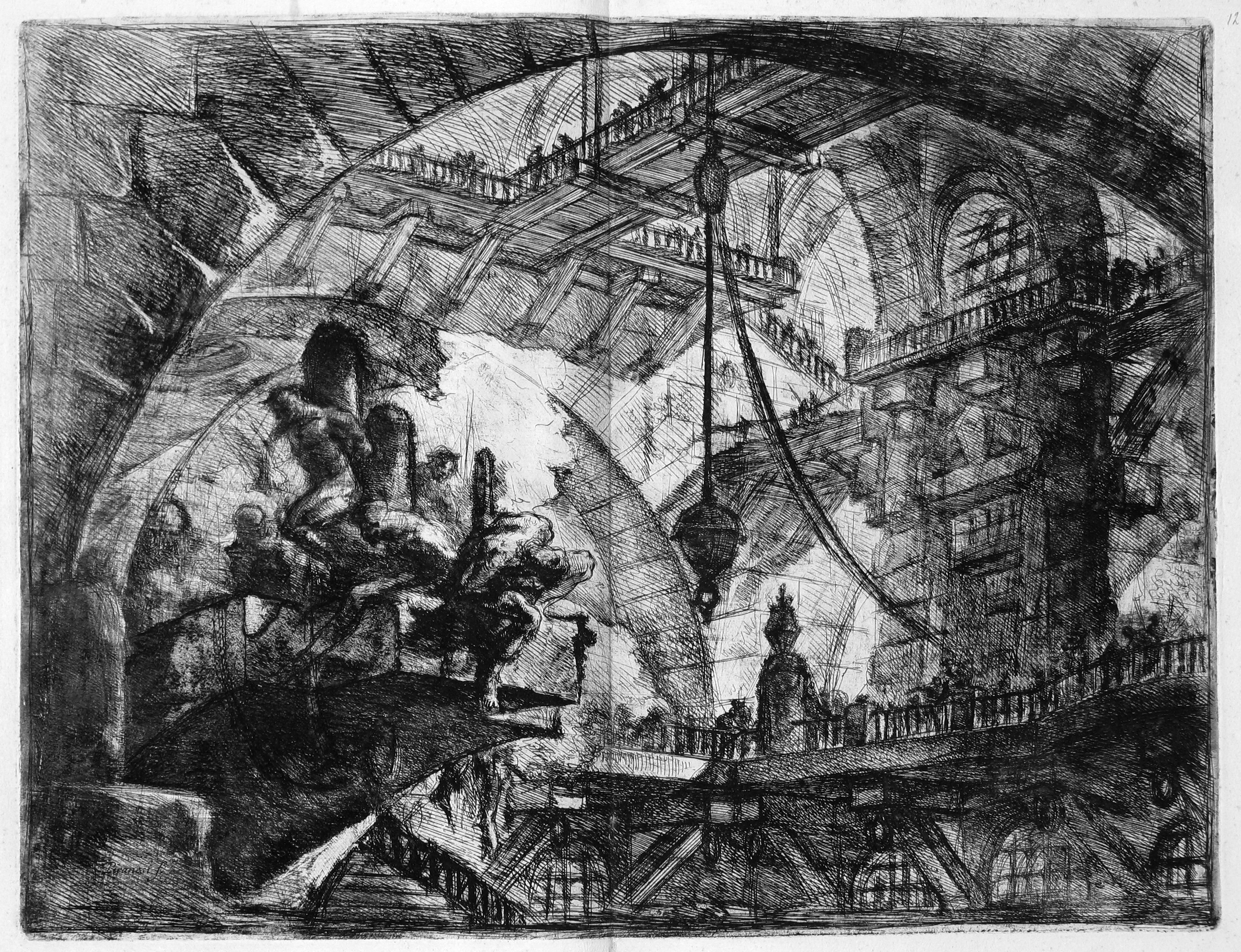
Larger plates here
"The fantasy of Piranesi’s Prisons is wholly different in quality from that displayed in the works of any of his immediate predecessors. All the plates in the series are self-evidently variations on a single symbol, whose reference is to things existing in the physical and metaphysical depths of human souls—to acedia and confusion, to nightmare and angst, to incomprehension and a panic bewilderment.
The most disquietingly obvious fact about all these dungeons is the perfect pointlessness which reigns throughout. Their architecture is colossal and magnificent. One is made to feel that the genius of great artists and the labour of innumerable slaves have gone into the creation of these monuments, every detail of which is completely without a purpose. Yes, without a purpose: for the staircases lead nowhere, the vaults support nothing but their own weight and enclose vast spaces that are never truly rooms, but only ante-rooms, lumber-rooms, vestibules, outhouses. And this magnificence of Cyclopaean stone is everywhere made squalid by wooden ladders, by flimsy gangways and cat-walks. And the squalor is for squalor’s sake, since all these rickety roads through space are manifestly without destination. Below them, on the floor, stand great machines incapable of doing anything in particular, and from the arches overhead hang ropes that carry nothing except a sickening suggestion of torture. Some of the Prisons are lighted only by narrow windows. Others are half open to the sky, with hints of yet other vaults and walls in the distance. But even where the enclosure is more or less complete, Piranesi always contrives to give the impression that this colossal pointlessness goes on indefinitely, and is co-extensive with the universe. Engaged in no recognisable activity, paying no attention to one another, a few small, faceless figures haunt the shadows. Their insignificant presence merely emphasises the fact that there is nobody at home." - Aldous Huxley on Piranesi's Carceri
Larger plates here
"The fantasy of Piranesi’s Prisons is wholly different in quality from that displayed in the works of any of his immediate predecessors. All the plates in the series are self-evidently variations on a single symbol, whose reference is to things existing in the physical and metaphysical depths of human souls—to acedia and confusion, to nightmare and angst, to incomprehension and a panic bewilderment.
The most disquietingly obvious fact about all these dungeons is the perfect pointlessness which reigns throughout. Their architecture is colossal and magnificent. One is made to feel that the genius of great artists and the labour of innumerable slaves have gone into the creation of these monuments, every detail of which is completely without a purpose. Yes, without a purpose: for the staircases lead nowhere, the vaults support nothing but their own weight and enclose vast spaces that are never truly rooms, but only ante-rooms, lumber-rooms, vestibules, outhouses. And this magnificence of Cyclopaean stone is everywhere made squalid by wooden ladders, by flimsy gangways and cat-walks. And the squalor is for squalor’s sake, since all these rickety roads through space are manifestly without destination. Below them, on the floor, stand great machines incapable of doing anything in particular, and from the arches overhead hang ropes that carry nothing except a sickening suggestion of torture. Some of the Prisons are lighted only by narrow windows. Others are half open to the sky, with hints of yet other vaults and walls in the distance. But even where the enclosure is more or less complete, Piranesi always contrives to give the impression that this colossal pointlessness goes on indefinitely, and is co-extensive with the universe. Engaged in no recognisable activity, paying no attention to one another, a few small, faceless figures haunt the shadows. Their insignificant presence merely emphasises the fact that there is nobody at home." - Aldous Huxley on Piranesi's Carceri
68Poquette
What a revelation! Piranesi's Carceri are so different from his scenes of Rome, which I have always loved. If you hadn't told us they were by Piranesi, I would not have guessed it.
69QuentinTom
fantastic stuff, PK. I was not aware of Huxley's essay: a perfect compliment to Piranesi. it strikes me that Piranesi must have influenced Escher.
Isn't feuilleton a fabulous blog?
Isn't feuilleton a fabulous blog?

