This topic is currently marked as "dormant"—the last message is more than 90 days old. You can revive it by posting a reply.
1QuentinTom
I've been heavily involved with work this week, and with my essai on Rene Leys. I've also been reading an excellent new translation of the Dao Te Jing, which beats all the others I have seen. To keep from going gaga with all the Chinese food, I'm reading Ezra Pound. I read 'Lustra', and am now into 'Ripostes'.
I love old Ezra: his scope of his reference is enormous, and his range of style is amazing, and his ear for the rhythms of English never lets him down no matter how experimental he is trying to be.
The Rest from 'Lustra'
O HELPLESS few in my country,
remnant enslaved !
Artists broken against her,
A-stray, lost in the villages,
Mistrusted, spoken-against,
Lovers of beauty, starved,
Thwarted with systems,
Helpless against the control ;
You who can not wear yourselves out
By persisting to successes,
You who can only speak,
Who can not steel yourselves into reiteration ;
You of the finer sense,
Broken against false knowledge,
You who can know at first hand,
Hated, shut in, mistrusted :
Take thought :
I have weathered the storm,
I have beaten out my exile.
I love old Ezra: his scope of his reference is enormous, and his range of style is amazing, and his ear for the rhythms of English never lets him down no matter how experimental he is trying to be.
The Rest from 'Lustra'
O HELPLESS few in my country,
remnant enslaved !
Artists broken against her,
A-stray, lost in the villages,
Mistrusted, spoken-against,
Lovers of beauty, starved,
Thwarted with systems,
Helpless against the control ;
You who can not wear yourselves out
By persisting to successes,
You who can only speak,
Who can not steel yourselves into reiteration ;
You of the finer sense,
Broken against false knowledge,
You who can know at first hand,
Hated, shut in, mistrusted :
Take thought :
I have weathered the storm,
I have beaten out my exile.
2RickHarsch
this is particularly nice:
You who can not wear yourselves out
By persisting to successes,
You who can only speak,
Who can not steel yourselves into reiteration ;
You who can not wear yourselves out
By persisting to successes,
You who can only speak,
Who can not steel yourselves into reiteration ;
3QuentinTom
yeah, I particularly like:
thwarted with systems.
Makes me think of all the management systems we have to endure nowadays.
thwarted with systems.
Makes me think of all the management systems we have to endure nowadays.
5wrmjr66
You of the finer sense,
Broken against false knowledge
That's another nice pair of lines. I like the short line/longer line rhythm.
Broken against false knowledge
That's another nice pair of lines. I like the short line/longer line rhythm.
6urania1
At least Pound understood the difference between "lie" and "lay" unlike some poets I could name but will not name since I have already named them elsewhere.
Alas poor Pound. Politically deranged, but a wonderful ear for language.
Alas poor Pound. Politically deranged, but a wonderful ear for language.
7Macumbeira
I Love Ezra Pound, Here is an excerpt of Wikipedia describing the last days of the War. EP lives in Italy and tries to get away.
He returned to Rapallo, where on 2 May 1945, four days after Mussolini was shot, armed partisans arrived at the house while Pound was there alone. He stuffed a copy of Confucius and a Chinese dictionary in his pocket, and was taken to their HQ in Chiavari, although he was released shortly afterwards. He and Olga gave themselves up to an American military post in the nearby town of Lavagna. It was decided that Pound should be transported to U.S. Counter Intelligence Corps headquarters in Genoa, where he was interrogated by Frank L. Amprin, the FBI agent assigned by J. Edgar Hoover to gather evidence following the 1943 indictment. Pound asked permission to send a cable to President Truman to offer to help negotiate peace with Japan. He also asked to deliver a final broadcast from a script called "Ashes of Europe Calling," in which he recommended peace with Japan, American management of Italy, the establishment of a Jewish state in Palestine, and leniency toward Germany. His requests were denied and the script forwarded to Hoover.70
On 8 May, the day Germany surrendered, he told a reporter from the Philadelphia Record who had managed to get into the compound for an interview that Hitler was "a Jeanne d'Arc, a saint," and that Mussolini was an "imperfect character who lost his head." On 24 May he was transferred to the United States Army Disciplinary Training Center north of Pisa, used to house military personnel awaiting court martial. The temporary commander placed him in one of the camp's "death cells"—a series of six-by-six-foot outdoor steel cages lit up all night by floodlights. He was left for three weeks in isolation in the heat, denied exercise, eyes inflamed by dust, no bed, no belt, no shoelaces, and no communication with the guards, except for the chaplain. After two and a half weeks he began to break down under the strain. Richard Sieburth writes that he recorded it in Canto 80, where Odysseus is saved from drowning by Leucothea: "hast'ou swum in a sea of air strip / through an aeon of nothingness, / when the raft broke and the waters went over me." Medical staff moved him out of the cage the following week. On June 14 and 15 he was examined by psychiatrists, one of whom found symptoms of a mental breakdown, and he was transferred to his own officer's tent and allowed reading material. He began to write, and drafted what became known as The Pisan Cantos;70 the existence of a few sheets of toilet paper showing the beginning of Canto LXXXIV suggests he started it while in the cage.
He returned to Rapallo, where on 2 May 1945, four days after Mussolini was shot, armed partisans arrived at the house while Pound was there alone. He stuffed a copy of Confucius and a Chinese dictionary in his pocket, and was taken to their HQ in Chiavari, although he was released shortly afterwards. He and Olga gave themselves up to an American military post in the nearby town of Lavagna. It was decided that Pound should be transported to U.S. Counter Intelligence Corps headquarters in Genoa, where he was interrogated by Frank L. Amprin, the FBI agent assigned by J. Edgar Hoover to gather evidence following the 1943 indictment. Pound asked permission to send a cable to President Truman to offer to help negotiate peace with Japan. He also asked to deliver a final broadcast from a script called "Ashes of Europe Calling," in which he recommended peace with Japan, American management of Italy, the establishment of a Jewish state in Palestine, and leniency toward Germany. His requests were denied and the script forwarded to Hoover.70
On 8 May, the day Germany surrendered, he told a reporter from the Philadelphia Record who had managed to get into the compound for an interview that Hitler was "a Jeanne d'Arc, a saint," and that Mussolini was an "imperfect character who lost his head." On 24 May he was transferred to the United States Army Disciplinary Training Center north of Pisa, used to house military personnel awaiting court martial. The temporary commander placed him in one of the camp's "death cells"—a series of six-by-six-foot outdoor steel cages lit up all night by floodlights. He was left for three weeks in isolation in the heat, denied exercise, eyes inflamed by dust, no bed, no belt, no shoelaces, and no communication with the guards, except for the chaplain. After two and a half weeks he began to break down under the strain. Richard Sieburth writes that he recorded it in Canto 80, where Odysseus is saved from drowning by Leucothea: "hast'ou swum in a sea of air strip / through an aeon of nothingness, / when the raft broke and the waters went over me." Medical staff moved him out of the cage the following week. On June 14 and 15 he was examined by psychiatrists, one of whom found symptoms of a mental breakdown, and he was transferred to his own officer's tent and allowed reading material. He began to write, and drafted what became known as The Pisan Cantos;70 the existence of a few sheets of toilet paper showing the beginning of Canto LXXXIV suggests he started it while in the cage.
8QuentinTom
What a dreadful experience for the poor poet. And yes, Baz, my exile is beaten out. (i think)
ok, here at last my review of Rene Leys
Long version, in which I link the novel with the Dao de Jing, is here:
http://thelectern.blogspot.com/2011/10/rene-leys-victor-segalen.html
ok, here at last my review of Rene Leys
Long version, in which I link the novel with the Dao de Jing, is here:
http://thelectern.blogspot.com/2011/10/rene-leys-victor-segalen.html
9baswood
Fantastic essai TC, always an education to read your stuff. Of course I was "eager to have my innocence spoiled" and sort of half expected some authorial intrusion, having just read Thackeray' Vanity Fair.
10rebeccanyc
I ordered Rene Leys when you first mentioned it, and have so far restrained myself from reading past your "first reading" section, but found your blog post fascinating and may succumb to finishing it before I read the novel.
11theaelizabet
So interesting, 'Murr. I'm going to have order this one, I think. Reading your excellent blog is like getting another college degree.
12QuentinTom
Thank you all for your comments, and apologies for trying your patience with such a long review.
I do really recommend Rene Leys, it's not long, you can get through it in a couple of days. It's the book that's made the biggest impression on me this year, probably the last 5 years. 'Porius' was an important book for me as well this year, but I'm an old hand at JCP. Victor Segalen has been a new discovery, and he really touches a chord with me, probably for obvious reasons. More Segalen coming soon.
Backhouse's notorious book Decadence Mandchoue is now available for the first time, and it's on order. Interestingly, I was just in the bookstore here and I saw it has already been translated into Chinese, and is on sale, wrapped, with a big sticker saying 'not to be sold to minors'. Salacious! Also, China Under the Empress Dowager is now available, and on order as well.
I've been obsessed with Backhouse for years, obsessed. To borrow a phrase from Voltaire, I think, if he didn't exist, I would have had to invent him. There is also quite a lot of other work of his, including the diaries of Li Lien Ying the Empress Dowager's Chief Eunuch, (and whose chinese name sounds like the Russian pronunciation of 'Lenin'), another manuscript in Chinese which he claimed to have found. Forgeries or not, they've got to be made available. And I'd like to see some of his 'Chinese' poems translated into English. Borges would love that project! Ha!
Backhouse 'Baccus':

I do really recommend Rene Leys, it's not long, you can get through it in a couple of days. It's the book that's made the biggest impression on me this year, probably the last 5 years. 'Porius' was an important book for me as well this year, but I'm an old hand at JCP. Victor Segalen has been a new discovery, and he really touches a chord with me, probably for obvious reasons. More Segalen coming soon.
Backhouse's notorious book Decadence Mandchoue is now available for the first time, and it's on order. Interestingly, I was just in the bookstore here and I saw it has already been translated into Chinese, and is on sale, wrapped, with a big sticker saying 'not to be sold to minors'. Salacious! Also, China Under the Empress Dowager is now available, and on order as well.
I've been obsessed with Backhouse for years, obsessed. To borrow a phrase from Voltaire, I think, if he didn't exist, I would have had to invent him. There is also quite a lot of other work of his, including the diaries of Li Lien Ying the Empress Dowager's Chief Eunuch, (and whose chinese name sounds like the Russian pronunciation of 'Lenin'), another manuscript in Chinese which he claimed to have found. Forgeries or not, they've got to be made available. And I'd like to see some of his 'Chinese' poems translated into English. Borges would love that project! Ha!
Backhouse 'Baccus':

13Makifat
For background on Backhouse, see Trevor-Roper's excellent The Hermit of Peking. I'm ecstatic to hear that his memoirs are available.
Now, off to peruse Tomcat's Segalen review...
Now, off to peruse Tomcat's Segalen review...
14A_musing
Sooo much to read. Segalen getting ordered, looking forward to more discussion (rebel read emerging?). I'm not sure I can take more.
16Macumbeira
14 it is getting depressing and soooo much work at the office
17slickdpdx
Rene Leys is a book I have meant to get around to, and I own - unread - The Hermit of Peking. Would love to read them both. Geneg is not around. Was any final decision made regarging next year's reads? I think not. Why not strike while the interest is hot and make January the month to read and discuss Segalen/Backhouse/Trevor-Roper? I can only keep myself from reading the spoilers portion of Murr's excellent review for so long...
18A_musing
I also don't want to short Mann. I'm about 200 pages in, but am also trying to read a couple books about Mann/MM - I'm sort of thinking of a rebel read but in a month or so. Segalen first choice, Backhouse second.
19Makifat
Trevor-Roper pegs Backhouse as a prodigious liar/forger. The Hermit book is an entertaining read, but I'm curious to know to what degree T-R may have overstated the case. It has been at least two decades since I read his book: I'd be interesting to know what the current attitude towards Backhouse might be in scholarly circles.
20QuentinTom
I'm happy to lead a rebel read of Rene Leys after MM, but MM should come first. Mac has been doing loads of preparation, and I can't wait to read and discuss.
>19 Makifat: Makifat, I also read HTR some years ago, and my impression was that TR did not really get the fact that Backhouse was a literary genius. He seemed to follow the establishment line that as a hoaxer, B was beyond the pale. It's for this reason that I love old Baccus: his victims were always industrialists, governments, bankers and academics, and anyone who can con money of that gang of crooks has got to be worth rooting for.
Backhouse plays a prominent role in Sterling Seagrave's excellent book Dragon Lady, and he crops up fleetingly in some of Jonathan Spence's books as well.
However, none of them really understand Backhouse - especially his homosexuality- in my view. Is Backhouse ready for a post colonial/queer reading? YES we say!
I was digging around and found this, from a French website the Association of Victor Segalen, which seems to draw many of the same conclusions on Backhouse's relationship to RL that I do in my review:
http://associationvictorsegalen6.blogspot.com/2011/04/edmund-backhouse-et-rene-l...
Here's a link to Earnshaw books, the publisher who has brought out Backhouse's books:
http://www.earnshawbooks.com/index.php?route=common/home
I also notice that they are bringing out Princess Der Ling's book. Der Ling was a kind of female counterpart to Backhouse.
http://www.earnshawbooks.com/index.php?route=product/product&product_id=13
>19 Makifat: Makifat, I also read HTR some years ago, and my impression was that TR did not really get the fact that Backhouse was a literary genius. He seemed to follow the establishment line that as a hoaxer, B was beyond the pale. It's for this reason that I love old Baccus: his victims were always industrialists, governments, bankers and academics, and anyone who can con money of that gang of crooks has got to be worth rooting for.
Backhouse plays a prominent role in Sterling Seagrave's excellent book Dragon Lady, and he crops up fleetingly in some of Jonathan Spence's books as well.
However, none of them really understand Backhouse - especially his homosexuality- in my view. Is Backhouse ready for a post colonial/queer reading? YES we say!
I was digging around and found this, from a French website the Association of Victor Segalen, which seems to draw many of the same conclusions on Backhouse's relationship to RL that I do in my review:
http://associationvictorsegalen6.blogspot.com/2011/04/edmund-backhouse-et-rene-l...
Here's a link to Earnshaw books, the publisher who has brought out Backhouse's books:
http://www.earnshawbooks.com/index.php?route=common/home
I also notice that they are bringing out Princess Der Ling's book. Der Ling was a kind of female counterpart to Backhouse.
http://www.earnshawbooks.com/index.php?route=product/product&product_id=13
21Macumbeira
I am in for a "Chinese read" after the Mountain
22QuentinTom
Excellent
Makifat, I've just done a quick search on Backhouse at jstor (using an illegal password sh don't tell anyone) and there is nothing there on Backhouse since the early 90s.
Makifat, I've just done a quick search on Backhouse at jstor (using an illegal password sh don't tell anyone) and there is nothing there on Backhouse since the early 90s.

26urania1
>25 QuentinTom: Murrushka,
Awesome. I think art forgers are often more interesting than the artists they forge. And art forgery raises interesting questions about the commercial value of "original art." Have you seen the movie The Moderns? Excellent. I also love the art forgery sections that come up in the remake of The Thomas Crown Affair. I have a tawdry, fantasy, scholarly detective novel (involving a demonic character who can part the air of time) and a forgery (so deemed in the present), which turns out not to be a forgery at all. But as I said it is tawdry (as in fantasy), so I let it gather dust in the archives of my computer.
Awesome. I think art forgers are often more interesting than the artists they forge. And art forgery raises interesting questions about the commercial value of "original art." Have you seen the movie The Moderns? Excellent. I also love the art forgery sections that come up in the remake of The Thomas Crown Affair. I have a tawdry, fantasy, scholarly detective novel (involving a demonic character who can part the air of time) and a forgery (so deemed in the present), which turns out not to be a forgery at all. But as I said it is tawdry (as in fantasy), so I let it gather dust in the archives of my computer.
27QuentinTom
I agree, the whole notion of forgeries and hoaxes fascinates me too. the point about Chang Da Chien is that he was China's greatest painter of the 20th century. When I first came to Taiwan, they had a retrospective of his work at the National Palace Museum, and I was absolutely staggered. His work really is incredible. The forging was a just sideline when he realised how gullible Americans were and how much money was to be made from them. Of course, you have to remember, that copying the masters is an acceptable practice in chinese art. What CDC did that was different was to fake elaborate provenances for the paintings he made.
I did see the Moderns, but like 25 years ago.
Get that novel out there, womandatory. it sounds awesome.
CDC did a whole series of court ladies, which I know you will love.

I did see the Moderns, but like 25 years ago.
Get that novel out there, womandatory. it sounds awesome.
CDC did a whole series of court ladies, which I know you will love.

28QuentinTom
Pimping my review of Daoism: Beginners Guide. I've been doing more bookthrowing. Perhaps it's catching.
30wrmjr66
Enjoyed the review (baswood, 29), but was wondering if you could tell us how you really feel about the book.
32QuentinTom
30. Thanks for thumbing. I feel very ambivalent about this book. I learnt quite a lot from it, but I also disagreed with most of it. And I wrote it in a pit of feake when I looked at my library and realised what other much better books it was keeping me from reading.
Anyway. Onwards. I have a number of things on hand, desperately trying to finish them before the MM read starts (I have the feeling that only Choco and I are waiting for the official start of 22.10, seems like most people are already at Camp 2).
I'm reading Looking at Chinese Painting, which is glorious. big hardback with full colour plate illustrations and extremely informative text. This is in preparation for my review of Segalen's PAINTINGS, which I am reading again. (I seem to reading lots of books twice at the moment...)
Also reading a different translation of the Dao de Jing. It's amazing how different these translations can be: almost a completely different text, with a completely different philosophical perspective.
I've also recently discovered David Hinton, an American poet who is making it his life's work to translate as much of Chinese poetry and philosophy as he can.
http://www.davidhinton.net/Pages/Profile.html
His work is published by New Directions (praise New Directions to the heavens!!!!), and his versions of Tu Fu which I am reading now are outstanding. Anyone interested in Chinese lit should check these out.
Anyway. Onwards. I have a number of things on hand, desperately trying to finish them before the MM read starts (I have the feeling that only Choco and I are waiting for the official start of 22.10, seems like most people are already at Camp 2).
I'm reading Looking at Chinese Painting, which is glorious. big hardback with full colour plate illustrations and extremely informative text. This is in preparation for my review of Segalen's PAINTINGS, which I am reading again. (I seem to reading lots of books twice at the moment...)
Also reading a different translation of the Dao de Jing. It's amazing how different these translations can be: almost a completely different text, with a completely different philosophical perspective.
I've also recently discovered David Hinton, an American poet who is making it his life's work to translate as much of Chinese poetry and philosophy as he can.
http://www.davidhinton.net/Pages/Profile.html
His work is published by New Directions (praise New Directions to the heavens!!!!), and his versions of Tu Fu which I am reading now are outstanding. Anyone interested in Chinese lit should check these out.
33QuentinTom

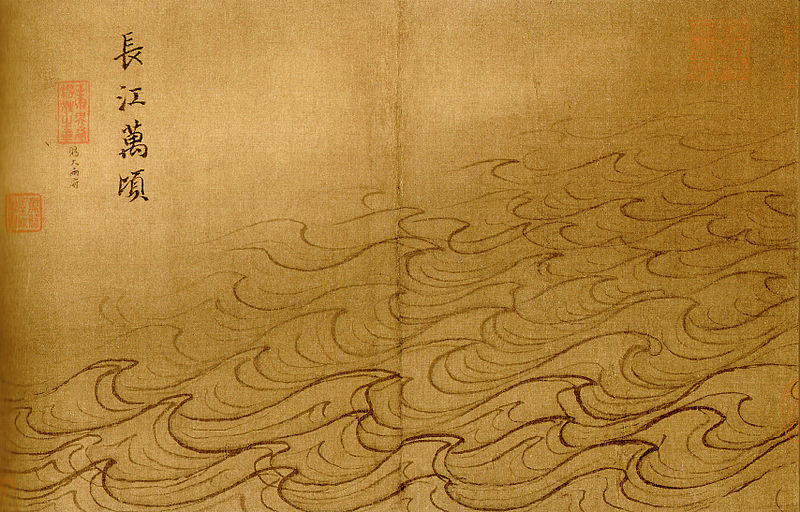
Ma Yuen
Song Dynasty (12th century)
This is more ancient and fundamental than the solid continent: It is the sleeping, weeping, voluble sea whose name we are about to read (that so many travellers ignore)... But, neither the Gulf Sea where a voyage from one cape to another takes three days; nor the hot waters where fish flash like arrows and beat their dragonfly wings... Nor the Glacial Sea, which endures during the months of winter. This one is not cold and is not hot; tepid as the temperature of tears and storm rain. It is neither here nor there. You recognize it suddenly, before you, when you had hoped to have escaped it. It is the Sea of Immense Nostalgia.
Peintures
Victor Segalen
34baswood
Great picture but on the first quick look I thought it might be an advert for Michelin Tyres: are you sure this isn't a fake.
36QuentinTom
>34 baswood: Baz, you are naughty lol. I thought it was a ploughed field when I first saw it. Here's another one by the same artist:
Ma Yuen
Ten Thousand Riplets on the River Yangzte
>35 zenomax:, Zeno, I think you would really like Paintings (no touchstone, of course). Segalens' verbal descriptions of pictures which don't exist allow one great freedom in creating one's own, inner pictures.
I've always been drawn to literature which describes art, Keats's 'Ode to a Grecian Urn', perhaps, and his sonnet to the 'Elgin Marbles', and the last two stanza's of W.B. Yeats' 'Lapis Lazuli' have always haunted me. Segalen's book has this same power.
Lapis Lazuli
...
...
Two Chinamen, behind them a third,
Are carved in lapis lazuli,
Over them flies a long-legged bird,
A symbol of longevity;
The third, doubtless a serving-man,
Carries a musical instmment.
Every discoloration of the stone,
Every accidental crack or dent,
Seems a water-course or an avalanche,
Or lofty slope where it still snows
Though doubtless plum or cherry-branch
Sweetens the little half-way house
Those Chinamen climb towards, and I
Delight to imagine them seated there;
There, on the mountain and the sky,
On all the tragic scene they stare.
One asks for mournful melodies;
Accomplished fingers begin to play.
Their eyes mid many wrinkles, their eyes,
Their ancient, glittering eyes, are gay.
Ma Yuen
Ten Thousand Riplets on the River Yangzte
>35 zenomax:, Zeno, I think you would really like Paintings (no touchstone, of course). Segalens' verbal descriptions of pictures which don't exist allow one great freedom in creating one's own, inner pictures.
I've always been drawn to literature which describes art, Keats's 'Ode to a Grecian Urn', perhaps, and his sonnet to the 'Elgin Marbles', and the last two stanza's of W.B. Yeats' 'Lapis Lazuli' have always haunted me. Segalen's book has this same power.
Lapis Lazuli
...
...
Two Chinamen, behind them a third,
Are carved in lapis lazuli,
Over them flies a long-legged bird,
A symbol of longevity;
The third, doubtless a serving-man,
Carries a musical instmment.
Every discoloration of the stone,
Every accidental crack or dent,
Seems a water-course or an avalanche,
Or lofty slope where it still snows
Though doubtless plum or cherry-branch
Sweetens the little half-way house
Those Chinamen climb towards, and I
Delight to imagine them seated there;
There, on the mountain and the sky,
On all the tragic scene they stare.
One asks for mournful melodies;
Accomplished fingers begin to play.
Their eyes mid many wrinkles, their eyes,
Their ancient, glittering eyes, are gay.
38baswood
#37 That's a lovely song, Von der Jugend - Youth. I have these Mahler lieds sung by Janet Baker and James King and the Royal concertgebouw Orchestra Amsterdam, Bernard Haitink.
Beautiful sunny day here in the Gers. The window has been flung wide and the autumnal sunshine with a hint of mist makes the countryside look beautiful, a perfect day for playing these songs..
Beautiful sunny day here in the Gers. The window has been flung wide and the autumnal sunshine with a hint of mist makes the countryside look beautiful, a perfect day for playing these songs..
39A_musing
Love the Ma Yuen. This one is part of a scroll ("Nine Dragons Scroll") at the Museum of Fine Arts, Chen Rong, Southern Song Dynasty, and one of my favorites here locally. The MFA site has more images from the scroll: http://www.mfa.org/collections/object/nine-dragons-28526
Murr, you're filling my shelves with Chinese poetry books, now you're going to start on art, too? I've always been a big new directions fan - I have a small collection of their early stuff, including many of their wonderful annuals. If ever you want some great often overlooked literature from late 30s and 40s, somewhat beaten-up copies of the New Directions Annuals are often on ebay for $5 or $10, and include everything from their staples like Pound, Rexroth, Delmore Schwartz and Williams Carlos Williams to hardly known or remembered translations of Latin American and Eastern European writers of the period.
40QuentinTom
so that's your revenge? To fill my shelves with NDP? LOL They're one of my favourite publishers. I snap them up whenever I stumble across them. I just got a collection of essays by Ezra as well. I have some Octavio Paz, whom I don't really know, and some odd bits n pieces by NDP stalwart good ol' Henry Miller. Thanks for the tip onthe annuals, I"l look out for them as well.
That 9 Dragons scroll is drop dead effing magnificent. Could you enlarge it for us?
(you know, a_musing, it occurred to me that we should do a study of the Tang dynasty. It was the greatest flourishing of art and letters in chinese history, and I would love to know more about it.)
That 9 Dragons scroll is drop dead effing magnificent. Could you enlarge it for us?
(you know, a_musing, it occurred to me that we should do a study of the Tang dynasty. It was the greatest flourishing of art and letters in chinese history, and I would love to know more about it.)
41QuentinTom
oh the link is tremendous.
42A_musing
I am game for the Tang! May I suggest we listen to Silk Road Radio while we read: http://www.silkroadproject.org/tabid/168/default.aspx
I went looking for a larger, better resolution image of the 9 Dragons Scroll and discovered that the University of Chicago has a special scroll viewer up that really lets you zoom in: http://scrolls.uchicago.edu/view.php?env=STD_PUB&_scroll_id=54&lang=defa...
I am conceding defeat in the shelf filling category. I am hoping to offset the loss, though, with a win in the "cool links" category.
I went looking for a larger, better resolution image of the 9 Dragons Scroll and discovered that the University of Chicago has a special scroll viewer up that really lets you zoom in: http://scrolls.uchicago.edu/view.php?env=STD_PUB&_scroll_id=54&lang=defa...
I am conceding defeat in the shelf filling category. I am hoping to offset the loss, though, with a win in the "cool links" category.
43LolaWalser
About the picture in #33--I don't know about the 'Sea of Immense Nostalgia', but the representation of waves reminds me of the Roman (or older) motif of the sea of time/life, often used in funerary art (which Mann mentions in Der Zauberberg), from ancient era onward, like so:

The waves represent life's coming and going.

The waves represent life's coming and going.
44QuentinTom
43 Amazing!
45LolaWalser
That's not the best example of the motif I've seen (my favourite is on a sarcophagus in Museo Nazionale in Rome, in the garden, just the elongated esses spreading in one direction from left to right, no mirroring or other decoration), but it's proving not easy to google, at least not fast. I may have to scan my own photos. Anyway, it looks exactly like a slice from your pic in 33.
46QuentinTom
Before we get going on the MM read, here is one last review of my chinese reading: Victor Segalen's Paintings Quartet Encounters. Another masterpiece.
http://thelectern.blogspot.com/2011/10/peintures-victor-segalen.html
http://thelectern.blogspot.com/2011/10/peintures-victor-segalen.html
47Macumbeira
Again a super review
48slickdpdx
Just checked out the Silk Road Radio link at 42 above. Beautiful. High point thus far: Zhao Jiping's Summer in the High Grassland.
49solla
Nice overview of the differences between Eastern and Western art and poetry, Tomcat, though Gaugin painting the horse blue to show the effect of shadow might also have been following Denis's idea, that if you see something as blue, paint it the most intense blue possible - I am paraphrasing. The point being seeing a painting as something in itself beyond the depiction of reality, including the effect of light.
50QuentinTom
Thanks everyone. Good point Solla, but this kind of thinking was completely alien to Chinese. Interestingly, when Chinese first encountered Western chiaroscuro and colour modelling, they regarded it as 'inauspicious' because it did not represent reality. Different ways of seeing, I guess.
BTW, who is Denis?
BTW, who is Denis?
51ChocolateMuse
Awe-inspiring review, Murr, as ever.
53QuentinTom
lol, nice one.
54janeajones
ah... parenting...
55solla
50 late answer - French, I believe he is listed among the Fauves - Wild Beasts - as was Matisse in his earlier career (not that he resigned, just outlived it) - late 1800's, about.
57anna_in_pdx
We miss you Murr.
58QuentinTom
oh thanks guys. I've been so busy here with work, I have not had time to read much or post. I currently have a class of 50 financial industry regulators, and I'm teaching them how to write. I have 50 reports a week to grade and edit, plus my normal teaching hours.
I'm currently going through a bit of a Japanese phase. My mother is coming to stay with me again at Chinese New Year and we are taking a short trip to Kyoto in Japan. It will be the first time both of us have been there. I'm reading japanese lit to try to get in the groove.
I reread The Temple of the Golden Pavilion. My inscription in the book shows that I first read it in December 1991, which OMG is 20 years ago! An awesome book, which is based on a true incident, the arson of the famous Golden Temple in Kyoto. Mishima tries to get inside the mind of the arsonist, a psychopathic Buddhist monk, and the book is full of Buddhist ideas, slightly perverted. The Golden Temple comes to stand for a symbol of beauty in the protagonists mind, which must be destroyed before he can interact normally with reality. I hope to review it in more depth when I have time. It is haunting me.
Then I read for the first time The Sailor who fell from grace with the sea a beautifully crafted shocker. Again, one of the characters is a member of a nihilist/terrorist group, a weird sect of schoolboys who exact revenge on the sailor of the title. A short but powerful novella. Mishima is a superb craftsman: this book has perfect balance and poise, and a kind of burning, suppressed eroticism, and some ravishing descriptive writing of Yokohama town and harbour.
Now I am reading After the Banquet, a political novel in the vein of Henry Adams's Democracy. Kazu is a rich 50 something socialite who marries a retired politician and tries to get him elected as governor of Tokyo. Also, a masterpiece of psychology.
Here are some snippets of Mishima to give an idea of his style, one of the most noticeable features of which is his choice of similes:
the bed of the retired politician Noguchi suggested somehow a windswept station platform. The moon in the night sky looks like a drawing pin stuck into a wall. Murder is a great act that will fill the hollows of the world in much the same way that a crack along its face will fill a mirror. an elderly male shop assistant looks at a woman as though he was examining a piece of fabric in his hand. Even if she was his employer. and finally this simile on the Golden Temple:
The Golden Temple had been built with gold dust in the long lightless night, just like a sutra that is painstakingly inscribed with gold dust onto the dark-blue pages of a book.

I'm currently going through a bit of a Japanese phase. My mother is coming to stay with me again at Chinese New Year and we are taking a short trip to Kyoto in Japan. It will be the first time both of us have been there. I'm reading japanese lit to try to get in the groove.
I reread The Temple of the Golden Pavilion. My inscription in the book shows that I first read it in December 1991, which OMG is 20 years ago! An awesome book, which is based on a true incident, the arson of the famous Golden Temple in Kyoto. Mishima tries to get inside the mind of the arsonist, a psychopathic Buddhist monk, and the book is full of Buddhist ideas, slightly perverted. The Golden Temple comes to stand for a symbol of beauty in the protagonists mind, which must be destroyed before he can interact normally with reality. I hope to review it in more depth when I have time. It is haunting me.
Then I read for the first time The Sailor who fell from grace with the sea a beautifully crafted shocker. Again, one of the characters is a member of a nihilist/terrorist group, a weird sect of schoolboys who exact revenge on the sailor of the title. A short but powerful novella. Mishima is a superb craftsman: this book has perfect balance and poise, and a kind of burning, suppressed eroticism, and some ravishing descriptive writing of Yokohama town and harbour.
Now I am reading After the Banquet, a political novel in the vein of Henry Adams's Democracy. Kazu is a rich 50 something socialite who marries a retired politician and tries to get him elected as governor of Tokyo. Also, a masterpiece of psychology.
Here are some snippets of Mishima to give an idea of his style, one of the most noticeable features of which is his choice of similes:
the bed of the retired politician Noguchi suggested somehow a windswept station platform. The moon in the night sky looks like a drawing pin stuck into a wall. Murder is a great act that will fill the hollows of the world in much the same way that a crack along its face will fill a mirror. an elderly male shop assistant looks at a woman as though he was examining a piece of fabric in his hand. Even if she was his employer. and finally this simile on the Golden Temple:
The Golden Temple had been built with gold dust in the long lightless night, just like a sutra that is painstakingly inscribed with gold dust onto the dark-blue pages of a book.

59MeditationesMartini
Good God, 58, I'm jealous. You are well capable of figuring all this out for yourself, of course, but another amazing place in Kyoto is the temple complex at Kiyomizu-dera, where the water heals your ailments and you can jump off the balcony to have the gods grant your wish. Also, a lesser-known temple that I love is Nanzen-ji, with its big aqueduct.
Will you be going to Nara?
Will you be going to Nara?
62janeajones
Kyoto is the one place I really want to visit in Japan. I'm drooling...
63QuentinTom
MArtini, keep the suggestions coming. It's an undiscovered country for me, so any tips are welcome. I don't think we will get to Nara, we only have three days in Kyoto.
I am worried about the snow. It will be freezing apparently. Brrrr.
I am worried about the snow. It will be freezing apparently. Brrrr.
64QuentinTom
Melville is looming as a figure of obsession in my imagination and interest, perhaps even to rival Dostoevsky. Moby Dick is blowing me away, if I might be permitted some nautical imagery. It is pushing all my buttons:
sailors yarn
19th century
metaphysics
innovative form
sublime language
a lofty vision
epic struggle
laughter
risk
I read the introduction to HM today in my Norton Anthology of American Literature, which contains the tales Bartleby Scrivener and Benito Cereno, which I am also going to read. I'm dying to read Mardi and The Confidence Man, but I must stop buying books. also I am supposed to be reading japanese lit to prepare inwardly for my first voyage to Japan, with my dear mother. oh dear oh dear oh dear. what's a pussy to do?
sailors yarn
19th century
metaphysics
innovative form
sublime language
a lofty vision
epic struggle
laughter
risk
I read the introduction to HM today in my Norton Anthology of American Literature, which contains the tales Bartleby Scrivener and Benito Cereno, which I am also going to read. I'm dying to read Mardi and The Confidence Man, but I must stop buying books. also I am supposed to be reading japanese lit to prepare inwardly for my first voyage to Japan, with my dear mother. oh dear oh dear oh dear. what's a pussy to do?
65theaelizabet
Melville hits me the same way. I think you have to add Billy Budd to the list, too.
66A_musing
Welcome!
Every time I pick up Moby Dick, it happens again. And I see so much new every time through.
I haven't read Mardi, and am dying to do so. Maybe we should read Mardi at some time, either next year or when there's a bit of a lull in the other reading, not as a formal read, but just as a random rebel read without a leader.
I recently read through the Piaza Tales, including Bartleby and Benito, both great, both very different. If you read either, I'd love to be bouncing thoughts around.
Every time I pick up Moby Dick, it happens again. And I see so much new every time through.
I haven't read Mardi, and am dying to do so. Maybe we should read Mardi at some time, either next year or when there's a bit of a lull in the other reading, not as a formal read, but just as a random rebel read without a leader.
I recently read through the Piaza Tales, including Bartleby and Benito, both great, both very different. If you read either, I'd love to be bouncing thoughts around.
67A_musing
By the way, Bruce Franklin, my favorite wild Melville writer, loves Mardi and has a bunch on the book in his The Wake of the Gods.
68RickHarsch
Kitty, can you replace 'risk' with something else? Writing...what do we risk?
Otherewise, I am planning on limiting my reading in the near future to MD, dostoevsky, Rabelais, and non-fiction. Maybe for life.
Otherewise, I am planning on limiting my reading in the near future to MD, dostoevsky, Rabelais, and non-fiction. Maybe for life.
69urania1
>68 RickHarsch: What about The Mahabharata? I think you should try to fit that one in.
71MeditationesMartini
Piazza Tales! What a good idea. I'll feel less bad about missing Moby.
72MeditationesMartini
And I would certainly jump in on a Mardi read. (My old roommate speaks v. highly of the early sea novels--specifically Typee and Omoo--and I like Jack London, ad I like Conrad--oh, and I like Melville--so it seems obvious).
Also, A_, I dreamed last night that you were staying with my parents (as was I, and some others--it was some kind of post-evacuation scenario) and wearing a suit like a hearse and exorcising their fruit trees with a stick with a clatter of rings like the priest in Rashomon. IT was almost completely the complete opposite of how I actually imagine you.
Also, A_, I dreamed last night that you were staying with my parents (as was I, and some others--it was some kind of post-evacuation scenario) and wearing a suit like a hearse and exorcising their fruit trees with a stick with a clatter of rings like the priest in Rashomon. IT was almost completely the complete opposite of how I actually imagine you.
73MeditationesMartini
(the yard stayed demon free)
74A_musing
You were seeing the future me, as I age and become curmudgeonly(er). Believe me, when I clatter rings, the demons know it.
75QuentinTom
but Rick, I do mean risk. MD is permeated with it, both in the artistic sense, in the shape of the thing, the formal innovations, and the prose, the asides and addresses to the reader, the longuers and more overtly philosophical chapters.
In his professional life, Melville was by all accounts also a risk taker. I mean he could have carried on producing safe readerly popular travel works like his two first books, but he didn't. he took risks.
I'm up for a read of Mardi sometime, definitely, and I"m kicking myself for not joining in on the confidence man read.
Thea, I think I have read BB at some point, but I need to revisit it.
The Wake of the Gods is on my wishlist.
In his professional life, Melville was by all accounts also a risk taker. I mean he could have carried on producing safe readerly popular travel works like his two first books, but he didn't. he took risks.
I'm up for a read of Mardi sometime, definitely, and I"m kicking myself for not joining in on the confidence man read.
Thea, I think I have read BB at some point, but I need to revisit it.
The Wake of the Gods is on my wishlist.
76A_musing
I may have to return to the Confidence Man threads at some point - I stopped doing my detailed analysis at one point, as some life issues took over, but did get the book read one and a half times and want to get through that second more careful read with notes in full. But I'm not sure when I'll return.
77QuentinTom
I'm going to get to it at some point this year.
Generally speaking, I am struck once again how the really great writers, Yeat's Holy Sages, all share one quality, no matter how disparate their styles and visions and methods, and that is the prescience they all display. The great writers all identify areas of human experience that science/practix later explore.
Dostoevsky - the unconscious, the irrational
Melville - epistemology
Dickens - the individual in the social realm
etc
Generally speaking, I am struck once again how the really great writers, Yeat's Holy Sages, all share one quality, no matter how disparate their styles and visions and methods, and that is the prescience they all display. The great writers all identify areas of human experience that science/practix later explore.
Dostoevsky - the unconscious, the irrational
Melville - epistemology
Dickens - the individual in the social realm
etc
79QuentinTom
word
80RickHarsch
Ur, The Mahabharata is in with my non-fiction, with the philosophy
81QuentinTom
I've been reading a famous essay Melville wrote on Hawthorne, the dedicatee of Moby Dick. Here are some excerpts which caught my imagination.
Genius all over the world stands hand in hand, and one shock of recognition runs the whole circle round.
There are hardly five critics in America, and several of them are asleep.
it is better to fail in originality, than to succeed in imitation. He who has never failed somewhere, that man can not be great. Failure is a true test of greatness. and if it be said that continual success is a proof that a man wisely knows his powers, it is only to be added that in that case he knows them to be small. Let us believe it then once and for all that there is no hope for us in these smooth pleasing writers that know their powers.
great geniuses are part of the times, they themselves are the time, and possess a correspondent colouring.
Genius all over the world stands hand in hand, and one shock of recognition runs the whole circle round.
There are hardly five critics in America, and several of them are asleep.
it is better to fail in originality, than to succeed in imitation. He who has never failed somewhere, that man can not be great. Failure is a true test of greatness. and if it be said that continual success is a proof that a man wisely knows his powers, it is only to be added that in that case he knows them to be small. Let us believe it then once and for all that there is no hope for us in these smooth pleasing writers that know their powers.
great geniuses are part of the times, they themselves are the time, and possess a correspondent colouring.
82baswood
It is better to fail in originality, than to be successful in imitation..... The Romantic hero perhaps. I would like to believe that.
Sounds like a fascinating essay and sounds like he got great enjoyment out of writing it.
Sounds like a fascinating essay and sounds like he got great enjoyment out of writing it.
84anna_in_pdx
That is a terrific quote. Almost makes me want to go back and read more Hawthorne (he is a casualty of high school English for me).
85PeterKein
>84 anna_in_pdx: "casualities of high school English"... a thread (if there hasn't already been one) in which we formalize the (conspiracy) theory that high school teachers have been forcing naive souls to read the lesser works of genius in an attempt to ensure they are never read again except perhaps by accident or by being old enough to forget we have read them at all.
86A_musing
You know, I feel the same way about Hawthorne - both a HS English casualty and someone I now want to read again because of Melville.
87slickdpdx
Great thread idea. I only got around to reading The Scarlet Letter the year before last and I ate it up; including the extended introductory portion!
88anna_in_pdx
87: Yes, that's exactly the novel I was talking about. God I hated that novel.
89anna_in_pdx
Also PK, please do start that thread and I bet it will be the greatest thing since sliced bread!
91QuentinTom
I agree. I never read Hawthorne in high school (he's not on the UK syllabus), but I read the Scarlett Letter (plot spoiler: it's A) and was bored rigid, but the introductory stuff -notes from a custom's house, is it? - was super.
93RickHarsch
TCat,
I recoil from the word risk because to me there is no risk in writing, within the text. Still not finished with Bakhtin on Dosteovsky, yet I have been overawed by the ancestors of our literature, their variety, the extent of their stylistic 'innovations' that are listed in the book (I am no classicist, and unfortunately). I would argue that there is more risk in adhering to an external norm than there is to writing according to the self, as Melville so obviously and freely does. Clearly I agree with your point, but I think the term risk has arisen only because of the commodification of literature. (How often I am urged to 'write a best-seller' so I can afford to be myself!)
I recoil from the word risk because to me there is no risk in writing, within the text. Still not finished with Bakhtin on Dosteovsky, yet I have been overawed by the ancestors of our literature, their variety, the extent of their stylistic 'innovations' that are listed in the book (I am no classicist, and unfortunately). I would argue that there is more risk in adhering to an external norm than there is to writing according to the self, as Melville so obviously and freely does. Clearly I agree with your point, but I think the term risk has arisen only because of the commodification of literature. (How often I am urged to 'write a best-seller' so I can afford to be myself!)
94tonikat
#93 -- Rick, I think it's an enormous risk to write from the self, to expose yourself, to write honestly, at any time.
edit - This may include risk in the text. But I cannot take for granted writing from the self, not really from the self.
edit - This may include risk in the text. But I cannot take for granted writing from the self, not really from the self.
95RickHarsch
TH, for me, no. I live once. I write. I have little choice in the matter vis a vis 'risk'.
As for the self, what I know if it is written from, but that leaves a lot of room for conjecture.
As for the self, what I know if it is written from, but that leaves a lot of room for conjecture.
96tonikat
Perhaps some conjecture.
Your point about risk I see as pointless. I don't mean to be argumentative, really, but ... You seem to be saying that we may write and we may write what we choose, express ourselves as freely as we wish, that that is not risky, and as you say any risk is not our choice. It seems a stubborn way to view this. Clearly there is political and social risk, for many at many times this seems to be what you are saying is not our choice -- but I don't think it is helpful to amputate writers from their context, it would seem a very special case where a writer may write freely without such concerns. And socially even in a 'free society' there may be for example the risk that your mother reads it or some such thing. You may expose yourself. All this you say is not a matter for us to choose, I'd disagree. But then more personally you seem to be saying that how we may express ourselves in writing is no risk at all, I deeply disagree, we may present ourslves with arguments, with stories that unlock parts of ourselves, that we carry as experience, that maybe we henceforth cannot back down from (relevant to us both here?), that may lead us to change our lives, to not hide things from oursleves that otherwise we would hide, to learn that we have to stand for the things we write, which again may involve political action for example or practical change for oursleves, Yes in some sense there may be no risk in being in ways we understand ourselves on paper, sometimes, but no, in many ways I really do think it is a risk. I write poetry and post some at Survivors' poetry, that's survival of the mental health system, to write that can be no risk, but can also be risky, I see it often in others, that it is a risk from them to express themselves.
tomcat - apologies, hope this isn't hijacking your thread.
Your point about risk I see as pointless. I don't mean to be argumentative, really, but ... You seem to be saying that we may write and we may write what we choose, express ourselves as freely as we wish, that that is not risky, and as you say any risk is not our choice. It seems a stubborn way to view this. Clearly there is political and social risk, for many at many times this seems to be what you are saying is not our choice -- but I don't think it is helpful to amputate writers from their context, it would seem a very special case where a writer may write freely without such concerns. And socially even in a 'free society' there may be for example the risk that your mother reads it or some such thing. You may expose yourself. All this you say is not a matter for us to choose, I'd disagree. But then more personally you seem to be saying that how we may express ourselves in writing is no risk at all, I deeply disagree, we may present ourslves with arguments, with stories that unlock parts of ourselves, that we carry as experience, that maybe we henceforth cannot back down from (relevant to us both here?), that may lead us to change our lives, to not hide things from oursleves that otherwise we would hide, to learn that we have to stand for the things we write, which again may involve political action for example or practical change for oursleves, Yes in some sense there may be no risk in being in ways we understand ourselves on paper, sometimes, but no, in many ways I really do think it is a risk. I write poetry and post some at Survivors' poetry, that's survival of the mental health system, to write that can be no risk, but can also be risky, I see it often in others, that it is a risk from them to express themselves.
tomcat - apologies, hope this isn't hijacking your thread.
97QuentinTom
not at all tony: No such thing as a hijacked thread here. you expressed what I wanted to say myself to Rick.
rick, I also deeply disagree with you:
I would argue that there is more risk in adhering to an external norm
This is too paradoxical for me, as I see no risk at all in playing it safe and following the herd, staying within generic boundaries. I can only repeat what I said above in 75. Melville took huge risks with MB.
Writing involves huge risks: Solzhenitsyn? in fact any Russian writer all through Russian history. and those are just social/political risks. Then there are the formal, experimental risks, the risks of alienating your reader/audience.
I have more to say on the 'self' in literature, but I have friends pressing me to go for dinner.
rick, I also deeply disagree with you:
I would argue that there is more risk in adhering to an external norm
This is too paradoxical for me, as I see no risk at all in playing it safe and following the herd, staying within generic boundaries. I can only repeat what I said above in 75. Melville took huge risks with MB.
Writing involves huge risks: Solzhenitsyn? in fact any Russian writer all through Russian history. and those are just social/political risks. Then there are the formal, experimental risks, the risks of alienating your reader/audience.
I have more to say on the 'self' in literature, but I have friends pressing me to go for dinner.
98RickHarsch
That's it--I'm going to plan a hijacking of this thread.
'I would argue that there is more risk in adhering to an external norm.' I should be more clear: there is more danger to the self in this than in writing what may alienate any others...Of course, I'm not talking about writers under political threat. And that's one of the reasons I recoil at the concept that we luckier ones, politically, risk anything by writing freely. My Melville would prefer what Moby Dick did to him to a celebrated life as the writer of a frisky, thrilling whale yarn.
Tony, I assume for writers not under true existential threat a context in which the basic pulling away from the self is the lure of money/popularity. Other concerns, especially compared to those of writers who risk jail or death, shouldn't be concerns at all. To be fair I should offer some of what I am reacting to: at the Iowa writer's porkshow I was often said, based on my writing, to be 'brave' or some such crap, and it disgusted me, for there was nothing at risk, I was safe at home with pen and paper and typewriter. While I rule out bravery, yet I find concern over what others might think when writing in such a safe situation something like cowardly.
As for Moby Dick, we made need A_ for arbitration. I think he was surprised at the reception to Moby Dick, perhaps shocked, in large part because what you see as risks I'm guessing he saw as either innovation or perhaps 'the obvious way to do this at this point'. He knew he wrote a great book, but I don't think he thought he was risking anything.
return of thread.
'I would argue that there is more risk in adhering to an external norm.' I should be more clear: there is more danger to the self in this than in writing what may alienate any others...Of course, I'm not talking about writers under political threat. And that's one of the reasons I recoil at the concept that we luckier ones, politically, risk anything by writing freely. My Melville would prefer what Moby Dick did to him to a celebrated life as the writer of a frisky, thrilling whale yarn.
Tony, I assume for writers not under true existential threat a context in which the basic pulling away from the self is the lure of money/popularity. Other concerns, especially compared to those of writers who risk jail or death, shouldn't be concerns at all. To be fair I should offer some of what I am reacting to: at the Iowa writer's porkshow I was often said, based on my writing, to be 'brave' or some such crap, and it disgusted me, for there was nothing at risk, I was safe at home with pen and paper and typewriter. While I rule out bravery, yet I find concern over what others might think when writing in such a safe situation something like cowardly.
As for Moby Dick, we made need A_ for arbitration. I think he was surprised at the reception to Moby Dick, perhaps shocked, in large part because what you see as risks I'm guessing he saw as either innovation or perhaps 'the obvious way to do this at this point'. He knew he wrote a great book, but I don't think he thought he was risking anything.
return of thread.
99QuentinTom
'I would argue that there is more risk in adhering to an external norm.' I should be more clear: there is more danger to the self in this than in writing what may alienate any others...Of course, I'm not talking about writers under political threat. And that's one of the reasons I recoil at the concept that we luckier ones, politically, risk anything by writing freely. My Melville would prefer what Moby Dick did to him to a celebrated life as the writer of a frisky, thrilling whale yarn.
I see what what you're saying, and I wholeheartedly agree with you.
However, in so far as I am talking about formal artistic risk, I offer this:
innovation = risk = innovation
Melville took huge artistic risks with MB. The book is always on the edge, and I experience a feeling of risk while reading it, it's visceral for me. I don't mean the risk inherent in the narrative, hunting whales, but of course this adds to it, and is in a way a metaphorical transference of other things M is trying to do on the plane of the ideas.
Part of this artistic risk is that the book alienates a lot of people around about the chapter 'Cetelogy', and we have heard even here in the Salon from people who have abandoned the book at that point. for many, the metaphysical project of the book remains undetectable, or unnecessary, irrelevant, or obstructive to the flow of the narrative, and for many the book remains frustratingly disappointing. this is the risk that M took, pursuing his artistic vision without compromise nonetheless, regardless of the pressures on him to write merely a ripping yarn.
It's a risk of a book. I stand by this, and I believe I have good reasons for doing so, but I need more time to put my thoughts together.
good old melville, eh? bless him.
I see what what you're saying, and I wholeheartedly agree with you.
However, in so far as I am talking about formal artistic risk, I offer this:
innovation = risk = innovation
Melville took huge artistic risks with MB. The book is always on the edge, and I experience a feeling of risk while reading it, it's visceral for me. I don't mean the risk inherent in the narrative, hunting whales, but of course this adds to it, and is in a way a metaphorical transference of other things M is trying to do on the plane of the ideas.
Part of this artistic risk is that the book alienates a lot of people around about the chapter 'Cetelogy', and we have heard even here in the Salon from people who have abandoned the book at that point. for many, the metaphysical project of the book remains undetectable, or unnecessary, irrelevant, or obstructive to the flow of the narrative, and for many the book remains frustratingly disappointing. this is the risk that M took, pursuing his artistic vision without compromise nonetheless, regardless of the pressures on him to write merely a ripping yarn.
It's a risk of a book. I stand by this, and I believe I have good reasons for doing so, but I need more time to put my thoughts together.
good old melville, eh? bless him.
100Macumbeira
bless his sailors 'art
101QuentinTom
GOD DAMMIT I HAVE LOST MY GLASSES AND THE PRINT IN MY OLD EVERYMAN EDITION IS TOO SMALL I AM UNABLE TO READ IT.
Grrrr.
Grrrr.
102tonikat
#98 it's curious some may pull away from the personal for those reasons, I tend to follow the Rogerian idea that what is most personal may be most universal, it may also be most interesting. of course that's not to say that the majority may not want to block their ears from it. I still think it is a risk to write freely even when in a 'free society', (what unspokens may we not speak?). I'd find it hard to attribute cowardice -- I may not agree with motivations, but something like cowardice may not be good enough, just as being brave may not be. I can accept your feelings for yourself -- big of me eh? -- and I see an aspect to what you say, but I still cannot agree. And who is not existentially challenged?
103A_musing
Things Melville did that might carry risk:
(1) Went on a whaling voyage on the Acushnet; most of the crew never returned from this voyage
(2) Participated in a mutiny, possible penalty of death
(3) Jumped ship to live among reputed cannibals, who, at the least, very much enjoyed a bit of mortal combat
(4) Lived in Hawaii for a period whie publicly speaking out against the Missionaries and their treatment of native population
(5) Wrote a book, Typee, publicly criticizing those missionaries but rather gently
(6) Wrote a book, MD, with all kinds of weirdness
(7) Wrote a book, Pierre, with lots of fairly open discussion of incest
(8) Became a poet
Which of these cost Melville most dearly? Which paid off?
I'd posit he took more risk in the last three that had more adverse impact on his life than he did in the first 3. The middle 2 actually worked out pretty well.
But maybe part of this is that risk has multiple meanings that we are confusing a bit?
And does the risk in writing decline as a society becomes both more free and more openly diverse?
(1) Went on a whaling voyage on the Acushnet; most of the crew never returned from this voyage
(2) Participated in a mutiny, possible penalty of death
(3) Jumped ship to live among reputed cannibals, who, at the least, very much enjoyed a bit of mortal combat
(4) Lived in Hawaii for a period whie publicly speaking out against the Missionaries and their treatment of native population
(5) Wrote a book, Typee, publicly criticizing those missionaries but rather gently
(6) Wrote a book, MD, with all kinds of weirdness
(7) Wrote a book, Pierre, with lots of fairly open discussion of incest
(8) Became a poet
Which of these cost Melville most dearly? Which paid off?
I'd posit he took more risk in the last three that had more adverse impact on his life than he did in the first 3. The middle 2 actually worked out pretty well.
But maybe part of this is that risk has multiple meanings that we are confusing a bit?
And does the risk in writing decline as a society becomes both more free and more openly diverse?
104RickHarsch
This is all interesting, but mainly the issue comes down to use of the word risk. In the sense you both are using it in reference to Moby Dick it's true that my objection is pointless: for all of what you call a risk I greatly admire.
ARE THEY READING GLASSES?
ARE THEY READING GLASSES?
105A_musing
Many of the physical risks paid off; he won. Many of the metaphysical ones did not, leading to perceptions of failure as a father, husband, literary figure, and breadwinner, as well as characterization as a mad man by even some of his closest family.
True, he did not lose a hand or arm. Though I think his son's suicide was a pretty big physical loss and who knows the source of it.
True, he did not lose a hand or arm. Though I think his son's suicide was a pretty big physical loss and who knows the source of it.
106A_musing
Part of this is why he's such a goddamned romantic figure in literature. Probably not his goal, however, unlike some who came after!
107zenomax
I think it may be in some people's nature to take risks - they almost cannot help themselves. Others are more circumspect and feel they are making a leap into darkness which they cannot control. This may worry them somewhat.
I am more of the latter school.
I am more of the latter school.
108baswood
TC you really do need a kindle, so that when you lose your glasses at least you will be able to enlarge the text and read. That is assuming you will be able to find your kindle without your glasses.
It is a bit of a risk posting in the salon.
It is a bit of a risk posting in the salon.
109A_musing
Yes, I think I'm in that school with you Zeno; and Melville was in the other, the one that is just pre-programmed to take risks.
I actually think he enjoyed the physical risks, the mutiny, the dangerous voyage.
It is risk in a different way, I think Rick is right on that. But there is still a big downside, just not getting flogged or hung, merely piloried in the sense other than being piloried.
Bas, these kindle things, they are the demons work, but as one with weakening eyes, oh, I like that feature.
I actually think he enjoyed the physical risks, the mutiny, the dangerous voyage.
It is risk in a different way, I think Rick is right on that. But there is still a big downside, just not getting flogged or hung, merely piloried in the sense other than being piloried.
Bas, these kindle things, they are the demons work, but as one with weakening eyes, oh, I like that feature.
110QuentinTom
Rick, I'm not sure what other meanings of the word risk you are thinking of. I"m using it in the conventional sense. Yes, my reading glasses. I am very long sighted: I can see the flies on a mexican at 800 paces, but close up is not so good.
Bas, tempt me not with Baron Kindle!
Zeno, I'm of the risk taking school, but that's usually because I am unaware of the inherent dangers and tend to plunge ahead with things.
Bas, tempt me not with Baron Kindle!
Zeno, I'm of the risk taking school, but that's usually because I am unaware of the inherent dangers and tend to plunge ahead with things.
111RickHarsch
Whenever I try to be too nice I lose focus. I too am using the conventional meaning. the #103 list includes 8 things that could be said to constitute risks: I believe the first four I would consider risks. What I should have said before is that this is a strictly personal belief in what constitutes risk and as such a meaningless debate; so it isn't actually the meaning of the word, but my use of it. I just wanted to get to the point where we agree, that it (any differing thoughts on risk) doesn't matter if we are appreciative (or in awe of) the same things in the book.
At the same time, I do feel strongly about the obligations of the writer, though I rarely have clear reason to apply them beyond my self. I mean, I can't look at a book and say the author did not live up to his/her standard or whatever for fear or...
But, again, for myself, risk begins at the jail. And for me, there is great risk in giving a shit about factors external to writing, but none in writing as I direct myself.
(None of us need be reminded that I am virtually unknown as a writer.)
At the same time, I do feel strongly about the obligations of the writer, though I rarely have clear reason to apply them beyond my self. I mean, I can't look at a book and say the author did not live up to his/her standard or whatever for fear or...
But, again, for myself, risk begins at the jail. And for me, there is great risk in giving a shit about factors external to writing, but none in writing as I direct myself.
(None of us need be reminded that I am virtually unknown as a writer.)
112zenomax
There is also a distinction between risk and imagination. A lot of great books have come out of a fertile imagination - where worlds are created distinct from the author. It strikes me that you can be a low risk taker but still produce something of value because of an ability to draw on a productive imagination.
However, Rick & Murr - I think you may be risk takers with a fertile imagination?
However, Rick & Murr - I think you may be risk takers with a fertile imagination?
113QuentinTom
111 I just wanted to get to the point where we agree, that it (any differing thoughts on risk) doesn't matter if we are appreciative (or in awe of) the same things in the book.
oh but I thought we went past that point long ago! It's an incredibly interesting conversation, and it's helping me to clear and voice my thoughts on the book. I understand what you are saying, and I agree with you to a certain extent.
I am in awe, no doubt about it. I am in awe of Melville's achievement, and I know you love the book too, so no worries there shipmate. :)
if I could just change the topic slightly. Based on your reading of Bakhtin and his idea of the multivocal novel, i'd be interested to know your thoughts on this vis a vis Moby.
oh but I thought we went past that point long ago! It's an incredibly interesting conversation, and it's helping me to clear and voice my thoughts on the book. I understand what you are saying, and I agree with you to a certain extent.
I am in awe, no doubt about it. I am in awe of Melville's achievement, and I know you love the book too, so no worries there shipmate. :)
if I could just change the topic slightly. Based on your reading of Bakhtin and his idea of the multivocal novel, i'd be interested to know your thoughts on this vis a vis Moby.
114QuentinTom
>112 zenomax:
It strikes me that you can be a low risk taker but still produce something of value because of an ability to draw on a productive imagination.
good point, Zeno. I was thinking about just the same point today, and trying to think of a writer that really did not take any formal artistic risks but still produced work of value. The names I come up with are, EM Forster and maybe De Maupassant. I"m sure there are others.
It strikes me that you can be a low risk taker but still produce something of value because of an ability to draw on a productive imagination.
good point, Zeno. I was thinking about just the same point today, and trying to think of a writer that really did not take any formal artistic risks but still produced work of value. The names I come up with are, EM Forster and maybe De Maupassant. I"m sure there are others.
115ChocolateMuse
George Eliot? (I hesitate to break into this discussion though, since it's a bit above my head)
116A_musing
Yes.
Also, David Foster Wallace.
Most of it's stuff Pynchon had done; the footnotes he ripped off from Melville.
Also, David Foster Wallace.
Most of it's stuff Pynchon had done; the footnotes he ripped off from Melville.
117RickHarsch
The funny thing about Bakhtin on Dostoevsky is that he is only making an argument for a way of reading a writer and so perhaps arguing as well that this writer is the best ever, the epitome, but not really, not really, yet I get the feeling, he is so convincing, that the only novel worth a shit is the polyphonic, menippean (though arguably he stretches the menippean to fit Dostoevsky somewhat better). I think Moby Dick is quite a lot of what the polyphonic can never be in the sense of a book about an idea with characters unleashed. Melville definitely has the main characters on a leash, but otherwise, I think he is a good argument against overly categorizing a book. MD has much of the menippean in it, and, like so many 20th century novels, a nice polyphonic quality. But there is never any doubt but that Melville moves the jaws.
118tonikat
#114 - I agree Forster's form does not take risks. I think it is something that allows him to take risks (? edit sorry Rick, can't think of another word) with content at times though - some of his consideration of relations between coloniser and colonised in India say, or what comes to mind is his pretty clear assertions of the power of places, say in The Story of a Panic or just about all his novels, or Lucy in a room with a view at the very moment she wants something to happen something does happen, or Godbole's philosophy, or the tipping into the water at the end of A Passage to India, or Mrs Moore, or or or....
I wonder if the need to appear conventional was also related to a need to appear so in some ways in life. Maybe thats too easy a thing to wonder.
I wonder if the need to appear conventional was also related to a need to appear so in some ways in life. Maybe thats too easy a thing to wonder.
119QuentinTom
oh I completely disagree with you about DFW, now if anyone took artistic risks, he did, especially with his style.
Good stuff on Forster, T, Eliot, yes, I agree there, Choco.
Yeah, Bakhtin does a good job of persuading one that the polyphonic, menippean novel is the only one worth reading. on the other hand, when one reads such a resolutely monovocal novel such as Laura Warholic, one can begin to see why.
Good stuff on Forster, T, Eliot, yes, I agree there, Choco.
Yeah, Bakhtin does a good job of persuading one that the polyphonic, menippean novel is the only one worth reading. on the other hand, when one reads such a resolutely monovocal novel such as Laura Warholic, one can begin to see why.
121RickHarsch
Tony, how about risque?

