There was a madman from Nantucket
Talk Le Salon Littéraire du Peuple pour le Peuple
Join LibraryThing to post.
This topic is currently marked as "dormant"—the last message is more than 90 days old. You can revive it by posting a reply.
1A_musing
This thread is for postings about Chapter 22 (Merry Christmas) to Chapter 42 (Moby Dick). Post comments on prior chapters in the prior thread.
Here is the original schedule:
Jan. 1 - 7: to Chapter 21, "Going Aboard"
Jan 8 - 14: to Chapter 42, "The Whiteness of the Whale"
Jan 15 - 21: to Chapter 65: "The Whale as a Dish"
Jan. 22 - 28: to Chapter 93: "The Castaway"
Jan 29 - Feb. 4: to Chapter 119: "The Candles"
Feb. 4 - Feb 11: The Blubbery Lay Sinks, Fini!
We're pretty much on schedule right now; we'll see if we slip a bit as we move on, certainly, can keep discussing the earlier stuff for those not yet here.
Here are the chapters covered and a quick line about each of them:
Chapter xxii - MERRY CHRISTMAS - There wouldn't be anything symbolic about leaving on Christmas, would there? Curious point of fact: Melville's first whaling trip, on the Acushnet, left on Christmas.
Chapter xxiii - THE LEE SHORE - Rick's favorite chapter, if I remember right. A eulogy before the fact. Yes, you ought to be quite certain by now that bad things will happen on this voyage.
Chapter xxiv - THE ADVOCATE - Our first full step outside the narrative, where Ishmael stops his story for a discourse on the glories of whaling. (Note: my first summary of this mixed up this and the Affadavit, which is Chapter 45).
Chapter xxv - POSTSCRIPT - What is it about royalty in this book? You will find a lot of discussion of it.
Chapter xxvi - KNIGHTS AND SQUIRES - We now start meeting a larger portion of the crew; this chapter is mostly Starbuck's.
Chapter xxvii - KNIGHTS AND SQUIRES - Another chapter by the same name, yet, different, and deals with the lower classes of officer.
Chapter xxviii - AHAB - Ahab makes but a ghostly appearance here, and, really, this is part of the build up.
Chapter xxix - ENTER AHAB; TO HIM, STUBB - Ahab's grand entrance.
Chapter xxx - THE PIPE - This is a nice, short punctuation mark on Ahab's entrance; it has a great dramatic impact, I think.
Chapter xxxi - QUEEN MAB - More of the sort of aftertaste of Ahab's first appearance. A dream.
Chapter xxxii - CETOLOGY - After a series of more narrative chapters, this is one of the strangest and in many ways most brilliant chapters. We begin to look at whales, first in a fairly elementary and simple way.
Chapter xxxiii - THE SPECKSYNDER - Time to return to Ahab; this focuses on his multiple roles and gets some philosophy in.
Chapter xxxiv - THE CABIN-TABLE - A favorite comic chapter of mine, full of some great writing and interesting character revelations. This chapter is the first time he really throws together a couple different collections of the crew to interact.
Chapter xxxv - THE MAST-HEAD - There are a handful of chapters in the book that impart the sheer bliss of being asea, and this is one of them. Ah, Ishmael, to be a dreamer like you on a ship like this!
Chapter xxxvi - THE QUARTER-DECK - This is the beginning of the "dramatic" chapters, beginning with a stage direction, "Enter Ahab: Then, all." This play-within-a-novel again gives us Ahab's grand plan, and rousing speach to the sailors. The game is on!
Chapter xxxvii - SUNSET - A little Ahab sort of solilloquy to himself.
Chapter xxxviii - DUSK - The same for Starbucks
Chapter xxxix - FIRST NIGHT-WATCH - And for Stubb.
Chapter xl - MIDNIGHT, FORECASTLE - Now, in my mind, I see this chapter as a Bollywood Dance number, with a huge cast. It's a small world.
Chapter xli - MOBY DICK - Just as the first chapter about Ahab was really about Ishmael and how he perceived Ahab, so the first chapter about Moby Dick is about Ahab in many ways. But, if there is to be a game, there must be an object, and here we have it.
Here is the original schedule:
Jan. 1 - 7: to Chapter 21, "Going Aboard"
Jan 8 - 14: to Chapter 42, "The Whiteness of the Whale"
Jan 15 - 21: to Chapter 65: "The Whale as a Dish"
Jan. 22 - 28: to Chapter 93: "The Castaway"
Jan 29 - Feb. 4: to Chapter 119: "The Candles"
Feb. 4 - Feb 11: The Blubbery Lay Sinks, Fini!
We're pretty much on schedule right now; we'll see if we slip a bit as we move on, certainly, can keep discussing the earlier stuff for those not yet here.
Here are the chapters covered and a quick line about each of them:
Chapter xxii - MERRY CHRISTMAS - There wouldn't be anything symbolic about leaving on Christmas, would there? Curious point of fact: Melville's first whaling trip, on the Acushnet, left on Christmas.
Chapter xxiii - THE LEE SHORE - Rick's favorite chapter, if I remember right. A eulogy before the fact. Yes, you ought to be quite certain by now that bad things will happen on this voyage.
Chapter xxiv - THE ADVOCATE - Our first full step outside the narrative, where Ishmael stops his story for a discourse on the glories of whaling. (Note: my first summary of this mixed up this and the Affadavit, which is Chapter 45).
Chapter xxv - POSTSCRIPT - What is it about royalty in this book? You will find a lot of discussion of it.
Chapter xxvi - KNIGHTS AND SQUIRES - We now start meeting a larger portion of the crew; this chapter is mostly Starbuck's.
Chapter xxvii - KNIGHTS AND SQUIRES - Another chapter by the same name, yet, different, and deals with the lower classes of officer.
Chapter xxviii - AHAB - Ahab makes but a ghostly appearance here, and, really, this is part of the build up.
Chapter xxix - ENTER AHAB; TO HIM, STUBB - Ahab's grand entrance.
Chapter xxx - THE PIPE - This is a nice, short punctuation mark on Ahab's entrance; it has a great dramatic impact, I think.
Chapter xxxi - QUEEN MAB - More of the sort of aftertaste of Ahab's first appearance. A dream.
Chapter xxxii - CETOLOGY - After a series of more narrative chapters, this is one of the strangest and in many ways most brilliant chapters. We begin to look at whales, first in a fairly elementary and simple way.
Chapter xxxiii - THE SPECKSYNDER - Time to return to Ahab; this focuses on his multiple roles and gets some philosophy in.
Chapter xxxiv - THE CABIN-TABLE - A favorite comic chapter of mine, full of some great writing and interesting character revelations. This chapter is the first time he really throws together a couple different collections of the crew to interact.
Chapter xxxv - THE MAST-HEAD - There are a handful of chapters in the book that impart the sheer bliss of being asea, and this is one of them. Ah, Ishmael, to be a dreamer like you on a ship like this!
Chapter xxxvi - THE QUARTER-DECK - This is the beginning of the "dramatic" chapters, beginning with a stage direction, "Enter Ahab: Then, all." This play-within-a-novel again gives us Ahab's grand plan, and rousing speach to the sailors. The game is on!
Chapter xxxvii - SUNSET - A little Ahab sort of solilloquy to himself.
Chapter xxxviii - DUSK - The same for Starbucks
Chapter xxxix - FIRST NIGHT-WATCH - And for Stubb.
Chapter xl - MIDNIGHT, FORECASTLE - Now, in my mind, I see this chapter as a Bollywood Dance number, with a huge cast. It's a small world.
Chapter xli - MOBY DICK - Just as the first chapter about Ahab was really about Ishmael and how he perceived Ahab, so the first chapter about Moby Dick is about Ahab in many ways. But, if there is to be a game, there must be an object, and here we have it.
2A_musing
We left the last chapters with a vague sense of foreboding, having had a jolly good time with Ishmael and Queequeg and still looking forward to our adventure. Over these 20 chapters, we will still have a good time, and witness more than a few hi-jinks, and experience some of the bliss of being at sea in the tropics, but we will also realize that, yes, it is quite definitie, something is amiss and we have some problems, and, just as clearly, we are reading a somewhat off-beat and unusual book. Between the cetology chapter, a re-wrought encyclopia entry, the Affadavit, where we get pulled right out of the narrative to talk about it from a distance, to the little play-within-the novel, Melville is now starting to grace us with his mastery of a whole range of literary techniques. I find these chapters thrilling.
3RickHarsch
right about the lee shore, though I have yet to determine what it really means...is their fate really so bad?
4anna_in_pdx
Yay! I have read up to the lee shore, and having read all those Patriick O'Brien books I don't need telling that it's a bad omen! This book is surprisingly funny so far.
6RickHarsch
ya hear the one about the pegleg and the albino sea mammal?
7A_musing
I forgot to add pretty pictures to the new thread! Here's a mish-mash of different images of Queequeg:

From the 1930 Moby Dick Film.
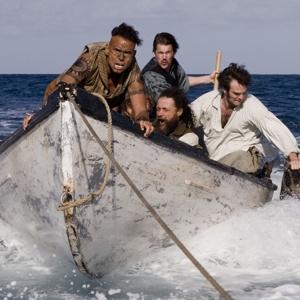
From a recent cable TV movie

From the 1956 movie
Youtube version, recent movie: http://www.youtube.com/watch?v=-R0quok0dR0

From the 1930 Moby Dick Film.
From a recent cable TV movie
From the 1956 movie
Youtube version, recent movie: http://www.youtube.com/watch?v=-R0quok0dR0
8LisaCurcio
The Lee Shore reminded me that Rick told me a while back that I was not a Bulkington. If he is dashed on a lee shore, I agree. I don't want to be dashed on a lee shore.
9A_musing
I don't think I'd fully appreciated the Lee Shore until this time around, when Rick had highlighted it. It really has nothing to do with the plot, but is a great little chapter that really does a lot for the foreboding, the pacing, the sort of abstract themes. It's just stuck there, dealing with a truly minor character, yet adding much to Ishmael's character and to the feeling we've got reading through, with some really wonderful language all through.
10LisaCurcio
One of the things that strikes me-- although I cannot put a finger on what it means--is the way the chapters often end with exclamations and exhortations. Certainly it gives a "feeling" to the tale, but what is it?
11A_musing
It certainly helps drive it along. I end a lot of chapters feeling like I need to think for a bit. A series of open questions.
12dchaikin
I need to skim back through these chapters based on your descriptions in post 1. Apparently, my memory of much of this is already fading. And I may need to re-read The Lee Shore, even if that is a chapter that kind of stuck with me.
13RidgewayGirl
A Quaker with a vengeance. Melville's descriptions of the ship's owners were fabulous. Keep the Sabbath holy, unless there's money to be made, boys!
14A_musing
The name, Bildad, is great there, too. He was the self-assured and pious interrogator of Job whom God found a little wanting in the true piety category. Remind one of any candidates for polical office out there?
15A_musing
>3 RickHarsch:: "Better is it to perish in that howling infinite, than be ingloriously dashed upon the lee, even if that were safety! For worm-like, then, oh! who would craven crawl to land! Terrors of the terrible! is all this agony so vain?"
Yes, things could be worse. This is one of the ways this chapter strikes me as wholly, thematically, at the center of the book, even though it's a short little bit about a minor character that is pretty utterly divorced from the plot of the book. I've reread that chapter several times this reading.
Yes, things could be worse. This is one of the ways this chapter strikes me as wholly, thematically, at the center of the book, even though it's a short little bit about a minor character that is pretty utterly divorced from the plot of the book. I've reread that chapter several times this reading.
16QuentinTom
Sam, you asked in the previous thread, is Moby Dick more than a whale, and I think the answer is buried in 'the lee shore', as well as in other places. For me, the white whale is becoming a symbol of the quest for knowledge itself.
In 'the lee shore', M draws a distinction between 1) positivism and mental conformity: 'I know the world' represented by the land, the lee shore, a slavish mentality (shades of nietzsche here) towards which 'mariners' crawl worm like; and 2) relativism, independent thought, free thinking: 'The world is ultimately unknowable' represented by the formless sea.
The latter - the sea, relativism, the quest - is a man's true domain, the quest for knowledge, where he achieves his apotheosis:
in landlessness alone resides highest truth, shoreless, indefinite as God
The former, when it is a lee shore, is full of dangers to the quest for knowledge, it represents a kind of temptation an ineluctable pull towards the (illusory and ultimately debilitating) safety of conformity:
all deep, earnest thinking is but the intrepid effort of the soul to keep the open independence of her sea; while the wildest winds of heaven and earth conspire to cast her on the treacherous, slavish shore
The white whale with the harpoons hanging off him represents man's attempts to skewer the unknowable mysterious world with his harpoons of knowledge, and ultimately failing. The letter Q - an entity with an implanted barb but also a tail- is also a symbol of this: it resounds again and again throughout this novel, in the names of queequeg-quohog-pequod-the quito spring-queen mab etc etc, and the constant reiteration of the word 'queer', emphasising the strangeness of everything.
This all culminates in the fantastic chapter 'cetology' which is one of the most brilliant things I have read. I will have more to say about this, but need to think more on it.
The metaphysics of this book is beginning to emerge for me. I am in awe.
In 'the lee shore', M draws a distinction between 1) positivism and mental conformity: 'I know the world' represented by the land, the lee shore, a slavish mentality (shades of nietzsche here) towards which 'mariners' crawl worm like; and 2) relativism, independent thought, free thinking: 'The world is ultimately unknowable' represented by the formless sea.
The latter - the sea, relativism, the quest - is a man's true domain, the quest for knowledge, where he achieves his apotheosis:
in landlessness alone resides highest truth, shoreless, indefinite as God
The former, when it is a lee shore, is full of dangers to the quest for knowledge, it represents a kind of temptation an ineluctable pull towards the (illusory and ultimately debilitating) safety of conformity:
all deep, earnest thinking is but the intrepid effort of the soul to keep the open independence of her sea; while the wildest winds of heaven and earth conspire to cast her on the treacherous, slavish shore
The white whale with the harpoons hanging off him represents man's attempts to skewer the unknowable mysterious world with his harpoons of knowledge, and ultimately failing. The letter Q - an entity with an implanted barb but also a tail- is also a symbol of this: it resounds again and again throughout this novel, in the names of queequeg-quohog-pequod-the quito spring-queen mab etc etc, and the constant reiteration of the word 'queer', emphasising the strangeness of everything.
This all culminates in the fantastic chapter 'cetology' which is one of the most brilliant things I have read. I will have more to say about this, but need to think more on it.
The metaphysics of this book is beginning to emerge for me. I am in awe.
17janeajones
brilliantly right on, Murr -- Ahab is the American Faust -- with the tragedy, but without the sardonic humor of being made a fool as Faust is -- Ahab is wild, idealistic, merciless, pure (the ultimate neo-con?). But the crew is the rest of us mongrelized seekers.
18A_musing
One of the quotes there that really speaks to me is "indefinite AS God" - that is, not God but like God. This Lee Shore is very rich.
20QuentinTom
in landlessness alone resides highest truth, shoreless, indefinite as God
yeah, the essence of relativism, I think.
yeah, the essence of relativism, I think.
21QuentinTom
Sam, any input at this point on what Melville's reading of Eastern religions was?
highest truth, shoreless, indefinite
Daoism?
highest truth, shoreless, indefinite
Daoism?
22A_musing
I read Moby Dick as wandering between pantheist and animist poles in many ways, but also with plenty of more modern rationalism thrown in; I'd overlay on some of what you're seeing the very fundamental question of whether man is one with or separate from nature, and one thing I'm puzzling through this read, a read after having read Franklin, is how he's unifying various fairly fundamental mythic structures. Franklin sees Egyptian mythology as at the center of Moby Dick (and I'll get into some of that shortly in the Advocate chapter); I think he's doing more than that with his mythologic renderings, trying to bring together and almost unify and rationalize the myths. I'm seeing more of all of this mythic theme this time around. But I think it just reinforces the central issues you are seeing, the sort of Faustian seeking of knowledge of the unknowable.
The amazing thing is, these are just a couple themes that interweaves with others. There is an epistemological kind of stream - how do we know what we know and how does a writing or thought relate to the world itself - that I think I've only really begun to appreciate post-Confidence Man immersion.
Of course, he pokes fun at all of it as he weaves it. My favorite is when the boat has a whale's head on either side, precariously balancing it, and he points to one head as Locke, another as Kant, and says when both are astride you attain a wobbling balance, where if you have neither, you sail straight without the wobble.
But, let's try to tie it down to the read, along the way, I think we're very deeply into these few inches of text on the Lee Shore, and am looking forward to Ceteology.
The amazing thing is, these are just a couple themes that interweaves with others. There is an epistemological kind of stream - how do we know what we know and how does a writing or thought relate to the world itself - that I think I've only really begun to appreciate post-Confidence Man immersion.
Of course, he pokes fun at all of it as he weaves it. My favorite is when the boat has a whale's head on either side, precariously balancing it, and he points to one head as Locke, another as Kant, and says when both are astride you attain a wobbling balance, where if you have neither, you sail straight without the wobble.
But, let's try to tie it down to the read, along the way, I think we're very deeply into these few inches of text on the Lee Shore, and am looking forward to Ceteology.
23QuentinTom
There is an epistemological kind of stream - how do we know what we know and how does a writing or thought relate to the world itself -
well stated. for me this is the essence of the book and Melville's metaphysical project with it.
well stated. for me this is the essence of the book and Melville's metaphysical project with it.
24Porius
Just stupendous fellas, I only wish I had the time to take part. A good companion here would be Conrad's CHANCE. Once again, very exciting.
26RickHarsch
another word on the Lee Shore. the book's in the other room, but if I recall there is also the bit about the danger of the safe shore once you're asea--the layers of meaning in that discombobulate all my efforts to pin the chapter down
27A_musing
I just posted a link to today's blog post on the chapter The Advocate on the other thread, but thought I would duplicate it here since it really relates to this set of chapters: http://thetreadleoftheloom.blogspot.com/2012/01/primordial-divinity.html
I am going to have more to say on the Advocate in another post, which I'll probably finish up tomorrow.
This is where some of it can get pretty strange. We can't let all these crazy readings and theories muck up the good story well told, right? Any good limericks for the day?
I am going to have more to say on the Advocate in another post, which I'll probably finish up tomorrow.
This is where some of it can get pretty strange. We can't let all these crazy readings and theories muck up the good story well told, right? Any good limericks for the day?
29QuentinTom
I'm forging ahead, can't put the thing down.
I love all the singing and dancing and the whacky shakespearean turn in the vow scene. I note now that this is where Thomas Pynchon gets his singing and dancing scenes: incorporating revue or burlesque/theatre script into a novel, complete with stage directions and songs. Also, the Circe chapter in Ulysses makes more sense now. I'm also curious about Melville's influence on Auden's verse dramas.
some quotes that stuck in my head:
A laugh's the wisest, easiest answer to all that's queer...
All visible objects, man, are as but pasteboard masks. But in each event - ion the living act, the undoubted deed- there, some unknown but still reasoning thing puts forth the mouldings of its features from behind the unreasoning mask.
I love all the singing and dancing and the whacky shakespearean turn in the vow scene. I note now that this is where Thomas Pynchon gets his singing and dancing scenes: incorporating revue or burlesque/theatre script into a novel, complete with stage directions and songs. Also, the Circe chapter in Ulysses makes more sense now. I'm also curious about Melville's influence on Auden's verse dramas.
some quotes that stuck in my head:
A laugh's the wisest, easiest answer to all that's queer...
All visible objects, man, are as but pasteboard masks. But in each event - ion the living act, the undoubted deed- there, some unknown but still reasoning thing puts forth the mouldings of its features from behind the unreasoning mask.
30A_musing
I adore that dance number - Pip's first appearance. But I haven't even begun writing up my thoughts on it.
Reading the dance number, I'm quite sure Melville would have liked our limericks.
Reading the dance number, I'm quite sure Melville would have liked our limericks.
31Macumbeira
I come back to the Christmas day of departure. Sailing on Christmas is not a bad omen ( otherwise it wouldn't be done ) unless it is on a Friday. Serious skippers in the past would avoid, if possible, a Friday departure.
On the other hand Christmas has always been a "family" celebration. Lonely seaman are especially sensible on these days for it makes them think about their companions and kids and mothers and fathers at home, but also if lucky, about their own joyful Christmas days when young. It happened twice to me to be at sea at Christmas and I still remember some kind of sadness when I think about it. We celebrated alright, but everybody was with his mind elsewhere.
Christmas at sea really emphasizes the loneliness of the sailor. I am sure Melville remembered those feelings when he wrote the book
On the other hand Christmas has always been a "family" celebration. Lonely seaman are especially sensible on these days for it makes them think about their companions and kids and mothers and fathers at home, but also if lucky, about their own joyful Christmas days when young. It happened twice to me to be at sea at Christmas and I still remember some kind of sadness when I think about it. We celebrated alright, but everybody was with his mind elsewhere.
Christmas at sea really emphasizes the loneliness of the sailor. I am sure Melville remembered those feelings when he wrote the book
32A_musing
Note Peleg and Bildad have trouble parting with their "family" though. I agree that it emphasizes the loneliness in general, but he also sees some of the ties there.
33Macumbeira
What do you mean ?
34A_musing
After escorting the ship to sea, it is harD for them to leave. I sense it is as much the sea they long for, as anything - lonely, but still a place they love.
35Macumbeira
They don't love the sea... They are sailors and whalers, it is their way to make a living...
If they linger on board, I think it is because they are worried about the capital invested and people involved and that they are giving away the responsibility over the ship. It is an investment which takes three year to eventually bring profit and there is no way to make half year assessments in between : )
Peleg and Bildad are well aware that this could be the last time they see their boat and their crew...
If they linger on board, I think it is because they are worried about the capital invested and people involved and that they are giving away the responsibility over the ship. It is an investment which takes three year to eventually bring profit and there is no way to make half year assessments in between : )
Peleg and Bildad are well aware that this could be the last time they see their boat and their crew...
37QuentinTom
I agree with mac, I got the feeling that B and P were worried about their investment. and perhaps a reluctance to begin the long period of anxious waiting.
38Macumbeira
36 "And it may be the boat more than the crew".
if they were sailing today I would say yes. But them being Quakers, Patriarchal and very religious, I think they are worried about their people too, like a herder would worry about his cattle. There is not one man too many on the boat, they cannot afford crew losses. each loss is less speed in the sloops, less chance to catch up with the whale etc etc
Whalers were rather "good" boats compared to other vessels. One needed a crew in athletic condition. Profit was not made by cutting costs on food or clothes or so. They took care of their crew on Whalers.
Whalers were also the first boats where a woman, mostly the wife of the captain, was accepted as normal. She participated in life on board and functioned often as a surrogate mother for the sailors.
if they were sailing today I would say yes. But them being Quakers, Patriarchal and very religious, I think they are worried about their people too, like a herder would worry about his cattle. There is not one man too many on the boat, they cannot afford crew losses. each loss is less speed in the sloops, less chance to catch up with the whale etc etc
Whalers were rather "good" boats compared to other vessels. One needed a crew in athletic condition. Profit was not made by cutting costs on food or clothes or so. They took care of their crew on Whalers.
Whalers were also the first boats where a woman, mostly the wife of the captain, was accepted as normal. She participated in life on board and functioned often as a surrogate mother for the sailors.
39A_musing
It's a lovely passage, that I think gives us a mix of some real emotion and some mixed motives for the emotion:
"It was curious and not unpleasing, how Peleg and Bildad were affected at this juncture, especially Captain Bildad. For loath to depart, yet; very loath to leave, for good, a ship bound on so long and perilous a voyage - beyond both stormy Capes; a ship in which some thousands of his hard earned dollars were invested; a ship, in which an old shipmate sailed as captain; a man almost as old as he, once more starting to encounter all the terrors of the pitiless jaw; loath to say good-bye to a thing so every way brimful of every interest to him, - poor old Bildad lingered long; paced the deck with anxious strides" ran down into the cabin to speak another farewell word there; again came on deck, and looked to windward; looked towards the wide and endless waters, only bounded by the far-off unseen Eastern Continents; looked towards the land, looked aloft; looked right and left; looked everywhere and nowhere; and at last, mechanically coiling a rope upon its pin, convulsively grasped stout Peleg by the hand, and holding up a lantern, for a moment stood gazing heroically in his face, as much as to say, "Nevertheless, friend Peleg, I can stand it; yes, I can."
As for Peleg himself, he took it more like a philosopher; but for all his philosophy, there was a tear twinkling in his eye, when the lantern came too near. And he, too, did not a little run from cabin to deck - now a word below, and now a word with Starbuck, the chief mate.
But, at last, he turned to his comrade, with a final sort of look about him, - "Captain Bildad - come, old shipmate, we must go. Back the main-yard there! Boat ahoy! Stand by to come close alongside, now! Careful, careful! - come, Bildad, boy - say your last. Luck to ye, Starbuck - luck to ye, Mr. Stubb - luck to ye,
Mr. Flask - good-bye, and good luck to ye all - and this day three years I'll have a hot supper smoking for ye in old Nantucket. Hurrah and away!"
"God bless ye, and have ye in His holy keeping, men," murmured old Bildad, almost incoherently. "I hope ye'll have fine weather now, so that Captain Ahab may soon be moving among ye - a pleasant sun is all he needs, and ye'll have plenty of them in the tropic voyage ye go. Be careful in the hunt, ye mates. Don't stave the boats needlessly, ye harpooneers; good white cedar plank is raised full three per cent. within the year. Don't forget your prayers, either. Mr Starbuck, mind that cooper don't waste the spare staves. Oh! the sail-needles are in the green locker! Don't whale it too much a' Lord's days, men; but don't miss a fair chance either, that's rejecting Heaven's good gifts. Have an eye to the molasses tierce, Mr. Stubb; it was a little leaky, I thought. If ye touch at the islands, Mr. Flask, beware of fornication. Good-bye, good-bye! Don't keep that cheese too long down in the hold, Mr. Starbuck; it'll spoil. Be careful with the butter - twenty cents the pound it was, and mind ye, if - "
"Come, come, Captain Bildad; stop palavering, - away!" and with that, Peleg hurried him over the side, and both dropt into the boat. "
***
I like the particular concern for Ahab, of about their age - there is an empathy there - and for Starbuck, Stubb and Flask. The tear in Peleg's eye I don't think is wholly about money, but still strong elements of their greatest asset.
"It was curious and not unpleasing, how Peleg and Bildad were affected at this juncture, especially Captain Bildad. For loath to depart, yet; very loath to leave, for good, a ship bound on so long and perilous a voyage - beyond both stormy Capes; a ship in which some thousands of his hard earned dollars were invested; a ship, in which an old shipmate sailed as captain; a man almost as old as he, once more starting to encounter all the terrors of the pitiless jaw; loath to say good-bye to a thing so every way brimful of every interest to him, - poor old Bildad lingered long; paced the deck with anxious strides" ran down into the cabin to speak another farewell word there; again came on deck, and looked to windward; looked towards the wide and endless waters, only bounded by the far-off unseen Eastern Continents; looked towards the land, looked aloft; looked right and left; looked everywhere and nowhere; and at last, mechanically coiling a rope upon its pin, convulsively grasped stout Peleg by the hand, and holding up a lantern, for a moment stood gazing heroically in his face, as much as to say, "Nevertheless, friend Peleg, I can stand it; yes, I can."
As for Peleg himself, he took it more like a philosopher; but for all his philosophy, there was a tear twinkling in his eye, when the lantern came too near. And he, too, did not a little run from cabin to deck - now a word below, and now a word with Starbuck, the chief mate.
But, at last, he turned to his comrade, with a final sort of look about him, - "Captain Bildad - come, old shipmate, we must go. Back the main-yard there! Boat ahoy! Stand by to come close alongside, now! Careful, careful! - come, Bildad, boy - say your last. Luck to ye, Starbuck - luck to ye, Mr. Stubb - luck to ye,
Mr. Flask - good-bye, and good luck to ye all - and this day three years I'll have a hot supper smoking for ye in old Nantucket. Hurrah and away!"
"God bless ye, and have ye in His holy keeping, men," murmured old Bildad, almost incoherently. "I hope ye'll have fine weather now, so that Captain Ahab may soon be moving among ye - a pleasant sun is all he needs, and ye'll have plenty of them in the tropic voyage ye go. Be careful in the hunt, ye mates. Don't stave the boats needlessly, ye harpooneers; good white cedar plank is raised full three per cent. within the year. Don't forget your prayers, either. Mr Starbuck, mind that cooper don't waste the spare staves. Oh! the sail-needles are in the green locker! Don't whale it too much a' Lord's days, men; but don't miss a fair chance either, that's rejecting Heaven's good gifts. Have an eye to the molasses tierce, Mr. Stubb; it was a little leaky, I thought. If ye touch at the islands, Mr. Flask, beware of fornication. Good-bye, good-bye! Don't keep that cheese too long down in the hold, Mr. Starbuck; it'll spoil. Be careful with the butter - twenty cents the pound it was, and mind ye, if - "
"Come, come, Captain Bildad; stop palavering, - away!" and with that, Peleg hurried him over the side, and both dropt into the boat. "
***
I like the particular concern for Ahab, of about their age - there is an empathy there - and for Starbuck, Stubb and Flask. The tear in Peleg's eye I don't think is wholly about money, but still strong elements of their greatest asset.
40RickHarsch
There was a fine writer named Melville
who tried a fish book in sellville
but the too fine print
made the bildads squint
and they kicked his ass back to smellville
who tried a fish book in sellville
but the too fine print
made the bildads squint
and they kicked his ass back to smellville
41RickHarsch
A marvelous writer named Hank
Rode a big white whale that sank
The thoughts were big
for a US rig
but it was the critics themselves who stank
Rode a big white whale that sank
The thoughts were big
for a US rig
but it was the critics themselves who stank
42QuentinTom
bravo!
technical question: What is ishmael's status on the ship? is he an officer or an ordinary seaman? if the latter, how does he know about the goings on at the captain's table?
technical question: What is ishmael's status on the ship? is he an officer or an ordinary seaman? if the latter, how does he know about the goings on at the captain's table?
43A_musing
Murr is on the chapter "The Cabin Table".
Ordinary seaman. He mentions at one point looking through a porthole at the goings on, but that wouldn't be enough to get all the dialogue, would it? Is it still Ishmael talking here? Does the language of the chapter sound like Ishmael?
Absolutely adore those Rick.
Ordinary seaman. He mentions at one point looking through a porthole at the goings on, but that wouldn't be enough to get all the dialogue, would it? Is it still Ishmael talking here? Does the language of the chapter sound like Ishmael?
Absolutely adore those Rick.
44Macumbeira
ordinary, not even able seaman ?
47A_musing
Remind me sometime to tell you about the time I had a run in with a five foot whale penis. But it is too late now for that yarn - maybe Mac has a sailor's story to add when he gets up.
So no one realized they explode? That has happened with some smaller ones that beached near here.
So no one realized they explode? That has happened with some smaller ones that beached near here.
48Macumbeira
How did you know I was sleeping ?
A Musing you are close to my time zone ?
A Musing you are close to my time zone ?
49Macumbeira
45 LOL
Onassis who married Jacqueline Bouvier ( Kennedy ), had on his yacht bar stools which were covered with the hide of a whale penis. He would wait till his women guests would sit comfortably at the bar and then tell them that they were sitting on a whale's dick ! He loved it when they jumped off with surprised excited yaps !
Onassis who married Jacqueline Bouvier ( Kennedy ), had on his yacht bar stools which were covered with the hide of a whale penis. He would wait till his women guests would sit comfortably at the bar and then tell them that they were sitting on a whale's dick ! He loved it when they jumped off with surprised excited yaps !
50RickHarsch
It is not polite to talk about a woman's yaps.
51A_musing
Just thinking a bit on Quakerism as well (and that Q!), and supplementing my "wide world" post on what was going on in the world in 1850, it's also useful to understand a couple of fundamentals about Quakers, since not just Ahab but several other crew members and the owners of the Peqod are Quakers.
One of the key beliefs among Quakers is a doctrine that there is continuing revelation of God's will; so the Bible is not a static, historical document, but rather revelation is ongoing, occurs every day (not being confined to the Sabbath, which they play down; they also play down religious holidays like Christmas), and occurs to ordinary people, not needing priests, bishops or other people with some kind of "special" knowledge. The Bible is a touchstone, but not a limiting force when it comes to understanding God and God's will. There is a strong leveling, democratic tendancy to Quakerism.
One of the key beliefs among Quakers is a doctrine that there is continuing revelation of God's will; so the Bible is not a static, historical document, but rather revelation is ongoing, occurs every day (not being confined to the Sabbath, which they play down; they also play down religious holidays like Christmas), and occurs to ordinary people, not needing priests, bishops or other people with some kind of "special" knowledge. The Bible is a touchstone, but not a limiting force when it comes to understanding God and God's will. There is a strong leveling, democratic tendancy to Quakerism.
52QuentinTom
so what was Melville's own relationship to Quakerism?
53A_musing
None that I know of, though he certainly would have spent a lot of time on board with many of them. There is a hot debate over what religioun he personally subscribed to, focusing on churches attended mainly by his wife or parents and schools he attended. Frankly, I read most of those discussions and feel like the evidence one way or the other is all so thin that my eyes glaze over and the discussions get no traction. We're better off reading his books for his religious feelings than trying to parse through who his gurus were.
Quakers are also pacifists, of course, which is why you get many of the "fighting quaker" references.
Quakers are also pacifists, of course, which is why you get many of the "fighting quaker" references.
56anna_in_pdx
Slick,
My co-worker from Boston would like a word.
My co-worker from Boston would like a word.
58anna_in_pdx
Now THAT's a great name for CG's kid, regardless of gender!
60A_musing
After talking mythology and diving into the background history in the last couple of blog posts, today I have a pretty straightforward one about The Advocate and the role this chapter plays in the book. http://thetreadleoftheloom.blogspot.com/2012/01/break.html
There is a lot here. While it is much more concrete that the Lee Shore, the chapter really does help create a break in the book and frame much of what will come as we set to sea and the adventure is upon us.
There is a lot here. While it is much more concrete that the Lee Shore, the chapter really does help create a break in the book and frame much of what will come as we set to sea and the adventure is upon us.
61A_musing
I have some thoughts and posts brewing on The Pipe, Cetology, the Mast Head, and the Play chapters above, and certainly won't have them all posted by Sunday. Should we let the opening of the next thread, and thus the read schedule, slip a bit, or should I open the thread Sunday anyways? The next section of chapters starts with The Whiteness of the Whale, a big and important chapter.
By the way, the chapters introducing the crew and Ahab were pretty heavily dealt with in my December blog posts on the characters. I'm not going to post more on them now, but if anyone has thoughts, questions, observations on them, they all make for good discussion. There is a lot in there about all our key players here.
By the way, the chapters introducing the crew and Ahab were pretty heavily dealt with in my December blog posts on the characters. I'm not going to post more on them now, but if anyone has thoughts, questions, observations on them, they all make for good discussion. There is a lot in there about all our key players here.
62A_musing
Murr has posted a great quote from Melville on Shakespeare over on his blog: http://thelectern.blogspot.com/2012/01/melville-on-shakespeare.html
63QuentinTom
sam, can you put the link to your blog posts on the characters. I'm having problems navigating your blog. I think my browser must be prehistoric or something.
I'm up to the town ho chapter, but I"m forging ahead coz I can't put the thing down. Don't mind me. looking forward to the discussion on cetology, I have lots of thoughts on that.
I'm up to the town ho chapter, but I"m forging ahead coz I can't put the thing down. Don't mind me. looking forward to the discussion on cetology, I have lots of thoughts on that.
64A_musing
You may have more to say on Cetology than I do - don't hold back!
Here is the bit on Ahab, that refers to several of these chapters: http://thetreadleoftheloom.blogspot.com/2011/12/enter-ahab.html
Here is one on the harpooners: http://thetreadleoftheloom.blogspot.com/2011/12/harpooners.html
That draws some from these chapters, some from later, when Fedallah appears.
I just realized I had not finished and posted on the officers, and that has some more in it. I'll finish that up and we will have some more on these chapters soon.
Here is the bit on Ahab, that refers to several of these chapters: http://thetreadleoftheloom.blogspot.com/2011/12/enter-ahab.html
Here is one on the harpooners: http://thetreadleoftheloom.blogspot.com/2011/12/harpooners.html
That draws some from these chapters, some from later, when Fedallah appears.
I just realized I had not finished and posted on the officers, and that has some more in it. I'll finish that up and we will have some more on these chapters soon.
65Macumbeira
There is something in Quaker belief about Evil. That Evil is white for instance and they wear black clothes...
66QuentinTom
looking forward to it, Sam, thanks for all your efforts!
67LisaCurcio
Just at "Sunset". Ahab admits to being demoniac--with his reference to wearing the Iron Crown of Lombardy is he also showing that he is egomaniac?
We could wait a couple of days for the new thread.
We could wait a couple of days for the new thread.
68A_musing
I'll have some more substantive posting tonight. In the meantime, I offer a minor meditation on a minor chapter: http://thetreadleoftheloom.blogspot.com/2012/01/pipe_12.html
Lisa, very important, both the egomania and the demonic element. Whatever he is, Ahab is furiously self-aware.
Mac, very interested in the evil as white bit. I may have to look into that.
Lisa, very important, both the egomania and the demonic element. Whatever he is, Ahab is furiously self-aware.
Mac, very interested in the evil as white bit. I may have to look into that.
69Macumbeira
It always makes me think about the first Hannibal the Cannibal movie... silence of the goats...
The producer made sure to dress Lecter in white because it was the color of evil and ... because it reminded him of his dentist...
The producer made sure to dress Lecter in white because it was the color of evil and ... because it reminded him of his dentist...
70A_musing
I had a little fun with Cetology: http://thetreadleoftheloom.blogspot.com/2012/01/of-cetology-and-chaos.html
71A_musing
Lisa, just re-read Sunset. It's really a strange little bit of stream-of-consciousness running through his head. He's talking of the weight of that iron crown on his head, but also used "iron" to refer to his unbending will, the "iron way". He's also talking about getting no comfort - nothing will "soothe" him, which is like the pipe chapter, when he throws the pipe overboard because it doesn't soothe him.
Very much builds him up as not just as egomaniac, but as really mono-maniacal too, and self-consciously so.
Very much builds him up as not just as egomaniac, but as really mono-maniacal too, and self-consciously so.
72QuentinTom
Melville is self consciously creating Ahab in the tradition of Lear, Tamurlaine, Oedipus, Dr Faustus, everytime he appears he has these monologues in which Melville's prose takes on the quality of ancient marble: monolithic, tragic, monumental. The first time he does this I was unsure about it: is it mere pastiche of Shakespeare, Marlowe, the great tragic thunderers? But I believe in its sincerity. This is part of the risk we were talking about on my thread. Elevation or Pastiche? Will the reader's response to this device be awe, or a snigger?
Whenever Ahab appears, the novel stops being a novel and becomes a tragedy, the Pequod stops being a ship, and it becomes a stage.
A short space elapsed, and up into this noiselessness came Ahab, alone from his cabin.
Exeunt. Pause. Enter Ahab stage right.
and recently I read this, which just blew my topsails off:
Silence reigned over the before tumultuous but now deserted deck. An intense copper calm, like a universal yellow lotus, was more and more unfolding its noiseless measureless leaves upon the sea.
fuck me. I mean, fuck me. Writing rarely gets better than this.
Whenever Ahab appears, the novel stops being a novel and becomes a tragedy, the Pequod stops being a ship, and it becomes a stage.
A short space elapsed, and up into this noiselessness came Ahab, alone from his cabin.
Exeunt. Pause. Enter Ahab stage right.
and recently I read this, which just blew my topsails off:
Silence reigned over the before tumultuous but now deserted deck. An intense copper calm, like a universal yellow lotus, was more and more unfolding its noiseless measureless leaves upon the sea.
fuck me. I mean, fuck me. Writing rarely gets better than this.
73A_musing
Right on target - with the sole exception that it is not just monologues. Some of them are stream-of-consciousness, inside his head where Shakespeare didn't get.
74QuentinTom
mmmmmmm Shakespeare's monologues are streams of consciousness: Shakespeare is always inside his character's heads when they soliloquize.
75A_musing
Yes, but in a novel they get to be written as actual streams of consciousness, more disjointed and rambling. I think he's got a keen sense of using Shakespearian techniques, but melding them in with some of the novelistic ones.
Dropping Ishmael's voice for some of these, using stage direction as part of building it up, all part of the dramatic technique. He uses the Shakespearian, but also uses the novelistic, so he builds up Ahab in the novelistic chapter, "Ahab", then, in the next one, he goes Shakesperian and dramatic on us in "Enter Ahab; to him, Stubb".
Dropping Ishmael's voice for some of these, using stage direction as part of building it up, all part of the dramatic technique. He uses the Shakespearian, but also uses the novelistic, so he builds up Ahab in the novelistic chapter, "Ahab", then, in the next one, he goes Shakesperian and dramatic on us in "Enter Ahab; to him, Stubb".
76QuentinTom
excellent stuff on 'cetology', sam. I am thinking along the same lines.
Here are some of my notes, which I will probably develop later into (the first volume of) my review ;)
The text tells us that many whalers in the fishery have sighted a white whale.
This gives rise to two questions:
1. Have they all seen the same white whale?
2. Is this white whale Moby Dick, or another white whale?
These two questions involve the fundamental elements of ratiocination, of knowledge, of the quest for knowledge, of epistemology:
1.Categorisation
2.Naming
The novel is obsessed with categorisation. 'Cetelogy' is only the first. In the chapter called 'the whiteness of the whale', the category 'white' is explored in more detail. We are given details of other categories: literary whales, whales in art and the fine arts, we are presented with detailed information of the lore, practice, technology and culture of whaling. The status of knowledge is explored: knowledge from books, or knowledge from experience? Knowledge from naturalists, or knowledge from whalers. Only whalers have actually seen whales. This status also involves a categorisation.
for me this is the metaphysical project of the book: it's an enquiry into the origins and status of knowledge, basically an epistemology.
By the way are you familiar with this:
http://www.amazon.com/gp/product/0691146152/ref=s9_simh_gw_p14_d3_g14_i1?pf_rd_m...
http://www.nature.com/nature/journal/v450/n7173/full/4501161a.html
this court case involved categorisation and naming, and also the status of knowledge: is knowledge something to be defined by those in authority, the church?
or is it something democratic, based on experience and observation? how does categorisation, perception and naming play into this?
This ties in to what Captainsflat is hinting at in the previous thread, I think, about American values.
anyway, this all needs more development.
Here are some of my notes, which I will probably develop later into (the first volume of) my review ;)
The text tells us that many whalers in the fishery have sighted a white whale.
This gives rise to two questions:
1. Have they all seen the same white whale?
2. Is this white whale Moby Dick, or another white whale?
These two questions involve the fundamental elements of ratiocination, of knowledge, of the quest for knowledge, of epistemology:
1.Categorisation
2.Naming
The novel is obsessed with categorisation. 'Cetelogy' is only the first. In the chapter called 'the whiteness of the whale', the category 'white' is explored in more detail. We are given details of other categories: literary whales, whales in art and the fine arts, we are presented with detailed information of the lore, practice, technology and culture of whaling. The status of knowledge is explored: knowledge from books, or knowledge from experience? Knowledge from naturalists, or knowledge from whalers. Only whalers have actually seen whales. This status also involves a categorisation.
for me this is the metaphysical project of the book: it's an enquiry into the origins and status of knowledge, basically an epistemology.
By the way are you familiar with this:
http://www.amazon.com/gp/product/0691146152/ref=s9_simh_gw_p14_d3_g14_i1?pf_rd_m...
http://www.nature.com/nature/journal/v450/n7173/full/4501161a.html
this court case involved categorisation and naming, and also the status of knowledge: is knowledge something to be defined by those in authority, the church?
or is it something democratic, based on experience and observation? how does categorisation, perception and naming play into this?
This ties in to what Captainsflat is hinting at in the previous thread, I think, about American values.
anyway, this all needs more development.
78dchaikin
I was reading the first paragraph of the book over again (http://www.princeton.edu/~batke/moby/moby_001.html ), pondering over the various meanings of "I account it high time to get to sea" and had the idea that Melville was talking about writing itself. That he was comparing getting lost in the unpredictable sea to that of getting lost in a writing project...and that there was a psychological need behind his doing this.
I know this is suspect. But, anyway, my thoughts intertwined with my knowledge that we are reading a book that didn't sell, and was only re-discovered much later. This makes me wonder about Melville's expectations with this book. Is it possible that he knew the general reading public wouldn't get it, and wouldn't be interested, and is it possible that he was writing this mainly for himself?
Which brings me to Cetology. That there are deeper meanings here, eloquently captured in Sam's post, is a big deal. But there is also a practical side, it's a story set-up, and it's manipulated. Most of this book feels like a stage set-up so far. Melville is going around his main topic and filling in the context so that when we get to heart of the story we have all the requisite information. He is covering every angle, and with layering. He is setting up all the various contexts all on the different ways we may or may not read this book on. And it's all done with such care, that each section by itself, is in full color.
In Cetology, Melville is constructing his frame. He needed the reader to be thinking about Moby Dick in the context of one of a variety of animals. And Melville's elaborations on this are very detailed and yet not practically useful except within the text itself. Cetology is a signature chapter in the sense that he lays out all this manipulated detail in order to construct a frame in which to view the book as a whole.
And we're left with a sense of thoroughness behind this all. A patient need to capture and record everything so that the work is complete. And, to do so in such a way that gives attention and beauty to all the details.
What I'm struggling to say is that this has a very personal feel to it. He does it this way because that is how he needs to construct it in his own mind. He is building this book for himself as much as, or even more than, he is building it for us.
I know this is suspect. But, anyway, my thoughts intertwined with my knowledge that we are reading a book that didn't sell, and was only re-discovered much later. This makes me wonder about Melville's expectations with this book. Is it possible that he knew the general reading public wouldn't get it, and wouldn't be interested, and is it possible that he was writing this mainly for himself?
Which brings me to Cetology. That there are deeper meanings here, eloquently captured in Sam's post, is a big deal. But there is also a practical side, it's a story set-up, and it's manipulated. Most of this book feels like a stage set-up so far. Melville is going around his main topic and filling in the context so that when we get to heart of the story we have all the requisite information. He is covering every angle, and with layering. He is setting up all the various contexts all on the different ways we may or may not read this book on. And it's all done with such care, that each section by itself, is in full color.
In Cetology, Melville is constructing his frame. He needed the reader to be thinking about Moby Dick in the context of one of a variety of animals. And Melville's elaborations on this are very detailed and yet not practically useful except within the text itself. Cetology is a signature chapter in the sense that he lays out all this manipulated detail in order to construct a frame in which to view the book as a whole.
And we're left with a sense of thoroughness behind this all. A patient need to capture and record everything so that the work is complete. And, to do so in such a way that gives attention and beauty to all the details.
What I'm struggling to say is that this has a very personal feel to it. He does it this way because that is how he needs to construct it in his own mind. He is building this book for himself as much as, or even more than, he is building it for us.
79A_musing
I was reading a passage last night later in the book that I think you'll find interesting with that reading:
"One often hears of writers that rise and swell with their subject, though it may seem but an ordinary one. How, then, with me, writing of this Leviathan? Unconsciously my chirography expands into placard capitals. Give me a condor's quill! Give me Vesuvius' crater for an inkstand! Friends, hold my arms! For in the mere act of penning my thoughts of this Leviathan, they weary me, and make me faint with their out-reaching comprehensiveness of sweep, as if to include the whole circle of the sciences, and all the generations of whales, and men, and mastodons, past, present, and to come, with all the revolving panoramas of empire on earth, and throughout the whole universe, not excluding its suburbs. Such, and so magnifying, is the virtue of a large and liberal theme! We expand to its bulk. To produce a mighty book, you must choose a mighty theme. No great and enduring volume can ever be written on the flea, though many there be who have tried it. "
***
Confidence-Man is a really self-conscious discourse on writing; I had not realized until this read-through, with C-M behind me, just how much this book is, too. I keep seeing some of the same things you are seeing, and that read of the opening is worth considering.
I think Melville wants us to play with and create different reads of his book; he expects each of us to see different things in our reading.
An interesting speculation that I got yesterday from my daughter: Ishmael and Samuel are near cognates in Hebrew; they have the same root and apparently the symbols for them only vary slightly. Could we also reference Samuel, the prophet who turns down a crown when the Hebrews start looking for a king, as a touchstone for Ishmael?
"One often hears of writers that rise and swell with their subject, though it may seem but an ordinary one. How, then, with me, writing of this Leviathan? Unconsciously my chirography expands into placard capitals. Give me a condor's quill! Give me Vesuvius' crater for an inkstand! Friends, hold my arms! For in the mere act of penning my thoughts of this Leviathan, they weary me, and make me faint with their out-reaching comprehensiveness of sweep, as if to include the whole circle of the sciences, and all the generations of whales, and men, and mastodons, past, present, and to come, with all the revolving panoramas of empire on earth, and throughout the whole universe, not excluding its suburbs. Such, and so magnifying, is the virtue of a large and liberal theme! We expand to its bulk. To produce a mighty book, you must choose a mighty theme. No great and enduring volume can ever be written on the flea, though many there be who have tried it. "
***
Confidence-Man is a really self-conscious discourse on writing; I had not realized until this read-through, with C-M behind me, just how much this book is, too. I keep seeing some of the same things you are seeing, and that read of the opening is worth considering.
I think Melville wants us to play with and create different reads of his book; he expects each of us to see different things in our reading.
An interesting speculation that I got yesterday from my daughter: Ishmael and Samuel are near cognates in Hebrew; they have the same root and apparently the symbols for them only vary slightly. Could we also reference Samuel, the prophet who turns down a crown when the Hebrews start looking for a king, as a touchstone for Ishmael?
80A_musing
And on the framing: I think you are right, and that Cetology is also the first in a series of chapters that similarly frame the book; the next in this series will be "The Whiteness of the Whale".
81A_musing
Murr, I wasn't familiar with that - it looks fascinating.
One of the things I'm playing with is whether it's right to say it's about categorization as such or whether he is exploring approaches to knowledge in general, a sort of broader concept that categorization.
But, having said it, I'm mentally stepping through the post-Cetology chapters like Whiteness and seeing lots of focus on the concept of categorization as such.
Might be time to revisit the extracts at the beginning, too. There's some interesting thoughts to be had thinking about those little gems and categorization.
One of the things I'm playing with is whether it's right to say it's about categorization as such or whether he is exploring approaches to knowledge in general, a sort of broader concept that categorization.
But, having said it, I'm mentally stepping through the post-Cetology chapters like Whiteness and seeing lots of focus on the concept of categorization as such.
Might be time to revisit the extracts at the beginning, too. There's some interesting thoughts to be had thinking about those little gems and categorization.
82RidgewayGirl
And then he returns to the subject again with a comparison between the sperm whale and the right whale. Every time a little bit more.
I did end up looking up pictures of the sperm and right whales. That is quite a jaw on the sperm whale!
I did end up looking up pictures of the sperm and right whales. That is quite a jaw on the sperm whale!
83RickHarsch
Tell Ahab!
84anna_in_pdx
I have started Cetology today. I am happy to have made it thus far!
86A_musing
Two chapters I really love, The Cabin Table and The Mast-Head: http://thetreadleoftheloom.blogspot.com/2012/01/heed-well-ye-pantheists.html
I think these form a very important kind of interlude between the challenging Cetology chapter and the exotic dramatic chapters; they also have some wonderful images and language in them. I really do believe Melville offerred them in part as a reward for the climb that was Cetology.
I think these form a very important kind of interlude between the challenging Cetology chapter and the exotic dramatic chapters; they also have some wonderful images and language in them. I really do believe Melville offerred them in part as a reward for the climb that was Cetology.
87A_musing
Today, the all important dramatic chapters: http://thetreadleoftheloom.blogspot.com/2012/01/stage-storm-enter-pip.html
As Murr has already pointed out, you cannot see enough Shakespeare here. Really, we know from his letters that as he wrote this, Melville was totally Shakespeare obsessed, and scribbling notes about the book on his Shakespeare edition.
I am going to open the next thread later tonight; we'll try to open it with the Whiteness of the Whale Chapter, and then move on from there.
As Murr has already pointed out, you cannot see enough Shakespeare here. Really, we know from his letters that as he wrote this, Melville was totally Shakespeare obsessed, and scribbling notes about the book on his Shakespeare edition.
I am going to open the next thread later tonight; we'll try to open it with the Whiteness of the Whale Chapter, and then move on from there.
88dchaikin
Thanks for these, Sam. I do love that excerpt from The Mast-Head, a favorite chapter so far.
89A_musing
Thanks - I'm a personal fan of that "mystic" chapter myself. It's the poetry of it.
One of the things I think we really see in this batch of chapters is what drives Melville's innovative forms. I always get the feeling the 20th century innovators were driven by the idea of innovation itself - they want to make "it" "new", and it doesn't matter what "it" is. For the most part, they're poseurs.
But, here, I think we see that Melville has a problem. He wants to tell a story with two enormously larger than life figures in it, Ahab and the Whale, and to do that, he has to figure out how to really really really build them up. His innovation answers his problem: how do I make Ahab a Huge figure, not just a sad, bitter old man on a tiny, ricketty boat in a great big sea who, like thousands of others, will die at sea. And how do we make a whale something other than a large hunk of floating fat?
These chapters really take on these problems, first with Cetology, then with the Dramatic chapters, glued together by The Mast-Head and The Cabin Table.
One of the things I think we really see in this batch of chapters is what drives Melville's innovative forms. I always get the feeling the 20th century innovators were driven by the idea of innovation itself - they want to make "it" "new", and it doesn't matter what "it" is. For the most part, they're poseurs.
But, here, I think we see that Melville has a problem. He wants to tell a story with two enormously larger than life figures in it, Ahab and the Whale, and to do that, he has to figure out how to really really really build them up. His innovation answers his problem: how do I make Ahab a Huge figure, not just a sad, bitter old man on a tiny, ricketty boat in a great big sea who, like thousands of others, will die at sea. And how do we make a whale something other than a large hunk of floating fat?
These chapters really take on these problems, first with Cetology, then with the Dramatic chapters, glued together by The Mast-Head and The Cabin Table.
90QuentinTom
Excellent analysis. As far as I know, Melville wrote his Hawthorne essay - in which he wrote about Shakespeare - while he was at work on Moby Dick.
for those who missed it:
http://thelectern.blogspot.com/2012/01/melville-on-shakespeare.html
for those who missed it:
http://thelectern.blogspot.com/2012/01/melville-on-shakespeare.html
91QuentinTom
it just occurred to me reading your blog post sam, that the removal of Ishmael as a controlling force in the discourse during these dramatic sections acts as a kind of liberation of language. There is something wild and uncontrolled, liberated, about the language in these sections, especially in pip's closing speech. James Joyce eat your heart out!

