THE DEEP ONES: "Necromancy in Naat" by Clark Ashton Smith
Talk The Weird Tradition
Join LibraryThing to post.
This topic is currently marked as "dormant"—the last message is more than 90 days old. You can revive it by posting a reply.
1gwendetenebre
"Necromancy in Naat" by Clark Ashton Smith (pub. 1936)
Discussion begins February 22
First published in this issue of Weird Tales

ONLINE VERSIONS
http://www.eldritchdark.com/writings/short-stories/151/necromancy-in-naat
PRINT VERSIONS
Zothique
The Last Hieroglyph
The Emperor of Dreams
MISCELLANY
http://www.eldritchdark.com/articles/reviews/68/introduction-to-%27tales-of-zoth...
http://www.blackgate.com/the-fantasy-cycles-of-clark-ashton-smith-part-iii-tales...
http://en.wikipedia.org/wiki/Zothique
Discussion begins February 22
First published in this issue of Weird Tales

ONLINE VERSIONS
http://www.eldritchdark.com/writings/short-stories/151/necromancy-in-naat
PRINT VERSIONS
Zothique
The Last Hieroglyph
The Emperor of Dreams
MISCELLANY
http://www.eldritchdark.com/articles/reviews/68/introduction-to-%27tales-of-zoth...
http://www.blackgate.com/the-fantasy-cycles-of-clark-ashton-smith-part-iii-tales...
http://en.wikipedia.org/wiki/Zothique
2artturnerjr
Don't have access to a print version of this so I'll be reading it online.
3paradoxosalpha
I'll be reading this one in the Arkham House CAS anthology A Rendezvous in Averoigne.
4gwendetenebre
The Last Hieroglyph from Night Shade Books for me!
5paradoxosalpha
Well, that was just horrifying, and funny, and ... sweet?
6gwendetenebre
Still reading, but thought I'd share the Night Shade Books cover. That's CAS himself, of course. I believe that the big head in the background is one of his sculptures, too.


7paradoxosalpha
It just now occurred to me (while viewing the picture below) that the three necromancers of this story suggest a parody of the biblical gospel. If they are the "three magi" of the future aeon of Zothique, then note the inversions:
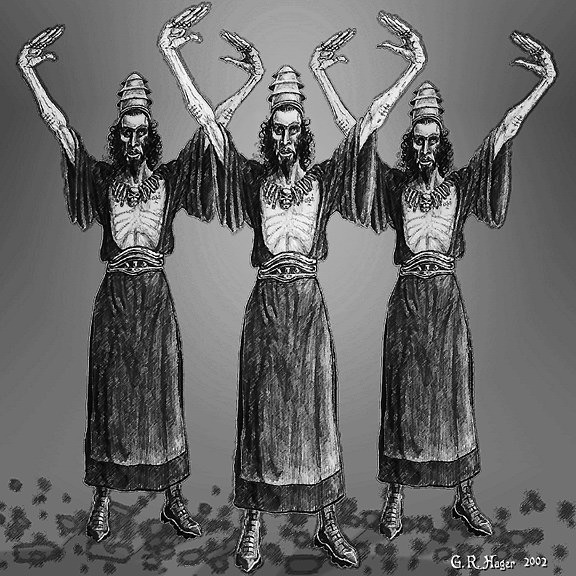
- Yadar and Dalili (twisted from Joseph and Mary) come to the magi, rather than the magi to them. (And the guiding influence is a black ocean current, rather than starlight.)
- The inaugurating event of the narrative is death, rather than birth. And Dalili is magically sterile, rather than miraculously fertile.
- There is to be no redeeming death, since the liches stumble along even after the expiration of the magi.
- Feeding the cannibal to Esrit becomes a symbolic criticism of the Christian Eucharist that is beyond my powers to gloss!
8artturnerjr
>7 paradoxosalpha:
Interesting analysis, That last point reminds me of a conversation I had several years back with a minister friend of mine (never let it be said that I do not have a diverse bunch of aquaintances!). We were discussing what was the best of the gospels for someone new to the Bible to read first. As I recall it, "Any of them except John." When I asked why, he said, "Because someone who's new to the faith might read something like 'I tell you the truth, unless you eat the flesh of the Son of Man and drink his blood, you have no life in you' {6:53} and get the wrong idea!" :D
Okay. Back to the story. ****SPOILERS**** will probably abound from here on out.
I guess this is Smith's idea of a happy ending, eh? Everybody ready? OK - all together now: "Awwwwwww..." :D
This one's all about the juxtaposition, isn't it? Smith (smart guy that he was) knew that the way to really make the reader's flesh crawl was not just by piling on the gruesomeness and phantasmagoria (although he certainly does that) - you have to put all that against something pleasant or lovely or banal to really "make it pop" (as the current idiom goes). For me, he does this most effectively here in two ways: (1) By utilizing that beautifully arcane and lapidary style of his to describe the nightmarish and macabre; (2) By setting this sort of imagery against scenes of eating and drinking. If you really wanna make me squirm in my seat, show me a scene where someone is eating and put it up against corpses, murder, mayhem, and this sort of thing. It gets me every time. (Some recent cinematic examples where I think this is done well would be in the films 300 and The Lord of the Rings: The Return of the King.)
****END SPOILERS****
A question for everybody here: Do you think Smith has a better chance of being appreciated in the present day than he did when he was alive, or was his sensibility just so unusual that he is sort of doomed to a life on the margins?
Interesting analysis, That last point reminds me of a conversation I had several years back with a minister friend of mine (never let it be said that I do not have a diverse bunch of aquaintances!). We were discussing what was the best of the gospels for someone new to the Bible to read first. As I recall it, "Any of them except John." When I asked why, he said, "Because someone who's new to the faith might read something like 'I tell you the truth, unless you eat the flesh of the Son of Man and drink his blood, you have no life in you' {6:53} and get the wrong idea!" :D
Okay. Back to the story. ****SPOILERS**** will probably abound from here on out.
I guess this is Smith's idea of a happy ending, eh? Everybody ready? OK - all together now: "Awwwwwww..." :D
This one's all about the juxtaposition, isn't it? Smith (smart guy that he was) knew that the way to really make the reader's flesh crawl was not just by piling on the gruesomeness and phantasmagoria (although he certainly does that) - you have to put all that against something pleasant or lovely or banal to really "make it pop" (as the current idiom goes). For me, he does this most effectively here in two ways: (1) By utilizing that beautifully arcane and lapidary style of his to describe the nightmarish and macabre; (2) By setting this sort of imagery against scenes of eating and drinking. If you really wanna make me squirm in my seat, show me a scene where someone is eating and put it up against corpses, murder, mayhem, and this sort of thing. It gets me every time. (Some recent cinematic examples where I think this is done well would be in the films 300 and The Lord of the Rings: The Return of the King.)
****END SPOILERS****
A question for everybody here: Do you think Smith has a better chance of being appreciated in the present day than he did when he was alive, or was his sensibility just so unusual that he is sort of doomed to a life on the margins?
9paradoxosalpha
> 8
I like your point about juxtaposition of the ick with appetite. But it's not just the gustatory appetite that he uses that way: it's the amatory one too. When Dalili pulls Yadar out of the sea, her body is familiar to him, and she has apparently retained some attractiveness to the point where he'd be willing to dine among the zombies for her company. But she's an awful tease in her current condition.
I like your point about juxtaposition of the ick with appetite. But it's not just the gustatory appetite that he uses that way: it's the amatory one too. When Dalili pulls Yadar out of the sea, her body is familiar to him, and she has apparently retained some attractiveness to the point where he'd be willing to dine among the zombies for her company. But she's an awful tease in her current condition.
10paradoxosalpha
> 8
I don't think Smith will ever be popular, at least not without destroying the elements that make his work valuable. Call it a doom, if you like. But Sturgeon's law dictates that 90% of everything is crap -- including audiences. Therefore some of the best materials are impossible to accord mass appreciation.
Still, as far as changing fashions go, he's one for decadent periods.
I don't think Smith will ever be popular, at least not without destroying the elements that make his work valuable. Call it a doom, if you like. But Sturgeon's law dictates that 90% of everything is crap -- including audiences. Therefore some of the best materials are impossible to accord mass appreciation.
Still, as far as changing fashions go, he's one for decadent periods.
11artturnerjr
>10 paradoxosalpha:
S.T. Joshi has used a Latin phrase (which Friedrich Nietzche was also fond of) in writing about Smith's work: pulchrum est paucorum hominum - beauty is for the few. It's a rather elitist sentiment, but in this case, anyway, I think it's a true one.
S.T. Joshi has used a Latin phrase (which Friedrich Nietzche was also fond of) in writing about Smith's work: pulchrum est paucorum hominum - beauty is for the few. It's a rather elitist sentiment, but in this case, anyway, I think it's a true one.
12gwendetenebre
More later, but I was enthralled by this phantasmagorical tale. The eerie aspects of the dead reminded me a lot of great films such as I WALKED WITH A ZOMBIE, WHITE ZOMBIE, and CARNIVAL OF SOULS. The fate of Yadar was pitch-perfect and really quite disturbing. CAS can even do the grue in such a manner that the sheer awfulness of it takes on a surreality of it's own. I also really appreciate the mournful, somnolent atmosphere that Smith is able to evoke so effortlessly.
13AndreasJ
Was I the only one expecting/dreading a more ... er, actively necrophiliac end for a while?
14artturnerjr
>12 gwendetenebre:
We're kind of back to what we were talking about when we discussing "The White People", aren't we? I.e., the thing that weird fiction is able to do so well for those of us who like it is to hold us almost literally spellbound. I can't really think of another form of writing that can do that as successfully - not for me, anyway.
>13 AndreasJ:
There's always this thing I get when I read a Smith story for the first time where I say to myself, "Okay, exactly how far is he gonna take this?" I remember reading that he had endless battles with his editors because he was always wanting to up the explicit content of his stories and they were always wanting to tone it down, so who knows - the ending might have been very different if CAS had his say.
(Actually, the real reason the ending wasn't more (ahem) climactic is because necromancy is one of the leading causes of erectile dysfunction. Haven't you seen the commercials? :D )
We're kind of back to what we were talking about when we discussing "The White People", aren't we? I.e., the thing that weird fiction is able to do so well for those of us who like it is to hold us almost literally spellbound. I can't really think of another form of writing that can do that as successfully - not for me, anyway.
>13 AndreasJ:
There's always this thing I get when I read a Smith story for the first time where I say to myself, "Okay, exactly how far is he gonna take this?" I remember reading that he had endless battles with his editors because he was always wanting to up the explicit content of his stories and they were always wanting to tone it down, so who knows - the ending might have been very different if CAS had his say.
(Actually, the real reason the ending wasn't more (ahem) climactic is because necromancy is one of the leading causes of erectile dysfunction. Haven't you seen the commercials? :D )
15gwendetenebre
>13 AndreasJ:
Vokal does state "Dalili shall remain as the bond-slave of Vacharn, toiling for his avarice by day in the dark waters ... and perchance serving his lust by night", so the possibility of necrophilia very much hangs over the tale, whether via Yadar or the necromancers.
I appreciated that Dalili was not under some kind of spell which our hero would break in the end so they could live happily ever after. Nope, she's dead. Just plain corpse-like.
Another truly unique, truly weird bit of imagery was of the dead swimming in the wake of the "strange vessel with funereal purple sails".
Vokal does state "Dalili shall remain as the bond-slave of Vacharn, toiling for his avarice by day in the dark waters ... and perchance serving his lust by night", so the possibility of necrophilia very much hangs over the tale, whether via Yadar or the necromancers.
I appreciated that Dalili was not under some kind of spell which our hero would break in the end so they could live happily ever after. Nope, she's dead. Just plain corpse-like.
Another truly unique, truly weird bit of imagery was of the dead swimming in the wake of the "strange vessel with funereal purple sails".
16gwendetenebre
A few details from the notes by Scott Connors and Ron Hilger in the NSB edition of The Last Hieroglyph:
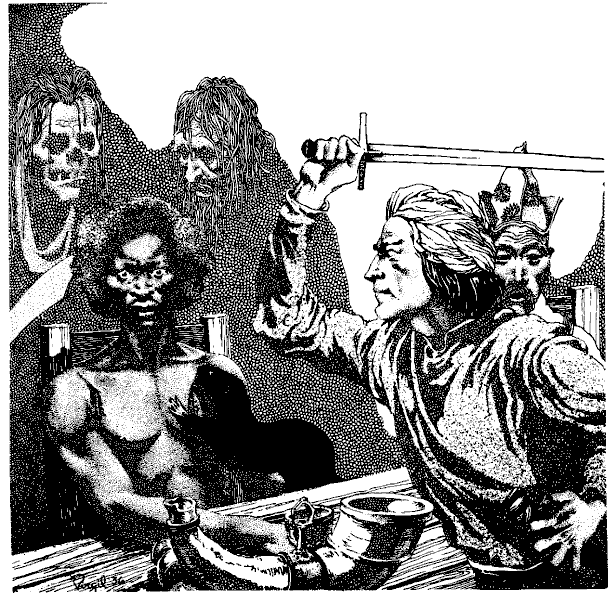
"Necromancy in Naat" was completed on February 6, 1935. It appeared in the July 1936 issue of Weird Tales, where it was accompanied by another Virgil Finlay illustration, where it tied with Robert E. Howard's "Red Nails" as the most popular story in the issue. Smith was paid seventy-three dollars for the story.
Smith wrote to August Derleth that "'Necromancy in Naat' seems the best of my more recently published weirds; though Wright forced me to mutilate the ending."
Apparently Farnsworth Wright had an issue with the last paragraph and the "shadowy love" that is hinted at (although it's not exactly necrophilia if it's between two consenting dead folk, now is it? Let's just call it necromantic). The original version was eventually restored for the NSB volume and presumably the online version listed above.
"Necromancy in Naat" was completed on February 6, 1935. It appeared in the July 1936 issue of Weird Tales, where it was accompanied by another Virgil Finlay illustration, where it tied with Robert E. Howard's "Red Nails" as the most popular story in the issue. Smith was paid seventy-three dollars for the story.
Smith wrote to August Derleth that "'Necromancy in Naat' seems the best of my more recently published weirds; though Wright forced me to mutilate the ending."
Apparently Farnsworth Wright had an issue with the last paragraph and the "shadowy love" that is hinted at (although it's not exactly necrophilia if it's between two consenting dead folk, now is it? Let's just call it necromantic). The original version was eventually restored for the NSB volume and presumably the online version listed above.
17prosfilaes
When reading the start of the story, I told myself that everyone on the ship except the narrator was dead-man-walking. It sometimes seem like part of Smith's style to telegraph things like that, instead of more realistically giving them names or doing the disaster movie thing of trying to get us to care about one of them.
18paradoxosalpha
> 16 the last tale of Zothique
Not according to the chronology here, which concludes with "Morthylla" and "The Dead Will Cuckold You" in 1952. The Wikipedia article has it as number 11 out of 16. However, our Smith story for next week "The Empire of the Necromancers" was the first Zothique tale.
Being a fan of "Dying Earth" literature generally, I have to admit to loving me some Zothique particularly.
Not according to the chronology here, which concludes with "Morthylla" and "The Dead Will Cuckold You" in 1952. The Wikipedia article has it as number 11 out of 16. However, our Smith story for next week "The Empire of the Necromancers" was the first Zothique tale.
Being a fan of "Dying Earth" literature generally, I have to admit to loving me some Zothique particularly.
19gwendetenebre
>18 paradoxosalpha:
>16 gwendetenebre: corrected. I may have slightly misread the note in the Night Shade volume. According to them, the story ”The Last Hieroglyph” was intended by CAS to be the last Zothique tale, but it was followed by ”Necromancy in Naat”, which served to perpetuate the cycle for a while longer, as you point out.
>16 gwendetenebre: corrected. I may have slightly misread the note in the Night Shade volume. According to them, the story ”The Last Hieroglyph” was intended by CAS to be the last Zothique tale, but it was followed by ”Necromancy in Naat”, which served to perpetuate the cycle for a while longer, as you point out.
20artturnerjr
Here's the cool-ass Virgil Finlay illustration mentioned by Kenton in #16 (courtesy of www.eldritchdark.com , natch):
21artturnerjr
>18 paradoxosalpha:
Being a fan of "Dying Earth" literature generally, I have to admit to loving me some Zothique particularly.
Yeah, the Zothique tales are definitely my favorite of Smith's fantasy "cycles".
Being a fan of "Dying Earth" literature generally, I have to admit to loving me some Zothique particularly.
Yeah, the Zothique tales are definitely my favorite of Smith's fantasy "cycles".
22AndreasJ
15> Specifically, for a while I was half expecting that the brothers' plan would succeed and Yadar would indeed be permitted to leave alive with the girl, and eventually decide not to let mere death come between him and his love.
On the subject of Zothique and the dying earth genre, as old and decadent as Zothique is, it (in the stories I've read, which are not all) lacks the feeling of a world winding down or sputtering out I'd expect from the genre. We're told Zothique is the last continent, but not given much indication why that is. (This not to say I don't like the Zothique stories - I do - but I don't think they fit very comfortably in the genre.)
On the subject of Zothique and the dying earth genre, as old and decadent as Zothique is, it (in the stories I've read, which are not all) lacks the feeling of a world winding down or sputtering out I'd expect from the genre. We're told Zothique is the last continent, but not given much indication why that is. (This not to say I don't like the Zothique stories - I do - but I don't think they fit very comfortably in the genre.)
24artturnerjr
>23 gwendetenebre:
My pleasure. Just required a high-tech necromantic spell I like to call "Google Image Search". :D
My pleasure. Just required a high-tech necromantic spell I like to call "Google Image Search". :D
25gwendetenebre
In I Am Providence, S.T. Joshi is actually pretty hard on Clark Ashton Smith, basically saying that with a few exceptions, his stories aren't all that well written and often use unnecessarily "esoteric" words and phrases, and that there isn't much below the "glittering surface" of the story. He also claims that Lovecraft is the better writer. Hmmmm....
Joshi is also pretty harsh on Robert E. Howard's fiction, claiming that with a few notable exceptions, REH is just a glorified pulp writer with no cohesive world view. I really disagree with Joshi here. I think that REH's great strength is that he is a great, old-time, tall-tales-told-on-the-front-porch kind of writer. A born storyteller. I'm surprised that Joshi seemed to miss (or ignore) this aspect! He does laud REH's correspondence, though, saying that it has a literary value all its own.
Not that Joshi is by any means required to hold these guys in some kind of holy reverence, but I was a bit surprised.
Joshi is also pretty harsh on Robert E. Howard's fiction, claiming that with a few notable exceptions, REH is just a glorified pulp writer with no cohesive world view. I really disagree with Joshi here. I think that REH's great strength is that he is a great, old-time, tall-tales-told-on-the-front-porch kind of writer. A born storyteller. I'm surprised that Joshi seemed to miss (or ignore) this aspect! He does laud REH's correspondence, though, saying that it has a literary value all its own.
Not that Joshi is by any means required to hold these guys in some kind of holy reverence, but I was a bit surprised.
27paradoxosalpha
> 25
If my reading of the antichristian symbolism of this story is right, there's more than "glittering surface" here. Heck, just the unconventional plot resolution deserves props. It's true that CAS favors a slightly obtuse vocabulary, but he's not a lot worse than HPL in that regard.
If my reading of the antichristian symbolism of this story is right, there's more than "glittering surface" here. Heck, just the unconventional plot resolution deserves props. It's true that CAS favors a slightly obtuse vocabulary, but he's not a lot worse than HPL in that regard.
28gwendetenebre
>27 paradoxosalpha:
CAS vs. HPL in an esoteric/obtuse vocabulary runoff would be a battle of epic proportions!
I agree - there is a lot going on below the surface in most of the CAS I've read so far. Let's see what we get next week!
CAS vs. HPL in an esoteric/obtuse vocabulary runoff would be a battle of epic proportions!
I agree - there is a lot going on below the surface in most of the CAS I've read so far. Let's see what we get next week!
29artturnerjr
>25 gwendetenebre: et al.
What's odd to me is that Joshi has nothing but praise for Smith's poetry, calling it (in An H.P. Lovecraft Encyclopedia) "scintillating" and "some of the finest formal poetry written by any American writer of the twentieth century" and yet seems to be lukewarm (at best) on his fiction. To me, Smith's fiction and poetry is very much of a piece - when CAS started writing fiction profesionally he largely took the skills he had learned as a poet and applied them to narrative - quite successfully, I might add.
What's odd to me is that Joshi has nothing but praise for Smith's poetry, calling it (in An H.P. Lovecraft Encyclopedia) "scintillating" and "some of the finest formal poetry written by any American writer of the twentieth century" and yet seems to be lukewarm (at best) on his fiction. To me, Smith's fiction and poetry is very much of a piece - when CAS started writing fiction profesionally he largely took the skills he had learned as a poet and applied them to narrative - quite successfully, I might add.

