
The cat reads on
This is a continuation of the topic The cat reads.
Talk Le Salon Littéraire du Peuple pour le Peuple
Join LibraryThing to post.
This topic is currently marked as "dormant"—the last message is more than 90 days old. You can revive it by posting a reply.
1QuentinTom
I've just posted a review of Victor Serge's novel The Case of Comrade Tulayev here:
http://www.librarything.com/work/295154/reviews/37442456
and here:
http://thelectern.blogspot.tw/2012/09/the-case-of-comrade-tulayev-victor-serge.h...
This is my first Serge, and I will definitely be reading more.
I'm reading Edmund Wilson's To the Finland Station, which is a kind of layman's guide to the philosophy/historiography of the left. Somewhat dated, but still very readable. Wilson's exposition of the key tenets of Marxism is clear and easy to follow, although I have my doubts as to why he started with a survey of French historiography - although I enjoyed reading the sections on Michelet. It's a shame Michelet is not available in English :(
Also, reading until 2.00 am every night Akysonov's Generations of Winter, which is utterly glorious, and impossible to put down. The comparison with Tolstoy in the blurb is apt, for once, and not just publisher-speak. Aksyonov's writing has all the immediacy of Tolstoy: the characters are splendid, both the real and the fictional. Here is Aksyonov's description of Voroshilov, the real life commissar of the Army and Navy, reading a paper at a conference:
Upon closer observation of his face with its shrewd eyes, one could catch occasional flashes of pure stupidity. From time to time, as though reminding himself of just who he was, Kliment Yefremovich would pause for a moment and fix his attention on his monumentality.
http://www.librarything.com/work/295154/reviews/37442456
and here:
http://thelectern.blogspot.tw/2012/09/the-case-of-comrade-tulayev-victor-serge.h...
This is my first Serge, and I will definitely be reading more.
I'm reading Edmund Wilson's To the Finland Station, which is a kind of layman's guide to the philosophy/historiography of the left. Somewhat dated, but still very readable. Wilson's exposition of the key tenets of Marxism is clear and easy to follow, although I have my doubts as to why he started with a survey of French historiography - although I enjoyed reading the sections on Michelet. It's a shame Michelet is not available in English :(
Also, reading until 2.00 am every night Akysonov's Generations of Winter, which is utterly glorious, and impossible to put down. The comparison with Tolstoy in the blurb is apt, for once, and not just publisher-speak. Aksyonov's writing has all the immediacy of Tolstoy: the characters are splendid, both the real and the fictional. Here is Aksyonov's description of Voroshilov, the real life commissar of the Army and Navy, reading a paper at a conference:
Upon closer observation of his face with its shrewd eyes, one could catch occasional flashes of pure stupidity. From time to time, as though reminding himself of just who he was, Kliment Yefremovich would pause for a moment and fix his attention on his monumentality.
2RickHarsch
I like Serge's memoirs so much the thing is in pieces.
To the Finland Station was great--I think Wilson writes so well in it that it would be a mistake to worry about such little matters as cohesiveness. French historiography? Trier is just one Luxembourg from France.
To the Finland Station was great--I think Wilson writes so well in it that it would be a mistake to worry about such little matters as cohesiveness. French historiography? Trier is just one Luxembourg from France.
3dchaikin
Grabbing a comfortable chair (I know I could star and all that, but this chair is so much easier.) Now to read about Serge.
4dchaikin
Fascinating stuff Murr.
An American-centric, dated even if not journalistic, and apropos of nothing, contribution - from Abraham Lincoln, circa 1855
An American-centric, dated even if not journalistic, and apropos of nothing, contribution - from Abraham Lincoln, circa 1855
"Our progress in degeneracy appears to me to be pretty rapid. As a nation, we began by declaring that 'all men are created equal.' We now practically read it 'all men are created equal, except negroes.' When the Know-Nothings get control, it will read 'all men are created equal, except negroes and foreigners, and catholics.' When it comes to this I should prefer emigrating to some country where they make no pretense of loving liberty—to Russia, for instance."
5LolaWalser
FREE PUSSY RIOT!!!!1!
I can't believe you missed such naming opportunities for this thread, Murr--I'll just pretend that's what it is.
I can't believe you missed such naming opportunities for this thread, Murr--I'll just pretend that's what it is.
6rebeccanyc
I am a big fan of Serge and enjoyed your review of The Case of Comrade Tulayev, which was also the first Serge I read. I liked To the Finland Station although Wilson is much too gullible about Lenin; Serge's Memoirs of a Revolutionary should provide a good counterbalance.
7QuentinTom
Lola, I thought about it, but then realised that I might be inundated by hordes of Midwestern tourists looking for the free pussy.
Rebecca, and rick, I plan to read as much VS as I can. NRB has published quite a few. Im about half way through Wilson, so have not got to Lenin yet. Marx has just died (thank god, what a terrible swine he was to his wife and children and friends). I just found that Chernyshevsky does not appear in the index, and I'm worried. any discussion of the left without mentioning Cherny is bound to be incomplete. Perhaps it's just a bad index. I"ll keep you posted. oh, and Rebecca, well done on Nana. It's nice to see some real literature at the top of the hot review for once. Good old Zola.
Dan, that is an amazing quote, very reminiscent of Orwell's famous dictum from animal farm, right?
Rebecca, and rick, I plan to read as much VS as I can. NRB has published quite a few. Im about half way through Wilson, so have not got to Lenin yet. Marx has just died (thank god, what a terrible swine he was to his wife and children and friends). I just found that Chernyshevsky does not appear in the index, and I'm worried. any discussion of the left without mentioning Cherny is bound to be incomplete. Perhaps it's just a bad index. I"ll keep you posted. oh, and Rebecca, well done on Nana. It's nice to see some real literature at the top of the hot review for once. Good old Zola.
Dan, that is an amazing quote, very reminiscent of Orwell's famous dictum from animal farm, right?
8RickHarsch
As a 'Midwesterner' I object to the implied derogatory. What's wrong with free pussy? I never paid for it in my life.
9urania1
Great review of Serge. Have you read Serge's The Unforgiving Years. it is wonderful and ties in nicely with my project on betrayal on which I am working in a desultory fashion. Everything is desultory with me right now except for the goats. I have still not recovered from all the summer company and the various tragedies that occurred. Beloved is not sympathetic.
10RickHarsch
Can you expand on the project on betrayal, U?
11A_musing
How, I ask you, HOW, will I ever get enough time to read all this Chinese poetry I have if you keep throwing damn Russians in the way?!?
Thumbed. Ordered. And that Anna Akhmatova too.
Thumbed. Ordered. And that Anna Akhmatova too.
12anna_in_pdx
I love Anna Akhmatova and not just for her great taste in first names. Even though I only have a cheesy Everyman collection of Russian poetry that includes many by her. I need to get a really good translation of just her, one of these days.
13RickHarsch
Sam, go back to Moby Dick and your problem is solved.
14baswood
Superb review of The Case of Comrade Tulayev. I liked your thoughts on the differences between journalism and literature, which leads you onto a nice definition of fiction.
Keep reading on cat.
Keep reading on cat.
15A_musing
I never leave Moby Dick, but chasing that whale just seems to get us into bigger problems. The thing is, the Russians understand.
16QuentinTom
they do, don't they... Unfortunately, I don't think Wilson did. Here is my review of his effort.
http://www.librarything.com/work/58228/74218253
but I refer you also to Rebeccanyc's review, which is more detailed and helpful.
http://www.librarything.com/work/58228/74218253
but I refer you also to Rebeccanyc's review, which is more detailed and helpful.
17RickHarsch
Terror!
18urania1
>10 RickHarsch: Rick,
A lot of philosophers have written about friendship, but no one has written a philosophical account of betrayal. If I ever become intelligent again and relearn how to use the word epistemology in a sentence, I will finish this project.
A lot of philosophers have written about friendship, but no one has written a philosophical account of betrayal. If I ever become intelligent again and relearn how to use the word epistemology in a sentence, I will finish this project.
19QuentinTom
Urania, you did just use the word epistemology in a sentence.
20urania1
Murr,
Don't confuse me any more than I am already confused. I've been drinking fermented goat's milk and I'm starting to read books that don't exist. I am also engaging in goat trafficking - it's a horny business. So I just don't have the time or the intellect to use epistemology thingies.
Don't confuse me any more than I am already confused. I've been drinking fermented goat's milk and I'm starting to read books that don't exist. I am also engaging in goat trafficking - it's a horny business. So I just don't have the time or the intellect to use epistemology thingies.
21QuentinTom
lol
HAve you read Aksyonov's Generations of Winter? You should.
HAve you read Aksyonov's Generations of Winter? You should.
22urania1
No I have not read Generations of Winter and neither of my current lovers - the wicked but seductive Baron von Kindle nor the mysterious Conte de Pomme - has it in their library. Lovers are so slack these days.
23RickHarsch
Ur,
I'm interested, but feeling patient as all get out. (All get out!) Let me know how it progresses. You know, you really should read Generations of Winter, though, as soon as possible.
I'm interested, but feeling patient as all get out. (All get out!) Let me know how it progresses. You know, you really should read Generations of Winter, though, as soon as possible.
24RickHarsch
TC,
Long long ago in a place far from here I ordered Burn when it first was translated and was sorely disappointed--I think I was too young and didn't get it. Generations seems just the book for me now, right now, but alas, no money. I assume you have read Burn. What do you think? And if you have the time, can you write a little about Generations of Winter?
Long long ago in a place far from here I ordered Burn when it first was translated and was sorely disappointed--I think I was too young and didn't get it. Generations seems just the book for me now, right now, but alas, no money. I assume you have read Burn. What do you think? And if you have the time, can you write a little about Generations of Winter?
25rebeccanyc
Enjoyed your review of To the Finland Station, and thanks for the shout-out. I do encourage you to read Serge's Memoirs of a Revolutionary sooner rather than later; he has a remarkable ability to see what is really going on even when other people's eyes are clouded by wishful thinking and, besides, he was really there at all those events. Be sure to get the recent NYRB edition because it is the only complete one.
26QuentinTom
it's on order.
Rick, I havne't read anything else by Aksyonov -yet. GOW is just marvellous. Good, character-based writing, no tricks, no modernist experiments: just tells the story of what happens to his characters. I'm completely drawn in. After every three or four chapters, he includes (real? fictional?) excerpts from Pravda, to give a picture of what was happening in Russia at the time of the story: news articles, slogans, adverts and so on. He also includes sections written from the point of view of animals and trees. Sounds nutty but they really work (Remember the horse-as-focaliser in War and Peace?) as a way of including the natural world and the longer stretches of Russian history. the family dog is a reincarnation of the 16th century Prince Kurbsky, and the action also includes the viewpoint of a 400 year old owl.
The closest parallels I can think of are Elsa Morante's History: A Novel, and Vikram Seth's A Suitable Boy, and also Olivia Manning's trilogies. My only complaint is that the chapters are broken up into quite short units, to switch between different characters. You just get sucked into one situation, and you have to break off and immerse yourself into another. I hate this: it's so modern, and smacks of a lack of ability to concentrate for any length of time. However, each chapter and each section is so beautifully constructed, that the complaint is more to do with me than with Aksyonov. I hate this constant pausing, but I can see the necessity for including periods of contemplation on what one has just read.
I see from LT that there is a sequel, which is also on order.
Rick, I havne't read anything else by Aksyonov -yet. GOW is just marvellous. Good, character-based writing, no tricks, no modernist experiments: just tells the story of what happens to his characters. I'm completely drawn in. After every three or four chapters, he includes (real? fictional?) excerpts from Pravda, to give a picture of what was happening in Russia at the time of the story: news articles, slogans, adverts and so on. He also includes sections written from the point of view of animals and trees. Sounds nutty but they really work (Remember the horse-as-focaliser in War and Peace?) as a way of including the natural world and the longer stretches of Russian history. the family dog is a reincarnation of the 16th century Prince Kurbsky, and the action also includes the viewpoint of a 400 year old owl.
The closest parallels I can think of are Elsa Morante's History: A Novel, and Vikram Seth's A Suitable Boy, and also Olivia Manning's trilogies. My only complaint is that the chapters are broken up into quite short units, to switch between different characters. You just get sucked into one situation, and you have to break off and immerse yourself into another. I hate this: it's so modern, and smacks of a lack of ability to concentrate for any length of time. However, each chapter and each section is so beautifully constructed, that the complaint is more to do with me than with Aksyonov. I hate this constant pausing, but I can see the necessity for including periods of contemplation on what one has just read.
I see from LT that there is a sequel, which is also on order.
27dcozy
Okay, okay, Generations of Winter has gone onto my wishlist.
28urania1
Generations of Winter is also on my wish list, but I'm holding out for the Kindle moment. So if everyone here barrages Amazon with "I would like to read this book on Kindle" click, who knows? Perhaps it will work.
29RickHarsch
Is it okay to lie to Amazon?
31urania1
Rick,
It is always acceptable to lie to mega-corporations. They are evil by definition. Lie away. Mother urania absolves you on advance.
It is always acceptable to lie to mega-corporations. They are evil by definition. Lie away. Mother urania absolves you on advance.
32RickHarsch
Dchaikin, the cat is a cat, not a human and not to be judged by human standards.
Ur, I have lied so much to corporations, mega, minor, and state that I need only my own absolution. Yours can only hurt you, though in an afterlife of my conception you are on the throne(s). Someday we must sit down and discuss my zigzag flights from, for instance, bill collectors.
Ur, I have lied so much to corporations, mega, minor, and state that I need only my own absolution. Yours can only hurt you, though in an afterlife of my conception you are on the throne(s). Someday we must sit down and discuss my zigzag flights from, for instance, bill collectors.
34RickHarsch
There are also Murrs and Murrs---I think this one has exceeded the first
35QuentinTom
fabulously disgusting section on how family patriarch PRofessor Doctor Comrade Gradov is called in to the Kremlin on a top secret mission in the middle of the night to cure Stalin of his chronic and acute constipation. The russian intelligentsia administer a powerful enema to the Great Leader of the Dictatorship of the Proletariat.
37LolaWalser
The Russkies put the purr in Murr.
38RickHarsch
Sam, I would sooner de-Dick
42QuentinTom
this thread has descended into enigma.
LELI-LELI - the snow of locust flowers shielding a rifle
CHEECHECHACHA - the shine of sabers
NEE-EH-ENZAI - the scarlet of banners
ZEE-EH-EGZOI -the words of an oath
BOBO-BE'EBA -the stripe of scarlet
MEEPEEOPEE -the glitter of grey-eyed troops
CHUCHU BE'EZA -the glitter of swear words
MEE-VEH-AH-A the heavens
MEEPEEOPEE - the glitter of eyes
VE-E-AH-VA -the green of the tropps!
MEEMOMAYA -the dark blue of hussars
ZEEZOZEYA - the sun's handwriting, a rye field of sun-eyed sabers
LELI-LILI - the snow of locust flowers
SOSESAO- mountains of buildings
Vladimir Khlebnikov
trans Paul Schmidt
used as the epigram for volume 1of Generations of Winter, which I finished this weekend. what a book, comrades.
on to other things. currently rereading Anthony Burgess's The long day wanes, about the tail end of the British in Malaya at the end of the 1950s, for a piece for a big Burgess tribute which will take place in December on OpenLettersMonthly.
so last night I turn to my beloved Victor Segalen's Essay on Exoticism for some background/theoretical reading, and I discover that pages 12 and 13, and 16 and 17 are blank. totally bank. the text starts on page 14, with a footnote 5. I turn to the footnotes, and discover that notes 1-4 refer to blank pages 12, 13, and footnotes 7-13 to blank pages 16 and 17. Now, this could be a textual strategy, suitable for this highly fragmented, unfinished, playful and enigmatic work. The footnotes tease me with their references to something I can never read, something I cannot grasp. They tantalise. They suggest. They create. (At this stage, late at night, it must be noted that I have been chewing catnip for a good few hours, and I'm beginning to wonder whether I'm hallucinating, whether the missing pages might reappear in the morning.) On the other hand, it could be a simple printing error. Either way, I am torn between enjoying the fluke, the felicity of coincidence between the type of structural game (albeit an accidental one) Segalen would have enjoyed, and outrage that i have been cheated by shoddy publishing. should I keep the book as a curio, or send it back to the publisher with a snooty letter demanding a complete replacement?
Thoughts?
LELI-LELI - the snow of locust flowers shielding a rifle
CHEECHECHACHA - the shine of sabers
NEE-EH-ENZAI - the scarlet of banners
ZEE-EH-EGZOI -the words of an oath
BOBO-BE'EBA -the stripe of scarlet
MEEPEEOPEE -the glitter of grey-eyed troops
CHUCHU BE'EZA -the glitter of swear words
MEE-VEH-AH-A the heavens
MEEPEEOPEE - the glitter of eyes
VE-E-AH-VA -the green of the tropps!
MEEMOMAYA -the dark blue of hussars
ZEEZOZEYA - the sun's handwriting, a rye field of sun-eyed sabers
LELI-LILI - the snow of locust flowers
SOSESAO- mountains of buildings
Vladimir Khlebnikov
trans Paul Schmidt
used as the epigram for volume 1of Generations of Winter, which I finished this weekend. what a book, comrades.
on to other things. currently rereading Anthony Burgess's The long day wanes, about the tail end of the British in Malaya at the end of the 1950s, for a piece for a big Burgess tribute which will take place in December on OpenLettersMonthly.
so last night I turn to my beloved Victor Segalen's Essay on Exoticism for some background/theoretical reading, and I discover that pages 12 and 13, and 16 and 17 are blank. totally bank. the text starts on page 14, with a footnote 5. I turn to the footnotes, and discover that notes 1-4 refer to blank pages 12, 13, and footnotes 7-13 to blank pages 16 and 17. Now, this could be a textual strategy, suitable for this highly fragmented, unfinished, playful and enigmatic work. The footnotes tease me with their references to something I can never read, something I cannot grasp. They tantalise. They suggest. They create. (At this stage, late at night, it must be noted that I have been chewing catnip for a good few hours, and I'm beginning to wonder whether I'm hallucinating, whether the missing pages might reappear in the morning.) On the other hand, it could be a simple printing error. Either way, I am torn between enjoying the fluke, the felicity of coincidence between the type of structural game (albeit an accidental one) Segalen would have enjoyed, and outrage that i have been cheated by shoddy publishing. should I keep the book as a curio, or send it back to the publisher with a snooty letter demanding a complete replacement?
Thoughts?
43urania1
I would offer thoughts if I were able to think. Unfortunately, I have gone over to the Dark Side and am reading the book worse than which must not be named and giggling hysterically. I refuse to divulge the title of the aforementioned book as it must not be named or maybe it can be named because something even more mindless exists.
44ChocolateMuse
Do tell us if they reappeared in the morning. That would be exotic indeed.
45A_musing
I will check the Kindle version - have to run somewhere now and leave you in suspense, but later today will tell you if this is a printing error.
46QuentinTom
oh choco, no, the pages are still blank. Well, at least I know im not going crazy.
Bless you sam, I eagerly await news.
Urania, the thought of you reading Atlas Farted is only adding to my woes.
Bless you sam, I eagerly await news.
Urania, the thought of you reading Atlas Farted is only adding to my woes.
47urania1
Oh compared to the book worse than which cannot be named, Atlas Farted is a masterpiece. I have excavated new depths of bad writing difficult for even my world-weary cynical eyes to take in.
48A_musing
Well, it appears you have a printing issues. Footnotes 1-4 are right there in the beginning of the text, which starts "WITHIN SIGHT OF JAVA, OCTOBER, 1904. Write a book on exoticism. Bernardin de Saint-Pierre -- Chateaubriand -- Marco Polo, the initiator --- Loti. fn1..."
What paragraph does your text start on? It is two pages, maybe I can type them out?
What paragraph does your text start on? It is two pages, maybe I can type them out?
49QuentinTom
My text starts p 14 :
It is important that I set down my views on future exoticism....
and ends p14:
...savouring it with rapture.
then starts again on p 18 with
Excerpt from a letter to Max Prat...
if it's not too much trouble, sam, that would be great.
It is important that I set down my views on future exoticism....
and ends p14:
...savouring it with rapture.
then starts again on p 18 with
Excerpt from a letter to Max Prat...
if it's not too much trouble, sam, that would be great.
50QuentinTom
continuing the saga of my love affair with Joseph Brodsky.
I've been slowly reading through Conversations with Joseph Brodsky. apart from my deepening admiration for the man and some of the funny things he says (his favourite form of saying goodbye was "Kisses!" and he waves off one of the interviewers with this), his absolutely colossal erudition in about 119 languages and his humility and Russian irony and all that stuff, he answered one question about the difference between free verse and strict verse forms, that I thought would be worth talking about.
oooOOOooo
Interviewer: "When the students in your class submitted their poems the one things that seemed to surprise you was the fact that so many of them wrote with little or no attention to form. DO you yourself feel more comfortable writing in a strict form?
Brodsky: "By strict form, you mean some so-called classical forms, some metrical organization? Yes, I think so, precisely for this reason: The strict form is a device to organize those things which are not supposed to be organized. ... If you use a strict form for your modern contemporary content you can see when you put it in this form, that it works stronger because there appears something like a tension between what you are saying and the form in which you are saying it. Between the content and the form and this tension indicates the real scale of the new thing you are saying."
...
Interviewer: "it seems to be a characteristic of younger poets ..(free verse)".
Brodsky: "because it's easier to express yourself in free verse. but poetry is not a question of self-expression. It's something else. It's also some kind of craft, you know."
He then quotes Robert Frost, that writing in free verse is like playing tennis with the net down.
ooOOOooo
now, I'm totally with this, but i'd like to hear the other side of the argument. Any ideas anyone?
I've been slowly reading through Conversations with Joseph Brodsky. apart from my deepening admiration for the man and some of the funny things he says (his favourite form of saying goodbye was "Kisses!" and he waves off one of the interviewers with this), his absolutely colossal erudition in about 119 languages and his humility and Russian irony and all that stuff, he answered one question about the difference between free verse and strict verse forms, that I thought would be worth talking about.
oooOOOooo
Interviewer: "When the students in your class submitted their poems the one things that seemed to surprise you was the fact that so many of them wrote with little or no attention to form. DO you yourself feel more comfortable writing in a strict form?
Brodsky: "By strict form, you mean some so-called classical forms, some metrical organization? Yes, I think so, precisely for this reason: The strict form is a device to organize those things which are not supposed to be organized. ... If you use a strict form for your modern contemporary content you can see when you put it in this form, that it works stronger because there appears something like a tension between what you are saying and the form in which you are saying it. Between the content and the form and this tension indicates the real scale of the new thing you are saying."
...
Interviewer: "it seems to be a characteristic of younger poets ..(free verse)".
Brodsky: "because it's easier to express yourself in free verse. but poetry is not a question of self-expression. It's something else. It's also some kind of craft, you know."
He then quotes Robert Frost, that writing in free verse is like playing tennis with the net down.
ooOOOooo
now, I'm totally with this, but i'd like to hear the other side of the argument. Any ideas anyone?
51LolaWalser
None for the other side. There's a similar argument in art--before you start slopping paint around like Pollock, better make sure you can draw like Ingres.
To me it's about training. I don't trust the undisciplined ear, eye and body.
To me it's about training. I don't trust the undisciplined ear, eye and body.
52baswood
To write free verse it would seem to me that you have got to be free of something.
A poet who is able to use strict form to express himself can free himself up from this by writing in free verse. The reader can then appreciate what he is doing, knowing he has plenty of command/skill in the poetic form and is breaking the rules for a reason
I can think of two simile's:
Free jazz or the avante garde jazz scene of the early 1960's. John Coltrane and Ornette Coleman absolute masters of their instruments proceeded to break the established rules of music. As a listener you then realised that they knew what they were doing. The problem came a little later when people who could not play burst onto the scene playing free jazz. The music stepped back from the brink and today the scene is again dominated by musicians that can play.
As you know TC I recently went to the recent David Hockney Exhibition. He originally became famous as a pop artist, but he had always been a consummate draughtsman who may well be able to draw as well as Ingres.
I do not know enough about Jackson Pollack to comment on his action painting, but I do know that I am fed up with conceptual art.
A poet who is able to use strict form to express himself can free himself up from this by writing in free verse. The reader can then appreciate what he is doing, knowing he has plenty of command/skill in the poetic form and is breaking the rules for a reason
I can think of two simile's:
Free jazz or the avante garde jazz scene of the early 1960's. John Coltrane and Ornette Coleman absolute masters of their instruments proceeded to break the established rules of music. As a listener you then realised that they knew what they were doing. The problem came a little later when people who could not play burst onto the scene playing free jazz. The music stepped back from the brink and today the scene is again dominated by musicians that can play.
As you know TC I recently went to the recent David Hockney Exhibition. He originally became famous as a pop artist, but he had always been a consummate draughtsman who may well be able to draw as well as Ingres.
I do not know enough about Jackson Pollack to comment on his action painting, but I do know that I am fed up with conceptual art.
53tonikat
I'm someone who's route to trying to write a little came through self expression I think it's very important for creativity and I value it highly. I think as I go I am learning more about form and metre and how I can use it. I'm a little unsure of saying one should go before the other, for me I think creativity and free expression does come first, maybe as I learn more about form that will change further and maybe if I am lucky they will go hand in hand better. But I want to say that perhaps what is good is good but also that what is good may be subjective.
54rebeccanyc
When I worked as an editor, I always believed you have to know the rules to be able to break them.
55dchaikin
I'm not sure I agree that you need to master the form before you break it. It depends what your are trying to do. If you can write in the restrictions of form, then I agree there is more there, that the tension Brodsky describes is real. And, if you break that form, that is another kind of tension. But there are other ways. Words have their own built in restrictions, and one doesn't need to stick to form to get something out of them.
57Porius
http://www.youtube.com/watch?v=EXoM0Ze-9xE
http://www.youtube.com/watch?v=rQgXx98IvGw
http://www.youtube.com/watch?v=bphcsW24Ue8&feature=related
the net must certainly be in place
http://www.youtube.com/watch?v=DDXWclpGhcg&feature=endscreen
COME IN
As I came to the edge of the woods,
Thrush music -- hark!
Now if it was dusk outside,
Inside it was dark.
Too dark in the woods for a bird
By sleight of wing
To better its perch for the night,
Though it still could sing.
The last of the light of the sun
That had died in the west
Still lived for one song more
In a thrush's breast.
Far in the pillared dark
Thrush music went --
Almost like a call to come in
To the dark and lament.
But no, I was out for stars;
I would not come in.
I meant not even if asked;
And I hadn't been.
ROBERT FROST
http://www.youtube.com/watch?v=rQgXx98IvGw
http://www.youtube.com/watch?v=bphcsW24Ue8&feature=related
the net must certainly be in place
http://www.youtube.com/watch?v=DDXWclpGhcg&feature=endscreen
COME IN
As I came to the edge of the woods,
Thrush music -- hark!
Now if it was dusk outside,
Inside it was dark.
Too dark in the woods for a bird
By sleight of wing
To better its perch for the night,
Though it still could sing.
The last of the light of the sun
That had died in the west
Still lived for one song more
In a thrush's breast.
Far in the pillared dark
Thrush music went --
Almost like a call to come in
To the dark and lament.
But no, I was out for stars;
I would not come in.
I meant not even if asked;
And I hadn't been.
ROBERT FROST
58QuentinTom
interesting. I guess with the exception of Tony and Dan we are all just a bunch of wretched formalists.
Bas, you echoed exactly what Brodsky himself says later or earlier in the conversation:
"with free verse the first question should be free from what?. It's ok if you write free verse because you are tired, and you can't write anymore. It's all right if you at least experience a strict form, and if the free verse is a consequence of it. Because why did free verse appear? as a consequence of strict form. So each poet has to repeat in miniature the same process.... "
Brodsky was a great admirer of Robert Frost and mentions him frequently.
Bas, you echoed exactly what Brodsky himself says later or earlier in the conversation:
"with free verse the first question should be free from what?. It's ok if you write free verse because you are tired, and you can't write anymore. It's all right if you at least experience a strict form, and if the free verse is a consequence of it. Because why did free verse appear? as a consequence of strict form. So each poet has to repeat in miniature the same process.... "
Brodsky was a great admirer of Robert Frost and mentions him frequently.
59Porius
i likes a little 'free verse'. ferlenghetti is ok.
if this is indeed 'free' i likes it:
http://www.writing.upenn.edu/~afilreis/88/dog.html
if this is indeed 'free' i likes it:
http://www.writing.upenn.edu/~afilreis/88/dog.html
60tonikat
and yet everything I try to wrote at the moment is formal or trying to be (as I learn it better)
I just think we must not kill the spark of creativity due to some rules, which as many rules may be, may effectively kills certain types of expression and perception of these rules may silence some voices. I can also break those rules without knowing them, as can anybody. There is something about convention and quite a conservative view about demanding they be recognised always before being broken.
I just think we must not kill the spark of creativity due to some rules, which as many rules may be, may effectively kills certain types of expression and perception of these rules may silence some voices. I can also break those rules without knowing them, as can anybody. There is something about convention and quite a conservative view about demanding they be recognised always before being broken.
61Macumbeira
sometimes the rules are so strict, that they paradoxically and unintentionally are the cause of creativity.
63anna_in_pdx
I love many free verse poets, but I believe a lot of them had mastered form as well. My favorite poet (although it is probably silly to have a favorite poet) is e.e. cummings and I know he was very good at formal poetry (e.g., sonnets) before he started being experimental.
I do not write poetry myself. My partner, Chris, writes very good (if you ask me) poetry that is free verse, making lots of use of wordplay and assonance. Incidentally, he was actually so fortunate as to hear Joseph Brodsky give a poetry reading in his high school (long story) and also won an award in high school for his poetry - the prize was a series of master classes with William Stafford. But he has never published his poetry or really concentrated on writing, more's the pity.
I do not write poetry myself. My partner, Chris, writes very good (if you ask me) poetry that is free verse, making lots of use of wordplay and assonance. Incidentally, he was actually so fortunate as to hear Joseph Brodsky give a poetry reading in his high school (long story) and also won an award in high school for his poetry - the prize was a series of master classes with William Stafford. But he has never published his poetry or really concentrated on writing, more's the pity.
64urania1
>63 anna_in_pdx: Anna,
My students frequently asked me, "Why does e.e. cummings get to break the rules but we do not?" I responded that cummings' poetry worked because he knew the rules.
My students frequently asked me, "Why does e.e. cummings get to break the rules but we do not?" I responded that cummings' poetry worked because he knew the rules.
65janeajones
Murr -- there's a new documentary on Brodsky that seems to be getting some limited release: http://arts.heraldtribune.com/2012-09-28/section/riaf-preview-russian-poet-subje...
66rebeccanyc
#62, Tony
I don't write poetry (although I did as a teenager), and when I mentioned knowing the rules in order to break them, I was thinking more the kinds of things I focused on as an editor mostly of scientific reports, etc., not works of literary creativity, which I respond to only as a reader.
I don't write poetry (although I did as a teenager), and when I mentioned knowing the rules in order to break them, I was thinking more the kinds of things I focused on as an editor mostly of scientific reports, etc., not works of literary creativity, which I respond to only as a reader.
67QuentinTom
Oh JAne, that looks great! Thanks for the link.
Thinking more about this, I think one of my objections to free verse is that very often it's an excuse for producing stuff which is not really poetry. A lot of modern verse reads to me like prose just chopped up into lines. Like this:
The retreat of western forces from Afghanistan
could come sooner than expected,
the head of Nato has said
as he conceded
that the recent Taliban strategy
of "green on blue"
killings
had been successful
in sapping morale.
Anon (actually the first paragraph of an article from the front page of the Guardian chopped up more or less randomly)
but, there is a lot of free verse that I adore: Whitman, Eliot, ee cummings, Pound, Ginsberg, Mayakovksy, and so on. I think the best free verse combines a knowledge of the rules, a liberation from them, and an extremely sensitive ear to the rhythms and sounds of English, an ear that can only be got, I think, through knowledge of/mastery of the forms.
I have written poetry in my misguided youth. I avoided free verse though, and tried at least to make it rhyme.
Thinking more about this, I think one of my objections to free verse is that very often it's an excuse for producing stuff which is not really poetry. A lot of modern verse reads to me like prose just chopped up into lines. Like this:
The retreat of western forces from Afghanistan
could come sooner than expected,
the head of Nato has said
as he conceded
that the recent Taliban strategy
of "green on blue"
killings
had been successful
in sapping morale.
Anon (actually the first paragraph of an article from the front page of the Guardian chopped up more or less randomly)
but, there is a lot of free verse that I adore: Whitman, Eliot, ee cummings, Pound, Ginsberg, Mayakovksy, and so on. I think the best free verse combines a knowledge of the rules, a liberation from them, and an extremely sensitive ear to the rhythms and sounds of English, an ear that can only be got, I think, through knowledge of/mastery of the forms.
I have written poetry in my misguided youth. I avoided free verse though, and tried at least to make it rhyme.
68ChocolateMuse
I think much of the worst kind of bad poetry is free verse. But how about translations of foreign language poems in which the translators don't try to recapture the form. Some of that is incredible. I guess the limitations were there to begin with in the original language, and I think that if something's too free, then it's hard to find greatness in it. It's the limitations and boundaries that push a thing into having something worthwhile in it. or so I think.
Murr, I love your free verse example. All 'news' should be in free verse. That little sample is way more interesting than when written as prose.
Murr, I love your free verse example. All 'news' should be in free verse. That little sample is way more interesting than when written as prose.
69tonikat
I didn't mean for my question about who writes poetry to be a confrontational thing, I could read it like that, sorry if it so seemed.
I think as someone who is developing their poetry writing I find it hard to imagine knowing all the rules and then writing -- for me it seems the inspiration comes and maybe some words or a line or two and then my working with the rules develops alongside practicing this, over some time - maybe soem get to do this in their youth, i didn't really. Too much focus on the rules could lead me to get nowhere, could blow out the flame I am trying to kindle (not on the Baron). And how does anyone know all the rules without a good deal of work and practice and maybe reworking what was free into something rule bound, and I wonder if only through such process do we get to tend towards any feeling of knowing them...and I do wonder about that word knowing, I wonder if it might be to know some conventions that have been agreed over a long time and wonder what else it might be to know, maybe there is something.
I think as someone who is developing their poetry writing I find it hard to imagine knowing all the rules and then writing -- for me it seems the inspiration comes and maybe some words or a line or two and then my working with the rules develops alongside practicing this, over some time - maybe soem get to do this in their youth, i didn't really. Too much focus on the rules could lead me to get nowhere, could blow out the flame I am trying to kindle (not on the Baron). And how does anyone know all the rules without a good deal of work and practice and maybe reworking what was free into something rule bound, and I wonder if only through such process do we get to tend towards any feeling of knowing them...and I do wonder about that word knowing, I wonder if it might be to know some conventions that have been agreed over a long time and wonder what else it might be to know, maybe there is something.
70LolaWalser
I think it's not about mere knowing of rules--what's important is application, practice, training, in short everything that shapes the tool, the instruments of the artist. A lot of free verse produced seems to be of that toneless variety exemplified by Murr's newspaper excerpt. I can't believe someone with a good instrument, good ear would purposely choose to write that way.
Someone who draws a lot, or plays the piano a lot, or dissects a lot, has a different hand from those who don't. And their range of action and expression is wider. Anyone can scribble, bang a key, or cut and the effect may be startling. But, as Lucy said to Schroeder in regard to Snoopy's dancing, is it art?
I've seen some fantastic forgeries of Matisse. Late Matisse is easy to forge. Why don't people appreciate the forgeries as much as the originals? I'd bet nobody could know the difference.
It's a deep question worthy of long debate, but I sum the answer up in the authenticity of the hand, the real hand of the real master, the real creative sensibility, shaped through real experience--it has to exist at some point of the chain for quality to assert itself.
72anna_in_pdx
I own a very silly mystery novel called The burglar who painted like Mondrian which dealt with the issue of forgery of modern art.
Snoopy's dancing is, of course, art.
Snoopy's dancing is, of course, art.
73LolaWalser
#71
**sharpening pencils!!1!**
**sharpening pencils!!1!**
75QuentinTom
oh the whole issue of forgeries and authenticity is a huge other issue, and fits in nicely with my love of the spurious. Robertson Davies's Cornish trilogy also deals with the same thing. Forgeries and fakes: I love em!
Choco, I'm glad you liked my free verse. I'm working on an app which will take any text you insert and turn it into free verse just like that voila! (I have no idea what any of that means, but I heard a student say that the other day: I'm working on an app. and thought I'd try the same phrase. :)
Tony, what you say is very interesting: And how does anyone know all the rules without a good deal of work and practice and maybe reworking what was free into something rule bound This is the key , I think. I mean very often 'a strict form' is just a simple rhyme ABAB, nothing more complex, but looking for those rhymes can in itself be a challenge. I gave up writing poetry years ago: the muse left me and I simply got too busy. Anyway, what I'm trying to say is, don't be discouraged.
Auden: a poem is a verbal contraption.
Choco, I'm glad you liked my free verse. I'm working on an app which will take any text you insert and turn it into free verse just like that voila! (I have no idea what any of that means, but I heard a student say that the other day: I'm working on an app. and thought I'd try the same phrase. :)
Tony, what you say is very interesting: And how does anyone know all the rules without a good deal of work and practice and maybe reworking what was free into something rule bound This is the key , I think. I mean very often 'a strict form' is just a simple rhyme ABAB, nothing more complex, but looking for those rhymes can in itself be a challenge. I gave up writing poetry years ago: the muse left me and I simply got too busy. Anyway, what I'm trying to say is, don't be discouraged.
Auden: a poem is a verbal contraption.
76MeditationesMartini
Speaking of forgeries and poetry, waht do you guys say to a group read of Ossian sometime?
77Porius
We can be sure, for a number of reasons, that Dr. Johnson will not be leading the way on this one.
78Macumbeira
I can already write à fake review, don't need to read it
79dchaikin
Why is it, while thinking about whether form is necessary, I'm suddenly seeing forms in what I thought were free verse?
80Macumbeira
free forms ?
81QuentinTom
dan, can you share? some examples?
Ossian? omg, I'd rather do Chatterton, though
Ossian? omg, I'd rather do Chatterton, though
82dchaikin
#81 - share my stupidity. I came across this by John Frederick Nims last night. I really liked it, but couldn't see anything I recognized as a form (not that I'm an expert...). Anyway, looked at it again this morning, and what do you know, it rhymes abab. It lost something for me once I noticed that, for whatever reason. But I guess it's more impressive that way.
http://www.poetryfoundation.org/poetrymagazine/browse/151/1#20601366
http://www.poetryfoundation.org/poetrymagazine/browse/151/1#20601366
83MeditationesMartini
Chatterton is so good! I was at the Tate this summer and ws hoping to see the cover painting and they'd sent it out for cleaning or some nonsense and I literally stamped my foot.
Murr, have you read Peter Ackroyd's book Chatterton? It stuck with me. Reminded me a bit of A Dead Man in Deptford, that sort of voyeuristic fan-consubstantiation.
Murr, have you read Peter Ackroyd's book Chatterton? It stuck with me. Reminded me a bit of A Dead Man in Deptford, that sort of voyeuristic fan-consubstantiation.
84QuentinTom
>82 dchaikin:, yup ABAB Nice poem, too.
Martini, no, I haven't read it yet. I think I can get it here.
O SING unto my roundelay,
O drop the briny tear with me;
Dance no more at holyday,
Like a running river be:
My love is dead,
Gone to his death-bed
All under the willow-tree.
Black his cryne as the winter night,
White his rode as the summer snow,
Red his face as the morning light,
Cold he lies in the grave below:
My love is dead,
Gone to his death-bed
All under the willow-tree.
Sweet his tongue as the throstle's note,
Quick in dance as thought can be,
Deft his tabor, cudgel stout;
O he lies by the willow-tree!
My love is dead,
Gone to his death-bed
All under the willow-tree.
Hark! the raven flaps his wing
In the brier'd dell below;
Hark! the death-owl loud doth sing
To the nightmares, as they go:
My love is dead,
Gone to his death-bed
All under the willow-tree.
See! the white moon shines on high;
Whiter is my true-love's shroud:
Whiter than the morning sky,
Whiter than the evening cloud:
My love is dead,
Gone to his death-bed
All under the willow-tree.
Here upon my true-love's grave
Shall the barren flowers be laid;
Not one holy saint to save
All the coldness of a maid:
My love is dead,
Gone to his death-bed
All under the willow-tree.
With my hands I'll dent the briers
Round his holy corse to gre:
Ouph and fairy, light your fires,
Here my body still shall be:
My love is dead,
Gone to his death-bed
All under the willow-tree.
Come, with acorn-cup and thorn,
Drain my heartès blood away;
Life and all its good I scorn,
Dance by night, or feast by day:
My love is dead,
Gone to his death-bed
All under the willow-tree.

Martini, no, I haven't read it yet. I think I can get it here.
O SING unto my roundelay,
O drop the briny tear with me;
Dance no more at holyday,
Like a running river be:
My love is dead,
Gone to his death-bed
All under the willow-tree.
Black his cryne as the winter night,
White his rode as the summer snow,
Red his face as the morning light,
Cold he lies in the grave below:
My love is dead,
Gone to his death-bed
All under the willow-tree.
Sweet his tongue as the throstle's note,
Quick in dance as thought can be,
Deft his tabor, cudgel stout;
O he lies by the willow-tree!
My love is dead,
Gone to his death-bed
All under the willow-tree.
Hark! the raven flaps his wing
In the brier'd dell below;
Hark! the death-owl loud doth sing
To the nightmares, as they go:
My love is dead,
Gone to his death-bed
All under the willow-tree.
See! the white moon shines on high;
Whiter is my true-love's shroud:
Whiter than the morning sky,
Whiter than the evening cloud:
My love is dead,
Gone to his death-bed
All under the willow-tree.
Here upon my true-love's grave
Shall the barren flowers be laid;
Not one holy saint to save
All the coldness of a maid:
My love is dead,
Gone to his death-bed
All under the willow-tree.
With my hands I'll dent the briers
Round his holy corse to gre:
Ouph and fairy, light your fires,
Here my body still shall be:
My love is dead,
Gone to his death-bed
All under the willow-tree.
Come, with acorn-cup and thorn,
Drain my heartès blood away;
Life and all its good I scorn,
Dance by night, or feast by day:
My love is dead,
Gone to his death-bed
All under the willow-tree.

85dchaikin
Dearest Cat,
Can you, from your most respected breath of literary knowledge, try tossing an answer at a little quandary I'm having? I'm wondering, at what point does following strict form remove something meaningful from the poetry? When does form make the poem an act, instead of a sincere statement? Are are we losing something therein, something that is moving us away from the attempted expressions of some kind truth?
Sincerely,
an under-read little human
Can you, from your most respected breath of literary knowledge, try tossing an answer at a little quandary I'm having? I'm wondering, at what point does following strict form remove something meaningful from the poetry? When does form make the poem an act, instead of a sincere statement? Are are we losing something therein, something that is moving us away from the attempted expressions of some kind truth?
Sincerely,
an under-read little human
86MeditationesMartini
Oooh, yeah, like if every line had to end in the same word and the next line had to start with that word and be one foot longer than the previous line and reference the works of Morrissey.
87QuentinTom
Dan I can only quote Spike
Milligan at this point:
Beauty is in the eye of the beholder: get it out with Optrex.
Milligan at this point:
Beauty is in the eye of the beholder: get it out with Optrex.
88tonikat
#75 - thanks tomcat.
I have read Ackroy'd Chatterton by the way, gets a mention in my first librarything reading log thread, but all too brief - I said i thouyght the method he uses may work better than in Hawksmoor (which I love), but sadly do not remember the details well at the moment.
I have read Ackroy'd Chatterton by the way, gets a mention in my first librarything reading log thread, but all too brief - I said i thouyght the method he uses may work better than in Hawksmoor (which I love), but sadly do not remember the details well at the moment.
89ChocolateMuse
>85 dchaikin: Well an example of it in prose would probably be Ella Minnow Pea, not that I've read it.
90QuentinTom
I am so disgustingly undisciplined. There I was all set to read Russian lit for the foreseeable future, and I got sidetracked, finding myself in India for the duration.
Working on a review of Anthony Burgess's The Long Day Wanes and reading around for background research, found myself having to endure some ghastly awful academic writing from someone calling herself Sara Suleri, who in a perfectly incomprehensible essay on Passage to India writes stuff like this:
The adventure of twentieth-century narrative in english has engendered an area studies that, in the act of taking India as its subject, transforms the locality of an historic space into a vast introspective question mark.
WTF? Thank god I'm not an academic, can you imagine having to read turgid crap like this every day.
Read Kipling's Kim, which left me strangely moved, especially the portrait of the lama. It's fashionable nowadays to diss Kipling, and no doubt La Suleri would hate him, but to my mind Kim was especially well done. Who is Kim ultimately? He is not English, and he's not Indian. At times he is everyone: Muslim, Hindu, European Sahib, and Buddhist Chela, India itself perhaps. Apart from all the usual 19th century stuff about the Asiatic soul etc etc I thought Kipling's account of Buddhism was quite accurate, and his descriptions of Indian landscape are very evocative: his love for the country shines through in everything.
Now, I'm embarking on a long read of Paul Scott's Twilight of the Raj quartet, first volume The Jewel in the Crown, which is a bit trashy, and has moments of ineptness, but is on the whole rather gripping.
so there we are, all post colonial.
Working on a review of Anthony Burgess's The Long Day Wanes and reading around for background research, found myself having to endure some ghastly awful academic writing from someone calling herself Sara Suleri, who in a perfectly incomprehensible essay on Passage to India writes stuff like this:
The adventure of twentieth-century narrative in english has engendered an area studies that, in the act of taking India as its subject, transforms the locality of an historic space into a vast introspective question mark.
WTF? Thank god I'm not an academic, can you imagine having to read turgid crap like this every day.
Read Kipling's Kim, which left me strangely moved, especially the portrait of the lama. It's fashionable nowadays to diss Kipling, and no doubt La Suleri would hate him, but to my mind Kim was especially well done. Who is Kim ultimately? He is not English, and he's not Indian. At times he is everyone: Muslim, Hindu, European Sahib, and Buddhist Chela, India itself perhaps. Apart from all the usual 19th century stuff about the Asiatic soul etc etc I thought Kipling's account of Buddhism was quite accurate, and his descriptions of Indian landscape are very evocative: his love for the country shines through in everything.
Now, I'm embarking on a long read of Paul Scott's Twilight of the Raj quartet, first volume The Jewel in the Crown, which is a bit trashy, and has moments of ineptness, but is on the whole rather gripping.
so there we are, all post colonial.
91RickHarsch
Why TC, you anti-subaltern! When you decide to grow up and read some real books let me know and i'll recommend All About H. Hatterr.
If you have trouble with my tone, keep in mind that I am writing from deep in the bowels of a vast introspective question mark, what at one time was an historic space but was altered by a veritable avalanche of PhDs.
If you have trouble with my tone, keep in mind that I am writing from deep in the bowels of a vast introspective question mark, what at one time was an historic space but was altered by a veritable avalanche of PhDs.
92A_musing
Did you read the version with the Edward Said intro? Said may not have always said nice things about Kipling, but he was always fascinated and interestied in him.
93baswood
I have always been a bit sniffy about The Raj Quartet, but it has been a great favourite with the womenfolk in my life. There is usually a copy around the house somewhere.
94RickHarsch
Don't encourage the lad.
95QuentinTom
Sam, no, I didn't, but your point is interesting, George Orwell made pretty much the same statement about Kipling: He's always there, no matter how much you disapprove of him.
Baz, i'm enjoying it so far, even the bad bits.
Rick, here is some more Silly Suleri to ponder over:
Thus geography is subsumed into the more immediate and familiar territory of the liberal imagination, in the act of recolonizing its vagrant subject with the intricacies of a defined sensibility.
I love that 'vagrant subject', very good that is.
but I'm wondering, how does one exactly recolonize something with the intricacies of something?
Baz, i'm enjoying it so far, even the bad bits.
Rick, here is some more Silly Suleri to ponder over:
Thus geography is subsumed into the more immediate and familiar territory of the liberal imagination, in the act of recolonizing its vagrant subject with the intricacies of a defined sensibility.
I love that 'vagrant subject', very good that is.
but I'm wondering, how does one exactly recolonize something with the intricacies of something?
97RickHarsch
India tried to run away and be all by itself, but the neo-colonial academics roped it and hogtied it and cooked it with an Indian recipe over a British spit.
98FlorenceArt
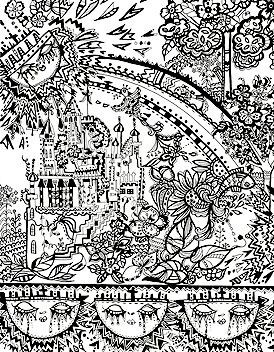
Trying to picture the intricacies of a defined sensibility, recolonizing a vagrant subject... Something like this?
99QuentinTom
oh FLo, that is suitably boggling.
100RickHarsch
i can see it temporarily confusing the vagrant subject, but not for long enough to establish a recolony
101Macumbeira
I think you are all familiar with the Dilbert character. ( If not you have hours of laughter lurking behind the corner ! )
The above academic bulshit reminded me of the famous " Mission statement generator ", which would reshuffle words into the most loony corporation mission statements. Every time you clicked the button, the same sentence would turn into another incomprehensible string of words.
Here are a few that Dilbert generated:
It is our mission to completely utilize mission-critical opportunities to stay competitive in tomorrow’s world
or
Our mission is to proactively coordinate emerging sources in order to solve business problems
or
Our mission is to continue to conveniently supply seven-habits-conforming data such that we may continue to authoritatively integrate value-added catalysts for change while promoting personal employee growth
or
It is our job to dramatically network prospective products so that we may authoritatively utilize interdependent solutions to stay competitive in tomorrow’s world
it is a pity they took it off the web. Corporations are not known for there sense of humour
The above academic bulshit reminded me of the famous " Mission statement generator ", which would reshuffle words into the most loony corporation mission statements. Every time you clicked the button, the same sentence would turn into another incomprehensible string of words.
Here are a few that Dilbert generated:
It is our mission to completely utilize mission-critical opportunities to stay competitive in tomorrow’s world
or
Our mission is to proactively coordinate emerging sources in order to solve business problems
or
Our mission is to continue to conveniently supply seven-habits-conforming data such that we may continue to authoritatively integrate value-added catalysts for change while promoting personal employee growth
or
It is our job to dramatically network prospective products so that we may authoritatively utilize interdependent solutions to stay competitive in tomorrow’s world
it is a pity they took it off the web. Corporations are not known for there sense of humour
103anna_in_pdx
I was counseled at work to stop using those random mission statements as my email signature.
104Macumbeira
hahaha ... why am I not surprised ?
105isabelle612
It was great when a hacker changed Halliburton's Mission Statement on their website for a day so it read:
To get away with as much as possible
To get away with as much as possible
106QuentinTom
hahahaha!, great!
mac I love the Dilbert link. I"m going to show them to one of my students -corporate VIP- see what she says about them.
ana, really, how silly! how humourless!
That kind of language is really like a hideous mental smudge, I find, like something filthy and unformed, the academic variety and the corporate variety.
mac I love the Dilbert link. I"m going to show them to one of my students -corporate VIP- see what she says about them.
ana, really, how silly! how humourless!
That kind of language is really like a hideous mental smudge, I find, like something filthy and unformed, the academic variety and the corporate variety.
107anna_in_pdx
Corporate speak and its public sector counterpart, bureaucratese, are two of my greatest nemeses. Love the Halliburton prank.
108QuentinTom
oh gosh I'm so in love.....
http://www.abebooks.co.uk/servlet/BookDetailsPL?bi=6887245081&tab=1&sear...
http://www.abebooks.co.uk/servlet/BookDetailsPL?bi=6887245081&tab=1&sear...
109anna_in_pdx
Whoo! what a price tag!
110Macumbeira
Yes it is à gem
111RickHarsch
Anna, that's the Yen sign, it's not really all that much
112QuentinTom
Steles, published 1914 Beijing (Peking)
640 copies were printed, each copy numbered by the printer, and affixed with Segalen's personal Chinese seal (ying zhang) in red ink.
Copies 1- 35 were printed on papier de tribut
Copies 36 – 70 bound in Verge Nacre (can someone please help me out with the translation here?)
Copies 71 – 640 bound in Verge Feutre (ditto)
Every detail of the book's production was overseen by Segalen himself. The book is long and thin, shaped like a stele, and is bound Chinese style, opening from both sides, like an accordion, so that the whole thing can be laid out like a scroll. When shut, it is tied closed with a ribbon.
The text is isolated from the whiteness of the paper by a black border, a visual representation of the stele. Each text includes an epigram in Chinese characters.
The title page of each section is in Chinese, with two huge characters on each page done in cursive script.
The cover has the word 'Steles' done in gold leaf on the bottom left, capitals, in a vaguely Art Nouveau font. Top right, also in gold leaf, has four characters in seal script: 古今碑錄 (gu, jing, bei, lu – literally: ancient modern stele collection).
The one for sale in the link above is number 279.
Love, I tell you, love. Here is a picture.
http://www.steles.org/index.html
I have the Wesley University Press edition, which includes a facsimile reproduction of the original on facing pages, and English translation from the French, and pictures of copy no:447.
640 copies were printed, each copy numbered by the printer, and affixed with Segalen's personal Chinese seal (ying zhang) in red ink.
Copies 1- 35 were printed on papier de tribut
Copies 36 – 70 bound in Verge Nacre (can someone please help me out with the translation here?)
Copies 71 – 640 bound in Verge Feutre (ditto)
Every detail of the book's production was overseen by Segalen himself. The book is long and thin, shaped like a stele, and is bound Chinese style, opening from both sides, like an accordion, so that the whole thing can be laid out like a scroll. When shut, it is tied closed with a ribbon.
The text is isolated from the whiteness of the paper by a black border, a visual representation of the stele. Each text includes an epigram in Chinese characters.
The title page of each section is in Chinese, with two huge characters on each page done in cursive script.
The cover has the word 'Steles' done in gold leaf on the bottom left, capitals, in a vaguely Art Nouveau font. Top right, also in gold leaf, has four characters in seal script: 古今碑錄 (gu, jing, bei, lu – literally: ancient modern stele collection).
The one for sale in the link above is number 279.
Love, I tell you, love. Here is a picture.
http://www.steles.org/index.html
I have the Wesley University Press edition, which includes a facsimile reproduction of the original on facing pages, and English translation from the French, and pictures of copy no:447.
113QuentinTom
Just finished volume 1 of the Raj Quartet. It's engrossing, but I guess partly because I am so busy at the moment I don't have time for anything more challenging/satisfying, and the book is small and easy to carry around.
The story of a rape, the book examines the incident from the viewpoint of all the characters involved, as well as some of the peripheral characters, English and Indian. The text is a collection of verbatim reports, diaries, letters and depositions. It's tempting to see in this the influence of Durrell's Alexandria Quartet, or Joyce Carey's Triptych, but Durrell and Carey do it better. Scott tries to give each text in the collection its own voice, but he doesn't really succeed because there is an underlying uniformity in the language, which is unmistakably Scott's own voice. There is a drive towards total explanation. Scott's imagination is, I suppose, what we could call forensic: every detail must be explicated. There is no room for the reader to supply imaginative details. The reader can see things coming from about half a mile away. This attitude extends even to Scott's grammar, which frequently jars with redundancy and pedantry. The closest parallel, now that I think of it, is Wilkie Collins, especially The Moonstone, which also is a collection of texts and which also has an underlying, forensic drive towards total explication.
Still, as I say engrossing. On to the second volume.
The story of a rape, the book examines the incident from the viewpoint of all the characters involved, as well as some of the peripheral characters, English and Indian. The text is a collection of verbatim reports, diaries, letters and depositions. It's tempting to see in this the influence of Durrell's Alexandria Quartet, or Joyce Carey's Triptych, but Durrell and Carey do it better. Scott tries to give each text in the collection its own voice, but he doesn't really succeed because there is an underlying uniformity in the language, which is unmistakably Scott's own voice. There is a drive towards total explanation. Scott's imagination is, I suppose, what we could call forensic: every detail must be explicated. There is no room for the reader to supply imaginative details. The reader can see things coming from about half a mile away. This attitude extends even to Scott's grammar, which frequently jars with redundancy and pedantry. The closest parallel, now that I think of it, is Wilkie Collins, especially The Moonstone, which also is a collection of texts and which also has an underlying, forensic drive towards total explication.
Still, as I say engrossing. On to the second volume.
114Macumbeira
Steles, the original
http://www.neh.gov/humanities/2010/januaryfebruary/feature/the-end-man
cheapest original 3500 euro
http://www.abebooks.fr/servlet/SearchResults?an=segalen&sortby=1&tn=stel...
but this one is for free
http://www.ebooksgratuits.com/pdf/segalen_steles.pdf
http://www.neh.gov/humanities/2010/januaryfebruary/feature/the-end-man
cheapest original 3500 euro
http://www.abebooks.fr/servlet/SearchResults?an=segalen&sortby=1&tn=stel...
but this one is for free
http://www.ebooksgratuits.com/pdf/segalen_steles.pdf
115QuentinTom
oh thanks for the pic, mac. Are you in love as well?
116FlorenceArt
Tom, vergé is a kind of paper that has faint horizontal lines, which are the marks left by metal rods in the manufacturing process. I'm not sure what nacré and feutré mean exactly, but I would think that the first is a kind of semi gloss paper for color illustrations, and the other a matte one.
117QuentinTom
oh thanks flo!
118Macumbeira
"vergé feutré" = laid paper = http://en.wikipedia.org/wiki/Laid_paper
nacré = glossy
nacré = glossy
119Macumbeira
> I am, it is a beautiful book
shall we steal two copies?
shall we steal two copies?
120QuentinTom
yes yes!
Here are my fragmentary thoughts on Segalen's Essay on Exoticism, which I have been studying on and off for the last few weeks.
http://www.librarything.com/work/244659
and Lectern link:
http://thelectern.blogspot.tw/2012/10/essay-on-exoticism-aesthetics-of.html
Here are my fragmentary thoughts on Segalen's Essay on Exoticism, which I have been studying on and off for the last few weeks.
http://www.librarything.com/work/244659
and Lectern link:
http://thelectern.blogspot.tw/2012/10/essay-on-exoticism-aesthetics-of.html
121Macumbeira
Mon dieu,
I need to undust my brain for this !
Thumbed in advance
Mac
I need to undust my brain for this !
Thumbed in advance
Mac
124dchaikin
Law 1: (Schopenhauer's Law of Representation) Every object presupposes a subject.
Mac's undusting, I'm trying to find more brain as I'm already confused. (wikipedia is not so helpful here)
ETA - nonetheless, Murr's essay makes fascinating sense. Very interesting.
Mac's undusting, I'm trying to find more brain as I'm already confused. (wikipedia is not so helpful here)
ETA - nonetheless, Murr's essay makes fascinating sense. Very interesting.
125ChocolateMuse
Murr's essay is frankly way over my head. I bow to your brain, Murr.
126QuentinTom
sorry choco :(
Thanks everyone. Segalen continues to enthral me. I wish there was an edition of his letters in English. I might have to read them in french, which would be very taxing.
Thanks everyone. Segalen continues to enthral me. I wish there was an edition of his letters in English. I might have to read them in french, which would be very taxing.
127dcozy
Here's a review of Stèles I did for Kyoto Journal ages ago.
Stèles / 古今碑錄, by Victor Segalen, Translated and Annotated by Timothy Billings and Christopher Bush, Wesleyan University Press, Middletown, CT, 2007, 415 pp.
There are authors who can create a compelling book from the fastness of a cork-lined room, and if plumbing the depths of the self is an author’s primary concern then such a room is as good a place as any to plumb those depths. If, however, a writer wishes to investigate precisely that which is other than the self, that which the novelist, poet, literary theorist, sinologist, and traveler Victor Segalen (1878-1919) called the exotic, then that writer will want to step out of her room and into the world. Such excursions, though they are likely to reward the intrepid with interesting lives, do not necessarily give rise to interesting work.
In Segalen’s case, his excursions—to San Francisco, to Polynesia, and most importantly, to China—do seem essential to the masterpieces he created; one can’t imagine any of them being written had Segalen lived a cork-lined life in the French, Catholic, middle-class milieu into which he had been born. His awareness, acquired at first-hand, that denizens of different cultures can see things differently and that they do so for reasons difficult to comprehend, may have given him the boldness he needed (and which few aspiring essayists possess) to allow his Essay on Exoticism to remain an unfinished collection of fragments, journal entries, letters, and outlines: a work, therefore, which is fecund and fruitful in ways a water-tight summation could never be.
His posthumously published novel, René Leys, regarded as a masterpiece in France, and periodically rediscovered and recognized abroad as an essential modernist work, deals precisely with the agitation, both pleasurable and otherwise, that comes with immersion in a culture that is foreign and will remain so. The culture which agitates Segalen in René Leys is that of China, a place that, for Segalen and such contemporaries as Paul Claudel, dedicatee of Stèles / 古今碑錄. and author of Knowing the East, seems to have been at the apogee of otherness. China’s culture and long history—and most of all, the supposed inability of Segalen and other Europeans to grasp that culture and history—lie at the center of Stèles / 古今碑錄.
To understand how important Europeans not knowing the East was to Segalen one need only consider the form of Stèles / 古今碑錄 as it was originally published, a form which Timothy Billings and Christopher Bush have done their best to maintain in the current edition. Each of the stele-shaped pages of the original contained a title in French, some Chinese text copied or adapted from a stele, and a prose-poem in French which, it is important to note, is not a translation of the Chinese, but is, instead, inspired by it. Segalen knew, of course, that few of his French readers would be able to decipher the Chinese characters, but since he deplored the displacement of difference by facile “understanding,” this did not trouble him.
Segalen’s decision not to translate the Chinese did, however, present a problem for Billings and Bush: should they translate and explicate what Segalen had chosen not to? Their solution, to provide copious annotations of the Chinese in appendices and also in a second volume accessible on line, was surely the correct one. Billings and Bush recognize that different readers will come to the text with different needs. Those who prefer to see the epigraphs as nothing more than “fine-looking decorations and signs of ‘Chineseness’” can do that, while those of a more scholarly bent will be happy for help in understanding the relationship between the Chinese epigraphs and the French poems.
“Segalen’s poems are, it is tempting to say, good,” mutter Billings and Bush with exquisite scholarly diffidence. In fact, it is hard to imagine a reader who will not revel in their masterful translations of Segalen’s poetry. One enjoys, for example, the jab Segalen takes at his Western readers’ preconceptions when he has the speaker of one poem defend the odd beliefs contained in that exotic religion, Christianity, by likening one of its tall tales to a Chinese legend:
Reason is not offended: certainly a western vir-
gin conceived, two thousand years ago,
for two thousand years before her, Jiang-
yuan, a girl without fault, became a mother . . . .
One cannot, however, do justice to Segalen’s poetry by quoting it in dribs and drabs. Here, employing tropes from the Book of Odes, Segalen builds a ringing defense of poetry and the beautiful:
They are, in the twenty-eight houses of Heaven:
the starry Shuttle that has never woven
silk;
The instarred Bull, rope about his neck, that
cannot pull his cart;
The myriadfold Net made perfectly for snatch-
ing hares, & that never gets one;
The Winnowing Basket that does not winnow;
the Dipper useless even for measuring oil!
And the throng of earthly craftsmen accuse the
celestial ones of imposture & nullity.
The poet says: They beam.
Let this poem stand as evidence that there is neither imposture nor nullity in Segalen’s work: Masterfully translated, Segalen’s poetry beams.
Stèles / 古今碑錄, by Victor Segalen, Translated and Annotated by Timothy Billings and Christopher Bush, Wesleyan University Press, Middletown, CT, 2007, 415 pp.
There are authors who can create a compelling book from the fastness of a cork-lined room, and if plumbing the depths of the self is an author’s primary concern then such a room is as good a place as any to plumb those depths. If, however, a writer wishes to investigate precisely that which is other than the self, that which the novelist, poet, literary theorist, sinologist, and traveler Victor Segalen (1878-1919) called the exotic, then that writer will want to step out of her room and into the world. Such excursions, though they are likely to reward the intrepid with interesting lives, do not necessarily give rise to interesting work.
In Segalen’s case, his excursions—to San Francisco, to Polynesia, and most importantly, to China—do seem essential to the masterpieces he created; one can’t imagine any of them being written had Segalen lived a cork-lined life in the French, Catholic, middle-class milieu into which he had been born. His awareness, acquired at first-hand, that denizens of different cultures can see things differently and that they do so for reasons difficult to comprehend, may have given him the boldness he needed (and which few aspiring essayists possess) to allow his Essay on Exoticism to remain an unfinished collection of fragments, journal entries, letters, and outlines: a work, therefore, which is fecund and fruitful in ways a water-tight summation could never be.
His posthumously published novel, René Leys, regarded as a masterpiece in France, and periodically rediscovered and recognized abroad as an essential modernist work, deals precisely with the agitation, both pleasurable and otherwise, that comes with immersion in a culture that is foreign and will remain so. The culture which agitates Segalen in René Leys is that of China, a place that, for Segalen and such contemporaries as Paul Claudel, dedicatee of Stèles / 古今碑錄. and author of Knowing the East, seems to have been at the apogee of otherness. China’s culture and long history—and most of all, the supposed inability of Segalen and other Europeans to grasp that culture and history—lie at the center of Stèles / 古今碑錄.
To understand how important Europeans not knowing the East was to Segalen one need only consider the form of Stèles / 古今碑錄 as it was originally published, a form which Timothy Billings and Christopher Bush have done their best to maintain in the current edition. Each of the stele-shaped pages of the original contained a title in French, some Chinese text copied or adapted from a stele, and a prose-poem in French which, it is important to note, is not a translation of the Chinese, but is, instead, inspired by it. Segalen knew, of course, that few of his French readers would be able to decipher the Chinese characters, but since he deplored the displacement of difference by facile “understanding,” this did not trouble him.
Segalen’s decision not to translate the Chinese did, however, present a problem for Billings and Bush: should they translate and explicate what Segalen had chosen not to? Their solution, to provide copious annotations of the Chinese in appendices and also in a second volume accessible on line, was surely the correct one. Billings and Bush recognize that different readers will come to the text with different needs. Those who prefer to see the epigraphs as nothing more than “fine-looking decorations and signs of ‘Chineseness’” can do that, while those of a more scholarly bent will be happy for help in understanding the relationship between the Chinese epigraphs and the French poems.
“Segalen’s poems are, it is tempting to say, good,” mutter Billings and Bush with exquisite scholarly diffidence. In fact, it is hard to imagine a reader who will not revel in their masterful translations of Segalen’s poetry. One enjoys, for example, the jab Segalen takes at his Western readers’ preconceptions when he has the speaker of one poem defend the odd beliefs contained in that exotic religion, Christianity, by likening one of its tall tales to a Chinese legend:
Reason is not offended: certainly a western vir-
gin conceived, two thousand years ago,
for two thousand years before her, Jiang-
yuan, a girl without fault, became a mother . . . .
One cannot, however, do justice to Segalen’s poetry by quoting it in dribs and drabs. Here, employing tropes from the Book of Odes, Segalen builds a ringing defense of poetry and the beautiful:
They are, in the twenty-eight houses of Heaven:
the starry Shuttle that has never woven
silk;
The instarred Bull, rope about his neck, that
cannot pull his cart;
The myriadfold Net made perfectly for snatch-
ing hares, & that never gets one;
The Winnowing Basket that does not winnow;
the Dipper useless even for measuring oil!
And the throng of earthly craftsmen accuse the
celestial ones of imposture & nullity.
The poet says: They beam.
Let this poem stand as evidence that there is neither imposture nor nullity in Segalen’s work: Masterfully translated, Segalen’s poetry beams.
128dcozy
And that looks to me like the pound sign, £, rather than a yen sign, ¥. If it were yen I'd be all over it.
129QuentinTom
127
Oh that's wonderful! Thanks for sharing.
Oh that's wonderful! Thanks for sharing.
130LolaWalser
#120
You're tempting me to jump into Segalen as well, Murr. I'd love to polemise about these notions of exoticism with you, I don't understand so much.
#127
That's great, David.
OH! *slaps forehead* I remember what I came in to say--discovered another great book with a very unusual cat, Henri Guigonnat's Daemon in Lithuania. Hoffmann is name-checked, so we can take it for granted the Daemon is a cousin to Murr.
In a castle in Lithuania a strange family passes idly their snowbound days. The grandson takes in a mysterious cat who quickly establishes itself as the Controller, the idol and the pivot of the whole company. Moreover, the cat grows ever larger... on dessert and, it seems, a stray village child or two.
You're tempting me to jump into Segalen as well, Murr. I'd love to polemise about these notions of exoticism with you, I don't understand so much.
#127
That's great, David.
OH! *slaps forehead* I remember what I came in to say--discovered another great book with a very unusual cat, Henri Guigonnat's Daemon in Lithuania. Hoffmann is name-checked, so we can take it for granted the Daemon is a cousin to Murr.
In a castle in Lithuania a strange family passes idly their snowbound days. The grandson takes in a mysterious cat who quickly establishes itself as the Controller, the idol and the pivot of the whole company. Moreover, the cat grows ever larger... on dessert and, it seems, a stray village child or two.
131QuentinTom
oh do jump right in, Lola, the water's lovely. :)
Guigonnat sounds fab.
Guigonnat sounds fab.
132QuentinTom
Further thoughts on Segalen:
From the Essay on Exoticism:
...we have on the one hand the mental world that is immediately and interiorly given to us by our consciousness; it includes all mental events, sensations, images, ideas. On the other hand, we have the physiological and physical world, which ends where the other begins. This latter world is only given to us indirectly, through the mediation of the mental world, by means of perception and of the senses. This world is exterior to us It includes a series of phenomena that occasion the awakening of the of the mental world. These phenomena are vibratory...nerves... centres...After that the setting suddenly changes: the physiological world vanishes and the mental world erupts onto the scene of consciousness with its retinue of images and ideas. .....
One of the things that fascinates me about Segalen is his attempt to merge- or at least establish a dialogue- between Locke's empiricism, and the quite different empiricism of the Dao Der Jing. This passage from the Essay seems to me to be straight out of Locke.
Locke: Seeing, categorising and naming are inseparable activities
Daoism: Seeing and naming are separate activities and must never be confused for each other
From the Essay on Exoticism:
...we have on the one hand the mental world that is immediately and interiorly given to us by our consciousness; it includes all mental events, sensations, images, ideas. On the other hand, we have the physiological and physical world, which ends where the other begins. This latter world is only given to us indirectly, through the mediation of the mental world, by means of perception and of the senses. This world is exterior to us It includes a series of phenomena that occasion the awakening of the of the mental world. These phenomena are vibratory...nerves... centres...After that the setting suddenly changes: the physiological world vanishes and the mental world erupts onto the scene of consciousness with its retinue of images and ideas. .....
One of the things that fascinates me about Segalen is his attempt to merge- or at least establish a dialogue- between Locke's empiricism, and the quite different empiricism of the Dao Der Jing. This passage from the Essay seems to me to be straight out of Locke.
Locke: Seeing, categorising and naming are inseparable activities
Daoism: Seeing and naming are separate activities and must never be confused for each other
133QuentinTom
oh golly, look at that, two months nearly I havne't posted.
Truth is, I've been drifting. Work has been madly busy and Im not really in much of a reading mood. I've also set myself a task of trying to complete by Chinese New Year several things I started earlier in the year. But this has been fatal, because It requires concentration that I can ill afford right now.
After the Segalen debacle earlier, I read with much relish and enjoyment right through Paul Scott's Raj Quartet. I became a bit obsessed and watched lots of the Granada TV version, which for some reason I missed on its first showing in the UK in the 80s. It's all rather melodramatic in a kind of Dorothy Dunnett way, but not as good as she is because PS has pretensions towards something grander and more ambitious than he's really quite capable of. his Vision outreaches his grasp. But it was a thumping good read if you want to just wallow in the Raj, which I confess to wanting to do sometimes.
I've been studying very closely Othello with my Taiwanese high school student. It's one of her set texts for the IBC. This girl is Taiwanese but educated at the Taipei European School (influential parents I guess), and her English is AWESOME! She's as bright as a button and refreshingly idealistic and she loves her classes with me and prepares diligently for them. we've been reading Othello to each other in a cafe, going through it line by line. I felt a bit wary of explaining all of Iago's filthy humour to her, but she didn't blink an eyelid. She even went through the play and made a list of synonyms for 'whore', which she proudly presented me with. I've been giving her assignments where she has to go through a speech and translate it as closely as she can into modern English. It's wonderful training in the manipulation of English syntax. The great miracle of Shakespeare's ENglish is its incredible concision. To help in my teaching, I read Bradley's two lectures on Othello in Shakespearean Tragedy and the relevant chapters in Shakespeare the invention of the human by Bloom. I know DFw and all those guys lampooned old Harold, but I agree with him more times than I disagree with him, despite his penchant for sounding forth in lofty tones, with full pedal.
Truth is, I've been drifting. Work has been madly busy and Im not really in much of a reading mood. I've also set myself a task of trying to complete by Chinese New Year several things I started earlier in the year. But this has been fatal, because It requires concentration that I can ill afford right now.
After the Segalen debacle earlier, I read with much relish and enjoyment right through Paul Scott's Raj Quartet. I became a bit obsessed and watched lots of the Granada TV version, which for some reason I missed on its first showing in the UK in the 80s. It's all rather melodramatic in a kind of Dorothy Dunnett way, but not as good as she is because PS has pretensions towards something grander and more ambitious than he's really quite capable of. his Vision outreaches his grasp. But it was a thumping good read if you want to just wallow in the Raj, which I confess to wanting to do sometimes.
I've been studying very closely Othello with my Taiwanese high school student. It's one of her set texts for the IBC. This girl is Taiwanese but educated at the Taipei European School (influential parents I guess), and her English is AWESOME! She's as bright as a button and refreshingly idealistic and she loves her classes with me and prepares diligently for them. we've been reading Othello to each other in a cafe, going through it line by line. I felt a bit wary of explaining all of Iago's filthy humour to her, but she didn't blink an eyelid. She even went through the play and made a list of synonyms for 'whore', which she proudly presented me with. I've been giving her assignments where she has to go through a speech and translate it as closely as she can into modern English. It's wonderful training in the manipulation of English syntax. The great miracle of Shakespeare's ENglish is its incredible concision. To help in my teaching, I read Bradley's two lectures on Othello in Shakespearean Tragedy and the relevant chapters in Shakespeare the invention of the human by Bloom. I know DFw and all those guys lampooned old Harold, but I agree with him more times than I disagree with him, despite his penchant for sounding forth in lofty tones, with full pedal.
134QuentinTom
Desdemona:
My mother had a maid called Barbary,
She was in love, and he she loved proved mad
And did forsake her. She had a song of “Willow,”
An old thing ’twas, but it expressed her fortune
And she died singing it.
Othello IV.3
Bradley notes that this is essentially Ophelia's story. Othello was the next play written after Hamlet.
I could kiss him for this little insight.
My mother had a maid called Barbary,
She was in love, and he she loved proved mad
And did forsake her. She had a song of “Willow,”
An old thing ’twas, but it expressed her fortune
And she died singing it.
Othello IV.3
Bradley notes that this is essentially Ophelia's story. Othello was the next play written after Hamlet.
I could kiss him for this little insight.
135QuentinTom
speaking of India, 2013 is the year the much awaited sequel to A Suitable Boy is expected: A suitable Girl. any one hear anything?
136QuentinTom
Anyway, there's more to come but the midnight hour draws nigh, and I'm off on a jaunt to Chiang Mai tomorrow at dawn, followed by a few days in Bangkok the city of (fallen) angels.
I'm only taking my kindle, coz I hope to stock up on books in the excellent second hand bookstores in CM. Im reading Dicken's The Uncommercial Traveller which is marvellous, but more on that later.
I'm only taking my kindle, coz I hope to stock up on books in the excellent second hand bookstores in CM. Im reading Dicken's The Uncommercial Traveller which is marvellous, but more on that later.
137RickHarsch
Dcozy, great review, thanks.
TC: Why are there no such students in Slovenia?
TC: Why are there no such students in Slovenia?
138MeditationesMartini
>133 QuentinTom: fuck, lucky! My favourite of all my students in my tutoring days was Taiwanese and super bright, but his English level was more Harry Potter than Shakespeare.
139Porius
the 'wealthy curled darlings' were shunned for the dusky moor.
from Trollope's AUTOBIOGRAPHY
Mrs. Drury, when she saw us, shook her head with pitying horror. There were ever so many other punishments accumulated on our heads. It broke my heart, knowing myself to be innocent, and suffering also under the almost equally painful feeling that the other three--no doubt wicked boys--were the CURLED DARLINGS of the school, who would never have selected me to share their wickedness with them. I contrived to learn, from words that fell from Mr. Drury, that he condemned me because I, having come from a public school, might be supposed to be the leader of wickedness!
from Trollope's AUTOBIOGRAPHY
Mrs. Drury, when she saw us, shook her head with pitying horror. There were ever so many other punishments accumulated on our heads. It broke my heart, knowing myself to be innocent, and suffering also under the almost equally painful feeling that the other three--no doubt wicked boys--were the CURLED DARLINGS of the school, who would never have selected me to share their wickedness with them. I contrived to learn, from words that fell from Mr. Drury, that he condemned me because I, having come from a public school, might be supposed to be the leader of wickedness!
140ChocolateMuse
All such interesting posts, Murr! I wish I'd had a tutor like you when we studied Othello at school. Funny, everyone else imagines themselves as the tutor in your story but I see myself as the student. An age thing?
141QuentinTom
but choco, I am only 23!
142dchaikin
A lucky student, indeed, I would worry for her if she also used you as a math tutor (23 my a$$)
Looking forward to anything you write about Dickens.
Looking forward to anything you write about Dickens.
143ChocolateMuse
23, you say?
Disprove this villain, if thou be'st a man!
Disprove this villain, if thou be'st a man!
144RickHarsch
woops, i went to look at post 23, which was mine, and began trembling...
145LolaWalser
There was a Segalen debacle? What happened? Why am I not IN THE FLOW?
147QuentinTom
Maybe the debacle was more in my own mind than anywhere else.......
Just back from Chiang Mai, the second hand bookstore centre of Asia, especially a fabulous shop called Backstreet books:
Where I found some treasures. I was just on the point of leaving with a giant haul, when I turned round, and saw, at eye level, Franco Venturi's Roots of Revolution, in perfect condition, giving me one of my orgasm-in-public moments, usually experienced in bookstores when I stumble across something completely unexpected but longed for.
I read on vacation:
The Great Indian Novel by Shashi Tharoor, another new author for me. A great book, more on this later, and then RK Narayan's redaction of the Mahabarata. Indian literature makes a lot of sense read in the bright sunshine and intense heat of Thailand, but back here in TPE in the cold and rain, I am at a loss now as to what to read.
I have to finish the years reading: which means:
The Idylls of the King, which I started in the middle of OMF (those mid victorians, how I love them)
A Christmas Carol, which I am reading with another of my students
I should be embarking on a read of the latest bio of Mao Tse Tung for Open Letters Monthly, but do I really want to read yet another bio of Mao, already having read three? It's hard to find the motivation, but I might combine it with a longish study of all the books I have on China.
Mmm.
Just back from Chiang Mai, the second hand bookstore centre of Asia, especially a fabulous shop called Backstreet books:
Where I found some treasures. I was just on the point of leaving with a giant haul, when I turned round, and saw, at eye level, Franco Venturi's Roots of Revolution, in perfect condition, giving me one of my orgasm-in-public moments, usually experienced in bookstores when I stumble across something completely unexpected but longed for.
I read on vacation:
The Great Indian Novel by Shashi Tharoor, another new author for me. A great book, more on this later, and then RK Narayan's redaction of the Mahabarata. Indian literature makes a lot of sense read in the bright sunshine and intense heat of Thailand, but back here in TPE in the cold and rain, I am at a loss now as to what to read.
I have to finish the years reading: which means:
The Idylls of the King, which I started in the middle of OMF (those mid victorians, how I love them)
A Christmas Carol, which I am reading with another of my students
I should be embarking on a read of the latest bio of Mao Tse Tung for Open Letters Monthly, but do I really want to read yet another bio of Mao, already having read three? It's hard to find the motivation, but I might combine it with a longish study of all the books I have on China.
Mmm.

