Rebeccanyc Reads in 2013, Part 1
This topic was continued by Rebeccanyc Reads in 2013, Part 2.
Talk Club Read 2013
Join LibraryThing to post.
This topic is currently marked as "dormant"—the last message is more than 90 days old. You can revive it by posting a reply.
1rebeccanyc
* means a favorite read
Read in February
12. The City Builder by George Konrád
11. Young Stalin by Simon Sebag Montefiore*
10. Old Man Goriot by Honoré de Balzac
9. The Ladies' Paradise by Émile Zola
8. Explosion in a Cathedral by Alejo Carpentier*
Read in January
7. Doomsday Book by Connie Willis
6. Bring Up the Bodies by Hilary Mantel*
5. My Century by Alexander Wat*
4. Kornél Esti by Dezsõ Kosztolányi
3. The Toilers of the Sea by Victor Hugo*
2. The Black Count: Glory, Revolution, Betrayal and the Real Count of Monte Cristo by Tom Reiss*
1. Pot Luck by Emile Zola
Read in February
12. The City Builder by George Konrád
11. Young Stalin by Simon Sebag Montefiore*
10. Old Man Goriot by Honoré de Balzac
9. The Ladies' Paradise by Émile Zola
8. Explosion in a Cathedral by Alejo Carpentier*
Read in January
7. Doomsday Book by Connie Willis
6. Bring Up the Bodies by Hilary Mantel*
5. My Century by Alexander Wat*
4. Kornél Esti by Dezsõ Kosztolányi
3. The Toilers of the Sea by Victor Hugo*
2. The Black Count: Glory, Revolution, Betrayal and the Real Count of Monte Cristo by Tom Reiss*
1. Pot Luck by Emile Zola
2rebeccanyc
So, thinking about my reading for the coming year, I realize that of course I will continue to read what strikes my fancy at the time I need to pick up a new book, that I'll continue to buy more new books than I read and to read newer books in preference to those languishing on my TBR, and that I'll need more fun reads (as I discovered last year) to balance my tendency to read grim and depressing books!
That said, there are several areas that I suspect will claim my interest at least part of the time, some related to groups I participate in and some that are of personal fascination.
Reading Globally
I know I'll be participating eagerly in the first quarter read on 20th and 21st century Eastern and Central European literature, as I have already read a lot in this category and have a ton of books on my TBR.
I'm intrigued by the Southeast Asia read, as I have nothing from this area, and will enjoy the Francophone (outside Europe) read as this will encourage me to read some African Francophone literature and the South American read which will encourage me to read more than Mario Vargas Llosa (although I still have a couple of his books, unread, on the TBR).
I had greater ambitions for last quarter's China theme read than I was able to fulfil, so I hope to be reading some of the works by Chinese authors I've acquired, including more Mo Yan for the Read Mo Yan! group.
Author Theme Reads
This year's focus is French writers, and the year-long writer is Zola, who I became addicted to this year, so I'll have no problem continuing my read of the Rougon-Macquart cycle. I'm reading it in the recommended order and only reading titles that have recent English translations, as the older translation are notoriously bowdlerized. (I have an ambition to improve my French to the point where I could read the others in French, but not only am I unlikely to put enough effort into improving my French (actually, bringing it back to where it was when I graduated from high school) but Zola is said to be an incredibly difficult author to read in French.)
I expect to read works by other French authors as part of this group (hopefully, at least one for each of the featured authors) and I hope also to read works by other authors that are sitting on my TBR (e.g., Stendahl). I've been moderately interested in the French revolution since reading Mantel's A Place of Greater Safety several years ago and finally got around to reading the voluminous and fascinating Citizens last summer, so I will probably continue to read books that are peripherally related to the revolution, including The Black Count, which I may start today and Carpentier's Explosion in a Cathedral, which has been on the TBR for a few years.
Literary Centennials
I read a big zero of books for the two literary centennials of the past year that I hoped to read (Patrick White and Elizabeth Taylor), but I can be confident that I'll do better this year, not only because there's a group for it but because Robertson Davies is one of this year's centennial authors and I'm looking forward to reading the two books of his I haven't yet read. Might read some Camus too.
Russian Literature and History
This is an area that has interested me for quite a while and I have a lot of classic and more recent works of Russian literature on my TBR. This also segues into my next ongoing area of interest . . .
Evils of the 20th (and maybe the 21st) Century
A few years ago I realized I was reading a lot about the Hitler and Stalin eras, and I have continued to do so (although I think I've reached my limit on the Holocaust). This year I hope to read the two-volume Stalin biography by Simon Sebag Montefiore (Young Stalin and The Court of the Red Tsar, as well as a book I have on Stalingrad, Kolyma Tales, and In Russian and French Prisons, among others. I also would like to branch out to Asia, and read Mao's Great Famine, and possibly to the 21st century, as I've got The Cage: The Fight for Sri Lanka and the Last Days of the Tamil Tigers on my wish list, thanks to an LT review.
Author Discoveries
I discovered many great authors this year (see post 4) and will continue reading works by some of them, as well as by other authors I've discovered in recent years (mostly thanks to LT). And I'm sure I'll continue to find new ones, thanks to all of you.
New Directions?
This is the fun part! I have no idea what I'll become interested in this year. Stay tuned.
That said, there are several areas that I suspect will claim my interest at least part of the time, some related to groups I participate in and some that are of personal fascination.
Reading Globally
I know I'll be participating eagerly in the first quarter read on 20th and 21st century Eastern and Central European literature, as I have already read a lot in this category and have a ton of books on my TBR.
I'm intrigued by the Southeast Asia read, as I have nothing from this area, and will enjoy the Francophone (outside Europe) read as this will encourage me to read some African Francophone literature and the South American read which will encourage me to read more than Mario Vargas Llosa (although I still have a couple of his books, unread, on the TBR).
I had greater ambitions for last quarter's China theme read than I was able to fulfil, so I hope to be reading some of the works by Chinese authors I've acquired, including more Mo Yan for the Read Mo Yan! group.
Author Theme Reads
This year's focus is French writers, and the year-long writer is Zola, who I became addicted to this year, so I'll have no problem continuing my read of the Rougon-Macquart cycle. I'm reading it in the recommended order and only reading titles that have recent English translations, as the older translation are notoriously bowdlerized. (I have an ambition to improve my French to the point where I could read the others in French, but not only am I unlikely to put enough effort into improving my French (actually, bringing it back to where it was when I graduated from high school) but Zola is said to be an incredibly difficult author to read in French.)
I expect to read works by other French authors as part of this group (hopefully, at least one for each of the featured authors) and I hope also to read works by other authors that are sitting on my TBR (e.g., Stendahl). I've been moderately interested in the French revolution since reading Mantel's A Place of Greater Safety several years ago and finally got around to reading the voluminous and fascinating Citizens last summer, so I will probably continue to read books that are peripherally related to the revolution, including The Black Count, which I may start today and Carpentier's Explosion in a Cathedral, which has been on the TBR for a few years.
Literary Centennials
I read a big zero of books for the two literary centennials of the past year that I hoped to read (Patrick White and Elizabeth Taylor), but I can be confident that I'll do better this year, not only because there's a group for it but because Robertson Davies is one of this year's centennial authors and I'm looking forward to reading the two books of his I haven't yet read. Might read some Camus too.
Russian Literature and History
This is an area that has interested me for quite a while and I have a lot of classic and more recent works of Russian literature on my TBR. This also segues into my next ongoing area of interest . . .
Evils of the 20th (and maybe the 21st) Century
A few years ago I realized I was reading a lot about the Hitler and Stalin eras, and I have continued to do so (although I think I've reached my limit on the Holocaust). This year I hope to read the two-volume Stalin biography by Simon Sebag Montefiore (Young Stalin and The Court of the Red Tsar, as well as a book I have on Stalingrad, Kolyma Tales, and In Russian and French Prisons, among others. I also would like to branch out to Asia, and read Mao's Great Famine, and possibly to the 21st century, as I've got The Cage: The Fight for Sri Lanka and the Last Days of the Tamil Tigers on my wish list, thanks to an LT review.
Author Discoveries
I discovered many great authors this year (see post 4) and will continue reading works by some of them, as well as by other authors I've discovered in recent years (mostly thanks to LT). And I'm sure I'll continue to find new ones, thanks to all of you.
New Directions?
This is the fun part! I have no idea what I'll become interested in this year. Stay tuned.
3rebeccanyc
My favorite reads of 2012. Lists are not in any particular order.
Fiction
The Best of the Best: Contemporary
Nervous Conditions by Tsitsi Dangarembga
The Colonel by Mahmoud Dowlatabadi
The Devil in Silver by Victor Lavalle
Binocular Vision by Edith Pearlman
GB84 by David Peace
Red Sorghum by Mo Yan
The Best of the Best: Classics
The Monk by M. G. Lewis
Jack Sheppard by William Harrison Ainsworth
Germinal, L'Assommoir, The Kill and Nana by Emile Zola
The Expendable Man and In a Lonely Place by Dorothy Hughes
White Guard by Mikhail Bulgakov
The Cornish Trilogy and The Salterton Trilogy by Robertson Davies
The Kingdom of This World by Alejo Carpentier
The Corner That Held Them by Sylvia Townsend Warner
Fiction: Most Fun Reads (some overlap with other categories)
Jack Sheppard by William Harrison Ainsworth
The Monk by M. G. Lewis
13 Inspector Montalbano mysteries by Andrea Camilleri
World War Z by Max Brooks
Fiction: The Best of the Rest
The Round House by Louise Erdrich
Big Machine by Victor Lavalle
Moving Parts by Magdalena Tulli
The Birthday Boys, Master Georgie, and Every Man for Himself by Beryl Bainbridge
13 Inspector Montalbano mysteries by Andrea Camilleri
A Tomb for Boris Davidovich by Danilo Kis
Ashes and Diamonds by Jerzy Andrejewski
The Ermine of Czernopol by Gregor von Rezzori
Nonfiction
Nonfiction: The Best of the Best
The New Jim Crow by Michelle Alexander
Memoirs of a Revolutionary by Victor Serge
Cleopatra: A Life by Stacy Schiff
Nonfiction: The Best or the Rest
The Stammering Century by Gilbert Seldes
Iron Curtain by Anne Alexander
The Story of America and The Mansion of Happiness by Jill Lepore
To the Finland Station by Edmund Wilson
Still More Categories
Disappointments
Battleborn by Claire Vaye Watkins
Vlad by Carlos Fuentes
The Dream of the Celt by Mario Vargas Llosa
Duds
How to Write a Sentence by Stanley Fish
The First Crusade: The Call from the East by Peter Frankopan
Vesuvius by Gillian Darley
And, finally, if I had to pick just five . . .well, make that six (but this is just how I feel at this moment!)
The New Jim Crow by Michelle Alexander
Memoirs of a Revolutionary by Victor Serge
Germinal by Emile Zola
The Expendable Man by Dorothy Hughes
White Guard by Mikhail Bulgakov
Nervous Conditions by Tsitsi Dangarembga
Fiction
The Best of the Best: Contemporary
Nervous Conditions by Tsitsi Dangarembga
The Colonel by Mahmoud Dowlatabadi
The Devil in Silver by Victor Lavalle
Binocular Vision by Edith Pearlman
GB84 by David Peace
Red Sorghum by Mo Yan
The Best of the Best: Classics
The Monk by M. G. Lewis
Jack Sheppard by William Harrison Ainsworth
Germinal, L'Assommoir, The Kill and Nana by Emile Zola
The Expendable Man and In a Lonely Place by Dorothy Hughes
White Guard by Mikhail Bulgakov
The Cornish Trilogy and The Salterton Trilogy by Robertson Davies
The Kingdom of This World by Alejo Carpentier
The Corner That Held Them by Sylvia Townsend Warner
Fiction: Most Fun Reads (some overlap with other categories)
Jack Sheppard by William Harrison Ainsworth
The Monk by M. G. Lewis
13 Inspector Montalbano mysteries by Andrea Camilleri
World War Z by Max Brooks
Fiction: The Best of the Rest
The Round House by Louise Erdrich
Big Machine by Victor Lavalle
Moving Parts by Magdalena Tulli
The Birthday Boys, Master Georgie, and Every Man for Himself by Beryl Bainbridge
13 Inspector Montalbano mysteries by Andrea Camilleri
A Tomb for Boris Davidovich by Danilo Kis
Ashes and Diamonds by Jerzy Andrejewski
The Ermine of Czernopol by Gregor von Rezzori
Nonfiction
Nonfiction: The Best of the Best
The New Jim Crow by Michelle Alexander
Memoirs of a Revolutionary by Victor Serge
Cleopatra: A Life by Stacy Schiff
Nonfiction: The Best or the Rest
The Stammering Century by Gilbert Seldes
Iron Curtain by Anne Alexander
The Story of America and The Mansion of Happiness by Jill Lepore
To the Finland Station by Edmund Wilson
Still More Categories
Disappointments
Battleborn by Claire Vaye Watkins
Vlad by Carlos Fuentes
The Dream of the Celt by Mario Vargas Llosa
Duds
How to Write a Sentence by Stanley Fish
The First Crusade: The Call from the East by Peter Frankopan
Vesuvius by Gillian Darley
And, finally, if I had to pick just five . . .well, make that six (but this is just how I feel at this moment!)
The New Jim Crow by Michelle Alexander
Memoirs of a Revolutionary by Victor Serge
Germinal by Emile Zola
The Expendable Man by Dorothy Hughes
White Guard by Mikhail Bulgakov
Nervous Conditions by Tsitsi Dangarembga
4rebeccanyc
2012 Statistics
Overall Statistics
Total Read: 110
Fiction: 90 (82%)/Nonfiction: 20 (18%)
Male authors: 82 (75%)/Female authors: 28 (25%)
Note: This statistic was skewed by my reading 13 books by Andrea Camilleri, 6 by Emile Zola, and 6 by Robertson Davies.
Books read within a year of my acquiring them: 98 (89%)/Books on TBR longer than a year: 12 (11%)
Authors new to me: 41
Books read because of LT recommendations: 17
Books from the 21st century: 35/ Books from the 20th century: 45/ Books from before the 20th century: 30
Country of Author
USA 13 fiction/13 nonfiction
Canada 7
England 8
Italy 13 (all Camilleris)
France 9
Russia 5
Poland 3
Austria, Croatia, Greece, Iceland, Serbia, and Yiddish 1 each
Mexico 1
Peru 1
Cuba 1
Kenya 2
Zimbabwe 2
Cameroon 1
Egypt 4
Iran 1
Japan 10 (Author Theme Reads focus)
China 2
India 1
Burma/Myanmar 1
Discoveries
Jerzy Andrzejewski
Beryl Bainbridge
Andrea Camilleri
Tsitsi Dangarembga
Dorothy Hughes
Victor Lavalle
Edith Pearlman
Emile Zola
Analysis
Well, what to make of this? I discovered I can't always read long, serious, grim books, and that sometimes I need to read readable fun books (hence, Camilleri, among others). I read a lot from Japan because of the Author Theme Reads group. I discovered Zola and Bainbridge, Dorothy Hughes and Tsitsi Dangaremga. Overall, I read proportionally fewer books by women, because they were overwhelmed by 13 Camilleris and 6 Zolas. I didn't read as globally as in previous years, but I did get somewher on every continent. I continue to buy more books than I read, and I continue to read what strikes my fancy when I'm ready to pick up a new book, although I sometimes have a sense of what I want to read in the near future. I tend to read books I've recently acquired rather than books on the TBR, although occasionally something will spur me to read something I've had for decades. LT, and this group especially, continues to introduce me to new authors and new books -- and dramatically expand my TBR. May it continue!
Overall Statistics
Total Read: 110
Fiction: 90 (82%)/Nonfiction: 20 (18%)
Male authors: 82 (75%)/Female authors: 28 (25%)
Note: This statistic was skewed by my reading 13 books by Andrea Camilleri, 6 by Emile Zola, and 6 by Robertson Davies.
Books read within a year of my acquiring them: 98 (89%)/Books on TBR longer than a year: 12 (11%)
Authors new to me: 41
Books read because of LT recommendations: 17
Books from the 21st century: 35/ Books from the 20th century: 45/ Books from before the 20th century: 30
Country of Author
USA 13 fiction/13 nonfiction
Canada 7
England 8
Italy 13 (all Camilleris)
France 9
Russia 5
Poland 3
Austria, Croatia, Greece, Iceland, Serbia, and Yiddish 1 each
Mexico 1
Peru 1
Cuba 1
Kenya 2
Zimbabwe 2
Cameroon 1
Egypt 4
Iran 1
Japan 10 (Author Theme Reads focus)
China 2
India 1
Burma/Myanmar 1
Discoveries
Jerzy Andrzejewski
Beryl Bainbridge
Andrea Camilleri
Tsitsi Dangarembga
Dorothy Hughes
Victor Lavalle
Edith Pearlman
Emile Zola
Analysis
Well, what to make of this? I discovered I can't always read long, serious, grim books, and that sometimes I need to read readable fun books (hence, Camilleri, among others). I read a lot from Japan because of the Author Theme Reads group. I discovered Zola and Bainbridge, Dorothy Hughes and Tsitsi Dangaremga. Overall, I read proportionally fewer books by women, because they were overwhelmed by 13 Camilleris and 6 Zolas. I didn't read as globally as in previous years, but I did get somewher on every continent. I continue to buy more books than I read, and I continue to read what strikes my fancy when I'm ready to pick up a new book, although I sometimes have a sense of what I want to read in the near future. I tend to read books I've recently acquired rather than books on the TBR, although occasionally something will spur me to read something I've had for decades. LT, and this group especially, continues to introduce me to new authors and new books -- and dramatically expand my TBR. May it continue!
5rebeccanyc
List by country of books read in 2013 (i.e., country of author)
Central America (and Mexico) and the Caribbean
Explosion in a Cathedral by Alejo Carpentier
Europe
England and the UK
Fiction
Doomsday Book by Connie Willis
Bring Up the Bodies by Hilary Mantel
Nonfiction
Young Stalin by Simon Sebag Montefiore
France
Old Man Goriot by Honoré de Balzac
The Ladies' Paradise by Émile Zola
The Toilers of the Sea by Victor Hugo
Pot Luck by Emile Zola
Hungary
The City Builder by George Konrád
Kornél Esti by Dezsõ Kosztolányi
Poland
My Century by Aleksander Wat
US and Canada
USA
Fiction
Nonfiction
The Black Count: Glory, Revolution, Betrayal, and the Real Count of Monte Cristo by Tom Reiss
Central America (and Mexico) and the Caribbean
Explosion in a Cathedral by Alejo Carpentier
Europe
England and the UK
Fiction
Doomsday Book by Connie Willis
Bring Up the Bodies by Hilary Mantel
Nonfiction
Young Stalin by Simon Sebag Montefiore
France
Old Man Goriot by Honoré de Balzac
The Ladies' Paradise by Émile Zola
The Toilers of the Sea by Victor Hugo
Pot Luck by Emile Zola
Hungary
The City Builder by George Konrád
Kornél Esti by Dezsõ Kosztolányi
Poland
My Century by Aleksander Wat
US and Canada
USA
Fiction
Nonfiction
The Black Count: Glory, Revolution, Betrayal, and the Real Count of Monte Cristo by Tom Reiss
7alphaorder
Nice - I am going to steal your "reserved" to start my thread.
8marieke54
Hi Rebecca. Last year I often looked up and enjoyed your reviews and now I am also going to steal your "reserved" idea.
10rebeccanyc
Hi everyone, and thanks for stopping by.
I've posted my thoughts (as of now) about my 2013 reading in the second post. I also hope to go to one of my favorite bookstores, Book Culture, later today for my first book-buying of the year, as they're having a 20% off New Year's Day sale.
I've posted my thoughts (as of now) about my 2013 reading in the second post. I also hope to go to one of my favorite bookstores, Book Culture, later today for my first book-buying of the year, as they're having a 20% off New Year's Day sale.
12labfs39
Have fun book shopping. I love your lists and analysis up top. Lots of great books, and ones that I want to read or am thinking about reading. Still with the family in Maine and am behind in reviews and in starting my new thread. *sigh* How can I already be behind on January first?!
Happy New Year!
Happy New Year!
13rebeccanyc
My first book haul of the year, from the 20% off New Year's day sale at Book Culture:
Dancing Lessons for the Advanced in Age by Bohumil Hrabal (already reduced as a remainder)
The Story of the Stone, Volume I by Cao Xueqin
My Happy Days in Hell by Gyorgy Faludy
Family by Ian Frazier
Of Africa by Wole Soyinka
Dancing Lessons for the Advanced in Age by Bohumil Hrabal (already reduced as a remainder)
The Story of the Stone, Volume I by Cao Xueqin
My Happy Days in Hell by Gyorgy Faludy
Family by Ian Frazier
Of Africa by Wole Soyinka
14janeajones
Interesting and eclectic!
15arubabookwoman
Interesting book statistics. We have several favorites in common, but that isn't too surprising to me after following your reading for several years.
Your new purchases look good. In reviewing my year end I noted I had bought more than 300 books last year, so I'm going to make a concerted effort this year to buy fewer books, a lot fewer books.
Your new purchases look good. In reviewing my year end I noted I had bought more than 300 books last year, so I'm going to make a concerted effort this year to buy fewer books, a lot fewer books.
16deebee1
Great haul, rebecca. I look forward to what you think of My Happy Days in Hell which has been on my wish list for a while. Sounds like a fun book!
17rebeccanyc
Thanks, Jane, Deborah, and Deebee.
Deborah, I owe many of my favorite reads of recent years to you, so the feeling is mutual. I too bought way too many books last year (240 more or less), but it's hard to resist a 20% off sale and free day to browse as much as I like.
Deebee, I hadn't heard of My Happy Days in Hell, but the cover jumped out at me from the shelves (one of my browsing techniques is to look for unusual looking spines as a way of finding books from smaller publishers -- although in this case it turns out that "Central European Classics" is a part of Penguin) and I have an interest in Central European writing. Not sure when I'll get to it, but it does look like fun (at least for someone like me who likes grim books).
Deborah, I owe many of my favorite reads of recent years to you, so the feeling is mutual. I too bought way too many books last year (240 more or less), but it's hard to resist a 20% off sale and free day to browse as much as I like.
Deebee, I hadn't heard of My Happy Days in Hell, but the cover jumped out at me from the shelves (one of my browsing techniques is to look for unusual looking spines as a way of finding books from smaller publishers -- although in this case it turns out that "Central European Classics" is a part of Penguin) and I have an interest in Central European writing. Not sure when I'll get to it, but it does look like fun (at least for someone like me who likes grim books).
19rebeccanyc
Ha ha ha, Barry -- I don't think of myself as that advanced in age, but maybe I'm deluding myself!
20RidgewayGirl
I'm looking forward to following your thread for another year.
23SassyLassy
Great haul to start your year. Looking forward to your reviews.
24The_Hibernator
Hi rebeccanyc! I plan on reading The New Jim Crow in February for a Social Justice theme read I'm hosting on my blog. It's good to know you liked it. I'm really looking forward to it.
25rebeccanyc
#21, Dan, Well, I know better than to expect miraculous change!
#21, 22 Marieke & Sassy, Thanks!
#24 Rachel, it was one of the most stunning (and horrifying) books I've read in the past several years. As I said in my review, it makes me ashamed for my country.
#21, 22 Marieke & Sassy, Thanks!
#24 Rachel, it was one of the most stunning (and horrifying) books I've read in the past several years. As I said in my review, it makes me ashamed for my country.
26rebeccanyc
Books Recommended by Others
(in future threads, I'll put this post, which I've stolen from Deebee's thread, at the top)
The Pursuit of the Millennium by Norman Cohn Recommended by SassyLassy Bought 1/9
Religion and the Decline of Magic by Keith Thomas Recommended by dmsteyn Bought 1/9
Forged: Why Fakes are the Great Art of Our Age by Jonathon Keats Recommended by RidgewayGirl
The Recognitions by William Gaddis Recommended by EnriqueFreeque
The Embarrassment of Riches by Simon Schama Recommended by deebee
The Song of Everlasting Sorrow by Wang Anyi Recommended by steven03tx
Sister Bernadette's Barking Dog by Kitty Burns Florey Recommended by detailmuse
Country of My Skull by Antjie Krog Recommended bymkboylan
Arabian Sands and The Marsh Arabs by Wilfred Thesiger Recommended by Linda92007
The Issa Valley by Czeslaw Milosz Recommended by Lisa/labfs39 Bought 2/15
Slouching Towards Bethlehem by Joan Didion Recommended by MK/detailmuse and SassyLassy
(in future threads, I'll put this post, which I've stolen from Deebee's thread, at the top)
Forged: Why Fakes are the Great Art of Our Age by Jonathon Keats Recommended by RidgewayGirl
The Recognitions by William Gaddis Recommended by EnriqueFreeque
The Embarrassment of Riches by Simon Schama Recommended by deebee
The Song of Everlasting Sorrow by Wang Anyi Recommended by steven03tx
Sister Bernadette's Barking Dog by Kitty Burns Florey Recommended by detailmuse
Country of My Skull by Antjie Krog Recommended bymkboylan
Arabian Sands and The Marsh Arabs by Wilfred Thesiger Recommended by Linda92007
Slouching Towards Bethlehem by Joan Didion Recommended by MK/detailmuse and SassyLassy
27lilisin
Oh your post number 26 is very tempting! Does it mean I have an ego if I want to see "Recommended by Lilisin" all over? ;)
In any case, I'll be following your thread as usual. And thanks for initiating the Zola postings in Author Theme Reads.
In any case, I'll be following your thread as usual. And thanks for initiating the Zola postings in Author Theme Reads.
28rebeccanyc
I got the idea from Deebee's thread! In fact, I'll note that above.
29DieFledermaus
Nice bookstore haul. I noticed the Penguin Central European Classics also - the covers look fun. I have the Krudy short stories from that collection. Will be interested to hear your opinion of the Faludy.l
30rebeccanyc
I'm going to look for more from that collection; I might have something else but not with those colorful covers.
ETA I have the Krudy book too.
ETA I have the Krudy book too.
31rebeccanyc
1. Pot Luck by Émile Zola
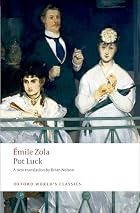
The English title of this book doesn't really reflect the seething activity taking place in it; a more literal translation of something like "boiling pot" would have been better. In this novel, Zola tackles the hypocrisy of bourgeois life by focusing on the residents of a single, recently built apartment building.
The story starts when Octave Mouret, related to both the Rougons and Macquarts in a complicated way (explained by the genealogical chart on this Wikipedia page)), comes to Paris to seek his fortune, and through an acquaintance from his home town of Plassans, movies into the apartment building on the Rue de Choiseul and finds a job as the head assistant at a large draper's shop run by the Hedouins. Octave is impressed by the modernity of the building, with a grand heated stairway (at least partway up the building for the tenants, only an unheated back stairway for the servants); the acquaintance, an architect named Campardon, assures him there is water and gas on every floor, although he also points out cracks in the paneling and peeling paint. He insists (as many other will insist throughout the book) that this is a "respectable" building. He tells Octave: "The only thing, my boy, is that there must be no noise and above all no women. My word! If you brought a woman here, there would be a revolution in the house." Then, after Campardon introduces Octave to his family and takes him to his new place of employment, Octave overhears him talking very familiarly with Gasparine, a supposedly estranged cousin of Madame Campardon who also works at the Hedouins. In subsequent chapters, the reader encounters the Josserand family (father, mother, two daughters who the mother is desperately trying to marry off), other tenants in the building and, very importantly, many of the servants who work for the tenants, living in tiny rooms at the top of the building and sharing news and gossip with each other by yelling out of their courtyard-facing kitchens. While Octave and the Josserats (and the family of the landlord) are at the center of a lot what happens in this novel, it is almost the building that is the main character, with the varied tenants acting as an ensemble cast.
And what happens is a lot of intrigue, both sexual and financial, among the tenants, between the tenants and the servants, between the tenants and outsiders, and between outsiders and other outsiders. "Respectable" men decry "slutty" servants one minute and visit their mistresses the next. Across the board, the contempt most of the men have for most women is spectacular. Although there are horrifying moments (including one, towards the end, that is a tour de force of Zola's naturalistic style), this is largely a satirical work, with Zola showing the dirt (sometimes literally) that lies under the veneer of bourgeois "respectability." He also manages to poke a little fun at the church, as represented by the local priest who does the bidding of his bourgeois parishioners, and to allow a few characters, including the local doctor, to express anti-Empire sentiments. The servants, who are treated terribly by their employers, of course know everything that goes on in the building and are eager to share their thoughts on their employers with each other; thus, Zola brings class issues into the mix.
As always, Zola's varied characters jump of the page, the suspense builds through his expert story-telling, and the set pieces at parties satirize pretensions while advancing the plot. While this is not my favorite of the Rougon-Macquart novels I've read so far, I couldn't put it down.
The English title of this book doesn't really reflect the seething activity taking place in it; a more literal translation of something like "boiling pot" would have been better. In this novel, Zola tackles the hypocrisy of bourgeois life by focusing on the residents of a single, recently built apartment building.
The story starts when Octave Mouret, related to both the Rougons and Macquarts in a complicated way (explained by the genealogical chart on this Wikipedia page)), comes to Paris to seek his fortune, and through an acquaintance from his home town of Plassans, movies into the apartment building on the Rue de Choiseul and finds a job as the head assistant at a large draper's shop run by the Hedouins. Octave is impressed by the modernity of the building, with a grand heated stairway (at least partway up the building for the tenants, only an unheated back stairway for the servants); the acquaintance, an architect named Campardon, assures him there is water and gas on every floor, although he also points out cracks in the paneling and peeling paint. He insists (as many other will insist throughout the book) that this is a "respectable" building. He tells Octave: "The only thing, my boy, is that there must be no noise and above all no women. My word! If you brought a woman here, there would be a revolution in the house." Then, after Campardon introduces Octave to his family and takes him to his new place of employment, Octave overhears him talking very familiarly with Gasparine, a supposedly estranged cousin of Madame Campardon who also works at the Hedouins. In subsequent chapters, the reader encounters the Josserand family (father, mother, two daughters who the mother is desperately trying to marry off), other tenants in the building and, very importantly, many of the servants who work for the tenants, living in tiny rooms at the top of the building and sharing news and gossip with each other by yelling out of their courtyard-facing kitchens. While Octave and the Josserats (and the family of the landlord) are at the center of a lot what happens in this novel, it is almost the building that is the main character, with the varied tenants acting as an ensemble cast.
And what happens is a lot of intrigue, both sexual and financial, among the tenants, between the tenants and the servants, between the tenants and outsiders, and between outsiders and other outsiders. "Respectable" men decry "slutty" servants one minute and visit their mistresses the next. Across the board, the contempt most of the men have for most women is spectacular. Although there are horrifying moments (including one, towards the end, that is a tour de force of Zola's naturalistic style), this is largely a satirical work, with Zola showing the dirt (sometimes literally) that lies under the veneer of bourgeois "respectability." He also manages to poke a little fun at the church, as represented by the local priest who does the bidding of his bourgeois parishioners, and to allow a few characters, including the local doctor, to express anti-Empire sentiments. The servants, who are treated terribly by their employers, of course know everything that goes on in the building and are eager to share their thoughts on their employers with each other; thus, Zola brings class issues into the mix.
As always, Zola's varied characters jump of the page, the suspense builds through his expert story-telling, and the set pieces at parties satirize pretensions while advancing the plot. While this is not my favorite of the Rougon-Macquart novels I've read so far, I couldn't put it down.
32janemarieprice
31 - Hmm. Tempting for me with the building so strong of an element to it. Put it on the wishlist for future reference.
33Linda92007
Another excellent Zola review, Rebecca! I hope to start Germinal soon.
34qebo
31: Excellent review of a book I'm unlikely to read anytime soon, though with the author theme read I suppose Zola will be making frequent appearances in the threads and I may eventually get curious.
35StevenTX
I'm looking forward to Pot Luck, but you're three Zolas ahead of me right now, so it will be a few months before I get to this one. It does sound like the title is a poor translation. It will be interesting to see how Zola depicts the urban middle class--the 19th century counterparts of many of us.
36rebeccanyc
Thanks, Jane, Linda, Katherine, and Steven. Jane, there isn't a whole lot about architecture in the book, but I read the building and its inhabitants as a metaphor for the wider society.
37RidgewayGirl
The urge to pick up a Zola, any Zola, is gaining strength. Looking forward to your review of the next one.
38charbutton
Great review that makes me want to try Zola. Is this a good one to start with. It sounds like it's one of a set of novels with the same characters - is it a series or can I jump in anywhere?
39rebeccanyc
Thanks RG and Charlotte. Charlotte, I would recommend starting with Germinal. That's the first one I read (i.e., the one that got me hooked), and it's still my favorite. Basically, Zola wrote a cycle of 20 novels dealing with life under the Second Empire, and it is called Rougon-Macquart after two branches of the family that is featured in it. Zola, who had ideas about heredity that wouldn't hold water today, wanted to look at the interaction of heredity and environment while also painting a picture of many different aspects of life during that time period. I read a few out of sequence and now am reading them in the order Zola recommended (not the order they were written in), which you can see on the same Wikipedia page I linked to in my review, but am only reading the ones in recent English translation since the original English translations were notoriously bowdlerized. However, each novel stands on its own so you can read them in any order.
I am spreading them out so I can read other books too, but I will get to the next one in the not too distant future. Also, the Author Theme Reads group is focusing on French writers this year, and Zola is the year-long author (there are other quarterly authors).
I am spreading them out so I can read other books too, but I will get to the next one in the not too distant future. Also, the Author Theme Reads group is focusing on French writers this year, and Zola is the year-long author (there are other quarterly authors).
41DieFledermaus
Another fantastic Zola review. A nice start to the year.
42letterpress
Pot Luck (I do prefer your translation of the title) sounds like it could be my cup of tea. I'd no idea that Zola's novels were written as a cycle. The only one I have on my shelves is The Belly Of Paris, sadly pristine. I think I should work on remedying that.
43charbutton
>39 rebeccanyc:, thanks for the tips! I'll do some investigating.
44rebeccanyc
Thanks, DieF and letterpress. I'll be getting to The Belly of Paris later this year.
45dchaikin
I feel like I'm late, but (here I'm trying and failing to avoid the word "another") terrific Zola review. I own one Zola - Nana...some day.
46fuzzy_patters
The positive Zola reviews I have been reading make me want to read one of his novels. I may have to download one to the Nook sometime soon. Good reviews, Rebecca!
47rebeccanyc
Thanks, fuzzy. As I've mentioned before (or elsewhere), I recommend starting with Germinal and I encourage you to make sure you get a modern translations, as the earlier translations (which are often available free or close to it) are notoriously bowdlerized.
49rebeccanyc
At the end of last year, I mentioned that I might try to resurrect my long-lost French reading skills so that I could read the Zolas that haven't been translated into English in modern times in the original. I can't find the thread anymore, but I believe somebody mentioned Camus as a writer who might be less of a challenge than some others. So, today, when I walked past a bookstore that sells books in French, Spanish, and Italian, I picked up a copy of L'étranger in French (the only Camus they had in stock, but one I read years ago). Of course, I couldn't resist picking up a Zola too, La conquête de Plassans. I have no idea when, if ever, I'll try to tackle these, dictionary and grammar book in hand; maybe I'll make trying to relearn French a summer project . . .
50labfs39
Good for you, Rebecca. I wish I could join you. I have such competing interests on my time, and I seem to lack the willpower to take on such reading projects. I'll look forward to your language journey with interest.
51rebeccanyc
Don't get your hopes up, Lisa. I may very well be deluding myself!
52StevenTX
Good luck. I tried doing the same thing with my college German a couple of years ago, but I found that juggling a book and a dictionary at the same time was too difficult. Hopefully your French is in better shape. I still have a couple of German novels around just in case I get motivated to try again.
53rebeccanyc
I can read simple things in French, like news, where I can figure out what I don't know from context. I've lost my knowledge of more arcane verb tenses, and I'm sure my vocabulary needs expanding too.
54baswood
Like you rebecca I have also very recently picked up a copy of L'etranger in French. It starts off easily enough in short terse sentences. I plan to read it before I read a translation.
55rebeccanyc
But Barry, you LIVE in France! Your French must be orders of magnitude better than mine!
56SassyLassy
>48 labfs39: I suspect I'm the culprit, I remember recommending Camus and even L'Etranger. I don't think you'll find it too difficult once you start, as bas says, short terse sentences. I don't recall many complex tense structures either. I'll be rereading it this year and since my French was much better first time round, I may change that opinion!
I think I might like to try my French on Mister Blue which you and others read and highly recommended last year
I think I might like to try my French on Mister Blue which you and others read and highly recommended last year
57DieFledermaus
We had to read The Stranger in high school - a friend, who speaks fairly fluent French now, said she hated it then but found she loved it when she read it in French. (Of course, the reading it in high school sometimes kills possible book love regardless of language.) Good luck with your French project.
58QuentinTom
Great Zola review! I never even heard of this one!
Come to think of it, it might have been a possible influence on Life,a User's Manual, which also centres on an apartment building.
reading in French, it will get easier, I suspect, the more time you give it. A worthwhile endeavour for sure.
ESKER......
Come to think of it, it might have been a possible influence on Life,a User's Manual, which also centres on an apartment building.
reading in French, it will get easier, I suspect, the more time you give it. A worthwhile endeavour for sure.
ESKER......
59rebeccanyc
Thanks for the encouragement, Sassy, DieF, and Murr!
Murr, ESKER ?????????
Murr, ESKER ?????????
60LisaMorr
57> I read The Stranger in high school too. The Cure song Killing an Arab, an homage to that book, came out in the US in 1980; that of course made the book much cooler, but I always liked it. I read the Little Prince in French but I don't think I've read, or tried to read, The Stranger. Might be a fun challenge and allow me to refresh my French language skills.
61QuentinTom
ESKER.....
62amandameale
#49 Rebecca, I tried that a couple of years ago. I read a page aloud in French and then read the same page in English, and so on. I think I only reached page 6 but was tremendous fun! Go for it!! Perhaps I will even join you, since I've joined the Literary Centennials group.
63rebeccanyc
#61 You tease!
64Linda92007
>47 rebeccanyc: Which translation of Germinal did you read, Rebecca? I am in a bit of a quandary. I have the Barnes and Noble Classics edition which is an older translation by Havelock Ellis, although the intro insists that it is other earlier versions that are bowdlerized. I am debating whether to instead get the Penguin Classics edition, translated by Roger Pearson.
65rebeccanyc
Wow, Havelock Ellis! Interesting; I had no idea he was a translator too. I have the Penguin Classics edition translated by Roger Pearson, and it also had many helpful notes.
66rebeccanyc
In this post in my last 2012 thread, after a discussion of The Turn of the Screw and The Aspern Papers, janeajones called my attention to two movies based on TTOFTS, one a literal telling of the tale (as much as it can be told literally), called "The Innocents," and one an imaginative backstory of Flora and Miles with the previous governess, Miss Jessel, and the previous gardener, Quint, both dead in the James novella, "The Nightcomers." I've now watched both of them. The first was well done, but I had the same mixed feelings about it as I did the novella. The second, though, starring Marlon Brando as Quint, was thoroughly creepy and disquieting and extremely kinky to boot. There is a scene near the beginning that almost made me stop watching it, but after that it certainly held my interest.
67janeajones
Rebecca -- I first saw the "The Innocents" when I was about 12, and I found it really frightening ( probably due to my naivete), but it still stays with me. I totally agree with your comments on "The Nightcomers" -- another film that I've never really been able to forget.
68rebeccanyc
#67 Marlon Brando is perfect as Quint, and really really disturbing. Of course, there are differences from the book beyond just being a complete imagining of what might have happened before it started (e.g., the children seem older than in the novella), but despite being a little over the top, I found it fascinating.
69rebeccanyc
2. The Black Count: Glory, Revolution, Betrayal, and the Real Count of Monte Cristo by Tom Reiss

What a delight it is to read a biography that is impeccably researched yet rolls off the pages like a novel, that tells the story of a fascinating yet little known person and situates it so lightly yet fully in the tumultuous time in which he lived. The Black Count is Alex Dumas (father of the novelist), né Thomas-Alexandre Dumas Davy de la Pallertrie, the son of a white French slave owner in Saint-Domingue (now Haiti) and an enslaved black woman, who became one of the leading generals in the French revolutionary army and whose adventures and mishaps inspired his son (who was four when his father died).
The story begins when Alex's father Antoine goes to Saint-Domingue to seek his fortune and ultimately "disappears" for a while after running into problems with his brothers and others, only to reappear when it seems he may be able to claim his inheritance back in France. He sold his son into slavery to pay for his own passage to France, but then buys him back and sends for him to come to France to join him. The year is 1776, and Thomas-Alexandre is 14 years old. His father enrolls him in a fencing academy and he becomes quite the young gentleman around town, often admired, but sometimes encountering racist comments and actions. After his father remarries, in 1786, he enlists in the army, not as an officer but as a common soldier in the dragoons, and takes the name Alexandre Dumas, rejecting the aristocratic name and title and identifying himself as the son of Cessette and Antoine Dumas.
From there, his adventures begin, as he becomes involved in various activities relating to the Revolution. Having previously discussed slavery in France's American colonies and how people of color were treated in France under the laws relating to slavery, Reiss now describes the blossoming of a period in which people of color were considered citizens of France along with the white people, a time in which schools were multiracial and people of color could advance in the army. Along the way, Alex falls in love with Marie-Louise, a white woman, and her republican father couldn't have been more thrilled to have this handsome, dashing man for his son-in-law, only requesting that he make sergeant before the pair get married. Little did he imagine that Alex would already be a lieutenant colonel by the time he returned. Reiss describes what is happening in the revolution and how this complicates reporting requirements for army officers, as well as what happened in the wars it undertook to spread its republican mandate. We see Alex undertaking daring and heroic actions as he leads his men (even generals led from the front, not the back, in those days) and getting promoted to general. In the Alps, as part of the Army of Italy, he encounters dangers in the form of mountains and glaciers, as well as Austrians and impatient revolutionary bureaucrats back in Paris. And it is in the Army of Italy that he first meets another general, Napoleon Bonaparte, who will become his nemesis.
Alex goes with General Bonaparte (not yet just Napoleon) on his ill-fated expedition to Egypt. There, the Egyptians tend to think that six-foot Alex, riding a horse as if the horse were part of him, is the leader, not the shorter, less imposing, and less handsome Bonaparte. Needless to say, this adds to Bonaparte's dislike of Alex. After a military disaster, Bonaparte sneaks back to France, leaving Alex and his colleagues to find their own way back. It is then that Alex gets captured by the Neapolitans in southern Italy and is imprisoned in a cell in a medieval castle for two years while they try to figure out what to do with him. His experiences are harrowing, and form some of the basis for his son's novel, The Count of Monte Cristo. Eventually he is released and comes home to Marie-Louise; shortly thereafter, their only son, the future novelist is born. But Alex's health has been ruined, and the new government under Napoleon has no interest in helping him, and racial laws are returning, and he dies.
This book is a compelling read for so many reasons, as I alluded to above. It was so readable, in fact, that I worried about the scholarship, until I discovered the 45 pages of endnotes, several for almost every page, and the 16 pages of selected bibliography, including three of primary sources. I especially liked the way Reiss works in the history of everything from sugar plantations in Saint-Domingue to the ins and outs of southern Italian alliances while still telling the story of Alex Dumas. This is a fascinating portrait of a fascinating man and his era, and above all it is fun and thought-provoking.

What a delight it is to read a biography that is impeccably researched yet rolls off the pages like a novel, that tells the story of a fascinating yet little known person and situates it so lightly yet fully in the tumultuous time in which he lived. The Black Count is Alex Dumas (father of the novelist), né Thomas-Alexandre Dumas Davy de la Pallertrie, the son of a white French slave owner in Saint-Domingue (now Haiti) and an enslaved black woman, who became one of the leading generals in the French revolutionary army and whose adventures and mishaps inspired his son (who was four when his father died).
The story begins when Alex's father Antoine goes to Saint-Domingue to seek his fortune and ultimately "disappears" for a while after running into problems with his brothers and others, only to reappear when it seems he may be able to claim his inheritance back in France. He sold his son into slavery to pay for his own passage to France, but then buys him back and sends for him to come to France to join him. The year is 1776, and Thomas-Alexandre is 14 years old. His father enrolls him in a fencing academy and he becomes quite the young gentleman around town, often admired, but sometimes encountering racist comments and actions. After his father remarries, in 1786, he enlists in the army, not as an officer but as a common soldier in the dragoons, and takes the name Alexandre Dumas, rejecting the aristocratic name and title and identifying himself as the son of Cessette and Antoine Dumas.
From there, his adventures begin, as he becomes involved in various activities relating to the Revolution. Having previously discussed slavery in France's American colonies and how people of color were treated in France under the laws relating to slavery, Reiss now describes the blossoming of a period in which people of color were considered citizens of France along with the white people, a time in which schools were multiracial and people of color could advance in the army. Along the way, Alex falls in love with Marie-Louise, a white woman, and her republican father couldn't have been more thrilled to have this handsome, dashing man for his son-in-law, only requesting that he make sergeant before the pair get married. Little did he imagine that Alex would already be a lieutenant colonel by the time he returned. Reiss describes what is happening in the revolution and how this complicates reporting requirements for army officers, as well as what happened in the wars it undertook to spread its republican mandate. We see Alex undertaking daring and heroic actions as he leads his men (even generals led from the front, not the back, in those days) and getting promoted to general. In the Alps, as part of the Army of Italy, he encounters dangers in the form of mountains and glaciers, as well as Austrians and impatient revolutionary bureaucrats back in Paris. And it is in the Army of Italy that he first meets another general, Napoleon Bonaparte, who will become his nemesis.
Alex goes with General Bonaparte (not yet just Napoleon) on his ill-fated expedition to Egypt. There, the Egyptians tend to think that six-foot Alex, riding a horse as if the horse were part of him, is the leader, not the shorter, less imposing, and less handsome Bonaparte. Needless to say, this adds to Bonaparte's dislike of Alex. After a military disaster, Bonaparte sneaks back to France, leaving Alex and his colleagues to find their own way back. It is then that Alex gets captured by the Neapolitans in southern Italy and is imprisoned in a cell in a medieval castle for two years while they try to figure out what to do with him. His experiences are harrowing, and form some of the basis for his son's novel, The Count of Monte Cristo. Eventually he is released and comes home to Marie-Louise; shortly thereafter, their only son, the future novelist is born. But Alex's health has been ruined, and the new government under Napoleon has no interest in helping him, and racial laws are returning, and he dies.
This book is a compelling read for so many reasons, as I alluded to above. It was so readable, in fact, that I worried about the scholarship, until I discovered the 45 pages of endnotes, several for almost every page, and the 16 pages of selected bibliography, including three of primary sources. I especially liked the way Reiss works in the history of everything from sugar plantations in Saint-Domingue to the ins and outs of southern Italian alliances while still telling the story of Alex Dumas. This is a fascinating portrait of a fascinating man and his era, and above all it is fun and thought-provoking.
70LisaMorr
Wow - The Black Count sounds great! Onto the wishlist it goes. Thanks for your review.
71Linda92007
Fabulous review of The Black Count, Rebecca. What a great way to read some history. This is definitely one for the wishlist.
73rebeccanyc
Just to be clear, Lisa, Alex Dumas is the père of Dumas père (Alexandre, the novelist) who is the père of Dumas fils (Alexandre, dramatist and writer). So there are three generations and "the Black Count" is the father and grandfather of the two writers.
And thanks, Lisa M. and Linda.
And thanks, Lisa M. and Linda.
74DieFledermaus
Oh, I am definitely adding this to the wishlist. I've seen the book in multiple bookstores but I don't think I realized it was about the father of Dumas père (Dumas père père as it were). I've only seen the hardback but it's available as an ebook.
75janeajones
I got this book from LTER and haven't had time to read it yet -- but my husband loved it. Back to the top of the TBR list.
76baswood
The Black Count sounds like a great read. It just goes to show that in the right hands history does not always need to be dull.
77QuentinTom
straight on to my TBR as well. Sounds fabulous.
79yolana
great review of the black count I need to get it.
80pamelad
I've read L'Etranger in French too! It's nice and short. The language was simple, but existentialism was a bit of a puzzle to me at 17.
I have to read The Black Count. Great review, Rebecca. The book must be on every wishlist in Club Read because of it.
I have to read The Black Count. Great review, Rebecca. The book must be on every wishlist in Club Read because of it.
81kidzdoc
Fabulous review of The Black Count, Rebecca! Wow, mine is the 19th thumb you've received for it so far. You may have seen that it was chosen as a finalist for the 2012 National Book Critics Circle Award for Biography yesterday. I've added it to my wish list.
82henkmet
And one Black Count added to my TBR as well. Thanks for the review.
83rebeccanyc
Wow! This one really struck a nerve. Thanks, DieF, Jane, Barry, Murr, Yolana, Pam, Darryl, and Henk.
Pam, that's encouraging about reading L'etranger in French; I'm probably going to have to make reading in French a summer project, though.
Pam, that's encouraging about reading L'etranger in French; I'm probably going to have to make reading in French a summer project, though.
84SassyLassy
Another book for the wishlist and we're only two weeks into the year! This sounds terrific.
I reread The Count of Monte Cristo for the third time about ten years ago and still love it. I just went back to the intro to my Penguin edition and saw that poor old Dumas grand-père gets short shrift with just one line. It'll be interesting to see if that get revised in new editions in light of this book.
Edited to change OUP to Penguin. This desk is cluttered.
I reread The Count of Monte Cristo for the third time about ten years ago and still love it. I just went back to the intro to my Penguin edition and saw that poor old Dumas grand-père gets short shrift with just one line. It'll be interesting to see if that get revised in new editions in light of this book.
Edited to change OUP to Penguin. This desk is cluttered.
85rebeccanyc
3. The Toilers of the Sea by Victor Hugo

This is such a magnificent book that it is difficult for me to know what to say about it. It can be read as the tale of an epic and exciting struggle, man against nature in the form of the sea, the winds, and the creatures, an adventure that in places keeps the reader on the edge of the seat. But it is so so much more. Hugo explores everything from the natural world and social structure of the Channel Islands to the genesis and progress of storms to the geology and vegetation of caverns to the construction of sailing and steam boats to important winds of the world to the types of religion on the different islands to the psychology of loss to techniques of carpentry and blacksmithing to the contrast of science and philosophy -- and much more. And yet, despite the digressive nature of much of this, as well as the fact that while some of it consists of perceptive observation, some of it is flights of fancy, or at least the wanderings of an active mind, I found it fascinating.
This was my first introduction to Hugo's writing, thanks to the Author Theme Read's group group read, and I was unprepared for the beauty of his writing -- or that I would like the excesses of his writing in which many words and phrases are better than a few words and a single phrase. Here is an example:
Possibility is a formidable matrix. Mystery takes concrete form in monsters. Fragments of darkness emerge from the mass we call immanence, tear themselves apart, break off, roll, float, condense, borrow matter from the surrounding blackness, undergo unheard of polarizations, take on life, compose themselves into curious forms with darkness and curious souls with miasma, and go on their way, like masks among living and breathing beings. They are like darkness made into animals. What is the point of them? What purpose do they serve? We return to the eternal question. p. 354
And Hugo is also a consummate story teller, who has a talent for foreshadowing. When the normally predictable ship captain Sieur Clubin slips off to buy a revolver and a bottle of brandy, the reader can't help but wonder why. When Gilliat, the hero, wanders into a magnificent cavern, sees another entrance to it, and hears a little rustling in the water, the reader knows he will return and encounter whatever creature is there. Even an event that I thought was the end of something turned out not to be so (trying to be vague to avoid spoilers). In places, the novel is incredibly exciting -- and there is also a love story.
So what is this book about, aside from being a great tale? It is easy to see it as allegorical, with Hugo in exile on the Channel Islands and feeling the social goals he has professed have been shipwrecked but can be recovered through struggle. It is also easy to see psychological and mythical angles to the book -- man's struggle for meaning, monsters in deep caverns. I tend to think it is all of these and, although I am not good at reading slowly, I would almost like to start over at the beginning, now that I've followed the plot, to gain a deeper appreciation of the writing and Hugo's ideas.
My Modern Library edition was enhanced by some of Hugo's drawings of ships and the sea and by helpful endnotes.

This is such a magnificent book that it is difficult for me to know what to say about it. It can be read as the tale of an epic and exciting struggle, man against nature in the form of the sea, the winds, and the creatures, an adventure that in places keeps the reader on the edge of the seat. But it is so so much more. Hugo explores everything from the natural world and social structure of the Channel Islands to the genesis and progress of storms to the geology and vegetation of caverns to the construction of sailing and steam boats to important winds of the world to the types of religion on the different islands to the psychology of loss to techniques of carpentry and blacksmithing to the contrast of science and philosophy -- and much more. And yet, despite the digressive nature of much of this, as well as the fact that while some of it consists of perceptive observation, some of it is flights of fancy, or at least the wanderings of an active mind, I found it fascinating.
This was my first introduction to Hugo's writing, thanks to the Author Theme Read's group group read, and I was unprepared for the beauty of his writing -- or that I would like the excesses of his writing in which many words and phrases are better than a few words and a single phrase. Here is an example:
Possibility is a formidable matrix. Mystery takes concrete form in monsters. Fragments of darkness emerge from the mass we call immanence, tear themselves apart, break off, roll, float, condense, borrow matter from the surrounding blackness, undergo unheard of polarizations, take on life, compose themselves into curious forms with darkness and curious souls with miasma, and go on their way, like masks among living and breathing beings. They are like darkness made into animals. What is the point of them? What purpose do they serve? We return to the eternal question. p. 354
And Hugo is also a consummate story teller, who has a talent for foreshadowing. When the normally predictable ship captain Sieur Clubin slips off to buy a revolver and a bottle of brandy, the reader can't help but wonder why. When Gilliat, the hero, wanders into a magnificent cavern, sees another entrance to it, and hears a little rustling in the water, the reader knows he will return and encounter whatever creature is there. Even an event that I thought was the end of something turned out not to be so (trying to be vague to avoid spoilers). In places, the novel is incredibly exciting -- and there is also a love story.
So what is this book about, aside from being a great tale? It is easy to see it as allegorical, with Hugo in exile on the Channel Islands and feeling the social goals he has professed have been shipwrecked but can be recovered through struggle. It is also easy to see psychological and mythical angles to the book -- man's struggle for meaning, monsters in deep caverns. I tend to think it is all of these and, although I am not good at reading slowly, I would almost like to start over at the beginning, now that I've followed the plot, to gain a deeper appreciation of the writing and Hugo's ideas.
My Modern Library edition was enhanced by some of Hugo's drawings of ships and the sea and by helpful endnotes.
86RidgewayGirl
Another tantalizing review. It sounds a little like Moby Dick. Not the whale part, but the structure and writing.
87janeajones
great review.
88helensq
Brilliant review! I am reading it in French which means I am slower than normal and it is not so easy to pick up the subtleties. But I am not about half way through yet and even I can admire the quality of the writing and the way Hugo builds the narrative. The lead up to the shipwreck was so full of tension...
Your review is really helping me appreciate the book all the more.
Your review is really helping me appreciate the book all the more.
89rebeccanyc
Thanks, RG, Jane, and Helen.
RG I have tried several times over the years, without success, to read Moby Dick, starting in my teens and again in my 20s and 30s, even taking the extreme measure of making it the only book I took with me on a (fortunately brief) vacation! I think I've given up on it.
Helen, I'm impressed that you're reading it in French! I see from your profile that you frequently go to Normandy, so the area Hugo is discussing must be very familiar to you. Are you fluent in French? I hope to start reviving my French reading, probably over the summer, but will start with something much shorter and easier than Hugo.
RG I have tried several times over the years, without success, to read Moby Dick, starting in my teens and again in my 20s and 30s, even taking the extreme measure of making it the only book I took with me on a (fortunately brief) vacation! I think I've given up on it.
Helen, I'm impressed that you're reading it in French! I see from your profile that you frequently go to Normandy, so the area Hugo is discussing must be very familiar to you. Are you fluent in French? I hope to start reviving my French reading, probably over the summer, but will start with something much shorter and easier than Hugo.
90baswood
Excellent review of The Toilers of the Sea. Some books just have to be read slowly otherwise you might just as well not read them. I believe this was a group read on the Author themed reads group and so I am looking forward to other readers reviews. Do you get a prize for being first to finish rebecca.
91rebeccanyc
I don't think I get a prize, Barry, and I should have read it more slowly, but I just wanted to keep going!
92kidzdoc
Great review of The Toilers of the Sea, Rebecca!
93deebee1
I love Hugo, though I've not read this. I have an "Islands" mini-theme for this year, so this should fit nicely. Thanks to your enthusiastic review, I'm looking forward to it already!
94rebeccanyc
Thanks, Darryl and deebee. I'll definitely be reading more Hugo. Do you have any recommendations, deebee? Also, interesting about your Islands mini-theme; I'll go over to your thread to check some of the books you're reading for it.
95StevenTX
I'm just over a fourth of the way into Toilers of the Sea myself. He's still just providing background information on the setting and characters, but the writing is so good and the anecdotes so interesting that it is quite a pleasure to read.
96edwinbcn
I surely looks as if this years reading of French authors at the Author Theme Reads Group is going to be very rewarding.
I think many of us have always heard a lot about such authors as Balzac, Hugo, Maupassant and Zola, probably have owned their books for many years, yet never read.
I think many of us have always heard a lot about such authors as Balzac, Hugo, Maupassant and Zola, probably have owned their books for many years, yet never read.
97lilisin
edwin -
That was certainly one reason for choosing those authors! Also, it's one reason Victor Hugo was NOT made a featured author as everyone already knows his name and his books Les Miserables and Notre-Dame de Paris (I refuse to call it the Hunchback title name). The reason I chose Toilers of the Sea as the group read was because it was Hugo but it's lesser known. Some people get so focused and afraid of his big books that they don't "tackle" him when really there is no tackling required. He's a pleasant read. Which is why he's one of my favorite authors.
rebecca -
Now that you have a taste of Hugo I could easily recommend Les Mis or "Hunchback". BUT, if you want to continue going the non-traditional route, I highly recommend his very dark The Man who Laughs and/or The Last Days of a Condemned Man. I have a review for the latter on the book page (and it's quite a short book!) and I believe one for the former as well.
That was certainly one reason for choosing those authors! Also, it's one reason Victor Hugo was NOT made a featured author as everyone already knows his name and his books Les Miserables and Notre-Dame de Paris (I refuse to call it the Hunchback title name). The reason I chose Toilers of the Sea as the group read was because it was Hugo but it's lesser known. Some people get so focused and afraid of his big books that they don't "tackle" him when really there is no tackling required. He's a pleasant read. Which is why he's one of my favorite authors.
rebecca -
Now that you have a taste of Hugo I could easily recommend Les Mis or "Hunchback". BUT, if you want to continue going the non-traditional route, I highly recommend his very dark The Man who Laughs and/or The Last Days of a Condemned Man. I have a review for the latter on the book page (and it's quite a short book!) and I believe one for the former as well.
98rebeccanyc
Thanks, lilisin. I did a little online research and found editions of The Man Who Laughs (but titled The Laughing Man) and Ninety-three translated by the same translator who translated my edition of Toilers of the Sea. I couldn't seem to find a modern translation of The Last Days of a Condemned Man, so I'll pass on that for now. Can always read the famous books. Oh my, too many books to read!
99Linda92007
And On the heels of Zola, of course comes Hugo! Great review, Rebecca.
100labfs39
I have Toilers of the Sea around somewhere and Ninety-three as well. I loved Les Misérables and Notre Dame de Paris, but those are the only two I've read. Who did the Modern Library translation? I have the Kensington editions for the two unread ones and can't find a translator or date. Nor can I find them on Abe Books or Alibris. So I don't know much about the them at all. Definitely no notes.
101letterpress
I'll confess it, I have never had the slightest interest in reading Hugo. Les Mis and Notre-Dame are still firmly in the "pass" category (I think it's a combination of your big book theory and the sad realisation that the words "hunchback" and "Notre-Dame" in combination immediately give me mental Disney pictures... I know, I know) but after that review I have got to get my hands on The Toilers of the Sea. Excellent work!
102rebeccanyc
The translator is James Hogarth. Other than The Toilers of the Sea|, the other two seem to be British translation.
103rebeccanyc
4. Kornél Esti by Dezsõ Kosztolányi

This book grew on me as I read it. In the first chapter, the unnamed narrator decides to visit his estranged childhood friend Kornél Esti, a fellow writer and indeed an alter ego who looks exactly like him and who encouraged him in all his pranks and bad boy activities as a child and young man. He finds Esti somewhat down on his luck and suggests that they "stick together" from that point onwards and collaborate in writing a book about Esti's exploits. After some discussion of how this will work and whose name will be bigger on the cover, they agree that Esti will tell stories of his life to the narrator, stories that may or may not be true, and the narrator will "edit" them slightly.
The rest of the book takes off from there in a series of episodic chapters, more or less in chronological order. Some of Esti's stories border on the realistic, others are fantastic or metaphorical or whimsical or disturbing -- or a mixture of all of these, and Esti does not always present himself as an admirable person. Written in the early 1930s, itself a time of growing turmoil, the book takes place both before and after the first world war, the war which finally toppled the Austro-Hungarian empire and resulted in the loss of a significant portion of what had been Hungary to neighboring countries. Never alluded to directly, this is nonetheless a dividing line in Hungarian history and in Hungarian self-perception.
Many of the stories are delightful (although always thought-provoking) -- for example, there is a story about a town in which everyone always tells the truth (so that a restaurant might advertize "Inedible food, undrinkable drinks"); one about a magnificent hotel with hundreds of staff members, each of whom resembles (or is) a famous person such as Thomas Edison, Rodin, and Marie Antoinette; one in which he struggles to get rid of an inheritance; one in which a friend who says he will only stay for a few minutes ends up staying for hours; and one in which he carries on a conversation with a Bulgarian train conductor although he speaks not a word of the language. Others depict life in the literary cafes of Budapest, or the attitudes of peasants, or encounters on trains. Still others are more grim in their portrayal of people with mental illness or in dire financial straits. One of my favorite chapters is the one in which Esti describes his time as a student in Germany; his understated satire of German behavior is priceless, and perhaps a little pointed in 1933. The book ends with Esti boarding a tram that is both real and metaphorical for an unnamed destination that turns out to be the "Terminus."
All in all, I enjoyed this book a lot. Unlike the only other book by Kosztolányi which I've read, Skylark, it does not tell a straightforward story but is quite modern in its almost metafictional style. I also enjoyed Kosztolányi's (or Esti's) technique of occasionally mixing story-telling with philosophical thoughts, while providing a fanciful yet serious picture of a world which was already slipping away when he wrote.

This book grew on me as I read it. In the first chapter, the unnamed narrator decides to visit his estranged childhood friend Kornél Esti, a fellow writer and indeed an alter ego who looks exactly like him and who encouraged him in all his pranks and bad boy activities as a child and young man. He finds Esti somewhat down on his luck and suggests that they "stick together" from that point onwards and collaborate in writing a book about Esti's exploits. After some discussion of how this will work and whose name will be bigger on the cover, they agree that Esti will tell stories of his life to the narrator, stories that may or may not be true, and the narrator will "edit" them slightly.
The rest of the book takes off from there in a series of episodic chapters, more or less in chronological order. Some of Esti's stories border on the realistic, others are fantastic or metaphorical or whimsical or disturbing -- or a mixture of all of these, and Esti does not always present himself as an admirable person. Written in the early 1930s, itself a time of growing turmoil, the book takes place both before and after the first world war, the war which finally toppled the Austro-Hungarian empire and resulted in the loss of a significant portion of what had been Hungary to neighboring countries. Never alluded to directly, this is nonetheless a dividing line in Hungarian history and in Hungarian self-perception.
Many of the stories are delightful (although always thought-provoking) -- for example, there is a story about a town in which everyone always tells the truth (so that a restaurant might advertize "Inedible food, undrinkable drinks"); one about a magnificent hotel with hundreds of staff members, each of whom resembles (or is) a famous person such as Thomas Edison, Rodin, and Marie Antoinette; one in which he struggles to get rid of an inheritance; one in which a friend who says he will only stay for a few minutes ends up staying for hours; and one in which he carries on a conversation with a Bulgarian train conductor although he speaks not a word of the language. Others depict life in the literary cafes of Budapest, or the attitudes of peasants, or encounters on trains. Still others are more grim in their portrayal of people with mental illness or in dire financial straits. One of my favorite chapters is the one in which Esti describes his time as a student in Germany; his understated satire of German behavior is priceless, and perhaps a little pointed in 1933. The book ends with Esti boarding a tram that is both real and metaphorical for an unnamed destination that turns out to be the "Terminus."
All in all, I enjoyed this book a lot. Unlike the only other book by Kosztolányi which I've read, Skylark, it does not tell a straightforward story but is quite modern in its almost metafictional style. I also enjoyed Kosztolányi's (or Esti's) technique of occasionally mixing story-telling with philosophical thoughts, while providing a fanciful yet serious picture of a world which was already slipping away when he wrote.
104deebee1
Very interesting, rebecca. Good to read such a positive review of a book that has been on my wishlist for a while. I like books that grow on you as you go along.
106dchaikin
Despite your review from Wednesday, I think I'll pass on Toilers. I had enough of Hugo's Hugoness in Les Mis....but still interested in The Last Days of a Condemned Man...
Great review of K Esti, and thanks for so wonderfully bringing to our attention The Black Count
#101 letterpress - the "hunchback" part is actually a creation of the French-to-English translator. Quasimodo is not in the French title.
Great review of K Esti, and thanks for so wonderfully bringing to our attention The Black Count
#101 letterpress - the "hunchback" part is actually a creation of the French-to-English translator. Quasimodo is not in the French title.
107baswood
Enjoyed your excellent review of Kornel Esti
108Linda92007
Great review of Kornel Esti, Rebecca.
109rebeccanyc
Thanks, deebee, Lisa, Dan, Barry, and Linda. Dan, if you've had enough of "Hugo-ness," stay away from The Toilers of the Sea! Let me know if you find a modern translation of The Last Day of a Condemned Man.
110rebeccanyc
5. My Century by Aleksander Wat

Part prison/internal exile memoir, part intellectual history, this compelling and moving book is most fundamentally an exploration of ethics, human dignity, and religious struggle in the face of the horrors of Stalinism, Nazism, and the second world war. Born in 1900, Wat was the son of assimilated, intellectual Warsaw Jews who first became a futurist/dadist poet in the 1920s and, starting at the end of the decade, flirted with communism as the editor of The Literary Monthly. Arrested by the Poles, he was jailed for the first time, but not for long. Later, he rejected communism, largely because of the people who were executed (although he continued to be called a "Jewish communist")." When the Nazis invaded Poland, he and his wife, Ola, and son fled to L'wow, but became separated, although they did eventually find each other. After some time in L'wow, Wat was arrested by the Soviets and began his journey through a variety of prisons, including Moscow's notorious Lubyanka, before winding up "free" in Alma-Ata and the neighboring town of Ili.
The book is based on a series of lengthy interviews with Wat conducted by fellow Polish poet Czeslaw Milosz in Berkeley and Paris in the mid-1960s, shortly before Wat's death; he was in extreme pain even during the interviews and ultimately chose to commit suicide. Thus, except for two chapters which Wat had the opportunity to edit and make more literary, the reader is hearing Wat's voice as he talked to Milosz. And what a voice it is -- perceptive, informed, rigorously honest about human strengths and failings (including his own), unsentimental, at times prejudiced (but aware of that prejudice, e.g., the idea that Poles are superior to Russians, especially "Asian" Russians), warm, and often poetic.
The early part of the book depicts the literary and political scene in Warsaw in the 1920s and 1930s and was filled with the names of Polish and other intellectuals; this was a little heavy going for someone unfamiliar with that scene (although there is a very helpful list of people mentioned at the end of my NYRB edition). But the story picked up as the war started and the Wats fled. Wat's descriptions of the people he met in various prisons, the horrific conditions in many of them, how to adapt to prison life, the different types of interrogators, how bedbugs behave, the different kinds of lice, and much more are both spare and detailed, fascinating and profoundly depressing. Wat was very acute at picking up signs from people and hypothesized that his interrogator in the Lubyanka was no longer interested in his "crime" but was instead picking his brain about the Polish literary and intellectual scene in anticipation of the Soviets taking over Poland in the future. In prison, he worried terribly about what had happened to his family, engaged in in-depth conversations with other intellectuals, pondered (as all do) who are the informers, and underwent a religious experience in which he saw "the devil in history" and converted to Catholocism. When the Germans approached Moscow, the Lubyanka was evacuated and Wat was sent to a variety of prisons further east. Ultimately released, although barely alive, he traveled to Alma-Ata (despite not having papers to go there) to try to find Ola and his son; after heroic efforts, he did.. Everyone was desperately hungry, struggling to find food. Through connections with the delegation of the Polish government (in exile in London) in Alma-Ata, Wat was able for a time to find some work and some access to supplies the delegation received from foreign sources, but it was a very hand-to-mouth existence both there and in the smaller town of Ili where they wind up. The book ends, because the interviews ended, but the NYRB edition includes an excerpt from Ola Wat's memoirs which describes Wat's role in resisting the Soviet government's efforts to force Soviet passports on Polish citizens in Ili, and both their experiences in prisons, hers more terrifying than his.
The best part of this book is Wat's voice, his warmth, his perception, and his ceaseless self-evaluation. But almost equally fascinating is the varied cast of characters who pass through Wat's life, from Warsaw intellectuals to urks (Russian criminals), from NKVD officers with aristocratic manners to people from poorer walks of life who help him (or despise him), from people going mad from imprisonment to people who somehow learn to live with it. One of the interesting aspects is that everyone is acutely aware not only of each other's social status within the community of the cell, but also of their ethnicity or national background. In prison and elsewhere, Jews gravitate to other Jews, Poles to other Poles, and so on, and Wat is quick to point out if someone has a Mongol-type face, or looks like a Kazakh. This makes the challenge of the Stalinist effort to make all the various nationalities "Soviet" come alive. Finally, I found Wat's thoughts about such varied topics as the similarities between communism and Nazism, how to talk to interrogators, nighttime conversations between a former Polish cavalry captain and an Ukrainian peasant based on their shared love of animals, literary works and people, religion and the relationship between Judaism and Christianity, endlessly fascinating.

Part prison/internal exile memoir, part intellectual history, this compelling and moving book is most fundamentally an exploration of ethics, human dignity, and religious struggle in the face of the horrors of Stalinism, Nazism, and the second world war. Born in 1900, Wat was the son of assimilated, intellectual Warsaw Jews who first became a futurist/dadist poet in the 1920s and, starting at the end of the decade, flirted with communism as the editor of The Literary Monthly. Arrested by the Poles, he was jailed for the first time, but not for long. Later, he rejected communism, largely because of the people who were executed (although he continued to be called a "Jewish communist")." When the Nazis invaded Poland, he and his wife, Ola, and son fled to L'wow, but became separated, although they did eventually find each other. After some time in L'wow, Wat was arrested by the Soviets and began his journey through a variety of prisons, including Moscow's notorious Lubyanka, before winding up "free" in Alma-Ata and the neighboring town of Ili.
The book is based on a series of lengthy interviews with Wat conducted by fellow Polish poet Czeslaw Milosz in Berkeley and Paris in the mid-1960s, shortly before Wat's death; he was in extreme pain even during the interviews and ultimately chose to commit suicide. Thus, except for two chapters which Wat had the opportunity to edit and make more literary, the reader is hearing Wat's voice as he talked to Milosz. And what a voice it is -- perceptive, informed, rigorously honest about human strengths and failings (including his own), unsentimental, at times prejudiced (but aware of that prejudice, e.g., the idea that Poles are superior to Russians, especially "Asian" Russians), warm, and often poetic.
The early part of the book depicts the literary and political scene in Warsaw in the 1920s and 1930s and was filled with the names of Polish and other intellectuals; this was a little heavy going for someone unfamiliar with that scene (although there is a very helpful list of people mentioned at the end of my NYRB edition). But the story picked up as the war started and the Wats fled. Wat's descriptions of the people he met in various prisons, the horrific conditions in many of them, how to adapt to prison life, the different types of interrogators, how bedbugs behave, the different kinds of lice, and much more are both spare and detailed, fascinating and profoundly depressing. Wat was very acute at picking up signs from people and hypothesized that his interrogator in the Lubyanka was no longer interested in his "crime" but was instead picking his brain about the Polish literary and intellectual scene in anticipation of the Soviets taking over Poland in the future. In prison, he worried terribly about what had happened to his family, engaged in in-depth conversations with other intellectuals, pondered (as all do) who are the informers, and underwent a religious experience in which he saw "the devil in history" and converted to Catholocism. When the Germans approached Moscow, the Lubyanka was evacuated and Wat was sent to a variety of prisons further east. Ultimately released, although barely alive, he traveled to Alma-Ata (despite not having papers to go there) to try to find Ola and his son; after heroic efforts, he did.. Everyone was desperately hungry, struggling to find food. Through connections with the delegation of the Polish government (in exile in London) in Alma-Ata, Wat was able for a time to find some work and some access to supplies the delegation received from foreign sources, but it was a very hand-to-mouth existence both there and in the smaller town of Ili where they wind up. The book ends, because the interviews ended, but the NYRB edition includes an excerpt from Ola Wat's memoirs which describes Wat's role in resisting the Soviet government's efforts to force Soviet passports on Polish citizens in Ili, and both their experiences in prisons, hers more terrifying than his.
The best part of this book is Wat's voice, his warmth, his perception, and his ceaseless self-evaluation. But almost equally fascinating is the varied cast of characters who pass through Wat's life, from Warsaw intellectuals to urks (Russian criminals), from NKVD officers with aristocratic manners to people from poorer walks of life who help him (or despise him), from people going mad from imprisonment to people who somehow learn to live with it. One of the interesting aspects is that everyone is acutely aware not only of each other's social status within the community of the cell, but also of their ethnicity or national background. In prison and elsewhere, Jews gravitate to other Jews, Poles to other Poles, and so on, and Wat is quick to point out if someone has a Mongol-type face, or looks like a Kazakh. This makes the challenge of the Stalinist effort to make all the various nationalities "Soviet" come alive. Finally, I found Wat's thoughts about such varied topics as the similarities between communism and Nazism, how to talk to interrogators, nighttime conversations between a former Polish cavalry captain and an Ukrainian peasant based on their shared love of animals, literary works and people, religion and the relationship between Judaism and Christianity, endlessly fascinating.
111SassyLassy
endlessly fascinating, what is it about these accounts that keeps us glued to the text? Great review and another book to add to my list of prison books.
112rebeccanyc
I'm leaving for vacation tomorrow, so after this evening I won't be around for a little over a week, and then it will take me some time to catch up with all of you.
Of course, I'm taking more books than I can read. The ones I think I'll bring, subject to change of course are Bring Up the Bodies, Pere Goriot, Jonathan Wild, Explosion in the Cathedral and Young Stalin.
Of course, I'm taking more books than I can read. The ones I think I'll bring, subject to change of course are Bring Up the Bodies, Pere Goriot, Jonathan Wild, Explosion in the Cathedral and Young Stalin.
113labfs39
Have fun on vacation, Rebecca! Look forward to hearing your thoughts on Young Stalin.
114Linda92007
That is a truly fabulous review of My Century, Rebecca. I am pre-ordering the NYRB Kindle edition, due out next week. Enjoy your vacation!
116rebeccanyc
Thanks, Lisa, Linda, and Barry. I've revised my book list to substitute Zola's The Ladies Paradise for Jonathan Wild, and I might bring The Doomsday Book because it's so small.
118rachbxl
Hello Rebecca, have finally found the time to catch up with what you've been reading over the last month - some great stuff, as always, but I'm particularly excited about the Aleksander Wat.
121DieFledermaus
Fantastic review of My Century! I've had that one on the wishlist for several years now but never saw it in various NYRB sales. I might have to make an actual effort to get it. Hope you're having a fun vacation.
122LisaMorr
Your review of Kornél Esti has me putting it on the WishList. Thanks!
123SassyLassy
Welcome back ?tomorrow and hope you got lots of reading done on vacation, especially Bring Up the Bodies. Looking forward to your thoughts whatever you read. Absolutely no pressure though!
124rebeccanyc
I'm back!
Thanks, Merrikay, Rachel, deebee, Dan, DieF, Lisa, and Sassy.
I have way too much to catch up with (in real life, as well as on LT) to post reviews now, but I had a great reading vacation and finished Bring Up the Bodies, Doomsday Book, and Explosion in a Cathedral. I've almost finished Zola's The Ladies Paradise and I've started Young Stalin. It was quite disconcerting (if not entirely surprising) to learn that in his schooldays, Stalin liked Germinal, Toilers of the Sea, and a Hugo I hope to read, Ninety-Three!
I'll try to post reviews tonight or tomorrow.
Thanks, Merrikay, Rachel, deebee, Dan, DieF, Lisa, and Sassy.
I have way too much to catch up with (in real life, as well as on LT) to post reviews now, but I had a great reading vacation and finished Bring Up the Bodies, Doomsday Book, and Explosion in a Cathedral. I've almost finished Zola's The Ladies Paradise and I've started Young Stalin. It was quite disconcerting (if not entirely surprising) to learn that in his schooldays, Stalin liked Germinal, Toilers of the Sea, and a Hugo I hope to read, Ninety-Three!
I'll try to post reviews tonight or tomorrow.
125rebeccanyc
6. Bring Up the Bodies by Hilary Mantel

Since reading Wolf Hall when it came out, I've devoured most of Hilary Mantel's fiction and admired her for the breadth and bravery of her work. So I was excited to get back to the world of Henry VIII and Thomas Cromwell that got me started on my Mantel journey. As is well known, Bring Up the Bodies tells the tale of the downfall of Anne Boleyn, wife #2, from the perspective of the ever fascinating Cromwell: the intrigue, the backbiting, the rumors, the gossip, and the diplomacy.
For me, as I think for Mantel, it is the character of Cromwell that makes this book, both because I am not a devotee of Tudor history and because the endless self-aggrandizement of most of the nobles -- those who serve the king and queen and those who seek to increase their power and their wealth through their actions or their relatives -- is so unappetizing. This is not to say that other characters, some quite interesting, don't spring to life, but that they pale in comparison to the complex Cromwell.
This book doesn't have the breadth of Wolf Hall, which covered a large swath of Cromwell's life; rather it spans less than a year, during which the fate of Anne Boleyn is sealed. Helpfully, Mantel provides a list of character at the beginning, grouped by category, as the characters are many and their connections confusing. Just as the time period is condensed, the action is intense, and the plotting and counterplotting complex. As always, Mantel writes beautifully and perceptively, with never a wasted word. She can provide compassion where appropriate and twist the knife where warranted. I look forward to the final volume of this trilogy.

Since reading Wolf Hall when it came out, I've devoured most of Hilary Mantel's fiction and admired her for the breadth and bravery of her work. So I was excited to get back to the world of Henry VIII and Thomas Cromwell that got me started on my Mantel journey. As is well known, Bring Up the Bodies tells the tale of the downfall of Anne Boleyn, wife #2, from the perspective of the ever fascinating Cromwell: the intrigue, the backbiting, the rumors, the gossip, and the diplomacy.
For me, as I think for Mantel, it is the character of Cromwell that makes this book, both because I am not a devotee of Tudor history and because the endless self-aggrandizement of most of the nobles -- those who serve the king and queen and those who seek to increase their power and their wealth through their actions or their relatives -- is so unappetizing. This is not to say that other characters, some quite interesting, don't spring to life, but that they pale in comparison to the complex Cromwell.
This book doesn't have the breadth of Wolf Hall, which covered a large swath of Cromwell's life; rather it spans less than a year, during which the fate of Anne Boleyn is sealed. Helpfully, Mantel provides a list of character at the beginning, grouped by category, as the characters are many and their connections confusing. Just as the time period is condensed, the action is intense, and the plotting and counterplotting complex. As always, Mantel writes beautifully and perceptively, with never a wasted word. She can provide compassion where appropriate and twist the knife where warranted. I look forward to the final volume of this trilogy.
126rebeccanyc
7. Doomsday Book by Connie Willis

I wouldn't have read, or even known about, this book if not for an intriguing review by steven03tx. I found it mostly compulsively readable, but I had mixed feelings about it. While, especially at the end, I could barely put it down, some parts seemed to drag a little bit, some plot "surprises" were so well foreshadowed that they weren't much of a surprise, and the time that has passed since Willis wrote it in 1992 makes some aspects of the future of the 2050s seem dated.
For this is a novel of the future, in which time travel -- at least for research purposes -- is possible, but other than this remarkable advance much in 2050s Oxford is the same as it was in 1990s Oxford. There, in the 2050s, in the absence of the head of the Medieval History department, and with the department's experienced technical staff away during the Christmas holidays, an ambitious, vain, and foolish assistant head is determined to send Kivrin, an aspiring historian, through "the net" to the year 1320, much to the despair of her mentor Dunworthy from another department and college who, in an effort to avert disaster, recruits Badri, a technician from his college, to run "the drop." Needless to say, all does not go well. Badri falls ill at the console while checking "the fix," tries but fails to tell Dunworthy what went wrong, and becomes the index case in a deadly influenza epidemic that strikes Oxford. Experience from past pandemics dictates that the area be quarantine; will they still be able to bring Kivrin back at the appointed time.
Meanwhile, in the middle ages, Kivrin arrives and realizes that she is very ill. Feverish and delirious, she is rescued by unknown men from the site where she was dropped and brought to the home of a family that is sheltering there while the man of the house stays in Bath, where he is involved in some legal proceedings. Kivrin knows that she can't have the plague, because she has been inoculated against it and because the plague didn't reach Oxford until 1348, but is puzzled why the various inoculations she's had aren't fighting it. She's also puzzled because although she can understand the "contemps" as they're called, her automatic translation device isn't translating her thoughts into language they can understand. And how can she find the site where she was "dropped" so she can be picked up at the appointed time?
As the novel progresses, various characters, some endearing, some not, make their appearances in the Oxford of the past and the Oxford of the present. Soon, there are epidemics in both times, and so the reader can compare and contrast the behavior of people in the 14th century with those of the 21st when confronted with widespread illness and death. Especially in the 21st century, there are lots of intersecting story lines, perhaps as befits a busy and bustling town, but not all of them were, perhaps, necessary. It was here that the most striking anachronism, for me, was the tremendous efforts people put into trying to reach others by phone -- landlines (albeit with video), that is. Obviously when this was written in the early 90s, the ubiquity of mobile phones was unimaginable. On the other hand, I found the descriptions of Kivrin's preparations for her visit to the middle ages, from languages to inoculations, from clothing to behavior, fascinating.
This is a novel both of action and of ideas, a novel with intriguing characters and a satire of academia, a novel that lightly explores the place and value of religion and human connections. Although parts of it irritated me, I'm glad I read it.

I wouldn't have read, or even known about, this book if not for an intriguing review by steven03tx. I found it mostly compulsively readable, but I had mixed feelings about it. While, especially at the end, I could barely put it down, some parts seemed to drag a little bit, some plot "surprises" were so well foreshadowed that they weren't much of a surprise, and the time that has passed since Willis wrote it in 1992 makes some aspects of the future of the 2050s seem dated.
For this is a novel of the future, in which time travel -- at least for research purposes -- is possible, but other than this remarkable advance much in 2050s Oxford is the same as it was in 1990s Oxford. There, in the 2050s, in the absence of the head of the Medieval History department, and with the department's experienced technical staff away during the Christmas holidays, an ambitious, vain, and foolish assistant head is determined to send Kivrin, an aspiring historian, through "the net" to the year 1320, much to the despair of her mentor Dunworthy from another department and college who, in an effort to avert disaster, recruits Badri, a technician from his college, to run "the drop." Needless to say, all does not go well. Badri falls ill at the console while checking "the fix," tries but fails to tell Dunworthy what went wrong, and becomes the index case in a deadly influenza epidemic that strikes Oxford. Experience from past pandemics dictates that the area be quarantine; will they still be able to bring Kivrin back at the appointed time.
Meanwhile, in the middle ages, Kivrin arrives and realizes that she is very ill. Feverish and delirious, she is rescued by unknown men from the site where she was dropped and brought to the home of a family that is sheltering there while the man of the house stays in Bath, where he is involved in some legal proceedings. Kivrin knows that she can't have the plague, because she has been inoculated against it and because the plague didn't reach Oxford until 1348, but is puzzled why the various inoculations she's had aren't fighting it. She's also puzzled because although she can understand the "contemps" as they're called, her automatic translation device isn't translating her thoughts into language they can understand. And how can she find the site where she was "dropped" so she can be picked up at the appointed time?
As the novel progresses, various characters, some endearing, some not, make their appearances in the Oxford of the past and the Oxford of the present. Soon, there are epidemics in both times, and so the reader can compare and contrast the behavior of people in the 14th century with those of the 21st when confronted with widespread illness and death. Especially in the 21st century, there are lots of intersecting story lines, perhaps as befits a busy and bustling town, but not all of them were, perhaps, necessary. It was here that the most striking anachronism, for me, was the tremendous efforts people put into trying to reach others by phone -- landlines (albeit with video), that is. Obviously when this was written in the early 90s, the ubiquity of mobile phones was unimaginable. On the other hand, I found the descriptions of Kivrin's preparations for her visit to the middle ages, from languages to inoculations, from clothing to behavior, fascinating.
This is a novel both of action and of ideas, a novel with intriguing characters and a satire of academia, a novel that lightly explores the place and value of religion and human connections. Although parts of it irritated me, I'm glad I read it.
127baswood
I had much the same reaction to Doomsday Book as you rebecca. I found that Oxford in 2050 was very unconvincing. You said it felt like Oxford in the 1990's I think it felt more like Oxford in the 1960's. It was all far too parochial. I was however mesmerised by Willis's depiction of the 14th century. The plot did creak a bit at times but it was all worthwhile for those excellent scenes set back in medieval times.
Hope you had a good vacation (holiday for us Brits)
Hope you had a good vacation (holiday for us Brits)
128rebeccanyc
Thanks, Barry. Not being familiar with Oxford (except from a brief visit several years ago), it was the cell-phone-less aspect that really jumped out at me
PS I hope to post a review of my favorite vacation read, Explosion in a Cathedral by Alejo Carpentier, tomorrow, but am too tired now after catching up with everything to make something intelligible of the notes I wrote while away. I also hope to catch up with everybody's reading threads tomorrow.
PS I hope to post a review of my favorite vacation read, Explosion in a Cathedral by Alejo Carpentier, tomorrow, but am too tired now after catching up with everything to make something intelligible of the notes I wrote while away. I also hope to catch up with everybody's reading threads tomorrow.
129dmsteyn
Interesting reviews, Rebecca. I hope to get to Bring Up the Bodies soon, and Doomsday Book has also been on my radar since Steven's review. Thanks for sharing your thoughts on both.
130deebee1
I look forward to your review of Explosion in a Cathedral -- Carpentier can never disappoint (this reader anyway!).
131charbutton
I'm desperate to read Bring up the Bodies but it still doesn't seem to have come out in paperback in the UK. Very frustrating!
Doomsday Book sounds intriguing, might have to add it to the wishlist.
Doomsday Book sounds intriguing, might have to add it to the wishlist.
132wandering_star
Welcome back! Re: 126/7 - the anachronistic nature of future Oxford was actually one of the things I really liked in Doomsday Book - I found it rather comforting...
133StevenTX
I'm glad you enjoyed Doomsday Book. I think the relative backwardness of 2050s Oxford was more deliberate than otherwise, and can be seen as a satire of academia--at least that's how I took it. Willis introduced just enough science to her science fiction to make the plot work, and no more. Nor did she pursue the broader implications of the technologies she did introduce--Kivrin's "translator," for example. If knowledge could be implanted by injection, the entire nature of education would be radically different. William certainly couldn't pretend to be spending his vacation "reading Plutarch" when he could get Plutarch (and Greek to boot) as easily as a flu shot.
134laytonwoman3rd
Just delurking to say that, as usual, your thread is baaaaaad for my wishlist. Although, one or two of your recent reads can safely be relegated to my "probably never" list, and I have already read Bring Up the Bodies.
135rebeccanyc
Thanks, Dewald, Char, wandering, Steven, and Linda. Deebee, I am eager to post a review of Explosion in a Cathedral as I too am a big Carpentier fan (I think I owe my discovery of him to you), but as I'm still catching up at work, so I may not get to it tonight. At the very least, I hope to start catching up with people's threads this evening.
Steven, I loved the character of William and also of Colin and several other modern Oxford characters, but I could certainly have done without the bellringers. Very funny about the injections.
Steven, I loved the character of William and also of Colin and several other modern Oxford characters, but I could certainly have done without the bellringers. Very funny about the injections.
136RidgewayGirl
Bring Up the Bodies was good, wasn't it? I had enjoyed Wolf Hall so much that I was ready to be disappointed, but instead I found it to be even better. I liked how Cromwell became harder and more ruthless as the circumstances dictated. Wolf Hall showed his humanity, and Bring Up the Bodies showed how he got his reputation. I'm very eager to read the next installation, but sad that it's the last one.
137AnnieMod
Great review of Doomsday Book :)
138Linda92007
Great reviews of Bring Up the Bodies and Doomsday Book, Rebecca. I have Mantel's, but have been delaying reading it, waiting for just the right moment. I liked the humane side of Cromwell from Wolf Hall so much that I hate to see that change! I'm also looking forward to your Carpentier review. He is an author that I have been meaning to find.
139rebeccanyc
8. Explosion in a Cathedral by Alejo Carpentier

Warning: Some plot spoilers ahead!
In this fascinating novel, the historical tale of Victor Hughes (the "Caribbean Robespierre") and the fictional story of a young sister, brother, and cousin anchor a sweeping look at the natural and social history of the colonial and even precolonial Caribbean. Victor Hughes, a man of action who has been a baker, sailor, and trader, appears one night pounding on the doors of young Carlos, Sophia, and Esteban, who have been in mourning since their father and uncle died. It is the late 1780s in Havana, and the young people have kept to their home and lived quite eccentrically, exploring the arts and new ideas inside the four walls of their large house, allowing the executor to manage the family's warehouse and trading business. Hughes brings them back to the world, introduces them to Ogé, a mulatto (in the language of the day) who cures Esteban, the cousin, of his terrible asthma by removing the plants that are causing it, and also to various masonic ideas. A hurricane hits (what would a Caribbean novel be without a hurricane?), word of the French Revolution reaches Havana and foreigners begin to be distrusted, and Hughes, fleeing with Ogé, takes Sophia and Esteban with him to Haiti. Thus begin the travels and travails of Hughes and Esteban (Sophia is eventually sent back to Cuba), first to revolutionary France, then back to the Caribbean.
After a dangerous journey, avoiding an English blockade off the French coast and then fighting them when they reach the Caribbean, they arrive in Guadeloupe where Hughes has been designated the Commissioner of the convention, the revolution's representative and local man in charge. But they have not come alone: a guillotine is with them.
With all the insignia of his authority sparkling, Victor Hughes stood motionless, turned to stone, his right hand resting on the upright of the Machine, suddenly transformed into a symbolic figure. Together with Liberty, the first guillotine was arriving in the New World." p. 131
After Robespierre's own execution, Hughes falls out of favor with the powers that be, but carries on as if nothing has happened, turning the French fleet into profiteering buccaneers. He lets Esteban, who has long become disillusioned with Hughes, flee to Cayenne in Guiana, then another French colony. There, and along the jungle-covered rivers of Guiana, the detritus of the French Revolution has washed up, men who have been sent there to exile and/or imprisonment, facing certain death. But Hughes himself is a survivor, and ultimately becomes Napoleon's representative in Guadeloupe, while Esteban return to Havana, finding things quite changed.
The story, as event-filled as it is (with revolution, pirates, sexual exploits, and more), is really just a backdrop for a novel of ideas, ideas about slavery and freedom, colonialism, the role of art and the role of action, religion and masonry, integrity, and more. Victor Hughes is, as noted, a man of action, but he is also a man who loves power. When the wind from France blows with freedom, saying that all people, black and white, are free citizens, nobody is more avid than Hughes in enforcing the law, despite the horror and resistance of the colonial elite (the "big whites"). But, eight years later, when the wind blows the other way, he is just as eager to enforce the new law, sending the freed black people back into slavery. Beyond the obvious, the novel also explores people's freedom of action as it depicts Esteban's and Sophia's reactions to Hughes and his behavior. In some ways, this is Esteban's coming-of-age story..
Lying beneath all of this is the Caribbean itself -- the sea, the islands, the mainland, and the people. The novel sweeps from Cuba and Haiti at the northern end of the Sea to Guiana in the south, with much action on boats traveling through it. Carpentier's writing is gorgeous as he describes the water and the sea shores, as for example when Esteban explores rocks along the shoreline:
There were the pulpy leaves of the madrepore; the speckled, pitcher-shaped apples of the cowries; the slender cathedral architecture of certain snails, which, with their winged and needle-pointed shells, could only be seen in terms of the Gothic; the beaded whorls of the sea periwinkles, the Pythagorean convolution of the spindle-shell, the simulation with which many shells concealed in their depths the splendor of an ornate palace, under the humble plaster of their exterior. At his approach, the sea urchin proffered its black spines, the timid oyster closed, the starfish shrank, and the sponges, attached to some submerged rock, swayed among rippling reflections. p. 175
He also beautifully depicts the northern journey of the Caribs and their encounter with European ships. Much is told in almost mythical language, often involving unfamiliar (to me) masonic terminology. This is a book written on many levels, and I have only scratched the surface. Carpentier has achieved the remarkable feat of intertwining compelling story-telling with psychological insight, historical and social perspective, and beautiful writing.
As a final note, the translation I read (which I believe to be the only English translation) is a translation from the French translation of the Spanish original. I have no reason the think the translation is a bad one, but I have no idea why the publisher (the University of Minnesota Press) couldn't have obtained a translation from the Spanish as easily as one from the French. Additionally, I think a more literal translation of the Spanish title, (El siglo de las luces) as something like "The Century of Light" or (as Timothy Brennan suggests in his introduction) "The Age of Enlightenment" would have been more meaningful than "Explosion in a Cathedral" (which is the title of a painting that hangs in the Havana house).

Warning: Some plot spoilers ahead!
In this fascinating novel, the historical tale of Victor Hughes (the "Caribbean Robespierre") and the fictional story of a young sister, brother, and cousin anchor a sweeping look at the natural and social history of the colonial and even precolonial Caribbean. Victor Hughes, a man of action who has been a baker, sailor, and trader, appears one night pounding on the doors of young Carlos, Sophia, and Esteban, who have been in mourning since their father and uncle died. It is the late 1780s in Havana, and the young people have kept to their home and lived quite eccentrically, exploring the arts and new ideas inside the four walls of their large house, allowing the executor to manage the family's warehouse and trading business. Hughes brings them back to the world, introduces them to Ogé, a mulatto (in the language of the day) who cures Esteban, the cousin, of his terrible asthma by removing the plants that are causing it, and also to various masonic ideas. A hurricane hits (what would a Caribbean novel be without a hurricane?), word of the French Revolution reaches Havana and foreigners begin to be distrusted, and Hughes, fleeing with Ogé, takes Sophia and Esteban with him to Haiti. Thus begin the travels and travails of Hughes and Esteban (Sophia is eventually sent back to Cuba), first to revolutionary France, then back to the Caribbean.
After a dangerous journey, avoiding an English blockade off the French coast and then fighting them when they reach the Caribbean, they arrive in Guadeloupe where Hughes has been designated the Commissioner of the convention, the revolution's representative and local man in charge. But they have not come alone: a guillotine is with them.
With all the insignia of his authority sparkling, Victor Hughes stood motionless, turned to stone, his right hand resting on the upright of the Machine, suddenly transformed into a symbolic figure. Together with Liberty, the first guillotine was arriving in the New World." p. 131
After Robespierre's own execution, Hughes falls out of favor with the powers that be, but carries on as if nothing has happened, turning the French fleet into profiteering buccaneers. He lets Esteban, who has long become disillusioned with Hughes, flee to Cayenne in Guiana, then another French colony. There, and along the jungle-covered rivers of Guiana, the detritus of the French Revolution has washed up, men who have been sent there to exile and/or imprisonment, facing certain death. But Hughes himself is a survivor, and ultimately becomes Napoleon's representative in Guadeloupe, while Esteban return to Havana, finding things quite changed.
The story, as event-filled as it is (with revolution, pirates, sexual exploits, and more), is really just a backdrop for a novel of ideas, ideas about slavery and freedom, colonialism, the role of art and the role of action, religion and masonry, integrity, and more. Victor Hughes is, as noted, a man of action, but he is also a man who loves power. When the wind from France blows with freedom, saying that all people, black and white, are free citizens, nobody is more avid than Hughes in enforcing the law, despite the horror and resistance of the colonial elite (the "big whites"). But, eight years later, when the wind blows the other way, he is just as eager to enforce the new law, sending the freed black people back into slavery. Beyond the obvious, the novel also explores people's freedom of action as it depicts Esteban's and Sophia's reactions to Hughes and his behavior. In some ways, this is Esteban's coming-of-age story..
Lying beneath all of this is the Caribbean itself -- the sea, the islands, the mainland, and the people. The novel sweeps from Cuba and Haiti at the northern end of the Sea to Guiana in the south, with much action on boats traveling through it. Carpentier's writing is gorgeous as he describes the water and the sea shores, as for example when Esteban explores rocks along the shoreline:
There were the pulpy leaves of the madrepore; the speckled, pitcher-shaped apples of the cowries; the slender cathedral architecture of certain snails, which, with their winged and needle-pointed shells, could only be seen in terms of the Gothic; the beaded whorls of the sea periwinkles, the Pythagorean convolution of the spindle-shell, the simulation with which many shells concealed in their depths the splendor of an ornate palace, under the humble plaster of their exterior. At his approach, the sea urchin proffered its black spines, the timid oyster closed, the starfish shrank, and the sponges, attached to some submerged rock, swayed among rippling reflections. p. 175
He also beautifully depicts the northern journey of the Caribs and their encounter with European ships. Much is told in almost mythical language, often involving unfamiliar (to me) masonic terminology. This is a book written on many levels, and I have only scratched the surface. Carpentier has achieved the remarkable feat of intertwining compelling story-telling with psychological insight, historical and social perspective, and beautiful writing.
As a final note, the translation I read (which I believe to be the only English translation) is a translation from the French translation of the Spanish original. I have no reason the think the translation is a bad one, but I have no idea why the publisher (the University of Minnesota Press) couldn't have obtained a translation from the Spanish as easily as one from the French. Additionally, I think a more literal translation of the Spanish title, (El siglo de las luces) as something like "The Century of Light" or (as Timothy Brennan suggests in his introduction) "The Age of Enlightenment" would have been more meaningful than "Explosion in a Cathedral" (which is the title of a painting that hangs in the Havana house).
140dmsteyn
Great review, Rebecca! Adding this to my wishlist, although I take the note about the translation into account.
141laytonwoman3rd
"Explosion in a Cathedral" is grabbier than 'The Century of Light', I think...translation issues aside. And "The Age of Enlightenment" sounds like history, rather than fiction. If I saw a book titled "Explosion in a Cathedral" while browsing in a bookstore, I'd be more likely to pick it up and take a look than I would with either of the other two. Your review, regardless of title, piques my interest, and I've given it a thumb, the first of many, I'm sure.
142rebeccanyc
Thanks, Dewald and Linda. I see your point, Linda, but I guess it just irks me when translators change titles so dramatically.
143rebeccanyc
9. The Ladies' Paradise by Émile Zola
The strength of this novel is its almost overwhelming depiction of the merchandise in the Ladies' Paradise, one of the first Parisian department stores, and of Parisian women's insatiable demand for the goods it offers. The weakness is the plot and the characterization; the usually brilliant story-teller Zola falls down on that aspect of the job in this novel. However, a less good Zola is still a lot better than a lot of other books!
At the beginning of this novel, an orphaned provincial young woman, Denise, brings her two younger brothers (one a young man, one a child) to Paris, hoping to stay at the home of their uncle, who owns a small store. His business is failing, however, because Octave Mouret, the protagonist of Pot Luck, has turned the small store he acquired by marrying Mme. Hedouin (who subsequently died) into a department store which is stealing business from all the shop-owners in the neighborhood. Despite the fact that everyone she meets hates the Ladies' Paradise, Denise is attracted by it and has no other option except to get a job there as a salesgirl; this entitles her to a small room in which to live as well as her meals. As the novel progresses, she encounters various problems, is fired and then rehired, and comes to the attention of Mouret, who is the creative genius and dictatorial ruler of the store. A ladies man, he somewhat unbelievably becomes romantically interested in Denise; although she resists, her prestige rises in the store. I found the character of Denise much too meek and good to be true, and I couldn't believe the romantic attachment between Mouret and her.
So much for the plot. Zola dazzles the reader, as Mouret dazzles the shoppers, with his descriptions of the displays and the merchandise and the ways in which the female shoppers almost swoon over it. He also brilliantly dissects the inner workings of a department store: how the goods enter, how they're sold, how they're paid for, how they're shipped out, how the finances work, how the different types of employees are encouraged to compete with each other and how, mostly cattily, they treat each other, how shoplifting works and is caught, and much more. Another aspect of the novel is real estate: the creation of the large boulevards of Paris (as described in other works in the Rougon-Macquart cycle) and the attempts to cash in on them, as well as Mouret's machinations to acquire the right parcels to create a store that fills the entire block. Although Zola also tries to show how this drives the other merchants out of business, this part of the story is less fully told. As a portrait of the growth of department stores, materialism, and commercialism, this novel is fascinating, if not horrifying, and a meaningful contribution to Zola's goal of giving readers a full picture of life of during the Second Empire. It just isn't a very good story.
The strength of this novel is its almost overwhelming depiction of the merchandise in the Ladies' Paradise, one of the first Parisian department stores, and of Parisian women's insatiable demand for the goods it offers. The weakness is the plot and the characterization; the usually brilliant story-teller Zola falls down on that aspect of the job in this novel. However, a less good Zola is still a lot better than a lot of other books!
At the beginning of this novel, an orphaned provincial young woman, Denise, brings her two younger brothers (one a young man, one a child) to Paris, hoping to stay at the home of their uncle, who owns a small store. His business is failing, however, because Octave Mouret, the protagonist of Pot Luck, has turned the small store he acquired by marrying Mme. Hedouin (who subsequently died) into a department store which is stealing business from all the shop-owners in the neighborhood. Despite the fact that everyone she meets hates the Ladies' Paradise, Denise is attracted by it and has no other option except to get a job there as a salesgirl; this entitles her to a small room in which to live as well as her meals. As the novel progresses, she encounters various problems, is fired and then rehired, and comes to the attention of Mouret, who is the creative genius and dictatorial ruler of the store. A ladies man, he somewhat unbelievably becomes romantically interested in Denise; although she resists, her prestige rises in the store. I found the character of Denise much too meek and good to be true, and I couldn't believe the romantic attachment between Mouret and her.
So much for the plot. Zola dazzles the reader, as Mouret dazzles the shoppers, with his descriptions of the displays and the merchandise and the ways in which the female shoppers almost swoon over it. He also brilliantly dissects the inner workings of a department store: how the goods enter, how they're sold, how they're paid for, how they're shipped out, how the finances work, how the different types of employees are encouraged to compete with each other and how, mostly cattily, they treat each other, how shoplifting works and is caught, and much more. Another aspect of the novel is real estate: the creation of the large boulevards of Paris (as described in other works in the Rougon-Macquart cycle) and the attempts to cash in on them, as well as Mouret's machinations to acquire the right parcels to create a store that fills the entire block. Although Zola also tries to show how this drives the other merchants out of business, this part of the story is less fully told. As a portrait of the growth of department stores, materialism, and commercialism, this novel is fascinating, if not horrifying, and a meaningful contribution to Zola's goal of giving readers a full picture of life of during the Second Empire. It just isn't a very good story.
144baswood
The Ladies Paradise still sounds good to me rebecca and a great review of Explosion in a Cathedral
145edwinbcn
Great reviews of books by Zola and Carpentier. I like the quotations you give from Carpentier's book showing its exquisite language. To read that in Spanish would be no mean feat.
146dmsteyn
Enjoyed your review of The Ladies' Paradise, Rebecca. A shame that it isn't as good as the previous Zola books, but as you say, that's still better than most books.
147Rise
Explosive review of Carpentier's novel. I also liked the suggestion of explosiveness in the title. It fits the cinematic, action-packed story. The French translation must be excellent since the English produced from it (based on the passage you excerpted) is wonderful.
148deebee1
Carpentier has achieved the remarkable feat of intertwining compelling story-telling with psychological insight, historical and social perspective, and beautiful writing.
It's amazing what this man could pack into a couple of hundred or so pages, and with such elegance, too, isn't it? Glad you enjoyed Explosion in a Cathedral. On the changing of titles, that annoys me too, especially those which are made to sound obviously sensationalist and cheap, like a tabloid headline. And as far as I've seen, it's always done to the translation into English, but not to those into other languages. It's a marketing ploy, I know, but I think it's also an insult both to the original idea (and by extension, to the author) and to the customer's intelligence.
It's amazing what this man could pack into a couple of hundred or so pages, and with such elegance, too, isn't it? Glad you enjoyed Explosion in a Cathedral. On the changing of titles, that annoys me too, especially those which are made to sound obviously sensationalist and cheap, like a tabloid headline. And as far as I've seen, it's always done to the translation into English, but not to those into other languages. It's a marketing ploy, I know, but I think it's also an insult both to the original idea (and by extension, to the author) and to the customer's intelligence.
149kidzdoc
I skimmed through your review of Explosion in a Cathedral, based on your opening warning, but I'll certainly look for it soon. I bought The Lost Steps based on your review of it, and I'll probably read it this year.
150janeajones
Great review of Explosion in the Cathedral, Rebecca. I keep meaning to get back to Carpentier -- I read The Harp and the Shadow about Columbus about 15 years ago, but haven't revisited him since then.
151labfs39
Too bad Doomsday Book didn't tickle your fancy more. I've read it probably 4-5 times, and I always laugh at Willis's wit (yes, including those silly bellringers) and cry over the simple and powerful humanity of the priest. There is something about this book and To Say Nothing of the Dog that I find endearing. I guess I turn off my plausibility meter when it comes to Connie Willis. Not something I often do.
152rebeccanyc
Thanks, all.
#146 Dewald, I don't expect all the Zolas to be up to the quality of the best (of the ones I've read so far, Germinal, L'assommoir, Nana, and The Kill), but I am beginning to get a feeling for the scope of his vision even from the ones that aren't first rate.
#148, deebee. I am in awe of Carpentier's talent, and I am quite sure it was you who introduced me to him. I have two more books by him on the TBR, which I had to buy used: The Harp and the Shadow and Reasons of State. And yes, I hate title changing too. It's as if the marketers think English-speaking readers are too dumb to want to read a book with a less exciting title. As you say, it's an insult to both the author and the readers. In this particular case, I also think the original title speaks to the underlying ideas of the book (ironically, to be sure) rather than to the action.
#149, Darryl. I think you would also enjoy Carpentier's The Kingdom of This World, which takes place during and after Haiti's revolution; it is also an easier read than either The Lost Steps or Explosion in a Cathedral.
#151, Lisa. Knowing that you've read Doomsday Book four or five times gives me pause, and makes me think perhaps I was too critical as there was a lot I enjoyed about it. Maybe I should have suspended disbelief a little more. As for To Say Nothing of the Dog, does this have anything to do with Three Men in a Boat and, if so, should I read that first? I've had it on the TBR since reading about it in Ngugi's latest memoir, In the House of the Interpreter (the one Darryl just reviewed).
#146 Dewald, I don't expect all the Zolas to be up to the quality of the best (of the ones I've read so far, Germinal, L'assommoir, Nana, and The Kill), but I am beginning to get a feeling for the scope of his vision even from the ones that aren't first rate.
#148, deebee. I am in awe of Carpentier's talent, and I am quite sure it was you who introduced me to him. I have two more books by him on the TBR, which I had to buy used: The Harp and the Shadow and Reasons of State. And yes, I hate title changing too. It's as if the marketers think English-speaking readers are too dumb to want to read a book with a less exciting title. As you say, it's an insult to both the author and the readers. In this particular case, I also think the original title speaks to the underlying ideas of the book (ironically, to be sure) rather than to the action.
#149, Darryl. I think you would also enjoy Carpentier's The Kingdom of This World, which takes place during and after Haiti's revolution; it is also an easier read than either The Lost Steps or Explosion in a Cathedral.
#151, Lisa. Knowing that you've read Doomsday Book four or five times gives me pause, and makes me think perhaps I was too critical as there was a lot I enjoyed about it. Maybe I should have suspended disbelief a little more. As for To Say Nothing of the Dog, does this have anything to do with Three Men in a Boat and, if so, should I read that first? I've had it on the TBR since reading about it in Ngugi's latest memoir, In the House of the Interpreter (the one Darryl just reviewed).
153cabegley
I really liked Doomsday Book, but I do think you need to suspend disbelief. I would read Three Men in a Boat first to get some of the humor--To Say Nothing of the Dog is a much lighter read than Doomsday Book. I've been contemplating reading Blackout and All Clear, which are set in the same world. I've heard a lot of criticism that they're baggy, and would have been better as one volume.
155labfs39
I think the difference in our appreciation for Doomsday Book may be that I approached it as entertainment, and perhaps you approached it as literature. For me, DB is something I read when I want an easy but satisfying emotional experience, if that makes sense. I don't expect her books to be deep, so my expectations are lower, and I enjoy them as escapism. And yes, To Say Nothing of the Dog refers directly to Three Men in a Boat, which I have yet to read. I'm going to check my library right now to see if they have a copy.
Hold placed.
Hold placed.
156rebeccanyc
Thanks, Chris, for the advice about Three Men in a Boat. I'll probably take it with me the week after next when I go to visit my relatives in Arizona. I did suspend disbelief about the time travel with Doomsday Book, but I also the 21st century sections were a tad overlong for me, albeit largely entertaining. I didn't really think of it as literature, Lisa, but I felt it had certain pretensions to deeper meaning which got in the way of my thinking of it as pure entertainment.
157mkboylan
So if you go to Arizona and are near Phoenix or Tucson, maybe you can go to Morenci, the mining town discussed in The Great Arizona Orphan Abduction and report back! Hope you have a great time there - it ought to be good timing weather wise and the desert should be beautiful.
Merrikay
Merrikay
158dchaikin
Coming in late as usual. A really terrific review of Explosion in a Cathedral. And always enjoy your reviews as you make your way through Zola.
159detailmuse
Enjoying your reviews -- bumped The Doomsday Book upward in my wishlist and The Ladies' Paradise into my shopping cart.
But about the Zola, I'm deciding between two editions, both translated by Brian Nelson, both Oxford World's Classics. I prefer the edition (cover) you seem to have (ISBN 978-0199536900) but some amazon reviewers say pages are missing (they're "verified purchases" but still maybe the reviews landed on the wrong product?). The other's cover is a tie-in to the BBC series. Did you notice any problems with your edition?
But about the Zola, I'm deciding between two editions, both translated by Brian Nelson, both Oxford World's Classics. I prefer the edition (cover) you seem to have (ISBN 978-0199536900) but some amazon reviewers say pages are missing (they're "verified purchases" but still maybe the reviews landed on the wrong product?). The other's cover is a tie-in to the BBC series. Did you notice any problems with your edition?
160rebeccanyc
Thanks, Dan. MJ, there was nothing wrong with my copy of the Zola. I imagine if they are both Oxford World Classics and both translated by Brian Nelson that they are the same inside, just with different covers.
161rebeccanyc
10. Old Man Goriot by Honoré de Balzac

It is difficult to read the sections of this novel that deal with Père Goriot as a father and not think of King Lear -- but King Lear without any Cordelia. These sections, in which his role as a father who sacrifices his wealth and his happiness to his two hideously ungrateful daughters, are the ones in which the original title of "Father" Goriot is most important, and are also the ones that are most painful for the reader. But this novel is much more than the story of Goriot and his daughters. Instead, through the lens of the denizens of a run-down (but "respectable") boarding house in 1819/1820 Paris, Balzac creates a picture of the breadth of Parisian society, from the hereditary nobility on down to the criminals and pawnbrokers.
Much of the story follows Eugène de Rastignac, the son of a somewhat impoverished provincial noble family, who comes to Paris to study law. He stays in the boarding house of Madame Vauquer, along with a variety of others, including not only Goriot but also a mysterious but compelling man named Vautrin and a young woman, Victorine, whose extremely rich father has abandoned her, both of whom play major roles in the plot. Through a noble relative, who is at the height of Parisian society, Rastignac meets first one and then two lovely women, sisters, who turn out to be Goriot's two daughters who have married into the second tier of Parisian society, wealthy men and women who are not hereditary nobles. He finds this world of wealth and social entertaining extremely seductive, and borrows money from his loving family to fund a new set of clothes that will enable him to enter it. Partly this is Rastignac's coming of age story, as he moves from being a naive provincial young man who doesn't know his way around Parisian society to the suitor of one of the daughters, Delphine de Nucingen. However, at the same time that Rastignac is paying court to Delphine, Vautrin has cooked up a plot to help Victorine get her father's money and marry Rastignac.
Rastignac doesn't completely lose his sense of honesty and compassion as he enters a world in which both husbands and wives have other lovers: he pays his family back (albeit by gambling) and is kind to Goriot, who is despised and almost tormented by the other denizens of the boarding house (who thought the two elegant young women visiting him were prostitutes, not his daughters). Because much of the plot deals with the goings-on in the boarding house, where Goriot is not thought of as a father, it didn't bother me that the translator calls him old man Goriot instead of Father Goriot, something SassyLassy raised in her review of this book. The book is largely about love and money and how they are intertwined -- or not: at one point, Rastignac muses "Vautrin is right. Wealth equals virtue." But, of course, it doesn't.
Some of the plot seemed a little melodramatic to me, but overall this book vividly portrays life in Paris during this post-revolutionary period, sometimes in incredible detail, from the location and decor of the house to the appearance and behavior of the characters to slang trends of the times to which tradesman give credit and how various diseases are treated. Each character is fully developed, and the sights and sounds of Paris come alive. Balzac was one of the first "naturalistic" French writers, one tried to describe life as it really was and who inspired other authors such as Zola. He can also be quite funny in places. This is the first of his works I've read, and while I don't think I'll become as enthused about Balzac as I am about Zola, I will probably read more of his work.

It is difficult to read the sections of this novel that deal with Père Goriot as a father and not think of King Lear -- but King Lear without any Cordelia. These sections, in which his role as a father who sacrifices his wealth and his happiness to his two hideously ungrateful daughters, are the ones in which the original title of "Father" Goriot is most important, and are also the ones that are most painful for the reader. But this novel is much more than the story of Goriot and his daughters. Instead, through the lens of the denizens of a run-down (but "respectable") boarding house in 1819/1820 Paris, Balzac creates a picture of the breadth of Parisian society, from the hereditary nobility on down to the criminals and pawnbrokers.
Much of the story follows Eugène de Rastignac, the son of a somewhat impoverished provincial noble family, who comes to Paris to study law. He stays in the boarding house of Madame Vauquer, along with a variety of others, including not only Goriot but also a mysterious but compelling man named Vautrin and a young woman, Victorine, whose extremely rich father has abandoned her, both of whom play major roles in the plot. Through a noble relative, who is at the height of Parisian society, Rastignac meets first one and then two lovely women, sisters, who turn out to be Goriot's two daughters who have married into the second tier of Parisian society, wealthy men and women who are not hereditary nobles. He finds this world of wealth and social entertaining extremely seductive, and borrows money from his loving family to fund a new set of clothes that will enable him to enter it. Partly this is Rastignac's coming of age story, as he moves from being a naive provincial young man who doesn't know his way around Parisian society to the suitor of one of the daughters, Delphine de Nucingen. However, at the same time that Rastignac is paying court to Delphine, Vautrin has cooked up a plot to help Victorine get her father's money and marry Rastignac.
Rastignac doesn't completely lose his sense of honesty and compassion as he enters a world in which both husbands and wives have other lovers: he pays his family back (albeit by gambling) and is kind to Goriot, who is despised and almost tormented by the other denizens of the boarding house (who thought the two elegant young women visiting him were prostitutes, not his daughters). Because much of the plot deals with the goings-on in the boarding house, where Goriot is not thought of as a father, it didn't bother me that the translator calls him old man Goriot instead of Father Goriot, something SassyLassy raised in her review of this book. The book is largely about love and money and how they are intertwined -- or not: at one point, Rastignac muses "Vautrin is right. Wealth equals virtue." But, of course, it doesn't.
Some of the plot seemed a little melodramatic to me, but overall this book vividly portrays life in Paris during this post-revolutionary period, sometimes in incredible detail, from the location and decor of the house to the appearance and behavior of the characters to slang trends of the times to which tradesman give credit and how various diseases are treated. Each character is fully developed, and the sights and sounds of Paris come alive. Balzac was one of the first "naturalistic" French writers, one tried to describe life as it really was and who inspired other authors such as Zola. He can also be quite funny in places. This is the first of his works I've read, and while I don't think I'll become as enthused about Balzac as I am about Zola, I will probably read more of his work.
162dmsteyn
Good review of Old Man Goriot, Rebecca. I'll eventually get round to Balzac, of whom I've only read a few short stories.
163rebeccanyc
Thanks, Dewald. I read this now because Balzac is the first quarter author for the Author Theme Reads group this year.
164StevenTX
Great review of Goriot. I read it several years ago and agree that at times it had a melodramatic feel. I'm currently reading A Harlot High and Low, which features several of the characters from Old Goriot. It has more of a cynical tone to it. The theme of love and money continues, as one woman is literally sold so that a man may buy the hand of another as his gateway into high society.
165Linda92007
Having read your excellent review of Explosion in a Cathedral, I am very much looking forward to reading anything by Alejo Carpentier. Unfortunately, our entire library system has only one of his books, and that one in a Spanish edition.
166rebeccanyc
That sounds like a good one, Steven. I'm thinking about which other Balzacs to read. Are there others you recommend?
167StevenTX
This is just my third Balzac (keeping even with the three Zolas I've read), so I would be making recommendations more by reputation than personal experience. The other one I've read is Lost Illusions. A Harlot High and Low then brings together the principal character from Lost Illusions with several of the secondary characters from Old Goriot.
The Balzac novels highest on my priority list after this would be Eugénie Grandet and Cousin Bette.
The Balzac novels highest on my priority list after this would be Eugénie Grandet and Cousin Bette.
168kidzdoc
Great review of Old Man Goriot, Rebecca. I'm not drawn to any of the 19th century French authors, so I doubt that I'll read this book.
169labfs39
I only read the first paragraph of your review, Rebecca, because Pere Goriot is on my reading table. I'll come back after I read it.
>168 kidzdoc: I'm curious, Darryl, is your disinterest in 19th century French authors due to a bad experience with an author(s) or just a general distaste for the period?
>168 kidzdoc: I'm curious, Darryl, is your disinterest in 19th century French authors due to a bad experience with an author(s) or just a general distaste for the period?
170rebeccanyc
The only drawback I find to having become enamored of 19th century French writers is because there are so many of them and they were so prolific! Not to try to convince you, Darryl, but although they are often very detailed about the specifics of time and place, I find the human nature they portray to border on the universal.
171baswood
Enjoyed your review of Old Man Goriot. Did you find any difficulties when reading it apart from the slower pace of 19th century literature
172rebeccanyc
I'm curious, Barry, as to what you mean by difficulties reading it. I had a little trouble keeping track of the various residents of the boarding house at first, but eventually they sorted themselves out. My Penguin Classics edition had a lot of very helpful notes about references to contemporary and classical works, and more, and I might have had trouble without those.
173avaland
>126 rebeccanyc: I hardly expected to find a review of The Doomsday Book on your thread, Rebecca, but I'm delighted and good on you for being adventurous. The sequel is To Say Nothing of the Dog (and it's worth reading Three Men in a Boat by Jerome K. Jerome beforehand). I suspect you may not be up for another (?)
174detailmuse
>160 rebeccanyc: Rebecca thanks!
175rebeccanyc
Ha ha ha, Lois. You never know what LT will get me to read! Chris has already advised me to read Three Men in a Boat before reading To Say Nothing of the Dog, and (as I think I already mentioned) I've had that on the TBR since reading about it in Ngugi's memoir, In the House of the Interpreter.
176kidzdoc
>169 labfs39: Lisa, my disinterest in 19th century French literature is mainly due to a distaste for the period, and the style of writing that was common in the late 19th and early 20th century. I'd much rather read Camus, de Beauvoir, Sartre, Gide and Malraux instead. I also want to avoid buying a lot of books for a theme that I have little interest in, especially since I have so many books already that I'm far more eager to read.
177qebo
126: Although parts of it irritated me, I'm glad I read it.
I loved Doomsday Book and Blackout/All Clear, absorbing page turners though I recognize the irritations. I have To Say Nothing of the Dog, and also Three Men in a Boat to read first, but I’ve been hesitant because I thought it was hilarious when I was 12 and that was over 40 years ago...
I loved Doomsday Book and Blackout/All Clear, absorbing page turners though I recognize the irritations. I have To Say Nothing of the Dog, and also Three Men in a Boat to read first, but I’ve been hesitant because I thought it was hilarious when I was 12 and that was over 40 years ago...
178avaland
>175 rebeccanyc: I must have missed Chris's post.
179rebeccanyc
#176, Darryl, I'm curious why you have a distaste for the period; I can understand having a dislike of the somewhat lengthy and discursive style of writing (it only works for me when it's well done). Nonetheless, I think you might like Germinal.
#177 I did find Doomsday Book an "absorbing page turner!"
#178 I miss things all the time on LT!
#177 I did find Doomsday Book an "absorbing page turner!"
#178 I miss things all the time on LT!
180kidzdoc
>179 rebeccanyc: My distaste has everything to do with the writing style, which I find to be overblown and tiresome. I'm also turned off by the virulent racism and sexism that is present is so many of the American and British books of that period. However, the most important thing is still that I am severely overloaded with hundreds of books I already own and am very eager to read, including The Mandarins by Simone de Beauvoir, The First Man by Albert Camus and Man's Fate by André Malraux, which are vastly more interesting to me than books by 19th century French authors.
181rebeccanyc
That's interesting, Darryl, about the racism and sexism. How do you react to finding these in more contemporary works and in works from other parts of the world? I generally try to take prejudice of all sorts as an expression of the time and place, although admittedly it can grate on me at times. We live in a world of prejudice and discrimination, and I don't see how authors can avoid reflecting the world they live in.
182QuentinTom
Great stuff on Balzac. He truly was colossal. Anything by him is good. The character Vautrin is based on the famous french spy Vidocq, and is one of the first openly homosexual characters in 19th Century European lit. he appears in several books in the Comedie Humane, so Kidzdoc, you might need to revise your opinion of the bigotry of 19th century writers, especially Balzac in particular, whose humanity is universal.
:)
But you should get to Man's Fate ASAP. It's awesome. I want to read more MAlreux. and more Balzac.
http://rmack.com/balzac_with_footnotes.htm
:)
But you should get to Man's Fate ASAP. It's awesome. I want to read more MAlreux. and more Balzac.
http://rmack.com/balzac_with_footnotes.htm
183rebeccanyc
Thanks, Murr, for the info about Vautrin; I didn't realize he was based on a real person, but he was one of the most compelling characters in Père Goriot and I am looking forward to encountering him again in Lost Illusions and A Harlot High and Low. The fact that he is gay is pretty subtle in PG, but I guess it had to be. Thanks for the link!
Haven't read Man's Fate although I've owned it for decades!
Haven't read Man's Fate although I've owned it for decades!
184kidzdoc
Rebecca, I can handle racist and sexist characters in mid to late 20th and 21st century novels, but I don't sense that the authors share their views, as IMO was the case in most of the 19th and early 20th century American novels that I've read.
As you know, the late 19th and early 20th centuries in America were particularly despicable times, with virulent racism, race riots and murder of innocent African Americans, and lynchings of blacks and violence against Jews, the Chinese and other groups throughout the country. The photos taken of lynched and often burnt black corpses, with smiling and leering white faces, are the most horrifying images I've ever seen.
I also had several intensely negative experiences in having to read aloud passages from some of these books in high school, as I was usually the only black kid in my class. My fellow classmates were also uncomfortable in reading these passages aloud, but the teachers were far less sensitive and concerned about it.
So, I harbor an intense negativity and prejudice against writers from that period, such as Edgar Allan Poe, Jack London and others who held strongly racist views, and I am very reluctant to read writers such as them and others from that period.
However, and as Murr convincingly mentions, I should not condemn all writers from that period, particularly those from outside of the US who were more open minded and analytical than their ignorant American counterparts. You have both convinced me to give Balzac a try, so I'll plan to buy and read Old Man Goriot soon! Thanks, you two.
ETA: The Penguin Classics e-book edition of Old Man Goriot is only $6.60 on Amazon, so I've just purchased it. I'll plan to read it next month.
As you know, the late 19th and early 20th centuries in America were particularly despicable times, with virulent racism, race riots and murder of innocent African Americans, and lynchings of blacks and violence against Jews, the Chinese and other groups throughout the country. The photos taken of lynched and often burnt black corpses, with smiling and leering white faces, are the most horrifying images I've ever seen.
I also had several intensely negative experiences in having to read aloud passages from some of these books in high school, as I was usually the only black kid in my class. My fellow classmates were also uncomfortable in reading these passages aloud, but the teachers were far less sensitive and concerned about it.
So, I harbor an intense negativity and prejudice against writers from that period, such as Edgar Allan Poe, Jack London and others who held strongly racist views, and I am very reluctant to read writers such as them and others from that period.
However, and as Murr convincingly mentions, I should not condemn all writers from that period, particularly those from outside of the US who were more open minded and analytical than their ignorant American counterparts. You have both convinced me to give Balzac a try, so I'll plan to buy and read Old Man Goriot soon! Thanks, you two.
ETA: The Penguin Classics e-book edition of Old Man Goriot is only $6.60 on Amazon, so I've just purchased it. I'll plan to read it next month.
185rebeccanyc
I couldn't agree with you more about the horrors that took place in the US and find those images you describe shocking and horrifying as well. (Not that everything is perfect now, but we've certainly made some major steps forward.) And you've mentioned before your discomfort in high school with the insensitive teachers; I can only imagine how disturbing that must have been.
I still think it is an interesting question about how much the (reprehensible) beliefs of an author should affect a reader's response to his work. There was a discussion on my thread last year about Gregor von Rezzori who wrote some beautiful semi-autobiographical novels (one, which I haven't yet read, actually called Memoirs of an Anti-Semite that for the most part illustrate "normal" Central European pre-Nazi antisemitism, because he lived in Berlin and worked as a radio announcer during the Nazi period, a job which must have required Nazi approval. I don't think I have a definitive answer to the question, but I can certainly understand not being able to stomach certain material.
I still think it is an interesting question about how much the (reprehensible) beliefs of an author should affect a reader's response to his work. There was a discussion on my thread last year about Gregor von Rezzori who wrote some beautiful semi-autobiographical novels (one, which I haven't yet read, actually called Memoirs of an Anti-Semite that for the most part illustrate "normal" Central European pre-Nazi antisemitism, because he lived in Berlin and worked as a radio announcer during the Nazi period, a job which must have required Nazi approval. I don't think I have a definitive answer to the question, but I can certainly understand not being able to stomach certain material.
186rebeccanyc
11. Young Stalin by Simon Sebag Montefiore

The most remarkable thing about this fascinating biography, which essentially shows how "Soso" Djugashvili became Stalin, is the amazing use Montefiore makes of the incredibly rich resources of recently opened Soviet and especially Georgian and other Caucasian archives. From memoirs recorded(?) by Stalin's mother, to those of the friends of his childhood and his colleagues in his early days as a thug for Bolshevism, these documents reveal much about the young Stalin and his environment, and Montefiore weaves them into a history that reads almost like a novel.
From his earliest years, Stalin exhibited the kind of drive, cunning, contempt for others, sense of his own superiority, and willingness to commit violence, albeit on a smaller stage, that stood him is such bad stead when he came to power. He prided himself on his ability to sniff out spies (although, it turns out, he was often woefully wrong) and he was a master of saving his own skin and escaping from dangerous situations. The story of his childhood, with an ambitious (for him) mother abandoned by an alcoholic husband, and his "adoption" by other families who his mother felt could help him get ahead (specifically by going to a seminary for his education) is fascinating, as is his interest in revolutionary ideas and his affinity for thugs and crime. (While he was studying in the seminary, he read a lot and it was a little disconcerting to learn of his enthusiasm for books I also like, including Germinal and Toilers of the Sea.) For a while he helped finance Lenin's work through bank and other robberies in the Georgian region; he and members of other pre-revolutionary groups also basically extorted money from oil barons in the Caucasus to support their activities.
Another interesting aspect of this book was the insight into the effectiveness of the Okhrana, the Tsar's secret police. According to Montefiore, they were one of the best spy services of the era and had double agents very close to the top in the Bolshevik and other parties. Certainly, Stalin was arrested several times and sent into exile, from which he escaped every time except the last time, when he was sent to an extremely remote (and cold) area of Siberia. His experiences there, where he became friendly with some of the local tribespeople, are fascinating. It was at a dinner with fellow Bolshevik exiles in Siberia that Stalin, in a discussion of the greatest pleasures in life, said "My greatest pleasure is to choose one's victim, prepare one's plans minutely, slake an implacable vengeance, and then go to bed. There's nothing sweeter in the world." (p. 295) And Molotov said, "A little piece of Siberia remained lodged in Stalin for the rest of his life." (p. 301)
Stalin was quite the ladies man. While in Siberia, he impregnated (twice) a girl who was initially 13 years old, and he was involved with dozens of women and girls over the years and abandoned them all. Early on, he married, but his wife died soon thereafter, and he ignored their son who remained in Georgia. By the end of this volume, in 1917, he had gotten involved with Nadya Alleiluva, who would become his second wife.
Stalin recognized that Lenin was the key to the revolution and to power, and increasingly sought to stay close to him and help him. Lenin, Stalin's opposite in background, recognized in him a kindred hard-liner and somebody who, with his coterie of thugs, could make certain things happen that his more intellectual hangers-on could not. After the Bolsheviks took over the Winter Palace in October 1917, Stalin and Trotsky were the only people allowed to enter Lenin's office whenever they wanted. The book presents a strong picture of Lenin as well, and makes the case that Leninism and Stalinism were aligned, not that Stalinism was a perversion of Leninism. Lenin is quoted as responding to a proposal by Kamenev and Trotsky that capital punishment in the army be abolished by saying, "What nonsense! How can you have a revolution without shooting people?" (p. 350)
Montefiore also argues that Stalin
"could not have risen to power at any other time in history; it required the synchronicity of man and moment. His unlikely rise as a Georgian who could rule Russia was only made possible by the internationalist character of Marxism. His tyranny was made possible by the beleaguered circumstances of Soviet Russia, the utopian fanaticism of its quasi-religious ideology, the merciless Bolshevik machismo, the slaughterous spirit of the Great War, and Lenin's homicidal vision of a "dictatorship of the proletariat." Stalin would not have been possible if Lenin had not, in the first days of the regime, defeated Kamenev's milder way to create the machinery for so boundless and absolute a power. That was the forum for which Stalin was superbly equipped. Now Stalin could become Stalin." (p. 353)
Finally, a word from Montefiore about his sources.
I have been hugely fortunate in finding new sources, often unpublished or partly unpublished, and barely previously used by historians. Archival sources are more reliable than oral histories, but of course they too have their dangers and must be analysed carefully. But the anti-Stalinist histories often turn out to be just as unreliable.
Many of the archives used in this book, for example, were recorded by official Party historians . . . Therefore, one must be constantly aware that they were recorded under constant pressure to present Stalin in a good light. At all times, one has to be aware of the circumstances and try to penetrate the Bolshevik language to see what the witnesses are really trying to tell us.
Yet those recorded before the Terror in 1937 are often astonishingly frank, tactless, or derogatory about Stalin: a derogatory story about Stalin in an official memoir is almost certainly true. Many of the witnesses were so naive or honest that their memoirs were unusable at the time, or only usable in small sections. Such memoirs were not destroyed, but were simply preserved in the archives. Many were edited, then copied and sent to Stalin's Moscow archive, so there are differences between versions. But the originals usually survived in the local archive." (p. 385)
He goes on, but this gives a flavor of his approach. He also conducted many interviews with descendents of key people. The effort that went into telling this story is remarkable.
This is a compelling and chilling portrait, and I am eager to read Monefiore's sequel, The Court of the Red Tsar (which he actually wrote first).

The most remarkable thing about this fascinating biography, which essentially shows how "Soso" Djugashvili became Stalin, is the amazing use Montefiore makes of the incredibly rich resources of recently opened Soviet and especially Georgian and other Caucasian archives. From memoirs recorded(?) by Stalin's mother, to those of the friends of his childhood and his colleagues in his early days as a thug for Bolshevism, these documents reveal much about the young Stalin and his environment, and Montefiore weaves them into a history that reads almost like a novel.
From his earliest years, Stalin exhibited the kind of drive, cunning, contempt for others, sense of his own superiority, and willingness to commit violence, albeit on a smaller stage, that stood him is such bad stead when he came to power. He prided himself on his ability to sniff out spies (although, it turns out, he was often woefully wrong) and he was a master of saving his own skin and escaping from dangerous situations. The story of his childhood, with an ambitious (for him) mother abandoned by an alcoholic husband, and his "adoption" by other families who his mother felt could help him get ahead (specifically by going to a seminary for his education) is fascinating, as is his interest in revolutionary ideas and his affinity for thugs and crime. (While he was studying in the seminary, he read a lot and it was a little disconcerting to learn of his enthusiasm for books I also like, including Germinal and Toilers of the Sea.) For a while he helped finance Lenin's work through bank and other robberies in the Georgian region; he and members of other pre-revolutionary groups also basically extorted money from oil barons in the Caucasus to support their activities.
Another interesting aspect of this book was the insight into the effectiveness of the Okhrana, the Tsar's secret police. According to Montefiore, they were one of the best spy services of the era and had double agents very close to the top in the Bolshevik and other parties. Certainly, Stalin was arrested several times and sent into exile, from which he escaped every time except the last time, when he was sent to an extremely remote (and cold) area of Siberia. His experiences there, where he became friendly with some of the local tribespeople, are fascinating. It was at a dinner with fellow Bolshevik exiles in Siberia that Stalin, in a discussion of the greatest pleasures in life, said "My greatest pleasure is to choose one's victim, prepare one's plans minutely, slake an implacable vengeance, and then go to bed. There's nothing sweeter in the world." (p. 295) And Molotov said, "A little piece of Siberia remained lodged in Stalin for the rest of his life." (p. 301)
Stalin was quite the ladies man. While in Siberia, he impregnated (twice) a girl who was initially 13 years old, and he was involved with dozens of women and girls over the years and abandoned them all. Early on, he married, but his wife died soon thereafter, and he ignored their son who remained in Georgia. By the end of this volume, in 1917, he had gotten involved with Nadya Alleiluva, who would become his second wife.
Stalin recognized that Lenin was the key to the revolution and to power, and increasingly sought to stay close to him and help him. Lenin, Stalin's opposite in background, recognized in him a kindred hard-liner and somebody who, with his coterie of thugs, could make certain things happen that his more intellectual hangers-on could not. After the Bolsheviks took over the Winter Palace in October 1917, Stalin and Trotsky were the only people allowed to enter Lenin's office whenever they wanted. The book presents a strong picture of Lenin as well, and makes the case that Leninism and Stalinism were aligned, not that Stalinism was a perversion of Leninism. Lenin is quoted as responding to a proposal by Kamenev and Trotsky that capital punishment in the army be abolished by saying, "What nonsense! How can you have a revolution without shooting people?" (p. 350)
Montefiore also argues that Stalin
"could not have risen to power at any other time in history; it required the synchronicity of man and moment. His unlikely rise as a Georgian who could rule Russia was only made possible by the internationalist character of Marxism. His tyranny was made possible by the beleaguered circumstances of Soviet Russia, the utopian fanaticism of its quasi-religious ideology, the merciless Bolshevik machismo, the slaughterous spirit of the Great War, and Lenin's homicidal vision of a "dictatorship of the proletariat." Stalin would not have been possible if Lenin had not, in the first days of the regime, defeated Kamenev's milder way to create the machinery for so boundless and absolute a power. That was the forum for which Stalin was superbly equipped. Now Stalin could become Stalin." (p. 353)
Finally, a word from Montefiore about his sources.
I have been hugely fortunate in finding new sources, often unpublished or partly unpublished, and barely previously used by historians. Archival sources are more reliable than oral histories, but of course they too have their dangers and must be analysed carefully. But the anti-Stalinist histories often turn out to be just as unreliable.
Many of the archives used in this book, for example, were recorded by official Party historians . . . Therefore, one must be constantly aware that they were recorded under constant pressure to present Stalin in a good light. At all times, one has to be aware of the circumstances and try to penetrate the Bolshevik language to see what the witnesses are really trying to tell us.
Yet those recorded before the Terror in 1937 are often astonishingly frank, tactless, or derogatory about Stalin: a derogatory story about Stalin in an official memoir is almost certainly true. Many of the witnesses were so naive or honest that their memoirs were unusable at the time, or only usable in small sections. Such memoirs were not destroyed, but were simply preserved in the archives. Many were edited, then copied and sent to Stalin's Moscow archive, so there are differences between versions. But the originals usually survived in the local archive." (p. 385)
He goes on, but this gives a flavor of his approach. He also conducted many interviews with descendents of key people. The effort that went into telling this story is remarkable.
This is a compelling and chilling portrait, and I am eager to read Monefiore's sequel, The Court of the Red Tsar (which he actually wrote first).
187cabegley
Adding to my wish list as always, Rebecca!
Vidocq was also the model for both Jean Valjean and Javert in Les Miserables. My husband gave me The Memoirs of Vidocq for Christmas, and I'm interested in reading it along with Les Miserables and (now) Pere Goriot. (It's a terrible photocopied edition, however, so we'll see if I can make it through.)
Young Stalin is also jumping on my list.
Vidocq was also the model for both Jean Valjean and Javert in Les Miserables. My husband gave me The Memoirs of Vidocq for Christmas, and I'm interested in reading it along with Les Miserables and (now) Pere Goriot. (It's a terrible photocopied edition, however, so we'll see if I can make it through.)
Young Stalin is also jumping on my list.
188kidzdoc
Wow! Fabulous review of Young Stalin, Rebecca; I was disappointed to realize that I own The Court of the Red Tsar and not this book. No matter, I'll get this one, too.
189laytonwoman3rd
Yes...there's another BB that went straight to its target. I've had a Stalin biography on my wishlist for some time...this one sounds like it may be a good place to start.
190rebeccanyc
Thanks, Chris, Darryl, and Linda.
Interesting about Vidoq and the memoirs, Chris.
Linda, I read Hitler and Stalin some years ago; it's a great book, but the author wrote before the fall of the wall, etc. So I was eager to read a biography that could take advantage of newly opened Soviet era archives.
Interesting about Vidoq and the memoirs, Chris.
Linda, I read Hitler and Stalin some years ago; it's a great book, but the author wrote before the fall of the wall, etc. So I was eager to read a biography that could take advantage of newly opened Soviet era archives.
191moneybeets
Also adding Young Stalin to my list. It's a little disturbing to see how handsome he is on that cover! Makes me feel weird.
192labfs39
I'm so glad you enjoyed Young Stalin, Rebecca. So you plan to read the next one soon?
193QuentinTom
>184 kidzdoc: That is immensely sad, but Kidzdoc, you cannot base your reaction on the whole of 19th century lit on your reaction to some bad experiences with a few decidedly second-rate American writers such as London and Poe!
Do you mean to tell me you have never read Dickens? Zola? Mellville? Tolstoy? Flaubert? Dumas? Eliot? James?OMG.
*Murr faints*
Do you mean to tell me you have never read Dickens? Zola? Mellville? Tolstoy? Flaubert? Dumas? Eliot? James?OMG.
*Murr faints*
194DieFledermaus
Catching up – a lot of great reviews as usual.
Terrific review of Young Stalin. I also felt a little uncomfortable reading about how Stalin loved the realist classics of the 19th c. as some of those are my favorites. I had to tell myself that I'd love to see Lady Macbeth of the Mtsensk (and other weird stuff that Stalin would have hated) when his love of classical music/opera was mentioned.
>188 kidzdoc: - kidzdoc, The Court of the Red Tsar is also a fascinating read. I read that one first and didn't have too much trouble getting into the story.
Rebecca, I enjoyed reading your review of Old Goriot - it reminded me of the things I liked about the book but also how much I'd forgotten!
A good review of The Ladies Paradise - I still think I want to read it but clearly there are other Zolas to read first.
Terrific review of Young Stalin. I also felt a little uncomfortable reading about how Stalin loved the realist classics of the 19th c. as some of those are my favorites. I had to tell myself that I'd love to see Lady Macbeth of the Mtsensk (and other weird stuff that Stalin would have hated) when his love of classical music/opera was mentioned.
>188 kidzdoc: - kidzdoc, The Court of the Red Tsar is also a fascinating read. I read that one first and didn't have too much trouble getting into the story.
Rebecca, I enjoyed reading your review of Old Goriot - it reminded me of the things I liked about the book but also how much I'd forgotten!
A good review of The Ladies Paradise - I still think I want to read it but clearly there are other Zolas to read first.
195rebeccanyc
Thanks, Kelly, Lisa, and DieF.
Lisa, I do plan to read The Court of the Red Tsar but I'm taking a little break. I may start it in a few weeks or a month or so.
Lisa, I do plan to read The Court of the Red Tsar but I'm taking a little break. I may start it in a few weeks or a month or so.
196charbutton
I'm reading this over lunch before a book shopping trip. I am now sooooooo tempted to buy Young Stalin!
197Linda92007
Excellent review of Young Stalin, Rebecca. I have been holding off on reading Stalin: The Court of the Red Tsar until I can put my hands on a copy of this one.
198kidzdoc
>193 QuentinTom: Do you mean to tell me you have never read Dickens? Zola? Mellville? Tolstoy? Flaubert? Dumas? Eliot? James?OMG.
Um...no, except for a short novel by Henry James recently, and maybe one of Dickens' novels in high school.
*hangs head in shame*
In my own defense, I did very little reading for pleasure between 1978, my senior year in high school, and 2000, the year that I completed my medical training; I'm certain that I read more books last year than in that entire 22-23 year stretch. I took no literature courses as an undergraduate student, as I majored first in chemical engineering and later in microbiology. And, needless to say, my graduate school (molecular biology and public health), medical school and postgraduate coursework didn't focus on 19th century literature.
Um...no, except for a short novel by Henry James recently, and maybe one of Dickens' novels in high school.
*hangs head in shame*
In my own defense, I did very little reading for pleasure between 1978, my senior year in high school, and 2000, the year that I completed my medical training; I'm certain that I read more books last year than in that entire 22-23 year stretch. I took no literature courses as an undergraduate student, as I majored first in chemical engineering and later in microbiology. And, needless to say, my graduate school (molecular biology and public health), medical school and postgraduate coursework didn't focus on 19th century literature.
199baswood
Comprehensive review of Young Stalin rebecca
"What nonsense! How can you have a revolution without shooting people?" (p. 350) Love that quote from Lenin.
"What nonsense! How can you have a revolution without shooting people?" (p. 350) Love that quote from Lenin.
200mkboylan
198 - hanging head with you - out of that list I have only read Tolstoy and that was not until my 64th year!
More kudos for the Stalin review!
More kudos for the Stalin review!
201QuentinTom
198, 200
Well, MY GOD are you in for a treat!!!!!a whole world waiting to be discovered. In a way I am envious that you have this huge stretch of undiscovered country lying at your feet, while for me, it's already at my back. and both of you, judging from your reading threads, are both making up for lost time. Kudos to you both. :)
and of course for the Stalin review (sorry Rebecca to hijack your thread.)
Well, MY GOD are you in for a treat!!!!!a whole world waiting to be discovered. In a way I am envious that you have this huge stretch of undiscovered country lying at your feet, while for me, it's already at my back. and both of you, judging from your reading threads, are both making up for lost time. Kudos to you both. :)
and of course for the Stalin review (sorry Rebecca to hijack your thread.)
202rebeccanyc
Thanks Char (did you buy it?), Linda, Barry, Merrikay, and Murr! Murr, don't worry about "hijacking" my thread -- discussions are always welcome!
203rebeccanyc
12. The City Builder by George Konrád
This was a difficult book to read and is a difficult one to write about. Why? Both because of the structure of the novel and because of Konrád's writing style. The narrator is a city planner in an unnamed Hungarian town who has lived through both World War II and the communist takeover. But the reader doesn't know this at first (except from reading the blurb on the back of the book). Instead, the book begins as the narrator wakes up one morning and muses about various topics including the death of his wife. But he muses in what is essentially a stream of consciousness way, and the whole book is like this, occasionally direct and understandable but more often dream-like and even surrealistic. Additionally, Konrád writes by piling phrase upon phrase, image upon image, and it is often not at all clear what he is writing about or how one topic connects to another.
Essentially, the narrator is reviewing his life, but in a nonchronological manner. The reader learns not only about the death of his wife, but about his childhood, his father, how he met his wife, the nature of his work and how it differs from that of his father who was a pre-communism planner and architect, the nature of socialist planning, wartime, prison, torture, God and religion, and more. The novel is also a meditation on the meaning of life and freedom, history and social revolutions, cities and communities, and fathers and sons. But all of this is enveloped in prose that is hard to decipher, although beautifully written. Here is an example, by far not the most obscure.
For me, this city is a challenge, a parable, an interrogation frozen in space, the messages of my fellow citizens dead and alive, a system of disappearing and regenerating worlds to come, the horizontal delineation of societies replacing one another by sperm, gunfire, senility; a fossilized tug of war, an Eastern European showcase of devastation and reconstruction . . . Because by virtue of my practiced clichés I have become one of its shareholders; though beyond the tenuous links of my existence and surroundings, beyond my father's overdecorated gravestone and the haunting shadow of a cremated woman, beyond my hardened and irremediable blueprints, my myopic utopias, and the procession of figures out of an ever-darkening past, I could well ask: what have I to do with this East-Central European city whose every shame I know so well. p.22
The introduction to my Dalkey Archive edition, by Carlos Fuentes, compares the experience and writing style of Central Europeans to those of writers from Central and South America and contrasts them with writers from the west, and especially those from the US who, to oversimplify, he feels are always seeking happiness. I didn't find his thoughts particularly helpful in understanding Konrád or this book, but I see some parallels between Konrád's writing style and that of Fuentes in Terra Nostra although, of course, they deal with very different subjects.
I felt lost through a lot of this novel but, having finished, I almost feel I should start at the beginning again to more fully appreciate what Konrád was doing. I feel I missed a lot the first time through, but I understood enough to realize what an impressive writer Konrád is and what complicated ideas he was exploring.
This was a difficult book to read and is a difficult one to write about. Why? Both because of the structure of the novel and because of Konrád's writing style. The narrator is a city planner in an unnamed Hungarian town who has lived through both World War II and the communist takeover. But the reader doesn't know this at first (except from reading the blurb on the back of the book). Instead, the book begins as the narrator wakes up one morning and muses about various topics including the death of his wife. But he muses in what is essentially a stream of consciousness way, and the whole book is like this, occasionally direct and understandable but more often dream-like and even surrealistic. Additionally, Konrád writes by piling phrase upon phrase, image upon image, and it is often not at all clear what he is writing about or how one topic connects to another.
Essentially, the narrator is reviewing his life, but in a nonchronological manner. The reader learns not only about the death of his wife, but about his childhood, his father, how he met his wife, the nature of his work and how it differs from that of his father who was a pre-communism planner and architect, the nature of socialist planning, wartime, prison, torture, God and religion, and more. The novel is also a meditation on the meaning of life and freedom, history and social revolutions, cities and communities, and fathers and sons. But all of this is enveloped in prose that is hard to decipher, although beautifully written. Here is an example, by far not the most obscure.
For me, this city is a challenge, a parable, an interrogation frozen in space, the messages of my fellow citizens dead and alive, a system of disappearing and regenerating worlds to come, the horizontal delineation of societies replacing one another by sperm, gunfire, senility; a fossilized tug of war, an Eastern European showcase of devastation and reconstruction . . . Because by virtue of my practiced clichés I have become one of its shareholders; though beyond the tenuous links of my existence and surroundings, beyond my father's overdecorated gravestone and the haunting shadow of a cremated woman, beyond my hardened and irremediable blueprints, my myopic utopias, and the procession of figures out of an ever-darkening past, I could well ask: what have I to do with this East-Central European city whose every shame I know so well. p.22
The introduction to my Dalkey Archive edition, by Carlos Fuentes, compares the experience and writing style of Central Europeans to those of writers from Central and South America and contrasts them with writers from the west, and especially those from the US who, to oversimplify, he feels are always seeking happiness. I didn't find his thoughts particularly helpful in understanding Konrád or this book, but I see some parallels between Konrád's writing style and that of Fuentes in Terra Nostra although, of course, they deal with very different subjects.
I felt lost through a lot of this novel but, having finished, I almost feel I should start at the beginning again to more fully appreciate what Konrád was doing. I feel I missed a lot the first time through, but I understood enough to realize what an impressive writer Konrád is and what complicated ideas he was exploring.
204Linda92007
Fabulous review of The City Builder, Rebecca, although a bit too intimidating for me, I think.
206rebeccanyc
Thanks, Linda and Dewald. It's a book that grows on you.
207laytonwoman3rd
#198 Goodness! Now I feel so much better about not reading my first Jane Austen until 2013! I, however, was born an English major, so I don't have your perfectly legitimate justification for the gaps in my reading history.
208detailmuse
Fascinating reviews of Young Stalin (onto the wishlist) and The City Builder (undecided; I love experimental writing when it works and it sounds like it ... does).
209rebeccanyc
#207, Linda, I haven't read Austen since I was in high school, so I'm in almost as bad shape as you! At least I was a science major, so I have an excuse!
#208, MJ, Thanks. I sometimes have trouble with experimental writing (and can't stand it when it's just writers showing off how clever they are), but it definitely works in this case. I've ordered another Konrad, The Case Worker, from ABE Books, since it seems to be out of print.
#208, MJ, Thanks. I sometimes have trouble with experimental writing (and can't stand it when it's just writers showing off how clever they are), but it definitely works in this case. I've ordered another Konrad, The Case Worker, from ABE Books, since it seems to be out of print.
210rebeccanyc
I've started a new thread because I'm going away the day after tomorrow and won't have time tomorrow. Thanks for visiting this thread, and please come over to the new one.
This topic was continued by Rebeccanyc Reads in 2013, Part 2.

