This topic is currently marked as "dormant"—the last message is more than 90 days old. You can revive it by posting a reply.
1rebeccanyc
Now that we have many lists of books to choose from on this thread, here is a thread to start talking about books!

3edwinbcn
003. Falsifications of the Russian Orange Book: Actual exchange of telegrams between Paris and St. Petersburg at the outbreak of the war
Finished reading: 5 January 2014

The Great War of 1914 - 1918, which later came to be known as World War I, was fought in modern-day Europe, and had some characteristics which have been long-time overlooked. One of these aspects, not of the least importance, is the question what was the cause, or who is to blame. It seems that this question will be one of the major focus points in the The Great War Centennial, 2014-2018 in the United Kingdom.
Even in the initial stages of the Great War, i.e. in July and August 1914, the countries involved in the war tried to sway the public opinion to believe that they were fighting a just war, attempting to put the blame on other countries. This was achieved by the publication of diplomatic correspondence, telegrams exchanged between ministries and diplomats in the few weeks leading up to the war. It escaped the public’s attention that all of “the colour books” were nothing but official propaganda.
In 1923, Baron G. von Romberg published Falsifications of the Russian Orange Book: Actual exchange of telegrams between Paris and St. Petersburg at the outbreak of the war. This small volume consists of the original "Russian Orange Book" of 1914 while the suppressed passages from Baron Schilling’s diary are inserted, so that the original telegrams are restored. These corrections are printed in bold type-face, so that the reader can clearly see which words were deleted, and which passages or complete telegrams were suppressed, thus showing how the public was misled.
The importance of the “colour books” is most clearly described in the work of the American historian Sidney Bradshaw Fay in his 2-volume work The Origins of the World War (1928), while his legacy is carried on by few modern-day scholars, most notably Christopher Clark, whose book The Sleepwalkers: How Europe Went to War in 1914 will most likely and justifiably receive a lot of attention this year.
Falsifications of the Russian Orange Book: Actual exchange of telegrams between Paris and St. Petersburg at the outbreak of the war was a moderately interesting read, which, however, sparked great interest with what it reveals. While Fay’s conclusions remain controversial, the responsibility for the Great War should not be put with one culprit, least of all Germany, but rather more be found among various powers, most notably Austria, France and Russia.

Finished reading: 5 January 2014

The Great War of 1914 - 1918, which later came to be known as World War I, was fought in modern-day Europe, and had some characteristics which have been long-time overlooked. One of these aspects, not of the least importance, is the question what was the cause, or who is to blame. It seems that this question will be one of the major focus points in the The Great War Centennial, 2014-2018 in the United Kingdom.
Even in the initial stages of the Great War, i.e. in July and August 1914, the countries involved in the war tried to sway the public opinion to believe that they were fighting a just war, attempting to put the blame on other countries. This was achieved by the publication of diplomatic correspondence, telegrams exchanged between ministries and diplomats in the few weeks leading up to the war. It escaped the public’s attention that all of “the colour books” were nothing but official propaganda.
In 1923, Baron G. von Romberg published Falsifications of the Russian Orange Book: Actual exchange of telegrams between Paris and St. Petersburg at the outbreak of the war. This small volume consists of the original "Russian Orange Book" of 1914 while the suppressed passages from Baron Schilling’s diary are inserted, so that the original telegrams are restored. These corrections are printed in bold type-face, so that the reader can clearly see which words were deleted, and which passages or complete telegrams were suppressed, thus showing how the public was misled.
The importance of the “colour books” is most clearly described in the work of the American historian Sidney Bradshaw Fay in his 2-volume work The Origins of the World War (1928), while his legacy is carried on by few modern-day scholars, most notably Christopher Clark, whose book The Sleepwalkers: How Europe Went to War in 1914 will most likely and justifiably receive a lot of attention this year.
Falsifications of the Russian Orange Book: Actual exchange of telegrams between Paris and St. Petersburg at the outbreak of the war was a moderately interesting read, which, however, sparked great interest with what it reveals. While Fay’s conclusions remain controversial, the responsibility for the Great War should not be put with one culprit, least of all Germany, but rather more be found among various powers, most notably Austria, France and Russia.

4rebeccanyc
Thanks for kicking off this thread, Edwin, with another great graphic -- I immediately thought of:
"In Flanders fields, the poppies blow
Between the crosses, row on row"
And with your fascinating discussion of the color books and their falsification.
"In Flanders fields, the poppies blow
Between the crosses, row on row"
And with your fascinating discussion of the color books and their falsification.
5NanaCC
>3 edwinbcn: Very interesting review. I am looking forward to the reviews to come.
9mabith
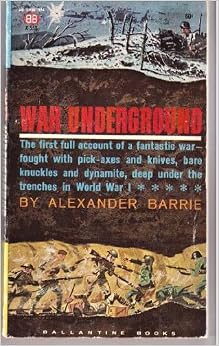
War Underground by Alexander Barrie
(This was actually one of my first reads of 2013, but it was a great read, so I wanted to share it. It's long out of print in the US at least, if it was EVER in print here. I got it in a used shop, as it's my general rule to pick up any older WWI books I find.)
This book was excellent. It follows the British tunneling efforts by first covering the formation of the units and men behind that, and then focusing on individuals and specific events. Throughout the book it breaks away to talk about how these units were run or were getting along with the regular army, etc...
The writing is good and interesting, if a bit dated in style, the stories are all generally amazing, no anti-German feeling, and the book is ordered chronologically. It ends with the Messines Ridge attack. The basic moral is "Pretty much every mine blown resulted in extra British losses and the effort generally only served to make the infantry feel slightly less paranoid." It really is staggering how utterly useless it was, in terms of offense, apart from the Messines Ridge attack, and of course that was the idea that it took the leaders the longest to come around to.
I do recommend this, if you can find it! If you enjoyed Sebastian Faulks' Birdsong and want the real story on the tunneling then this is the book for you.
10Polaris-
Great review Meredith. I was thinking towards the end that this would be a great companion read to Birdsong... Did you recommend each on the other's book page?
11baswood
War Underground looks like a real curiosity, but it was a serious business in WWI
12mabith
Paul - I always forget about being able to do the recommendations, but they're on there now. Thanks for the reminder!
13kidzdoc
1914: A Novel by Jean Echenoz

The latest novel by Echenoz opens in the Vendée region of France, as a lazy and quiet Saturday afternoon in August 1914 is interrupted by the insistent pealing of church bells throughout the region, which signals a call for mobilization for the impending war against Germany. The novel focuses on five ordinary men in one village, and a young woman who loves one man and is fond of another. The men and their commanding officers are convinced that the combat will last no longer than a few weeks, and that all will return home safely. However, as weeks turn into months and months into years, and as the soldiers see their companions felled in action, they are transformed into dispirited men who rely on alcohol to dull their senses. Echenoz writes poignantly about their seemingly hopeless circumstances:
The lives of the five men are all irrevocably altered by the war, in different ways. However, Echenoz shows us that the trauma of war is not limited to those who have experienced combat, or have had their homes or livelihoods taken away from them. Many seem to lose their basic sense of humanity by taking advantage of their countrymen in battle, overcharging them for food or drink as they march through villages, or supplying them with overpriced, shoddily made equipment.
1914 is a quiet and elegantly written novella about the effects of The Great War on a group of ordinary men and citizens of a small French town, whose power comes not from grisly descriptions of combat, but in the benumbed despair that afflicts everyone in its midst. The book is greatly enhanced by notes from the book's translator, Linda Coverdale. Although this book doesn't match my favorite ones by Echenoz, it was still a very enjoyable read.

The latest novel by Echenoz opens in the Vendée region of France, as a lazy and quiet Saturday afternoon in August 1914 is interrupted by the insistent pealing of church bells throughout the region, which signals a call for mobilization for the impending war against Germany. The novel focuses on five ordinary men in one village, and a young woman who loves one man and is fond of another. The men and their commanding officers are convinced that the combat will last no longer than a few weeks, and that all will return home safely. However, as weeks turn into months and months into years, and as the soldiers see their companions felled in action, they are transformed into dispirited men who rely on alcohol to dull their senses. Echenoz writes poignantly about their seemingly hopeless circumstances:
Well, you don't get out of this war like that. It's simple: you're trapped. The enemy is in front of you, the rats and lice are with you, and behind you are the gendarmes. Since the only solution is to become an invalid, you're reduced to waiting for that “good wound”, the one you wind up longing for, your guaranteed ticket home, but there's a problem: it doesn't depend on you. So that wonder-working wound, some men tried to acquire it on their own without attracting too much attention by shooting themselves in the hand, for example, but they usually failed and were confronted with their misdeed, tried, and shot for treason. Mowed down by your own side rather than asphyxiated, burned to a crisp, or shredded by gas, flamethrowers, or shells—that could be a choice. But there was also blowing your own head off, with a toe on the trigger and the rifle barrel in your mouth, a way of getting out like any other—that could be a choice too.
The lives of the five men are all irrevocably altered by the war, in different ways. However, Echenoz shows us that the trauma of war is not limited to those who have experienced combat, or have had their homes or livelihoods taken away from them. Many seem to lose their basic sense of humanity by taking advantage of their countrymen in battle, overcharging them for food or drink as they march through villages, or supplying them with overpriced, shoddily made equipment.
1914 is a quiet and elegantly written novella about the effects of The Great War on a group of ordinary men and citizens of a small French town, whose power comes not from grisly descriptions of combat, but in the benumbed despair that afflicts everyone in its midst. The book is greatly enhanced by notes from the book's translator, Linda Coverdale. Although this book doesn't match my favorite ones by Echenoz, it was still a very enjoyable read.
15fannyprice
William, An Englishman by Cicely Hamilton
(Cross posted at ClubRead 2014 and VMC WWI Read)
Like many, I read this for the VMC "Beginning of the War" read. I honestly have to say that I do not know what to think of this book, which tells the story of a young Englishman and his new wife - both devotees of leftist causes - who are unwittingly caught up in the outbreak of WWI (specifically the Battle of Ardennes) as they honeymoon in Belgium in August 1914. I am very glad I read it, but it was extremely problematic for me. I will be thinking about it for a while and trying to dig up more on this author.
William, the title character, is a "negligible" person who has so little imagination he cannot even determine his own desires; throughout the book, he will be tossed about by circumstance from one extreme set of affiliations to another. He inadvertently becomes a "Social Reformer" after a misunderstanding with a socialist co-worker and quickly develops into an "extremist, passionately well-intentioned and with all the extremist's contempt for those who balance, see difficulties and strive to give the other side its due." Later, after a series of traumatizing events in Europe, he will abandon pacifism and embrace militarism and nationalism with equal fervor before becoming disillusioned with everything.
At first it was easy to read Hamilton's book as a satire of ignorant young people and be amused by their foolishness, but I gradually grew very uncomfortable with this book as it started to seem more and more like an indictment of anti-war sentiment and of "...those who had fiery little battles of their own to fight, and whose own warfare was suddenly rendered null and incompetent by a sudden diversion of energy and interest in the face of the national danger."
Hamilton seems for a period of time to be glorying in militaristic nationalism and issuing a call to arms. But then the book's attitude shifts yet again, as William's dreams of martial glory are replaced by the reality of service. "She knew him for a man disillusioned, in whom the imaginings of his pre-soldier days had died as completely as his faith in his pre-war creed."
I share (substantial spoilers in the linked review) CurrerBell's perplexity at the author's attitude toward her own characters. Is Hamilton critiquing all anti-war and leftist activists? Only stupid activists (because William and his wife are so ignorant and narrow-minded as to be almost unreal)? Is the book a critique of militarism and war, as most reviews suggest, given that Hamilton wrote it during her service as a nurse during the war? I was also confused by Hamilton's frequent references to people who denied that the war was happening. I understand that there was a segment of the public - particularly among leftists - who thought that European war was impossible before it began and another segment among leftists who thought that the war was a conspiracy to distract the common man from the goal of reform and splinter the international labor cause. But was there a group who denied the fact of the war?
Ultimately, I think Hamilton is trying to criticize both those who deny the possibility of war and those who glorify it as somehow redemptive, but I think a lot of her narrative choices are really problematic and end up reinforcing more of a nationalistic, "rally around the crown" perspective. She strongly suggests that suffragists, labor activists, and other leftists who did not suspend their activism during the war - as did the main suffragette group with which Hamilton herself was associated - were somehow unpatriotic, an attitude that really rankled me, especially after reading Adam Hochschild's wonderful history of pacifists and leftists during WWI, To End All Wars: A Story of Loyalty and Rebellion, which explored the moral and political struggles that these activists went through as they tried how to push for domestic reform without being tarred as traitors to the British Government.
I found some comprehensive biographical information on Hamilton that gets more into some of the issues I've raised in my review.
(Cross posted at ClubRead 2014 and VMC WWI Read)
Like many, I read this for the VMC "Beginning of the War" read. I honestly have to say that I do not know what to think of this book, which tells the story of a young Englishman and his new wife - both devotees of leftist causes - who are unwittingly caught up in the outbreak of WWI (specifically the Battle of Ardennes) as they honeymoon in Belgium in August 1914. I am very glad I read it, but it was extremely problematic for me. I will be thinking about it for a while and trying to dig up more on this author.
William, the title character, is a "negligible" person who has so little imagination he cannot even determine his own desires; throughout the book, he will be tossed about by circumstance from one extreme set of affiliations to another. He inadvertently becomes a "Social Reformer" after a misunderstanding with a socialist co-worker and quickly develops into an "extremist, passionately well-intentioned and with all the extremist's contempt for those who balance, see difficulties and strive to give the other side its due." Later, after a series of traumatizing events in Europe, he will abandon pacifism and embrace militarism and nationalism with equal fervor before becoming disillusioned with everything.
At first it was easy to read Hamilton's book as a satire of ignorant young people and be amused by their foolishness, but I gradually grew very uncomfortable with this book as it started to seem more and more like an indictment of anti-war sentiment and of "...those who had fiery little battles of their own to fight, and whose own warfare was suddenly rendered null and incompetent by a sudden diversion of energy and interest in the face of the national danger."
Hamilton seems for a period of time to be glorying in militaristic nationalism and issuing a call to arms. But then the book's attitude shifts yet again, as William's dreams of martial glory are replaced by the reality of service. "She knew him for a man disillusioned, in whom the imaginings of his pre-soldier days had died as completely as his faith in his pre-war creed."
I share (substantial spoilers in the linked review) CurrerBell's perplexity at the author's attitude toward her own characters. Is Hamilton critiquing all anti-war and leftist activists? Only stupid activists (because William and his wife are so ignorant and narrow-minded as to be almost unreal)? Is the book a critique of militarism and war, as most reviews suggest, given that Hamilton wrote it during her service as a nurse during the war? I was also confused by Hamilton's frequent references to people who denied that the war was happening. I understand that there was a segment of the public - particularly among leftists - who thought that European war was impossible before it began and another segment among leftists who thought that the war was a conspiracy to distract the common man from the goal of reform and splinter the international labor cause. But was there a group who denied the fact of the war?
Ultimately, I think Hamilton is trying to criticize both those who deny the possibility of war and those who glorify it as somehow redemptive, but I think a lot of her narrative choices are really problematic and end up reinforcing more of a nationalistic, "rally around the crown" perspective. She strongly suggests that suffragists, labor activists, and other leftists who did not suspend their activism during the war - as did the main suffragette group with which Hamilton herself was associated - were somehow unpatriotic, an attitude that really rankled me, especially after reading Adam Hochschild's wonderful history of pacifists and leftists during WWI, To End All Wars: A Story of Loyalty and Rebellion, which explored the moral and political struggles that these activists went through as they tried how to push for domestic reform without being tarred as traitors to the British Government.
I found some comprehensive biographical information on Hamilton that gets more into some of the issues I've raised in my review.
16labfs39
It was interesting to read your review in light of my current reading of Testament of Youth by Vera Brittain. She wrote this memoir after the war (it was published in 1933), but it discusses many of the same social issues, as she was a nurse during the war, a feminist, and became a staunch pacifist during WWII. I think she does a wonderful job of showing how youthful idealism led to initial patriotism that was warped and disillusioned by the futility of the deaths of an entire generation of young men. I think you are planning to read it, aren't you, Fanny? I will be interested to see what you think of the two in comparison.
17fannyprice
Indeed!
18edwinbcn
A cup of tea. A novel of 1917
Finished reading: 12 January 2014

A cup of tea. A novel of 1917 is a short and somewhat bland novel by the American author Amy Ephron. Despite its shortness, the novel is packed with various complex plot elements, while none is really developed to its full potential. The novel seeks to explore various types of relationships between people, but again, the novel is too short to support such a broad thematic scope.
Young Rosemary Fell is betrothed to Philip Alsop. She spends her days in idleness, shopping and is seen spending a lot of money buying antiques at the opening of the story. On her way home she is accosted by a young woman who is shivering in the rain, asking for money to buy a cup of tea. Rather than give her the money, she invites the young woman, Eleanor Smith, to drive home with her in her car, and drink tea with her.She is quite pleased with her act of charity, despite the frowning of her chauffeur and house-keeper. A visiting friend is helpful by introducing Eleanor to employment in a hat shop.
With a single glance over her cup of tea, Eleanor manages to steal Philip's heart, and when Philip meets her again by chance in the hat shop he falls in love with Eleanor, and starts seeing her. Despite their sexual relationship, Philip does not break off the engagement with Rosemary, and Eleanor feels betrayed when he marries Rosemary, earlier than originally planned as Philip is sent to serve in the War. Philip is reported missing and assumed dead, but then miraculously returns home alive. Back in New York, he picks up his old life and ways, married to Rosemary he keeps seeing Eleanor which leads to the dramatic climax of the novel.
The novel explores themes as various as friendship, love, pre-marital love and betrayal of a fiancée, marital and extra-martital love with betrayal of both the spouse and the lover, (insincere) altruism and there is even a sideline of lesbian love. The backdrop of the First World War and unexpected somewhat unlikely twists in the plot, such as Eleanor shivering in a sweater in the rain (it is never explained how she got into that situation) and Philip reported dead and then re-appearing all just serve to create more variation in the extricacies of the relations between the women in the novel. It is not surprising that the characters are not very well developed in a short novel with such a complex plot.

Finished reading: 12 January 2014

A cup of tea. A novel of 1917 is a short and somewhat bland novel by the American author Amy Ephron. Despite its shortness, the novel is packed with various complex plot elements, while none is really developed to its full potential. The novel seeks to explore various types of relationships between people, but again, the novel is too short to support such a broad thematic scope.
Young Rosemary Fell is betrothed to Philip Alsop. She spends her days in idleness, shopping and is seen spending a lot of money buying antiques at the opening of the story. On her way home she is accosted by a young woman who is shivering in the rain, asking for money to buy a cup of tea. Rather than give her the money, she invites the young woman, Eleanor Smith, to drive home with her in her car, and drink tea with her.She is quite pleased with her act of charity, despite the frowning of her chauffeur and house-keeper. A visiting friend is helpful by introducing Eleanor to employment in a hat shop.
With a single glance over her cup of tea, Eleanor manages to steal Philip's heart, and when Philip meets her again by chance in the hat shop he falls in love with Eleanor, and starts seeing her. Despite their sexual relationship, Philip does not break off the engagement with Rosemary, and Eleanor feels betrayed when he marries Rosemary, earlier than originally planned as Philip is sent to serve in the War. Philip is reported missing and assumed dead, but then miraculously returns home alive. Back in New York, he picks up his old life and ways, married to Rosemary he keeps seeing Eleanor which leads to the dramatic climax of the novel.
The novel explores themes as various as friendship, love, pre-marital love and betrayal of a fiancée, marital and extra-martital love with betrayal of both the spouse and the lover, (insincere) altruism and there is even a sideline of lesbian love. The backdrop of the First World War and unexpected somewhat unlikely twists in the plot, such as Eleanor shivering in a sweater in the rain (it is never explained how she got into that situation) and Philip reported dead and then re-appearing all just serve to create more variation in the extricacies of the relations between the women in the novel. It is not surprising that the characters are not very well developed in a short novel with such a complex plot.

19Oandthegang
Oh dear! I've just read your review, fannyprice, which sent me off reading all the other reviews of 'William'.
I like to do my reviews as first reactions, and try not to read other commentaries (including prefaces) so I can come unbiased to the work, rather in the same way that films seem most enjoyable when one has not encountered any publicity for them. If a work interests me sufficiently, I may then go back and read around it. This isn't always the case, as I am starting The Wise Virgins and for some reason did read the preface first.
Having posted my review of William I then read yours, and therefore CurrerBell's, and then all the others. I agree with you that the second half of the book does not work quite so well as the first. The trajectory is inevitable and one therefore reads it knowing what will come, if not exactly how, and the tone shifts so that there is less indulgent warmth toward William, but then William is changed, his views and behaviour have changed, so it is natural that we feel differently about him. William's move towards a militarism is not surprising - it is after all triggered initially by desire for revenge for all the loss and harm he has suffered. When William comes to identify himself specifically as an Englishman, linked to the soil of his country, suddenly finding England's chalk cliffs so much more appealing than France's it is not surprising. War brings out tribal feelings. I was in the UK during the Falklands/Malvinas conflict and was amazed how quickly a nationalistic fervour developed about occupation of a place most of the UK population had probably never heard of before. How much more would such feelings arise in William's case?
I think Hamilton's anger was to some extent against those who sit and pontificate about things of which they have no real knowledge, the people in the kind of meetings that William attended who would see their own struggles as equal to those of the people in the midst of war, and looked down on the soldiers as deluded fools. As a sort of modern day equivalent I once attended a conference at which Harold Pinter went on at great length about the fact that a UK newspaper had not published a poem he had written objecting to some military conflict and in which he had used a certain four-letter word. He believed that the failure of the paper to publish the poem was a dreadful act of censorship. He was sharing a platform with a man who had been sent to jail for writing a poem referring to a famine which despite its death toll did not officially exist, and other men whose lives were in danger because they had written other truths. In the circumstances I found Pinter's complaint embarrassing; his situation was nothing like that of his fellow panelists, yet he appeared not to notice. I think Hamilton's activists are much the same, and it is that which principally angers her rather than that they do not suspend their activism There is of course the point that they are only able to continue to devote themselves to their causes in their comfortable London homes because other people are out there fighting to defend the country.
It is natural that William, with his childlike character, should imagine himself as a sort of knight going into battle before he is once again disillusioned.
I read Heaven-Ali's review of 8 December 2012, and was struck by the extract s/he chose to quote from the book, about the first execution which William witnessed. "... William saw the two civilians clearly. One was a short and rotund little man who might have been sixty to sixty-five and might have been a local tradesman - nearly bald and with drooping moustaches, rather like a stout little seal. Essentially an ordinary and unpretentious creature, he was obviously aiming at dignity; his chin was lifted at an angle that revealed the measure of the roll of fat that rested on his collar, and he walked almost with a strut, as if he were attempting to march. Afterwards William remembered that he had seen on the little man's portly stomach some sort of insignia or ribbon; at the time it conveyed nothing to him, he was told later that it was the outward token of a mayor. He remembered also that the little man's face was pale, with a sickly yellow-grey pallor; and that as he came down the steps with his head held up the drooping moustache quivered and the fat chin beneath it twitched spasmodically. There was something extraordinarily pitiful about his attempt at a personal dignity which nature had wholly denied; William felt the appeal in it even before he grasped the situation the meaning and the need of pose." Reading this as an extract I was struck by the mayor's similarity to, yet subtle differences from, William. Is the mayor perhaps someone William might have been? A slightly absurd little man, but one who had risen to significant public office and carried the dignity of his office as well as of his person to face as bravely as he could his own death. Might William at some level have recognized aspects of himself in the little mayor?
Oh dear, indeed. The difficulty (and pleasure) of LibraryThing is reading everyone else's thoughts and then needing to go back to read the book again - but with so many books to get through how is one to find the time to read everything twice?
I like to do my reviews as first reactions, and try not to read other commentaries (including prefaces) so I can come unbiased to the work, rather in the same way that films seem most enjoyable when one has not encountered any publicity for them. If a work interests me sufficiently, I may then go back and read around it. This isn't always the case, as I am starting The Wise Virgins and for some reason did read the preface first.
Having posted my review of William I then read yours, and therefore CurrerBell's, and then all the others. I agree with you that the second half of the book does not work quite so well as the first. The trajectory is inevitable and one therefore reads it knowing what will come, if not exactly how, and the tone shifts so that there is less indulgent warmth toward William, but then William is changed, his views and behaviour have changed, so it is natural that we feel differently about him. William's move towards a militarism is not surprising - it is after all triggered initially by desire for revenge for all the loss and harm he has suffered. When William comes to identify himself specifically as an Englishman, linked to the soil of his country, suddenly finding England's chalk cliffs so much more appealing than France's it is not surprising. War brings out tribal feelings. I was in the UK during the Falklands/Malvinas conflict and was amazed how quickly a nationalistic fervour developed about occupation of a place most of the UK population had probably never heard of before. How much more would such feelings arise in William's case?
I think Hamilton's anger was to some extent against those who sit and pontificate about things of which they have no real knowledge, the people in the kind of meetings that William attended who would see their own struggles as equal to those of the people in the midst of war, and looked down on the soldiers as deluded fools. As a sort of modern day equivalent I once attended a conference at which Harold Pinter went on at great length about the fact that a UK newspaper had not published a poem he had written objecting to some military conflict and in which he had used a certain four-letter word. He believed that the failure of the paper to publish the poem was a dreadful act of censorship. He was sharing a platform with a man who had been sent to jail for writing a poem referring to a famine which despite its death toll did not officially exist, and other men whose lives were in danger because they had written other truths. In the circumstances I found Pinter's complaint embarrassing; his situation was nothing like that of his fellow panelists, yet he appeared not to notice. I think Hamilton's activists are much the same, and it is that which principally angers her rather than that they do not suspend their activism There is of course the point that they are only able to continue to devote themselves to their causes in their comfortable London homes because other people are out there fighting to defend the country.
It is natural that William, with his childlike character, should imagine himself as a sort of knight going into battle before he is once again disillusioned.
I read Heaven-Ali's review of 8 December 2012, and was struck by the extract s/he chose to quote from the book, about the first execution which William witnessed. "... William saw the two civilians clearly. One was a short and rotund little man who might have been sixty to sixty-five and might have been a local tradesman - nearly bald and with drooping moustaches, rather like a stout little seal. Essentially an ordinary and unpretentious creature, he was obviously aiming at dignity; his chin was lifted at an angle that revealed the measure of the roll of fat that rested on his collar, and he walked almost with a strut, as if he were attempting to march. Afterwards William remembered that he had seen on the little man's portly stomach some sort of insignia or ribbon; at the time it conveyed nothing to him, he was told later that it was the outward token of a mayor. He remembered also that the little man's face was pale, with a sickly yellow-grey pallor; and that as he came down the steps with his head held up the drooping moustache quivered and the fat chin beneath it twitched spasmodically. There was something extraordinarily pitiful about his attempt at a personal dignity which nature had wholly denied; William felt the appeal in it even before he grasped the situation the meaning and the need of pose." Reading this as an extract I was struck by the mayor's similarity to, yet subtle differences from, William. Is the mayor perhaps someone William might have been? A slightly absurd little man, but one who had risen to significant public office and carried the dignity of his office as well as of his person to face as bravely as he could his own death. Might William at some level have recognized aspects of himself in the little mayor?
Oh dear, indeed. The difficulty (and pleasure) of LibraryThing is reading everyone else's thoughts and then needing to go back to read the book again - but with so many books to get through how is one to find the time to read everything twice?
20rebeccanyc
The War That Ended Peace: The Road to 1914 by Margaret MacMillan

MacMillan, who previously wrote a book about the aftermath of World War I that I enjoyed, here looks at the years leading up to that war, largely from the perspective of high-level diplomacy and the character and actions of leaders of countries. Thus it contrasts with Barbara Tuchman's The Proud Tower, which I read several years ago, in that it presents a somewhat exhaustive history of the actions of leaders, rather than looking at discrete and illustrative examples of life in Europe before the war.
MacMillan first examines individual European countries and their relationships with each other, starting with England and Germany and moving on to France, Russia, and the Austro-Hungarian Empire. Many but not all of these chapters focus on England's relationship with these countries. She then explores the thinking of people in various countries, and how they started planning for war, before turning to a variety of crises that preceded the outbreak of war in 1914, including ones in Morocco (twice), Bosnia, and the Balkans generally. There is a lot of detail in every chapter, and sometimes it is hard to keep the people straight, but the reader does get a sense of the human beings involved in decision-making and the characters of some of the leading players.
If I had to sum up what MacMillan presents as the factors that led to war, I would include the naval arms race between Germany and England (started by Germany), the German fear of being surrounded by Russia and France, injured feelings of national pride from previous events (e.g., the Boer War for England, the loss of Alsace and Lorraine for France, the loss of the Russo-Japanese war for Russia), the way developing war plans create a force for using them (as well as the difficulty some leaders have of standing up to their military), and the belief after weathering several crises that other crises could also be resolved relatively peacefully.
This is a long book, and some of it is more interesting, some less interesting. However, MacMillan is an excellent writer and she keeps everything moving. Every now and then, she relates something that happened back in the first part of the 20th century to political and international events that are more current, as a way of demonstrating that human nature doesn't change, I guess. At first, I found this helpful and illuminating, but after a while I wearied of it.
The First World War not only destroyed two empires and redrew the map of Europe and the middle east but also killed millions of people. As MacMillan notes in her epilogue:
By the time the war ended on November 11, 1918, sixty-five million men had fought and eight and a half million had been killed. Eight million were prisoners or simply missing. Twenty-one million had been wounded and that figure only included the wounds that could be measured; no one will ever know how many were damaged or destroyed psychologically. pp. 636-637
In the end, she believes the leaders, and the countries, made a choice for war, and that is what she tries to illustrate in this book. She believes there is always a choice.

MacMillan, who previously wrote a book about the aftermath of World War I that I enjoyed, here looks at the years leading up to that war, largely from the perspective of high-level diplomacy and the character and actions of leaders of countries. Thus it contrasts with Barbara Tuchman's The Proud Tower, which I read several years ago, in that it presents a somewhat exhaustive history of the actions of leaders, rather than looking at discrete and illustrative examples of life in Europe before the war.
MacMillan first examines individual European countries and their relationships with each other, starting with England and Germany and moving on to France, Russia, and the Austro-Hungarian Empire. Many but not all of these chapters focus on England's relationship with these countries. She then explores the thinking of people in various countries, and how they started planning for war, before turning to a variety of crises that preceded the outbreak of war in 1914, including ones in Morocco (twice), Bosnia, and the Balkans generally. There is a lot of detail in every chapter, and sometimes it is hard to keep the people straight, but the reader does get a sense of the human beings involved in decision-making and the characters of some of the leading players.
If I had to sum up what MacMillan presents as the factors that led to war, I would include the naval arms race between Germany and England (started by Germany), the German fear of being surrounded by Russia and France, injured feelings of national pride from previous events (e.g., the Boer War for England, the loss of Alsace and Lorraine for France, the loss of the Russo-Japanese war for Russia), the way developing war plans create a force for using them (as well as the difficulty some leaders have of standing up to their military), and the belief after weathering several crises that other crises could also be resolved relatively peacefully.
This is a long book, and some of it is more interesting, some less interesting. However, MacMillan is an excellent writer and she keeps everything moving. Every now and then, she relates something that happened back in the first part of the 20th century to political and international events that are more current, as a way of demonstrating that human nature doesn't change, I guess. At first, I found this helpful and illuminating, but after a while I wearied of it.
The First World War not only destroyed two empires and redrew the map of Europe and the middle east but also killed millions of people. As MacMillan notes in her epilogue:
By the time the war ended on November 11, 1918, sixty-five million men had fought and eight and a half million had been killed. Eight million were prisoners or simply missing. Twenty-one million had been wounded and that figure only included the wounds that could be measured; no one will ever know how many were damaged or destroyed psychologically. pp. 636-637
In the end, she believes the leaders, and the countries, made a choice for war, and that is what she tries to illustrate in this book. She believes there is always a choice.
21labfs39
I think I'll pass on A Cup of Tea - doesn't sound like my cuppa!
Thank you for sharing your thoughts on William, O. It was interesting to get another perspective. I especially liked your ideas about the mayor and William.
I love the quote you include at the end of your review. Especially, no one will ever know how many were damaged or destroyed psychologically. Have you read Regeneration, Rebecca?
Thank you for sharing your thoughts on William, O. It was interesting to get another perspective. I especially liked your ideas about the mayor and William.
I love the quote you include at the end of your review. Especially, no one will ever know how many were damaged or destroyed psychologically. Have you read Regeneration, Rebecca?
22NanaCC
For anyone who hasn't read the Regeneration Trology, I highly recommend it.
23VivienneR
Apologies for duplication if you found this on another thread.

Kitchener's Last Volunteer : the life of Henry Allingham the oldest surviving veteran of the Great War by Henry Allingham
Henry Allingham was born June 6, 1896. In that year the first traffic fatality occurred, and the first speeding ticket was issued - to a car speeding along at 8mph in a 2mph zone! He volunteered for service in 1915 serving with the Royal Naval Air Service, the forerunner of the RAF. Allingham saw action at the Battle of Jutland and was at the front lines at Passchendaele. As he was in the RNAS he did not take part in the trench warfare. On numerous occasions he refers to the men in the trenches as having won the war, all the while suffering unspeakable conditions. Throughout his life Henry Allingham was talented, positive and charming. He was a gem. When he was 100 years old and his deteriorating vision meant he could no longer drive he got a bicycle. A photo of him on the bike on his 100th birthday, shows a man who looks like he was thirty years younger.
Henry Allingham became Britain's oldest living man March 29, 2009. As his counterpart veterans from other nations died, he became the sole survivor of the RNAS and the last founding member of the RAF. In 2007 he became the oldest known veteran of WWI. On the death of Tomoji Tanabe in Japan, June 19, 2009, Henry became the world's oldest man. He died July 18, 2009.
Allingham's memories are interspersed with passages by Dennis Goodwin, of the Veteran's Association, who elaborates on Henry's memories and describes events of the day. In the early years it was useful to have the memories of a child filled out, however, as the book progresses Goodwin's passages become more dominant and less interesting. I have to admit that towards the end of the book I speed-read them. Allingham's story was much more engaging.
http://www.theguardian.com/global/2009/jul/18/obituary-henry-allingham

Kitchener's Last Volunteer : the life of Henry Allingham the oldest surviving veteran of the Great War by Henry Allingham

Henry Allingham was born June 6, 1896. In that year the first traffic fatality occurred, and the first speeding ticket was issued - to a car speeding along at 8mph in a 2mph zone! He volunteered for service in 1915 serving with the Royal Naval Air Service, the forerunner of the RAF. Allingham saw action at the Battle of Jutland and was at the front lines at Passchendaele. As he was in the RNAS he did not take part in the trench warfare. On numerous occasions he refers to the men in the trenches as having won the war, all the while suffering unspeakable conditions. Throughout his life Henry Allingham was talented, positive and charming. He was a gem. When he was 100 years old and his deteriorating vision meant he could no longer drive he got a bicycle. A photo of him on the bike on his 100th birthday, shows a man who looks like he was thirty years younger.
Henry Allingham became Britain's oldest living man March 29, 2009. As his counterpart veterans from other nations died, he became the sole survivor of the RNAS and the last founding member of the RAF. In 2007 he became the oldest known veteran of WWI. On the death of Tomoji Tanabe in Japan, June 19, 2009, Henry became the world's oldest man. He died July 18, 2009.
Allingham's memories are interspersed with passages by Dennis Goodwin, of the Veteran's Association, who elaborates on Henry's memories and describes events of the day. In the early years it was useful to have the memories of a child filled out, however, as the book progresses Goodwin's passages become more dominant and less interesting. I have to admit that towards the end of the book I speed-read them. Allingham's story was much more engaging.
http://www.theguardian.com/global/2009/jul/18/obituary-henry-allingham
24fannyprice
Excellent review.
26japaul22
Birdsong by Sebastian Faulks
I have had this book on my radar for a while now, but after seeing some mediocre reviews I wasn't sure I would like it much. With the WWI theme and a group read in the "1001 books to read before you die" group, I decided it was time to try it. I'm so glad I did since I ended up loving it.
This is the story of Stephen Wraysford's war experience. The book begins in 1910 and shows a youthful Stephen in France falling in love with an older married woman, Isabelle. This is the most obvious "love" part of the novel. Next we skip to 1916 and see Stephan's brutal war experience. He is cold and detached, uncaring, perfect for a soldier. He also has luck and as all of his comrades are gruesomely dying around him, he somehow lives on. But for what? The next part of the novel takes place in England in 1978 and focuses on Elizabeth who is becoming interested in the history of her grandfather who was a soldier in WWI and who she knows almost nothing about.
The novel is subtitled "A Novel of Love and War" and I found it a significant addition to the title. What really struck me about this book was the idea of love. To me, the idea of love between Stephen and the other soldiers he fought alongside was the real love present in the book. It is an untraditional love - these men don't really know much about each other, they don't share much, sometimes they don't even remember names, but I think you could still say that they do love each other. As they die together and experience the same horrors, they are bound together. It isn't a way I've really thought of love before, but I think it counts.This idea all came together for me when Jack Firebrance says "I could have loved you" towards the end of his life. Then I thought of all the men Stephen had watched die and thought that this was such a deeper love than he ever felt for Isabelle, even though it didn't strike me as love when I was reading those parts.
I did not particularly love the 1970s portion of the book. I thought the main character, Elizabeth, was pretty annoying, and though there was a connection to the war story, I just didn't think it added all the much to the book. I do think, though, that it gave some relief to the horrors of the war sections.
Overall, I really loved this book and would recommend it to anyone looking for some WWI reading during this anniversary year.
I have had this book on my radar for a while now, but after seeing some mediocre reviews I wasn't sure I would like it much. With the WWI theme and a group read in the "1001 books to read before you die" group, I decided it was time to try it. I'm so glad I did since I ended up loving it.
This is the story of Stephen Wraysford's war experience. The book begins in 1910 and shows a youthful Stephen in France falling in love with an older married woman, Isabelle. This is the most obvious "love" part of the novel. Next we skip to 1916 and see Stephan's brutal war experience. He is cold and detached, uncaring, perfect for a soldier. He also has luck and as all of his comrades are gruesomely dying around him, he somehow lives on. But for what? The next part of the novel takes place in England in 1978 and focuses on Elizabeth who is becoming interested in the history of her grandfather who was a soldier in WWI and who she knows almost nothing about.
The novel is subtitled "A Novel of Love and War" and I found it a significant addition to the title. What really struck me about this book was the idea of love. To me, the idea of love between Stephen and the other soldiers he fought alongside was the real love present in the book. It is an untraditional love - these men don't really know much about each other, they don't share much, sometimes they don't even remember names, but I think you could still say that they do love each other. As they die together and experience the same horrors, they are bound together. It isn't a way I've really thought of love before, but I think it counts.
I did not particularly love the 1970s portion of the book. I thought the main character, Elizabeth, was pretty annoying, and though there was a connection to the war story, I just didn't think it added all the much to the book. I do think, though, that it gave some relief to the horrors of the war sections.
Overall, I really loved this book and would recommend it to anyone looking for some WWI reading during this anniversary year.
27RidgewayGirl
I'd like to read some fiction, after having finished July 1914: Countdown to War by Sean McMeekin. I'm considering rereading Birdsong or maybe the Regeneration trilogy.
In any case, the McMeekin book was, I think, a good start in exploring WWI. It was dry and I really prefer to have more social history in with the machinations of government and military officials, but I did get a good sense of what was going on in that month between the assassination of Archduke Ferdinand and the start of hostilities. I've posted a review to the book's page if anyone wants more details.
In any case, the McMeekin book was, I think, a good start in exploring WWI. It was dry and I really prefer to have more social history in with the machinations of government and military officials, but I did get a good sense of what was going on in that month between the assassination of Archduke Ferdinand and the start of hostilities. I've posted a review to the book's page if anyone wants more details.
28labfs39
I thought the Regeneration trilogy was very interesting, and it is based on real people. It deals primarily with shell shock and other psychological damage caused by the war, but also with issues like the prosecution of homosexuality during WWI and conscientious objectors. I thought the first book to be the best and definitely stands on its own, if you didn't want to commit to the entire trilogy.
For more social history, I also recommend the memoir by Vera Brittain, Testament of Youth.
For more social history, I also recommend the memoir by Vera Brittain, Testament of Youth.
29NanaCC
Also posted on my reading thread

Mr. Britling Sees It Through by H. G. Wells
The story of Mr. Britling takes place in a fictional village in Essex, England called Matching's Easy. The book is broken into three parts, and seems that it might be part autobiography.
Book One is called "Matching's Easy at Ease". Here we are introduced to Mr. Britling and his family. He adores his son Hugh, by his first wife, who was the love of his life. There is his second wife, with whom he has a "comfortable" relationship, and their two young sons. We are introduced to his neighbors Letty and her husband Teddy, Letty's sister, Cissie, and also to Herr Heinrich, a visiting German student who tutors the younger boys. It is early summer 1914, and an American, Mr. Direck, who has admired Mr. Britling's writings, arrives for a stay. He wants to study what it is to be English, and intends to visit more of Europe. There is talk of war, and Mr. Britling is positive that war will not happen. If Germany were to attack France or Belgium, of course, they would have to help. But, people could not be that crazy, they should be keeping an eye on the troubles starting in Ireland. As the reality of war approaches, however, there is much talk about the superior preparedness of the Germans, and the embarrassingly unprepared British military. As war breaks out Herr Heinrich is reluctantly forced to leave to join the German army much to the dismay of Mr. Britling and the rest of the family. The first part is filled with humour. Mr. Britling has a new car, and he is learning to drive as he picks up Mr. Direck from the train station. There are several very funny scenes related to the car. Mr. Britling is also involved in his eighth love affair.
Book Two is called "Matching's Easy At War". At this point Herr Heinrich is in the German army and is communicating to the Britlings through a friend in Norway. He asks Mr. Britling to be sure to send his violin to his parents if anything should happen to him. Teddy is now off to officer training. And, Mr. Britling is secure in the knowledge that his beautiful son, Hugh, is too young to go to war. In two years, the war would surely be over, wouldn't it. Unfortunately, Hugh has different ideas. Part two is filled with war. Letters from Mr. Britling's son, Hugh, are touching, and filled with his thoughts about life in the trenches and thoughts of how foolish are the leaders on both sides of the battle. He talks about retrieving diaries from the dead bodies of German soldiers, which they are using as a form of intelligence gathering. Apparently, the German soldiers were initially ordered to keep daily diaries, until they were aware of it being used against them, at which point they were ordered not to have one scrap of paper on their person. Cissie and Mr. Direck have grown fond of one another, but America's refusal to enter the war is a point of contention between them. There is very little humour in part two.
Book Three is called "The Testament of Matching's Easy". Mr. Britling begins to write a new manuscript "The Better Government of the World". He writes a letter to Herr Heinrich's parents, and in it he states:
"It is you and I who must stop these wars, these massacres of boys."
"Massacres of boys! That is the essence of modern war. The killing off of the young. It is the destruction of the human inheritance, it is the spending of all life and material of the future upon present-day hate and greed. Fools and knaves, politicians, tricksters, and those who trade on the suspicions and thoughtless, generous angers of men, make wars; the indolence and modesty of the mass of men permit them. Are you and I to suffer such things until the whole fabric of our civilisation, that has been so slowly and so laboriously built up, is altogether destroyed?"
Mr. Britling is overwhelmed by and then coming to terms with the losses of life that have been inflicted on both sides of the battle. He finds a new view of religion. His feeling of what is god and religion is a big part of book three. Wells' book was published in September 1916, so obviously he had no idea how the war would end.
Mr. Britling Sees It Through gives a view into society in England just before the war, and then proceeds with the changes that were needed as people faced the realities and challenges of the war. I liked the book, although, I felt it might have become a little wordy and preachy in parts. Perhaps he was feeling the frustrations that nearly everyone felt after two years of bloodshed, and that came out in the book. I don't think I knew that H.G. Wells wrote anything but science fiction. I am happy I gave this one a try. I gave it 4 stars.

Mr. Britling Sees It Through by H. G. Wells
The story of Mr. Britling takes place in a fictional village in Essex, England called Matching's Easy. The book is broken into three parts, and seems that it might be part autobiography.
Book One is called "Matching's Easy at Ease". Here we are introduced to Mr. Britling and his family. He adores his son Hugh, by his first wife, who was the love of his life. There is his second wife, with whom he has a "comfortable" relationship, and their two young sons. We are introduced to his neighbors Letty and her husband Teddy, Letty's sister, Cissie, and also to Herr Heinrich, a visiting German student who tutors the younger boys. It is early summer 1914, and an American, Mr. Direck, who has admired Mr. Britling's writings, arrives for a stay. He wants to study what it is to be English, and intends to visit more of Europe. There is talk of war, and Mr. Britling is positive that war will not happen. If Germany were to attack France or Belgium, of course, they would have to help. But, people could not be that crazy, they should be keeping an eye on the troubles starting in Ireland. As the reality of war approaches, however, there is much talk about the superior preparedness of the Germans, and the embarrassingly unprepared British military. As war breaks out Herr Heinrich is reluctantly forced to leave to join the German army much to the dismay of Mr. Britling and the rest of the family. The first part is filled with humour. Mr. Britling has a new car, and he is learning to drive as he picks up Mr. Direck from the train station. There are several very funny scenes related to the car. Mr. Britling is also involved in his eighth love affair.
Book Two is called "Matching's Easy At War". At this point Herr Heinrich is in the German army and is communicating to the Britlings through a friend in Norway. He asks Mr. Britling to be sure to send his violin to his parents if anything should happen to him. Teddy is now off to officer training. And, Mr. Britling is secure in the knowledge that his beautiful son, Hugh, is too young to go to war. In two years, the war would surely be over, wouldn't it. Unfortunately, Hugh has different ideas. Part two is filled with war. Letters from Mr. Britling's son, Hugh, are touching, and filled with his thoughts about life in the trenches and thoughts of how foolish are the leaders on both sides of the battle. He talks about retrieving diaries from the dead bodies of German soldiers, which they are using as a form of intelligence gathering. Apparently, the German soldiers were initially ordered to keep daily diaries, until they were aware of it being used against them, at which point they were ordered not to have one scrap of paper on their person. Cissie and Mr. Direck have grown fond of one another, but America's refusal to enter the war is a point of contention between them. There is very little humour in part two.
Book Three is called "The Testament of Matching's Easy". Mr. Britling begins to write a new manuscript "The Better Government of the World". He writes a letter to Herr Heinrich's parents, and in it he states:
"It is you and I who must stop these wars, these massacres of boys."
"Massacres of boys! That is the essence of modern war. The killing off of the young. It is the destruction of the human inheritance, it is the spending of all life and material of the future upon present-day hate and greed. Fools and knaves, politicians, tricksters, and those who trade on the suspicions and thoughtless, generous angers of men, make wars; the indolence and modesty of the mass of men permit them. Are you and I to suffer such things until the whole fabric of our civilisation, that has been so slowly and so laboriously built up, is altogether destroyed?"
Mr. Britling is overwhelmed by and then coming to terms with the losses of life that have been inflicted on both sides of the battle. He finds a new view of religion. His feeling of what is god and religion is a big part of book three. Wells' book was published in September 1916, so obviously he had no idea how the war would end.
Mr. Britling Sees It Through gives a view into society in England just before the war, and then proceeds with the changes that were needed as people faced the realities and challenges of the war. I liked the book, although, I felt it might have become a little wordy and preachy in parts. Perhaps he was feeling the frustrations that nearly everyone felt after two years of bloodshed, and that came out in the book. I don't think I knew that H.G. Wells wrote anything but science fiction. I am happy I gave this one a try. I gave it 4 stars.
30labfs39
I don't think I knew that H.G. Wells wrote anything but science fiction.
Neither did I. Sounds interesting. I'll keep my eye out.
Neither did I. Sounds interesting. I'll keep my eye out.
31NanaCC
>30 labfs39: Lisa, I got it for the Virago group read. I think it was either free or 99 cents for Kindle. I found myself bookmarking so many places where I wanted to be able to refer back. I thought it was a great blend of story and history.
32fannyprice
I'm still hoping to get to that one!
33baswood
Excellent review of Mr Britling Sees it Through and I am glad you enjoyed it Colleen. It is interesting to know the book was published in 1916. H G Wells wrote his novels quickly and so I imagine most of Mr Britling was written in 1916. H G Wells had been having books published from about 1895 probably two or thee per year and he did get a bit preachy in the later ones. He did of course write in plenty of other genres apart from Science Fiction.
34NanaCC
Barry, I just looked in Wikipedia after your comment, and found this comment-
"Mr. Britling Sees It Through was one of the most popular novels in the United Kingdom and Australia during World War I. Wells's American publisher paid ₤20,000 for it. Maxim Gorky called the novel "the finest, most courageous, truthful, and humane book written in Europe in the course of this accursed war . . at a time of universal barbarism and cruelty, your book is an important and truly humane work.""
"Mr. Britling Sees It Through was one of the most popular novels in the United Kingdom and Australia during World War I. Wells's American publisher paid ₤20,000 for it. Maxim Gorky called the novel "the finest, most courageous, truthful, and humane book written in Europe in the course of this accursed war . . at a time of universal barbarism and cruelty, your book is an important and truly humane work.""
36NanaCC
>35 labfs39: Agreed, Lisa. I wonder if the popularity was in some way related to a feeling of hope for the future. The incredibly bloody war went on and here was a book talking about a world where England was England, Germany was Germany, France was France, etc., and people with saner minds had stopped trying to conquer the world.
37Oandthegang
I'm tempted by the Wells book, so have skimmed through the posts very quickly to avoid picking up anything that might influence me. There's a small cluster of Matchings in Essex, so he was being pretty specific about his neighbourhood. (I think there's a Matching Tye, but no Handkerchief)
I've started reading Great Britain's Great War. It's a much lighter non-fiction guide and it does what it says on the tin, i.e. it looks at Great Britain's war, which makes it a rather odd read after The Guns Of August. Because the subject of his book is specifically the British experience Paxman's description of Britain's entry into the war leaves out the Belgian drama and French frustration with the initial British military response. In addition to The Sleepwalkers I've also got the Margaret MacMillan to get through, so there is bound to be a lot of cross referencing and silent arguing with authors.
I've started reading Great Britain's Great War. It's a much lighter non-fiction guide and it does what it says on the tin, i.e. it looks at Great Britain's war, which makes it a rather odd read after The Guns Of August. Because the subject of his book is specifically the British experience Paxman's description of Britain's entry into the war leaves out the Belgian drama and French frustration with the initial British military response. In addition to The Sleepwalkers I've also got the Margaret MacMillan to get through, so there is bound to be a lot of cross referencing and silent arguing with authors.
38NanaCC
>37 Oandthegang: I do try very hard not to put in spoilers, and hope I managed to avoid them. I really enjoyed the book, and would like to hear your thoughts if you get to it.
39labfs39
I'm not sure if I should post this here, as it's not specifically about WWI. Rather it is about the effects of WWI and specifically the reparations and ensuing depression on ordinary Germans. I can remove it, if it seems too unrelated.
Life Goes On by Hans Keilson, translated from the German by Damion Searls
Written when the author was only twenty-three and published in 1933, Life Goes On is an autobiographical novel that is in part a depiction of Keilson's father and in part a commentary on the post-WWI years and the generation that grew up during 1920's Germany.
Seldersen the shopkeeper had never in his life wanted anything to do with people whose heads seemed to be bursting with big, boundless ideas. What he needed was right there next to him, in arm's reach at all times; his type is absorbed in everyday life, and he always kept his air of calm mastery, not without a certain restraint and reserve. He was a whole man, and behind him stood a whole age. He was past fifty by that time and his life up until then had been nothing but one long struggle... He had survived the war on the front lines unharmed, even if those four years seemed like ten... His wife had run the business during those four years, while raising two children. Despite how hard she tried, Herr Seldersen had found nothing but ruins when he came back: shelves empty, customers gone, a distressing outlook all in all...
He lost all his money in the inflation and this time had to struggle hard to barely get back on his feet... But he made enough to get by and was satisfied. So times were tough and there were signs of even more serious problems ahead—you just had to be a man and shoulder whatever burden there was. But there was no getting around old age.
Albrecht is still a boy in school when the novel opens, and his ideas about his country, manhood, and intellectual life are in development. He watches, almost as a disinterested third party, as his father struggles to keep the store going in a worsening economic climate and faces the end of his dreams of an easy retirement. As Albrecht gets older, he starts to make his own decisions about the right way to face the inflation, labor unrest, and despair that grows steadily around him and pulls his generation into its grip.
This is not a cheerful book, and from the first page, you know things are only going to get worse. But no one knew how much worse, not even the author. The Nazis banned his book in 1934 and later forced him to emigrate. He ended up in the Netherlands, joined the Dutch Resistance, and became a Dutch citizen. He would spend his life helping treat children traumatized by war. His parents, the shopkeepers immortalized in this debut novel, were murdered at Auschwitz. Keilson would go on to write two more critically acclaimed novels, The Death of the Adversary and Comedy in a Minor Key, but at the age of 100, Keilson approached The New York Times and said he would love to see his first novel reissued and translated. I would recommend this novel for those interested in Keilson's life and a somewhat dry, but true depiction of life in interwar Germany.
Life Goes On by Hans Keilson, translated from the German by Damion Searls
Written when the author was only twenty-three and published in 1933, Life Goes On is an autobiographical novel that is in part a depiction of Keilson's father and in part a commentary on the post-WWI years and the generation that grew up during 1920's Germany.
Seldersen the shopkeeper had never in his life wanted anything to do with people whose heads seemed to be bursting with big, boundless ideas. What he needed was right there next to him, in arm's reach at all times; his type is absorbed in everyday life, and he always kept his air of calm mastery, not without a certain restraint and reserve. He was a whole man, and behind him stood a whole age. He was past fifty by that time and his life up until then had been nothing but one long struggle... He had survived the war on the front lines unharmed, even if those four years seemed like ten... His wife had run the business during those four years, while raising two children. Despite how hard she tried, Herr Seldersen had found nothing but ruins when he came back: shelves empty, customers gone, a distressing outlook all in all...
He lost all his money in the inflation and this time had to struggle hard to barely get back on his feet... But he made enough to get by and was satisfied. So times were tough and there were signs of even more serious problems ahead—you just had to be a man and shoulder whatever burden there was. But there was no getting around old age.
Albrecht is still a boy in school when the novel opens, and his ideas about his country, manhood, and intellectual life are in development. He watches, almost as a disinterested third party, as his father struggles to keep the store going in a worsening economic climate and faces the end of his dreams of an easy retirement. As Albrecht gets older, he starts to make his own decisions about the right way to face the inflation, labor unrest, and despair that grows steadily around him and pulls his generation into its grip.
This is not a cheerful book, and from the first page, you know things are only going to get worse. But no one knew how much worse, not even the author. The Nazis banned his book in 1934 and later forced him to emigrate. He ended up in the Netherlands, joined the Dutch Resistance, and became a Dutch citizen. He would spend his life helping treat children traumatized by war. His parents, the shopkeepers immortalized in this debut novel, were murdered at Auschwitz. Keilson would go on to write two more critically acclaimed novels, The Death of the Adversary and Comedy in a Minor Key, but at the age of 100, Keilson approached The New York Times and said he would love to see his first novel reissued and translated. I would recommend this novel for those interested in Keilson's life and a somewhat dry, but true depiction of life in interwar Germany.
40baswood
Very interesting review of Life Goes On, Hans Keilson
41mabith
39 - Yes, Life Goes On sound interesting and worthwhile.
I read this last year but really recommend To Hell and Back: The Banned Account of Gallipoli. It was a great read, originally published as a work of fiction. However, as the war went on, the author felt he had to tell people it was all true and then it was banned, etc... Loch spent the rest of his life helping the civilian victims of war.
I read this last year but really recommend To Hell and Back: The Banned Account of Gallipoli. It was a great read, originally published as a work of fiction. However, as the war went on, the author felt he had to tell people it was all true and then it was banned, etc... Loch spent the rest of his life helping the civilian victims of war.
42fannyprice
Great review of Life Goes On and totally at home in the WWI chat, I think.
43Polaris-
Adding to the appreciation of your review of Life Goes On. (I've fallen behind with your thread at the moment Lisa - so just wanted to quickly comment here...)
44VivienneR

Maisie Dobbs by Jacqueline Winspear
Regarded as a mystery, although the mystery takes second place because it is interupted with a lengthy story of Maisie's early life and how she got started in the business of psychology and detection. In the early stages of the Great War Maisie had just begun her studies at Cambridge when she was inspired to give it up to tackle nursing, quickly ending up at the front. Winspear is able to recreate the times well: young men setting off for France feeling a combination of excitement and apprehension; and those returning from the front, broken and scarred mentally and physically. Most of all, she portrays the overwhelming tragedy of the Great War.
I've enjoyed others in the series but was unaware of her origins. I have to admit if I had read this one first, I may not have progressed to others as the mystery is secondary. Maisie's story merges tidily with the mystery, however minimal, and provides the reader with a well-written, enjoyable story.
45edwinbcn
015 Der Spaziergang
Finished reading: 3 February 2014
 In English:
Der Spaziergang is a dark, sombre piece of prose. It was written at a time when Robert Walser felt himself cut off from the cultural scene in Berlin, where in the decade before he had written his great novels.
Between 1913–1921, Robert Walser lived in Switzerland. The transition from Berlin to the quiet and rural Swiss countryside and smaller towns marks a change in the work of Walser. Since 1913, his work consists mainly of short prose compositions. However, Walser found descriptions of nature of less interest, and preferred to write about people. It was also at this time that Walser started making long walks in the countryside, sometimes by night.
A walk is a type of activity that leads to encounters with people, but of a fleeting nature. In Der Spaziergang the "I" leaves his home spurred by the desire to go for a walk. The author's mood is described as romantic and adventurous as he gets away from his writing room "dem Schreib- oder Geisterzimmer" in which he had been brooding over a blank sheet of paper filled with "Trauer, Schmerz und alle schweren gedanken", --mourning, pain and heavy thoughts. Nonetheless, the author knows that despite the elevating effect of the walk, he remains serious, and appearing to be happy, he will try to keep his true feelings hidden from other people.
The first part of the walk goes through his familiar neighbourhood, in which he greets and knows the people, however, further down the road, familiarity disappears, and the author is described as standing out in his bright yellow suit. In this "hellgelben (...) Engländer-Anzug" he thinks he look like an English Lord, a Grandseigneur or a Marquis trotting around in a park, whereas in fact he is walking on a rural road through an impoverished suburb.
In his yellow suit, Walser reminds us a little of Goethe's Werther, and in his romantic mood he revels in the sight of the countryside, despite the fact that in reality the suburb is polluted and crowded with factories.
No longer in familiar territory, moving as a stranger among strangers, Walser's throughts and ruminations become increasingly laden with imagery and language of war, and his ideas about people swing from friendly to suspicion and agression. In his dealings with a tailor, he muses that he should be prepared for a dangerous offensive war:
{Ich} rüstete mich für diesen höchst gefährlichen Angriffskrieg mit Eigenschaften, wie Mut, Trotz, Zorn, Entrüstung, Verachtung oder gar Todesverachtung aus, mit welchen ohne Zweifel sehr schätzenswerten Waffen ich der beißenden Ironie und dem Spott hinter erheuchelter Treuherzigkeit erfolgreich und siegreich entgegentreten zu können hoffte. (p. 44)
While Walser goes for a walk to set his mind free, depressing thoughts about war are never far off, and even in his most optimistic mood he still sees himself as a soldier at the front , "dem wackeren, dienstbereiten und aufopferungsfreudigen erprobten Feldsoldaten." The walker cannot escape his dark thoughts, so that sometimes, unexpectedly Heaven and Earth clash together, breaking up all order into chaos, and the author asks himself: "Where am I?"
Erde und Himmel fließen und stürzen mit einmal in ein blitzendes, schimmerndes, übereinanderwogendes, undeutliches Nebelgebilde zusammen; das Chaos beginnt, und die Ordnungen verschwinden. Der Kopf will ihm abfallen, und die sonst so lebendigen Arme und Beine sind ihm wie erstarrt. Land und Leute, Töne und Farben, Gesichter und Gestalten, Wolken und Sonnenschein drehen sich wie Schemen rund um ihn herum, und er muß sich fragen: »Wo bin ich?«. (p.58).
In his mind, the walk through the peaceful countryside becomes an ordeal, and each interaction with people is rewritten in terms of war. Gradually, the war also invades the walkers' reality. Waiting to cross a railroad track, a train passes full of soldiers and he observes a group of children with wooden rifles playing war.
Getting up to go home, Walser wonders why he picked a bunch of flowers. Was it to place them upon his unhappiness, he asks himself, as it drops from his hand.
Der Spaziergang was published in 1917. Between 1914 and 1917 Robert Walser had served in the army several times, enough to be haunted by the spectre of the Great War.

Finished reading: 3 February 2014
 In English:
Der Spaziergang is a dark, sombre piece of prose. It was written at a time when Robert Walser felt himself cut off from the cultural scene in Berlin, where in the decade before he had written his great novels.
Between 1913–1921, Robert Walser lived in Switzerland. The transition from Berlin to the quiet and rural Swiss countryside and smaller towns marks a change in the work of Walser. Since 1913, his work consists mainly of short prose compositions. However, Walser found descriptions of nature of less interest, and preferred to write about people. It was also at this time that Walser started making long walks in the countryside, sometimes by night.
A walk is a type of activity that leads to encounters with people, but of a fleeting nature. In Der Spaziergang the "I" leaves his home spurred by the desire to go for a walk. The author's mood is described as romantic and adventurous as he gets away from his writing room "dem Schreib- oder Geisterzimmer" in which he had been brooding over a blank sheet of paper filled with "Trauer, Schmerz und alle schweren gedanken", --mourning, pain and heavy thoughts. Nonetheless, the author knows that despite the elevating effect of the walk, he remains serious, and appearing to be happy, he will try to keep his true feelings hidden from other people.
The first part of the walk goes through his familiar neighbourhood, in which he greets and knows the people, however, further down the road, familiarity disappears, and the author is described as standing out in his bright yellow suit. In this "hellgelben (...) Engländer-Anzug" he thinks he look like an English Lord, a Grandseigneur or a Marquis trotting around in a park, whereas in fact he is walking on a rural road through an impoverished suburb.
In his yellow suit, Walser reminds us a little of Goethe's Werther, and in his romantic mood he revels in the sight of the countryside, despite the fact that in reality the suburb is polluted and crowded with factories.
No longer in familiar territory, moving as a stranger among strangers, Walser's throughts and ruminations become increasingly laden with imagery and language of war, and his ideas about people swing from friendly to suspicion and agression. In his dealings with a tailor, he muses that he should be prepared for a dangerous offensive war:
{Ich} rüstete mich für diesen höchst gefährlichen Angriffskrieg mit Eigenschaften, wie Mut, Trotz, Zorn, Entrüstung, Verachtung oder gar Todesverachtung aus, mit welchen ohne Zweifel sehr schätzenswerten Waffen ich der beißenden Ironie und dem Spott hinter erheuchelter Treuherzigkeit erfolgreich und siegreich entgegentreten zu können hoffte. (p. 44)
While Walser goes for a walk to set his mind free, depressing thoughts about war are never far off, and even in his most optimistic mood he still sees himself as a soldier at the front , "dem wackeren, dienstbereiten und aufopferungsfreudigen erprobten Feldsoldaten." The walker cannot escape his dark thoughts, so that sometimes, unexpectedly Heaven and Earth clash together, breaking up all order into chaos, and the author asks himself: "Where am I?"
Erde und Himmel fließen und stürzen mit einmal in ein blitzendes, schimmerndes, übereinanderwogendes, undeutliches Nebelgebilde zusammen; das Chaos beginnt, und die Ordnungen verschwinden. Der Kopf will ihm abfallen, und die sonst so lebendigen Arme und Beine sind ihm wie erstarrt. Land und Leute, Töne und Farben, Gesichter und Gestalten, Wolken und Sonnenschein drehen sich wie Schemen rund um ihn herum, und er muß sich fragen: »Wo bin ich?«. (p.58).
In his mind, the walk through the peaceful countryside becomes an ordeal, and each interaction with people is rewritten in terms of war. Gradually, the war also invades the walkers' reality. Waiting to cross a railroad track, a train passes full of soldiers and he observes a group of children with wooden rifles playing war.
Getting up to go home, Walser wonders why he picked a bunch of flowers. Was it to place them upon his unhappiness, he asks himself, as it drops from his hand.
Der Spaziergang was published in 1917. Between 1914 and 1917 Robert Walser had served in the army several times, enough to be haunted by the spectre of the Great War.

46mabith

Forgotten Voices of the Somme: The Most Devastating Battle of the Great War in the Words of Those Who Survived edited by Joshua Levine
A personal history of the Somme offensive, told by many men and many ranks, with different jobs, different battles, and different end view-points.
Levine divides the book into sections, and gives brief commentary at the beginning of each, especially about the different battles and more of an over-view of the situations, but he lets the soldier's words do the rest. It begins with passages about recruitment and general life in the trenches, before sharing some experiences of Verdun, as it led to the Somme offensive being pushed ahead and made more a battle of attrition in order to relieve pressure on the French. Then a short section about the lead up to July 1 and the first attacks before the first experiences of going over the top on July 1, then more of the specific battles and finally a very short section where the soldiers are looking back on their experiences.
There are a few perspectives on the war, Haig's leadership, etc... but they boil down to "bloody butchers," "everything was necessary and correct," and "it was hell but I loved it" (the first camp certainly had the most voices). Very few had anything bad to say about the Germans.
No complaints about this book. First hand testimony is so important for events like this, and I'm extremely glad we have it. I thought Levine laid out everything quite well, gave enough detail on battles but not too much, and never tried to talk over the men. Each bit of testimony includes the man's name, rank, and unit (if that's the word I want), and you hear from some (perhaps most, I didn't pay that much attention) men multiple times.
47mabith
The three and a bit star rating for Forgotten Voices of the Somme confuses me somewhat, so I'm adding this addendum.
Of course it's not a completely in-depth book, a book about tactical operations, a book about the big picture view of the battles, and it's not meant to be. You can't get that from first-person testimony. It gives one a deeper feeling about this part of the war though, and that's what I want. It's about a personal experiences, and the reality of the trenches, of army life, the diversity of command within battalions, the reality of going over the top, etc...
Of course it's not a completely in-depth book, a book about tactical operations, a book about the big picture view of the battles, and it's not meant to be. You can't get that from first-person testimony. It gives one a deeper feeling about this part of the war though, and that's what I want. It's about a personal experiences, and the reality of the trenches, of army life, the diversity of command within battalions, the reality of going over the top, etc...
48labfs39
I agree about the importance of first person narrative, and it sounds like it does what it sets out to do well. I might look for it after I get a better big-picture view.
49StevenTX
Under Fire by Henri Barbusse


"...this war is about appalling, superhuman exhaustion, about water up to your belly and about mud, dung and repulsive filth. It is about moulding faces and shredded flesh and corpses that do not even look like corpses any more, floating on the greedy earth. It is this, this infinite monotony of miseries, interrupted by sharp, sudden drama. This is what it is--not the bayonet glittering like silver or the bugle's call in the sunlight!"
At age 41, writer Henri Barbusse enlisted as a common private in the French infantry. For the next seventeen months he served in some of the fiercest fighting and most miserable conditions on the Western Front. During one five-day period alone, half of the men in Barbusse's unit were killed. Barbusse himself was twice cited for bravery, but by the end of 1915 when he was reassigned to a desk job because of failing health, he had become completely disillusioned with war. His novel Under Fire is a fictionalized compilation of his personal experiences.
The novel gives us a comprehensive picture of the life of a poilu, a French infantryman, starting with the boredom of life "in the ground" in the reserve trenches. The narrator never names himself, and is rarely the focus of the story. Instead we see and hear through his eyes and ears as his unit goes from the trenches, to a rear area camp, and finally back on rotation to the front lines. Actual combat takes up a fairly small part of the novel, just as it occupies a small proportion of military life. "You are always waiting in wartime. We have become machines for waiting." The author further emphasizes the dehumanizing effect of war with such startling phrases as "...he wants to see the village where he used to live happily, in former times, when he was a man."
What distinguishes Under Fire from many other war novels and memoirs is the expressiveness of its language: "Night is falling over the trenches. All day long, invisible as fate, it has been approaching and now it encroaches on the embankments of the long ditches like the lips of an unending wound." The horrors of trench warfare are vividly depicted. The narrator and his companions live in a landscape which has become imbued with human remains, with body parts embedded in trench walls and carpeting the ground of No Man's Land. Fear and bravery are concepts equally and utterly without meaning in an alien existence beyond the comprehension of those who have not experienced it.
Barbusse became a communist after the war, and it is obvious that his sympathies were already tending in that direction. He sees the war as part of a broader conflict "between those who profit and those who toil," where the common soldiers of both nations are the pawns of the arms merchants and other capitalists who profit from the conflict. Speaking of the Germans he has helped to kill, he says "My poor fellow men, poor unknown brothers, it is your turn for sacrifice. Another time it will be ours."
Of his own fellow soldiers, Barbusse writes: "They are not careless of their own lives, like bandits, or blind with fury, like savages. Despite all the propaganda, they are not inflamed... Fully conscious of what they are doing, fully fit and in good health, they have massed there to throw themselves once more into the madman's role that is imposed on them by the folly of the human race.... They are not the sort of heroes that people think they are, but their sacrifice has greater value than those who have not seen them will ever be able to understand."
The "sacrifice" he speaks of in the last two quotations comes from the idea that The Great War was the "War to End All Wars," as many others hoped and believed. He felt it would lead to a revolution of the common people of all nations, modeled on the French Revolution, against wealth, church, and privilege. He would see the Russian Revolution, two years later, as the beginnings of just such a revolt. For all the miseries and horrors it depicts, Under Fire ends on a hopeful note which, unfortunately, history has not sustained.
The weakest parts of the novel are when the author has common soldiers deliver sustained, eloquent, and well-structured ideological arguments in the midst of appalling conditions. There aren't very many of these episodes, but when they occur they detract from the realism of the work. Ironically, they are also completely superfluous, for Barbusse's depiction of war has already made his case far more convincingly than any amount of rhetoric could do. And perhaps the most poignant part of the novel is completely unintentional--the closing dateline: "December 1915." Could he have imagined at the time that the nightmare would continue for three more years?


"...this war is about appalling, superhuman exhaustion, about water up to your belly and about mud, dung and repulsive filth. It is about moulding faces and shredded flesh and corpses that do not even look like corpses any more, floating on the greedy earth. It is this, this infinite monotony of miseries, interrupted by sharp, sudden drama. This is what it is--not the bayonet glittering like silver or the bugle's call in the sunlight!"
At age 41, writer Henri Barbusse enlisted as a common private in the French infantry. For the next seventeen months he served in some of the fiercest fighting and most miserable conditions on the Western Front. During one five-day period alone, half of the men in Barbusse's unit were killed. Barbusse himself was twice cited for bravery, but by the end of 1915 when he was reassigned to a desk job because of failing health, he had become completely disillusioned with war. His novel Under Fire is a fictionalized compilation of his personal experiences.
The novel gives us a comprehensive picture of the life of a poilu, a French infantryman, starting with the boredom of life "in the ground" in the reserve trenches. The narrator never names himself, and is rarely the focus of the story. Instead we see and hear through his eyes and ears as his unit goes from the trenches, to a rear area camp, and finally back on rotation to the front lines. Actual combat takes up a fairly small part of the novel, just as it occupies a small proportion of military life. "You are always waiting in wartime. We have become machines for waiting." The author further emphasizes the dehumanizing effect of war with such startling phrases as "...he wants to see the village where he used to live happily, in former times, when he was a man."
What distinguishes Under Fire from many other war novels and memoirs is the expressiveness of its language: "Night is falling over the trenches. All day long, invisible as fate, it has been approaching and now it encroaches on the embankments of the long ditches like the lips of an unending wound." The horrors of trench warfare are vividly depicted. The narrator and his companions live in a landscape which has become imbued with human remains, with body parts embedded in trench walls and carpeting the ground of No Man's Land. Fear and bravery are concepts equally and utterly without meaning in an alien existence beyond the comprehension of those who have not experienced it.
Barbusse became a communist after the war, and it is obvious that his sympathies were already tending in that direction. He sees the war as part of a broader conflict "between those who profit and those who toil," where the common soldiers of both nations are the pawns of the arms merchants and other capitalists who profit from the conflict. Speaking of the Germans he has helped to kill, he says "My poor fellow men, poor unknown brothers, it is your turn for sacrifice. Another time it will be ours."
Of his own fellow soldiers, Barbusse writes: "They are not careless of their own lives, like bandits, or blind with fury, like savages. Despite all the propaganda, they are not inflamed... Fully conscious of what they are doing, fully fit and in good health, they have massed there to throw themselves once more into the madman's role that is imposed on them by the folly of the human race.... They are not the sort of heroes that people think they are, but their sacrifice has greater value than those who have not seen them will ever be able to understand."
The "sacrifice" he speaks of in the last two quotations comes from the idea that The Great War was the "War to End All Wars," as many others hoped and believed. He felt it would lead to a revolution of the common people of all nations, modeled on the French Revolution, against wealth, church, and privilege. He would see the Russian Revolution, two years later, as the beginnings of just such a revolt. For all the miseries and horrors it depicts, Under Fire ends on a hopeful note which, unfortunately, history has not sustained.
The weakest parts of the novel are when the author has common soldiers deliver sustained, eloquent, and well-structured ideological arguments in the midst of appalling conditions. There aren't very many of these episodes, but when they occur they detract from the realism of the work. Ironically, they are also completely superfluous, for Barbusse's depiction of war has already made his case far more convincingly than any amount of rhetoric could do. And perhaps the most poignant part of the novel is completely unintentional--the closing dateline: "December 1915." Could he have imagined at the time that the nightmare would continue for three more years?

50fannyprice
Great review of Under Fire. I've got this one on my TBR pile.
51labfs39
I wonder if communism would have gained so much traction with young intellectuals if not for the war. Your notes remind me of Vera Brittain and all she wrote about her transformation during the war. So much disillusionment and so much idealistic hope.
Great review. I'll keep my eye out for it.
Great review. I'll keep my eye out for it.
52StevenTX
Fear: A Novel of World War I by Gabriel Chevallier
First published 1930 as La Peur
English translation 2011 by Malcolm Imrie
Review of an ARC provided via NetGalley

"Would you like to know the chief occupation in war, the only one that matters: I was afraid."
What sets Fear apart from most other autobiographical war novels is the author's stark and unapologetic admission that he was afraid, not just at the most intense moments of combat, but all the time. Nor was he in any way different from his fellow infantrymen. "We were cowards and we knew it and we could be nothing else. The body was in charge and fear gave the orders."
The narrator of the novel, Jean Dartemont, is a 19-year-old student when he is called up for military service late in 1914. His initial feelings of mixed apprehension and curiosity soon turn to disgust for the mechanical and irrational aspects of military life. Nine months later, its training complete, Dartemont's unit is marched down endless dusty roads into the combat zone. "We had just marched over the crest of a hill, and suddenly there before us lay the front line, roaring with all its mouths of fire, blazing like some infernal factory where monstrous crucibles melted human flesh into a bloody lava."
Dartemont serves the entire rest of the war as a private in the French infantry. His experiences run the gamut from front line combat, to boring rear area duty, to special assignments. At one point he is wounded, recuperates, spends a few days leave at home, and is then sent back to the front. The author's description of trench warfare is as intense, harrowing, and grisly as any you will find. Throughout it all there is fear, but most especially during intense artillery bombardments. "Every explosion of the bombardment hits me in the chest. I am ashamed of the sick animal wallowing in filth that I have become, but all my strings have snapped. My fear is abject. It makes me want to spit on myself."
The narrator's attitude toward war and those who make it is equally frank. Speaking of the beginning of the war, he says "In a few short days, civilisation was wiped out. In a few short days, all our leaders became abject failures. For their role, their only role that mattered, was precisely to prevent all this." Dartemont also blames the Church for "ordering me to kill my brothers," he blames women who insist that their sons and lovers come back as heroes, he blames flag-waving patriots who shame others into dying for empty causes like "national honour," and he blames the industrialists who make war for profit. But ultimately the fault is with mankind itself. "Men are sheep. This fact makes armies and wars possible."
Gabriel Chevallier did not publish his fictionalized war memoir until 1930, by which time memories of the horrors of war were fading into nostalgia and Europe was rearming for another war. His strident anti-war novel met with a cool reception, and was eventually removed from publication lest it impair French morale. Its subsequent obscurity is unfortunate, for Fear is one of the most powerful, vivid, and convincing war novels I have ever read.
First published 1930 as La Peur
English translation 2011 by Malcolm Imrie
Review of an ARC provided via NetGalley

"Would you like to know the chief occupation in war, the only one that matters: I was afraid."
What sets Fear apart from most other autobiographical war novels is the author's stark and unapologetic admission that he was afraid, not just at the most intense moments of combat, but all the time. Nor was he in any way different from his fellow infantrymen. "We were cowards and we knew it and we could be nothing else. The body was in charge and fear gave the orders."
The narrator of the novel, Jean Dartemont, is a 19-year-old student when he is called up for military service late in 1914. His initial feelings of mixed apprehension and curiosity soon turn to disgust for the mechanical and irrational aspects of military life. Nine months later, its training complete, Dartemont's unit is marched down endless dusty roads into the combat zone. "We had just marched over the crest of a hill, and suddenly there before us lay the front line, roaring with all its mouths of fire, blazing like some infernal factory where monstrous crucibles melted human flesh into a bloody lava."
Dartemont serves the entire rest of the war as a private in the French infantry. His experiences run the gamut from front line combat, to boring rear area duty, to special assignments. At one point he is wounded, recuperates, spends a few days leave at home, and is then sent back to the front. The author's description of trench warfare is as intense, harrowing, and grisly as any you will find. Throughout it all there is fear, but most especially during intense artillery bombardments. "Every explosion of the bombardment hits me in the chest. I am ashamed of the sick animal wallowing in filth that I have become, but all my strings have snapped. My fear is abject. It makes me want to spit on myself."
The narrator's attitude toward war and those who make it is equally frank. Speaking of the beginning of the war, he says "In a few short days, civilisation was wiped out. In a few short days, all our leaders became abject failures. For their role, their only role that mattered, was precisely to prevent all this." Dartemont also blames the Church for "ordering me to kill my brothers," he blames women who insist that their sons and lovers come back as heroes, he blames flag-waving patriots who shame others into dying for empty causes like "national honour," and he blames the industrialists who make war for profit. But ultimately the fault is with mankind itself. "Men are sheep. This fact makes armies and wars possible."
Gabriel Chevallier did not publish his fictionalized war memoir until 1930, by which time memories of the horrors of war were fading into nostalgia and Europe was rearming for another war. His strident anti-war novel met with a cool reception, and was eventually removed from publication lest it impair French morale. Its subsequent obscurity is unfortunate, for Fear is one of the most powerful, vivid, and convincing war novels I have ever read.
53torontoc
. George, Nicholas and Wilhelm Three Royal Cousins and the Road to World War 1 by Miranda Carter I enjoyed this history and biography. The work really included George's father. Edward and extensive British relations. The author covers the time period at the turn of the 19th to the 20th century. The biographies of Kaiser Wilhem, of Germany and Tsar Nicholas of Russia detailed all the follies and mischief of hereditary leadership. Carter follows in detail all the meetings of royal cousins and traces how the importance of royal connections diminishes as the powers of army and democratic elected bodies take over making the important decisions. The story of the mismanagement of Russian government by the Tsar points out how the coming revolution was able to take place. Wilhem is a major figure as he blunders through his life and was not able to rule properly. George is probably the least influential as the British system of government is the most representative .Although there is the story of one incompetent general whose judgement led to the sacrifice of many thousands of lives in the first world war- he was kept in his place as a result of George's support. This history tells the stories of kings whose influence on government would be the last- only George's sons would rule but in a far different world. i found this work to be an important addition to the knowledge of the events leading up to the first world war.
54NanaCC
Copied from my thread-
21. The Daughters of Mars by Thomas Keneally. (Published by Atria Books 2013, Kindle Edition, 529 Pages)
This is the story of two Australian sisters, Naomi and Sally Durance, who volunteer their nursing skills in 1915 to aid Australian soldiers during the Great War. The nurses' travels take them from their father's dairy farm, first to Egypt, then to the Dardanelles, and finally to the Western Front in France. They start their journey with a shared secret that has held them distant from one another, but as their experiences caring for the wounded and dying become more and more personal, those same experiences bring the sisters closer together. More and more boys are carried away from the front, and more and more boys are poured in. Gas attacks add a new horror to the hospital tents. Influenza attacks not only the patients, but also the nurses and doctors. The friends they make and the friends they lose along the way, are defining parts of the story.
This is the fourth book I've read this year related to WWI and it is my favorite so far. The descriptions of the wounds and treatments are quite graphic, but I believe they were needed to give the full impact of the story. The harrowing experience aboard the hospital ship Archimedes was very realistic. Also woven into the story, the unimaginable descriptions of performing surgery at the clearing stations near the front as artillery fire sounded in the background or as bombs dropped around them made me worry about the main characters. While the story is fictional, history is fairly true to form as I know it. I definitely recommend this book.
***Keneally's note at the start of the book explains the lack of quotation marks in dialog ...might seem eccentric, but is designed to honor that of the forgotten private journals of the Great War...". I didn't have a problem with it.
21. The Daughters of Mars by Thomas Keneally. (Published by Atria Books 2013, Kindle Edition, 529 Pages)
This is the story of two Australian sisters, Naomi and Sally Durance, who volunteer their nursing skills in 1915 to aid Australian soldiers during the Great War. The nurses' travels take them from their father's dairy farm, first to Egypt, then to the Dardanelles, and finally to the Western Front in France. They start their journey with a shared secret that has held them distant from one another, but as their experiences caring for the wounded and dying become more and more personal, those same experiences bring the sisters closer together. More and more boys are carried away from the front, and more and more boys are poured in. Gas attacks add a new horror to the hospital tents. Influenza attacks not only the patients, but also the nurses and doctors. The friends they make and the friends they lose along the way, are defining parts of the story.
This is the fourth book I've read this year related to WWI and it is my favorite so far. The descriptions of the wounds and treatments are quite graphic, but I believe they were needed to give the full impact of the story. The harrowing experience aboard the hospital ship Archimedes was very realistic. Also woven into the story, the unimaginable descriptions of performing surgery at the clearing stations near the front as artillery fire sounded in the background or as bombs dropped around them made me worry about the main characters. While the story is fictional, history is fairly true to form as I know it. I definitely recommend this book.
***Keneally's note at the start of the book explains the lack of quotation marks in dialog ...might seem eccentric, but is designed to honor that of the forgotten private journals of the Great War...". I didn't have a problem with it.
55fannyprice
>53 torontoc:, I read George, Nicholas and Wilhelm a few years ago and really loved it.
56labfs39
Added both Fear and The Daughters of Mars to my wishlist.
57Oandthegang
>53 torontoc: Have you read Bertie : A Life of Edward VII by Jane Ridley? (Must have been published in the US under a different name as Touchstone is bringing up The Heir Apparent: A Life Of Edward VII, the Playboy Prince). It's very good and has some very interesting material about the lead up to WWI. I keep recommending it to people, so apologies if I've already mentioned it. I've recently bought the Miranda Carter book to complement it as there was a very good programme on tv recently which had Carter, MacMillan, Ridley, and a couple of other historians. I have both the MacMillans to work my way through The War That Ended Peace and Peacemakers (another one which seems to have two names as Touchstone is bringing it up as 'Paris 1919'). Am just thinking of the huge WWI backlog I've built up, so better get reading!
59mabith
Paris 1919: Six Months that Changed the World by Margaret MacMillan
A long book, but very worthwhile. I'd had a different WWI book by MacMillan on my list, but read some criticisms that made me give it a miss for now (I've read a lot about the war already, and have plenty of other books about it on my list). I knew almost nothing about the working out of the treaty though, and found this book to be a great study of it.
MacMillan sets out to give us a thorough view of the process, the people involved, the nations involved, good intentions swiftly left behind, and the ferocious scrabbling for new territory. She does not deal in speculations in this book at all, except in terms of refuting those made by others. I appreciated just getting the facts.
I'm in a group where strangers choose books from your TBR list for you to read, and this was the choice. I wasn't exactly in the mood for such a long audiobook (26 hours), but the tapes flew by once I started. Recommended. If you only feel the need to read a couple WWI books in your life, make this one of them.
A long book, but very worthwhile. I'd had a different WWI book by MacMillan on my list, but read some criticisms that made me give it a miss for now (I've read a lot about the war already, and have plenty of other books about it on my list). I knew almost nothing about the working out of the treaty though, and found this book to be a great study of it.
MacMillan sets out to give us a thorough view of the process, the people involved, the nations involved, good intentions swiftly left behind, and the ferocious scrabbling for new territory. She does not deal in speculations in this book at all, except in terms of refuting those made by others. I appreciated just getting the facts.
I'm in a group where strangers choose books from your TBR list for you to read, and this was the choice. I wasn't exactly in the mood for such a long audiobook (26 hours), but the tapes flew by once I started. Recommended. If you only feel the need to read a couple WWI books in your life, make this one of them.
60rebeccanyc
Copied from my thread.
The Sleepwalkers: How Europe Went to War in 1914 by Christopher Clark

Trees, trees, so many trees! Where, oh where, is the forest?
Now I'll get serious, for this is a serious book. For a student of history, it would be a treasure trove. As the flap copy on my edition says, this is a "minute-by-minute" tale, using "fresh sources" of the events leading up to World War I. Clark takes the reader though the details, and I mean details, of diplomatic discussions, military plans, personalities and personal conflicts, leadership qualities and the lack of them, and even the press and popular opinion. And he is the first to tell the reader how complex the crises leading up to the war were. As he notes in his introduction:
"The exceptionally intricate structure of this crisis is another distinctive feature. . . . the story of how this war came about must make sense of the multilateral interactions among five autonomous players of equal importance -- Germany, Austria-Hungary, France, Russia, and Britain -- six, if we add Italy, plus various other strategically important and equally autonomous sovereign actors, such as the Ottoman Empire and the states of the Balkan peninsula, a region of high political tension and instability in the years before the outbreak of war." p. xxvi
And:
"This book thus strives to understand the July Crisis of 1914 as a modern event, perhaps the most complex of modern times, perhaps of any time so far. It is less concerned with why the war happened than with how it came about. Questions of why and how are logically inseparable but they lead us in different directions. The question of how invites to look closely at the sequences of interactions that produced certain outcomes. By contrast, the question of why invites us to search in remote and categorical causes: imperialism, nationalism, armaments, alliances, high finance, ideas of national honour, the mechanics of mobilization. The why approach brings a certain analytical clarity, but it also has a distorting effect, because it creates the illusion of a steadily building causal pressure; the factors pile up on top of each other pushing down on the events; political actors become mere executors of forces long established and beyond their control.
The story this book tells is, by contrast saturated with agency. The key decision-makers -- kings, emperors, foreign ministers, ambassadors, military commanders and a host of lesser officials -- walked towards danger in watchful, calculated steps. The outbreak of war was the culmination of chains of decisions made by political actors with conscious objectives, who were capable of a degrees of self-reflection, acknowledged a range of options, and formed the best judgements they could on the basis of the best information they had to hand." p. xxix
I have quoted the introduction at such length because it is followed by 562 pages of such detailed information that I would be at a loss to describe most of it better than Clark has above. The book sorely needs a list of the people mentioned, with their titles and roles, because I would venture there are more than 100 names that recur and it is difficult for even the most dedicated reader to keep track of them. And I was far from the most dedicated reader, reading this bit by bit over the course of two months and, starting somewhere between half and two-thirds of the way through, just skimming it. Because for the nonscholarly reader, there is just too much here. Not that Clark doesn't write well, because he does, but I found myself longing for summaries and conclusions.
If I can draw some conclusions of my own from my not so dedicated reading, I have two. First, Clark blames neither the assassination of the Archduke and his wife, nor Germany, for "starting" the war. If he would assign the "blame" anywhere other than the complexity of the alliances and interactions among the nations and the weight of the crises and interactions leading up to the assassination, he would seem to lay some responsibility on Russia, which declared a general mobilization of its troops days before Germany did. But, as he writes, "there is no smoking gun in this story; or, rather, there is one in the hands of every major character." Second, he notes that all the players "filtered the world through narratives that were built from pieces of experience glued together with fears, projections, and interests masquerading as maxims." Of course, we all still do that.
I don't mean to completely put down this book, because it is a remarkable achievement. Clark has woven together information from probably hundreds of original sources to tell a tale that starts in 1903 with the murder of the king and queen of Serbia and ends with the outbreak of war in August 1914. As well as spanning more than a decade, it spans a continent. And he tells the tale well, in readable prose. Some of it is even exciting. For the right reader, this book would be fascinating. For me, it was more than I wanted to know.
The Sleepwalkers: How Europe Went to War in 1914 by Christopher Clark

Trees, trees, so many trees! Where, oh where, is the forest?
Now I'll get serious, for this is a serious book. For a student of history, it would be a treasure trove. As the flap copy on my edition says, this is a "minute-by-minute" tale, using "fresh sources" of the events leading up to World War I. Clark takes the reader though the details, and I mean details, of diplomatic discussions, military plans, personalities and personal conflicts, leadership qualities and the lack of them, and even the press and popular opinion. And he is the first to tell the reader how complex the crises leading up to the war were. As he notes in his introduction:
"The exceptionally intricate structure of this crisis is another distinctive feature. . . . the story of how this war came about must make sense of the multilateral interactions among five autonomous players of equal importance -- Germany, Austria-Hungary, France, Russia, and Britain -- six, if we add Italy, plus various other strategically important and equally autonomous sovereign actors, such as the Ottoman Empire and the states of the Balkan peninsula, a region of high political tension and instability in the years before the outbreak of war." p. xxvi
And:
"This book thus strives to understand the July Crisis of 1914 as a modern event, perhaps the most complex of modern times, perhaps of any time so far. It is less concerned with why the war happened than with how it came about. Questions of why and how are logically inseparable but they lead us in different directions. The question of how invites to look closely at the sequences of interactions that produced certain outcomes. By contrast, the question of why invites us to search in remote and categorical causes: imperialism, nationalism, armaments, alliances, high finance, ideas of national honour, the mechanics of mobilization. The why approach brings a certain analytical clarity, but it also has a distorting effect, because it creates the illusion of a steadily building causal pressure; the factors pile up on top of each other pushing down on the events; political actors become mere executors of forces long established and beyond their control.
The story this book tells is, by contrast saturated with agency. The key decision-makers -- kings, emperors, foreign ministers, ambassadors, military commanders and a host of lesser officials -- walked towards danger in watchful, calculated steps. The outbreak of war was the culmination of chains of decisions made by political actors with conscious objectives, who were capable of a degrees of self-reflection, acknowledged a range of options, and formed the best judgements they could on the basis of the best information they had to hand." p. xxix
I have quoted the introduction at such length because it is followed by 562 pages of such detailed information that I would be at a loss to describe most of it better than Clark has above. The book sorely needs a list of the people mentioned, with their titles and roles, because I would venture there are more than 100 names that recur and it is difficult for even the most dedicated reader to keep track of them. And I was far from the most dedicated reader, reading this bit by bit over the course of two months and, starting somewhere between half and two-thirds of the way through, just skimming it. Because for the nonscholarly reader, there is just too much here. Not that Clark doesn't write well, because he does, but I found myself longing for summaries and conclusions.
If I can draw some conclusions of my own from my not so dedicated reading, I have two. First, Clark blames neither the assassination of the Archduke and his wife, nor Germany, for "starting" the war. If he would assign the "blame" anywhere other than the complexity of the alliances and interactions among the nations and the weight of the crises and interactions leading up to the assassination, he would seem to lay some responsibility on Russia, which declared a general mobilization of its troops days before Germany did. But, as he writes, "there is no smoking gun in this story; or, rather, there is one in the hands of every major character." Second, he notes that all the players "filtered the world through narratives that were built from pieces of experience glued together with fears, projections, and interests masquerading as maxims." Of course, we all still do that.
I don't mean to completely put down this book, because it is a remarkable achievement. Clark has woven together information from probably hundreds of original sources to tell a tale that starts in 1903 with the murder of the king and queen of Serbia and ends with the outbreak of war in August 1914. As well as spanning more than a decade, it spans a continent. And he tells the tale well, in readable prose. Some of it is even exciting. For the right reader, this book would be fascinating. For me, it was more than I wanted to know.
61rebeccanyc
Copied from my thread.
The Burning of the World: A Memoir of 1914 by Béla Zombory-Moldován
This brief memoir was charming and chilling by turns. The author's grandson, Peter Zombory-Moldován, found it in a locked box and translated and edited it (letting the readers know in the introduction that there is more he is saving for another day). It begins with 30-year-old Béla, an artist and art teacher, learning while on vacation with friends that he is being called up to serve as a low-level officer in the war which is just beginning. It then details the brief few days before he leaves to report for duty, the all-too-short training period, a march towards the front, and then the gripping and horrifying description of the first (of several) battles between the troops of Austria-Hungary (in this case, Hungary) and Russia at Rava Ruska in what was then Galicia. He is wounded, the troops retreat, he eventually gets back to Budapest where he is treated for his head wound and not really treated for his psychological distress. He is put on leave for three months, and attempts to regain his equilibrium, but he cannot paint and doesn't want to see his old friends. Finally, he goes to the seashore and there finds some peace of mind and paints again. There the memoir ends, but his grandson tells us in the introduction that Béla did not again serve on the front lines.
The strengths of this memoir are its portrait of the life of a relatively privileged young man who is thrust into a war he never expected, the description of the confusion of battle, and the insight into the artistic life of pre-war Budapest (the grandson helpfully footnotes the names of multiple artists and writers). One point that interested me was that the jokes the people in the army told were about Jews (Cohen and Weiss); they weren't mean or antisemitic jokes (most, as might be expected, were about sex), but it felt odd to me that these non-Jewish Hungarians were telling jokes about Jews.
The Burning of the World: A Memoir of 1914 by Béla Zombory-Moldován
This brief memoir was charming and chilling by turns. The author's grandson, Peter Zombory-Moldován, found it in a locked box and translated and edited it (letting the readers know in the introduction that there is more he is saving for another day). It begins with 30-year-old Béla, an artist and art teacher, learning while on vacation with friends that he is being called up to serve as a low-level officer in the war which is just beginning. It then details the brief few days before he leaves to report for duty, the all-too-short training period, a march towards the front, and then the gripping and horrifying description of the first (of several) battles between the troops of Austria-Hungary (in this case, Hungary) and Russia at Rava Ruska in what was then Galicia. He is wounded, the troops retreat, he eventually gets back to Budapest where he is treated for his head wound and not really treated for his psychological distress. He is put on leave for three months, and attempts to regain his equilibrium, but he cannot paint and doesn't want to see his old friends. Finally, he goes to the seashore and there finds some peace of mind and paints again. There the memoir ends, but his grandson tells us in the introduction that Béla did not again serve on the front lines.
The strengths of this memoir are its portrait of the life of a relatively privileged young man who is thrust into a war he never expected, the description of the confusion of battle, and the insight into the artistic life of pre-war Budapest (the grandson helpfully footnotes the names of multiple artists and writers). One point that interested me was that the jokes the people in the army told were about Jews (Cohen and Weiss); they weren't mean or antisemitic jokes (most, as might be expected, were about sex), but it felt odd to me that these non-Jewish Hungarians were telling jokes about Jews.
62edwinbcn
Memoirs of a fox-hunting man
Finished reading: 12 August 2014

Unless, as most likely, Memoirs of a fox-hunting man was conceived as the first volume in the planning of the writing of the trilogy, the other two volumes to follow, being Memoirs of an Infantry Officer and Sherston's Progress, the first volume is quaintly unbalanced. It seems that the first part of the novel takes up too much, while the second part is relatively short.
However, it is this odd structure which lends Memoirs of a fox-hunting man its exceptional power. The first part of this autobiographical novel, which describes the early life of George Sherston (i.e. Siegfried Sassoon) appears as an endlessly long Indian Summer. Sherston is described as a young, upper-middle class, but not quite aristocratic boy who grows into adolescence, and quite apparently not bothered by schooling or the need to look for employment. Instead, he spends his time horse-riding. In the first 230 pages, or thereabout, social life in the English countrside is described from the point of view of the landed gentry. The purchase and learning to ride a horse, participating in a fox hunt, and the first steps of entering the social class just above his own level, George Sherston lives a laid-back life through the ever sunny summers of the Edwardian era. It was the backdrop to the life style that would be obliterated and completely disappear after World War I.
As young George Sherston reaches maturity he enlists in the army, and following mobilization finds himself at first under arms in England before being sent over to the front. This part of the book takes barely 50 pages, two chapters, of which only the last is about the experiences at the front. This chapter, however, still very much describes the experience of the Great War as a comradely, upper-class affair, with few gruesome details and room for poetry. Although it forms a grim contrast to the preceding part of the novel, in a way, it is still an extension of the priviledged life style of the upper classes.
Siegfried Sassoon is mostly known for his poetry, including his war poetry. Memoirs of a fox-hunting man is an autobiographical novel, and as such offers a first-hand experience of an author, and exceptionally brave soldier, who lived through the ordeal of the trench war. It describes a life style that was destroyed through the event of the Great War.
Finished reading: 12 August 2014

Unless, as most likely, Memoirs of a fox-hunting man was conceived as the first volume in the planning of the writing of the trilogy, the other two volumes to follow, being Memoirs of an Infantry Officer and Sherston's Progress, the first volume is quaintly unbalanced. It seems that the first part of the novel takes up too much, while the second part is relatively short.
However, it is this odd structure which lends Memoirs of a fox-hunting man its exceptional power. The first part of this autobiographical novel, which describes the early life of George Sherston (i.e. Siegfried Sassoon) appears as an endlessly long Indian Summer. Sherston is described as a young, upper-middle class, but not quite aristocratic boy who grows into adolescence, and quite apparently not bothered by schooling or the need to look for employment. Instead, he spends his time horse-riding. In the first 230 pages, or thereabout, social life in the English countrside is described from the point of view of the landed gentry. The purchase and learning to ride a horse, participating in a fox hunt, and the first steps of entering the social class just above his own level, George Sherston lives a laid-back life through the ever sunny summers of the Edwardian era. It was the backdrop to the life style that would be obliterated and completely disappear after World War I.
As young George Sherston reaches maturity he enlists in the army, and following mobilization finds himself at first under arms in England before being sent over to the front. This part of the book takes barely 50 pages, two chapters, of which only the last is about the experiences at the front. This chapter, however, still very much describes the experience of the Great War as a comradely, upper-class affair, with few gruesome details and room for poetry. Although it forms a grim contrast to the preceding part of the novel, in a way, it is still an extension of the priviledged life style of the upper classes.
Siegfried Sassoon is mostly known for his poetry, including his war poetry. Memoirs of a fox-hunting man is an autobiographical novel, and as such offers a first-hand experience of an author, and exceptionally brave soldier, who lived through the ordeal of the trench war. It describes a life style that was destroyed through the event of the Great War.
63Nickelini
Three Day Road, Joseph Boyden, 2005

Cover comments: entirely suitable for the story
Why I Read This Now: After not enjoying the same author's The Orenda this past winter, I hadn't planned on reading any more of his books for a while, but this was my book club's November book so I pulled it out from the depths of the TBR pile.
Comments: Joseph Boyden's debut novel is about two Cree young men, Xavier and Elijah, who become snipers on the Western Front of WWI. Their story is interspersed with stories from the life of Xavier's aunt, Niska, who takes care of the wounded and morphine addicted Xavier at the end of the war.
Three Day Road has won awards and earned critical acclaim, and it is highly esteemed by readers. The writing is good, the story is interesting, it has a pleasing narrative flow (something that has been lacking in too many books I've read this year), and the WWI setting is one I usually like reading about. Despite all that, I did not enjoy this book. I think it comes down to simply not wanting to spend time in the world he created. And every time I picked it up I thought how much I'd rather be reading something else.
Recommended for: everyone, since I seem to be the only person who didn't like Three Day Road.

Cover comments: entirely suitable for the story
Why I Read This Now: After not enjoying the same author's The Orenda this past winter, I hadn't planned on reading any more of his books for a while, but this was my book club's November book so I pulled it out from the depths of the TBR pile.
Comments: Joseph Boyden's debut novel is about two Cree young men, Xavier and Elijah, who become snipers on the Western Front of WWI. Their story is interspersed with stories from the life of Xavier's aunt, Niska, who takes care of the wounded and morphine addicted Xavier at the end of the war.
Three Day Road has won awards and earned critical acclaim, and it is highly esteemed by readers. The writing is good, the story is interesting, it has a pleasing narrative flow (something that has been lacking in too many books I've read this year), and the WWI setting is one I usually like reading about. Despite all that, I did not enjoy this book. I think it comes down to simply not wanting to spend time in the world he created. And every time I picked it up I thought how much I'd rather be reading something else.
Recommended for: everyone, since I seem to be the only person who didn't like Three Day Road.
64Nickelini
#62 - I was thinking of reading Memoirs of a Foxhunting Man this year and your comments have inspired me to go find my copy.
65edwinbcn
Unfortunately, I only have the first volume, Memoirs of a fox-hunting man. I liked it more than I expected, and would definitely read the consequtive volumes of the trilogy,Memoirs of an Infantry Officer and Sherston's Progress, if I can find them.
66labfs39
>63 Nickelini: Although I thought Three Day Road well-written and thoughtful, I didn't realize so much of it was about morphine addiction. I tired of that aspect, and thus the book, despite the great writing.
67edwinbcn
Goodbye to all that by Robert Graves
Finished reading: 25 August 2014

If you only want to read one book about the trench war and World War I, or the Great War, as it was called in its time, Goodbye to all that by Robert Graves would be an excellent choice. Graves was one of the long-term, active combattants. Goodbye to all that is a first-hand account of the horrors of trench warfare. It describes all the images which have since become emblematic for that event: snipers, gas, gas masks, severed limbs, etc. Horrors including sinking once fingers into a putrified corps while groping in the dark under shell fire, comrades who are felled by a shot in the skull from a sniper, and soldiers being blown up by grenades. There is also a passage in which he described the successive colours of the stages of decomposition of a corpse. Gruesome! Robert Graves survived these horrors much longer than most other soldiers, apparently through a great deal of luck, and the sensible attitude to not take any unnecessary risk, and pursuing a strategy of survival.
The first 80 pages, or so, deal with Graves time at boarding school in England, and the reality of war comes on very soon. The writing is very engaging, and the whole book is a very easy read. Towards the end, Graves descibes many literary figures he met, such as Siegfried Sassoon whom he actually met at the front, and other authors, later such as Aldous Huxley. The final 100 pages of the book seem to be dragging a bit, as they describe Graves life after the war.
Goodbye to all that is a very good introductory read to understanding the action of the Great War.
Finished reading: 25 August 2014

If you only want to read one book about the trench war and World War I, or the Great War, as it was called in its time, Goodbye to all that by Robert Graves would be an excellent choice. Graves was one of the long-term, active combattants. Goodbye to all that is a first-hand account of the horrors of trench warfare. It describes all the images which have since become emblematic for that event: snipers, gas, gas masks, severed limbs, etc. Horrors including sinking once fingers into a putrified corps while groping in the dark under shell fire, comrades who are felled by a shot in the skull from a sniper, and soldiers being blown up by grenades. There is also a passage in which he described the successive colours of the stages of decomposition of a corpse. Gruesome! Robert Graves survived these horrors much longer than most other soldiers, apparently through a great deal of luck, and the sensible attitude to not take any unnecessary risk, and pursuing a strategy of survival.
The first 80 pages, or so, deal with Graves time at boarding school in England, and the reality of war comes on very soon. The writing is very engaging, and the whole book is a very easy read. Towards the end, Graves descibes many literary figures he met, such as Siegfried Sassoon whom he actually met at the front, and other authors, later such as Aldous Huxley. The final 100 pages of the book seem to be dragging a bit, as they describe Graves life after the war.
Goodbye to all that is a very good introductory read to understanding the action of the Great War.
68Nickelini
If you only want to read one book about the trench war and World War I, or the Great War, as it was called in its time, Goodbye to all that by Robert Graves would be an excellent choice.
I agree with that statement 100%. I also agree with everything else you said about the book. When I think of WWI, the images from this book are what come to my mind.
I agree with that statement 100%. I also agree with everything else you said about the book. When I think of WWI, the images from this book are what come to my mind.
69mabith
I thought I would love Goodbye to All That, but in the end I didn't. I didn't dislike it, but it was simply what I expected from the times and his upbringing and no more. (Also I got really sick of him in Egypt and his disdainful comments about the Egyptian desire for independence.)
70Nickelini
#69 - I think when and where in your life you read a book makes all the difference. I suspect that if I'd read All Quiet on the Western Front first, then that would be my iconic WWI book. But I liked the lead up to the war in GBtAT. And I don't even remember the Egypt parts at all (good job, memory).

