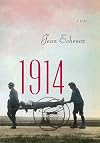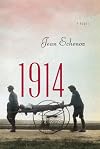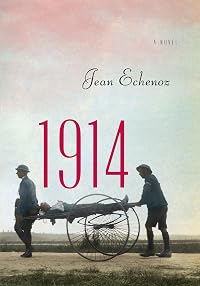
1914
by Jean Echenoz
On This Page
Description
Five Frenchmen go off to war, two of them leaving behind a certain young woman who longs for their return. But the main character in 1914 is the Great War itself. Jean Echenoz, the multi–award–winning French literary magician whose work has been compared to Joseph Conrad and Lawrence Sterne, has brought that deathtrap back to life, leading us gently from a balmy summer day deep into the insatiable—and still unthinkable—carnage of trench warfare.With the delicacy of a miniaturist and show more with irony both witty and clear–eyed, the author offers us an intimate epic with the atmosphere of a classic movie: in the panorama of a clear blue sky, a biplane spirals suddenly into the ground; a tardy piece of shrapnel shears the top off a man's head as if it were a soft–boiled egg; we dawdle dreamily in a spring–scented clearing with a lonely shell–shocked soldier strolling innocently to a firing squad ready to shoot him for desertion.
But ultimately, the grace notes of humanity in 1914 rise above the terrors of war in this beautifully crafted tale that Echenoz tells with discretion, precision, and love.
. show less
Tags
Recommendations















Member Reviews
Fransızların Büyük Savaş dedikleri Birinci Dünya Savaşı’nı küçük bir romana sığdırmak kolay olmasa gerek. Ama iğne deliğinden Hindistan geçiren Echenoz var karşımızda. Dolayısıyla romanın tam bir Homeros destanına dönüşmesi işten bile değil. Öyle de olur, Anthime adlı roman kahramanı, türdeşlerinin bu tuhaf, müziksiz, bitmek bilmez savaş dansının tam ortasına düşer. Tek “kahramanlığı” sağ eline taktığı şövalye yüzüğüdür belki de. Bir şarapnel parçası sağ kolunu özenle kesip aldığında o da kalmaz geriye. Oysa kolunu hiç unutmayacaktır o. Zaman geçtikçe daha çok hisseder sağ kolunu, öyle ki avucunun içinin acıdığını söyleyip tedavi ettirmeye bile show more yeltenecektir. Anthime’in kahramanlığı hafızasındaki kaşıntıdır bir bakıma. İşte böyle, Anthime yavaşça epik bir kahramana, okur da efsanevi zamanlara ait bir destanın dinleyicisine dönüşecektir. show less
My first book by this author and he has a unique voice. It’s a very slim book about two young men and their experiences at the outbreak of WWI. Echenoz has done enormous research and, according to what I have since read, it is his “style” to make that very clear: extended, highly detailed lists as a way to show I’m not entirely sure what. Thus, for example, he spends pages describing—in detail—what went into a French soldier’s backpack at the beginning of the war. I found it off-putting though he’s clearly a gifted writer. I’ll look for other books by him because I feel that I need to read more to understand him.
This novella is a quick read that is beautifully and simply written but also dramatic and and deeply emotional.
Through just a handful of powerful interwoven stories, Jean Echenoz shows World War I, with ALL its horror and futility. In fact, the war truly becomes the main character. Be warned though that little is left to the imagination.
Powerful descriptions of random death, sudden disfiguring injuries, and despondent soldiers are captured using simple, sparse language. Echenoz even explores the intimate relationships between fighting Frenchmen in the trenches and all the different types of animals they encounter -- domesticated farm survivors, wild animals subjected to poison gas, and rats and lice.
In this one short narrative, show more you'll also find a vivid portrait of how the war impacted those left behind -- from pregnant girlfriends to profiteering businesses, from mutineering soldiers to empty streets. It's really quite an accomplishment. show less
Through just a handful of powerful interwoven stories, Jean Echenoz shows World War I, with ALL its horror and futility. In fact, the war truly becomes the main character. Be warned though that little is left to the imagination.
Powerful descriptions of random death, sudden disfiguring injuries, and despondent soldiers are captured using simple, sparse language. Echenoz even explores the intimate relationships between fighting Frenchmen in the trenches and all the different types of animals they encounter -- domesticated farm survivors, wild animals subjected to poison gas, and rats and lice.
In this one short narrative, show more you'll also find a vivid portrait of how the war impacted those left behind -- from pregnant girlfriends to profiteering businesses, from mutineering soldiers to empty streets. It's really quite an accomplishment. show less
This novella is a quick read that is beautifully and simply written but also dramatic and and deeply emotional.
Through just a handful of powerful interwoven stories, Jean Echenoz shows World War I, with ALL its horror and futility. In fact, the war truly becomes the main character. Be warned though that little is left to the imagination.
Powerful descriptions of random death, sudden disfiguring injuries, and despondent soldiers are captured using simple, sparse language. Echenoz even explores the intimate relationships between fighting Frenchmen in the trenches and all the different types of animals they encounter -- domesticated farm survivors, wild animals subjected to poison gas, and rats and lice.
In this one short narrative, show more you'll also find a vivid portrait of how the war impacted those left behind -- from pregnant girlfriends to profiteering businesses, from mutineering soldiers to empty streets. It's really quite an accomplishment. show less
Through just a handful of powerful interwoven stories, Jean Echenoz shows World War I, with ALL its horror and futility. In fact, the war truly becomes the main character. Be warned though that little is left to the imagination.
Powerful descriptions of random death, sudden disfiguring injuries, and despondent soldiers are captured using simple, sparse language. Echenoz even explores the intimate relationships between fighting Frenchmen in the trenches and all the different types of animals they encounter -- domesticated farm survivors, wild animals subjected to poison gas, and rats and lice.
In this one short narrative, show more you'll also find a vivid portrait of how the war impacted those left behind -- from pregnant girlfriends to profiteering businesses, from mutineering soldiers to empty streets. It's really quite an accomplishment. show less
The latest novel by Echenoz opens in the Vendée region of France, as a lazy and quiet Saturday afternoon in August 1914 is interrupted by the insistent pealing of church bells throughout the region, which signals a call for mobilization for the impending war against Germany. The novel focuses on five ordinary men in one village, and a young woman who loves one man and is fond of another. The men and their commanding officers are convinced that the combat will last no longer than a few weeks, and that all will return home safely. However, as weeks turn into months and months into years, and as the soldiers see their companions felled in action, they are transformed into dispirited men who rely on alcohol to dull their senses. Echenoz show more writes poignantly about their seemingly hopeless circumstances:
Well, you don't get out of this war like that. It's simple: you're trapped. The enemy is in front of you, the rats and lice are with you, and behind you are the gendarmes. Since the only solution is to become an invalid, you're reduced to waiting for that “good wound”, the one you wind up longing for, your guaranteed ticket home, but there's a problem: it doesn't depend on you. So that wonder-working wound, some men tried to acquire it on their own without attracting too much attention by shooting themselves in the hand, for example, but they usually failed and were confronted with their misdeed, tried, and shot for treason. Mowed down by your own side rather than asphyxiated, burned to a crisp, or shredded by gas, flamethrowers, or shells—that could be a choice. But there was also blowing your own head off, with a toe on the trigger and the rifle barrel in your mouth, a way of getting out like any other—that could be a choice too.
The lives of the five men are all irrevocably altered by the war, in different ways. However, Echenoz shows us that the trauma of war is not limited to those who have experienced combat, or have had their homes or livelihoods taken away from them. Many seem to lose their basic sense of humanity by taking advantage of their countrymen in battle, overcharging them for food or drink as they march through villages, or supplying them with overpriced, shoddily made equipment.
1914 is a quiet and elegantly written novella about the effects of The Great War on a group of ordinary men and citizens of a small French town, whose power comes not from grisly descriptions of combat, but in the benumbed despair that afflicts everyone in its midst. The book is greatly enhanced by notes from the book's translator, Linda Coverdale. Although this book doesn't match my favorite ones by Echenoz, it was still a very enjoyable read. show less
Well, you don't get out of this war like that. It's simple: you're trapped. The enemy is in front of you, the rats and lice are with you, and behind you are the gendarmes. Since the only solution is to become an invalid, you're reduced to waiting for that “good wound”, the one you wind up longing for, your guaranteed ticket home, but there's a problem: it doesn't depend on you. So that wonder-working wound, some men tried to acquire it on their own without attracting too much attention by shooting themselves in the hand, for example, but they usually failed and were confronted with their misdeed, tried, and shot for treason. Mowed down by your own side rather than asphyxiated, burned to a crisp, or shredded by gas, flamethrowers, or shells—that could be a choice. But there was also blowing your own head off, with a toe on the trigger and the rifle barrel in your mouth, a way of getting out like any other—that could be a choice too.
The lives of the five men are all irrevocably altered by the war, in different ways. However, Echenoz shows us that the trauma of war is not limited to those who have experienced combat, or have had their homes or livelihoods taken away from them. Many seem to lose their basic sense of humanity by taking advantage of their countrymen in battle, overcharging them for food or drink as they march through villages, or supplying them with overpriced, shoddily made equipment.
1914 is a quiet and elegantly written novella about the effects of The Great War on a group of ordinary men and citizens of a small French town, whose power comes not from grisly descriptions of combat, but in the benumbed despair that afflicts everyone in its midst. The book is greatly enhanced by notes from the book's translator, Linda Coverdale. Although this book doesn't match my favorite ones by Echenoz, it was still a very enjoyable read. show less
Award-winning author Jean Echenoz's novel, 1914, was first published in French two years ago with an even shorter title, just 14. It seems appropriate that this able English translation by Linda Coverdale, just published this year, marks the 100th anniversary of that infamous year that marked the beginning of the Great War, also called "the war to end war." No such luck, of course. Here we are a hundred years hence and wars raging all over the globe. It seems man never learns anything from past mistakes.
It also seems more than coincidence that, while reading 1914, I happened to catch on late night TV, COMING HOME, the 1978 film about the Vietnam War, a movie about the lingering physical, psychological and emotional effects of that war, show more and how it destroyed lives and wrecked marriages and families.
Although the wars of Hal Ashby's Oscar-winning film and Echenoz's heartbreakingly brief novel were separated by fifty years or more, the two works both managed to convey the utter senselessness of war and its random destruction of innocent lives. 1914 gives us the story of a small group of French soldiers - four friends and the aloof brother of one of them - and one girl that was left behind, 'in trouble.'
1914 is, I think, the first novel of the Great War that I've read that is written from the French point of view, and with French soldiers as the unwilling 'heroes'. These men are poorly trained and kept mostly ignorant, and the omniscient narrator (who often displays a dark gallows sense of humor) notes that soon after the war began, the high command was careful to supply plenty of wine to the troops, "increasingly convinced that inebriating its soldiers helped bolster their courage and, above all, reduce their awareness of their condition." A condition characterized by filth, rats, lice and all manner of unpleasantness that was part of trench warfare.
All of the soldiers eventually began to hope for "the good wound," the one that wouldn't kill you but would invalid you back home. The protagonist, Anthime, got one of these, losing his right arm to shrapnel. And even at that, he is perhaps the luckiest of all the characters here.
The Ardennes, the Somme. These infamous battles of the war are mentioned only briefly, but the four friends were there. They 'adapted' or they died.
The story seems especially significant that, in the opening scene of the book, Anthime, a shoe factory accountant, is bicycling blissfully into the spring countryside on a Saturday to picnic and read - a fat Victor Hugo book, NINETY-THREE, a novel about the French Revolution. Like Echenoz's book, a title with only a number, a year in a war. Interrupted by tolling bells of mobilization, he never does read that book. And yet, despite the unremitting and random horror of the war depicted here, the closing lines of the book suggest at least the possibility of new beginnings. Probably not a "happily-ever-after" kind of thing, but the tiniest suggestion that maybe something good can still be rescued from the wreckage.
1914 will, I am sure, take its rightful place in the ever-growing pantheon of anti-war books. With its short choppy chapters, by turn humorous and horrific, 1914 packs a powerful emotional punch, one that will resonate with thoughtful readers for a long time. Highly recommended. show less
It also seems more than coincidence that, while reading 1914, I happened to catch on late night TV, COMING HOME, the 1978 film about the Vietnam War, a movie about the lingering physical, psychological and emotional effects of that war, show more and how it destroyed lives and wrecked marriages and families.
Although the wars of Hal Ashby's Oscar-winning film and Echenoz's heartbreakingly brief novel were separated by fifty years or more, the two works both managed to convey the utter senselessness of war and its random destruction of innocent lives. 1914 gives us the story of a small group of French soldiers - four friends and the aloof brother of one of them - and one girl that was left behind, 'in trouble.'
1914 is, I think, the first novel of the Great War that I've read that is written from the French point of view, and with French soldiers as the unwilling 'heroes'. These men are poorly trained and kept mostly ignorant, and the omniscient narrator (who often displays a dark gallows sense of humor) notes that soon after the war began, the high command was careful to supply plenty of wine to the troops, "increasingly convinced that inebriating its soldiers helped bolster their courage and, above all, reduce their awareness of their condition." A condition characterized by filth, rats, lice and all manner of unpleasantness that was part of trench warfare.
All of the soldiers eventually began to hope for "the good wound," the one that wouldn't kill you but would invalid you back home. The protagonist, Anthime, got one of these, losing his right arm to shrapnel. And even at that, he is perhaps the luckiest of all the characters here.
The Ardennes, the Somme. These infamous battles of the war are mentioned only briefly, but the four friends were there. They 'adapted' or they died.
The story seems especially significant that, in the opening scene of the book, Anthime, a shoe factory accountant, is bicycling blissfully into the spring countryside on a Saturday to picnic and read - a fat Victor Hugo book, NINETY-THREE, a novel about the French Revolution. Like Echenoz's book, a title with only a number, a year in a war. Interrupted by tolling bells of mobilization, he never does read that book. And yet, despite the unremitting and random horror of the war depicted here, the closing lines of the book suggest at least the possibility of new beginnings. Probably not a "happily-ever-after" kind of thing, but the tiniest suggestion that maybe something good can still be rescued from the wreckage.
1914 will, I am sure, take its rightful place in the ever-growing pantheon of anti-war books. With its short choppy chapters, by turn humorous and horrific, 1914 packs a powerful emotional punch, one that will resonate with thoughtful readers for a long time. Highly recommended. show less
A quiet, haunting, elegantly written novella that despite its brevity captures the optimism, horror, boredom, despair, absurdity, and consequences of war. Echenoz does not linger on any one aspect too long, yet the reader feels deeply the effects of each and every aspect. In a few succinct scenes, Echenoz paints vivid pictures of home, of the trenches and bombardment, of the early days of the aerial war, of mud and cold, of rigid bureaucracy, of greedy suppliers, of survivors. One quote in particular lingers in my memory--
Well, you don't get out of this war like that [by walking away]. It's simple: you're trapped. The enemy is in front of you, the rats and lice are with you, and behind you are the gendarmes. Since the only solution is show more to become an invalid, you're reduced to waiting for that "good wound," the one you wind up longing for, your guaranteed ticket home, but there's the problem: it doesn't depend on you. So that wonder-working wound, some men tried to acquire it on their own without attracting too much attention, by shooting themselves in the hand, for example, but they usually failed and were confronted with their misdeed, tried, and shot for treason. Mowed down by your own side rather than asphyxiated, burned to a crisp, or shredded by gas, flamethrowers, or shells--that could be a choice. But there was also blowing your own head off, with a toe on the trigger and the rifle barrel in you mouth, a way of getting out like any other--that could be a choice too. show less
Well, you don't get out of this war like that [by walking away]. It's simple: you're trapped. The enemy is in front of you, the rats and lice are with you, and behind you are the gendarmes. Since the only solution is show more to become an invalid, you're reduced to waiting for that "good wound," the one you wind up longing for, your guaranteed ticket home, but there's the problem: it doesn't depend on you. So that wonder-working wound, some men tried to acquire it on their own without attracting too much attention, by shooting themselves in the hand, for example, but they usually failed and were confronted with their misdeed, tried, and shot for treason. Mowed down by your own side rather than asphyxiated, burned to a crisp, or shredded by gas, flamethrowers, or shells--that could be a choice. But there was also blowing your own head off, with a toe on the trigger and the rifle barrel in you mouth, a way of getting out like any other--that could be a choice too. show less
Members
- Recently Added By
Lists

Best of French Literature
138 works; 27 members

Top Five Books of 2015
811 works; 241 members

Dublin Literary Award Longlist 2016
148 works; 4 members

Books Read in 2019
4,052 works; 110 members

THE WAR ROOM
813 works; 24 members
Author Information

38+ Works 3,374 Members
Some Editions
Awards and Honors
Distinctions
Notable Lists
Series
Belongs to Publisher Series
BvT (1019)
Common Knowledge
- Canonical title
- 1914
- Original title
- 14
- Original publication date
- 2012
- People/Characters*
- Anthime Sèze; Charles Sèze; Blanche Borne; Arcenel; Padioleau; Bossis
- Important events
- World War I (1914 | 1918)
- First words
- Since the weather was so inviting and it was Saturday, a half day, which allowed him to leave work early, Anthime set out on his bicycle after lunch.
- Last words
- (Click to show. Warning: May contain spoilers.)And the following autumn, during the very battle at Mons that turned out to be the last one, a male infant was born who was given the name Charles.
- Original language
- French
*Some information comes from Common Knowledge in other languages. Click "Edit" for more information.
Classifications
- Genres
- Fiction and Literature, General Fiction, Historical Fiction
- DDC/MDS
- 843.914 — Literature & rhetoric French Literature French fiction 1900- 20th Century 1945-1999
- LCC
- PQ2665 .C5 .A61413 — Language and Literature French, Italian, Spanish and Portuguese literatures French literature Modern literature 1961-2000
- BISAC
Statistics
- Members
- 411
- Popularity
- 75,643
- Reviews
- 26
- Rating
- (3.67)
- Languages
- 11 — Basque, Catalan, Dutch, English, French, German, Greek, Italian, Portuguese, Spanish, Turkish
- Media
- Paper, Audiobook, Ebook
- ISBNs
- 31
- ASINs
- 9