This topic is currently marked as "dormant"—the last message is more than 90 days old. You can revive it by posting a reply.
1markon
Although I've lurked here a lot, this is my first year posting in Global Reads. I'm Ardene and live in Georgia, USA. I plan to participate in an online reading group that is focusing on Iran the first few months of this year. I'm committing myself to read 2 books, but want to list others that have been suggested by various people in case I have time for more.
The two I am committing myself to read are
Shahnameh by Abolqasem Ferdowsi (Penguin edition translated by Dick Davis. An abridged version of the epic poem about Persia prior to the 7th century.
A Persian Requiem by Simin Daneshvar (published in Iran as Savushun).
Others include
Fiction
House of the mosque by Kader Abdolah
Censoring: an Iranian love story by Shahriar Mandanipour
Equal of the sun & Blood of Flowers by Anita Amirrezvani
My Uncle Napoleon by Iraj Pezeshkzad
The blind owl by Sadiq Hidayat
Rooftops of Tehran by Mahbod Seraji
The bathhouse by Farnoosh Moshiri
Missing Soluch by Mahmoud Dowlatabadi
Children of the Jacaranda Tree by Sahar Delijani
Non Fiction
Iran Awakening: From Prison to Peace Prize: One Woman's Struggle at the Crossroads of History by Shirin Ebadi.
Honeymoon in Tehran: Two Years of Love and Danger in Iran & Lipstick Jihad by Azadeh Moaveni.
The Complete Persepolis by Marjane Satrapi
Prisoner of Tehran: A Memoir by Marina Nemat
The two I am committing myself to read are
Shahnameh by Abolqasem Ferdowsi (Penguin edition translated by Dick Davis. An abridged version of the epic poem about Persia prior to the 7th century.
A Persian Requiem by Simin Daneshvar (published in Iran as Savushun).
Others include
Fiction
House of the mosque by Kader Abdolah
Censoring: an Iranian love story by Shahriar Mandanipour
Equal of the sun & Blood of Flowers by Anita Amirrezvani
My Uncle Napoleon by Iraj Pezeshkzad
The blind owl by Sadiq Hidayat
Rooftops of Tehran by Mahbod Seraji
The bathhouse by Farnoosh Moshiri
Missing Soluch by Mahmoud Dowlatabadi
Children of the Jacaranda Tree by Sahar Delijani
Non Fiction
Iran Awakening: From Prison to Peace Prize: One Woman's Struggle at the Crossroads of History by Shirin Ebadi.
Honeymoon in Tehran: Two Years of Love and Danger in Iran & Lipstick Jihad by Azadeh Moaveni.
The Complete Persepolis by Marjane Satrapi
Prisoner of Tehran: A Memoir by Marina Nemat
2Trifolia
Hi Ardene, Lisa (labfs) mentioned your thread as I just finished House of the mosque by Kader Abdolah. I loved it.
Do you plan to read books from other countries as well?
Do you plan to read books from other countries as well?
3markon
#2: Hi Monica, yes I do. I am following a group on Goodreads that reads Middle Eastern & North African literature (MENA). This year we are reading on Iran, Iraq & Turkey. I'm not necessarily limiting myself to these areas, but that's my focus for reading outside the US this year. Anything else will be serendipitous.
I'm glad to hear you liked House of the mosque. I hope to get to it later.
BTW, my 75 thread for 2014 is here.
I'm glad to hear you liked House of the mosque. I hope to get to it later.
BTW, my 75 thread for 2014 is here.
4markon

The hired man by Aminatta Forna
What happens after a civil war, when those who were neighbors before the hostilities attempt to live together again? In the Croatian village of Gost, apparently, the solution is not to talk about it. Duro, the only member of his family still living in Gost, befriends an English family that has bought a house in the country near him.
This gives Duro gainful employment, something he needs, but it also stirs up memories of his childhood and adolescence, of his exile from Gost and things that happened after his return. The renovation of the house and the appearance of the English woman Laura also stir up memories and emotions of others in Gost.
This is a beautiful and haunting novel of the conflicts that simmer underground in any community, but especially in one which has seen them erupt in violence.
Location: Unnamed Balkan country
5markon

Prince among slaves: the true story of an African prince sold into slavery in the American south by Terry Alford
Copyright/Year of original publication: 1977,
my copy 2007
Publisher: originally Harcourt Brace Jovanovich, Inc. (now Houghton Mifflin Harcourt), reissued by Oxford University Press in 2007
Date finished: Jan. 2013
Source: public library
Genre: biograhpy
Read for Muslim Journeys, American stories discussion at my local library
Rating:

Note: Although this is a biography of a man who spent most of his live in the US, I'm placing a review here since al Rahman was born, raised, and educated in West Africa (in the country's we now know as Guinea & Mali.)
Prince among slaves provides not only an outline of Abd al Rahman Ibrahima's life, but a glimpse of the local politics of the late eighteenth century in the area we now know as Guineau, into slavery as practiced in Mississippi in the late 18th-early 19th century, and into the stumbling blocks to repatriating an African to his homeland.
Ibrahima, the son of a Fulani ruler, is educated at Timbuktu. At age 26 while returning from battle he is captured and sold into slavery, ending up in Natchez, Mississippi on the plantation of Thomas Foster. He rises to act as overseer for Foster, is married to another slave, Isabella, and they raise 9 children.
After about 30 years in slavery, a repatriation effort full of errors in communication eventually results in Ibrahima and Isabella being sent to Liberia.
This is more and less than a biography. I say it's less because there isn't as much documentation of what Ibrahima thought (and said) as I'm used to seeing in a biography. (Of course, that's because he didn't write English, and not many people valued his words enough to record and keep them.)
It's more than a biography in that it focuses more on the context in which Ibrahima lived because that is more easily documented, and on how and why he was eventually released from slavery, yet how who he was and where he was from weren't understood by the people who helped him.
I also enjoyed the foreward ("Why") that told of how Alford ran across a document related to Ibrahima's life as a graduate student and the years of research and writing that went into the book, as well as the afterword discussing the (non) reception of the book by the academic community.
We had a very interesting discussion last night at the Muslim Journeys gathering. I was glad that even though there were 20-30 people present, everybody who wanted to got to say something.
6markon
Choices, choices! It's time for my MiddleEasternNorthAfrican reading group to choose a fiction read from Iraq. Here are the books that have been nominated so far.
Tobacco Keeper by Ali Bader
Absent & Sky so close by Betool Khedairi
Long way back by Fuad al-Takarli
East winds, west winds by Mahdi Issa al-Saqr
World through the eyes of angels & Saddam City by Mahmoud Saeed
American granddaughter by Inaam Kachachi
Naphtalene (Mothballs in the UK) is not on our list since the group read it last year.
I'm having trouble making up my mind who to vote for.
ETA: Long way back wins the first round, and When Baghdad ruled the Muslim World is the non fiction pick. I've just ordered Long way back and East winds, west winds.
Tobacco Keeper by Ali Bader
Absent & Sky so close by Betool Khedairi
Long way back by Fuad al-Takarli
East winds, west winds by Mahdi Issa al-Saqr
World through the eyes of angels & Saddam City by Mahmoud Saeed
American granddaughter by Inaam Kachachi
Naphtalene (Mothballs in the UK) is not on our list since the group read it last year.
I'm having trouble making up my mind who to vote for.
ETA: Long way back wins the first round, and When Baghdad ruled the Muslim World is the non fiction pick. I've just ordered Long way back and East winds, west winds.
7markon

A Persian Requiem by Simin Daneshvar
Copyright: Translation ©1991, original ©1969 Savushun
Publisher: Translation published by George Braziller, Inc.
Genre: fiction (translated from Farsi)

I found A Persian Requiem a fascinating glimpse of life in occupied Iran during World War II. Told primarily from the view of Zari, it tells the story of what occurs when her husband, Yusef, continues his resistance to selling his crops to the British army for the third year in a row, trying to keep back enough for the peasants who work the land to eat. Yusef’s brother, Abol-Ghassem Kahn, takes a more pragmatic view, hoping that in cooperating with the British he may earn a place in the governing classes (and a chance to increase his wealth), while protecting his family at the same time. The situation is further complicated by the request two friends of Yusef from a nomadic tribe make for him to sell them food for their people.
In my reading, Zari understands and agrees with her husband’s argument that Persia should be governed by Persians, but I think she has a clearer sight than Yusef of the consequences of not cooperating. She yearns for the safety of her household over and above what might be morally/ethically “right,” as might many of us in a situation where choosing a larger good may inflict suffering in the immediate future on those close to us.
The story has added depth for those who have some familiarity with the story of Seyavash/Siyavash in Ferdowsi’s epic poem, the Shanameh, and I’m sure this contributed to its being a bestseller in Iran. I did find that many of the secondary characters in the story seemed rather one-sided. However, the family – Zari, her husband, brother-in-law & sister-in law and her son Khosrow - and the conflicts Zari finds herself facing were depicted well.
Information about the author gleaned from Wikepdia and online obituaries:
Simin Daneshvar was born in 1921 in Shiraz, and was educated at a bilingual school. She started college at the University of Tehran in 1938 and was in college during the occupation of Iran by the Allied forces during World War II, which is when her novel Suvashan/Persian Requiem is set. In 1941 her father died, and she began supporting herself by writing & translating for Radio Tehran and local newspapers. In 1948 her first collection of short stories was published. She completed her PhD in 1949, and in 1950 married another Iranian writer, Jalal Al-e Ahmad. In 1952 she went to Stanford University in the USA on a Fullbright scholarship and studied with author Wallace Stegner. When she returned to Iran she joined the faculty of the University of Tehran.
In 1968 Daneshvr became the chair of the Iranian writers union. Her novel Suvashan was published in 1969, the same year her husband died. It is the first novel by a woman published in Iran. Suvashan refers to an ancient mourning ritual. In addition to teaching and writing, Daneshvar also translated works from English. She resigned from the University of Tehran in 1979. She died in 2012.
Location: Iran
8markon

Dust by Yvonne Adhiambo Owuor
©2014
Publisher: Alfred A. Knopf > Random House LLC > Bertelsmann AG
Genre: fiction
Source: public library

Dust is a symphony of memories, love, and grief. I savored the reading, the language, the story – and I also had to read slowly lest I be be overwhelmed.
Ostensibly the story is of a family and what happens when Odidi, the adult son, is shot. Dust is also the story of the hopes, dreams, achievements and disappointments of Odidi and Ajany, their parents Nyipir and Akai, of Galgalu, of Isaiah’s search, of a wandering trader, and of two policemen, Petrus and Ali Dida Hada. It is also the story of Kenya.
I knew this one would be a good read when I read the prologue, and, in spite of knowing what happens from the dust jacket, was pulled in immediately and kept reading, reading and hoping for a different result. And in spite of Odidi’s death, found the prologue beautiful.
The book is stunning, dense, and complex. And I’m going to leave it at that. Perhaps after I familiarize myself more with Kenya’s history and reread the book I could provide a more thorough analysis, but I don’t want to do that right now. This is a wonderful book. Read it!
Location: Kenya
10markon

The Long Way Back by Faud al-Takarli
Copyright:1980
Translation ©2001, Catherine Cobham
Paperback edition published 2007
Publisher: American University in Cairo Press
Date finished: July 12, 2014
Source: Purchased
Genre: fiction
Rating:
Puzzlement remains the word I’d use to describe my reaction to this slice of life novel. The writing is meditative – I give it four stars. Plot is non-existent; told from multiple points of view, this is the interior story of individuals in an extended family living in Baghdad in the early 1960s. I made a family tree to organize the characters (each generation of women has similar names). None of them are happy, unless Midhat is at the beginning of the story. Although external events intersect with their lives, the novel focuses on the internal thoughts, feelings, and struggles of each character.
I came away most focused on the story of Munria, wondering what would happen to her next. And my impression was that I knew the women much better than the men, although more page space is devoted to the brothers Midhat and Karumi.
The author was a lawyer & a judge who wrote “on the side.” In an interview published in 2007 in Al Jadid, Takarli refers to this novel as “The faraway man.” Neither that nor “the long way back” strike me as especially fitting titles, but I’m not sure what I would call it either.
I read this for an online book group. I enjoyed it, but it's not going to be a favorite read this year.
11markon

Suki Kim's memoir Without you there is no us covers her time teaching for two terms at a school in North Korea in 2011.
When I finished reading, my first reaction was that it was a fascinating and boring read at the same time. Fascinating because it gives a glimpse of life at a school for adolescent son's of North Korea's governing and business elite, and boring because while it depicts actions and conversations, it doesn't deeply probe motivations and attitudes of the students - it can't because neither Kim nor her students can talk openly and honestly.
A second look reveals a deep generational longing, a feeling of separation, and wish for reunification of Koreans as a people, at least on the author's part.
Suki Kim applied to teach at PUSH, a school run by evangelical Christians from the US, though Christianity is clearly not her faith. Born and raised in Seoul until age 13, Kim must hide her writing from her co-workers, her students, and the guards and minders at the school. Cut off from communicating openly with her family and friends (her email is monitored), and not identifying with the goals of the institution she is working for, the author identifies with her students instead.
On page 1 Kim describes the experience this way:
Thirty missionaries disguised as teachers and 270 male North Korean students and me, the sole writer disguised as a missionary disguised as a teacher. Locked in that prison disguised as a campus in an empty Pyongyang suburb, heavily guarded around the clock, all we had was each other.
I think Suki Kim's position in the school reflects her students' (and by implication North Koreans') position, not only in relation to their government, but to the rest of the world. Her students cannot see the rest of world clearly, but neither can we see North Koreans clearly.
I enjoyed the book, and it definitely deserves a close reading.

Publisher: Crown > Random House > Bertelsmann AG
(Read as part of Early Reviewer program)
12markon
Well, it's the end of 2014 & I have one book from Iraq I want to finish, and am starting to think about books for 2015 with MENA from Goodreads. In 2015 we will be focusing on Egypt for the first 6 months, then the horn of Africa (Sudan, Somalia, Eritrea, Ethiopia) July-September & Pakistan & Afghanistan towards the end of the year.
We're starting the year with Harafish by Naguib Mahfouz; I am interested in recommendations any of you may have for any of these countries.
And here are a few I came up with for Pakistan & Afghanistan when I was looking at what to recommend my library purchase from the DSC Prize for South Asian literature.
Nadeem Aslam: The Blind Man’s Garden‡
Uzma Aslam Khan: Thinner Than Skin & Trespassing‡
Bilal Tanweer: The scatter here is too great
A Golden Age†‡ & The Good Muslim†‡ by Tahmima Anan (really set in Bangladesh, about the civil war between East & West Pakistan where Bangladesh becomes independent)
Others -
The Wandering Falcon‡ by Jamil Ahmad
In other rooms, other wonders†‡ short stories by Daniyal Mueenuddin
A case of exploding mangoes‡ by Mohammed Hanif
Sadkia's way by Hina Haq
The Swallows of Kabul‡ by Yasmina Khadra
novels of partition
Ice-Candy man (Cracking India) by Bapsi Sidhwa
Train to Pakistan by Khushwant Singh
also check out this page on Good Reads
non fiction
Children of Dust†‡ by Ali Eteraz
Bed of red flowers†‡ by Nelofer Pazira
† I have already read
‡ Owned by the public library I use
We're starting the year with Harafish by Naguib Mahfouz; I am interested in recommendations any of you may have for any of these countries.
And here are a few I came up with for Pakistan & Afghanistan when I was looking at what to recommend my library purchase from the DSC Prize for South Asian literature.
Nadeem Aslam: The Blind Man’s Garden‡
Uzma Aslam Khan: Thinner Than Skin & Trespassing‡
Bilal Tanweer: The scatter here is too great
A Golden Age†‡ & The Good Muslim†‡ by Tahmima Anan (really set in Bangladesh, about the civil war between East & West Pakistan where Bangladesh becomes independent)
Others -
The Wandering Falcon‡ by Jamil Ahmad
In other rooms, other wonders†‡ short stories by Daniyal Mueenuddin
A case of exploding mangoes‡ by Mohammed Hanif
Sadkia's way by Hina Haq
The Swallows of Kabul‡ by Yasmina Khadra
novels of partition
Ice-Candy man (Cracking India) by Bapsi Sidhwa
Train to Pakistan by Khushwant Singh
also check out this page on Good Reads
non fiction
Children of Dust†‡ by Ali Eteraz
Bed of red flowers†‡ by Nelofer Pazira
† I have already read
‡ Owned by the public library I use
13markon
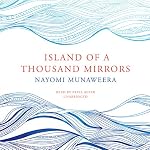
Island of a thousand mirrors by Nayomi Munaweera ***1/2?
First novel by a woman from Sri Lanka about the civil war between people of Tamil & Sinhala descent. Longlisted for the DSC South Asian Prize. (Lowland won). Audio on my new Kindle.
I liked this novel, but it's not perfect. Could feel and see the places described. But Yasodhara's story and family felt much more real and complex to me than Saraswathi's. I never felt inside Sarawathi's heart, the way I did Yasodhara's. While many (most?) reviewers might see this as a story of Yasodhara, her sister Lanka, & their friend Shiva, I want a character that has as much impact on the story as Sarawathi to carry as much emotional weight as well. I'll watch for another novel to see how this writer develops.
14markon
2015 Summary
Read a lot more comfort reads this year. Hope in 2016 I can pick this up a bit more.
The three-body problem by Cixin Lu
Gods of Tango by Carolina de Robertis
In the eye of the sun by Ahdaf Soueif
Land of love and drowning by Tiphanie Yanique
Read a lot more comfort reads this year. Hope in 2016 I can pick this up a bit more.
The three-body problem by Cixin Lu
Gods of Tango by Carolina de Robertis
In the eye of the sun by Ahdaf Soueif
Land of love and drowning by Tiphanie Yanique

