
This topic is currently marked as "dormant"—the last message is more than 90 days old. You can revive it by posting a reply.
1timspalding
Wired: Nasa validates 'impossible' space drive
http://www.wired.co.uk/news/archive/2014-07/31/nasa-validates-impossible-space-d...
The next cold fusion?
http://www.wired.co.uk/news/archive/2014-07/31/nasa-validates-impossible-space-d...
The next cold fusion?
2richardbsmith
Thanks for posting this Tim.
I have a long way to go in my understanding of Physics.
Maybe we can get some informed comments on this.
I have a long way to go in my understanding of Physics.
Maybe we can get some informed comments on this.
3dukedom_enough
We should note that this displays at least two of Robert L. Park's well-known seven warning signs of bad science, namely numbers 3 (extremely weak signal of the effect) and 7 (requires revision of known laws of nature). Also note that one of the discoverers, Robert Shawyer, is promoting his drive through his company. That puts him in the tradition of people with perpetual-motion machines to sell, IMO. Cool if true, but Tim's cold-fusion analogy is the likelier possibility.
4timspalding
It reminds me more of the perpetual motion guy. The cold fusion people were wrong, but they weren't trying to sell something.
I think I remember an article about the perpetual motion guy. It was in some popular science magazine 20 years ago, at least. Anyway, his argument was that his engine machine tapped into the rotational force of electrons going around a nucleus.
My question is: How did Nasa get in the business of validating these things?
I think I remember an article about the perpetual motion guy. It was in some popular science magazine 20 years ago, at least. Anyway, his argument was that his engine machine tapped into the rotational force of electrons going around a nucleus.
My question is: How did Nasa get in the business of validating these things?
5stretch
NASA is in the business of space flight. They test all kinds of seemingly wonky ideas even if they don't pan out. See Dean drives and experiments with antigravity in the 90's. JPL tests all kinds of engines and components that will never see the light of day. Experiments even with fringe technology can advance the goal of NASA, even it does nothing but disprove the concept.
This seems like it only add an except to the Newtonian Law not actually break it, like most of Quantum physics.
This seems like it only add an except to the Newtonian Law not actually break it, like most of Quantum physics.
6dukedom_enough
> 4
"...force of electrons going around a nucleus." This was the purported source of motive power for James Blish's "spindizzy", as featured in his Cities in Flight stories from the 1940s-1960s. Purely science fiction, and everyone reading those stories knew it, so it's interesting that a 1990s (?) perpetual-motion inventor would recycle the idea.
"...force of electrons going around a nucleus." This was the purported source of motive power for James Blish's "spindizzy", as featured in his Cities in Flight stories from the 1940s-1960s. Purely science fiction, and everyone reading those stories knew it, so it's interesting that a 1990s (?) perpetual-motion inventor would recycle the idea.
7DugsBooks
I thought about posting the same article when I read it. My immediate thought was that someone should concoct a "working model" from the lab bench and set it loose at the ISS space station. Maybe the results would be a little more perceptible.
Has anyone crunched the numbers and given an example of the amount of thrust available on a practical application I wonder? {I can't} Would the solar panels used to energize the system provide as much thrust by acting as a solar sail ?etc.....
Has anyone crunched the numbers and given an example of the amount of thrust available on a practical application I wonder? {I can't} Would the solar panels used to energize the system provide as much thrust by acting as a solar sail ?etc.....
8stellarexplorer
>4 timspalding: Actually some were trying to sell cold fusion not too long ago, namely Italian scientist Andrea Rossi:
http://phys.org/news/2011-01-italian-scientists-cold-fusion-video.html
http://phys.org/news/2011-01-italian-scientists-cold-fusion-video.html
9IreneF
". . . quantum vacuum plasma thruster." Whoo hoo. I can just see that one taking off into the kingdom of tin-foil hats.
10timspalding
Cold fusion would be so great.
11stellarexplorer
It would. I think we'll get to a renewable less toxic energy solution for the planet. But probably not before there are hundreds of millions of refugees from flooded low-lying areas, and major effects on food production, life on earth, and on the environment generally.
Which is meant to be a statement of some optimism.
Which is meant to be a statement of some optimism.
13pgmcc
>6 dukedom_enough:
"...force of electrons going around a nucleus." ...perpetual-motion inventor would recycle the idea.
He must have been a Spin Doctor.
I couldn't resist. I am weak that way. Even weaker than the thrust from the fantasy drive.
"...force of electrons going around a nucleus." ...perpetual-motion inventor would recycle the idea.
He must have been a Spin Doctor.
I couldn't resist. I am weak that way. Even weaker than the thrust from the fantasy drive.
14timspalding
What about artificial photosynthesis for hydrogen?
Oh dear, what's that?
Oh dear, what's that?
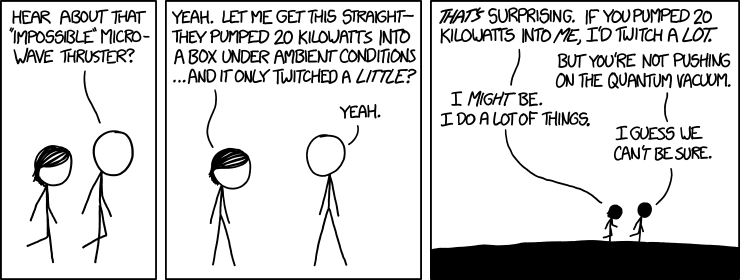
16MaureenRoy
Here's a 2016 NASA space drive experiment that appears to not need fuel. NASA is now ready to submit it for outside comment:
http://www.sciencealert.com/leaked-nasa-paper-shows-the-impossible-em-drive-real...
http://www.sciencealert.com/leaked-nasa-paper-shows-the-impossible-em-drive-real...
17stellarexplorer
Wow. Interesting. I will never believe it violates Newton's third law until definitively proven though.
18DugsBooks
>7 DugsBooks: Well, here's an update to >16 MaureenRoy: article that answers several of my questions, which means it should probably be subjected to severe scrutiny 🤔
http://www.dailygalaxy.com/my_weblog/2016/11/nasa-alert-confirms-startrek-em-dri...
An excerpt that repeats some info in >16 MaureenRoy:
"The NASA release is similar to the paper that was leaked online earlier this month and, most notably, shows that the drive does indeed produce 1.2 millinewtons per kilowatt of thrust in a vacuum:
To put that into perspective, the super-powerful Hall thruster, a type of ion thruster in which the propellant is accelerated by an electric field, generates force of 60 millinewtons per kilowatt, an order of magnitude more than the EM Drive. But the Hall thruster requires propellants, and that extra weight could offset the higher thrust, the team concludes. The Hall-effect thrusters trap electrons in a magnetic field and then use the electrons to ionize propellant, efficiently accelerate the ions to produce thrust, and neutralize the ions in the plume.
Light sails on the other hand, which are currently the most popular form of zero-propellant propulsion, only generate force up to 6.67 micronewtons per kilowatt – two orders of magnitude less than NASA's EM Drive, says the paper."
http://www.dailygalaxy.com/my_weblog/2016/11/nasa-alert-confirms-startrek-em-dri...
An excerpt that repeats some info in >16 MaureenRoy:
"The NASA release is similar to the paper that was leaked online earlier this month and, most notably, shows that the drive does indeed produce 1.2 millinewtons per kilowatt of thrust in a vacuum:
To put that into perspective, the super-powerful Hall thruster, a type of ion thruster in which the propellant is accelerated by an electric field, generates force of 60 millinewtons per kilowatt, an order of magnitude more than the EM Drive. But the Hall thruster requires propellants, and that extra weight could offset the higher thrust, the team concludes. The Hall-effect thrusters trap electrons in a magnetic field and then use the electrons to ionize propellant, efficiently accelerate the ions to produce thrust, and neutralize the ions in the plume.
Light sails on the other hand, which are currently the most popular form of zero-propellant propulsion, only generate force up to 6.67 micronewtons per kilowatt – two orders of magnitude less than NASA's EM Drive, says the paper."
19stellarexplorer
>18 DugsBooks: Yes, saw that. If it works, I have to believe someone will eventually figure out how it doesn't violate Newton's third law
Join to post
