Andrea's 2015 Challenge
Talk 2015 Category Challenge
Join LibraryThing to post.
This topic is currently marked as "dormant"—the last message is more than 90 days old. You can revive it by posting a reply.
1andreablythe
This year, I want to simplify things a bit and go with a much smaller step challenge with an ultimate goal of 55 books.
The Dreamer - Don Quixote (1/1) — FINISHED!
I always like to read at least one hefty classic a year, so this year it's Don Quixote by Miguel de Cervantes Saavedra.
Pulitzer Winners - Nonfiction (2/2) — FINISHED!
The list of past winners.
Pulitzer Winners - Fiction (3/3) — FINISHED!
The list of past winners.
James Tiptree Jr. Award Winners (4/4) — FINISHED!
The Tiptree Award is for books that explore aspects of gender, primarily in SciFi and Fantasy. The list of past winners.
Nebula and Hugo Awards for Novels (5/5) — FINISHED!
The list of winners that won both awards.
Newberry Medal Winners (6/6) — FINISHED!
The list of past winners.
Printz Award (YA) Winners (7/7) — FINISHED!
The list of past winners.
From 1001 Books to Read Before You Die (8/8)— FINISHED!
The Universe in Verse - Poetry (9/9) — FINISHED!
Miscellany (10/10) — FINISHED!
Total - (55/55) — FINISHED!
2andreablythe
1. Don Quixote by Miguel de Cervantes Saavedra (***1/2)
* * *
Pulitzer Winners - Nonfiction (2/2) - FINISHED!
1. Slavery by Another Name: The Re-Enslavement of Black Americans from the Civil War to World War II by Douglas A. Blackmon (****1/2) - 2009 Winner
2. Toms River: A Story of Science and Salvation by Dan Fagin (****) - 2014 Winner
* * *
Pulitzer Winners - Fiction (3/3) — FINISHED!
1. The Orphan Master's Son (audio book) by Adam Johnson (****) – 2013 Winner
2. Middlesex (audio book) by Jeffrey Eugenides (****) - 2003 Winner
3. The Hours by Michael Cunningham (****) - 1999 Winner
3andreablythe
1. Ancient, Ancient: Short Fiction by Kiini Ibura Salaam (****) – 2012 Winner
2. The Knife of Never Letting Go by Patrick Ness (****) - 2008 Winner
3. Baba Yaga Laid an Egg by Dubravka Ugresic (****) - 2010 Winner
4. Rupetta by N.A. Sulway (****) - 2013 Winner
.
4andreablythe
1. The Forever War by Joe Haldeman (****1/2) - 1976 Hugo/1975 Nebula
2. Red Mars by Kim Stanley Robinson (****) - Won the 1993 Nebula, nominated for the Hugo
3. Paladin of Souls (audio book) by Lois McMaster Bujold (*****) - 2004 Hugo and Nebula
4. Ancillary Justice by Ann Leckie (*****) - Won the 2014 Hugo and 2013 Nebula
5. Forever Peace by Joe Haldeman (****) - won the 1998 Hugo and Nebula
Possibilities:
2011 Hugo/2010 Nebula - Blackout/All Clear by Connie Willis
1993 Hugo/1992 Nebula - Doomsday Book by Connie Willis
1987 Hugo/1986 Nebula - Speaker for the Dead by Orson Scott Card
1984 Hugo/1983 Nebula - Startide Rising by David Brin
1979 Hugo/1978 Nebula - Dreamsnake by Vonda McIntyre
1978 Hugo/1977 Nebula - Gateway by Frederik Pohl
1974 Hugo/1973 Nebula - Rendezvous with Rama by Arthur C. Clarke
1973 Hugo/1972 Nebula - The Gods Themselves by Isaac Asimov
1971 Hugo/1970 Nebula - Ringworld by Larry Niven
Green Mars by Kim Stanley Robinson - Won the 1994 Hugo, nominated for the Nebula
Blue Mars by Kim Stanley Robinson - Won the 1997 Hugo, nominated for the Nebula
5andreablythe
1. Flora & Ulysses: The Illuminated Adventures by Kate DiCamillo (****) - 2014 Winner
2. A Year Down Yonder by Richard Peck (****) - 2001 Winner
3. Moon over Manifest by Clare Vanderpool (****1/2) - 2011 Winner
4. The Higher Power of Lucky by Susan Patron, illus. by Matt Phelan (***) - 2007 Winner
5. Crispin: The Cross of Lead by Avi (***)- 2003 Winner
6. A Single Shard by Linda Sue Park (****) - 2002 Winner
6andreablythe
1. The White Darkness (audio book) by Geraldine McCaughrean (****) - 2008 Winner
2. Midwinterblood by Marcus Sedgwick (****) - 2014 Winner
3. how i live now (audio book) by Meg Rosoff (***) - 2005 Winner
4. Monster, by Walter Dean Myers (***) - 2000 Winner
5. Ship Breaker (audio book) by Paolo Bacigalupi (****) - 2011 Winner
6. Kit's Wilderness, by David Almond (***) - 2001 Winner
7. Where Things Come Back by John Corey Whaley (***1/2) - 2012 Winner
Possiblities:
In Darkness by Nick Lake - 2013 Winner
2009 - Jellicoe Road by Melina Marchetta
2004 - The First Part Last, by Angela Johnson
2003 - Postcards from No Man's Land, by Aidan Chambers
2002 - A Step From Heaven, by An Na
7andreablythe
1. Smilla's Sense of Snow by Peter Høeg (***1/2)
2. Dirk Gently's Holistic Detective Agency by Douglas Adams (***1/2)
3. One Hundred Years of Solitude (audio book) by Gabriel Garcia Marquez (***1/2)
4. Breakfast at Tiffany's (audio book) by Truman Capote (****)
5. Atonement by Ian McEwan (***)
6. American Psycho by Bret Easton Ellis
7. Veronika Decides to Die by Paulo Coelho (**1/2)
8. The Reader by Bernhard Schlink (***)
8andreablythe
1. Blue by George Elliott Clarke (***1/2)
2. wingless, scorched & beautiful (chapbook) by Allie Marini Batts (****)
3. Everyone I Love is a Stranger to Someone: Poems by Annelyse Gelman (****)
5. Drink by Laura Madeline Wiseman (*****)
6. Highku: 4 & 20 Poems About Marijuana (chapbook) by Brennan 'B Deep' DeFrisco (***1/2)
7. House and Home (chapbook) by Jaz Sufi (*****)
8. Reflections by Jocelyn Deona De Leon (****)
9. The 2013 Rhysling Anthology, edited by by John C. Mannone
9andreablythe
1. A Study in Scarlet by Sir Arthur Conan Doyle (****)
2. Palimpsest by Catherynne M. Valente (****)
3. Links: A Collection of Short Stories by Kaylia M. Metcalfe (***)
4. Six-Gun Snow White by Catherynne M. Valente (****)
5. Under a Painted Sky by Stacey Lee (****1/2)
6. The Ask and the Answer by Patrick Ness (****)
7. Monsters of Men by Patrick Ness (****)
8. The Walls Around Us by Nova Ren Suma (*****)
9. Jonathan Strange and Mr. Norrel by Susanna Clarke (*****)
10. Her Smoke Rose Up Forever by James Tiptree Jr. (*****)
Possibilities:
TBD
10rabbitprincess
11LittleTaiko
13dudes22
14mamzel
I just finished a book by Scott Westerfeld in which the characters discuss YA heaven and say that Printz winners wear a tiara. That cracked me up.
Have a great reading year!
15andreablythe
I have never seen the Wishbone version. Is it a YouTube thing? I'll have to watch it after reading. :)
>11 LittleTaiko:
Thanks! I hope so, too.
>12 -Eva-:
Hi, Eva! Looking forward to talking books with you!
>13 dudes22:
Yeah, I had several awards categories last year and really liked working through the lists. It's interesting to see what's popular and honored in books, not all of them are favorites.
>14 mamzel:
Oooh, thanks for the heads up mamzel. I'll have to see what books I can grab.
16rabbitprincess
17DeltaQueen50
18LauraBrook
19andreablythe
OH! Now I know what Wishbone is. I never watched it but remember seeing it around back then.
>17 DeltaQueen50: and >18 LauraBrook:
Looking forward to hanging with you, too, as well next year — all of us dodging the book bullet cross fire. :D
20lkernagh
21cammykitty
22andreablythe
Thanks! Me, too!
>21 cammykitty:
Sweet! I'm starting off with Ancient, Ancient, which I'm just waiting for at the library.
I'm planning to do the same thing, start with the winners and work on the shortlist later.
24andreablythe
2015 Meme - Answers Based On Book I Read in 2014
Describe yourself:
Fangirl
Describe how you feel:
Practicing Disaster
Describe where you currently live:
The Happy Zombie Sunrise Home
If you could go anywhere, where would you go:
House of Leaves
Your favorite form of transportation:
Sleepwalk
Your best friend is:
The Drowning Girl
You and your friends are:
The Three Musketeers
What’s the weather like:
This One Summer
You fear:
Parasite
What is the best advice you have to give:
Who Fears Death
Thought for the day:
Steal Like An Artist
How I would like to die:
Poisoned Apples
My soul’s present condition:
Hourglass Museum
25DeltaQueen50
26electrice
27rabbitprincess
28andreablythe
Yes, indeed. It does seem that way. Lol.
>26 electrice:
Heh. Yeah, I'm definitely drawn to the creepy and strange. ;)
>27 rabbitprincess:
Thankee!
29andreablythe
Category: Miscellany
A Study in Scarlet is both Doctor Watson's and the world's first introduction to the frustrating, arrogant, and brilliant Sherlock Holmes. Watson in seeking a new flat to in which to live ends up paired with the consulting detective at 22B Baker Street. While at first Sherlock's profession and strange behavior is a mystery to the Doctor, he soon finds himself following Sherlock along in seeking out the truth behind the mysterious death of an American traveler. While I didn't like it as much as I enjoyed the tales in The Adventures of Sherlock Holmes, the novel is short and a quick read with a compelling mystery.
30andreablythe
Category: Miscellany
“Things that are unsightly: birthmarks, infidelity, strangers in one's kitchen. Too much sunlight. Stitches. Missing teeth. Overlong guests.”
Palimpsest is the story of a city that exists between dreaming and waking, full of living trains, mechanical bees, houses grown from trees, rivers made of coats, and other beautiful, ugly, wonderful, and dangerous imaginings. One of the most interesting aspects of the novel is that access to the city is achieved through sex, as four characters — a woman who loves trains, a man who loves locks and keys, a woman who tends bees, and a man longing for his lost wife — living in different parts of the world discover after chance encounters. As each one longs more desperately to reach the City of Palimpsest, they find they have to put them in increasingly compromising situations with a multitude of complications and consequences.
"Do not ask, he thinks, and tried to clench his throat around it. But the question is a lock and it seeks the key of her and he cannot stop himself, even though the taste of it is like the Volkhov, muddy and reedy and cold."
The language in Palimpsest is often beautiful, poetic, rich and thick as honey. It's perfect for the surreal other city of Palimpsest, though for the "real" world it can have feel of distancing, the focus more on the labyrinth of the words than on the characters. At the beginning, when we are just getting to know the characters, I think it creates a distancing effect, making them hard to relate to, their quirks feeling exotic and strange rather than relatable. So, I had a hard time with the novel at first, as it felt more like a complex poem that I couldn't quite penetrate.
“Every morning she pulled a delicate cup from its brass hook and filled it, hoping that it would be dark and deep and secret as a forest, and each morning it cooled too fast, had too much milk, stained the cup, made her nervous.”
After a certain point, though, when the threads of the characters' stories began to come together, twisting through the labyrinth of Palimpsest toward the conclusion, I began to really enjoy the novel. I varied between needing to compulsively read and needing to take a break to absorb one or another beautiful phrase. While the ending wasn't as satisfying as I would have liked, this was still a great journey and one I will reread in the future.
31andreablythe
Category: Miscellany
The story stories in Links look at the way humans long for connection in the world and often fail to achieve that connection through bad luck or personal flaws. Most of the stories are good with sparse, clean prose. Though there were two with endings so bleak, I hated them).
Since I like to focus on the positive, here are the four I liked most.
"Angel" was a surprising and powerful story about a young man who spends his free time time begging for change he doesn't need. The story shocked me the way brought to people together in a moment of collision.
In "Aside" an estranged mother and daughter try to find connection during a car ride is a simple tale, presenting lovely character sketches. Wonderfully bitter sweet.
"Surface Dweller" is about a woman who goes home with an art student to see her art and have a one night stand. But it turns out the art student keeps a frightening secret hidden in her bedroom. A subtly fantastical tale.
"Wife" is one of two speculative tales in the collection, presenting a women is trying to fit into her assigned role as new Wife despite past sorrows. Though, it's presents a bleak society with little to no freedom, the story manages to be subtly hopeful.
32thornton37814
33andreablythe
Thanks!
34luvamystery65
Love the set up of your thread. I look forward to some of your sci-fi selections because I really never know what to read but I am slowly coming around to that genre.
I read Smila's Sense of Snow last year and I absolutely loved it. I hope to read more by Peter Hoeg this year. I'm also going to try to fit in The Reader this year too.
35andreablythe
Yay! I've been found! – didn't know I was lost, lol.
I'm thrilled to know Smila is good. I love the movie, which to me is subtly scifi.
When you get around to reading The Reader, let me know and maybe we can do a buddy read. :)
36luvamystery65
When you get around to reading The Reader, let me know and maybe we can do a buddy read. That would be great.
37LauraBrook
38lkernagh
39andreablythe
Yes! First successful BB of the year!
>38 lkernagh:
This is the second that I've read by her (the first was Deathless). Her writing is just so lush.
I'm really curious now to read The Girl Who Circumnavigated Fairyland in a Ship of Her Own Making – first, because it's mentioned within Palimpsest and, second, because it's a middle grade/young adult book and I wonder how her style works in that case.
40andreablythe
I've also been reading a story every night out of Ancient, Ancient: Short Fiction, by Kiini Ibura Salaam — which is really interesting, but another slow read for me.
Another reason I've been slow reading is that I've started up on letterboxd.com, which lets me track, list, and talk about movies. Like all new shiny social networking things, I'm kind of obsessed right now. And it has me wanting to watch more movies lately. Though I'm sure that'll tone down eventually.
Best movie I've seen this month: Selma, directed by Ava DuVernay, who has put together an excellent biopic about the civil rights march from Selma, Alabama to the state capitol of Montgomery. The movie subtly fitting in many layers of history, including disagreements between different aspects of the civil rights movement (such as the SNCC) and the planning and focus required to steer events to a particular outcome. A really great movie that shows Martin Luther King Jr.'s humanity.
42andreablythe
I definitely recommend it.
43andreablythe
Category: James Tiptree Jr. Award Winners – 2012 Winner
In Ancient, Ancient, Kiini Ibura Salaam presents one of the most inventive and creative collection of science fiction and fantasy stories that I’ve read in a long time. I hardly even know how to describe some of these stories without giving everything away, the worlds and universes presented are so unique. Salaam’s writing often has a sensuality to it, which is quite lovely.
While I didn’t connect with all of the stories, here are the ones I loved.
"Pod Rendezvous" was my favorite story in the collection. Laki feels trapped by her fate of having to join a mother-unit and decides to throw a last hurrah party in the Velvet Stretch, while her sister Se-Se works feverishly to help Laki find an escape. It’s a smart and moving coming of age story in set a strange future (or maybe an alternate world altogether). I resonated quite a bit with both Laki and Se-Se.
“Desire" is the story of a woman named Sené who has an encounter with the god of desire, Faru. As with any encounter with the gods, it has wonderful and dangerous results. This is a poetically written and superbly sensual tale.
I also loved "Debris," in which a family skeletal beings take a visit to the earth during Día de Los Muertos celebrations. I can’t say more without giving the entire story away, so I’ll just say that I loved it.
The titular story, "Ancient, Ancient," is one of the shortest in the collection. It tells the story of an ancient being awakening through the body of a young woman. Though short, it is packed with layers of imagery in a rather poetic fashion, making it just as fulfilling as many a longer tale.
"Battle Royale" is the story of a young man who is punished by his grandfather for taking part in a semi-dangerous set of games involving dancing through a mock battle. The punishment involves the young man being forced to experience the lives and deaths of several people faced with subservience and slavery in history, each one stranger and more brutal than the last. This was so strange, powerful, moving, and I wanted so much more. I found myself both loving the story and being unsatisfied with the ending. All I can say is that I hope she continues the story elsewhere.
44andreablythe
January Progress
Books Finished:
1. A Study in Scarlet by Sir Arthur Conan Doyle (****)
2. Palimpsest by Catherynne M. Valente (****)
3. Links: A Collection of Short Stories by Kaylia M. Metcalfe (***)
4. Ancient, Ancient: Short Fiction by Kiini Ibura Salaam (****)
Total for the year: 4
Favorite Read:
Palimpsest was a complex and lyrical read.
Worst Read:
I did't love Links: A Collection of Short Stories, but I didn't hate it either.
Books Still in Progress at the End of the Month:
Slavery by Another Name: The Re-Enslavement of Black Americans from the Civil War to World War II by Douglas A. Blackmon. It's fascinating and fact heavy, which is why it's taking me so long to read.
Category Progress
1. The Dreamer - Don Quixote (0/1)
2. Pulitzer Winners - Nonfiction (0/2)
3. Pulitzer Winners - Fiction (0/3)
4. James Tiptree Jr. Award Winners (1/4)
5. Nebula and Hugo Awards for Novels (0/5)
6. Newberry Medal Winners (0/6)
7. Printz Award (YA) Winners (0/7)
8. From 1001 Books to Read Before You Die (0/8)
9. The Universe in Verse - Poetry (0/9)
10. Miscellany (3/10)
Total - (4/55)
45RidgewayGirl
46andreablythe
It's been very interesting so far. Not cheery, though, which I didn't really expect it to be., so...
47andreablythe
Category: Newberry Medal Winners - 2014 Winner
Looking out her window one day, Flora (a reader of superhero comics and self-professed cynic) witnesses an extraordinary event — an ordinary squirrel is sucked up into a rampaging vacuum and returns to life with amazing powers. Dubbing the squirrel Ulysses, Flora takes him home certain he will prove himself worthy of fighting evil and defending the defenseless.
This is an adorable little adventure story/family comedy. Flora and Ulysses are wonderful characters, especially Ulysses, the flying superhero squirrel, who writes poetry and is always hungry. The other characters are mostly one-dimensional, but it's in a quirky, fun sort of way, so I didn't particularly mind.
The most action packed sequences of the novel are presented in soft-toned comic book format, which sticks with the lighthearted comic book theme. I enjoyed these sequences for the most part, though it always took me a second to mentally transition from one form of storytelling to the other and back again.
A great book overall.
48andreablythe
49andreablythe
Category: Pulitzer Winners - Nonfiction - 2009 Winner
“Only by acknowledging the full extent of slavery's full grip on U.S. Society — its intimate connections to present day wealth and power, the depth of its injury to black Americans, the shocking nearness in time of its true end — can we reconcile the paradoxes of current American life.”
– Douglas A. Blackmon, Slavery by Another Name
When I was in high school, in regard to black history, I remember learning about the slavery and Civil War, and then jumping ahead to the civil rights movement, with only a brief mention of sharecropping. The impression left from these lessons was that although racism still abounded after Emancipation, African Americans in the South were at least free, able to farm and build a life for themselves.
It turns out this was mostly a myth.
Slavery by Another Name: The Re-Enslavement of Black Americans from the Civil War to World War II by Douglas A. Blackmon reveals through meticulous research how southern whites by-passed the Emancipation Proclamation and constitutional amendments to continue slavery in the form of convict forced labor. “In the first decades (after Emancipation), the intensity of southern whites' need to reestablish hegemony over blacks rivaled the most visceral patriotism of the wartime Confederacy,” writes Blackmon. So, they found their way around emancipation by criminalizing black life by writing laws targeted specifically at African Americans, one such law making it illegal for someone to leave their current employment without their employer’s permission.
"Whites realized that the combination of trumped-up legal charges and forced labor as punishment created both a desirable business proposition and an incredibly effective tool for intimidating rank-and-file emancipated African Americans and doing away with their most effective leaders," Blackmon notes. The forced labor of blacks was big business, refilling the coffers of southern governments that had been drained during the Civil War, as well lining the pockets of judges, sheriffs, justices of the peace, clerks, accusers, and the business owners who rented the young men, labeled “criminals,” from the county and state courthouses. The system became so efficient that a business man could have This combined with lynchings and other forms of intimidation provided a way for white southerners to crush what little autonomy African Americans acquired in the first decades after emancipation.
While a percentage of these black men (and some women) were sold to work in the cotton fields, a greater number of them were sent to work in the growing industrial complex of the south, including mining and metallurgy. The conditions were horrifying, with prisoners not only being beaten and tortured, but also working with little to no clothing and with little to no food. Disease ran rampant through the prisons, where the men were often chained together at night.
"The horror of the mortality rates and living conditions was underscored by the triviality of the alleged offenses for which hundreds of men were being held." Such offenses included illegally voting, vagrancy, false pretense (leaving employment of a white farmer without permission), homosexuality, and other minor infractions. In some cases, no accusation of a crime was even recorded.
Once this system took hold, it went uncontested for decades with northern whites turning a blind eye, tired of the fight and leaving the south to handle it's own problems. The U.S. government received thousands of complaints over the years, some from it's own investigators, with only one real attempt at combating the system — which failed because attorneys were able to argue that under the amendments as they were written, slavery wasn't technically illegal — up until WWII. At which point the new slavery system began to fall apart because it was becoming less economically viable, as well as with a dislike of the conditions of the mines, which became sensational news when two white men fell under the treatment. It was also a good political move for the president to show support for African Americans during the war, as the U.S. would need access to as many troops as possible.
The new form of slavery didn't officially end until 1945, when the federal laws were finally rewritten to clarify the illegality of slavery. 1945!
"As painful as it may be to plow the past, among the ephemera left behind by generations crushed in the wheels of American white supremacy are telling explanations for the fissures that still thread our society. In fact, these events explain more about the current state of American life, black and white, than the antebellum slavery that preceded."
It would be easy to disconnect, to relegate these events as things of the past and no longer relevant. But reading this book, I can clearly see the seeds of how race is currently handled in the U.S. today.
When Blackmon writes — “A venomous contempt for black life was not just tolerated but increasingly celebrated. ... When a black man in Henderson, NC, refused to give up his reserved seat in a local theater to a white patron in April 1903, he was forcibly ejected. When he resisted being moved, the black man was shot dead by a policeman. White southerners applauded.” — I can’t help but relate to the number of recent events in Ferguson and elsewhere in which unarmed black men have been shot and killed, after which the men and their lives are so criminalized by authorities and the media that the police officers in question are not even indicted in most cases.
I look at what a big business the conviction of African Americans was during the time period in this book, and I find myself disturbed to learn that the for-profit detention industry is growing, especially considering the fact that:
- African Americans constituted nearly 1 million of the total 2.3 million incarcerated population in 2008, and, together, African American and Hispanics comprised 58% of all prisoners in 2008, even though African Americans and Hispanics make up approximately one quarter of the US population.
- On average, black men’s prison sentences are 20% longer than white men’s for comparable crimes.
- Black people and white people use illegal drugs at similar rates, but black people are far more likely to be arrested for drug use.
- African Americans are far more likely to be stopped and searched (although the contraband hit rate is higher among white people) in California.
- And also in New York (where the data isn’t quite as good but appears to be comparable to CA).
- Those wrongfully convicted and later exonerated by DNA are disproportionately African American.
- Black kids are far more likely to be tried as adults and more likely to receive life sentences.
(I found these sources and statistics, along with the video “Racism by the numbers,” on John Green’s tumbler.)
This is a depressing book, which is also dense with facts and data, making it a difficult read. However, it’s also a vital book. It presents an aspect of American history that one would not necessarily want to look at, but it’s something we need to look at. I don’t know if reparations, such as those required of the Germans following WWII, are the answer, but I feel strongly that this piece of history needs to be openly acknowledged and accounted for in some way, if we in the U.S. are going to move forward toward a truer enactment of equality.
“When white Americans frankly peel back the layers of our commingled pasts, we are all marked by it. Whether a company or an individual, we are marred either by our connections to the specific crimes and injuries of our fathers and their fathers. Or we are tainted by the failures of our fathers to fulfill our national credos when their courage was most needed. We are formed in molds twisted by the gifts we received at the expense of others. It is not our “fault.” But it is undeniably our inheritance.”
50RidgewayGirl
51andreablythe
I haven't heard of The New Jim Crow, but it's going on my giant TBR list.
52andreablythe
Category: From 1001 Books to Read Before You Die
"Deep inside I know that trying to figure things out leads to blindness, that the desire to understand has a built-in brutality that erases what you seek to comprehend. Only experience is sensitive. But maybe I'm both weak and brutal. I've never been able to resist trying."
Smilla's story is a complex one. It is in part a thriller about the suspicious death of a young boy and a woman's unrelenting search to find out the truth despite the danger to her own life. But it's also a character study about Smilla, a half Greenlandic, half Danish woman whose years of growing up on the ice as a child has taught her and innate sense of the subtleties of snow and ice, a woman like an iceberg, whose surface hides much larger depths within.
The pace is too plodding and contemplative to be a page turner as I would expect a thriller to be, but there are moments that are gripping. I enjoyed working my way through this.
However, I have a love/hate relationship with the ending. I don't know what to do with it or how to feel. On the one hand, it's clever and suits Smilla's personality perfectly. On the other hand, it's clever instead of satisfying and that pisses me off.
53LauraBrook
Oy vey. Any chance someone wants to sponsor me to be a full-time reader? No? Anyone? Bueller? *sigh*
54andreablythe
55andreablythe
Category: Pulitzer Winners - Fiction
2013 Winner
Summary: “The son of an influential father who runs an orphan work camp, Pak Jun Do rises to prominence using instinctive talents and eventually becomes a professional kidnapper and romantic rival to Kim Jong Il.”
At the end of the audio book, Johnson talks about how he traveled to North Korea as part of his research, something I wasn’t even aware that it was possible to do. It’s clear that he put in a lot of time performing research, though I’m still not sure how much of this book is imagination versus “reality”. If even a portion of this book reflects actual conditions in North Korea, then it paints a horrifying picture.
I didn’t know what to think of this story at first, but it Jun Do’s tale quickly became riveting, as he was moved through various positions in North Korea, from kidnapper to radio operator to a visitor to Texas on a not-so-diplomatic mission. It was fascinating to see how Jun Do held on to his autonomy in subtle ways, through an internal world and perception of his life. This story surprised me several times as it unfolded, and it was one of the few audio books that I listened to compulsively. Really fantastic.
56RidgewayGirl
57andreablythe
58andreablythe
Category: Nebula and Hugo Awards for Novels
Winner of the 1976 Hugo and the 1975 Nebula
Military stories are usually not my cup of tea, but The Forever War is compelling from a number of angles. It begins with the main character Mandela drafted into a war against an alien species, though it’s unclear how the war started or why. The training is almost as brutal as the war itself as the soldiers learn to handle harsh conditions on alien worlds in specially designed battlesuits. We see Mandela face battle and then deal with the return to Earth.
The most fascinating aspect of the novel, for me, is how space travel and its associated time dilation, which means that though only a year or two of a battle campaign may pass for Mandela, decades and sometimes centuries have passed on Earth. Thus, Mandela and the readers get to see a glimpse into the dramatic technological and social changes that occur to the human race.
Mandela remains the “everman,” standing in for the reader experiencing these strange new realities. Throughout all the horrors and accidents and death he witnesses on his journey, he holds on to himself and his own sense of what it means to be human. The ending was perfect and left me thrilled to have read this book.
60andreablythe
Nice! I can't really say "I hope you enjoy it" since it's dark reading, but I hope you at least find it interesting and informative. :)
61hailelib
62andreablythe
63andreablythe
Books Finished:
1. Flora & Ulysses: The Illuminated Adventures by Kate DiCamillo (****)
2. Slavery by Another Name: The Re-Enslavement of Black Americans from the Civil War to World War IIby Douglas A. Blackmon (****1/2)
3. Smilla’s Sense of Snow by Peter Høeg (***1/2)
4. The Orphan Master’s Son (audio book) by Adam Johnson (****)
5. The Forever War by Joe Haldeman (****1/2)
Total for the year: 9
Favorite Read:
It's been a good reading month, but I'm going to go with The Forever War as being my favorite for providing action-packed science fiction with a subtle and interesting message.
Worst Read:
None. I liked them all, even though the ending of Smilla's Sense of Snow pissed me off.
Books Still in Progress at the End of the Month:
Red Mars by Kim Stanley Robinson and Six-Gun Snow White by Catherynne M. Valente.
Category Progress
1. The Dreamer - Don Quixote (0/1)
2. Pulitzer Winners - Nonfiction (1/2)
3. Pulitzer Winners - Fiction (1/3)
4. James Tiptree Jr. Award Winners (1/4)
5. Nebula and Hugo Awards for Novels (1/5)
6. Newberry Medal Winners (1/6)
7. Printz Award (YA) Winners (0/7)
8. From 1001 Books to Read Before You Die (1/8)
9. The Universe in Verse - Poetry (0/9)
10. Miscellany (3/10)
Categories Completed: 0
Total - (9/55)
64rabbitprincess
66andreablythe
Category: Nebula and Hugo Awards for Novels
Won the 1993 Nebula, nominated for the Hugo
I read this one, because the author is an Honored Guest at FogCon, which I will be attending this weekend. :)
Red Mars is the perfect blend of hard scifi combined with interesting characters and thrilling developments for me. The story involves the first exploration and colonization of Mars and is told from the POVs of several of the first 100 to live there. The diverse group’s divergent ideologies and perceptions of the planet result in tension, debate, and infighting, until it becomes clear that there are greater dangers coming from Earth.
Some of the characters are a bit annoying. I was not particularly fond of Frank, for example, who seemed both brutal and selfish. However, I loved Nadia and Arkady, who ended up being my favorite characters. Nadia was wonderful for her immense practicality and balances stance on things, loving the work of building and construction and solving problems. And within this practicality, there is also a passion that allows her to fall in love with Mars. Arkady is almost hilarious in his overzealous beliefs and is rarely practical, but there’s something about his over-exuberance that is charming.
Due to the varying points of view, assumptions are set up about each of the characters and events, which are then slowly unraveled later. It makes the story multi-faceted and fascinating. Though the novel is ended, the story of Mars and the first 100 is not finished, and I find myself craving the sequel to find out the end of their stories.
67andreablythe
Category: Miscellany
Although I’ve already read Palimpsest recently, Catherynne M. Valente is also an Honored Guest at FogCon, so I figured it would be good to read another by here. Plus, I love her writing.
One of the many things I love about Valente is how she handles fairy tales. A lot of times, the fairy tale tone gets lost in the retelling. Valente takes that tone and makes it thrive with her rich, lyrical writing style. Six-Gun Snow White not only keeps the original fairy tale alive in unique and surprising ways, but weaves it in with the styling of western dime novels and American folklore.
Snow White is an great character, able to shoot straighter and drink harder than any man around. She’s sharp and frowning and bitter. She rides hard and lives hard and asks for no grace or kindness from anyone.
The novel explores the complex weaving of mother and daughter relationships, with the absence of her biological mother, the cruel, bitter love with nails and beatings of her stepmother, and the hard, honest love of her seven adoptive mother-friends she meets in the woods, each an outcaste and just as stone hard as Snow herself.
Six-Gun Snow White is short and a quick read with vignette-like chapters, making the overall plotting sparse as a fairtale would be. My one complaint would be that I wish this was a bit longer, as I’m not entirely satisfied with the ending, which is unexpected and both ambiguous and not. I’m not really sure how I feel about it, as I’m not sure if the final tone actually fits with the overall novel.
69andreablythe
She's really great, a poet (she has several collections of poems), and that poetry comes through in her writing. I've also read Deathless, which is based on a Russian folk tale and it's amazing.
70andreablythe
Category: Nebula and Hugo Awards for Novels
Winner of the 2004 Hugo and Nebula
I LOVE THIS BOOK! Let me count the ways!
1. It’s so refreshing to have a female main character who is middle aged. At 40 years old, Rowena Ista dy Chalion is free of her past madness and tucked away into a safe, little town away from the demands of the central government. She is coddled and patronized and treated like a child. She’s hard on herself and bitter about her past mistakes. Ista longs only to escape the bounds of her past and of her claustrophobic present life, and so enacts a plan to venture forth on pilgrimage, even though she doesn’t feel slightly pious. Along the way, she curses the gods for the burdens they once placed on her and her failure to carry those burdens. Despite all her hard edges, she’s compassionate toward most people, hoping to do as little harm as possible as she seeks her own freedom.
2. Challion is a well imagined high fantasy setting. The back of the book described it as medieval, but I would more visualize it as similar to 16th century Italy or France. Without overwhelming the reader with details, Bujold presents the society along with its government and religions in a way that rather specific to this world.
3. I love that there clear magical rules and limitations with power sourced either from the gods or demons. The rule provide just enough leeway for mystery to still be possible, although it’s clear that while these rules can be bent, they cannot be outright broken.
3. The fifth god in Challion’s religion is The Bastard, who is less holy than the other gods, enjoys playing tricks, and has a delightfully crude sense of humor.
5. Liss is a courier, who becomes Ista’s lady in waiting on the road. She’s a rough and straightforward girl from a common family, who unabashedly rides faster than any man on the field. I love her.
6. Illvin makes me swoon.
7. The writing is wonderfully vivid, drawing me in so that I can hear the buzzing of green flies or the see the glint of a man’s armor.
8. Though it’s the second book in the series, it stands on its own feeling complete in and of itself. This book is just about perfect for me and my tastes, so much so that I almost don’t want to read the first or third books and risk marring the experience (though I’m sure I’ll read them eventually after some of the shine wears off in my memory).
71christina_reads
72DeltaQueen50
73andreablythe
Nice! I hope you love it as much as I did!
>72 DeltaQueen50:
I've been feeling hesitant about reading the first Chalion obook, because after reading this it feels like a prequel. But I've been hearing good things about it, so I'll have to try it out.
She also does a space travel series of some sort, which I think I may give a try afterward.
74DeltaQueen50
75christina_reads
76andreablythe
Cool. Thanks for the recommendation, guys. If her space travel series is as good as her fantasy, then I'll love it!
77andreablythe

The Lucky Strike, by Kim Stanley Robinson
Swallowing a Donkey's Eye, by Paul Tremblay
Her Smoke Rose Up Forever, by James Tiptree, Jr.
The Choir Boats, by Daniel A. Rabuzzi
Celestial Inventories, by Steve Rasnic Tem
The Family Unit and Other Fantasies, by Laurence Klavan
The Orphan's Tales: In the Night Garden, by Catherynne M. Valente (signed!)
Other Possibilities, by Mark Pantoja
Angels & Exiles, by Yves Meynard
From the Standard Cyclopedia of Recipes: Adapted Poems, by B.C. Edwards
Things Withered: Stories, by Susie Maloney
The one movie I bought was The Extraordinary Adventures of Adèle Blanc-Sec, directed by Luc Besson, which I've been dying to see ever since I saw the trailer.
79rabbitprincess
80mamzel
81andreablythe
Thanks! I'm excited to get to it as soon as I get through my library books. :)
>80 mamzel:
I don't know if it's dubbed, since it was not released in the U.S. Theatrically. But I'm sure it's subtitled. I'll check it out and let you know.
Also, apparently it's important to get the Director's Cut, since the "U.S. Version" is supposed to be tamer.
82andreablythe
83andreablythe
Hey, mamzel, the DVD offers both dubbed and subtitled versions of the movie.
85andreablythe
86-Eva-
Ooh, delicious!
87andreablythe
Category: Printz Award (YA) Winners
2008 Winner
This novel is as bleak and beautiful as the continent upon which it is set. Every step of Sym's journey has this sense of disaster about it. As her "Uncle" takes her deeper and deeper into Antarctica in a desperate attempt to reach the entrance to Hollow Earth, there's this brutal sense of foreboding that this all is going to end in such a terrible way, while also this tendril of hope (about to snap any second) that maybe everything will be all right although you can't possibly see how. It's rather interesting, too, that part of what upholds this slender thread of hope is Sym's imaginary love, a mental recreation of Titus Oates, who died in the Antarctic 90 years before her own journey.
While the writing style is gorgeous, the story is intense to the point of being uncomfortable. It was a vicious experience, leaving me nearly depressed sometimes, to the point where I felt like the character in that I wasn't sure I would go on. I'm glad I did, that I reached the end, but I'm not sure it's and experience I would want to go through again.
I will certainly be checking out some other of Geraldine McCaughrean's work, though.
88andreablythe
Category: Nebula and Hugo Awards for Novels
Won the 2014 Hugo and 2013 Nebula
Description "On a remote, icy planet, the soldier known as Breq is drawing closer to completing her quest. Once, she was the Justice of Toren - a colossal starship with an artificial intelligence linking thousands of soldiers in the service of the Radch, the empire that conquered the galaxy. Now, an act of treachery has ripped it all away, leaving her with one fragile human body, unanswered questions, and a burning desire for vengeance."
I love this book. There are so many layers of world building and character and language that make this fantastic. Beyond the creativity of the world, the just storyline is a straightforward and tense revenge tale and I often found myself unable to put this book down.
The ruling human culture and government is the Radch. The language has no distinction between genders in their culture, so the main character uses "she" for all characters. This is set up and made clear early on, as Breq's story begins on a world with distinct genders, so that while. Breq uses "she" in all cases, another character might use "he" pointing out the language distinction. Breq also has to be careful to not mis-gender characters in order to avoid confrontation. It might be confusing, except that it's handled exceptionally well. It was fascinated to note my own assumptions while reading and how they shifted when I learned that a particular character was "male" according to a more binary society.
In addition to the Radch, which is a complex society with rules of power and politeness and a sort of interplanetary manifest destiny, every world had its own societal rules that felt complete and natural to that world.
I also really loved Breq and the idea of a character as being one part of larger being. As Justice of Toren, she was the ship and all of the human-esque counterparts, known as ancillaries, all sharing the same mind. This was another area, where Leckie's skill is proven as she was able to portray that sense of being a single being existing many place at once in a clear and compelling way without it being overwhelming to the reader. It also created a unique and fascinating layering to Breq's character, who is the single unit cut off from her former self.
In fact, each of the characters was fascinating to me and those I initially hated turned out to have depth and histories that revealed them to not be bad guys, at least not from their own point of view.
I don't really know what else to say. I loved this book and. I can't wait to read the a sequel, Ancillary Sword.
89LittleTaiko
90andreablythe
Nice! I hope you enjoy it as much as I did and I'll be looking forward to your review. :)
* * *
15. Dirk Gently's Holistic Detective Agency by Douglas Adams (***1/2)
Category: From 1001 Books to Read Before You Die
I know I read this before, but I have little to no memory of the experience. I don't know why. This story is wacky good fun in the way only a Douglas Adams story could be with holistic detectives, electric monks, annoyed horses, breaking and entering, wayward ghosts, angry secretaries, and other oddities. Quite humorous and enjoyable, as long as you don't get lost along the way.
In related news, I've just learned that there is a Dirk Gently miniseries. Based on the trailer, the miniseries tries to play it as straight as possible and there doesn't seem to be evidence of the science fiction elements from the novel, but I would have to watch the series to be sure, which I am certainly willing to do.
91andreablythe
Category: James Tiptree Jr. Award Winners
2008 Winner
This deeply unsettling dystopian novel follows the story of Todd, a boy about to become a man in a town where everyone can hear everyone’s thoughts in a constant stream of Noise. I don’t really want to relate any more than that, because this book is full of surprising discoveries and once you think you have a handle on how the world works, something new is discovered that complicates things further.
The story that unfolds is brutal. It goes down dark and disturbing roads of what it means to be human and then punches the reader in the gut. I was unsettled many times and at one point crumpled up into weeping. While not a happy read, it’s well wrought and beautifully told with subtle and not-so-subtle details of language and style revealing a lot about this world and the people in it.
As with a few other readers, my one complaint was the ending, which is a cliffhanger and leaves the reader in the lurch. I felt really let down by it and would have preferred something more solid to rest on at the end. Regardless, I’ll be reading the second book because I really need to know what happens to these characters.
92AHS-Wolfy
93RidgewayGirl
94andreablythe
True. I immediately put the second book on hold from the library. If it wasn't available right away I might have been quite peeved.
>93 RidgewayGirl:
YES!
95mathgirl40
I'm a huge fan of Bujold's Vorkosigan series but haven't started her Chalion series yet. Nice to know there's more great stuff to look forward to, once I finish the Vorkosigan books.
If you decide to try the Vorkosigan books, do join us here in the space opera thread:
http://www.librarything.com/topic/185168
Some of us are continuing the group read from last year and are posting here.
96andreablythe
Thanks! I probably won't be getting to the Vorkosigan books anytime soon, but I do want to read them eventually.
* * * * *
17. Midwinterblood by Marcus Sedgwick (****)
Category: Printz Award (YA) Winners
2014 Winner
Not at all what I expected, Midwinterblood is a series of beautiful interconnected stories about Blessed Island. The stories weave through time, sometimes unsettling, sometimes sweet, but coming together into a powerful conclusion.
I can't quite figure out why this was marketed as a YA novel, not because teens wouldn't enjoy it — I'm sure they would — but because the themes are rather adult themes. Instead of dealing with teenage concerns normally presented in YA (such as growing up, figuring out who you are, dealing with friendship and first love and the feeling of being an outcast and so on), the book mainly presents adults with adult concerns, such as regret, life not having gone as expected, the love of work, death and mourning. There's a emotional maturity here that I just didn't expect and it makes for a wonderful and beautiful read.
98andreablythe
I'm very curious to read more by him. I have A Monster Calls on my bookshelf so I'll have to read that next.
100andreablythe
101andreablythe
Books Finished:
1. Red Mars by Kim Stanley Robinson (****)
2. Six-Gun Snow White by Catherynne M. Valente (****)
3. Paladin of Souls (audio book) by Lois McMaster Bujold (*****)
4. The White Darkness (audio book) by Geraldine McCaughrean (****)
5. Ancillary Justice by Ann Leckie (*****)
6. Dirk Gently's Holistic Detective Agency by Douglas Adams (***1/2)
7. The Knife of Never Letting Go by Patrick Ness (****)
8. Midwinterblood by Marcus Sedgwick (****)
Total for the year: 17
Favorite Read:
I couldn't possibly decide between Paladin of Souls and Ancillary Justice. I adored both.
Worst Read:
It's been a fantastic reading month, so none.
Books Still in Progress at the End of the Month:
Started in on Don Qixote and it's rather entertaining so far.
Category Progress
1. The Dreamer - Don Quixote (0/1)
2. Pulitzer Winners - Nonfiction (1/2)
3. Pulitzer Winners - Fiction (1/3)
4. James Tiptree Jr. Award Winners (2/4)
5. Nebula and Hugo Awards for Novels (4/5)
6. Newberry Medal Winners (1/6)
7. Printz Award (YA) Winners (2/7)
8. From 1001 Books to Read Before You Die (2/8)
9. The Universe in Verse - Poetry (0/9)
10. Miscellany (4/10)
Categories Completed: 0
Total - (17/55)
102rabbitprincess
103andreablythe
:D It was so much fun. Don't know how any other month with hold up in comparison.
104lkernagh
Interesting about the Dirk Gently miniseries. I remember watching the original Hitchhiker's Guide to the Galaxy many, many moons ago and enjoying it. My older brother was really into all of Adams books, including the Dirk Gently ones.
Happy Easter weekend!
105andreablythe
Yes, if you like space opera style stories, Anicillary Justice is a great one to try.
I've only ever seen the recent movie adaptation of Hitchhikers Guide, which was good enough for what it was. I should try watching the original sometimes.
Happy Easter Weekend to you as well!
106rabbitprincess
108andreablythe
Nice! I don't mind old-school effects, if the overall tale is fun, which Hitchhikers tends to be. :)
>107 mamzel:
Alan Rickman nails everything!
*Pun absolutely intended. He's a hottie.
109andreablythe
Category: Newberry Medal Winners
2001 Winner
Set in the late 1930s, A Year Down Yonder is about a young girl whose family has fallen on hard times. Her parents have to move the family out of their apartment in Chicago, her brother signs on to a work farm out west, and Mary Alice is sent south to stay with her Grandma Dowdel.
Grandma Dowdel is a fantastic character, a shotgun wielding prankster and trickster, and it’s ridiculously fun to read about the antics and adventures she drags her granddaughter Mary Alice into. And though, she’s not a hugging woman, or even a soft words kind of woman, you can tell she’s got a lot of heart and love for the people close to her.
A wonderful story.
110mamzel
111andreablythe
112andreablythe
Category: Newberry Medal Winners
2011 Winner
(Coincidentally, this is the second book I’ve read about young girls sent away from their families due to hard times in the 1930s.)
Abeline rides the rails with her father Gideon, until he decides the rails are no place for a young girl and he sends her off to where he lived as a child, the town of Manifest. Taken in by a bootlegger, woodcarver, and preacher named Shady, Abeline goes looking for pieces of her father’s past in the town but ends up uncovering a wonderful and bittersweet story full of spies, diviners, con artists, the KKK, and other oddities instead.
This is a slow build of a novel, alternating between Abeline’s point of view, the old stories told of Ned, Jinx, and the town, and newspaper clippings from the past. As such it kind of snuck up on me, making me fall in love with these characters and this hard luck town a little bit at the time, so that by the end I was broken hearted to see what happened and to have it end.
* * * *
In other news, I'm hosting a Poetry Giveaway on my blog, which any poetry lovers here are welcome to take part in.
113DeltaQueen50
114andreablythe
Me, too. I should be getting it in Monday. Plus, that cliffhanger had me dying to know what happens. Looking forward to seeing your review and book talking it with you.
115andreablythe
Category: The Universe in Verse - Poetry
Blue is described on cover leaf as "black, profane, surly, damning — and unrelenting in its brilliance." And George Elliott Clarke writes of his poems, "I craved to draft lyrics that would pour out like pentecostal fire — pell mell, scorching, bright, loud: a poetics of arson." I think both these descriptions are fairly accurate.
These poems unveil ugly truths with strong, beautiful words. They get into the mud, roll around in it: they go straight for gut and expose the entrails. These are poems that mix abrupt, blunt English with profanity and lilting French. These poems "skillfully turn rage into a violet bruise of love and meaning," according to the spine and I see that, too.
The one thing that unsettled me was how women seemed to be described as sluts and whores, with occasional visions of violence against them (although to be fair visions of violence happen throughout and to many, but it seems to be particularly hostile against women). Positive representations of women were few. But maybe I'm missing something, because these poems are not meant to be nice, but rough, ragged, and brutally real.
Many of these poems were not my cup of tea, they didn't resonate with me. But I can see their beauty, their power and I did love the poems in the last section, called "Ashen Blues". I respect the voice her, the full tilt bravery of the words. This collection is worth a read and many moments of contemplation. I'll have to reread myself at some point to try to reconsider some of these poems from a different angle.
"A pen burns paper. A black Blitzkrieg
Blazes, leaving the glinting odour of charred
Diction, a vocabulary in ashes: Detritus.
The word-scorched paper smells darkly."
— from "Burning Poems"
Footnote: Thanks, Lori, for sending this my way!!
116lkernagh
117andreablythe
Thank you, Loti. I struggled with many of the poems; they weren't easy. But there was enough going on that I ultimately enjoyed it.
118andreablythe
Category: Nebula and Hugo Awards for Novels — FIRST CATEGORY FINISHED! HUZZAH!
won the 1998 Hugo and Nebula
Although not a direct sequel to The Forever War, Forever Peace similarly explored war and the impact it has on society and soldiers, although from an entirely different angle. While Forever War explored issues surrounding the Vietnam War through a story of intergalactic war against aliens and space travel, Forever Peace is firmly earth-bound, providing a more modern look at war with explorations of colonization and race relations.
The Alliance clearly represents wealthy white culture with powerful robots driven by mentally linked soldiers. The Alliance has the ability to easily manufacture just about anything, from food to clothes to modern technology, by feeding the details into a machine. The Ngumi, which are not allowed access to these machines, represent parts of Africa and South America, poor and fighting back against more powerful force with guerrilla tactics. The story is told by a single Alliance soldier, Julien, who is drafted into the war and feels sympathetic in the face of the far less powerful enemy.
I didn't quite love Forever Peace the way I did Forever War. The POV switched back and forth between Julien's first person view and third person, which was confusing at first. Despite the slow start, it built into thrilling conclusion. Although the ending wrapped up in a way that was a bit unsettling.
Nevertheless, it's an interesting novel and one that could spark plenty of discussion.
119andreablythe
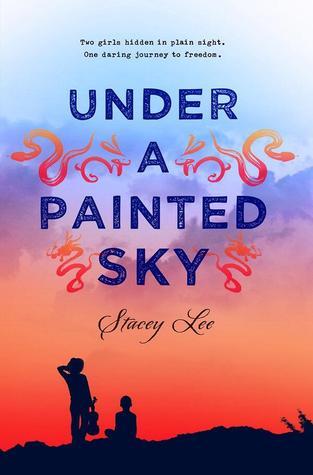
22. Under a Painted Sky by Stacey Lee (****1/2)
Category: Miscellany
Description from Goodreads: "Missouri, 1849: Samantha dreams of moving back to New York to be a professional musician—not an easy thing if you’re a girl, and harder still if you’re Chinese. But a tragic accident dashes any hopes of fulfilling her dream, and instead, leaves her fearing for her life. With the help of a runaway slave named Annamae, Samantha flees town for the unknown frontier. But life on the Oregon Trail is unsafe for two girls, so they disguise themselves as Sammy and Andy, two boys headed for the California gold rush. Sammy and Andy forge a powerful bond as they each search for a link to their past, and struggle to avoid any unwanted attention. But when they cross paths with a band of cowboys, the light-hearted troupe turn out to be unexpected allies. With the law closing in on them and new setbacks coming each day, the girls quickly learn that there are not many places to hide on the open trail."
I have a secret affinity for Westerns or, more accurately, I love the idea of Westerns — although I don't often read or watch them.
My interest is closely connected with my love for folklore and mythology and the ways modern storytellers break it apart and shape it anew. There is a myth of the American Wild West, often based almost on the image of lonely, noble white cowboys standing up against the dangers of a lawless land. I can understand the appeal of figures like Buffalo Bill Cody and Wild Bill Hickok and the characters portrayed by John Wayne. Although, I'm more partial to the female versions, seen in Calamity Jane and Annie Oakley. I love cowgirls and will be immediately drawn to any story that has women facing the Wild West on their own terms, even not-great movies, like Bad Girls.
I come to this interest in Westerns with the full knowledge that this mythology is deeply problematic, erasing and villainizing the image of POC, particularly Native Americans. It's a mythology to be tangled with carefully, with room for dismantling, and approached with reservation, oodles of research, and a sense of inclusion.
One of the things that drew me to Under the Painted Sky was not only the diversity of the main characters — Sammy is Chinese and Andy is black — but the fact that they disguise themselves as boys to make their road safer. I loved both of these girls, how they faced their fears and strove for their own freedom. They both have skills and knowledge of their own and learn a lot from each other. Their bond of friendship is powerful, as strong as sisterhood by the end, and I loved the mutual respect they had for each other.
“You miss being a girl? I ask her.
Not as much as I thought I would. Just feels like when I'm being a boy, I can cut a wider path.”
The trope Under the Painted Sky most clearly breaks from is the image of the lone noble cowboy image/hero image. Instead of solitude, the story presents the strength of community and the power of being backed by the family you choose. On the road, Sammy and Andy meet three young cowboys — two from Texans and one Mexican — who join them on their journey to California and teach them some cattle wrangling skills. The interactions between the five characters are often hilarious, and the author does a great job of showing how their friendship blossoms into complete trust.
Under the Painted Sky is sometimes thrilling, sometimes touching, and often funny. It had me staying up way to late so that I could finish it. A fantastic debut and a wonderful read from Stacey Lee. I'll be looking out for more work by her.
120andreablythe
Category: Newberry Medal Winners
2007 Winner
A young girl named Lucky lives in a tiny desert town in California, has a passion for science, and likes to eavesdrop on AA and other Anonymous meetings, which have inspired her to look for her own Higher Power. Terrified that her guardian Brigitte might abandon her and go back to France, she tries to find ways to get Brigitte to stay. A simple, sweet story with simple resolutions.
121luvamystery65
Ancillary Justice is added to the TBR pile.
122RidgewayGirl
123DeltaQueen50
124andreablythe
Everywhere I turn, people are telling me how great the Vorkosigan Saga, so it looks like I'll have to add it to the list.
Hope you like Ancillary Justice!
>122 RidgewayGirl:
Thankee!
>123 DeltaQueen50:
Nice! Hope you like it. :)
125andreablythe
Category: Miscellany
The second book in the Chaos Walking trilogy involves less action and more political and subversive maneuvering with Todd and Viola caught in the middle. Less action didn't make it any less tense. I felt deeply for these characters and the dark holes of thought and emotion they plummeted into, so much so that at one point the series of events brought me to such a state of anxiety I had to put my book down for a few hours, just to breathe and relax before going on.
Ness asks some really interesting questions about responsibility, leadership, and war and its effect on soldiers and people. These are deep, complicated questions with often no good answers. At many points the question of right and wrong gets tossed right out the window, because there are no good answers, only an increasing cycles of violence from which it is nearly impossible to extricate oneself from.
As with The Knife of Letting Go, the book ends on a cliffhanger. Fortunately, I have the third and final book, Monsters of Men, already at home and I look forward to reading it with anxious anticipation.
126DeltaQueen50
127andreablythe
I have a couple of books to read first and cleanse the palate, so to speak, before Ill get to Monsters of Men myself.
Have a good trip!
128andreablythe
Category: From 1001 Books to Read Before You Die
The story follows the Buendía family and their lives in the fictional South American town of Macando, where fathers and sons, mothers and daughters face fate, broken hearts, civil war, household ghosts, betrayal, storms, droughts, hunger, and other misfortunes. I kind of dug the magical realism of the story with alchemy, most ghosts, family members who predict their own deaths, superhuman feats, and other wonders.
I feel like I should have liked this one more than I did, based on how many other people I know love it. *sigh* I struggled a lot, especially in the first half of the book. Though, the writing style was beautiful, there were so many family members and so many events both past and present being jumped back and forth between that it was almost too much. I didn’t know what or whom to focus on and I didn’t like any of the family members, which made it hard to give them sympathy.
The only character I liked was Ursula, who maintained herself as a grounding element among her flighty children and grandchildren, trying her best to anchor them morally and physically in the world, and standing up to them when they do wrong. She actively worked to keep the home and its inhabitants alive, continuing the effort even as they marched toward their own destruction.
It’s a very fatalistic novel, which is not really my thing (though I’ve read and loved bleak novels before). I did get into it more toward the end, but ultimately didn’t love it.
129andreablythe

26. wingless, scorched & beautiful (chapbook) by Allie Marini Batts (****)
Category: The Universe in Verse - Poetry
"if, in April,
the seeds planted in your scapulas
fail to bloom into wings
at least learn to love falling—"
— from "Boneseeds"
The ten poems in wingless, scorched and beautiful delve into the dark corridors of women's lives and bodies. These are women who have made mistakes, crawled through the muck, endured, and returned scarred but with renewed strength.
At first glance, a reader might perceive these poems as gloomy, but here death and rebirth dance with each other in cyclical pirouettes and hope comes back around eventually. For example, in the opening poem “Boneseeds,” the act of crashing down transitions through catastrophe into flight, while “breeding, trumpet flowers out of the dead ash” reveals how life — both plant vines and oneself — can labor to come back from destruction.
In “Her Intentions Are,” the “you” of the poem is a woman broken down by abuse, her shame and devastation revealed public on a city street corner. Her “every clinging breath is futility” and her “tears are scented and boiling with the stink of desperation”. The imagery, such as wolves and women in battle armor, evokes a feeling of folklore that reflects the inner forests in which she struggles. Though no happily ever afters are on the horizon, the poem culminates in the ability to rise up and continue living.
Female sexuality and how it is twisted and commodified is discussed in the poems “Pussy Pass” and “high art”. The first expresses rage at the entitlement of men, who expect their advances to be granted with ready sex — “every man who thinks sex is a gumball that’s owed to them / after putting two nice-guy coins into the girl-machine”. Meanwhile, the second explores the nature of art, noting “soft filters / don’t make disenfranchised body parts / any less than pornographic.” For me, "high art" suggests that art is a mirror, reflecting both truth and lies that are determined by consensus of the beholders.
Each of the poems collected here is powerful, revealing its own mixture of beauty, strength, and pain. Multiple readings of these poems unveil new layers of meaning and I recommend downloading the collection, which is available free online, and spending time with each one.
"...poor things, they
can’t see that I am
dead inside, numb to their
ether, the drug they smell on me is
freedom, they want to taste it like
ginger, a sweet and hot burn."
— from "Vampire Boys" (note: not original formatting)
130lkernagh
131DeltaQueen50
132andreablythe
Excellent! I hope you like it. :)
>131 DeltaQueen50:
If you're referring to the chapbook, it is only available online as a free digital download: http://www.imaginaryfriendpress.com/2015/03/wingless-scorched-beautiful-by-allie...
133DeltaQueen50
134andreablythe
Yay! I'm glad you're enjoying it.
She's actually a new friend of mine, which I forgot to mention in the review. Always nerve racking reading and reviewing a friend's work, so I was happy to have enjoyed it so much.
135DeltaQueen50
136andreablythe
I will! :D
137-Eva-
I adored it when I read it, but it was at Uni and there was a lot of discussion in the classroom, which helped with keeping the characters and events apart. It's been on my to-reread list since I read it back then.
138andreablythe
Hi, Eva. I think being able to actively discuss it as I was reading, looking at the symbolism and all the detail more closely would definitely have improved my experience, too.
139andreablythe
Category: Printz Award (YA) Winners
2005 Winner
This was a strange book about Daisy, a young troubled teen sent to live in England with her cousins during an ongoing war. While she’s there the war slowly escalates, cutting her off from her home in New York — though Daisy and her cousins, parading freely through the fields in their innocence don’t notice it much since it doesn’t affect them directly. It’s not until war charges into their lives with the introduction of soldiers, fighting, and danger and causing them to be separated that the family begins to realize the impact of war on themselves and the people around them.
There’s a slight mystical quality to Daisy’s cousins, a natural charisma and a sort of telepathic ability. Edmund seems to be able to read people’s minds and the rest of them seem to be able to read and speak to animals. It adds an odd kind of surreal quality, especially to the airy joy of the first several chapters.
The most disturbing thing to me is the romantic relationship between Daisy and Edmund, because, you know, COUSINS.
I suppose I can understand how this got so popular. Daisy’s narration and voice is very real, sounding exactly like a bratty teenager. The story is fairly simple with a few interesting complexities slipping in. While I enjoyed the story, overall it felt a little off to me and I didn’t connect to it much.
140andreablythe
Books Finished:
1. A Year Down Yonder by Richard Peck (****)
2. Moon over Manifest by Clare Vanderpool (****1/2)
3. Blue by George Elliott Clarke (***1/2)
4. Forever Peace by Joe Haldeman (****)
5. Under a Painted Sky by Stacey Lee (****1/2)
6. The Higher Power of Lucky by Susan Patron, illus. by Matt Phelan (***)
7. The Ask and the Answer by Patrick Ness (****)
8. One Hundred Years of Solitude (audio book) by Gabriel Garcia Marquez (***1/2)
9. wingless, scorched & beautiful (chapbook) by Allie Marini Batts (****)
10. how i live now (audio book) by Meg Rosoff (***)
Total for the year: 27/55
Favorite Read:
Under a Painted Sky was a delight
Worst Read:
No terrible reads this month, just a few I didn't connect well with.
Random Reading Connection:
I didn't realize until after I read them that A Year Down Yonder and Moon over Manifest were going to be so similar — both feature young girls sent away from their families to live with distant friends/relatives during the Great Depression in the '30s — although both are very different in tone.
Books Still in Progress at the End of the Month:
I'm about halfway through Don Quixote, which has actually made me laugh out loud at some points.
Category Progress
1. The Dreamer - Don Quixote (0/1)
2. Pulitzer Winners - Nonfiction (1/2)
3. Pulitzer Winners - Fiction (1/3)
4. James Tiptree Jr. Award Winners (2/4)
5. Nebula and Hugo Awards for Novels (5/5) — Finished!
6. Newberry Medal Winners (4/6)
7. Printz Award (YA) Winners (3/7)
8. From 1001 Books to Read Before You Die (3/8)
9. The Universe in Verse - Poetry (2/9)
10. Miscellany (6/10)
Categories Completed: 1
So excited to have finished my first category this month!
141andreablythe
Category: James Tiptree Jr. Award Winners
2010 Winner
I love Baba Yaga, the old fairy tale witch who lives in a house with chicken legs and threatens to eat the heroine or hero if they don't complete certain tasks. So, when I saw this book I knew I had to read it.
Although, it turned out to be nothing at all like I expected, with the fairy tale and fantastic aspects nearly nonexistent, providing what at first seems a mundane picture of women's lives. The introduction, "At First You Don't See Them...", is the eeriest part of the book in the way it describes the old women around us everyday, invisible and ready to latch on to us like flimsy leeches at any moment.
In Part I, the narrator is a woman describing how she has turned into a caretaker for her mother, who is clinging to her home and demanding acknowledgement of her existence in whatever blunt way she can.
In Part II, the POV and tone shifts. Here an omniscient narrator reveals the mother, Pupa, on a trip with two other elderly friends to a Grand Hotel with a wellness center. Why they have come is not clear, but they meet many quirky characters along the way. Though anchored in some semblance of reality, this section has a fairy tale tone, with the narrator interjecting rhymes at the end of each section, each variants of the following: "What about us? We carry on. While the meaning of life may slip from our hold, the purpose of a tale is to be told!"
The third and final Part gets meta. It is written in the form of an introduction to Baba Yaga folklore an an analysis of the stories that appear in Part I and Part II of the novel. It's very strange reading these, since the academic writing them, Aba, is a young woman who appears in Part I, having met both the mother Pupa and the daughter/narrator. This section can drag a bit with the amount of detail it goes into, but the information on folklore and tales is fascinating (to me at least) and provides some insight into the symbolism of the first two parts, allowing me to think about them from an entirely new perspective.
Though reading Baba Yaga Laid an Egg was a slightly strange experience, I enjoyed it overall. It has me wanting to go out and read oodles of folktales now and has inspired me to write some reinterpretations of my own.
142lkernagh
143andreablythe
I learned about Baba Yaga as an adult, too. In college probably.
Thought provoking is a good way to describe Ugresic's work. I'll have to consider picking up something else by her.
144andreablythe
Category: Newberry Medal Winners
2002 Winner
Tree-Ear, a nameless orphan in medieval Korea is captivated by the work of the potters and longs to work the clay himself. Tree-Ear strives to be honest in all his doings and works hard to achieve his goals. It’s a sweet tale, weaving in the importance of family and dedication to one’s art.
* * *
30. Crispin: The Cross of Lead by Avi (***)
Category: Newberry Medal Winners — FINISHED!
2003 Winner
Crispin is accused of theft and declared a wolf’s head, a death sentence meaning anyone he meets has the right to kill him if they wish. Along the way, he takes up with Bear a colorful jester who believes in freedom above all else. Although danger lurks around every corner for Crispin, I found his story to be a little dragging at times. Still, it was a good read, even if I didn’t quite buy into the ending.
145andreablythe
I've just learned that it's short story month. In honor, I'm doing two challenges:
First, I'm reading a short story a day and posting mini reviews on my blog (people are also talking about it on twitter under the tag #ShortReads).
Second, I'm trying to write and post a flash fiction piece every Friday.
Would you guys be interested in having my cross-post my mini reviews and/or stories here?
146RidgewayGirl
147mamzel
Luckily I selected a short story collection for the SFFCAT challenge. I'll enjoy reading your short stories as well. Someone donated a bunch of old New Yorkers to my library and I was enjoying the fiction featured there.
148andreablythe
Yep, I'll post links to my flash fiction and will post the story reviews here.
I don't have any specific story reading plans, so I would love recommendations. Looking forward to seeing your reviews!
>147 mamzel:
I just googled it! Gorgeous!
149andreablythe
I'll post links to my flash fiction and short story reviews (with links if the stories appear online) in groups sporadically over the month. Here's round one.
My first Friday Flash: Resident Ghost
#ShortReads:
Day 1 - "Among the Sighs of the Violoncellos" by Daniel Ausema, published at Strange Horizons — The story is a poetic vision of a Eden-esque garden with fairy tale trees, wish granting lizard tales, and a single glinting white swan. It's told from the point of view of the tenders, the ones invisibly keeping paradise tended and beautiful. Wonderful.
Favorite Line(s): "In the back of the garden is a tree that bears orphan farmboy fruits. If you pluck one at just the right time, it will become a hero. A moment too soon, and the unripe hero fails in his quest. A moment too late, and he lives out his life bitter over missed opportunity, brooding on the injustices of life."
Day 2 - “The Last Flight of Doctor Ain” by James Tiptree, Jr.
Published in the collection Her Smoke Rose Up Forever.
This is the first Tiptree I’ve read and it’s excellent. The short story is told omnisciently giving little bits and pieces of what happened based on the comments of people who happened to notice him on his journey. Though dark and fatalistic, it’s brilliantly executed.
Favorite Line(s): “The woman seemed stronger here. She was panting in the sea wind, her large eyes fixed on Ain.”
Day 3 - “Sing, Pilgrim!” by James Patrick Kelly
Published in Fantasy & Science Fiction magazine, November/December 2013.
When a seemingly ordinary chair appears in the middle of a sidewalk, it sparks a new religion and hope of transcendence. A very short and simple story that paints a picture of what the world would be like if there existed a religious relic that actually did something. Not a story with any deep emotion or insight and not the type to linger after being read, but a decent read.
Favorite Line(s): “It has been said that every age gets the chair it deserves, and the history of chair culture is checkered at best.”
Day 4 - “Baba Makosh” by M.K. Hobson
Published in Fantasy & Science Fiction magazine, November/December 2013.
What happened when communist revolutionaries travel to hell and encounter old gods? I really enjoyed this one and its connection to mythology. Baba Makosh is a kindly old grandma figure who takes in three soldiers with offers of sympathy and food. Though the narrator remembers old ways and knows better than to accept the food of the gods. He survives the encounter in part due to his respect for old ways and for his skill in music. I always like seeing folklore and mythology done well and this is certainly that. Recommended for those who like Russian folklore.
Day 5 - "Ambiguity Machines: An Examination" by Vandana Singh
Published by Tor.com
This tale is presented in the form of an engineering exam offered by the Ministry of Abstract Engineering, in which three investigations involving "reports, rumors, folktales, and intimations of machines that do not and cannot exist" are offered. Each of the accounts presents different people from different parts of the world. They are a beautifully written tales with common themes of longing, sadness, and loneliness, although each seems to find ways to overcome this either through the machine or in avoidance of it. A gorgeous story.
Favorite Line(s): "So into his design he put the smoothness of her cheek, and the light-flash of her intelligence, and the fiercely tender gaze of her eyes. He put in the swirl of her hair in the wind, and the way her anger would sometimes dissolve into laughter, and sometimes into tears. He worked at it, refining, improving, delaying as much as he dared."
Day 6 - "The Two Weddings of Bronwyn Hyatt" by Alex Bledsoe
Published by Tor.com
Bronwyn Hyatt is Tufa (a kind of fairy creature) who is marrying her love, a human. In preparing for her wedding day, she's torn on what to wear for a dress, wanting to honor her people, while also not wanting to be bound by tradition. While pondering her problem, she meets a Yunwi Tsunsdi (another kind of fair, known as little people) who presents a solution to her problem as long as Bronwyn makes a deal. This was a fun, light-hearted story, in part due to the mundane way these events and fantastical creatures are described.
Favorite Line(s): The woman reached into a bush beside the trail and produced a miniature fiddle. She tucked it under her chin and played a high, mournful note. “It is a beautiful day for thinking. What are you pondering?”
Day 7 - "The Screwfly Solution" by James Tiptree, Jr.
Published in the collection, Her Smoke Rose Up Forever
Sometimes you read a story that impacts you with the same intensity of a novel. This is one of those stories. I'm still floored, just sitting her thinking about it.
Alan is an scientist in South America studying ways to decrease the productivity of parasitic caneflies. Meanwhile, his wife in Ann Arbor is writing with increasingly disturbing news about a Sons of Adam cult and a spreading violence against women.
"The Screwfly Solution" is incredibly unsettling and absolutely brilliant. One of the best stories I've read in a long time and I'm considering retreading it right now, even though I should really go to bed.
Favorite Line(s): N/A, I'm having a hard time picking just one when I pretty much adore this entire story from beginning to end.
150andreablythe
I'm also thoroughly enjoying the audio book for Middlesex, which is not at all what I expected. The language is fantastic, jumpy, engaging, and the narrator does an amazing job reading it with passion, bringing the complexity of the language to life.
Don Quixote is progressing, as well, if very slowly. I'm enjoying it and laughing, although some of the long speeches can drag sometimes.
Next up in my reading:
Veronika Decides to Die by Paulo Coelho
The Hours by Michael Cunningham
Toms River: A Story of Science and Salvation by Dan Fagin
Rupetta by N.A. Sulway
151lkernagh
152andreablythe
Yeah, I'm feeling pretty much the same. When things are good, they're great, but all the long conversations and speeches about the nature of good writing and the meaning of chivalry slow things down immensely.
153andreablythe
Category: Miscellany
A powerful conclusion to The Chaos Walking trilogy. The story continues to develop an expanded picture of humanity and the people we've come to hate in book two are revealed to be even more complex and human here, as the ways they can and cannot be redeemed are revealed. Todd and Viola also continue to make difficult decision and to work on atoning for their mistakes.
This book also reveals a greater understanding of the culture and community of the Spackle, who call themselves the Land. Their culture could fall under the Noble Savage trope. Although we are presented with the POV of a Spackle who is as furious and angry and complicated as Todd and Viola, revealing how war can make monsters of anyone it touched whether human or Spackle.
Overall this trilogy was fantastically well done, drawing me in with interesting concepts, fantastic characters, a great story, and deep feels.
154DeltaQueen50
155andreablythe
156andreablythe
Category: Pulitzer Winners - Fiction
2003 Winner
A complex family saga and coming-of-age story narrated by Cal Stephanide, who traces his family history (sometimes relating events omnisciently he could not possibly know) as a way to understand himself. He describes growing up as a girl, Callie, and his life-altering discovery as a teenager that he is intersex, at which point Cal lives the rest of his life as a man.
Fascinating on many levels and deeply human, I loved the way the story described each of these family members with all their mistakes and flaws — from incest to racism and other stuff in between. Maybe it’s because Cal is the narrator rather than some disconnected third party, but the love Cal has for his family shines through, providing a sense of compassion and empathy. It allows for characters to be seen as sympathetic, even at their worst. It’s a book I’d want to read and absorb again.
Also, the audiobook is excellent with Kristoffer Tabori giving a powerful reading that makes Cal’s passions come alive.
157andreablythe
(Links are to read the stories online.)
May 8 - My Friday Flash Fiction: The Shadows Among Us
Short Reads Day 8: "The Saint of the Sidewalks" by Kat Howard — Published by Clarkesworld Magazine
Joan's life is pretty screwed up and in an act of desperation, she enacts a prayer to the Saint of the Sidewalks for a miracle and gets far more than she bargained for. The idea of a saint who is worshiped and prayed to through found objects drew me in immediately. I love "detritus" — the word and the things left behind. As this story evolved into more than just a cool idea, it became a touching tale of hope and miracles. Really lovely.
Favorite Line(s): "She set her cardboard on the sidewalk, prayer-side up. Then lit the required cigarette—stolen out of the pack of some guy who had been hitting on her at a bar—with the almost empty lighter she had fished out of the trash. You couldn’t use anything new, anything you had previously owned, in your prayer. That was the way the devotion worked: found objects. Discards. Detritus made holy by the power of the saint."
Day 9: “The Paper Menagerie” by Ken Liu
Reprinted at iO9.
Such a bittersweet tale of magical realism, in which folded paper animals live. It shows the pain of internalized racism and the loss it can cause. Beautiful and so moving.
Favorite Line(s): "She turned the paper over and folded it again. She pleated, packed, tucked, rolled, and twisted until the paper disappeared between her cupped hands. Then she lifted the folded-up paper packet to her mouth and blew into it, like a balloon."
Day 10: “The Cartographer Wasps and the Anarchist Bees” by E. Lily Yu
Published at Clarksworld Magazine.
This is a reread for me and it is as astounding experience now as it was the first time around. A group of wasps enact a form of colonization on a nearby hive of bees, though that's only a small fraction of the story. It is beautifully told with vibrant language, relating an alien view of life in very relatable terms.
Favorite Line(s): "... it was discovered that the wasp nests of Yiwei, dipped in hot water, unfurled into beautifully accurate maps of provinces near and far, inked in vegetable pigments and labeled in careful Mandarin that could be distinguished beneath a microscope."
Day 11: "There Will Come Soft Rains" by Ray Bradbury
Published in The Martian Chronicles.
This is one of my favorite short stories of all time, which haunts me every time I think about it, so of course I had to reread it for this Short Story Month challenge.
I got chills all over again. Bradbury makes this tragic smart house come alive, breathing with its own mechanical needs and passions and fears in the absence of humanity.
A reading by Leonard Nimoy of "There Will Come Soft Rains" can be found on YouTube.
Favorite Line(s): "And one voice, with sublime disregard for the situation, read poetry aloud in the fiery study, until all the film spools burned, until all the wires withered and the circuits cracked." (Hard to choose a favorite line, since each word in this story sings.
Day 12: "Tuning Philomel’s Steely Strings in the Wasteland’s Dark Matter" by Carina Bissett
Published in Nonbinary Review.
This lyrical retelling of the myth of Philomela and her sister Procne poetically unveils a story of brutality and revenge. Two women reclaim their own sense of power following terrible and brutal abuse.
Favorite Line(s): "Through the centuries our story twists and turns, contorting to fit into new molds, yet the rumors persist as rumors will. They tear apart truths to meet their needs, finding new ways to silence our protesting screams. Only we know the truth."
I'm actually two day's behind. Eeep!
Any short story suggestions (particularly if their easy to find online)?
158andreablythe
Category: Printz Award (YA) Winners
2000 Winner
Sixteen-year-old Steve Harmon is on trial for murder. As a way to hold it together through his terrible nights in prison and the stress of the trial, he records events as part diary and as though he were writing a movie script about his life. It was an interesting structure and fits with Steve's personality, since one of his passions is to make films. But while the structure suits the character, it also created emotional distance from me, like I was looking at events through a lens instead of getting into Steve's head. The most moving moments in the novel were those written in diary format, where we were able to see more than just the surface and really get into his head.
159mamzel
I always recommend this book to my students. Myers died just recently and was a giant in YA literature.
160andreablythe
I'll have to look out for more of Myers work.
161mamzel
162andreablythe
163andreablythe
Category: From 1001 Books to Read Before You Die
The classic story of Holly Golightly, a "wild thing," party girl, flirt, gold digger, and dreamer — none of which really sums up the complexity of her character. The story is told through the POV of her upstairs neighbor, a writer who becomes her friend, despite (or perhaps because of) his own attractions to her. It's a short quick read, beautifully told.
Michael C. Hall does an amazing job as the audiobook narrator, melting into each character and drawing out their personalities.
Although the movie's ending is quite different, happy, smoothed out and clean, I can enjoy both separately for exactly what they are. In fact reading the book just makes me want to rematch the movie all the more.
164DeltaQueen50
165andreablythe
I recommend it! He melts into the characters perfectly. :D
166andreablythe
Category: The Dreamer - Don Quixote — FINISHED!
Wheeeeee! I’m done!
Obsessed with books and stories of chivalry, Don Quixote dons makeshift armor and rides out with his trusty squire Sancho Panza as a knight errant, seeking out adventures and to right wrongs and battle injustice. Unfortunately, he was born into the wrong time, because the knights are no more and his fancies evaporate, his giants become windmills, his castles fade into humble roadside inns.
I didn’t expect to laugh out loud as much as I did. While it certainly helps to have read some Arthurian and other chivalric romances in order to fully appreciate some of the tropes Cervantes is satirizing the genre, it’s not required. Don Quixote’s adventures are amusing on their own. There is also considerable amount of body humor (fart and poop jokes), which I didn’t expect and was most amusing. Part I also had some interesting side characters, who meet with Don Quixote and share their own tales of woe, whom he tries to help through chivalry, while these same characters (recognizing he is mad) try to lead him home.
That said, there were plenty of moments where the story dragged, mostly when the characters have some sort of discourse on the nature of books, writing, chivalry, or polite behavior. Sancho’s long speeches thick with proverbs also lead me to start speed reading in order to get through them more quickly.
If you want examples of meta, you can certainly look to Don Quixote in which Cervantes has characters talking about the value of Cervantes’ work on a number of occasions. The second part also comments on itself — a large reason as to why Cervantes ever bothered to write Part II was because writer author took up the slack and attempted to continue the Don Quixote adventures. Part II is infused with references of Don Quixote’s adventures having been written down by two different authors, one who wrote with beautiful nobility and another who was just a hack.
Knowing the Cervantes didn’t really want to write Part II explains a bit as to why it was so tedious. The joy of writing the estimable Don Quixote and the droll Sancho Panza was no longer there, which plays out in how he treats them. Instead of characters hoping to assist him in finding home again, he meets with a litany of characters who have heard of his madness and set about playing tricks on Quixote and Sancho for their own amusement. Some of these tricks are quite cruel and conveyed a feeling of underlying bitterness beneath all the fun, as though Cervantes was punishing these two fellows for being more popular than the works he really wanted to write.
Honestly, the best adventures appear in Part I. You could skip Part II entirely and the story would feel complete enough to enjoy.
* * *
Next up in Reading:
The Hours by Michael Cunningham
In Darkness by Nick Lake
Toms River: A Story of Science and Salvation by Dan Fagin
Rupetta by N.A. Sulway
167rabbitprincess
168mamzel
169LittleTaiko
170andreablythe
Thanks!
>168 mamzel:
There are definitely some slow bits in both Part I and II. When you do get back to it, I'd say you could just do Part I and be fine, since it feels fairly complete in itself.
>169 LittleTaiko:
I am! Thanks!
171andreablythe
Books Finished:
1. Baba Yaga Laid an Egg by Dubravka Ugresic (****)
2. A Single Shard by Linda Sue Park (****)
3. Crispin: The Cross of Lead by Avi (***)
4. Monsters of Men by Patrick Ness (****)
5. Middlesex (audio book) by Jeffrey Eugenides (****)
6. Monster by Walter Dean Myers (***)
7. Breakfast at Tiffany's (audio book) by Truman Capote (****)
8. Don Quixote by Miguel de Cervantes Saavedra (***1/2)
Total for the year: 27/55
Favorite Read:
Tough call. I may go with Monsters of Men, just because it was the conclusion to an amazing trilogy.
Worst Read:
Crispin: The Cross of Lead wasn't bad, but I wasn't really into it either.
Books Still in Progress at the End of the Month:
I'm loving The Hours by Michael Cunningham. It's filled with such pretty writing and is a loving tribute to Virginia Woolf.
Category Progress
1. The Dreamer - Don Quixote (1/1) — Finished!
2. Pulitzer Winners - Nonfiction (1/2)
3. Pulitzer Winners - Fiction (2/3)
4. James Tiptree Jr. Award Winners (3/4)
5. Nebula and Hugo Awards for Novels (5/5) — Finished!
6. Newberry Medal Winners (6/6) — Finished!
7. Printz Award (YA) Winners (4/7)
8. From 1001 Books to Read Before You Die (4/8)
9. The Universe in Verse - Poetry (2/9)
10. Miscellany (7/10)
Categories Completed this Month: 2
Total Categories Completed: 3
172-Eva-
Four stars - nice to know! It's been sitting on Mt. TBR for a long time now.
>142 lkernagh: & >143 andreablythe:
My first encounter with Baba Yaga (that I can recall at least) was in Fables - she wasn't part of my childhood fairy tales either.
>166 andreablythe:
Congrats!!! I made it half-way once, but would like to actually finish at some point. Problem is, it was so long ago, I'll have to start from the beginning again. :)
173andreablythe
I loved Baba Yaga in Fables. Such a great character. Baba Yaga also appears as a character in The Chaos (about a magical apocalypse) and Baba Yaga's Daughter & Other Tales of the Old Races (spin-off stories from a urban fantasy series) — both of which were quite fun.
Ah! I hate that, having to start over, but I've done it more than a few times.
174andreablythe
Category: Pulitzer Winners - Fiction — FINISHED!
1999 Winner
The Hours is a loving homage to Virginia Woolf's Mrs. Dalloway. The novel tells the stories of three women — Clarissa, a 52-year-old woman planning a party for her friend and former lover dying of AIDS; Laura, a young pregnant housewife in 1949 feeling trapped by the order of her life, and Virginia Woolf herself attempting to begin the writing of Mrs. Dalloway in 1925. Each story relates the women's complex inner journeys over the course of a single day.
One of the many profound ways these women's lives and hearts overlap is the way each woman seeks to create her own form of perfection in the world, making such a small thing into so much more than what it is. For Clarissa, it's putting together a party that will properly honor her friend. For Laura, it's assembling a cake that reflects all her feelings of love. For Virginia, it's taking words and shaping them into a story that reveals and transports. And yet, each in her own way feels herself incapable of achieving this perfection. This is just one part of this novel, just one piece, but it's a piece that resonated with me and is something I found to be a part of what makes this novel so heartbreakingly beautiful.
Not only do are each of these women affected personally by the novel, Mrs. Dalloway, but also the writing style of The Hours imitates Woolf's style, the way she layered image and meaning together in complex network of poetic prose. Like Mrs. Dalloway, The Hours is a novel that requires a certain amount of presence and focus in order to follow, but the result of each novel is uniquely beautiful and each are worth a read.
A delightful little footnote: I love that Clarissa mentions seeing a movie star (maybe Meryl Streep) and that Meryl Streep plays Clarissa in the movie version of The Hours.
175VivienneR
176andreablythe
Thanks, Vivienne. :)
177mathgirl40
I too loved E. Lily Yu's short story. I'm looking forward to reading more of her work.
178andreablythe
Thanks, mathgirl. I hope you enjoy it when you get around to it.
I will be reading more of her work as well. Her stories have appeared in a number of anthologies, but I look forward to the day she puts out a collection.
179andreablythe
Category: Printz Award (YA) Winners
2011 Winner
Nailer is a ship breaker, one of the many scavengers on the beach taking apart abandoned tankers piece by piece. It's dangerous, hazardous work and the dangerous, impoverished life makes for hard edged people. One learns not to expect much in this life, except a distant hope of striking it rich with some lucky find. When Nailer discovers a survivor inside a clipper ship that washed ashore after a storm, he has to choose between scavenging the ship for wealth or saving the swank girl.
Bacigalupi has shaped an almost believable dystopian world, which is starkly divided into poor and wealthy. Global warming has caused the seas to rise and fossil fuel has declined. The scavenge is a necessary part of business and the wealthy owners, who run things from a distance, don't much care what happens to the crews on the beach.
I liked Pima and Sadna, Nailer's friend and her mother who have cared for Nailer since he was a child and nursed him after his father's beatings. They had a practical sort of compassion for Nailer and others whom they considered crew. I also liked Tool, the half-man, but he disappeared from the story just as his character arc was getting interesting, which was disappointing. I would have liked to have seen more of his character.
The story was fast paced with Nailer and Lucky Girl struggling to survive from one moment to the next and Nailer's father is appropriately terrifying. A solid novel overall.
180AHS-Wolfy
181DeltaQueen50
182andreablythe
It's funny, but I didn't like The Windup Girl that much (the rape scenes were too graphic for me) and in some ways I liked Ship Breaker better. The worlds which Bacigalupi created are very similar in the way that global warming is causing flooding in coastal regions and famine in many parts of the world. I could easily see both novels as being set in different regions of the same world.
183DeltaQueen50
184andreablythe
I hope you like it, Judy!
185lkernagh
Congrats on completing Don Quixote!!! That deserves three exclamation marks. ;-)
I loved Mrs. Dalloway and have yet to find the time to get around to reading Cunningham's The Hours. Some day I will read it. Really, I will.
186andreablythe
Haha. Thanks for the extra exclamation marks. It felt like an accomplishment, for sure.
The Hours was lovely and I hope you enjoy it when you have the chance.
187andreablythe
So, what am I doing in my rare free time? Playing Fallout Shelter on my iPad because my braincells are tired. I've actually started setting a timer and limiting myself so that I don't get sucked in too much.
188andreablythe
Category: Pulitzer Winners - Nonfiction
2014 Winner
Looking for a place where they can manufacture fabric and industrial dyes and dump its chemical waste easily with little questioning from the public, a large chemical company (the name changes several times), constructs a plant in a small town known as Toms River in the 1950s. The plant is able to dump its chemical for years without question, even turning the river purple at one point, thanks in part to the silence of government adage vids. Later come cancer clusters, public outrage and investigations, buit takes decades. It's horrifying and facinating. The author intersperses the modern events with the history of science and chemistry that had a direct impCt on those events. It's an interesting story also because the expectation is for a clear resolution, which doesn't come. The results of the studies and negotiations and everything are vague and frustrating. People have to figure out their own sense of salvation in the end.
189LittleTaiko
190andreablythe
191DeltaQueen50
192andreablythe
193andreablythe
Category: From 1001 Books to Read Before You Die
When I saw the movie years ago, I was enamored with the gorgeous cinematography and began to fall in love with the story — about a young girl who makes a terrible mistake that causes a young man and friend to go to prison and her sister to be separated from her lover — which was beautiful and wonderful... right up into the ending, which felt like the greatest cheat of all time and had me leaving the theater in rage. I remember asking, "How can they possibly call that the greatest love story of all time?" and having a friend answer, "You have to read the book to understand."
So, now I've read the book and I almost understand, although the ending still feels like a bit of a cheat. Just like the cinematography in the movie, the writing is lush and gorgeous and I might have been able to enjoy it more, if I hadn't seen the movie and didn't already know what was going to happen. The ending in the book provides more explanation and a bit of nice symmetry that is not in the movie, but it still left me annoyed.
194andreablythe
Category: Printz Award (YA) Winners
I wasn’t quite sure what to make of this story. It opens with a game called Death, in which the young teenagers of the small town of Stoneygate play inside an old coal mining shaft. There is a girl who wants to be an actress, a grandfather who tells old stories but is starting to forget his past, and a number of children ghosts. I liked the story, but didn’t love it and I’m not really sure what else to say.
195andreablythe
Category: Printz Award (YA) Winners
This is a story about the sighting of a supposedly extinct woodpecker that reinvigorates a small town, except it’s not really. It’s more about a really decent kid Cullen Witter trying to cope with his brother vanishing one day, about his parents falling apart over the loss in different ways, about Cullen’s best friend trying to be supportive and feeling lost, too, about the girl Cullen has always had a crush on, about growing up and moving on. In other words, it’s about life, messy and frustrating and sometimes wonderful.
In addition to Cullen’s narrative, which has its own very clear voice, the book contains chapters from other characters’ points of view. Although they seem at first to be random and unconnected to the main story, they weave together rather perfectly by the end.
For the most part, I really enjoyed this quiet book, which felt so real in every way. I just wish the ending could have anchored things a little better. Instead of feeling elated by how things came together, I felt a little let down. I can’t say why exactly, since the ending fits but, yeah.
196andreablythe
Books Finished:
1. The Hours by Michael Cunningham
2. Ship Breaker (audio book) by Paolo Bacigalupi
3. Toms River: A Story of Science and Salvation by Dan Fagin
4. Atonement by Ian McEwan
5. Kit's Wilderness, by David Almond
6. Where Things Come Back by John Corey Whaley
Total for the year: 41/55
Favorite Read:
The Hours was such a lovely tribute to Virginia Woolf
Worst Read:
Still not that into Atonement
Books Still in Progress at the End of the Month:
American Psycho by Bret Easton Ellis
Category Progress
1. The Dreamer - Don Quixote (1/1) — FINISHED!
2. Pulitzer Winners - Nonfiction (2/2) — FINISHED!
3. Pulitzer Winners - Fiction (3/3) — FINISHED!
4. James Tiptree Jr. Award Winners (3/4)
5. Nebula and Hugo Awards for Novels (5/5) — FINISHED!
6. Newberry Medal Winners (6/6) — FINISHED!
7. Printz Award (YA) Winners (7/7) — FINISHED!
8. From 1001 Books to Read Before You Die (5/8)
9. The Universe in Verse - Poetry (2/9)
10. Miscellany (7/10)
Categories Completed this Month: 3
Total Categories Completed: 6
197rabbitprincess
>196 andreablythe: You're doing great on your challenge!
198andreablythe
199lkernagh
200RidgewayGirl
201mamzel
202christina_reads
203andreablythe
I had been in the middle of reading American Psycho before I took a pause and now I'm getting back to it. I'm looking forward to some more relaxed reading time.
It's going to take me a while to catch up on everyone else's threads.
>199 lkernagh:
It's a tough call. If you haven't seen the movie, then I say go for it, because the writing really is gorgeous and if you don't know what's coming then the ending might be more meaningful for you.
>200 RidgewayGirl:
McEwan's writing is so gorgeous that I would be willing to read something else by him. Any recommendations.
The movie has really gorgeous cinematography and is fantastic up to a point. It doesn't handle McEwan's ending very well, though.
>201 mamzel:
Yeah, it had it's good points but I don't know that it was better than all the other YA books that came out that year.
>202 christina_reads:
*high five* on being the same level of annoyed. I kind of want to just pretend that that addendum of an ending just doesn't exist, so I can enjoy the rest of it.
205rabbitprincess
206andreablythe
It was sooo much fun to write!
>205 rabbitprincess:
It was a ton of work. The final version clarifies, streamlines, and adds to what I put together randomly in my blog posts. If it's published, it will be available as part of Nonbinary Review, which is free (though currently only accessible as an app for iPhone and iPad users).
207andreablythe
Category: From 1001 Books to Read Before You Die
Patrick Bateman is a terrible human being — superficial, elitist, misogynistic, homophobic, racist, and a serial killer. His days and nights are filled with lounging around the office, working out to maintain the perfect image, buying expensive clothing, technology and other objects, eating and drinking at the hippest clubs and restaurants, getting high on cocaine (this is set in the '80s), and periodically torturing and murdering animals, women, and the homeless.
The novel switches from being mind numbingly mundane to being gratuitously graphic in both sex and violence. There are pages and page on what people ate, what people are wearing, what the decor was like, how much Patrick worked out that day, his skin care routine, and so on. All of these are things Patrick is obsessed with and gets anxiety over, so it makes sense that he would describe them in minutia — however, as a reader, I found it very tedious and by the time he was describing someone's outfit in detail for the upteenth time I was starting to get annoyed, because I just didn't give a crap about who designed some guy's tie. Meanwhile, the sex and violence are described with the same level of minute detail to the point where it's almost overwhelming toward the end (though, if the point of horror is to disturb, then it succeeded, because I was disturbed).
Patrick is able to get away with these horrifying acts because everyone in the story is vile. Everyone is the same superficial elitist he is, so self focused that they don't even notice or pay attention to the blood stains on his clothing. Sometimes he even says, flat out in the middle of a conversation, that he likes to torture and kill women and not one person notices or seems to care, either too wrapped up in their own little obsessions or believing it to be a joke. The author's point seems to be that it's a mad, vapid world, one in which a psychopath fits right in.
I know a lot of people who love this book. And I recognize a certain amount of technical skill in the writing and a layer of satire and cultural criticism, however, I didn't actually enjoy the experience of reading this book. I was either half bored or entirely overwhelmed with the level of women focused violence. Let's just say, it's not for me and leave it at that.
(I don't really know how to rate this, so I'm just not.)
208RidgewayGirl
McEwan is so diverse in his writing, so that one book is not like any of his others.
And, wow, the Arabian Nights essay sounds like a huge undertaking!
209DeltaQueen50
210andreablythe
It's good to know that McEwan is diverse. It makes me feel more open to the idea of reading more of his work. Although in reading the description of Enduring Love, I find it interesting that both American Psycho and Enduring Love include a homosexual stalking a straight man, which seems vaguely homophobic to me (although part of that perception may be due to my recently experience of American Psycho and its constant homophobia). Of all the books you listed, Sweet Tooth sounds like the one I would most likely pick up.
The Arabian Nights essay was a TON of work, but also so much fun. It was a happy obsession.
>209 DeltaQueen50:
I came THIS close to quitting, but managed to slog through. The movie, as I remember, was good but not great. Christian Bale I remember was perfect in it.
211andreablythe
Category: The Universe in Verse - Poetry
Hello,
my name is Annelyse, I have
chrystalized myself in the liberal arts
and now emerge, grotesque
insect, able to do nothing
but talk about everything.
— from "Ars Poetica"
I learned about Annelyse Gelman's work by attending a Writer's with Drinks reading at which she performed. Although she seemed to not be entirely comfortable with being on stage, she read well and her series of quirky, intelligent poems that had me immediately wanting to buy the book.
After purchasing Everyone I Love is a Stranger to Someone (and getting it signed by the poet), I quickly read through it and then went back to reread many of the poems over again, revisiting and re-experiencing them because I loved them, I really did. But when it came time time for me to sit down and write a review all I could think to say was, These poems are awesome, without really being able to find the words to explain how or why these poems. So, I spent the last two months, planning to write a review and thinking about the review and going back to read a poem here or there and falling in love all over again without being actually able to write a proper review.
We wanted to show you anything is possible.
Forgive us. We were so in love.
In past lives, we were mothers, and you mourned
when we promised you would outlive us.
— from "Hurricane"
These poems are witty, clever, fun with an undercurrent of vulnerability and introspection. They explore the chaotic realm of everyday life, poking fun at its imperfections and drawing out its underbelly. I don't really know what else to say, so I'll just end with, These poems are awesome and you should go read them.
The future has an obscenely happy
ending: one day there you are
then suddenly BANG!
— from "An Illustrated Guide to the Apocalypse"
* * *
44. Drink by Laura Madeline Wiseman (*****)
Category: The Universe in Verse - Poetry
The short version, I LOVED THESE POEMS. The long version will come later, because I'm doing something I've never done before, which is try to get my book review professionally published.
212-Eva-
That is quite an undertaking! Hope you're happy with the result, after all that work!
>207 andreablythe:
When I read it, I skipped the last few of the "women" chapters - it got much too much for me. It's one of those I'm not discontent with having read, but one I'd rather not remember too much about, if that makes sense.
213rabbitprincess
214andreablythe
I was happy with it, though I'm always a little shy about what I write, unsure of whether it's as good as I think it is. But since it was accepted by the publication, I think I must have done something right.
Yeah, I would have preferred to have skipped some of the "women" chapters in American Psycho as well. Some of those images will NEVER be out of my head.
>213 rabbitprincess:
Thanks! I suppose I should actually finish the review first. That would be helpful. lol.
215andreablythe
Books Finished:
1. American Psycho by Bret Easton Ellis
2. Everyone I Love is a Stranger to Someone: Poems by Annelyse Gelman (****)
3. Drink by Laura Madeline Wiseman (*****)
Total for the year: 46/55
Favorite Read:
I really loved Wiseman's book of poetry Drink, which almost told a complete story in the way the poems progressed, moving from poems of mermaids to the tragedy of young sisters to a sense of recovery and hope.
Worst Read:
Was not really a fan of American Psycho.
Books Still in Progress at the End of the Month:
The Walls Around Us by Nova Ren Suma and I've started listening to Jonathan Strange and Mr Norrell by Susanna Clarke on audio book, which is a reread after watching the recently released mini-series.
Category Progress
1. The Dreamer - Don Quixote (1/1) — FINISHED!
2. Pulitzer Winners - Nonfiction (2/2) — FINISHED!
3. Pulitzer Winners - Fiction (3/3) — FINISHED!
4. James Tiptree Jr. Award Winners (3/4)
5. Nebula and Hugo Awards for Novels (5/5) — FINISHED!
6. Newberry Medal Winners (6/6) — FINISHED!
7. Printz Award (YA) Winners (7/7) — FINISHED!
8. From 1001 Books to Read Before You Die (6/8)
9. The Universe in Verse - Poetry (7/9)
10. Miscellany (7/10)
Categories Completed this Month: 0
Total Categories Completed: 6
216andreablythe
Category: Miscellany
“We went wild that hot night. We howled, we raged, we screamed. We were girls — some fourteen and fifteen; some sixteen, seventeen — but when the locks came undone, the doors of our cells gaping open and no one to shove us back in, we made the noise of savage animals, of men.”
A few years ago now, I read and fell in love with Nova Ren Suma’s Imaginary Girls, an emotionally complicated sister-centered story with a touch of creepy and unsettling magical realism. It’s a story that still haunts me, sneaking from behind the shadows into the foreground of my mind. A book that I treasure in my soul and a level of achievement that I aspire to in my own writing.
Nova Ren’s latest novel, The Walls Around Us, has the same kind of haunting quality, and not just because it’s a ghost story. It’s a tale that lingers long after you’ve put it down.
Three girls are the center of this story — Amber is a young woman convicted of murder who has been locked in prison for years; Violet, a ballet dancer with a dark secret; and Orianna, a girl caught in a tide of misfortune who binds the other two together. Their stories weave together unveiling lies and secrets and the truth behind a murder.
Alternating between Amber and Violet’s points of view, the story unfolds with a feeling of inevitability, a sense that everything has happened before and cannot be stopped from happening again. Neither girl is nice or easy; instead they are both complicated and difficult, having made dangerous decisions that lead to catastrophes that define their lives. Where Nova Ren’s skill is clear is in how she manages to generate a feeling of fascination and sympathy for both of these girls. Violet in particular is an awful human being, and yet I found myself pitying her and how she has cut herself off from feeling for anyone else in the world and a part of me wanted her to make it to Julliard despite all the things she’s done.
Amber is particularly interesting to me in the way she erases herself into the group of her fellow prisoners, rarely using the singular “I” and more often using the plural “we”, as though their stories and her own story were the same, as though they are all one body of girls moving through the prison system. Her own personal story slowly unfolds but never quite condemns or absolves her of any crime. She is both guilty and a victim of society and circumstances, screwed over by the man her mother married and the system. A girl taken for granted, as many in the prison are.
Rich, gorgeous prose brings the world inside this prison for young women and the outside world (for this books seems to divide the world into two realms – inside and outside) to vivid, brutal reality. The supernatural aspects of this tale are subtle, weaved in among grounded real-world details enabling a level of plausibility. The effect — of not just the supernatural elements, but the entire story — is unsettling in all the right ways. Although the end is satisfying, this is a novel without easy answers, one to ponder after finishing, and then to go back and reread and ponder some more.
PS. I'm holding a giveaway of The Walls Around Us over at my blog through August 31, 2015.
218andreablythe
219-Eva-
Great review indeed! I still have Imaginary Girls sitting on my "potentials" list - possibly "thanks" to you. :)
220RidgewayGirl
221andreablythe
I hope you do read Imaginary Girls sometime. It's wonderful. :)
>220 RidgewayGirl:
Thanks!
* * *
47. Rupetta by N.A. Sulway (****)
James Tiptree Jr. Award Winners (4/4) — CATEGORY FINISHED!
2013 Winner
“History was an art form — the delicate, dangerous art of creating the past.”
Science fiction writers have long used visions of animatronic machines and robots to questions the nature of humanity and god and to explore what constitutes a soul. In this beautiful and strange alternate history, N.A. Sulway performs a similar exploration while also taking into consideration how history is shaped and how the creation of history through carefully selected "facts" or stories shapes a society.
Rupetta is an animatronic object, constructed in the 1600s by a young French woman out of brass gears and cogs and leather fittings to resemble a human being. She shares souls and consciousness with the women who wynd her. As Rupetta recounts her own story, in which she witnesses centuries, from her creation to the formation of a new society with her image at its center, she reveals the ways she has been loved, hated, and used by the women she is bound to, as well as the ways she herself has loved.
Alternating with her own story is Henri’s tale, a young woman living in the “present” day society formed out of the devotion to the Fourfold Rupettan Law — “Life is Death. The Earth is a Grave. The Body is a Machine for Dying. Knowledge is the Path to Imortality.” Henri longs to be a historian of the Penitent order and to give up her human heart for a mechanical one that would extend her life. In her researches on the Salt Lake Witches, she uncovers a hidden secret that could shake the stability of the current societal order.
This was a strange and wonderful read with beautiful language. I loved the varying relationships between each of these women, based on kindness, love, friendship, and trust, as well as pain, betrayal, and anger. At it’s core this is a love story interweaved with the histories that shape society and the intellectual rebellions that threaten to undo it.
The hardback edition is out of print and expensive to purchase, but I recommend picking up a digital copy.
222andreablythe
Category: From 1001 Books to Read Before You Die
I have become less and less enamored with Coelho's writing, since I first read The Alchemist many, many years ago. Maybe I have become a bit more cynical or maybe my relationship with spirituality has shifted and matured in a way that doesn't relate to the kinds of messages he shares anymore (it would be interesting to re-read The Alchemist and see if I still relate to it as I once did).
All of this is to say that I did not love Veronika Decides to Die, which tells the story of a young, beautiful woman who attempts suicide and is placed in the Villete mental hospital in Slovenia and how her redemption and growth inspires other patients to redeem themselves and find their own ways back into the world. My problem with the story is not so much a rejection of the idea that "normal" is a condition determined by the majoritythat condemns the unique and different as insane, but rather that none of the characters seem to behave as real people. Each character, including many of the patients turn out to be secretly wise old souls, able to spout deep and meaningful philosophy at a moment's notice. These four main patients are just "different" from what society expects them to be, which is why they have settled and become comfortable in the hospital. Although, some of the "real insane" are mentioned in passing, the complicated issues of those dealing with true mental illnesses is not treated well. The main focus of the story is on a more romantic vision of insanity and suicide as something that is just misunderstood, with the idea that if a person can just learn to take risks and live life fully everyday, then they can cure themselves of "insanity." While I agree in the concept of trying to live as fully as possible, here it is presented as such an oversimplification and repeated over and over again to the point that the story becomes dull and the message watered down.
There is also a strange meta-moment early in the book in which Coelho inserts himself into the story in order to explain that he chose to write the book due his own experiences of being put in a hospital as a young man. Although this is both true and interesting (his parents thought his entry into the arts was a mental aberration), it felt like an odd distraction from the main story and was something I would have preferred to have seen better described in an author's note.
Veronika Decides to Die — not a favorite of mine.
224andreablythe
So true!
225-Eva-
I listened to the audio of The Alchemist (many years ago) and remember that I liked it very much while it was playing (it was also beautifully read by Jeremy Irons), but as soon as I was done, the magic went away and I thought it almost trite. Odd. I haven't tried any other of Coelho's books after that.
226andreablythe
He tends to write fables, it seems, which The Alchemist certainly is. If I look at Veronica Decides to Die as one, as well, then I can appreciate it a bit more. Although I still don't love it.
I bet Jeremy Irons reads wonderfully. I may have to grab the audio book to listen to his voice.
227andreablythe
I gathered together with friends over a series of Saturday nights to watch. I was not disappointed.
One of the most important things for me was that the adaptation capture the qualities of the two main characters — Strange and Norrell — both intelligent, flawed and arrogant in their own way. Eddie Marsan is particularly fantastic Norrell, capturing the shrinking, shrewd, hoarding qualities of the character. Sometimes he appears rat-like in his fussy white wig, which is exactly how I imagined the character. Bertie Carvel is also wonderful in his role as Strange, revealing the arrogance and flightiness behind the handsome face and charm.
There are also a ton of side characters from the book and the mini-series does a good job of trying to cover them all and tell each of their stories despite the limitations of TV screen time. Not every portrayal was perfect (Childermass could have been more foreboding and the Gentleman with the thistledown hair could have hair that was more like thistledown), but most were handled well.
Jonathan Strange & Mr. Norrell is a rather large book (800+ pages if I remember correctly) representing a story that spans many years and, thus, it must have been a difficult book to adapt. Although the mini-series was seven episodes long, I could easily imagine a version that was ten or more episodes long and that's without including all the footnotes with additional stories that could never make it on screen.
The writers did an excellent job distilling as much of the plot as possible, merging scenes and characters in some places, removing others where they needed to, while maintaining the clarity of the storyline as much as possible. Of all the seven episodes, I was only confused once when several story points were tightened up into a ten minute span (or so). I noticed they changed Strange's character and his relationship to his wife some, making him a more romantic figure and their story more of a romance than the book portrayed. I suppose this makes sense, as it makes Strange more sympathetic and the magicians more heroic during the final battle.
The changes didn't bother me, partly because it had been so long since I read the book I didn't remember many of the details. But even so, any annoyances would have been minor, as on the whole watching Jonathan Strange & Mr. Norrell was great fun.
(Although one of my favorite moments in watching was listening to my friend rant about the absurdity of men's pants in that time period. I wish I could remember half of the things she said, so I could quote them here.)
* * *
49. Jonathan Strange and Mr. Norrell by Susanna Clarke (*****)
Category: Miscellany
“Can a magician kill a man by magic?” Lord Wellington asked Strange. Strange frowned. He seemed to dislike the question. “I suppose a magician might,” he admitted, “but a gentleman never would.”
Of course, as soon as I finished the mini-series, I knew I needed to reread the book so that I could become reacquainted with all that I had forgotten and was left out of the mini-series — most notably the footnotes. So, I listened to the novel on the audio book performed by Simon Prebble, who was fantastic.
There is SOOOOOO much that the mini-series left out (one of my favorite footnotes was the story of the statue of the Virgin Mary brought to life to catch a murderer). The story is rich with humor and interesting side stories. Stephen Black's character in particular is much fuller and more interesting in the novel, as he is a well educated black man, working as a servant in a country that will never see him as anything more than a novelty. There are also subtle and not-so-subtle references the uncomfortable restrictions of women's roles.
Clarke has created an amazingly rich historical world, full of imaginary books and complex magical histories, poetry and prophecies. I was dazzled all over again by how great her writing and wit and storytelling is. Although the miniseries is fun and wonderful and everything it should be, it's nothing to the extent of awesome that is the book (no surprise, I'm sure, to most readers). This is to say, if you haven't read Jonathan Strange & Mr. Norrell yet, you most definitely should.
“There is nothing else in magic but the wild thought of the bird as it casts itself into the void. There is no creature upon the earth with such potential for magic. Even the least of them may fly straight out of this world and come by chance to the Other Lands. Where does the wind come from that blows upon your face, that fans the pages of your book? Where the harum-scarum magic of small wild creatures meets the magic of Man, where the language of the wind and the rain and the trees can be understood, there we will find the Raven King.”
228lkernagh
229-Eva-
230andreablythe
Indeed they did and it was wonderful! And, yes, you do need to read the book, because it's amazing.
>229 -Eva-:
Marsan was amazing. Probably the best casting in the entire series. But they were all great. Even after rereading the book, I found I only had quibbles with the series. So much fun.
231andreablythe
50. Highku: 4 & 20 Poems About Marijuana (chapbook) by Brennan 'B Deep' DeFrisco (***1/2)
Category: The Universe in Verse - Poetry
I don't smoke, so normally I wouldn't be interested in a book of poetry about pot. But when I saw this tiny, adorable little book, I couldn't help but pick it up. The poems inside follow the traditional haiku 5-7-5 syllable format. Each tiny poem contains a single thought, some witty, some perceptive. A fun little read.
Nixon's solution
for Vietnam protesters:
Arrest them for pot
*
51. House and Home (chapbook) by Jaz Sufi (*****)
Category: The Universe in Verse - Poetry
Hand made with a string binding, House and Home is a gift of words, expressing raw wounds of body and heart, mind and soul. The poems explore love and its failures. They address the lives of women, revealing how they are damaged, while revealing a strength that allows them to reclaim their own power. What a gorgeous little collection.
Poetry is not the ship.
Poetry is not the captain.
Life is a constant storm, and poetry
is what we make of the wreckage,
what we cling to alone in the ocean.
— from "Better a Blacksmith Than a Writer, a Carpenter Than a Poet"
*
52. Reflections by Jocelyn Deona De Leon (****)
Category: The Universe in Verse - Poetry
Although only about the size of my hand, I don’t know if I can quite call Reflections mini at 62 pages.This collection is introspective and soulful, alternating between diary entries exploring and reflecting the author’s emotional space to individual poems sending messages to the world. These poems call upon the reader to ground themselves in the present moment, to look inside themselves, and to feel the world deeply.
moments flutter by like
butterfly wings slowly
floating you away from me.
i cannot catch you
because your freedom is exquisite.
it is the most explicit reminder that
the only way to love free is
to free love.
— from "Complicated Simplicity"
232andreablythe
233rabbitprincess
236DeltaQueen50
237andreablythe
*
53. The Reader by Bernhard Schlink (***)
Category: From 1001 Books to Read Before You Die – CATEGORY FINISHED!
I almost gave up reading during the first part of this book, which focused on the relationship between a fifteen-year-old boy and an older woman. I found no sense of the eroticism described on the back cover, only a feeling of unsettled bordom. Although the young man in part pursued the relationship, it was clear that emotional manipulation was taking place and that this was not really erotic or romantic.
It was only when the book shifted in part two to the young man as a law student, seeing his past lover again as a defendant in trial for war crimes after the holocaust that the story became interesting. The moral aspects of not only this one young man torn between wanting to understand his former lover’s horrifying actions as a guard at an intermnent camp and wanting to condemn her for those same actions, but also an entire generation of German young men and woman shamefully trying to distance themselves from their parents past crimes, is fascinating and well handled. The writing itself is plain and resists trying to come to any of its own judgements.
Although I didn’t love the reading experience, I find myself mentally returning to it over and over again, mentally rolling over the circumstances. What was circumstance? What was crime? What deserves condemnation and what does not? Questing and reconsidering my own conclusions again and again, just as the narrator does.
239andreablythe
Thanks, Eva. :)
*
54. Her Smoke Rose Up Forever by James Tiptree Jr. (*****)
Category: Miscellany (10/10) — FINISHED!
One of my goals this year was to start reading books that have won the James Tiptree, Jr. Award, which is presented for stories that explore aspects of gender, primarily in SciFi and Fantasy. Since I was reading these award winners, I figured I should also read some of the work by the author after whom the award is named. James Tiptree, Jr. is a pseudonym for Alice Bradley Sheldon, who wrote hard science fiction for years without readers knowing she was a woman.
Tiptree is a perfect namesake for this award because so many of her own stories explore gender and sexuality in challenging and innovative ways. These stories are intelligent, sometimes challenging, and often bleak.
"The Screwfly Solution," which is one of the best short stories I've read in years, involves increasing numbers of attacks by men against women. Bits of news clips, letters, and diary entries are placed alongside the main narrative of a man trying to make it home to his wife and daughter amid the mounting chaos. The ending is fatalistic and powerful, haunting.
In "The Women Men Don't See” a journalist on a trip into Mexico takes a flight on a small plane with a mother and daughter, whom he finds unsettlingly independent and not fitting into his expectations of how women should be. I can’t say much more about the story without giving too much away, but the exploration of gender roles becomes increasingly explicit.
“With Delicate Mad Hands” is the story of a woman with a facial deformity who has lived her entire life unloved by her fellow human beings who mock and abuse her. She perseveres through an inner secret drive to leave Earth’s solar system behind her, and she achieves this one day by stealing a ship and steering it solo to the stars. There is so much more to the story than that short description, but I don’t want to say anymore. Although as dark as any other of Tiptree’s stories, this was also sweet and romantic.
Another subset of stories explore sexual behavior through alien bodies and include stories such as “Love is the Plan the Plan is Death,” "On the Last Afternoon," and "A Momentary Taste of Being." The alien-ness of these creatures or beings is startling and often destructive to human existence.
Other stories reflect on moral complexities of human society. “The Last Flight of Doctor Ain,” for example presents bits and pieces of Doctor Ain’s last flight told through the points of view of the people who meet him along his journey (again, this tells too little, but it really is a thrilling story). In "We Who Stole the Dream" an alien race enacts a revolt against humanity which holds them captive, breaking free from slavery and suffering, only to find that the home they are returning to is not the dream-come-true they expected.
Although I didn’t necessarily love every story, reading this brick-thick collection was a fantastic experience. Tiptree was an amazing writer, a master of the genre. Her work is a must read for any science fiction fan.
240andreablythe
A sample:
As half-women, the mythical mermaids that swim and roll through the first third of Laura Madeline Wiseman’s Drink, call up the murky waters of teenage life. They are young women straddling two worlds, caught in the dreamy underwater quality of youth while looking forward to womanhood. The mermaids are “mercurial,” always on the verge of transformation in the same way teenagers exist in a constant state of flux, almost daily changing into new versions of themselves. They “change with the stories that change us” (“First Story”) and are capable of “unzipping the long, silky skirt of their tail” to step out into womanhood only to return to their tail and the sea (“The Switch”)....
I have also published an interview with Wiseman on mermaids, myth, and creative community.
241andreablythe
Category: The Universe in Verse - Poetry — FINISHED!
This is not really a review, because this anthology contains one of my poems. (I received my contributor's copy two years ago and it's taken me that long to getting around to actually reading it.)
The anthology, published by the Science Fiction Poetry Association (SFPA), comprises works nominated for the Rhysling Awards, which recognizes the best speculative poems published in the previous year. Below are the winners; I've included links to poems or poets, where I could find them.
Winners in the Short Poem Category:
First Place: “The Cat Star” by Terry A. Garey
Second Place: “Futurity’s Shoelaces” by Marge Simon
Third Place: “Sister Philomela Heard the Voices of Angels” by Megan Arkenberg
Winners in the Long Poem Category:
First Place: “Into Flight” by Andrew Robert Sutton
Second Place: “String Theory” by John Philip Johnson
Third Place (tie): “The Time Traveler’s Weekend” by Adele Gardner and
“The Necromantic Wine” by Wade German
In related news, I've decided to join the SFPA. In a large part this was to receive copies of the various publications as they come out, because I love speculative poetry, as well as to be able to participate in future voting when the time comes.
242andreablythe
Books Finished:
1. The Walls Around Us by Nova Ren Suma (*****)
2. Rupetta by N.A. Sulway (****)
3. Veronika Decides to Die by Paulo Coelho (**1/2)
4. Jonathan Strange and Mr. Norrell (audio book) by Susanna Clarke (*****)
5. Highku: 4 & 20 Poems About Marijuana (chapbook) by Brennan 'B Deep' DeFrisco (***1/2)
6. House and Home (chapbook) by Jaz Sufi (*****)
7. Reflections by Jocelyn Deona De Leon (****)
8. The Reader by Bernhard Schlink (***)
9. Her Smoke Rose Up Forever by James Tiptree Jr. (*****)
10. The 2013 Rhysling Anthology, edited by by John C. Mannone
Total for the year: 55/55 — Eeeeeeeeee!
Favorite Read:
I think everyone should read The Walls Around Us and Her Smoke Rose Up Forever
Worst Read:
Wasn't a fan of Veronika Decides to Die.
Books Still in Progress at the End of the Month:
The Martian by Andy Weir.
Category Progress
1. The Dreamer - Don Quixote (1/1) — FINISHED!
2. Pulitzer Winners - Nonfiction (2/2) — FINISHED!
3. Pulitzer Winners - Fiction (3/3) — FINISHED!
4. James Tiptree Jr. Award Winners (3/4)
5. Nebula and Hugo Awards for Novels (5/5) — FINISHED!
6. Newberry Medal Winners (6/6) — FINISHED!
7. Printz Award (YA) Winners (7/7) — FINISHED!
8. From 1001 Books to Read Before You Die (8/8) — FINISHED!
9. The Universe in Verse - Poetry (9/9) — FINISHED!
10. Miscellany (10/10) — FINISHED!
Categories Completed this Month: 3
Total Categories Completed: 10
* * *
DO YOU KNOW WHAT THIS MEANS? IT MEANS I FINISHED MY CHALLENGE!
243-Eva-
Congratulations!!!!!
>242 andreablythe:
Congratulations!!!!! You're sticking around, I hope...!