
THE DEEP ONES: "The Invisible City" by Clark Ashton Smith
Talk The Weird Tradition
Join LibraryThing to post.
This topic is currently marked as "dormant"—the last message is more than 90 days old. You can revive it by posting a reply.
1gwendetenebre
"The Invisible City" by Clark Ashton Smith
Discussion begins May 6, 2015.
First published the June 1932 issue of Wonder Stories.

ONLINE VERSIONS
http://www.eldritchdark.com/writings/short-stories/107/the-invisible-city
BIBLIOGRAPHY
http://www.isfdb.org/cgi-bin/title.cgi?45075
SELECTED PRINT VERSIONS
A Vintage From Atlantis: Volume Three of the Collected Fantasies of Clark Ashton Smith
Poseidonis
The Empire of the Necromancers
MISCELLANY
http://www.eldritchdark.com/writings/nonfiction/17/atmosphere-in-weird-fiction
http://thefanzine.com/the-last-warlock-a-brief-history-of-clark-ashton-smith-and...
http://www.eldritchdark.com/galleries/by-cas/
http://tinyurl.com/pwn8tpx
Discussion begins May 6, 2015.
First published the June 1932 issue of Wonder Stories.

ONLINE VERSIONS
http://www.eldritchdark.com/writings/short-stories/107/the-invisible-city
BIBLIOGRAPHY
http://www.isfdb.org/cgi-bin/title.cgi?45075
SELECTED PRINT VERSIONS
A Vintage From Atlantis: Volume Three of the Collected Fantasies of Clark Ashton Smith
Poseidonis
The Empire of the Necromancers
MISCELLANY
http://www.eldritchdark.com/writings/nonfiction/17/atmosphere-in-weird-fiction
http://thefanzine.com/the-last-warlock-a-brief-history-of-clark-ashton-smith-and...
http://www.eldritchdark.com/galleries/by-cas/
http://tinyurl.com/pwn8tpx

4elenchus
>3 paradoxosalpha:
Is that one of the titles you found in a single haul a bit ago? I recall you mentioning coming across a cache and grabbing the lot.
Online for me, as per usual, thanks to KentonSem and artturnerjr for keeping this an option!
Is that one of the titles you found in a single haul a bit ago? I recall you mentioning coming across a cache and grabbing the lot.
Online for me, as per usual, thanks to KentonSem and artturnerjr for keeping this an option!
5paradoxosalpha
>4 elenchus:
Yes, I found this one with Hyperborea and a bunch of Dunsany: The Charwoman's Shadow, Beyond the Fields We Know, Over the Hills and Far Away, and Don Rodriguez. They were in a bookstore that sells by weight, so it was a total steal.
Yes, I found this one with Hyperborea and a bunch of Dunsany: The Charwoman's Shadow, Beyond the Fields We Know, Over the Hills and Far Away, and Don Rodriguez. They were in a bookstore that sells by weight, so it was a total steal.
6paradoxosalpha
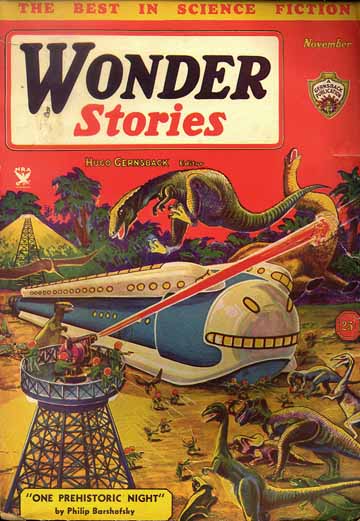
Given the prominence of the story title on the cover, it looks like that Wonder Stories art (in #1 above) may be an illustration of the story.
7RandyStafford
Vintage from Atlantis for me. (I've read the last two stories. I just haven't had anything at all to add to the discussions.)
8AndreasJ
Read it out of A Vintage from Atlantis a while ago. Yes, the WS cover would appear to be a depiction of a scene from the story.
9housefulofpaper
Yet another for A Vintage from Atlantis here.
10artturnerjr
Broke down and coughed up two bucks for an eBook called The Ultimate Weird Tales Collection (which I'd been eyeballing anyway) so I could read this (as well as other CAS goodness) on my Kindle.
>4 elenchus:
Online for me, as per usual, thanks to KentonSem and artturnerjr for keeping this an option!
Glad to be of service. :)
>6 paradoxosalpha: ff.
I'm very fond of the cover, as I am of the numerous covers that Frank R. Paul did for Wonder Stories. Here's another favorite of mine (which was repurposed for the cover of the great Prentice Hall Anthology of Science Fiction and Fantasy):
>4 elenchus:
Online for me, as per usual, thanks to KentonSem and artturnerjr for keeping this an option!
Glad to be of service. :)
>6 paradoxosalpha: ff.
I'm very fond of the cover, as I am of the numerous covers that Frank R. Paul did for Wonder Stories. Here's another favorite of mine (which was repurposed for the cover of the great Prentice Hall Anthology of Science Fiction and Fantasy):
12artturnerjr
An evil train, dinosaurs, and a laser cannon - what more could one possibly want? :D
13paradoxosalpha
I don't see a track. I think that's a flying vehicle that has landed (on the poor little dinos).
14elenchus
I noticed the lack of track, too, but still thought of it as a land vehicle / hovercar, sort of a train function but for areas without tracks. But now you say it, spaceship seems more likely.
15gwendetenebre
Definitely landed carelessly on the dinos. The spaceship, while not rail-bound, is obviously a distant descendant of Thomas the Tank Engine.
16artturnerjr
So does anybody here actually have (or have access to) the story ("One Prehistoric Night" by Philip Barshofsky*) that this is illustrating? I'd be very interested to find out wtf is actually going on here now!
* http://www.isfdb.org/cgi-bin/title.cgi?87415
* http://www.isfdb.org/cgi-bin/title.cgi?87415
17housefulofpaper
>16 artturnerjr:
Frustratingly, I may have done a couple of weeks ago. The Oxfam bookshop had a couple of volumes of Mike Ashley's The History of the Science Fiction Magazine.
Frustratingly, I may have done a couple of weeks ago. The Oxfam bookshop had a couple of volumes of Mike Ashley's The History of the Science Fiction Magazine.
18artturnerjr
Paul's interior art for "The Invisible City":
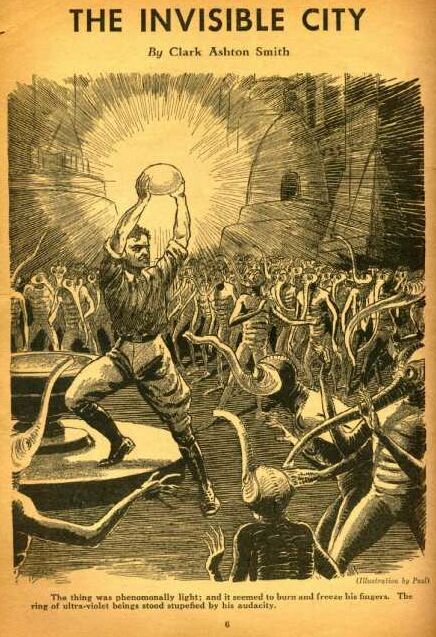
There's a brief article on CAS stories illustrated by Paul (with some wonderful high quality scans of those illustrations) here:
http://www.gwthomas.org/casmithsf.htm
There's a brief article on CAS stories illustrated by Paul (with some wonderful high quality scans of those illustrations) here:
http://www.gwthomas.org/casmithsf.htm
19gwendetenebre
>18 artturnerjr:
Thanks for posting that link, Art. I was unfamiliar with his work until now, but there is something enthralling about Paul's artwork, even down to the "strangely unimportant humans"!
Thanks for posting that link, Art. I was unfamiliar with his work until now, but there is something enthralling about Paul's artwork, even down to the "strangely unimportant humans"!
20artturnerjr
>19 gwendetenebre:
Yeah, I like it quite a bit. Not as much to my taste as Finlay, Bok, or Brundage, but it is quite striking.
Yeah, I like it quite a bit. Not as much to my taste as Finlay, Bok, or Brundage, but it is quite striking.
21paradoxosalpha
I have to say, this might be one of my least favorites of the CAS stories I've read. Characterization was clearly not at a premium here, with the expedition reduced to two survivors in order to avoid any burden of social detail, and those two so peevish and weary as to only communicate with each other before and after the adventure proper. It was as if there were two of them only so that each might objectively observe the other in the interactions with the mysterious environment and its denizens.
There were certainly exotic situations and events, but they just seemed gratuitous. The "happy" ending was also somewhat jarring, and I couldn't help but wonder if it was done to satisfy Gernsback, with CAS exacting a subtle payback in the self-referential quip: "the whole business would be too fantastic, outside of a super-scientific story."
There were certainly exotic situations and events, but they just seemed gratuitous. The "happy" ending was also somewhat jarring, and I couldn't help but wonder if it was done to satisfy Gernsback, with CAS exacting a subtle payback in the self-referential quip: "the whole business would be too fantastic, outside of a super-scientific story."
22AndreasJ
Sketchy characterization is common enough in CAS. It's perhaps extra apparent here because the exotic elements are less dazzling than in his better tales.
23elenchus
Funny you mention Gernsback, I'd noticed his name on the "masthead" of both covers featured above, but didn't make the further supposition his editorial fiat might extend into the story itself.
I also found this unexcitingly told. More in line with Indiana Jones and the Ark of the Covenant, especially in that Paul illustration, than with horror. It has the elements, to be sure: beings from outside our galaxy, the domesticated vampire, a mysterious city. But too many aspects worked against any experience of horror, primarily the seeming lack of menace on the part of the aliens. I suppose that could be another variety of cosmic indifference! "Leave us alone, we're happy living here and will leave you alone, so long as you humans leave us alone."
I also found this unexcitingly told. More in line with Indiana Jones and the Ark of the Covenant, especially in that Paul illustration, than with horror. It has the elements, to be sure: beings from outside our galaxy, the domesticated vampire, a mysterious city. But too many aspects worked against any experience of horror, primarily the seeming lack of menace on the part of the aliens. I suppose that could be another variety of cosmic indifference! "Leave us alone, we're happy living here and will leave you alone, so long as you humans leave us alone."
24paradoxosalpha
>22 AndreasJ:
Oh, I agree. Complex character is not what I expect from CAS. But these guys were plainly such place-holders. I would contrast, say, "The Tale of Satampra Zeiros," where I could at least care if they lived or died. In this case, I was just sort of vaguely disappointed that they lived.
Oh, I agree. Complex character is not what I expect from CAS. But these guys were plainly such place-holders. I would contrast, say, "The Tale of Satampra Zeiros," where I could at least care if they lived or died. In this case, I was just sort of vaguely disappointed that they lived.
25paradoxosalpha
>23 elenchus:
The more I reflect on it, the more I seem to detect authorial resentment in this story. "Hugo the Rat" could be the real menace!
The more I reflect on it, the more I seem to detect authorial resentment in this story. "Hugo the Rat" could be the real menace!
26elenchus
And if Hugo the Rat does lurk behind the story, I further wonder whether (a) CAS pragmatically considered this story a workaday cash-raising effort, and/or (b) whether other drafts exist which would be more to CAS's liking.
ETA Some corroboration from Collected Fantasies of CAS: A Vintage From Atlantis, edited by Scott Connors & Ron Hilger:
For (a): Editors note it was accepted by David Lasser, and Ione Weber (?) "was eventually able to extract sixty-five dollars for it from Gernsback's purse." They quote a CAS letter, "Smith called the story 'a hunk of tripe'. Also, "Smith probably didn't know it, but it appears Gernsback sold the foreign language rights to his story" to a German publication. Smith later sold the story to the British Tales of Wonder.
Also, "Despite his unpleasant experience with "The Invisible City", Smith found the two cents a word paid by the Clayton magazines as alluring as any pilgrim to Ydmos found the call of the Singing Flame."
For (b): "CAS worked on "The Empire of the Necromancers" at the same time as, and possibly an antidote to, "The Invisible City" and "The Immortals of Mercury". (Entry for "The Empire of the Necromancers") Finally, Connors & Hilger reference a second outline of "The Invisible City" but I am limited by my Google Books "peek" into the content, so no detail on any outline.
ETA Some corroboration from Collected Fantasies of CAS: A Vintage From Atlantis, edited by Scott Connors & Ron Hilger:
For (a): Editors note it was accepted by David Lasser, and Ione Weber (?) "was eventually able to extract sixty-five dollars for it from Gernsback's purse." They quote a CAS letter, "Smith called the story 'a hunk of tripe'. Also, "Smith probably didn't know it, but it appears Gernsback sold the foreign language rights to his story" to a German publication. Smith later sold the story to the British Tales of Wonder.
Also, "Despite his unpleasant experience with "The Invisible City", Smith found the two cents a word paid by the Clayton magazines as alluring as any pilgrim to Ydmos found the call of the Singing Flame."
For (b): "CAS worked on "The Empire of the Necromancers" at the same time as, and possibly an antidote to, "The Invisible City" and "The Immortals of Mercury". (Entry for "The Empire of the Necromancers") Finally, Connors & Hilger reference a second outline of "The Invisible City" but I am limited by my Google Books "peek" into the content, so no detail on any outline.
27gwendetenebre
>26 elenchus:
To elaborate just a tiny bit, in Vintage Connors & Hilger state, "Smith called the story a “hunk of tripe”, although Lovecraft praised it as “vivid & ingenious in the extreme - & with enough ‘eckshun’ to please the most exacting clientele”.
I think Grandpa is a bit off the mark. This is sub-par CAS.
To elaborate just a tiny bit, in Vintage Connors & Hilger state, "Smith called the story a “hunk of tripe”, although Lovecraft praised it as “vivid & ingenious in the extreme - & with enough ‘eckshun’ to please the most exacting clientele”.
I think Grandpa is a bit off the mark. This is sub-par CAS.
28artturnerjr
I found this to be an enjoyable if unspectacular CAS science fantasy effort; certainly he's done stuff in this vein that's much more awe-inspiring than this (e.g., the previously alluded to "City of the Singing Flame"*). I think, for better or worse, there's more than a hint of HPL's influence in this tale: consider both the "piping of some unearthly flute" heard by Langley and Furnham and the monster with "a huge, invertebrate body, formed like an elongated starfish, with the points ending in swollen tentacular limbs".
>21 paradoxosalpha:
I thought that line was an amusing metafictional touch.
* http://www.eldritchdark.com/writings/short-stories/26
>21 paradoxosalpha:
I thought that line was an amusing metafictional touch.
* http://www.eldritchdark.com/writings/short-stories/26
29housefulofpaper
When I was reading nothing but science fiction, from about age 11 or 12 to my early 20s, I pretty much read from Asimov onwards. Of course that was largely determined by what happened to be available in the bookshops, but I also had a sense of the antique from those earlier stories. This was something to do with Asimov's praise for John W Campbell's editorial principles (as per the biographical passages in his later short story collections) but also a sense of the antique from reproductions of original art from the pulps - especially the black and white interior illustrations. I had quite an antipathy to the past back then, and a naïve hope that we'd be enjoying a "jet pack" future by now. The idea of Steampunk would have struck me as a grotesque heresy, I think. Well, people change, and the future certainly isn't what it used to be.
One of my main sources for these images was a book (published in Britain in 1976) called A Pictorial History of Science Fiction by David A Kyle (who I recently learned was involved with the Gnome Press in the '50s). Interestingly, the illustrator with the greatest number of mentions in the book's index is none other than Frank R Paul.
All of which is to try to put my responses to this story in context. Although I haven't read a great deal of pre-1940s Science Fiction (leaving aside Verne, Wells, and some more recent reading of borderline SF "Weird" authors), I did get a sense that CAS was trying to write for a particular market instead of "following his muse" (the notes in the Night Shade Books volume back this up of course). It's entertaining enough but nowhere near his best work.
I was struck by the thought that this rather hoary strain of Science Fantasy has been resurrected in film and TV in recent years, with the ability of CGI to render pretty much any visual effect, without the filmmakers having to worry about it actually obeying the laws of physics.
One of my main sources for these images was a book (published in Britain in 1976) called A Pictorial History of Science Fiction by David A Kyle (who I recently learned was involved with the Gnome Press in the '50s). Interestingly, the illustrator with the greatest number of mentions in the book's index is none other than Frank R Paul.
All of which is to try to put my responses to this story in context. Although I haven't read a great deal of pre-1940s Science Fiction (leaving aside Verne, Wells, and some more recent reading of borderline SF "Weird" authors), I did get a sense that CAS was trying to write for a particular market instead of "following his muse" (the notes in the Night Shade Books volume back this up of course). It's entertaining enough but nowhere near his best work.
I was struck by the thought that this rather hoary strain of Science Fantasy has been resurrected in film and TV in recent years, with the ability of CGI to render pretty much any visual effect, without the filmmakers having to worry about it actually obeying the laws of physics.
30elenchus
>29 housefulofpaper:
Your adolescent reading history fairly describes my own, down to that antipathy for the antique. (Like you, my views have shifted somewhat in the interim.) In any event, yours is an interesting conjecture that CAS might have been writing for a particular market or even subgenre. It suggests that however much "tripe" the story held, nevertheless CAS could have come to the story with a measure of commemoration.
Your adolescent reading history fairly describes my own, down to that antipathy for the antique. (Like you, my views have shifted somewhat in the interim.) In any event, yours is an interesting conjecture that CAS might have been writing for a particular market or even subgenre. It suggests that however much "tripe" the story held, nevertheless CAS could have come to the story with a measure of commemoration.
32AndreasJ
>31 artturnerjr: Your link doesn't work, for me right now at least.
If continuing the tangent be excused, I too read a lot of SF in my teens, and due to the nature of the collections of my father and the city library, most of it was stuff written before I was born. The retro-ness mostly went above my head at the time, but reading more modern stuff I can still today find myself feeling the future should be more like the fifties.
If continuing the tangent be excused, I too read a lot of SF in my teens, and due to the nature of the collections of my father and the city library, most of it was stuff written before I was born. The retro-ness mostly went above my head at the time, but reading more modern stuff I can still today find myself feeling the future should be more like the fifties.
33artturnerjr
>32 AndreasJ:
It's from Clark Ashton Smith: A Critical Guide to the Man and His Work, Second Edition by Steve Behrends. Behrends is writing about science fiction stories of CAS' that represent "concessions to the demands of his editors". He writes:
Such stories include "The Immortals of Mercury", "The Invisible City", "The Dimension of Chance", and "An Adventure in Futurity". Smith acknowledged that some of these pieces bordered on hackwork, that many were slanted for a quick sale to a particular editor ("An Adventure in Futurity", "The Dimension of Chance", and "Seedling of Mars" were actually written to order). Much less space is devoted to the creation of place and atmosphere in these tales. Alien characters are usually strange-featured humanoids with the ability to communicate telepathically with the human characters; they are concessions to plot, and serve to expedite 'the action'. As in all of Smith's science fiction, the scientific element is restricted to no more than the use of certain 'buzzwords' and catch-phrases ("magnetic", "dynamo", "ultra-cosmic rays", etc.), but science and gadgetry generally play more prominent roles in these stories.
It's from Clark Ashton Smith: A Critical Guide to the Man and His Work, Second Edition by Steve Behrends. Behrends is writing about science fiction stories of CAS' that represent "concessions to the demands of his editors". He writes:
Such stories include "The Immortals of Mercury", "The Invisible City", "The Dimension of Chance", and "An Adventure in Futurity". Smith acknowledged that some of these pieces bordered on hackwork, that many were slanted for a quick sale to a particular editor ("An Adventure in Futurity", "The Dimension of Chance", and "Seedling of Mars" were actually written to order). Much less space is devoted to the creation of place and atmosphere in these tales. Alien characters are usually strange-featured humanoids with the ability to communicate telepathically with the human characters; they are concessions to plot, and serve to expedite 'the action'. As in all of Smith's science fiction, the scientific element is restricted to no more than the use of certain 'buzzwords' and catch-phrases ("magnetic", "dynamo", "ultra-cosmic rays", etc.), but science and gadgetry generally play more prominent roles in these stories.
35artturnerjr
>34 housefulofpaper:
No problem. That book sounds fascinating - I am seriously considering buying it!
No problem. That book sounds fascinating - I am seriously considering buying it!
36RandyStafford
A couple of reactions.
First, I wonder if CAS was inspired by Colonel Fawcett's quest for the Lost City of Z in 1925. On the other hand, that was South America and not Asia. And the pulps were full of lost cities and lost races.
Second, this story seemed like a dry run for the opposite and later "The Dweller in the Gulf". It's set on Earth and not Mars. Instead of Stygian darkness, we have an invisible city fully exposed to sun and moon. We have an alien cult clustered around a central entity in both stories. Our heroes escape rather than remain imprisoned.
>27 gwendetenebre:. This is sub-par CAS. I could have particularly done without the lame "degravitation" at the end. It would have been better with just presenting the visual wonders of the city's demise rather than layer on the science babble. If I'm right about some sort relation between this and "The Dweller in the Gulf", CAS certainly tightened up his prose too.
Now that I think of it, I think it would have been better if CAS would have gone for some sort of symbolic reason why the city was visible in moon but not sunlight rather than the scientific handwaving.
First, I wonder if CAS was inspired by Colonel Fawcett's quest for the Lost City of Z in 1925. On the other hand, that was South America and not Asia. And the pulps were full of lost cities and lost races.
Second, this story seemed like a dry run for the opposite and later "The Dweller in the Gulf". It's set on Earth and not Mars. Instead of Stygian darkness, we have an invisible city fully exposed to sun and moon. We have an alien cult clustered around a central entity in both stories. Our heroes escape rather than remain imprisoned.
>27 gwendetenebre:. This is sub-par CAS. I could have particularly done without the lame "degravitation" at the end. It would have been better with just presenting the visual wonders of the city's demise rather than layer on the science babble. If I'm right about some sort relation between this and "The Dweller in the Gulf", CAS certainly tightened up his prose too.
Now that I think of it, I think it would have been better if CAS would have gone for some sort of symbolic reason why the city was visible in moon but not sunlight rather than the scientific handwaving.

