This topic is currently marked as "dormant"—the last message is more than 90 days old. You can revive it by posting a reply.
1CassieBash
Welcome! This is a continuation of my first post on my caterpillars, which covered the 5/12ths of the calendar year. Now that June has started, I expect to have daily posts, and possibly very long ones. June is the true start of the butterfly season in northwest Indiana, with monarchs and other transients arriving and the local populations working hard to start their first generations, and the past couple of days has showed a lot of promise for the rest of the season!
First, not really much to update regarding yesterday; I was in Muncie all day and wasn't home to go a-hunting for caterpillars. No hatchlings, but I honestly didn't expect there to be, since it was cold and damp. And cold. Like 57 degrees was our high cold. But warmer temps are on their way. The only change was that the elm-eating caterpillar I collected on Saturday didn't make it--not to be gross, but he voided his insides until he was pretty much empty. Disease? Parasites? No way of knowing, as I removed him immediately and cleaned the container. I'm not into doing caterpillar autopsies. Everyone else seems to be fine.
Now, on to what everyone really wants--pictures! I promised, so I will deliver. Here is the former lid to the tank of large red admiral larva, that I switched out with an empty (at the time--empty no longer!) lid from a second, same-sized terrarium. The top right chrysalis that looks so dark is a cat that just made the chrysalis and the pupa was still soft and moist. It's since hardened and lightened in color and looks like all the rest.

This is a picture of the crocus geometer's pupa, with all the leaves peeled back. Sometimes, when they use fresh leaves to make a cocoon like this one did, the leaves die and shrivel away from the actual pupa, leaving it exposed. This one is extra-pretty, with a sort of yellow-green color mixed in with the dark brown/black.

Here's the inchworm I found on the sunflower, the one I suspect is a variable antepione.

And this is the horned spanworm, a type of filament bearer.

First, not really much to update regarding yesterday; I was in Muncie all day and wasn't home to go a-hunting for caterpillars. No hatchlings, but I honestly didn't expect there to be, since it was cold and damp. And cold. Like 57 degrees was our high cold. But warmer temps are on their way. The only change was that the elm-eating caterpillar I collected on Saturday didn't make it--not to be gross, but he voided his insides until he was pretty much empty. Disease? Parasites? No way of knowing, as I removed him immediately and cleaned the container. I'm not into doing caterpillar autopsies. Everyone else seems to be fine.
Now, on to what everyone really wants--pictures! I promised, so I will deliver. Here is the former lid to the tank of large red admiral larva, that I switched out with an empty (at the time--empty no longer!) lid from a second, same-sized terrarium. The top right chrysalis that looks so dark is a cat that just made the chrysalis and the pupa was still soft and moist. It's since hardened and lightened in color and looks like all the rest.

This is a picture of the crocus geometer's pupa, with all the leaves peeled back. Sometimes, when they use fresh leaves to make a cocoon like this one did, the leaves die and shrivel away from the actual pupa, leaving it exposed. This one is extra-pretty, with a sort of yellow-green color mixed in with the dark brown/black.

Here's the inchworm I found on the sunflower, the one I suspect is a variable antepione.

And this is the horned spanworm, a type of filament bearer.


3qebo
>1 CassieBash: what everyone really wants--pictures!
Yes! June is looking fun!
Yes! June is looking fun!
4CassieBash
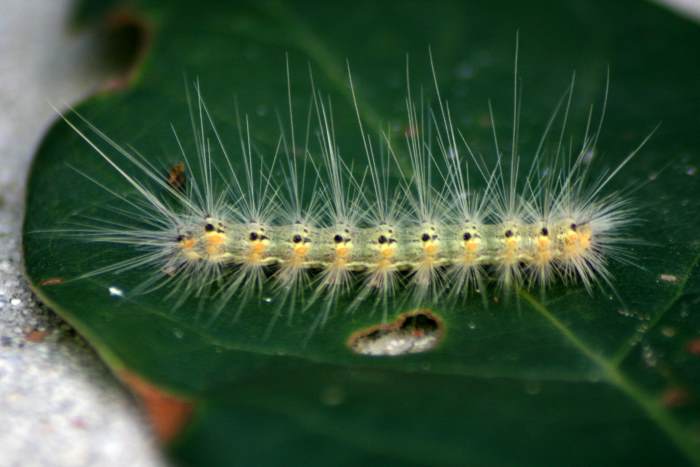
>2 fuzzi: Was it well-furred all over or was most of the hair the long wisps? If thickly furred in addition to the longer hairs, I initially think it could be a yellow bear, or Virginian tiger moth, not to be confused with the virgin tiger from the previous thread's post. The long hairs are distinctive and my print guides are a bit limited on specific species with this feature but Wagner's Caterpillars of Eastern North America seems to point towards the tiger and wasp moth family (Arctiinae) as having members with long hairs like that. They come in a wide variety of colors, not just yellow, so the orangish cast isn't necessarily knocking the "yellow" bear out of the running.
5fuzzi
>4 CassieBash: thanks! I looked on bugguide.net, and think it might be a Hyphantria cunea, Fall Webworm moth. You can't see the spots and the orange 'tubercles' in the photo I posted, but I can see them in another less focused photo I took, but did not post.
The description at bugguide fits, with the southern variety: southern larvae have orange or reddish head, yellowish-tan body with orange to reddish tubercles and brownish hair. Wagner(1) lists extremely long hairs, "greater in length than four or five body segments," as an identifying characteristic. See http://bugguide.net/node/view/453 .
The description at bugguide fits, with the southern variety: southern larvae have orange or reddish head, yellowish-tan body with orange to reddish tubercles and brownish hair. Wagner(1) lists extremely long hairs, "greater in length than four or five body segments," as an identifying characteristic. See http://bugguide.net/node/view/453 .
6CassieBash
>5 fuzzi: Well, I was in the same family--webworms do fall into Arctiinae. Much of my problem is that when I'm at home, I'm forced to use an iPhone screen and there's only so much detail that comes through, even if you "expand" the picture. (Sometimes that makes it even worse!) That's why I asked about the amount of hair. I also forget how much further south you are! ;)
7fuzzi
>6 CassieBash: oh, I'm not sure I'm correct on this one. I've put in an ID request at bugguide.net. You should be able to view all three photos here: http://bugguide.net/node/view/1077357. :)
8CassieBash
>7 fuzzi: Identifying caterpillars definitely takes equally large amounts of patience and research. And even then you won't necessarily be able to figure it out. For instance, I just submitted a "sighting" to Butterflies And Moths Of North America (BAMONA) site for the Crocus Geometer, and when I went to Google the scientific name (their preference for picture name is Genus-species and then whatever description, including your name, you want to use), I discovered that my Crocus Geometer is, in fact, more likely to be a False Crocus Geometer. To complicate matters, there's a third similar species known as the Rufous Geometer, though looking at the pictures I took of the adult geometer and comparing it to the darker, less yellow more red-brown rufous, you could easily dismiss that possibility. My fellow is definitely a bright and lovely buttery yellow with little of the red-brown markings. Still--what an ordeal. Oy-vay!
Oh, by the way, the "Crocus" Geometer hatched last night--the most interesting thing that happened yesterday. That, and I actually caught the horned spanworm eating. Every time I looked in on him, he'd just be sitting there. I know he's been eating, because of the frass (caterpillar poo). Here are pics (of the geometer, not the frass):

Look at that little face! Isn't he just so cute!

These are the photos I submitted to BAMONA, thus the copyright statement--they want that added to each pic I upload, so you may be seeing more of those. Just an FYI for those wondering why I've started putting a copyright statement on my pics.
I'm hoping the haploas will be next to hatch, and maybe an admiral or two.
Oh, by the way, the "Crocus" Geometer hatched last night--the most interesting thing that happened yesterday. That, and I actually caught the horned spanworm eating. Every time I looked in on him, he'd just be sitting there. I know he's been eating, because of the frass (caterpillar poo). Here are pics (of the geometer, not the frass):

Look at that little face! Isn't he just so cute!

These are the photos I submitted to BAMONA, thus the copyright statement--they want that added to each pic I upload, so you may be seeing more of those. Just an FYI for those wondering why I've started putting a copyright statement on my pics.
I'm hoping the haploas will be next to hatch, and maybe an admiral or two.
10CassieBash
>9 fuzzi: I have a friend on Facebook who takes wonderful pictures and is a member of our local art gallery. She sometimes posts pics to FB, and they do often have her watermark, but this one guy took her pic, cropped out the watermark, and used it as his profile picture. (Apparently, he'd "stolen" a lot of other photos, as several people lodged the same complaint to FB about him. He denies he's done it, apparently.) I know some people do a watermark that runs diagonally across the picture but that would so spoil the look, both for BAMONA and for you guys, that I think the copyright in the corner is sufficient for me. Of course, I'm also not trying to sell my pictures in the art gallery, either!
11fuzzi
>10 CassieBash: I'm not trying to sell my photos, either, but I wouldn't appreciate someone re-posting one of mine and claiming it for his/her own.
How do you watermark/copyright your pictures?
How do you watermark/copyright your pictures?
12CassieBash
>11 fuzzi: Well, for official copyright registration, you have to pay the government, of course! :) But seriously, the law says that once the work is in a fixed and tangible form, it's automatically copyrighted. Most people don't know or choose to ignore that when they share other people's pictures freely, like the FB guy above. Digital works are so easy to share. How I did it was I used a simple graphic editor--even Microsoft Paint will work--to make a text box and add the text. You can usually pick a color, it doesn't have to be black, so that the letters will show up on dark backgrounds if need be. Some may not include the copyright symbol as an option; if this is the case, use a text editor and copy/paste. I used Word but that's just because Word and Paint are already on my computer. As I said, it's not fool-proof, because anyone who can download the picture can use a graphic editor to crop out the copyright statement, but it takes a little time and effort and some, probably most, people won't bother. Like you, I don't mind the sharing so much as long as it's sharing and not stealing. So for anyone who wants to share these photos, I give permission as long as you leave my copyright statement on there, thanks.
14CassieBash
Today was quite eventful! I had my first red admiral hatch today! Possibly more exciting--my little (and I do mean little) horned spanworm made a tiny cocoon! He's going to be one small moth when he emerges! His larger inchworm companion is still eating and growing. I still have at least three distinct clover-eating species, and a couple of hackberry lovers--just not the distinctively horned larva of the tawny emperor or the hackberry butterfly, both of which I've raised in previous years. Sadly, I haven't seen any for a few years now; my last year I raised them was a heavy parasite year. They could be eating higher up in the tree, though.
I may take some "inventory" pictures this weekend of some of the species I have yet to chronicle visually, such as my clover eaters. I also am thinking of taking my ruler out and taking a pic of a couple of my smaller pupae along the top so you can get a good idea of scale. Aside from the spanworm, I have a tiny cocoon or two of a species similar, if not identical, to one of the clover eaters. I'm not sure as I haven't officially compared them, but my minuscule mystery moth pupa may even be smaller than the spanworm pupa!
Out of curiosity, how many of you out there reading this have ever raised a caterpillar? I know fuzzi (or was it qebo?--forgive me for my memory lapse, please) shared stories about raising monarchs. Anyone else?
I may take some "inventory" pictures this weekend of some of the species I have yet to chronicle visually, such as my clover eaters. I also am thinking of taking my ruler out and taking a pic of a couple of my smaller pupae along the top so you can get a good idea of scale. Aside from the spanworm, I have a tiny cocoon or two of a species similar, if not identical, to one of the clover eaters. I'm not sure as I haven't officially compared them, but my minuscule mystery moth pupa may even be smaller than the spanworm pupa!
Out of curiosity, how many of you out there reading this have ever raised a caterpillar? I know fuzzi (or was it qebo?--forgive me for my memory lapse, please) shared stories about raising monarchs. Anyone else?
16qebo
>14 CassieBash: Only monarchs, and only last year. I've cultivated black swallowtails on the dill/fennel/parsley for several years, but they are essentially in the wild, left to their own devices. I look forward to "inventory" photos.
17CassieBash
>16 qebo: OK, I remembered it was one of you, just not which.
I know a lot of elementary teachers raise monarchs. They're the easiest ones to raise (especially if you only do one or two, instead of going crazy like me and trying to raise the entire next generation!) They're also fast-growing and because of their well-known migratory habit, you know you won't have to keep them over the winter. Here's Monarch Watch's guide to rearing monarchs. I personally don't like keeping monarchs (or any other lepidoptera) any longer than possible, so the section on keeping adults for me is only on the rare occasions when I have a perfectly formed but weak adult emerge. It's rare, but I've had it happen. This page is how I got brave enough to rear monarchs (and later swallowtails) from eggs, though I found that the moist towel thing doesn't work as well as just adding small segments of fresh leaf to keep the humidity right. Moist towels just seem to promote mold growth. I also use much bigger containers than they show due to the larger numbers of caterpillars I collect. I used to use big coffee cans but haven't done that for a couple of decades now--once I was home from college and had a job, I could spend money on large terrariums. Nothing but the best for my cats! :)
Well, for all you visual aid lovers, here are the pics to go with post >14 CassieBash:.
My first red admiral hatchling, still "behind bars". It was ready to fly so I figured this might be the only way I'd get a picture of it.

I was right; it was the only way I got a picture of it. I tried to get one, but this is all I got--it flew right before the camera clicked the pic. The funky-colored chrysalis that's circled in red is a brand-new one; it'll get the pale grey color as its new skin dries and hardens.

This image gives you a slightly better idea of the spanworm pupa's scale. The arrow is pointing to the "inchworm companion" mentioned above, pretending to be a stick. The inchworm may be about 2 - 2 1/2 inches long. The little grey and brown thing with the crooked "tail" below it is the spanworm's pupa, and below that are the round balls of frass from the inchworm. The light brown pointed stick sitting between the caterpillar and the pupa is a wooden skewer that they sell as wooden shish-ka-bob skewers, and that I use to help anchor chrysalises when caterpillars use leaves instead of the top or sides of the terrariums--I skewer the leaf carefully so as to disturb the chrysalis as little as possible. It helps to keep them in a vertical position, and lets me remove old food plants. The leaves in the picture, by the way, are larger elm leaves. So there are several frames of reference there. I must remember to take my ruler out to the barn!

Yesterday morning at work, I saw this beautiful beetle on the college's sidewalk, and decided to move him to a safer location. But not before I took a picture, of course! It's definitely a member of the scarab beetle family--Edgar Allan Poe's "The Gold Bug", anyone?

And this morning when I got to work, I saw this delicate beauty of a moth on our doors. Since it's Friday and there are no classes scheduled, she's probably safe where she is. Faculty/staff are pretty good here about leaving nature alone, and the founding Sisters (Poor Handmaids of Jesus Christ) are environmentally conscious. Honestly, the reflection selfie is not the focus of the picture!

I know a lot of elementary teachers raise monarchs. They're the easiest ones to raise (especially if you only do one or two, instead of going crazy like me and trying to raise the entire next generation!) They're also fast-growing and because of their well-known migratory habit, you know you won't have to keep them over the winter. Here's Monarch Watch's guide to rearing monarchs. I personally don't like keeping monarchs (or any other lepidoptera) any longer than possible, so the section on keeping adults for me is only on the rare occasions when I have a perfectly formed but weak adult emerge. It's rare, but I've had it happen. This page is how I got brave enough to rear monarchs (and later swallowtails) from eggs, though I found that the moist towel thing doesn't work as well as just adding small segments of fresh leaf to keep the humidity right. Moist towels just seem to promote mold growth. I also use much bigger containers than they show due to the larger numbers of caterpillars I collect. I used to use big coffee cans but haven't done that for a couple of decades now--once I was home from college and had a job, I could spend money on large terrariums. Nothing but the best for my cats! :)
Well, for all you visual aid lovers, here are the pics to go with post >14 CassieBash:.
My first red admiral hatchling, still "behind bars". It was ready to fly so I figured this might be the only way I'd get a picture of it.

I was right; it was the only way I got a picture of it. I tried to get one, but this is all I got--it flew right before the camera clicked the pic. The funky-colored chrysalis that's circled in red is a brand-new one; it'll get the pale grey color as its new skin dries and hardens.

This image gives you a slightly better idea of the spanworm pupa's scale. The arrow is pointing to the "inchworm companion" mentioned above, pretending to be a stick. The inchworm may be about 2 - 2 1/2 inches long. The little grey and brown thing with the crooked "tail" below it is the spanworm's pupa, and below that are the round balls of frass from the inchworm. The light brown pointed stick sitting between the caterpillar and the pupa is a wooden skewer that they sell as wooden shish-ka-bob skewers, and that I use to help anchor chrysalises when caterpillars use leaves instead of the top or sides of the terrariums--I skewer the leaf carefully so as to disturb the chrysalis as little as possible. It helps to keep them in a vertical position, and lets me remove old food plants. The leaves in the picture, by the way, are larger elm leaves. So there are several frames of reference there. I must remember to take my ruler out to the barn!

Yesterday morning at work, I saw this beautiful beetle on the college's sidewalk, and decided to move him to a safer location. But not before I took a picture, of course! It's definitely a member of the scarab beetle family--Edgar Allan Poe's "The Gold Bug", anyone?

And this morning when I got to work, I saw this delicate beauty of a moth on our doors. Since it's Friday and there are no classes scheduled, she's probably safe where she is. Faculty/staff are pretty good here about leaving nature alone, and the founding Sisters (Poor Handmaids of Jesus Christ) are environmentally conscious. Honestly, the reflection selfie is not the focus of the picture!

18MarthaJeanne
I saw an article recently about an 'artist' who downloads other peoples' pictures, prints them, frames them and sells them for big money. (5-6 digit dollar amounts) without even mentioning who actually took the picture.
19CassieBash
>18 MarthaJeanne: And s/he gets away with it?! Are there lawsuits pending against him/her?! I'm the "copyright guru" at the college here and while there are specific times when I think copyright laws are crazy (mostly dealing with educational aspects), this is a clear-cut case of infringement. You do NOT copy and print and sell other people's work! However, I can't say I'm completely shocked. My younger sister is an artist--she's actually down in an art fair in Kentucky this weekend--and she's had people wanting to take photos of her work, and she knows they want to print it themselves without buying it. Apparently, at one fair, this lady was kicked out of more than one booth for taking excessive photos of various artists' works.
20NorthernStar
>18 MarthaJeanne: that takes a lot of nerve! Good reason to add a watermark, and to post low resolution photos in public online places.
21CassieBash
>First, you'll all be excited to know that I've begun taking inventory pics and will be going through them to try to ID what species I have (or at least, may have). I'm glad I didn't wait any longer since I caught one of the clover eaters starting to pupate, though unfortunately I think one already has, so I'll have to wait for the adult to emerge on that one. I still have a couple of individuals still eating--they have distinctive facial stripes so I'm hoping to match them to a species ID. My inchworm has also may be planning to cocoon, as he's knitting the paper towel lining and elm leaves together. The cat eating the lambs quarters isn't one I've raised before--it's not a skipper but, if I had to guess, it's likely a moth larva. I have at least 2 different species and maybe 3 eating hackberry right now. While unnecessary I did snap a pic of an admiral chrysalis beginning to show signs of hatching--I can just see the hint of the wing color showing through. I'll be sure to post on Tuesday when I have Internet and am back from my day off on Monday.
Yesterday's update: I had two more admirals hatch, a few more admiral deaths. Lots are successfully making it into chrysalis stage though. The number of smaller larvae is finally noticeably smaller, so I think the break between generations is coming up. No other activity, either in collecting or in other species hatchlings. I'm eagerly awaiting my first monarch sighting.
Yesterday's update: I had two more admirals hatch, a few more admiral deaths. Lots are successfully making it into chrysalis stage though. The number of smaller larvae is finally noticeably smaller, so I think the break between generations is coming up. No other activity, either in collecting or in other species hatchlings. I'm eagerly awaiting my first monarch sighting.
22fuzzi
I enjoyed the pics and the updates. :)
>20 NorthernStar: I usually resize my photos before posting, to about 500 (mb?) so they also email well. I don't know if that helps discourage would-be thieves. If they steal, there are repercussions, even if they're not caught.
>20 NorthernStar: I usually resize my photos before posting, to about 500 (mb?) so they also email well. I don't know if that helps discourage would-be thieves. If they steal, there are repercussions, even if they're not caught.
23CassieBash
Apologies for what's going to be an extra-long post, but I've been spending less time with LT and more with the caterpillars, horses, cats, dogs, and plants.
Whew, what an intense past 2 days! We spent all of Saturday and half of Sunday prepping for Sunday's big incoming storms, with the predictions of heavy rains (up to 2 inches expected), high winds (in excess of 60 mph) and potential hail (1 inch diameter). Fortunately, the storms weakened a lot by the time they made it into our area, though the county west of us did have an EF1 tornado touch down and it did quite a bit of damage to trees and property. We saw no hail, none of the strong winds, but the heavy rain (yep, we got our 2 inches out of that) did flatten down some of our plants temporarily. The only true damage was a small limb that broke free from one of our American elms, which is sick and weak anyway. (We've decided no more American elms--hackberry elm trees are much hardier and seem resistant to whatever disease--Dutch elm or something else--is effecting the Americans.) Yesterday afternoon we had another round of storms come through, this time with some hail, but very little and only pea-sized at best. But we did get another 1 1/4 inches of heavy rain, bringing our total for the two days to a whopping 3 1/4 inches!
All that running around doing storm prep has set me behind in my postings, so this is going to be a big catch-up post as well as the promised inventory. First, you’ll all be happy to hear that parasite deaths have dwindled to almost none now, though there are still some other deaths that I think may be due to other issues—possibly disease? At least 2 cats died by spider—I found the little blighter in the larger tank and it took me a good 5 minutes or so to “chase” him out using dead twigs fallen from the hackberry. He knew he had a good thing going and did NOT want to leave! Grrr!! I look for them and even hold the cut stems upside down and give them a shake to theoretically dislodge hidden predators, but insects and spiders are good at clinging so even this isn’t 100% effective. However, the number of deaths from the past three days is nothing compared to the number of hatchlings—22 total red admiral hatchings for the past 3 days, and every one of them healthy, strong, and perfect in every way! Yesterday was the biggest number of hatchings in one day this season, with a whopping 15 red admirals hatched, as you can see if you look carefully at this picture. Most have their wings closed and are a bit tricky to see.

This fellow is getting ready to hatch out; if you look carefully, you can see the colors of the wings developing underneath. He was one of five that hatched out Saturday.

This one is likely one of my just-released friends from Saturday; this picture was taken shortly after I’d released the five.

I’ve gathered only a couple of caterpillars this weekend, a white yellow bear and an unidentified (at the moment) green caterpillar that dropped onto the back end of our car—possibly brushed off when my sisters came home from the art fair. The hackberry overhangs the drive to the old corn crib where the silver Ion gets parked, and she had parked right underneath it to allow for some unloading. I tried to take a picture of the yellow bear but it’s too fuzzy (the picture, not the caterpillar), but I’ve got a good shot of the one sitting on the trunk of the car. Just one more generic green caterpillar eating hackberry....

Here’s another generic green caterpillar eating hackberry. I think maybe this is a distinct Quaker, but will be unsure until it hatches.

And another. This one I’m thinking may be a speckled green fruitworm.

This generic caterpillar is actually one of the clover eaters.

As is this one. I'd have thought that the distinctive facial lines might help ID him, but no such luck. Boy, do I have a lot of generic green caterpillars.

This fellow is eating clover, but I’ve seen similar (related?) looking ones eating nettle with my admirals, only the nettle eaters are green. They make some pretty tiny pupae—I have 2 of the nettle eaters that have made cocoons. I expect this one will be in his soon; I think that’s why he’s scrunched up.

I have no idea about this one; I found him under the hackberry and offered him some of that, plus some of the plants growing nearby, but he didn’t eat. He’s ready to pupate, I think, and was probably crawling around looking for a good spot when I found him. Again, he’s going to make one very small pupa.

I submitted the false crocus geometer moth pictures from post >8 CassieBash:, and its caterpillar from my earlier thread’s post, and today (my birthday!) they verified my sighting. It was indeed verified as the false crocus geometer moth; you can view my BAMONA sightings of the caterpillar and the moth, so my sightings are official and hopefully this species will be added to Marshall County, Indiana's life list.
I’ve learned one thing from this inventory and my BAMONA sighting report—it’s a lot easier finding and raising caterpillars than it is to positively ID one! ;)
Whew, what an intense past 2 days! We spent all of Saturday and half of Sunday prepping for Sunday's big incoming storms, with the predictions of heavy rains (up to 2 inches expected), high winds (in excess of 60 mph) and potential hail (1 inch diameter). Fortunately, the storms weakened a lot by the time they made it into our area, though the county west of us did have an EF1 tornado touch down and it did quite a bit of damage to trees and property. We saw no hail, none of the strong winds, but the heavy rain (yep, we got our 2 inches out of that) did flatten down some of our plants temporarily. The only true damage was a small limb that broke free from one of our American elms, which is sick and weak anyway. (We've decided no more American elms--hackberry elm trees are much hardier and seem resistant to whatever disease--Dutch elm or something else--is effecting the Americans.) Yesterday afternoon we had another round of storms come through, this time with some hail, but very little and only pea-sized at best. But we did get another 1 1/4 inches of heavy rain, bringing our total for the two days to a whopping 3 1/4 inches!
All that running around doing storm prep has set me behind in my postings, so this is going to be a big catch-up post as well as the promised inventory. First, you’ll all be happy to hear that parasite deaths have dwindled to almost none now, though there are still some other deaths that I think may be due to other issues—possibly disease? At least 2 cats died by spider—I found the little blighter in the larger tank and it took me a good 5 minutes or so to “chase” him out using dead twigs fallen from the hackberry. He knew he had a good thing going and did NOT want to leave! Grrr!! I look for them and even hold the cut stems upside down and give them a shake to theoretically dislodge hidden predators, but insects and spiders are good at clinging so even this isn’t 100% effective. However, the number of deaths from the past three days is nothing compared to the number of hatchlings—22 total red admiral hatchings for the past 3 days, and every one of them healthy, strong, and perfect in every way! Yesterday was the biggest number of hatchings in one day this season, with a whopping 15 red admirals hatched, as you can see if you look carefully at this picture. Most have their wings closed and are a bit tricky to see.

This fellow is getting ready to hatch out; if you look carefully, you can see the colors of the wings developing underneath. He was one of five that hatched out Saturday.

This one is likely one of my just-released friends from Saturday; this picture was taken shortly after I’d released the five.

I’ve gathered only a couple of caterpillars this weekend, a white yellow bear and an unidentified (at the moment) green caterpillar that dropped onto the back end of our car—possibly brushed off when my sisters came home from the art fair. The hackberry overhangs the drive to the old corn crib where the silver Ion gets parked, and she had parked right underneath it to allow for some unloading. I tried to take a picture of the yellow bear but it’s too fuzzy (the picture, not the caterpillar), but I’ve got a good shot of the one sitting on the trunk of the car. Just one more generic green caterpillar eating hackberry....

Here’s another generic green caterpillar eating hackberry. I think maybe this is a distinct Quaker, but will be unsure until it hatches.

And another. This one I’m thinking may be a speckled green fruitworm.

This generic caterpillar is actually one of the clover eaters.

As is this one. I'd have thought that the distinctive facial lines might help ID him, but no such luck. Boy, do I have a lot of generic green caterpillars.

This fellow is eating clover, but I’ve seen similar (related?) looking ones eating nettle with my admirals, only the nettle eaters are green. They make some pretty tiny pupae—I have 2 of the nettle eaters that have made cocoons. I expect this one will be in his soon; I think that’s why he’s scrunched up.

I have no idea about this one; I found him under the hackberry and offered him some of that, plus some of the plants growing nearby, but he didn’t eat. He’s ready to pupate, I think, and was probably crawling around looking for a good spot when I found him. Again, he’s going to make one very small pupa.

I submitted the false crocus geometer moth pictures from post >8 CassieBash:, and its caterpillar from my earlier thread’s post, and today (my birthday!) they verified my sighting. It was indeed verified as the false crocus geometer moth; you can view my BAMONA sightings of the caterpillar and the moth, so my sightings are official and hopefully this species will be added to Marshall County, Indiana's life list.
I’ve learned one thing from this inventory and my BAMONA sighting report—it’s a lot easier finding and raising caterpillars than it is to positively ID one! ;)
24qebo
>23 CassieBash: Boy, do I have a lot of generic green caterpillars.
:-)
:-)
25CassieBash
>24 qebo: and anybody else out there, feel free to suggest ID possibilities! I've just scratched the surface with my print sources. I have yet to do some deep searching. I may have to submit to BugGuide for a possible ID so that I can submit to BAMONA to verify the sighting.
26fuzzi
Love your pictures! And your Crocs... ;)
We get heavy storms here, but not a lot of tornadoes, for which I am grateful.
We get heavy storms here, but not a lot of tornadoes, for which I am grateful.
27CassieBash
Before I forget, I had 13-14 red admiral butterflies hatch. It was difficult to count at one point because when I opened the tank 4-5 butterflies seemed to explode upward simultaneously and I'm not sure my count was accurate.
The generic green cats are like Christmas tree lights--one starts pupating, they all start pupating! I estimate they'll all be metamorphing in cocoons by Thursday afternoon, hackberry and clover eaters alike.
One of my coworkers thinks she saw a monarch butterfly at her house, but we have to verify that it wasn't a viceroy instead. If it was a monarch, I should keep my eyes open for eggs and cats soon. I'll let you know ASAP on the monarch front.
The generic green cats are like Christmas tree lights--one starts pupating, they all start pupating! I estimate they'll all be metamorphing in cocoons by Thursday afternoon, hackberry and clover eaters alike.
One of my coworkers thinks she saw a monarch butterfly at her house, but we have to verify that it wasn't a viceroy instead. If it was a monarch, I should keep my eyes open for eggs and cats soon. I'll let you know ASAP on the monarch front.
28qebo
>27 CassieBash: There were reports of monarchs within a few miles of my house in May, but I've never seen one in my yard before late July. Too bad, because the milkweed's ready.
29MarthaJeanne
NOT a caterpillar.

Now was he getting something from the poppy to make him so unafraid of us and wanting to keep coming back there?

Now was he getting something from the poppy to make him so unafraid of us and wanting to keep coming back there?
30CassieBash
>28 qebo: I know, mine's ready, too, but I've yet to see an adult monarch. I start seeing them usually late June/early July, so I'm not too far off. Still, I'm ever hopeful. *sigh*
>29 MarthaJeanne: No, but it is a gorgeous dragonfly!
>29 MarthaJeanne: No, but it is a gorgeous dragonfly!
31MarthaJeanne
Jerry's pictures will be better, but this is good enough for me. just taken with my iPad.
32fuzzi
>31 MarthaJeanne: I have learned something about photographing dragonflies:
If you get too close, and it flies away, just stay still. Most of the time they just circle around and land close by, if not in the same exact location!
Butterflies aren't that considerate...
If you get too close, and it flies away, just stay still. Most of the time they just circle around and land close by, if not in the same exact location!
Butterflies aren't that considerate...
33MarthaJeanne
This one kept choosing the same poppy seed case, although there are four of them. The one that was on my shirt in England then flew up above my head, but when I put my hand up, it landed on my hand and let me bring it down for several people to admire.
Butterflies are really hard to get, because they go all over the place.
Butterflies are really hard to get, because they go all over the place.
34CassieBash
Yesterday a small brown moth--I think it was a three-lined leafroller--hatched from a cocoon I found at some point. I'm taking a few more days off so pictures of my particular specimen must wait. I also had 16 healthy red admirals flutter their way to freedom today, and I found an inchworm caterpillar outside the barn, underneath the hackberry elm. Again, I have pics but will have to wait until next week.
Speaking of next week's pictures, however, we're planning the annual trip to the local zoo, which for several years now has had a butterfly exhibit. Haven't heard that they have it this year, so no promises, but I'm hoping, of course, that they'll have it this year. I have a 32G memory card and a couple of sets of batteries to go in the Nikon, ready for the trip.
Speaking of next week's pictures, however, we're planning the annual trip to the local zoo, which for several years now has had a butterfly exhibit. Haven't heard that they have it this year, so no promises, but I'm hoping, of course, that they'll have it this year. I have a 32G memory card and a couple of sets of batteries to go in the Nikon, ready for the trip.
35MarthaJeanne
I've seen several zoo butterfly houses. The one at Chester (UK) Zoo is absolutely magnificent.
They also have the best bat house I've seen. Last time I was there I sat on the rocks at the side and some of the bats actually landed on me!
If you plan a trip to England. Chester would be a good stop anyway. But plan a full day for the zoo. Even without kids.
They also have the best bat house I've seen. Last time I was there I sat on the rocks at the side and some of the bats actually landed on me!
If you plan a trip to England. Chester would be a good stop anyway. But plan a full day for the zoo. Even without kids.
36CassieBash
>35 MarthaJeanne:. I always plan a full day at any zoo or museum. You can't thoroughly enjoy such places if you rush through them.
Yesterday was a big day for red admiral hatchlings, with a total of 23! My other big news was finding 3 Spicebush swallowtail cats, still young enough to have their bird-dropping coloration.
Today's news: so far, 15 red admirals have hatched as well as the 2 nettle-eating cats referred to as relatives of the next to last picture in post >23 CassieBash:. They are very similar in shape to the officially verified and recorded three-lined leafroller moth from post >34 CassieBash:, and I suspect that my pictured clover-eater is also a type of leafroller. I took pictures this morning of the newest leafroller hatching, the newest generic green, found on violet, and the yellow bear, which has changed color after molting and is now orange instead of cream. I'll share "before" and "after" pictures on Monday. I'll share the picture I took of two of the swallowtail babies, the largest and the smallest together. The suspected antepione made a lovely pupa--a very different color from the red-brown or almost black colors that most moth pupae are. I also have more red admiral pictures, if you're not bored to death with that species yet.
Yesterday was a big day for red admiral hatchlings, with a total of 23! My other big news was finding 3 Spicebush swallowtail cats, still young enough to have their bird-dropping coloration.
Today's news: so far, 15 red admirals have hatched as well as the 2 nettle-eating cats referred to as relatives of the next to last picture in post >23 CassieBash:. They are very similar in shape to the officially verified and recorded three-lined leafroller moth from post >34 CassieBash:, and I suspect that my pictured clover-eater is also a type of leafroller. I took pictures this morning of the newest leafroller hatching, the newest generic green, found on violet, and the yellow bear, which has changed color after molting and is now orange instead of cream. I'll share "before" and "after" pictures on Monday. I'll share the picture I took of two of the swallowtail babies, the largest and the smallest together. The suspected antepione made a lovely pupa--a very different color from the red-brown or almost black colors that most moth pupae are. I also have more red admiral pictures, if you're not bored to death with that species yet.
37CassieBash
Oh, and in >17 CassieBash: the moth I found on the door at work seems to be a Hellinsia of some sort. Apparently, having read through a few of the descriptions attached to likely photos, this family is full of nearly identical members and it's not likely I'll ever know specifics. Hellinsia is close enough for me.
38qebo
>36 CassieBash: not bored to death with that species yet
Nope. Happy to see more photos.
Nope. Happy to see more photos.
39fuzzi
>36 CassieBash: >38 qebo: BORED??????? Never!!!
40MarthaJeanne
>29 MarthaJeanne: This is Jerry's shot of the dragonfly. He asked which of two pictures he should upload today. I said I really want to see the other, but I would link this one here, so guess which one he decided to upload!
http://www.jerrybarton.eu/Miscellaneous/DailyPicks/i-PHdZ9zQ/A
http://www.jerrybarton.eu/Miscellaneous/DailyPicks/i-PHdZ9zQ/A
41Lyndatrue
>40 MarthaJeanne: Beautiful capture! I love dragonflies, and it's the season for them here as well. They follow me around when I'm gardening, and every once in a while, they perch on a tool I'm trying to use.
My compliments to Jerry on his close up.
My compliments to Jerry on his close up.
42CassieBash
>38 qebo: & >39 fuzzi: OK, I'll keep posting admiral pics then. I must admit that I think I've got some good shots--sometimes my hand-raised fellows stick around and let me handle them for a bit, and they seem almost to remember being handled as cats. That's probably my projecting more intelligence on them than they have, but as a general rule, I think we underestimate the intelligence levels of animals.
>40 MarthaJeanne: My phone doesn't want to load the pic--grr! I'll try again on Monday when I'll have a PC to work with.
>41 Lyndatrue: I'm trying to train myself to bring my camera out with me when I take care of cats, and if it would ever stop raining, when I garden. I'm still in training--I'm used to carrying the phone but keep forgetting I have a camera. Never fear--I have it with me as we head for the zoo!
Speaking of which, our zoo is apparently not doing butterflies this year--bummer! However, they've gotten the premiere of a traveling exhibit called "Here Be Dragons"--a lizard exhibit featuring lizards like the basilisk, a monitor, and an albino iguana. I won't say I won't miss the butterflies, but lizards are good, too. Since some people are squeamish about certain critters, I won't post any spiders, snakes, or lizards in this particular thread, but if anyone is interested, just say the word and I'll start a separate thread and provide the link in a later post. I personally am looking forward to seeing not just the dragon exhibit, but my permanent resident friends like the large cats, river otters, prairie dogs, Cape African wild dogs, warthogs, flamingoes and more. Last year the camel was striking magnificent poses on his hilltop.
So now comes the report on my own "zoo"--I hatched out a total of 21 red admiral butterflies yesterday. They just kept hatching out all day! This morning not a single admiral has hatched so far, but since I'm gone all day today, a slow day for admiral hatchlings may be a good thing! There are still plenty of chrysalises left. I also hatched out another pair of leafrollers, probably more nettle-eaters. I think one of them pupated in a leaf that one of the admirals used to anchor its chrysalis, because I had no idea it was in there. It made for a nice surprise.
>40 MarthaJeanne: My phone doesn't want to load the pic--grr! I'll try again on Monday when I'll have a PC to work with.
>41 Lyndatrue: I'm trying to train myself to bring my camera out with me when I take care of cats, and if it would ever stop raining, when I garden. I'm still in training--I'm used to carrying the phone but keep forgetting I have a camera. Never fear--I have it with me as we head for the zoo!
Speaking of which, our zoo is apparently not doing butterflies this year--bummer! However, they've gotten the premiere of a traveling exhibit called "Here Be Dragons"--a lizard exhibit featuring lizards like the basilisk, a monitor, and an albino iguana. I won't say I won't miss the butterflies, but lizards are good, too. Since some people are squeamish about certain critters, I won't post any spiders, snakes, or lizards in this particular thread, but if anyone is interested, just say the word and I'll start a separate thread and provide the link in a later post. I personally am looking forward to seeing not just the dragon exhibit, but my permanent resident friends like the large cats, river otters, prairie dogs, Cape African wild dogs, warthogs, flamingoes and more. Last year the camel was striking magnificent poses on his hilltop.
So now comes the report on my own "zoo"--I hatched out a total of 21 red admiral butterflies yesterday. They just kept hatching out all day! This morning not a single admiral has hatched so far, but since I'm gone all day today, a slow day for admiral hatchlings may be a good thing! There are still plenty of chrysalises left. I also hatched out another pair of leafrollers, probably more nettle-eaters. I think one of them pupated in a leaf that one of the admirals used to anchor its chrysalis, because I had no idea it was in there. It made for a nice surprise.
43MarthaJeanne
Of course we want to see lizards and snakes. Spiders are fun, too.
44fuzzi
>42 CassieBash: I don't mind snake, lizard, and spider pics. I like them, actually.
Thread created, here: http://www.librarything.com/topic/192057#
Thread created, here: http://www.librarything.com/topic/192057#
45CassieBash
Well, the one place we didn't have time to visit was the small animal building where the bats, snakes, spiders, and resident lizards live. But I did get some good shots of the lizards in the dragon exhibit. And, of course, many of the regulars, including Flash the Amur tiger, who according to the white board sign outside his exhibit bearing today's date, is 19 years old (mid-90s in human years). Average age for a male in captivity is 16 years. Not to be negative, but it's unlikely he'll be there next year. The white Siberian tiger they've had for a long time isn't there, either--she was pretty old, too. They have her exhibit under construction, and we're wondering if they're going to take out the wall between them to make one big exhibit.
That Bactrian camel is still a camera hog show off flirt! If he wasn't posing for the camera, then I'm a tamarin's aunt!
I'll sort through pictures tonight and tomorrow. I may do a separate thread anyway; I took a lot of pics, and that'll take up lots of room.
Anyone want to throw out their favorite animals and see if I have a match? I'll prioritize by request.
Also, I'll see if I can find the picture files from last year's trip, the ones with the butterflies. They won't be as good a quality since they were taken with the iPhone, but I did get some passable shots.
That Bactrian camel is still a camera hog show off flirt! If he wasn't posing for the camera, then I'm a tamarin's aunt!
I'll sort through pictures tonight and tomorrow. I may do a separate thread anyway; I took a lot of pics, and that'll take up lots of room.
Anyone want to throw out their favorite animals and see if I have a match? I'll prioritize by request.
Also, I'll see if I can find the picture files from last year's trip, the ones with the butterflies. They won't be as good a quality since they were taken with the iPhone, but I did get some passable shots.
46CassieBash
Add 10 more healthy red admiral butterflies to today's count, and to the world at large! :)
47fuzzi
I like wolves, did you see any? When we went to the Como Zoo in Minneapolis last April, the wolves would not come out of their lair, bummer. :(
48CassieBash
>47 fuzzi: Unfortunately, our zoo is too small to support wolves, who are shy and need lots of room. We do have Cape African wild dogs but other than catching a glimpse of the white tail tip of one, I didn't see them. It was so hot, even the warthogs were in their house and out of sight. If I can find last year's pics, I think I have a couple of shots of the dogs.
49CassieBash
Today's admiral count is 17 adults. Today was the first day I hatched one that I doubt will survive--its top left wing wasn't quite right. Frankly, I usually have more cripples hatch but I think this is the one time that high humidity is a blessing, as I've read that butterflies emerge easier on humid rather than arid days.
Unfortunately, this weekend has seen about half a dozen weird deaths in the large admiral tank. I've had a few smaller ones succumb to the usual parasites, and a few from a disease (I presume) that simply leaves them lying stiff at the bottom of the tank. But this is just downright disgusting--feel free to skip to the next paragraph if you want. Whatever it is, it seems to basically liquefy the caterpillar from the inside out. Bodies that I try to remove just fall apart in a green-yellow goop. At first I was blaming a predator, but I see no signs of any and I've completely changed out all bedding and food two days in a row, so if it is a predator, it's a tiny one that eludes notice easily. If it's a parasite, I'm not finding a pupal case like I usually do. If it's a disease, I've never seen this before. It's not killing them all, so if it's indeed a disease, it's not as contagious as it could be. It really has me puzzled; I'll have to do some Googling.
No other hatchlings of mine, but I did find a four-horned (aka elm) sphinx moth that I'm assuming had just emerged. It was clinging to the side of the foundation of our potting shed, what was once a "playhouse" for my sisters and I. And, ironically, where I once kept my caterpillars in metal coffee containers, cleaned out and with holes poked in the lids. I also found two question mark caterpillars, one on the gate leading to the pasture past the playhouse and one on the playhouse wall, headed toward a spider's web when I fortunately snatched him up. I also found what I believe to be a question mark chrysalis, which I've left where I found it. I'll monitor it now that I know it's there.
Now, usually I put question mark cats with admirals, as both will eat stinging nettle. But with the grisly admiral deaths, I decided to house the two marks with the plantain-munching yellow bear, and I'm feeding them on elm, so the yellow bear is "downstairs" while the marks are eating "upstairs" on the small piece of elm branch.
Pictures will be forthcoming tomorrow and over the next few days--I have plenty, especially since I found the butterfly pics from last year's zoo trip!
Unfortunately, this weekend has seen about half a dozen weird deaths in the large admiral tank. I've had a few smaller ones succumb to the usual parasites, and a few from a disease (I presume) that simply leaves them lying stiff at the bottom of the tank. But this is just downright disgusting--feel free to skip to the next paragraph if you want. Whatever it is, it seems to basically liquefy the caterpillar from the inside out. Bodies that I try to remove just fall apart in a green-yellow goop. At first I was blaming a predator, but I see no signs of any and I've completely changed out all bedding and food two days in a row, so if it is a predator, it's a tiny one that eludes notice easily. If it's a parasite, I'm not finding a pupal case like I usually do. If it's a disease, I've never seen this before. It's not killing them all, so if it's indeed a disease, it's not as contagious as it could be. It really has me puzzled; I'll have to do some Googling.
No other hatchlings of mine, but I did find a four-horned (aka elm) sphinx moth that I'm assuming had just emerged. It was clinging to the side of the foundation of our potting shed, what was once a "playhouse" for my sisters and I. And, ironically, where I once kept my caterpillars in metal coffee containers, cleaned out and with holes poked in the lids. I also found two question mark caterpillars, one on the gate leading to the pasture past the playhouse and one on the playhouse wall, headed toward a spider's web when I fortunately snatched him up. I also found what I believe to be a question mark chrysalis, which I've left where I found it. I'll monitor it now that I know it's there.
Now, usually I put question mark cats with admirals, as both will eat stinging nettle. But with the grisly admiral deaths, I decided to house the two marks with the plantain-munching yellow bear, and I'm feeding them on elm, so the yellow bear is "downstairs" while the marks are eating "upstairs" on the small piece of elm branch.
Pictures will be forthcoming tomorrow and over the next few days--I have plenty, especially since I found the butterfly pics from last year's zoo trip!
51CassieBash
First off....

Secondly, thank you, >50 fuzzi:. I did some research and found out about a virus called (WARNING: potentially disturbing pictures at this link!)NPV. I was smart not to put those two new question mark cats in with the admirals as usual, and it seems like I'll be disinfecting the tank as soon as possible, just in case. It may still be a predator, but since I cleaned out all the old food where a predator could be hiding (and where the virus could be ingested by the other cats already in there), I'm leaning toward NPV.
And doesn't this just look inviting to pollinators--it's my mom's new coreopsis:

This is the parasitic wasp I hate to love, but they're just so gosh-darn beautiful and calm, I can't stay mad at them, even after one emerges from a swallowtail chrysalis.

Here is what she was looking for, spicebush swallowtail larva. This shot is two of the three collected (hopefully before she found them!) and is the largest and smallest. I zoomed in quite a bit; the small cat was just a thread-sized little thing.

Here's one of the two question mark caterpillars I found yesterday. This was the one headed to imminent disaster, the spider web, when I plucked him from the side of the play house.

This is the white phase of the yellow bear:

This is the orange phase; I promise it's the same caterpillar!

My version of "Upstairs, Downstairs". You can see the undersides of the question mark caterpillars "upstairs" on the elm branch, and the orange fuzzy yellow bear downstairs on the plantain.

Red admirals

More red admirals

I love this picture! You don't see pictures of this angle every day. Yet another admiral, sitting in the hackberry tree by the barn. I'm pretty sure this is one of mine, as 1) the hackberry is right by the barn where I house my collection and where I release hatchlings, 2) I found him perched there shortly after releasing several, and 3) he was so tame that he let me slide a finger under him and pick him up after taking his picture. My older sister is wondering whether some of them remember being handled as caterpillars, and thus are comfortable with being handled as adults.

Still another admiral, this one on a different angle than what you usually see.

And in case you're still wanting more admirals, while looking for the info on NPV, I found a web page that's a pictorial documentation of the entire life cycle of the red admiral! This has got to be the best, most thorough single page illustrating the red admiral life cycle, plus it shows you a small sampling of the different color variations of the larva. Can you ever have too much of the red admiral? No, seriously, I'm really asking, because none of you seem ready for me to call it quits posting about them! :)
My sisters found this whopping big (for our area) snail in the middle of the gravel road that t's off of ours, while walking the dogs. We're used to seeing snails with shells that are best measured in milimeters, not centimeters. We don't usually find ones bigger than the head of a typical BIC pen cap. This guy's shell was probably about the size of a nickel, maybe larger.

I love my new camera! :) I'll post links to more pictures tomorrow, but if you just can't wait, I do have more uploaded into my gallery, just don't have the time right now to post them all. Wish my iPhone let me "right click" to get my image locations so I could do this at home, but I guess I should feel lucky that it lets me have internet of any kind. (For those who don't know, my house is in a boondock area that only offers dial-up access, which might as well be no access at all anymore.) I hope to upload and start my zoological postings soon, too. Would you like the zoo photos included in this post, or a separate one?

Secondly, thank you, >50 fuzzi:. I did some research and found out about a virus called (WARNING: potentially disturbing pictures at this link!)NPV. I was smart not to put those two new question mark cats in with the admirals as usual, and it seems like I'll be disinfecting the tank as soon as possible, just in case. It may still be a predator, but since I cleaned out all the old food where a predator could be hiding (and where the virus could be ingested by the other cats already in there), I'm leaning toward NPV.
And doesn't this just look inviting to pollinators--it's my mom's new coreopsis:

This is the parasitic wasp I hate to love, but they're just so gosh-darn beautiful and calm, I can't stay mad at them, even after one emerges from a swallowtail chrysalis.

Here is what she was looking for, spicebush swallowtail larva. This shot is two of the three collected (hopefully before she found them!) and is the largest and smallest. I zoomed in quite a bit; the small cat was just a thread-sized little thing.

Here's one of the two question mark caterpillars I found yesterday. This was the one headed to imminent disaster, the spider web, when I plucked him from the side of the play house.

This is the white phase of the yellow bear:

This is the orange phase; I promise it's the same caterpillar!

My version of "Upstairs, Downstairs". You can see the undersides of the question mark caterpillars "upstairs" on the elm branch, and the orange fuzzy yellow bear downstairs on the plantain.

Red admirals

More red admirals

I love this picture! You don't see pictures of this angle every day. Yet another admiral, sitting in the hackberry tree by the barn. I'm pretty sure this is one of mine, as 1) the hackberry is right by the barn where I house my collection and where I release hatchlings, 2) I found him perched there shortly after releasing several, and 3) he was so tame that he let me slide a finger under him and pick him up after taking his picture. My older sister is wondering whether some of them remember being handled as caterpillars, and thus are comfortable with being handled as adults.

Still another admiral, this one on a different angle than what you usually see.

And in case you're still wanting more admirals, while looking for the info on NPV, I found a web page that's a pictorial documentation of the entire life cycle of the red admiral! This has got to be the best, most thorough single page illustrating the red admiral life cycle, plus it shows you a small sampling of the different color variations of the larva. Can you ever have too much of the red admiral? No, seriously, I'm really asking, because none of you seem ready for me to call it quits posting about them! :)
My sisters found this whopping big (for our area) snail in the middle of the gravel road that t's off of ours, while walking the dogs. We're used to seeing snails with shells that are best measured in milimeters, not centimeters. We don't usually find ones bigger than the head of a typical BIC pen cap. This guy's shell was probably about the size of a nickel, maybe larger.

I love my new camera! :) I'll post links to more pictures tomorrow, but if you just can't wait, I do have more uploaded into my gallery, just don't have the time right now to post them all. Wish my iPhone let me "right click" to get my image locations so I could do this at home, but I guess I should feel lucky that it lets me have internet of any kind. (For those who don't know, my house is in a boondock area that only offers dial-up access, which might as well be no access at all anymore.) I hope to upload and start my zoological postings soon, too. Would you like the zoo photos included in this post, or a separate one?
52CassieBash
By the way, does anyone know how many pics you can upload into your gallery? If I keep this up, LT is going to need a separate server just to house all the pics tied to my account! :)
53qebo
>52 CassieBash: For a long time it was 200, then a few months ago Tim increased it to 1000: http://www.librarything.com/topic/189411#5108027 .
The new camera's doing a nice job.
The new camera's doing a nice job.
55CassieBash
Today's admiral total reached 27, with 23 of them hatching from a tank bearing one of the lids that was covered in the chrysalises. There were so many of them that the paper towels at the bottom of that tank are stained an almost uniform purplish red from the liquids that they secrete after hatching. (It's a beautiful color and stains like the Dickens, so one day maybe I'll try collecting enough to dye some fabric. I do think that at least one of the tanks contains that bleeping virus so as soon as the last of the admirals that made their chrysalis along the inner rim hatch, I'm going to disinfect it. Makes me glad that I put those question marks in with fuzzy, especially since one is in "J" position. They've gotten this far and I don't want to lose them to illness. The yellow bear doesn't seem to mind the company, either. Rounding out the report is a moth hatching, one of my unknowns--a clover eater, I think. It's a delicate thing but darned if I know what it is yet. I'll do a bit of research and get back to you if I figure it out. If not, I'll be posting the pic soon, provided I don't get swept out to sea by the flooding. (Admittedly, that would be quite a feat since Indiana is landlocked!)
56CassieBash
For today's pics, I thought I'd start out with the barn toad. Yes, that's right--even the toads are taking shelter from the rain! Actually, I took these pictures before the rain really got bad--I've been sitting on them for over a week--so I suspect the toad is drawn by all the bugs that have enjoyed the barn's renovations. I can't quite tell, but he may be missing a foot, or maybe it's turned under him funny. It certainly didn't keep him from hopping.


This is the four-horned, or elm, sphinx moth that I found at the same time I found the question mark caterpillars and chrysalis.


This is the newest leafroller. It may be a color variation of the three-lined leafroller that was verified by BAMONA.

This is the original, verified three-lined leafroller, shown here for comparison's sake.

An adult Polyphemus moth, hatched last year. I found the picture files for it while browsing for last year's zoo trip. I love shots of butterfly and moth faces!


I'm planning on submitting some of these photos to BAMONA, starting with the four-horned sphinx. I've been submitting caterpillar and moth pictures together to help the fellow who has been verifying my submissions, as caterpillars are often easier to ID in conjunction with the adults (though question mark caterpillars are pretty readily identifiable). Alas, I didn't find the sphinx moth larva; it would have been really awesome to rear a sphinx other than the Carolina and the occasional white-lined. Ah, well, perhaps another day....


This is the four-horned, or elm, sphinx moth that I found at the same time I found the question mark caterpillars and chrysalis.


This is the newest leafroller. It may be a color variation of the three-lined leafroller that was verified by BAMONA.

This is the original, verified three-lined leafroller, shown here for comparison's sake.

An adult Polyphemus moth, hatched last year. I found the picture files for it while browsing for last year's zoo trip. I love shots of butterfly and moth faces!


I'm planning on submitting some of these photos to BAMONA, starting with the four-horned sphinx. I've been submitting caterpillar and moth pictures together to help the fellow who has been verifying my submissions, as caterpillars are often easier to ID in conjunction with the adults (though question mark caterpillars are pretty readily identifiable). Alas, I didn't find the sphinx moth larva; it would have been really awesome to rear a sphinx other than the Carolina and the occasional white-lined. Ah, well, perhaps another day....
57fuzzi
Love, love, LOVE the pics!
The toad has survived with a missing foot? He's a smart/strong one. I bet he's enjoying the easy-pickings of the barn area.
Please send some rain this way, we're in a heatwave here, 100+ today with high humidity. The only good place to be is inside an air-conditioned building. Even the beach would be too hot, and the ocean's not safe right now due to two shark attacks last Sunday!
The toad has survived with a missing foot? He's a smart/strong one. I bet he's enjoying the easy-pickings of the barn area.
Please send some rain this way, we're in a heatwave here, 100+ today with high humidity. The only good place to be is inside an air-conditioned building. Even the beach would be too hot, and the ocean's not safe right now due to two shark attacks last Sunday!
58CassieBash
>57 fuzzi: Would that I could, though this rain has been accompanied with high humidity, and while we're not anywhere close to the 100 degree mark, we are in the 80s. Which, when you have high humidity, is bad enough. We could do with a little less rain, though. We are getting a small reprieve from the rain today, but not enough to help with the flooding issue long-term, as we're supposed to get another round of heavy rain tomorrow and Thursday. They say the Yellow River rose 3 feet yesterday. Our area isn't usually a floodplain, but we did used to have a lot more wetlands. Maybe Mother Nature's trying to reclaim a little....
59fuzzi
We sure could use the rain here, not so much for drought, but because it's been in the upper 90s for days. Today it hit 100F with high humidity. Ah, summer is here...
60casvelyn
The red admiral that hangs out on my basil plant wants you to say hello to all his cousins for him! :)
Are they attracted to bright colors? My red admiral is always around the basil plant, which has a red plastic crate over it to keep the squirrels out, or around our grill with its bright orange lid, or around the red hummingbird feeder. He also likes to land on my cat, and then speed off before the cat can catch him. He's rather a playful fellow.
Are they attracted to bright colors? My red admiral is always around the basil plant, which has a red plastic crate over it to keep the squirrels out, or around our grill with its bright orange lid, or around the red hummingbird feeder. He also likes to land on my cat, and then speed off before the cat can catch him. He's rather a playful fellow.
61CassieBash
>59 fuzzi: ah, yes, the downside of summer...
>60 casvelyn: Will do! As a general rule, admirals are indeed a playful, friendly group! (Or, at least, so we project on them.) I really don't know about colors attracting admirals, but they are a species drawn to moisture, sweat, and animal waste, as are their relatives the commas, question marks, Milbert's tortoiseshell and the like. In fact, a wild question mark butterfly was flitting around on the open porch and after a few attempts he finally let me slide a finger under him and he perched there, licking my finger (which was probably salty with sweat).
Speaking of admirals, 18 hatched, but one was badly crippled. Another 3-lined leafroller hatched, as did another tiny yellow moth that, unfortunately, I didn't get a photo before it flew off. Bummer.
>60 casvelyn: Will do! As a general rule, admirals are indeed a playful, friendly group! (Or, at least, so we project on them.) I really don't know about colors attracting admirals, but they are a species drawn to moisture, sweat, and animal waste, as are their relatives the commas, question marks, Milbert's tortoiseshell and the like. In fact, a wild question mark butterfly was flitting around on the open porch and after a few attempts he finally let me slide a finger under him and he perched there, licking my finger (which was probably salty with sweat).
Speaking of admirals, 18 hatched, but one was badly crippled. Another 3-lined leafroller hatched, as did another tiny yellow moth that, unfortunately, I didn't get a photo before it flew off. Bummer.
62NorthernStar
>56 CassieBash: - I love your toad, they have such beautiful eyes! And the sphinx moth and polyphemus are lovely too.
63CassieBash
>62 NorthernStar: We have several toads and those that live closest to our high traffic areas get used to us, and sometimes I'll get one calmed down to the point where they'll eat out of my hand. This process takes some time and patience, and a lot of mealworms, though. But it is cool!
The larger of the two spicebush swallowtail cats in post >51 CassieBash: has left his brown and white "bird poop" coloration and has become the lovely shade of green typical of larger cats of this species. I'll take more pics this weekend and include a shot of him. Over the next few days, we're supposed to get more rain, possibly heavy, and I'll likely be hurrying through outside chores to reduce time spent out in rain. Don't worry, if something particularly beautiful/unusual/just plain neat hatches out, I'll try to get a photo. Hopefully, it won't be as quick to react as my little yellow friend last night.
I'll also start posting zoo photos soon, possibly today. I have yet to sort through last year's pictures, so I'll start with this year's and work my way back. I do have an entire folder devoted to pictures of the butterflies last year.
The larger of the two spicebush swallowtail cats in post >51 CassieBash: has left his brown and white "bird poop" coloration and has become the lovely shade of green typical of larger cats of this species. I'll take more pics this weekend and include a shot of him. Over the next few days, we're supposed to get more rain, possibly heavy, and I'll likely be hurrying through outside chores to reduce time spent out in rain. Don't worry, if something particularly beautiful/unusual/just plain neat hatches out, I'll try to get a photo. Hopefully, it won't be as quick to react as my little yellow friend last night.
I'll also start posting zoo photos soon, possibly today. I have yet to sort through last year's pictures, so I'll start with this year's and work my way back. I do have an entire folder devoted to pictures of the butterflies last year.
64CassieBash
I meant to get some photos up, but you know what they say about best-laid plans.
7 admirals hatched yesterday--all perfect. I probably won't have the great numbers hatching out that I did earlier, as the numbers of my adults dwindled so quickly over the past couple of weeks. Nothing else hatched, but I do have a few more spicebush swallowtail cats.
First, I want you to know that the zoo makes every effort to protect visitors:

Elsewhere, there's a sign warning about the resident nesting red-winged blackbirds, as our zoo provides habitat for native creatures between exhibits, including butterfly nectar and host plants, rock piles for chipmunks, and lots of native trees for squirrels.
Well, since our zoo doesn't have wolves, and I haven't yet found the pictures of the Cape African wild dogs from last year's visit, I'll start with (if you ask him) the star of the zoo, the bactrian camel. Every time I visit, he's there posing for pictures. I don't know where they got him--he may be a circus refugee for all I know.


I'm probably projecting again, but he does seem to take delight in the attention. He's even smiling for the camera! Of course, for all I know, a smile is a threatening gesture in camel-language....
Here's one of the fellows that the sign is warning you about:

It's amusing, but the two lions are always doing the same thing--one is sleeping in the shade on the rock ledge they provide, the other stares wistfully at the animals in the pen adjacent to theirs. Their neighbors are always so unconcerned; the Ankole cattle are apparently used to being the object of the lion's daydreams:

It seems cruel to both species to have this arrangement, but they've been there for so long, they seem used to it. The lions are very calm, and so are the cattle--no nervous pacing or roaring from the lions, or pawing the ground from the cattle.
This fine barn owl is a rescue; he can't fly anymore. The zoo also has a pair of male turkey vultures that can no longer survive in the wild. In fact, I think several of the birds that they have on exhibit are rescues, including the parrot.


And one last picture for variety's sake, a reptile this time. This is the Godzilla wanna-be at our zoo, the ancient American alligator. He just gets bigger each year I go. His "hands" were probably about twice as big as mine, maybe more.

7 admirals hatched yesterday--all perfect. I probably won't have the great numbers hatching out that I did earlier, as the numbers of my adults dwindled so quickly over the past couple of weeks. Nothing else hatched, but I do have a few more spicebush swallowtail cats.
First, I want you to know that the zoo makes every effort to protect visitors:

Elsewhere, there's a sign warning about the resident nesting red-winged blackbirds, as our zoo provides habitat for native creatures between exhibits, including butterfly nectar and host plants, rock piles for chipmunks, and lots of native trees for squirrels.
Well, since our zoo doesn't have wolves, and I haven't yet found the pictures of the Cape African wild dogs from last year's visit, I'll start with (if you ask him) the star of the zoo, the bactrian camel. Every time I visit, he's there posing for pictures. I don't know where they got him--he may be a circus refugee for all I know.


I'm probably projecting again, but he does seem to take delight in the attention. He's even smiling for the camera! Of course, for all I know, a smile is a threatening gesture in camel-language....
Here's one of the fellows that the sign is warning you about:

It's amusing, but the two lions are always doing the same thing--one is sleeping in the shade on the rock ledge they provide, the other stares wistfully at the animals in the pen adjacent to theirs. Their neighbors are always so unconcerned; the Ankole cattle are apparently used to being the object of the lion's daydreams:

It seems cruel to both species to have this arrangement, but they've been there for so long, they seem used to it. The lions are very calm, and so are the cattle--no nervous pacing or roaring from the lions, or pawing the ground from the cattle.
This fine barn owl is a rescue; he can't fly anymore. The zoo also has a pair of male turkey vultures that can no longer survive in the wild. In fact, I think several of the birds that they have on exhibit are rescues, including the parrot.


And one last picture for variety's sake, a reptile this time. This is the Godzilla wanna-be at our zoo, the ancient American alligator. He just gets bigger each year I go. His "hands" were probably about twice as big as mine, maybe more.

65CassieBash
In post >23 CassieBash: the cat with the distinctive facial markings is probably a veiled ear moth. One (not as) generic green caterpillar identified, 4 more to go.
66CassieBash
Had 7 more admirals take flight today, but the big news is my caterpillar find. While gathering food for the spicebush swallowtails, I found 7 Promethea moth caterpillars on a leaf. Now that Fuzzy the yellow bear has made a cocoon, and both question marks have made their chrysalises and could be moved to a pupal tank, that left the hexagonal tank open for occupation. (The second question mark made its chrysalis on one of the elm branches.) Both moth and spicebush cats are currently sharing the space; its convenient for me since they share host plants. Eventually I will separate the two species but they are the same size right now and they should be OK until I can prep another tank this weekend.
67CassieBash
More pics, while I have a moment:
My "delicate thing" from post >55 CassieBash: is likely a Curved Angle moth. Unlike my spastic little yellow thing that popped out, this one stuck around long enough for a pic. I had forgotten about it until I came across an identification image on a website, and then I remembered I'd hatched this beauty. Now I will share him/her (?) with you.

This fellow was one of my small cats that I originally collected on lambs quarters, and he's done quite well. All my lambs quarters cats stuck the very top leaves together and were miniscule when collected; now look at him! He's cutworm-size and I fear he may be a cutworm relative, a type of armyworm. If I found him now, I'd say he was a cutworm, but his eating habits aren't the modus operandi of a cutworm. Never fear, I will continue to raise him. After all, he may be a beautiful moth one day.

A different type of leafroller, I think. This hatched yesterday.

My two largest spicebush swallowtail caterpillars, one green, one greenish-brown.

The second question mark's chrysalis:

To end, I'll post the last pic I took yesterday, the 7 Promethea moth caterpillars:

I need to keep an eye out on that tree. Promethea moths lay eggs in clusters, and as they grow, they branch out. My sisters were walking the dogs one day several years ago when they came across a sassafrass tree--a favorite of Promethea larva in our area--that was being stripped by over a dozen of the little guys. (Needless to say, I adopted them all!) We referred to that little tree as "The Caterpillar Tree" and my younger sister, the artist, has painted a rendition of it for a show. I told her I may have to buy the original from her!
Enjoy!
My "delicate thing" from post >55 CassieBash: is likely a Curved Angle moth. Unlike my spastic little yellow thing that popped out, this one stuck around long enough for a pic. I had forgotten about it until I came across an identification image on a website, and then I remembered I'd hatched this beauty. Now I will share him/her (?) with you.

This fellow was one of my small cats that I originally collected on lambs quarters, and he's done quite well. All my lambs quarters cats stuck the very top leaves together and were miniscule when collected; now look at him! He's cutworm-size and I fear he may be a cutworm relative, a type of armyworm. If I found him now, I'd say he was a cutworm, but his eating habits aren't the modus operandi of a cutworm. Never fear, I will continue to raise him. After all, he may be a beautiful moth one day.

A different type of leafroller, I think. This hatched yesterday.

My two largest spicebush swallowtail caterpillars, one green, one greenish-brown.

The second question mark's chrysalis:

To end, I'll post the last pic I took yesterday, the 7 Promethea moth caterpillars:

I need to keep an eye out on that tree. Promethea moths lay eggs in clusters, and as they grow, they branch out. My sisters were walking the dogs one day several years ago when they came across a sassafrass tree--a favorite of Promethea larva in our area--that was being stripped by over a dozen of the little guys. (Needless to say, I adopted them all!) We referred to that little tree as "The Caterpillar Tree" and my younger sister, the artist, has painted a rendition of it for a show. I told her I may have to buy the original from her!
Enjoy!
68CassieBash
4 admirals hatched; no other events.
69CassieBash
OK, big update, since I didn't post yesterday and a lot of lep stuff happened. First, the admiral count yesterday was 7 and today was 8, all healthy. Other than that, and the gathering of a slew of cabbage white larva from the garden, today's been slow. Yesterday my one and only tobacco hornworm hatched, but one of her wings didn't unfurl properly, so she can't fly. The best I could do for her was put her on a flower where she might feed. For whatever reason, last year was a poor year here for hornworms. Also yesterday I had two distinct moth species hatch. Remember the suspected variable antepione from >1 CassieBash:? Well, it's not a variable antepione and I'm not yet sure what it is. But it did hatch out. I had a fly in the same container and unfortunately suspect that it came from horned spanworm, as that was the only other pupa in there, and it showed signs of damage. However, remember the haploas from the first thread, early in the year? One of them finally hatched, and what I've got is a Clymene haploa. Then, while walking the dog, I found a male ebony jewel wing by the roadside and brought it home. As I suspected it was dying, but it was very beautiful and I got some pictures that really don't do the species justice--this is one of those metallic looking species that just look more brilliant when seen In person. OK, maybe if I had a professional camera.... Still, it gives you a good idea.... Pictures of all this will be forthcoming on Tuesday.
The last thing I guess I should mention is that I disinfected the two admiral tanks that had been exposed to that nasty virus. I don't use bleach often but since that's what they suggest you use, I didn't want to take chances. I want that virus eradicated from my tanks! I'm testing the power of bleach now by raising some cabbage whites in the smaller of the two tanks. While cleaning, I came across three small cats--two generic green ones and a tiny admiral. One of the greens had parasites but the admiral and larger green looked OK. Since the infection is spread via ingestion and not by touch, I've isolated the two (possibly) healthy ones in small tubs to see how they do. I hated not to give them a chance, but also didn't want to set potentially infected cats into the wild where it could spread even more. Since it's possible that one is infected and the other isn't, they will stay isolated until (and if) they hatch into adults.
The last thing I guess I should mention is that I disinfected the two admiral tanks that had been exposed to that nasty virus. I don't use bleach often but since that's what they suggest you use, I didn't want to take chances. I want that virus eradicated from my tanks! I'm testing the power of bleach now by raising some cabbage whites in the smaller of the two tanks. While cleaning, I came across three small cats--two generic green ones and a tiny admiral. One of the greens had parasites but the admiral and larger green looked OK. Since the infection is spread via ingestion and not by touch, I've isolated the two (possibly) healthy ones in small tubs to see how they do. I hated not to give them a chance, but also didn't want to set potentially infected cats into the wild where it could spread even more. Since it's possible that one is infected and the other isn't, they will stay isolated until (and if) they hatch into adults.
70CassieBash
The Clymene haploa moth and the ebony jewel wing damselfly.
71qebo
>69 CassieBash: I might try raising some Cabbage White out of curiosity, but they sure don't seem to need assistance. :-)
72CassieBash
>71 qebo: No, they don't, but these were in caterpillar stage and we're softies about all living things. Somehow squishing a caterpillar is psychologically harder than squishing the eggs. Maybe it's the guts v. yolk thing--somehow guts are grosser, maybe because we're used to eating eggs and not digestive organs in our family (chicken eggs are different, but the association may be there). Besides, I've got them in one of the former admiral tanks that I've cleaned and disinfected, so they're testing the cleaning of the tanks, before I use them for another, less common species. Actually, I've raised them before and if you get the chance to watch one hatch from its chrysalis, take the three minutes' time to do so. Unlike most of the other butterflies I've watched emerge, cabbage whites sort of pop out.
Update for this morning: my Promethea moth babies have molted and they're going to start growing at a good pace, so I've cleaned and bleached (on the side of caution) another tank. Except for the other two haploa cocoons, the only other things in there were a couple of red admiral chrysalises on leaves, so I transferred those all into another cocoon/chrysalis tank. I'm still reluctant to use the bigger former admiral tank until I see how my guinea pigs, the cabbage whites, fair. But the little admiral seems to be fine, and his green companion molted yesterday and isn't so green anymore. This could mean anything from disease or parasites to a simple color change that occurs naturally in his species.
Update for this morning: my Promethea moth babies have molted and they're going to start growing at a good pace, so I've cleaned and bleached (on the side of caution) another tank. Except for the other two haploa cocoons, the only other things in there were a couple of red admiral chrysalises on leaves, so I transferred those all into another cocoon/chrysalis tank. I'm still reluctant to use the bigger former admiral tank until I see how my guinea pigs, the cabbage whites, fair. But the little admiral seems to be fine, and his green companion molted yesterday and isn't so green anymore. This could mean anything from disease or parasites to a simple color change that occurs naturally in his species.
73qebo
>72 CassieBash: I don't squish them. I just let them be. The eclosures are interesting to watch, but it's not so easy to catch one in the act.
74CassieBash
First, I hope that everyone who experienced the storms that went through our area (sort of) are OK. We were fortunate in that our house was in the large "hole" in the storm where nothing happened but some strong straight line winds, some thunder and lighting--no heavy rainfall, no derecho, no tornadoes. Others sadly weren't as fortunate; they have my prayers. For those who are going to get the system today, I pray it's weakened quite a bit. I don't have any "worst enemies" but if I did, a tornado would be one of those things I wouldn't wish on them.
>73 qebo: That's possibly due in part to how quickly they come out! I happened to know this one was ready--his chrysalis was transparent and so I knew it would be soon--and I just kept checking until I managed to catch him in the act. If monarchs "flow" gently from their chrysalis, cabbage whites "explode". So timing is a big issue.
Yesterday, only two red admirals hatched, but while one had a slightly malformed wing, it didn't hinder it in the end. A piece of the chrysalis shell was stuck to it early in the morning while the butterfly's wings were still wet, but I removed it and the wing unfurled a little bit more than it probably would have if the shell had stayed there until the wings were completely dry. Both flew away just fine.
Now for what everyone loves...that's right, it's picture time!
The as of yet still unidentified, once suspected as a variable antepione but no longer, adult moth:

My poor Carolina sphinx moth:

Two views of the Clymene haploa:


A couple of shots of the male ebony jewelwing, one on my shirt where he rode home with me from the dog walk, one of him perched on a chair on our roofed (but not walled-in) porch:


I love dragonfly family faces as much as I love lepidoptera faces. And the mantid family--their faces are cool, too. I don't have a shot of a mantid (yet), but I do have another admiral picture (big surprise there). You can't walk anywhere in our yard without scaring up a couple of admirals right now. Most are probably mine. This one keeps hanging out on the pages of some directory; the addresses listed are local-ish--they're in our county, at least. Perhaps the admiral is looking at real estate options....

And one final admiral picture, because they are everywhere in our yard and I have endless pictures of them. This is a game; see how many you can spot in this picture. The "solution" picture is uploaded into my gallery if you want to cheat. If you find more than I did in the solution picture, congratulations! I can't say I'd be surprised, but you'd have better eyes than I.

>73 qebo: That's possibly due in part to how quickly they come out! I happened to know this one was ready--his chrysalis was transparent and so I knew it would be soon--and I just kept checking until I managed to catch him in the act. If monarchs "flow" gently from their chrysalis, cabbage whites "explode". So timing is a big issue.
Yesterday, only two red admirals hatched, but while one had a slightly malformed wing, it didn't hinder it in the end. A piece of the chrysalis shell was stuck to it early in the morning while the butterfly's wings were still wet, but I removed it and the wing unfurled a little bit more than it probably would have if the shell had stayed there until the wings were completely dry. Both flew away just fine.
Now for what everyone loves...that's right, it's picture time!
The as of yet still unidentified, once suspected as a variable antepione but no longer, adult moth:

My poor Carolina sphinx moth:

Two views of the Clymene haploa:


A couple of shots of the male ebony jewelwing, one on my shirt where he rode home with me from the dog walk, one of him perched on a chair on our roofed (but not walled-in) porch:


I love dragonfly family faces as much as I love lepidoptera faces. And the mantid family--their faces are cool, too. I don't have a shot of a mantid (yet), but I do have another admiral picture (big surprise there). You can't walk anywhere in our yard without scaring up a couple of admirals right now. Most are probably mine. This one keeps hanging out on the pages of some directory; the addresses listed are local-ish--they're in our county, at least. Perhaps the admiral is looking at real estate options....

And one final admiral picture, because they are everywhere in our yard and I have endless pictures of them. This is a game; see how many you can spot in this picture. The "solution" picture is uploaded into my gallery if you want to cheat. If you find more than I did in the solution picture, congratulations! I can't say I'd be surprised, but you'd have better eyes than I.

75CassieBash
Hmm...that last picture is a lot smaller on screen than I'd intended, and when I tried to make it bigger, it wouldn't accept my width change. So let me try a second post here, with the coding added in from the start:


76CassieBash
Still not the best--now it's blurry. I'll give this some thought; I may have to link you to the upload in my gallery.
77CassieBash
OK, here's the direct link to the Spot the Admiral game. This should provide a better quality while still being large enough to not provoke eye strain.
78qebo
>76 CassieBash: I suspect the problem is that the image is the gallery thumbnail (from the page where you can see all the gallery images), not the full size (from the page where you can see only one image).
79CassieBash
>78 qebo: That's probably it; I hadn't thought of that! I found it handy to use the thumbnails and, since I crop my pictures so close, none of the others really stuck out as being overly small for viewing, so I didn't consider thumbnail v. full size. Ah, well, live and learn. No more shortcuts for me, I guess!
Here is another small sampling of the Potawatomi Zoo:
The Amur leopard:

The basilisk lizard, whose setup held a well-hidden copy of Harry Potter and the Chamber of Secrets. Unfortunately, the picture I tried to take that included the book had too much glare and reflection on it, and you really couldn't see the book. You'll have to admire the lizard on his own merit, which isn't hard, as he's a lovely green.

These are the real thing, not those plastic things you find in yards:

This is Flash, the Amur tiger from >45 CassieBash:. The picture is cloudy because the glass is cloudy.

Finally, the Szechuan takin, a sort of goat-antelope-cattle-sheep-yak-muskox kind of thing. According to Wikipedia, and verified by the San Diego zoo, the takin's closest genetic relative is the Barbary sheep, and who am I to argue with the San Diego zoo? (I seldom argue with Wikipedia personally, but professionally it's frowned on as a verifiable source. But librarians use it and Google all the time.)

I'll leave you this time with one of the pictures from the Lep exhibit from 2014. Three times I visited the butterfly exhibit, and only once was I there when one of the moth species they had in cocoon had emerged. In 2014, we did see a few Atlas moths in the exhibit. This is one of them.

Not a bad pic for an iPhone, really. But then the moth was calm and I could get practically on top of it.
Here is another small sampling of the Potawatomi Zoo:
The Amur leopard:

The basilisk lizard, whose setup held a well-hidden copy of Harry Potter and the Chamber of Secrets. Unfortunately, the picture I tried to take that included the book had too much glare and reflection on it, and you really couldn't see the book. You'll have to admire the lizard on his own merit, which isn't hard, as he's a lovely green.

These are the real thing, not those plastic things you find in yards:

This is Flash, the Amur tiger from >45 CassieBash:. The picture is cloudy because the glass is cloudy.

Finally, the Szechuan takin, a sort of goat-antelope-cattle-sheep-yak-muskox kind of thing. According to Wikipedia, and verified by the San Diego zoo, the takin's closest genetic relative is the Barbary sheep, and who am I to argue with the San Diego zoo? (I seldom argue with Wikipedia personally, but professionally it's frowned on as a verifiable source. But librarians use it and Google all the time.)

I'll leave you this time with one of the pictures from the Lep exhibit from 2014. Three times I visited the butterfly exhibit, and only once was I there when one of the moth species they had in cocoon had emerged. In 2014, we did see a few Atlas moths in the exhibit. This is one of them.

Not a bad pic for an iPhone, really. But then the moth was calm and I could get practically on top of it.
80CassieBash
Yesterday's admiral count was 1, but it was all I needed. Yesterday someone at work asked for prayers for a health condition she's been diagnosed with. There's a Native American belief that the Great Spirit will grant a prayer request to the person who whispers the prayer to a butterfly and releases it unharmed. I don't often do that but she was touched when I asked her if she would like me to do it, so this one special butterfly carries a whispered prayer for good health for this coworker. As I said, one is all I needed. I'm under a dozen admiral chrysalises right now.
81CassieBash
Today was admiral-free, as far as hatchlings. I did have the first question mark emerge as well as one more of last year's pupae, a dusky sooty wing skipper. This means, of course, that I'll have to watch the tops of my lambs quarters--and just when my two current cats eating that are pupating. Who knew lambs quarters were capable of hosting such a variety of Leps?
Sadder news to report is the death of the tiny admiral. Its body was too small to see details so I don't know if it's the virus or parasites, but I've assumed virus and have taken the appropriate steps. The second cat is under careful surveillance to see if it, too, will die, but I'm still giving it the benefit of the doubt. I did collect another admiral but am keeping it separate on the assumption that it's healthy and the other isn't. It's in the hexagonal tank, which no longer houses swallowtail or Promethea larvae. They're doing well in their larger accommodation. Somewhere along the way I picked up a small inchworm that seems drawn to sassafras as a host--probably picked it up gathering food for the spicebush swallowtails and Prometheas. The whites seem to be doing fine and several have made it to the chrysalis stage. Everyone else is either making or has made a pupa or chrysalis of some sort.
Sadder news to report is the death of the tiny admiral. Its body was too small to see details so I don't know if it's the virus or parasites, but I've assumed virus and have taken the appropriate steps. The second cat is under careful surveillance to see if it, too, will die, but I'm still giving it the benefit of the doubt. I did collect another admiral but am keeping it separate on the assumption that it's healthy and the other isn't. It's in the hexagonal tank, which no longer houses swallowtail or Promethea larvae. They're doing well in their larger accommodation. Somewhere along the way I picked up a small inchworm that seems drawn to sassafras as a host--probably picked it up gathering food for the spicebush swallowtails and Prometheas. The whites seem to be doing fine and several have made it to the chrysalis stage. Everyone else is either making or has made a pupa or chrysalis of some sort.
82qebo
>81 CassieBash: lambs quarters
Hmm, I should check the patch that I let be, see if anybody's there.
What is your daily routine for caterpillar tending?
Hmm, I should check the patch that I let be, see if anybody's there.
What is your daily routine for caterpillar tending?
83CassieBash
>82 qebo: I check everyone at least once a day, including the tanks with nothing but cocoons, just in case I have surprise hatchings like yesterday's sooty wing. Then I check the cats themselves to determine "food freshness" and supply, removing and/or adding as needed, to change the paper towel bedding if needed, and to remove dead ones. Now that I know more about NPV, I'm also looking for signs of it, too, though until the caterpillar starts to "goop" it's difficult to tell whether it's preparing to molt, pupate, or die. If I have any suspicions about it, I'll quarantine it, like I did with the two from the admiral tank where I knew I had NPV issues. I don't like overcrowding but have limited space so I'll sometimes decide, like yesterday, whether anyone needs to be rearranged. I'm actually temporarily down by two larger tanks due to cracks--one is pretty minor but until I get some aquarium sealant I can't use it but the other may need to be replaced--so space will be an issue once the monarchs, who traditionally get the lion's share of space from late July--September, start laying eggs. While the NPV article I read did advise to rinse all food plants with a weak bleach solution, I take my chances with mine, but have been more mindful of leaves with debris, unusual discoloration that can't be easily explained (no drought, overwatering, leaf miners, etc.), and the like. I've even been removing leaves with bird droppings in case the virus can be passed on through bird waste (bird eats infected cat, passes virus on through droppings--it's a possibility). I do always give the food a good shaking to help remove predators; turning it upside down and giving it a good shake often reveals predatory beetles, earwigs, spiders, etc. Spiders are the most likely to get through the shake; they're good at clinging and hiding in rolled leaves, too, so it's not 100% effective. Still, I don't expect every cat I raise to survive--I try to maximize the outcomes as best I can with the resources I've got, and some cats will be infected/parasitized from before I collected it. New procedure: Any tank determined to have NPV doesn't get any new caterpillars added, nor can caterpillars from this tank intermingle with others. Once the tank is no longer holding any cats or chrysalises that might be damaged during cleaning, the tank is cleaned with a bleach solution before returning to "active duty". This isn't daily (thank goodness!) but it is worth mentioning, I suppose. Your cats all look good and I wouldn't worry about them. You're a good caterpillar mommie!
I've been intending on cleaning up the two cocoon tanks that still hold cocoons from last year, to try to determine which ones died over the winter (there are always a few) and which may still be viable, but it's difficult--I usually have to feel for the "heft" of the pupa. Very light pupa usually died over the winter and dried up, but it can be difficult to determine what's a dried pupa and what's just a lightweight pupa when they're very tiny, like my friend the common sooty wing (sorry, I misidentified yesterday night). And because it took so very long for such a small fellow to emerge, you can't assume that the smaller ones won't hatch eventually, so each pupa and chrysalis has to be inspected individually.
Picture of the common sooty wing:

Picture of the unidentified green inchworm with the peculiar orange head:

Pictures of the question mark:


I've been intending on cleaning up the two cocoon tanks that still hold cocoons from last year, to try to determine which ones died over the winter (there are always a few) and which may still be viable, but it's difficult--I usually have to feel for the "heft" of the pupa. Very light pupa usually died over the winter and dried up, but it can be difficult to determine what's a dried pupa and what's just a lightweight pupa when they're very tiny, like my friend the common sooty wing (sorry, I misidentified yesterday night). And because it took so very long for such a small fellow to emerge, you can't assume that the smaller ones won't hatch eventually, so each pupa and chrysalis has to be inspected individually.
Picture of the common sooty wing:

Picture of the unidentified green inchworm with the peculiar orange head:

Pictures of the question mark:


84qebo
>83 CassieBash: I bleached all the containers and mesh sleeves after monarch season last year, and I’m bleaching the containers again when the swallowtail caterpillars move out, even though they look fine and I don’t expect disease to be lurking. I line the containers with a paper towel, replace everything each morning except whatever stems or leaves the caterpillars are clinging to. Once the caterpillars are about a week old and the eating-pooping machines are in high gear, I do an evening cleanout too though not as thorough. I’ve read about rinsing leaves with a bleach solution, but haven’t tried it.
I love the shape of comma & question mark wings.
I love the shape of comma & question mark wings.
85MarthaJeanne
>72 CassieBash: I like tripe and my husband likes haggis.
86CassieBash
>85 MarthaJeanne: Excellent--I have no problems with other people eating internal organs. My younger sister is a vegetarian, my older sister eats only fish, mom and I eat only poultry and fish, as far as meat consumption at our house goes. I'm partial to white meat in poultry and I'm not into the organ thing. My boyfriend Derek loves the occasional fried liver and onions. I just thought it might explain my behavior regarding the destruction of caterpillar eggs versus caterpillars. I will say that the only caterpillar species I do this to is the cabbage whites, but that goes back to their prolific natures and, as >71 qebo: notes, their population is doing just fine.
Tonight's update is no update at all, since I had nothing happen at all.
Tonight's update is no update at all, since I had nothing happen at all.
87CassieBash
Nothing of interest...except the two monarch eggs I found and collected!! 😄
88CassieBash
The second admiral from >81 CassieBash: is almost a j. I ended up collecting another large admiral cat that I found while trimming nettle and other vegetation away from the electric fence ( which I'd already done about two or three weeks ago). I found another spicebush swallowtail larva and one more monarch egg. I'm sure more monarch eggs are out there but there are so many spread out across the horse pasture that right now the mosquitoes drive me indoors before I can make a thorough search. I'll have to get organized somehow so that I'll know where I left off and which ones still need to be looked over.
89fuzzi
Love the pictures and the commentary.
I saw an Ebony Jewelwing, too, a couple weeks ago. Gorgeous.
I saw an Ebony Jewelwing, too, a couple weeks ago. Gorgeous.
90CassieBash
Nothing to report tonight but the prospect of more rain coming in tomorrow.
91CassieBash
Some rain did fall, but not much. The mosquitoes weren't discouraged and I couldn't look for monarch eggs or cats for longer than five minutes. Blah!
No hatchlings. The army work, or whatever he was, sadly died, but his generically green companion has pupated, as well as the non-admiral survivor of the infected tank. One of the few admirals I do have died of parasites. The few spicebush swallowtails and Promethea cats are growing, and virtually all the cabbage whites are in chrysalises.
No hatchlings. The army work, or whatever he was, sadly died, but his generically green companion has pupated, as well as the non-admiral survivor of the infected tank. One of the few admirals I do have died of parasites. The few spicebush swallowtails and Promethea cats are growing, and virtually all the cabbage whites are in chrysalises.
92CassieBash
As this will be the last post (or next to last post, depending on what happens tonight with the Leps) for June, I've set up July's thread. Only the intro is there, so feel free to wait until tomorrow, when I kick off the official start of the month with tropical butterfly pics from last year's butterfly exhibit. Until then, here are some more pics from this year's zoo trip:
This is the frilled lizard, with the frill folded down, from the Here Be Dragons exhibit. They were very calm and neither of the two lizards would show off their frills. But you can see the folded skin of the frill nicely in this shot. These guys were hanging out in the Asian section of the exhibit.

One rather neat thing about this exhibit was the showmanship; this large fellow had obviously invaded the castle's throne room and treasury, as he had an ornate chair tipped over and oversized fake gems and gold coins lying scattered around. The terrarium setup was framed by a giant castle, as he represented some of the western dragons.

His smaller, arboreal relative had part of a fake horse carcass and some knightly armor lying around his cage. It looks suitably grotesque for dragons, but come on...look at that cute face! You don't really think he'd eat a horse, do you? Well....maybe....

Here's the very limber Diana monkey, across the way from the lions:

Over in Australia, they have a small sampling of two common marsupials, the grey kangaroo:

and the wallaby:

I don't remember which species of wallaby it is. But keeping them company is a small flock of black swans.

And, of course, among the Australian birds, there has to be a kookaburra or two:

This is the frilled lizard, with the frill folded down, from the Here Be Dragons exhibit. They were very calm and neither of the two lizards would show off their frills. But you can see the folded skin of the frill nicely in this shot. These guys were hanging out in the Asian section of the exhibit.

One rather neat thing about this exhibit was the showmanship; this large fellow had obviously invaded the castle's throne room and treasury, as he had an ornate chair tipped over and oversized fake gems and gold coins lying scattered around. The terrarium setup was framed by a giant castle, as he represented some of the western dragons.

His smaller, arboreal relative had part of a fake horse carcass and some knightly armor lying around his cage. It looks suitably grotesque for dragons, but come on...look at that cute face! You don't really think he'd eat a horse, do you? Well....maybe....

Here's the very limber Diana monkey, across the way from the lions:

Over in Australia, they have a small sampling of two common marsupials, the grey kangaroo:

and the wallaby:

I don't remember which species of wallaby it is. But keeping them company is a small flock of black swans.

And, of course, among the Australian birds, there has to be a kookaburra or two:

Join to post

