Extinction countdown
This topic was continued by Extinction countdown 2, unfortunately.
Talk Pro and Con
Join LibraryThing to post.
1LolaWalser
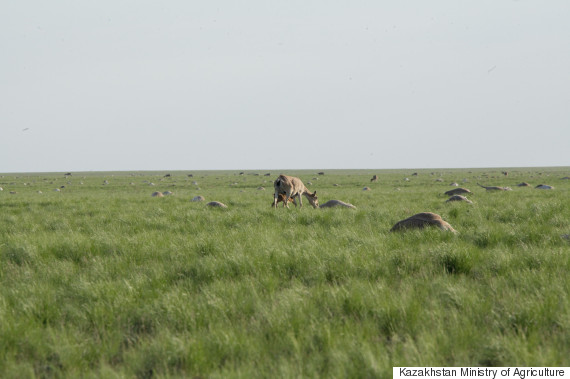
Mysterious Disease Threatens Australian Turtle with Immediate Extinction
Three months. That’s all it took to wipe almost every member of a species of turtles off of the map.
3margd
Then there is the infectious cancer threatening Tasmanian Devils...
http://discovermagazine.com/2014/may/13-the-immortal-devil
http://discovermagazine.com/2014/may/13-the-immortal-devil
4faceinbook
Wondering if this has to do with climate changes. I have seen all kinds of bugs in my yard I haven't previously seen. What this does is tend to wipe out my many of my flowers as they are not resistant to those types of bugs. Viruses may be no different and animals may not be able to fight off something they have never been in contact with previously. We have had cooler summers, cold winters and plenty of moisture. While other parts of the country have has severe droughts. Can't help but affect what types on wildlife and insect life, as well as bacteria and viruses survive in any given area.
One thing we can be sure of......it wasn't the animals that shit in their own food supply....that would be man.
"“Dear future generations: Please accept our apologies. We were rolling drunk on petroleum.”
~Kurt Vonnegut
One thing we can be sure of......it wasn't the animals that shit in their own food supply....that would be man.
"“Dear future generations: Please accept our apologies. We were rolling drunk on petroleum.”
~Kurt Vonnegut
5DugsBooks
How weird. Mobility has had some blame also with "bugs" finding new territories - like Ebola.
6margd
Gerardo Ceballos et al. 2017. Biological annihilation via the ongoing sixth mass extinction signaled by vertebrate population losses and declines. Proceedings of National Academy of Sciences of USA. doi: 10.1073/pnas.1704949114 . http://www.pnas.org/content/early/2017/07/05/1704949114
Significance
The strong focus on species extinctions, a critical aspect of the contemporary pulse of biological extinction, leads to a common misimpression that Earth’s biota is not immediately threatened, just slowly entering an episode of major biodiversity loss. This view overlooks the current trends of population declines and extinctions. Using a sample of 27,600 terrestrial vertebrate species, and a more detailed analysis of 177 mammal species, we show the extremely high degree of population decay in vertebrates, even in common “species of low concern.” Dwindling population sizes and range shrinkages amount to a massive anthropogenic erosion of biodiversity and of the ecosystem services essential to civilization. This “biological annihilation” underlines the seriousness for humanity of Earth’s ongoing sixth mass extinction event.
Abstract
The population extinction pulse we describe here shows, from a quantitative viewpoint, that Earth’s sixth mass extinction is more severe than perceived when looking exclusively at species extinctions. Therefore, humanity needs to address anthropogenic population extirpation and decimation immediately. That conclusion is based on analyses of the numbers and degrees of range contraction (indicative of population shrinkage and/or population extinctions according to the International Union for Conservation of Nature) using a sample of 27,600 vertebrate species, and on a more detailed analysis documenting the population extinctions between 1900 and 2015 in 177 mammal species. We find that the rate of population loss in terrestrial vertebrates is extremely high—even in “species of low concern.” In our sample, comprising nearly half of known vertebrate species, 32% (8,851/27,600) are decreasing; that is, they have decreased in population size and range. In the 177 mammals for which we have detailed data, all have lost 30% or more of their geographic ranges and more than 40% of the species have experienced severe population declines (>80 John5918:% range shrinkage). Our data indicate that beyond global species extinctions Earth is experiencing a huge episode of population declines and extirpations, which will have negative cascading consequences on ecosystem functioning and services vital to sustaining civilization. We describe this as a “biological annihilation” to highlight the current magnitude of Earth’s ongoing sixth major extinction event.
Significance
The strong focus on species extinctions, a critical aspect of the contemporary pulse of biological extinction, leads to a common misimpression that Earth’s biota is not immediately threatened, just slowly entering an episode of major biodiversity loss. This view overlooks the current trends of population declines and extinctions. Using a sample of 27,600 terrestrial vertebrate species, and a more detailed analysis of 177 mammal species, we show the extremely high degree of population decay in vertebrates, even in common “species of low concern.” Dwindling population sizes and range shrinkages amount to a massive anthropogenic erosion of biodiversity and of the ecosystem services essential to civilization. This “biological annihilation” underlines the seriousness for humanity of Earth’s ongoing sixth mass extinction event.
Abstract
The population extinction pulse we describe here shows, from a quantitative viewpoint, that Earth’s sixth mass extinction is more severe than perceived when looking exclusively at species extinctions. Therefore, humanity needs to address anthropogenic population extirpation and decimation immediately. That conclusion is based on analyses of the numbers and degrees of range contraction (indicative of population shrinkage and/or population extinctions according to the International Union for Conservation of Nature) using a sample of 27,600 vertebrate species, and on a more detailed analysis documenting the population extinctions between 1900 and 2015 in 177 mammal species. We find that the rate of population loss in terrestrial vertebrates is extremely high—even in “species of low concern.” In our sample, comprising nearly half of known vertebrate species, 32% (8,851/27,600) are decreasing; that is, they have decreased in population size and range. In the 177 mammals for which we have detailed data, all have lost 30% or more of their geographic ranges and more than 40% of the species have experienced severe population declines (>80 John5918:% range shrinkage). Our data indicate that beyond global species extinctions Earth is experiencing a huge episode of population declines and extirpations, which will have negative cascading consequences on ecosystem functioning and services vital to sustaining civilization. We describe this as a “biological annihilation” to highlight the current magnitude of Earth’s ongoing sixth major extinction event.
7margd
Franck Courchamp et al. 2018. The paradoxical extinction of the most charismatic animals. PLOS. April 12, 2018. https://doi.org/10.1371/journal.pbio.2003997 http://journals.plos.org/plosbiology/article?id=10.1371/journal.pbio.2003997
Abstract
A widespread opinion is that conservation efforts disproportionately benefit charismatic species. However, this doesn’t mean that they are not threatened, and which species are “charismatic” remains unclear. Here, we identify the 10 most charismatic animals and show that they are at high risk of imminent extinction in the wild. We also find that the public ignores these animals’ predicament and we suggest it could be due to the observed biased perception of their abundance, based more on their profusion in our culture than on their natural populations. We hypothesize that this biased perception impairs conservation efforts because people are unaware that the animals they cherish face imminent extinction and do not perceive their urgent need for conservation. By freely using the image of rare and threatened species in their product marketing, many companies may participate in creating this biased perception, with unintended detrimental effects on conservation efforts, which should be compensated by channeling part of the associated profits to conservation. According to our hypothesis, this biased perception would be likely to last as long as the massive cultural and commercial presence of charismatic species is not accompanied by adequate information campaigns about the imminent threats they face.
...the 10 most charismatic animals...the
tiger (Panthera tigris),
lion (P. leo),
elephant (Loxodonta africana, L. cyclotis, and Elephas maximus),
giraffe (Giraffa camelopardalis),
leopard (P. pardus),
panda (Ailuropoda melanoleuca),
cheetah (Acinonyx jubatus),
polar bear (Ursus maritimus),
gray wolf (Canis lupus), and
gorilla (Gorilla beringei and G. gorilla).
Abstract
A widespread opinion is that conservation efforts disproportionately benefit charismatic species. However, this doesn’t mean that they are not threatened, and which species are “charismatic” remains unclear. Here, we identify the 10 most charismatic animals and show that they are at high risk of imminent extinction in the wild. We also find that the public ignores these animals’ predicament and we suggest it could be due to the observed biased perception of their abundance, based more on their profusion in our culture than on their natural populations. We hypothesize that this biased perception impairs conservation efforts because people are unaware that the animals they cherish face imminent extinction and do not perceive their urgent need for conservation. By freely using the image of rare and threatened species in their product marketing, many companies may participate in creating this biased perception, with unintended detrimental effects on conservation efforts, which should be compensated by channeling part of the associated profits to conservation. According to our hypothesis, this biased perception would be likely to last as long as the massive cultural and commercial presence of charismatic species is not accompanied by adequate information campaigns about the imminent threats they face.
...the 10 most charismatic animals...the
tiger (Panthera tigris),
lion (P. leo),
elephant (Loxodonta africana, L. cyclotis, and Elephas maximus),
giraffe (Giraffa camelopardalis),
leopard (P. pardus),
panda (Ailuropoda melanoleuca),
cheetah (Acinonyx jubatus),
polar bear (Ursus maritimus),
gray wolf (Canis lupus), and
gorilla (Gorilla beringei and G. gorilla).
8margd
Humans Are Just 0.01% of Life on Earth, But We Still Annihilated The Rest of It
PETER DOCKRILL | 22 MAY 2018
Ruining things since 298,000 BCE.
...analysis suggests human civilisation has slashed the total biomass of wild mammals by as much as 85 per cent, and has cut plant biomass in half.
This inadvertent culling has had a massive effect on the overall biosphere, leading to a situation where scientists say we're now in the midst of a mass extinction event that is almost without precedent.
While entirely regrettable, our actions also constitute a frighteningly outsized effort for a delicate species of bipeds that only makes up a hundredth of a percent of the world's living things...
https://www.sciencealert.com/humans-are-just-0-01-of-life-earth-but-we-annihilat...
____________________________________________________
Yinon M. Bar-On, Rob Phillips, and Ron Milo. 2018. The biomass distribution on Earth. PNAS May 21, 2018. 201711842; published ahead of print May 21, 2018. https://doi.org/10.1073/pnas.1711842115 . http://www.pnas.org/content/early/2018/05/15/1711842115
PETER DOCKRILL | 22 MAY 2018
Ruining things since 298,000 BCE.
...analysis suggests human civilisation has slashed the total biomass of wild mammals by as much as 85 per cent, and has cut plant biomass in half.
This inadvertent culling has had a massive effect on the overall biosphere, leading to a situation where scientists say we're now in the midst of a mass extinction event that is almost without precedent.
While entirely regrettable, our actions also constitute a frighteningly outsized effort for a delicate species of bipeds that only makes up a hundredth of a percent of the world's living things...
https://www.sciencealert.com/humans-are-just-0-01-of-life-earth-but-we-annihilat...
____________________________________________________
Yinon M. Bar-On, Rob Phillips, and Ron Milo. 2018. The biomass distribution on Earth. PNAS May 21, 2018. 201711842; published ahead of print May 21, 2018. https://doi.org/10.1073/pnas.1711842115 . http://www.pnas.org/content/early/2018/05/15/1711842115
9margd
When we fish or hunt we tend to select the largest specimens, so even today we see downward pressure on size of at least some species. Some say better to emulate non-human predators and prey on young, sick, and older specimens.
Mammals worldwide are shrinking because people are spreading everywhere!
DEBORAH NETBURN | May 28, 2018
....Over the past 100,000 years, the mean body mass of mammals in Eurasia dropped by 50% and by an order of magnitude in Australia. More recently, there was a tenfold drop in the average size of mammals in the Americas.
...“When we look at the fossil record, what we find is that every time hominids get to a new continent there is an extinction event, and that extinction is always large-bodied animals,” said Felisa Smith, a paleoecologist at the University of New Mexico, who led the work.
Her research also revealed that if this pattern continues, in a mere 200 years the largest land mammals left on Earth will be the size of a domestic cow.
“And it shouldn’t escape your notice that we take care of cows,” she added. “If they survive, it’s because we want them here.”
...mammal body mass did indeed drop dramatically when hominids arrived in in Eurasia around 100,000 years ago, when they arrived in Australia around 60,000 years ago and when they migrated to the Americas around 13,000 years ago.
...extinction events were swifter and more dramatic as time went on. The extinction event was slow and long in Eurasia, and much speedier and deadlier in the Americas. This suggests that as humans developed more advanced weaponry, they were more effective at eradicating large animals quickly, she said.
A slightly different story came to light in Africa, however, where the largest mammals on Earth reside today. According to the fossil record, the mean size of African mammals 125,000 years ago was roughly 50% smaller than you would expect, based on the size of the land mass they inhabited.
Smith and her colleagues conclude that the size of large mammals on that continent may have been affected by hominid hunters going back more than a million years.
“In the past, large mammals were able to adapt to climate change by moving to different regions,” she said. “But we have urbanised most of the land, so they can’t move to cope with the changes.”
Finally, Smith wants you to know that the loss of big mammals has far-reaching effects on the environment. These land-dwelling giants were so massive that their collective weight caused the dirt to compact in the regions they lived. This influenced how gas was exchanged between the soil and the air, and affected the water table.
Their browsing choices had an outsize effect on the ecology of their habitats and the sheer process of their eating, pooping and burping affected how nitrogen, phosphorous and methane moved through the environment..." ecosystem engineers"...
https://www.star2.com/living/2018/05/28/the-more-humans-spread-across-the-globe-...
_______________________________________________________
Felisa A. Smith et al. 2018. Body size downgrading of mammals over the late Quaternary. Science 20 Apr 2018:
Vol. 360, Issue 6386, pp. 310-313. DOI: 10.1126/science.aao5987 http://science.sciencemag.org/content/360/6386/310
Megafaunal loss
Today, it is well known that human activities put larger animals at greater risk of extinction. Such targeting of the largest species is not new, however. Smith et al. show that biased loss of large-bodied mammal species from ecosystems is a signature of human impacts that has been following hominin migrations since the Pleistocene. If the current trend continues, terrestrial mammal body sizes will become smaller than they have been over the past 45 million years. Megafaunal mammals have a major impact on the structure of ecosystems, so their loss could be particularly damaging.
Abstract
Since the late Pleistocene, large-bodied mammals have been extirpated from much of Earth. Although all habitable continents once harbored giant mammals, the few remaining species are largely confined to Africa. This decline is coincident with the global expansion of hominins over the late Quaternary. Here, we quantify mammalian extinction selectivity, continental body size distributions, and taxonomic diversity over five time periods spanning the past 125,000 years and stretching approximately 200 years into the future. We demonstrate that size-selective extinction was already under way in the oldest interval and occurred on all continents, within all trophic modes, and across all time intervals. Moreover, the degree of selectivity was unprecedented in 65 million years of mammalian evolution. The distinctive selectivity signature implicates hominin activity as a primary driver of taxonomic losses and ecosystem homogenization. Because megafauna have a disproportionate influence on ecosystem structure and function, past and present body size downgrading is reshaping Earth’s biosphere.
Mammals worldwide are shrinking because people are spreading everywhere!
DEBORAH NETBURN | May 28, 2018
....Over the past 100,000 years, the mean body mass of mammals in Eurasia dropped by 50% and by an order of magnitude in Australia. More recently, there was a tenfold drop in the average size of mammals in the Americas.
...“When we look at the fossil record, what we find is that every time hominids get to a new continent there is an extinction event, and that extinction is always large-bodied animals,” said Felisa Smith, a paleoecologist at the University of New Mexico, who led the work.
Her research also revealed that if this pattern continues, in a mere 200 years the largest land mammals left on Earth will be the size of a domestic cow.
“And it shouldn’t escape your notice that we take care of cows,” she added. “If they survive, it’s because we want them here.”
...mammal body mass did indeed drop dramatically when hominids arrived in in Eurasia around 100,000 years ago, when they arrived in Australia around 60,000 years ago and when they migrated to the Americas around 13,000 years ago.
...extinction events were swifter and more dramatic as time went on. The extinction event was slow and long in Eurasia, and much speedier and deadlier in the Americas. This suggests that as humans developed more advanced weaponry, they were more effective at eradicating large animals quickly, she said.
A slightly different story came to light in Africa, however, where the largest mammals on Earth reside today. According to the fossil record, the mean size of African mammals 125,000 years ago was roughly 50% smaller than you would expect, based on the size of the land mass they inhabited.
Smith and her colleagues conclude that the size of large mammals on that continent may have been affected by hominid hunters going back more than a million years.
“In the past, large mammals were able to adapt to climate change by moving to different regions,” she said. “But we have urbanised most of the land, so they can’t move to cope with the changes.”
Finally, Smith wants you to know that the loss of big mammals has far-reaching effects on the environment. These land-dwelling giants were so massive that their collective weight caused the dirt to compact in the regions they lived. This influenced how gas was exchanged between the soil and the air, and affected the water table.
Their browsing choices had an outsize effect on the ecology of their habitats and the sheer process of their eating, pooping and burping affected how nitrogen, phosphorous and methane moved through the environment..." ecosystem engineers"...
https://www.star2.com/living/2018/05/28/the-more-humans-spread-across-the-globe-...
_______________________________________________________
Felisa A. Smith et al. 2018. Body size downgrading of mammals over the late Quaternary. Science 20 Apr 2018:
Vol. 360, Issue 6386, pp. 310-313. DOI: 10.1126/science.aao5987 http://science.sciencemag.org/content/360/6386/310
Megafaunal loss
Today, it is well known that human activities put larger animals at greater risk of extinction. Such targeting of the largest species is not new, however. Smith et al. show that biased loss of large-bodied mammal species from ecosystems is a signature of human impacts that has been following hominin migrations since the Pleistocene. If the current trend continues, terrestrial mammal body sizes will become smaller than they have been over the past 45 million years. Megafaunal mammals have a major impact on the structure of ecosystems, so their loss could be particularly damaging.
Abstract
Since the late Pleistocene, large-bodied mammals have been extirpated from much of Earth. Although all habitable continents once harbored giant mammals, the few remaining species are largely confined to Africa. This decline is coincident with the global expansion of hominins over the late Quaternary. Here, we quantify mammalian extinction selectivity, continental body size distributions, and taxonomic diversity over five time periods spanning the past 125,000 years and stretching approximately 200 years into the future. We demonstrate that size-selective extinction was already under way in the oldest interval and occurred on all continents, within all trophic modes, and across all time intervals. Moreover, the degree of selectivity was unprecedented in 65 million years of mammalian evolution. The distinctive selectivity signature implicates hominin activity as a primary driver of taxonomic losses and ecosystem homogenization. Because megafauna have a disproportionate influence on ecosystem structure and function, past and present body size downgrading is reshaping Earth’s biosphere.
10margd
Red list research finds 26,000 global species under extinction threat
Jonathan Watts | Thu 5 Jul 2018
IUCN fears planet is entering sixth wave of extinctions with research from Australia revealing more risks to reptiles
More than 26,000 of the world’s species are now threatened, according to the latest red list assessment of the natural world, adding to fears the planet is entering a sixth wave of extinctions.
New research, particularly in Australia, has widened the scope of the annual stock take, which is compiled by the International Union for the Conservation of Nature (IUCN https://www.iucn.org/), and revealed the growing range of risks to flora and fauna...
https://www.theguardian.com/environment/2018/jul/05/red-list-research-finds-2600...
Jonathan Watts | Thu 5 Jul 2018
IUCN fears planet is entering sixth wave of extinctions with research from Australia revealing more risks to reptiles
More than 26,000 of the world’s species are now threatened, according to the latest red list assessment of the natural world, adding to fears the planet is entering a sixth wave of extinctions.
New research, particularly in Australia, has widened the scope of the annual stock take, which is compiled by the International Union for the Conservation of Nature (IUCN https://www.iucn.org/), and revealed the growing range of risks to flora and fauna...
https://www.theguardian.com/environment/2018/jul/05/red-list-research-finds-2600...
11margd
Endangered Species Act stripped of key provisions in Trump administration proposal
Darryl Fears | July 19, 2018
The Trump administration unveiled a proposal Thursday that would strip the Endangered Species Act of key provisions, a move that conservationists say would weaken a law enacted 45 years ago to keep plant and animal species in decline from going extinct.
...announced jointly by the Interior and Commerce departments, which are charged with protecting endangered wildlife, would end the practice of extending similar protections to species regardless of whether they are listed as endangered or threatened. If the proposal is approved, likely by year’s end, protections for threatened plants and animals would be made on a case-by-case basis.
...the administration wants the U.S. Fish and Wildlife Service and National Oceanic and Atmospheric Administration to strike language that guides officials to ignore economic impacts when determining how wildlife should be protected.
Conservationists...decried numerous aspects of the proposal, including the removal of a requirement compelling federal agencies to consult with scientists and wildlife agencies before approving permits for ventures such as oil and gas drilling and logging.
...In April,...the Interior Department told police who enforce the Migratory Bird Treaty Act that killing birds “when the underlying purpose of that activity” is not intended to kill them is no longer prohibited...A mass killing of birds resulting from a catastrophic event such as the Deepwater Horizon oil spill, which destroyed or injured up to a million birds, would no longer be punished under the treaty. Interior would pursue penalties under the Natural Resources Damage Assessment program, which is not specific to birds.
...Interior and Commerce officials said the Endangered Species Act proposal would be published in the Federal Register “in coming days.” The public can submit comments on a government website within 60 days after publication.
...The desire by (some) Republicans...to defer to states that stood by as wildlife populations declined, according to conservationists, was reflected in Interior’s statement Thursday about the proposal...
https://www.washingtonpost.com/news/animalia/wp/2018/07/19/endangered-species-ac...
Darryl Fears | July 19, 2018
The Trump administration unveiled a proposal Thursday that would strip the Endangered Species Act of key provisions, a move that conservationists say would weaken a law enacted 45 years ago to keep plant and animal species in decline from going extinct.
...announced jointly by the Interior and Commerce departments, which are charged with protecting endangered wildlife, would end the practice of extending similar protections to species regardless of whether they are listed as endangered or threatened. If the proposal is approved, likely by year’s end, protections for threatened plants and animals would be made on a case-by-case basis.
...the administration wants the U.S. Fish and Wildlife Service and National Oceanic and Atmospheric Administration to strike language that guides officials to ignore economic impacts when determining how wildlife should be protected.
Conservationists...decried numerous aspects of the proposal, including the removal of a requirement compelling federal agencies to consult with scientists and wildlife agencies before approving permits for ventures such as oil and gas drilling and logging.
...In April,...the Interior Department told police who enforce the Migratory Bird Treaty Act that killing birds “when the underlying purpose of that activity” is not intended to kill them is no longer prohibited...A mass killing of birds resulting from a catastrophic event such as the Deepwater Horizon oil spill, which destroyed or injured up to a million birds, would no longer be punished under the treaty. Interior would pursue penalties under the Natural Resources Damage Assessment program, which is not specific to birds.
...Interior and Commerce officials said the Endangered Species Act proposal would be published in the Federal Register “in coming days.” The public can submit comments on a government website within 60 days after publication.
...The desire by (some) Republicans...to defer to states that stood by as wildlife populations declined, according to conservationists, was reflected in Interior’s statement Thursday about the proposal...
https://www.washingtonpost.com/news/animalia/wp/2018/07/19/endangered-species-ac...
12margd
Republicans push to overhaul the Endangered Species Act before midterms
CBS News | July 27, 2018
The Trump administration and congressional Republicans are pushing nearly a dozen bills that would overhaul the Endangered Species Act, a 45-year-old landmark law that has helped safeguard American icons like the bald eagle and grizzly bear. The proposed legislation would make it harder to get a species on the list and easier to remove it, which Republicans say would modernize the act, while conservationists say the changes would actually gut it.
...Utah Republican Rob Bishop...One of his bills would require the government to consider not just science but the cost to business before adding a new animal to the list.
...nfa-cordes-endgangered-species-act-needs-trx-frame-2209.jpg
...Wyoming Republican John Barrasso. His bill would turn some of the federal role for protecting endangered animals over to the states.
....Republicans argue that long-term protections for animals like the spotted owl hamper logging, drilling and development.
...As Congress debates, the Trump administration is looking at ways to act on its own by blocking certain animals from the list like the sage grouse, a bird that lives on oil-rich land out west.
https://www.cbsnews.com/news/endangered-species-act-republicans-pushing-overhaul...
CBS News | July 27, 2018
The Trump administration and congressional Republicans are pushing nearly a dozen bills that would overhaul the Endangered Species Act, a 45-year-old landmark law that has helped safeguard American icons like the bald eagle and grizzly bear. The proposed legislation would make it harder to get a species on the list and easier to remove it, which Republicans say would modernize the act, while conservationists say the changes would actually gut it.
...Utah Republican Rob Bishop...One of his bills would require the government to consider not just science but the cost to business before adding a new animal to the list.
...nfa-cordes-endgangered-species-act-needs-trx-frame-2209.jpg
...Wyoming Republican John Barrasso. His bill would turn some of the federal role for protecting endangered animals over to the states.
....Republicans argue that long-term protections for animals like the spotted owl hamper logging, drilling and development.
...As Congress debates, the Trump administration is looking at ways to act on its own by blocking certain animals from the list like the sage grouse, a bird that lives on oil-rich land out west.
https://www.cbsnews.com/news/endangered-species-act-republicans-pushing-overhaul...
13margd
All species matter. Some have unexpected benefits for humans--below--but they are at risk of extinction.
(Tamoxifen had its origins in a yew tree, I think?)
Scientists identify strong cancer killer in Central Highlands’ forest
02/08/2018
An active element in the dinh tung (Cephalotaxaceae) plant has been found to inhibit the development of many kinds of diseases, including lung, liver, epithelium and breast cancer.
...(Dinh Thi Phong, a member of the research team) said one of the big problems researchers face is the lack of input materials. The new active element can be useful only when it is extracted from adult trees 5-10 years old.
Meanwhile, dinh tung is in danger of extinction in Vietnam. There are only 34 dinh tung trees in the entire province of Lam Dong, including five adult trees. (In Vietnam, dinh tung can be found in Ha Tay (Ba Vi), Thanh Hoa (Lung Van), Quang Tri, Thua Thien-Hue and Kon Tum.
...The researchers have asked local authorities to think of solutions to develop dinh tung to protect the valuable genetic source.)
In Vietnam, dinh tung can be found in Ha Tay (Ba Vi), Thanh Hoa (Lung Van), Quang Tri, Thua Thien-Hue and Kon Tum.
...in June reported that Nguyen Thi Hoai from Hue Medical & Pharmaceutical University found two compounds in bu de tia (Uvaria grandiflora Roxb. ex Hornem), grown in Quang Tri’s forests which can be used to treat cancer.
http://english.vietnamnet.vn/fms/science-it/206117/scientists-identify-strong-ca...
(Tamoxifen had its origins in a yew tree, I think?)
Scientists identify strong cancer killer in Central Highlands’ forest
02/08/2018
An active element in the dinh tung (Cephalotaxaceae) plant has been found to inhibit the development of many kinds of diseases, including lung, liver, epithelium and breast cancer.
...(Dinh Thi Phong, a member of the research team) said one of the big problems researchers face is the lack of input materials. The new active element can be useful only when it is extracted from adult trees 5-10 years old.
Meanwhile, dinh tung is in danger of extinction in Vietnam. There are only 34 dinh tung trees in the entire province of Lam Dong, including five adult trees. (In Vietnam, dinh tung can be found in Ha Tay (Ba Vi), Thanh Hoa (Lung Van), Quang Tri, Thua Thien-Hue and Kon Tum.
...The researchers have asked local authorities to think of solutions to develop dinh tung to protect the valuable genetic source.)
In Vietnam, dinh tung can be found in Ha Tay (Ba Vi), Thanh Hoa (Lung Van), Quang Tri, Thua Thien-Hue and Kon Tum.
...in June reported that Nguyen Thi Hoai from Hue Medical & Pharmaceutical University found two compounds in bu de tia (Uvaria grandiflora Roxb. ex Hornem), grown in Quang Tri’s forests which can be used to treat cancer.
http://english.vietnamnet.vn/fms/science-it/206117/scientists-identify-strong-ca...
14margd
Facts matter...
Trump has ordered the NOAA to prioritize water intended for the protection of Chinook salmon and Delta smelt (#EndangeredSpecies) for firefighting purposes. DESPITE @CAL_FIRE clearly stating that they already have enough water resources for firefighting operations. #California
Alternative NOAA @altNOAA
1:19 PM - 8 Aug 2018
____________________________________________________________________
Commerce orders NOAA to prioritize water for firefighting over endangered species
Andrew Freedman | Aug 8, 2018
...The policy directive follows tweets President Trump sent that were met with confusion by California officials, including firefighters, who said the state has more than enough water to combat the blazes.
...The Commerce Department's new directive states in part: "Public safety is the first priority. Consistent with the emergency consultation provisions under the ESA, Federal agencies may use any water as necessary to protect life and property in the affected areas. Based on this directive, NOAA will facilitate the use of water for this emergency. Going forward, the Department and NOAA are committed to finding new solutions to address threatened and endangered species in the context of the challenging water management situation in California."
The Trump administration is pursuing separate actions through the Interior Department and Congress to enact broad changes to the Endangered Species Act.
https://www.axios.com/commerce-secretary-orders-noaa-to-prioritize-water-for-fir...
Trump has ordered the NOAA to prioritize water intended for the protection of Chinook salmon and Delta smelt (#EndangeredSpecies) for firefighting purposes. DESPITE @CAL_FIRE clearly stating that they already have enough water resources for firefighting operations. #California
Alternative NOAA @altNOAA
1:19 PM - 8 Aug 2018
____________________________________________________________________
Commerce orders NOAA to prioritize water for firefighting over endangered species
Andrew Freedman | Aug 8, 2018
...The policy directive follows tweets President Trump sent that were met with confusion by California officials, including firefighters, who said the state has more than enough water to combat the blazes.
...The Commerce Department's new directive states in part: "Public safety is the first priority. Consistent with the emergency consultation provisions under the ESA, Federal agencies may use any water as necessary to protect life and property in the affected areas. Based on this directive, NOAA will facilitate the use of water for this emergency. Going forward, the Department and NOAA are committed to finding new solutions to address threatened and endangered species in the context of the challenging water management situation in California."
The Trump administration is pursuing separate actions through the Interior Department and Congress to enact broad changes to the Endangered Species Act.
https://www.axios.com/commerce-secretary-orders-noaa-to-prioritize-water-for-fir...
15DugsBooks
>14 margd: Sleazy politics
16margd
The US (esp. the Mississippi R system) is home to thousands of freshwater mollusc species incl. hundreds of mussels, the largest concentration in the world. They are threatened by zebra mussels, dams, pollution, climate change. A Republican Congressman wants to strip them of Endangered Species Act protection--very short-sighted, not only for reasons below, but for the very self-serving reason that such species are proving to have as-yet-undiscovered benefits in medicine (cancer meds from rare Vietnamese trees), materials engineering (adhesive from hagfish):
House Republican bill would strip protection for mussels
Michael Doyle | August 13, 2018
Dozens of freshwater mussel species nationwide would lose their Endangered Species Act protections under a sweeping new bill introduced by an Indiana lawmaker who's been unhappy with the Fish and Wildlife Service.
https://www.eenews.net/greenwire/2018/08/13/stories/1060093963
______________________________________________________
America’s Freshwater Mussels Are Going Extinct — Here’s Why That Sucks
John R. Platt | April 4, 2018
Dozens of these water-filtering species are at risk of vanishing, and that’s bad news for every living creature that relies on them.
https://therevelator.org/mussels-going-extinct-sucks/
ETA___________________________________________________
Text of bill to exempt freshwater mussels from protection of Endangered Species Act:
https://www.congress.gov/bill/115th-congress/house-bill/6668/text
ETA____________________________________________________
Similar functional ecology, similar impacts, and similar contexts (in zebra and golden mussels invading N and S America respectively): inland waters of N. America & most of S. America do not have native bivalves w/ these traits (byssal attachment, planktonic larva, rapid maturity). Their biotas lack evolutionary experience with such species. (Anthony Ricciardi on Twitter)
17margd
>13 margd: More unexpected benefit to humans from critters that we may be driving to extinction:
A resurrected gene may protect elephants from cancer
LIF6 instructs damaged cells to self-destruct before the disease has a chance to take hold
Aimee Cunningham | August 14, 2018
https://www.sciencenews.org/article/resurrected-gene-may-protect-elephants-cance...
J.M. Vazquez et al. A zombie LIF gene in elephants is upregulated by TP53 to induce apoptosis in response to DNA damage. Cell Reports. Published online August 14, 2018. doi:10.1016/j.celrep.2018.07.042.
________________________________________________________________________
Your guide to the practical uses of hagfish slime, glowworm glue, and other animal goo
The surprising benefits of animal-inspired gunk
Kate Baggaley | April 14, 2017
https://www.popsci.com/animal-goo
A resurrected gene may protect elephants from cancer
LIF6 instructs damaged cells to self-destruct before the disease has a chance to take hold
Aimee Cunningham | August 14, 2018
https://www.sciencenews.org/article/resurrected-gene-may-protect-elephants-cance...
J.M. Vazquez et al. A zombie LIF gene in elephants is upregulated by TP53 to induce apoptosis in response to DNA damage. Cell Reports. Published online August 14, 2018. doi:10.1016/j.celrep.2018.07.042.
________________________________________________________________________
Your guide to the practical uses of hagfish slime, glowworm glue, and other animal goo
The surprising benefits of animal-inspired gunk
Kate Baggaley | April 14, 2017
https://www.popsci.com/animal-goo
18margd
Living Planet Report
World Wildlife Fund 2018
The Living Planet Report documents the state of the planet—including biodiversity, ecosystems, and demand on natural resources—and what it means for humans and wildlife. Published by WWF every two years, the report brings together a variety of research to provide a comprehensive view of the health of the Earth.
We are pushing our planet to the brink. Human activity—how we feed, fuel, and finance our lives—is taking an unprecedented toll on wildlife, wild places, and the natural resources we need to survive.
On average, we’ve seen an astonishing 60% decline in the size of populations of mammals, birds, fish, reptiles, and amphibians in just over 40 years, according to WWF’s Living Planet Report 2018. The top threats to species identified in the report link directly to human activities, including habitat loss and degradation and the excessive use of wildlife such as overfishing and overhunting.
The report presents a sobering picture of the impact human activity has on the world’s wildlife, forests, oceans, rivers, and climate. We’re facing a rapidly closing window for action and the urgent need for everyone—everyone—to collectively rethink and redefine how we value, protect, and restore nature.
“This report sounds a warning shot across our bow,” said Carter Roberts, president and CEO of WWF-US. “Natural systems essential to our survival—forests, oceans, and rivers—remain in decline. Wildlife around the world continue to dwindle. It reminds us we need to change course. It’s time to balance our consumption with the needs of nature, and to protect the only planet that is our home.”...
https://www.worldwildlife.org/pages/living-planet-report-2018
World Wildlife Fund 2018
The Living Planet Report documents the state of the planet—including biodiversity, ecosystems, and demand on natural resources—and what it means for humans and wildlife. Published by WWF every two years, the report brings together a variety of research to provide a comprehensive view of the health of the Earth.
We are pushing our planet to the brink. Human activity—how we feed, fuel, and finance our lives—is taking an unprecedented toll on wildlife, wild places, and the natural resources we need to survive.
On average, we’ve seen an astonishing 60% decline in the size of populations of mammals, birds, fish, reptiles, and amphibians in just over 40 years, according to WWF’s Living Planet Report 2018. The top threats to species identified in the report link directly to human activities, including habitat loss and degradation and the excessive use of wildlife such as overfishing and overhunting.
The report presents a sobering picture of the impact human activity has on the world’s wildlife, forests, oceans, rivers, and climate. We’re facing a rapidly closing window for action and the urgent need for everyone—everyone—to collectively rethink and redefine how we value, protect, and restore nature.
“This report sounds a warning shot across our bow,” said Carter Roberts, president and CEO of WWF-US. “Natural systems essential to our survival—forests, oceans, and rivers—remain in decline. Wildlife around the world continue to dwindle. It reminds us we need to change course. It’s time to balance our consumption with the needs of nature, and to protect the only planet that is our home.”...
https://www.worldwildlife.org/pages/living-planet-report-2018
19margd
Mapping the decline of Canada’s caribou
Aaron Kylie | October 30, 2018
A snapshot of the country’s drastically dwindling caribou herds
...All of Canada’s caribou subspecies have increasingly been in the news as the animal’s national population, which once numbered in the millions, has declined drastically and quickly to little more than a million today. Experts are concerned some populations may not survive the threats they’re facing. One herd, British Columbia’s South Selkirk, had just three females left in April 2018.
Canadian Geographic created the map (at website) as a snapshot of the status of Canada’s caribou, grouping the species by “designatable units,” or DUs...that the Committee on the Status of Endangered Wildlife in Canada uses. (Dawson’s caribou, which lived on Graham Island, B.C., went extinct in the early 20th century, and haven’t been included.)...
https://www.canadiangeographic.ca/article/mapping-decline-canadas-caribou
Aaron Kylie | October 30, 2018
A snapshot of the country’s drastically dwindling caribou herds
...All of Canada’s caribou subspecies have increasingly been in the news as the animal’s national population, which once numbered in the millions, has declined drastically and quickly to little more than a million today. Experts are concerned some populations may not survive the threats they’re facing. One herd, British Columbia’s South Selkirk, had just three females left in April 2018.
Canadian Geographic created the map (at website) as a snapshot of the status of Canada’s caribou, grouping the species by “designatable units,” or DUs...that the Committee on the Status of Endangered Wildlife in Canada uses. (Dawson’s caribou, which lived on Graham Island, B.C., went extinct in the early 20th century, and haven’t been included.)...
https://www.canadiangeographic.ca/article/mapping-decline-canadas-caribou
20margd
Chocolate giant Cadbury ‘still pushing orangutans towards extinction by wrecking habitat for palm oil’
Jane Dalton | Nov 13, 2018
The maker of Cadbury chocolate bars, Oreo biscuits and Ritz crackers is accused of destroying tens of thousands of hectares of orangutan habitat in just two years for palm oil.
Suppliers to food giant Mondelez have destroyed 70,000 hectares since 2016, analysis by Greenpeace International claims, pushing the primate further towards extinction.
The areas razed to the ground include 25,000 hectares of habitations in Indonesia that are home to the critically endangered orangutan.
The new investigation, carried out through mapping Indonesia, discovered that between 2015 and 2017, 22 of the company’s palm oil suppliers cleared at least 70,000 hectares of rainforest – an area bigger than the City of Chicago, where Mondelez is based.
In a 31-page report detailing the supply chains of the main brands the charity says are responsible for destruction, Greenpeace points the finger largely at the producer of some of Britain’s favourite chocolates and snacks.
...Campaigners have warned “it’s now or never” for Indonesia’s critically endangered orangutans, which are being killed at a rate of 25 a day as natural vegetation is bulldozed to make way for palm plantations.
...“Palm oil can be made without destroying forests, yet our investigation discovered that Mondelez suppliers are still trashing forests and wrecking orangutan habitat, pushing these beautiful and intelligent creatures to the brink of extinction.
Bornean orangutan numbers have halved in 16 years, studies show, and both the Sumatran and newly discovered Tapanuli orangutan lost more than half their habitat between 1985 and 2007.
All three species are classified by the International Union for Conservation of Nature as critically endangered, along with the Sumatran tiger and Sumatran rhino...
https://www.independent.co.uk/environment/orangutans-palm-oil-habitat-rainforest...
Jane Dalton | Nov 13, 2018
The maker of Cadbury chocolate bars, Oreo biscuits and Ritz crackers is accused of destroying tens of thousands of hectares of orangutan habitat in just two years for palm oil.
Suppliers to food giant Mondelez have destroyed 70,000 hectares since 2016, analysis by Greenpeace International claims, pushing the primate further towards extinction.
The areas razed to the ground include 25,000 hectares of habitations in Indonesia that are home to the critically endangered orangutan.
The new investigation, carried out through mapping Indonesia, discovered that between 2015 and 2017, 22 of the company’s palm oil suppliers cleared at least 70,000 hectares of rainforest – an area bigger than the City of Chicago, where Mondelez is based.
In a 31-page report detailing the supply chains of the main brands the charity says are responsible for destruction, Greenpeace points the finger largely at the producer of some of Britain’s favourite chocolates and snacks.
...Campaigners have warned “it’s now or never” for Indonesia’s critically endangered orangutans, which are being killed at a rate of 25 a day as natural vegetation is bulldozed to make way for palm plantations.
...“Palm oil can be made without destroying forests, yet our investigation discovered that Mondelez suppliers are still trashing forests and wrecking orangutan habitat, pushing these beautiful and intelligent creatures to the brink of extinction.
Bornean orangutan numbers have halved in 16 years, studies show, and both the Sumatran and newly discovered Tapanuli orangutan lost more than half their habitat between 1985 and 2007.
All three species are classified by the International Union for Conservation of Nature as critically endangered, along with the Sumatran tiger and Sumatran rhino...
https://www.independent.co.uk/environment/orangutans-palm-oil-habitat-rainforest...
21margd
Only 411 North Atlantic right whales left, says new report
Emma Davie | Nov 12, 2018
...the North Atlantic Right Whale Consortium released its 2018 report card...there are just 411 (only 71 breeding females) North Atlantic right whales left of the rapidly declining species...a "significant drop" in the population.
...fishing-gear entanglements and whale strikes as the leading cause of death for these animals.
...Right whales could be 20 years away from certain extinction
...these numbers don't include the three documented deaths so far in 2018
..."for every whale you see dead on the beach, or floating at sea, there have been two more deaths of that species," said Scott Kraus, vice-president at the New England Aquarium and the chair-elect for the right whale consortium.
...the decrease in population is also because for the first time in the 38 years these whales have been monitored, no new calves were born.
...71 breeding females in 2017, down from 105 in 2015. The report also said that entanglements with fishing gear have a big impact on the females — and within three years of a severe entanglement, only about 33 per cent of females survive...they bear scars and wounds their entanglements."
...climate change. As whales move further away in search of food, Kraus said the animals are using more energy than they're getting through food — and female whales need to have adequate reserves to carry a calf.
"In that context, if they take a few years off from having babies, it's not such a big deal. They can recover from that. But in a population like this though, for them to survive going through several years of not having many kids, we have to stop killing them. That's the simple answer," Kraus said.
...Canada implemented new measures to try to protect the right whale (reducing vessel speeds and temporary fisheries closures when a right whale was spotted)...(no) deaths in Canadian waters this year, there were still three reported entanglements. One of the U.S. entanglement deaths was caused by Canadian snow crab gear.
..."I do feel optimistic about it largely because many of the shipping and fishing industry groups have really bought on to the idea that they need to change practices to figure out how to co-exist with right whales," (Kraus) said.
"So it may take us a few years, but I have a lot of confidence that we're going to be able to keep guys fishing, keep the shipping going and not kill whales at the same time."
https://www.cbc.ca/news/canada/nova-scotia/north-atlantic-right-whale-population...
Emma Davie | Nov 12, 2018
...the North Atlantic Right Whale Consortium released its 2018 report card...there are just 411 (only 71 breeding females) North Atlantic right whales left of the rapidly declining species...a "significant drop" in the population.
...fishing-gear entanglements and whale strikes as the leading cause of death for these animals.
...Right whales could be 20 years away from certain extinction
...these numbers don't include the three documented deaths so far in 2018
..."for every whale you see dead on the beach, or floating at sea, there have been two more deaths of that species," said Scott Kraus, vice-president at the New England Aquarium and the chair-elect for the right whale consortium.
...the decrease in population is also because for the first time in the 38 years these whales have been monitored, no new calves were born.
...71 breeding females in 2017, down from 105 in 2015. The report also said that entanglements with fishing gear have a big impact on the females — and within three years of a severe entanglement, only about 33 per cent of females survive...they bear scars and wounds their entanglements."
...climate change. As whales move further away in search of food, Kraus said the animals are using more energy than they're getting through food — and female whales need to have adequate reserves to carry a calf.
"In that context, if they take a few years off from having babies, it's not such a big deal. They can recover from that. But in a population like this though, for them to survive going through several years of not having many kids, we have to stop killing them. That's the simple answer," Kraus said.
...Canada implemented new measures to try to protect the right whale (reducing vessel speeds and temporary fisheries closures when a right whale was spotted)...(no) deaths in Canadian waters this year, there were still three reported entanglements. One of the U.S. entanglement deaths was caused by Canadian snow crab gear.
..."I do feel optimistic about it largely because many of the shipping and fishing industry groups have really bought on to the idea that they need to change practices to figure out how to co-exist with right whales," (Kraus) said.
"So it may take us a few years, but I have a lot of confidence that we're going to be able to keep guys fishing, keep the shipping going and not kill whales at the same time."
https://www.cbc.ca/news/canada/nova-scotia/north-atlantic-right-whale-population...

23RickHarsch
https://www.theguardian.com/commentisfree/2018/nov/14/earth-death-spiral-radical...
"The problem is political. A fascinating analysis by the social science professor Kevin MacKay contends that oligarchy has been a more fundamental cause of the collapse of civilisations than social complexity or energy demand. Control by oligarchs, he argues, thwarts rational decision-making, because the short-term interests of the elite are radically different to the long-term interests of society. This explains why past civilisations have collapsed “despite possessing the cultural and technological know-how needed to resolve their crises”. Economic elites, which benefit from social dysfunction, block the necessary solutions.
The oligarchic control of wealth, politics, media and public discourse explains the comprehensive institutional failure now pushing us towards disaster. Think of Donald Trump and his cabinet of multi-millionaires; the influence of the Koch brothers in funding rightwing organisations; the Murdoch empire and its massive contribution to climate science denial; or the oil and motor companies whose lobbying prevents a faster shift to new technologies."
"The problem is political. A fascinating analysis by the social science professor Kevin MacKay contends that oligarchy has been a more fundamental cause of the collapse of civilisations than social complexity or energy demand. Control by oligarchs, he argues, thwarts rational decision-making, because the short-term interests of the elite are radically different to the long-term interests of society. This explains why past civilisations have collapsed “despite possessing the cultural and technological know-how needed to resolve their crises”. Economic elites, which benefit from social dysfunction, block the necessary solutions.
The oligarchic control of wealth, politics, media and public discourse explains the comprehensive institutional failure now pushing us towards disaster. Think of Donald Trump and his cabinet of multi-millionaires; the influence of the Koch brothers in funding rightwing organisations; the Murdoch empire and its massive contribution to climate science denial; or the oil and motor companies whose lobbying prevents a faster shift to new technologies."
24margd
Interesting to glance at map of locations that are only/last spot for some species...43% of these locations unprotected.
Nearly half of endangered species’ last refuges unprotected
Jessica Law | Nov 13, 2018
...Sometimes, a species’s population can dwindle so much that it can only be found in one location. Sometimes, a species has only ever lived in one location, but is now facing threats that weren’t around before. No matter the reason, protecting these sites is crucial to prevent species from going extinct.
That’s where the Alliance for Zero Extinction (AZE) comes in – a partnership of 95 organisations from all around the world, working together to bring species back from the brink of extinction. Founding members of the Alliance, BirdLife, the International Union for Conservation of Nature (IUCN) and the American Bird Conservancy (ABC) have spent the past three years pooling their science and expertise to map the last known locations of Endangered and Critically Endangered plants and animals. This year’s major update has increased the number of these ‘AZE trigger species’ to 1,483, confined to 853 ‘AZE sites’ across the world. The map is invaluable in helping the conservation world decide where to focus its efforts, and in informing developers of the places they should avoid.
Dr Ian Burfield, Global Science Coordinator at BirdLife International and lead coordinator of the new AZE site assessment, says: "...a shocking 43% of these sites lack any formal protection whatsoever.”...
http://www.birdlife.org/worldwide/news/nearly-half-endangered-species%E2%80%99-l...
Nearly half of endangered species’ last refuges unprotected
Jessica Law | Nov 13, 2018
...Sometimes, a species’s population can dwindle so much that it can only be found in one location. Sometimes, a species has only ever lived in one location, but is now facing threats that weren’t around before. No matter the reason, protecting these sites is crucial to prevent species from going extinct.
That’s where the Alliance for Zero Extinction (AZE) comes in – a partnership of 95 organisations from all around the world, working together to bring species back from the brink of extinction. Founding members of the Alliance, BirdLife, the International Union for Conservation of Nature (IUCN) and the American Bird Conservancy (ABC) have spent the past three years pooling their science and expertise to map the last known locations of Endangered and Critically Endangered plants and animals. This year’s major update has increased the number of these ‘AZE trigger species’ to 1,483, confined to 853 ‘AZE sites’ across the world. The map is invaluable in helping the conservation world decide where to focus its efforts, and in informing developers of the places they should avoid.
Dr Ian Burfield, Global Science Coordinator at BirdLife International and lead coordinator of the new AZE site assessment, says: "...a shocking 43% of these sites lack any formal protection whatsoever.”...
http://www.birdlife.org/worldwide/news/nearly-half-endangered-species%E2%80%99-l...
25DugsBooks
>20 margd: Ouch! I just bought some Ritz crackers and deleted an email plea to sign a petition to stop the palm oil farms expansions - makes me feel bad. I was aware the situation was habitually bad but I thought progress had been made.
Sounds like the info should be made available on a product boycott site if that is not already being done.
>24 margd: I need to buy some bird feed - any manufacturers contribute to that project?
Sounds like the info should be made available on a product boycott site if that is not already being done.
>24 margd: I need to buy some bird feed - any manufacturers contribute to that project?
26margd
>25 DugsBooks: I need to buy some bird feed - any manufacturers contribute to (Alliance for Zero Extinction) project?
Not that I'm aware of. We buy 20 lb bags of seed from the farm supply place, though I do buy some EXPENSIVE specialty stuff for bluebirds, if any elect to stick around. (I also fire up a heated birdbath for the poor things in the depths of winter. "Winterize" a couple of their nestboxes... ) Maybe I should use money I save buying in bulk locally and donate to two of the birdy members of Alliance for Zero Extinction:
American Bird Conservancy (ABC is active on domestic issues.)
https://abcbirds.org/donate
or
BirdLife International (based in Great Britain with international focus)
https://www.birdlife.org/worldwide/support-us/support-us
The latter sells t-shirts to support its work: I like "Preventing Extinctions" and "Birds see no borders".
Not that I'm aware of. We buy 20 lb bags of seed from the farm supply place, though I do buy some EXPENSIVE specialty stuff for bluebirds, if any elect to stick around. (I also fire up a heated birdbath for the poor things in the depths of winter. "Winterize" a couple of their nestboxes... ) Maybe I should use money I save buying in bulk locally and donate to two of the birdy members of Alliance for Zero Extinction:
American Bird Conservancy (ABC is active on domestic issues.)
https://abcbirds.org/donate
or
BirdLife International (based in Great Britain with international focus)
https://www.birdlife.org/worldwide/support-us/support-us
The latter sells t-shirts to support its work: I like "Preventing Extinctions" and "Birds see no borders".
27margd
>20 margd: contd. Not just Cadbury, America's biofuels mandate also driving deforestation, sounds like moreso... The fuel in our vehicles... :(
Palm Oil Was Supposed to Help Save the Planet. Instead It Unleashed a Catastrophe.
Abrahm Lustgarten | Nov. 20, 2018
A decade ago, the U.S. mandated the use of vegetable oil in biofuels, leading to industrial-scale deforestation — and a huge spike in carbon emissions.
President George W. Bush’s 2007 State of the Union address...proposed, homegrown energy could be drawn from the rural places most in need of an economic boost. Clean-coal initiatives would generate the electricity of the future, but it was biofuels — in particular ethanol, which is largely distilled from corn, and biodiesel, made with vegetable oil — that would power the vehicles of the future. Within 10 years, the country would replace 35 billion gallons of petroleum, or one-fifth of all the gas and diesel burned, with fuel made from plants. The measure, as he put it, would confront “the serious challenge of global climate change.” Unsaid, but clear to anyone paying attention, was that it would also please America’s agriculture industry, which had been lobbying for ethanol and advanced biofuel research for years. The House chamber erupted in applause.
...serious flaw in the claim that the president’s proposal would ameliorate climate change. (EDF lawyer Timothy) Searchinger* knew that cropland had already consumed virtually every arable acre across the Midwest. Quintupling biofuel production would require a huge amount of additional arable land, far more than existed in the United States. Unless Americans planned to eat less, that meant displacing food production to some other country with unused land — and he knew that when forests are cut, or new land is opened for farming, substantial new amounts of carbon can be released into the atmosphere. Forests hold as much as 45 percent of the planet’s carbon stored on land, and old-growth trees in particular hold a great deal of that carbon, typically far more than any of the crops that replace them. When the trees are cut down, most of that carbon is released.
... a sprawling omnibus bill that would eventually be called the Energy Independence and Security Act, or EISA. In addition to requiring carmakers to improve fuel standards, a longtime priority for Democrats, the bill updated and expanded renewable-fuel standards, requiring fuel producers to mix in soy, palm and other kinds of vegetable oil with diesel fuel and to use ethanol from corn and sugar in gasoline. The bill also set tough standards for how much cleaner, in terms of carbon, each of those categories of fuel had to become — 50 percent for diesel, 20 percent for gas — and empowered the Environmental Protection Agency to judge what qualified.
The expected gains were enormous. The switch to biofuels, the E.P.A. would later calculate, promised to stop the release of 4.5 billion tons of carbon over three decades, the equivalent of parking every single American automobile for more than seven years...
...Biodiesel production in the United States would jump from 250 million gallons in 2006 to more than 1.5 billion gallons in 2016. Imports of biodiesel to the United States surged from near zero to more than 100 million gallons a month. As fuel markets snatched up every ounce of domestic soy oil to meet the American fuel mandate, the food industry also replaced the soy it had used with something cheaper and just as good: palm oil, largely from Malaysia and Indonesia, which are the sources of nearly 90 percent of the global supply. Lawmakers never anticipated that their well-intentioned plan — to help the climate by helping American farmers — might instead transform Indonesia and present one of the greatest threats to the planet’s tropical rain forests. But as Indonesian palm oil began to flood Western markets, that is exactly what began to happen.
...Palm-oil producers had been lobbying American lawmakers to introduce biofuel incentives for years, and they were well prepared for the moment when the incentives became law. Wilmar — the colossal Singaporean conglomerate that controls nearly half of the global palm-oil trade — announced in 2007 that it would quadruple its biodiesel production. In Indonesia, officials directed state-owned and regional banks to make loans on more than $8 billion worth of palm-oil-related development projects and pledged to produce 5.9 billion gallons of biofuel within five years. They also announced that Indonesia would convert more than 13 million acres of additional forest to industrialized palm production. It was as if in response to a law in China, the United States undertook a plan to convert every single acre of New Jersey to soybean crops, and then threw in all of Connecticut and New Hampshire.
...Tanjung Puting is one of Indonesia’s most protected and beloved landscapes, rimmed by mangrove swamps around a core of heath forests that are home to orangutans, proboscis monkeys, clouded leopards and sun bears, as well as some 230 species of birds. Its 1,100 square miles of peatland bogs are one of the last remnants of an ecosystem that used to dominate the southern coast of Borneo; (guide Gusti Gelambong) said its peatland bogs once stretched most of the way from here to Kotawaringin, two hours by truck. Ecotourists come from around the world to see what remains of them, cruising the Sekonyer River on private klotoks, long wooden ships outfitted with netted open-air bedrooms.
The exception to the devastation of South Kalimantan is supposed to be the national parks. But the parks are not safe, either...
...The advanced cellulosic-biofuels program that once seemed so promising has been a failure. It never attracted the investment it needed, and the E.P.A. has allowed biodiesel to serve as a substitute in meeting the mandate. President Trump has wandered into the renewable-fuels-standard debate, too, and found himself caught in a thicket, at one moment poised to reform the fuel standard completely and the very next snagged by the interest of a powerful agriculture industry grown accustomed to its enormous benefit. The result is likely to be at least a near-term doubling down on American biofuels use, no matter the cost...
https://www.nytimes.com/2018/11/20/magazine/palm-oil-borneo-climate-catastrophe....
________________________________________________________________________
*Timothy Searchinger et al. 2008. Use of U.S. Croplands for Biofuels Increases Greenhouse Gases Through Emissions from Land-Use Change. Science 29 Feb 2008:
Vol. 319, Issue 5867, pp. 1238-1240. DOI: 10.1126/science.1151861 . http://science.sciencemag.org/content/319/5867/1238
Abstract. Most prior studies have found that substituting biofuels for gasoline will reduce greenhouse gases because biofuels sequester carbon through the growth of the feedstock. These analyses have failed to count the carbon emissions that occur as farmers worldwide respond to higher prices and convert forest and grassland to new cropland to replace the grain (or cropland) diverted to biofuels. By using a worldwide agricultural model to estimate emissions from land-use change, we found that corn-based ethanol, instead of producing a 20% savings, nearly doubles greenhouse emissions over 30 years and increases greenhouse gases for 167 years. Biofuels from switchgrass, if grown on U.S. corn lands, increase emissions by 50%. This result raises concerns about large biofuel mandates and highlights the value of using waste products.
Subsequent discussion:
http://science.sciencemag.org/content/319/5867/1238/tab-e-letters
Palm Oil Was Supposed to Help Save the Planet. Instead It Unleashed a Catastrophe.
Abrahm Lustgarten | Nov. 20, 2018
A decade ago, the U.S. mandated the use of vegetable oil in biofuels, leading to industrial-scale deforestation — and a huge spike in carbon emissions.
President George W. Bush’s 2007 State of the Union address...proposed, homegrown energy could be drawn from the rural places most in need of an economic boost. Clean-coal initiatives would generate the electricity of the future, but it was biofuels — in particular ethanol, which is largely distilled from corn, and biodiesel, made with vegetable oil — that would power the vehicles of the future. Within 10 years, the country would replace 35 billion gallons of petroleum, or one-fifth of all the gas and diesel burned, with fuel made from plants. The measure, as he put it, would confront “the serious challenge of global climate change.” Unsaid, but clear to anyone paying attention, was that it would also please America’s agriculture industry, which had been lobbying for ethanol and advanced biofuel research for years. The House chamber erupted in applause.
...serious flaw in the claim that the president’s proposal would ameliorate climate change. (EDF lawyer Timothy) Searchinger* knew that cropland had already consumed virtually every arable acre across the Midwest. Quintupling biofuel production would require a huge amount of additional arable land, far more than existed in the United States. Unless Americans planned to eat less, that meant displacing food production to some other country with unused land — and he knew that when forests are cut, or new land is opened for farming, substantial new amounts of carbon can be released into the atmosphere. Forests hold as much as 45 percent of the planet’s carbon stored on land, and old-growth trees in particular hold a great deal of that carbon, typically far more than any of the crops that replace them. When the trees are cut down, most of that carbon is released.
... a sprawling omnibus bill that would eventually be called the Energy Independence and Security Act, or EISA. In addition to requiring carmakers to improve fuel standards, a longtime priority for Democrats, the bill updated and expanded renewable-fuel standards, requiring fuel producers to mix in soy, palm and other kinds of vegetable oil with diesel fuel and to use ethanol from corn and sugar in gasoline. The bill also set tough standards for how much cleaner, in terms of carbon, each of those categories of fuel had to become — 50 percent for diesel, 20 percent for gas — and empowered the Environmental Protection Agency to judge what qualified.
The expected gains were enormous. The switch to biofuels, the E.P.A. would later calculate, promised to stop the release of 4.5 billion tons of carbon over three decades, the equivalent of parking every single American automobile for more than seven years...
...Biodiesel production in the United States would jump from 250 million gallons in 2006 to more than 1.5 billion gallons in 2016. Imports of biodiesel to the United States surged from near zero to more than 100 million gallons a month. As fuel markets snatched up every ounce of domestic soy oil to meet the American fuel mandate, the food industry also replaced the soy it had used with something cheaper and just as good: palm oil, largely from Malaysia and Indonesia, which are the sources of nearly 90 percent of the global supply. Lawmakers never anticipated that their well-intentioned plan — to help the climate by helping American farmers — might instead transform Indonesia and present one of the greatest threats to the planet’s tropical rain forests. But as Indonesian palm oil began to flood Western markets, that is exactly what began to happen.
...Palm-oil producers had been lobbying American lawmakers to introduce biofuel incentives for years, and they were well prepared for the moment when the incentives became law. Wilmar — the colossal Singaporean conglomerate that controls nearly half of the global palm-oil trade — announced in 2007 that it would quadruple its biodiesel production. In Indonesia, officials directed state-owned and regional banks to make loans on more than $8 billion worth of palm-oil-related development projects and pledged to produce 5.9 billion gallons of biofuel within five years. They also announced that Indonesia would convert more than 13 million acres of additional forest to industrialized palm production. It was as if in response to a law in China, the United States undertook a plan to convert every single acre of New Jersey to soybean crops, and then threw in all of Connecticut and New Hampshire.
...Tanjung Puting is one of Indonesia’s most protected and beloved landscapes, rimmed by mangrove swamps around a core of heath forests that are home to orangutans, proboscis monkeys, clouded leopards and sun bears, as well as some 230 species of birds. Its 1,100 square miles of peatland bogs are one of the last remnants of an ecosystem that used to dominate the southern coast of Borneo; (guide Gusti Gelambong) said its peatland bogs once stretched most of the way from here to Kotawaringin, two hours by truck. Ecotourists come from around the world to see what remains of them, cruising the Sekonyer River on private klotoks, long wooden ships outfitted with netted open-air bedrooms.
The exception to the devastation of South Kalimantan is supposed to be the national parks. But the parks are not safe, either...
...The advanced cellulosic-biofuels program that once seemed so promising has been a failure. It never attracted the investment it needed, and the E.P.A. has allowed biodiesel to serve as a substitute in meeting the mandate. President Trump has wandered into the renewable-fuels-standard debate, too, and found himself caught in a thicket, at one moment poised to reform the fuel standard completely and the very next snagged by the interest of a powerful agriculture industry grown accustomed to its enormous benefit. The result is likely to be at least a near-term doubling down on American biofuels use, no matter the cost...
https://www.nytimes.com/2018/11/20/magazine/palm-oil-borneo-climate-catastrophe....
________________________________________________________________________
*Timothy Searchinger et al. 2008. Use of U.S. Croplands for Biofuels Increases Greenhouse Gases Through Emissions from Land-Use Change. Science 29 Feb 2008:
Vol. 319, Issue 5867, pp. 1238-1240. DOI: 10.1126/science.1151861 . http://science.sciencemag.org/content/319/5867/1238
Abstract. Most prior studies have found that substituting biofuels for gasoline will reduce greenhouse gases because biofuels sequester carbon through the growth of the feedstock. These analyses have failed to count the carbon emissions that occur as farmers worldwide respond to higher prices and convert forest and grassland to new cropland to replace the grain (or cropland) diverted to biofuels. By using a worldwide agricultural model to estimate emissions from land-use change, we found that corn-based ethanol, instead of producing a 20% savings, nearly doubles greenhouse emissions over 30 years and increases greenhouse gases for 167 years. Biofuels from switchgrass, if grown on U.S. corn lands, increase emissions by 50%. This result raises concerns about large biofuel mandates and highlights the value of using waste products.
Subsequent discussion:
http://science.sciencemag.org/content/319/5867/1238/tab-e-letters
28margd
A favorite poem (below).
Sad to think that a goodly number of "wild things" may not be there for our children and grandchildren.
THE PEACE OF WILD THINGS
When despair for the world grows in me
and I wake in the night at the least sound
in fear of what my life and my children’s lives may be,
I go and lie down where the wood drake
rests in his beauty on the water, and the great heron feeds.
I come into the peace of wild things
who do not tax their lives with forethought
of grief. I come into the presence of still water.
and I feel above me the day-blind stars
waiting with their light. For a time
I rest in the grace of the world, and am free.
--Wendell Berry from The Peace of Wild Things: And Other Poems
Harvest Books (San Diego, 1980)
Sad to think that a goodly number of "wild things" may not be there for our children and grandchildren.
THE PEACE OF WILD THINGS
When despair for the world grows in me
and I wake in the night at the least sound
in fear of what my life and my children’s lives may be,
I go and lie down where the wood drake
rests in his beauty on the water, and the great heron feeds.
I come into the peace of wild things
who do not tax their lives with forethought
of grief. I come into the presence of still water.
and I feel above me the day-blind stars
waiting with their light. For a time
I rest in the grace of the world, and am free.
--Wendell Berry from The Peace of Wild Things: And Other Poems
Harvest Books (San Diego, 1980)
29DugsBooks
>27 margd: I remember the initial glee then the depressing facts that started to leak out about "biomass production". I remember calculations coming out about how we were actually losing energy by converting corn to fuel - takes more to produce it than it makes when all is factored in.
During that time I also had rare phone conversation with a North Carolina official about soybeans being used as a biofuel, which she was interested in. I mentioned the ratio above and said some program for surplus might be eco friendly.
Isn't , wasn't Brazil the leader in biomass fuel for a long time? I understood their production to be from by products mostly but don't remember any "sustainable" concepts being mentioned.
During that time I also had rare phone conversation with a North Carolina official about soybeans being used as a biofuel, which she was interested in. I mentioned the ratio above and said some program for surplus might be eco friendly.
Isn't , wasn't Brazil the leader in biomass fuel for a long time? I understood their production to be from by products mostly but don't remember any "sustainable" concepts being mentioned.
30margd
Human ancestors not to blame for ancient mammal extinctions in Africa
November 22, 2018, University of Utah
New research disputes a long-held view that our earliest tool-bearing ancestors contributed to the demise of large mammals in Africa over the last several million years. Instead, the researchers argue that long-term environmental change drove the extinctions, mainly in the form of grassland expansion likely caused by falling atmospheric carbon dioxide (CO2) levels.
...To test for ancient hominin impacts, the researchers compiled a seven-million-year record of herbivore extinctions in eastern Africa, focusing on the very largest species, the so-called 'megaherbivores' (species over 2,000 lbs.) Though only five megaherbivores exist in Africa today, there was a much greater diversity in the past. For example, three-million-year-old 'Lucy' (Australopithecus afarensis) shared her woodland landscape with three giraffes, two rhinos, a hippo, and four elephant-like species at Hadar, Ethiopia.
...over the last seven million years substantial megaherbivore extinctions occurred: 28 lineages became extinct, leading to the present-day communities lacking in large animals. These results highlight the great diversity of ancient megaherbivore communities, with many having far more megaherbivore species than exist today across Africa as a whole.
Further analysis showed that the onset of the megaherbivore decline began roughly 4.6 million years ago, and that the rate of diversity decline did not change following the appearance of Homo erectus, a human ancestor often blamed for the extinctions. Rather, (Tyler Faith, curator of archaeology at the Natural History Museum of Utah and assistant professor in the Department of Anthropology at the University of Utah)...argues that climate is more likely culprit.
..."We know there are also major extinctions among African carnivores at this time and that some of them, like saber-tooth cats, may have specialized on very large prey, perhaps juvenile elephants" says Paul Koch (University of California, Santa Cruz). "It could be that some of these carnivores disappeared with their megaherbivore prey."
"Looking at all of the potential drivers of the megaherbivore decline, our analyses suggest that changing climate and environment played the key role in Africa's past extinctions," said Faith. "It follows that in the search for ancient hominin impacts on ancient African ecosystems, we must focus our attention on the one species known to be capable of causing them—us, Homo sapiens, over the last 300,000 years."
https://phys.org/news/2018-11-human-ancestors-blame-ancient-mammal.html#jCp
November 22, 2018, University of Utah
New research disputes a long-held view that our earliest tool-bearing ancestors contributed to the demise of large mammals in Africa over the last several million years. Instead, the researchers argue that long-term environmental change drove the extinctions, mainly in the form of grassland expansion likely caused by falling atmospheric carbon dioxide (CO2) levels.
...To test for ancient hominin impacts, the researchers compiled a seven-million-year record of herbivore extinctions in eastern Africa, focusing on the very largest species, the so-called 'megaherbivores' (species over 2,000 lbs.) Though only five megaherbivores exist in Africa today, there was a much greater diversity in the past. For example, three-million-year-old 'Lucy' (Australopithecus afarensis) shared her woodland landscape with three giraffes, two rhinos, a hippo, and four elephant-like species at Hadar, Ethiopia.
...over the last seven million years substantial megaherbivore extinctions occurred: 28 lineages became extinct, leading to the present-day communities lacking in large animals. These results highlight the great diversity of ancient megaherbivore communities, with many having far more megaherbivore species than exist today across Africa as a whole.
Further analysis showed that the onset of the megaherbivore decline began roughly 4.6 million years ago, and that the rate of diversity decline did not change following the appearance of Homo erectus, a human ancestor often blamed for the extinctions. Rather, (Tyler Faith, curator of archaeology at the Natural History Museum of Utah and assistant professor in the Department of Anthropology at the University of Utah)...argues that climate is more likely culprit.
..."We know there are also major extinctions among African carnivores at this time and that some of them, like saber-tooth cats, may have specialized on very large prey, perhaps juvenile elephants" says Paul Koch (University of California, Santa Cruz). "It could be that some of these carnivores disappeared with their megaherbivore prey."
"Looking at all of the potential drivers of the megaherbivore decline, our analyses suggest that changing climate and environment played the key role in Africa's past extinctions," said Faith. "It follows that in the search for ancient hominin impacts on ancient African ecosystems, we must focus our attention on the one species known to be capable of causing them—us, Homo sapiens, over the last 300,000 years."
https://phys.org/news/2018-11-human-ancestors-blame-ancient-mammal.html#jCp
312wonderY
The Insect Apocalypse Is Here
In 2013, Krefeld entomologists confirmed that the total number of insects caught in one nature reserve was nearly 80 percent lower than the same spot in 1989. They had sampled other sites, analyzed old data sets and found similar declines: Where 30 years earlier, they often needed a liter bottle for a week of trapping, now a half-liter bottle usually sufficed. But it would have taken even highly trained entomologists years of painstaking work to identify all the insects in the bottles. So the society used a standardized method for weighing insects in alcohol, which told a powerful story simply by showing how much the overall mass of insects dropped over time. “A decline of this mixture,” Sorg said, “is a very different thing than the decline of only a few species.”
…
What we’re losing is not just the diversity part of biodiversity, but the bio part: life in sheer quantity. While I was writing this article, scientists learned that the world’s largest king penguin colony shrank by 88 percent in 35 years, that more than 97 percent of the bluefin tuna that once lived in the ocean are gone. The number of Sophie the Giraffe toys sold in France in a single year is nine times the number of all the giraffes that still live in Africa.
Finding reassurance in the survival of a few symbolic standard-bearers ignores the value of abundance, of a natural world that thrives on richness and complexity and interaction. Tigers still exist, for example, but that doesn’t change the fact that 93 percent of the land where they used to live is now tigerless. This matters for more than romantic reasons: Large animals, especially top predators like tigers, connect ecosystems to one another and move energy and resources among them simply by walking and eating and defecating and dying. (In the deep ocean, sunken whale carcasses form the basis of entire ecosystems in nutrient-poor places.) One result of their loss is what’s known as trophic cascade, the unraveling of an ecosystem’s fabric as prey populations boom and crash and the various levels of the food web no longer keep each other in check. These places are emptier, impoverished in a thousand subtle ways.
Scientists have begun to speak of functional extinction (as opposed to the more familiar kind, numerical extinction). Functionally extinct animals and plants are still present but no longer prevalent enough to affect how an ecosystem works. Some phrase this as the extinction not of a species but of all its former interactions with its environment — an extinction of seed dispersal and predation and pollination and all the other ecological functions an animal once had, which can be devastating even if some individuals still persist. The more interactions are lost, the more disordered the ecosystem becomes. A 2013 paper in Nature, which modeled both natural and computer-generated food webs, suggested that a loss of even 30 percent of a species’ abundance can be so destabilizing that other species start going fully, numerically extinct — in fact, 80 percent of the time it was a secondarily affected creature that was the first to disappear. A famous real-world example of this type of cascade concerns sea otters. When they were nearly wiped out in the northern Pacific, their prey, sea urchins, ballooned in number and decimated kelp forests, turning a rich environment into a barren one and also possibly contributing to numerical extinctions, notably of the Stellar’s sea cow.
…
We’ve begun to talk about living in the Anthropocene, a world shaped by humans. But E.O. Wilson, the naturalist and prophet of environmental degradation, has suggested another name: the Eremocine, the age of loneliness.
In 2013, Krefeld entomologists confirmed that the total number of insects caught in one nature reserve was nearly 80 percent lower than the same spot in 1989. They had sampled other sites, analyzed old data sets and found similar declines: Where 30 years earlier, they often needed a liter bottle for a week of trapping, now a half-liter bottle usually sufficed. But it would have taken even highly trained entomologists years of painstaking work to identify all the insects in the bottles. So the society used a standardized method for weighing insects in alcohol, which told a powerful story simply by showing how much the overall mass of insects dropped over time. “A decline of this mixture,” Sorg said, “is a very different thing than the decline of only a few species.”
…
What we’re losing is not just the diversity part of biodiversity, but the bio part: life in sheer quantity. While I was writing this article, scientists learned that the world’s largest king penguin colony shrank by 88 percent in 35 years, that more than 97 percent of the bluefin tuna that once lived in the ocean are gone. The number of Sophie the Giraffe toys sold in France in a single year is nine times the number of all the giraffes that still live in Africa.
Finding reassurance in the survival of a few symbolic standard-bearers ignores the value of abundance, of a natural world that thrives on richness and complexity and interaction. Tigers still exist, for example, but that doesn’t change the fact that 93 percent of the land where they used to live is now tigerless. This matters for more than romantic reasons: Large animals, especially top predators like tigers, connect ecosystems to one another and move energy and resources among them simply by walking and eating and defecating and dying. (In the deep ocean, sunken whale carcasses form the basis of entire ecosystems in nutrient-poor places.) One result of their loss is what’s known as trophic cascade, the unraveling of an ecosystem’s fabric as prey populations boom and crash and the various levels of the food web no longer keep each other in check. These places are emptier, impoverished in a thousand subtle ways.
Scientists have begun to speak of functional extinction (as opposed to the more familiar kind, numerical extinction). Functionally extinct animals and plants are still present but no longer prevalent enough to affect how an ecosystem works. Some phrase this as the extinction not of a species but of all its former interactions with its environment — an extinction of seed dispersal and predation and pollination and all the other ecological functions an animal once had, which can be devastating even if some individuals still persist. The more interactions are lost, the more disordered the ecosystem becomes. A 2013 paper in Nature, which modeled both natural and computer-generated food webs, suggested that a loss of even 30 percent of a species’ abundance can be so destabilizing that other species start going fully, numerically extinct — in fact, 80 percent of the time it was a secondarily affected creature that was the first to disappear. A famous real-world example of this type of cascade concerns sea otters. When they were nearly wiped out in the northern Pacific, their prey, sea urchins, ballooned in number and decimated kelp forests, turning a rich environment into a barren one and also possibly contributing to numerical extinctions, notably of the Stellar’s sea cow.
…
We’ve begun to talk about living in the Anthropocene, a world shaped by humans. But E.O. Wilson, the naturalist and prophet of environmental degradation, has suggested another name: the Eremocine, the age of loneliness.
32DugsBooks
>31 2wonderY: Mosquitoes seem to be the exception unfortunately!
In my lifetime I have seen literal clouds of hundreds of butterflies hovering over flower beds {so many that my cat would sit beneath them for hours jumping up periodically to catch one and eat it} reduced to only two or three butterflies if you are lucky visiting a patch of blooming plants.
In my lifetime I have seen literal clouds of hundreds of butterflies hovering over flower beds {so many that my cat would sit beneath them for hours jumping up periodically to catch one and eat it} reduced to only two or three butterflies if you are lucky visiting a patch of blooming plants.
33margd
>31 2wonderY: I think we, too, see far fewer bugs smashed on our windshields--amazing really to not have to scrub after a long drive! It's been a couple years at least since I remember seeing huge numbers of emerging Caddis Flies, which scores of swallows would snarf up.
In the last decade or so, on shores of St Lawrence River, we notice far less use of our nest boxes by Tree Swallows, and the Cliff Swallows that were laying claim to our porch eves in ever-increasing numbers are completely gone. I remember every August power lines would be groaning with swallows, and we would need to reduce car speed to avoid hitting them as they swept in front of us, the darn fool birds. Just a handful these days.
Naturalists report still thousands of migrating swallows in wetlands of a local bay, though.
Tree and Cliff Swallows are larger species that fly higher after different bugs than smaller Barn Swallows. (Latter much less common, but don't seem to be in further decline, at least by my subjective scan of St Lawrence shores.)
Swallows were in early mortality reports for nearby wind turbines, but I can't imagine that they would be the proximal cause of apparent local decline?
Could it be decline in insect poplutaions?
In the last decade or so, on shores of St Lawrence River, we notice far less use of our nest boxes by Tree Swallows, and the Cliff Swallows that were laying claim to our porch eves in ever-increasing numbers are completely gone. I remember every August power lines would be groaning with swallows, and we would need to reduce car speed to avoid hitting them as they swept in front of us, the darn fool birds. Just a handful these days.
Naturalists report still thousands of migrating swallows in wetlands of a local bay, though.
Tree and Cliff Swallows are larger species that fly higher after different bugs than smaller Barn Swallows. (Latter much less common, but don't seem to be in further decline, at least by my subjective scan of St Lawrence shores.)
Swallows were in early mortality reports for nearby wind turbines, but I can't imagine that they would be the proximal cause of apparent local decline?
Could it be decline in insect poplutaions?
34bnielsen
>33 margd: We see the same decline here (Denmark). Agriculture with only one sort of crop is mostly a desert for insects. And less insects gives less birds. Much less insects gives much less birds. Wind turbines and predators is not a problem if just there's food enough. If you take away almost all the insects and you only have a few large birds left, the turbines might kill off the last five birds, but that's not really the turbines fault.
35margd
US Supreme Court: Sorry, Mexican Wolf!
Trump can ignore environmental laws to build border wall after Supreme Court declines to hear challenge
Tucker Higgins | Dec 3, 2018
The U.S. Supreme Court on Monday said it would not hear a challenge to the Trump administration's proposed border wall brought by environmental groups who say construction could threaten endangered animals and violate environmental laws.
The groups asked the court to reject a 1996 law signed by President Bill Clinton that provides the executive branch with sweeping powers to waive environmental laws if those laws impede construction of barriers and roads near the border...
https://www.cnbc.com/2018/12/03/supreme-court-lets-dhs-ignore-environmental-laws...
Trump can ignore environmental laws to build border wall after Supreme Court declines to hear challenge
Tucker Higgins | Dec 3, 2018
The U.S. Supreme Court on Monday said it would not hear a challenge to the Trump administration's proposed border wall brought by environmental groups who say construction could threaten endangered animals and violate environmental laws.
The groups asked the court to reject a 1996 law signed by President Bill Clinton that provides the executive branch with sweeping powers to waive environmental laws if those laws impede construction of barriers and roads near the border...
https://www.cnbc.com/2018/12/03/supreme-court-lets-dhs-ignore-environmental-laws...
36margd
The Mississippi R basin is one of the world's richest in the world with respect to mollusc species. Sounds like the snail below succumbed to "extreme modification" of its habitat. Native bivalves (clams and mussels) are losing to Zebra Mussels, which, attaching to the larger native, binds them shut. From a purely selfish viewpoint, who knows what we've lost with such species. So many discoveries lately from similarly humble critters...
Anthony Ricciardi @EcoInvasions (McGill U) | 7:58 PM - 20 Dec 2018
This is the way the world ends...for a snail. The Ozark pyrg (Marstonia ozarkensis), endemic to an Arkansas river threatened by land use, was identified in 1991 as needing protection - which it never received. Declared extinct yesterday, its obituary buried in a federal registry.
(Small possibility that a few Ozrk Pyrgs may survive in Mud Creek Wildlife Management Area per 2006 report. Hopefully Zinke's USFWS will pounce on a second chance to do right by this species...)
Anthony Ricciardi @EcoInvasions (McGill U) | 7:58 PM - 20 Dec 2018
This is the way the world ends...for a snail. The Ozark pyrg (Marstonia ozarkensis), endemic to an Arkansas river threatened by land use, was identified in 1991 as needing protection - which it never received. Declared extinct yesterday, its obituary buried in a federal registry.
(Small possibility that a few Ozrk Pyrgs may survive in Mud Creek Wildlife Management Area per 2006 report. Hopefully Zinke's USFWS will pounce on a second chance to do right by this species...)
37margd
Our species may have already survived one genetic bottleneck brought on by a shift in climate (https://en.wikipedia.org/wiki/Toba_catastrophe_theory), so I suspect that unless we inadvertently trigger some threshold that propels us to Martian-like conditions, some of us will survive, although our civilizations probably won't. (A good recession might just pause our C emissions, though...) Interesting that philosophers are beginning to discuss the prospect of human extinction. To biologists, we ARE a weedy species, albeit with unique capability to reduce our footprint on this earth. If only we want to...
Varied Views (Dark, Light, in Between) of Earth’s Anthropocene Age
Andrew C. Revkin | July 15, 2015
...In this important paper (http://www.bioone.org/doi/abs/10.1579/0044-7447%282007%2936%5B614%3ATAAHNO%5D2.0.CO%3B2), Crutzen, Steffen and McNeill describe the Anthropocene future as inherently open, with both negative and positive potentials. They warn that “the Great Acceleration is reaching criticality.” But at the same time, radically different pathways become possible through “innovative, knowledge-based solutions.”
The authors conclude: “Whatever unfolds, the next few decades will surely be a tipping point in the evolution of the Anthropocene.”
...(Revkin 1992) Perhaps earth scientists of the future will name this new post-Holocene era for its causative element — for us. We are entering an age that might someday be referred to as, say, the Anthrocene. After all, it is a geological age of our own making. The challenge now is to find a way to act that will make geologists of the future look upon this age as a remarkable time, a time in which a species began to take into account the long-term impact of its actions. The alternative will be to leave a legacy of irresponsibility and neglect that will manifest itself in the fossil record as just one more mass extinction — like the record of bones and empty footprints left behind by the dinosaurs.
https://dotearth.blogs.nytimes.com/2015/07/15/varied-views-dark-light-in-between...
________________________________________________________________________
A Good, Even GREAT Anthropocene? Not If It Depends on Wisdom Overcoming Instinct.
David Ropeik | 13 June, 2015
The hope that humans can use wisdom and technology to prevent a bleak future for life on Earth is overly optimistic. It falsely presumes that we can use wisdom to overcome instincts.
https://bigthink.com/risk-reason-and-reality/an-ecomodernist-hope-for-a-good-ant...
________________________________________________________________________
Would Human Extinction Be a Tragedy?
Todd May (professor of philosophy at Clemson University) | Dec. 17, 2018
Our species possesses inherent value, but we are devastating the earth and causing unimaginable animal suffering..
https://www.nytimes.com/2018/12/17/opinion/human-extinction-climate-change.html
ETA______________________________________________________________________
We Are All Riders on the Same Planet
Seen from space (on Christmas Eve) 50 years ago, Earth appeared as a gift to preserve and cherish. What happened?
Matthew Myer Boulton and Joseph Heithaus | Dec. 24, 2018
...In 2018, it is virtually impossible to see “Earthrise” (Apollo 8 photo) without thinking of the ways the planet’s biosphere — proportionally as thin as a coat of paint on a classroom globe — is not only fragile but also under sustained attack by human actions. It is hard not to conclude that we have utterly failed to uphold the grave responsibility that the Apollo 8 crew and “Earthrise” delivered to us.
Our precious “raft” is losing members — species are dying — as our climate changes and our planet warms. The very technologies that flung us around the moon and back, the dazzling industrial genius that gave us fossil-fuel-fed transport and electricity, animal agriculture and all the rest, have fundamentally changed our Earth, and they now threaten to cook us into catastrophe. We may be afloat in (poet Archibald) MacLeish’s “eternal cold,” but what MacLeish couldn’t yet see was how, even then, we were madly stoking the furnace.
It’s all there in “Earthrise,” if we look closely enough. Those spiraling ribbons of clouds foreshadow the extreme weather to come. In the foreground, the gray moon testifies to how unforgiving the laws of nature can be. And behind the camera, so to speak, is the sprawling apparatus of the modern industrial age, spewing an insulating layer of haze around that little blue marble, the only home we’ve ever known.
Today, against the backdrop of our enormous challenge in salvaging the Earth, MacLeish’s message* almost seems quaint, if not dated. (He wrote of brothers, no sisters mentioned.) And yet, the poet still has a point. The vision of “Earthrise” is still one of awe and wonder. As we continue to venture out beyond Earth’s orbit, we citizens of Earth can at least hope that we will still be humbled by each new vision of our lonely planet from space.
https://www.nytimes.com/2018/12/24/opinion/earth-space-christmas-eve-apollo-8.ht...
*“To see the Earth as it truly is...small and blue and beautiful in that eternal silence where it floats, is to see ourselves as riders on the Earth together, brothers on that bright loveliness in the eternal cold — brothers who know now that they are truly brothers.”
Varied Views (Dark, Light, in Between) of Earth’s Anthropocene Age
Andrew C. Revkin | July 15, 2015
...In this important paper (http://www.bioone.org/doi/abs/10.1579/0044-7447%282007%2936%5B614%3ATAAHNO%5D2.0.CO%3B2), Crutzen, Steffen and McNeill describe the Anthropocene future as inherently open, with both negative and positive potentials. They warn that “the Great Acceleration is reaching criticality.” But at the same time, radically different pathways become possible through “innovative, knowledge-based solutions.”
The authors conclude: “Whatever unfolds, the next few decades will surely be a tipping point in the evolution of the Anthropocene.”
...(Revkin 1992) Perhaps earth scientists of the future will name this new post-Holocene era for its causative element — for us. We are entering an age that might someday be referred to as, say, the Anthrocene. After all, it is a geological age of our own making. The challenge now is to find a way to act that will make geologists of the future look upon this age as a remarkable time, a time in which a species began to take into account the long-term impact of its actions. The alternative will be to leave a legacy of irresponsibility and neglect that will manifest itself in the fossil record as just one more mass extinction — like the record of bones and empty footprints left behind by the dinosaurs.
https://dotearth.blogs.nytimes.com/2015/07/15/varied-views-dark-light-in-between...
________________________________________________________________________
A Good, Even GREAT Anthropocene? Not If It Depends on Wisdom Overcoming Instinct.
David Ropeik | 13 June, 2015
The hope that humans can use wisdom and technology to prevent a bleak future for life on Earth is overly optimistic. It falsely presumes that we can use wisdom to overcome instincts.
https://bigthink.com/risk-reason-and-reality/an-ecomodernist-hope-for-a-good-ant...
________________________________________________________________________
Would Human Extinction Be a Tragedy?
Todd May (professor of philosophy at Clemson University) | Dec. 17, 2018
Our species possesses inherent value, but we are devastating the earth and causing unimaginable animal suffering..
https://www.nytimes.com/2018/12/17/opinion/human-extinction-climate-change.html
ETA______________________________________________________________________
We Are All Riders on the Same Planet
Seen from space (on Christmas Eve) 50 years ago, Earth appeared as a gift to preserve and cherish. What happened?
Matthew Myer Boulton and Joseph Heithaus | Dec. 24, 2018
...In 2018, it is virtually impossible to see “Earthrise” (Apollo 8 photo) without thinking of the ways the planet’s biosphere — proportionally as thin as a coat of paint on a classroom globe — is not only fragile but also under sustained attack by human actions. It is hard not to conclude that we have utterly failed to uphold the grave responsibility that the Apollo 8 crew and “Earthrise” delivered to us.
Our precious “raft” is losing members — species are dying — as our climate changes and our planet warms. The very technologies that flung us around the moon and back, the dazzling industrial genius that gave us fossil-fuel-fed transport and electricity, animal agriculture and all the rest, have fundamentally changed our Earth, and they now threaten to cook us into catastrophe. We may be afloat in (poet Archibald) MacLeish’s “eternal cold,” but what MacLeish couldn’t yet see was how, even then, we were madly stoking the furnace.
It’s all there in “Earthrise,” if we look closely enough. Those spiraling ribbons of clouds foreshadow the extreme weather to come. In the foreground, the gray moon testifies to how unforgiving the laws of nature can be. And behind the camera, so to speak, is the sprawling apparatus of the modern industrial age, spewing an insulating layer of haze around that little blue marble, the only home we’ve ever known.
Today, against the backdrop of our enormous challenge in salvaging the Earth, MacLeish’s message* almost seems quaint, if not dated. (He wrote of brothers, no sisters mentioned.) And yet, the poet still has a point. The vision of “Earthrise” is still one of awe and wonder. As we continue to venture out beyond Earth’s orbit, we citizens of Earth can at least hope that we will still be humbled by each new vision of our lonely planet from space.
https://www.nytimes.com/2018/12/24/opinion/earth-space-christmas-eve-apollo-8.ht...
*“To see the Earth as it truly is...small and blue and beautiful in that eternal silence where it floats, is to see ourselves as riders on the Earth together, brothers on that bright loveliness in the eternal cold — brothers who know now that they are truly brothers.”
38margd
We’re losing monarchs fast—here’s why
Carrie Arnold | December 21, 2018
It’s not too late to save them, but it’s a question of whether we make the effort, scientists say.
...The twin forces of human-caused climate change and habitat loss are now threatening North American monarch butterflies with extinction.
Increasing carbon dioxide levels may be making milkweed—the only food monarch caterpillars will eat—too toxic for the monarchs to tolerate. And higher temperatures may also be driving summer breeding areas further north. That means the monarchs’ migration routes will get longer and therefore more difficult.
...herbicide-resistant corn and soybeans meant that farmers could eradicate weeds and other understory plants, including milkweed, that competed with their crops...herbicide-resistant corn and soybeans meant that farmers could eradicate weeds and other understory plants, including milkweed, that competed with their crops.
...drought also harms milkweed quality.
...Milkweed produces toxic steroids called cardenolides. The monarchs have evolved in a way that allows them to tolerate low levels of this poison, storing it in their bodies as a bitter-tasting deterrent to predators.
Cardenolides also help the butterflies by impeding the growth of a monarch parasite with the tongue-twisting name Ophryocystis elektroscirrha. ...The single-celled parasite can infect newly hatched caterpillars by drilling holes in their gut to replicate. If the caterpillars survive, the resulting butterflies have misshapen wings and lowered endurance. Cardenolides help the monarchs tolerate the parasite so that it doesn’t harm them...
Milkweed produces toxic steroids called cardenolides. The monarchs have evolved in a way that allows them to tolerate low levels of this poison, storing it in their bodies as a bitter-tasting deterrent to predators...But when ... milkweed (grown) in a greenhouse with carbon dioxide levels of 760 parts per million (ppm)—what climate scientists project will happen in 150 to 200 years as the current level of 410 ppm continues to rise—...the plants produced a different mix of cardenolides, one that was less effective against monarch parasites...As the public began to plant milkweed in their backyard, big box and chain nurseries eagerly supplied them. The plants they tended to offer, however, were a hardy, easy-to-grow species of milkweed originally found in Mexico, Asclepias curassavica. Like its other North American cousins, A. curassavica produces toxic cardenolides, but in significantly higher levels than native U.S. milkweed species. These levels are at the very top end of what the monarchs can handle
...Monarch butterflies come in a range of sizes, with a wingspan from 3.5 to 4.8 inches...a small but consistent 4.9 percent increase in wing size over the past century and a half...one reason could be climate change. Rising temperatures could be pushing spring and summer breeding grounds further north, which means a longer return trip to Mexico in the fall. Knowing that monarch size corresponds to the distance they migrate, ... monarchs with larger, longer wings have a major advantage over their smaller counterparts.
...A study by the USGS group showed that the top three factors that led to lower monarch numbers were loss of habitat area in the Upper Midwest and high temperatures both in the spring and the late summer...estimates that more than a billion milkweed stems are needed to reduce the carnage.
...How You Can Help
Plant milkweed that’s native to your area for monarchs to lay eggs on and for monarch caterpillars to eat. Even just a pot or two helps, according to the Monarch Joint Venture, a group of nonprofits, government agencies, businesses, and academic institutions.
Provide native nectar-rich plants for monarch butterflies to feed on.
Become a citizen scientist. There are lots of opportunities to participate in tracking monarch migration, milkweed growth, caterpillars, and other important aspects of monarch survival. Coming up soon is the Western Monarch New Year’s Count.
Understand why our climate is getting warmer and what the solutions are.
Encourage others to learn and get involved.
https://www.nationalgeographic.com/animals/2018/12/monarch-butterflies-risk-exti...
Carrie Arnold | December 21, 2018
It’s not too late to save them, but it’s a question of whether we make the effort, scientists say.
...The twin forces of human-caused climate change and habitat loss are now threatening North American monarch butterflies with extinction.
Increasing carbon dioxide levels may be making milkweed—the only food monarch caterpillars will eat—too toxic for the monarchs to tolerate. And higher temperatures may also be driving summer breeding areas further north. That means the monarchs’ migration routes will get longer and therefore more difficult.
...herbicide-resistant corn and soybeans meant that farmers could eradicate weeds and other understory plants, including milkweed, that competed with their crops...herbicide-resistant corn and soybeans meant that farmers could eradicate weeds and other understory plants, including milkweed, that competed with their crops.
...drought also harms milkweed quality.
...Milkweed produces toxic steroids called cardenolides. The monarchs have evolved in a way that allows them to tolerate low levels of this poison, storing it in their bodies as a bitter-tasting deterrent to predators.
Cardenolides also help the butterflies by impeding the growth of a monarch parasite with the tongue-twisting name Ophryocystis elektroscirrha. ...The single-celled parasite can infect newly hatched caterpillars by drilling holes in their gut to replicate. If the caterpillars survive, the resulting butterflies have misshapen wings and lowered endurance. Cardenolides help the monarchs tolerate the parasite so that it doesn’t harm them...
Milkweed produces toxic steroids called cardenolides. The monarchs have evolved in a way that allows them to tolerate low levels of this poison, storing it in their bodies as a bitter-tasting deterrent to predators...But when ... milkweed (grown) in a greenhouse with carbon dioxide levels of 760 parts per million (ppm)—what climate scientists project will happen in 150 to 200 years as the current level of 410 ppm continues to rise—...the plants produced a different mix of cardenolides, one that was less effective against monarch parasites...As the public began to plant milkweed in their backyard, big box and chain nurseries eagerly supplied them. The plants they tended to offer, however, were a hardy, easy-to-grow species of milkweed originally found in Mexico, Asclepias curassavica. Like its other North American cousins, A. curassavica produces toxic cardenolides, but in significantly higher levels than native U.S. milkweed species. These levels are at the very top end of what the monarchs can handle
...Monarch butterflies come in a range of sizes, with a wingspan from 3.5 to 4.8 inches...a small but consistent 4.9 percent increase in wing size over the past century and a half...one reason could be climate change. Rising temperatures could be pushing spring and summer breeding grounds further north, which means a longer return trip to Mexico in the fall. Knowing that monarch size corresponds to the distance they migrate, ... monarchs with larger, longer wings have a major advantage over their smaller counterparts.
...A study by the USGS group showed that the top three factors that led to lower monarch numbers were loss of habitat area in the Upper Midwest and high temperatures both in the spring and the late summer...estimates that more than a billion milkweed stems are needed to reduce the carnage.
...How You Can Help
Plant milkweed that’s native to your area for monarchs to lay eggs on and for monarch caterpillars to eat. Even just a pot or two helps, according to the Monarch Joint Venture, a group of nonprofits, government agencies, businesses, and academic institutions.
Provide native nectar-rich plants for monarch butterflies to feed on.
Become a citizen scientist. There are lots of opportunities to participate in tracking monarch migration, milkweed growth, caterpillars, and other important aspects of monarch survival. Coming up soon is the Western Monarch New Year’s Count.
Understand why our climate is getting warmer and what the solutions are.
Encourage others to learn and get involved.
https://www.nationalgeographic.com/animals/2018/12/monarch-butterflies-risk-exti...
39margd
60% of world's wildlife has been wiped out since 1970
Emily Chung | Oct 29, 2018
...Between 1970 and 2014, there was 60 per cent decline, on average, among 16,700 wildlife populations around the world according to the 2018 edition of the Living Planet Report*
...The situation is most dire in the:
"Neotropical realm" made up of Central and South America and the Caribbean, where wildlife populations have declined by 89 per cent.
Freshwater ecosystems, which are plentiful in Canada, where populations have declined by 83 per cent worldwide.
...the biggest drivers of the declines are habitat loss and overexploitation...climate change is a growing threat.
In Canada, habitat fragmentation due to human-built structures like roads, pollution and invasive species are all taking their toll...
https://www.cbc.ca/news/technology/living-plant-wwf-2018-1.4882819
_______________________________________________________
* 2018: Aiming Higher. Living Planet Report (75 p). World Wildlife Fund.
EXECUTIVE SUMMARY (excerpts)
Everything that has built modern human society is provided by nature and, increasingly, research demonstrates the natural world’s incalculable importance
to our health, wealth, food and security...
AS WE BETTER UNDERSTAND OUR RELIANCE ON NATURAL SYSTEMS IT’S CLEAR THAT NATURE IS NOT JUST A ‘NICE TO HAVE’
CONSUMPTION IS THE DRIVING FORCE BEHIND THE UNPRECEDENTED PLANETARY CHANGE WE ARE WITNESSING, THROUGH THE INCREASED DEMAND FOR ENERGY, LAND AND WATER
CURRENT RATES OF SPECIES EXTINCTION ARE 100 TO 1,000 TIMES HIGHER THAN THE BACKGROUND RATE, THE STANDARD RATE OF EXTINCTION IN EARTH’S HISTORY
BEFORE HUMAN PRESSURE BECAME A PROMINENT FACTOR
BIODIVERSITY HAS BEEN DESCRIBED AS THE ‘INFRASTRUCTURE’ THAT SUPPORTS ALL LIFE ON EARTH. IT IS, SIMPLY, A PREREQUISITE FOR OUR MODERN, PROSPEROUS
HUMAN SOCIETY TO EXIST, AND TO CONTINUE TO THRIVE
WE ARE CALLING FOR THE MOST AMBITIOUS GLOBAL AGREEMENT YET – A NEW GLOBAL DEAL FOR NATURE AND PEOPLE
WE ARE THE FIRST GENERATION THAT HAS A CLEAR PICTURE OF THE VALUE OF NATURE AND OUR IMPACT ON IT. WE MAY BE THE LAST THAT CAN TAKE ACTION TO REVERSE THIS TREND. FROM NOW UNTIL 2020 WILL BE A DECISIVE MOMENT IN HISTORY.
Emily Chung | Oct 29, 2018
...Between 1970 and 2014, there was 60 per cent decline, on average, among 16,700 wildlife populations around the world according to the 2018 edition of the Living Planet Report*
...The situation is most dire in the:
"Neotropical realm" made up of Central and South America and the Caribbean, where wildlife populations have declined by 89 per cent.
Freshwater ecosystems, which are plentiful in Canada, where populations have declined by 83 per cent worldwide.
...the biggest drivers of the declines are habitat loss and overexploitation...climate change is a growing threat.
In Canada, habitat fragmentation due to human-built structures like roads, pollution and invasive species are all taking their toll...
https://www.cbc.ca/news/technology/living-plant-wwf-2018-1.4882819
_______________________________________________________
* 2018: Aiming Higher. Living Planet Report (75 p). World Wildlife Fund.
EXECUTIVE SUMMARY (excerpts)
Everything that has built modern human society is provided by nature and, increasingly, research demonstrates the natural world’s incalculable importance
to our health, wealth, food and security...
AS WE BETTER UNDERSTAND OUR RELIANCE ON NATURAL SYSTEMS IT’S CLEAR THAT NATURE IS NOT JUST A ‘NICE TO HAVE’
CONSUMPTION IS THE DRIVING FORCE BEHIND THE UNPRECEDENTED PLANETARY CHANGE WE ARE WITNESSING, THROUGH THE INCREASED DEMAND FOR ENERGY, LAND AND WATER
CURRENT RATES OF SPECIES EXTINCTION ARE 100 TO 1,000 TIMES HIGHER THAN THE BACKGROUND RATE, THE STANDARD RATE OF EXTINCTION IN EARTH’S HISTORY
BEFORE HUMAN PRESSURE BECAME A PROMINENT FACTOR
BIODIVERSITY HAS BEEN DESCRIBED AS THE ‘INFRASTRUCTURE’ THAT SUPPORTS ALL LIFE ON EARTH. IT IS, SIMPLY, A PREREQUISITE FOR OUR MODERN, PROSPEROUS
HUMAN SOCIETY TO EXIST, AND TO CONTINUE TO THRIVE
WE ARE CALLING FOR THE MOST AMBITIOUS GLOBAL AGREEMENT YET – A NEW GLOBAL DEAL FOR NATURE AND PEOPLE
WE ARE THE FIRST GENERATION THAT HAS A CLEAR PICTURE OF THE VALUE OF NATURE AND OUR IMPACT ON IT. WE MAY BE THE LAST THAT CAN TAKE ACTION TO REVERSE THIS TREND. FROM NOW UNTIL 2020 WILL BE A DECISIVE MOMENT IN HISTORY.
40margd
"tropical arthropods should be particularly vulnerable to climate warming"
"precipitating a bottom-up trophic cascade and consequent collapse of the forest food web"
Insect collapse: ‘We are destroying our life support systems’
Damian Carrington | Tue 15 Jan 2019
Scientist Brad Lister returned to Puerto Rican rainforest after 35 years to find 98% of ground insects had vanished
His return to the Luquillo rainforest in Puerto Rico after 35 years was to reveal an appalling discovery. The insect population that once provided plentiful food for birds throughout the mountainous national park had collapsed. On the ground, 98% had gone. Up in the leafy canopy, 80% had vanished. The most likely culprit by far is global warming.
...“The frogs and birds had also declined simultaneously by about 50% to 65%,” Lister said. The population of one dazzling green bird that eats almost nothing but insects, the Puerto Rican tody, dropped by 90%.
...scientists had predicted that tropical insects, having evolved in a very stable climate, would be much more sensitive to climate warming. “If you go a little bit past the thermal optimum for tropical insects, their fitness just plummets,” he said.
https://www.theguardian.com/environment/2019/jan/15/insect-collapse-we-are-destr...
______________________________________________________
Bradford C. Lister and Andres Garcia. 2018. Climate-driven declines in arthropod abundance restructure a rainforest food web. PNAS October 30, 2018 115 (44) E10397-E10406; published ahead of print October 15, 2018 https://doi.org/10.1073/pnas.1722477115 . https://www.pnas.org/content/115/44/E10397
Significance
Arthropods, invertebrates including insects that have external skeletons, are declining at an alarming rate. While the tropics harbor the majority of arthropod species, little is known about trends in their abundance. We compared arthropod biomass in Puerto Rico’s Luquillo rainforest with data taken during the 1970s and found that biomass had fallen 10 to 60 times. Our analyses revealed synchronous declines in the lizards, frogs, and birds that eat arthropods. Over the past 30 years, forest temperatures have risen 2.0 °C, and our study indicates that climate warming is the driving force behind the collapse of the forest’s food web. If supported by further research, the impact of climate change on tropical ecosystems may be much greater than currently anticipated.
Abstract
A number of studies indicate that tropical arthropods should be particularly vulnerable to climate warming. If these predictions are realized, climate warming may have a more profound impact on the functioning and diversity of tropical forests than currently anticipated. Although arthropods comprise over two-thirds of terrestrial species, information on their abundance and extinction rates in tropical habitats is severely limited. Here we analyze data on arthropod and insectivore abundances taken between 1976 and 2012 at two midelevation habitats in Puerto Rico’s Luquillo rainforest. During this time, mean maximum temperatures have risen by 2.0 °C. Using the same study area and methods employed by Lister in the 1970s, we discovered that the dry weight biomass of arthropods captured in sweep samples had declined 4 to 8 times, and 30 to 60 times in sticky traps. Analysis of long-term data on canopy arthropods and walking sticks taken as part of the Luquillo Long-Term Ecological Research program revealed sustained declines in abundance over two decades, as well as negative regressions of abundance on mean maximum temperatures. We also document parallel decreases in Luquillo’s insectivorous lizards, frogs, and birds. While El Niño/Southern Oscillation influences the abundance of forest arthropods, climate warming is the major driver of reductions in arthropod abundance, indirectly precipitating a bottom-up trophic cascade and consequent collapse of the forest food web.
"precipitating a bottom-up trophic cascade and consequent collapse of the forest food web"
Insect collapse: ‘We are destroying our life support systems’
Damian Carrington | Tue 15 Jan 2019
Scientist Brad Lister returned to Puerto Rican rainforest after 35 years to find 98% of ground insects had vanished
His return to the Luquillo rainforest in Puerto Rico after 35 years was to reveal an appalling discovery. The insect population that once provided plentiful food for birds throughout the mountainous national park had collapsed. On the ground, 98% had gone. Up in the leafy canopy, 80% had vanished. The most likely culprit by far is global warming.
...“The frogs and birds had also declined simultaneously by about 50% to 65%,” Lister said. The population of one dazzling green bird that eats almost nothing but insects, the Puerto Rican tody, dropped by 90%.
...scientists had predicted that tropical insects, having evolved in a very stable climate, would be much more sensitive to climate warming. “If you go a little bit past the thermal optimum for tropical insects, their fitness just plummets,” he said.
https://www.theguardian.com/environment/2019/jan/15/insect-collapse-we-are-destr...
______________________________________________________
Bradford C. Lister and Andres Garcia. 2018. Climate-driven declines in arthropod abundance restructure a rainforest food web. PNAS October 30, 2018 115 (44) E10397-E10406; published ahead of print October 15, 2018 https://doi.org/10.1073/pnas.1722477115 . https://www.pnas.org/content/115/44/E10397
Significance
Arthropods, invertebrates including insects that have external skeletons, are declining at an alarming rate. While the tropics harbor the majority of arthropod species, little is known about trends in their abundance. We compared arthropod biomass in Puerto Rico’s Luquillo rainforest with data taken during the 1970s and found that biomass had fallen 10 to 60 times. Our analyses revealed synchronous declines in the lizards, frogs, and birds that eat arthropods. Over the past 30 years, forest temperatures have risen 2.0 °C, and our study indicates that climate warming is the driving force behind the collapse of the forest’s food web. If supported by further research, the impact of climate change on tropical ecosystems may be much greater than currently anticipated.
Abstract
A number of studies indicate that tropical arthropods should be particularly vulnerable to climate warming. If these predictions are realized, climate warming may have a more profound impact on the functioning and diversity of tropical forests than currently anticipated. Although arthropods comprise over two-thirds of terrestrial species, information on their abundance and extinction rates in tropical habitats is severely limited. Here we analyze data on arthropod and insectivore abundances taken between 1976 and 2012 at two midelevation habitats in Puerto Rico’s Luquillo rainforest. During this time, mean maximum temperatures have risen by 2.0 °C. Using the same study area and methods employed by Lister in the 1970s, we discovered that the dry weight biomass of arthropods captured in sweep samples had declined 4 to 8 times, and 30 to 60 times in sticky traps. Analysis of long-term data on canopy arthropods and walking sticks taken as part of the Luquillo Long-Term Ecological Research program revealed sustained declines in abundance over two decades, as well as negative regressions of abundance on mean maximum temperatures. We also document parallel decreases in Luquillo’s insectivorous lizards, frogs, and birds. While El Niño/Southern Oscillation influences the abundance of forest arthropods, climate warming is the major driver of reductions in arthropod abundance, indirectly precipitating a bottom-up trophic cascade and consequent collapse of the forest food web.
41margd
Author is always thinking out of the box, but I'm happy to see this article!
Ducted Propellers Could Boost Marine Wildlife Safety
Harry Valentine 2019-01-13 16:04:58
https://www.maritime-executive.com/editorials/ducted-propellers-could-boost-mari...
Ducted Propellers Could Boost Marine Wildlife Safety
Harry Valentine 2019-01-13 16:04:58
https://www.maritime-executive.com/editorials/ducted-propellers-could-boost-mari...
42margd
Not just humans--anomalies also reported in male reproductive systems of other animals such as Florida alligators and Lake Ontario lake trout, all apparently due to endocrine-disrupting chemicals...
Sperm Count Zero
Daniel Noah Halpern | September 4, 2018
...The Hebrew University/Mount Sinai paper was a meta-analysis by a team of epidemiologists, clinicians, and researchers that culled data from 185 studies, which examined semen from almost 43,000 men. It showed that the human race is apparently on a trend line toward becoming unable to reproduce itself. Sperm counts went from 99 million sperm per milliliter of semen in 1973 to 47 million per milliliter in 2011, and the decline has been accelerating. Would 40 more years—or fewer—bring us all the way to zero?
I called Shanna H. Swan, a reproductive epidemiologist at Mount Sinai and one of the lead authors of the study, to ask if there was any good news hiding behind those brutal numbers. Were we really at risk of extinction? She failed to comfort me. “The What Does It Mean question means extrapolating beyond your data,” Swan said, “which is always a tricky thing. But you can ask, ‘What does it take? When is a species in danger? When is a species threatened?’ And we are definitely on that path.” That path, in its darkest reaches, leads to no more naturally conceived babies and potentially to no babies at all—and the final generation of Homo sapiens will roam the earth knowing they will be the last of their kind.
...When a chemical affects your hormones, it's called an endocrine disruptor. And it turns out that many of the compounds used to make plastic soft and flexible (like phthalates) or to make them harder and stronger (like Bisphenol A, or BPA) are consummate endocrine disruptors. Phthalates and BPA, for example, mimic estrogen in the bloodstream. If you're a man with a lot of phthalates in his system, you'll produce less testosterone and fewer sperm. If exposed to phthalates in utero, a male fetus's reproductive system itself will be altered: He will develop to be less male.
Women with raised levels of phthalates in their urine during pregnancy were significantly more likely to have sons with shorter anogenital distance as well as shorter penis length and smaller testes. “When the fetus's testicles start making testosterone, which is about week eight of pregnancy, they make a little less,” Swan said. “That's the nub of this whole story. So phthalates decrease testosterone. The testicles then do not produce proper testosterone, and the anogenital distance is shorter.”
The problem is that these chemicals are everywhere. BPA can be found in water bottles and food containers and sales receipts. Phthalates are even more common: They are in the coatings of pills and nutritional supplements; they're used in gelling agents, lubricants, binders, emulsifying agents, and suspending agents. Not to mention medical devices, detergents and packaging, paint and modeling clay, pharmaceuticals and textiles and sex toys and nail polish and liquid soap and hair spray. They are used in tubing that processes food, so you'll find them in milk, yogurt, sauces, soups, and even, in small amounts, in eggs, fruits, vegetables, pasta, noodles, rice, and water. The CDC determined that just about everyone in the United States has measurable levels of phthalates in his or her body—they're unavoidable.
What's more, there is evidence that the effect of these endocrine disruptors increases over generations, due to something called epigenetic inheritance. Normally, acquired traits—like, say, a sperm count lowered by obesity—aren't passed down from father to son. But some chemicals, including phthalates and BPA, can change the way genes are expressed without altering the underlying genetic code, and that change is inheritable. Your father passes along his low sperm count to you, and your sperm count goes even lower after you're exposed to endocrine disruptors. That's part of the reason there's been no leveling off even after 40 years of declining sperm counts—the baseline keeps dropping...
https://www.gq.com/story/sperm-count-zero
Sperm Count Zero
Daniel Noah Halpern | September 4, 2018
...The Hebrew University/Mount Sinai paper was a meta-analysis by a team of epidemiologists, clinicians, and researchers that culled data from 185 studies, which examined semen from almost 43,000 men. It showed that the human race is apparently on a trend line toward becoming unable to reproduce itself. Sperm counts went from 99 million sperm per milliliter of semen in 1973 to 47 million per milliliter in 2011, and the decline has been accelerating. Would 40 more years—or fewer—bring us all the way to zero?
I called Shanna H. Swan, a reproductive epidemiologist at Mount Sinai and one of the lead authors of the study, to ask if there was any good news hiding behind those brutal numbers. Were we really at risk of extinction? She failed to comfort me. “The What Does It Mean question means extrapolating beyond your data,” Swan said, “which is always a tricky thing. But you can ask, ‘What does it take? When is a species in danger? When is a species threatened?’ And we are definitely on that path.” That path, in its darkest reaches, leads to no more naturally conceived babies and potentially to no babies at all—and the final generation of Homo sapiens will roam the earth knowing they will be the last of their kind.
...When a chemical affects your hormones, it's called an endocrine disruptor. And it turns out that many of the compounds used to make plastic soft and flexible (like phthalates) or to make them harder and stronger (like Bisphenol A, or BPA) are consummate endocrine disruptors. Phthalates and BPA, for example, mimic estrogen in the bloodstream. If you're a man with a lot of phthalates in his system, you'll produce less testosterone and fewer sperm. If exposed to phthalates in utero, a male fetus's reproductive system itself will be altered: He will develop to be less male.
Women with raised levels of phthalates in their urine during pregnancy were significantly more likely to have sons with shorter anogenital distance as well as shorter penis length and smaller testes. “When the fetus's testicles start making testosterone, which is about week eight of pregnancy, they make a little less,” Swan said. “That's the nub of this whole story. So phthalates decrease testosterone. The testicles then do not produce proper testosterone, and the anogenital distance is shorter.”
The problem is that these chemicals are everywhere. BPA can be found in water bottles and food containers and sales receipts. Phthalates are even more common: They are in the coatings of pills and nutritional supplements; they're used in gelling agents, lubricants, binders, emulsifying agents, and suspending agents. Not to mention medical devices, detergents and packaging, paint and modeling clay, pharmaceuticals and textiles and sex toys and nail polish and liquid soap and hair spray. They are used in tubing that processes food, so you'll find them in milk, yogurt, sauces, soups, and even, in small amounts, in eggs, fruits, vegetables, pasta, noodles, rice, and water. The CDC determined that just about everyone in the United States has measurable levels of phthalates in his or her body—they're unavoidable.
What's more, there is evidence that the effect of these endocrine disruptors increases over generations, due to something called epigenetic inheritance. Normally, acquired traits—like, say, a sperm count lowered by obesity—aren't passed down from father to son. But some chemicals, including phthalates and BPA, can change the way genes are expressed without altering the underlying genetic code, and that change is inheritable. Your father passes along his low sperm count to you, and your sperm count goes even lower after you're exposed to endocrine disruptors. That's part of the reason there's been no leveling off even after 40 years of declining sperm counts—the baseline keeps dropping...
https://www.gq.com/story/sperm-count-zero
43DugsBooks
The contiguous United States just lost its last wild caribou
https://www.sciencemag.org/news/2019/01/contiguous-united-states-just-lost-its-l...
https://www.sciencemag.org/news/2019/01/contiguous-united-states-just-lost-its-l...
44margd
>43 DugsBooks: Sad to see North America and Europe still losing large herbivores, though mega fauna is long gone. Woodland caribou in Canada are in decline, too. When glaciers and L Huron water levels low, humans hunted migrating caribou on a midlake ridge that linked Michigan and Ontario!
Moose are succumbing to ticks and (deer) brainworm.
Reindeer in n Europe have difficulty pawing through ice to graze, an effect of freeze-thaw from warmer winters...
Moose are succumbing to ticks and (deer) brainworm.
Reindeer in n Europe have difficulty pawing through ice to graze, an effect of freeze-thaw from warmer winters...
45DugsBooks
A quick way to help? This organization may have been mentioned before, RAINFOREST TRUST. They actually buy land to help protect species/the environment. I know years ago I donated a very little money {I forget to whom} that bought a few acres of S. America rainforest and at that time they mentioned maintenance fees were needed also to keep everything from being plowed.
https://www.rainforesttrust.org/our-work/current-projects/
https://www.rainforesttrust.org/our-work/current-projects/
46margd
Bitter Reality: Most Wild Coffee Species Risk Extinction Worldwide
Jim Daley | January 17, 2019
Researchers surveyed the world’s 124 coffee species and found more than half are threatened
...Wild coffee species are an important source of genetic material for crossbreeding useful traits into commercial crops. A morning cup of domesticated Arabica (Coffea arabica, the species that dominates commercial cultivation) might have been produced with the help of disease-resistance genes from the once-wild robusta (C. canephora), for example. As climate change increasingly drives shifts in local environmental conditions, wild coffee species could be essential to the sustainability of commercial coffee production. “Looking back at the history of coffee cultivation, time and time again, every 40 years or so we have gone back to wild populations to use wild genetic diversity to solve specific production problems,” says Aaron Davis, the study’s lead author and head of coffee research at England’s Royal Botanic Gardens, Kew.
...Coffee species are notoriously difficult to conserve for a variety of reasons, says Sarada Krishnan, director of horticulture and the Center for Global Initiatives at the Denver Botanic Gardens who was not involved in the study. Each species has very specific climate requirements and is highly specialized to tolerate a narrow range of habitat conditions, she notes. Also, whereas the Coffea genus is represented around the globe, each wild species has a very small natural distribution. “With climate change, coffee is going to be one of those genera that is going to be highly impacted because of its limited suitability for wider eco-regions,” Krishnan says. And deforestation poses a particularly acute extinction threat; when “the forest is gone, that species is gone.”
...Maintaining coffee germplasms in seed banks can be problematic, however. Coffee beans do not easily tolerate the very cool, dry conditions generally required in such facilities. As a result, seed bank collections have to be continually replenished and improved, Davis says. Cryopreservation, or freezing, is a potential approach—but costs can be prohibitive. Ultimately, the study researchers recommend engaging with local farmers to find solutions that can protect biodiversity and maintain farmers’ livelihoods...
https://www.scientificamerican.com/article/bitter-reality-most-wild-coffee-speci...
Jim Daley | January 17, 2019
Researchers surveyed the world’s 124 coffee species and found more than half are threatened
...Wild coffee species are an important source of genetic material for crossbreeding useful traits into commercial crops. A morning cup of domesticated Arabica (Coffea arabica, the species that dominates commercial cultivation) might have been produced with the help of disease-resistance genes from the once-wild robusta (C. canephora), for example. As climate change increasingly drives shifts in local environmental conditions, wild coffee species could be essential to the sustainability of commercial coffee production. “Looking back at the history of coffee cultivation, time and time again, every 40 years or so we have gone back to wild populations to use wild genetic diversity to solve specific production problems,” says Aaron Davis, the study’s lead author and head of coffee research at England’s Royal Botanic Gardens, Kew.
...Coffee species are notoriously difficult to conserve for a variety of reasons, says Sarada Krishnan, director of horticulture and the Center for Global Initiatives at the Denver Botanic Gardens who was not involved in the study. Each species has very specific climate requirements and is highly specialized to tolerate a narrow range of habitat conditions, she notes. Also, whereas the Coffea genus is represented around the globe, each wild species has a very small natural distribution. “With climate change, coffee is going to be one of those genera that is going to be highly impacted because of its limited suitability for wider eco-regions,” Krishnan says. And deforestation poses a particularly acute extinction threat; when “the forest is gone, that species is gone.”
...Maintaining coffee germplasms in seed banks can be problematic, however. Coffee beans do not easily tolerate the very cool, dry conditions generally required in such facilities. As a result, seed bank collections have to be continually replenished and improved, Davis says. Cryopreservation, or freezing, is a potential approach—but costs can be prohibitive. Ultimately, the study researchers recommend engaging with local farmers to find solutions that can protect biodiversity and maintain farmers’ livelihoods...
https://www.scientificamerican.com/article/bitter-reality-most-wild-coffee-speci...
47margd
With MUCH discussion and universal consensus, I can see using gene drive to eradicate the mosquito species that carries malaria, but you know it would be easy to then go after all disease-carrying mosquitoes. Also, invasive species and vermin attacking our crops, but, given the usual disregard for externalized costs, unregulated gene drives scare me as much or more as the one baby genetically manipulated in China. Like Jenga or pick-up-sticks, there is potential to undermine underpinnings to entire ecosystems, some of which serve US!
A CRISPR gene drive for mice is one step closer to reality
Tina Hesman Saey | January 23, 2019
The genetic tool might one day help control invasive wild rodents
https://www.sciencenews.org/article/crispr-gene-drive-mice-pest-control-one-step...
References
H.A. Grunwald et al. Super-Mendelian inheritance mediated by CRISPR–Cas9 in the female mouse germline. Nature. Published online January 23, 2019. doi:10.1038/s41586-019-0875-2. https://www.nature.com/articles/s41586-019-0875-2
B.R. Conklin. On the road to a gene drive in mammals. Nature. Published online January 23, 2019. https://www.nature.com/articles/d41586-019-00185-y
A CRISPR gene drive for mice is one step closer to reality
Tina Hesman Saey | January 23, 2019
The genetic tool might one day help control invasive wild rodents
https://www.sciencenews.org/article/crispr-gene-drive-mice-pest-control-one-step...
References
H.A. Grunwald et al. Super-Mendelian inheritance mediated by CRISPR–Cas9 in the female mouse germline. Nature. Published online January 23, 2019. doi:10.1038/s41586-019-0875-2. https://www.nature.com/articles/s41586-019-0875-2
B.R. Conklin. On the road to a gene drive in mammals. Nature. Published online January 23, 2019. https://www.nature.com/articles/d41586-019-00185-y
48DugsBooks
>47 margd: I have yet to read any of your links but:
" I can see using gene drive to eradicate the mosquito species that carries malaria"
What if they tried this in Hawaii? Aren't mosquitoes an invasive species there? - see link below.
https://www.nlm.nih.gov/nativevoices/timeline/694.html
" I can see using gene drive to eradicate the mosquito species that carries malaria"
What if they tried this in Hawaii? Aren't mosquitoes an invasive species there? - see link below.
https://www.nlm.nih.gov/nativevoices/timeline/694.html
49margd
If Hawaii's is the malaria-carrying species of mosquito, might be a place to try gene drive. I don't think that mosquito species is particularly important to native ecosystems (?), and Lord knows it's been the bane of humanity. Still would want to have full risk assessment and consensus of all concerned.
Australia has contemplated introducing "daughterless carp" to drive that species to extinction in that country. I'm told no risk of escape to Asian countries where carp are native and important protein source, but Australia more than any country should appreciate potential for mishap. Full risk assessment and consent of all--even countries across the ocean--should be required before proceeding, IMHO.
I seem to recall that an academic in Hawaii was gung ho to eradicate rodents there. Perfectly understandable there, but elsewhere rodents are base of foodchain...
BTW, apparently Paraguay has managed to rid itself of malaria:
https://www.who.int/news-room/detail/11-06-2018-who-certifies-paraguay-malaria-f...
It attempts to identify potential cases within one day, lab results within three, and meds within seven.
In addition the area is fumigated and neighbors are screened
Australia has contemplated introducing "daughterless carp" to drive that species to extinction in that country. I'm told no risk of escape to Asian countries where carp are native and important protein source, but Australia more than any country should appreciate potential for mishap. Full risk assessment and consent of all--even countries across the ocean--should be required before proceeding, IMHO.
I seem to recall that an academic in Hawaii was gung ho to eradicate rodents there. Perfectly understandable there, but elsewhere rodents are base of foodchain...
BTW, apparently Paraguay has managed to rid itself of malaria:
https://www.who.int/news-room/detail/11-06-2018-who-certifies-paraguay-malaria-f...
It attempts to identify potential cases within one day, lab results within three, and meds within seven.
In addition the area is fumigated and neighbors are screened
50margd
See Figure 4 in tweet, "proposed ethical framework for genome-editing applications in conservation. Conservation priorities emphasizing the maintenance of genetic diversity and ecological function of target species and how genome-editing technology may be applicable at different IUCN Red List threat level classifications." I think attention to habitat including preventing invasion and neutralizing global warming would be more cost-effective and comprehensive--in long run...
Conservation Biology @ConBiology | 9:02 AM - 2 Feb 2019:
https://twitter.com/ConBiology
Review: CRISPR has the potential to make significant contributions to ecology & conservation. The authors highlight emerging genome editing technologies that could transform the environmental sciences and enhance conservation of threatened species. https://onlinelibrary.wiley.com/doi/abs/10.1111/cobi.13292 …
_________________________________________________
Michael P. Phelps et al. 2019. Transforming ecology and conservation biology through genome editing (review). Conservation Biology. First published: 29 January 2019. https://doi.org/10.1111/cobi.13292
Article impact statement: : Novel CRISPR technologies are needed to enhance conservation of threatened species.
Abstract
As the conservation challenges of the planet increase, new approaches are needed to help combat losses in biodiversity and slow or reverse the decline of threatened species. Genome editing technology is changing the face of modern biology, facilitating applications that were unimaginable only a decade ago. The technology has the potential to make significant contributions to the fields of evolutionary biology, ecology, and conservation, yet the fear of unintended consequences from designer ecosystems containing engineered organisms has stifled innovation. To overcome this gap in the understanding of what genome editing is, and what its capabilities are, more research is needed to translate genome editing discoveries into tools for ecological research. We propose to enrich the debate by highlighting emerging and future genome editing technologies that have the potential to transform the environmental sciences, with the goal of expediting the implementation of new and creative uses for this powerful technology to enhance conservation of threatened species.
Conservation Biology @ConBiology | 9:02 AM - 2 Feb 2019:
https://twitter.com/ConBiology
Review: CRISPR has the potential to make significant contributions to ecology & conservation. The authors highlight emerging genome editing technologies that could transform the environmental sciences and enhance conservation of threatened species. https://onlinelibrary.wiley.com/doi/abs/10.1111/cobi.13292 …
_________________________________________________
Michael P. Phelps et al. 2019. Transforming ecology and conservation biology through genome editing (review). Conservation Biology. First published: 29 January 2019. https://doi.org/10.1111/cobi.13292
Article impact statement: : Novel CRISPR technologies are needed to enhance conservation of threatened species.
Abstract
As the conservation challenges of the planet increase, new approaches are needed to help combat losses in biodiversity and slow or reverse the decline of threatened species. Genome editing technology is changing the face of modern biology, facilitating applications that were unimaginable only a decade ago. The technology has the potential to make significant contributions to the fields of evolutionary biology, ecology, and conservation, yet the fear of unintended consequences from designer ecosystems containing engineered organisms has stifled innovation. To overcome this gap in the understanding of what genome editing is, and what its capabilities are, more research is needed to translate genome editing discoveries into tools for ecological research. We propose to enrich the debate by highlighting emerging and future genome editing technologies that have the potential to transform the environmental sciences, with the goal of expediting the implementation of new and creative uses for this powerful technology to enhance conservation of threatened species.
51margd
DNA from extinct red wolves lives on in some mysterious Texas coyotes
The find raises questions of whether conservation efforts should preserve DNA, not just species
Tina Hesman Saey | February 4, 2019
GHOST GENETICS Some canids on Galveston Island in Texas carry DNA from red wolves, an animal thought to be extinct in the wild for almost 40 years. The discovery raises questions about whether conservation efforts should preserve DNA, not just species.
...These ghosts are worth keeping around, vonHoldt says, urging conservation measures that preserve not just species, but genetic diversity at every level. Saving the ghost DNA could allow at least part of red wolves to live on in the wild, much the way that Neandertals are still present in the 1 to almost 3 percent of Neandertal DNA carried by modern people of Asian and European ancestry (SN Online: 10/10/17).
Conservation efforts are mostly geared toward saving rare or endangered species, not preserving genetic diversity within common species, such as coyotes, vonHoldt says.
Wooten agrees the Texas canids are a treasure to be protected. “We have buried genetic gold in Galveston,” he says.
Citations
E. Heppenheimer et al. Rediscovery of red wolf ghost alleles in a canid population along the American Gulf Coast. Genes. Vol. 9, December 10, 2018, p. 618. doi:10.3390/genes9120618. https://www.mdpi.com/2073-4425/9/12/618
Further Reading
H. Thompson. How oral vaccines could save Ethiopian wolves from extinction. Science News. Vol. 193, March 31, 2018, p. 20.
T. H. Saey. Hybrids reveal the barriers to successful mating between species. Science News. Vol. 192, November 11, 2017, p. 16.
T. H. Saey. We’re more Neandertal than we thought. Science News Online, October 10, 2017.
L. Hamers. Distinctions blur between wolf species. Science News. Vol. 190, September 3, 2016, p. 7. https://www.sciencenews.org/article/distinctions-blur-between-wolf-species https://www.sciencenews.org/article/distinctions-blur-between-wolf-species
https://www.sciencenews.org/article/dna-extinct-red-wolves-lives-some-mysterious...
Avatar
George Reeves • 2 days ago
An attempt to reestablish a red wolf wild population in North Carolina has had trouble with coyote interbreeding. The released pure red wolves after a few generations produced wolf coyote hybrids.
The find raises questions of whether conservation efforts should preserve DNA, not just species
Tina Hesman Saey | February 4, 2019
GHOST GENETICS Some canids on Galveston Island in Texas carry DNA from red wolves, an animal thought to be extinct in the wild for almost 40 years. The discovery raises questions about whether conservation efforts should preserve DNA, not just species.
...These ghosts are worth keeping around, vonHoldt says, urging conservation measures that preserve not just species, but genetic diversity at every level. Saving the ghost DNA could allow at least part of red wolves to live on in the wild, much the way that Neandertals are still present in the 1 to almost 3 percent of Neandertal DNA carried by modern people of Asian and European ancestry (SN Online: 10/10/17).
Conservation efforts are mostly geared toward saving rare or endangered species, not preserving genetic diversity within common species, such as coyotes, vonHoldt says.
Wooten agrees the Texas canids are a treasure to be protected. “We have buried genetic gold in Galveston,” he says.
Citations
E. Heppenheimer et al. Rediscovery of red wolf ghost alleles in a canid population along the American Gulf Coast. Genes. Vol. 9, December 10, 2018, p. 618. doi:10.3390/genes9120618. https://www.mdpi.com/2073-4425/9/12/618
Further Reading
H. Thompson. How oral vaccines could save Ethiopian wolves from extinction. Science News. Vol. 193, March 31, 2018, p. 20.
T. H. Saey. Hybrids reveal the barriers to successful mating between species. Science News. Vol. 192, November 11, 2017, p. 16.
T. H. Saey. We’re more Neandertal than we thought. Science News Online, October 10, 2017.
L. Hamers. Distinctions blur between wolf species. Science News. Vol. 190, September 3, 2016, p. 7. https://www.sciencenews.org/article/distinctions-blur-between-wolf-species https://www.sciencenews.org/article/distinctions-blur-between-wolf-species
https://www.sciencenews.org/article/dna-extinct-red-wolves-lives-some-mysterious...
Avatar
George Reeves • 2 days ago
An attempt to reestablish a red wolf wild population in North Carolina has had trouble with coyote interbreeding. The released pure red wolves after a few generations produced wolf coyote hybrids.
52margd
The killing of large species is pushing them towards extinction, study finds
Oliver Milman | 6 Feb 2019
An analysis of 362 megafauna species found that 70% of them are in decline, with 59% classed as threatened by the International Union for Conservation of Nature. Direct killing by humans is the leading cause across all classes of animals, the study states. A range of maladies including intensive agriculture, toxins and invasive competitors are also helping to trigger these declines.
This situation adds to the “mounting evidence that humans are poised to cause a sixth mass extinction event”, according to the research*... It adds that “minimizing the direct killing of the world’s largest vertebrates is a priority conservation strategy that might save many of these iconic species and the functions and services they provide.”
Humans cause the deaths of large creatures in a variety of ways, from snares that entangle mountain gorillas and the poaching of elephants for ivory to the killing of the Chinese giant salamander, which can grow up to 6ft long and is considered a delicacy in Asia...
https://www.theguardian.com/world/2019/feb/06/the-killing-of-large-species-is-pu...
_______________________________________________________________
* William J. Ripple et al. 2019. Are we eating the world's megafauna to extinction? Conservation Letters. First published: 06 February 2019
https://doi.org/10.1111/conl.12627 https://onlinelibrary.wiley.com/doi/full/10.1111/conl.12627
Abstract
Many of the world's vertebrates have experienced large population and geographic range declines due to anthropogenic threats that put them at risk of extinction. The largest vertebrates, defined as megafauna, are especially vulnerable. We analyzed how human activities are impacting the conservation status of megafauna within six classes: mammals, ray‐finned fish, cartilaginous fish, amphibians, birds, and reptiles. We identified a total of 362 extant megafauna species. We found that 70% of megafauna species with sufficient information are decreasing and 59% are threatened with extinction. Surprisingly, direct harvesting of megafauna for human consumption of meat or body parts is the largest individual threat to each of the classes examined, and a threat for 98% (159/162) of threatened species with threat data available. Therefore, minimizing the direct killing of the world's largest vertebrates is a priority conservation strategy that might save many of these iconic species and the functions and services they provide.
Oliver Milman | 6 Feb 2019
An analysis of 362 megafauna species found that 70% of them are in decline, with 59% classed as threatened by the International Union for Conservation of Nature. Direct killing by humans is the leading cause across all classes of animals, the study states. A range of maladies including intensive agriculture, toxins and invasive competitors are also helping to trigger these declines.
This situation adds to the “mounting evidence that humans are poised to cause a sixth mass extinction event”, according to the research*... It adds that “minimizing the direct killing of the world’s largest vertebrates is a priority conservation strategy that might save many of these iconic species and the functions and services they provide.”
Humans cause the deaths of large creatures in a variety of ways, from snares that entangle mountain gorillas and the poaching of elephants for ivory to the killing of the Chinese giant salamander, which can grow up to 6ft long and is considered a delicacy in Asia...
https://www.theguardian.com/world/2019/feb/06/the-killing-of-large-species-is-pu...
_______________________________________________________________
* William J. Ripple et al. 2019. Are we eating the world's megafauna to extinction? Conservation Letters. First published: 06 February 2019
https://doi.org/10.1111/conl.12627 https://onlinelibrary.wiley.com/doi/full/10.1111/conl.12627
Abstract
Many of the world's vertebrates have experienced large population and geographic range declines due to anthropogenic threats that put them at risk of extinction. The largest vertebrates, defined as megafauna, are especially vulnerable. We analyzed how human activities are impacting the conservation status of megafauna within six classes: mammals, ray‐finned fish, cartilaginous fish, amphibians, birds, and reptiles. We identified a total of 362 extant megafauna species. We found that 70% of megafauna species with sufficient information are decreasing and 59% are threatened with extinction. Surprisingly, direct harvesting of megafauna for human consumption of meat or body parts is the largest individual threat to each of the classes examined, and a threat for 98% (159/162) of threatened species with threat data available. Therefore, minimizing the direct killing of the world's largest vertebrates is a priority conservation strategy that might save many of these iconic species and the functions and services they provide.
53margd
Francisco Sánchez-Bayoa and Kris A.G.Wyckhuysbcd. Worldwide decline of the entomofauna: A review of its drivers. Biological Conservation
Volume 232, April 2019, Pages 8-27. https://doi.org/10.1016/j.biocon.2019.01.020 . https://www.sciencedirect.com/science/article/abs/pii/S0006320718313636
• Over 40% of insect species are threatened with extinction.
• Lepidoptera (butterflies), Hymenoptera (bees) and dung beetles (Coleoptera) are the taxa most affected.
• Four aquatic taxa are imperiled and have already lost a large proportion of species.
• Habitat loss by conversion to intensive agriculture is the main driver of the declines.
• Agro-chemical pollutants, invasive species and climate change are additional causes.
Abstract
Biodiversity of insects is threatened worldwide. Here, we present a comprehensive review of 73 historical reports of insect declines from across the globe, and systematically assess the underlying drivers. Our work reveals dramatic rates of decline that may lead to the extinction of 40% of the world's insect species over the next few decades. In terrestrial ecosystems, Lepidoptera (butterflies), Hymenoptera (bees) and dung beetles (Coleoptera) appear to be the taxa most affected, whereas four major aquatic taxa (Odonata (dragonflies), Plecoptera (stoneflies), Trichoptera (caddisflies) and Ephemeroptera (mayflies) have already lost a considerable proportion of species. Affected insect groups not only include specialists that occupy particular ecological niches, but also many common and generalist species. Concurrently, the abundance of a small number of species is increasing; these are all adaptable, generalist species that are occupying the vacant niches left by the ones declining. Among aquatic insects, habitat and dietary generalists, and pollutant-tolerant species are replacing the large biodiversity losses experienced in waters within agricultural and urban settings. The main drivers of species declines appear to be in order of importance: i) habitat loss and conversion to intensive agriculture and urbanisation; ii) pollution, mainly that by synthetic pesticides and fertilisers; iii) biological factors, including pathogens and introduced species; and iv) climate change. The latter factor is particularly important in tropical regions, but only affects a minority of species in colder climes and mountain settings of temperate zones. A rethinking of current agricultural practices, in particular a serious reduction in pesticide usage and its substitution with more sustainable, ecologically-based practices, is urgently needed to slow or reverse current trends, allow the recovery of declining insect populations and safeguard the vital ecosystem services they provide. In addition, effective remediation technologies should be applied to clean polluted waters in both agricultural and urban environments.
_______________________________________________________________________
Massive insect decline could have 'catastrophic' environmental impact, study says
Euan McKirdy | February 11, 2019
(CNN)Insect populations are declining precipitously worldwide due to pesticide use and other factors, with a potentially "catastrophic" effect on the planet, a study has warned.
More than 40% of insect species could become extinct in the next few decades, according to the "Worldwide decline of the entomofauna: A review of its drivers" report, published in the journal Biological Conservation.
Insect biomass is declining by a staggering 2.5% a year, a rate that indicates widespread extinctions within a century, the report found.
In addition to the 40% at risk of dying out, a third of species are endangered -- numbers that could cause the collapse of the planet's ecosystems with a devastating impact on life on Earth.
The report, co-authored by scientists from the universities of Sydney and Queensland and the China Academy of Agricultural Sciences, looked at dozens of existing reports on insect decline published over the past three decades, and examined the reasons behind the falling numbers to produce the alarming global picture.
Its lead author, Francisco Sanchez-Bayo, of the School of Life and Environmental Sciences at the University of Sydney, called the study the first truly global examination of the issue.
While the focus in the past has been on the decline in vertebrate animal biodiversity, this study stressed the importance of insect life on interconnected ecosystems and the food chain. (Insects) make up around 70% of all animal species.
The repercussions of insect extinction would be "catastrophic to say the least," according to the report, as insects have been at "the structural and functional base of many of the world's ecosystems since their rise ... almost 400 million years ago."
Key causes of the decline included "habitat loss and conversion to intensive agriculture and urbanization," pollution, particularly from pesticides and fertilizers, as well as biological factors, such as "pathogens and introduced species" and climate change.
While large numbers of specialist insects, which fill a specific ecological niche, and general insects were declining, a small group of adaptable insects were seeing their numbers rise -- but nowhere near enough to arrest the decline.
...They suggested overhauling existing agricultural methods, "in particular a serious reduction in pesticide usage and its substitution with more sustainable, ecologically-based practices."
"The conclusion is clear: unless we change our ways of producing food, insects as a whole will go down the path of extinction in a few decades," they concluded.
https://www.cnn.com/2019/02/11/health/insect-decline-study-intl/index.html
Volume 232, April 2019, Pages 8-27. https://doi.org/10.1016/j.biocon.2019.01.020 . https://www.sciencedirect.com/science/article/abs/pii/S0006320718313636
• Over 40% of insect species are threatened with extinction.
• Lepidoptera (butterflies), Hymenoptera (bees) and dung beetles (Coleoptera) are the taxa most affected.
• Four aquatic taxa are imperiled and have already lost a large proportion of species.
• Habitat loss by conversion to intensive agriculture is the main driver of the declines.
• Agro-chemical pollutants, invasive species and climate change are additional causes.
Abstract
Biodiversity of insects is threatened worldwide. Here, we present a comprehensive review of 73 historical reports of insect declines from across the globe, and systematically assess the underlying drivers. Our work reveals dramatic rates of decline that may lead to the extinction of 40% of the world's insect species over the next few decades. In terrestrial ecosystems, Lepidoptera (butterflies), Hymenoptera (bees) and dung beetles (Coleoptera) appear to be the taxa most affected, whereas four major aquatic taxa (Odonata (dragonflies), Plecoptera (stoneflies), Trichoptera (caddisflies) and Ephemeroptera (mayflies) have already lost a considerable proportion of species. Affected insect groups not only include specialists that occupy particular ecological niches, but also many common and generalist species. Concurrently, the abundance of a small number of species is increasing; these are all adaptable, generalist species that are occupying the vacant niches left by the ones declining. Among aquatic insects, habitat and dietary generalists, and pollutant-tolerant species are replacing the large biodiversity losses experienced in waters within agricultural and urban settings. The main drivers of species declines appear to be in order of importance: i) habitat loss and conversion to intensive agriculture and urbanisation; ii) pollution, mainly that by synthetic pesticides and fertilisers; iii) biological factors, including pathogens and introduced species; and iv) climate change. The latter factor is particularly important in tropical regions, but only affects a minority of species in colder climes and mountain settings of temperate zones. A rethinking of current agricultural practices, in particular a serious reduction in pesticide usage and its substitution with more sustainable, ecologically-based practices, is urgently needed to slow or reverse current trends, allow the recovery of declining insect populations and safeguard the vital ecosystem services they provide. In addition, effective remediation technologies should be applied to clean polluted waters in both agricultural and urban environments.
_______________________________________________________________________
Massive insect decline could have 'catastrophic' environmental impact, study says
Euan McKirdy | February 11, 2019
(CNN)Insect populations are declining precipitously worldwide due to pesticide use and other factors, with a potentially "catastrophic" effect on the planet, a study has warned.
More than 40% of insect species could become extinct in the next few decades, according to the "Worldwide decline of the entomofauna: A review of its drivers" report, published in the journal Biological Conservation.
Insect biomass is declining by a staggering 2.5% a year, a rate that indicates widespread extinctions within a century, the report found.
In addition to the 40% at risk of dying out, a third of species are endangered -- numbers that could cause the collapse of the planet's ecosystems with a devastating impact on life on Earth.
The report, co-authored by scientists from the universities of Sydney and Queensland and the China Academy of Agricultural Sciences, looked at dozens of existing reports on insect decline published over the past three decades, and examined the reasons behind the falling numbers to produce the alarming global picture.
Its lead author, Francisco Sanchez-Bayo, of the School of Life and Environmental Sciences at the University of Sydney, called the study the first truly global examination of the issue.
While the focus in the past has been on the decline in vertebrate animal biodiversity, this study stressed the importance of insect life on interconnected ecosystems and the food chain. (Insects) make up around 70% of all animal species.
The repercussions of insect extinction would be "catastrophic to say the least," according to the report, as insects have been at "the structural and functional base of many of the world's ecosystems since their rise ... almost 400 million years ago."
Key causes of the decline included "habitat loss and conversion to intensive agriculture and urbanization," pollution, particularly from pesticides and fertilizers, as well as biological factors, such as "pathogens and introduced species" and climate change.
While large numbers of specialist insects, which fill a specific ecological niche, and general insects were declining, a small group of adaptable insects were seeing their numbers rise -- but nowhere near enough to arrest the decline.
...They suggested overhauling existing agricultural methods, "in particular a serious reduction in pesticide usage and its substitution with more sustainable, ecologically-based practices."
"The conclusion is clear: unless we change our ways of producing food, insects as a whole will go down the path of extinction in a few decades," they concluded.
https://www.cnn.com/2019/02/11/health/insect-decline-study-intl/index.html
54margd
Our little brown rat': first climate change-caused mammal extinction
Peter Hannam | February 19, 2019
The Morrison government has formally recognised the extinction of a tiny island rodent, the Bramble Cay melomys - the first known demise of a mammal because of human-induced climate change...
The federal policy director for the Wilderness Society, Tim Beshara, said...“The Bramble Cay melomys was a little brown rat," Mr Beshara said. "But it was our little brown rat and it was our responsibility to make sure it persisted. And we failed."...
https://www.smh.com.au/environment/climate-change/our-little-brown-rat-first-cli...
Peter Hannam | February 19, 2019
The Morrison government has formally recognised the extinction of a tiny island rodent, the Bramble Cay melomys - the first known demise of a mammal because of human-induced climate change...
The federal policy director for the Wilderness Society, Tim Beshara, said...“The Bramble Cay melomys was a little brown rat," Mr Beshara said. "But it was our little brown rat and it was our responsibility to make sure it persisted. And we failed."...
https://www.smh.com.au/environment/climate-change/our-little-brown-rat-first-cli...
55margd
Is the Insect Apocalypse Really Upon Us?
Ed Yong | Feb 19, 2019
Claims that insects will disappear within a century are absurd, but the reality isn’t reassuring either.
...I spoke with several entomologists about whether these claims are valid, and what I found was complicated. The data on insect declines are too patchy, unrepresentative, and piecemeal to justify some of the more hyperbolic alarms. At the same time, what little information we have tends to point in the same worrying direction. How, then, should we act on that imperfect knowledge? It’s a question that goes beyond the fate of insects: How do we preserve our rapidly changing world when the unknowns are vast and the cost of inaction is potentially high?
First, some good news: The claim that insects will all be annihilated within the century is absurd. Almost everyone I spoke with says that it’s not even plausible, let alone probable. “Not going to happen,” says Elsa Youngsteadt from North Carolina State University. “They’re the most diverse group of organisms on the planet. Some of them will make it.” Indeed, insects of some sort are likely to be the last ones standing. Any event sufficiently catastrophic to scour the world of insects would also render it inhospitable to other animal life. “If it happened, humans would no longer be on the planet,” says Corrie Moreau from Cornell University.
The sheer diversity of insects makes them, as a group, resilient—but also impossible to fully comprehend. There are more species of ladybugs than mammals, of ants than birds, of weevils than fish. There are probably more species of parasitic wasps than of any other group of animal. In total, about 1 million insect species have been described, and untold millions await discovery. And having learned of a creature’s existence is very different from actually knowing it: Most of the identified species are still mysterious in their habits, their proclivities, and—crucially for this discussion—their numbers.
...Insects, though diverse, are also particularly vulnerable to...changes because many of them are so specialized...
https://www.theatlantic.com/science/archive/2019/02/insect-apocalypse-really-upo...
Ed Yong | Feb 19, 2019
Claims that insects will disappear within a century are absurd, but the reality isn’t reassuring either.
...I spoke with several entomologists about whether these claims are valid, and what I found was complicated. The data on insect declines are too patchy, unrepresentative, and piecemeal to justify some of the more hyperbolic alarms. At the same time, what little information we have tends to point in the same worrying direction. How, then, should we act on that imperfect knowledge? It’s a question that goes beyond the fate of insects: How do we preserve our rapidly changing world when the unknowns are vast and the cost of inaction is potentially high?
First, some good news: The claim that insects will all be annihilated within the century is absurd. Almost everyone I spoke with says that it’s not even plausible, let alone probable. “Not going to happen,” says Elsa Youngsteadt from North Carolina State University. “They’re the most diverse group of organisms on the planet. Some of them will make it.” Indeed, insects of some sort are likely to be the last ones standing. Any event sufficiently catastrophic to scour the world of insects would also render it inhospitable to other animal life. “If it happened, humans would no longer be on the planet,” says Corrie Moreau from Cornell University.
The sheer diversity of insects makes them, as a group, resilient—but also impossible to fully comprehend. There are more species of ladybugs than mammals, of ants than birds, of weevils than fish. There are probably more species of parasitic wasps than of any other group of animal. In total, about 1 million insect species have been described, and untold millions await discovery. And having learned of a creature’s existence is very different from actually knowing it: Most of the identified species are still mysterious in their habits, their proclivities, and—crucially for this discussion—their numbers.
...Insects, though diverse, are also particularly vulnerable to...changes because many of them are so specialized...
https://www.theatlantic.com/science/archive/2019/02/insect-apocalypse-really-upo...
56margd
#50 gene drive research to eradicate malaria mosquitoes
Scientists Release Controversial Genetically Modified Mosquitoes In High-Security Lab
Rob Stein | February 20, 2019 5:00 AM ET
Heard on Morning Edition (6:59)
Scientists have launched a major new phase in the testing of a controversial genetically modified organism: a mosquito designed to quickly spread a genetic mutation lethal to its own species, NPR has learned.
For the first time, researchers have begun large-scale releases of the engineered insects, into a high-security laboratory in Terni, Italy.
"This will really be a breakthrough experiment," says Ruth Mueller, an entomologist who runs the lab. "It's a historic moment."
The goal is to see if the mosquitoes could eventually provide a powerful new weapon to help eradicate malaria in Africa, where most cases occur...
https://www.npr.org/sections/goatsandsoda/2019/02/20/693735499/scientists-releas...
_____________________________________________________________________
A little off topic, but example of how genetic manipulation can go wrong:
China’s CRISPR twins might have had their brains inadvertently enhanced
Antonio Regalado February 21, 2019
...new research shows that the same alteration introduced into the girls’ DNA, to a gene called CCR5, not only makes mice smarter but also improves human brain recovery after stroke, and could be linked to greater success in school.
“The answer is likely yes, it did affect their brains,” says Alcino J. Silva, a neurobiologist at the University of California, Los Angeles, whose lab has been uncovering a major new role for the CCR5 gene in memory and the brain’s ability to form new connections.
“The simplest interpretation is that those mutations will probably have an impact on cognitive function in the twins,” says Silva. He says the exact effect on the girls’ cognition is impossible to predict, and “that is why it should not be done.” ...
https://www.technologyreview.com/s/612997/the-crispr-twins-had-their-brains-alte...
Scientists Release Controversial Genetically Modified Mosquitoes In High-Security Lab
Rob Stein | February 20, 2019 5:00 AM ET
Heard on Morning Edition (6:59)
Scientists have launched a major new phase in the testing of a controversial genetically modified organism: a mosquito designed to quickly spread a genetic mutation lethal to its own species, NPR has learned.
For the first time, researchers have begun large-scale releases of the engineered insects, into a high-security laboratory in Terni, Italy.
"This will really be a breakthrough experiment," says Ruth Mueller, an entomologist who runs the lab. "It's a historic moment."
The goal is to see if the mosquitoes could eventually provide a powerful new weapon to help eradicate malaria in Africa, where most cases occur...
https://www.npr.org/sections/goatsandsoda/2019/02/20/693735499/scientists-releas...
_____________________________________________________________________
A little off topic, but example of how genetic manipulation can go wrong:
China’s CRISPR twins might have had their brains inadvertently enhanced
Antonio Regalado February 21, 2019
...new research shows that the same alteration introduced into the girls’ DNA, to a gene called CCR5, not only makes mice smarter but also improves human brain recovery after stroke, and could be linked to greater success in school.
“The answer is likely yes, it did affect their brains,” says Alcino J. Silva, a neurobiologist at the University of California, Los Angeles, whose lab has been uncovering a major new role for the CCR5 gene in memory and the brain’s ability to form new connections.
“The simplest interpretation is that those mutations will probably have an impact on cognitive function in the twins,” says Silva. He says the exact effect on the girls’ cognition is impossible to predict, and “that is why it should not be done.” ...
https://www.technologyreview.com/s/612997/the-crispr-twins-had-their-brains-alte...
58margd
From wildlife managers and biologists in Zimbabwe and Yellowstone, to USFWS and other conservation officers, my understanding is that organized crime & gangs (drugs) and really rich people create the demand. It can get nasty out there in the field--amazing the values assigned to some animal bits. Still, there is sympathy for little guys whose farms (and themselves) are trampled by elephants, etc. The preferred strategy for engaging the local population is to give reason to value the megafauna (= tourist $$$). We all lose when bad guys steal our natural heritage...
(Not just an African phenomenon--don't get me going on the fishermen who jump the season, pulling bass off the nests they are guarding from egg-gobbling invasive gobies. The fishermen (probably visitors judging by their nice boats) come right up to our shore, ignore warnings--even when we photograph them. Grr!)
(Not just an African phenomenon--don't get me going on the fishermen who jump the season, pulling bass off the nests they are guarding from egg-gobbling invasive gobies. The fishermen (probably visitors judging by their nice boats) come right up to our shore, ignore warnings--even when we photograph them. Grr!)
59John5918
If extrajudicial executions and human rights abuses are taking place, then the perpetrators certainly need to be held accountable.
However I would suggest that usually the boot is on the other foot. Commercial poaching is now a highly militarised industry, often supported by governments, rebel groups or other powerful interests, and can involve helicopters, sophisticated communications and observation equipment and powerful weaponry. After the deaths of far too many dedicated but outgunned wildlife rangers, unfortunately the rangers have been forced into a paramilitary stance not only to protect the wildlife but also just to protect themselves.
I believe British SAS special forces have been involved in training some African rangers. In Southern Africa there are all-women teams of armed and military-trained rangers. But the preference is for these rangers to work with local communities, who are often as pissed off as anybody about foreigners dropping in in helicopters to kill a rhino or two with a machine gun and make off with the horns. The paramilitary rangers are needed when contact is made with the heavily-armed mercenaries, but it's often the local community who are the eyes and ears of wildlife preservation.
However I would suggest that usually the boot is on the other foot. Commercial poaching is now a highly militarised industry, often supported by governments, rebel groups or other powerful interests, and can involve helicopters, sophisticated communications and observation equipment and powerful weaponry. After the deaths of far too many dedicated but outgunned wildlife rangers, unfortunately the rangers have been forced into a paramilitary stance not only to protect the wildlife but also just to protect themselves.
I believe British SAS special forces have been involved in training some African rangers. In Southern Africa there are all-women teams of armed and military-trained rangers. But the preference is for these rangers to work with local communities, who are often as pissed off as anybody about foreigners dropping in in helicopters to kill a rhino or two with a machine gun and make off with the horns. The paramilitary rangers are needed when contact is made with the heavily-armed mercenaries, but it's often the local community who are the eyes and ears of wildlife preservation.
60John5918
Same basic story but from a less sensationalist news source:
WWF accused of funding guards who 'tortured and killed scores of people' (Guardian)
World Wide Fund for Nature launches inquiry into claims that it works with paramilitaries allegedly involved in serious abuses
WWF accused of funding guards who 'tortured and killed scores of people' (Guardian)
World Wide Fund for Nature launches inquiry into claims that it works with paramilitaries allegedly involved in serious abuses
61Kuiperdolin
By less sensationalist you mean it skips over wwf gloating over a dead tortured guy ?
62RickHarsch
Obvioulsy in countries with very low average incomes and perhaps particularly those madly shaped by colonialism Western European and/or US values are not going to be easily applied in many cases. I find it quite valuable to have our man in the field in most cases African, Johnthefireman, and so I find him a trustworthy source and source of sources. He's not posting to 'get' anyone.
He's not gloating as is the author of #61 (in his 57).
He's not gloating as is the author of #61 (in his 57).
63DugsBooks
>57 Kuiperdolin: Sounds horrible. From what I have read professional government entities, CIA & various agencies, have screw ups when recruiting operatives . I can’t imagine what hurdles there must be for NGO’s that have no expertise.
I thought integrating the indigenous population was a basic principal for modern conservation efforts.
I thought integrating the indigenous population was a basic principal for modern conservation efforts.
64margd
Mammoth DNA Briefly 'Woke Up' Inside Mouse Eggs. But Cloning Mammoths Is Still a Pipe Dream.
Laura Geggel | March 14, 2019
...none of the mouse-mammoth hybrid cells entered cell division, a step that is necessary to create an embryo and, perhaps one day, clone a mammoth.
"The results presented here clearly show us again the de facto impossibility to clone the mammoth by current NT nuclear-transfer technology," the researchers wrote in the study, published online March 11 in the journal Scientific Reports.
Put another way, "it's a pretty clear demonstration that this approach is not going to work to clone a mammoth. The cells are too damaged."
... Other research groups are also trying to resurrect the mammoth, using different technology...the Harvard Woolly Mammoth Revival team, is...using CRISPR — a tool that can edit DNA's bases, or letters — to insert woolly mammoth genes into the DNA of Asian elephants, which are closely related to the extinct animals.
"They're not trying to revive a mammoth genome," (Beth Shapiro, a professor of ecology and evolutionary biology at the University of California)o said. "They are trying to create one by tweaking an elephant genome. In that way, they could have a living cell as an end product."
Bringing back the ice age mammals is controversial, however. Many conservationists argue that resources should be spent on currently threatened or endangered animals rather than beasts that died off long ago.
https://www.livescience.com/64998-mammoth-cells-inserted-in-mouse-eggs.html
__________________________________________________
Kazuo Yamagata et al. 2019. Signs of biological activities of 28,000-year-old mammoth nuclei in mouse oocytes visualized by live-cell imaging. (Nature) Scientific Reports volume 9, Article number: 4050 (2019) | https://www.nature.com/articles/s41598-019-40546-1
Abstract
The 28,000-year-old remains of a woolly mammoth, named ‘Yuka’, were found in Siberian permafrost. Here we recovered the less-damaged nucleus-like structures from the remains and visualised their dynamics in living mouse oocytes after nuclear transfer. Proteomic analyses demonstrated the presence of nuclear components in the remains. Nucleus-like structures found in the tissue homogenate were histone- and lamin-positive by immunostaining. In the reconstructed oocytes, the mammoth nuclei showed the spindle assembly, histone incorporation and partial nuclear formation; however, the full activation of nuclei for cleavage was not confirmed. DNA damage levels, which varied among the nuclei, were comparable to those of frozen-thawed mouse sperm and were reduced in some reconstructed oocytes. Our work provides a platform to evaluate the biological activities of nuclei in extinct animal species.
Laura Geggel | March 14, 2019
...none of the mouse-mammoth hybrid cells entered cell division, a step that is necessary to create an embryo and, perhaps one day, clone a mammoth.
"The results presented here clearly show us again the de facto impossibility to clone the mammoth by current NT nuclear-transfer technology," the researchers wrote in the study, published online March 11 in the journal Scientific Reports.
Put another way, "it's a pretty clear demonstration that this approach is not going to work to clone a mammoth. The cells are too damaged."
... Other research groups are also trying to resurrect the mammoth, using different technology...the Harvard Woolly Mammoth Revival team, is...using CRISPR — a tool that can edit DNA's bases, or letters — to insert woolly mammoth genes into the DNA of Asian elephants, which are closely related to the extinct animals.
"They're not trying to revive a mammoth genome," (Beth Shapiro, a professor of ecology and evolutionary biology at the University of California)o said. "They are trying to create one by tweaking an elephant genome. In that way, they could have a living cell as an end product."
Bringing back the ice age mammals is controversial, however. Many conservationists argue that resources should be spent on currently threatened or endangered animals rather than beasts that died off long ago.
https://www.livescience.com/64998-mammoth-cells-inserted-in-mouse-eggs.html
__________________________________________________
Kazuo Yamagata et al. 2019. Signs of biological activities of 28,000-year-old mammoth nuclei in mouse oocytes visualized by live-cell imaging. (Nature) Scientific Reports volume 9, Article number: 4050 (2019) | https://www.nature.com/articles/s41598-019-40546-1
Abstract
The 28,000-year-old remains of a woolly mammoth, named ‘Yuka’, were found in Siberian permafrost. Here we recovered the less-damaged nucleus-like structures from the remains and visualised their dynamics in living mouse oocytes after nuclear transfer. Proteomic analyses demonstrated the presence of nuclear components in the remains. Nucleus-like structures found in the tissue homogenate were histone- and lamin-positive by immunostaining. In the reconstructed oocytes, the mammoth nuclei showed the spindle assembly, histone incorporation and partial nuclear formation; however, the full activation of nuclei for cleavage was not confirmed. DNA damage levels, which varied among the nuclei, were comparable to those of frozen-thawed mouse sperm and were reduced in some reconstructed oocytes. Our work provides a platform to evaluate the biological activities of nuclei in extinct animal species.
65margd
America’s Freshwater Mussels Are Going Extinct — Here’s Why That Sucks
Dozens of these water-filtering species are at risk of vanishing, and that’s bad news for every living creature that relies on them.
Extinction Countdown
John R. Platt | April 4, 2018
...despite the service they provide to our rivers and streams, North America’s freshwater mussels now need some conservation muscle. Pretty much wherever they’re found, the shelled bivalves are disappearing. Many of the 300-plus mussel species in the United States have already been added to the endangered species list; many more are waiting for similar protection. Beautiful species with crazy names like the orangefoot pimpleback, purple bean, Higgins eye pearlymussel and pink mucket could soon be a thing of the past.
extinction countdown. In part that’s because the very water the mussels filter through their bodies has also often become dangerous to them.
...Mussels also depend on something else that’s often in short supply in many streams — fish. You see, most mussel species can’t reproduce without assistance. In order to create the next generation, adult mussels lure in nearby fish — often using fleshy appendages camouflaged to look like fish food — then inject them full of larvae (glochidia) and let the fish carry the young’uns around until they’re old enough and big enough to go back into the water and survive on their own.
...Pollution is bad enough. What comes next might be even worse for mussels. “We’re coming into drought, climate change, water temperatures warming up — there are a lot of other things at play”... (margd: also, ubiquitous, invasive dreissenid mussels--zebra and quagga--colonize native mussels, their byssal threads and sheer weight preventing normal filtering/feeding behavior...)
...More and more scientists are looking into how to breed mussels in captivity...just-released book, "Freshwater Mussel Propagation for Restoration" (Cambridge University Press, March 2018)...
https://therevelator.org/mussels-going-extinct-sucks/
Dozens of these water-filtering species are at risk of vanishing, and that’s bad news for every living creature that relies on them.
Extinction Countdown
John R. Platt | April 4, 2018
...despite the service they provide to our rivers and streams, North America’s freshwater mussels now need some conservation muscle. Pretty much wherever they’re found, the shelled bivalves are disappearing. Many of the 300-plus mussel species in the United States have already been added to the endangered species list; many more are waiting for similar protection. Beautiful species with crazy names like the orangefoot pimpleback, purple bean, Higgins eye pearlymussel and pink mucket could soon be a thing of the past.
extinction countdown. In part that’s because the very water the mussels filter through their bodies has also often become dangerous to them.
...Mussels also depend on something else that’s often in short supply in many streams — fish. You see, most mussel species can’t reproduce without assistance. In order to create the next generation, adult mussels lure in nearby fish — often using fleshy appendages camouflaged to look like fish food — then inject them full of larvae (glochidia) and let the fish carry the young’uns around until they’re old enough and big enough to go back into the water and survive on their own.
...Pollution is bad enough. What comes next might be even worse for mussels. “We’re coming into drought, climate change, water temperatures warming up — there are a lot of other things at play”... (margd: also, ubiquitous, invasive dreissenid mussels--zebra and quagga--colonize native mussels, their byssal threads and sheer weight preventing normal filtering/feeding behavior...)
...More and more scientists are looking into how to breed mussels in captivity...just-released book, "Freshwater Mussel Propagation for Restoration" (Cambridge University Press, March 2018)...
https://therevelator.org/mussels-going-extinct-sucks/
66margd
European and North American countries declare International Year of the Salmon.
While there is one species of Atlantic Salmon, there are seven species of Pacific salmon. Five of them occur in North American waters: chinook, coho, chum, sockeye, and pink. (Steelhead Trout would make eight species of Pacific salmon?) Masu and amago salmon occur only in Asia.
Our impacts on salmon have reached a critical point – it’s time to build resilience for salmon and people.
Environmental change and human impacts across the Northern Hemisphere are placing salmon at risk. The International Year of the Salmon aims to bring people together to share and develop knowledge more effectively, raise awareness and take action.
2019 is the focal year of the IYS, with research and outreach continuing through to 2022.
https://yearofthesalmon.org/
While there is one species of Atlantic Salmon, there are seven species of Pacific salmon. Five of them occur in North American waters: chinook, coho, chum, sockeye, and pink. (Steelhead Trout would make eight species of Pacific salmon?) Masu and amago salmon occur only in Asia.
Our impacts on salmon have reached a critical point – it’s time to build resilience for salmon and people.
Environmental change and human impacts across the Northern Hemisphere are placing salmon at risk. The International Year of the Salmon aims to bring people together to share and develop knowledge more effectively, raise awareness and take action.
2019 is the focal year of the IYS, with research and outreach continuing through to 2022.
https://yearofthesalmon.org/
67margd
Sadly I've seen the local Tree Swallow population plummet on the St Lawrence River near Lake Ontario (# nests, # fledglings, # second nestings, # birds on a wire in late summer). Cliff Swallows' 22 nests on our porch disappeared completely...
Below, researchers have determined that rainy springs (related to climate change) and thus insect availability (as opposed to abundance) are linked to poor nestling growth in Tree Swallows, and probably other aerial insectivores such as bats.
We can help swallows by
"providing good habitat,
putting up nest boxes,
leaving barn doors open for barn swallows (which are declining even faster) and
leaving wetlands alone."
"But to get to the root of the problem, we must tackle climate change."
---------------------------------------------------------------------------------------------
Tree swallows expose state of our climate
March 19, 2019 by Anne Craig, Queen's University
https://phys.org/news/2019-03-tree-swallows-expose-state-climate.html
---------------------------------------------------------------------------------------------
Amelia R. Cox et al. Rainy springs linked to poor nestling growth in a declining avian aerial insectivore (Tachycineta bicolor), Proceedings of the Royal Society B: Biological Sciences (2019). DOI: 10.1098/rspb.2019.0018
Abstract
As species shift their ranges and phenology to cope with climate change, many are left without a ready supply of their preferred food source during critical life stages. Food shortages are often assumed to be driven by reduced total food abundance, but here we propose that climate change may cause short-term food shortages for foraging specialists without affecting overall food availability. We frame this hypothesis around the special case of birds that forage on flying insects for whom effects mediated by their shared food resource have been proposed to cause avian aerial insectivores' decline worldwide. Flying insects are inactive during cold, wet or windy conditions, effectively reducing food availability to zero even if insect abundance remains otherwise unchanged. Using long-term monitoring data from a declining population of tree swallows (Tachycineta bicolor), we show that nestlings’ body mass declined substantially from 1977 to 2017. In 2017, nestlings had lower body mass if it rained during the preceding 3 days, though females increased provisioning rates, potentially in an attempt to compensate. Adult body mass, particularly that of the males, has also declined over the long-term study. Mean rainfall during the nestling period has increased by 9.3 ± 0.3 mm decade−1, potentially explaining declining nestling body mass and population declines. Therefore, we suggest that reduced food availability, distinct from food abundance, may be an important and previously overlooked consequence of climate change, which could be affecting populations of species that specialize on foraging on flying insects...
Below, researchers have determined that rainy springs (related to climate change) and thus insect availability (as opposed to abundance) are linked to poor nestling growth in Tree Swallows, and probably other aerial insectivores such as bats.
We can help swallows by
"providing good habitat,
putting up nest boxes,
leaving barn doors open for barn swallows (which are declining even faster) and
leaving wetlands alone."
"But to get to the root of the problem, we must tackle climate change."
---------------------------------------------------------------------------------------------
Tree swallows expose state of our climate
March 19, 2019 by Anne Craig, Queen's University
https://phys.org/news/2019-03-tree-swallows-expose-state-climate.html
---------------------------------------------------------------------------------------------
Amelia R. Cox et al. Rainy springs linked to poor nestling growth in a declining avian aerial insectivore (Tachycineta bicolor), Proceedings of the Royal Society B: Biological Sciences (2019). DOI: 10.1098/rspb.2019.0018
Abstract
As species shift their ranges and phenology to cope with climate change, many are left without a ready supply of their preferred food source during critical life stages. Food shortages are often assumed to be driven by reduced total food abundance, but here we propose that climate change may cause short-term food shortages for foraging specialists without affecting overall food availability. We frame this hypothesis around the special case of birds that forage on flying insects for whom effects mediated by their shared food resource have been proposed to cause avian aerial insectivores' decline worldwide. Flying insects are inactive during cold, wet or windy conditions, effectively reducing food availability to zero even if insect abundance remains otherwise unchanged. Using long-term monitoring data from a declining population of tree swallows (Tachycineta bicolor), we show that nestlings’ body mass declined substantially from 1977 to 2017. In 2017, nestlings had lower body mass if it rained during the preceding 3 days, though females increased provisioning rates, potentially in an attempt to compensate. Adult body mass, particularly that of the males, has also declined over the long-term study. Mean rainfall during the nestling period has increased by 9.3 ± 0.3 mm decade−1, potentially explaining declining nestling body mass and population declines. Therefore, we suggest that reduced food availability, distinct from food abundance, may be an important and previously overlooked consequence of climate change, which could be affecting populations of species that specialize on foraging on flying insects...
68margd
Apparently applied ecologists as well as journalists are under attack. One of the Iranians imprisoned for using camera traps worked as an undergrad for a colleague on the St Lawrence River. I'm seeing such beautiful video clips of Siberian Tigers and Snow Leopards taken by camera traps. Hopefully, Iran will come to understand biologists' desire to likewise record and study their rare Asiatic Cheetahs.
Nathalie W Pettorelli et al. 2019. Applied ecologists in a landscape of fear. (Editorial) Journal of Applied Ecology. First published: 25 March 2019. https://doi.org/10.1111/1365-2664.13382
...The increased role of technology in applied ecology poses further risks to ecologists. Remote sensing of habitats and wildlife is increasingly important for improving our understanding of ecosystems and population dynamics. Yet the use of such techniques may put ecologists in danger when their scientific approaches are misinterpreted. This has been an issue faced by nine conservationists, who were imprisoned last year in Iran for using camera traps to survey the rare Asiatic cheetah (Stone, 2018); one of those detained has since died in prison...
______________________________________________________________________________
https://www.youtube.com/watch?v=pL7HU1C2LtY&feature=youtu.be
NILOUFAR BAYANI CAMPAIGN_ENGLISH #freeNiloufar #Niloufar_Bayani
Niloufar Bayani
Published on Feb 6, 2019
Learn more: http://www.niloufarbayani.com .
Also visit: https://anyhopefornature.wordpress.com/
Nathalie W Pettorelli et al. 2019. Applied ecologists in a landscape of fear. (Editorial) Journal of Applied Ecology. First published: 25 March 2019. https://doi.org/10.1111/1365-2664.13382
...The increased role of technology in applied ecology poses further risks to ecologists. Remote sensing of habitats and wildlife is increasingly important for improving our understanding of ecosystems and population dynamics. Yet the use of such techniques may put ecologists in danger when their scientific approaches are misinterpreted. This has been an issue faced by nine conservationists, who were imprisoned last year in Iran for using camera traps to survey the rare Asiatic cheetah (Stone, 2018); one of those detained has since died in prison...
______________________________________________________________________________
https://www.youtube.com/watch?v=pL7HU1C2LtY&feature=youtu.be
NILOUFAR BAYANI CAMPAIGN_ENGLISH #freeNiloufar #Niloufar_Bayani
Niloufar Bayani
Published on Feb 6, 2019
Learn more: http://www.niloufarbayani.com .
Also visit: https://anyhopefornature.wordpress.com/
69margd
Bats (White-Nose Syndrome) aren't the only species endangered by a fungus spread by humans--amphibians (Chytrid Fungus), too...
(Clean your gear! Don't release pets. Better still, don't lust after the latest import...)
African Clawed Frog Spreads Deadly Amphibian Fungus
Jane J. Lee | May 16, 2013
...Researchers in South Africa first proposed in 2004 that the African clawed frog was responsible for the spread of chytrid fungus around the world, said Vredenburg.
That earlier study suggested that the spread of chytrid was aided by the pet trade in African clawed frogs and by the animal’s widespread use as a research animal. Until the 1970s, the frog was also used in many hospitals as an indicator of human pregnancy; injecting the urine of a pregnant woman into the frog caused it to lay eggs.
Individual frogs that escaped or were released into the wild by hospital workers or pet owners may have carried the chytrid fungus, introducing the pathogen to new habitats around the world...
https://news.nationalgeographic.com/news/2013/13/130515-chytrid-fungus-origin-af...
____________________________________________________________________
Ben C. Scheele et al. 2019. Amphibian fungal panzootic causes catastrophic and ongoing loss of biodiversity (report).
Science 29 Mar 2019: Vol. 363, Issue 6434, pp. 1459-1463 (See also see also p. 1386). DOI: 10.1126/science.aav0379 . http://science.sciencemag.org/content/363/6434/1459 .
The demise of amphibians?
Rapid spread of disease is a hazard in our interconnected world. The chytrid fungus Batrachochytrium dendrobatidis was identified in amphibian populations about 20 years ago and has caused death and species extinction at a global scale. Scheele et al. found that the fungus has caused declines in amphibian populations everywhere except at its origin in Asia... A majority of species and populations are still experiencing decline, but there is evidence of limited recovery in some species. The analysis also suggests some conditions that predict resilience.
Abstract
Anthropogenic trade and development have broken down dispersal barriers, facilitating the spread of diseases that threaten Earth’s biodiversity. We present a global, quantitative assessment of the amphibian chytridiomycosis panzootic, one of the most impactful examples of disease spread, and demonstrate its role in the decline of at least 501 amphibian species over the past half-century, including 90 presumed extinctions. The effects of chytridiomycosis have been greatest in large-bodied, range-restricted anurans in wet climates in the Americas and Australia. Declines peaked in the 1980s, and only 12% of declined species show signs of recovery, whereas 39% are experiencing ongoing decline. There is risk of further chytridiomycosis outbreaks in new areas. The chytridiomycosis panzootic represents the greatest recorded loss of biodiversity attributable to a disease.
(Clean your gear! Don't release pets. Better still, don't lust after the latest import...)
African Clawed Frog Spreads Deadly Amphibian Fungus
Jane J. Lee | May 16, 2013
...Researchers in South Africa first proposed in 2004 that the African clawed frog was responsible for the spread of chytrid fungus around the world, said Vredenburg.
That earlier study suggested that the spread of chytrid was aided by the pet trade in African clawed frogs and by the animal’s widespread use as a research animal. Until the 1970s, the frog was also used in many hospitals as an indicator of human pregnancy; injecting the urine of a pregnant woman into the frog caused it to lay eggs.
Individual frogs that escaped or were released into the wild by hospital workers or pet owners may have carried the chytrid fungus, introducing the pathogen to new habitats around the world...
https://news.nationalgeographic.com/news/2013/13/130515-chytrid-fungus-origin-af...
____________________________________________________________________
Ben C. Scheele et al. 2019. Amphibian fungal panzootic causes catastrophic and ongoing loss of biodiversity (report).
Science 29 Mar 2019: Vol. 363, Issue 6434, pp. 1459-1463 (See also see also p. 1386). DOI: 10.1126/science.aav0379 . http://science.sciencemag.org/content/363/6434/1459 .
The demise of amphibians?
Rapid spread of disease is a hazard in our interconnected world. The chytrid fungus Batrachochytrium dendrobatidis was identified in amphibian populations about 20 years ago and has caused death and species extinction at a global scale. Scheele et al. found that the fungus has caused declines in amphibian populations everywhere except at its origin in Asia... A majority of species and populations are still experiencing decline, but there is evidence of limited recovery in some species. The analysis also suggests some conditions that predict resilience.
Abstract
Anthropogenic trade and development have broken down dispersal barriers, facilitating the spread of diseases that threaten Earth’s biodiversity. We present a global, quantitative assessment of the amphibian chytridiomycosis panzootic, one of the most impactful examples of disease spread, and demonstrate its role in the decline of at least 501 amphibian species over the past half-century, including 90 presumed extinctions. The effects of chytridiomycosis have been greatest in large-bodied, range-restricted anurans in wet climates in the Americas and Australia. Declines peaked in the 1980s, and only 12% of declined species show signs of recovery, whereas 39% are experiencing ongoing decline. There is risk of further chytridiomycosis outbreaks in new areas. The chytridiomycosis panzootic represents the greatest recorded loss of biodiversity attributable to a disease.
70John5918
Should cats be culled to stop extinctions? (BBC)
Scientists are calling for a widespread cull of feral cats and dogs, pigs, goats, and rats and mice to save the endangered species they prey upon.
Their eradication on more than 100 islands could save some of the rarest animals on Earth, says an international team.
Islands have seen 75% of known bird, mammal, amphibian and reptile extinctions over the past 500 years.
Many of the losses are caused by animals introduced by humans.
Not naturally present on islands, they can threaten native wildlife.
"Eradicating invasive mammals from islands is a powerful way to remove a key threat to island species and prevent extinctions and conserve biodiversity"...
The researchers argue the likes of feral cats are not of conservation concern, but the species they threaten are often found only on islands where the entire population is at risk of extinction...
71margd
> 70 Good article!
Incredible how many feral cats there are on our island in the St. Lawrence R.--a threat to at least one vulnerable species, the grassland bird Bob-o-Link.
We think well-meaning(?) mainlanders keep releasing their unwanted pets, thinking it a kitty-paradise, but Fluffy faces disease & parasites, hostility from dominant cats, predation (fishers!), brutal winters--a short, brutish life spent killing songbirds and other animals.
Kindhearted Islanders formed a group to spay and neuter, an expensive time-consuming approach and not that effective.
As I understand it, one problem is that neutered Toms are no longer territorial, so don't resist newcomers. Also, they don't mate, a loss in that a female mating with a sterile Tom can develop a false pregnancy that takes her out of the breeding population for a while. For these reasons, one needs to spay & neuter far more animals than one would have to sterilize with an agent that preserves territorial and mating behavior in Toms. (Sterile Male Release in sea lamprey requires only about 1 in 11 males be chemically sterilized, mind you sea lamprey die after mating, unlike cats.)
I haven't read more about one-shot DNA vaccine (below), but it sure sounded promising back in 2015:
DNA ‘vaccine’ sterilizes mice, could lead to one-shot birth control
Sarah C. P. Williams | Oct. 5, 2015
If a new contraceptive—tested only in mice so far—is also shown to work in cats, it could be used to control feral populations.
http://www.sciencemag.org/news/2015/10/dna-vaccine-sterilizes-mice-could-lead-on...
------------------------------------------------------------------------------------------------------------------------------------
Juan Li et al. 2015. Vectored antibody gene delivery mediates long-term contraception. Correspondence. Current Biology Volume 25, Issue 19, pR820–R822, 5 October 2015. http://dx.doi.org/10.1016/j.cub.2015.08.002
|http://www.cell.com/current-biology/fulltext/S0960-9822(15)00944-6?_returnURL=http%3A%2F%2Flinkinghub.elsevier.com%2Fretrieve%2Fpii%2FS0960982215009446%3Fshowall%3Dtrue
Summary
Development of non-surgical methods of long-term or permanent contraception remains a challenge. Towards this objective, we show that intramuscular injection of a replication-incompetent, recombinant adeno-associated virus (rAAV) designed to express an antibody that binds gonadotropin-releasing hormone (GnRH), a master regulator of reproduction in vertebrates, results in long-term infertility in male and female mice. Female mice are also rendered infertile through rAAV-dependent expression of an antibody that binds to the zona pellucida (ZP), a glycoprotein matrix that surrounds the egg and functions as a sperm-binding site. Many proteins known or suspected to be important for reproduction can be targeted, potentially reversibly, using this approach, which we refer to as vectored contraception (VC).
Incredible how many feral cats there are on our island in the St. Lawrence R.--a threat to at least one vulnerable species, the grassland bird Bob-o-Link.
We think well-meaning(?) mainlanders keep releasing their unwanted pets, thinking it a kitty-paradise, but Fluffy faces disease & parasites, hostility from dominant cats, predation (fishers!), brutal winters--a short, brutish life spent killing songbirds and other animals.
Kindhearted Islanders formed a group to spay and neuter, an expensive time-consuming approach and not that effective.
As I understand it, one problem is that neutered Toms are no longer territorial, so don't resist newcomers. Also, they don't mate, a loss in that a female mating with a sterile Tom can develop a false pregnancy that takes her out of the breeding population for a while. For these reasons, one needs to spay & neuter far more animals than one would have to sterilize with an agent that preserves territorial and mating behavior in Toms. (Sterile Male Release in sea lamprey requires only about 1 in 11 males be chemically sterilized, mind you sea lamprey die after mating, unlike cats.)
I haven't read more about one-shot DNA vaccine (below), but it sure sounded promising back in 2015:
DNA ‘vaccine’ sterilizes mice, could lead to one-shot birth control
Sarah C. P. Williams | Oct. 5, 2015
If a new contraceptive—tested only in mice so far—is also shown to work in cats, it could be used to control feral populations.
http://www.sciencemag.org/news/2015/10/dna-vaccine-sterilizes-mice-could-lead-on...
------------------------------------------------------------------------------------------------------------------------------------
Juan Li et al. 2015. Vectored antibody gene delivery mediates long-term contraception. Correspondence. Current Biology Volume 25, Issue 19, pR820–R822, 5 October 2015. http://dx.doi.org/10.1016/j.cub.2015.08.002
|http://www.cell.com/current-biology/fulltext/S0960-9822(15)00944-6?_returnURL=http%3A%2F%2Flinkinghub.elsevier.com%2Fretrieve%2Fpii%2FS0960982215009446%3Fshowall%3Dtrue
Summary
Development of non-surgical methods of long-term or permanent contraception remains a challenge. Towards this objective, we show that intramuscular injection of a replication-incompetent, recombinant adeno-associated virus (rAAV) designed to express an antibody that binds gonadotropin-releasing hormone (GnRH), a master regulator of reproduction in vertebrates, results in long-term infertility in male and female mice. Female mice are also rendered infertile through rAAV-dependent expression of an antibody that binds to the zona pellucida (ZP), a glycoprotein matrix that surrounds the egg and functions as a sperm-binding site. Many proteins known or suspected to be important for reproduction can be targeted, potentially reversibly, using this approach, which we refer to as vectored contraception (VC).
72margd
"Narwhals are totally adapted to living amongst thick sea ice. They evolved without a dorsal fin, allowing them to travel closely under ice to take refuge from faster predators. But with sea ice melting earlier, predators like orcas can potentially access new areas that they previously couldn’t because of their large dorsal fin. The risk of becoming a meal for an orca is forcing narwhals closer to shore where food availability is limited." :(
10 Arctic species affected by climate change
Climate change affects us all, but the Arctic is “ground zero”. Here are the stories of some of the species on the front line of climate change
1. Walrus
2. Reindeer
3. Saimaa ringed seal (finland)
4. Polar bear
5. Narwhal
6. Arctic fox
7. Lemming
8. Beluga whale
9. Red knot (UK, during migration)
10. Muskox
https://www.wwf.org.uk/updates/10-arctic-species-affected-climate-change
10 Arctic species affected by climate change
Climate change affects us all, but the Arctic is “ground zero”. Here are the stories of some of the species on the front line of climate change
1. Walrus
2. Reindeer
3. Saimaa ringed seal (finland)
4. Polar bear
5. Narwhal
6. Arctic fox
7. Lemming
8. Beluga whale
9. Red knot (UK, during migration)
10. Muskox
https://www.wwf.org.uk/updates/10-arctic-species-affected-climate-change
73margd
Want to prevent 131 extinctions? Focus on these islands
BirdLife International 26 Mar 2019
Invasive species are a huge threat to island wildlife. A new study pinpoints key islands across the world that we could start restoring right now to help save the maximum number of highly threatened species.
(See map in infographic: https://www.birdlife.org/sites/default/files/prevent-island-extinctions_island-c... .)
https://www.birdlife.org/worldwide/news/want-prevent-131-extinctions-focus-these...
--------------------------------------------------------------------------------------------------------------------
Should cats be culled to stop extinctions?
Helen Briggs | 28 March 2019
Scientists are calling for a widespread cull of feral cats and dogs, pigs, goats, and rats and mice to save the endangered species they prey upon...
https://www.bbc.com/news/science-environment-47721807
--------------------------------------------------------------------------------------------------------------------
Nick D. Holmes et al. 2019. Globally important islands where eradicating invasive mammals will benefit highly threatened vertebrates. PLOS: March 27, 2019.
https://doi.org/10.1371/journal.pone.0212128 . https://journals.plos.org/plosone/article?id=10.1371/journal.pone.0212128
Abstract
Invasive alien species are a major threat to native insular species. Eradicating invasive mammals from islands is a feasible and proven approach to prevent biodiversity loss. We developed a conceptual framework to identify globally important islands for invasive mammal eradications to prevent imminent extinctions of highly threatened species using biogeographic and technical factors, plus a novel approach to consider socio-political feasibility. We applied this framework using a comprehensive dataset describing the distribution of 1,184 highly threatened native vertebrate species (i.e. those listed as Critically Endangered or Endangered on the IUCN Red List) and 184 non-native mammals on 1,279 islands worldwide. Based on extinction risk, irreplaceability, severity of impact from invasive species, and technical feasibility of eradication, we identified and ranked 292 of the most important islands where eradicating invasive mammals would benefit highly threatened vertebrates. When socio-political feasibility was considered, we identified 169 of these islands where eradication planning or operation could be initiated by 2020 or 2030 and would improve the survival prospects of 9.4% of the Earth’s most highly threatened terrestrial insular vertebrates (111 of 1,184 species). Of these, 107 islands were in 34 countries and territories and could have eradication projects initiated by 2020. Concentrating efforts to eradicate invasive mammals on these 107 islands would benefit 151 populations of 80 highly threatened vertebrates and make a major contribution towards achieving global conservation targets adopted by the world’s nations.
*The paper was led by conservation biologists from Island Conservation, BirdLife International, the Coastal and Conservation Action Laboratory at the University of California at Santa Cruz (UCSC), and the International Union for the Conservation of Nature (IUCN) Species Survival Commission (SSC) Invasive Species Specialist Group.
BirdLife International 26 Mar 2019
Invasive species are a huge threat to island wildlife. A new study pinpoints key islands across the world that we could start restoring right now to help save the maximum number of highly threatened species.
(See map in infographic: https://www.birdlife.org/sites/default/files/prevent-island-extinctions_island-c... .)
https://www.birdlife.org/worldwide/news/want-prevent-131-extinctions-focus-these...
--------------------------------------------------------------------------------------------------------------------
Should cats be culled to stop extinctions?
Helen Briggs | 28 March 2019
Scientists are calling for a widespread cull of feral cats and dogs, pigs, goats, and rats and mice to save the endangered species they prey upon...
https://www.bbc.com/news/science-environment-47721807
--------------------------------------------------------------------------------------------------------------------
Nick D. Holmes et al. 2019. Globally important islands where eradicating invasive mammals will benefit highly threatened vertebrates. PLOS: March 27, 2019.
https://doi.org/10.1371/journal.pone.0212128 . https://journals.plos.org/plosone/article?id=10.1371/journal.pone.0212128
Abstract
Invasive alien species are a major threat to native insular species. Eradicating invasive mammals from islands is a feasible and proven approach to prevent biodiversity loss. We developed a conceptual framework to identify globally important islands for invasive mammal eradications to prevent imminent extinctions of highly threatened species using biogeographic and technical factors, plus a novel approach to consider socio-political feasibility. We applied this framework using a comprehensive dataset describing the distribution of 1,184 highly threatened native vertebrate species (i.e. those listed as Critically Endangered or Endangered on the IUCN Red List) and 184 non-native mammals on 1,279 islands worldwide. Based on extinction risk, irreplaceability, severity of impact from invasive species, and technical feasibility of eradication, we identified and ranked 292 of the most important islands where eradicating invasive mammals would benefit highly threatened vertebrates. When socio-political feasibility was considered, we identified 169 of these islands where eradication planning or operation could be initiated by 2020 or 2030 and would improve the survival prospects of 9.4% of the Earth’s most highly threatened terrestrial insular vertebrates (111 of 1,184 species). Of these, 107 islands were in 34 countries and territories and could have eradication projects initiated by 2020. Concentrating efforts to eradicate invasive mammals on these 107 islands would benefit 151 populations of 80 highly threatened vertebrates and make a major contribution towards achieving global conservation targets adopted by the world’s nations.
*The paper was led by conservation biologists from Island Conservation, BirdLife International, the Coastal and Conservation Action Laboratory at the University of California at Santa Cruz (UCSC), and the International Union for the Conservation of Nature (IUCN) Species Survival Commission (SSC) Invasive Species Specialist Group.
74margd
Sadly wild-roaming domestic cats (disease, hybridization) are a factor in decline of Scottish Wildcats...also deforestation, cars, gamekeepers, etc.
The Scottish Wildcat Is Disappearing. Can It Be Saved?
Perhaps only a couple dozen "Highlands tigers" are left in the wild. Now, the race is on to prevent their extinction.
https://www.nationalgeographic.com/animals/2018/09/scottish-wildcat-highlands-ti...
ETA___________________________________________________________
The Ice Age @Jamie_Woodward_ | 1:57 AM - 11 Apr 2019
Scotland has trees that remember the wolves....
The Scottish Wildcat Is Disappearing. Can It Be Saved?
Perhaps only a couple dozen "Highlands tigers" are left in the wild. Now, the race is on to prevent their extinction.
https://www.nationalgeographic.com/animals/2018/09/scottish-wildcat-highlands-ti...
ETA___________________________________________________________
The Ice Age @Jamie_Woodward_ | 1:57 AM - 11 Apr 2019
Scotland has trees that remember the wolves....
75margd
How humans hunted, farmed and warmed their way to the 6th mass extinction
Michael Dhar | 04-11-2019
The so-called sixth mass extinction may have first caught flame at the end of the last ice age, but it’s turned into an inferno in today’s warming world. The blame, unlike with previous mass extinctions, lies largely at the feet of one species: us. But how have we done it? From ice-age humans’ overhunting of megafauna to today’s warming climate, humans have remade the biosphere in an alarming — but fascinatingly — evolving way.
Number 6?
Five times in prehistory, a mass extinction event decimated Earth’s life, with at least 75% of the planet’s species disappearing. Many scientists say we’ve entered the sixth one: the “Holocene mass extinction,” named for the current geological epoch (to 11,7000 years ago), which coincides with humanity’s rise from hunter-gathering to world dominance.
Evidence comes from extinction rates, which are now 100 to 1,000 times the normal (or “background’) rate of extinction...
First spears fired
...The disappearance of megafauna repeatedly follows the arrival of humans to bodies of land, particularly islands. Natural climate change likely played a role in those extinctions. But many scientists argue that human hunting killed off the mammoth in North America, the moa in New Zealand and others.
...we don’t follow the typical predator-prey cycles, with predator populations falling in response to overhunting.
The human intellect also supercharged our hunting prowess, giving us tools like the spear-hurling atlatl. ...
Transforming the land
Early humans may also have contributed to extinctions by using fire to clear areas for more-accessible plants. The big leap in extinctions, however, came with the transformations of the agricultural revolution...Forest and wetlands converted to fields offer poorer resources for wildlife.
Humans have also destroyed species’ habitats via urban development, bleaching coral due to CO2 emissions and other means. Overall, our land use could rob 1,700 species of 50% of their habitat over the next half-century...
Climate change
...hotter temperatures...shift habitats...
Overexploitation
...hunting still plays a role in extinction — food, traditional medicine and the pet trade...trophy hunters...giraffes...elephants...modern fishing methods, like trawling...
The pangolin*, a mammal prized for both its meat and unusual scales, faces widespread poaching, with 300 killed every day...
Spreading fungi, cats and plastic
...disease, invasive species and pollution globally...the fungi-caused disease chytridiomycosis has killed off some 90 amphibian species.
...domesticated carnivores, including Fluffy and Fido, severely endanger creatures who evolved without such threats.
... the orca, which faces population collapses due to PCBs...plastic endanger turtles that may ingest our trash.
A tangled web
These varied extinction pressures rarely act in isolation....
“Species are often driven to extinction by a combination and often-complex interaction between these factors,” (Jennifer Crees, a biodiversity researcher at the Zoological Society of London) said.
...pollution and climate came together to put extreme pressures on butterflies.
...insects...are vanishing due to similar combinations of agricultural effects and climate change.
The lives we save…
The threat to insects highlights what humanity stands to lose...“Without (insects), our crops can’t be pollinated. Our water can’t be purified.”
...reduce consumption and conserve habitat – which humanity has actually been doing quite well, (Duke University biologist Stuart Pimm) said....“We need to do a lot more" …
https://www.earth.com/news/humans-hunted-6th-extinction
ETA____________________________________________________________
*
Illegal pangolin scale seizure crosses $100 million mark
Alok Gupta | 11-Apr-2019
...More than 36,000 pangolins belonging to four species were brutally poached for the record-breaking consignment. A previous estimate cited 17,000 pangolins were killed for the cargo.
Strikingly, both consignments had the same port of origin and destination.
...Used extensively for traditional medicine, its meat is also consumed as a delicacy in Asian countries, leading to a massive global decline of pangolins.
Despite the Convention on International Trade in Endangered Species of Wild Fauna and Flora (CITES), a global wildlife trade regulator, banning the international trade of pangolin scales and meat, the illegal trade still flourishes.
Frequent seizures “demonstrate the serious nature of wildlife crime and the scale of the challenge we are facing,” Ivonne Higuero, Secretary-General of CITES, told CGTN.
Concerned over the uncontrolled poaching, the International Union for Conservation of Nature (IUCN) declared all eight pangolin species as threatened by extinction.
...Last week, Hong Kong made a record seizure of rhino horns in a single haul in the previous five years. The cargo contained 82.5 kg of rhino horn worth 2.1 million U.S. dollars on the way from South Africa to Malaysia.
According to wildlife experts, the frequent seizure of illegal consignments shows the active role of law enforcement agencies. But they expressed concern about toothless laws that makes it easy for suspects to escape prosecution.
https://news.cgtn.com/news/3d3d774e3355544f33457a6333566d54/index.html
Michael Dhar | 04-11-2019
The so-called sixth mass extinction may have first caught flame at the end of the last ice age, but it’s turned into an inferno in today’s warming world. The blame, unlike with previous mass extinctions, lies largely at the feet of one species: us. But how have we done it? From ice-age humans’ overhunting of megafauna to today’s warming climate, humans have remade the biosphere in an alarming — but fascinatingly — evolving way.
Number 6?
Five times in prehistory, a mass extinction event decimated Earth’s life, with at least 75% of the planet’s species disappearing. Many scientists say we’ve entered the sixth one: the “Holocene mass extinction,” named for the current geological epoch (to 11,7000 years ago), which coincides with humanity’s rise from hunter-gathering to world dominance.
Evidence comes from extinction rates, which are now 100 to 1,000 times the normal (or “background’) rate of extinction...
First spears fired
...The disappearance of megafauna repeatedly follows the arrival of humans to bodies of land, particularly islands. Natural climate change likely played a role in those extinctions. But many scientists argue that human hunting killed off the mammoth in North America, the moa in New Zealand and others.
...we don’t follow the typical predator-prey cycles, with predator populations falling in response to overhunting.
The human intellect also supercharged our hunting prowess, giving us tools like the spear-hurling atlatl. ...
Transforming the land
Early humans may also have contributed to extinctions by using fire to clear areas for more-accessible plants. The big leap in extinctions, however, came with the transformations of the agricultural revolution...Forest and wetlands converted to fields offer poorer resources for wildlife.
Humans have also destroyed species’ habitats via urban development, bleaching coral due to CO2 emissions and other means. Overall, our land use could rob 1,700 species of 50% of their habitat over the next half-century...
Climate change
...hotter temperatures...shift habitats...
Overexploitation
...hunting still plays a role in extinction — food, traditional medicine and the pet trade...trophy hunters...giraffes...elephants...modern fishing methods, like trawling...
The pangolin*, a mammal prized for both its meat and unusual scales, faces widespread poaching, with 300 killed every day...
Spreading fungi, cats and plastic
...disease, invasive species and pollution globally...the fungi-caused disease chytridiomycosis has killed off some 90 amphibian species.
...domesticated carnivores, including Fluffy and Fido, severely endanger creatures who evolved without such threats.
... the orca, which faces population collapses due to PCBs...plastic endanger turtles that may ingest our trash.
A tangled web
These varied extinction pressures rarely act in isolation....
“Species are often driven to extinction by a combination and often-complex interaction between these factors,” (Jennifer Crees, a biodiversity researcher at the Zoological Society of London) said.
...pollution and climate came together to put extreme pressures on butterflies.
...insects...are vanishing due to similar combinations of agricultural effects and climate change.
The lives we save…
The threat to insects highlights what humanity stands to lose...“Without (insects), our crops can’t be pollinated. Our water can’t be purified.”
...reduce consumption and conserve habitat – which humanity has actually been doing quite well, (Duke University biologist Stuart Pimm) said....“We need to do a lot more" …
https://www.earth.com/news/humans-hunted-6th-extinction
ETA____________________________________________________________
*
Illegal pangolin scale seizure crosses $100 million mark
Alok Gupta | 11-Apr-2019
...More than 36,000 pangolins belonging to four species were brutally poached for the record-breaking consignment. A previous estimate cited 17,000 pangolins were killed for the cargo.
Strikingly, both consignments had the same port of origin and destination.
...Used extensively for traditional medicine, its meat is also consumed as a delicacy in Asian countries, leading to a massive global decline of pangolins.
Despite the Convention on International Trade in Endangered Species of Wild Fauna and Flora (CITES), a global wildlife trade regulator, banning the international trade of pangolin scales and meat, the illegal trade still flourishes.
Frequent seizures “demonstrate the serious nature of wildlife crime and the scale of the challenge we are facing,” Ivonne Higuero, Secretary-General of CITES, told CGTN.
Concerned over the uncontrolled poaching, the International Union for Conservation of Nature (IUCN) declared all eight pangolin species as threatened by extinction.
...Last week, Hong Kong made a record seizure of rhino horns in a single haul in the previous five years. The cargo contained 82.5 kg of rhino horn worth 2.1 million U.S. dollars on the way from South Africa to Malaysia.
According to wildlife experts, the frequent seizure of illegal consignments shows the active role of law enforcement agencies. But they expressed concern about toothless laws that makes it easy for suspects to escape prosecution.
https://news.cgtn.com/news/3d3d774e3355544f33457a6333566d54/index.html
76margd
>74 margd: contd. As beautiful as Scotland is, I always wonder at absence of trees. Article below reminded me of chapter in Jared Diamond's Collapse: How Societies Choose to Fail or Succeed, which contrasts forested Dominican Republic v. deforested Haiti, on the same island.
Reforestation in Norway: showing what’s possible in Scotland and beyond
Rewilding Britain | 20 Jan 2016
Scotland and Norway suffered large-scale deforestation over centuries but over the last 100 years the trees have been returning to Norway. It could be happening in Scotland too.
Much of SW Norway was once deforested. Now it has more trees and more people than the Highlands of Scotland...
https://www.rewildingbritain.org.uk/blog/reforestation-in-norway-showing-what%E2...
Reforestation in Norway: showing what’s possible in Scotland and beyond
Rewilding Britain | 20 Jan 2016
Scotland and Norway suffered large-scale deforestation over centuries but over the last 100 years the trees have been returning to Norway. It could be happening in Scotland too.
Much of SW Norway was once deforested. Now it has more trees and more people than the Highlands of Scotland...
https://www.rewildingbritain.org.uk/blog/reforestation-in-norway-showing-what%E2...
77margd
Excerpts from “FALTER: Has the Human Game Begun to Play Itself Out? by Bill McKibben:
This Is How Human Extinction Could Play Out
Food-system collapse, sea-level rise, disease. “Is it Too Late?”
Bill McKibben | April 9, 2019
...let’s try to occupy ourselves with the most likely scenarios, because they are more than disturbing enough. Long before we get to tidal waves or smallpox, long before we choke to death or stop thinking clearly, we will need to concentrate on the most mundane and basic facts: everyone needs to eat every day, and an awful lot of us live near the ocean.
FOOD SUPPLY first...
https://www.rollingstone.com/politics/politics-features/bill-mckibben-falter-cli...
This Is How Human Extinction Could Play Out
Food-system collapse, sea-level rise, disease. “Is it Too Late?”
Bill McKibben | April 9, 2019
...let’s try to occupy ourselves with the most likely scenarios, because they are more than disturbing enough. Long before we get to tidal waves or smallpox, long before we choke to death or stop thinking clearly, we will need to concentrate on the most mundane and basic facts: everyone needs to eat every day, and an awful lot of us live near the ocean.
FOOD SUPPLY first...
https://www.rollingstone.com/politics/politics-features/bill-mckibben-falter-cli...
78margd
If past is any guide, it will take at least 10 million years to recover from mass extinction underway today.
Apparently, while life quickly evolves to refill available niches, further spikes in species diversity have to wait for the evolution of new traits.
At least 10 million years to recover all lost biodiversity...
Evolution Imposes “Speed Limit” on Recovery after Mass Extinctions
U TX News | Apr 08, 2019
AUSTIN, Texas – It takes at least 10 million years for life to fully recover after a mass extinction, a speed limit for the recovery of species diversity that is well known among scientists. Explanations for this apparent rule have usually invoked environmental factors, but research led by The University of Texas at Austin links the lag to something different: evolution.
The recovery speed limit has been observed across the fossil record, from the “Great Dying” that wiped out nearly all ocean life 252 million years ago to the massive asteroid strike that killed all nonavian dinosaurs. The study*... focused on the later example. It looks at how life recovered after Earth’s most recent mass extinction, which snuffed out most dinosaurs 66 million years ago. The asteroid impact that triggered the extinction is the only event in Earth’s history that brought about global change faster than present-day climate change, so the authors said the study could offer important insight on recovery from ongoing, human-caused extinction events.
The idea that evolution – specifically, how long it takes surviving species to evolve traits that help them fill open ecological niches or create new ones – could be behind the extinction recovery speed limit is a theory proposed 20 years ago. This study is the first to find evidence for it in the fossil record...
...recovery took millions of years despite many areas being habitable soon after Earth’s most recent mass extinction. This suggested a control factor other than the environment alone.
They found that although foram (or foraminifera, a type of plankton with external shell detectable in fossil record) diversity as a whole was decimated by the asteroid, the species that survived bounced back quickly to refill available niches. However, after this initial recovery, further spikes in species diversity had to wait for the evolution of new traits. As the speed limit would predict, 10 million years after extinction, the overall diversity of forams was nearly back to levels observed before the extinction event. Foram fossils are prolific in ocean sediments around the world, allowing the researchers to closely track species diversity without any large gaps in time.
...The authors said that recovery from past extinctions offers a road map for what might come after the modern ongoing extinction, which is driven by climate change, habitat loss, invasive species and other factors.
https://news.utexas.edu/2019/04/08/evolution-imposes-speed-limit-on-recovery-aft...
* Christopher M. Lowery & Andrew J. Fraass. 2019. Morphospace expansion paces taxonomic diversification after end Cretaceous mass extinction.
Nature Ecology & Evolution (April 8, 2019). https://www.nature.com/articles/s41559-019-0835-0
Apparently, while life quickly evolves to refill available niches, further spikes in species diversity have to wait for the evolution of new traits.
At least 10 million years to recover all lost biodiversity...
Evolution Imposes “Speed Limit” on Recovery after Mass Extinctions
U TX News | Apr 08, 2019
AUSTIN, Texas – It takes at least 10 million years for life to fully recover after a mass extinction, a speed limit for the recovery of species diversity that is well known among scientists. Explanations for this apparent rule have usually invoked environmental factors, but research led by The University of Texas at Austin links the lag to something different: evolution.
The recovery speed limit has been observed across the fossil record, from the “Great Dying” that wiped out nearly all ocean life 252 million years ago to the massive asteroid strike that killed all nonavian dinosaurs. The study*... focused on the later example. It looks at how life recovered after Earth’s most recent mass extinction, which snuffed out most dinosaurs 66 million years ago. The asteroid impact that triggered the extinction is the only event in Earth’s history that brought about global change faster than present-day climate change, so the authors said the study could offer important insight on recovery from ongoing, human-caused extinction events.
The idea that evolution – specifically, how long it takes surviving species to evolve traits that help them fill open ecological niches or create new ones – could be behind the extinction recovery speed limit is a theory proposed 20 years ago. This study is the first to find evidence for it in the fossil record...
...recovery took millions of years despite many areas being habitable soon after Earth’s most recent mass extinction. This suggested a control factor other than the environment alone.
They found that although foram (or foraminifera, a type of plankton with external shell detectable in fossil record) diversity as a whole was decimated by the asteroid, the species that survived bounced back quickly to refill available niches. However, after this initial recovery, further spikes in species diversity had to wait for the evolution of new traits. As the speed limit would predict, 10 million years after extinction, the overall diversity of forams was nearly back to levels observed before the extinction event. Foram fossils are prolific in ocean sediments around the world, allowing the researchers to closely track species diversity without any large gaps in time.
...The authors said that recovery from past extinctions offers a road map for what might come after the modern ongoing extinction, which is driven by climate change, habitat loss, invasive species and other factors.
https://news.utexas.edu/2019/04/08/evolution-imposes-speed-limit-on-recovery-aft...
* Christopher M. Lowery & Andrew J. Fraass. 2019. Morphospace expansion paces taxonomic diversification after end Cretaceous mass extinction.
Nature Ecology & Evolution (April 8, 2019). https://www.nature.com/articles/s41559-019-0835-0
79margd
Why the loss of amphibians matters
Cory Rosenberg | March 29, 2019
...Hundreds of amphibian species have declined and disappeared in the past few decades, making them some of the hardest-hit victims of a broader mass extinction that's wiping out many kinds of wildlife. These extinctions are due to many factors, including herbicides, habitat loss, invasive species and general pollution — but much of the problem is due to the chytrid fungus Batrachochytrium dendrobatidis (Bd). This fungus causes a disease called chytridiomycosis, which has caused mass die-offs of frogs, toads and salamanders for the past 50 years.
Chytridiomycosis is now responsible for "the greatest recorded loss of biodiversity attributable to a disease," according to a major study published March 29 in the journal Science. Conducted by a team of 41 scientists, the study marks the first worldwide analysis of the outbreak, and it reveals that Bd has pushed more than 500 amphibians toward extinction, representing 6.5 percent of all known amphibian species. At least 90 of those species are confirmed or presumed to be extinct in the wild, while the others have all declined by more than 90 percent.
...Not only have we lost "some really amazing species," as (author Benjamin Scheele, an ecologist at Australian National University) tells the BBC, but these losses pose an increasing threat to more than just amphibians. A major decline in amphibian diversity can cause a major decline in the health and sustainability of ecosystems as a whole, and a deteriorating ecosystem means the deterioration of the quality of human life. Amphibians can help us in numerous ways — from assessing the general health of our ecosystems, to pest control, water filtration and medical research...
https://www.mnn.com/earth-matters/animals/stories/why-loss-amphibians-matters
________________________________________________________________
Ben C. Scheele et al. 2019.Amphibian fungal panzootic causes catastrophic and ongoing loss of biodiversity. Science 29 Mar 2019: Vol. 363, Issue 6434, pp. 459-1463
DOI: 10.1126/science.aav0379 https://science.sciencemag.org/content/363/6434/1459
Rapid spread of disease is a hazard in our interconnected world. The chytrid fungus Batrachochytrium dendrobatidis was identified in amphibian populations about 20 years ago and has caused death and species extinction at a global scale. Scheele et al. found that the fungus has caused declines in amphibian populations everywhere except at its origin in Asia (see the Perspective by Greenberg and Palen). A majority of species and populations are still experiencing decline, but there is evidence of limited recovery in some species. The analysis also suggests some conditions that predict resilience.
Cory Rosenberg | March 29, 2019
...Hundreds of amphibian species have declined and disappeared in the past few decades, making them some of the hardest-hit victims of a broader mass extinction that's wiping out many kinds of wildlife. These extinctions are due to many factors, including herbicides, habitat loss, invasive species and general pollution — but much of the problem is due to the chytrid fungus Batrachochytrium dendrobatidis (Bd). This fungus causes a disease called chytridiomycosis, which has caused mass die-offs of frogs, toads and salamanders for the past 50 years.
Chytridiomycosis is now responsible for "the greatest recorded loss of biodiversity attributable to a disease," according to a major study published March 29 in the journal Science. Conducted by a team of 41 scientists, the study marks the first worldwide analysis of the outbreak, and it reveals that Bd has pushed more than 500 amphibians toward extinction, representing 6.5 percent of all known amphibian species. At least 90 of those species are confirmed or presumed to be extinct in the wild, while the others have all declined by more than 90 percent.
...Not only have we lost "some really amazing species," as (author Benjamin Scheele, an ecologist at Australian National University) tells the BBC, but these losses pose an increasing threat to more than just amphibians. A major decline in amphibian diversity can cause a major decline in the health and sustainability of ecosystems as a whole, and a deteriorating ecosystem means the deterioration of the quality of human life. Amphibians can help us in numerous ways — from assessing the general health of our ecosystems, to pest control, water filtration and medical research...
https://www.mnn.com/earth-matters/animals/stories/why-loss-amphibians-matters
________________________________________________________________
Ben C. Scheele et al. 2019.Amphibian fungal panzootic causes catastrophic and ongoing loss of biodiversity. Science 29 Mar 2019: Vol. 363, Issue 6434, pp. 459-1463
DOI: 10.1126/science.aav0379 https://science.sciencemag.org/content/363/6434/1459
Rapid spread of disease is a hazard in our interconnected world. The chytrid fungus Batrachochytrium dendrobatidis was identified in amphibian populations about 20 years ago and has caused death and species extinction at a global scale. Scheele et al. found that the fungus has caused declines in amphibian populations everywhere except at its origin in Asia (see the Perspective by Greenberg and Palen). A majority of species and populations are still experiencing decline, but there is evidence of limited recovery in some species. The analysis also suggests some conditions that predict resilience.
81margd
7 Species of Bees Added to Endangered List
Lauren Bennet | March 6th, 2016
...There are roughly 20,000 different species of bees...honey bees are not endangered. In the United States, the only bees that have been added to the endangered species list are seven species of Hawaiian yellow-faced bees...
... some have argued that, due to their rapidly declining numbers, the rusty patched bumble bee...should also be placed on the endangered list
...Climate change...parasitic fungus Nosema ceranae...Colony Collapse Disorder, a phenomenon in which bees abandoned their hive, leaving their queen and young larvae behind for reasons that are not always obvious...Invasive species...pesticides...habitat loss...
...The government of Ontario has published a plan called the “Pollinator Health Action Plan”, which addresses many of the contributing factors relating to the decline of bee populations, including habitat rehabilitation, the mitigation and prevention of diseases and bee pests, climate change, and pesticide exposure.
In the US, the White House under President Obama released a “Pollinator Research Action Plan” which aims to address issues such as habitat depletion and environmental stressors.
The Environmental Protection Agency also provides pollinator risk assessment in the hopes of preventing some of these issues. Unfortunately, no specific plans to help the Hawaiian yellow-faced bee have been released by the United States Government, or the Government of Hawaii yet.
In urban areas, some people are taking matters into their own hands. Some concerned citizens have even taken to making “bee hotels.” (Costco had some the other day.)
...bee- and pollinator-friendly gardens to attract pollinators and help them to thrive in sometimes unfavorable conditions, while also reaping the benefits of seeing your backyard garden thrive with all the extra attention.
...the focus of remediation and rehabilitation should also be split, with a great focus on prevention strategies. It is better for the environment and easier for many species to not be exposed to dangerously low numbers and environmental degradation, than to try and remedy damage that has already been caused.
http://climate.org/7-species-of-bees-added-to-endangered-list/
________________________________________________________________________
Honeybee Conservancy suggests bee-friend the bees:
Rethink your lawn;
Select single flower tops for your bee garden;
Skip the highly hybridized plants;
Plan for blooms season-round;
Only use natural pesticides and fertilizers;
Create a "bee bath";
Live in a home without a garden?;
Bee-friend the Conservancy.
https://thehoneybeeconservancy.org/plant-a-bee-garden/
Lauren Bennet | March 6th, 2016
...There are roughly 20,000 different species of bees...honey bees are not endangered. In the United States, the only bees that have been added to the endangered species list are seven species of Hawaiian yellow-faced bees...
... some have argued that, due to their rapidly declining numbers, the rusty patched bumble bee...should also be placed on the endangered list
...Climate change...parasitic fungus Nosema ceranae...Colony Collapse Disorder, a phenomenon in which bees abandoned their hive, leaving their queen and young larvae behind for reasons that are not always obvious...Invasive species...pesticides...habitat loss...
...The government of Ontario has published a plan called the “Pollinator Health Action Plan”, which addresses many of the contributing factors relating to the decline of bee populations, including habitat rehabilitation, the mitigation and prevention of diseases and bee pests, climate change, and pesticide exposure.
In the US, the White House under President Obama released a “Pollinator Research Action Plan” which aims to address issues such as habitat depletion and environmental stressors.
The Environmental Protection Agency also provides pollinator risk assessment in the hopes of preventing some of these issues. Unfortunately, no specific plans to help the Hawaiian yellow-faced bee have been released by the United States Government, or the Government of Hawaii yet.
In urban areas, some people are taking matters into their own hands. Some concerned citizens have even taken to making “bee hotels.” (Costco had some the other day.)
...bee- and pollinator-friendly gardens to attract pollinators and help them to thrive in sometimes unfavorable conditions, while also reaping the benefits of seeing your backyard garden thrive with all the extra attention.
...the focus of remediation and rehabilitation should also be split, with a great focus on prevention strategies. It is better for the environment and easier for many species to not be exposed to dangerously low numbers and environmental degradation, than to try and remedy damage that has already been caused.
http://climate.org/7-species-of-bees-added-to-endangered-list/
________________________________________________________________________
Honeybee Conservancy suggests bee-friend the bees:
Rethink your lawn;
Select single flower tops for your bee garden;
Skip the highly hybridized plants;
Plan for blooms season-round;
Only use natural pesticides and fertilizers;
Create a "bee bath";
Live in a home without a garden?;
Bee-friend the Conservancy.
https://thehoneybeeconservancy.org/plant-a-bee-garden/
82margd
Fate of carnivore-of-my-nightmares suggests today's hypercarnivores (lions, hyenas, tigers, and wolves) will find it difficult to survive climate change.
(Polar bears, too(?), although other bears have less specialized diet?)
This new species of ancient carnivore was bigger than a polar bear
Catherine Zuckerman | April 18, 2019
...Modern hypercarnivores (animal that gets more than 70 percent of its calories from meat), such as lions, hyenas, tigers, and wolves, “are among the most endangered mammals we have, and part of the reason for that is they’re so sensitive to environmental disruption,” (paleontologist Matthew) Borths says. Because hypercarnivore populations are relatively small compared to other organisms, they suffer most when the food chain begins to destabilize.
“Something put Simbakubwa over the edge,” Borths says. “Things changed too quickly, the prey species population didn’t come back fast enough, and these things ultimately went extinct.”.
https://www.nationalgeographic.com/science/2019/04/new-species-ancient-carnivore...
(Polar bears, too(?), although other bears have less specialized diet?)
This new species of ancient carnivore was bigger than a polar bear
Catherine Zuckerman | April 18, 2019
...Modern hypercarnivores (animal that gets more than 70 percent of its calories from meat), such as lions, hyenas, tigers, and wolves, “are among the most endangered mammals we have, and part of the reason for that is they’re so sensitive to environmental disruption,” (paleontologist Matthew) Borths says. Because hypercarnivore populations are relatively small compared to other organisms, they suffer most when the food chain begins to destabilize.
“Something put Simbakubwa over the edge,” Borths says. “Things changed too quickly, the prey species population didn’t come back fast enough, and these things ultimately went extinct.”.
https://www.nationalgeographic.com/science/2019/04/new-species-ancient-carnivore...
83margd
Blue Bonds: An Audacious Plan to Save the World’s Oceans
How upfront philanthropy could provide debt relief for island nations and unlock $1.6 billion for ocean conservation
April 16, 2019
Key Takeaways
Blue Bonds for Conservation leverage upfront philanthropy to catalyze as much as 40 times more in additional investments, which will be used to protect over 4 million square kilometers of the world's oceans in the next five years.
How it works: TNC (The Nature Conservancy) is helping 20 island nations refinance their national debt; the governments then use the savings to invest in marine protection efforts that will revitalize fisheries and protect coral reefs.
But the full opportunity is even bigger—85 countries could use this approach to protect their ocean territories...
Blue Bonds for Conservation are an opportunity for island and coastal nations to reinvest in their natural resources by refinancing their national debt in a way that secures funding for conservation work that also benefits their economies.
Here's how it works:
The countries’ governments commit to protect at least 30 percent of their near-shore ocean areas, including coral reefs, mangroves and other important habitats, and engage in ongoing conservation work such as improving fisheries management and reducing pollution.
Then TNC leverages public grants and commercial capital to restructure the nations’ sovereign debt, leading to lower interest rates and longer repayment periods.
A portion of those savings fund the new marine protected areas and the conservation activities to which the country has committed.
We also lend our scientific expertise to the planning process and work with local partners to identify activities that combine conservation and sustainable economic opportunities, such as restoring reefs for tourism and improving fisheries management to help ensure buy in and compliance from all stakeholders...
https://www.nature.org/en-us/what-we-do/our-insights/perspectives/an-audacious-p...
How upfront philanthropy could provide debt relief for island nations and unlock $1.6 billion for ocean conservation
April 16, 2019
Key Takeaways
Blue Bonds for Conservation leverage upfront philanthropy to catalyze as much as 40 times more in additional investments, which will be used to protect over 4 million square kilometers of the world's oceans in the next five years.
How it works: TNC (The Nature Conservancy) is helping 20 island nations refinance their national debt; the governments then use the savings to invest in marine protection efforts that will revitalize fisheries and protect coral reefs.
But the full opportunity is even bigger—85 countries could use this approach to protect their ocean territories...
Blue Bonds for Conservation are an opportunity for island and coastal nations to reinvest in their natural resources by refinancing their national debt in a way that secures funding for conservation work that also benefits their economies.
Here's how it works:
The countries’ governments commit to protect at least 30 percent of their near-shore ocean areas, including coral reefs, mangroves and other important habitats, and engage in ongoing conservation work such as improving fisheries management and reducing pollution.
Then TNC leverages public grants and commercial capital to restructure the nations’ sovereign debt, leading to lower interest rates and longer repayment periods.
A portion of those savings fund the new marine protected areas and the conservation activities to which the country has committed.
We also lend our scientific expertise to the planning process and work with local partners to identify activities that combine conservation and sustainable economic opportunities, such as restoring reefs for tourism and improving fisheries management to help ensure buy in and compliance from all stakeholders...
https://www.nature.org/en-us/what-we-do/our-insights/perspectives/an-audacious-p...
842wonderY
Thousands of penguin chicks wiped out
The catastrophe occurred in 2016 in Antarctica's Weddell Sea.
Scientists say the colony at the edge of the Brunt Ice Shelf has collapsed with adult birds showing no sign of trying to re-establish the population.
And it would probably be pointless for them to try as a giant iceberg is about to disrupt the site.
The dramatic loss of the young emperor birds is reported by a team from the British Antarctic Survey (BAS).
Drs. Peter Fretwell and Phil Trathan noticed the disappearance of the so-called Halley Bay colony in satellite pictures.
It is possible even from 800km up to spot the animals' excrement, or guano, on the white ice and then to estimate the likely size of any gathering.
But the Brunt population, which had sustained an average of 14,000 to 25,000 breeding pairs for several decades (5-9% of the global population), essentially disappeared overnight.
Emperors are the tallest and heaviest of the penguin species and need reliable patches of sea-ice on which to breed, and this icy platform must persist from April, when the birds arrive, until December, when their chicks fledge.
If the sea-ice breaks up too early, the young birds will not have the right feathers to start swimming.
This appears to have been what happened in 2016.
The catastrophe occurred in 2016 in Antarctica's Weddell Sea.
Scientists say the colony at the edge of the Brunt Ice Shelf has collapsed with adult birds showing no sign of trying to re-establish the population.
And it would probably be pointless for them to try as a giant iceberg is about to disrupt the site.
The dramatic loss of the young emperor birds is reported by a team from the British Antarctic Survey (BAS).
Drs. Peter Fretwell and Phil Trathan noticed the disappearance of the so-called Halley Bay colony in satellite pictures.
It is possible even from 800km up to spot the animals' excrement, or guano, on the white ice and then to estimate the likely size of any gathering.
But the Brunt population, which had sustained an average of 14,000 to 25,000 breeding pairs for several decades (5-9% of the global population), essentially disappeared overnight.
Emperors are the tallest and heaviest of the penguin species and need reliable patches of sea-ice on which to breed, and this icy platform must persist from April, when the birds arrive, until December, when their chicks fledge.
If the sea-ice breaks up too early, the young birds will not have the right feathers to start swimming.
This appears to have been what happened in 2016.
85margd
Researchers say world's second-largest emperor penguin colony has been wiped out
Aris Folley - 04/25/19
Researchers say what was once the world’s second-largest colony of emperor penguins has “now all but disappeared” after changes in sea-ice conditions made their typical breeding grounds highly unstable.
...“very high resolution satellite imagery to reveal the unusual findings”
...the emperor penguin colony at Halley Bay in Antarctica had drastically decreased over the past three years on account of breeding failures caused by severe changes in local environmental conditions.
“For the last 60 years the sea-ice conditions in the Halley Bay site have been stable and reliable,” the team said. “But in 2016, after a period of abnormally stormy weather, the sea-ice broke up in October, well before any emperor chicks would have fledged.”
The group said the conditions were repeated the following two years, leading to “the death of almost all the chicks at the site each season.”
“The colony at Halley Bay colony has now all but disappeared, whilst the nearby Dawson Lambton colony has markedly increased in size, indicating that many of the adult emperors have moved there, seeking better breeding grounds as environmental conditions have changed”...
https://thehill.com/policy/energy-environment/440646-researchers-say-the-worlds-...
-----------------------------------------------------------------------------------------------------------
Peter T. Fretwell and Philip N. Trathan. 2019. Emperors on thin ice: three years of breeding failure at Halley Bay. Antarctic Science. Published online: 25 April 2019. https://doi.org/10.1017/S0954102019000099 . https://www.cambridge.org/core/journals/antarctic-science/article/emperors-on-th...
Abstract
Satellite imagery is used to show that the world's second largest emperor penguin colony, at Halley Bay, has suffered three years of almost total breeding failure. Although, like all emperor colonies, there has been large inter-annual variability in the breeding success at this site, the prolonged period of failure is unprecedented in the historical record. The observed events followed the early breakup of the fast ice in the ice creeks that the birds habitually used for breeding. The initial breakup was associated with a particularly stormy period in September 2015, which corresponded with the strongest El Niño in over 60 years, strong winds, and a record low sea-ice year locally. Conditions have not recovered in the two years since. Meanwhile, during the same three-year period, the nearby Dawson-Lambton colony, 55 km to the south, has seen a more than tenfold increase in penguin numbers. The authors associate this with immigration from the birds previously breeding at Halley Bay. Studying this ‘tale of two cities’ provides valuable information relevant to modelling penguin movement under future climate change scenarios.
Aris Folley - 04/25/19
Researchers say what was once the world’s second-largest colony of emperor penguins has “now all but disappeared” after changes in sea-ice conditions made their typical breeding grounds highly unstable.
...“very high resolution satellite imagery to reveal the unusual findings”
...the emperor penguin colony at Halley Bay in Antarctica had drastically decreased over the past three years on account of breeding failures caused by severe changes in local environmental conditions.
“For the last 60 years the sea-ice conditions in the Halley Bay site have been stable and reliable,” the team said. “But in 2016, after a period of abnormally stormy weather, the sea-ice broke up in October, well before any emperor chicks would have fledged.”
The group said the conditions were repeated the following two years, leading to “the death of almost all the chicks at the site each season.”
“The colony at Halley Bay colony has now all but disappeared, whilst the nearby Dawson Lambton colony has markedly increased in size, indicating that many of the adult emperors have moved there, seeking better breeding grounds as environmental conditions have changed”...
https://thehill.com/policy/energy-environment/440646-researchers-say-the-worlds-...
-----------------------------------------------------------------------------------------------------------
Peter T. Fretwell and Philip N. Trathan. 2019. Emperors on thin ice: three years of breeding failure at Halley Bay. Antarctic Science. Published online: 25 April 2019. https://doi.org/10.1017/S0954102019000099 . https://www.cambridge.org/core/journals/antarctic-science/article/emperors-on-th...
Abstract
Satellite imagery is used to show that the world's second largest emperor penguin colony, at Halley Bay, has suffered three years of almost total breeding failure. Although, like all emperor colonies, there has been large inter-annual variability in the breeding success at this site, the prolonged period of failure is unprecedented in the historical record. The observed events followed the early breakup of the fast ice in the ice creeks that the birds habitually used for breeding. The initial breakup was associated with a particularly stormy period in September 2015, which corresponded with the strongest El Niño in over 60 years, strong winds, and a record low sea-ice year locally. Conditions have not recovered in the two years since. Meanwhile, during the same three-year period, the nearby Dawson-Lambton colony, 55 km to the south, has seen a more than tenfold increase in penguin numbers. The authors associate this with immigration from the birds previously breeding at Halley Bay. Studying this ‘tale of two cities’ provides valuable information relevant to modelling penguin movement under future climate change scenarios.
862wonderY
Extinction Rebellion
If Politicians Can’t Face Climate Change, Extinction Rebellion Will
To many of us, pretty much anything seems better than carrying on as usual, unto disaster. If ever a time called for grand visions, this is it. Yet politicians almost everywhere seem unable to think beyond the next election. The kind of vision in public works and collaboration that no more than a few generations ago created the United Nations, welfare states, space programs and the internet now seems inconceivable to the richest and most powerful governments on earth, even if the very fate of the planet depends on it.
... the technocrats have so far proved utterly incapable of addressing the climate crisis.
If real passion and vision are necessary, they will have to come from outside the system. The activists who assembled and debated in London recognized that the goal of zero emissions in six years would require huge social and economic dislocation. But the very daunting nature of the task seemed to call out creative solutions.
These took many forms, from new mass transport systems to four- or even three-day work weeks, green industrial revolutions, spiritual awakenings and the replacement of the discipline of economics and its exhortations toward endless growth with a new science based on principles that rise to the challenges of a changing climate. Many of these ideas might seem ridiculous. Some no doubt are. But with scientists warning us we may have precious little time before rates of planetary warming lead to irreversible consequences, the one thing that seems clear is that refusal to engage in this kind of imaginative exercise is the real danger.
Threatened with irrelevance, some politicians have started to respond. In Britain, the opposition Labour Party under Jeremy Corbyn has now proposed that the first of Extinction Rebellion’s demands, a national state of climate emergency, be put to a vote in Parliament as early as Wednesday. Whether the motion is successful or not, it represents a previously difficult-to-imagine acknowledgment of the crisis.
If Politicians Can’t Face Climate Change, Extinction Rebellion Will
To many of us, pretty much anything seems better than carrying on as usual, unto disaster. If ever a time called for grand visions, this is it. Yet politicians almost everywhere seem unable to think beyond the next election. The kind of vision in public works and collaboration that no more than a few generations ago created the United Nations, welfare states, space programs and the internet now seems inconceivable to the richest and most powerful governments on earth, even if the very fate of the planet depends on it.
... the technocrats have so far proved utterly incapable of addressing the climate crisis.
If real passion and vision are necessary, they will have to come from outside the system. The activists who assembled and debated in London recognized that the goal of zero emissions in six years would require huge social and economic dislocation. But the very daunting nature of the task seemed to call out creative solutions.
These took many forms, from new mass transport systems to four- or even three-day work weeks, green industrial revolutions, spiritual awakenings and the replacement of the discipline of economics and its exhortations toward endless growth with a new science based on principles that rise to the challenges of a changing climate. Many of these ideas might seem ridiculous. Some no doubt are. But with scientists warning us we may have precious little time before rates of planetary warming lead to irreversible consequences, the one thing that seems clear is that refusal to engage in this kind of imaginative exercise is the real danger.
Threatened with irrelevance, some politicians have started to respond. In Britain, the opposition Labour Party under Jeremy Corbyn has now proposed that the first of Extinction Rebellion’s demands, a national state of climate emergency, be put to a vote in Parliament as early as Wednesday. Whether the motion is successful or not, it represents a previously difficult-to-imagine acknowledgment of the crisis.
87DugsBooks
>86 2wonderY: “ the technocrats have so far proved utterly incapable of addressing the climate crisis”
Some of the companies lead in keeping their own act clean. Apple recycles everything it makes and says that all their offices, data centers and stores run on 100% renewable energy.
Some of the companies lead in keeping their own act clean. Apple recycles everything it makes and says that all their offices, data centers and stores run on 100% renewable energy.
88margd
Conservation Groups Petition for (US) Protection of Giraffes
Richelle H. Concio | May 02, 2019
...For two years, the Center for Biological Diversity, Natural Resources Defense Council, International Fund for Animal Welfare, and the Humane Society of the United States/Humane Society International have fought for the giraffes' protection. The said agencies have started a petition in April 2017 for the protection of the said animals.
Three of the organizations filed a lawsuit against the US Fish and Wildlife Service in December as the agency has passed its stated 90-day review period to consider the petition. This move has compelled the agency to make a decision. However, The decision made on Thursday only means that the US Fish and Wildlife Service will conduct its own review to assess whether giraffes should be included on the list. This process could take up to 12 months.
After the review is done by the agency, it will be followed by a public comment period. Only then will the agency be able to decide whether the giraffes will be covered under the endangered species act.
The petition submitted by the conservation groups stated that the giraffes are experiencing a decrease in their numbers because of both illegal and legal hunting. Development and human encroachment that causes loss of habitat for the giraffes also contribute to the animals' significant decrease in numbers. US trade also plays a significant threat to the species as 39,516 giraffe specimens where are imported into the United States between 2006 to 2015, according to the petition submitted in 2017.
Tanya Sanerib, the international legal director at the Center for Biological Diversity, stated that the animals have been undergoing a silent extinction without the public being aware.
Currently, there are no restrictions regarding sales of giraffe parts of the United States.
https://www.sciencetimes.com/articles/21031/20190502/conservation-groups-petitio...
Richelle H. Concio | May 02, 2019
...For two years, the Center for Biological Diversity, Natural Resources Defense Council, International Fund for Animal Welfare, and the Humane Society of the United States/Humane Society International have fought for the giraffes' protection. The said agencies have started a petition in April 2017 for the protection of the said animals.
Three of the organizations filed a lawsuit against the US Fish and Wildlife Service in December as the agency has passed its stated 90-day review period to consider the petition. This move has compelled the agency to make a decision. However, The decision made on Thursday only means that the US Fish and Wildlife Service will conduct its own review to assess whether giraffes should be included on the list. This process could take up to 12 months.
After the review is done by the agency, it will be followed by a public comment period. Only then will the agency be able to decide whether the giraffes will be covered under the endangered species act.
The petition submitted by the conservation groups stated that the giraffes are experiencing a decrease in their numbers because of both illegal and legal hunting. Development and human encroachment that causes loss of habitat for the giraffes also contribute to the animals' significant decrease in numbers. US trade also plays a significant threat to the species as 39,516 giraffe specimens where are imported into the United States between 2006 to 2015, according to the petition submitted in 2017.
Tanya Sanerib, the international legal director at the Center for Biological Diversity, stated that the animals have been undergoing a silent extinction without the public being aware.
Currently, there are no restrictions regarding sales of giraffe parts of the United States.
https://www.sciencetimes.com/articles/21031/20190502/conservation-groups-petitio...
89proximity1
>87 DugsBooks:
Unfortunately, Apple Inc.'s profits are based upon and imply, as an inevitable consequence, the continued destruction of the natural (i.e. non-man-made) world.
A little pond within a little contrived pseudo-"park" all set within a concrete ring, itself set within a massive urban sprawl--all that, with occasional lunch-time meditation and sensitivity & awareness training, ain't gonna cut it for Mutha Nature.
Human extinction would be the greatest "favor" we could do for Nature.

What does Apple Inc. do when this fact becomes inescapable?
A "server-farm" 's "side-dishes"

(Google)
Google's major data centers are located in:
Berkeley County, S.C.
Council Bluffs, Iowa
Douglas County, Ga.
Mayes County, Okla.
Lenoir, N.C.
The Dalles, Ore.
Hamina, Finland
St. Ghislain, Belgium.
New data centers are currently being built in Quilicura, Chile; Hong Kong, Singapore and Taiwan.
Unfortunately, Apple Inc.'s profits are based upon and imply, as an inevitable consequence, the continued destruction of the natural (i.e. non-man-made) world.
A little pond within a little contrived pseudo-"park" all set within a concrete ring, itself set within a massive urban sprawl--all that, with occasional lunch-time meditation and sensitivity & awareness training, ain't gonna cut it for Mutha Nature.
Human extinction would be the greatest "favor" we could do for Nature.
Historical population
Census Pop. .. %±
1960 ...... 3,664 —
1970 ......17,895 388.4%
1980 .....34,297 91.7%
1990 .....40,263 17.4%
2000 .....50,546 25.5%
2010 .....58,302 15.3%
2016 .....60,643 (6) 4.0% (Est.)
U.S. Decennial Census (11)
________________________
Wikipedia
What does Apple Inc. do when this fact becomes inescapable?
A "server-farm" 's "side-dishes"
(Google)
Google's major data centers are located in:
Berkeley County, S.C.
Council Bluffs, Iowa
Douglas County, Ga.
Mayes County, Okla.
Lenoir, N.C.
The Dalles, Ore.
Hamina, Finland
St. Ghislain, Belgium.
New data centers are currently being built in Quilicura, Chile; Hong Kong, Singapore and Taiwan.
90DugsBooks
>89 proximity1: “Human extinction would be the greatest "favor" we could do for Nature.”
Well good luck with a suicide cult - remember to all wear the same kind of tennis shoes when leaving for the mother ship. ;-)
I remember when The Population Bomb and other similar titles were published in the 1970’s there were suggestions of a biblical type solution of snuffing all children after the 2cd. I don’t think it got much traction or publicity.
I had the chance but didn’t take it on the server farm biz, too bad I could use 50 - 100 million $$$. Instead I collect online food coupons these days.
A side note I live in North Carolina and there were better, more environmentally sound, areas locally to build the server farms but there are companies who specialize in squeezing the most tax breaks/subsidies etc. from local governments and that is how those decisions are made evidently.
Well good luck with a suicide cult - remember to all wear the same kind of tennis shoes when leaving for the mother ship. ;-)
I remember when The Population Bomb and other similar titles were published in the 1970’s there were suggestions of a biblical type solution of snuffing all children after the 2cd. I don’t think it got much traction or publicity.
I had the chance but didn’t take it on the server farm biz, too bad I could use 50 - 100 million $$$. Instead I collect online food coupons these days.
A side note I live in North Carolina and there were better, more environmentally sound, areas locally to build the server farms but there are companies who specialize in squeezing the most tax breaks/subsidies etc. from local governments and that is how those decisions are made evidently.
91davidgn
>90 DugsBooks:
A bit too late for that one (and anyway, it's a bit of a dodge -- the ideology was all wrong!), but I've got a couple.
http://www.vhemt.org/
or perhaps, https://en.wikipedia.org/wiki/Church_of_Euthanasia (of certain local fame/infamy in Boston -- and apparently Springer had them on, too. Who knew? https://vimeo.com/235654079 )
A bit too late for that one (and anyway, it's a bit of a dodge -- the ideology was all wrong!), but I've got a couple.
http://www.vhemt.org/
or perhaps, https://en.wikipedia.org/wiki/Church_of_Euthanasia (of certain local fame/infamy in Boston -- and apparently Springer had them on, too. Who knew? https://vimeo.com/235654079 )
92margd
Short of mass euthanasia, there are efforts to accord rights of "personhood" to various animals and their habitats, e.g., Lake Erie.
https://www.greatlakeslaw.org/blog/2019/02/lake-erie-bill-of-rights.html . (Animal rights arguments are gaining steam from research that shows our various intelligences are more alike--on a continuum--than a bright line dividing us and them.)
No doubt process is too slow to stop the dying, but if successful, perhaps rights of "personhood" could stem rapaciousness of our species, and steer us more toward stewardship. At least balance out the weight we give our interests, leaning on the scale with such notions as "corporate personhood". ( https://en.wikipedia.org/wiki/Corporate_personhood )
As posted in #5, climate thread, it's not just a function of our numbers--it's how heavily we--especially, but not exclusively in the west--live on this earth:
These Scientists Are Radically Changing How They Live To Cope With Climate Change
Zahra Hirji | April 23, 2019
...The top actions you can take to cut your own emissions, in order of impact, include having one fewer child (equaling, for someone in a rich country, an estimated 58.6 tons of carbon dioxide equivalent per year), living car-free (about 2.4 tons per year), avoiding air travel (about 1.6 tons per round-trip transatlantic flight), and eating a plant-based diet (roughly 0.8 tons per year), according to a 2017 study in the journal Environment Research Letters.*
The study authors also looked at what recommendations were being shared in textbooks, government material, and other sources. They found the biggest actions, mentioned above, were often omitted, whereas moderate- and low-impact choices — like recycling, buying energy-efficient products, and taking public transportation — were featured. For example, the Environmental Protection Agency’s “What You Can Do” website includes a “green vehicle guide” and “fuel economy guide” but doesn’t suggest ditching cars altogether...
https://www.buzzfeednews.com/article/zahrahirji/scientists-climate-change-action
----------------------------------------------------------------------------------------------------
*Seth Wynes and Kimberly A Nicholas. 2017. The climate mitigation gap: education and government recommendations miss the most effective individual actions. Environ. Res. Lett.12 074024 . (10 p) https://iopscience.iop.org/article/10.1088/1748-9326/aa7541/pdf
__________________________________________________
List of countries by ecological footprint
This is a list of countries by ecological footprint. The table is based on data spanning from 1961 to 2013 from the Global Footprint Network's National Footprint Accounts published in 2016. Numbers are given in global hectares per capita. The world-average ecological footprint in 2012 was 2.84 global hectares per person (22.1 billion in total). With a world-average biocapacity of 1.73 global hectares (gha) per person (9.2 billion in total), this leads to a global ecological deficit of 1.1 global hectares per person (7.8 billion in total).
For humanity, having a footprint smaller than the planet's biocapacity is a necessary condition for sustainability. After all, ecological overuse is only possible temporarily. A country that consumes more than 1.73 gha per person has a resource demand that is not sustainable world-wide. Countries with a footprint below 1.73 gha per person might not be sustainable. The quality of the footprint may still lead to ecological destruction. If a country does not have enough ecological resources within its own territory to cover its population's footprint, then it runs an ecological deficit and the country is termed an ecological debtor. Otherwise, it has an ecological reserve and it is called a creditor.
Countries...
https://en.wikipedia.org/wiki/List_of_countries_by_ecological_footprint
__________________________________________________
https://www.greatlakeslaw.org/blog/2019/02/lake-erie-bill-of-rights.html . (Animal rights arguments are gaining steam from research that shows our various intelligences are more alike--on a continuum--than a bright line dividing us and them.)
No doubt process is too slow to stop the dying, but if successful, perhaps rights of "personhood" could stem rapaciousness of our species, and steer us more toward stewardship. At least balance out the weight we give our interests, leaning on the scale with such notions as "corporate personhood". ( https://en.wikipedia.org/wiki/Corporate_personhood )
As posted in #5, climate thread, it's not just a function of our numbers--it's how heavily we--especially, but not exclusively in the west--live on this earth:
These Scientists Are Radically Changing How They Live To Cope With Climate Change
Zahra Hirji | April 23, 2019
...The top actions you can take to cut your own emissions, in order of impact, include having one fewer child (equaling, for someone in a rich country, an estimated 58.6 tons of carbon dioxide equivalent per year), living car-free (about 2.4 tons per year), avoiding air travel (about 1.6 tons per round-trip transatlantic flight), and eating a plant-based diet (roughly 0.8 tons per year), according to a 2017 study in the journal Environment Research Letters.*
The study authors also looked at what recommendations were being shared in textbooks, government material, and other sources. They found the biggest actions, mentioned above, were often omitted, whereas moderate- and low-impact choices — like recycling, buying energy-efficient products, and taking public transportation — were featured. For example, the Environmental Protection Agency’s “What You Can Do” website includes a “green vehicle guide” and “fuel economy guide” but doesn’t suggest ditching cars altogether...
https://www.buzzfeednews.com/article/zahrahirji/scientists-climate-change-action
----------------------------------------------------------------------------------------------------
*Seth Wynes and Kimberly A Nicholas. 2017. The climate mitigation gap: education and government recommendations miss the most effective individual actions. Environ. Res. Lett.12 074024 . (10 p) https://iopscience.iop.org/article/10.1088/1748-9326/aa7541/pdf
__________________________________________________
List of countries by ecological footprint
This is a list of countries by ecological footprint. The table is based on data spanning from 1961 to 2013 from the Global Footprint Network's National Footprint Accounts published in 2016. Numbers are given in global hectares per capita. The world-average ecological footprint in 2012 was 2.84 global hectares per person (22.1 billion in total). With a world-average biocapacity of 1.73 global hectares (gha) per person (9.2 billion in total), this leads to a global ecological deficit of 1.1 global hectares per person (7.8 billion in total).
For humanity, having a footprint smaller than the planet's biocapacity is a necessary condition for sustainability. After all, ecological overuse is only possible temporarily. A country that consumes more than 1.73 gha per person has a resource demand that is not sustainable world-wide. Countries with a footprint below 1.73 gha per person might not be sustainable. The quality of the footprint may still lead to ecological destruction. If a country does not have enough ecological resources within its own territory to cover its population's footprint, then it runs an ecological deficit and the country is termed an ecological debtor. Otherwise, it has an ecological reserve and it is called a creditor.
Countries...
https://en.wikipedia.org/wiki/List_of_countries_by_ecological_footprint
__________________________________________________
93margd
Nature's emergency: Where we are in five graphics
Helen Briggs, Becky Dale and Nassos Stylianou | 5 May 2019
The felling of forests, the plundering of seas and soils, and the pollution of air and water are together pushing the natural world to the brink.
1. The world's biodiversity is vanishing fast...
2. Among the biggest threats to wildlife are habitat loss, climate change and pollution...
3. Animals and plants are disappearing and so is the land they rely upon for natural habitat...
4. Habitat conversion drives biodiversity loss...
5. Some of the last great rainforests are being wiped out...
https://www.bbc.com/news/science-environment-48104037
---------------------------------------------------------------------------
The Ice Age @Jamie_Woodward_ | 12:29 AM - 6 May 2019
Do we need colours on the chart for apathy / complacency / denial ?
________________________________________________
Report will be published today:
2019 Global Assessment Report on Biodiversity (UN)
Preview: https://www.ipbes.net/news/ipbes-global-assessment-preview
Helen Briggs, Becky Dale and Nassos Stylianou | 5 May 2019
The felling of forests, the plundering of seas and soils, and the pollution of air and water are together pushing the natural world to the brink.
1. The world's biodiversity is vanishing fast...
2. Among the biggest threats to wildlife are habitat loss, climate change and pollution...
3. Animals and plants are disappearing and so is the land they rely upon for natural habitat...
4. Habitat conversion drives biodiversity loss...
5. Some of the last great rainforests are being wiped out...
https://www.bbc.com/news/science-environment-48104037
---------------------------------------------------------------------------
The Ice Age @Jamie_Woodward_ | 12:29 AM - 6 May 2019
Do we need colours on the chart for apathy / complacency / denial ?
________________________________________________
Report will be published today:
2019 Global Assessment Report on Biodiversity (UN)
Preview: https://www.ipbes.net/news/ipbes-global-assessment-preview
952wonderY
On the proposed Pebble Mine in SW Alaska, the NYT posts a picture of Don Jr. and Don 3 with a sockeye salmon.
‘The Wrong Mine for the Wrong Place’
A proposed Alaskan mine threatens the planet’s largest spawning ground for sockeye salmon and lays bare Trump's gaslighting of American sportsmen.
Comment period ends June 29.
‘The Wrong Mine for the Wrong Place’
A proposed Alaskan mine threatens the planet’s largest spawning ground for sockeye salmon and lays bare Trump's gaslighting of American sportsmen.
Comment period ends June 29.
96margd
> 93 contd. 1970 features again as a turning point: we baby boomers have really screwed up it seems..
Summary for policymakers of the global assessment report on biodiversity and ecosystem services – unedited advance version (39 p)
...Key messages
A. Nature and its vital contributions to people, which together embody biodiversity and ecosystem functions and services, are deteriorating worldwide.
Nature embodies different concepts for different people, including biodiversity, ecosystems, Mother Earth, systems of life and other analogous concepts. Nature’s contributions to people embody different concepts such as ecosystem goods and services, and nature’s gifts. Both nature and nature’s contributions to people are vital for human existence and good quality of life (human well-being, living in harmony with nature, living well in balance and harmony with Mother Earth, and other analogous concepts).While more food, energy and materials than ever before are now being supplied to people in most places, this is increasingly at the expense of nature’s ability to provide such contributions in the future and frequently undermines nature’s many other contributions, which range from water quality regulation to sense of place. The biosphere, upon which humanity as a whole depends, is being altered to an unparalleled degree across all spatial scales. Biodiversity – the diversity within species, between species and of ecosystems – is declining faster than at any time in human history...
B. Direct and indirect drivers of change have accelerated during the past 50 years. The rate of global change in nature during the past 50 years is unprecedented in human history. The direct drivers of change in nature with the largest global impact have been (starting with those with most impact): changes in land and sea use; direct exploitation of organisms; climate change; pollution; and invasion of alien species. Those five direct drivers result from an array of underlying causes –the indirect drivers of change – which are in turn underpinned by societal values and behaviours that include production and consumption patterns, human population
4dynamics and trends, trade, technological innovations and local through global governance. The rate of change in the direct and indirect drivers differs among regions and countries...
C. Goals for conserving and sustainably using nature and achieving sustainability cannot be met by current trajectories, and goals for 2030 and beyond may only be achieved through transformative3 changes across economic, social, political and technological factorsPast and ongoing rapid declines in biodiversity, ecosystem functions and many of nature’s contributions to people mean that most international societal and environmental goals, such as those embodied in the Aichi Biodiversity Targets and the 2030 Agenda for Sustainable Development, will not be achieved based on current trajectories. These declines will also undermine other goals, such as those specified in the Paris Agreement adopted under the United Nations Framework Convention on Climate Change and the 2050 Vision for Biodiversity. The negative trends in biodiversity and ecosystem functions are projected to continue or worsen in many future scenarios in response to indirect drivers such as rapid human population growth, unsustainable production and consumption and associated technological development. In contrast, scenarios and pathways that explore the effects of a low-to-moderate population growth, and transformative changes in production and consumption of energy, food, feed, fibre and water, sustainable use, equitable sharing of the benefits arising from use and nature-friendly climate adaptation and mitigation, will better support the achievement of future societal and environmental objectives...
D. Nature can be conserved, restored and used sustainably while simultaneously meeting other global societal goals through urgent and concerted efforts fostering transformative changeSocietal goals – including those for food, water, energy, health and the achievement of human well-being for all, mitigating and adapting to climate change and conserving and sustainably using nature – can be achieved in sustainable pathways through the rapid and improved deployment of existing policy instruments and new initiatives that more effectively enlist individual and collective action for transformative change. Since current structures often inhibit sustainable development and actually represent the indirect drivers of biodiversity loss, such fundamental, structural change is called for. By its very nature, transformative change can expect opposition from those with interests vested in the status quo, but such opposition can be overcome for the broader public good. If obstacles are overcome, commitment to mutually supportive international goals and targets, supporting actions by indigenous peoples and local communities at the local level, new frameworks for private sector investment and innovation, inclusive and adaptive governance approaches and arrangements, multi-sectoral planning and strategic policy mixes can help to transform the public and private sectors to achieve sustainability at the local, national and global levels...
https://www.ipbes.net/sites/default/files/downloads/summary_for_policymakers_ipb...
__________________________________________________________
>95 2wonderY: Thanks for heads up. Salmon not only feed killer whales, bears, eagles, and people, they transport nutrients that power upstream productivity and biodiversity. Tough times for salmon mean tough times for many species.
Summary for policymakers of the global assessment report on biodiversity and ecosystem services – unedited advance version (39 p)
...Key messages
A. Nature and its vital contributions to people, which together embody biodiversity and ecosystem functions and services, are deteriorating worldwide.
Nature embodies different concepts for different people, including biodiversity, ecosystems, Mother Earth, systems of life and other analogous concepts. Nature’s contributions to people embody different concepts such as ecosystem goods and services, and nature’s gifts. Both nature and nature’s contributions to people are vital for human existence and good quality of life (human well-being, living in harmony with nature, living well in balance and harmony with Mother Earth, and other analogous concepts).While more food, energy and materials than ever before are now being supplied to people in most places, this is increasingly at the expense of nature’s ability to provide such contributions in the future and frequently undermines nature’s many other contributions, which range from water quality regulation to sense of place. The biosphere, upon which humanity as a whole depends, is being altered to an unparalleled degree across all spatial scales. Biodiversity – the diversity within species, between species and of ecosystems – is declining faster than at any time in human history...
B. Direct and indirect drivers of change have accelerated during the past 50 years. The rate of global change in nature during the past 50 years is unprecedented in human history. The direct drivers of change in nature with the largest global impact have been (starting with those with most impact): changes in land and sea use; direct exploitation of organisms; climate change; pollution; and invasion of alien species. Those five direct drivers result from an array of underlying causes –the indirect drivers of change – which are in turn underpinned by societal values and behaviours that include production and consumption patterns, human population
4dynamics and trends, trade, technological innovations and local through global governance. The rate of change in the direct and indirect drivers differs among regions and countries...
C. Goals for conserving and sustainably using nature and achieving sustainability cannot be met by current trajectories, and goals for 2030 and beyond may only be achieved through transformative3 changes across economic, social, political and technological factorsPast and ongoing rapid declines in biodiversity, ecosystem functions and many of nature’s contributions to people mean that most international societal and environmental goals, such as those embodied in the Aichi Biodiversity Targets and the 2030 Agenda for Sustainable Development, will not be achieved based on current trajectories. These declines will also undermine other goals, such as those specified in the Paris Agreement adopted under the United Nations Framework Convention on Climate Change and the 2050 Vision for Biodiversity. The negative trends in biodiversity and ecosystem functions are projected to continue or worsen in many future scenarios in response to indirect drivers such as rapid human population growth, unsustainable production and consumption and associated technological development. In contrast, scenarios and pathways that explore the effects of a low-to-moderate population growth, and transformative changes in production and consumption of energy, food, feed, fibre and water, sustainable use, equitable sharing of the benefits arising from use and nature-friendly climate adaptation and mitigation, will better support the achievement of future societal and environmental objectives...
D. Nature can be conserved, restored and used sustainably while simultaneously meeting other global societal goals through urgent and concerted efforts fostering transformative changeSocietal goals – including those for food, water, energy, health and the achievement of human well-being for all, mitigating and adapting to climate change and conserving and sustainably using nature – can be achieved in sustainable pathways through the rapid and improved deployment of existing policy instruments and new initiatives that more effectively enlist individual and collective action for transformative change. Since current structures often inhibit sustainable development and actually represent the indirect drivers of biodiversity loss, such fundamental, structural change is called for. By its very nature, transformative change can expect opposition from those with interests vested in the status quo, but such opposition can be overcome for the broader public good. If obstacles are overcome, commitment to mutually supportive international goals and targets, supporting actions by indigenous peoples and local communities at the local level, new frameworks for private sector investment and innovation, inclusive and adaptive governance approaches and arrangements, multi-sectoral planning and strategic policy mixes can help to transform the public and private sectors to achieve sustainability at the local, national and global levels...
https://www.ipbes.net/sites/default/files/downloads/summary_for_policymakers_ipb...
__________________________________________________________
>95 2wonderY: Thanks for heads up. Salmon not only feed killer whales, bears, eagles, and people, they transport nutrients that power upstream productivity and biodiversity. Tough times for salmon mean tough times for many species.
97margd
A happier story from inundated Mozambique? (UN's World Food Program and Catholic Charities among those helping on the human front.)
War wrecked an African ecosystem. Ecologists are trying to restore it
Jeremy Rehm | 8:00am, May 5, 2019
Predators and prey roam Gorongosa in Mozambique once again, but there’s still a long way to go
The national park at the southern end of Africa’s Great Rift Valley was once considered a wildlife paradise. Hippopotamuses lolled in the lush waters of Mozambique’s Lake Urema, and thousands of antelope bounded across the park’s savannas and floodplains. Elephant herds and prides of lions drew international tourists.
Then civil war erupted in the southeast African nation in 1977, leaving Gorongosa National Park in shambles. Closed in 1983, the sanctuary became a battleground, with animals slaughtered for food or — in the case of elephants — ivory to fund the fighting. Populations of African buffalo, blue wildebeest and zebra, thousands strong, plummeted until 15 or less of each remained. Hundreds of lions, leopards and wild dogs fled, starved or died in snares and steel-jaw traps. By the war’s end in 1992, only lions remained, their numbers in the single digits.
The park’s ruined condition has inspired a complex scientific effort by Mozambique officials and an international team of scientists to restore not just the park’s wildlife but an entire ecosystem — an enormous challenge that has rarely been attempted. Probably the most well-known example of such an effort to date is the reintroduction of gray wolves into Yellowstone National Park about 25 years ago, so far with uneven results.
Bringing back Gorongosa will require far more than the reintroduction of one species. It will take the reestablishment of at least 10 species and curtailing rampant poaching. About a decade into the project, the scientists have had mixed success...
Citations
J. Atkins et al. Cascading impacts of large-carnivore extirpation in an African ecosystem. Science. Vol. 362, April 12, 2019, p. 173. doi: 10.1126/science.aau3561.
M. Stalmans et al. War-induced collapse and asymmetric recovery of large-mammal populations in Gorongosa National Park, Mozambique. PLOS ONE. Published online March 13, 2019. doi: 10.1371/journal.pone.0212864.
R. Beschta and W. Ripple. Can large carnivores change streams via a trophic cascade? Ecohydrology. Vol. 12, January 2019, p. e2048. doi: 10.1002/eco.2048.
P. Bouley et al. Post-war recovery of the African lion in response to large-scale ecosystem restoration. Biological Conservation. Vol. 227, November 2018, p. 233. doi:10.1016/j.biocon.2018.08.024.
J. Ogutu et al. Dynamics of ungulates in relation to climatic and land use changes in an insularized African savanna ecosystem. Biodiversity and Conservation. Vol. 21, April 2012, p. 1033. doi: 10.1007/s10531-012-0239-9.
Further Reading
J. Alston et al. Reciprocity in restoration ecology: When might large carnivore reintroduction restore ecosystems? Biological Conservation. Published online March 26, 2019. doi: 10.1016/j.biocon.2019.03.021.
J. Suraci et al. Fear of large carnivores causes a trophic cascade. Nature Communications. Vol. 7, February 23, 2016, p. 10698. doi: 10.1038/ncomms10698.
J. Rehm. ‘Epic Yellowstone’ captures the thriving ecosystem of the world-famous park. Science News Online. March 17, 2019.
A. Bohac. War’s ecological effects laid bare in ‘A Window on Eternity.’ Science News. Vol. 185, May 3, 2014, p. 29.
S. Zielinski. Cheetahs, but not wild dogs, manage to live with lions. Science News Online. April 21, 2014.
https://www.sciencenews.org/article/ecologists-restore-war-wrecked-ecosystem-moz...
War wrecked an African ecosystem. Ecologists are trying to restore it
Jeremy Rehm | 8:00am, May 5, 2019
Predators and prey roam Gorongosa in Mozambique once again, but there’s still a long way to go
The national park at the southern end of Africa’s Great Rift Valley was once considered a wildlife paradise. Hippopotamuses lolled in the lush waters of Mozambique’s Lake Urema, and thousands of antelope bounded across the park’s savannas and floodplains. Elephant herds and prides of lions drew international tourists.
Then civil war erupted in the southeast African nation in 1977, leaving Gorongosa National Park in shambles. Closed in 1983, the sanctuary became a battleground, with animals slaughtered for food or — in the case of elephants — ivory to fund the fighting. Populations of African buffalo, blue wildebeest and zebra, thousands strong, plummeted until 15 or less of each remained. Hundreds of lions, leopards and wild dogs fled, starved or died in snares and steel-jaw traps. By the war’s end in 1992, only lions remained, their numbers in the single digits.
The park’s ruined condition has inspired a complex scientific effort by Mozambique officials and an international team of scientists to restore not just the park’s wildlife but an entire ecosystem — an enormous challenge that has rarely been attempted. Probably the most well-known example of such an effort to date is the reintroduction of gray wolves into Yellowstone National Park about 25 years ago, so far with uneven results.
Bringing back Gorongosa will require far more than the reintroduction of one species. It will take the reestablishment of at least 10 species and curtailing rampant poaching. About a decade into the project, the scientists have had mixed success...
Citations
J. Atkins et al. Cascading impacts of large-carnivore extirpation in an African ecosystem. Science. Vol. 362, April 12, 2019, p. 173. doi: 10.1126/science.aau3561.
M. Stalmans et al. War-induced collapse and asymmetric recovery of large-mammal populations in Gorongosa National Park, Mozambique. PLOS ONE. Published online March 13, 2019. doi: 10.1371/journal.pone.0212864.
R. Beschta and W. Ripple. Can large carnivores change streams via a trophic cascade? Ecohydrology. Vol. 12, January 2019, p. e2048. doi: 10.1002/eco.2048.
P. Bouley et al. Post-war recovery of the African lion in response to large-scale ecosystem restoration. Biological Conservation. Vol. 227, November 2018, p. 233. doi:10.1016/j.biocon.2018.08.024.
J. Ogutu et al. Dynamics of ungulates in relation to climatic and land use changes in an insularized African savanna ecosystem. Biodiversity and Conservation. Vol. 21, April 2012, p. 1033. doi: 10.1007/s10531-012-0239-9.
Further Reading
J. Alston et al. Reciprocity in restoration ecology: When might large carnivore reintroduction restore ecosystems? Biological Conservation. Published online March 26, 2019. doi: 10.1016/j.biocon.2019.03.021.
J. Suraci et al. Fear of large carnivores causes a trophic cascade. Nature Communications. Vol. 7, February 23, 2016, p. 10698. doi: 10.1038/ncomms10698.
J. Rehm. ‘Epic Yellowstone’ captures the thriving ecosystem of the world-famous park. Science News Online. March 17, 2019.
A. Bohac. War’s ecological effects laid bare in ‘A Window on Eternity.’ Science News. Vol. 185, May 3, 2014, p. 29.
S. Zielinski. Cheetahs, but not wild dogs, manage to live with lions. Science News Online. April 21, 2014.
https://www.sciencenews.org/article/ecologists-restore-war-wrecked-ecosystem-moz...
99margd
Musk Oxen evolved for DRY, cold conditions. My understanding is that their hair, while warm, is not particularly waterproof(?)
Like reindeer and caribou, they can graze through snow, but not ice.
(Musk Oxen) Are Shrinking and Freezing to Death in a Changing Arctic
Craig Welch | January 18, 2018
Muskoxen, the plant-chomping, long-haired mammals that huddle on the Arctic tundra, are being born smaller in parts of the far north, as pregnant mothers struggle to find food.
One reason, according to new research published Thursday in Scientific Reports*: Muskoxen eat most of the year by pawing through snow with their hooves. But rising temperatures mean precipitation increasingly falls as rain, only to then freeze on the surface, encasing plant life in inaccessible ice. (margd: also, reindeer and caribou?)
Meanwhile, in a type of freak weather event likely to become more common, more than 50 muskoxen died swamped in ice, as gusts of howling winds drove ice and freezing waters from a tidal surge so far inland that fish were found a half-mile from shore. Rising seas are making such surges bigger and more common.
After seven years of working through the wind and dark of bleak Arctic winters on two continents, a team of scientists tracking muskoxen unearthed surprising ways that unusual weather brought by climate change is straining life for some of the far north's least-studied wildlife...
https://news.nationalgeographic.com/2018/01/muskoxen-shrink-freeze-arctic-climat...
----------------------------------------------------------------------------------------------------------------------
* Berger, J., C. Hartway, A. Gruzdev, & M. Johnson. Climate Degradation and Extreme Icing Events Constrain Life in Cold-Adapted Mammals. 2018. Scientific Reports. 8: 1156 (PDF) https://sites.warnercnr.colostate.edu/joelberger/wp-content/uploads/sites/30/201...
Like reindeer and caribou, they can graze through snow, but not ice.
(Musk Oxen) Are Shrinking and Freezing to Death in a Changing Arctic
Craig Welch | January 18, 2018
Muskoxen, the plant-chomping, long-haired mammals that huddle on the Arctic tundra, are being born smaller in parts of the far north, as pregnant mothers struggle to find food.
One reason, according to new research published Thursday in Scientific Reports*: Muskoxen eat most of the year by pawing through snow with their hooves. But rising temperatures mean precipitation increasingly falls as rain, only to then freeze on the surface, encasing plant life in inaccessible ice. (margd: also, reindeer and caribou?)
Meanwhile, in a type of freak weather event likely to become more common, more than 50 muskoxen died swamped in ice, as gusts of howling winds drove ice and freezing waters from a tidal surge so far inland that fish were found a half-mile from shore. Rising seas are making such surges bigger and more common.
After seven years of working through the wind and dark of bleak Arctic winters on two continents, a team of scientists tracking muskoxen unearthed surprising ways that unusual weather brought by climate change is straining life for some of the far north's least-studied wildlife...
https://news.nationalgeographic.com/2018/01/muskoxen-shrink-freeze-arctic-climat...
----------------------------------------------------------------------------------------------------------------------
* Berger, J., C. Hartway, A. Gruzdev, & M. Johnson. Climate Degradation and Extreme Icing Events Constrain Life in Cold-Adapted Mammals. 2018. Scientific Reports. 8: 1156 (PDF) https://sites.warnercnr.colostate.edu/joelberger/wp-content/uploads/sites/30/201...
100margd
I shouldn't complain, but where are the mosquitoes?
It's wet, and we haven't had a freeze in several weeks...
It's wet, and we haven't had a freeze in several weeks...
1012wonderY
I got a tick bite last month that itched like crazy. There, does that make you feel any better?
102margd
Speaking of climate refugees...
‘Lynx without borders’ project aims to protect wildlife
Lynn Desjardins | 8 May, 2019
Six conservation organizations and 40 partners from both Canada and the U.S. are meeting to try to maintain corridors* between protected land in the province of Quebec. The conservation of the corridors is seen as essential for the movement of lynx and other animals like moose, bears and wolves.**
...The Nature Conservancy of Canada says this will be particularly important given predictions that species’ habitat in Quebec will shift s northward about 45 km per decade. “The province could become a climate refuge for several mammals,” says its statement...
http://www.rcinet.ca/en/2019/05/08/canada-u-s-protected-corridors-ncc-animals/
* http://www.natureconservancy.ca/en/where-we-work/quebec/our-work/connectivity-an...
**which cross the St Lawrence R between New York and Ontario & Quebec. Already there was a collaborative to provide connectivity between Adirondack and Algonquin Parks. We see critters such as coyotes, otters, and deer on the ice and in the water from time to time. Ontario government distributes "hamburgers" of rabies vaccine along St Lawrence and Niagara Rivers to prevent outbreaks of raccoon-strain" rabies, unfortunately endemic south of the border. (Ontario's "fox-strain" rabies is mostly in the north.) People are not the only ones crossing the border--critters seeking refuge from warming climate need connectivity, not walls!
_______________________________________________________________________________________
>101 2wonderY: Yeah, we're seeing quite a few ticks in Michigan--on my guys and on the dog. Precious few insects, though... :(
‘Lynx without borders’ project aims to protect wildlife
Lynn Desjardins | 8 May, 2019
Six conservation organizations and 40 partners from both Canada and the U.S. are meeting to try to maintain corridors* between protected land in the province of Quebec. The conservation of the corridors is seen as essential for the movement of lynx and other animals like moose, bears and wolves.**
...The Nature Conservancy of Canada says this will be particularly important given predictions that species’ habitat in Quebec will shift s northward about 45 km per decade. “The province could become a climate refuge for several mammals,” says its statement...
http://www.rcinet.ca/en/2019/05/08/canada-u-s-protected-corridors-ncc-animals/
* http://www.natureconservancy.ca/en/where-we-work/quebec/our-work/connectivity-an...
**which cross the St Lawrence R between New York and Ontario & Quebec. Already there was a collaborative to provide connectivity between Adirondack and Algonquin Parks. We see critters such as coyotes, otters, and deer on the ice and in the water from time to time. Ontario government distributes "hamburgers" of rabies vaccine along St Lawrence and Niagara Rivers to prevent outbreaks of raccoon-strain" rabies, unfortunately endemic south of the border. (Ontario's "fox-strain" rabies is mostly in the north.) People are not the only ones crossing the border--critters seeking refuge from warming climate need connectivity, not walls!
_______________________________________________________________________________________
>101 2wonderY: Yeah, we're seeing quite a few ticks in Michigan--on my guys and on the dog. Precious few insects, though... :(
103margd
Les Kaufman Authors Book Chapter on Climate Change Impacts on Freshwater Ecosystems
...new second edition of Biodiversity and Climate Change: Transforming the Biosphere (Yale University Press 2019), edited by Thomas E. Lovejoy and Lee Hannah.
Prof. Kaufman’s chapter, titled “Climate Change: Final arbiter of the mass extinction of freshwater fishes,” explores how each of the four horsemen of global climate change — warming, volatility, sea level rise, and acidification — affect freshwater ecosystems.
“No matter the approach taken, the data shout for themselves: the global freshwater fish fauna is facing mass extinction, with climate change a major contributing factor,” Kaufman writes.
...At the Pardee Center, Prof. Kaufman...investigates how governance, social, and economic systems are intricately connected to natural systems, and the trade-offs that confront those making resource management decisions. Specifically, this work explores the relationship between biodiversity and human well being, food-energy-water systems dynamics, and recovery of coral reef systems. The research encompasses four geographic areas: Cambodia (Tonle Sap and the Mekong Delta), East Africa (Lake Victoria), South Florida and Belize (the tropical west Atlantic and Caribbean Basin), and the Gulf of Maine.
https://www.bu.edu/pardee/2019/04/22/les-kaufman-authors-book-chapter-on-climate...
...new second edition of Biodiversity and Climate Change: Transforming the Biosphere (Yale University Press 2019), edited by Thomas E. Lovejoy and Lee Hannah.
Prof. Kaufman’s chapter, titled “Climate Change: Final arbiter of the mass extinction of freshwater fishes,” explores how each of the four horsemen of global climate change — warming, volatility, sea level rise, and acidification — affect freshwater ecosystems.
“No matter the approach taken, the data shout for themselves: the global freshwater fish fauna is facing mass extinction, with climate change a major contributing factor,” Kaufman writes.
...At the Pardee Center, Prof. Kaufman...investigates how governance, social, and economic systems are intricately connected to natural systems, and the trade-offs that confront those making resource management decisions. Specifically, this work explores the relationship between biodiversity and human well being, food-energy-water systems dynamics, and recovery of coral reef systems. The research encompasses four geographic areas: Cambodia (Tonle Sap and the Mekong Delta), East Africa (Lake Victoria), South Florida and Belize (the tropical west Atlantic and Caribbean Basin), and the Gulf of Maine.
https://www.bu.edu/pardee/2019/04/22/les-kaufman-authors-book-chapter-on-climate...
104margd
>33 margd: >67 margd: contd. (Tree Swallow nesting less successful)
Below is PBS story on Queen's U study (Amelia Cox), which I shared previously. We've noticed a drastic decline in Tree Swallow nesting success in recent years in our dozen or so nestboxes on the St Lawrence R. I've read about handfeeding nestlings in cold rainy snaps and even enticing adults when insects are scarce by tossing them mealworms. (Tough trick for them to learn.) Just 30 minutes ago I tied a mealworm to a branch by a thread/S hook. The way parents perch on their nestbox they can't fail to see the mealworm gently swinging in the breeze. Question is--will they take it??? I figure if I can train one, the others may follow its example and I can help when conditions are bad... Not overly hopeful, but fingers crossed. (L Ontario and the upper St Lawrence appear to be facing 2017 flooding or worse. Montreal which receives Ottawa R drainage as well as the St Lawence has been flooded for weeks now...)
Rainy Springs Bring Disaster for Nesting Tree Swallows
Liza Gross | April 18, 2019
...populations of swallows and other flying insect specialists—a group that includes martins, swifts and nighthawks—are declining faster than almost any other group of birds in North America. Their decline is particularly steep in the northeast.
Now, a new study ( https://royalsocietypublishing.org/doi/full/10.1098/rspb.2019.0018 ) of tree swallows in southeastern Ontario, Canada, points to a likely explanation. Climate change has disrupted spring weather patterns in the northeast. More cold spells and more rain have been devastating for this colorful little songbird.
...researchers...kept finding dead babies in their nests after rainy days.
Since the late 1970s, rainfall has spiked during the 20-day period when baby tree swallows are in the nest. After it rained three days straight, the researchers found, the babies stopped putting on weight—just when they should be getting ready to fledge.
(Amelia Cox) ...“Flying insects totally shut down and aren’t flying when it’s cold or rainy, so parents have nothing to hunt. And when it’s rainy, it’s also often cold. So you’re kind of hit by this double whammy of I’m starving and I’m freezing.”
Cox and her colleagues think swallow parents try to make up for the food shortages by taking even more insects to their babies when the rain stops. “They know their babies are starving,” Cox says. “They’re probably begging a whole lot more than usual.”
(Frances Bonier, an assistant professor in the Queen’s University biology department, who oversaw the study) ...To satisfy their ravenous chicks, moms stuff their mouths with insects and bring them to the nest every five to ten minutes all day long, says. But during the cold, rainy snaps, she adds, “nest visit rates dropped to zero.” That made “pretty bleak” work for the students who check the nests only to find dead chicks....
This extra effort appears to have taken more of a toll on the dads, Cox says. Mom has probably always given it everything she’s got, she explains, while dad typically steps in to help out when needed. “But now we’re actually seeing that the males are losing body mass over the course of the nesting period,” Cox says.
It’s not clear whether they’re losing weight because they’re working harder or because they’re starving too. Either way, even with the extra parental effort, the babies didn’t gain weight. Back in the 1970s, over the five days leading up to the time they should fledge, at 15 days old, tree swallows used to gain 3.5 grams, about a tenth of an ounce. That’s about 15 percent of an adult bird’s total body weight—enough to spell the difference between life and death.
Babies that don’t gain that weight are less likely to fledge. And more likely to die in the nest. Those that do fledge are less likely to survive because they don’t have the extra calories to sustain them as they figure out how to feed themselves.
...Bonier inherited the study setup ( nest boxes, like those spread out among a patchwork of old hayfields at the Queen’s University field station) from Raleigh Robertson, now an emeritus professor, who put the boxes up in 1975 to study swallow mating behavior. “He would always tell me that if you’re doing a study and you need a bigger sample size, you just put up more boxes and you’ll get more birds,” Bonier says. “That’s not true anymore.”
Swallows, like many other birds responding to rising temperatures, are breeding several days earlier than they did in Robertson’s day.
...problem for the tree swallows is not being able to find food at their hour of greatest need.
Taking steps to improve overall insect abundance could possibly offset shortages during these bad weather days, Cox says. “Making sure we have high-quality wetlands, not spraying pesticides all over your hayfields, things like that can improve insect availability.” (not mowing during nesting season, esp when cool & rainy)
But ultimately, she says, “We’ve got to do better on climate change.”
https://www.pbs.org/wnet/nature/blog/rainy-springs-bring-disaster-for-nesting-tr...
_________________________________________________________________
I'll have to start seeing dead Tree Swallow nestlings before I attempted hand feeding, but here's how it's done:
Tree Swallow Nestling Growth
and Development to 12 Days
http://www.treeswallowprojects.com/cgrowth.html
ATTENTION: If you are concerned because one or more Tree Swallow
nestlings is not growing well and is significantly smaller than its nestmates,
or if there has been a prolonged period of bad weather, or if you have
nestlings you believe may need human intervention in order to grow and
survive, please read and consider the possible options below:
Fostering Tree Swallow Nestlings
2 page pdf: http://www.treeswallowprojects.com/files/Fostering_doc.pdf
Hand-Feeding Tree Swallow Nestlings in the Field
3 page pdf: http://www.treeswallowprojects.com/files/Supplemental_Hand.pdf
Temporary Care of Tree Swallow Nestlings
10 page pdf: http://www.treeswallowprojects.com/files/Temporary_Care_doc.pdf
Below is PBS story on Queen's U study (Amelia Cox), which I shared previously. We've noticed a drastic decline in Tree Swallow nesting success in recent years in our dozen or so nestboxes on the St Lawrence R. I've read about handfeeding nestlings in cold rainy snaps and even enticing adults when insects are scarce by tossing them mealworms. (Tough trick for them to learn.) Just 30 minutes ago I tied a mealworm to a branch by a thread/S hook. The way parents perch on their nestbox they can't fail to see the mealworm gently swinging in the breeze. Question is--will they take it??? I figure if I can train one, the others may follow its example and I can help when conditions are bad... Not overly hopeful, but fingers crossed. (L Ontario and the upper St Lawrence appear to be facing 2017 flooding or worse. Montreal which receives Ottawa R drainage as well as the St Lawence has been flooded for weeks now...)
Rainy Springs Bring Disaster for Nesting Tree Swallows
Liza Gross | April 18, 2019
...populations of swallows and other flying insect specialists—a group that includes martins, swifts and nighthawks—are declining faster than almost any other group of birds in North America. Their decline is particularly steep in the northeast.
Now, a new study ( https://royalsocietypublishing.org/doi/full/10.1098/rspb.2019.0018 ) of tree swallows in southeastern Ontario, Canada, points to a likely explanation. Climate change has disrupted spring weather patterns in the northeast. More cold spells and more rain have been devastating for this colorful little songbird.
...researchers...kept finding dead babies in their nests after rainy days.
Since the late 1970s, rainfall has spiked during the 20-day period when baby tree swallows are in the nest. After it rained three days straight, the researchers found, the babies stopped putting on weight—just when they should be getting ready to fledge.
(Amelia Cox) ...“Flying insects totally shut down and aren’t flying when it’s cold or rainy, so parents have nothing to hunt. And when it’s rainy, it’s also often cold. So you’re kind of hit by this double whammy of I’m starving and I’m freezing.”
Cox and her colleagues think swallow parents try to make up for the food shortages by taking even more insects to their babies when the rain stops. “They know their babies are starving,” Cox says. “They’re probably begging a whole lot more than usual.”
(Frances Bonier, an assistant professor in the Queen’s University biology department, who oversaw the study) ...To satisfy their ravenous chicks, moms stuff their mouths with insects and bring them to the nest every five to ten minutes all day long, says. But during the cold, rainy snaps, she adds, “nest visit rates dropped to zero.” That made “pretty bleak” work for the students who check the nests only to find dead chicks....
This extra effort appears to have taken more of a toll on the dads, Cox says. Mom has probably always given it everything she’s got, she explains, while dad typically steps in to help out when needed. “But now we’re actually seeing that the males are losing body mass over the course of the nesting period,” Cox says.
It’s not clear whether they’re losing weight because they’re working harder or because they’re starving too. Either way, even with the extra parental effort, the babies didn’t gain weight. Back in the 1970s, over the five days leading up to the time they should fledge, at 15 days old, tree swallows used to gain 3.5 grams, about a tenth of an ounce. That’s about 15 percent of an adult bird’s total body weight—enough to spell the difference between life and death.
Babies that don’t gain that weight are less likely to fledge. And more likely to die in the nest. Those that do fledge are less likely to survive because they don’t have the extra calories to sustain them as they figure out how to feed themselves.
...Bonier inherited the study setup ( nest boxes, like those spread out among a patchwork of old hayfields at the Queen’s University field station) from Raleigh Robertson, now an emeritus professor, who put the boxes up in 1975 to study swallow mating behavior. “He would always tell me that if you’re doing a study and you need a bigger sample size, you just put up more boxes and you’ll get more birds,” Bonier says. “That’s not true anymore.”
Swallows, like many other birds responding to rising temperatures, are breeding several days earlier than they did in Robertson’s day.
...problem for the tree swallows is not being able to find food at their hour of greatest need.
Taking steps to improve overall insect abundance could possibly offset shortages during these bad weather days, Cox says. “Making sure we have high-quality wetlands, not spraying pesticides all over your hayfields, things like that can improve insect availability.” (not mowing during nesting season, esp when cool & rainy)
But ultimately, she says, “We’ve got to do better on climate change.”
https://www.pbs.org/wnet/nature/blog/rainy-springs-bring-disaster-for-nesting-tr...
_________________________________________________________________
I'll have to start seeing dead Tree Swallow nestlings before I attempted hand feeding, but here's how it's done:
Tree Swallow Nestling Growth
and Development to 12 Days
http://www.treeswallowprojects.com/cgrowth.html
ATTENTION: If you are concerned because one or more Tree Swallow
nestlings is not growing well and is significantly smaller than its nestmates,
or if there has been a prolonged period of bad weather, or if you have
nestlings you believe may need human intervention in order to grow and
survive, please read and consider the possible options below:
Fostering Tree Swallow Nestlings
2 page pdf: http://www.treeswallowprojects.com/files/Fostering_doc.pdf
Hand-Feeding Tree Swallow Nestlings in the Field
3 page pdf: http://www.treeswallowprojects.com/files/Supplemental_Hand.pdf
Temporary Care of Tree Swallow Nestlings
10 page pdf: http://www.treeswallowprojects.com/files/Temporary_Care_doc.pdf
105margd
Anthropocene now: influential panel votes to recognize Earth’s new epoch
Atomic Age would mark the start of the current geologic time unit, if proposal receives final approval.
Meera Subramanian | 21 May 2019
An influential panel of scientists voted this week to designate a new geologic epoch — the Anthropocene — to mark the profound ways that humans have altered the planet. That decision, by the 34-member Anthropocene Working Group (AWG), marks an important step toward formally defining a new slice of the geologic record, which has generated intense debate within the scientific community over the past few years.
The panel plans to submit a formal proposal for the new epoch by 2021 to the International Commission on Stratigraphy, which oversees the official geological time chart.
Twenty-nine members of the Anthropocene Working Group (AWG) supported the Anthropocene designation and they also voted in favour of starting the new epoch in the mid-20th century, when a rapidly rising human population accelerated the pace of industrial production, use of agricultural chemicals and other human activities. At the same time, the first atomic bomb blasts littered the globe with radioactive debris that became embedded in sediments and glacial ice, becoming part of the geologic record.
...Four members of the AWG voted against the idea of designating the Anthropocene as a new epoch. They objected to the group’s efforts to find a single clear signal that can be found globally in the geological record, as opposed to acknowledging the progressive impacts of humans on the world, starting with agriculture in prehistoric times. “The stratigraphic evidence overwhelmingly indicates a time-transgressive Anthropocene with multiple beginnings rather than a single moment of origin,” says Matt Edgeworth, an archaeologist at the University of Leicester and a member of the AWG. Naming a new epoch based on the radionuclide signal alone, he says, “impedes rather than facilitates scientific understanding of human involvement in Earth system change.”
https://www.nature.com/articles/d41586-019-01641-5
Atomic Age would mark the start of the current geologic time unit, if proposal receives final approval.
Meera Subramanian | 21 May 2019
An influential panel of scientists voted this week to designate a new geologic epoch — the Anthropocene — to mark the profound ways that humans have altered the planet. That decision, by the 34-member Anthropocene Working Group (AWG), marks an important step toward formally defining a new slice of the geologic record, which has generated intense debate within the scientific community over the past few years.
The panel plans to submit a formal proposal for the new epoch by 2021 to the International Commission on Stratigraphy, which oversees the official geological time chart.
Twenty-nine members of the Anthropocene Working Group (AWG) supported the Anthropocene designation and they also voted in favour of starting the new epoch in the mid-20th century, when a rapidly rising human population accelerated the pace of industrial production, use of agricultural chemicals and other human activities. At the same time, the first atomic bomb blasts littered the globe with radioactive debris that became embedded in sediments and glacial ice, becoming part of the geologic record.
...Four members of the AWG voted against the idea of designating the Anthropocene as a new epoch. They objected to the group’s efforts to find a single clear signal that can be found globally in the geological record, as opposed to acknowledging the progressive impacts of humans on the world, starting with agriculture in prehistoric times. “The stratigraphic evidence overwhelmingly indicates a time-transgressive Anthropocene with multiple beginnings rather than a single moment of origin,” says Matt Edgeworth, an archaeologist at the University of Leicester and a member of the AWG. Naming a new epoch based on the radionuclide signal alone, he says, “impedes rather than facilitates scientific understanding of human involvement in Earth system change.”
https://www.nature.com/articles/d41586-019-01641-5
106margd
42 77, 99, contd. Northern ungulates challenged by warming climate: wild Svalbard reindeer populations increasingly isolated by lack of sea‐ice respond to rain‐on‐snow and ice‐locked pastures by increased kelp consumption
Svalbard Reindeer Are So Starving They've Started Eating Seaweed
CARLY CASSELLA | 28 APR 2019
For the northernmost herbivores on Earth, foraging for food has never been easy. Bound to the icy tundras of an Arctic archipelago, the wild Svalbard reindeers of Norway (Rangifer tarandus platyrhynchus) are accustomed to sparse vegetation.
But what they are dealing with now is far beyond that. With global warming causing more rain and less snow, their usual winter pastures have become trapped under ice. And to avoid starvation, many of these creatures have resorted to seaweed.
In one particularly bad winter, local researchers counted no less than a third of the archipelago's 20,000 reindeer feeding on the shore.
"It seems they can't sustain themselves on seaweed," says lead author Brage Bremset Hansen, a biologist from the Norwegian University of Science and Technology who has been studying this subspecies for decades. "They do move back and forth between the shore and the few ice-free vegetation patches every day, so it is obvious that they have to combine it with normal food, whatever they can find."
Marooned on an island, without an ice corridor for escape (that, too, has melted), Hansen and his colleagues have watched the Svalbard reindeer grow ever more desperate. Rather than trying to paw through an impenetrable wall of ice or dig through an exceptionally deep pile of snow, many reindeer are turning to seaweed. This is a less-than-ideal supplement, and an absolute last resort. While the salty snack does provide a few extra calories, the researchers say it often gives the reindeer diarrhoea.
...The Arctic region is currently warming three times faster than the rest of the world, and as the northern skies dump rain instead of snow, the icy tundra becomes difficult, if not impossible for the reindeer to penetrate.
...A couple years ago, a study found that the average weight of adult reindeer on Svalbard had fallen from 55kg (121lb) to 48kg (106lb) in the 1990s, mostly as a consequence of global warming and charging Arctic landscapes. That's roughly 20kg less than they should ideally be...
https://www.sciencealert.com/northern-reindeer-have-started-eating-seaweed-to-su...
_______________________________________________________________________
Brage Bremset Hansen et al. 2019. Reindeer turning maritime: Ice‐locked tundra triggers changes in dietary niche utilization. Ecosphere. First published: 23 April 2019 https://doi.org/10.1002/ecs2.2672 https://esajournals.onlinelibrary.wiley.com/doi/full/10.1002/ecs2.2672
Abstract
The rapid warming of the Arctic may not only alter species’ abundances and distributions, but likely also the trophic interactions within and between ecosystems. On the high‐arctic tundra, extreme warm spells and associated rain‐on‐snow events in winter can encapsulate the vegetation entirely in ground‐ice (i.e., basal ice) and directly or indirectly affect plants, herbivores, and carnivores. However, the implications of such extreme events for trophic interactions and food‐web ecology are generally far from understood. Here, we show that wild Svalbard reindeer populations increasingly isolated by lack of sea‐ice respond to rain‐on‐snow and ice‐locked pastures by increased kelp consumption. Based on annual population surveys in late winters 2006–2015, the proportion of individual reindeer feeding along the shoreline increased the icier the winter. Stable isotope values (δ34S, δ13C, δ15N) of plants, washed‐ashore kelp, and fresh reindeer feces collected along coast‐inland gradients, confirmed ingestion of marine biomass by the reindeer in the shoreline habitat. Thus, even on remote islands and peninsulas increasingly isolated by sea‐ice loss, effects of climate change may be buffered in part by behavioral plasticity and increased use of resource subsidies. This marine dimension of a terrestrial herbivore's realized foraging niche adds to evidence that global warming significantly alters trophic interactions as well as meta‐ecosystem processes.
Svalbard Reindeer Are So Starving They've Started Eating Seaweed
CARLY CASSELLA | 28 APR 2019
For the northernmost herbivores on Earth, foraging for food has never been easy. Bound to the icy tundras of an Arctic archipelago, the wild Svalbard reindeers of Norway (Rangifer tarandus platyrhynchus) are accustomed to sparse vegetation.
But what they are dealing with now is far beyond that. With global warming causing more rain and less snow, their usual winter pastures have become trapped under ice. And to avoid starvation, many of these creatures have resorted to seaweed.
In one particularly bad winter, local researchers counted no less than a third of the archipelago's 20,000 reindeer feeding on the shore.
"It seems they can't sustain themselves on seaweed," says lead author Brage Bremset Hansen, a biologist from the Norwegian University of Science and Technology who has been studying this subspecies for decades. "They do move back and forth between the shore and the few ice-free vegetation patches every day, so it is obvious that they have to combine it with normal food, whatever they can find."
Marooned on an island, without an ice corridor for escape (that, too, has melted), Hansen and his colleagues have watched the Svalbard reindeer grow ever more desperate. Rather than trying to paw through an impenetrable wall of ice or dig through an exceptionally deep pile of snow, many reindeer are turning to seaweed. This is a less-than-ideal supplement, and an absolute last resort. While the salty snack does provide a few extra calories, the researchers say it often gives the reindeer diarrhoea.
...The Arctic region is currently warming three times faster than the rest of the world, and as the northern skies dump rain instead of snow, the icy tundra becomes difficult, if not impossible for the reindeer to penetrate.
...A couple years ago, a study found that the average weight of adult reindeer on Svalbard had fallen from 55kg (121lb) to 48kg (106lb) in the 1990s, mostly as a consequence of global warming and charging Arctic landscapes. That's roughly 20kg less than they should ideally be...
https://www.sciencealert.com/northern-reindeer-have-started-eating-seaweed-to-su...
_______________________________________________________________________
Brage Bremset Hansen et al. 2019. Reindeer turning maritime: Ice‐locked tundra triggers changes in dietary niche utilization. Ecosphere. First published: 23 April 2019 https://doi.org/10.1002/ecs2.2672 https://esajournals.onlinelibrary.wiley.com/doi/full/10.1002/ecs2.2672
Abstract
The rapid warming of the Arctic may not only alter species’ abundances and distributions, but likely also the trophic interactions within and between ecosystems. On the high‐arctic tundra, extreme warm spells and associated rain‐on‐snow events in winter can encapsulate the vegetation entirely in ground‐ice (i.e., basal ice) and directly or indirectly affect plants, herbivores, and carnivores. However, the implications of such extreme events for trophic interactions and food‐web ecology are generally far from understood. Here, we show that wild Svalbard reindeer populations increasingly isolated by lack of sea‐ice respond to rain‐on‐snow and ice‐locked pastures by increased kelp consumption. Based on annual population surveys in late winters 2006–2015, the proportion of individual reindeer feeding along the shoreline increased the icier the winter. Stable isotope values (δ34S, δ13C, δ15N) of plants, washed‐ashore kelp, and fresh reindeer feces collected along coast‐inland gradients, confirmed ingestion of marine biomass by the reindeer in the shoreline habitat. Thus, even on remote islands and peninsulas increasingly isolated by sea‐ice loss, effects of climate change may be buffered in part by behavioral plasticity and increased use of resource subsidies. This marine dimension of a terrestrial herbivore's realized foraging niche adds to evidence that global warming significantly alters trophic interactions as well as meta‐ecosystem processes.
107margd
Malaysia's last male Sumatran rhino dies
Mon 27 May 2019 13.12 EDT
Malaysia’s last surviving male Sumatran rhino has died, wildlife officials have said, leaving behind only one female in the country and pushing the critically endangered species closer to extinction.
Once found as far away as eastern India and throughout Malaysia, the Sumatran rhino has been almost wiped out, according to the World Wildlife Fund (WWF).
The smallest species of rhinoceros was declared extinct in the wild in Malaysia in 2015. Iman, a female captured in 2014, is the only surviving member of the subspecies left in the country. Wildlife experts estimate that only about 30 to 80 Sumatran rhinos remain in the world, mostly on the Indonesian island of Sumatra and on the Indonesian side of Borneo...
https://www.theguardian.com/environment/2019/may/27/malaysias-last-male-sumatran...
_________________________________________________________________
The Ice Age @Jamie_Woodward_ | 1:31 PM - 27 May 2019
The Sumatran rhinoceros (Dicerorhinus sumatrensis) is also known as the hairy rhinoceros. It is the closing living relative of the extinct woolly rhinoceros (Coelodonta antiquitatis) of the Pleistocene ice age #SixthExtinction
Mon 27 May 2019 13.12 EDT
Malaysia’s last surviving male Sumatran rhino has died, wildlife officials have said, leaving behind only one female in the country and pushing the critically endangered species closer to extinction.
Once found as far away as eastern India and throughout Malaysia, the Sumatran rhino has been almost wiped out, according to the World Wildlife Fund (WWF).
The smallest species of rhinoceros was declared extinct in the wild in Malaysia in 2015. Iman, a female captured in 2014, is the only surviving member of the subspecies left in the country. Wildlife experts estimate that only about 30 to 80 Sumatran rhinos remain in the world, mostly on the Indonesian island of Sumatra and on the Indonesian side of Borneo...
https://www.theguardian.com/environment/2019/may/27/malaysias-last-male-sumatran...
_________________________________________________________________
The Ice Age @Jamie_Woodward_ | 1:31 PM - 27 May 2019
The Sumatran rhinoceros (Dicerorhinus sumatrensis) is also known as the hairy rhinoceros. It is the closing living relative of the extinct woolly rhinoceros (Coelodonta antiquitatis) of the Pleistocene ice age #SixthExtinction
108John5918
The butterfly effect: what one species’ miraculous comeback can teach us (Guardian)
The Duke of Burgundy is back from the brink – and the work to conserve it has helped other declining species...
In recent years, however, the duke has staged a miraculous comeback. Or rather, it has been revived by human action. Last summer, its numbers increased by 65%. This wasn’t a seasonal fluke: the butterfly has bounced back in Kent, revived in Sussex and is booming in North Yorkshire, where its long-term trend is up 71%. “This is a species that has come back from the brink... We’ve halted the slide towards extinction and in some landscapes it is genuinely marching back across the landscape”...
The duke’s caterpillars eat common wildflowers, cowslips or primroses, but the butterfly is oddly fussy: it doesn’t like the open downs favoured by most warmth-loving butterflies, nor does it thrive in dense woodland. It requires lightly grazed grassland and scrub, or coppiced woodland...
Conservation scientists began to save the duke by first assessing the reasons for its disappearance from former haunts: 57% of extinctions were caused by “lack of management” – too-shady woodlands or too-scrubby grasslands. But 27% of extinctions were caused by “excessive management” – grassland grazed too heavily, or cleared of scrub. Ironically, these clearances were often funded by well-meaning conservation schemes to ensure that flower-rich chalk grassland remained free of bushes and trees. As Hoare puts it: “The duke doesn’t like the way our conservation effort is funded, with grants awarded every 10 years to remove all scrub in one go. That’s disastrous – dukes want scrub-removal little and often"...
The effort to save the Yorkshire dukes began in the early 00s, with areas of hawthorn scrub cleared from steep-sided valleys to create a mosaic of suitable cowslip-rich grassland. Woodlands were also coppiced. The key, says Wainwright, was to connect existing habitat to new areas...
109John5918
>107 margd:
I can report that the search for northern white rhino in South Sudan continues, with some hopeful signs, but it is a very slow and difficult process with a small number of intrepid local rangers on foot deep in the bush in a vast country with no roads, little communication, and ongoing armed conflict. Very little information is being shared, because if the elusive beasts do exist, the last thing we would want is to trumpet their location so that helicopters full of men with machine guns could drop in and massacre them.
I can report that the search for northern white rhino in South Sudan continues, with some hopeful signs, but it is a very slow and difficult process with a small number of intrepid local rangers on foot deep in the bush in a vast country with no roads, little communication, and ongoing armed conflict. Very little information is being shared, because if the elusive beasts do exist, the last thing we would want is to trumpet their location so that helicopters full of men with machine guns could drop in and massacre them.
110margd
> 108 and >109 John5918: Glimmers of hope are so welcome! (Go, critters! Yay, human helpers!)
I'm pretty depressed right now thinking about the acidification tipping point predicted for our southern oceans at 450 ppm atmospheric CO2: https://www.pnas.org/content/105/48/18860 . (Maui Lab just clocked us passing 415 ppm...) With our limestone, most of the Lauentian Great Lakes (except Lake Superior and Georgian Bay) are buffered, and so might be last to die. North of us, however, the waters of the Canadian Shield are not so buffered. A problem now largely fixed, acid rain (localized S and N air pollution) killed some of those lakes a couple decades ago: they were perfectly clear--no life at all to speak of... Without emergency action to roll back CO2 emissions, sounds like we may be headed for a global version of Canada's acid rain experience, starting with the most vulnerable regions...
Can't say we weren't warned:
"As new groundbreaking research suggests that climate change played a major role in the most extreme catastrophes in the planet's history, award-winning science journalist Peter Brannen takes us on a wild ride through the planet's five mass extinctions and, in the process, offers us a glimpse of our increasingly dangerous future. " The Ends of the World: Volcanic Apocalypses, Lethal Oceans, and Our Quest to Understand Earth's Past Mass Extinctions (2017), as described on Amazon.
-----------------------------------------------------------------------------------------
Hope powers-that-be prove WH Auden wrong, SOON:
Between those happenings that prefigure it
And those that happen in its anamnesis
Occurs the Event, but that no human wit
Can recognize until all happening ceases.
- WH Auden in poem “The More Loving One,” originally published in his 1960 book Homage to Clio (public library -- https://www.worldcat.org)
https://www.brainpickings.org/2019/02/04/janna-levin-w-h-auden-the-more-loving-o...
------------------------------------------------------------------------------------------
Excerpts from Rachel Carson's “Undersea” (The Atlantic Monthly. September 1937 issue):
... Who has known the ocean? Neither you nor I, with our earth-bound senses, know the foam and surge of the tide that beats over the crab hiding under the seaweed of his tide-pool home; or the lilt of the long, slow swells of mid-ocean, where shoals of wandering fish prey and are preyed upon, and the dolphin breaks the waves to breathe the upper atmosphere. Nor can we know the vicissitudes of life on the ocean floor, where sunlight, filtering through a hundred feet of water, makes but a fleeting, bluish twilight, in which dwell sponge and mollusk and starfish and coral, where swarms of diminutive fish twinkle through the dusk like a silver rain of meteors, and eels lie in wait among the rocks. Even less is it given to man to descend those six incomprehensible miles into the recesses of the abyss, where reign utter silence and unvarying cold and eternal night.
To sense this world of waters known to the creatures of the sea we must shed our human perceptions of length and breadth and time and place, and enter vicariously into a universe of all-pervading water.
... The ocean is a place of paradoxes. It is the home of the great white shark, two thousand pound killer of the seas. And of the hundred foot blue whale, the largest animal that ever lived. It is also the home of living things so small that your two hands may scoop up as many of them as there are stars in the Milky Way. And it is becoming of the flowering of astronomical numbers of these diminutive plants known as diatoms, that the surface waters of the ocean are in reality boundless pastures.
Every marine animal, from the smallest to the sharks and whales is ultimately dependent for its food upon these microscopic entities of the vegetable life of the ocean. Within their fragile walls, the sea performs a vital alchemy that utilizes the sterile chemical elements dissolved in the water and welds them with the torch of sunlight into the stuff of life. Only through the little-understood synthesis of proteins, fats and carbohydrates by myriad plant “producers” is the mineral wealth of the sea made available to the animal “consumers” that browse as they float with the currents. Drifting endlessly, midway between the sea of air above and the depths of the abyss below, these strange creatures and the marine inflorescence that sustains them are called “plankton” — the wanderers.
... While bottoms near the shore are covered with detritus from the land, the remains of the floating and swimming creatures of the sea prevail in the deep waters of the open ocean. Beneath the tropical seas, in depths of 1000 to 1500 fathoms, calcareous oozes cover nearly a third of the ocean floor; while the colder waters of the temperate and polar regions release to the underlying bottom the silicious remains of diatoms and Radiolaria. In the red clay that carpets the great deeps at 5000 fathoms or more, such delicate skeletons are extremely rare. Among the few organic remains not dissolved before they reach these cold and silent depths are the ear bones of whales and the teeth of sharks.
Thus we see parts of the plan fall into place: the water receiving from earth and air the simple materials, storing them up into the gathering energy of the spring wakens the sleeping plants to a burst of dynamic energy, hungry swarms of planktonic animals growing and multiplying upon the abundant plants, and themselves falling prey to the shoals of fish; all, in the end; to be redissolved into their component substances when the inexorable laws of the sea demand it. Individual elements are lost to view, only to repair again and again in different incarnations in a kind material immortality. Kindred forces to those which, in some period inconceivably remote, gave birth to that primeval bit of protoplasm tossing on the ancient seas continue their mighty and incomprehensible work. Against this cosmic background the lifespan of a particular plant or animal appears, not as drama complete in itself, but only as a brief interlude in a panorama of endless change.
as quoted in https://www.brainpickings.org/2017/02/28/undersea-rachel-carson/
I'm pretty depressed right now thinking about the acidification tipping point predicted for our southern oceans at 450 ppm atmospheric CO2: https://www.pnas.org/content/105/48/18860 . (Maui Lab just clocked us passing 415 ppm...) With our limestone, most of the Lauentian Great Lakes (except Lake Superior and Georgian Bay) are buffered, and so might be last to die. North of us, however, the waters of the Canadian Shield are not so buffered. A problem now largely fixed, acid rain (localized S and N air pollution) killed some of those lakes a couple decades ago: they were perfectly clear--no life at all to speak of... Without emergency action to roll back CO2 emissions, sounds like we may be headed for a global version of Canada's acid rain experience, starting with the most vulnerable regions...
Can't say we weren't warned:
"As new groundbreaking research suggests that climate change played a major role in the most extreme catastrophes in the planet's history, award-winning science journalist Peter Brannen takes us on a wild ride through the planet's five mass extinctions and, in the process, offers us a glimpse of our increasingly dangerous future. " The Ends of the World: Volcanic Apocalypses, Lethal Oceans, and Our Quest to Understand Earth's Past Mass Extinctions (2017), as described on Amazon.
-----------------------------------------------------------------------------------------
Hope powers-that-be prove WH Auden wrong, SOON:
Between those happenings that prefigure it
And those that happen in its anamnesis
Occurs the Event, but that no human wit
Can recognize until all happening ceases.
- WH Auden in poem “The More Loving One,” originally published in his 1960 book Homage to Clio (public library -- https://www.worldcat.org)
https://www.brainpickings.org/2019/02/04/janna-levin-w-h-auden-the-more-loving-o...
------------------------------------------------------------------------------------------
Excerpts from Rachel Carson's “Undersea” (The Atlantic Monthly. September 1937 issue):
... Who has known the ocean? Neither you nor I, with our earth-bound senses, know the foam and surge of the tide that beats over the crab hiding under the seaweed of his tide-pool home; or the lilt of the long, slow swells of mid-ocean, where shoals of wandering fish prey and are preyed upon, and the dolphin breaks the waves to breathe the upper atmosphere. Nor can we know the vicissitudes of life on the ocean floor, where sunlight, filtering through a hundred feet of water, makes but a fleeting, bluish twilight, in which dwell sponge and mollusk and starfish and coral, where swarms of diminutive fish twinkle through the dusk like a silver rain of meteors, and eels lie in wait among the rocks. Even less is it given to man to descend those six incomprehensible miles into the recesses of the abyss, where reign utter silence and unvarying cold and eternal night.
To sense this world of waters known to the creatures of the sea we must shed our human perceptions of length and breadth and time and place, and enter vicariously into a universe of all-pervading water.
... The ocean is a place of paradoxes. It is the home of the great white shark, two thousand pound killer of the seas. And of the hundred foot blue whale, the largest animal that ever lived. It is also the home of living things so small that your two hands may scoop up as many of them as there are stars in the Milky Way. And it is becoming of the flowering of astronomical numbers of these diminutive plants known as diatoms, that the surface waters of the ocean are in reality boundless pastures.
Every marine animal, from the smallest to the sharks and whales is ultimately dependent for its food upon these microscopic entities of the vegetable life of the ocean. Within their fragile walls, the sea performs a vital alchemy that utilizes the sterile chemical elements dissolved in the water and welds them with the torch of sunlight into the stuff of life. Only through the little-understood synthesis of proteins, fats and carbohydrates by myriad plant “producers” is the mineral wealth of the sea made available to the animal “consumers” that browse as they float with the currents. Drifting endlessly, midway between the sea of air above and the depths of the abyss below, these strange creatures and the marine inflorescence that sustains them are called “plankton” — the wanderers.
... While bottoms near the shore are covered with detritus from the land, the remains of the floating and swimming creatures of the sea prevail in the deep waters of the open ocean. Beneath the tropical seas, in depths of 1000 to 1500 fathoms, calcareous oozes cover nearly a third of the ocean floor; while the colder waters of the temperate and polar regions release to the underlying bottom the silicious remains of diatoms and Radiolaria. In the red clay that carpets the great deeps at 5000 fathoms or more, such delicate skeletons are extremely rare. Among the few organic remains not dissolved before they reach these cold and silent depths are the ear bones of whales and the teeth of sharks.
Thus we see parts of the plan fall into place: the water receiving from earth and air the simple materials, storing them up into the gathering energy of the spring wakens the sleeping plants to a burst of dynamic energy, hungry swarms of planktonic animals growing and multiplying upon the abundant plants, and themselves falling prey to the shoals of fish; all, in the end; to be redissolved into their component substances when the inexorable laws of the sea demand it. Individual elements are lost to view, only to repair again and again in different incarnations in a kind material immortality. Kindred forces to those which, in some period inconceivably remote, gave birth to that primeval bit of protoplasm tossing on the ancient seas continue their mighty and incomprehensible work. Against this cosmic background the lifespan of a particular plant or animal appears, not as drama complete in itself, but only as a brief interlude in a panorama of endless change.
as quoted in https://www.brainpickings.org/2017/02/28/undersea-rachel-carson/
111John5918
Africa's elephant poaching is in decline, analysis suggests (Guardian)
The annual poaching mortality rate fell from a high of more than 10% in 2011 to less than 4% in 2017, but the researchers warned that current levels were still unsustainable and could spell trouble for the future of the animals on the continent. An estimated 350,000 elephants remain in Africa, but 10,000 to 15,000 are killed by poachers every year...
The annual poaching mortality rate fell from a high of more than 10% in 2011 to less than 4% in 2017, but the researchers warned that current levels were still unsustainable and could spell trouble for the future of the animals on the continent. An estimated 350,000 elephants remain in Africa, but 10,000 to 15,000 are killed by poachers every year...
112margd
What is extinction? The answer is complicated.
Liz Langley | May 29, 2019
Extinction is a natural phenomenon: After all, more than 90 percent of all organisms that have ever lived on Earth aren’t alive today.
But humans have made it worse, accelerating natural extinction rates due to our role in habitat loss, climate change, invasive species, disease, overfishing, and hunting.
...Dozens of new species go extinct every day, and scientists say that more than 20,000 plants and animals are on the brink of disappearing forever. A quarter of known mammal species is at risk of extinction.
The main body that tracks species decline is the International Union for the Conservation of Nature. The organization evaluates species in the wild, and, along with data from a variety of sources, categorizes their vulnerability on its Red List of Threatened Species.
Here are some terms and concepts that biologists use when talking about extinction.
Critically endangered...
Extinct in the wild...
Locally extinct (margd: aka "extirpation")...
Functionally instinct...
Extinct...Hunting and habitat loss likely wiped out the colorful Carolina parakeet, which was once abundant in the U.S. and is now officially extinct. These birds were especially vulnerable since they didn’t flee gunfire, but stayed with their wounded comrades, according to the Cornell Lab of Ornithology...
Extinct species rediscovered...
https://www.nationalgeographic.com/animals/reference/extinction-wild-endangered-...
Liz Langley | May 29, 2019
Extinction is a natural phenomenon: After all, more than 90 percent of all organisms that have ever lived on Earth aren’t alive today.
But humans have made it worse, accelerating natural extinction rates due to our role in habitat loss, climate change, invasive species, disease, overfishing, and hunting.
...Dozens of new species go extinct every day, and scientists say that more than 20,000 plants and animals are on the brink of disappearing forever. A quarter of known mammal species is at risk of extinction.
The main body that tracks species decline is the International Union for the Conservation of Nature. The organization evaluates species in the wild, and, along with data from a variety of sources, categorizes their vulnerability on its Red List of Threatened Species.
Here are some terms and concepts that biologists use when talking about extinction.
Critically endangered...
Extinct in the wild...
Locally extinct (margd: aka "extirpation")...
Functionally instinct...
Extinct...Hunting and habitat loss likely wiped out the colorful Carolina parakeet, which was once abundant in the U.S. and is now officially extinct. These birds were especially vulnerable since they didn’t flee gunfire, but stayed with their wounded comrades, according to the Cornell Lab of Ornithology...
Extinct species rediscovered...
https://www.nationalgeographic.com/animals/reference/extinction-wild-endangered-...
113margd
U.S. biologists probe deaths of 70 emaciated gray whales
Yereth Rosen | June 1, 2019
ANCHORAGE, Alaska (Reuters) - U.S. government biologists have launched a special investigation into the deaths of at least 70 gray whales washed ashore in recent months along the U.S. West Coast, from California to Alaska, many of them emaciated, officials said on Friday.
...The National Oceanic and Atmospheric Administration (NOAA) declared the whale die-off an “unusual mortality event,” a designation that triggers greater scrutiny and allocation of more resources to determine the cause.
So far this year, 37 dead gray whales have turned up in California waters, three in Oregon, 25 in Washington state and five in Alaska, say officials of NOAA’s National Marine Fisheries Service. Five more were found in British Columbia.
...experts...suspect the die-off is caused by declining food sources in the dramatically warming waters of the northern Bering Sea and Chukchi Sea off Alaska.
The gray whales summer there, consuming most of a year’s worth of nourishment to pack on the blubber they need to carry them through the migration south to wintering grounds off Mexico and back north to feeding grounds off Alaska.
Sea ice has been at or near record lows in the Bering and Chukchi, and water temperatures have been persistently much higher than normal, an apparent consequence of human-caused climate change, scientists say.
The conditions the whales encountered last summer could be hurting the animals now as they make their annual migration north, said scientists assembled by NOAA for a teleconference on Friday.
Lack of sea ice may be reducing supplies of the tiny crustaceans known as amphipods* that are the gray whales’ prime food source...
Another theory is (carrying capacity reached)...The current estimated population of eastern North Pacific gray whales is about 27,000, the highest recorded by the agency since it began gray whale surveys in 1967
...Some whales have detoured into places like San Francisco Bay and Puget Sound, where they face a greater risk of ship strikes and other hazards
...The total of dead whales documented probably represents a small fraction of those that have perished in the current episode...
The last major West Coast gray whale die-off, in 1999 and 2000, was believed to have been related to an ocean-warming El Nino event. It also triggered an unusual mortality event declaration...
https://www.reuters.com/article/us-usa-whales/u-s-biologists-probe-deaths-of-70-...
* Amphipoda: an order of crustaceans with no carapace and generally with laterally compressed bodies (like a shrimp). Amphipods range in size from 1 to 340 mm (0.039 to 13 in) and are mostly detritivores or scavengers. Coldwater amphipods are sometimes called "fat pills" because they contain so much lipid. Thus they are an important food for fish and apparently, gray whales.
Yereth Rosen | June 1, 2019
ANCHORAGE, Alaska (Reuters) - U.S. government biologists have launched a special investigation into the deaths of at least 70 gray whales washed ashore in recent months along the U.S. West Coast, from California to Alaska, many of them emaciated, officials said on Friday.
...The National Oceanic and Atmospheric Administration (NOAA) declared the whale die-off an “unusual mortality event,” a designation that triggers greater scrutiny and allocation of more resources to determine the cause.
So far this year, 37 dead gray whales have turned up in California waters, three in Oregon, 25 in Washington state and five in Alaska, say officials of NOAA’s National Marine Fisheries Service. Five more were found in British Columbia.
...experts...suspect the die-off is caused by declining food sources in the dramatically warming waters of the northern Bering Sea and Chukchi Sea off Alaska.
The gray whales summer there, consuming most of a year’s worth of nourishment to pack on the blubber they need to carry them through the migration south to wintering grounds off Mexico and back north to feeding grounds off Alaska.
Sea ice has been at or near record lows in the Bering and Chukchi, and water temperatures have been persistently much higher than normal, an apparent consequence of human-caused climate change, scientists say.
The conditions the whales encountered last summer could be hurting the animals now as they make their annual migration north, said scientists assembled by NOAA for a teleconference on Friday.
Lack of sea ice may be reducing supplies of the tiny crustaceans known as amphipods* that are the gray whales’ prime food source...
Another theory is (carrying capacity reached)...The current estimated population of eastern North Pacific gray whales is about 27,000, the highest recorded by the agency since it began gray whale surveys in 1967
...Some whales have detoured into places like San Francisco Bay and Puget Sound, where they face a greater risk of ship strikes and other hazards
...The total of dead whales documented probably represents a small fraction of those that have perished in the current episode...
The last major West Coast gray whale die-off, in 1999 and 2000, was believed to have been related to an ocean-warming El Nino event. It also triggered an unusual mortality event declaration...
https://www.reuters.com/article/us-usa-whales/u-s-biologists-probe-deaths-of-70-...
* Amphipoda: an order of crustaceans with no carapace and generally with laterally compressed bodies (like a shrimp). Amphipods range in size from 1 to 340 mm (0.039 to 13 in) and are mostly detritivores or scavengers. Coldwater amphipods are sometimes called "fat pills" because they contain so much lipid. Thus they are an important food for fish and apparently, gray whales.
114margd
"Medicine already owes more to biodiversity than can be counted in dollars..."
Aaron Bernstein. 2019. All creatures great and small. BMJ 2019; 365 doi: https://doi.org/10.1136/bmj.l2385 (Published 03 June 2019) . https://www.bmj.com/content/365/bmj.l2385.full
Biodiversity is critical to human health
A recent report from the United Nations forecasting the pending loss of one million or more species from the planet seems an unlikely topic for a medical journal. After all, what does this loss of life, as tragic as it is, have to do with the daily practice of medicine? As it turns out, almost everything.
Medicines
Around 65% of all new small molecule drugs licensed by the US Food and Drug Administration between 1981 and 2014 owe their existence to the molecular peculiarities harboured within life on earth. For some groups of therapeutics, such as chemotherapeutics and antimicrobials, our dependence on biodiversity is even greater. Of the 14 major classes of antibiotics, 10 would not exist if they hadn’t been given to us by an assortment of fungi and bacteria. Antivirals and antiparasitics are no different. Many, if not most, are directly or indirectly based on natural products, and some come from exotic creatures, such as the sea sponges that live in highly endangered coral reef habitats. …
Aaron Bernstein. 2019. All creatures great and small. BMJ 2019; 365 doi: https://doi.org/10.1136/bmj.l2385 (Published 03 June 2019) . https://www.bmj.com/content/365/bmj.l2385.full
Biodiversity is critical to human health
A recent report from the United Nations forecasting the pending loss of one million or more species from the planet seems an unlikely topic for a medical journal. After all, what does this loss of life, as tragic as it is, have to do with the daily practice of medicine? As it turns out, almost everything.
Medicines
Around 65% of all new small molecule drugs licensed by the US Food and Drug Administration between 1981 and 2014 owe their existence to the molecular peculiarities harboured within life on earth. For some groups of therapeutics, such as chemotherapeutics and antimicrobials, our dependence on biodiversity is even greater. Of the 14 major classes of antibiotics, 10 would not exist if they hadn’t been given to us by an assortment of fungi and bacteria. Antivirals and antiparasitics are no different. Many, if not most, are directly or indirectly based on natural products, and some come from exotic creatures, such as the sea sponges that live in highly endangered coral reef habitats. …
115margd
Weeds, we are...
Anthony Ricciardi @EcoInvasions | 11:29 AM - 9 Jun 2019 :
This is a biological invasion. A species evolves in Africa, spreads into new biogeographic regions where it adapts, proliferates, and alters the native flora & fauna (the megafauna in particular), which have no evolutionary experience with functionally similar animals.
--------------------------------------------------------------------
Watch 125,000 years of human migration in 1 minute
Simon Torkington | 02 Nov 2016
DNA tests on almost 1,000 people have shown all non-Africans are related to a single population that migrated from Africa between 80,000 and 50,000 years ago.
The research, published in the journal Nature*, details how geneticists took DNA samples from people of different cultures in different parts of the world. They then traced back their genetic links through the millennia. All arrived at the same conclusion.
...(1:02) animated video, produced by the University of Hawaii, shows the spread of the human race across the globe over a 125,000 year period.
https://www.weforum.org/agenda/2016/11/watch-125000-years-of-human-migration-in-...
_____________________________________________________________________________
*Serena Tucci & Joshua M. Akey. 2019. A map of human wanderlust.
Nature volume 538, pages 179–180 (13 October 2016) | https://www.nature.com/articles/nature19472
Genetic studies of individuals from geographically diverse human populations provide insights into the dispersal of modern humans across the globe and how geography shaped genomic variation. See Articles p.201 & p.207 & Letter p. 238
A remarkable feature of modern humans is our wanderlust, which the poet Charles Baudelaire famously referred to as “l'horreur du domicile”. From our evolutionary birthplace in Africa, modern humans have migrated to nearly every habitable corner of Earth (Fig. 1), overcoming obstacles such as ice, deserts, oceans and mountains. The number, timing and routes of human dispersals out of Africa have implications for understanding our past and how that past influenced contemporary patterns of human genomic variation. Three studies on pages 207, 201 and 238 (Malaspinas et al.3, Mallick et al.4 and Pagani et al.5) describe 787 new, high-quality genomes of individuals from geographically diverse populations, providing opportunities to refine and extend current models of historical human migration.
Anthony Ricciardi @EcoInvasions | 11:29 AM - 9 Jun 2019 :
This is a biological invasion. A species evolves in Africa, spreads into new biogeographic regions where it adapts, proliferates, and alters the native flora & fauna (the megafauna in particular), which have no evolutionary experience with functionally similar animals.
--------------------------------------------------------------------
Watch 125,000 years of human migration in 1 minute
Simon Torkington | 02 Nov 2016
DNA tests on almost 1,000 people have shown all non-Africans are related to a single population that migrated from Africa between 80,000 and 50,000 years ago.
The research, published in the journal Nature*, details how geneticists took DNA samples from people of different cultures in different parts of the world. They then traced back their genetic links through the millennia. All arrived at the same conclusion.
...(1:02) animated video, produced by the University of Hawaii, shows the spread of the human race across the globe over a 125,000 year period.
https://www.weforum.org/agenda/2016/11/watch-125000-years-of-human-migration-in-...
_____________________________________________________________________________
*Serena Tucci & Joshua M. Akey. 2019. A map of human wanderlust.
Nature volume 538, pages 179–180 (13 October 2016) | https://www.nature.com/articles/nature19472
Genetic studies of individuals from geographically diverse human populations provide insights into the dispersal of modern humans across the globe and how geography shaped genomic variation. See Articles p.201 & p.207 & Letter p. 238
A remarkable feature of modern humans is our wanderlust, which the poet Charles Baudelaire famously referred to as “l'horreur du domicile”. From our evolutionary birthplace in Africa, modern humans have migrated to nearly every habitable corner of Earth (Fig. 1), overcoming obstacles such as ice, deserts, oceans and mountains. The number, timing and routes of human dispersals out of Africa have implications for understanding our past and how that past influenced contemporary patterns of human genomic variation. Three studies on pages 207, 201 and 238 (Malaspinas et al.3, Mallick et al.4 and Pagani et al.5) describe 787 new, high-quality genomes of individuals from geographically diverse populations, providing opportunities to refine and extend current models of historical human migration.
116margd
Humans have driven nearly 600 plant species to extinction since 1750s
Adam Vaughan | 10 June 2019
Humanity has caused an average of more than two plant species a year to be wiped off the Earth since the middle of the eighteenth century, according to the first comprehensive attempt to chart worldwide plant extinctions.
...The rate of loss is happening as much as 500 times faster than the background rate of extinction for plants, the speed at which they have naturally been lost before humanity’s impact. But even the grim toll of 571 is likely to be lower than the reality, says Aelys Humphreys of Kew Gardens...
The number of plant extinctions is much greater than the number for birds, mammals, and amphibians. That’s what researchers would expect, given there are more plant species overall. The geography of the extinctions in plants and animals is strikingly similar though. Island species are inherently vulnerable and have been particularly badly hit, as have species living in regions with a tropical or Mediterranean climate, as they simply have a rich variety of life. Hawaii has seen more losses than anywhere else in the world with 79 extinctions alone, but other hotspots include Brazil, Australia and Madagascar...
https://www.newscientist.com/article/2205949-humans-have-driven-nearly-600-plant...
-------------------------------------------------------------------------------
Aelys M. Humphrey et al. 2019. Global dataset shows geography and life form predict modern plant extinction and rediscovery. Nature Ecology & Evolution (10 June 2019) | DOI: 10.1038/s41559-019-0906-2 https://www.nature.com/articles/s41559-019-0906-2
Abstract
Most people can name a mammal or bird that has become extinct in recent centuries, but few can name a recently extinct plant. We present a comprehensive, global analysis of modern extinction in plants. Almost 600 species have become extinct, at a higher rate than background extinction, but almost as many have been erroneously declared extinct and then been rediscovered. Reports of extinction on islands, in the tropics and of shrubs, trees or species with narrow ranges are least likely to be refuted by rediscovery. Plant extinctions endanger other organisms, ecosystems and human well-being, and must be understood for effective conservation planning.
Adam Vaughan | 10 June 2019
Humanity has caused an average of more than two plant species a year to be wiped off the Earth since the middle of the eighteenth century, according to the first comprehensive attempt to chart worldwide plant extinctions.
...The rate of loss is happening as much as 500 times faster than the background rate of extinction for plants, the speed at which they have naturally been lost before humanity’s impact. But even the grim toll of 571 is likely to be lower than the reality, says Aelys Humphreys of Kew Gardens...
The number of plant extinctions is much greater than the number for birds, mammals, and amphibians. That’s what researchers would expect, given there are more plant species overall. The geography of the extinctions in plants and animals is strikingly similar though. Island species are inherently vulnerable and have been particularly badly hit, as have species living in regions with a tropical or Mediterranean climate, as they simply have a rich variety of life. Hawaii has seen more losses than anywhere else in the world with 79 extinctions alone, but other hotspots include Brazil, Australia and Madagascar...
https://www.newscientist.com/article/2205949-humans-have-driven-nearly-600-plant...
-------------------------------------------------------------------------------
Aelys M. Humphrey et al. 2019. Global dataset shows geography and life form predict modern plant extinction and rediscovery. Nature Ecology & Evolution (10 June 2019) | DOI: 10.1038/s41559-019-0906-2 https://www.nature.com/articles/s41559-019-0906-2
Abstract
Most people can name a mammal or bird that has become extinct in recent centuries, but few can name a recently extinct plant. We present a comprehensive, global analysis of modern extinction in plants. Almost 600 species have become extinct, at a higher rate than background extinction, but almost as many have been erroneously declared extinct and then been rediscovered. Reports of extinction on islands, in the tropics and of shrubs, trees or species with narrow ranges are least likely to be refuted by rediscovery. Plant extinctions endanger other organisms, ecosystems and human well-being, and must be understood for effective conservation planning.
117John5918
Bermuda land snail: An animal 'back from the dead' (BBC)
Thousands of critically endangered snails have been released into the wild after being rescued from the edge of extinction...
Thousands of critically endangered snails have been released into the wild after being rescued from the edge of extinction...
118margd
>117 John5918: Yay! Molluscs can be tough to culture, so good for the conservationists!
Sadly, poachers have figured out a two-fer in assaulting threatened species:
Critically endangered vultures poisoned en masse in Botswana
BBC | 6/21/2019
...A total of 537 vultures and two tawny eagles were found dead in the country's north-east, though it's unclear when.
The government suspects poachers who killed three elephants had laced their carcasses with poison.
Conservationists have called the incident one of the largest documented killings of the threatened species.
...Vultures circling a carcass can be seen from miles away, so poachers often poison them to prevent their activity being tracked...
Most of the birds were white-backed vultures, which are classified as "critically endangered" by the International Union for Conservation of Nature...
https://www.bbc.com/news/world-africa-48717018
Sadly, poachers have figured out a two-fer in assaulting threatened species:
Critically endangered vultures poisoned en masse in Botswana
BBC | 6/21/2019
...A total of 537 vultures and two tawny eagles were found dead in the country's north-east, though it's unclear when.
The government suspects poachers who killed three elephants had laced their carcasses with poison.
Conservationists have called the incident one of the largest documented killings of the threatened species.
...Vultures circling a carcass can be seen from miles away, so poachers often poison them to prevent their activity being tracked...
Most of the birds were white-backed vultures, which are classified as "critically endangered" by the International Union for Conservation of Nature...
https://www.bbc.com/news/world-africa-48717018
119proximity1
>90 DugsBooks:
You completely failed to grasp my point, "Dug." There was--and is--nothing, but nothing about "suicide" behind it. Not individual suicide, not mass-suicide, not any sort of "suicide" at all. But you're free here to leap into utterly stupid and irrelevant straw-man dodges, if that's the sort of cheap satisfaction you're here for.
No. Speaking of "suicide" as my proposition merely distracts from the point that much about contemporary industrial "civilization" is "species-suicidal", from a strictly neutral Darwinian evolutionary point of view. The suggestion, even by implication, that there'd be some added "punch" (that is, by great numbers of people's spontaneously or by plan, deciding to depart "earlier than expected") to what is already in the offing is just ludicrous nonsense.
Nature doesn't and won't need any such "help" --beyond, that is, what we're already doing now.
So, no: I don't suggest that we're to promote, celebrate or encourage our own species' extinction. Rather, I make the point that, when it comes, we won't be around to notice the salutary effects (for other living creatures) of our disappearance. And, since, obviously, (as I should have thought) "Nature" certainly doesn't care either that we're "here" or that, later, we might not be, neither shall the surviving species.
Or, briefly, you've confused my pointing out that our disappearance should be as a matter of fact what amounts to a "favour" to other species, not that we ought to produce it for them.
Your dumb-shit comment at >90 DugsBooks: is one of the best (because so typical of the many) examples of why I find less and less to bother to read in the discussion-threads of this site.
You completely failed to grasp my point, "Dug." There was--and is--nothing, but nothing about "suicide" behind it. Not individual suicide, not mass-suicide, not any sort of "suicide" at all. But you're free here to leap into utterly stupid and irrelevant straw-man dodges, if that's the sort of cheap satisfaction you're here for.
No. Speaking of "suicide" as my proposition merely distracts from the point that much about contemporary industrial "civilization" is "species-suicidal", from a strictly neutral Darwinian evolutionary point of view. The suggestion, even by implication, that there'd be some added "punch" (that is, by great numbers of people's spontaneously or by plan, deciding to depart "earlier than expected") to what is already in the offing is just ludicrous nonsense.
Nature doesn't and won't need any such "help" --beyond, that is, what we're already doing now.
So, no: I don't suggest that we're to promote, celebrate or encourage our own species' extinction. Rather, I make the point that, when it comes, we won't be around to notice the salutary effects (for other living creatures) of our disappearance. And, since, obviously, (as I should have thought) "Nature" certainly doesn't care either that we're "here" or that, later, we might not be, neither shall the surviving species.
Or, briefly, you've confused my pointing out that our disappearance should be as a matter of fact what amounts to a "favour" to other species, not that we ought to produce it for them.
Your dumb-shit comment at >90 DugsBooks: is one of the best (because so typical of the many) examples of why I find less and less to bother to read in the discussion-threads of this site.
122margd
A small town's economy. Endangered caribou. Which do we protect?
Cassidy Randall | Mon 15 Jul 2019
British Columbia faces extreme protections to help the caribou, which would decimate the economies of towns like Revelstoke – prompting a ‘moral crisis’
On 15 April, with less than a week’s notice, 700 people squeezed into a community center in Revelstoke, British Columbia, for a last-minute meeting with Canadian government officials. Snowmobilers, skiers, loggers, activists, berry-pickers and business owners were all drawn there to discuss the threat of a widespread closure to the mountains that are the lifeblood of this community.
At stake: three herds of caribou. Or, potentially, the entire town.
British Columbia is rushing to put plans in place to manage the endangered woodland caribou before the Canadian federal government loses patience and invokes the most extreme protections across herd ranges, which would likely involve year-round blanket closures to the mountains to protect caribou habitat. Such mass closures would decimate the economies of neighboring small towns, like Revelstoke, that depend on those same mountains for tourism and resource extraction, like logging.
This debate leaves residents with a troubling question: how much are they expected to sacrifice to save a dying species?...
https://www.theguardian.com/world/2019/jul/15/caribou-revelstoke-british-columbi...
Cassidy Randall | Mon 15 Jul 2019
British Columbia faces extreme protections to help the caribou, which would decimate the economies of towns like Revelstoke – prompting a ‘moral crisis’
On 15 April, with less than a week’s notice, 700 people squeezed into a community center in Revelstoke, British Columbia, for a last-minute meeting with Canadian government officials. Snowmobilers, skiers, loggers, activists, berry-pickers and business owners were all drawn there to discuss the threat of a widespread closure to the mountains that are the lifeblood of this community.
At stake: three herds of caribou. Or, potentially, the entire town.
British Columbia is rushing to put plans in place to manage the endangered woodland caribou before the Canadian federal government loses patience and invokes the most extreme protections across herd ranges, which would likely involve year-round blanket closures to the mountains to protect caribou habitat. Such mass closures would decimate the economies of neighboring small towns, like Revelstoke, that depend on those same mountains for tourism and resource extraction, like logging.
This debate leaves residents with a troubling question: how much are they expected to sacrifice to save a dying species?...
https://www.theguardian.com/world/2019/jul/15/caribou-revelstoke-british-columbi...
123margd
Unsustainable fishing and hunting for bushmeat driving iconic species to extinction – IUCN Red List
Thu, 18 Jul 2019
Gland, Switzerland, 18 July 2019 (IUCN) – Overfishing has pushed two families of rays to the brink of extinction, while hunting for bushmeat and habitat loss have led to the decline of seven primate species, according to the latest update of The IUCN Red List of Threatened Species.
Rhino Rays on the brink of extinction...
Primates threatened by hunting for bushmeat, habitat loss...
Silent decline of freshwater fish species...
Shining a light on the deep...
Trees threatened by overexploitation and invasive diseases...
European fungi...
https://www.iucn.org/news/species/201907/unsustainable-fishing-and-hunting-bushm...
Thu, 18 Jul 2019
Gland, Switzerland, 18 July 2019 (IUCN) – Overfishing has pushed two families of rays to the brink of extinction, while hunting for bushmeat and habitat loss have led to the decline of seven primate species, according to the latest update of The IUCN Red List of Threatened Species.
Rhino Rays on the brink of extinction...
Primates threatened by hunting for bushmeat, habitat loss...
Silent decline of freshwater fish species...
Shining a light on the deep...
Trees threatened by overexploitation and invasive diseases...
European fungi...
https://www.iucn.org/news/species/201907/unsustainable-fishing-and-hunting-bushm...
124margd
:D
Humpback whales make stunning comeback in southern Africa
Dustin Renwick | July 18, 2019
Whaling drove humpbacks in the region to near extinction. Now...More than 30,000 humpback whales now splash across the western Indian Ocean, according to newly released preliminary data. That’s up from fewer than 600 in the late 1970s, after nearly two centuries of whaling decimated populations in the region.
A team led by marine biologist Chris Wilkinson, technical manager for the Mammal Research Institute at the University of Pretoria, sampled the number of humpback whales in one population by counting them as they swam past Cape Vidal, on South Africa’s east coast. The whales migrate each year from feeding grounds in Antarctic waters to breeding areas near Mozambique. From their 2018 survey and data from previous years, the researchers extrapolated to estimate a population of more than 30,000 humpbacks in the entire western Indian Ocean.
...Europeans and Americans began whaling in southern Africa as far back as the 1790s. Ship logs and sailors’ journals noted sperm, right, and humpback whales being killed for baleen—which functioned then in some ways like modern plastic—and blubber, which could be rendered into oil for lamps and industrial machinery.
Whale migrations were so predictable that crews returned to hunt in the same bays season after season and simply waited for the animals to appear. Each ship could harvest more than two dozen whales per voyage.
...That number grew with the development of local onshore facilities in places like Durban, a city that had six whale processing plants by 1912. And the advent of factory ships, which accomplished the processing work at larger scales while remaining out at sea, further contributed to precipitous population declines in the decades before and after World War II, when thousands of humpbacks across the southern hemisphere were killed each year.
In 1979, South Africa took action and banned commercial whaling. By then, the humpback population in the western Indian Ocean was approaching extinction—down to roughly 300 to 600 individuals.
https://www.nationalgeographic.com/animals/2019/07/humpback-whales-recovery-sout...
Humpback whales make stunning comeback in southern Africa
Dustin Renwick | July 18, 2019
Whaling drove humpbacks in the region to near extinction. Now...More than 30,000 humpback whales now splash across the western Indian Ocean, according to newly released preliminary data. That’s up from fewer than 600 in the late 1970s, after nearly two centuries of whaling decimated populations in the region.
A team led by marine biologist Chris Wilkinson, technical manager for the Mammal Research Institute at the University of Pretoria, sampled the number of humpback whales in one population by counting them as they swam past Cape Vidal, on South Africa’s east coast. The whales migrate each year from feeding grounds in Antarctic waters to breeding areas near Mozambique. From their 2018 survey and data from previous years, the researchers extrapolated to estimate a population of more than 30,000 humpbacks in the entire western Indian Ocean.
...Europeans and Americans began whaling in southern Africa as far back as the 1790s. Ship logs and sailors’ journals noted sperm, right, and humpback whales being killed for baleen—which functioned then in some ways like modern plastic—and blubber, which could be rendered into oil for lamps and industrial machinery.
Whale migrations were so predictable that crews returned to hunt in the same bays season after season and simply waited for the animals to appear. Each ship could harvest more than two dozen whales per voyage.
...That number grew with the development of local onshore facilities in places like Durban, a city that had six whale processing plants by 1912. And the advent of factory ships, which accomplished the processing work at larger scales while remaining out at sea, further contributed to precipitous population declines in the decades before and after World War II, when thousands of humpbacks across the southern hemisphere were killed each year.
In 1979, South Africa took action and banned commercial whaling. By then, the humpback population in the western Indian Ocean was approaching extinction—down to roughly 300 to 600 individuals.
https://www.nationalgeographic.com/animals/2019/07/humpback-whales-recovery-sout...
1252wonderY
>124 margd: Wow!
1262wonderY
My friend's SIL is one of the principals working on this research:
Using weather radar to monitor insects
BioDAR researchers from the University of Leeds, University of Exeter and the National Centre for Atmospheric Science will use weather radar technology to provide detailed maps of insect abundance and diversity.
The information they collect will support the conservation of insects that are vital to ecosystems such as bees and other pollinators, and will help protect against crop pests. The new project will initially aim to monitor insect populations in the UK, followed by Rwanda, Mali, and South Africa.
…
Now, BioDAR is developing a way to use machine learning to automatically recognise and quantify the diversity of insects using weather radar data, uncovering a treasure trove of information about our wildlife.
Using weather radar to monitor insects
BioDAR researchers from the University of Leeds, University of Exeter and the National Centre for Atmospheric Science will use weather radar technology to provide detailed maps of insect abundance and diversity.
The information they collect will support the conservation of insects that are vital to ecosystems such as bees and other pollinators, and will help protect against crop pests. The new project will initially aim to monitor insect populations in the UK, followed by Rwanda, Mali, and South Africa.
…
Now, BioDAR is developing a way to use machine learning to automatically recognise and quantify the diversity of insects using weather radar data, uncovering a treasure trove of information about our wildlife.
127margd
Population of Critically Endangered Vaquita Porpoises Now Less Than 19 Individuals
George Dvorsky | Aug 1, 2019
There are now less than 19 individual vaquita porpoises left in the wild, according to an alarming new survey. Scientists say immediate measures are now required to save this enigmatic species from extinction.
If fishing nets continue to be used illegally off the coast of Mexico, vaquita porpoises (Phocoena sinus) will likely become extinct within a year, according to new research published today in Royal Society Open Science. This species, which lives exclusively in the upper Gulf of California, is listed by the IUCN as Critically Endangered. As the new research shows, and despite measures taken by the Mexican government in 2015 to crack down on the use of illegal nets, the population of vaquita porpoises continues to decline.
Vaquita porpoises are the world’s smallest cetacean. On average, females measure around 140 centimeters (55 inches) in length, while males are slightly shorter at 135 centimeters (53 inches) long. Vaquitas, which translates to “small cow” in Spanish, have a gray or white complexion, a tall dorsal fin, dark eye rings, and long flippers...
...Part of the problem has to do with the long reproduction cycles of vaquita porpoises, as this species is not able to replenish its numbers quickly enough. But as noted, the bigger, deeper problem has to do with human activity, namely the use of gillnets. These vertical nets are designed to catch fish by their gills, but sometimes they inadvertently capture and kill vaquitas.
Sadly, fishermen in Mexico use gillnets to capture another endangered species: the totoabas fish (Totoaba macdonaldi). The bladder of this species is valued in China for its perceived medicinal qualities. According to the New York Times, a single bladder can sell for upwards of $20,000, and its high value has even attracted drug cartels. It’s currently illegal to fish totoabas in Mexico, as is the use of gillnets, but this fishing has persisted despite these measures...
https://gizmodo.com/population-of-critically-endangered-vaquita-porpoises-n-1836...
George Dvorsky | Aug 1, 2019
There are now less than 19 individual vaquita porpoises left in the wild, according to an alarming new survey. Scientists say immediate measures are now required to save this enigmatic species from extinction.
If fishing nets continue to be used illegally off the coast of Mexico, vaquita porpoises (Phocoena sinus) will likely become extinct within a year, according to new research published today in Royal Society Open Science. This species, which lives exclusively in the upper Gulf of California, is listed by the IUCN as Critically Endangered. As the new research shows, and despite measures taken by the Mexican government in 2015 to crack down on the use of illegal nets, the population of vaquita porpoises continues to decline.
Vaquita porpoises are the world’s smallest cetacean. On average, females measure around 140 centimeters (55 inches) in length, while males are slightly shorter at 135 centimeters (53 inches) long. Vaquitas, which translates to “small cow” in Spanish, have a gray or white complexion, a tall dorsal fin, dark eye rings, and long flippers...
...Part of the problem has to do with the long reproduction cycles of vaquita porpoises, as this species is not able to replenish its numbers quickly enough. But as noted, the bigger, deeper problem has to do with human activity, namely the use of gillnets. These vertical nets are designed to catch fish by their gills, but sometimes they inadvertently capture and kill vaquitas.
Sadly, fishermen in Mexico use gillnets to capture another endangered species: the totoabas fish (Totoaba macdonaldi). The bladder of this species is valued in China for its perceived medicinal qualities. According to the New York Times, a single bladder can sell for upwards of $20,000, and its high value has even attracted drug cartels. It’s currently illegal to fish totoabas in Mexico, as is the use of gillnets, but this fishing has persisted despite these measures...
https://gizmodo.com/population-of-critically-endangered-vaquita-porpoises-n-1836...
128margd
Humans Have Done 50 Million Years of Damage to New Zealand’s Birds
Madeleine Gregory | Aug 5 2019
...researchers used statistical modeling to estimate the rates that these land birds arrive at the island, form new species, and go extinct.* These three processes determine the species on the island at any moment, but have been completely altered since humans arrived in New Zealand about 700 years ago.
The researchers projected that it would take 50 million years to return to pre-human levels and 4 million to return to pre-European levels. They also calculated that, if all the currently threatened birds went extinct, it’d take 6 million years to make up for those losses. If you expand that to include near-threatened birds, it would take 10 million years.
The time New Zealand will need to recover from the damage we’ve done—and may still do—is longer than humans have been alive.
...Humans threaten these unique creatures by killing them directly, developing the land, and introducing competing species. While introduced species can make up for losses in numbers, they often don’t provide the same services for the environment...
https://www.vice.com/en_us/article/zmjb3a/humans-have-done-50-million-years-of-d...
* Current Biology, Valente et al.: "Deep Macroevolutionary Impact of Humans on New Zealand's Unique Avifauna" http://cell.com/current-biology/fulltext/S0960-9822(19)30785-7
Highlights
• Large numbers of bird species went extinct in New Zealand after human colonization
• We reconstruct diversity dynamics of New Zealand’s birds
• It would take 50 million years (Ma) to recover the diversity of bird species lost
• If threatened species go extinct, up to 10 Ma needed to return to today’s levels
Summary
Islands are at the frontline of the anthropogenic extinction crisis. A vast number of island birds have gone extinct since human colonization, and an important proportion is currently threatened with extinction. While the number of lost or threatened avian species has often been quantified, the macroevolutionary consequences of human impact on island biodiversity have rarely been measured. Here, we estimate the amount of evolutionary time that has been lost or is under threat due to anthropogenic activity in a classic example, New Zealand. Half of its bird taxa have gone extinct since humans arrived and many are threatened, including lineages forming highly distinct branches in the avian tree of life. Using paleontological and ancient DNA information, we compiled a dated phylogenetic dataset for New Zealand’s terrestrial avifauna. We extend the method DAISIE developed for island biogeography to allow for the fact that many of New Zealand’s birds are evolutionarily isolated and use it to estimate natural rates of speciation, extinction, and colonization. Simulating under a range of human-induced extinction scenarios, we find that it would take approximately 50 million years (Ma) to recover the number of species lost since human colonization of New Zealand and up to 10 Ma to return to today’s species numbers if currently threatened species go extinct. This study puts into macroevolutionary perspective the impact of humans in an isolated fauna and reveals how conservation decisions we take today will have repercussions for millions of years.
Madeleine Gregory | Aug 5 2019
...researchers used statistical modeling to estimate the rates that these land birds arrive at the island, form new species, and go extinct.* These three processes determine the species on the island at any moment, but have been completely altered since humans arrived in New Zealand about 700 years ago.
The researchers projected that it would take 50 million years to return to pre-human levels and 4 million to return to pre-European levels. They also calculated that, if all the currently threatened birds went extinct, it’d take 6 million years to make up for those losses. If you expand that to include near-threatened birds, it would take 10 million years.
The time New Zealand will need to recover from the damage we’ve done—and may still do—is longer than humans have been alive.
...Humans threaten these unique creatures by killing them directly, developing the land, and introducing competing species. While introduced species can make up for losses in numbers, they often don’t provide the same services for the environment...
https://www.vice.com/en_us/article/zmjb3a/humans-have-done-50-million-years-of-d...
* Current Biology, Valente et al.: "Deep Macroevolutionary Impact of Humans on New Zealand's Unique Avifauna" http://cell.com/current-biology/fulltext/S0960-9822(19)30785-7
Highlights
• Large numbers of bird species went extinct in New Zealand after human colonization
• We reconstruct diversity dynamics of New Zealand’s birds
• It would take 50 million years (Ma) to recover the diversity of bird species lost
• If threatened species go extinct, up to 10 Ma needed to return to today’s levels
Summary
Islands are at the frontline of the anthropogenic extinction crisis. A vast number of island birds have gone extinct since human colonization, and an important proportion is currently threatened with extinction. While the number of lost or threatened avian species has often been quantified, the macroevolutionary consequences of human impact on island biodiversity have rarely been measured. Here, we estimate the amount of evolutionary time that has been lost or is under threat due to anthropogenic activity in a classic example, New Zealand. Half of its bird taxa have gone extinct since humans arrived and many are threatened, including lineages forming highly distinct branches in the avian tree of life. Using paleontological and ancient DNA information, we compiled a dated phylogenetic dataset for New Zealand’s terrestrial avifauna. We extend the method DAISIE developed for island biogeography to allow for the fact that many of New Zealand’s birds are evolutionarily isolated and use it to estimate natural rates of speciation, extinction, and colonization. Simulating under a range of human-induced extinction scenarios, we find that it would take approximately 50 million years (Ma) to recover the number of species lost since human colonization of New Zealand and up to 10 Ma to return to today’s species numbers if currently threatened species go extinct. This study puts into macroevolutionary perspective the impact of humans in an isolated fauna and reveals how conservation decisions we take today will have repercussions for millions of years.
129John5918
Germans kept up at night by noisy igelsex (that’s hedgehog coupling) (Guardian)
Emergency services personnel have taken advice from hedgehog experts who urge them to avoid disturbing the animals, not least because urban hedgehog populations have dropped dramatically in recent years and are under threat. Torchlight scares the animals and often breaks up the coupling, but quiet observation will not usually disturb them...
Not strictly about extinction, but hedgehog populations are threatened, and I have to grin when I think of those German police officers tip-toeing away so as not to disturb the population-increasing activities of the randy little beasts.
Emergency services personnel have taken advice from hedgehog experts who urge them to avoid disturbing the animals, not least because urban hedgehog populations have dropped dramatically in recent years and are under threat. Torchlight scares the animals and often breaks up the coupling, but quiet observation will not usually disturb them...
Not strictly about extinction, but hedgehog populations are threatened, and I have to grin when I think of those German police officers tip-toeing away so as not to disturb the population-increasing activities of the randy little beasts.
130margd
U.S. Significantly Weakens Endangered Species Act
Lisa Friedman | Aug. 12, 2019
WASHINGTON — The Trump administration on Monday announced that it would change the way the Endangered Species Act is applied, significantly weakening the nation’s bedrock conservation law credited with rescuing the bald eagle, the grizzly bear and the American alligator from extinction.
... harder to consider the effects of climate change on wildlife when deciding whether a given species warrants protection...shrink critical habitats and, for the first time, would allow economic assessments to be conducted when making determinations...also make it easier to remove a species from the endangered species list and weaken protections for threatened species, a designation that means they are at risk of becoming endangered.
Overall, the new rules would very likely clear the way for new mining, oil and gas drilling, and development in areas where protected species live.
...The new rules are expected to appear in the Federal Register this week and will go into effect 30 days after that...
https://www.nytimes.com/2019/08/12/us/politics/trump-immigration-policy.html
Lisa Friedman | Aug. 12, 2019
WASHINGTON — The Trump administration on Monday announced that it would change the way the Endangered Species Act is applied, significantly weakening the nation’s bedrock conservation law credited with rescuing the bald eagle, the grizzly bear and the American alligator from extinction.
... harder to consider the effects of climate change on wildlife when deciding whether a given species warrants protection...shrink critical habitats and, for the first time, would allow economic assessments to be conducted when making determinations...also make it easier to remove a species from the endangered species list and weaken protections for threatened species, a designation that means they are at risk of becoming endangered.
Overall, the new rules would very likely clear the way for new mining, oil and gas drilling, and development in areas where protected species live.
...The new rules are expected to appear in the Federal Register this week and will go into effect 30 days after that...
https://www.nytimes.com/2019/08/12/us/politics/trump-immigration-policy.html
131LolaWalser
>130 margd:
That is the absolute worst that bloody ape has done, the absolute worst everyone who voted for him and every single Killarian swine did. That is a crime not just against people, but all life on this planet. That is a crime against the future, against existence itself, and for any survivors we leave behind, against everything decent and fair and beautiful. That is the ultimate fascist act. Viva la muerte. I hope the scum all die with the taste of shit in their maws.
That is the absolute worst that bloody ape has done, the absolute worst everyone who voted for him and every single Killarian swine did. That is a crime not just against people, but all life on this planet. That is a crime against the future, against existence itself, and for any survivors we leave behind, against everything decent and fair and beautiful. That is the ultimate fascist act. Viva la muerte. I hope the scum all die with the taste of shit in their maws.
132margd
>131 LolaWalser:
Never mind grizzlies, condors, whales, butterflies--
heck, I'd take a Snail Darter or a Tubercled-blossom Pearlymussel (Epioblasma torulosa torulosa) over the whole lot of them,
Trump and his friends...
Never mind grizzlies, condors, whales, butterflies--
heck, I'd take a Snail Darter or a Tubercled-blossom Pearlymussel (Epioblasma torulosa torulosa) over the whole lot of them,
Trump and his friends...
133margd
Plants and animal spp that the USFWS proposed for delisting in 2019 is FIVE pages long!
https://www.fws.gov/endangered/esa-library/pdf/3-Year_Downlisting_Delisting_Work...
I'd like to think that USFWS is prioritizing, but given that this is is the Trump Administration, cannot.
Key Deer, Grizzly Bear, Gray Wolf have proponents, but some of these lesser known species have few in their corner, I'm thinking...
Key deer may lose endangered species protection. Less than 1,000 live in the Lower Keys
Adriana Brasileiro | August 14, 2019
Read more here: https://www.miamiherald.com/news/local/environment/article233996242.html#storyli...
...The proposal, according to the letter, comes after the U.S. Fish and Wildlife Service conducted a review of the “best available scientific and commercial information” and concluded that threats to the Key deer have been eliminated, meaning the species no longer meets the criteria of endangered or threatened under the Endangered Species Act.
The July 30 letter came just before the federal government announced on Monday that it would change the way the Endangered Species Act is applied, making it easier to remove species from the endangered list. The new rules also allow wildlife managers to conduct economic assessments when considering the status of a species, meaning that lost revenue from a protected habitat could potentially lead to lower protections.
Widely photographed by visitors to the Florida Keys, the deer got very close to extinction in the 1950s when habitat destruction and poaching reduced its population to around two dozen. Since then a federal recovery effort and the 1957 establishment of the refuge helped recover the population to between 950 and 1,000 animals. The bulk of the population is on Big Pine, but others spread out across the Lower Keys.
But life for Key deer hasn’t been a fairy tale. A flesh-eating diseased caused by the New World screwworm killed more than 130 deer in 2016. Hurricane Irma wiped out a large part of their habitat in 2017 as storm surge submerged much of the Lower Keys, including the refuge on Big Pine. Traffic accidents also kill animals every year, leading the refuge to add chain-link fencing along U.S. 1 on Big Pine Key to protect the herd.
Hurricanes and tropical storms that are predicted to intensify pose a significant threat to the deer. A single large event could reduce the herd to an irreversibly small level, and continued development and population growth is already threatening the deer’s habitat, said Ed Davidson, chairman of the FlaKeys Citizens Coalition.
...The Fish and Wildlife Service is holding a meeting in the Keys on Aug. 22 to provide the public with information on the status review. On a three-year work plan*, the “recommendation or action type” for the Key deer is described as “delist due to recovery.” The final determination is scheduled for next year.
https://www.miamiherald.com/news/local/environment/article233996242.html
* https://www.fws.gov/Endangered/What-we-do/downlisting-delisting-workplan.html
** 5 pages of plants and animals that the USFWS proposed for delisting in 2019...
https://www.fws.gov/endangered/esa-library/pdf/3-Year_Downlisting_Delisting_Work...
https://www.fws.gov/endangered/esa-library/pdf/3-Year_Downlisting_Delisting_Work...
I'd like to think that USFWS is prioritizing, but given that this is is the Trump Administration, cannot.
Key Deer, Grizzly Bear, Gray Wolf have proponents, but some of these lesser known species have few in their corner, I'm thinking...
Key deer may lose endangered species protection. Less than 1,000 live in the Lower Keys
Adriana Brasileiro | August 14, 2019
Read more here: https://www.miamiherald.com/news/local/environment/article233996242.html#storyli...
...The proposal, according to the letter, comes after the U.S. Fish and Wildlife Service conducted a review of the “best available scientific and commercial information” and concluded that threats to the Key deer have been eliminated, meaning the species no longer meets the criteria of endangered or threatened under the Endangered Species Act.
The July 30 letter came just before the federal government announced on Monday that it would change the way the Endangered Species Act is applied, making it easier to remove species from the endangered list. The new rules also allow wildlife managers to conduct economic assessments when considering the status of a species, meaning that lost revenue from a protected habitat could potentially lead to lower protections.
Widely photographed by visitors to the Florida Keys, the deer got very close to extinction in the 1950s when habitat destruction and poaching reduced its population to around two dozen. Since then a federal recovery effort and the 1957 establishment of the refuge helped recover the population to between 950 and 1,000 animals. The bulk of the population is on Big Pine, but others spread out across the Lower Keys.
But life for Key deer hasn’t been a fairy tale. A flesh-eating diseased caused by the New World screwworm killed more than 130 deer in 2016. Hurricane Irma wiped out a large part of their habitat in 2017 as storm surge submerged much of the Lower Keys, including the refuge on Big Pine. Traffic accidents also kill animals every year, leading the refuge to add chain-link fencing along U.S. 1 on Big Pine Key to protect the herd.
Hurricanes and tropical storms that are predicted to intensify pose a significant threat to the deer. A single large event could reduce the herd to an irreversibly small level, and continued development and population growth is already threatening the deer’s habitat, said Ed Davidson, chairman of the FlaKeys Citizens Coalition.
...The Fish and Wildlife Service is holding a meeting in the Keys on Aug. 22 to provide the public with information on the status review. On a three-year work plan*, the “recommendation or action type” for the Key deer is described as “delist due to recovery.” The final determination is scheduled for next year.
https://www.miamiherald.com/news/local/environment/article233996242.html
* https://www.fws.gov/Endangered/What-we-do/downlisting-delisting-workplan.html
** 5 pages of plants and animals that the USFWS proposed for delisting in 2019...
https://www.fws.gov/endangered/esa-library/pdf/3-Year_Downlisting_Delisting_Work...
134margd
Shocking rate of plant extinctions in South Africa
Stellenbosch University South Africa | August 22, 2019
Over the past 300 years, 79 plants have been confirmed extinct from three of the world's biodiversity hotspots located in South Africa—the Cape Floristic Region, the Succulent Karoo, and the Maputuland-Pondoland-Albany corridor.
According to a study published in the journal Current Biology this week*, this represents a shocking 45.4 percent of all known plant extinctions from 10 of the world's 36 biodiversity hotspots. Biodiversity hotspots are areas that harbor exceptionally high numbers of unique species, but at the same time they are under severe threat from human disturbance.
South Africa is remarkable in that, for a relatively small country, it is home to three of these hotspots.
...The main drivers for extinctions in South Africa were found to be agriculture (49.4 percent), urbanization (38 percent) and invasive species (22 percent).
The results of their analysis show that, since the 1990s, extinction rates for plants over the past 300 years appear to have settled at about 1.26 extinctions per year. At its peak, however, it was at least 350 times that of historical background rates during pre-human times.
At this rate, they predict that, in the areas they studied, an additional 21 plant species will go extinct by 2030, 47 species by 2050 and 110 species by 2100.
...these findings stand in sharp contrast to predictions from other studies that as much as half of the earth's estimated 390,000 plant species may disappear within the remainder of this century.
"This would translate into more than 49,000 extinctions in the regions we studied over the next 80 years, which seems unlikely, bar a cataclysmic event such as an asteroid strike!" they argue.
...The researchers emphasize that biodiversity loss and climate change are the biggest threats confronting humanity: "Along with habitat destruction, the effects of climate change are expected to be particularly severe on those plants not capable of dispersing their seeds over long distances," they conclude.
https://phys.org/news/2019-08-extinctions-south-africa.html
------------------------------------------------------------------------------------------------------------
* Johannes J. Le Roux et al. 2019. Recent Anthropogenic Plant Extinctions Differ in Biodiversity Hotspots and Coldspots. Current Biology. Published:August 22, 2019. DOI:https://doi.org/10.1016/j.cub.2019.07.063 https://www.cell.com/current-biology/fulltext/S0960-9822(19)30943-1
Highlights
• Global plant extinction rates are low but notably higher than background rates
• Plant extinctions are higher in biodiversity hotspots than in coldspots
• Certain plant life forms are more prone to extinction than others
• The causes of recent plant extinctions vary over time
Summary
During the Anthropocene, humans are changing the Earth system in ways that will be detectable for millennia to come. Biologically, these changes include habitat destruction, biotic homogenization, increased species invasions, and accelerated extinctions. Contemporary extinction rates far surpass background rates, but they seem remarkably low in plants. However, biodiversity is not evenly distributed, and as a result, extinction rates may vary among regions. Some authors have contentiously argued that novel anthropic habitats and human-induced plant speciation can actually increase regional biodiversity. Here, we report on one of the most comprehensive datasets to date, including regional and global plant extinctions in both biodiversity hotspots (mostly from Mediterranean-type climate regions) and coldspots (mostly from Eurasian countries). Our data come from regions covering 15.3% of the Earth’s surface and span over 300 years. With this dataset, we explore the trends, causes, and temporal dynamics of recent plant extinctions. We found more, and faster accrual of, absolute numbers of extinction events in biodiversity hotspots compared to coldspots. Extinction rates were also substantially higher than historical background rates, but recent declines are evident. We found higher levels of taxonomic uniqueness being lost in biodiversity coldspots compared to hotspots. Causes of plant extinctions also showed distinct temporal patterns, with agriculture, invasions, and urbanization being significant drivers in hotspots, while hydrological disturbance was an important driver in coldspots. Overall, plant extinctions over the last three centuries appear to be low, with a recent (post-1990) and steady extinction rate of 1.26 extinctions/year.
Stellenbosch University South Africa | August 22, 2019
Over the past 300 years, 79 plants have been confirmed extinct from three of the world's biodiversity hotspots located in South Africa—the Cape Floristic Region, the Succulent Karoo, and the Maputuland-Pondoland-Albany corridor.
According to a study published in the journal Current Biology this week*, this represents a shocking 45.4 percent of all known plant extinctions from 10 of the world's 36 biodiversity hotspots. Biodiversity hotspots are areas that harbor exceptionally high numbers of unique species, but at the same time they are under severe threat from human disturbance.
South Africa is remarkable in that, for a relatively small country, it is home to three of these hotspots.
...The main drivers for extinctions in South Africa were found to be agriculture (49.4 percent), urbanization (38 percent) and invasive species (22 percent).
The results of their analysis show that, since the 1990s, extinction rates for plants over the past 300 years appear to have settled at about 1.26 extinctions per year. At its peak, however, it was at least 350 times that of historical background rates during pre-human times.
At this rate, they predict that, in the areas they studied, an additional 21 plant species will go extinct by 2030, 47 species by 2050 and 110 species by 2100.
...these findings stand in sharp contrast to predictions from other studies that as much as half of the earth's estimated 390,000 plant species may disappear within the remainder of this century.
"This would translate into more than 49,000 extinctions in the regions we studied over the next 80 years, which seems unlikely, bar a cataclysmic event such as an asteroid strike!" they argue.
...The researchers emphasize that biodiversity loss and climate change are the biggest threats confronting humanity: "Along with habitat destruction, the effects of climate change are expected to be particularly severe on those plants not capable of dispersing their seeds over long distances," they conclude.
https://phys.org/news/2019-08-extinctions-south-africa.html
------------------------------------------------------------------------------------------------------------
* Johannes J. Le Roux et al. 2019. Recent Anthropogenic Plant Extinctions Differ in Biodiversity Hotspots and Coldspots. Current Biology. Published:August 22, 2019. DOI:https://doi.org/10.1016/j.cub.2019.07.063 https://www.cell.com/current-biology/fulltext/S0960-9822(19)30943-1
Highlights
• Global plant extinction rates are low but notably higher than background rates
• Plant extinctions are higher in biodiversity hotspots than in coldspots
• Certain plant life forms are more prone to extinction than others
• The causes of recent plant extinctions vary over time
Summary
During the Anthropocene, humans are changing the Earth system in ways that will be detectable for millennia to come. Biologically, these changes include habitat destruction, biotic homogenization, increased species invasions, and accelerated extinctions. Contemporary extinction rates far surpass background rates, but they seem remarkably low in plants. However, biodiversity is not evenly distributed, and as a result, extinction rates may vary among regions. Some authors have contentiously argued that novel anthropic habitats and human-induced plant speciation can actually increase regional biodiversity. Here, we report on one of the most comprehensive datasets to date, including regional and global plant extinctions in both biodiversity hotspots (mostly from Mediterranean-type climate regions) and coldspots (mostly from Eurasian countries). Our data come from regions covering 15.3% of the Earth’s surface and span over 300 years. With this dataset, we explore the trends, causes, and temporal dynamics of recent plant extinctions. We found more, and faster accrual of, absolute numbers of extinction events in biodiversity hotspots compared to coldspots. Extinction rates were also substantially higher than historical background rates, but recent declines are evident. We found higher levels of taxonomic uniqueness being lost in biodiversity coldspots compared to hotspots. Causes of plant extinctions also showed distinct temporal patterns, with agriculture, invasions, and urbanization being significant drivers in hotspots, while hydrological disturbance was an important driver in coldspots. Overall, plant extinctions over the last three centuries appear to be low, with a recent (post-1990) and steady extinction rate of 1.26 extinctions/year.
136RickHarsch
Great thread, Margd. Thanks.
137margd
Hopes revived for saving the northern white rhino
Reuters | August 26th 2019
NAIROBI (Reuters) - Seven eggs from the world's last two remaining northern white rhinos have been successfully fertilized artificially, reviving hopes of saving the endangered animals, scientists said on Monday.
The world’s last male northern white rhinoceros, a 45-year-old named Sudan, died last year in Kenya, leaving only the two surviving female members of the species.
...The sperm used in the process had been harvested from two bulls of the same species and kept frozen.
"This is the next critical step in hopefully creating viable embryos that can be frozen and then later on transferred to southern white rhino surrogate mothers," the scientists said.
"We were surprised by the high rate of maturation achieved as we do not get such a high rate...with southern white rhino females in European zoos."
Kenya had 20,000 rhinos in the 1970s, but years of rampant poaching reduced the number to an estimated 650 now, almost all of which are black rhinos.
(Reporting by George Obulutsa; Writing by Elias Biryabarema,; Editing by Maggie Fick and Ed Osmond)
https://www.theweathernetwork.com/ca/news/article/hope-for-endangered-species-as...
Reuters | August 26th 2019
NAIROBI (Reuters) - Seven eggs from the world's last two remaining northern white rhinos have been successfully fertilized artificially, reviving hopes of saving the endangered animals, scientists said on Monday.
The world’s last male northern white rhinoceros, a 45-year-old named Sudan, died last year in Kenya, leaving only the two surviving female members of the species.
...The sperm used in the process had been harvested from two bulls of the same species and kept frozen.
"This is the next critical step in hopefully creating viable embryos that can be frozen and then later on transferred to southern white rhino surrogate mothers," the scientists said.
"We were surprised by the high rate of maturation achieved as we do not get such a high rate...with southern white rhino females in European zoos."
Kenya had 20,000 rhinos in the 1970s, but years of rampant poaching reduced the number to an estimated 650 now, almost all of which are black rhinos.
(Reporting by George Obulutsa; Writing by Elias Biryabarema,; Editing by Maggie Fick and Ed Osmond)
https://www.theweathernetwork.com/ca/news/article/hope-for-endangered-species-as...
138John5918
>137 margd:
And coincidentally I've just received an update on the search for living northern white rhino in the wild in some very inaccessible parts of South Sudan. Still no definite proof but some hopeful signs, and opportunities to expand the search area.
And coincidentally I've just received an update on the search for living northern white rhino in the wild in some very inaccessible parts of South Sudan. Still no definite proof but some hopeful signs, and opportunities to expand the search area.
139margd
Fingers crossed for successful search!
Much better use of technology, IMO, to save rhinos than to resurrect mammoths.
Even better if we could stop the slaughter...
Much better use of technology, IMO, to save rhinos than to resurrect mammoths.
Even better if we could stop the slaughter...
140margd
Radchuk, V., Reed, T., Teplitsky, C., et al. 2019. Adaptive responses of animals to climate change are most likely insufficient. Nature Communications.
https://www.nature.com/articles/s41467-019-10924-4
Abstract
Biological responses to climate change have been widely documented across taxa and regions, but it remains unclear whether species are maintaining a good match between phenotype* and environment, i.e. whether observed trait changes are adaptive. Here we reviewed 10,090 abstracts and extracted data from 71 studies reported in 58 relevant publications, to assess quantitatively whether phenotypic trait changes associated with climate change are adaptive in animals. A meta-analysis focussing on birds, the taxon best represented in our dataset, suggests that global warming has not systematically affected morphological traits**, but has advanced phenological traits. We demonstrate that these advances are adaptive for some species, but imperfect as evidenced by the observed consistent selection for earlier timing. Application of a theoretical model indicates that the evolutionary load imposed by incomplete adaptive responses to ongoing climate change may already be threatening the persistence of species.
Introduction
Climate change can reduce the viability of species and associated biodiversity loss can impact ecosystem functions and services1,2,3. Fitness losses (i.e. reductions in survival or reproductive rates) can be mitigated, however, if populations respond adaptively by undergoing morphological, physiological or behavioural changes that maintain an adequate match—or at least reduce the extent of mismatch—between phenotype and environment. Such adaptive phenotypic changes—which we call ‘adaptive response’ (to climate change)—come about via phenotypic plasticity, microevolution or a combination of both, and can occur in tandem with geographic range shifts4,5,6. Quantifying adaptive responses, or demonstrating their absence despite directional selection, is important in a biodiversity conservation context for predicting species’ abundances or distributions4,5 and for mitigating the effects of climate change on biodiversity by developing strategies tailored to species’ ecologies4,5,6.
... A phenotypic change qualifies as an adaptive response to climate change if three conditions are met: (1) a climatic factor changes over time, (2) this climatic factor affects a phenotypic trait of a species and (3) the corresponding trait change confers fitness benefits (Fig. 1)10,11. ...
_________________________________________________________________
* Phenotype, all the observable characteristics of an organism that result from the interaction of its genotype (total genetic inheritance) with the environment. Examples of observable characteristics include behaviour, biochemical properties, colour, shape, and size.
** Morphological Traits: changes to the outward appearance of an animal as well as the form and structure of internal parts, like bones and organs.
https://www.nature.com/articles/s41467-019-10924-4
Abstract
Biological responses to climate change have been widely documented across taxa and regions, but it remains unclear whether species are maintaining a good match between phenotype* and environment, i.e. whether observed trait changes are adaptive. Here we reviewed 10,090 abstracts and extracted data from 71 studies reported in 58 relevant publications, to assess quantitatively whether phenotypic trait changes associated with climate change are adaptive in animals. A meta-analysis focussing on birds, the taxon best represented in our dataset, suggests that global warming has not systematically affected morphological traits**, but has advanced phenological traits. We demonstrate that these advances are adaptive for some species, but imperfect as evidenced by the observed consistent selection for earlier timing. Application of a theoretical model indicates that the evolutionary load imposed by incomplete adaptive responses to ongoing climate change may already be threatening the persistence of species.
Introduction
Climate change can reduce the viability of species and associated biodiversity loss can impact ecosystem functions and services1,2,3. Fitness losses (i.e. reductions in survival or reproductive rates) can be mitigated, however, if populations respond adaptively by undergoing morphological, physiological or behavioural changes that maintain an adequate match—or at least reduce the extent of mismatch—between phenotype and environment. Such adaptive phenotypic changes—which we call ‘adaptive response’ (to climate change)—come about via phenotypic plasticity, microevolution or a combination of both, and can occur in tandem with geographic range shifts4,5,6. Quantifying adaptive responses, or demonstrating their absence despite directional selection, is important in a biodiversity conservation context for predicting species’ abundances or distributions4,5 and for mitigating the effects of climate change on biodiversity by developing strategies tailored to species’ ecologies4,5,6.
... A phenotypic change qualifies as an adaptive response to climate change if three conditions are met: (1) a climatic factor changes over time, (2) this climatic factor affects a phenotypic trait of a species and (3) the corresponding trait change confers fitness benefits (Fig. 1)10,11. ...
_________________________________________________________________
* Phenotype, all the observable characteristics of an organism that result from the interaction of its genotype (total genetic inheritance) with the environment. Examples of observable characteristics include behaviour, biochemical properties, colour, shape, and size.
** Morphological Traits: changes to the outward appearance of an animal as well as the form and structure of internal parts, like bones and organs.
141John5918
Meat-eating plants making a comeback in England (BBC)
Endangered carnivorous plants are being reintroduced to parts of England in an attempt to reverse their decline.
Botanists say the "fascinating and beautiful" great sundew is extinct in many areas, due to loss of wetlands.
With tentacles that trap and digest insects, the plant is one of a dozen or so meat-eating plants native to the UK...
Wonder if a vegan would eat a meat-eating plant?
Endangered carnivorous plants are being reintroduced to parts of England in an attempt to reverse their decline.
Botanists say the "fascinating and beautiful" great sundew is extinct in many areas, due to loss of wetlands.
With tentacles that trap and digest insects, the plant is one of a dozen or so meat-eating plants native to the UK...
Wonder if a vegan would eat a meat-eating plant?
142John5918
Climate emergency to blame for heather crisis (Guardian)
Hillsides across Britain have turned from glorious purple to muddy brown because of a worrying loss of heather, conservationists have warned.
The National Trust has flagged up that 75% of the plant has been lost or is struggling on some slopes that it manages in the west of England and blames the climate emergency for the problem.
Experts from the Heather Trust, which is based in Dumfries and Galloway, south-west Scotland, said it was seeing similar problems across moorland in Scotland, northern England and Wales...
Hillsides across Britain have turned from glorious purple to muddy brown because of a worrying loss of heather, conservationists have warned.
The National Trust has flagged up that 75% of the plant has been lost or is struggling on some slopes that it manages in the west of England and blames the climate emergency for the problem.
Experts from the Heather Trust, which is based in Dumfries and Galloway, south-west Scotland, said it was seeing similar problems across moorland in Scotland, northern England and Wales...
143margd
Not the platypus!!
The silent decline of the platypus, Australia’s beloved oddity
Christie Wilcox | August 29, 2019
Recent studies suggest the duck-billed mammal is not as widespread as thought, in part due to centuries of hunting and habitat loss...
...In general, though, experts are on the same page that platypuses are struggling and will continue to decline if nothing changes...
https://www.nationalgeographic.com/animals/2019/08/common-platypus-disappearing-...
________________________________________________________
Tahneal Hawke et al. A silent demise: Historical insights into population changes of the iconic platypus (Ornithorhynchus anatinus). Global Ecology and Conservation. Volume 20, October 2019, e00720. https://doi.org/10.1016/j.gecco.2019.e00720 . https://www.sciencedirect.com/science/article/pii/S2351989419302276
Highlights
• Historical data highlight distribution and abundance declines in iconic platypus.
• 41.4% of sub-catchments have no platypus records in the last 10 years.
• Shitfing baselines has led to the underestimation of the magnitude of platypus declines.
Abstract
Platypus (Ornithorhynchus anatinus) are evolutionarily distinct monotremes, endemic to creeks and rivers of eastern Australia. Given recent evidence of a contracting distribution and local extinctions, the species was listed as ‘Near-Threatened’ in 2016. The magnitude of decline remains unknown, given little quantitative evidence of historical abundance and distribution. From data over 258 years (1760–2018), distribution declines surpassed previous estimates, with 41.4% and 12.8% of sub-catchments having no records over the past 10 and 20 years, respectively. Additionally, 44% of sub-catchments within the potential range were lacking data. Further, historic accounts of platypus numbers during the 19th century far exceeded contemporary numbers, likely reflecting the impacts of the fur trade, exacerbated by recent synergistic threats of river regulation and habitat destruction. Improved monitoring is essential to increase understanding and inform effective management of this enigmatic and iconic mammal for which Australia has a global responsibility.
The silent decline of the platypus, Australia’s beloved oddity
Christie Wilcox | August 29, 2019
Recent studies suggest the duck-billed mammal is not as widespread as thought, in part due to centuries of hunting and habitat loss...
...In general, though, experts are on the same page that platypuses are struggling and will continue to decline if nothing changes...
https://www.nationalgeographic.com/animals/2019/08/common-platypus-disappearing-...
________________________________________________________
Tahneal Hawke et al. A silent demise: Historical insights into population changes of the iconic platypus (Ornithorhynchus anatinus). Global Ecology and Conservation. Volume 20, October 2019, e00720. https://doi.org/10.1016/j.gecco.2019.e00720 . https://www.sciencedirect.com/science/article/pii/S2351989419302276
Highlights
• Historical data highlight distribution and abundance declines in iconic platypus.
• 41.4% of sub-catchments have no platypus records in the last 10 years.
• Shitfing baselines has led to the underestimation of the magnitude of platypus declines.
Abstract
Platypus (Ornithorhynchus anatinus) are evolutionarily distinct monotremes, endemic to creeks and rivers of eastern Australia. Given recent evidence of a contracting distribution and local extinctions, the species was listed as ‘Near-Threatened’ in 2016. The magnitude of decline remains unknown, given little quantitative evidence of historical abundance and distribution. From data over 258 years (1760–2018), distribution declines surpassed previous estimates, with 41.4% and 12.8% of sub-catchments having no records over the past 10 and 20 years, respectively. Additionally, 44% of sub-catchments within the potential range were lacking data. Further, historic accounts of platypus numbers during the 19th century far exceeded contemporary numbers, likely reflecting the impacts of the fur trade, exacerbated by recent synergistic threats of river regulation and habitat destruction. Improved monitoring is essential to increase understanding and inform effective management of this enigmatic and iconic mammal for which Australia has a global responsibility.
144margd
Steve Ormerod @SteveOrmerod (Cardiff U) | 5:12 AM · Sep 12, 2019:
More evidence on the tragic decline of freshwater megafauna from @GlobChangeBio:
populations fell by 88% from 1970 to 2012,
fastest in Indomalaya and the Palearctic (−99% and −97%, respectively).
Mega‐fishes are plummeting (−94%)
Fengzhi He et al. 2019. The global decline of freshwater megafauna. Global Change Biology. First published: 08 August 2019.
https://doi.org/10.1111/gcb.14753 https://onlinelibrary.wiley.com/doi/10.1111/gcb.14753
Abstract
Freshwater ecosystems are among the most diverse and dynamic ecosystems on Earth. At the same time, they are among the most threatened ecosystems but remain underrepresented in biodiversity research and conservation efforts. The rate of decline of vertebrate populations is much higher in freshwaters than in terrestrial or marine realms. Freshwater megafauna (i.e., freshwater animals that can reach a body mass ≥30 kg) are intrinsically prone to extinction due to their large body size, complex habitat requirements and slow life‐history strategies such as long life span and late maturity. However, population trends and distribution changes of freshwater megafauna, at continental or global scales, remain unclear. In the present study, we compiled population data of 126 freshwater megafauna species globally from the Living Planet Database and available literature, and distribution data of 44 species inhabiting Europe and the United States from literature and databases of the International Union for Conservation of Nature and NatureServe. We quantified changes in population abundance and distribution range of freshwater megafauna species. Globally, freshwater megafauna populations declined by 88% from 1970 to 2012, with the highest declines in the Indomalaya and Palearctic realms (−99% and −97%, respectively). Among taxonomic groups, mega‐fishes exhibited the greatest global decline (−94%). In addition, freshwater megafauna experienced major range contractions. For example, distribution ranges of 42% of all freshwater megafauna species in Europe contracted by more than 40% of historical areas. We highlight the various sources of uncertainty in tracking changes in populations and distributions of freshwater megafauna, such as the lack of monitoring data and taxonomic and spatial biases. The detected trends emphasize the critical plight of freshwater megafauna globally and highlight the broader need for concerted, targeted and timely conservation of freshwater biodiversity.
____________________________________________________________
Just one of many endangered freshwater species, the critically endangered Mekong Catfish can reach the size of a small whale!
https://en.wikipedia.org/wiki/Mekong_giant_catfish
More evidence on the tragic decline of freshwater megafauna from @GlobChangeBio:
populations fell by 88% from 1970 to 2012,
fastest in Indomalaya and the Palearctic (−99% and −97%, respectively).
Mega‐fishes are plummeting (−94%)
Fengzhi He et al. 2019. The global decline of freshwater megafauna. Global Change Biology. First published: 08 August 2019.
https://doi.org/10.1111/gcb.14753 https://onlinelibrary.wiley.com/doi/10.1111/gcb.14753
Abstract
Freshwater ecosystems are among the most diverse and dynamic ecosystems on Earth. At the same time, they are among the most threatened ecosystems but remain underrepresented in biodiversity research and conservation efforts. The rate of decline of vertebrate populations is much higher in freshwaters than in terrestrial or marine realms. Freshwater megafauna (i.e., freshwater animals that can reach a body mass ≥30 kg) are intrinsically prone to extinction due to their large body size, complex habitat requirements and slow life‐history strategies such as long life span and late maturity. However, population trends and distribution changes of freshwater megafauna, at continental or global scales, remain unclear. In the present study, we compiled population data of 126 freshwater megafauna species globally from the Living Planet Database and available literature, and distribution data of 44 species inhabiting Europe and the United States from literature and databases of the International Union for Conservation of Nature and NatureServe. We quantified changes in population abundance and distribution range of freshwater megafauna species. Globally, freshwater megafauna populations declined by 88% from 1970 to 2012, with the highest declines in the Indomalaya and Palearctic realms (−99% and −97%, respectively). Among taxonomic groups, mega‐fishes exhibited the greatest global decline (−94%). In addition, freshwater megafauna experienced major range contractions. For example, distribution ranges of 42% of all freshwater megafauna species in Europe contracted by more than 40% of historical areas. We highlight the various sources of uncertainty in tracking changes in populations and distributions of freshwater megafauna, such as the lack of monitoring data and taxonomic and spatial biases. The detected trends emphasize the critical plight of freshwater megafauna globally and highlight the broader need for concerted, targeted and timely conservation of freshwater biodiversity.
____________________________________________________________
Just one of many endangered freshwater species, the critically endangered Mekong Catfish can reach the size of a small whale!
https://en.wikipedia.org/wiki/Mekong_giant_catfish
145John5918
Spanish wind farms kill 6-18 million birds & bats a year (Save the Eagles International)
This article is seven years old but it has only recently come to my attention as people here in Kenya grapple with the huge increase in wind farms (two, for example, being constructed within twenty kms of where I live, on a known migration corridor for raptors). Life is complicated - even renewable green energy has its downside. Until human beings learn to use less resources, extinctions will continue.
This article is seven years old but it has only recently come to my attention as people here in Kenya grapple with the huge increase in wind farms (two, for example, being constructed within twenty kms of where I live, on a known migration corridor for raptors). Life is complicated - even renewable green energy has its downside. Until human beings learn to use less resources, extinctions will continue.
146margd
>145 John5918: Important to site wind turbines appropriately, consider cumulative effect, consider ecosystem effects, use wildlife-friendly designs, operate in wildlife-friendly ways, monitor to capture all effects, e.g.,
1. Don't put wind turbines in areas where migrating , breeding, or feeding birds or bats congregate.
2. In our corner of the Great Lakes, developers of the US and Canada were proposing to virtually cover every island and some of the offshore of a migratory pathway.
3. Short ear owls avoid area with wind turbines on our island. Other predators may also, but their absence was particularly noticed by our birdwatchers. One wonders if rodent populations increased with their load of ticks hosting Lyme Disease pathogens.
4. Some designs are better than others in sparing wildlife. Even color of lights, column-design, roads (an endangered turtle here) can make a difference
5. Bats tend to migrate during calm nights--it costs producers almost nothing to stop the turbines then.
6. Our developer chose an industry-friendly consultant who monitored morts in a limited circumference--like carcasses aren't flung like a baseball. Weekly, then extrapolating in a way which failed to account for our very efficient scavengers (coyotes, etc.). Ecosystem effects like owl/rodent/ticks were not. Neither were snakes some of which are susceptible to infrasound, and by vacating the area again would spare rodents.
Also, ~22% of people are sensitive to infrasound, so it's important to site wind turbines far enough away depending on hills, etc., to not trigger sleep disorders. Or at least be willing to compensate sufferers so they can move.
Some disruption may be unavoidable, but a significant amount IS. In my experience, developers are focused on bottom-line, and will rarely spend extra to spare wildlife unless forced to by governments. (Not just wind developers.)
1. Don't put wind turbines in areas where migrating , breeding, or feeding birds or bats congregate.
2. In our corner of the Great Lakes, developers of the US and Canada were proposing to virtually cover every island and some of the offshore of a migratory pathway.
3. Short ear owls avoid area with wind turbines on our island. Other predators may also, but their absence was particularly noticed by our birdwatchers. One wonders if rodent populations increased with their load of ticks hosting Lyme Disease pathogens.
4. Some designs are better than others in sparing wildlife. Even color of lights, column-design, roads (an endangered turtle here) can make a difference
5. Bats tend to migrate during calm nights--it costs producers almost nothing to stop the turbines then.
6. Our developer chose an industry-friendly consultant who monitored morts in a limited circumference--like carcasses aren't flung like a baseball. Weekly, then extrapolating in a way which failed to account for our very efficient scavengers (coyotes, etc.). Ecosystem effects like owl/rodent/ticks were not. Neither were snakes some of which are susceptible to infrasound, and by vacating the area again would spare rodents.
Also, ~22% of people are sensitive to infrasound, so it's important to site wind turbines far enough away depending on hills, etc., to not trigger sleep disorders. Or at least be willing to compensate sufferers so they can move.
Some disruption may be unavoidable, but a significant amount IS. In my experience, developers are focused on bottom-line, and will rarely spend extra to spare wildlife unless forced to by governments. (Not just wind developers.)
147margd
Climate change may be throwing coral sex out of sync
Spawning is out of whack for at least three species in the Red Sea, researchers say
Susan Milius | September 13, 2019
Records from the 1980s suggest that whole swaths of corals from particular species (in the Red Sea) typically let colorful egg-sperm bundles float out of their tiny mouths and up into the water on the same few nights a year, (Tom Shlesinger, a marine biologist at Tel Aviv University) says. Released in a big synchronized cloud, the sex cells separate from one another, gaining a chance at fertilization during the brief time that they survive on their own in seawater. It’s “a wonder of nature,” he says.
But after four years of recent monitoring, Shlesinger argues that three of the five species studied no longer tightly synchronize their species-wide gamete releases. And few if any new colonies of these kinds of corals are showing up in recent surveys, so the species might dwindle away in the region...
...A whole species can synchronize its spawning to the same half-hour. That precision depends on an interlocking set of environmental cues. Water temperature, sunlight and wind affect the month of the event, researchers have found. The phase of the moon matters in determining the night, and local sunset cues the time...
...Mini releases don’t create a thick enough soup of gametes to make fertilization likely or for there to be a lot left over after fish finish feasting on the bundles.
The moon still waxes and wanes regularly, but other spawning cues may be wavering out of sync with it. For instance, since 1982, when the earlier surveys were conducted, water in the northern part of the gulf has warmed about 0.31 degrees Celsius per decade, the researchers calculate. (Pollutants, especially hormone-disrupting ones, might also be sabotaging coral reproduction, the scientists say.)
Corals around the world are already threatened by rising temperatures, which can cause corals to severely bleach and die...
...(a) struggle to find youngsters for the three out-of-sync coral species. For two of them, (Shlesinger) has found no new youngsters at all.
https://www.sciencenews.org/article/climate-change-throwing-coral-sex-out-sync
-------------------------------------------------------------------------------------------------------
T. Shlesinger and Y. Loya. Breakdown in spawning synchrony: A silent threat to coral persistence. Science. Vol. 365, September 8, 2019, p. 1002. doi:10.1126/science.aax0110. https://science.sciencemag.org/content/365/6457/1002
Invisible threat
Our changing climate is a threat to corals, causing disfiguring bleaching and mortality to reefs that once teemed with life. Shlesinger and Loya alert us to an equally dangerous yet nearly invisible hazard to coral: loss of breeding synchrony (see the Perspective by Fogarty and Marhaver*). They found that environmental changes have resulted in shifts in the timing of gamete release in several species of broadcast-spawning corals in the Red Sea. Similar changes are likely occurring globally. Such a loss of spawning synchrony could result in reproductive failure, a much less obvious but no less insidious threat to coral reefs.
Science, this issue p. 1002; see also p. 987
Abstract
The impacts of human and natural disturbances on coral reefs are typically quantified through visible damage (e.g., reduced coral coverage as a result of bleaching events), but changes in environmental conditions may also cause damage in less visible ways. Despite the current paradigm, which suggests consistent, highly synchronized spawning events, corals that reproduce by broadcast spawning are particularly vulnerable because their reproductive phenology is governed by environmental cues. Here, we quantify coral spawning intensity during four annual reproductive seasons, alongside laboratory analyses at the polyp, colony, and population levels, and we demonstrate that, compared with historical data, several species from the Red Sea have lost their reproductive synchrony. Ultimately, such a synchrony breakdown reduces the probability of successful fertilization, leading to a dearth of new recruits, which may drive aging populations to extinction.
---------------------------------------------------------------------------------------------------------
Nicole D. Fogarty and Kristen L. Marhaver. 2019. Coral spawning, unsynchronized. Science 06 Sep 2019:
Vol. 365, Issue 6457, pp. 987-988. DOI: 10.1126/science.aay7457 https://science.sciencemag.org/content/365/6457/987
Summary
During annual mass spawning events, hundreds of corals release millions of egg–sperm bundles in a coordinated manner. Underwater, the reef appears awash in a blizzard of pink snowflakes, but instead of falling, they rise to the surface, resulting in a slick of eggs that has even been seen from space. Mass spawning helps to overcome the dilution that is an ever-present challenge to fertilization for free-spawning marine species. It provides high gamete densities to ensure fertilization (1) while swamping gamete predators (2). However, the reproductive coordination of corals may be breaking down. On page 1002 of this issue, Shlesinger and Loya (3) compared four recent years of coral spawning observations to data collected from the same reef in the Red Sea 30 years before. They show that three of five species exhibited spawning asynchrony in recent years relative to earlier observations at the same site.
Spawning is out of whack for at least three species in the Red Sea, researchers say
Susan Milius | September 13, 2019
Records from the 1980s suggest that whole swaths of corals from particular species (in the Red Sea) typically let colorful egg-sperm bundles float out of their tiny mouths and up into the water on the same few nights a year, (Tom Shlesinger, a marine biologist at Tel Aviv University) says. Released in a big synchronized cloud, the sex cells separate from one another, gaining a chance at fertilization during the brief time that they survive on their own in seawater. It’s “a wonder of nature,” he says.
But after four years of recent monitoring, Shlesinger argues that three of the five species studied no longer tightly synchronize their species-wide gamete releases. And few if any new colonies of these kinds of corals are showing up in recent surveys, so the species might dwindle away in the region...
...A whole species can synchronize its spawning to the same half-hour. That precision depends on an interlocking set of environmental cues. Water temperature, sunlight and wind affect the month of the event, researchers have found. The phase of the moon matters in determining the night, and local sunset cues the time...
...Mini releases don’t create a thick enough soup of gametes to make fertilization likely or for there to be a lot left over after fish finish feasting on the bundles.
The moon still waxes and wanes regularly, but other spawning cues may be wavering out of sync with it. For instance, since 1982, when the earlier surveys were conducted, water in the northern part of the gulf has warmed about 0.31 degrees Celsius per decade, the researchers calculate. (Pollutants, especially hormone-disrupting ones, might also be sabotaging coral reproduction, the scientists say.)
Corals around the world are already threatened by rising temperatures, which can cause corals to severely bleach and die...
...(a) struggle to find youngsters for the three out-of-sync coral species. For two of them, (Shlesinger) has found no new youngsters at all.
https://www.sciencenews.org/article/climate-change-throwing-coral-sex-out-sync
-------------------------------------------------------------------------------------------------------
T. Shlesinger and Y. Loya. Breakdown in spawning synchrony: A silent threat to coral persistence. Science. Vol. 365, September 8, 2019, p. 1002. doi:10.1126/science.aax0110. https://science.sciencemag.org/content/365/6457/1002
Invisible threat
Our changing climate is a threat to corals, causing disfiguring bleaching and mortality to reefs that once teemed with life. Shlesinger and Loya alert us to an equally dangerous yet nearly invisible hazard to coral: loss of breeding synchrony (see the Perspective by Fogarty and Marhaver*). They found that environmental changes have resulted in shifts in the timing of gamete release in several species of broadcast-spawning corals in the Red Sea. Similar changes are likely occurring globally. Such a loss of spawning synchrony could result in reproductive failure, a much less obvious but no less insidious threat to coral reefs.
Science, this issue p. 1002; see also p. 987
Abstract
The impacts of human and natural disturbances on coral reefs are typically quantified through visible damage (e.g., reduced coral coverage as a result of bleaching events), but changes in environmental conditions may also cause damage in less visible ways. Despite the current paradigm, which suggests consistent, highly synchronized spawning events, corals that reproduce by broadcast spawning are particularly vulnerable because their reproductive phenology is governed by environmental cues. Here, we quantify coral spawning intensity during four annual reproductive seasons, alongside laboratory analyses at the polyp, colony, and population levels, and we demonstrate that, compared with historical data, several species from the Red Sea have lost their reproductive synchrony. Ultimately, such a synchrony breakdown reduces the probability of successful fertilization, leading to a dearth of new recruits, which may drive aging populations to extinction.
---------------------------------------------------------------------------------------------------------
Nicole D. Fogarty and Kristen L. Marhaver. 2019. Coral spawning, unsynchronized. Science 06 Sep 2019:
Vol. 365, Issue 6457, pp. 987-988. DOI: 10.1126/science.aay7457 https://science.sciencemag.org/content/365/6457/987
Summary
During annual mass spawning events, hundreds of corals release millions of egg–sperm bundles in a coordinated manner. Underwater, the reef appears awash in a blizzard of pink snowflakes, but instead of falling, they rise to the surface, resulting in a slick of eggs that has even been seen from space. Mass spawning helps to overcome the dilution that is an ever-present challenge to fertilization for free-spawning marine species. It provides high gamete densities to ensure fertilization (1) while swamping gamete predators (2). However, the reproductive coordination of corals may be breaking down. On page 1002 of this issue, Shlesinger and Loya (3) compared four recent years of coral spawning observations to data collected from the same reef in the Red Sea 30 years before. They show that three of five species exhibited spawning asynchrony in recent years relative to earlier observations at the same site.
148margd
Cited below, a nice overview for USDA by Stanton et al (2018), "Analysis of trends and agricultural drivers of farmland bird declines in North America."
Birds fed a common pesticide lost weight rapidly and had migration delays
Maanvi Singh | September 12, 2019
...scientists captured 24 white-crowned sparrows as they migrated north from Mexico and the southern United States to Canada and Alaska. The team fed half of those birds with a low dose of the commonly used agricultural insecticide imidacloprid and the other half with a slightly higher dose. An additional 12 birds were captured and dosed with sunflower oil, but no pesticide.
Within hours, the dosed birds began to lose weight and ate less food...Birds given the higher amount of imidacloprid (3.9 milligrams per kilogram of body mass) lost 6 percent of their body mass within six hours. That’s about 1.6 grams for an average bird weighing 27 grams. Tracking the birds (Zonotrichia leucophrys) revealed that the pesticide-treated sparrows also lagged behind the others when continuing their migration to their summer mating grounds.
...The highest dose that “we gave each bird is the equivalent of if they ate one-tenth of a single pesticide-coated corn seed,” says Christy Morrissey, a biologist at the University of Saskatchewan in Saskatoon, Canada. “Frankly, these were minuscule doses we gave the birds.”
...The highest-dosed birds stayed a median of 3.5 days longer near the site where they were captured — possibly to recover and regain strength — than birds that weren’t dosed with the pesticide. Birds given the lower dose of pesticide (1.2 milligrams per kilogram of body mass) stuck around for a median of three days, and those that weren’t dosed with pesticides flew away after half a day.
Even a slight delay could affect a sparrow’s chances of finding a mate and nesting, Morrissey says.
Outdoor use of imidacloprid and two other neonicotinoid pesticides is banned in the European Union, but the pesticides are still widely used in the United States. (Canada is in process if phasing out two neonicotinois.)
Unlike DDT...neonicotinoids are quicker to break down
It does seem that after resting for a few days, the birds dosed with the pesticide were able to resume their migration, Eng says. “But there’s still a lot we don’t know about how repeated exposures to the pesticides might affect a bird.”
Citations
M. Eng et al. A neonicotinoid insecticide reduces fueling and delays migration in songbirds. Science. Vol. 365, September 13, 2019. doi:10.1126/science.aaw9419. https://science.sciencemag.org/content/365/6458/1177
R.L Stanton, C.A. Morrissey and R.G. Clark. Analysis of trends and agricultural drivers of farmland bird declines in North America: A review. Agriculture, Ecosystems & Environment. Volume 254, February 15, 2018, p. 254. doi:10.1016/j.agee.2017.11.028. https://pubag.nal.usda.gov/catalog/5972283
https://www.researchgate.net/profile/Christy_Morrissey/publication/322758321_Ana...
M. Eng et al. Imidacloprid and chlorpyrifos insecticides impair migratory ability in a seed-eating songbird. Scientific Reports. Published November 09, 2017. doi:10.1038/s41598-017-15446-x. https://www.nature.com/articles/s41598-017-15446-x
https://www.sciencenews.org/article/birds-neonicotinoid-pesticides-farming-migra...
Birds fed a common pesticide lost weight rapidly and had migration delays
Maanvi Singh | September 12, 2019
...scientists captured 24 white-crowned sparrows as they migrated north from Mexico and the southern United States to Canada and Alaska. The team fed half of those birds with a low dose of the commonly used agricultural insecticide imidacloprid and the other half with a slightly higher dose. An additional 12 birds were captured and dosed with sunflower oil, but no pesticide.
Within hours, the dosed birds began to lose weight and ate less food...Birds given the higher amount of imidacloprid (3.9 milligrams per kilogram of body mass) lost 6 percent of their body mass within six hours. That’s about 1.6 grams for an average bird weighing 27 grams. Tracking the birds (Zonotrichia leucophrys) revealed that the pesticide-treated sparrows also lagged behind the others when continuing their migration to their summer mating grounds.
...The highest dose that “we gave each bird is the equivalent of if they ate one-tenth of a single pesticide-coated corn seed,” says Christy Morrissey, a biologist at the University of Saskatchewan in Saskatoon, Canada. “Frankly, these were minuscule doses we gave the birds.”
...The highest-dosed birds stayed a median of 3.5 days longer near the site where they were captured — possibly to recover and regain strength — than birds that weren’t dosed with the pesticide. Birds given the lower dose of pesticide (1.2 milligrams per kilogram of body mass) stuck around for a median of three days, and those that weren’t dosed with pesticides flew away after half a day.
Even a slight delay could affect a sparrow’s chances of finding a mate and nesting, Morrissey says.
Outdoor use of imidacloprid and two other neonicotinoid pesticides is banned in the European Union, but the pesticides are still widely used in the United States. (Canada is in process if phasing out two neonicotinois.)
Unlike DDT...neonicotinoids are quicker to break down
It does seem that after resting for a few days, the birds dosed with the pesticide were able to resume their migration, Eng says. “But there’s still a lot we don’t know about how repeated exposures to the pesticides might affect a bird.”
Citations
M. Eng et al. A neonicotinoid insecticide reduces fueling and delays migration in songbirds. Science. Vol. 365, September 13, 2019. doi:10.1126/science.aaw9419. https://science.sciencemag.org/content/365/6458/1177
R.L Stanton, C.A. Morrissey and R.G. Clark. Analysis of trends and agricultural drivers of farmland bird declines in North America: A review. Agriculture, Ecosystems & Environment. Volume 254, February 15, 2018, p. 254. doi:10.1016/j.agee.2017.11.028. https://pubag.nal.usda.gov/catalog/5972283
https://www.researchgate.net/profile/Christy_Morrissey/publication/322758321_Ana...
M. Eng et al. Imidacloprid and chlorpyrifos insecticides impair migratory ability in a seed-eating songbird. Scientific Reports. Published November 09, 2017. doi:10.1038/s41598-017-15446-x. https://www.nature.com/articles/s41598-017-15446-x
https://www.sciencenews.org/article/birds-neonicotinoid-pesticides-farming-migra...
149John5918
>146 margd:
Unfortunately many developing countries have very weak regulatory processes, and wind turbines are often being erected by unscrupulous private developers rather than green champions.
Unfortunately many developing countries have very weak regulatory processes, and wind turbines are often being erected by unscrupulous private developers rather than green champions.
150margd
Gorgeous, evocative photos of animals are worth viewing...
What we lose when animals go extinct
Animals are disappearing at hundreds of times the normal rate, primarily because of shrinking habitats. Their biggest threat: humans.
Elizabeth Kolbert, author The Sixth Extinction . Photographs by Joel Sartore | Oct 2019
...If we lived in an ordinary time—time here being understood in the long, unhurried sense of a geologic epoch—it would be nearly impossible to watch a species vanish. Such an event would occur too infrequently for a person to witness. In the case of mammals, the best-studied group of animals, the fossil record indicates that the “background” rate of extinction, the one that prevailed before humans entered the picture, is so low that over the course of a millennium, a single species should disappear.
...The great naturalist E.O. Wilson has noted that humans are the “first species in the history of life to become a geophysical force.” Many scientists argue that we have entered a new geologic epoch—the Anthropocene, or age of man. This time around, in other words, the asteroid is us.
...What's lost when an animal goes extinct?
One way to think of a species, be it of ape or of ant, is as an answer to a puzzle: how to live on planet Earth. A species’ genome is a sort of manual; when the species perishes, that manual is lost. We are, in this sense, plundering a library—the library of life. Instead of the Anthropocene, Wilson has dubbed the era we are entering the Eremozoic—the age of loneliness....
...Precisely because extinction takes place so frequently now, it’s possible to become inured to it. This desensitizing is what makes Sartore’s images so crucial: They show us just how remarkable each species is that’s being lost...
https://www.nationalgeographic.com/animals/2019/09/vanishing-what-we-lose-when-a...
What we lose when animals go extinct
Animals are disappearing at hundreds of times the normal rate, primarily because of shrinking habitats. Their biggest threat: humans.
Elizabeth Kolbert, author The Sixth Extinction . Photographs by Joel Sartore | Oct 2019
...If we lived in an ordinary time—time here being understood in the long, unhurried sense of a geologic epoch—it would be nearly impossible to watch a species vanish. Such an event would occur too infrequently for a person to witness. In the case of mammals, the best-studied group of animals, the fossil record indicates that the “background” rate of extinction, the one that prevailed before humans entered the picture, is so low that over the course of a millennium, a single species should disappear.
...The great naturalist E.O. Wilson has noted that humans are the “first species in the history of life to become a geophysical force.” Many scientists argue that we have entered a new geologic epoch—the Anthropocene, or age of man. This time around, in other words, the asteroid is us.
...What's lost when an animal goes extinct?
One way to think of a species, be it of ape or of ant, is as an answer to a puzzle: how to live on planet Earth. A species’ genome is a sort of manual; when the species perishes, that manual is lost. We are, in this sense, plundering a library—the library of life. Instead of the Anthropocene, Wilson has dubbed the era we are entering the Eremozoic—the age of loneliness....
...Precisely because extinction takes place so frequently now, it’s possible to become inured to it. This desensitizing is what makes Sartore’s images so crucial: They show us just how remarkable each species is that’s being lost...
https://www.nationalgeographic.com/animals/2019/09/vanishing-what-we-lose-when-a...
151margd
How Long Before These Salmon Are Gone? ‘Maybe 20 Years’
Jim Robbins | Sept. 16, 2019
Warming waters and a series of dams are making the grueling migration of the Chinook salmon even more deadly — and threatening dozens of other species.
...Thirteen species of salmon and steelhead trout are listed as threatened or endangered in the Columbia basin, an area that includes parts of Idaho, Oregon, Washington, Montana and British Columbia. Salmon are a keystone species in this region, critical as a food source for animals from bears to eagles to insects.
That group of beneficiaries includes an endangered population of orcas, or killer whales, along the West Coast that survive by eating Chinook in the winter and spring, up to 30 a day.
Many experts believe the orcas are starving in large part because of the decline of wild salmon. This year alone, their number has dropped from 76 to 73, alarming conservationists and scientists. Last year, an orca mother carried a dead calf for 17 days on her back. She was presumed to be grieving....
...While farming, logging and especially the commercial harvest of salmon in the early 20th century all took a toll, the single greatest impact on wild fish comes from eight large dams — four on the Columbia and four on the Snake River, a major tributary.
...Climate change also has raised both river and ocean water temperatures, which can be deadly to fish. In 2015, for example, unusually warm water killed an estimated 250,000 sockeye salmon....
https://www.nytimes.com/2019/09/16/science/chinook-salmon-columbia.html?smtyp=cu...
Jim Robbins | Sept. 16, 2019
Warming waters and a series of dams are making the grueling migration of the Chinook salmon even more deadly — and threatening dozens of other species.
...Thirteen species of salmon and steelhead trout are listed as threatened or endangered in the Columbia basin, an area that includes parts of Idaho, Oregon, Washington, Montana and British Columbia. Salmon are a keystone species in this region, critical as a food source for animals from bears to eagles to insects.
That group of beneficiaries includes an endangered population of orcas, or killer whales, along the West Coast that survive by eating Chinook in the winter and spring, up to 30 a day.
Many experts believe the orcas are starving in large part because of the decline of wild salmon. This year alone, their number has dropped from 76 to 73, alarming conservationists and scientists. Last year, an orca mother carried a dead calf for 17 days on her back. She was presumed to be grieving....
...While farming, logging and especially the commercial harvest of salmon in the early 20th century all took a toll, the single greatest impact on wild fish comes from eight large dams — four on the Columbia and four on the Snake River, a major tributary.
...Climate change also has raised both river and ocean water temperatures, which can be deadly to fish. In 2015, for example, unusually warm water killed an estimated 250,000 sockeye salmon....
https://www.nytimes.com/2019/09/16/science/chinook-salmon-columbia.html?smtyp=cu...
152margd
>2 LolaWalser: a bit of good news
Critically endangered antelope saiga makes comeback
Helen Briggs | 7/3/2021
he population of a rare type of antelope has more than doubled since 2019, in a remarkable turn around in fortunes.
According to the first aerial survey in two years, the number of saiga in their Kazakhstan heartland has risen from 334,000 to 842,000.
There were fears the animal was on the brink of extinction following a mass die-off in 2015.
Distressing images of carcasses strewn over the steppes made world headlines.
Following a series of conservation measures, including a government crackdown on poaching, and local and international conservation work, numbers have started to bounce back.
That, together with the natural resilience of the species, gives hope for their future, said Albert Salemgareyev of the Association for the Conservation of Biodiversity of Kazakhstan (ACBK).
"They give birth to twins every year, which gives high potential for the species to quickly recover," he told BBC News...
https://www.bbc.com/news/science-environment-57688320
Critically endangered antelope saiga makes comeback
Helen Briggs | 7/3/2021
he population of a rare type of antelope has more than doubled since 2019, in a remarkable turn around in fortunes.
According to the first aerial survey in two years, the number of saiga in their Kazakhstan heartland has risen from 334,000 to 842,000.
There were fears the animal was on the brink of extinction following a mass die-off in 2015.
Distressing images of carcasses strewn over the steppes made world headlines.
Following a series of conservation measures, including a government crackdown on poaching, and local and international conservation work, numbers have started to bounce back.
That, together with the natural resilience of the species, gives hope for their future, said Albert Salemgareyev of the Association for the Conservation of Biodiversity of Kazakhstan (ACBK).
"They give birth to twins every year, which gives high potential for the species to quickly recover," he told BBC News...
https://www.bbc.com/news/science-environment-57688320
This topic was continued by Extinction countdown 2, unfortunately.

