THE DEEP ONES: "What Was It?" by Fitz-James O'Brien
Talk The Weird Tradition
Join LibraryThing to post.
This topic is currently marked as "dormant"—the last message is more than 90 days old. You can revive it by posting a reply.
1gwendetenebre
"What Was It?" by Fitz-James O'Brien
Discussion begins July 8.
First published in the March 1859 issue of Harper's Magazine.

ONLINE VERSIONS
http://www.bartleby.com/195/13.html
http://amzn.com/B004UIUU9Y (free eBook)
http://tinyurl.com/osar27v
BIBLIOGRAPHY
http://www.isfdb.org/cgi-bin/title.cgi?99465
SELECTED PRINT VERSIONS
American Supernatural Tales
Dracula's Guest: A Connoisseur's Collection of Victorian Vampire Stories
The Dark Descent
The Mammoth Book of Ghost Stories
MISCELLANY
https://en.wikipedia.org/wiki/Fitz_James_O%27Brien
http://www.sf-encyclopedia.com/entry/obrien_fitz-james
http://tellersofweirdtales.blogspot.com/2012/01/weird-tales-from-ireland-and-sco...
http://tinyurl.com/pj333hr
Discussion begins July 8.
First published in the March 1859 issue of Harper's Magazine.

ONLINE VERSIONS
http://www.bartleby.com/195/13.html
http://amzn.com/B004UIUU9Y (free eBook)
http://tinyurl.com/osar27v
BIBLIOGRAPHY
http://www.isfdb.org/cgi-bin/title.cgi?99465
SELECTED PRINT VERSIONS
American Supernatural Tales
Dracula's Guest: A Connoisseur's Collection of Victorian Vampire Stories
The Dark Descent
The Mammoth Book of Ghost Stories
MISCELLANY
https://en.wikipedia.org/wiki/Fitz_James_O%27Brien
http://www.sf-encyclopedia.com/entry/obrien_fitz-james
http://tellersofweirdtales.blogspot.com/2012/01/weird-tales-from-ireland-and-sco...
http://tinyurl.com/pj333hr
2housefulofpaper
American Fantastic Tales: Terror and the Uncanny from Poe to the Pulps for me.
There's a 20-page article on O'Brien, by Kevin Corstorphine, in the latest issue of the Swan River Press's journal, The Green Book.
There's a 20-page article on O'Brien, by Kevin Corstorphine, in the latest issue of the Swan River Press's journal, The Green Book.
3elenchus
Online for me.
I'm interested to see how it compares in terms of generating horror or supernatural forces to "The Invisible Eye", from the same era.
I'm interested to see how it compares in terms of generating horror or supernatural forces to "The Invisible Eye", from the same era.
4artturnerjr
I'll be reading it in the free eBook linked to in >1 gwendetenebre: (Famous Modern Ghost Stories); getting a kick out of the editor's gee-whiz intro at the moment.
5elenchus
O'Brien alludes to an 1843 illustration by Tony Johannot, here (but I'm uncertain which image, O'Brien notes merely "a face in one of the latter’s illustrations to “Un Voyage où il vous plaira”).
6artturnerjr
"...Mrs. Crowe's Night Side of Nature...":
https://archive.org/details/nightsideofnatur01crowiala
(Hey! It's a real book this time!)
https://archive.org/details/nightsideofnatur01crowiala
(Hey! It's a real book this time!)
8RandyStafford
Famous Modern Ghost Stories for me.
It also has Leonid Andreyev's "Lazarus" in it which I keep meaning to nominate for the Deep Ones.
It also has Leonid Andreyev's "Lazarus" in it which I keep meaning to nominate for the Deep Ones.
9paradoxosalpha
"What Was It?"
Well, it's certainly an honest title!
I did find this one a little scarier than "The Invisible Eye."
Presumably, the fastidious monster only ate human flesh?
Well, it's certainly an honest title!
I did find this one a little scarier than "The Invisible Eye."
Presumably, the fastidious monster only ate human flesh?
10AndreasJ
Anthropophagous propensities are certainly suggested by its being likened to a ghoul. My own thoughts were however more along the lines of it being from another world or plane of existence, and that its sustenance may simply not be available on Earth at all. It's noteworthy that it scared away rather than devoured the caretaker and his wife.
If indeed the previous haunting was related to the creature - the long interruption before and very different character of the attack on Harry certainly license doubt on that point. Also, if a few weeks without food was enough to bring it from apparent health to death by starvation, it can hardly have tenanted the building for long before the attack - on the anthropophagous theory it'd certainly brought attention to itself, and if it ate anything else available there available presumably its captors would've discovered it. (It's apparently not conspecific with the Horla, as Americans would indubitably have tried feeding it milk.)
Maybe both the previous haunting and the appearance of the creature are symptoms of the house being one of those places where our reality wears thin and things from Outside slip in?
One might think the creature unlucky - its chosen victim was apparently not only of above-average physical strength, but also of sterner stuff psychologically than any other inhabitant of the house bar possibly Hammond. Had it chosen anyone else it must very likely have been successful in its murderous intent.
If indeed the previous haunting was related to the creature - the long interruption before and very different character of the attack on Harry certainly license doubt on that point. Also, if a few weeks without food was enough to bring it from apparent health to death by starvation, it can hardly have tenanted the building for long before the attack - on the anthropophagous theory it'd certainly brought attention to itself, and if it ate anything else available there available presumably its captors would've discovered it. (It's apparently not conspecific with the Horla, as Americans would indubitably have tried feeding it milk.)
Maybe both the previous haunting and the appearance of the creature are symptoms of the house being one of those places where our reality wears thin and things from Outside slip in?
One might think the creature unlucky - its chosen victim was apparently not only of above-average physical strength, but also of sterner stuff psychologically than any other inhabitant of the house bar possibly Hammond. Had it chosen anyone else it must very likely have been successful in its murderous intent.
11elenchus
Good points, AndreasJ. And had it the "good fortune" to choose another victim, it remains open whether it would have served any better. If human flesh wouldn't have satiated, the end result may have been the same, barring of course the lack of a story!
I also found this more effective than "The Invisible Eye", partly the strangely breathless pace despite the somewhat languorous opening passages, partly that once Harry went to bed and the creature dropped from the ceiling, it didn't let up. It's as though O'Brien had the idea of that specific episode: something horrible dropping on you in the dark, and that's pretty much the story: the thrill or terror of being in that situation. He extends it slightly by making it invisible, so that even when the lights come on, we're no closer to knowing what it is other than touching it without knowing what our fingers would find.
Seems most effective as a fireside or campfire story.
I also found this more effective than "The Invisible Eye", partly the strangely breathless pace despite the somewhat languorous opening passages, partly that once Harry went to bed and the creature dropped from the ceiling, it didn't let up. It's as though O'Brien had the idea of that specific episode: something horrible dropping on you in the dark, and that's pretty much the story: the thrill or terror of being in that situation. He extends it slightly by making it invisible, so that even when the lights come on, we're no closer to knowing what it is other than touching it without knowing what our fingers would find.
Seems most effective as a fireside or campfire story.
12artturnerjr
I thought this was pretty good, and, as others have noted, more effective as a horror story than "The Invisible Eye".
The "reluctant narrator" strategy seems to be one that HPL picked up on from this tale (and perhaps from other sources as well). Compare the opening paragraph of this story...
It is, I confess, with considerable diffidence that I approach the strange narrative which I am about to relate. The events which I purpose detailing are of so extraordinary and unheard-of a character that I am quite prepared to meet with an unusual amount of incredulity and scorn. I accept all such beforehand. I have, I trust, the literary courage to face unbelief. I have, after mature consideration, resolved to narrate, in as simple and straightforward a manner as I can compass, some facts that passed under my observation in the month of July last, and which, in the annals of the mysteries of physical science, are wholly unparalleled.
...with (for example) the opening paragraph of At the Mountains of Madness:
I am forced into speech because men of science have refused to follow my advice without knowing why. It is altogether against my will that I tell my reasons for opposing this contemplated invasion of the antarctic—with its vast fossil-hunt and its wholesale boring and melting of the ancient ice-cap—and I am the more reluctant because my warning may be in vain. Doubt of the real facts, as I must reveal them, is inevitable; yet if I suppressed what will seem extravagant and incredible there would be nothing left. The hitherto withheld photographs, both ordinary and aërial, will count in my favour; for they are damnably vivid and graphic. Still, they will be doubted because of the great lengths to which clever fakery can be carried. The ink drawings, of course, will be jeered at as obvious impostures; notwithstanding a strangeness of technique which art experts ought to remark and puzzle over.
Interesting, no?
So our narrator is reluctant; does his opium (ab)use automatically make him unreliable as well? Discuss!
The "reluctant narrator" strategy seems to be one that HPL picked up on from this tale (and perhaps from other sources as well). Compare the opening paragraph of this story...
It is, I confess, with considerable diffidence that I approach the strange narrative which I am about to relate. The events which I purpose detailing are of so extraordinary and unheard-of a character that I am quite prepared to meet with an unusual amount of incredulity and scorn. I accept all such beforehand. I have, I trust, the literary courage to face unbelief. I have, after mature consideration, resolved to narrate, in as simple and straightforward a manner as I can compass, some facts that passed under my observation in the month of July last, and which, in the annals of the mysteries of physical science, are wholly unparalleled.
...with (for example) the opening paragraph of At the Mountains of Madness:
I am forced into speech because men of science have refused to follow my advice without knowing why. It is altogether against my will that I tell my reasons for opposing this contemplated invasion of the antarctic—with its vast fossil-hunt and its wholesale boring and melting of the ancient ice-cap—and I am the more reluctant because my warning may be in vain. Doubt of the real facts, as I must reveal them, is inevitable; yet if I suppressed what will seem extravagant and incredible there would be nothing left. The hitherto withheld photographs, both ordinary and aërial, will count in my favour; for they are damnably vivid and graphic. Still, they will be doubted because of the great lengths to which clever fakery can be carried. The ink drawings, of course, will be jeered at as obvious impostures; notwithstanding a strangeness of technique which art experts ought to remark and puzzle over.
Interesting, no?
So our narrator is reluctant; does his opium (ab)use automatically make him unreliable as well? Discuss!
13elenchus
That reluctant narrator is a trope, for certain. Perhaps less reluctant than one anticipating the story won't be believed, and hoping that by stating that suspicion at the outset, will reframe the story for their audience so it will be more plausible. Which differs from the author's purpose, being simply to titillate the reader.
It's the author's use of the trope as a device which makes me less concerned about the narrator being unreliable due to opium use or whatever. I take that as a sign of how severe the experience was for him, further whetting my appetite for thrills.
It's the author's use of the trope as a device which makes me less concerned about the narrator being unreliable due to opium use or whatever. I take that as a sign of how severe the experience was for him, further whetting my appetite for thrills.
14RandyStafford
I liked this one a lot. James Gunn has a bit on O'Brien in The Road to Science Fiction #1, so I'll have to see what he says.
Weirdness thrown out without any ultimate explanation.
>10 AndreasJ: I never got the impression the narrator was offering an explanation, just making the invisible entity weirder by merely describing the experience. The reference to the haunting had the tone of "I suppose I have to mention this in case it has relevance I don't see".
There are some other elements in the narrative's thicket.
Why bring up the opium usage except to detail what occurred immediately before bed? The narrator and Hammond have witnesses and a cast to refute any charge of mere hallucination.
And then there's the journey at the end the narrator may not return from. Yet the narrator doesn't say he's fleeing in fear or has any lasting psychological trauma.
According to the Science Fiction Encyclopedia's "Invisibility" entry (http://www.sf-encyclopedia.com/entry/invisibility), this is near the beginning of a tradition of invisible beings in science fiction, and the tone here is scientific. A cast is made. Like Wells' The Invisible Man we have a discussion of refraction.
I also liked the soundless quality of the invisible entity. That rendered it weirder than a babbling or growling entity or some sort of language being spoken by it.
Weirdness thrown out without any ultimate explanation.
>10 AndreasJ: I never got the impression the narrator was offering an explanation, just making the invisible entity weirder by merely describing the experience. The reference to the haunting had the tone of "I suppose I have to mention this in case it has relevance I don't see".
There are some other elements in the narrative's thicket.
Why bring up the opium usage except to detail what occurred immediately before bed? The narrator and Hammond have witnesses and a cast to refute any charge of mere hallucination.
And then there's the journey at the end the narrator may not return from. Yet the narrator doesn't say he's fleeing in fear or has any lasting psychological trauma.
According to the Science Fiction Encyclopedia's "Invisibility" entry (http://www.sf-encyclopedia.com/entry/invisibility), this is near the beginning of a tradition of invisible beings in science fiction, and the tone here is scientific. A cast is made. Like Wells' The Invisible Man we have a discussion of refraction.
I also liked the soundless quality of the invisible entity. That rendered it weirder than a babbling or growling entity or some sort of language being spoken by it.
15AndreasJ
>14 RandyStafford:
I'm not sure where I suggested the narrator offered an explanation?
Regarding the Science Fiction Encyclopedia, I've spent way too much of today browsing it ...
I'm not sure where I suggested the narrator offered an explanation?
Regarding the Science Fiction Encyclopedia, I've spent way too much of today browsing it ...
16gwendetenebre
I thought this was a nice bit of humorous friendly banter that made things seem at least 1859-contemporary:
“I don’t know what’s the matter with me to-night,” he replied, “but my brain is running upon all sorts of weird and awful thoughts. I feel as if I could write a story like Hoffman to night, if I were only master of a literary style."
“Well, if we are going to be Hoffmanesque in our talk, I’m off to bed. How sultry it is! Good night, Hammond."
“Good night, Harry. Pleasant dreams to you.”
“To you, gloomy wretch, afreets, ghouls, and enchanters.”
“I don’t know what’s the matter with me to-night,” he replied, “but my brain is running upon all sorts of weird and awful thoughts. I feel as if I could write a story like Hoffman to night, if I were only master of a literary style."
“Well, if we are going to be Hoffmanesque in our talk, I’m off to bed. How sultry it is! Good night, Hammond."
“Good night, Harry. Pleasant dreams to you.”
“To you, gloomy wretch, afreets, ghouls, and enchanters.”
17RandyStafford
>15 AndreasJ: You're right. You didn't suggest that.
Let me restate my impressions.
The text suggests possible explanations. The narrator doesn't. He seems to just scrupulously lay out the facts in a "simple and straightforward manner".
Yes. Some say the house was haunted.
Yes, we had opium that night.
Yes, it seemed to be trying to bite me.
Yes, it seemed roughly human in shape.
After all, the title's a sincere question the narrator proposes no answer for.
Let me restate my impressions.
The text suggests possible explanations. The narrator doesn't. He seems to just scrupulously lay out the facts in a "simple and straightforward manner".
Yes. Some say the house was haunted.
Yes, we had opium that night.
Yes, it seemed to be trying to bite me.
Yes, it seemed roughly human in shape.
After all, the title's a sincere question the narrator proposes no answer for.
19gwendetenebre
>18 paradoxosalpha:
And further references to Dore, Callot... there was quite a bit of name dropping going on. Does that make this tale fairly progressive for it's time? Check out these illustrations by Tony Johannot:
http://tinyurl.com/ptr7knu
A clue, perhaps, as to "It"?
And further references to Dore, Callot... there was quite a bit of name dropping going on. Does that make this tale fairly progressive for it's time? Check out these illustrations by Tony Johannot:
http://tinyurl.com/ptr7knu
A clue, perhaps, as to "It"?
20artturnerjr
>18 paradoxosalpha:
Just for fun, I did a search on Bulwer-Lytton on my Kindle just now (actually, just on the name "Bulwer"). His name came up a lot! A few of the "hits":
- Mentioned by HPL in both "Dagon" (we discussed that a few months ago, didn't we?) and Supernatural Horror in Literature
- In a blurb on Algernon Blackwood reprinted in The Empty House and Other Ghost Stories, someone from the Birmingham Daily Post wrote (in part), "In its way {Blackwood's} work bids fair to become classical . . . an art superior to that of Bulwer-Lytton, at least as fine as Le Fanu's, and hardly, if at all, inferior to that exhibited by the supreme living masters of the short story, Mr. Kipling and Mr. James."
- And then there's this extraordinary passage in W. Scott-Elliot's The Story of Atlantis and The Lost Lemuria:
The children of superior abilities, who as we have seen had been taught to read and write, had a much more elaborate education. The properties of plants and their healing qualities formed an important branch of study. There were no recognized physicians in those days—every educated man knew more or less of medicine as well as of magnetic healing. Chemistry, mathematics and astronomy were also taught. The training in such studies finds its analogy among ourselves, but the object towards which the teachers' efforts were mainly directed, was the development of the pupil's psychic faculties and his instruction in the more hidden forces of nature. The occult properties of plants, metals, and precious stones, as well as the alchemical processes of transmutation, were included in this category. But as time went on it became more and more the personal power, which Bulwer Lytton calls vril, and the operation of which he has fairly accurately described in his Coming Race, that the colleges for the higher training of the youth of Atlantis were specially occupied in developing. The marked change which took place when the decadence of the race set in was, that instead of merit and aptitude being regarded as warrants for advancement to the higher grades of instruction, the dominant classes becoming more and more exclusive allowed none but their own children to graduate in the higher knowledge which gave so much power.
Amazeballs. We need to discuss one of his tales soon ("The House and the Brain", perhaps?).
>19 gwendetenebre:
Elenchus mentioned Johannot back in >5 elenchus:
Just for fun, I did a search on Bulwer-Lytton on my Kindle just now (actually, just on the name "Bulwer"). His name came up a lot! A few of the "hits":
- Mentioned by HPL in both "Dagon" (we discussed that a few months ago, didn't we?) and Supernatural Horror in Literature
- In a blurb on Algernon Blackwood reprinted in The Empty House and Other Ghost Stories, someone from the Birmingham Daily Post wrote (in part), "In its way {Blackwood's} work bids fair to become classical . . . an art superior to that of Bulwer-Lytton, at least as fine as Le Fanu's, and hardly, if at all, inferior to that exhibited by the supreme living masters of the short story, Mr. Kipling and Mr. James."
- And then there's this extraordinary passage in W. Scott-Elliot's The Story of Atlantis and The Lost Lemuria:
The children of superior abilities, who as we have seen had been taught to read and write, had a much more elaborate education. The properties of plants and their healing qualities formed an important branch of study. There were no recognized physicians in those days—every educated man knew more or less of medicine as well as of magnetic healing. Chemistry, mathematics and astronomy were also taught. The training in such studies finds its analogy among ourselves, but the object towards which the teachers' efforts were mainly directed, was the development of the pupil's psychic faculties and his instruction in the more hidden forces of nature. The occult properties of plants, metals, and precious stones, as well as the alchemical processes of transmutation, were included in this category. But as time went on it became more and more the personal power, which Bulwer Lytton calls vril, and the operation of which he has fairly accurately described in his Coming Race, that the colleges for the higher training of the youth of Atlantis were specially occupied in developing. The marked change which took place when the decadence of the race set in was, that instead of merit and aptitude being regarded as warrants for advancement to the higher grades of instruction, the dominant classes becoming more and more exclusive allowed none but their own children to graduate in the higher knowledge which gave so much power.
Amazeballs. We need to discuss one of his tales soon ("The House and the Brain", perhaps?).
>19 gwendetenebre:
Elenchus mentioned Johannot back in >5 elenchus:
21paradoxosalpha
>20 artturnerjr:
See my review of The Coming Race. I've read that one and Zanoni, but neither his short fiction, nor his most-read book by far, The Last Days of Pompeii.
Of course, he's the author of the immemorial opening clause "It was a dark and stormy night," followed by four more clauses to make up a single monstrous sentence. He is consequently the namesake of the Bulwer-Lytton Fiction Contest for deliberately ill-formed prose.
The hardcover multi-volume edition of his collected works had this lovely cover:
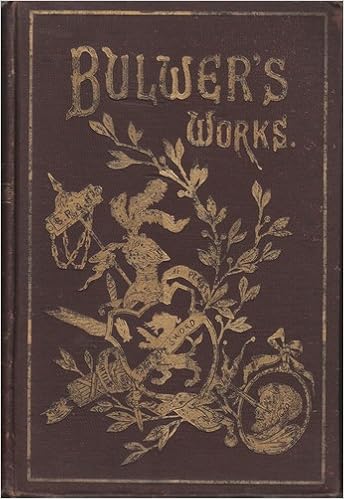
It's hard to read it at this scale, but the ribbon wound through this design says quite clearly: THE PENIS MIGHTIER THAN THE SWORD -- a frighteningly ironic motto considering his publicly acrimonious relationship with his wife, for which see, e.g. his wikipedia entry.
See my review of The Coming Race. I've read that one and Zanoni, but neither his short fiction, nor his most-read book by far, The Last Days of Pompeii.
Of course, he's the author of the immemorial opening clause "It was a dark and stormy night," followed by four more clauses to make up a single monstrous sentence. He is consequently the namesake of the Bulwer-Lytton Fiction Contest for deliberately ill-formed prose.
The hardcover multi-volume edition of his collected works had this lovely cover:
It's hard to read it at this scale, but the ribbon wound through this design says quite clearly: THE PENIS MIGHTIER THAN THE SWORD -- a frighteningly ironic motto considering his publicly acrimonious relationship with his wife, for which see, e.g. his wikipedia entry.
22elenchus
I cannot fathom why the joke never occurred to me before: THE PENIS MIGHTIER THAN THE SWORD. So much better a legacy than It was a dark and stormy night ....
23artturnerjr
>21 paradoxosalpha:
THE PENIS MIGHTIER THAN THE SWORD
Indeed!
Fits in quite nicely with Alan Moore and Kevin O'Neill's usage of the Vril-ya (from The Coming Race) in The League of Extraordinary Gentlemen, in which they are quite literally the coming race:
http://www.newsarama.com/8098-league-of-extraordinary-gentlemen-century-1969-che...
THE PENIS MIGHTIER THAN THE SWORD
Indeed!
Fits in quite nicely with Alan Moore and Kevin O'Neill's usage of the Vril-ya (from The Coming Race) in The League of Extraordinary Gentlemen, in which they are quite literally the coming race:
http://www.newsarama.com/8098-league-of-extraordinary-gentlemen-century-1969-che...
25housefulofpaper
Bulwer-Lytton's indirect contribution to British gastronomy, Bovril (i.e., "Bovine Vril"):
https://en.wikipedia.org/wiki/Bovril
https://en.wikipedia.org/wiki/Bovril
26housefulofpaper
I suppose this is still early days for the weird tale. If What Was It? looks forward to H G Wells, it also looks back to Poe and Hoffmann, I think. It's Poe-like in that the touches of real-world verisimilitude could suggest a hoax like "The Balloon Hoax" or "Some Words with a Mummy" (did Harper's publish non-fiction articles, I wonder?). Hoffmann's stories are generally (it seems to me) in the form of malevolent fairy tales which leave much unexplained - although that could be because I've missed references of a Rosicrucian or Alchemical nature, which the notes to Hoffmann collections I own, assure me are there.
Kevin Corstorphine, in his Green Book essay, suggests the narrator is "an unreliable narrator of a highly subjectve tale" and "O'Brien's greatest strength, like Bierce after him, lies in his capacity to give credible grounding for how incredible events might well have been seen to have happened." That would undermine the story's science fiction credentials, if "having the reality of the creature validated within the narrative" (to quote Costorphine again) has to be weighed against the unreliabilty of the narrator, and thus the narrative.
Kevin Corstorphine, in his Green Book essay, suggests the narrator is "an unreliable narrator of a highly subjectve tale" and "O'Brien's greatest strength, like Bierce after him, lies in his capacity to give credible grounding for how incredible events might well have been seen to have happened." That would undermine the story's science fiction credentials, if "having the reality of the creature validated within the narrative" (to quote Costorphine again) has to be weighed against the unreliabilty of the narrator, and thus the narrative.

