StevenTX's 2015 Reading Log - Vol. II
This is a continuation of the topic StevenTX Returns to the Lists in 2015 - Vol. I.
Talk Club Read 2015
Join LibraryThing to post.
This topic is currently marked as "dormant"—the last message is more than 90 days old. You can revive it by posting a reply.
2StevenTX
2015 Reading Index
Multiple or anonymous authors - Classical Literary Criticism - September 16
Abbott, Edwin A. - Flatland - July 20
Acker, Kathy - Literal Madness - July 23
Auster, Paul - The Music of Chance - July 22
Banks, Iain M. - Consider Phlebas - April 13
- The Player of Games - July 21
Bellamy, Edward - Looking Backward: 2000-1887 - August 20
Bellow, Saul - Seize the Day - January 6
- Dangling Man - April 23
Bernhard, Thomas - Yes - April 22
Böll, Heinrich - The Lost Honor of Katharina Blum - February 4
Burroughs, Edgar Rice - The Return of Tarzan - February 17
- Pellucidar - March 7
- Tanar of Pellucidar - March 30
- The Beasts of Tarzan - April 14
- The Son of Tarzan - May 11
- Beyond Thirty; or, The Lost Continent - June 16
- Tarzan and the Jewels of Opar - June 18
- Jungle Tales of Tarzan - August 24
- A Princess of Mars - September 18
Chesney, George Tomkyns - The Battle of Dorking - August 7
Christopher, John - The Death of Grass - March 17
Coetzee, J. M. - In the Heart of the Country - April 18
Dacre, Charlotte - Zofloya, or The Moor - April 14
DeLillo, Don - The Body Artist - August 15
Faber, Michel - Under the Skin - March 22
Fielding, Henry - Joseph Andrews - January 21
- Amelia - May 25
Gilman, Charlotte Perkins - Herland - April 19
Gray, Alasdair - Lanark: A Life in 4 Books - July 9
Green, Henry - Blindness - March 5
Greg, Percy - Across the Zodiac: The Story of a Wrecked Record - March 6
Haggard, H. Rider - She - August 12
Herrin, Judith - Byzantium: The Surprising Life of a Medieval Empire - January 15
Hippocrates - On Ancient Medicine - May 17
Hudson, W. H. - A Crystal Age - July 27
Jarry, Alfred - The Ubu Plays - September 28
Jefferies, Richard - After London; or, Wild England - January 3
Lach-Szyrma, W. S. - Aleriel - May 14
Laurie, Andre - The Conquest of the Moon - June 24
Lennox, Charlotte - The Female Quixote - July 13
Mankell, Henning - Faceless Killers - August 19
Morris, William - News from Nowhere - September 6
Morrison, Toni - Song of Solomon - February 1
Neira Vilas, Xosé - Memoirs of a Peasant Boy - October 8
O'Brien, Edna - August Is a Wicked Month - September 8
Paasilinna, Arto - The Year of the Hare - August 15
Plato - Ion - January 2
- Phaedo - January 28
- Cratylus - February 26
- Euthydemus - March 14
- Protagoras - April 17
- Gorgias - May 15
- Meno - May 18
- Menexenus - May 30
- Symposium - July 2
- Phaedrus - July 3
- Parmenides - July 6
- Theaetetus - July 14
- Clitophon - July 14
- Timaeus - July 18
- Critias - July 18
- The Sophist - July 24
- The Statesman - July 27
- Philebus - July 30
- Laws - August 23
Rosny aîné, J.-H. - August 5
Rushdie, Salman - Shame - June 29
- Two Years Eight Months and Twenty-Eight Nights - July 28
Sartre, Jean-Paul - Nausea - January 27
Scalzi, John - Redshirts - May 1
Schechter, Elizabeth - House of the Sable Locks - January 1
Simmons, Dan - The Rise of Endymion - January 17
Slauerhoff, J. J. - The Forbidden Kingdom May 21
Stokoe, Matthew - Cows - February 1
Tabucchi, Antonio - Pereira Declares - April 23
Theocritus - Idylls - September 29
Trollope, Anthony - Can You Forgive Her? - March 10
- Phineas Finn - June 7
- The Eustace Diamonds - October 4
Uzanne, Octave - The End of Books - October 7
Verne, Jules - The Mysterious Island - October 5
- Hector Servadac; or, Off on a Comet - October 23
Villiers de l'Isle Adam - Tomorrow's Eve - July 11
Weber, David - War of Honor - September 24
Woolf, Virginia - Orlando - January 14
Wyndham, John - The Midwich Cuckoos - January 23
Zola, Émile - The Conquest of Plassans - April 15
Multiple or anonymous authors - Classical Literary Criticism - September 16
Abbott, Edwin A. - Flatland - July 20
Acker, Kathy - Literal Madness - July 23
Auster, Paul - The Music of Chance - July 22
Banks, Iain M. - Consider Phlebas - April 13
- The Player of Games - July 21
Bellamy, Edward - Looking Backward: 2000-1887 - August 20
Bellow, Saul - Seize the Day - January 6
- Dangling Man - April 23
Bernhard, Thomas - Yes - April 22
Böll, Heinrich - The Lost Honor of Katharina Blum - February 4
Burroughs, Edgar Rice - The Return of Tarzan - February 17
- Pellucidar - March 7
- Tanar of Pellucidar - March 30
- The Beasts of Tarzan - April 14
- The Son of Tarzan - May 11
- Beyond Thirty; or, The Lost Continent - June 16
- Tarzan and the Jewels of Opar - June 18
- Jungle Tales of Tarzan - August 24
- A Princess of Mars - September 18
Chesney, George Tomkyns - The Battle of Dorking - August 7
Christopher, John - The Death of Grass - March 17
Coetzee, J. M. - In the Heart of the Country - April 18
Dacre, Charlotte - Zofloya, or The Moor - April 14
DeLillo, Don - The Body Artist - August 15
Faber, Michel - Under the Skin - March 22
Fielding, Henry - Joseph Andrews - January 21
- Amelia - May 25
Gilman, Charlotte Perkins - Herland - April 19
Gray, Alasdair - Lanark: A Life in 4 Books - July 9
Green, Henry - Blindness - March 5
Greg, Percy - Across the Zodiac: The Story of a Wrecked Record - March 6
Haggard, H. Rider - She - August 12
Herrin, Judith - Byzantium: The Surprising Life of a Medieval Empire - January 15
Hippocrates - On Ancient Medicine - May 17
Hudson, W. H. - A Crystal Age - July 27
Jarry, Alfred - The Ubu Plays - September 28
Jefferies, Richard - After London; or, Wild England - January 3
Lach-Szyrma, W. S. - Aleriel - May 14
Laurie, Andre - The Conquest of the Moon - June 24
Lennox, Charlotte - The Female Quixote - July 13
Mankell, Henning - Faceless Killers - August 19
Morris, William - News from Nowhere - September 6
Morrison, Toni - Song of Solomon - February 1
Neira Vilas, Xosé - Memoirs of a Peasant Boy - October 8
O'Brien, Edna - August Is a Wicked Month - September 8
Paasilinna, Arto - The Year of the Hare - August 15
Plato - Ion - January 2
- Phaedo - January 28
- Cratylus - February 26
- Euthydemus - March 14
- Protagoras - April 17
- Gorgias - May 15
- Meno - May 18
- Menexenus - May 30
- Symposium - July 2
- Phaedrus - July 3
- Parmenides - July 6
- Theaetetus - July 14
- Clitophon - July 14
- Timaeus - July 18
- Critias - July 18
- The Sophist - July 24
- The Statesman - July 27
- Philebus - July 30
- Laws - August 23
Rosny aîné, J.-H. - August 5
Rushdie, Salman - Shame - June 29
- Two Years Eight Months and Twenty-Eight Nights - July 28
Sartre, Jean-Paul - Nausea - January 27
Scalzi, John - Redshirts - May 1
Schechter, Elizabeth - House of the Sable Locks - January 1
Simmons, Dan - The Rise of Endymion - January 17
Slauerhoff, J. J. - The Forbidden Kingdom May 21
Stokoe, Matthew - Cows - February 1
Tabucchi, Antonio - Pereira Declares - April 23
Theocritus - Idylls - September 29
Trollope, Anthony - Can You Forgive Her? - March 10
- Phineas Finn - June 7
- The Eustace Diamonds - October 4
Uzanne, Octave - The End of Books - October 7
Verne, Jules - The Mysterious Island - October 5
- Hector Servadac; or, Off on a Comet - October 23
Villiers de l'Isle Adam - Tomorrow's Eve - July 11
Weber, David - War of Honor - September 24
Woolf, Virginia - Orlando - January 14
Wyndham, John - The Midwich Cuckoos - January 23
Zola, Émile - The Conquest of Plassans - April 15
3StevenTX
2015 Statistics
Summary of Books Read
85 - books read
79 - novels
2 - fiction collections
2 - philosophy
1 - history
1 - science and technology
1 - drama collections
1 - poetry collections
11 - rereads
Authors
65 - different authors
36 - authors new to me
69 - books by male authors
15 - books by female authors
3 - books by multiple, anonymous or unknown authors
Books Read by Author's Nationality
30 - American
22 - English
9 - French
4 - Scottish
3 - Greek
2 - Dutch
2 - Indian
2 - Irish
1 - German
1 - South African
1 - Austrian
1 - Italian
1 - Argentine
1 - Belgian
1 - Finnish
1 - Swedish
1 - Spanish
Books Read by Original Language
66 - English
10 - French
2 - German
2 - Classical Greek
1 - Modern Greek
1 - Italian
1 - Dutch
1 - Finnish
1 - Swedish
1 - Galician
Books Read by Decade of First Publication
3 - Classical Age
1 - 1740s
2 - 1750s
1 - 1800s
2 - 1860s
5 - 1870s
11 - 1880s
6 - 1890s
9 - 1910s
3 - 1920s
2 - 1930s
1 - 1940s
4 - 1950s
6 - 1960s
7 - 1970s
5 - 1980s
9 - 1990s
5 - 2000s
5 - 2010s
2014 Statistics
2013 Statistics
2012 Statistics
Summary of Books Read
85 - books read
79 - novels
2 - fiction collections
2 - philosophy
1 - history
1 - science and technology
1 - drama collections
1 - poetry collections
11 - rereads
Authors
65 - different authors
36 - authors new to me
69 - books by male authors
15 - books by female authors
3 - books by multiple, anonymous or unknown authors
Books Read by Author's Nationality
30 - American
22 - English
9 - French
4 - Scottish
3 - Greek
2 - Dutch
2 - Indian
2 - Irish
1 - German
1 - South African
1 - Austrian
1 - Italian
1 - Argentine
1 - Belgian
1 - Finnish
1 - Swedish
1 - Spanish
Books Read by Original Language
66 - English
10 - French
2 - German
2 - Classical Greek
1 - Modern Greek
1 - Italian
1 - Dutch
1 - Finnish
1 - Swedish
1 - Galician
Books Read by Decade of First Publication
3 - Classical Age
1 - 1740s
2 - 1750s
1 - 1800s
2 - 1860s
5 - 1870s
11 - 1880s
6 - 1890s
9 - 1910s
3 - 1920s
2 - 1930s
1 - 1940s
4 - 1950s
6 - 1960s
7 - 1970s
5 - 1980s
9 - 1990s
5 - 2000s
5 - 2010s
2014 Statistics
2013 Statistics
2012 Statistics
4StevenTX
Welcome to my second thread for 2015. My reading during the first half of the year was less productive and less focused than I would have liked, so I have returned to the categorical approach to planning my reading that was very productive for me in 2012 and 2013.
6rebeccanyc
What Barry said!
7chlorine
I could not plan like you but love reading about your plans!
Looking forwards to hearing what you think about Notre-Dame de Paris, and I hope you like The Dispossessed as much as I did.
Looking forwards to hearing what you think about Notre-Dame de Paris, and I hope you like The Dispossessed as much as I did.
8StevenTX
More Plato...

Symposium translated by Tom Griffith
The term "symposium" originally meant a drinking party. At this event, attended by Socrates and a number of his friends, the talk turns to the subject of Eros (both the god and the concept of love). Each participant is invited to present an encomium, a speech in praise of the subject. It is understood that throughout the dialogue the love being discussed is between men, usually a generation apart in age. The Symposium is a good source of information about the practice of homosexuality in classical Greece and how its acceptance differed in various cities and foreign lands. There is also a distinction made between love and sex, with one speaker arguing that the noblest love is that which abstains from physical pleasure. This is the origin of our phrase "Platonic love."
As Socrates is taking his turn to speak, Alcibiades, his young protege, arrives. Alcibiades is drunk and proceeds to complain that instead of Socrates's trying to seduce him, Alcibiades himself has fallen in love with the older man. But while Alcibiades has thrown himself at Socrates, his mentor hasn't shown any desire for sex even though he is known to lust after other youths. In praise of Socrates, Alcibiades gives some valuable details about the philosopher's life that show he was a man of action as well as words and had a distinguished military career.
Phaedrus translated by Tom Griffith
Love is also the subject initially discussed in Phaedrus, a dialogue in which Socrates encounters a young man named Phaedrus who is a fan of a celebrated orator named Lysias. Phaedrus has brought a copy of speech by Lysias and reads it to Socrates. Lysias makes the case that young men should only grant sexual favors to older men who do not love them, not to those who do love them.
Socrates counters this with a speech making the distinction between respectful, reasoned love and bestial lust. The subject then changes to the divine origins of madness and the nature of the soul. Socrates discloses his theory of the immortality of the soul and how it continually returns to the earth through reincarnation. He makes the analogy that every man has competing good and bad natures like a chariot with a good horse and a bad horse.
Ultimately the subject of the dialog is not love or the soul but the institution of rhetorical speech which was very important in Athens. Lysias is an example of a sophist, a professional teacher of rhetoric, whose goal is to persuade, not to inform or educate. As in earlier dialogues, Socrates maintains that rhetoric is not a worthy art as it has nothing to do with the pursuit of wisdom and justice.
Parmenides translated by Benjamin Jowett
In this dialogue a very young Socrates encounters two of his most important predecessors, Parmenides and Zeno. The subject of their discussion is the very nature of existence. Socrates's own dualistic ideas on the matter are, surprisingly, shot down very quickly, and in a dazzling display of abstract logic, Parmenides goes on to prove that all existence is a single entity, called the "one," which is indivisible, which has no shape or dimensions, and exists without time. Contemplating alternatives, such as the existence of "others," or the idea that the "one" might not exist, leads to arguments such as the following:
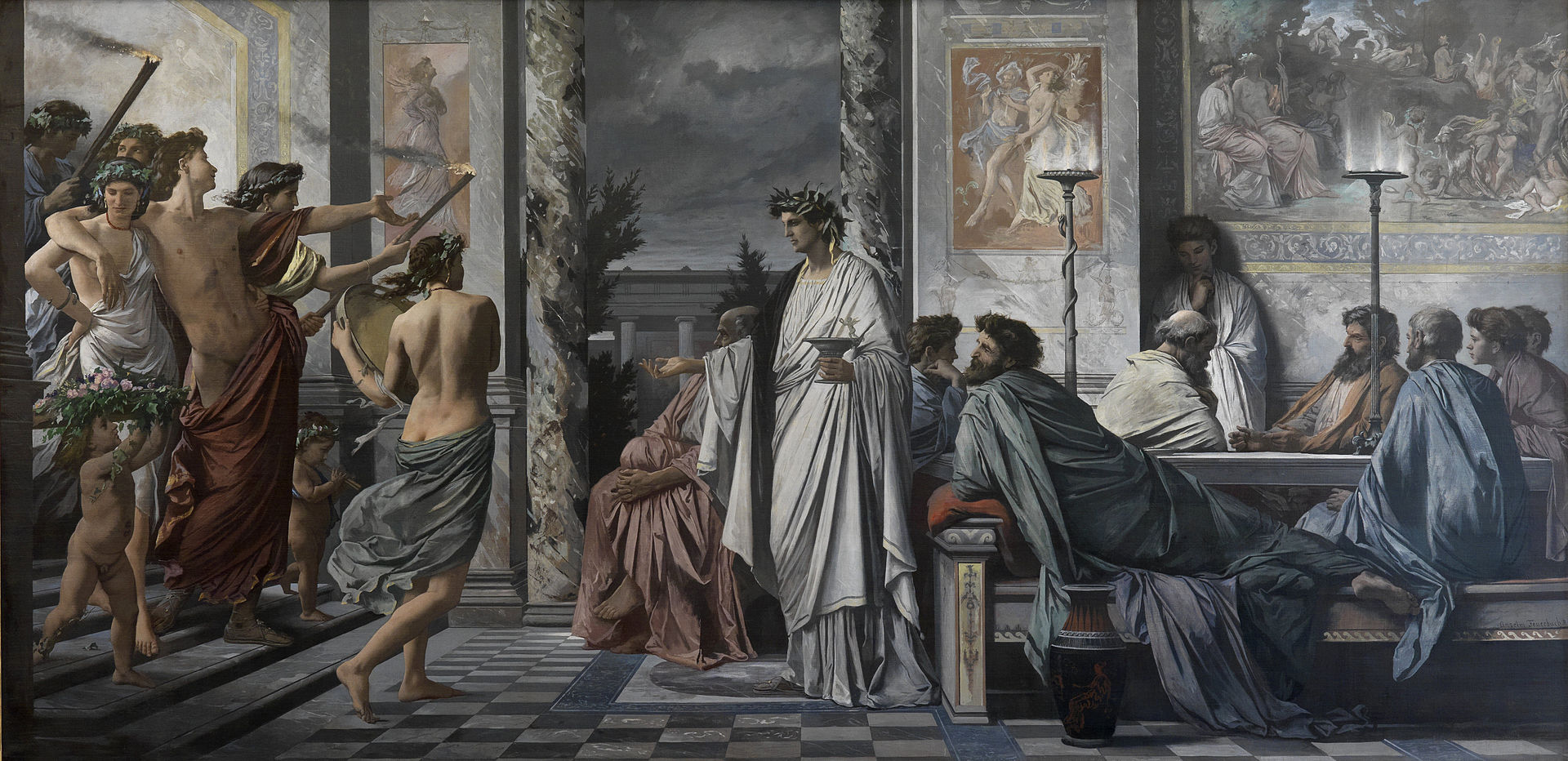
Alcibiades crashes the party in Plato's Symposium

Symposium translated by Tom Griffith
The term "symposium" originally meant a drinking party. At this event, attended by Socrates and a number of his friends, the talk turns to the subject of Eros (both the god and the concept of love). Each participant is invited to present an encomium, a speech in praise of the subject. It is understood that throughout the dialogue the love being discussed is between men, usually a generation apart in age. The Symposium is a good source of information about the practice of homosexuality in classical Greece and how its acceptance differed in various cities and foreign lands. There is also a distinction made between love and sex, with one speaker arguing that the noblest love is that which abstains from physical pleasure. This is the origin of our phrase "Platonic love."
As Socrates is taking his turn to speak, Alcibiades, his young protege, arrives. Alcibiades is drunk and proceeds to complain that instead of Socrates's trying to seduce him, Alcibiades himself has fallen in love with the older man. But while Alcibiades has thrown himself at Socrates, his mentor hasn't shown any desire for sex even though he is known to lust after other youths. In praise of Socrates, Alcibiades gives some valuable details about the philosopher's life that show he was a man of action as well as words and had a distinguished military career.
Phaedrus translated by Tom Griffith
Love is also the subject initially discussed in Phaedrus, a dialogue in which Socrates encounters a young man named Phaedrus who is a fan of a celebrated orator named Lysias. Phaedrus has brought a copy of speech by Lysias and reads it to Socrates. Lysias makes the case that young men should only grant sexual favors to older men who do not love them, not to those who do love them.
Socrates counters this with a speech making the distinction between respectful, reasoned love and bestial lust. The subject then changes to the divine origins of madness and the nature of the soul. Socrates discloses his theory of the immortality of the soul and how it continually returns to the earth through reincarnation. He makes the analogy that every man has competing good and bad natures like a chariot with a good horse and a bad horse.
Ultimately the subject of the dialog is not love or the soul but the institution of rhetorical speech which was very important in Athens. Lysias is an example of a sophist, a professional teacher of rhetoric, whose goal is to persuade, not to inform or educate. As in earlier dialogues, Socrates maintains that rhetoric is not a worthy art as it has nothing to do with the pursuit of wisdom and justice.
Parmenides translated by Benjamin Jowett
In this dialogue a very young Socrates encounters two of his most important predecessors, Parmenides and Zeno. The subject of their discussion is the very nature of existence. Socrates's own dualistic ideas on the matter are, surprisingly, shot down very quickly, and in a dazzling display of abstract logic, Parmenides goes on to prove that all existence is a single entity, called the "one," which is indivisible, which has no shape or dimensions, and exists without time. Contemplating alternatives, such as the existence of "others," or the idea that the "one" might not exist, leads to arguments such as the following:
Then the one which is not, if it is to maintain itself, must have the being of not-being as the bond of not-being, just as being must have as a bond the not-being of not-being in order to perfect its own being; for the truest assertion of the being of being and of the not-being of not-being is when being partakes of the being of being, and not of the being of not-being — that is, the perfection of being; and when not-being does not partake of the not-being of not-being but of the being of not-being — that is the perfection of not-being.The dialogue concludes with the paradox, "let us affirm what seems to be the truth, that, whether one is or is not, one and the others in relation to themselves and one another, all of them, in every way, are and are not, and appear to be and appear not to be."
Alcibiades crashes the party in Plato's Symposium
9dchaikin
Those were fun reviews of Plato, although i'm not sure how the being of being is any different than the not-being of not-being. :)
10baswood
Loving your reviews of Plato. Very confused by Parmenides - its enough to put one of philosophy
11RidgewayGirl
I love the collection of books you're planning. I'm looking forward to your thoughts on more than a few of them.
12StevenTX
Lanark: A Life in 4 Books by Alasdair Gray
First published 1981
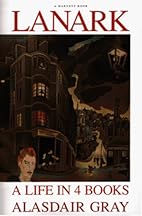
Lanark: A Life in 4 Books, is a highly unusual novel that defies any attempt at a succinct description. The story begins in the middle with Book 3, a Kafkaesque tale of a young man who finds himself in a city trapped in perpetual darkness. The man, who takes the name Lanark, does not know who he is or where he comes from. He falls in with set of intellectuals who meet regularly in a cafe, and he becomes involved in the group's inner rivalries and love affairs. He also discovers he has some kind of disease which is gradually turning his skin into hard, reptilian scales. This is only the beginning of Lanark's bizarre experiences and transformations.
Next come Book's 1 and 2 of the novel, which are the completely conventional coming of age story of a young Scot named Duncan Thaw. Duncan is a bright boy but afflicted with asthma and tormented by the sickness and early death of his mother. His chief passion is art, and he neglects everything else for it. But he also has a young man's yearning for love and doubts about religion. His demands that art, religion, and love all be on his own terms gradually alienate him from those who care for him. Duncan's home is Glasgow, and we recognize that the dark city of Book 3 is also Glasgow. Lanark is, presumably, Duncan in some sort of dream or afterlife.
Book 4 returns to the world of the darkened city and finds Lanark becoming increasingly involved in the world of politics. This portion of the novel is partly a statement on the way multi-national corporations wield power and how that power threatens not only individual workers but the earth itself. Yet at one point Lanark steps through a hidden door and comes face to face with the author of the book. In this metafictional segment the author explains to Lanark how his life and world have been drawn from works as varied as The Iliad, Leviathan, Alice in Wonderland, and Breakfast of Champions.
Whether it was meant to be a political statement, the story of a lonely and angry artist, a multifaceted portrait of Glasgow, a potpourri of literary imitations, or all of the above, Lanark is an absorbing and thoughtful novel that I recommend to anyone with a taste for the unorthodox.
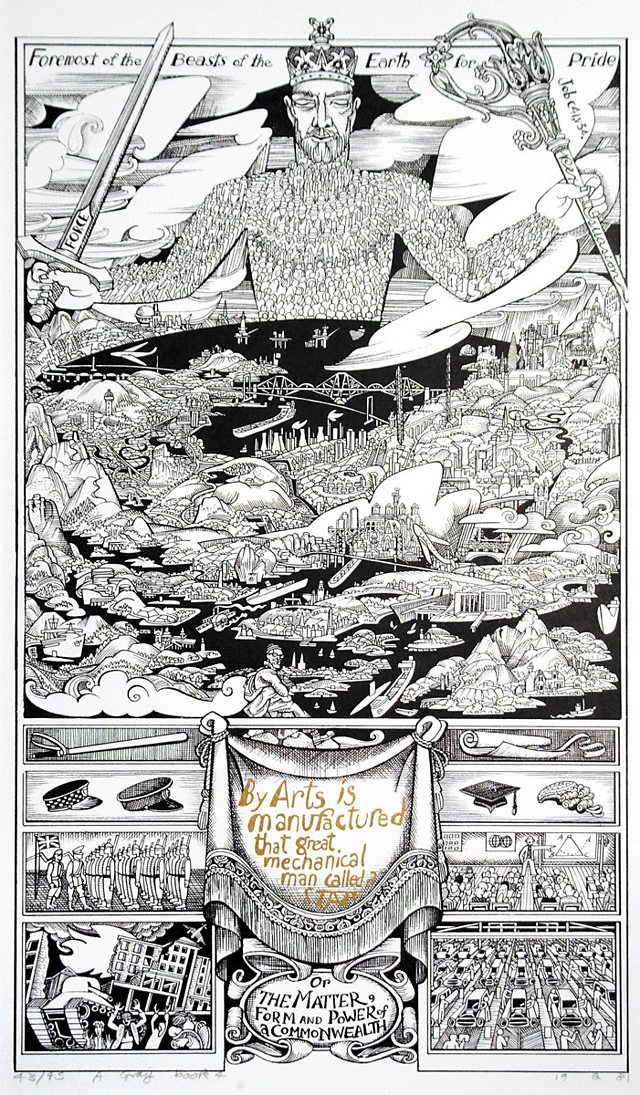

The author's illustration for the title page for Book 4 of Lanark is based on the title page of Thomas Hobbes's Leviathan
First published 1981
Lanark: A Life in 4 Books, is a highly unusual novel that defies any attempt at a succinct description. The story begins in the middle with Book 3, a Kafkaesque tale of a young man who finds himself in a city trapped in perpetual darkness. The man, who takes the name Lanark, does not know who he is or where he comes from. He falls in with set of intellectuals who meet regularly in a cafe, and he becomes involved in the group's inner rivalries and love affairs. He also discovers he has some kind of disease which is gradually turning his skin into hard, reptilian scales. This is only the beginning of Lanark's bizarre experiences and transformations.
Next come Book's 1 and 2 of the novel, which are the completely conventional coming of age story of a young Scot named Duncan Thaw. Duncan is a bright boy but afflicted with asthma and tormented by the sickness and early death of his mother. His chief passion is art, and he neglects everything else for it. But he also has a young man's yearning for love and doubts about religion. His demands that art, religion, and love all be on his own terms gradually alienate him from those who care for him. Duncan's home is Glasgow, and we recognize that the dark city of Book 3 is also Glasgow. Lanark is, presumably, Duncan in some sort of dream or afterlife.
Book 4 returns to the world of the darkened city and finds Lanark becoming increasingly involved in the world of politics. This portion of the novel is partly a statement on the way multi-national corporations wield power and how that power threatens not only individual workers but the earth itself. Yet at one point Lanark steps through a hidden door and comes face to face with the author of the book. In this metafictional segment the author explains to Lanark how his life and world have been drawn from works as varied as The Iliad, Leviathan, Alice in Wonderland, and Breakfast of Champions.
Whether it was meant to be a political statement, the story of a lonely and angry artist, a multifaceted portrait of Glasgow, a potpourri of literary imitations, or all of the above, Lanark is an absorbing and thoughtful novel that I recommend to anyone with a taste for the unorthodox.

The author's illustration for the title page for Book 4 of Lanark is based on the title page of Thomas Hobbes's Leviathan
14baswood
A taste for the unorthodox I would put you in that category Steven. Great review of Lanark
16StevenTX
>13 dchaikin: Where did you find out about Lanark?
From the following:
501 Great Writers
1001 Books You Must Read Before You Die
99 Novels: The Best in English Since 1939 by Anthony Burgess
The Modern Library: The 200 Best Novels in English Since 1950 by Callil and Toibin
Cult Fiction Readers' Guide by Andrew Calcutt
The Guardian's 1000 Novels Everyone Must Read
Flavorwire's List of 50 Great Books You'll Never Read in School
Flavorwire's List of 50 Essential Cult Novels
Robert McCrum's 100 Greatest Novels
Modern Fantasy: 100 Best Novels 1946-1987
The Rough Guide to Classic Novels
The Slipstream Core Canon
Jeff VanderMeer's Essential Fantasy Reading List
Bloomsbury Guide to World Fiction, Key Works
Anatomy of Wonder's Key Works in Science Fiction
Fantasy & Horror's Key Works in Fantasy
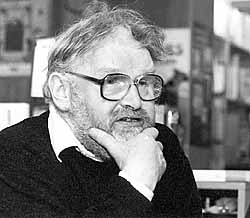
Lanark is unorthodox, but not at all obscure. It is one of those works that straddles the boundaries between genres and thus gets recognition from different directions. Alasdair Gray has written several other works of experimental fiction (and presumably is still writing at age 80), but none has achieved the prominence of Lanark, his first novel.
From the following:
501 Great Writers
1001 Books You Must Read Before You Die
99 Novels: The Best in English Since 1939 by Anthony Burgess
The Modern Library: The 200 Best Novels in English Since 1950 by Callil and Toibin
Cult Fiction Readers' Guide by Andrew Calcutt
The Guardian's 1000 Novels Everyone Must Read
Flavorwire's List of 50 Great Books You'll Never Read in School
Flavorwire's List of 50 Essential Cult Novels
Robert McCrum's 100 Greatest Novels
Modern Fantasy: 100 Best Novels 1946-1987
The Rough Guide to Classic Novels
The Slipstream Core Canon
Jeff VanderMeer's Essential Fantasy Reading List
Bloomsbury Guide to World Fiction, Key Works
Anatomy of Wonder's Key Works in Science Fiction
Fantasy & Horror's Key Works in Fantasy
Lanark is unorthodox, but not at all obscure. It is one of those works that straddles the boundaries between genres and thus gets recognition from different directions. Alasdair Gray has written several other works of experimental fiction (and presumably is still writing at age 80), but none has achieved the prominence of Lanark, his first novel.
17StevenTX
Tomorrow's Eve by Villiers de L'Isle Adam
First published in French 1886 as L'Eve Future
English translation by Robert Martin Adams 1982
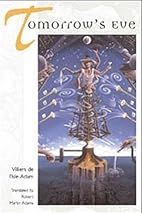

Jean Marie Mathias Philippe Auguste Villiers de l'Isle Adam was an impoverished French aristocrat and a conservative Catholic who despised science, technology, and everything associated with materialism and progress. How ironic, then, that he should be the first writer to publish a perfect and detailed description of an android ("andréïde" in his original French) in a novel that anticipates scientific developments that were decades in the future.
The central figure in the novel is the American inventor Thomas Alva Edison, a man given almost supernatural powers by Villiers. Edison is being visited by a young English aristocrat, Lord Celian Ewald, who is in a state of suicidal despair. Lord Ewald has fallen in love, and according to him the Ewald's fall in love only once in their life and either attain the object of their love or die. The object of his affection is a young lady named Miss Alicia Clary whose perfect beauty and grace make her the living twin of the Venus de Milo. But within this exquisite exterior lies a mind of excruciating banality. "How can it be?" laments Ewald. "This stunning beauty is the habitation of such appalling moral misery!" Vanity and materialism are her only thoughts, and she is incapable of even understanding the purpose of art, much less appreciating it. Ewald cannot live without her, yet every time she opens her mouth it is pure torture. He has resolved to end his life and has come to bid his friend Edison farewell.
Edison offers an alternative. "At this very hour and this very place twenty-one days from today, Miss Alicia Clary will appear before you, not simply transfigured, not just made the most enchanting of companions, nor merely lifted to the most sublime level of spirituality, but actually endowed with a sort of immortality. In a word, the present gorgeous little fool will no longer be a woman, but an angel; no longer a mistress, but a lover; no longer reality, but the IDEAL." He proposes, in short, to build a mechanical woman indistinguishable by sight or touch from the living model but endowed with a personality that is a reflection of Lord Ewald's purest desires.
The android, in fact, has already been built. Her name is Hadaly, and she lacks only the integument, voice and mannerisms that will make her a perfect counterfeit of Alicia Clary. Edison introduces her to Ewald and spends about half the novel demonstrating her abilities, uncovering her mechanisms, and trying to convince the highly skeptical aristocrat to give it a try. As Villiers was no scientist, much of the detail of Hadaly's construction is nonsense, but in a few cases he stumbled upon some very prescient details. For example, as Edison explains, the android's movements are controlled "by means of an intricate code" recorded on spinning discs which sends instructions along a complex network of wires to the tiny motors and magnets which move the androids limbs, flex the skin of her face into a smile, and cause tears to flow when she is distressed.
The philosophical discussions which Ewald and Edision pursue are, however, far more interesting than the technology. Ewald objects that the android will be merely playing a role using pre-recorded words and phrases which can never be changed or augmented. Edison replies, "Oh, who under the sun could be so strange as to imagine that he doesn't enact a comedy every day of his life until his death? The only people who pretend to the contrary are those who don't realize what role they are playing!" As for the repetitious conversation, Edison proclaims that the last thing we want is for our perfect soulmate to be unpredictable and changeable: "...better than a false, mediocre, and ever-changing Reality; what I bring is a positive, enchanting, and ever-faithful Illusion."
Edison's android turns out, ironically, to be more than what she was designed to be, and here the author introduces elements of mysticism which were, in his day, surprising popular among both scientific and religious circles. The novel eventually becomes a dialogue on the nature of the soul, and Edison comes to resemble a remorseful Victor Frankenstein.
Though Tomorrow's Eve is much more than a 19th century version of The Stepford Wives, it is still flawed by an underlying view of women as having value only in their relation to men. Speaking of women who use their charms to seduce gentlemen for the sake of wealth or title, Villers's Edison says that they are "...less remote in Reality from the animal species than our own. Hence the man worthy of his name has the rights of high and low justice over this species of deadly female, by the same title that he claims these rights over other members of the animal kingdom." He may "inflict a summary execution on her, in the most secret and certain manner that he can, without the least scruple or form of legality, any more than one would hesitate about killing a vampire or a viper." Of course the notion of an heiress bumping off an annoying suitor--like that of a male android as companion to an intellectually starved woman--would have been unthinkable to the author.
Villiers was a dilettante and charlatan with a touch of genius who produced a strange, inconsistent work that touches on a number of thoughtful ideas but remains ambiguous. Most of the novel is sedentary dialogue or soliloquy in rather overblown prose, though there is a burst of satirical humor near the end that reminded me of Jules Verne as it poked fun at America's embryonic media culture. I strongly recommend reading the introduction by Robert Martin Adams to his translation of the novel, as it provides illuminating detail about Villiers's life and personality, the real-life model for Alicia Clary, and the author's reactionary views that underlie his work.
As an example of the novel's inconsistency, I will close with a marvelous quote from Hadaly, the android, that seems exactly the opposite sentiment of what one would expect from an orthodox Catholic aristocrat: "Recall that had you been born in other countries, your thought would take other forms, and that there is no other truth for Man than that which he chooses for his own out of many thousands--all of them just as doubtful as the one he chooses: choose then the one that makes you a god."

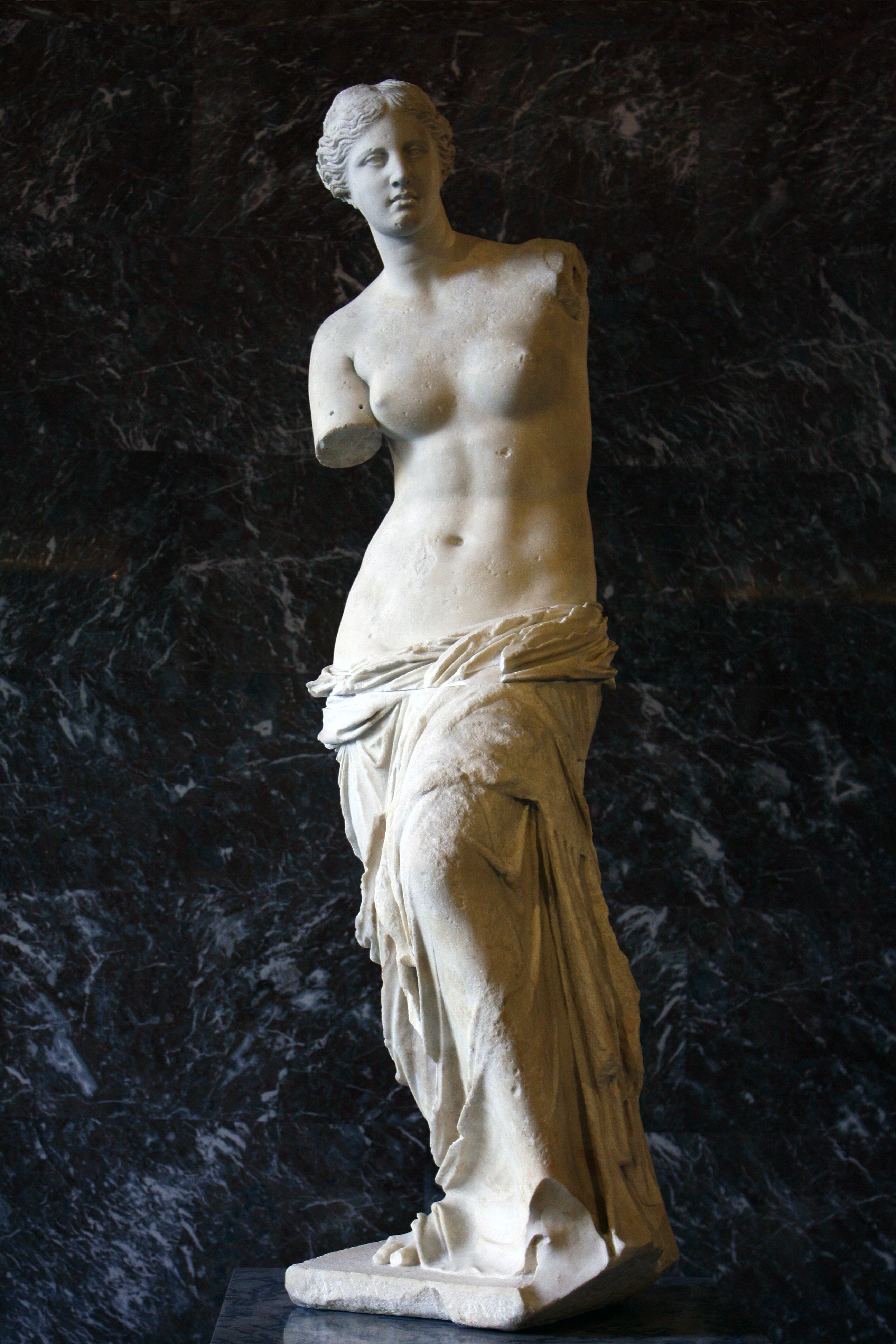
Hadaly, the android, before she is transformed into a twin of Alicia Clary and the Venus de Milo.
First published in French 1886 as L'Eve Future
English translation by Robert Martin Adams 1982

Jean Marie Mathias Philippe Auguste Villiers de l'Isle Adam was an impoverished French aristocrat and a conservative Catholic who despised science, technology, and everything associated with materialism and progress. How ironic, then, that he should be the first writer to publish a perfect and detailed description of an android ("andréïde" in his original French) in a novel that anticipates scientific developments that were decades in the future.
The central figure in the novel is the American inventor Thomas Alva Edison, a man given almost supernatural powers by Villiers. Edison is being visited by a young English aristocrat, Lord Celian Ewald, who is in a state of suicidal despair. Lord Ewald has fallen in love, and according to him the Ewald's fall in love only once in their life and either attain the object of their love or die. The object of his affection is a young lady named Miss Alicia Clary whose perfect beauty and grace make her the living twin of the Venus de Milo. But within this exquisite exterior lies a mind of excruciating banality. "How can it be?" laments Ewald. "This stunning beauty is the habitation of such appalling moral misery!" Vanity and materialism are her only thoughts, and she is incapable of even understanding the purpose of art, much less appreciating it. Ewald cannot live without her, yet every time she opens her mouth it is pure torture. He has resolved to end his life and has come to bid his friend Edison farewell.
Edison offers an alternative. "At this very hour and this very place twenty-one days from today, Miss Alicia Clary will appear before you, not simply transfigured, not just made the most enchanting of companions, nor merely lifted to the most sublime level of spirituality, but actually endowed with a sort of immortality. In a word, the present gorgeous little fool will no longer be a woman, but an angel; no longer a mistress, but a lover; no longer reality, but the IDEAL." He proposes, in short, to build a mechanical woman indistinguishable by sight or touch from the living model but endowed with a personality that is a reflection of Lord Ewald's purest desires.
The android, in fact, has already been built. Her name is Hadaly, and she lacks only the integument, voice and mannerisms that will make her a perfect counterfeit of Alicia Clary. Edison introduces her to Ewald and spends about half the novel demonstrating her abilities, uncovering her mechanisms, and trying to convince the highly skeptical aristocrat to give it a try. As Villiers was no scientist, much of the detail of Hadaly's construction is nonsense, but in a few cases he stumbled upon some very prescient details. For example, as Edison explains, the android's movements are controlled "by means of an intricate code" recorded on spinning discs which sends instructions along a complex network of wires to the tiny motors and magnets which move the androids limbs, flex the skin of her face into a smile, and cause tears to flow when she is distressed.
The philosophical discussions which Ewald and Edision pursue are, however, far more interesting than the technology. Ewald objects that the android will be merely playing a role using pre-recorded words and phrases which can never be changed or augmented. Edison replies, "Oh, who under the sun could be so strange as to imagine that he doesn't enact a comedy every day of his life until his death? The only people who pretend to the contrary are those who don't realize what role they are playing!" As for the repetitious conversation, Edison proclaims that the last thing we want is for our perfect soulmate to be unpredictable and changeable: "...better than a false, mediocre, and ever-changing Reality; what I bring is a positive, enchanting, and ever-faithful Illusion."
Edison's android turns out, ironically, to be more than what she was designed to be, and here the author introduces elements of mysticism which were, in his day, surprising popular among both scientific and religious circles. The novel eventually becomes a dialogue on the nature of the soul, and Edison comes to resemble a remorseful Victor Frankenstein.
Though Tomorrow's Eve is much more than a 19th century version of The Stepford Wives, it is still flawed by an underlying view of women as having value only in their relation to men. Speaking of women who use their charms to seduce gentlemen for the sake of wealth or title, Villers's Edison says that they are "...less remote in Reality from the animal species than our own. Hence the man worthy of his name has the rights of high and low justice over this species of deadly female, by the same title that he claims these rights over other members of the animal kingdom." He may "inflict a summary execution on her, in the most secret and certain manner that he can, without the least scruple or form of legality, any more than one would hesitate about killing a vampire or a viper." Of course the notion of an heiress bumping off an annoying suitor--like that of a male android as companion to an intellectually starved woman--would have been unthinkable to the author.
Villiers was a dilettante and charlatan with a touch of genius who produced a strange, inconsistent work that touches on a number of thoughtful ideas but remains ambiguous. Most of the novel is sedentary dialogue or soliloquy in rather overblown prose, though there is a burst of satirical humor near the end that reminded me of Jules Verne as it poked fun at America's embryonic media culture. I strongly recommend reading the introduction by Robert Martin Adams to his translation of the novel, as it provides illuminating detail about Villiers's life and personality, the real-life model for Alicia Clary, and the author's reactionary views that underlie his work.
As an example of the novel's inconsistency, I will close with a marvelous quote from Hadaly, the android, that seems exactly the opposite sentiment of what one would expect from an orthodox Catholic aristocrat: "Recall that had you been born in other countries, your thought would take other forms, and that there is no other truth for Man than that which he chooses for his own out of many thousands--all of them just as doubtful as the one he chooses: choose then the one that makes you a god."

Hadaly, the android, before she is transformed into a twin of Alicia Clary and the Venus de Milo.
18NanaCC
Tomorrow's Eve sounds quite interesting. Nice review.
19StevenTX
Hadaly from Tomorrow's Eve may be the first named android in fiction. An android is an autonomous, artificial being created to resemble--or even impersonate--a human being. Some androids, like Hadaly, have a mechanical interior and are made of inorganic materials, while others are synthesized from organic materials and are difficult to distinguish from natural human beings. (The android itself may not even know that it is not human.) Here are some notable androids from movies and television. They are all Hadaly's offspring.





Though they are called "droids," the two characters pictured below are more properly termed robots, as they are not human in appearance. (ETA: Though, come to think of it, the one on the left does resemble my brother-in-law.)


Though they are called "droids," the two characters pictured below are more properly termed robots, as they are not human in appearance. (ETA: Though, come to think of it, the one on the left does resemble my brother-in-law.)

20StevenTX
The Female Quixote; or, The Adventures of Arabella by Charlotte Lennox
First published (anonymously) in 1752

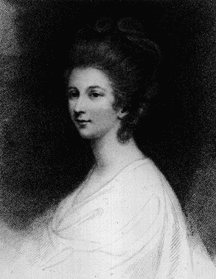
The premise of The Female Quixote is easily discerned from its title. Arabella is an English girl--17 years old when the novel begins--who has been raised in the secluded luxury of her father's country estate to which he retired in self-imposed exile after falling politically out of favor. Arabella's mother died young, leaving her daughter little but a collection of French romance novels of the previous century in bad English translations. Having no contact with the outside world, and being largely neglected by her father, Arabella has filled her head with romances of chivalry which she believes to be a faithful depiction of the world outside her estate. (Her favorite writer is Madeleine de Scudéry (1607-1701), whose novel Artamène ou Le Grand Cyrus, at 2 million words, is considered the longest ever published.)
When Arabella's father suddenly dies, she is pushed into contact with the real world. Being both exquisitely beautiful and extremely rich, she is set upon by suitors both sincere and opportunistic. But her code of honor, that of a world that never was, demands that no man may speak to her of love until he has vanquished armies, slain his challengers, and appeared at her feet oozing the last drops of his blood in her honor as he awaits the word from her lips that will let him live. Her imagination also sees threats to her chastity in every direction. When a young man applies for work as an assistant gardener, she sees him as a prince in disguise trying to infiltrate her castle. Imagining that he is plotting to abduct and ravish her, she flees desperately into the night.
Arabella's uncle and cousins are hard-pressed to understand, much less correct, her extravagant and often bloodthirsty view of the world. Eventually they decide to remove her to Bath and then London, hoping that exposure to society will cure her of her delusions. But Arabella only continues to see the world through the lens of her reading, and causes a sensation by her outrageous ideas and behavior.
The Female Quixote is hilarious from beginning to end. Just when you think the joke has played out, Lennox comes up with yet another twist to the story to keep it fresh. There is nothing like the depth of Don Quixote, but Lennox effectively satirizes the shallow, insipid society of her time by contrasting it with the heroism and passion of Arabella's imaginary world. The novel also shows how empty were the lives of young, upper class women when they had little to fill their time but primping and gossip.
I would recommend The Female Quixote for anyone with a strong interest in 18th century English literature, especially women's writing. The novel was very popular in its day and earned praise from contemporary writers such as Samuel Richardson and Henry Fielding.
Why I read this: It is on the "1001 Books" list, and was the oldest book on the list that I had not yet read.
First published (anonymously) in 1752

The premise of The Female Quixote is easily discerned from its title. Arabella is an English girl--17 years old when the novel begins--who has been raised in the secluded luxury of her father's country estate to which he retired in self-imposed exile after falling politically out of favor. Arabella's mother died young, leaving her daughter little but a collection of French romance novels of the previous century in bad English translations. Having no contact with the outside world, and being largely neglected by her father, Arabella has filled her head with romances of chivalry which she believes to be a faithful depiction of the world outside her estate. (Her favorite writer is Madeleine de Scudéry (1607-1701), whose novel Artamène ou Le Grand Cyrus, at 2 million words, is considered the longest ever published.)
When Arabella's father suddenly dies, she is pushed into contact with the real world. Being both exquisitely beautiful and extremely rich, she is set upon by suitors both sincere and opportunistic. But her code of honor, that of a world that never was, demands that no man may speak to her of love until he has vanquished armies, slain his challengers, and appeared at her feet oozing the last drops of his blood in her honor as he awaits the word from her lips that will let him live. Her imagination also sees threats to her chastity in every direction. When a young man applies for work as an assistant gardener, she sees him as a prince in disguise trying to infiltrate her castle. Imagining that he is plotting to abduct and ravish her, she flees desperately into the night.
Arabella's uncle and cousins are hard-pressed to understand, much less correct, her extravagant and often bloodthirsty view of the world. Eventually they decide to remove her to Bath and then London, hoping that exposure to society will cure her of her delusions. But Arabella only continues to see the world through the lens of her reading, and causes a sensation by her outrageous ideas and behavior.
The Female Quixote is hilarious from beginning to end. Just when you think the joke has played out, Lennox comes up with yet another twist to the story to keep it fresh. There is nothing like the depth of Don Quixote, but Lennox effectively satirizes the shallow, insipid society of her time by contrasting it with the heroism and passion of Arabella's imaginary world. The novel also shows how empty were the lives of young, upper class women when they had little to fill their time but primping and gossip.
I would recommend The Female Quixote for anyone with a strong interest in 18th century English literature, especially women's writing. The novel was very popular in its day and earned praise from contemporary writers such as Samuel Richardson and Henry Fielding.
Why I read this: It is on the "1001 Books" list, and was the oldest book on the list that I had not yet read.
22FlorenceArt
I agree with Alison, and I wishlisted The Female Quixote.
23japaul22
I enjoyed The Female Quixote also, though it did get a little repetitive after the first half or so.
There is nothing like the depth of Don Quixote, but Lennox effectively satirizes the shallow, insipid society of her time by contrasting it with the heroism and passion of Arabella's imaginary world. The novel also shows how empty were the lives of young, upper class women when they had little to fill their time but primping and gossip.
Nicely summed up analysis, here!
There is nothing like the depth of Don Quixote, but Lennox effectively satirizes the shallow, insipid society of her time by contrasting it with the heroism and passion of Arabella's imaginary world. The novel also shows how empty were the lives of young, upper class women when they had little to fill their time but primping and gossip.
Nicely summed up analysis, here!
24rebeccanyc
I'm enjoying all your reviews, even though I'm unlikely to read these books.
25FlorenceArt
I am also intrigued by Mademoiselle de Scudéry. According to Amazon, her books can be found in shortened versions, which is annoying but I gather that the whole versions would be a bit too much for modern readers. I think I might put her on my wishlist too, albeit with a rather low probability that I will actually read her.
26StevenTX
>25 FlorenceArt: Here is a link to an online copy of Artamene; ou le Grand Cyrus in what appears to be the full text of the 1653 English translation, the one Arabella would have read: http://quod.lib.umich.edu/cgi/t/text/text-idx?c=eebo;idno=A70988.0001.001.
27StevenTX
Plato continued...
Theaetetus translated by Benjamin Jowett
If you had asked me 50 years ago, before I had read any of it, what "philosophy" meant, I would probably have described something like this dialogue. It begins by asking what the difference is between knowledge and wisdom, but then proceeds to address the necessary prequel to that question: what is knowledge.
Theaetetus, an eager young friend of Socrates, first proposes that knowledge is perception. This leads to the idea of Pythagoras that "man is the measure of all things," i.e. that all we can know of the universe is what we perceive by our own senses, and therefore any man's perception is as valid as another's.
But to equate perception with knowledge leads to some obvious problems, such as when we mistake one person for another at a distance. Obviously our first perception was not true knowledge. This leads Socrates to develop a marvelous analogy where memory functions like a wax impression of an object, and knowing involves matching our current perceptions with our past impressions.
But flaws develop in this line of reasoning, so Socrates tries out two others: First, that knowledge of something involves knowing its parts, and, second, that knowledge means recognizing what distinguishes something from other objects or ideas of its class. But Socrates finds flaws in these arguments as well, and eventually is forced to abandon the discussion so he can go face charges of impiety that have been leveled against him--the case for which he will soon be put to death.
I think the Theaetetus would be an excellent introduction to Plato, and to philosophy in general. Unlike some dialogues, it doesn't involve splitting hairs over definitions, nor does it go off into impractical flights of abstraction. Instead, it addresses practical and universal ideas in a profound but entertaining discussion.
Clitophon translated by George Burges
The Clitophon is the shortest of Plato's dialogues, and one in which Socrates speaks only three sentences. Basically Clitophon is complaining to Socrates that the latter is good at getting people to study philosophy, but hopeless at finding the answers that philosophy is supposed to provide. Obviously he is missing the point that Socrates's goal is to teach people how to think, not what to think. There is some speculation that this dialogue was either not composed by Plato at all, or that it is just a fragment, and Socrates's response is missing.
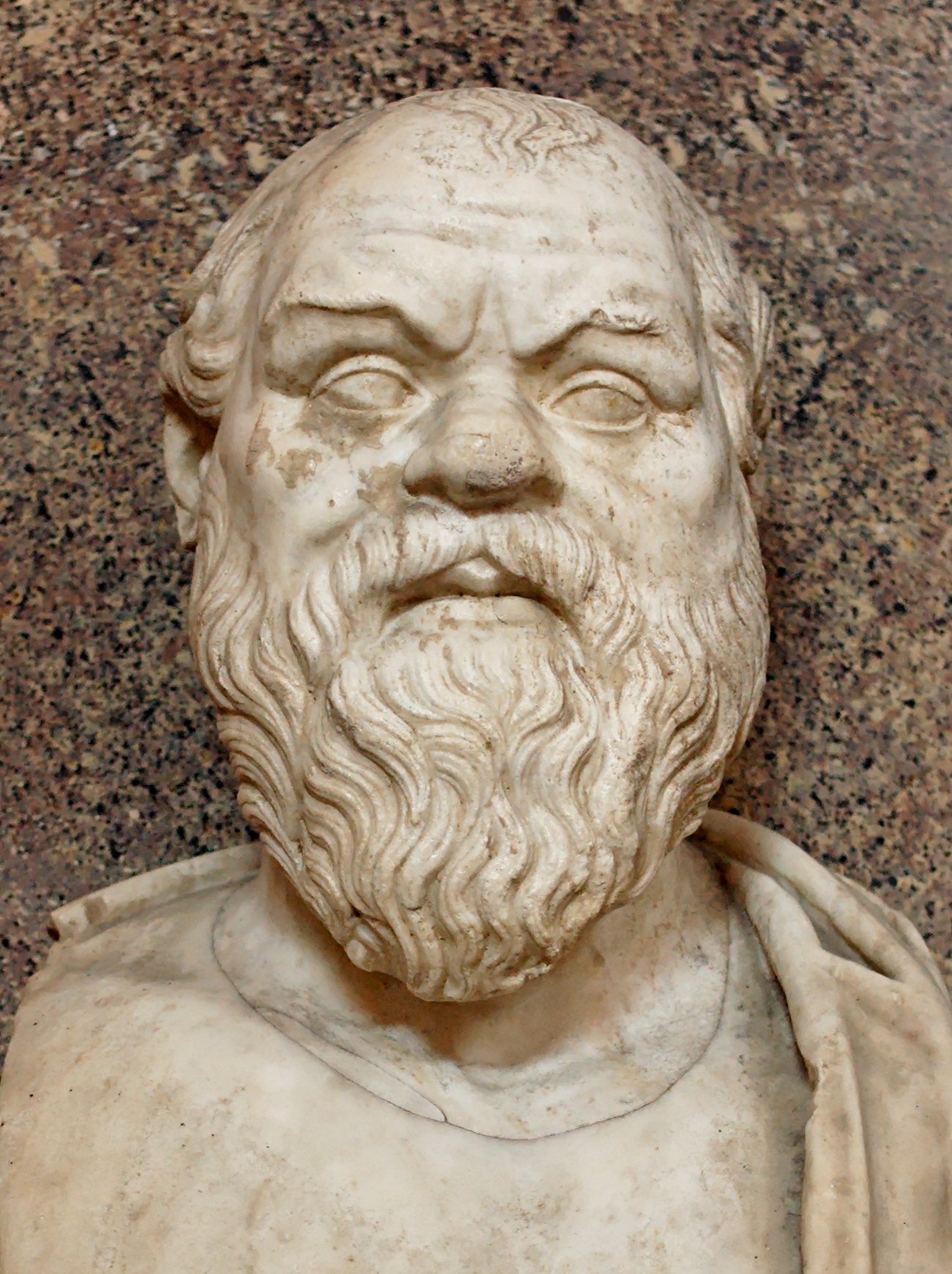
In the dialogue named after him, it is said that the young Theaetetus bears an unfortunate resemblance to Socrates with his bulging eyes and snub nose.
Theaetetus translated by Benjamin Jowett
If you had asked me 50 years ago, before I had read any of it, what "philosophy" meant, I would probably have described something like this dialogue. It begins by asking what the difference is between knowledge and wisdom, but then proceeds to address the necessary prequel to that question: what is knowledge.
Theaetetus, an eager young friend of Socrates, first proposes that knowledge is perception. This leads to the idea of Pythagoras that "man is the measure of all things," i.e. that all we can know of the universe is what we perceive by our own senses, and therefore any man's perception is as valid as another's.
But to equate perception with knowledge leads to some obvious problems, such as when we mistake one person for another at a distance. Obviously our first perception was not true knowledge. This leads Socrates to develop a marvelous analogy where memory functions like a wax impression of an object, and knowing involves matching our current perceptions with our past impressions.
But flaws develop in this line of reasoning, so Socrates tries out two others: First, that knowledge of something involves knowing its parts, and, second, that knowledge means recognizing what distinguishes something from other objects or ideas of its class. But Socrates finds flaws in these arguments as well, and eventually is forced to abandon the discussion so he can go face charges of impiety that have been leveled against him--the case for which he will soon be put to death.
I think the Theaetetus would be an excellent introduction to Plato, and to philosophy in general. Unlike some dialogues, it doesn't involve splitting hairs over definitions, nor does it go off into impractical flights of abstraction. Instead, it addresses practical and universal ideas in a profound but entertaining discussion.
Clitophon translated by George Burges
The Clitophon is the shortest of Plato's dialogues, and one in which Socrates speaks only three sentences. Basically Clitophon is complaining to Socrates that the latter is good at getting people to study philosophy, but hopeless at finding the answers that philosophy is supposed to provide. Obviously he is missing the point that Socrates's goal is to teach people how to think, not what to think. There is some speculation that this dialogue was either not composed by Plato at all, or that it is just a fragment, and Socrates's response is missing.
In the dialogue named after him, it is said that the young Theaetetus bears an unfortunate resemblance to Socrates with his bulging eyes and snub nose.
28baswood
>19 StevenTX: I am not surprised to learn that Arnold Schwarzenegger is an android.
Tomorrow's eve sounds like a real curiosity
Tomorrow's eve sounds like a real curiosity
29baswood
Great review of The Female Quixote
30dchaikin
Enjoyed catching up on books I'm pretty sure i'll never read, (Well I could find myself reading Plato) and also the look at our android ancestry.
31StevenTX
Timaeus and Critias by Plato
Both translated by Benjamin Jowett
These two dialogues are really just two soliloquies as part of a single discussion which continues the subject of Plato's Republic. Critias, Timaeus, and Hermocrates propose to tell Socrates a story handed down from Athens's lawgiver Solon of how Athens had, at one time 9000 years ago, a government and society exactly like that proposed in the Republic. This information was supposedly maintained in written records by the Egyptians who passed it on to Solon during a visit to that country. Athens was not only an exemplary republic, but the leading city in the Mediterranean and a mighty military power. Athens led her neighbors in a war against the mighty island nation of Atlantis, winning the war before an earthquake destroyed Atlantis and plunged it beneath the sea.
Not to omit any details, Timaeus begins his part of the story with the creation of the universe. He describes the four basic elements, earth, air, fire and water, how they change form, and how they combine to create all manner of materials, living and inert. He then describes the soul and how its three parts are contained within the body. Following a detailed description of human anatomy and physiology, he gives a treatise on medicine and closes with some thoughts on reincarnation.
Most of what Timaeus has to say would be of interest chiefly to those who are tracing the history of science or medicine, but some fascinating ideas stand out. He says the universe was created by a single omnipotent and perfect God who then created the giants, who in turn begat the Olympian gods. Obsessed with bringing a mathematical order to the universe, Timaeus proposes a sort of atomic theory in which the basic elements of nature are comprised of invisible triangles. Fire, for example, is made up of the tiniest triangles, thus it is able to pass through other elements. And fire's triangles are sharply pointed, which is why fire burns.
Critias takes his turn, as a new dialogue begins. He talks briefly about Greece and Athens of 9000 years ago, describing the land as being much more fertile than in his own time. He recaps how Athens was governed in accordance with the ideals of the Republic and makes note of the fact that women of the Guardian class wore armor and marched into battle alongside the men. He then begins a detailed description and history of Athens's arch-enemy, Atlantis.
Atlantis was large island peopled by the descendants of Poseidon. It's central capital was on a hill ringed by alternate bands of land and water. Each band was walled, and the moats were connected to the sea by a canal, thus making Atlantis an impregnable inland harbor. It was a city of such fabulous wealth that even the walls were sheathed in precious metals. There were ten kingdoms in all on the island, existing in peace and harmony. But the leadership of Atlantis degenerated, leading to war with Athens.
At this point the dialog comes to an abrupt end in mid-sentence. The rest was either lost or never completed, along with a probable third dialogue by Hermocrates.

Of the various conjectural paintings of Atlantis I have found on the web, this one comes closest by far to Plato's description. The location is repeatedly given as being outside the Pillars of Hercules (i.e. in the Atlantic Ocean). After Atlantis sank, the whole area became nothing but mud shoals, making it impossible to navigate safely outside the Pillars. Many believe that the volcanic eruption on the island of Thera (modern Santorini) is the origin of the Atlantis myth, but Plato describes a much larger island in a completely different place.
Both translated by Benjamin Jowett
These two dialogues are really just two soliloquies as part of a single discussion which continues the subject of Plato's Republic. Critias, Timaeus, and Hermocrates propose to tell Socrates a story handed down from Athens's lawgiver Solon of how Athens had, at one time 9000 years ago, a government and society exactly like that proposed in the Republic. This information was supposedly maintained in written records by the Egyptians who passed it on to Solon during a visit to that country. Athens was not only an exemplary republic, but the leading city in the Mediterranean and a mighty military power. Athens led her neighbors in a war against the mighty island nation of Atlantis, winning the war before an earthquake destroyed Atlantis and plunged it beneath the sea.
Not to omit any details, Timaeus begins his part of the story with the creation of the universe. He describes the four basic elements, earth, air, fire and water, how they change form, and how they combine to create all manner of materials, living and inert. He then describes the soul and how its three parts are contained within the body. Following a detailed description of human anatomy and physiology, he gives a treatise on medicine and closes with some thoughts on reincarnation.
Most of what Timaeus has to say would be of interest chiefly to those who are tracing the history of science or medicine, but some fascinating ideas stand out. He says the universe was created by a single omnipotent and perfect God who then created the giants, who in turn begat the Olympian gods. Obsessed with bringing a mathematical order to the universe, Timaeus proposes a sort of atomic theory in which the basic elements of nature are comprised of invisible triangles. Fire, for example, is made up of the tiniest triangles, thus it is able to pass through other elements. And fire's triangles are sharply pointed, which is why fire burns.
Critias takes his turn, as a new dialogue begins. He talks briefly about Greece and Athens of 9000 years ago, describing the land as being much more fertile than in his own time. He recaps how Athens was governed in accordance with the ideals of the Republic and makes note of the fact that women of the Guardian class wore armor and marched into battle alongside the men. He then begins a detailed description and history of Athens's arch-enemy, Atlantis.
Atlantis was large island peopled by the descendants of Poseidon. It's central capital was on a hill ringed by alternate bands of land and water. Each band was walled, and the moats were connected to the sea by a canal, thus making Atlantis an impregnable inland harbor. It was a city of such fabulous wealth that even the walls were sheathed in precious metals. There were ten kingdoms in all on the island, existing in peace and harmony. But the leadership of Atlantis degenerated, leading to war with Athens.
At this point the dialog comes to an abrupt end in mid-sentence. The rest was either lost or never completed, along with a probable third dialogue by Hermocrates.

Of the various conjectural paintings of Atlantis I have found on the web, this one comes closest by far to Plato's description. The location is repeatedly given as being outside the Pillars of Hercules (i.e. in the Atlantic Ocean). After Atlantis sank, the whole area became nothing but mud shoals, making it impossible to navigate safely outside the Pillars. Many believe that the volcanic eruption on the island of Thera (modern Santorini) is the origin of the Atlantis myth, but Plato describes a much larger island in a completely different place.
32ljbwell
I've been catching up and really enjoying you reviews. Lanark has been staring at me from the bookshelf for years, and now I've got renewed incentive to give it a go.
Tomorrow's Eve also looks intriguing. I wish I could remember if it was part of the Out of This World exhibition at the British Library. Part of me wants to say I saw it at least mentioned there, but it could just be that it sounds like it would have fit right in.
http://www.bl.uk/press-releases/2011/march/out-of-this-world-science-fiction-but...
Tomorrow's Eve also looks intriguing. I wish I could remember if it was part of the Out of This World exhibition at the British Library. Part of me wants to say I saw it at least mentioned there, but it could just be that it sounds like it would have fit right in.
http://www.bl.uk/press-releases/2011/march/out-of-this-world-science-fiction-but...
33DieFledermaus
Lanark sounds like a fascinating book - good review. I've been meaning to read The Female Quixote for a while now, glad you enjoyed it.
34StevenTX
Flatland: A Romance of Many Dimensions by Edwin A. Abbott
First published 1884


Flatland is a brilliant little novel which is both a social satire and a lesson in open-mindedness, in both cases using geometry as a language of instruction. The narrator is a Square, living in a world of only two dimensions where all living creatures are just flat geometric figures. The first half of the novel is simply a description of his world, Flatland, its people and institutions. The Square is writing for a three-dimensional reader, so he describes his world in terms we can understand. Much attention is given to the various classes of people, from the lowly triangles, to the middle-class squares and hexagons, all the way up to the revered circles. Many of the attitudes and practices of Flatland, which seem ludicrous to us when presented in such a fashion, clearly refer to the class distinctions, gender biases, and social mores of Victorian England.
In the second half of the novel the Square first has a dream in which he visits a one-dimensional world consisting of a single line. It's inhabitants are line segments living perpetually end-to-end. The Square addresses the king of Lineland and attempts to explain to him the reality of two dimensions, but the poor Line is unable to conceive of another dimension and eventually dismisses the Square as an evil phantom.
Next, the Square is visited by an intruder from another dimension, a Sphere from Spaceland. The Sphere tries to explain a third dimension to the Square just as the Square tried to explain a second dimension to the Line, but the results are the same. Finally the Sphere physically pushes the Square into the third dimension where a revelation awaits him.
Flatland is a book that challenges us to see commonplace things in new ways and to understand that the point of view of another person may be outside the realm of our experience. Even though it refers often to the concepts of geometry, no particular knowledge is required of the reader. Highly recommended.
First published 1884


Flatland is a brilliant little novel which is both a social satire and a lesson in open-mindedness, in both cases using geometry as a language of instruction. The narrator is a Square, living in a world of only two dimensions where all living creatures are just flat geometric figures. The first half of the novel is simply a description of his world, Flatland, its people and institutions. The Square is writing for a three-dimensional reader, so he describes his world in terms we can understand. Much attention is given to the various classes of people, from the lowly triangles, to the middle-class squares and hexagons, all the way up to the revered circles. Many of the attitudes and practices of Flatland, which seem ludicrous to us when presented in such a fashion, clearly refer to the class distinctions, gender biases, and social mores of Victorian England.
In the second half of the novel the Square first has a dream in which he visits a one-dimensional world consisting of a single line. It's inhabitants are line segments living perpetually end-to-end. The Square addresses the king of Lineland and attempts to explain to him the reality of two dimensions, but the poor Line is unable to conceive of another dimension and eventually dismisses the Square as an evil phantom.
Next, the Square is visited by an intruder from another dimension, a Sphere from Spaceland. The Sphere tries to explain a third dimension to the Square just as the Square tried to explain a second dimension to the Line, but the results are the same. Finally the Sphere physically pushes the Square into the third dimension where a revelation awaits him.
Flatland is a book that challenges us to see commonplace things in new ways and to understand that the point of view of another person may be outside the realm of our experience. Even though it refers often to the concepts of geometry, no particular knowledge is required of the reader. Highly recommended.
35baswood
Great review of Flatland: A Romance of many Dimensions This one has been on my kindle for some and I am looking forward to reading it. It has a brilliant central idea.
36StevenTX
>35 baswood: Thanks, bas. This one has been on my kindle... Be sure to get the illustrated version. The one I got free from Amazon wasn't illustrated, but you can get one here directly from Project Gutenberg which is.
37reva8
>34 StevenTX: That's a great review of Flatland!
38rebeccanyc
I've heard about Flatland for years, but your review really explained it to me.
39StevenTX
The Player of Games by Iain M. Banks
First published 1988

Jernau Gurgeh is a member of a vast community of humanoid species and machine intelligences known as the Culture. Technology has freed its members from want and fear to the extent that they have no need of laws or money and can basically spend their endlessly prolonged lives doing whatever they find fulfilling. Gurgeh's passion is playing games, and he is a renowned master. But his greatest challenge comes when the Culture's Contact group asks him to go to the Azad Empire as a special envoy. Game-playing is such an integral part of the Azad culture that it is the basis for selecting their rulers. Gurgeh will enter a tournament where the ultimate prize is the Empire itself.
The story is basically a vehicle for contrasting the power-based Azad Empire with the freedom-based Culture. In many ways the Empire is a composite of all that is wrong with our world today--inequality, exploitation, pollution, crime, etc. But this isn't just a political critique; The Player of Games is a thoughtful look at how our ingrained value systems manifest themselves in ways we don't expect--even in how we play games. Yet it is also a highly entertaining novel with plenty of action, intrigue and suspense.
The Player of Games is the second of Banks's Culture novels. There is no direct connection with the first novel, Consider Phlebas, but I would still recommend reading Consider Phlebas first because it introduces you to many of the technologies and social concepts used by the Culture which aren't much explained in The Player of Games.
First published 1988

Jernau Gurgeh is a member of a vast community of humanoid species and machine intelligences known as the Culture. Technology has freed its members from want and fear to the extent that they have no need of laws or money and can basically spend their endlessly prolonged lives doing whatever they find fulfilling. Gurgeh's passion is playing games, and he is a renowned master. But his greatest challenge comes when the Culture's Contact group asks him to go to the Azad Empire as a special envoy. Game-playing is such an integral part of the Azad culture that it is the basis for selecting their rulers. Gurgeh will enter a tournament where the ultimate prize is the Empire itself.
The story is basically a vehicle for contrasting the power-based Azad Empire with the freedom-based Culture. In many ways the Empire is a composite of all that is wrong with our world today--inequality, exploitation, pollution, crime, etc. But this isn't just a political critique; The Player of Games is a thoughtful look at how our ingrained value systems manifest themselves in ways we don't expect--even in how we play games. Yet it is also a highly entertaining novel with plenty of action, intrigue and suspense.
The Player of Games is the second of Banks's Culture novels. There is no direct connection with the first novel, Consider Phlebas, but I would still recommend reading Consider Phlebas first because it introduces you to many of the technologies and social concepts used by the Culture which aren't much explained in The Player of Games.
40StevenTX
The Music of Chance by Paul Auster
First published 1990


The Music of Chance is the unusual, and intentionally outlandish, story of a Boston fireman named Jim Nashe who comes into a modest inheritance, quits his job, and starts randomly driving across the country. When his money starts to run low he picks up a brash young man named Jack Pozzi who is stumbling along the road with his clothes torn and bloody. Pozzi is a would-be professional gambler who has just had his winnings in an all-night poker game stolen from him. He tells Nashe how he is desperate to build up a stake so he can fulfill an invitation to play poker at the home of a couple of offbeat millionaires. Nashe decides to give Pozzi every penny he has so the youth can play the rich guys. They will split the winnings 50/50, and Nashe will be able to continue his aimless driving.
Needless to say, chance takes the wheel and steers Nashe's life in directions he could never have expected or planned for. How we let fate reshape our lives, and whether we fight or adapt, is essentially the theme of the novel. The Music of Chance is a short and entertaining novel, though I didn't find anything exceptional in it to warrant its place on the "1001 Books You Must Read Before You Die" list, which is what led me to read it.
Other works I have read by Paul Auster:
Moon Palace
The New York Trilogy
First published 1990


The Music of Chance is the unusual, and intentionally outlandish, story of a Boston fireman named Jim Nashe who comes into a modest inheritance, quits his job, and starts randomly driving across the country. When his money starts to run low he picks up a brash young man named Jack Pozzi who is stumbling along the road with his clothes torn and bloody. Pozzi is a would-be professional gambler who has just had his winnings in an all-night poker game stolen from him. He tells Nashe how he is desperate to build up a stake so he can fulfill an invitation to play poker at the home of a couple of offbeat millionaires. Nashe decides to give Pozzi every penny he has so the youth can play the rich guys. They will split the winnings 50/50, and Nashe will be able to continue his aimless driving.
Needless to say, chance takes the wheel and steers Nashe's life in directions he could never have expected or planned for. How we let fate reshape our lives, and whether we fight or adapt, is essentially the theme of the novel. The Music of Chance is a short and entertaining novel, though I didn't find anything exceptional in it to warrant its place on the "1001 Books You Must Read Before You Die" list, which is what led me to read it.
Other works I have read by Paul Auster:
Moon Palace
The New York Trilogy
41rebeccanyc
I read the first volume in The New York Trilogy back in the day (i.e,, when it was first published and was such a sensation), and it didn't do anything for me, so I've avoided Auster ever since. Not based on this novel, but I wonder whether I should try again.
42reva8
>40 StevenTX: The only Auster I've read is the New York Trilogy which I did enjoy, althought I felt it was patchy. This is an interesting review, but I don't know if I'll pick up Auster anytime soon!
43StevenTX
>41 rebeccanyc:, >42 reva8: I loved The New York Trilogy when I read it five years ago, but I have a taste for experimental fiction that not everyone shares. If you didn't like the trilogy you might find The Music of Chance more to your liking. Another factor that may have made me lukewarm on this last book is that I neither know nor care anything about gambling. I don't know how to play poker, so much of the action in the novel was meaningless to me.
44StevenTX
The Sophist by Plato
Translated by Benjamin Jowett
The Sophist is a dialogue which takes place a day after the Theatetus (see msg. 27 above), but it is really more of a sequel to the discussion in Parmenides (see msg. 8 above). That connection, however, doesn't appear until midway through the dialogue. The Sophist begins with the introduction of a new character, an unnamed visitor from Elea, which is the home of Parmenides. The other participants are Socrates and Theatetus. Socrates drops out of the conversation after the introduction, and the rest of the dialogue is a long exchange between the visitor and Theatetus.
The visitor accepts the challenge to define the terms sophist, statesman, and philosopher. He begins his definition of a sophist in taxonomic fashion by categorizing all human endeavors and showing how the sophist fits into several different categories. He first makes the analogy between a sophist and an angler, showing how the sophist hooks young men to become his clients the way the angler hooks fish. (Could this be the source of the "fisher of men" analogy in the New Testament?). After several other analogies, the visitor comes to the sophist's role as someone who persuades through the creation of ideas and images like a painter.
But here he comes across a stumbling block. A false idea is something which doesn't exist. Yet according to his mentor, Parmenides, it is impossible to refer to that which does not exist (is possessed of "non-being"). From this point on, the dialogue becomes an extension, refinement, and correction of the Parmenides dialogue, only in much more comprehensible language. The visitor eventually argues that the idea of something is separate from the fact of something, and it is possible for the idea of something which does not exist to have being even though the object itself does not have being. This dualistic concept is something the young Socrates tried to put forth at the very beginning of the Parmenides dialogue, before he was shouted down by the elder Parmenides.
The speech and methodology of the unnamed visitor in The Sophist is remarkably like that of Socrates himself in other dialogues. If this conversation actually happened, it was probably just between Socrates and Theatetus. Plato chose to conceal the speaker, possibly because he didn't agree with Socrates and preferred not "discredit" his mentor with ideas he thought were wrong.
The Sophist is one of the most interesting of Plato's dialogues, but you'll need to wade through the much more difficult Parmenides first so you have the background.
Translated by Benjamin Jowett
The Sophist is a dialogue which takes place a day after the Theatetus (see msg. 27 above), but it is really more of a sequel to the discussion in Parmenides (see msg. 8 above). That connection, however, doesn't appear until midway through the dialogue. The Sophist begins with the introduction of a new character, an unnamed visitor from Elea, which is the home of Parmenides. The other participants are Socrates and Theatetus. Socrates drops out of the conversation after the introduction, and the rest of the dialogue is a long exchange between the visitor and Theatetus.
The visitor accepts the challenge to define the terms sophist, statesman, and philosopher. He begins his definition of a sophist in taxonomic fashion by categorizing all human endeavors and showing how the sophist fits into several different categories. He first makes the analogy between a sophist and an angler, showing how the sophist hooks young men to become his clients the way the angler hooks fish. (Could this be the source of the "fisher of men" analogy in the New Testament?). After several other analogies, the visitor comes to the sophist's role as someone who persuades through the creation of ideas and images like a painter.
But here he comes across a stumbling block. A false idea is something which doesn't exist. Yet according to his mentor, Parmenides, it is impossible to refer to that which does not exist (is possessed of "non-being"). From this point on, the dialogue becomes an extension, refinement, and correction of the Parmenides dialogue, only in much more comprehensible language. The visitor eventually argues that the idea of something is separate from the fact of something, and it is possible for the idea of something which does not exist to have being even though the object itself does not have being. This dualistic concept is something the young Socrates tried to put forth at the very beginning of the Parmenides dialogue, before he was shouted down by the elder Parmenides.
The speech and methodology of the unnamed visitor in The Sophist is remarkably like that of Socrates himself in other dialogues. If this conversation actually happened, it was probably just between Socrates and Theatetus. Plato chose to conceal the speaker, possibly because he didn't agree with Socrates and preferred not "discredit" his mentor with ideas he thought were wrong.
The Sophist is one of the most interesting of Plato's dialogues, but you'll need to wade through the much more difficult Parmenides first so you have the background.
46chlorine
Thanks for the reviews. Sounds like The player of games would be more my cup of tea than Consider Phlebas which I could not finish. Adding it to my wishlist.
47StevenTX
The Statesman by Plato
Translated by Benjamin Jowett
The Statesman is a continuation of the conversation begun in The Sophist in which an unnamed Stranger from Elea proposes to define the terms "sophist," "statesman," and "philosopher." In this case his partner in the dialogue is a young man named Socrates but not related to the philosopher. The Stranger begins with a rather humorous taxonomy of the entire animal kingdom that leads him to give a preliminary definition of a statesman as a herder of featherless bipeds.
Along the way, however, the Stranger digresses into theology in order to address the question of free will. The Creator God (see Plato's Timaeus), he says, is fully capable of ordering the actions of all his creations down to the least thought or movement, and at times has done so. In other epochs, however, the Creator simply sets things in motion and lets them run on their own. A change in epochs is signified by reversing the direction in which the universe turns. When the Creator is in control, the sun, moon and stars rise in the west. When things are playing out on their own, the celestial orbs rise in the east.
Of greater relevance to us is the Stranger's discussion of laws. The law cannot take into account every contingency, nor can it anticipate change, therefore "the law does not perfectly comprehend what is noblest and most just for all and therefore cannot enforce what is best." Furthermore, "no art whatsoever can lay down a rule which will last for all time," and "A perfectly simple principle can never be applied to a state of things which is the reverse of simple." Therefore the statesman is most effective and just when he can dispense with or override the laws based on his own judgment and the needs of the moment. Yet it is impossible to ensure that every statesman will have such virtue, so laws are an unfortunate necessity. (The "philosopher king" in Plato's The Republic would be an example of an ideal ruler.)
Next the Stranger defines the types of governments. There are three forms: rule by one, rule by a few, and rule by the many. And each form has two modes: rule by law and custom, and rule disregarding law and custom. Of the six possible combinations of form and mode, the best would be rule by one person in compliance with laws and customs. This he calls monarchy. A single ruler, if he is virtuous, is much more efficient than a government that depends on debate and compromise. On the other hand, however, the worst possible government is that by a single unjust ruler who disregards law and custom. This is tyranny. Rule by the few is divided into aristocracy (in accordance with law) and oligarchy (lawless). Rule by the many is divided into democracy (lawful) and mob rule (lawless). This sixfold division is the same that Aristotle will use in his Politics.
The dialogue concludes with the paradox that courage and temperance, which are both virtuous attributes, represent opposites of temperaments. The Stranger advises statesmen to include men of both types among his advisers so that he may benefit from a synthesis of their strengths. He compares this with the skill of a weaver taking threads at right angles and making of them a beautiful piece of cloth.
Though The Statesmen is a direct sequel to The Sophist, it is more closely related in content to Plato's The Republic, and serves as a logical link between that work and Aristotle's Politics.
Translated by Benjamin Jowett
The Statesman is a continuation of the conversation begun in The Sophist in which an unnamed Stranger from Elea proposes to define the terms "sophist," "statesman," and "philosopher." In this case his partner in the dialogue is a young man named Socrates but not related to the philosopher. The Stranger begins with a rather humorous taxonomy of the entire animal kingdom that leads him to give a preliminary definition of a statesman as a herder of featherless bipeds.
Along the way, however, the Stranger digresses into theology in order to address the question of free will. The Creator God (see Plato's Timaeus), he says, is fully capable of ordering the actions of all his creations down to the least thought or movement, and at times has done so. In other epochs, however, the Creator simply sets things in motion and lets them run on their own. A change in epochs is signified by reversing the direction in which the universe turns. When the Creator is in control, the sun, moon and stars rise in the west. When things are playing out on their own, the celestial orbs rise in the east.
Of greater relevance to us is the Stranger's discussion of laws. The law cannot take into account every contingency, nor can it anticipate change, therefore "the law does not perfectly comprehend what is noblest and most just for all and therefore cannot enforce what is best." Furthermore, "no art whatsoever can lay down a rule which will last for all time," and "A perfectly simple principle can never be applied to a state of things which is the reverse of simple." Therefore the statesman is most effective and just when he can dispense with or override the laws based on his own judgment and the needs of the moment. Yet it is impossible to ensure that every statesman will have such virtue, so laws are an unfortunate necessity. (The "philosopher king" in Plato's The Republic would be an example of an ideal ruler.)
Next the Stranger defines the types of governments. There are three forms: rule by one, rule by a few, and rule by the many. And each form has two modes: rule by law and custom, and rule disregarding law and custom. Of the six possible combinations of form and mode, the best would be rule by one person in compliance with laws and customs. This he calls monarchy. A single ruler, if he is virtuous, is much more efficient than a government that depends on debate and compromise. On the other hand, however, the worst possible government is that by a single unjust ruler who disregards law and custom. This is tyranny. Rule by the few is divided into aristocracy (in accordance with law) and oligarchy (lawless). Rule by the many is divided into democracy (lawful) and mob rule (lawless). This sixfold division is the same that Aristotle will use in his Politics.
The dialogue concludes with the paradox that courage and temperance, which are both virtuous attributes, represent opposites of temperaments. The Stranger advises statesmen to include men of both types among his advisers so that he may benefit from a synthesis of their strengths. He compares this with the skill of a weaver taking threads at right angles and making of them a beautiful piece of cloth.
Though The Statesmen is a direct sequel to The Sophist, it is more closely related in content to Plato's The Republic, and serves as a logical link between that work and Aristotle's Politics.
48StevenTX
A Crystal Age by W. H. Hudson
First published 1887


The Argentine-born naturalist William Henry Hudson was a prolific writer of over 30 books, mostly on ornithology. His best known work is the novel Green Mansions, but his first published work of fiction was A Crystal Age, a utopian vision in the form of a time-travel novel.
The narrator, a young Englishman named Smith, begins his story by admitting that he cannot remember even what country he was in when he sat down on the bank of a ravine and was suddenly covered by a landslide that knocked him unconscious. Later, he does not know when or how, he wakes and digs himself out. He wanders for a while before stumbling upon a group of people engaged in a funeral ceremony. Yet they are dressed in brightly colored clothes of a fashion he has never seen before. The strangers speak English, but are dumbfounded by Smith's appearance and manners.
Gradually we learn that Smith has somehow slept for centuries during which his own civilization has come to an end. The world is now thinly populated by communal dwellings simply called "Houses." The residents live in peace and security, growing their own crops and weaving their own clothes. They are ignorant of technology, money or trade, but they have a very sophisticated social organization and spend much of their time in artistic pursuits.
The people of the House are initially very offended by Smith's social gaffes, but they reluctantly agree to take him in. He wastes no time in falling in love with Yoletta, the youngest and prettiest daughter of the House. But he is increasingly puzzled and frustrated that she can neither share his romantic feelings nor begin to understand them. All that Yoletta can show him is sisterly affection--in fact that seems to be the only kind of love these strange, apparently childless people understand.
Hudson, even in the 1880s, saw overpopulation and its attendant devastation of the environment as the greatest threats clouding our future. His pastoral utopia is an indefinitely sustainable "green" solution, but one that sacrifices much of the challenge, adventure and romance that we might consider essential to the human spirit. The novel is beautifully written, but the pace is slow, and it frustrates our desire to know more about how the society it depicts might have come into being.
First published 1887


The Argentine-born naturalist William Henry Hudson was a prolific writer of over 30 books, mostly on ornithology. His best known work is the novel Green Mansions, but his first published work of fiction was A Crystal Age, a utopian vision in the form of a time-travel novel.
The narrator, a young Englishman named Smith, begins his story by admitting that he cannot remember even what country he was in when he sat down on the bank of a ravine and was suddenly covered by a landslide that knocked him unconscious. Later, he does not know when or how, he wakes and digs himself out. He wanders for a while before stumbling upon a group of people engaged in a funeral ceremony. Yet they are dressed in brightly colored clothes of a fashion he has never seen before. The strangers speak English, but are dumbfounded by Smith's appearance and manners.
Gradually we learn that Smith has somehow slept for centuries during which his own civilization has come to an end. The world is now thinly populated by communal dwellings simply called "Houses." The residents live in peace and security, growing their own crops and weaving their own clothes. They are ignorant of technology, money or trade, but they have a very sophisticated social organization and spend much of their time in artistic pursuits.
The people of the House are initially very offended by Smith's social gaffes, but they reluctantly agree to take him in. He wastes no time in falling in love with Yoletta, the youngest and prettiest daughter of the House. But he is increasingly puzzled and frustrated that she can neither share his romantic feelings nor begin to understand them. All that Yoletta can show him is sisterly affection--in fact that seems to be the only kind of love these strange, apparently childless people understand.
Hudson, even in the 1880s, saw overpopulation and its attendant devastation of the environment as the greatest threats clouding our future. His pastoral utopia is an indefinitely sustainable "green" solution, but one that sacrifices much of the challenge, adventure and romance that we might consider essential to the human spirit. The novel is beautifully written, but the pace is slow, and it frustrates our desire to know more about how the society it depicts might have come into being.
49dchaikin
Love all your plato summaries. They actually make me want to read Plato. I still need to read Auster. W. H. Hudson i'm probably best off enjoying through your review. Interesting how modern the ideas seem.
50StevenTX
Two Years Eight Months and Twenty-Eight Nights by Salman Rushdie
An Early Review selection to be published September 2015


"To tell a story about the past is to tell a story about the present. To recount a fantasy, a story of the imaginary, is also a way of recounting a tale about the actual."
A narrator a thousand years in our future opens this tale with a story set more than 800 years in our past. The philosopher Ibn Rushd (also known as Averroës) takes a beautiful mistress called Dunia. She bears him many children before he leaves her. But Ibn Rushd never learns that Dunia is actually a jinnia who has taken human form. The jinn normally reside in their own universe and are incapable of entering our own except at rare times when the portals between worlds are open. Dunia, however, is the Lightning Princess, and she has unique powers that let her slide between the universes at will. Her love for this disciple of Aristotle is unique, for love is an emotion that is largely unknown among the jinn.
We move forward to our own time and to a catastrophic storm that strikes New York City. In the wake of the tempest, the portals between worlds have opened wide, and the jinn and their supernatural minions are able to move freely into our own universe. Inexplicable things begin to happen. A gardener who calls himself Mr. Geronimo finds that his feet no longer touch the ground. Instead he floats inches above the earth, and every day he rises higher. A baby is abandoned at City Hall who has the miraculous ability to detect lies. A graphic novelist is confronted by one of his own life-sized characters. A sea monster rises up to swallow a ferry off Staten Island. And a woman who has been dumped by her lover takes revenge by frying him with a lightning bolt. The jinn are loose, and this Time of Strangeness will last for two years, eight months and twenty-eight nights--or 1001 nights, if you prefer.
Among the jinn who have come to our world are four evil spirits who wish to conquer and rule the earth for their own pleasure. Opposing them there is initially only Dunia, the Lightning Princess, who loves humanity and wants to protect us. But she soon finds scattered across the globe her own progeny, the descendants of her love affair with Ibn Rushd. She awakens their latent jinn powers and enlists them in her battle against darkness.
The battle between the four evil jinni and the jinnia princess reenacts the historical debate between Ibn Rushd and the theologian Al-Ghazali. Ghazali felt that Man should come to know God through fear, so his jinn disciples attempt to drive men into the arms of religion and superstition through acts of terror. Ibn Rushd taught rational thought and understanding, and thus Dunia and her descendants attempt to combat terror with truth, humanism, and liberation. The ultimate goal of Dunia's side is not just to defeat the forces of evil, but to "set God aside, as boys and girls put down their childhood toys," and banish Fear itself. The war between the jinn becomes an allegory for the 21st century's ongoing "war on terror," with the leading evil jinni playing the role of Osama bin Laden.
Two Years Eight Months and Twenty-Eight Nights is much more than just a commentary on today's struggle against terrorism and religious oppression. It is a demonstration of the role of storytelling in our history and culture. We are all "trapped in stories,... each of us the prisoner of our own solipsistic narrative, each family the captive of the family story, each community locked within its own tale of itself, each people the victims of their own versions of history." Like its inspiration, the Thousand and One Nights, Rushdie's novel is a Chinese box of stories within stories, many of them referencing literary antecedents from Homer to Hardy. Above all, we see role of the role of the magical in our perception of the world, how our dreams can bring us closer to the truth, and how fantasy is often the surest path to understand reality. This is an absorbing, entertaining and inspiring novel--highly recommended.
An Early Review selection to be published September 2015


"To tell a story about the past is to tell a story about the present. To recount a fantasy, a story of the imaginary, is also a way of recounting a tale about the actual."
A narrator a thousand years in our future opens this tale with a story set more than 800 years in our past. The philosopher Ibn Rushd (also known as Averroës) takes a beautiful mistress called Dunia. She bears him many children before he leaves her. But Ibn Rushd never learns that Dunia is actually a jinnia who has taken human form. The jinn normally reside in their own universe and are incapable of entering our own except at rare times when the portals between worlds are open. Dunia, however, is the Lightning Princess, and she has unique powers that let her slide between the universes at will. Her love for this disciple of Aristotle is unique, for love is an emotion that is largely unknown among the jinn.
We move forward to our own time and to a catastrophic storm that strikes New York City. In the wake of the tempest, the portals between worlds have opened wide, and the jinn and their supernatural minions are able to move freely into our own universe. Inexplicable things begin to happen. A gardener who calls himself Mr. Geronimo finds that his feet no longer touch the ground. Instead he floats inches above the earth, and every day he rises higher. A baby is abandoned at City Hall who has the miraculous ability to detect lies. A graphic novelist is confronted by one of his own life-sized characters. A sea monster rises up to swallow a ferry off Staten Island. And a woman who has been dumped by her lover takes revenge by frying him with a lightning bolt. The jinn are loose, and this Time of Strangeness will last for two years, eight months and twenty-eight nights--or 1001 nights, if you prefer.
Among the jinn who have come to our world are four evil spirits who wish to conquer and rule the earth for their own pleasure. Opposing them there is initially only Dunia, the Lightning Princess, who loves humanity and wants to protect us. But she soon finds scattered across the globe her own progeny, the descendants of her love affair with Ibn Rushd. She awakens their latent jinn powers and enlists them in her battle against darkness.
The battle between the four evil jinni and the jinnia princess reenacts the historical debate between Ibn Rushd and the theologian Al-Ghazali. Ghazali felt that Man should come to know God through fear, so his jinn disciples attempt to drive men into the arms of religion and superstition through acts of terror. Ibn Rushd taught rational thought and understanding, and thus Dunia and her descendants attempt to combat terror with truth, humanism, and liberation. The ultimate goal of Dunia's side is not just to defeat the forces of evil, but to "set God aside, as boys and girls put down their childhood toys," and banish Fear itself. The war between the jinn becomes an allegory for the 21st century's ongoing "war on terror," with the leading evil jinni playing the role of Osama bin Laden.
Two Years Eight Months and Twenty-Eight Nights is much more than just a commentary on today's struggle against terrorism and religious oppression. It is a demonstration of the role of storytelling in our history and culture. We are all "trapped in stories,... each of us the prisoner of our own solipsistic narrative, each family the captive of the family story, each community locked within its own tale of itself, each people the victims of their own versions of history." Like its inspiration, the Thousand and One Nights, Rushdie's novel is a Chinese box of stories within stories, many of them referencing literary antecedents from Homer to Hardy. Above all, we see role of the role of the magical in our perception of the world, how our dreams can bring us closer to the truth, and how fantasy is often the surest path to understand reality. This is an absorbing, entertaining and inspiring novel--highly recommended.
51FlorenceArt
>50 StevenTX: This sounds fascinating. I have never read anything by Rushdie. I have been thinking I should.
52AnnieMod
> 50 An Early Review selection to be published September 1915
2015 :)
Loved the review. And the book is staring at me to pick it up from the top of the pile.
2015 :)
Loved the review. And the book is staring at me to pick it up from the top of the pile.
53StevenTX
>52 AnnieMod: An evil jinni must've pushed me through a magic time portal. I've corrected the date. :-)

Here's a painting described in the novel. This is Zumurrud Shah, the leader of the jinn forces of darkness.

Here's a painting described in the novel. This is Zumurrud Shah, the leader of the jinn forces of darkness.
54rebeccanyc
>40 StevenTX: Sounds fascinating. I haven't read Rushdie in decades.
55baswood
Great review of two Years eight months and Twenty-eight nights Not quite the first boy on the block to review Rushdie's new book, but I shouldn't think there will be a better review.
56NanaCC
I read Midnight's Children many years ago, and told myself I should read more of him. I have two more of his books on my shelf, and you've pushed me to move them up the list. Nice review as always.
57kidzdoc
Excellent: I was planning to buy the new Rushdie in September, even though I knew nothing about it, so I'm glad that you liked it, Steven.
59StevenTX
Philebus by Plato
Translated by Benjamin Jowett
Which is it better to have, pleasure or wisdom? That is the question debated in this dialogue. Philebus has taken the position that pleasure is always to be preferred over wisdom. Socrates disagrees. Coming (rather feebly, as it turns out) to the defense of Philebus is Protarchus, a disciple of the Sophists.
Socrates sets the ground rules in which they will compare a life full of pleasure but devoid altogether of mind, with a life of unlimited wisdom while experiencing neither pleasure nor pain. He goes on to get Protarchus to agree that physical pleasure consists simply in fulfilling bodily needs--water for the thirsty, food for the hungry, etc. Moreover, in a life consisting entirely of pleasure there is no memory or anticipation, so there is no sense of past or present. When Socrates concludes that a life of complete bliss is best exemplified by that of an oyster, Protarchus capitulates, saying "I cannot answer you, Socrates; the argument has taken away from me the power of speech."
The dialogue is far from over at this point, however, as Socrates goes on to analyze the life of the mind and the relationship of knowledge, beauty, and symmetry. Included in this discussion is a categorization of things into those which are infinite and those which are finite. Socrates then posits a third element which is a combination of the finite and infinite, which he defines as things that are in a state of becoming. Lastly there is a fourth element which is the cause of the third. I found this line of reasoning very difficult to follow.
Socrates's definition of pleasure as the gratification of a physical need resembles Aristotle's definition of happiness as the absence of want or pain. The positive is defined as the absence of the negative. It seems to me that this only leads us to ask what is pain? What is hunger? We'll end up turning the question around and defining the negative as the absence of the positive. That is not a satisfactory definition.
I asked my grandchildren, who are visiting this week, what is pleasure and what is happiness. The answers I got at first were things like video games, pizza, and hanging out with friends. As Socrates would have done, I told them these were examples of things that brought pleasure and happiness, but not the thing itself. But would infinite pizza be the source of infinite happiness? Quite the contrary. So happiness is not in the having of pizza, but in the change from not having pizza to having pizza. This brings me closer to understanding what Socrates means by "a state of becoming," and maybe we can apply it where he failed to do so. Happiness and pleasure are not simply the opposites of want and pain, but would seem to be the process of change (or "state of becoming") from a condition of want to a condition of fulfillment.
Translated by Benjamin Jowett
Which is it better to have, pleasure or wisdom? That is the question debated in this dialogue. Philebus has taken the position that pleasure is always to be preferred over wisdom. Socrates disagrees. Coming (rather feebly, as it turns out) to the defense of Philebus is Protarchus, a disciple of the Sophists.
Socrates sets the ground rules in which they will compare a life full of pleasure but devoid altogether of mind, with a life of unlimited wisdom while experiencing neither pleasure nor pain. He goes on to get Protarchus to agree that physical pleasure consists simply in fulfilling bodily needs--water for the thirsty, food for the hungry, etc. Moreover, in a life consisting entirely of pleasure there is no memory or anticipation, so there is no sense of past or present. When Socrates concludes that a life of complete bliss is best exemplified by that of an oyster, Protarchus capitulates, saying "I cannot answer you, Socrates; the argument has taken away from me the power of speech."
The dialogue is far from over at this point, however, as Socrates goes on to analyze the life of the mind and the relationship of knowledge, beauty, and symmetry. Included in this discussion is a categorization of things into those which are infinite and those which are finite. Socrates then posits a third element which is a combination of the finite and infinite, which he defines as things that are in a state of becoming. Lastly there is a fourth element which is the cause of the third. I found this line of reasoning very difficult to follow.
Socrates's definition of pleasure as the gratification of a physical need resembles Aristotle's definition of happiness as the absence of want or pain. The positive is defined as the absence of the negative. It seems to me that this only leads us to ask what is pain? What is hunger? We'll end up turning the question around and defining the negative as the absence of the positive. That is not a satisfactory definition.
I asked my grandchildren, who are visiting this week, what is pleasure and what is happiness. The answers I got at first were things like video games, pizza, and hanging out with friends. As Socrates would have done, I told them these were examples of things that brought pleasure and happiness, but not the thing itself. But would infinite pizza be the source of infinite happiness? Quite the contrary. So happiness is not in the having of pizza, but in the change from not having pizza to having pizza. This brings me closer to understanding what Socrates means by "a state of becoming," and maybe we can apply it where he failed to do so. Happiness and pleasure are not simply the opposites of want and pain, but would seem to be the process of change (or "state of becoming") from a condition of want to a condition of fulfillment.
61FlorenceArt
Yes, I like your pizza maieutics experiment.
62LolaWalser
The Pizzan Dialogues.
You should start writing those down, Steven. :)
You should start writing those down, Steven. :)
63kidzdoc
>59 StevenTX: Fabulous!
65StevenTX
>64 baswood: Is expectation of pizza, better than pizza itself? or better than 'a state of becoming"
A fascinating question. I had to call in some help on this one...
STEVEN: Socrates, shall we attempt to answer baswood’s question?
SOCRATES: I think we must, Steven, but first let us consider rephrasing the question itself, for it appears that we did not make ourselves clear.
STEVEN: In what way were we not clear?
SOCRATES: The state of becoming is what we call the transition from non-being to being, is it not?
STEVEN: Yes, that is what we meant by a state of becoming.
SOCRATES: And in the case of our pizza example, what is the state of non-being?
STEVEN: I should say it is having no pizza.
SOCRATES: Yes, that is obvious, but what about the state of being? Is it in having one’s pizza on the table, or in having eaten the pizza?
STEVEN: Since we have defined being and non-being as states in which there is no change, I should think the state of being can only exist when one has finished eating the pizza.
SOCRATES: Very good. So the state of becoming includes not only expecting one's pizza and preparing to eat it, but the eating of pizza as well. I believe we have now established the boundaries of our discussion. But there is still one problem with the question.
STEVEN: What is that, Socrates?
SOCRATES: I am not certain that the word “better” expresses the idea that baswood intended. When we say one thing is better than another, what do we usually mean?
STEVEN: Why, surely, that it is more virtuous.
SOCRATES: And is virtue a quality that we should associate with the eating of pizza?
STEVEN: Some may say otherwise, but I should hardly think that virtue is an attribute of pizza.
SOCRATES: So what word would be more in keeping with the subject of our discussion?
STEVEN: Happiness, of course.
SOCRATES: Yes, I think we have now taken a firm hold of baswood’s question and are ready to rephrase it. Would you like to try?
STEVEN: I should rather hear you do so, Socrates.
SOCRATES: Very well, let us say that baswood is asking this: Is one happier anticipating pizza or eating it? Do you not agree that this is an acceptable substitute?
STEVEN: Yes, indeed, there can be no other. But is it not obvious that one is happier eating one’s pizza than just anticipating it?
SOCRATES: I am confused on this point and do not see the answer as clearly as you do, Steven. Perhaps we should look at what it means to anticipate and how that differs from eating. When you anticipate something, what senses are you using?
STEVEN: Surely none at all, Socrates. Anticipation is simply an activity of the mind.
SOCRATES: And what is another word we have used for that part of us which is independent of our senses.
STEVEN: The soul.
SOCRATES: Very good. Now when we are eating our pizza, what senses are we using?
STEVEN: We are using almost all of our senses, Socrates. We see the pizza. We touch it. We smell it, and we taste it. The only sense we are not using is our sense of hearing.
SOCRATES: And what about our soul? Does it partake in the eating of pizza?
STEVEN: I think it may, Socrates, but I cannot say how.
SOCRATES: I cannot say either, Steven, but perhaps we should examine ourselves. What have we been doing while we have been having this conversation?
STEVEN: We have been drinking wine and eating olives and cheese.
SOCRATES: And did our soul occupy itself with our eating and drinking?
STEVEN: I should think not, Socrates. Our souls were entirely occupied in our discourse.
SOCRATES: You must be right, Steven. So can we conclude that the soul does not partake in the eating of pizza?
STEVEN: I think we must. Clearly anticipating pizza is an activity only of the soul, but eating pizza is an activity only of the body. But does this answer baswood’s question?
SOCRATES: Sadly, I fear we have only found ourselves in the grip of another question that we may not be able to answer.
STEVEN: What is that question, Socrates?
SOCRATES: It is this: Is the happiness of the soul a greater happiness than the happiness of the body?
STEVEN: Nonetheless, I think this is a very important question. Can we not try to answer it?
SOCRATES: I suppose we must, but we are not getting any younger, so perhaps we can make a bold leap and hope that we land safely on our feet.
STEVEN: Yes, let’s do so. Please proceed, Socrates.
SOCRATES: It is my belief, as I discussed with both Phaedrus and Timaeus, that the soul is eternal and immortal, while the body is but a temporary shell that will dissolve into its constituent elements when we die.
STEVEN: Yes, I heard Plato talk about those discussions you had with Phaedrus, Timaeus and others.
SOCRATES: Ah, Plato! I fear that lad is too much taken with Pythagoras at times, but let us hope that in this case his grasp of our discussion was firm. So if the soul is eternal, but the body is not, what must we say about the happiness of the two?
STEVEN: Clearly the happiness of the soul is more important than the happiness of the body because the one is eternal while the other is ephemeral.
SOCRATES: Undoubtedly. And now have we answered baswood’s question?
STEVEN: I believe we have, Socrates. The happiness from anticipating pizza is a happiness of the soul, and therefore greater than the happiness of eating pizza, which is merely a happiness of the body.
A fascinating question. I had to call in some help on this one...
STEVEN: Socrates, shall we attempt to answer baswood’s question?
SOCRATES: I think we must, Steven, but first let us consider rephrasing the question itself, for it appears that we did not make ourselves clear.
STEVEN: In what way were we not clear?
SOCRATES: The state of becoming is what we call the transition from non-being to being, is it not?
STEVEN: Yes, that is what we meant by a state of becoming.
SOCRATES: And in the case of our pizza example, what is the state of non-being?
STEVEN: I should say it is having no pizza.
SOCRATES: Yes, that is obvious, but what about the state of being? Is it in having one’s pizza on the table, or in having eaten the pizza?
STEVEN: Since we have defined being and non-being as states in which there is no change, I should think the state of being can only exist when one has finished eating the pizza.
SOCRATES: Very good. So the state of becoming includes not only expecting one's pizza and preparing to eat it, but the eating of pizza as well. I believe we have now established the boundaries of our discussion. But there is still one problem with the question.
STEVEN: What is that, Socrates?
SOCRATES: I am not certain that the word “better” expresses the idea that baswood intended. When we say one thing is better than another, what do we usually mean?
STEVEN: Why, surely, that it is more virtuous.
SOCRATES: And is virtue a quality that we should associate with the eating of pizza?
STEVEN: Some may say otherwise, but I should hardly think that virtue is an attribute of pizza.
SOCRATES: So what word would be more in keeping with the subject of our discussion?
STEVEN: Happiness, of course.
SOCRATES: Yes, I think we have now taken a firm hold of baswood’s question and are ready to rephrase it. Would you like to try?
STEVEN: I should rather hear you do so, Socrates.
SOCRATES: Very well, let us say that baswood is asking this: Is one happier anticipating pizza or eating it? Do you not agree that this is an acceptable substitute?
STEVEN: Yes, indeed, there can be no other. But is it not obvious that one is happier eating one’s pizza than just anticipating it?
SOCRATES: I am confused on this point and do not see the answer as clearly as you do, Steven. Perhaps we should look at what it means to anticipate and how that differs from eating. When you anticipate something, what senses are you using?
STEVEN: Surely none at all, Socrates. Anticipation is simply an activity of the mind.
SOCRATES: And what is another word we have used for that part of us which is independent of our senses.
STEVEN: The soul.
SOCRATES: Very good. Now when we are eating our pizza, what senses are we using?
STEVEN: We are using almost all of our senses, Socrates. We see the pizza. We touch it. We smell it, and we taste it. The only sense we are not using is our sense of hearing.
SOCRATES: And what about our soul? Does it partake in the eating of pizza?
STEVEN: I think it may, Socrates, but I cannot say how.
SOCRATES: I cannot say either, Steven, but perhaps we should examine ourselves. What have we been doing while we have been having this conversation?
STEVEN: We have been drinking wine and eating olives and cheese.
SOCRATES: And did our soul occupy itself with our eating and drinking?
STEVEN: I should think not, Socrates. Our souls were entirely occupied in our discourse.
SOCRATES: You must be right, Steven. So can we conclude that the soul does not partake in the eating of pizza?
STEVEN: I think we must. Clearly anticipating pizza is an activity only of the soul, but eating pizza is an activity only of the body. But does this answer baswood’s question?
SOCRATES: Sadly, I fear we have only found ourselves in the grip of another question that we may not be able to answer.
STEVEN: What is that question, Socrates?
SOCRATES: It is this: Is the happiness of the soul a greater happiness than the happiness of the body?
STEVEN: Nonetheless, I think this is a very important question. Can we not try to answer it?
SOCRATES: I suppose we must, but we are not getting any younger, so perhaps we can make a bold leap and hope that we land safely on our feet.
STEVEN: Yes, let’s do so. Please proceed, Socrates.
SOCRATES: It is my belief, as I discussed with both Phaedrus and Timaeus, that the soul is eternal and immortal, while the body is but a temporary shell that will dissolve into its constituent elements when we die.
STEVEN: Yes, I heard Plato talk about those discussions you had with Phaedrus, Timaeus and others.
SOCRATES: Ah, Plato! I fear that lad is too much taken with Pythagoras at times, but let us hope that in this case his grasp of our discussion was firm. So if the soul is eternal, but the body is not, what must we say about the happiness of the two?
STEVEN: Clearly the happiness of the soul is more important than the happiness of the body because the one is eternal while the other is ephemeral.
SOCRATES: Undoubtedly. And now have we answered baswood’s question?
STEVEN: I believe we have, Socrates. The happiness from anticipating pizza is a happiness of the soul, and therefore greater than the happiness of eating pizza, which is merely a happiness of the body.
69rebeccanyc
I too loved that it; in fact, it made my day.
70chlorine
Excellent! Now I'll go and cook my dinner. I suggest as a sequel to your dialogue: how does the unhappiness of having to cook the dinner (for those of us who don't like it) fit with the happiness of the soul of anticipating eating it? ;)
ETA to add : feel free to rephrase my question! :)
ETA to add : feel free to rephrase my question! :)
71LolaWalser
*applause*
72FlorenceArt
Well done!
73dchaikin
Bravo! bravo! Now I want pizza, olive, cheese and wine. I may very well have a happy soul. But my body is hungry.
74StevenTX
Three Science Fiction Novellas: From Prehistory to the End of Mankind by J.-H. Rosny aîné
The Xipéhuz published 1888 as Les Xipéhuz
Another World published 1898 as Un autre monde
The Death of the Earth published 1910 as La Mort de la Terre
English translation, notes and introduction by Danièle Chatelain and George Slusser 2012
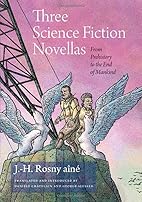

Joseph Henri Honoré Boëx was a Belgian telegraphist who largely educated himself while working for eleven years in London for the British Post Office. He began his writing career in Paris in collaboration with his younger brother, using the pen name J.-H. Rosny. His sibling's contributions were minimal, so Boëx added the suffix "aîné" (elder). He wrote equal amounts of naturalist fiction and what we now call science fiction and is best known in the English-speaking world as the author of the novel that was the basis for the marvelous film "Quest for Fire."
The introduction to this collection of three novellas occupies more than a third of its length, but it is well worth reading for its insight into the science fiction genre and its early development. The editors grant that Jules Verne should be deemed the "father of science fiction," but they insist Rosny be termed the "father of hard SF." Hard science fiction they define as when the science writes the story; i.e., the author accepts both its limits and its implications. After reading the novellas, I completely agree with their praise for Rosny's scientific rigor.
The Xipéhuz is set in pre-historic Mesopotamia at a time when mankind is still largely nomadic, but has developed sophisticated social institutions. The story begins when a tribal group comes to an oasis only to discover it occupied by "a large circle of bluish, translucent cones, with their pointed ends upright, each one with a volume of about half a man." These are what will come to be known as the Xipéhuz, a form of life completely alien to our biology with a metabolism apparently based on electromagnetic energy. It soon becomes obvious that they are hostile to all forms of organic life, killing anything that comes into contact with their stony, apparently invulnerable shells. Moreover, they are increasing steadily in number. When sacrifices to the gods fail to destroy or appease the Xipéhuz, the tribesmen turn to Bakhoun, a free-thinker known for his solitary ways and unique ideas. Bakhoun studies the Xipéhuz from a safe distance, learns their ways, and concludes that they must be exterminated at all costs before they eradicate all of humankind.
Another World is set in the author's present day. On a modest Flemish farm a baby is born with a frail body of a strange pale violet color. The child, Karel Ondereet, survives to maturity, but as he grows, other oddities emerge. His eyes are covered in what appears to be a solid black cataract, yet he can see. Only he sees principally in what he later learns is the ultraviolet spectrum. Karel's movements are lightning fast, and so is his speech--so much so that few people can understand him, and he is considered to be retarded. Yet he is anything but. Karel educates himself with books to the point that he understands that he is the product of a mutation and perhaps the next step in humanity's evolution. But there is an even more important discovery. With his remarkable vision, Karel is able to see that the Earth is inhabited by beings invisible to us, and equally unable to sense our presence.
The Death of the Earth relates the end of carbon-based life on Earth. Over the millenniums the oceans have dried up leaving only a handful of oases where the last remnants of humanity conserve what little water and food remains. They have abundant technology, but nothing can halt the increasing seismic activity which dries up their springs, cracks open their reservoirs, and shatters their settlements. On top of this there is a new threat. A new form of iron-based life, the ferromagnetics, has appeared. Though they are scarcely more intelligent or mobile than algae, the ferromagnetics are capable of drawing the hemoglobin from the blood of anyone comes into contact with them. The history of mankind finally comes down to one last individual named Targ, who sees his coming death, not as the end of life on earth, but as an evolutionary transition to a new form.
Each of these three novellas features an individual whose epiphany is to realize that he is at a turning point in the evolution of his species and his planet. The stories are grand in scope, yet intimate in detail. Rosny's prose is clumsy at times, but dramatic and moving at its best. And his grasp of scientific ideas and their implications is impeccable. Rosny was an older contemporary of H. G. Wells, yet these novellas--except for a few instances of terminology--could have been written yesterday.
Rosny's work resembles most closely that of Olaf Stapledon, and I would recommend this collection to anyone who enjoys science fiction.
The Xipéhuz published 1888 as Les Xipéhuz
Another World published 1898 as Un autre monde
The Death of the Earth published 1910 as La Mort de la Terre
English translation, notes and introduction by Danièle Chatelain and George Slusser 2012

Joseph Henri Honoré Boëx was a Belgian telegraphist who largely educated himself while working for eleven years in London for the British Post Office. He began his writing career in Paris in collaboration with his younger brother, using the pen name J.-H. Rosny. His sibling's contributions were minimal, so Boëx added the suffix "aîné" (elder). He wrote equal amounts of naturalist fiction and what we now call science fiction and is best known in the English-speaking world as the author of the novel that was the basis for the marvelous film "Quest for Fire."
The introduction to this collection of three novellas occupies more than a third of its length, but it is well worth reading for its insight into the science fiction genre and its early development. The editors grant that Jules Verne should be deemed the "father of science fiction," but they insist Rosny be termed the "father of hard SF." Hard science fiction they define as when the science writes the story; i.e., the author accepts both its limits and its implications. After reading the novellas, I completely agree with their praise for Rosny's scientific rigor.
The Xipéhuz is set in pre-historic Mesopotamia at a time when mankind is still largely nomadic, but has developed sophisticated social institutions. The story begins when a tribal group comes to an oasis only to discover it occupied by "a large circle of bluish, translucent cones, with their pointed ends upright, each one with a volume of about half a man." These are what will come to be known as the Xipéhuz, a form of life completely alien to our biology with a metabolism apparently based on electromagnetic energy. It soon becomes obvious that they are hostile to all forms of organic life, killing anything that comes into contact with their stony, apparently invulnerable shells. Moreover, they are increasing steadily in number. When sacrifices to the gods fail to destroy or appease the Xipéhuz, the tribesmen turn to Bakhoun, a free-thinker known for his solitary ways and unique ideas. Bakhoun studies the Xipéhuz from a safe distance, learns their ways, and concludes that they must be exterminated at all costs before they eradicate all of humankind.
Another World is set in the author's present day. On a modest Flemish farm a baby is born with a frail body of a strange pale violet color. The child, Karel Ondereet, survives to maturity, but as he grows, other oddities emerge. His eyes are covered in what appears to be a solid black cataract, yet he can see. Only he sees principally in what he later learns is the ultraviolet spectrum. Karel's movements are lightning fast, and so is his speech--so much so that few people can understand him, and he is considered to be retarded. Yet he is anything but. Karel educates himself with books to the point that he understands that he is the product of a mutation and perhaps the next step in humanity's evolution. But there is an even more important discovery. With his remarkable vision, Karel is able to see that the Earth is inhabited by beings invisible to us, and equally unable to sense our presence.
The Death of the Earth relates the end of carbon-based life on Earth. Over the millenniums the oceans have dried up leaving only a handful of oases where the last remnants of humanity conserve what little water and food remains. They have abundant technology, but nothing can halt the increasing seismic activity which dries up their springs, cracks open their reservoirs, and shatters their settlements. On top of this there is a new threat. A new form of iron-based life, the ferromagnetics, has appeared. Though they are scarcely more intelligent or mobile than algae, the ferromagnetics are capable of drawing the hemoglobin from the blood of anyone comes into contact with them. The history of mankind finally comes down to one last individual named Targ, who sees his coming death, not as the end of life on earth, but as an evolutionary transition to a new form.
Each of these three novellas features an individual whose epiphany is to realize that he is at a turning point in the evolution of his species and his planet. The stories are grand in scope, yet intimate in detail. Rosny's prose is clumsy at times, but dramatic and moving at its best. And his grasp of scientific ideas and their implications is impeccable. Rosny was an older contemporary of H. G. Wells, yet these novellas--except for a few instances of terminology--could have been written yesterday.
Rosny's work resembles most closely that of Olaf Stapledon, and I would recommend this collection to anyone who enjoys science fiction.
76SassyLassy
steven, this is one of those threads where if the reader goes away for any time, it takes a good part of a pleasant afternoon to read on the return. What can I say, it all sounds wonderful. The sendup of Socratic method is incredible.
Have you read The Enchantress of Florence? It sounds as if Rushdie may be going back to some of the themes there.
Have you read The Enchantress of Florence? It sounds as if Rushdie may be going back to some of the themes there.
77StevenTX
>76 SassyLassy: Thanks for visiting, Sassy. No, I haven't read The Enchantress of Florence, only Rushdie's first three novels: Grimus, Shame, and Midnight's Children. I should read Satanic Verses next, but I hope eventually to read all of his works.
78StevenTX
The Battle of Dorking by George Tomkyns Chesney
First published 1871

The Battle of Dorking initiated a genre of writing known as "invasion literature" in which the author imagines his country invaded and conquered by an enemy. Most such works are written to alarm the public about a real threat against which the author feels his nation is unprepared. George Chesney, a lieutenant colonel in the Royal Engineers, wanted readers to know that the British army was woefully undermanned and poorly supplied, and that its strength was being frittered away on colonial missions of low priority such as defending Canada from a possible invasion by the United States. British forces were in no condition to defend the island against an invasion by a German army which had, in 1870, humbled mighty France in a matter of weeks.
The novella consists of the reminiscences, years after the war, of a former Government clerk who served briefly in a volunteer regiment during the invasion. He is writing to tell his children how the once-mighty Empire had become the impoverished, insignificant country which they are now preparing to leave. He never mentions Germany by name, but it is obvious that is who the enemy is. The political events that trigger war between the country are not described. Instead we read how the British are complacent behind the supposedly invulnerable shield of the Royal Navy. The Germans, however, destroy the British fleet by luring it into a minefield. (They are called torpedoes in the book, but this was the 19th century term for what we now call mines.) From that point on, with her army outnumbered, ill-equipped, and poorly-led, Britain's defeat is inevitable.
The bulk of the story is a very realistic account of a volunteer soldier's first experience with combat. It strongly resembles similar accounts of real battles written by common soldiers in the American Civil War ten years before. Of course if you want to read a book about a soldier's combat experience, I would suggest you read one of the many factual accounts available from wars of the period rather than a book about a war that never happened. Rather, the value of The Battle of Dorking is two-fold. First, it is an entertaining look at the attitudes and challenges that shaped British military and foreign policy in the years before World War I. Second, even though The Battle of Dorking is not science fiction, it introduced a motif which writers of science fiction and other genres have used to make points similar to those Chesney was trying to get across. Works like Edgar Rice Burroughs's The Moon Men and Robert Heinlein's The Puppet Masters are part of the invasion literature tradition.
Two comments in this novella spurred me to do some research. The first was the idea of troops being sent from Britain to Canada circa 1870 to defend the Dominion from an American invasion. It turns out this was a real fear. Relations between the U.S. and Britain were severely strained because Britain had built ships for the Confederacy during the Civil War, and these ships had been largely crewed by British subjects. Moreover a group of Irish-American veterans called the Fenians had staged raids into Canada with the idea of seizing territory which they could trade for Irish independence. The British government was angry that the U.S. wasn't doing anything to curb the Fenians. Tensions between the U.S. and Britain were eased in 1872 when Britain agreed to pay $15 million in claims for damages inflicted by the Confederate raider Alabama, which had been built to order in England.
In the novel one of the outcomes of Britain's defeat by Germany is that the United States seizes both Canada and Britain's possessions in the West Indies.
Here is a Canadian political cartoon from the period. The caption reads:
Mrs. Britannia.—"Is it possible, my dear, that you have ever given your cousin Jonathan any encouragement?"
Miss Canada.—"Encouragement! Certainly not, Mamma. I have told him that we can never be united."
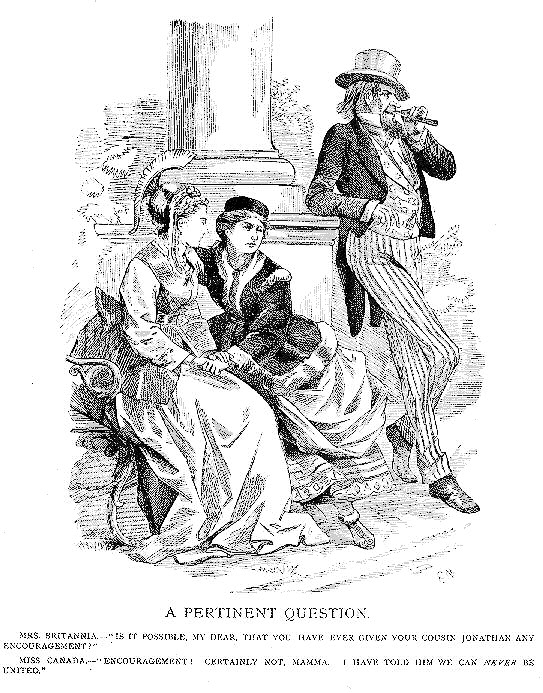
The other issue is whether Germany actually could have defeated Britain as described in the novel. Certainly the German army was powerful enough had it managed to get ashore, but getting the army to England and keeping supply lines open would have been an impossible task for the fledgling German Imperial Navy. The Royal Navy, on the other hand, had only recently been significantly enlarged and upgraded in an attempt to maintain its superiority over the French fleet. In the story the outnumbered Germans sink the British fleet using floating mines (torpedoes) which they drop overboard as the British are pursuing them. I have never read of floating mines being used successfully in such a manner.
First published 1871

The Battle of Dorking initiated a genre of writing known as "invasion literature" in which the author imagines his country invaded and conquered by an enemy. Most such works are written to alarm the public about a real threat against which the author feels his nation is unprepared. George Chesney, a lieutenant colonel in the Royal Engineers, wanted readers to know that the British army was woefully undermanned and poorly supplied, and that its strength was being frittered away on colonial missions of low priority such as defending Canada from a possible invasion by the United States. British forces were in no condition to defend the island against an invasion by a German army which had, in 1870, humbled mighty France in a matter of weeks.
The novella consists of the reminiscences, years after the war, of a former Government clerk who served briefly in a volunteer regiment during the invasion. He is writing to tell his children how the once-mighty Empire had become the impoverished, insignificant country which they are now preparing to leave. He never mentions Germany by name, but it is obvious that is who the enemy is. The political events that trigger war between the country are not described. Instead we read how the British are complacent behind the supposedly invulnerable shield of the Royal Navy. The Germans, however, destroy the British fleet by luring it into a minefield. (They are called torpedoes in the book, but this was the 19th century term for what we now call mines.) From that point on, with her army outnumbered, ill-equipped, and poorly-led, Britain's defeat is inevitable.
The bulk of the story is a very realistic account of a volunteer soldier's first experience with combat. It strongly resembles similar accounts of real battles written by common soldiers in the American Civil War ten years before. Of course if you want to read a book about a soldier's combat experience, I would suggest you read one of the many factual accounts available from wars of the period rather than a book about a war that never happened. Rather, the value of The Battle of Dorking is two-fold. First, it is an entertaining look at the attitudes and challenges that shaped British military and foreign policy in the years before World War I. Second, even though The Battle of Dorking is not science fiction, it introduced a motif which writers of science fiction and other genres have used to make points similar to those Chesney was trying to get across. Works like Edgar Rice Burroughs's The Moon Men and Robert Heinlein's The Puppet Masters are part of the invasion literature tradition.
Two comments in this novella spurred me to do some research. The first was the idea of troops being sent from Britain to Canada circa 1870 to defend the Dominion from an American invasion. It turns out this was a real fear. Relations between the U.S. and Britain were severely strained because Britain had built ships for the Confederacy during the Civil War, and these ships had been largely crewed by British subjects. Moreover a group of Irish-American veterans called the Fenians had staged raids into Canada with the idea of seizing territory which they could trade for Irish independence. The British government was angry that the U.S. wasn't doing anything to curb the Fenians. Tensions between the U.S. and Britain were eased in 1872 when Britain agreed to pay $15 million in claims for damages inflicted by the Confederate raider Alabama, which had been built to order in England.
In the novel one of the outcomes of Britain's defeat by Germany is that the United States seizes both Canada and Britain's possessions in the West Indies.
Here is a Canadian political cartoon from the period. The caption reads:
Mrs. Britannia.—"Is it possible, my dear, that you have ever given your cousin Jonathan any encouragement?"
Miss Canada.—"Encouragement! Certainly not, Mamma. I have told him that we can never be united."
The other issue is whether Germany actually could have defeated Britain as described in the novel. Certainly the German army was powerful enough had it managed to get ashore, but getting the army to England and keeping supply lines open would have been an impossible task for the fledgling German Imperial Navy. The Royal Navy, on the other hand, had only recently been significantly enlarged and upgraded in an attempt to maintain its superiority over the French fleet. In the story the outnumbered Germans sink the British fleet using floating mines (torpedoes) which they drop overboard as the British are pursuing them. I have never read of floating mines being used successfully in such a manner.
79zenomax
Many interesting books here Steven, and your reviews are always very enlightening.
I am particularly interested in the science fiction and counter factual ones. The Rosny trilogy sounds very intriguing.
On Alasdair Gray, I have heard him on radio and television here in the UK and he comes across as eccentric and out of step with today's world. However, when you listen to what he has to say you realise he is also very astute and has a lot of interesting observations to make.
I am particularly interested in the science fiction and counter factual ones. The Rosny trilogy sounds very intriguing.
On Alasdair Gray, I have heard him on radio and television here in the UK and he comes across as eccentric and out of step with today's world. However, when you listen to what he has to say you realise he is also very astute and has a lot of interesting observations to make.
80StevenTX
It's simply weird here...
We had record rainfall in May, and many lakes and rivers in the area are still out of their banks, closing some roads and parks. I get a "flood warning" message every day on my cell phone. Yet we've hardly had any rain since May, so the areas not under water are in drought conditions. After setting a record for the most rain in a month, 2015 is now in the record books with one of the longest rainless streaks in over a century. Meanwhile the temperature and humidity are both well above average. Today's high is supposed to be 105F (40C) with a heat index of 110F, so now I'm getting heat advisory warnings too. My house is full of lizards that run inside to cool off every time we open a door.
The rain, of course, brought a bumper crop of mosquitoes and another outbreak of West Nile virus. For the past two nights the county has been spraying my neighborhood from trucks while rural areas are being sprayed by air.
But all of this is nothing compared to The Great Spider Invasion. As I was doing some trimming and weeding outside this morning I noticed spider webs coating the branches of every tree and shrub. Ground Zero of the spider invasion is a park a couple of miles from my house. I took these pictures there this morning.


We had record rainfall in May, and many lakes and rivers in the area are still out of their banks, closing some roads and parks. I get a "flood warning" message every day on my cell phone. Yet we've hardly had any rain since May, so the areas not under water are in drought conditions. After setting a record for the most rain in a month, 2015 is now in the record books with one of the longest rainless streaks in over a century. Meanwhile the temperature and humidity are both well above average. Today's high is supposed to be 105F (40C) with a heat index of 110F, so now I'm getting heat advisory warnings too. My house is full of lizards that run inside to cool off every time we open a door.
The rain, of course, brought a bumper crop of mosquitoes and another outbreak of West Nile virus. For the past two nights the county has been spraying my neighborhood from trucks while rural areas are being sprayed by air.
But all of this is nothing compared to The Great Spider Invasion. As I was doing some trimming and weeding outside this morning I noticed spider webs coating the branches of every tree and shrub. Ground Zero of the spider invasion is a park a couple of miles from my house. I took these pictures there this morning.


81AlisonY
Wow! You must be having some serious monsters invading to get webs that big! Excellent photos!
I think the entire world's weather system has gone haywire. We used to get pleasantly warm summers in N. Ireland, with plenty of sunny days and temperatures in the early 20s for much of the time. These past 10 years have seen our summers turn to being rainy, grey and generally low to mid teens. When you have rainy and grey for much of the rest of the year, it's really quite depressing.
I think the entire world's weather system has gone haywire. We used to get pleasantly warm summers in N. Ireland, with plenty of sunny days and temperatures in the early 20s for much of the time. These past 10 years have seen our summers turn to being rainy, grey and generally low to mid teens. When you have rainy and grey for much of the rest of the year, it's really quite depressing.
83wandering_star
Actually I think those pictures are rather beautiful - they remind me of Japanese parks where the more sensitive trees have been wrapped up for the winter.
Doesn't mean you'd get me to go anywhere near them in real life, of course...
Doesn't mean you'd get me to go anywhere near them in real life, of course...
84weird_O
>80 StevenTX: Those webs look to me like bagworms. Moths, not spiders. Here in PA, we get them occasionally, usually in weed trees and weak trees. If it's a yard tree we want to preserve, we burn out the clusters of worms with a propane torch.
85SassyLassy
Those are amazing photos. I wonder what will happen when the webs fill up with prey.
They remind me of the webs spun by tent caterpillars which appear in this part of the world every spring. The tents are filled with up to hundreds of caterpillars, which emerge and immediately eat all the new foliage on the tree.
They remind me of the webs spun by tent caterpillars which appear in this part of the world every spring. The tents are filled with up to hundreds of caterpillars, which emerge and immediately eat all the new foliage on the tree.
86StevenTX
>84 weird_O: We have webworms at times too, but these are definitely spiders. Spider specialists have identified them as "two types of arachnids: long-jawed spiders, Tetragnathidae, and communal nesting spiders, Anelosimus studiosus" (quoting from local news article). The photos can't show the finer strands running everywhere tree to tree. I had to trim low-hanging limbs from trees in my front yard because I was walking into webs just going out for the morning paper.
The reason they are concentrated in this area is the lake you can see a branch of in one of the pictures. The suburb I live in lies between arms of the lake, so after an exceptionally wet spring we are overrun with mosquitoes and other water-bred insects the spiders feed on.
Incidentally, I get rid of webworms just by hitting the web with a jet of water from the hose. This tears the web and lets wasps get inside to catch the caterpillars.
The reason they are concentrated in this area is the lake you can see a branch of in one of the pictures. The suburb I live in lies between arms of the lake, so after an exceptionally wet spring we are overrun with mosquitoes and other water-bred insects the spiders feed on.
Incidentally, I get rid of webworms just by hitting the web with a jet of water from the hose. This tears the web and lets wasps get inside to catch the caterpillars.
87AlisonY
I just Googled the first of those spiders - that is utter nightmare material (well, for wooses like me anyway).
Plagues of spiders... caterpillar invasions... webworm tents... mosquito swarms. Are you all in an episode of "I'm a Celebrity... Get Me Out of Here!"?
I feel like I need to row a wee boat across the Atlantic and rescue you.
Plagues of spiders... caterpillar invasions... webworm tents... mosquito swarms. Are you all in an episode of "I'm a Celebrity... Get Me Out of Here!"?
I feel like I need to row a wee boat across the Atlantic and rescue you.
88StevenTX
>87 AlisonY: Thanks for the rescue offer, Alison, but the spiders don't really bother me. (Now if Donald Trump gets elected president, I may swim out to meet you halfway.)
89chlorine
At least the spiders must help with the mosquito problem. I hope for you things won't get any weirder!
90StevenTX
She by H. Rider Haggard
Serialized 1886-1887
First book publication 1887


She is a thrilling adventure story that walks the borderline between science fiction and fantasy, but is more of the latter. It is the account by a Cambridge professor Horace Holly of his trip to unexplored parts of Africa with his ward, 25-year-old Leo Vincey. The trip was the dying request of Vincey's father who left his bachelor friend Holly in charge of his then 5-year-old son. The elder Vincey also left a strange casket to be opened when Leo turned 25. Inside was an ancient Egyptian potsherd on which was written a tale of a lost city in Africa where dwelt a dangerously beautiful, immortal woman with strange powers. This woman had killed a remote ancestor of Vincey's, a Greek named Kallikrates. The Greek's Egyptian widow implored her offspring to go in search of this woman and exact revenge for Kallikrates's death. Over scores of generations, some had tried, but none had succeeded in finding the lost city of Kôr.
Young Vincey resolves, against his mentor's advice, to make the trip. They make their way south along the east coast of Africa to probably what is now northern Mozambique. After being shipwrecked and crossing a pestilential swamp, they are captured by a group of savages speaking an archaic dialect of Arabic. These prove to be the people ruled by She-who-must-be-obeyed, a woman who claims to be over 2000 years old but so beautiful that she must veil her face with a shroud like that of a mummy to avoid driving men mad with love for her.
The mysterious woman's name is Ayesha (which Holly says is pronounced "Assha"). She insists that Leo is the awaited reincarnation of her long-lost love Kallikrates whom she slew in a fit of jealous rage. She demonstrates that she has the power to strike men dead with a touch of her hand and to see distant events, but insists that these powers, like her longevity, have a scientific and not a magical explanation.
In addition to being an exciting and exotic story, She is full of ruminations on death, love, religion, ambition and materialism. A philosophy often expressed is to trust in science rather than religion and to live for the present, not the future.
"The religions come and the religions pass, and the civilisations come and pass, and naught endures but the world and human nature. Ah! if man would but see that hope is from within and not from without — that he himself must work out his own salvation! He is there, and within him is the breath of life and a knowledge of good and evil as good and evil is to him. Thereon let him build and stand erect, and not cast himself before the image of some unknown God,"
Therefore...
"...let us love and take that which is given us, and be happy; for in the grave there is no love and no warmth, nor any touching of the lips. Nothing perchance, or perchance but bitter memories of what might have been. To-night the hours are our own, how know we to whom they shall belong to-morrow?"
Holly also expresses some rather cynical ideas about feminine beauty and its role in our culture.
"For man can be bought with woman’s beauty, if it be but beautiful enough; and woman’s beauty can be ever bought with gold, if only there be gold enough."
"...and by a law of nature man is apt to think but lightly of a woman’s crimes, especially if that woman be beautiful, and the crime be committed for the love of him."
"What a terrifying reflection it is, by the way, that nearly all our deep love for women who are not our kindred depends — at any rate, in the first instance — upon their personal appearance."
H. Rider Haggard was a master of the "lost race" novel, and his powers of imagination and description are formidable. She also reflects the 19th century European fascination with Muslim cultures known as Orientalism. Much of the dialogue in the novel would have been in Arabic, and Haggard chose to write those passages in 17th century English (i.e. that of the King James Bible), presumably to better reflect the ornate formality of the Arabic language. This gets to be a little tiresome, which is about the only negative thing I can find to say about this fine and entertaining novel.
Serialized 1886-1887
First book publication 1887


She is a thrilling adventure story that walks the borderline between science fiction and fantasy, but is more of the latter. It is the account by a Cambridge professor Horace Holly of his trip to unexplored parts of Africa with his ward, 25-year-old Leo Vincey. The trip was the dying request of Vincey's father who left his bachelor friend Holly in charge of his then 5-year-old son. The elder Vincey also left a strange casket to be opened when Leo turned 25. Inside was an ancient Egyptian potsherd on which was written a tale of a lost city in Africa where dwelt a dangerously beautiful, immortal woman with strange powers. This woman had killed a remote ancestor of Vincey's, a Greek named Kallikrates. The Greek's Egyptian widow implored her offspring to go in search of this woman and exact revenge for Kallikrates's death. Over scores of generations, some had tried, but none had succeeded in finding the lost city of Kôr.
Young Vincey resolves, against his mentor's advice, to make the trip. They make their way south along the east coast of Africa to probably what is now northern Mozambique. After being shipwrecked and crossing a pestilential swamp, they are captured by a group of savages speaking an archaic dialect of Arabic. These prove to be the people ruled by She-who-must-be-obeyed, a woman who claims to be over 2000 years old but so beautiful that she must veil her face with a shroud like that of a mummy to avoid driving men mad with love for her.
The mysterious woman's name is Ayesha (which Holly says is pronounced "Assha"). She insists that Leo is the awaited reincarnation of her long-lost love Kallikrates whom she slew in a fit of jealous rage. She demonstrates that she has the power to strike men dead with a touch of her hand and to see distant events, but insists that these powers, like her longevity, have a scientific and not a magical explanation.
In addition to being an exciting and exotic story, She is full of ruminations on death, love, religion, ambition and materialism. A philosophy often expressed is to trust in science rather than religion and to live for the present, not the future.
"The religions come and the religions pass, and the civilisations come and pass, and naught endures but the world and human nature. Ah! if man would but see that hope is from within and not from without — that he himself must work out his own salvation! He is there, and within him is the breath of life and a knowledge of good and evil as good and evil is to him. Thereon let him build and stand erect, and not cast himself before the image of some unknown God,"
Therefore...
"...let us love and take that which is given us, and be happy; for in the grave there is no love and no warmth, nor any touching of the lips. Nothing perchance, or perchance but bitter memories of what might have been. To-night the hours are our own, how know we to whom they shall belong to-morrow?"
Holly also expresses some rather cynical ideas about feminine beauty and its role in our culture.
"For man can be bought with woman’s beauty, if it be but beautiful enough; and woman’s beauty can be ever bought with gold, if only there be gold enough."
"...and by a law of nature man is apt to think but lightly of a woman’s crimes, especially if that woman be beautiful, and the crime be committed for the love of him."
"What a terrifying reflection it is, by the way, that nearly all our deep love for women who are not our kindred depends — at any rate, in the first instance — upon their personal appearance."
H. Rider Haggard was a master of the "lost race" novel, and his powers of imagination and description are formidable. She also reflects the 19th century European fascination with Muslim cultures known as Orientalism. Much of the dialogue in the novel would have been in Arabic, and Haggard chose to write those passages in 17th century English (i.e. that of the King James Bible), presumably to better reflect the ornate formality of the Arabic language. This gets to be a little tiresome, which is about the only negative thing I can find to say about this fine and entertaining novel.
91baswood
I share your enthusiasm for She and Ayesha: The Return of She has its moments.
Fascinated by your recent early science fiction reading - all of those books are on my reading list.
Weather patterns tend to go in cycles (although I believe that global warming is now a fact). After four summers here in the South West of France where there has been far more rain than usual. This year we seem to be back to more longer hot dry spells, which is the sort of summer weather I expected when we moved here.
Fascinated by your recent early science fiction reading - all of those books are on my reading list.
Weather patterns tend to go in cycles (although I believe that global warming is now a fact). After four summers here in the South West of France where there has been far more rain than usual. This year we seem to be back to more longer hot dry spells, which is the sort of summer weather I expected when we moved here.
92StevenTX
The Year of the Hare by Arto Paasilinna
First published in Finnish 1975
English translation by Herbert Lomas 1995


A journalist named Vatanen is riding through the Finnish countryside in a car with a photographer on their way to an assignment. Their car strikes a young hare that can't get out of the way in time. Vatanen gets out and follows the injured animal into the forest. He finds the terrified hare and uses twigs and a strip of cloth to splint its broken leg. The photographer is angrily honking the horn to get him to return to the car, but Vatanen asks himself why he should go back to a life he hates, a failing marriage, and a miserable job. He never returns.
Vatanen and the hare (who is never given a name) become devoted to one another and go on an odyssey through the Finnish countryside. The man takes odd jobs wherever he can find them, looking for peace and solitude. But like Don Quixote and Sancho Panza, he and the hare always seems to be stirring up the most madcap adventures.
The Year of the Hare is about breaking out of the system to be your own person. It is a lyrical and joyful book, but there is an edge of bitterness because the system inevitably fights back to try to force you back into conformity.
My desk and computer are next to a large window that overlooks my front yard. The window goes almost to the ground, so I have a good view. I had just finished typing the second sentence of this review when a rabbit came running out from under the trees in the center of my yard heading straight for my window. It stopped about five feet from me before ambling off. (It couldn't have seen me because we have reflective screens on the windows to keep out the heat.) Rabbits are not a common sight in this dog-infested neighborhood, so what am I to make of this ominous event?
First published in Finnish 1975
English translation by Herbert Lomas 1995


A journalist named Vatanen is riding through the Finnish countryside in a car with a photographer on their way to an assignment. Their car strikes a young hare that can't get out of the way in time. Vatanen gets out and follows the injured animal into the forest. He finds the terrified hare and uses twigs and a strip of cloth to splint its broken leg. The photographer is angrily honking the horn to get him to return to the car, but Vatanen asks himself why he should go back to a life he hates, a failing marriage, and a miserable job. He never returns.
Vatanen and the hare (who is never given a name) become devoted to one another and go on an odyssey through the Finnish countryside. The man takes odd jobs wherever he can find them, looking for peace and solitude. But like Don Quixote and Sancho Panza, he and the hare always seems to be stirring up the most madcap adventures.
The Year of the Hare is about breaking out of the system to be your own person. It is a lyrical and joyful book, but there is an edge of bitterness because the system inevitably fights back to try to force you back into conformity.
My desk and computer are next to a large window that overlooks my front yard. The window goes almost to the ground, so I have a good view. I had just finished typing the second sentence of this review when a rabbit came running out from under the trees in the center of my yard heading straight for my window. It stopped about five feet from me before ambling off. (It couldn't have seen me because we have reflective screens on the windows to keep out the heat.) Rabbits are not a common sight in this dog-infested neighborhood, so what am I to make of this ominous event?
93StevenTX
The Body Artist by Don DeLillo
First published 2001


The Body Artist begins with a recently-married couple having breakfast in a large house they have rented for a few months as a getaway. The focus of the narrative is on how much and how little they each know of the other and how each retains his or her own sense of ownership and personal space. Between this chapter and the next one there is an obituary from which we learn that the man has gone to New York and committed suicide in the apartment of his ex wife.
The story resumes with the widow, a performance artist named Lauren Hartke, returning to the lonely house. She encounters a man who is apparently mentally deficient and probably homeless, but who utters some bizarre and seemingly profound remarks that suggest his perception of time is somehow different. Lauren becomes fascinated, then obsessed with this man, and treats his occasional utterances as the key to turning back the clock and understanding the husband she barely got to know.
The Body Artist is a short novella, easily read in a single sitting, written in sparse but poetic language. There is a disquieting air about it, but I'm not sure what to take away from it.
Other works I have read by Don DeLillo:
Ratner's Star
White Noise
Libra
Underworld
First published 2001


The Body Artist begins with a recently-married couple having breakfast in a large house they have rented for a few months as a getaway. The focus of the narrative is on how much and how little they each know of the other and how each retains his or her own sense of ownership and personal space. Between this chapter and the next one there is an obituary from which we learn that the man has gone to New York and committed suicide in the apartment of his ex wife.
The story resumes with the widow, a performance artist named Lauren Hartke, returning to the lonely house. She encounters a man who is apparently mentally deficient and probably homeless, but who utters some bizarre and seemingly profound remarks that suggest his perception of time is somehow different. Lauren becomes fascinated, then obsessed with this man, and treats his occasional utterances as the key to turning back the clock and understanding the husband she barely got to know.
The Body Artist is a short novella, easily read in a single sitting, written in sparse but poetic language. There is a disquieting air about it, but I'm not sure what to take away from it.
Other works I have read by Don DeLillo:
Ratner's Star
White Noise
Libra
Underworld
94AlisonY
Really enjoyed the reviews of your last 2 books. Think these need to go on my wish list.
So do you think your own little bunny was urging you to quit the rat race and move into a yurt or something? Spooky coincidence...
So do you think your own little bunny was urging you to quit the rat race and move into a yurt or something? Spooky coincidence...
95FlorenceArt
The Year of the Hare has been on my wishlist for a while, mostly on account of the cover of the French edition. Although I don't remember exactly what drew my attention, I do remember it has the portrait of a hare on it. I'm glad you reviewed it, it sound like I should move it up the list.
I tried to read a book by Don DeLillo, I think it was Ratner's Star, and I don't think I understood a word of the few pages I read. I should give him another chance I guess.
I tried to read a book by Don DeLillo, I think it was Ratner's Star, and I don't think I understood a word of the few pages I read. I should give him another chance I guess.
96StevenTX
>94 AlisonY: I quit racing the rats about eight years ago when I retired. Maybe the rabbit was telling me to quit reading so many books and get out and plant some flowers. Come to think of it, that's what my wife keeps saying. Could be a conspiracy.
>95 FlorenceArt: Of the DeLillo novels I've read, I would definitely recommend White Noise as the place to start.
>95 FlorenceArt: Of the DeLillo novels I've read, I would definitely recommend White Noise as the place to start.
97rebeccanyc
Enjoyed these two reviews too. I'm not likely to read either of these books, but I appreciated learning about hem.
98StevenTX
Faceless Killers by Henning Mankell
First published in Swedish 1991
English translation by Steven T. Murray 1997


I won't attempt a formal review of this novel, since I've only read a handful of examples of detective fiction, all of them much older, and have little basis to compare it with other works of its kind. Like the others that I read, Faceless Killers was on the "1001 Books" list, and I am glad I was introduced to it. It is a gripping, intelligent and believable story about a police detective's attempt to solve the apparently senseless but brutal murder of an elderly couple living on a farm in southern Sweden. Clues suggest that the murderer or murderers may have been foreigners. When this information is leaked to the press, there are threats of violence against refugee camps in the area, sidetracking the murder investigation. The novel explores the causes and consequences of racism in modern Sweden.
I will resist--for now--the temptation to add murder mysteries to my already bloated TBR pile, but if I were to delve into the genre I would certainly want to read more by Henning Mankell.
First published in Swedish 1991
English translation by Steven T. Murray 1997


I won't attempt a formal review of this novel, since I've only read a handful of examples of detective fiction, all of them much older, and have little basis to compare it with other works of its kind. Like the others that I read, Faceless Killers was on the "1001 Books" list, and I am glad I was introduced to it. It is a gripping, intelligent and believable story about a police detective's attempt to solve the apparently senseless but brutal murder of an elderly couple living on a farm in southern Sweden. Clues suggest that the murderer or murderers may have been foreigners. When this information is leaked to the press, there are threats of violence against refugee camps in the area, sidetracking the murder investigation. The novel explores the causes and consequences of racism in modern Sweden.
I will resist--for now--the temptation to add murder mysteries to my already bloated TBR pile, but if I were to delve into the genre I would certainly want to read more by Henning Mankell.
99LolaWalser
>98 StevenTX:
The novel explores the causes and consequences of racism in modern Sweden.
Don't you find funny, in the light of this, the whatsisname inspector's getting the hots for a woman because she's (and I believe the adjective is a quote from his POV) exotic? I think a black woman, can't remember... Talk about irony...
I only read that one of Mankell's, found it excruciatingly boring and empty, nothing at all like Sjöwall and Wahlöö's books--if you haven't read those, they are terrific.
The novel explores the causes and consequences of racism in modern Sweden.
Don't you find funny, in the light of this, the whatsisname inspector's getting the hots for a woman because she's (and I believe the adjective is a quote from his POV) exotic? I think a black woman, can't remember... Talk about irony...
I only read that one of Mankell's, found it excruciatingly boring and empty, nothing at all like Sjöwall and Wahlöö's books--if you haven't read those, they are terrific.
100StevenTX
>99 LolaWalser: The police inspector has a recurrent dream about a black woman, but she isn't based on anyone he knows. At the same time he is obviously upset when he spies his estranged daughter holding hands with a black man. I'm sure this is meant to demonstrate his internal conflict over race as being representative of his country's.
I've heard of Sjöwall and Wahlöö, but don't have anything by them. I'll keep your recommendation in mind.
I've heard of Sjöwall and Wahlöö, but don't have anything by them. I'll keep your recommendation in mind.
101NanaCC
Interesting to see a Mankell review on your thread, Steven. I've read all of the books in his Wallander series, and some are better than others. His stand alone novels are also good. There are some really excellent Scandanavian crime fiction writers, although I'm not expecting to see them on your TBR. :)
102StevenTX
Looking Backward: 2000-1887 by Edward Bellamy
First published 1888


Looking Backward is a utopian novel promoting an extreme form of socialism as the natural solution to many ills of 19th century society. The narrator is a wealthy young Bostonian of 1887 named Julian West. Afflicted with insomnia, he has constructed a soundproof concrete vault beneath his home in which to sleep. Even then, he often needs the help of a mesmerist who puts West into an hypnotic trance so deep that he will sleep indefinitely if not wakened. One night he uses this technique to fall asleep, then his house burns, killing the servant who was to wake him and burying his vault under debris and ash. West is discovered and awakened in September 2000, his body not having aged during its 113 years of sleep.
West discovers that he has awakened in a new world that is a paradise compared to the one he left. Boston is a clean and flawless city of beautiful buildings, parks and open spaces. There is no longer any poverty or hunger. Nor is there any unemployment or illiteracy. Crime is almost unknown because no one has more than anyone else, and there is no such thing as money. All of this was achieved peacefully in the early 20th century when America, followed by most of the rest of the world, made a natural transition to socialism. And once all men had achieved equality and brotherhood, there was no more war and no need for expensive armies and navies.
The doctor under whose garden West was found explains patiently how the new system works, and why it is so much better than 19th century capitalism. The government is now the only employer, the only landowner, and the only vendor of goods. The workforce is organized into an "army of labor," in which participation is compulsory between ages of 21 and 45. Women participate as well as men, but are excused for childrearing. People choose their profession, but must first complete three years of mandatory unskilled labor. The government balances the supply and demand of labor by setting shorter work hours for the less desirable professions to entice workers, but ultimately it has the authority to put anyone to work at any job. Retirement at age 45 is possible because of the efficiency of a system without wasteful competition.
Instead of wages, every man woman and child is given an annual allowance by the government. The waiter receives as much as the physician, as does the disabled person who can't work at all. The payment is simply each citizen's per capita share of the domestic product, and it is given in the form of a credit card which can be used to purchase goods and services. Because the government provides for all basic needs--including food which is prepared at communal kitchens--people chiefly use their personal allowances for entertainment or to pursue hobbies. There is no incentive to accumulate ostentatious possessions, as everybody is exactly as wealthy as everyone else.
Much of Bellamy's utopia sounds too good to be true, but nothing so much as his brief explanation of how this system came about. The great capitalist ventures of the late 19th century kept absorbing one another and creating ever larger monopolies until it was a just a step of "natural evolution" for all the industry and capital of the nation to be "intrusted to a single syndicate representing the people, to be conducted in the common interest for the common profit. The nation, that is to say, organized as the one great business corporation in which all other corporations were absorbed; it became the one capitalist in the place of all other capitalists, the sole employer." What might possibly motivate the wealthy capitalists to voluntary reduce themselves to the level of their employees--or a government controlled by those capitalists to initiate it--is never addressed. Bellamy seems in many respects to give human nature more credit than it deserves.
Is Bellamy's utopia really appealing, though? It depends your perspective and values. It is certainly free from physical want and social ills like illiteracy and unemployment. But one gets the sense of self-satisfied stagnation. Believing itself to have attained perfection, it isn't going anywhere. With nothing to do after age 45 but entertain oneself, decadence will surely set in. But decadence isn't without its appeal, especially to those who have known privation.
Looking Backward is more a work of political philosophy in the mode of Plato's The Republic than it is a science fiction novel. The author introduces only a few technological advances, and these are simple extrapolations of technologies already in use (e.g the telephone). This may have been a deliberate restraint, as he would not have wanted it to seem that his utopia depended on tools that weren't already in existence. The plot is a typical "sleeper wakes" scenario, common in that era. And like virtually all such novels of the period, as well as all utopias set on other planets, the center of the earth, etc., the traveler's host has a beautiful daughter with whom the traveler falls madly in love.
Looking Backward is an important and influential novel that I would consider essential reading for anyone doing a survey of utopian fiction. It is of lesser appeal for those with a more general interest in science fiction.
First published 1888


Looking Backward is a utopian novel promoting an extreme form of socialism as the natural solution to many ills of 19th century society. The narrator is a wealthy young Bostonian of 1887 named Julian West. Afflicted with insomnia, he has constructed a soundproof concrete vault beneath his home in which to sleep. Even then, he often needs the help of a mesmerist who puts West into an hypnotic trance so deep that he will sleep indefinitely if not wakened. One night he uses this technique to fall asleep, then his house burns, killing the servant who was to wake him and burying his vault under debris and ash. West is discovered and awakened in September 2000, his body not having aged during its 113 years of sleep.
West discovers that he has awakened in a new world that is a paradise compared to the one he left. Boston is a clean and flawless city of beautiful buildings, parks and open spaces. There is no longer any poverty or hunger. Nor is there any unemployment or illiteracy. Crime is almost unknown because no one has more than anyone else, and there is no such thing as money. All of this was achieved peacefully in the early 20th century when America, followed by most of the rest of the world, made a natural transition to socialism. And once all men had achieved equality and brotherhood, there was no more war and no need for expensive armies and navies.
The doctor under whose garden West was found explains patiently how the new system works, and why it is so much better than 19th century capitalism. The government is now the only employer, the only landowner, and the only vendor of goods. The workforce is organized into an "army of labor," in which participation is compulsory between ages of 21 and 45. Women participate as well as men, but are excused for childrearing. People choose their profession, but must first complete three years of mandatory unskilled labor. The government balances the supply and demand of labor by setting shorter work hours for the less desirable professions to entice workers, but ultimately it has the authority to put anyone to work at any job. Retirement at age 45 is possible because of the efficiency of a system without wasteful competition.
Instead of wages, every man woman and child is given an annual allowance by the government. The waiter receives as much as the physician, as does the disabled person who can't work at all. The payment is simply each citizen's per capita share of the domestic product, and it is given in the form of a credit card which can be used to purchase goods and services. Because the government provides for all basic needs--including food which is prepared at communal kitchens--people chiefly use their personal allowances for entertainment or to pursue hobbies. There is no incentive to accumulate ostentatious possessions, as everybody is exactly as wealthy as everyone else.
Much of Bellamy's utopia sounds too good to be true, but nothing so much as his brief explanation of how this system came about. The great capitalist ventures of the late 19th century kept absorbing one another and creating ever larger monopolies until it was a just a step of "natural evolution" for all the industry and capital of the nation to be "intrusted to a single syndicate representing the people, to be conducted in the common interest for the common profit. The nation, that is to say, organized as the one great business corporation in which all other corporations were absorbed; it became the one capitalist in the place of all other capitalists, the sole employer." What might possibly motivate the wealthy capitalists to voluntary reduce themselves to the level of their employees--or a government controlled by those capitalists to initiate it--is never addressed. Bellamy seems in many respects to give human nature more credit than it deserves.
Is Bellamy's utopia really appealing, though? It depends your perspective and values. It is certainly free from physical want and social ills like illiteracy and unemployment. But one gets the sense of self-satisfied stagnation. Believing itself to have attained perfection, it isn't going anywhere. With nothing to do after age 45 but entertain oneself, decadence will surely set in. But decadence isn't without its appeal, especially to those who have known privation.
Looking Backward is more a work of political philosophy in the mode of Plato's The Republic than it is a science fiction novel. The author introduces only a few technological advances, and these are simple extrapolations of technologies already in use (e.g the telephone). This may have been a deliberate restraint, as he would not have wanted it to seem that his utopia depended on tools that weren't already in existence. The plot is a typical "sleeper wakes" scenario, common in that era. And like virtually all such novels of the period, as well as all utopias set on other planets, the center of the earth, etc., the traveler's host has a beautiful daughter with whom the traveler falls madly in love.
Looking Backward is an important and influential novel that I would consider essential reading for anyone doing a survey of utopian fiction. It is of lesser appeal for those with a more general interest in science fiction.
103StevenTX
>101 NanaCC: Thanks, Colleen. I wouldn't call my remarks on Faceless Killers a "review." Whenever I see a review that begins, "I don't normally read books of this type...," I usually read no further. That's why I kept my comments as short as possible. :-)
I do have a few more mysteries to read that are on the "1001 Books" list, but I'm in no particular hurry to get to them, and I'll read those before I venture to others.
I've seen other remarks referring to Scandinavian mysteries as a distinct class. What is it about them that makes them different?
I do have a few more mysteries to read that are on the "1001 Books" list, but I'm in no particular hurry to get to them, and I'll read those before I venture to others.
I've seen other remarks referring to Scandinavian mysteries as a distinct class. What is it about them that makes them different?
104LolaWalser
I loved Looking backward. I think it helps to know something of the background of its origin, that, for instance, it owes its existence to Bellamy's profound disgust at the treatment of the poor and working class in Europe and the US.
I'm not sure that kind of "stagnation" (isn't it better understood as "steady-state"? Which does not preclude dynamic development, on the contrary.) isn't preferable to the all-out skidding to hell we are currently on. There is no infinite growth in a finite world, and we have long run out of places to go to.
Should we continue to sacrifice billions of people so that a handful of rich men could feel they are going places?
I'm not sure that kind of "stagnation" (isn't it better understood as "steady-state"? Which does not preclude dynamic development, on the contrary.) isn't preferable to the all-out skidding to hell we are currently on. There is no infinite growth in a finite world, and we have long run out of places to go to.
Should we continue to sacrifice billions of people so that a handful of rich men could feel they are going places?
105baswood
Bring on the decadence! Excellent review of Looking Backward 2000-1987 A book I am sure I will enjoy.
106StevenTX
>104 LolaWalser: Personally I find Bellamy's utopia very appealing, perhaps the most so of any I've come across. I'm one of those who has experienced privation and can appreciate that being a private soldier in his "army of industry" is preferable to belonging to the "army of the unemployed," burdened with debt and unable to pay for even basic health care. But I can also see how another writer could have presented the same society in a very negative light by viewing, for example, its community spirit as simply enforced conformity. There are plenty of other questions that can be raised, such as what would stand in the way of a potential Stalin. Obviously, though, it wasn't within the scope of Bellamy's work to answer every possible objection.
I still think the biggest problem, though, is how we get there from here. Obviously things didn't work the way Bellamy predicted. The 20th century was a bloodbath, and while we are better off in many ways than we were before, capitalism is even more firmly entrenched. It will probably take the coming eco-catastrophe to force people to open their minds to radical change.
On the other hand, technology makes quite feasible some of the features of Bellamy's society that might have been hard to put into effect in his day. His system of purchasing and distribution is basically Amazon run as a public utility. And his method of supporting the arts is what we now call crowdfunding.
I've now read 50+ proto-SF works of the 19th century and earlier, many of them utopian. Off the top of my head I would say that Bellamy's society most closely resembles that of Tommasso Campanella's The City of the Sun, with its classless society, universal education, centrally managed labor force, communal kitchen, and cashless economy. Campanella, however, goes further by dissolving the family.
Next up on my SF reading queue is News from Nowhere by William Morris, a novel written in angry reaction to Bellamy's. I'm eager to see what Morris says.
I still think the biggest problem, though, is how we get there from here. Obviously things didn't work the way Bellamy predicted. The 20th century was a bloodbath, and while we are better off in many ways than we were before, capitalism is even more firmly entrenched. It will probably take the coming eco-catastrophe to force people to open their minds to radical change.
On the other hand, technology makes quite feasible some of the features of Bellamy's society that might have been hard to put into effect in his day. His system of purchasing and distribution is basically Amazon run as a public utility. And his method of supporting the arts is what we now call crowdfunding.
I've now read 50+ proto-SF works of the 19th century and earlier, many of them utopian. Off the top of my head I would say that Bellamy's society most closely resembles that of Tommasso Campanella's The City of the Sun, with its classless society, universal education, centrally managed labor force, communal kitchen, and cashless economy. Campanella, however, goes further by dissolving the family.
Next up on my SF reading queue is News from Nowhere by William Morris, a novel written in angry reaction to Bellamy's. I'm eager to see what Morris says.
107NanaCC
>103 StevenTX: "I've seen other remarks referring to Scandinavian mysteries as a distinct class. What is it about them that makes them different?
I'm not sure I know if there is a definitive answer to that question, Steven. For me, it has a lot to do with atmosphere. Since they are so different from my own experience, the descriptions of the scenery, customs and even political leanings make the story interesting to me.
I'm not sure I know if there is a definitive answer to that question, Steven. For me, it has a lot to do with atmosphere. Since they are so different from my own experience, the descriptions of the scenery, customs and even political leanings make the story interesting to me.
108StevenTX
Another observation about Looking Backward that just came to mind...
One the things about 18th and 19th century society (as depicted in novels, at least) that has always appealed to me is the tradition in the middle classes of retiring to the parlor after dinner to listen to music performed by members of the family. It seems so congenial and a way of cultivating a taste and talent for music in everyone.
In Looking Backward the host's daughter suggests to Mr. West (the sleeper from the 19th century) that they go to the music room after dinner. He says he looks forward to hearing her sing or play for him. Instead she explains that what they will listen to is a concert by professional musicians broadcast over the telephone system. West goes into raptures over the chance to finally listen to qualified musicians instead of a bunch of amateur caterwauling (my words, not his). It's another case of the grass is greener...
One the things about 18th and 19th century society (as depicted in novels, at least) that has always appealed to me is the tradition in the middle classes of retiring to the parlor after dinner to listen to music performed by members of the family. It seems so congenial and a way of cultivating a taste and talent for music in everyone.
In Looking Backward the host's daughter suggests to Mr. West (the sleeper from the 19th century) that they go to the music room after dinner. He says he looks forward to hearing her sing or play for him. Instead she explains that what they will listen to is a concert by professional musicians broadcast over the telephone system. West goes into raptures over the chance to finally listen to qualified musicians instead of a bunch of amateur caterwauling (my words, not his). It's another case of the grass is greener...
109NanaCC
>108 StevenTX: I enjoyed your review of Looking Backward.
110LolaWalser
>108 StevenTX:
Heh, we sure are incredibly spoiled when it comes to sheer wealth of art at our fingertips--recorded, live, stored, exhibited...
But I think music-making, any kind of performing and creating has a private value for whoever is doing it separate from pleasure (or displeasure) anyone else may get from that. We have infinitely more opportunity to consume, but I think we lost a lot with turning into (mostly) consumers.
Heh, we sure are incredibly spoiled when it comes to sheer wealth of art at our fingertips--recorded, live, stored, exhibited...
But I think music-making, any kind of performing and creating has a private value for whoever is doing it separate from pleasure (or displeasure) anyone else may get from that. We have infinitely more opportunity to consume, but I think we lost a lot with turning into (mostly) consumers.
111dchaikin
Enjoyed catching up here. Good luck with those spiders. I think i could live in Ballamy's imagined world, especially since I would be so close to retirement and much less interested in chasing that hare.
112SassyLassy
>103 StevenTX: and >107 NanaCC: I think Nana is right about the atmosphere. It seems to me that scandinavian mysteries move at a slower pace, as a real investigation would. We see the routine paperwork, the interplay in the office, the same characters over time as they develop and age from book to book. There is a different attitude toward violence than American crime books often have. The lead characters often muse on the social and political milieu and the reasons for crime, which always provides an interesting look at the countries that make up Scandinavia. All that said, the novels of Andrea Camilleri (Sicily) and Ian Rankin (Edinburgh) do the same, albeit with totally different lead detectives and cultures.
Whatever did happen with those spiders?
Whatever did happen with those spiders?
113rebeccanyc
>112 SassyLassy: I agree, although the only Scandinavian mysteries I have read/am reading are the Inspector Sejer novels by Karin Fossum. I agree also about the Camilleri novels and would add the Pepe Carvalho mysteries by Manuel Vasquez Montalban, which take place in Barcelona, and the Amsterdam cops mysteries by Jan Van de Wetering. All of these provide a great sense of place and characterization, which I've come to like more than plot in mysteries.
114StevenTX
The Laws by Plato
Translated by Benjamin Jowett
The Laws was Plato's last, and by far his longest, dialogue. It is also the only dialogue firmly attributable to Plato that does not feature Socrates.
Late in his life, long after the death of Socrates, Plato offered his services as political adviser to Dionysus, the tyrant of the city of Syracuse. Plato hoped to remodel the city along the ideals expressed in The Republic. His experiment was a failure, and Plato was arrested and briefly imprisoned. He presumably wrote The Laws after this experience, largely to explain and justify himself.
The dialogue takes place on the island of Crete where Cleinias, a Cretan, and his Spartan friend Megillus have met an Athenian gentleman known only as the Stranger. The Stranger surely represents Plato himself. Cleinias has been chosen to lead a colonizing expedition from Crete that will found a new city. He is eager for some advice on how to get started, what city plan to use, how to structure his government, and what laws to enact. The Athenian Stranger is more than willing to give him all the advice he can handle, and the bulk of the dialogue is simply the Athenian's lecture on every subject from commerce and diplomacy to music and fashion.
The ideal city that Plato describes bears a strong resemblance to his plan for The Republic, but it is not the same. It is a less radical departure from existing city states, but ideologically much more conservative. Ironically the institutions proposed by the Athenian are modeled much more closely on those of Sparta than of Athens.
Plato's city is a totalitarian regime in which every institution is regulated to the benefit of the State in accordance with traditional notions of virtue and piety. Art which is not considered moral is suppressed. Music or other entertainment for the sake of pleasure is not admitted. Dancing, the principal form of social recreation, is to be conducted as a form of military exercise.
One of the most surprising feature of The Laws is the degree of equality afforded to women. While a wife is considered subordinate to her husband, she still has the same rights to file lawsuits. Older women may fill certain government positions. From infancy, women receive exactly the same education as men, even when it comes to military training. Boys and girls exercise and train naked together until the girls are age 13. At that point the girls are required to wear clothing, but they still take part in the same competitions--racing, wrestling, boxing, horsemanship--and like almost everything else in this city, if it isn't prohibited, it is compulsory. Until they are married, girls take part in military drill wearing the same armor and carrying the same weapons as the men. Women would not be expected to go on campaign except in dire circumstances, but they are subject to being called up for duty in an emergency such as a slave revolt.
Strangely for someone who once wrote dialogues celebrating homosexual love, Plato appears to have turned decidedly anti-gay in his old age. The Athenian rants against "unnatural loves," and proposes laws against it as well as any other form of extra-marital sex.
The cornerstone of The Laws is religion, and the weight of authority and tradition derived from it. Near the end of the dialogue the Athenian Stranger goes to some length to prove the existence of the soul (which he seems to think automatically proves the existence and nature of the twelve Olympian gods). He proposes that non-believers and heretics be given penalties up to and including death. Socrates, of course, was sentenced to death for impiety, and it was Plato who chronicled his trial and execution. Did Plato, as an old man, approve of the killing of his former friend and mentor?
The Laws is dry and didactic, easily the least entertaining of Plato's dialogues. Yet it develops many of the concepts in government and law that are still with us today--ideas such as crimes of passion, premeditation, compensatory damages, etc. It should be read only after one has read The Republic. In it you will find, sadly, the bitter voice of a philosopher's old age, resentful and defensive, with its focus always on public morality and never on individual freedom.
Translated by Benjamin Jowett
The Laws was Plato's last, and by far his longest, dialogue. It is also the only dialogue firmly attributable to Plato that does not feature Socrates.
Late in his life, long after the death of Socrates, Plato offered his services as political adviser to Dionysus, the tyrant of the city of Syracuse. Plato hoped to remodel the city along the ideals expressed in The Republic. His experiment was a failure, and Plato was arrested and briefly imprisoned. He presumably wrote The Laws after this experience, largely to explain and justify himself.
The dialogue takes place on the island of Crete where Cleinias, a Cretan, and his Spartan friend Megillus have met an Athenian gentleman known only as the Stranger. The Stranger surely represents Plato himself. Cleinias has been chosen to lead a colonizing expedition from Crete that will found a new city. He is eager for some advice on how to get started, what city plan to use, how to structure his government, and what laws to enact. The Athenian Stranger is more than willing to give him all the advice he can handle, and the bulk of the dialogue is simply the Athenian's lecture on every subject from commerce and diplomacy to music and fashion.
The ideal city that Plato describes bears a strong resemblance to his plan for The Republic, but it is not the same. It is a less radical departure from existing city states, but ideologically much more conservative. Ironically the institutions proposed by the Athenian are modeled much more closely on those of Sparta than of Athens.
Plato's city is a totalitarian regime in which every institution is regulated to the benefit of the State in accordance with traditional notions of virtue and piety. Art which is not considered moral is suppressed. Music or other entertainment for the sake of pleasure is not admitted. Dancing, the principal form of social recreation, is to be conducted as a form of military exercise.
One of the most surprising feature of The Laws is the degree of equality afforded to women. While a wife is considered subordinate to her husband, she still has the same rights to file lawsuits. Older women may fill certain government positions. From infancy, women receive exactly the same education as men, even when it comes to military training. Boys and girls exercise and train naked together until the girls are age 13. At that point the girls are required to wear clothing, but they still take part in the same competitions--racing, wrestling, boxing, horsemanship--and like almost everything else in this city, if it isn't prohibited, it is compulsory. Until they are married, girls take part in military drill wearing the same armor and carrying the same weapons as the men. Women would not be expected to go on campaign except in dire circumstances, but they are subject to being called up for duty in an emergency such as a slave revolt.
Strangely for someone who once wrote dialogues celebrating homosexual love, Plato appears to have turned decidedly anti-gay in his old age. The Athenian rants against "unnatural loves," and proposes laws against it as well as any other form of extra-marital sex.
The cornerstone of The Laws is religion, and the weight of authority and tradition derived from it. Near the end of the dialogue the Athenian Stranger goes to some length to prove the existence of the soul (which he seems to think automatically proves the existence and nature of the twelve Olympian gods). He proposes that non-believers and heretics be given penalties up to and including death. Socrates, of course, was sentenced to death for impiety, and it was Plato who chronicled his trial and execution. Did Plato, as an old man, approve of the killing of his former friend and mentor?
The Laws is dry and didactic, easily the least entertaining of Plato's dialogues. Yet it develops many of the concepts in government and law that are still with us today--ideas such as crimes of passion, premeditation, compensatory damages, etc. It should be read only after one has read The Republic. In it you will find, sadly, the bitter voice of a philosopher's old age, resentful and defensive, with its focus always on public morality and never on individual freedom.
115StevenTX
>112 SassyLassy: Whatever did happen with those spiders?
They're still there--at least the webs are intact. There was another news feature on them a few days ago. But after the county health department started spraying for mosquitoes I doubt the spiders are getting much to eat.
They're still there--at least the webs are intact. There was another news feature on them a few days ago. But after the county health department started spraying for mosquitoes I doubt the spiders are getting much to eat.
116baswood
What is it with us old gits - always getting more conservative.
Have you come to the end of the dialogues with The Laws.
Have you come to the end of the dialogues with The Laws.
117StevenTX
>116 baswood: I don't know, bas, but hopefully it won't happen to us.
Yes, this completes Plato for me. I've been reading the dialogues since last October. Now I can move on to some other writers, starting with a bit of Aristotle. I read his Nicomachean Ethics and Politics just a few years ago, so I'm just going to read his Poetics. One of these years I may even make it to the Romans.
Yes, this completes Plato for me. I've been reading the dialogues since last October. Now I can move on to some other writers, starting with a bit of Aristotle. I read his Nicomachean Ethics and Politics just a few years ago, so I'm just going to read his Poetics. One of these years I may even make it to the Romans.
118dchaikin
>114 StevenTX: A curious philosopher.
The last book I read cited Aristotle's Poetics several times as the earliest description of various literary concepts.
The last book I read cited Aristotle's Poetics several times as the earliest description of various literary concepts.
119FlorenceArt
I am curious about Aristotle, it seems he had an immense influence on western thought but later was set aside and compared negatively (and unjustly) to Plato and a little forgotten. But after my experiences with Plato and some presocratic fragments, I'm not very eager to read him in the text.
120StevenTX
>119 FlorenceArt: As I read Plato I kept running across ideas that I had previously encountered in Aristotle's Politics and had assumed originated with him (for example, the classification of governments into six types). Yet Aristotle's approach is balanced and analytical while Plato focuses on a single ideal. And Aristotle wrote on a number of scientific subjects that Plato never touched. So as a systematic body of knowledge, the writings of Aristotle are far superior to those of Plato even though many of his ideas may not have been original. But Plato's dialogues are much easier to read than Aristotle's treatises. That's why I decided to read all of Plato but only the three most notable works of Aristotle.
As far as their subsequent impact, I think it's fair to say that Aristotle was the chief model for political philosophers like Hobbes, while Plato inspired utopian dreamers like Thomas More. I've read Leviathan, and it is almost a point-for-point response to Aristotle's Politics, while several of the utopian novels I've read recently mention or incorporate ideas from Plato's Republic.
As far as their subsequent impact, I think it's fair to say that Aristotle was the chief model for political philosophers like Hobbes, while Plato inspired utopian dreamers like Thomas More. I've read Leviathan, and it is almost a point-for-point response to Aristotle's Politics, while several of the utopian novels I've read recently mention or incorporate ideas from Plato's Republic.
121edwinbcn
Great reading, Steven, obvioulsly too much for me to comment on. I love to follow your ongoing reading of Plate whom I loved so much when I was a student, and hope to get back to eventually.
I have been looking at Vol II of your thread but just now went back to the final 61 entries on Vol I
Slauerhoff is a great and unusual choice to pick up, an advantage though that some of his work is translated into English. Nice to read your review on Fielding's Amelia. Later this year, I aim to read Herland and I have yet to start Trollope.
I have one small, antiquarian volume of short stories by W. H. Hudson, and would like to pick up Looking backward.
Your perseverance to read so much Sci-Fi is remarkable.
I have been looking at Vol II of your thread but just now went back to the final 61 entries on Vol I
Slauerhoff is a great and unusual choice to pick up, an advantage though that some of his work is translated into English. Nice to read your review on Fielding's Amelia. Later this year, I aim to read Herland and I have yet to start Trollope.
I have one small, antiquarian volume of short stories by W. H. Hudson, and would like to pick up Looking backward.
Your perseverance to read so much Sci-Fi is remarkable.
122StevenTX
News from Nowhere by William Morris
First published 1890
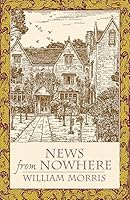

News from Nowhere is a Utopian novel using the common "sleeper wakes" device to portray an ideal society of the future and contrast it with the 19th century. The "sleeper" is author William Morris himself. Following a socialist political meeting he goes to bed in the west London borough of Hammersmith and, for reasons he cannot explain, awakens more than two hundred years in the future. He finds himself in a paradise peopled by beautiful, happy and healthy people. He explains himself as a traveler from distant lands--an explanation the people seem willing to accept even though he betrays a detailed knowledge of London's geography and history.
The pastoral paradise of News from Nowhere is based on pure agrarian communism. There is no private property, no money, no industry, no laws, and practically no government. People meet periodically in councils to make decisions on things like irrigation plans, erecting buildings for community enterprises, and dealing with dangerously insane individuals. But no one has the authority to tell anyone else what to do.
The crux of Morris's Utopia is the notion that people will work simply because they enjoy it, and they will work for the benefit of others as willingly as they work for their own benefit. Artisans make or grow whatever they are best at and bring their goods to market where those who want them will take what they need while the artisans help themselves to the produce of others. Trade exists over longer distances because what some people like to do is drive wagons or sail ships to other regions carrying things they know people will like.
Family life is equally informal. People cohabitate mostly as couples, though group relationships are acceptable. Children are raised mostly by women who simply like to raise children, no matter who the parents may have been. People move about at will, sharing large houses or finding an empty cottage somewhere and simply moving in. There is no system of education. A child or adult who wants to learn to read finds it easy enough to teach him or herself, and there are plenty of books because there are people who choose to employ themselves as printers and bookbinders. With no money or industry, there is no need to learn arithmetic. Morris's pastoral Utopia resembles a romantic view of the Middle Ages, minus Church and State. The people consciously abandoned all technology beyond water and animal power, and in their lives of vigorous contentment they have little need for medical science.
News from Nowhere was written in response to Looking Backward: 2000-1887, a similar "sleeper wakes" Utopian vision by the American socialist, Edward Bellamy. Bellamy describes a highly organized egalitarian and collectivist society based on centralized control of labor. Where Morris's Utopia is rural and shuns technology, Bellamy's is urban and embraces it. In describing how his ideal society developed, Morris says that, following the collapse of capitalism, there was an abortive phase of state socialism (Bellamy's ideal), but centralized management of the economy turned out to be corrupt and inefficient, leading to labor revolt, civil war, a collapse of all institutions and governments, and the emergence of pure communism. Neither of these novels has much of a plot: The narrator wakes up, is shown around, is told how things came to be, and falls in love with a pretty girl. But they are both very readable presentations of contrasting ideological solutions to the social and economic ills of the 19th century.
Doing my own comparison of Looking Backward and News from Nowhere, I would say that the pastoral Utopia of the latter is, on the surface, more appealing. You do what you like, live as you please, and submit to no authority but the gentle social pressure to find a way to contribute to the common good. But it would be impossible to implement on a large scale with today's population levels. We are hopelessly dependent on our organizational and technological infrastructures to keep people fed. It's also doubtful that we could willingly give up modern medicine in favor of the self-taught village healer armed with splints and herbs (though this would go a long way toward addressing the population problem). It also seems that with its dismissive attitude toward education and intellectualism, Morris's Utopia could easily devolve into a more primitive tribal condition vulnerable to mysticism and fear. Once all memory of the past and its lessons had faded, we would just start over as hunter-gatherers and replay the last 6,000 years.
On the other hand, there is no doubt that the state socialism of Looking Backward would work. Properly managed it would end poverty, unemployment, and injustice. It would embrace education and technology and be driven by long term goals like protecting the environment. But "properly managed" is the crux. State socialism concentrates a huge amount of authority into the hands of a few, and history has shown that it is vulnerable to dictatorships like Stalin's and disastrous economic mistakes like Mao's. Still, when you see where capitalism and theocracy are taking us and the planet, Bellamy's vision of universal secular state socialism looks like the only viable and desirable way forward.
One of the things both of these books has in common that makes them worth serious consideration is the complete absence of an underclass. Most, if not all, of the previous Utopias I have read had some kind of underclass to do the dirty work. In some cases they were convicts or prisoners of war, in some (mostly those set on other planets) they were a species of sub-human, and in some cases the underclass were machines. Bellamy solves the problem of the underclass by making everyone do three years of menial labor as soon as they finish college. Morris simply has people want to do it for the joy of using their muscles in the service of others.
Each of these contrasting ideals has been the subject of subsequent novels and films, both as Utopian and Dystopian treatments. I will enjoy tracking the evolution of these visions in my future reading.
First published 1890

News from Nowhere is a Utopian novel using the common "sleeper wakes" device to portray an ideal society of the future and contrast it with the 19th century. The "sleeper" is author William Morris himself. Following a socialist political meeting he goes to bed in the west London borough of Hammersmith and, for reasons he cannot explain, awakens more than two hundred years in the future. He finds himself in a paradise peopled by beautiful, happy and healthy people. He explains himself as a traveler from distant lands--an explanation the people seem willing to accept even though he betrays a detailed knowledge of London's geography and history.
The pastoral paradise of News from Nowhere is based on pure agrarian communism. There is no private property, no money, no industry, no laws, and practically no government. People meet periodically in councils to make decisions on things like irrigation plans, erecting buildings for community enterprises, and dealing with dangerously insane individuals. But no one has the authority to tell anyone else what to do.
The crux of Morris's Utopia is the notion that people will work simply because they enjoy it, and they will work for the benefit of others as willingly as they work for their own benefit. Artisans make or grow whatever they are best at and bring their goods to market where those who want them will take what they need while the artisans help themselves to the produce of others. Trade exists over longer distances because what some people like to do is drive wagons or sail ships to other regions carrying things they know people will like.
Family life is equally informal. People cohabitate mostly as couples, though group relationships are acceptable. Children are raised mostly by women who simply like to raise children, no matter who the parents may have been. People move about at will, sharing large houses or finding an empty cottage somewhere and simply moving in. There is no system of education. A child or adult who wants to learn to read finds it easy enough to teach him or herself, and there are plenty of books because there are people who choose to employ themselves as printers and bookbinders. With no money or industry, there is no need to learn arithmetic. Morris's pastoral Utopia resembles a romantic view of the Middle Ages, minus Church and State. The people consciously abandoned all technology beyond water and animal power, and in their lives of vigorous contentment they have little need for medical science.
News from Nowhere was written in response to Looking Backward: 2000-1887, a similar "sleeper wakes" Utopian vision by the American socialist, Edward Bellamy. Bellamy describes a highly organized egalitarian and collectivist society based on centralized control of labor. Where Morris's Utopia is rural and shuns technology, Bellamy's is urban and embraces it. In describing how his ideal society developed, Morris says that, following the collapse of capitalism, there was an abortive phase of state socialism (Bellamy's ideal), but centralized management of the economy turned out to be corrupt and inefficient, leading to labor revolt, civil war, a collapse of all institutions and governments, and the emergence of pure communism. Neither of these novels has much of a plot: The narrator wakes up, is shown around, is told how things came to be, and falls in love with a pretty girl. But they are both very readable presentations of contrasting ideological solutions to the social and economic ills of the 19th century.
Doing my own comparison of Looking Backward and News from Nowhere, I would say that the pastoral Utopia of the latter is, on the surface, more appealing. You do what you like, live as you please, and submit to no authority but the gentle social pressure to find a way to contribute to the common good. But it would be impossible to implement on a large scale with today's population levels. We are hopelessly dependent on our organizational and technological infrastructures to keep people fed. It's also doubtful that we could willingly give up modern medicine in favor of the self-taught village healer armed with splints and herbs (though this would go a long way toward addressing the population problem). It also seems that with its dismissive attitude toward education and intellectualism, Morris's Utopia could easily devolve into a more primitive tribal condition vulnerable to mysticism and fear. Once all memory of the past and its lessons had faded, we would just start over as hunter-gatherers and replay the last 6,000 years.
On the other hand, there is no doubt that the state socialism of Looking Backward would work. Properly managed it would end poverty, unemployment, and injustice. It would embrace education and technology and be driven by long term goals like protecting the environment. But "properly managed" is the crux. State socialism concentrates a huge amount of authority into the hands of a few, and history has shown that it is vulnerable to dictatorships like Stalin's and disastrous economic mistakes like Mao's. Still, when you see where capitalism and theocracy are taking us and the planet, Bellamy's vision of universal secular state socialism looks like the only viable and desirable way forward.
One of the things both of these books has in common that makes them worth serious consideration is the complete absence of an underclass. Most, if not all, of the previous Utopias I have read had some kind of underclass to do the dirty work. In some cases they were convicts or prisoners of war, in some (mostly those set on other planets) they were a species of sub-human, and in some cases the underclass were machines. Bellamy solves the problem of the underclass by making everyone do three years of menial labor as soon as they finish college. Morris simply has people want to do it for the joy of using their muscles in the service of others.
Each of these contrasting ideals has been the subject of subsequent novels and films, both as Utopian and Dystopian treatments. I will enjoy tracking the evolution of these visions in my future reading.
123dchaikin
I don't know Steven, they seem to both have obvious unsovlable and fundamental fatal flaws. Any workable utopian idea needs to solve both the practical issues and the human element, leaving everything in balance. I don't see how these ideas come anywhere near doing that. They just deny many of the problems.
Of course, enjoyed your review and thoughts.
Of course, enjoyed your review and thoughts.
124baswood
Enjoyed your reviews and comparisons of the two very different Utopias. Like you I would plump for Edward Bellamy's socialist ideal. I think that I could be completely at home in a society like that and its made me want to read Looking Backward.
Looking at Dans post >123 dchaikin: I see the unsolvable and fatal flaws in the Utopias as being human nature itself. While we continue to be acquisitive and competitive it is difficult to see an Utopia evolving as not many people would recognise Utopia if it smacked them in the face. Unfortunately I think we deserve the capitalist society that we have created.
I have a book on my shelf The Faber book of Utopias edited by John Carey which purports to examine writers ideas of Utopia from 800BC until 1998. I have not read it, only dipped into it, but could not recommend it as it seems just to provide a summary of those ideas. Of course Bellamy and Morris are included.
Looking at Dans post >123 dchaikin: I see the unsolvable and fatal flaws in the Utopias as being human nature itself. While we continue to be acquisitive and competitive it is difficult to see an Utopia evolving as not many people would recognise Utopia if it smacked them in the face. Unfortunately I think we deserve the capitalist society that we have created.
I have a book on my shelf The Faber book of Utopias edited by John Carey which purports to examine writers ideas of Utopia from 800BC until 1998. I have not read it, only dipped into it, but could not recommend it as it seems just to provide a summary of those ideas. Of course Bellamy and Morris are included.
125rebeccanyc
Interesting thoughts, and I'm enjoying your reviews of Utopian novels.
126AlisonY
Enjoyed your review of News from Nowhere. I read it about 10 years ago, and thought the idea of a Utopian London was really interesting but totally unachievable. I don't think too many people would volunteer for menial dirty jobs just for the fun of it.
127chlorine
>122 StevenTX: Very interesting review and comparison!
128StevenTX
August Is a Wicked Month by Edna O'Brien
First published 1965


Ellen is a 28-year-old Irish woman living in London. She is divorced and lives with her young son who is leaving to spend a vacation with his father. A brief affair has culminated with a night in bed with a lover, but it will go no further because the man's wife refuses to separate. So Ellen decides on a whim to take advantage of her son's absence and books a room in a hotel on the French Rivera, even though she can barely afford it. Whether she is chiefly looking for romance or sexual adventure is something Ellen probably could not have said, but she is determined to leave motherhood and responsibility behind.
Ellen is so desperate to be loved that she responds to all male advances, ranging from the hotel staff to a locally-famous actor. But either her own inhibitions or her companion's duplicity become an obstacle to the carefree adventure she is seeking. Then, as her mood turns to despair, tragedy strikes, leaving Ellen devastated, betrayed and benumbed.
August Is a Wicked Month is tightly-constructed novel that explores many facets of Ellen's physical desires and emotional needs. When it was first published in 1965 the novel was banned in Ireland and elsewhere because of its sexual frankness. Yet its overall impression is that a focus on sensuality leads to emotional vacuum. The luxurious villa of an aging aristocratic playboy is every bit as sordid as the squeaky, threadbare attic bed of a hotel employee where there is no love, only desire.
First published 1965


Ellen is a 28-year-old Irish woman living in London. She is divorced and lives with her young son who is leaving to spend a vacation with his father. A brief affair has culminated with a night in bed with a lover, but it will go no further because the man's wife refuses to separate. So Ellen decides on a whim to take advantage of her son's absence and books a room in a hotel on the French Rivera, even though she can barely afford it. Whether she is chiefly looking for romance or sexual adventure is something Ellen probably could not have said, but she is determined to leave motherhood and responsibility behind.
Ellen is so desperate to be loved that she responds to all male advances, ranging from the hotel staff to a locally-famous actor. But either her own inhibitions or her companion's duplicity become an obstacle to the carefree adventure she is seeking. Then, as her mood turns to despair, tragedy strikes, leaving Ellen devastated, betrayed and benumbed.
August Is a Wicked Month is tightly-constructed novel that explores many facets of Ellen's physical desires and emotional needs. When it was first published in 1965 the novel was banned in Ireland and elsewhere because of its sexual frankness. Yet its overall impression is that a focus on sensuality leads to emotional vacuum. The luxurious villa of an aging aristocratic playboy is every bit as sordid as the squeaky, threadbare attic bed of a hotel employee where there is no love, only desire.
129NanaCC
>128 StevenTX: Nice review of August is a Wicked Month. I read O'Brien's Wild Decembers last year, and keep meaning to get to August, which I have on my Kindle. Have you read anything else by O'Brien?
130StevenTX
>123 dchaikin:, >126 AlisonY: I'm not sure that Bellamy's solution to labor needs wouldn't work at least as well as what we have now. Capitalism assumes that people will dig ditches and clean toilets because the alternative is starvation. Bellamy, first of all, removes the stigma against manual labor by making everyone do some of it as their first job. Then he compensates the laborer, not with higher pay, but with shorter work hours. He invokes the law of supply and demand only with time instead of money as the medium of exchange. There are probably lots of people who would spend four hours peeling potatoes or mining coal if it meant spending the rest of the day on the golf course--especially if there was no concern about social status or being taken care of once they are no longer physically able to do such work.
The other objection you might raise to Bellamy's Utopia is the absence of incentives. This does seem to have been a problem with the Soviet system, yet when I was working they hammered home to us in one management course and film after another that workers perform for recognition and out of team spirit, not in expectation of higher pay. Whether this is true or not, it is exactly what Bellamy was saying.
>129 NanaCC: Thanks, Colleen. This was my first book by O'Brien. I read it because she has four books on the "1001 Books" list and was one of only two authors remaining who had that many books on the list and whom I had never read. (The other is James Kelman, so I guess he's next.) The others by O'Brien on the 1001 list are: The Country Girls, Girl with Green Eyes, and In the Forest.
The other objection you might raise to Bellamy's Utopia is the absence of incentives. This does seem to have been a problem with the Soviet system, yet when I was working they hammered home to us in one management course and film after another that workers perform for recognition and out of team spirit, not in expectation of higher pay. Whether this is true or not, it is exactly what Bellamy was saying.
>129 NanaCC: Thanks, Colleen. This was my first book by O'Brien. I read it because she has four books on the "1001 Books" list and was one of only two authors remaining who had that many books on the list and whom I had never read. (The other is James Kelman, so I guess he's next.) The others by O'Brien on the 1001 list are: The Country Girls, Girl with Green Eyes, and In the Forest.
131rebeccanyc
>128 StevenTX: I was interested in your review of August Is a Wicked Month because I've had The Country Girls on the TBR for years, and keep meaning to get to it . . .
132baswood
Glad you enjoyed the Edna O'Brien book, another author i would like to read more of if I could find the time.
133dchaikin
I'm not familiar with this book. Very interesting review.
>130 StevenTX: I think I don't have a response. I kind of forgot my thought process, which was very intuitive instead of worked out in language. It's just that people don't act the way they supposed to act. And any society dependent on certain human actions is going to discover that weakness. It's kind of amazing capitalism hasn't collapsed. I guess it works until the resources run out. Or i'm just off base somewhere or too influenced by dystopian literature. (Communism didn't work. Russia failed and China opened up. )
>130 StevenTX: I think I don't have a response. I kind of forgot my thought process, which was very intuitive instead of worked out in language. It's just that people don't act the way they supposed to act. And any society dependent on certain human actions is going to discover that weakness. It's kind of amazing capitalism hasn't collapsed. I guess it works until the resources run out. Or i'm just off base somewhere or too influenced by dystopian literature. (Communism didn't work. Russia failed and China opened up. )
134AlisonY
Ping - there goes August is a Wicked Month onto the wish list. Another author I too have been meaning to get to for ages. Will have to move her up the pile a bit. Nice review.
135LolaWalser
>133 dchaikin:
Do you think capitalism is "working"? How does it ever "work"? Through robbery and exploitation. So, yeah, it "works" from your perspective as long as you're in the West--which, like the nascent United States with slavery (as the founding patriarch Jefferson openly wrote), would never have achieved ascendancy without a totally unscrupulous exploitation of its colonies, including the contemporary neocolonisation through globalisation. It didn't work for the slaves and servants, peasants and workers, and even for the industrial workers in the West it didn't work for long. Where's US industry these days? Stripping in front of webcams and feeding shit to people who can't afford real food. It doesn't "work" for the great mass of humanity, as we have witnessed plentifully over the last decades.
I don't want to disrupt Steven's thread with analysis of the various communisms and socialisms and whether, what and why "failed". But it's so slapdash and vapid to think that "communism" lost! (automatically: capitalism won!) I want to at least mention that there are such things as history and its contingencies of time, place, personalities and events, and the myriad complexities of politics.
There is socialism and communism everywhere, including in the policies of the US. Your economic protectionism is pure communism, as are farm subsidies--and what was bailing out comrade bankers? Some bloody free market at work was that! Obama's health reform is socialistic. Even after the obscene depredations of the neocons, there remain in your system socialist gains and reforms--worker safety, unions, social security, unemployment benefits and so on till the cows come home.
There is no single "recipe" for communism, resulting in single end "Stalin" (nor was Stalin the end of Russian communism, but some minds apparently cannot see beyond the gulags or outside the indoctrination of the Red Scare). It's not A thing, it's a movement toward an egalitarian world, and as such it is obviously something that can never fail.
And it will never disappear, as individual motivator or collective programme, as long as inequality and exploitation obscenely grow.
Do you think capitalism is "working"? How does it ever "work"? Through robbery and exploitation. So, yeah, it "works" from your perspective as long as you're in the West--which, like the nascent United States with slavery (as the founding patriarch Jefferson openly wrote), would never have achieved ascendancy without a totally unscrupulous exploitation of its colonies, including the contemporary neocolonisation through globalisation. It didn't work for the slaves and servants, peasants and workers, and even for the industrial workers in the West it didn't work for long. Where's US industry these days? Stripping in front of webcams and feeding shit to people who can't afford real food. It doesn't "work" for the great mass of humanity, as we have witnessed plentifully over the last decades.
I don't want to disrupt Steven's thread with analysis of the various communisms and socialisms and whether, what and why "failed". But it's so slapdash and vapid to think that "communism" lost! (automatically: capitalism won!) I want to at least mention that there are such things as history and its contingencies of time, place, personalities and events, and the myriad complexities of politics.
There is socialism and communism everywhere, including in the policies of the US. Your economic protectionism is pure communism, as are farm subsidies--and what was bailing out comrade bankers? Some bloody free market at work was that! Obama's health reform is socialistic. Even after the obscene depredations of the neocons, there remain in your system socialist gains and reforms--worker safety, unions, social security, unemployment benefits and so on till the cows come home.
There is no single "recipe" for communism, resulting in single end "Stalin" (nor was Stalin the end of Russian communism, but some minds apparently cannot see beyond the gulags or outside the indoctrination of the Red Scare). It's not A thing, it's a movement toward an egalitarian world, and as such it is obviously something that can never fail.
And it will never disappear, as individual motivator or collective programme, as long as inequality and exploitation obscenely grow.
136dchaikin
>135 LolaWalser: Lola - I have no problems with your post. Working only means the West hasn't collapsed yet. - i mean that is what I meant.
137LolaWalser
>136 dchaikin:
well, I don't mean to blow, and hard, but I gotta wonder just what do you think a collapse would be. Earth opening and flames surging swallowing us one and all?
There are collapses long before that point. You know when the US "collapsed" for me? When I came to New Orleans in September 1992 and saw the first homeless person. The idea that a country could be called rich and a superpower and yet eject mental patients to ramble around or cause people bankruptcies because of medical bills, rubbished the idea of a "winning" capitalist society for me right there.
Eastern Europe and Russia were despoiled more after the fall of communism than in any way before, and, significantly, no regime of theirs dared dismantle completely the "goodies" of communism. If capitalism were such a winning formula this would not be possible.
Here's the thing that is unpopular to point out to capitalist cheerleaders: with all the atrocities, the gulags, the surveillance, the shortages, the drabness and paucity of consumer goods--with all the WORST that happened under various communist systems--with all that there's the fact that they brought UP masses of people that were kept down lower than mud.
The truth is that the middle class, such as LT is awash in, be it said, doesn't give a damn for that. Very few of us care to recall or even know that we are a small minority, that 90% or more of humanity is that huge poor class who doesn't profit from capitalism (actually, even the middle class "profits" from capitalism less and less). For most of history, until the American, French and Soviet revolutions, the huge majority of the people anywhere were disenfranchised, illiterate, exploited muscle. Nothing else, just that. So that's what the Eastern communisms did, their first, fundamental mortal sin--they uplifted those the upper classes regarded as subhuman, disposable, not worth bothering about except to exploit--as they still do.
Who gasps in horror over Soviets partitioning bourgeois apartments to accommodate the proletarians? Not the proletarians.
Sorry for going on, there's so much more to say, but, this is not the place, sorry Steven, I'll delete if you want.
well, I don't mean to blow, and hard, but I gotta wonder just what do you think a collapse would be. Earth opening and flames surging swallowing us one and all?
There are collapses long before that point. You know when the US "collapsed" for me? When I came to New Orleans in September 1992 and saw the first homeless person. The idea that a country could be called rich and a superpower and yet eject mental patients to ramble around or cause people bankruptcies because of medical bills, rubbished the idea of a "winning" capitalist society for me right there.
Eastern Europe and Russia were despoiled more after the fall of communism than in any way before, and, significantly, no regime of theirs dared dismantle completely the "goodies" of communism. If capitalism were such a winning formula this would not be possible.
Here's the thing that is unpopular to point out to capitalist cheerleaders: with all the atrocities, the gulags, the surveillance, the shortages, the drabness and paucity of consumer goods--with all the WORST that happened under various communist systems--with all that there's the fact that they brought UP masses of people that were kept down lower than mud.
The truth is that the middle class, such as LT is awash in, be it said, doesn't give a damn for that. Very few of us care to recall or even know that we are a small minority, that 90% or more of humanity is that huge poor class who doesn't profit from capitalism (actually, even the middle class "profits" from capitalism less and less). For most of history, until the American, French and Soviet revolutions, the huge majority of the people anywhere were disenfranchised, illiterate, exploited muscle. Nothing else, just that. So that's what the Eastern communisms did, their first, fundamental mortal sin--they uplifted those the upper classes regarded as subhuman, disposable, not worth bothering about except to exploit--as they still do.
Who gasps in horror over Soviets partitioning bourgeois apartments to accommodate the proletarians? Not the proletarians.
Sorry for going on, there's so much more to say, but, this is not the place, sorry Steven, I'll delete if you want.
138StevenTX
>137 LolaWalser: Please do not delete anything, Lola. I always enjoy your perspective on things, even if I don't agree with it (though in this case I do). This discussion is highly relevant and shows there is still value in reading the works of Utopian thinkers like Bellamy and Morris. I only wish there were such debates among the populace at large, but we seem ever less inclined to discuss fundamental issues.
139lyzard
I always thought that the basis of capitalism "working" is that it's a survival-of-the-fittest system and therefore it doesn't matter if a certain number of people fall by the wayside; conversely, systems like socialism and communism attempt the impossible task of picking everyone up and therefore "fail" almost by definition.
140dchaikin
>137 LolaWalser: I can't say I agree with everything in that post, but I'm certainly OK you feel that way (I'm a little uncomfortable with the certainty, as that is outside my comprehension this stuff which can be viewed from so many different perspectives) But, I'll leave it to you at this point and try to step out of the conversation. I'm no fan of capitalism and its rat race and its neglect of the commons and of those who get run over, but don't have a handy utopia to argue for.
141LolaWalser
Thanks, Steven... I'll try to keep it short though...
>139 lyzard:
Communism obviously "fails by definition" in the eyes of the fans of capitalism. You have to look at the myths people live by and how they stack up against what reality is forcing us to consider.
And as I pointed out above, how does one judge "failure" or "success" when a so-called capitalist system incorporates communistic principles and inventions? Is China capitalist or communist? Did Roosevelt's New Deal mean that capitalism failed?
>140 dchaikin:
Could you indicate what's the "certainty" you're objecting to, what do you think I'm "certain" about? Seems to me I pointed out perfectly obvious, superficial things, and in fact only somewhat less vaguely than you (it's not easy to address fog on point).
Also, and I can't stress this enough, I'm not "arguing for utopia". I have much more use for Marx than for all the utopians taken together and a cartload of apples. And Marx didn't posit a land of Cockaigne, to be found or founded, some X on the map to get to; he had no patience for utopias at all. He was a historical materialist, concentrating on process, on "what happens", not on wishful thinking or what people WANT to happen. There are no "recipes" for "utopias" in Marx, but a humanistic impulse for justice, the only guarantor of decent life for us all.
Apocalyptic "end of times" thinking serves those who can't countenance change because it endangers their comfort. Since most of us (I mean globally) aren't comfortable, we shall see the waxing and waning of other communist programmes and systems. It is inevitable despite all the capitalist propaganda. How can I put it any simpler? You cannot inflict injustice on people AND expect them not to dream of justice.
>139 lyzard:
Communism obviously "fails by definition" in the eyes of the fans of capitalism. You have to look at the myths people live by and how they stack up against what reality is forcing us to consider.
And as I pointed out above, how does one judge "failure" or "success" when a so-called capitalist system incorporates communistic principles and inventions? Is China capitalist or communist? Did Roosevelt's New Deal mean that capitalism failed?
>140 dchaikin:
Could you indicate what's the "certainty" you're objecting to, what do you think I'm "certain" about? Seems to me I pointed out perfectly obvious, superficial things, and in fact only somewhat less vaguely than you (it's not easy to address fog on point).
Also, and I can't stress this enough, I'm not "arguing for utopia". I have much more use for Marx than for all the utopians taken together and a cartload of apples. And Marx didn't posit a land of Cockaigne, to be found or founded, some X on the map to get to; he had no patience for utopias at all. He was a historical materialist, concentrating on process, on "what happens", not on wishful thinking or what people WANT to happen. There are no "recipes" for "utopias" in Marx, but a humanistic impulse for justice, the only guarantor of decent life for us all.
Apocalyptic "end of times" thinking serves those who can't countenance change because it endangers their comfort. Since most of us (I mean globally) aren't comfortable, we shall see the waxing and waning of other communist programmes and systems. It is inevitable despite all the capitalist propaganda. How can I put it any simpler? You cannot inflict injustice on people AND expect them not to dream of justice.
142dchaikin
I'm not objecting Lola. You are just very confident. I don't have the same confidence. So, I guess it's just striking to me. Sorry for the fog, it's all I've got.
143AlisonY
Very interesting (slightly heated!) debate.
My tuppence - I guess the success of capitalism (or otherwise) depends on how you measure success. If you take solely economic indicators such as GDP and average standards of living, then yes - capitalism has been more successful than communism. However, it clearly can create a much bigger imbalance in social problems, being crueler to the "weaker" (for want of a better word - those who cannot contribute rather than are unwilling to contribute, although lets be fair - we have both in society). Bhutan's Gross National Happiness measure is an interesting concept, and no doubt strong capitalist countries would not necessarily score well on this level. Capitalism offers an unlimited personal advancement opportunity, which is generally fuelled by personal greed and ambition.
Clearly aspects of socialism are also present in modern day capitalist economies (take our NHS system in the UK - available to all regardless of their time or effort in their work).
At an economic level, the facts are that true communism has failed - it has often resulted in poor production, mass poverty and little advancement.
Steven - to your point on Bellamy and incentives, that seems to have been a major missing factor in the economic failure of communist regimes - there is no additional reward for working more than is required, so production has ultimately been affected.
I think most of us would agree that the ideal of equal sharing of wealth and resources between all is a good one, but historically most communist regimes have deteriorated into dictatorships enforced through fear and violence, which again have been fuelled by power and greed.
For me, that's what it comes down to - any economic or social system is ultimately ruined by greed, and until that's out of our DNA it will always be difficult for justice to prevail.
Anyway, enjoyed the discussion on this. It's nice that LT had me musing on political systems rather than watching trash TV...
My tuppence - I guess the success of capitalism (or otherwise) depends on how you measure success. If you take solely economic indicators such as GDP and average standards of living, then yes - capitalism has been more successful than communism. However, it clearly can create a much bigger imbalance in social problems, being crueler to the "weaker" (for want of a better word - those who cannot contribute rather than are unwilling to contribute, although lets be fair - we have both in society). Bhutan's Gross National Happiness measure is an interesting concept, and no doubt strong capitalist countries would not necessarily score well on this level. Capitalism offers an unlimited personal advancement opportunity, which is generally fuelled by personal greed and ambition.
Clearly aspects of socialism are also present in modern day capitalist economies (take our NHS system in the UK - available to all regardless of their time or effort in their work).
At an economic level, the facts are that true communism has failed - it has often resulted in poor production, mass poverty and little advancement.
Steven - to your point on Bellamy and incentives, that seems to have been a major missing factor in the economic failure of communist regimes - there is no additional reward for working more than is required, so production has ultimately been affected.
I think most of us would agree that the ideal of equal sharing of wealth and resources between all is a good one, but historically most communist regimes have deteriorated into dictatorships enforced through fear and violence, which again have been fuelled by power and greed.
For me, that's what it comes down to - any economic or social system is ultimately ruined by greed, and until that's out of our DNA it will always be difficult for justice to prevail.
Anyway, enjoyed the discussion on this. It's nice that LT had me musing on political systems rather than watching trash TV...
144StevenTX
>143 AlisonY: Thanks for your thoughts, Alison. A serious discussion like this now and then is what makes all the reading worthwhile.
Just some thoughts on various points that have been made:
You can't necessarily point to the experience of Russia and China as proof that communism (or socialism or Marxism) inevitably results in a repressive dictatorship and a failing economy. The French Revolution also produced a repressive dictatorship and a failed state. Democratic revolutions failed in France again in 1830 and again in 1848. Liberal democracy failed multiple times in Spain and other countries as well. It took many tries for Europe to finally achieve a stable democracy. In most cases outside intervention played a major role in the failure of communism, socialism, or liberalism just as it did with the French Revolution.
I was raised during the era of Joseph McCarthy and J. Edgar Hoover. We were taught that the opposite of communism was democracy, and that socialism is just another word for communism. The term capitalism rarely came up, but it was assumed to be a necessary precondition for democracy. This nonsense still persists in public opinion, and stands in the way of a serious and open-minded discussion of the fundamental problems with capitalism. There have been a number of democratically elected Marxist and socialist governments that were not dictatorships (only most of them have been sabotaged by the CIA or crushed by the U.S. Marines).
LolaWalser mentioned in her first post that there is socialism everywhere, even in the U.S. Perhaps the biggest example is something that is so widely accepted that we take it for granted: free public education. It was once a radical notion, but is now not only adopted in most of the world, but compulsory in most countries. (The exceptions being those Muslim nations which exclude women.) And it was the communist countries which made the greatest strides in education, taking a nation of illiterate serfs and peasants and achieving literacy rates close to 100% in little more than a generation.
Just some thoughts on various points that have been made:
You can't necessarily point to the experience of Russia and China as proof that communism (or socialism or Marxism) inevitably results in a repressive dictatorship and a failing economy. The French Revolution also produced a repressive dictatorship and a failed state. Democratic revolutions failed in France again in 1830 and again in 1848. Liberal democracy failed multiple times in Spain and other countries as well. It took many tries for Europe to finally achieve a stable democracy. In most cases outside intervention played a major role in the failure of communism, socialism, or liberalism just as it did with the French Revolution.
I was raised during the era of Joseph McCarthy and J. Edgar Hoover. We were taught that the opposite of communism was democracy, and that socialism is just another word for communism. The term capitalism rarely came up, but it was assumed to be a necessary precondition for democracy. This nonsense still persists in public opinion, and stands in the way of a serious and open-minded discussion of the fundamental problems with capitalism. There have been a number of democratically elected Marxist and socialist governments that were not dictatorships (only most of them have been sabotaged by the CIA or crushed by the U.S. Marines).
LolaWalser mentioned in her first post that there is socialism everywhere, even in the U.S. Perhaps the biggest example is something that is so widely accepted that we take it for granted: free public education. It was once a radical notion, but is now not only adopted in most of the world, but compulsory in most countries. (The exceptions being those Muslim nations which exclude women.) And it was the communist countries which made the greatest strides in education, taking a nation of illiterate serfs and peasants and achieving literacy rates close to 100% in little more than a generation.
145AlisonY
Interesting thoughts, Steven. I learn so much from other Club Readers.
I just finished reading The Heart is a Lonely Hunter which also raises as ones of it's themes the "truth" about capitalism. Must be something in the air in our reading at the moment!
I just finished reading The Heart is a Lonely Hunter which also raises as ones of it's themes the "truth" about capitalism. Must be something in the air in our reading at the moment!
146StevenTX
Classical Literary Criticism translated and edited by T. S. Dorsh
"On the Art of Poetry" by Aristotle, late 4th cent BCE
"On the Art of Poetry" by Horace, between 12 and 8 BCE
"On the Sublime" by an unknown author formerly identified as Longinus, 1st cent BCE
English translations from the Greek and Latin 1965

Aristotle was a great collector and classifier of knowledge. His "On the Art of Poetry" (or "Poetics" for short) is a taxonomy of Greek verse, encompassing lyric poetry, epic poetry, tragedy, and comedy. The chapter titles give a good idea of the content of the work. Here is a sampling:
The Origins and Development of Poetry
Unity of Plot
Poetic Truth and Historical Truth
The Main Parts of Tragedy
Poetic Diction
Many of his ideas, terms and principles seem obvious and familiar simply because our way of classifying literature probably derives from Aristotle in the first place. He offers more analysis than opinion, but Aristotle does rank tragedy as the highest of the poetic forms. He has relatively little to say about comedy, and some scholars have theorized that there is a lost second treatise on the topic. (See The Name of the Rose for Umberto Eco's speculation on this.) The "Poetics" is rather dry reading, though Aristotle does gives us a chuckle when he says "Hence poetry is the product either of a man of great natural ability or of one not wholly sane."
Horace's "On the Art of Poetry" (often simply given its Latin title, "Ars Poetica") is a much shorter and less formal work than Aristotle's. Horace meanders through several topics, giving opinions and critiques. He speaks mostly of drama, and more to the art than to the technique. "If you want to move me to tears, you must first feel grief yourself," he advises. But he warns against being overly ambitious, as was the dramatist who proposed to tell the entire story of the Trojan War in a single evening's entertainment: "What will emerge that can live up to such extravagant promises? The mountains will fall into labor, and there will be born - an absurd little mouse."
One of Horace's most remembered (but least followed) pieces of advice is to avoid sensationalism. "Medea must not butcher her children in the presence of the audience," he warns. Horace also says there should be no more than three actors with speaking roles on stage at one time, and that the deus ex machina should be avoided if at all possible. Like Aristotle, Horace pokes fun at what we would now call the Bohemian traits of poets who "...will not take the trouble to trim their nails and their beards; they haunt solitary places and keep away from the public baths. For they will gain the repute and title of poets, they think, if they never submit to the ministrations of the barber..."
"On the Sublime" was formerly attributed to a 3rd century BCE writer named Longinus, but it is now believed to be a later work by an unknown author. The author is still, however, generally referred to as Longinus. Parts of the essay are missing, including the ending, but the bulk of it survives, and still makes for a coherent text. The subject is literary style, not form, and the elusive quality of sublimity which lifts works of genius above the crowd. "For the effect of elevated language is," the author explains, "not to persuade the hearers, but to entrance them."
Sublime writing consists, in many cases, in breaking the rules of language at just the right moment for dramatic effect. The treatise names figures of speech such as "asyndeton," the omission of a conjunction, and "polyptoton," a sudden change in tense, person or number. The author cites many examples from poetry, drama and rhetoric to illustrate his points. He gives examples, not only of sublime language, but of cases where attempts at sublimity misfire. He shows especial reverence for Homer, Sophocles, Plato and Demosthenes, but finds cases where even they stumbled. He also gives us quotes from works which have not survived. Most famously, the unknown author cites the sublime verse of the unknown Jewish lawgiver who wrote "God said, 'Let there be light, and there was light; let there be land, and there was land.'"
Of all the passages quoted by the author of "On the Sublime," none surpasses his own words when, in praise of "those godlike authors," he gives voice to the very essence of what we now consider the spirit of the Greek mind:
"...nature has adjudged us men to be creatures of no mean or ignoble quality. Rather, as though inviting us to some great festival, she has brought us into life, into the whole vast universe, there to be spectators of all that she has created and the keenest aspirants for renown; and thus from the first she has implanted in our souls an unconquerable passion for all that is great and for all that is more divine than ourselves. For this reason the entire universe does not satisfy the contemplation and thought that lie within the scope of human endeavour; our ideas often go beyond the boundaries by which we are circumscribed, and if we look at life from all sides, observing how in everything that concerns us the extraordinary, the great, and the beautiful play the leading part, we shall soon realize the purpose of our creation."
As the three essays in this volume demonstrate, the Greeks and Romans were very much aware of the significance of their literary legacy, both as a craft with rules and techniques, and as an art form that would represent their culture and its values for centuries to come.
"On the Art of Poetry" by Aristotle, late 4th cent BCE
"On the Art of Poetry" by Horace, between 12 and 8 BCE
"On the Sublime" by an unknown author formerly identified as Longinus, 1st cent BCE
English translations from the Greek and Latin 1965

Aristotle was a great collector and classifier of knowledge. His "On the Art of Poetry" (or "Poetics" for short) is a taxonomy of Greek verse, encompassing lyric poetry, epic poetry, tragedy, and comedy. The chapter titles give a good idea of the content of the work. Here is a sampling:
The Origins and Development of Poetry
Unity of Plot
Poetic Truth and Historical Truth
The Main Parts of Tragedy
Poetic Diction
Many of his ideas, terms and principles seem obvious and familiar simply because our way of classifying literature probably derives from Aristotle in the first place. He offers more analysis than opinion, but Aristotle does rank tragedy as the highest of the poetic forms. He has relatively little to say about comedy, and some scholars have theorized that there is a lost second treatise on the topic. (See The Name of the Rose for Umberto Eco's speculation on this.) The "Poetics" is rather dry reading, though Aristotle does gives us a chuckle when he says "Hence poetry is the product either of a man of great natural ability or of one not wholly sane."
Horace's "On the Art of Poetry" (often simply given its Latin title, "Ars Poetica") is a much shorter and less formal work than Aristotle's. Horace meanders through several topics, giving opinions and critiques. He speaks mostly of drama, and more to the art than to the technique. "If you want to move me to tears, you must first feel grief yourself," he advises. But he warns against being overly ambitious, as was the dramatist who proposed to tell the entire story of the Trojan War in a single evening's entertainment: "What will emerge that can live up to such extravagant promises? The mountains will fall into labor, and there will be born - an absurd little mouse."
One of Horace's most remembered (but least followed) pieces of advice is to avoid sensationalism. "Medea must not butcher her children in the presence of the audience," he warns. Horace also says there should be no more than three actors with speaking roles on stage at one time, and that the deus ex machina should be avoided if at all possible. Like Aristotle, Horace pokes fun at what we would now call the Bohemian traits of poets who "...will not take the trouble to trim their nails and their beards; they haunt solitary places and keep away from the public baths. For they will gain the repute and title of poets, they think, if they never submit to the ministrations of the barber..."
"On the Sublime" was formerly attributed to a 3rd century BCE writer named Longinus, but it is now believed to be a later work by an unknown author. The author is still, however, generally referred to as Longinus. Parts of the essay are missing, including the ending, but the bulk of it survives, and still makes for a coherent text. The subject is literary style, not form, and the elusive quality of sublimity which lifts works of genius above the crowd. "For the effect of elevated language is," the author explains, "not to persuade the hearers, but to entrance them."
Sublime writing consists, in many cases, in breaking the rules of language at just the right moment for dramatic effect. The treatise names figures of speech such as "asyndeton," the omission of a conjunction, and "polyptoton," a sudden change in tense, person or number. The author cites many examples from poetry, drama and rhetoric to illustrate his points. He gives examples, not only of sublime language, but of cases where attempts at sublimity misfire. He shows especial reverence for Homer, Sophocles, Plato and Demosthenes, but finds cases where even they stumbled. He also gives us quotes from works which have not survived. Most famously, the unknown author cites the sublime verse of the unknown Jewish lawgiver who wrote "God said, 'Let there be light, and there was light; let there be land, and there was land.'"
Of all the passages quoted by the author of "On the Sublime," none surpasses his own words when, in praise of "those godlike authors," he gives voice to the very essence of what we now consider the spirit of the Greek mind:
"...nature has adjudged us men to be creatures of no mean or ignoble quality. Rather, as though inviting us to some great festival, she has brought us into life, into the whole vast universe, there to be spectators of all that she has created and the keenest aspirants for renown; and thus from the first she has implanted in our souls an unconquerable passion for all that is great and for all that is more divine than ourselves. For this reason the entire universe does not satisfy the contemplation and thought that lie within the scope of human endeavour; our ideas often go beyond the boundaries by which we are circumscribed, and if we look at life from all sides, observing how in everything that concerns us the extraordinary, the great, and the beautiful play the leading part, we shall soon realize the purpose of our creation."
As the three essays in this volume demonstrate, the Greeks and Romans were very much aware of the significance of their literary legacy, both as a craft with rules and techniques, and as an art form that would represent their culture and its values for centuries to come.
147FlorenceArt
Wonderful quote from Longinus!
148dchaikin
yeah, that is quite the quote. I find Aristotle summing up all these still used literary concepts quite fascinating on it's own, regardless of how dry it must read. And nice to seem the impetus behind that bit in The Name of the Rose.
149NanaCC
>146 StevenTX:. Very interesting review of Classical Literary Criticism.
I also enjoyed the discussion re: capitalism and communism. There is always so much to learn on these threads.
I also enjoyed the discussion re: capitalism and communism. There is always so much to learn on these threads.
150StevenTX
A Princess of Mars by Edgar Rice Burroughs
Serialized 1912, first book publication 1914


A Princess of Mars is the archetype of the planetary adventure story, a blend of heroic fantasy and science fiction. The hero and narrator is John Carter of Virginia, a former officer in the Confederate army who has gone prospecting for gold in Arizona. Pursued by Apaches, he takes refuge in a cave where he soon senses a strange, invisible presence. Carter is overcome by sleep. He awakens in full sunlight on a barren plain covered in strange, mossy vegetation. He knows with a certitude he cannot explain that he is on the planet Mars. (He is also stark naked, but that proves to be the least of his problems because no one on Mars ever wears any clothing--a fact which gives a slight erotic edge to the story.)
It isn't long before John Carter encounters his first Martian, a 16-foot tall green giant with four arms, bulging eyes, huge tusks, and a foul temper. But Carter, an accomplished fighter already, discovers that Earth's stronger gravity has given him a strength and leaping ability that makes him more than a match for any single Martian. Once he kills one of their chieftains, the green men make him an honorary member of their tribe. As he masters their simple language, Carter learns that the locals refer to their planet as "Barsoom."
Days later, Carter gets his first glimpse of a Martian more like himself. She is Dejah Thoris, a princess in her own land and a prisoner of the green Martians. Dejah Thoris is an exquisitely perfect human specimen with copper-colored skin and long black hair. It's love at first sight, and the rescue of the princess, in parallel with their sometimes rocky romance, is the core of the story.
Compared to later novels that Burroughs would write, A Princess of Mars has a very simple and straightforward plot. Much of the novel's appeal comes in the setting. The author superbly evokes a dying planet with an ecosystem reduced to a few species. The green men are a degenerate, savage race dwelling in the ruins of great cities. They stable their beasts in palaces filled with magnificent works of art they can neither understand nor appreciate. The red men, always at war with the green men and one another, huddle in walled cities where each house is a fortress. They are users of technology, but dependent for their survival on a science they no longer understand.
As to the science in this work of science fiction, it is better to simply suspend disbelief than to try to make any sense of it. Basic laws of physics are violated left and right. There are small inconsistencies as well. For example, John Carter tells us there are no birds on Mars, yet somehow the green men adorn themselves and their animals profusely with feathers.
The use of feathered headpieces is one of several deliberate parallels between the green Martians and the Indians of the American West. The green Martians are a cruel but proud race with a strong sense of honor and tradition. Their society bears a number of characteristics we might consider Utopian: They have no private property except the ornaments they wear and the weapons they carry. There is no class structure except for the chieftains who have proven their worth in combat. Nor is there any institution of marriage or family. A council of chieftains directs who will mate with whom for the sake of improving the species, and children, to the extent they get any nurturing at all, are the collective responsibility of the community. We don't learn as much about red Martian society except that it is an hereditary monarchy, but the red and green Martians each learn to tolerate and cooperate with the other, which helps make A Princess of Mars an uplifting tale as well as an exciting adventure story.

Edgar Rice Burroughs' Barsoom series has been the subject of many paintings. Despite the author's detailed descriptions, most art work only approximates the scenes in the novel. These are two of the better ones. The first painting, by Fortunino Matania, accurately shows how the Martians adorned their otherwise naked bodies and perfectly recreates the abandoned city in which Dejah Thoris is being held captive by the green Martians. But Dejah Thoris's skin and hair should be darker, the skin a "light reddish copper" and the hair "a mass of coal black," and her captors should be closer in color to olive green. The latters' eyes, moreover, should be on the side of the head, not the front
The second painting, by Michael Whelan, is the most convincing I've seen insofar as the coloration and visage of the green Martians is concerned. You don't get a proper sense of their size, however. The males are up to 16 feet tall, the females somewhat smaller.
Looking at these paintings does bring up some questions with regard to the text. For example, there is mention of a pair of renegade green Martians kissing. With those tusks it's difficult to imagine how this might be safely accomplished.
Serialized 1912, first book publication 1914


A Princess of Mars is the archetype of the planetary adventure story, a blend of heroic fantasy and science fiction. The hero and narrator is John Carter of Virginia, a former officer in the Confederate army who has gone prospecting for gold in Arizona. Pursued by Apaches, he takes refuge in a cave where he soon senses a strange, invisible presence. Carter is overcome by sleep. He awakens in full sunlight on a barren plain covered in strange, mossy vegetation. He knows with a certitude he cannot explain that he is on the planet Mars. (He is also stark naked, but that proves to be the least of his problems because no one on Mars ever wears any clothing--a fact which gives a slight erotic edge to the story.)
It isn't long before John Carter encounters his first Martian, a 16-foot tall green giant with four arms, bulging eyes, huge tusks, and a foul temper. But Carter, an accomplished fighter already, discovers that Earth's stronger gravity has given him a strength and leaping ability that makes him more than a match for any single Martian. Once he kills one of their chieftains, the green men make him an honorary member of their tribe. As he masters their simple language, Carter learns that the locals refer to their planet as "Barsoom."
Days later, Carter gets his first glimpse of a Martian more like himself. She is Dejah Thoris, a princess in her own land and a prisoner of the green Martians. Dejah Thoris is an exquisitely perfect human specimen with copper-colored skin and long black hair. It's love at first sight, and the rescue of the princess, in parallel with their sometimes rocky romance, is the core of the story.
Compared to later novels that Burroughs would write, A Princess of Mars has a very simple and straightforward plot. Much of the novel's appeal comes in the setting. The author superbly evokes a dying planet with an ecosystem reduced to a few species. The green men are a degenerate, savage race dwelling in the ruins of great cities. They stable their beasts in palaces filled with magnificent works of art they can neither understand nor appreciate. The red men, always at war with the green men and one another, huddle in walled cities where each house is a fortress. They are users of technology, but dependent for their survival on a science they no longer understand.
As to the science in this work of science fiction, it is better to simply suspend disbelief than to try to make any sense of it. Basic laws of physics are violated left and right. There are small inconsistencies as well. For example, John Carter tells us there are no birds on Mars, yet somehow the green men adorn themselves and their animals profusely with feathers.
The use of feathered headpieces is one of several deliberate parallels between the green Martians and the Indians of the American West. The green Martians are a cruel but proud race with a strong sense of honor and tradition. Their society bears a number of characteristics we might consider Utopian: They have no private property except the ornaments they wear and the weapons they carry. There is no class structure except for the chieftains who have proven their worth in combat. Nor is there any institution of marriage or family. A council of chieftains directs who will mate with whom for the sake of improving the species, and children, to the extent they get any nurturing at all, are the collective responsibility of the community. We don't learn as much about red Martian society except that it is an hereditary monarchy, but the red and green Martians each learn to tolerate and cooperate with the other, which helps make A Princess of Mars an uplifting tale as well as an exciting adventure story.

Edgar Rice Burroughs' Barsoom series has been the subject of many paintings. Despite the author's detailed descriptions, most art work only approximates the scenes in the novel. These are two of the better ones. The first painting, by Fortunino Matania, accurately shows how the Martians adorned their otherwise naked bodies and perfectly recreates the abandoned city in which Dejah Thoris is being held captive by the green Martians. But Dejah Thoris's skin and hair should be darker, the skin a "light reddish copper" and the hair "a mass of coal black," and her captors should be closer in color to olive green. The latters' eyes, moreover, should be on the side of the head, not the front
The second painting, by Michael Whelan, is the most convincing I've seen insofar as the coloration and visage of the green Martians is concerned. You don't get a proper sense of their size, however. The males are up to 16 feet tall, the females somewhat smaller.
Looking at these paintings does bring up some questions with regard to the text. For example, there is mention of a pair of renegade green Martians kissing. With those tusks it's difficult to imagine how this might be safely accomplished.
151baswood
Enjoyed reading about A Princess of Mars It's on my reading list.
152Nickelini
>150 StevenTX: Wow, that's some awesome art. Conjures up all sorts of 1960s and early 70s memories from my childhood and some really bad movies.
153StevenTX
War of Honor by David Weber
First published 2002
10th novel in the "Honor Harrington" series
I read the first nine novels in this series in the 1990s when they were first published. It's a very popular space opera modeled after the Horatio Hornblower novels of C. S. Forester (one of many such imitations in various genres and settings). My reading interests took me in other directions for a while, and the lapse of time definitely interfered with my enjoyment of this installment. The focus is more on political and diplomatic intrigue and less on the primary character and her military career, so a fresher memory of the events and characters of the previous nine volumes would have helped me appreciate the seemingly endless scenes of dinner table discussions and political debates.
To reinforce the series's Hornblower heritage, I suppose, the author has chosen to model the contending interstellar nations, their political structures, and their military infrastructure and traditions after those of the era of the French Revolution and Napoleonic Wars, with a heavy dose of Cold War thrown in as well. At times I thought: Why not just read 800+ pages of history and come away actually knowing something worthwhile? There was just enough suspense and action to keep me going, but for escapist fiction that does little more than paraphrase the past, War of Honor should have been more entertaining than it was.
First published 2002
10th novel in the "Honor Harrington" series
I read the first nine novels in this series in the 1990s when they were first published. It's a very popular space opera modeled after the Horatio Hornblower novels of C. S. Forester (one of many such imitations in various genres and settings). My reading interests took me in other directions for a while, and the lapse of time definitely interfered with my enjoyment of this installment. The focus is more on political and diplomatic intrigue and less on the primary character and her military career, so a fresher memory of the events and characters of the previous nine volumes would have helped me appreciate the seemingly endless scenes of dinner table discussions and political debates.
To reinforce the series's Hornblower heritage, I suppose, the author has chosen to model the contending interstellar nations, their political structures, and their military infrastructure and traditions after those of the era of the French Revolution and Napoleonic Wars, with a heavy dose of Cold War thrown in as well. At times I thought: Why not just read 800+ pages of history and come away actually knowing something worthwhile? There was just enough suspense and action to keep me going, but for escapist fiction that does little more than paraphrase the past, War of Honor should have been more entertaining than it was.
154LolaWalser
At times I thought: Why not just read 800+ pages of history and come away actually knowing something worthwhile?
Ha! Exactly how I feel most of the time when it comes to fiction (apparently very common in fantasy/space opera) "inspired" by true history. Why bother with sloppy secondhand versions of, say, Renaissance diplomacy etc. and not the infinitely richer real thing? Actual historical fiction is often better too than the "transplanted plot" variety.
Ha! Exactly how I feel most of the time when it comes to fiction (apparently very common in fantasy/space opera) "inspired" by true history. Why bother with sloppy secondhand versions of, say, Renaissance diplomacy etc. and not the infinitely richer real thing? Actual historical fiction is often better too than the "transplanted plot" variety.
155StevenTX
>154 LolaWalser: Actual historical fiction is often better too than the "transplanted plot" variety.
Yes, I just commented on Poquette's thread a couple of days ago that the educational value of good historical fiction is often overlooked. There have been several times in my reading life where a good historical novel inspired me to do years of follow-up reading on a period of history and gave me enough of an introduction to appreciate what I was reading.
Yes, I just commented on Poquette's thread a couple of days ago that the educational value of good historical fiction is often overlooked. There have been several times in my reading life where a good historical novel inspired me to do years of follow-up reading on a period of history and gave me enough of an introduction to appreciate what I was reading.
156StevenTX
The Ubu Plays by Alfred Jarry
Ubu Rex, first performed 1896, translated by Cyril Connelly and Simon Watson Taylor 1968
Ubu Cuckolded, first performed 1944, translated by Cyril Connelly 1965
Ubu Enchained, first performed 1937, translated by Simon Watson Taylor 1968

At age fifteen, Alfred Jarry wrote what would become "Ubu Roi" (tranlated as "Ubu Rex") to lampoon his physics teacher. After the young Frenchman had earned some success in publishing other works, he modified the play for the marionette theater. He revised it further for live stage, and, on December 10, 1896, the then 23-year-old playwright put on his first performance of "Ubu Roi." According to the translator, Simon Watson Taylor, there ensued "scenes of violence and pandemonium" among the audience. "The theatre critics took over the battle from the screaming, whistling, fist-shaking audience the following day, and continued the duel of insults from the pages of their newspapers, while in the cafés and salons of Paris the mutual recriminations between supporters and opponents of the play raged unabated for weeks." Jarry was an overnight sensation, but never a financial success. Poverty and tuberculosis, compounded by drugs and drink, would lead to his death just a decade later.
"Ubu Rex" is a parody of Shakespeare's "Macbeth." The anti-heroic title character begins the play as a captain and aide-de-camp serving under King Wenceslas of Poland. As long as he has plenty to eat and drink, Ubu is content with his lot, but Ma Ubu reminds her husband that he was once King of Aragon, and he can become a king again simply by assassinating Wenceslas and his three sons, Boleslas, Ladislas, and Boggerlas. Ma Ubu works on Pa Ubu's greed until he gives in. With his supporter, Captain M'Nure, and his three henchmen, the Palcontents, Ubu stages a revolt. He kills all but Boggerlas who escapes and takes refuge with the Czar of Russia. Ubu then goes on a rampage of brutality and extortion, causing M'Nure to change sides and accompany Boggerlas in an invasion of Poland at the head of the Czar's armies.
"Ubu Cuckolded" finds ex-King Ubu in Paris accompanied by his wife and a new trio of Palcontents. Ubu now carries his Conscience in a suitcase so he can listen to it only when he wants to. He storms the house of Achras, a collector of polyhedra, and announces that he is bestowing his presence upon the owner. He and his henchmen then descend upon Paris, robbing, assaulting and defrauding the populace. Meanwhile Ubu learns that Ma Ubu has been unfaithful to him with an Egyptian named Memnon. The action in this play is rather haphazard, and much of the sophomoric humor is scatological. (A toilet is a central piece of furniture in the principal setting.) There are also some debrainings, splitting of bodies in half, burnings, and an impalement--all of which must be a challenge to stage.
"Ubu Enchained" has the clearest and most serious theme of the three plays. Pa and Ma Ubu are still in France where everyone is equal and everyone is free. We meet Corporal Pissweet who commands a squad of three Free Men. They are free to obey him or not and to do what they choose, so he commands them by telling them to do the opposite of what he wants. "Fall out" and they come to attention, "march left" and they march right. But Ubu has decided that in the land of the free and equal the only truly free man is a slave. After several adventures, he manages to get himself thrown into prison where he doesn't have to work, is protected by stout walls and bars, has a doorman to keep out unwanted visitors, gets three meals a day, and enjoys a nice damp straw bed and plenty of multi-legged companions. The only thing that would be nicer would be to serve the Sultan of Turkey as a galley slave.
Jarry's writing was as creative as it was bold. He invented some words and modified others. "Ubu Rex" opens, in the original French, with the solitary exclamation "Merdre!," which is a variant of the expletive "merde" (shit). Translators Connelly and Taylor have chosen to render "merdre" as "pschitt." Similar challenges will ensure that no two translations of the Ubu plays will read alike. I haven't read any other translations, but this one certainly captures the idea of stepping outside the bounds of convention in language as well as action.
Pa Ubu writes his own epigraph to the final play of the trilogy: "Hornstrumpot! We shall not have succeeded in demolishing everything unless we have demolished the ruins as well. But the only way I can see of doing this is to use them to put up a lot of fine, well-designed buildings." The Ubu Plays give us a character who rejects every law, code, and convention. He is repulsive, amoral, completely selfish, fiendishly inventive, and thoroughly funny. These plays are not for everyone, but they are avant-garde theater at its best, defying the rules of language, style, and decorum while showing us a character who challenges everything we call civilization.

Jarry's own depiction of Ubu. The item in is pocket is a toilet brush.
Other works I have read by Alfred Jarry:
The Supermale
Ubu Rex, first performed 1896, translated by Cyril Connelly and Simon Watson Taylor 1968
Ubu Cuckolded, first performed 1944, translated by Cyril Connelly 1965
Ubu Enchained, first performed 1937, translated by Simon Watson Taylor 1968

At age fifteen, Alfred Jarry wrote what would become "Ubu Roi" (tranlated as "Ubu Rex") to lampoon his physics teacher. After the young Frenchman had earned some success in publishing other works, he modified the play for the marionette theater. He revised it further for live stage, and, on December 10, 1896, the then 23-year-old playwright put on his first performance of "Ubu Roi." According to the translator, Simon Watson Taylor, there ensued "scenes of violence and pandemonium" among the audience. "The theatre critics took over the battle from the screaming, whistling, fist-shaking audience the following day, and continued the duel of insults from the pages of their newspapers, while in the cafés and salons of Paris the mutual recriminations between supporters and opponents of the play raged unabated for weeks." Jarry was an overnight sensation, but never a financial success. Poverty and tuberculosis, compounded by drugs and drink, would lead to his death just a decade later.
"Ubu Rex" is a parody of Shakespeare's "Macbeth." The anti-heroic title character begins the play as a captain and aide-de-camp serving under King Wenceslas of Poland. As long as he has plenty to eat and drink, Ubu is content with his lot, but Ma Ubu reminds her husband that he was once King of Aragon, and he can become a king again simply by assassinating Wenceslas and his three sons, Boleslas, Ladislas, and Boggerlas. Ma Ubu works on Pa Ubu's greed until he gives in. With his supporter, Captain M'Nure, and his three henchmen, the Palcontents, Ubu stages a revolt. He kills all but Boggerlas who escapes and takes refuge with the Czar of Russia. Ubu then goes on a rampage of brutality and extortion, causing M'Nure to change sides and accompany Boggerlas in an invasion of Poland at the head of the Czar's armies.
"Ubu Cuckolded" finds ex-King Ubu in Paris accompanied by his wife and a new trio of Palcontents. Ubu now carries his Conscience in a suitcase so he can listen to it only when he wants to. He storms the house of Achras, a collector of polyhedra, and announces that he is bestowing his presence upon the owner. He and his henchmen then descend upon Paris, robbing, assaulting and defrauding the populace. Meanwhile Ubu learns that Ma Ubu has been unfaithful to him with an Egyptian named Memnon. The action in this play is rather haphazard, and much of the sophomoric humor is scatological. (A toilet is a central piece of furniture in the principal setting.) There are also some debrainings, splitting of bodies in half, burnings, and an impalement--all of which must be a challenge to stage.
"Ubu Enchained" has the clearest and most serious theme of the three plays. Pa and Ma Ubu are still in France where everyone is equal and everyone is free. We meet Corporal Pissweet who commands a squad of three Free Men. They are free to obey him or not and to do what they choose, so he commands them by telling them to do the opposite of what he wants. "Fall out" and they come to attention, "march left" and they march right. But Ubu has decided that in the land of the free and equal the only truly free man is a slave. After several adventures, he manages to get himself thrown into prison where he doesn't have to work, is protected by stout walls and bars, has a doorman to keep out unwanted visitors, gets three meals a day, and enjoys a nice damp straw bed and plenty of multi-legged companions. The only thing that would be nicer would be to serve the Sultan of Turkey as a galley slave.
Jarry's writing was as creative as it was bold. He invented some words and modified others. "Ubu Rex" opens, in the original French, with the solitary exclamation "Merdre!," which is a variant of the expletive "merde" (shit). Translators Connelly and Taylor have chosen to render "merdre" as "pschitt." Similar challenges will ensure that no two translations of the Ubu plays will read alike. I haven't read any other translations, but this one certainly captures the idea of stepping outside the bounds of convention in language as well as action.
Pa Ubu writes his own epigraph to the final play of the trilogy: "Hornstrumpot! We shall not have succeeded in demolishing everything unless we have demolished the ruins as well. But the only way I can see of doing this is to use them to put up a lot of fine, well-designed buildings." The Ubu Plays give us a character who rejects every law, code, and convention. He is repulsive, amoral, completely selfish, fiendishly inventive, and thoroughly funny. These plays are not for everyone, but they are avant-garde theater at its best, defying the rules of language, style, and decorum while showing us a character who challenges everything we call civilization.

Jarry's own depiction of Ubu. The item in is pocket is a toilet brush.
Other works I have read by Alfred Jarry:
The Supermale
157baswood
Great review of The Ubu plays I have come across excerpts from the and often wondered what they would be like to read. Now I know thanks to your review.
158StevenTX
Idylls by Theocritus
Written in Greek first half of the 3rd century BCE
English translation by Anthony Verity 2002
The constant task of the daughters of Zeus, and of poets,
Is to celebrate in song the immortals and the glorious
Deeds of heroes. Muses are goddesses and therefore sing of gods;
We on earth are mortal, so let us sing of mortal men.
Theocritus of Syracuse did, indeed, sing of mortal men. He is credited with introducing a form of verse known as "bucolic," literally poems of ox-herders. But there is great variety in this all-too-short collection of his surviving verse. There are, indeed, poems about herdsmen. There are also poems about women, lovers, heroes, rulers, demigods, and a lovesick cyclops. There are scenes of romance, adventure, combat, sports, murder, divine mischief, storms at sea, and serene landscapes.
Theocritus was well-traveled, and his verse abounds with description of pastoral and natural scenes ranging from the rocky hills of Sicily to the fertile shores of Cos. He lived during the time known as "Hellenistic" when the heirs of Alexander were ruling the Greek world. His work reflects the dominance of the Ptolemies, rulers of Egypt, and the growing influence of Egyptian culture. His poems also reflect a world grown more literate and educated and a people accustomed to trade with faraway lands like Syria and Carthage.
There are several poems in the bucolic form, each with the same general structure. A pair of herdsmen--they may be free men or slaves--meets in the fields or on the road to market. They share news of the day, often including the status of their respective love affairs. But the conversation inevitably comes around to poetry, and each proposes to outdo the other in a contest of song. So each bucolic idyll really contains three stories: that of the meeting of the herdsmen and the songs they each sing. These songs may be on mythological themes, or they may be legends about the love affairs of other shepherds and ox-herds.
One of the most entertaining poems--and one very different from all the others--is the hysterical lament of a young woman named Simaetha. The poem is titled "The Sorceress" because Simaetha is trying to concoct a love charm to bring back her lover Delphis. Or to destroy him--Simaetha isn't sure from one moment to the next what she wants to do. It all started when she saw Delphis coming out of wrestling class, his body glistening with oil and his face flushed with exercise. She hoped he would notice her, but he did not. So, boldy, she invited him to her home.
...As soon as I saw him
Stepping lightly across the threshold at my door
From head to foot I became colder than snow,
And sweat like watery dew dripped from my brow.
I couldn't utter a sound, not so much as the whimper
That babies make, calling in sleep to their mothers.
My whole body went rigid and stiff as a doll's.
Delphis sees the way things stand and seizes the opportunity. He tells Simaetha he was planning anyway to come visit her "just as night fell." Simaetha falls for it:
This is what he said. And I, poor gullible creature,
Took his hand and pulled him down on to my soft bed.
Quickly flesh grew warm against flesh, and our faces
Became flushed with heat. We whispered sweet nothings.
There is no need to prolong the tale, dear Moon:
We went to the very end, and both fulfilled our desires.
The collection includes stories of homoerotic love as well. Most notably we see that bisexuality was a common feature at all levels of Greek culture, not just an affectation of the elite as some would prefer to believe. The ox-herds and shepherds, even those who are slaves, mention male lovers as often as they do female. There is also a reference to an annual contest at the tomb of Diocles, an Athenian hero:
Every year at the start of spring young men gather
Around his tomb and compete for a prize in kissing.
The one who plants the sweetest kisses, lip on lip,
Goes home to his mother bowed with the weight of garlands.
Happy the man chosen to judge these boys' kisses!
The final poem in the collection is also about homoerotic love. It is a beautiful and poignant statement about a man who can't accept that at his age he should give up love. Having fallen in love with a boy, he looks into the mirror and asks himself:
Not again! What are you doing? Is there no end to your idiocy?
You should remember that the hair on your head is white, and it's
High time to learn some sense. Your youthful looks have gone; don't
Behave as if you were tasting the pleasures of life for the first time.
But his heart talks back to him and tells him that all his logic is in vain:
If you believe you can master ingenious Love, you must also believe
That counting the myriad stars above your head is an easy task.
That is why now, whether I like it or not, I must stretch out my neck
And strain against the yoke. Such, my friend, is the will of the god who
Deceived even the powerful mind of Zeus, and the lady of Cyprus herself.
With one breath he lifts me up and quickly whisks me away, like a
Leaf that is stirred by light winds and lives only for a day.
The passages I have quoted above are ample evidence of the beauty and fluidity of the verse translations by Anthony Verity in the Oxford World's Classics edition. The introduction by Richard Hunter is rather stiff and scholarly for a general reader such as myself, but his endnotes are extremely useful. (I just wish the publisher had made them footnotes instead of endnote, because there are often as many as ten per page.)
The Idylls of Theocritus have given me a better picture than anything I have read to date of the lives of ordinary Greeks. They were lives filled with the ordinary cares of making a living and impressing a lover, but they were also lives that were enriched by music, poetry, and an awareness of their history and cultural heritage. I highly recommend this collection.

Written in Greek first half of the 3rd century BCE
English translation by Anthony Verity 2002
The constant task of the daughters of Zeus, and of poets,
Is to celebrate in song the immortals and the glorious
Deeds of heroes. Muses are goddesses and therefore sing of gods;
We on earth are mortal, so let us sing of mortal men.
Theocritus of Syracuse did, indeed, sing of mortal men. He is credited with introducing a form of verse known as "bucolic," literally poems of ox-herders. But there is great variety in this all-too-short collection of his surviving verse. There are, indeed, poems about herdsmen. There are also poems about women, lovers, heroes, rulers, demigods, and a lovesick cyclops. There are scenes of romance, adventure, combat, sports, murder, divine mischief, storms at sea, and serene landscapes.
Theocritus was well-traveled, and his verse abounds with description of pastoral and natural scenes ranging from the rocky hills of Sicily to the fertile shores of Cos. He lived during the time known as "Hellenistic" when the heirs of Alexander were ruling the Greek world. His work reflects the dominance of the Ptolemies, rulers of Egypt, and the growing influence of Egyptian culture. His poems also reflect a world grown more literate and educated and a people accustomed to trade with faraway lands like Syria and Carthage.
There are several poems in the bucolic form, each with the same general structure. A pair of herdsmen--they may be free men or slaves--meets in the fields or on the road to market. They share news of the day, often including the status of their respective love affairs. But the conversation inevitably comes around to poetry, and each proposes to outdo the other in a contest of song. So each bucolic idyll really contains three stories: that of the meeting of the herdsmen and the songs they each sing. These songs may be on mythological themes, or they may be legends about the love affairs of other shepherds and ox-herds.
One of the most entertaining poems--and one very different from all the others--is the hysterical lament of a young woman named Simaetha. The poem is titled "The Sorceress" because Simaetha is trying to concoct a love charm to bring back her lover Delphis. Or to destroy him--Simaetha isn't sure from one moment to the next what she wants to do. It all started when she saw Delphis coming out of wrestling class, his body glistening with oil and his face flushed with exercise. She hoped he would notice her, but he did not. So, boldy, she invited him to her home.
...As soon as I saw him
Stepping lightly across the threshold at my door
From head to foot I became colder than snow,
And sweat like watery dew dripped from my brow.
I couldn't utter a sound, not so much as the whimper
That babies make, calling in sleep to their mothers.
My whole body went rigid and stiff as a doll's.
Delphis sees the way things stand and seizes the opportunity. He tells Simaetha he was planning anyway to come visit her "just as night fell." Simaetha falls for it:
This is what he said. And I, poor gullible creature,
Took his hand and pulled him down on to my soft bed.
Quickly flesh grew warm against flesh, and our faces
Became flushed with heat. We whispered sweet nothings.
There is no need to prolong the tale, dear Moon:
We went to the very end, and both fulfilled our desires.
The collection includes stories of homoerotic love as well. Most notably we see that bisexuality was a common feature at all levels of Greek culture, not just an affectation of the elite as some would prefer to believe. The ox-herds and shepherds, even those who are slaves, mention male lovers as often as they do female. There is also a reference to an annual contest at the tomb of Diocles, an Athenian hero:
Every year at the start of spring young men gather
Around his tomb and compete for a prize in kissing.
The one who plants the sweetest kisses, lip on lip,
Goes home to his mother bowed with the weight of garlands.
Happy the man chosen to judge these boys' kisses!
The final poem in the collection is also about homoerotic love. It is a beautiful and poignant statement about a man who can't accept that at his age he should give up love. Having fallen in love with a boy, he looks into the mirror and asks himself:
Not again! What are you doing? Is there no end to your idiocy?
You should remember that the hair on your head is white, and it's
High time to learn some sense. Your youthful looks have gone; don't
Behave as if you were tasting the pleasures of life for the first time.
But his heart talks back to him and tells him that all his logic is in vain:
If you believe you can master ingenious Love, you must also believe
That counting the myriad stars above your head is an easy task.
That is why now, whether I like it or not, I must stretch out my neck
And strain against the yoke. Such, my friend, is the will of the god who
Deceived even the powerful mind of Zeus, and the lady of Cyprus herself.
With one breath he lifts me up and quickly whisks me away, like a
Leaf that is stirred by light winds and lives only for a day.
The passages I have quoted above are ample evidence of the beauty and fluidity of the verse translations by Anthony Verity in the Oxford World's Classics edition. The introduction by Richard Hunter is rather stiff and scholarly for a general reader such as myself, but his endnotes are extremely useful. (I just wish the publisher had made them footnotes instead of endnote, because there are often as many as ten per page.)
The Idylls of Theocritus have given me a better picture than anything I have read to date of the lives of ordinary Greeks. They were lives filled with the ordinary cares of making a living and impressing a lover, but they were also lives that were enriched by music, poetry, and an awareness of their history and cultural heritage. I highly recommend this collection.

159ursula
>156 StevenTX: Interesting. I just realized this must be where the musical group Pere Ubu got their name (and Wikipedia confirms it).
160FlorenceArt
>158 StevenTX: The Idylls of Theocritus have given me a better picture than anything I have read to date of the lives of ordinary Greeks. They were lives filled with the ordinary cares of making a living and impressing a lover, but they were also lives that were enriched by music, poetry, and an awareness of their history and cultural heritage.
Fascinating!
Fascinating!
161rebeccanyc
Just catching up with your varied and always interesting reading.
162baswood
Theocritus; Idylls sounds like a real eye opener to understanding more about life in 3rd century BCE. Enjoyed your review.
163AlisonY
Excellent reviews, Steven. I think reading these kind of books would make my brain ache too much, but you do a great job of summarising the best points.
164dchaikin
Enjoyed your reviews of the Ubu plays and Theocritus, and the especially the samples of Theocritus.
165StevenTX
The Eustace Diamonds by Anthony Trollope
First published 1872
There have been several excellent reviews of The Eustace Diamonds posted on LT recently, so I will dispense with summarizing the plot of this novel, the third in Trollope's "Palliser" series. I found it to be very enjoyable, if a bit slow at times, and peopled with the usual insightful and believable cast of Trollope characters.
Some reviewers have remarked that there are few very likable characters in the novel. Trollope himself is often very harsh in the judgments he passes on his heroine, Lizzie Eustace. I found Lizzie more appealing than not. She is very young, still, and in need of a guiding hand, but she knows this as well as anyone. It is her misfortune that all the men in her life think of her only as a beautiful face appended to an income of £4,000. Of course Lizzie, herself, married Sir Florian Eustace for his money, so in her widowhood she should expect her suitors to be just as mercenary as she was.
The theme of marriage and inheritance dominates 19th century English literature, and The Eustace Diamonds is certainly no exception. Trollope writes, as usual, with particular sympathy to the woman's predicament when it comes to money and marriage. A woman with money will lose control of it when she marries, so it behooves her to marry a man with a title so she at least gets something in return for her wealth. This is what Glencora Palliser has done (albeit reluctantly) in Can You Forgive Her?, and it is what Lizzie Eustace attempts to do with her engagement to Lord Fawn.
One of the benefits of reading the Palliser series is that I am finally beginning to understand what the sport of fox hunting is all about. Though it's cruel to the foxes, the horses, and the farmers whose crops get trampled, there is no denying that Trollope's description made the hunting scenes very thrilling and suspenseful.
Another aspect to the novel is that it is a rudimentary detective story. Trollope seems to downplay that aspect of the novel, revealing secrets long before Scotland Yard has learned them, but it is interesting to see that the case of the stolen diamonds is largely solved by giving immunity to the lesser criminals in order to catch the greater ones.
I don't need to recommend The Eustace Diamonds to anyone who has read the first two installments of "Palliser." You know what to expect from Anthony Trollope. This is a novel that could stand on its own and be read out of sequence, but I see no reason to do so.
First published 1872
There have been several excellent reviews of The Eustace Diamonds posted on LT recently, so I will dispense with summarizing the plot of this novel, the third in Trollope's "Palliser" series. I found it to be very enjoyable, if a bit slow at times, and peopled with the usual insightful and believable cast of Trollope characters.
Some reviewers have remarked that there are few very likable characters in the novel. Trollope himself is often very harsh in the judgments he passes on his heroine, Lizzie Eustace. I found Lizzie more appealing than not. She is very young, still, and in need of a guiding hand, but she knows this as well as anyone. It is her misfortune that all the men in her life think of her only as a beautiful face appended to an income of £4,000. Of course Lizzie, herself, married Sir Florian Eustace for his money, so in her widowhood she should expect her suitors to be just as mercenary as she was.
The theme of marriage and inheritance dominates 19th century English literature, and The Eustace Diamonds is certainly no exception. Trollope writes, as usual, with particular sympathy to the woman's predicament when it comes to money and marriage. A woman with money will lose control of it when she marries, so it behooves her to marry a man with a title so she at least gets something in return for her wealth. This is what Glencora Palliser has done (albeit reluctantly) in Can You Forgive Her?, and it is what Lizzie Eustace attempts to do with her engagement to Lord Fawn.
One of the benefits of reading the Palliser series is that I am finally beginning to understand what the sport of fox hunting is all about. Though it's cruel to the foxes, the horses, and the farmers whose crops get trampled, there is no denying that Trollope's description made the hunting scenes very thrilling and suspenseful.
Another aspect to the novel is that it is a rudimentary detective story. Trollope seems to downplay that aspect of the novel, revealing secrets long before Scotland Yard has learned them, but it is interesting to see that the case of the stolen diamonds is largely solved by giving immunity to the lesser criminals in order to catch the greater ones.
I don't need to recommend The Eustace Diamonds to anyone who has read the first two installments of "Palliser." You know what to expect from Anthony Trollope. This is a novel that could stand on its own and be read out of sequence, but I see no reason to do so.
166NanaCC
>165 StevenTX: I'm looking forward to starting the Pallisers series next year. All of the reviews, including yours, sound so good. I'm about to read the last of the Barsetshire series later this month. It has been an enjoyable journey.
167rebeccanyc
Nice review of The Eustace Diamonds, which I also enjoyed, although I didn't like Lizzie as much as you apparently did.
168StevenTX
The Mysterious Island by Jules Verne
First published 1874-75
Anonymous English translation 1875
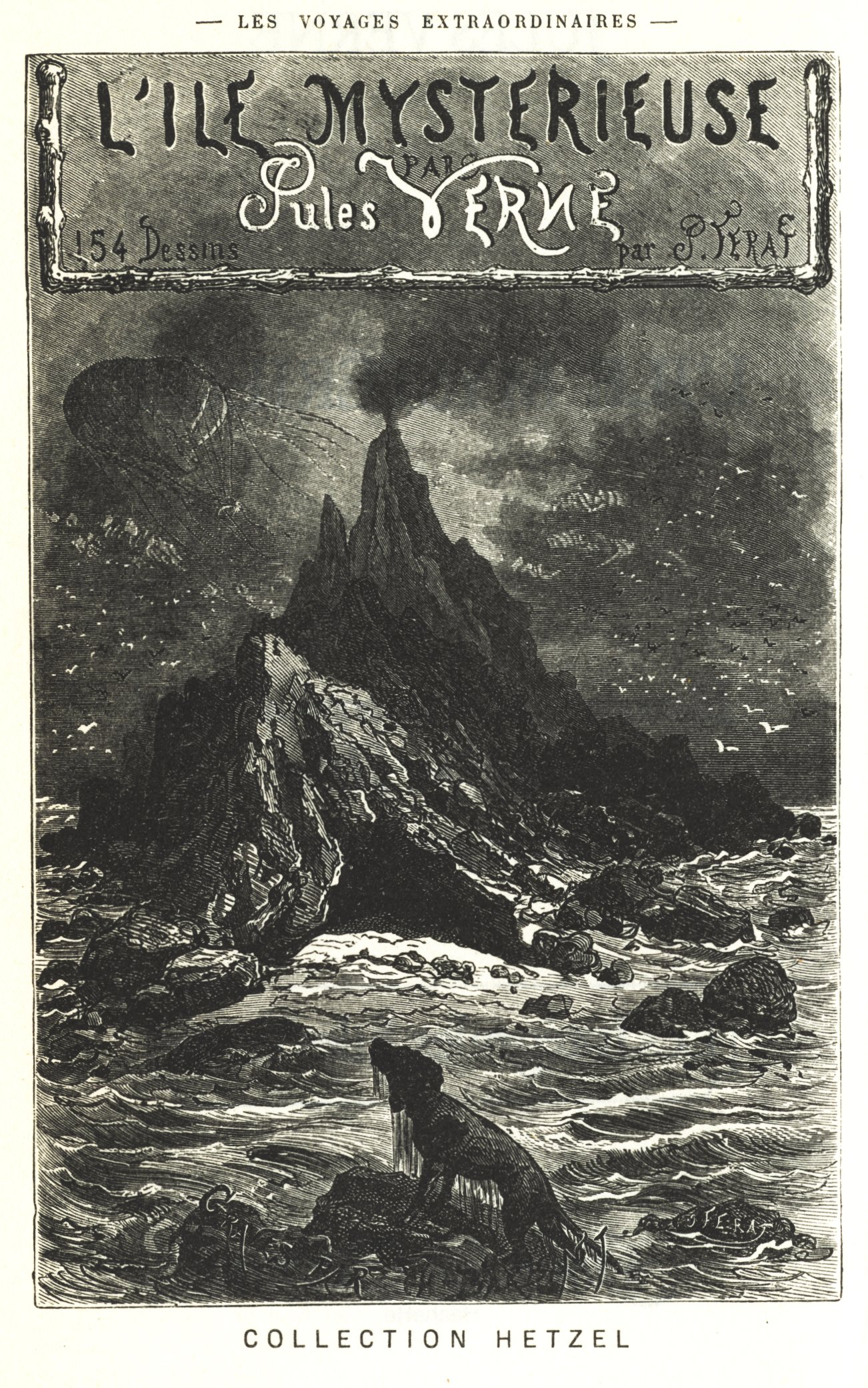

In 1865, as the American Civil War is nearing its end, five Northerners who are being held prisoner in the besieged Confederate capital of Richmond make a daring escape by seizing an observation balloon during the height of a storm. The storm is of epic proportions and global in its scope. It blows the five escapees at fearsome speeds for days on end. The balloon is shrouded in clouds, and they have no sight of land. When the storm finally begins to abate they discover that they are over water. Their balloon, moreover, is damaged and leaking hydrogen. Finally it crashes on the shore of what they will later discover is a small uninhabited island in the South Pacific.
Through hard work, boundless optimism, and the vast practical knowledge of their leader, Cyrus Harding, a captain of engineers, the five Americans not only survive but manage to thrive on their island even though they landed with nothing but the clothes on their backs. The island abounds in natural resources, and Harding manages to make such things as a pottery kiln and a primitive iron foundry. The castaways--who consider themselves colonists--must nonetheless overcome severe weather, dangerous beasts, disease, and even pirates. Occasionally they are aided by what is either a remarkable stroke of luck or the hand of an invisible protector hidden somewhere on the island. As time goes by, and incidents accumulate, the existence of a hidden stranger becomes ever more apparent.
The Mysterious Island refers back to two previous novels by Jules Verne: The Children of Captain Grant (also translated as In Search of the Castaways), and 20,000 Leagues Under the Sea. Because of its connection to the latter, The Mysterious Island can be considered part of the science fiction genre, but it is basically story of survival and adventure. If you have seen one of the film adaptations and are expecting monsters, you will be disappointed. (Likewise if you are expecting women--the female sex is scarcely even mentioned in the novel.)
Jules Verne displays a broad range of scientific and practical knowledge in showing how the castaways turn the raw materials of the island into basic tools, machinery, and finished products. We learn how they make their own cloth, bricks, pottery, hand tools, flour mill, explosives, and more. But Verne never overwhelms us with detail. There is always plenty of action looming, and the suspense is often nail-biting. The prevailing attitude that nature is there to be conquered and made use of is something that may annoy today's readers, but that was typical of the 19th century. The Mysterious Island has no social or moral message; it is simply an exciting adventure story and a manly tribute to valor and ingenuity.


First published 1874-75
Anonymous English translation 1875

In 1865, as the American Civil War is nearing its end, five Northerners who are being held prisoner in the besieged Confederate capital of Richmond make a daring escape by seizing an observation balloon during the height of a storm. The storm is of epic proportions and global in its scope. It blows the five escapees at fearsome speeds for days on end. The balloon is shrouded in clouds, and they have no sight of land. When the storm finally begins to abate they discover that they are over water. Their balloon, moreover, is damaged and leaking hydrogen. Finally it crashes on the shore of what they will later discover is a small uninhabited island in the South Pacific.
Through hard work, boundless optimism, and the vast practical knowledge of their leader, Cyrus Harding, a captain of engineers, the five Americans not only survive but manage to thrive on their island even though they landed with nothing but the clothes on their backs. The island abounds in natural resources, and Harding manages to make such things as a pottery kiln and a primitive iron foundry. The castaways--who consider themselves colonists--must nonetheless overcome severe weather, dangerous beasts, disease, and even pirates. Occasionally they are aided by what is either a remarkable stroke of luck or the hand of an invisible protector hidden somewhere on the island. As time goes by, and incidents accumulate, the existence of a hidden stranger becomes ever more apparent.
The Mysterious Island refers back to two previous novels by Jules Verne: The Children of Captain Grant (also translated as In Search of the Castaways), and 20,000 Leagues Under the Sea. Because of its connection to the latter, The Mysterious Island can be considered part of the science fiction genre, but it is basically story of survival and adventure. If you have seen one of the film adaptations and are expecting monsters, you will be disappointed. (Likewise if you are expecting women--the female sex is scarcely even mentioned in the novel.)
Jules Verne displays a broad range of scientific and practical knowledge in showing how the castaways turn the raw materials of the island into basic tools, machinery, and finished products. We learn how they make their own cloth, bricks, pottery, hand tools, flour mill, explosives, and more. But Verne never overwhelms us with detail. There is always plenty of action looming, and the suspense is often nail-biting. The prevailing attitude that nature is there to be conquered and made use of is something that may annoy today's readers, but that was typical of the 19th century. The Mysterious Island has no social or moral message; it is simply an exciting adventure story and a manly tribute to valor and ingenuity.


170FlorenceArt
Yes, the illustrations are cool.
In the French version, the engineer is called Cyrus Smith. I had a look at the Gutenberg text and found all the names:
Cyrus Smith
Gédéon (Gideon presumably) Spilett, reporter at the New-York Herald newspaper
Nabuchodonosor or Nab for short, a "nègre"
Pencroff, a sailor
Harbert Brown, an orphan
Top, a dog
I'm sure other names were changed in the translation, not only Smith to Harding.
In the French version, the engineer is called Cyrus Smith. I had a look at the Gutenberg text and found all the names:
Cyrus Smith
Gédéon (Gideon presumably) Spilett, reporter at the New-York Herald newspaper
Nabuchodonosor or Nab for short, a "nègre"
Pencroff, a sailor
Harbert Brown, an orphan
Top, a dog
I'm sure other names were changed in the translation, not only Smith to Harding.
171FlorenceArt
Also, the best adaptation of L'Ile mystérieuse that I know is Mystérieuse : matin, midi et soir by Jean-Claude Forest. Unfortunately there doesn't seem to be an English translation available. I remember it from my childhood when it was serialized in the magazine Pif Gadget in 1971, and I have re-read it at least once but I don't have it any more. Makes me want to re-read it again. I'm sure my library has it.
172StevenTX
>170 FlorenceArt: The other names were anglicized but not changed: Gideon for Gédéon, Neb for Nab, Pencroft for Pencroff, and Herbert for Harbert. Top is still Top.
173baswood
Enjoyed your review of The mysterious island. Whenever I read Jules Verne I am struck by his practical and scientific knowledge, so much so that I am never really sure when the fact based stuff reaches into the realms of fantasy (and then probably only marginally).
174StevenTX
The End of Books by Octave Uzanne
First published in 1894 in anonymous English translation for Scribner's Magazine


Octave Uzanne was a French bibliophile, author, critic, and publisher. He was fascinated with technology, and wrote The End of Books as a speculation on the impact of Thomas A. Edison's latest inventions on the publishing industry. The work is a short sketch in which a group of London friends are dining after attending a lecture on the evolution of the sun and its implications for the distant future of life on earth. They each speculate on what the next century will bring in their own areas of expertise. An historian predicts that the United States will soon eclipse Europe as the leader in world affairs. A naturalist predicts that in the 20th century it will become unthinkable to eat meat or kill animals for their hides or oils. An art critic maintains that photography will be the death of painting. The group then turns to the narrator (presumably Uzanne himself) for his thoughts on the future of books.
Uzanne predicts that the phonograph will replace printed books and newspapers, largely because it takes less effort to listen than to read. He also expects that the recording and reproduction of phonographic cylinders will be easier and cheaper than typesetting and printing. Authors will record their books in their own voice, and the classics of Shakespeare, Balzac, Dickens and Hugo will be recorded by famous actors and actresses. He says that phonographs will become small enough that people can listen to them on the train, aboard ships, in hotels, in waiting rooms, and even while taking their daily exercise.
Newspapers will be replaced by cylinders containing the recorded news of the day, and even live recordings of events themselves. Instead of reading a politician's speech, citizens may actually listen to it in their own homes. And instead of just a review of the opera or a play, they can listen to samples at home and judge its quality for themselves.
When one of his companions questions Uzanne about the lack of pictures in his phonographic books, he responds by saying that he has just months before witnessed a demonstration in Chicago of Edison's new kinetograph, the forerunner of the motion picture projector. (Uzanne actually did attend this demonstration in 1893.) He could forsee that the kinetograph would be linked to the gramophone, displaying moving pictures that illustrate the scenes being read from the book or newspaper. Every home will eventually have its own projection screen.
It would be almost a century before the audio books that Uzanne foresaw would become a practical reality. The biggest obstacle would be the limited storage capacity of phonographic cylinders and, later, discs. Yet we can also see in his vision a rudimentary notion of today's television and internet, as well as the demand for portable electronic devices. And while printed books are still far from extinct, the traditional newspaper is definitely endangered by multimedia technology just as Uzanne predicted.
The End of Books is an amusing essay that shows us how Victorians saw the future of technology. I recommend it to those who have a specialized interest in the evolution of publishing or the history of science fiction and futurology.

An audio book library on phonographic cylinders.

A gentleman enjoying his audio book while out for a stroll.

Commuters using headphone jacks for the Victorian equivalent of "in-flight entertainment."

A home entertainment center featuring audio and video.
First published in 1894 in anonymous English translation for Scribner's Magazine


Octave Uzanne was a French bibliophile, author, critic, and publisher. He was fascinated with technology, and wrote The End of Books as a speculation on the impact of Thomas A. Edison's latest inventions on the publishing industry. The work is a short sketch in which a group of London friends are dining after attending a lecture on the evolution of the sun and its implications for the distant future of life on earth. They each speculate on what the next century will bring in their own areas of expertise. An historian predicts that the United States will soon eclipse Europe as the leader in world affairs. A naturalist predicts that in the 20th century it will become unthinkable to eat meat or kill animals for their hides or oils. An art critic maintains that photography will be the death of painting. The group then turns to the narrator (presumably Uzanne himself) for his thoughts on the future of books.
Uzanne predicts that the phonograph will replace printed books and newspapers, largely because it takes less effort to listen than to read. He also expects that the recording and reproduction of phonographic cylinders will be easier and cheaper than typesetting and printing. Authors will record their books in their own voice, and the classics of Shakespeare, Balzac, Dickens and Hugo will be recorded by famous actors and actresses. He says that phonographs will become small enough that people can listen to them on the train, aboard ships, in hotels, in waiting rooms, and even while taking their daily exercise.
Newspapers will be replaced by cylinders containing the recorded news of the day, and even live recordings of events themselves. Instead of reading a politician's speech, citizens may actually listen to it in their own homes. And instead of just a review of the opera or a play, they can listen to samples at home and judge its quality for themselves.
When one of his companions questions Uzanne about the lack of pictures in his phonographic books, he responds by saying that he has just months before witnessed a demonstration in Chicago of Edison's new kinetograph, the forerunner of the motion picture projector. (Uzanne actually did attend this demonstration in 1893.) He could forsee that the kinetograph would be linked to the gramophone, displaying moving pictures that illustrate the scenes being read from the book or newspaper. Every home will eventually have its own projection screen.
It would be almost a century before the audio books that Uzanne foresaw would become a practical reality. The biggest obstacle would be the limited storage capacity of phonographic cylinders and, later, discs. Yet we can also see in his vision a rudimentary notion of today's television and internet, as well as the demand for portable electronic devices. And while printed books are still far from extinct, the traditional newspaper is definitely endangered by multimedia technology just as Uzanne predicted.
The End of Books is an amusing essay that shows us how Victorians saw the future of technology. I recommend it to those who have a specialized interest in the evolution of publishing or the history of science fiction and futurology.

An audio book library on phonographic cylinders.

A gentleman enjoying his audio book while out for a stroll.

Commuters using headphone jacks for the Victorian equivalent of "in-flight entertainment."

A home entertainment center featuring audio and video.
175FlorenceArt
Wow! It's impressive how much he got right in his predictions.
176NanaCC
>174 StevenTX: The End of Books sounds really interesting. Nice review. I love the pictures.
177SassyLassy
What an interesting sounding book. The Victorian Internet takes the other approach of necessity, since it looks back from 1998, but it does show how the Victorians were already transforming their ideas about technology and the printed word.
ETA What great pictures.
ETA What great pictures.
178StevenTX
Memoirs of a Peasant Boy by Xosé Neira Vilas
First published in Galician 1961
English translation by Camilo Ogando Vázquez 2004
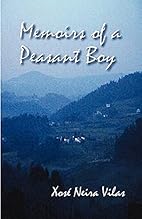

This short novel is the coming of age story of Balbino, a poor peasant boy in Galicia, the northwestern province of Spain which preserves its own language and cultural traditions. In each chapter Balbino narrates an incident or aspect of his childhood: the death of a relative, his crush on a beautiful young schoolteacher, finding a best friends, and being persecuted by the landlord's son. The work is strewn with folk wisdom and the general sense of Balbino realizing that, even though he just the child of poor tenant farmers, he can find a way to make his life matter.
Memoirs of a Peasant Boy is written in simple language that would make it suitable for a young adult audience. Its insights into childhood are more universal than they are specific to the author's native land, which is actually a disappointment. There are hints at the ways Galicia is different from the rest of Spain and, in the aftermath of the Spanish Civil War, at odds with the Nationalist government, but I would liked to have learned more. Balbino grows up in poverty, but not destitution, and his experiences are simply typical of an intellectually active youth who feels acutely the fetters that his social rank has placed upon him.
Memoirs of a Peasant Boy is included in the "1001 Books You Must Read Before You Die" list and is a nice example of a coming of age story, but not a novel I would especially recommend unless you are particularly interested in Galicia and its literature.
First published in Galician 1961
English translation by Camilo Ogando Vázquez 2004

This short novel is the coming of age story of Balbino, a poor peasant boy in Galicia, the northwestern province of Spain which preserves its own language and cultural traditions. In each chapter Balbino narrates an incident or aspect of his childhood: the death of a relative, his crush on a beautiful young schoolteacher, finding a best friends, and being persecuted by the landlord's son. The work is strewn with folk wisdom and the general sense of Balbino realizing that, even though he just the child of poor tenant farmers, he can find a way to make his life matter.
Memoirs of a Peasant Boy is written in simple language that would make it suitable for a young adult audience. Its insights into childhood are more universal than they are specific to the author's native land, which is actually a disappointment. There are hints at the ways Galicia is different from the rest of Spain and, in the aftermath of the Spanish Civil War, at odds with the Nationalist government, but I would liked to have learned more. Balbino grows up in poverty, but not destitution, and his experiences are simply typical of an intellectually active youth who feels acutely the fetters that his social rank has placed upon him.
Memoirs of a Peasant Boy is included in the "1001 Books You Must Read Before You Die" list and is a nice example of a coming of age story, but not a novel I would especially recommend unless you are particularly interested in Galicia and its literature.
179baswood
The End of Books can be found in translation at Project Gutenberg. Another one to add to the list.
180dchaikin
>174 StevenTX: - re The End of Books, that is some foresight. Even what he got wrong was interesting.
Too bad Memoirs of a Peasant Boy is so thin, if that is the right word. There should be fascinating stories from there.
Too bad Memoirs of a Peasant Boy is so thin, if that is the right word. There should be fascinating stories from there.
181StevenTX
I spent a very enjoyable afternoon at a festival celebrating the opening of an exhibit of Spanish art and other treasures collected over several centuries by the House of Alba. The exhibit was on the campus of SMU (my alma mater) at the Meadows Museum, which specializes in Spanish art and has a large permanent collection as well as hosting various exhibits from Europe and Latin America.
One of the highlights of the exhibit was a 1605 first edition of Don Quixote (Part I) which looked exactly like this:

There was also one of Christopher Columbus's log books, a list of crewmen of the Santa Maria written by Columbus in 1492, and a letter to the Duke of Alba signed by Jean-Jacques Rousseau.
Of course the paintings were the focus of the collection. There were works by El Greco, Titian, Rubens, Velazquez, Murillo, Goya and many more. It was a special treat to watch a performance by dancers and musicians from Seville in a room surrounded by Flemish tapestries and masterpieces such as these:

One of the highlights of the exhibit was a 1605 first edition of Don Quixote (Part I) which looked exactly like this:
There was also one of Christopher Columbus's log books, a list of crewmen of the Santa Maria written by Columbus in 1492, and a letter to the Duke of Alba signed by Jean-Jacques Rousseau.
Of course the paintings were the focus of the collection. There were works by El Greco, Titian, Rubens, Velazquez, Murillo, Goya and many more. It was a special treat to watch a performance by dancers and musicians from Seville in a room surrounded by Flemish tapestries and masterpieces such as these:

182FlorenceArt
Great paintings. Who's the lady with the big hair? I think I saw that Velasquez in the Grand Palais earlier this year.
183StevenTX
>182 FlorenceArt: The lady with the dog is the Duchess of Alba painted by Goya in 1795. The Infanta in the Blue Dress by Velazquez is actually on loan from Vienna and not part of the House of Alba collection, but they are on display together.
Of course seeing art like this is an everyday experience for you folks in Europe, but it's a rare treat to see a collection like this out here.
Of course seeing art like this is an everyday experience for you folks in Europe, but it's a rare treat to see a collection like this out here.
186StevenTX
>185 ELiz_M: Sorry, no. Same surname but opposite ends of the social scale. These Albas had an interesting link, however, to English aristocracy. They intermarried with a descendant of an illegitimate son of the English King James II, and some Dukes of Alba also bore the English title Duke of Berwick. Among the "family" portraits in the exhibition were paintings of James II and Mary Queen of Scots. There was also a French connection. A Duke of Alba married the older sister of Eugénie de Montijo who became Empress of France by marrying Napoleon III. A gigantic portrait of her by Franz Winterhalter was on display as well.
.jpg)
.jpg)
187StevenTX

I've put this picture at the top of my thread as well. It shows about 2/3 of my collection of bookmarks. The ones not shown are mostly from book stores. Some years ago I decided that the only souvenirs I wanted to bring back from my travels were bookmarks. They are cheap, easy to pack, and can be put to good use. I've also collected a few from art galleries, and a local community theater produces one for each of its plays. Some of the more interesting ones just turned up inside used books I had purchased, and a couple in this photo are bookmarks I made for myself.
188NanaCC
That is a great collection of bookmarks. I always feel that I miss them when I'm reading a book on my Kindle.
189StevenTX
>188 NanaCC: Yes, and there have been dozens of times that I've automatically reached for a bookmark as I closed the case on my Kindle.
190Nickelini
What a smashing idea, and I'm kicking myself for not thinking about it first. I have a absolutely fabu collection. I'm going to do this soon. Thanks for the inspiration.
191SassyLassy
I love bookmarks. They are so individual they each deserve their own book.
Persephone Books has individual ones for each of its books, which match the fabric image on the endpapers.
Persephone Books has individual ones for each of its books, which match the fabric image on the endpapers.
193AlisonY
I'm very fussy about my bookmarks too. There's something very satisfying about having a really nice one tucked inside your book. Great collection!
194FlorenceArt
Looks like a great collection!
195rebeccanyc
just catching up and enjoying both your description (and pictures) of the exhibition and your bookmark collection. I have to confess I just use the bookmarks bookstores give you.
196Nickelini
I have to confess I just use the bookmarks bookstores give you.
Some of those are fabulous. I especially treasure the ones I pick up when I travel.
Some of those are fabulous. I especially treasure the ones I pick up when I travel.
197StevenTX
Hector Servadac; or, Off on a Comet by Jules Verne
First published 1877

Captain Hector Servadac, with his faithful orderly Ben Zoof, is spending the night composing poetry in a lonely hut in Algeria where he is conducting a topographical survey for the French army. Suddenly there is a terrific barrage of light, sound, wind and motion which collapses the roof of the hut onto the two men, knocking them unconscious. When they come to it is daylight, though Servadac's watch tells hem it should still be dark. Further strange discoveries await them: The sun is setting in the east and rising in the west. The days are only half as long as they should be. The moon has disappeared. The air seems thinner than it should be. And a leap of some 50 feet shows them that the force of gravity is a fraction of what it once was.
Servadac and Ben Zoof set out to explore and soon discover that their portion of Algeria has become an island only a few miles long. At first they appear to have been the only survivors of whatever calamity has struck the earth, but later a Russian steam yacht comes to their shore. Eventually after further explorations and encounters they come to realize that they are now on a comet that has grazed the earth, carrying off just a few patches of land around the Mediterranean along with enough of the earth's air and water to sustain them.
Jules Verne seems to have written this novel primarily to take his readers on a tour of the solar system. The interplanetary collision was probably written with tongue in cheek; Verne no doubt knew that the results would have been cataclysmic, so he doesn't dwell on how a comet might have scraped off a bit of Algeria like a fleck of paint from the fender of a carriage. Yet he is at pains to describe convincingly the nature of the comet's elliptical orbit and gives facts and figures about each of the planets it bypasses to the best knowledge of 19th century astronomy.
Our heroes are not idle during their ride through the solar system. In addition to exploring their new world and rescuing the handful of other survivors, they must survive the intense heat inside the orbit of Venus and the devastating cold beyond the orbit of Jupiter. Lastly they must plan a way to make a safe return to the surface of the earth when the comet makes its next encounter with our planet.
Hector Servadac; or, Off on a Comet borrows a bit of everything from Verne's earlier and best-known novels: a journey deep underground, a volcano, survival on an island, storms at sea, and even a balloon. All that's missing is a submarine. Also typical of Verne, it is virtually an all-male adventure. The only female to make an appearance is an eight-year-old Italian girl rescued from what is left of Sardinia.
Aside from some scientific absurdities, the one huge flaw in the novel is antisemitism. One of the survivors collected by the Frenchmen is a German Jew to whom Verne attributes every one of the negative stereotypes typically associated in literature with Jewish usurers.
With its showcasing new discoveries and ideas in astronomy, it's easy to see why Hector Servadac would have been popular in its day. It remains a good adventure novel (if you can get past the stereotyping) but doesn't quite measure up to Verne's earlier and more enduring novels.
First published 1877

Captain Hector Servadac, with his faithful orderly Ben Zoof, is spending the night composing poetry in a lonely hut in Algeria where he is conducting a topographical survey for the French army. Suddenly there is a terrific barrage of light, sound, wind and motion which collapses the roof of the hut onto the two men, knocking them unconscious. When they come to it is daylight, though Servadac's watch tells hem it should still be dark. Further strange discoveries await them: The sun is setting in the east and rising in the west. The days are only half as long as they should be. The moon has disappeared. The air seems thinner than it should be. And a leap of some 50 feet shows them that the force of gravity is a fraction of what it once was.
Servadac and Ben Zoof set out to explore and soon discover that their portion of Algeria has become an island only a few miles long. At first they appear to have been the only survivors of whatever calamity has struck the earth, but later a Russian steam yacht comes to their shore. Eventually after further explorations and encounters they come to realize that they are now on a comet that has grazed the earth, carrying off just a few patches of land around the Mediterranean along with enough of the earth's air and water to sustain them.
Jules Verne seems to have written this novel primarily to take his readers on a tour of the solar system. The interplanetary collision was probably written with tongue in cheek; Verne no doubt knew that the results would have been cataclysmic, so he doesn't dwell on how a comet might have scraped off a bit of Algeria like a fleck of paint from the fender of a carriage. Yet he is at pains to describe convincingly the nature of the comet's elliptical orbit and gives facts and figures about each of the planets it bypasses to the best knowledge of 19th century astronomy.
Our heroes are not idle during their ride through the solar system. In addition to exploring their new world and rescuing the handful of other survivors, they must survive the intense heat inside the orbit of Venus and the devastating cold beyond the orbit of Jupiter. Lastly they must plan a way to make a safe return to the surface of the earth when the comet makes its next encounter with our planet.
Hector Servadac; or, Off on a Comet borrows a bit of everything from Verne's earlier and best-known novels: a journey deep underground, a volcano, survival on an island, storms at sea, and even a balloon. All that's missing is a submarine. Also typical of Verne, it is virtually an all-male adventure. The only female to make an appearance is an eight-year-old Italian girl rescued from what is left of Sardinia.
Aside from some scientific absurdities, the one huge flaw in the novel is antisemitism. One of the survivors collected by the Frenchmen is a German Jew to whom Verne attributes every one of the negative stereotypes typically associated in literature with Jewish usurers.
With its showcasing new discoveries and ideas in astronomy, it's easy to see why Hector Servadac would have been popular in its day. It remains a good adventure novel (if you can get past the stereotyping) but doesn't quite measure up to Verne's earlier and more enduring novels.
198dchaikin
Pre-Dryfus affair anti-semitism. Jules Verne too. Bummer.
Hope you find some regular reading time again...or at least your distractions are worthwhile.
Hope you find some regular reading time again...or at least your distractions are worthwhile.
199rebeccanyc
I was surprised to see that Steven has been "removed" from LT. I emailed info@librarything.com, as suggested on the removal page, to say that if he didn't request removal himself, I hoped they would reinstate him. I pointed out that he was an active member of Club Read and I couldn't imagine him doing anything that would warrant removal. Do any of you know anything about Steven?
200dchaikin
No... I wish I had RL contact info to ask him. Thanks for that update.
Hoping he is well. And hope he reappears here. You're missed Steven.
Hoping he is well. And hope he reappears here. You're missed Steven.
202rebeccanyc
The implication was that LT had removed him. If you click on his name above his last post you'll see what I mean.
203.Monkey.
I'm not sure if it says something else if you remove yourself, though. It might, but like that's not the message that shows up for, say, spam removal. But looking into it is certainly no harm!
204LolaWalser
Oh dear. I hope Steven is all right.
Yes, I'm afraid that the same message shows even if you have requested removal yourself.
Yes, I'm afraid that the same message shows even if you have requested removal yourself.
205rebeccanyc
Update. Loranne, an LT staffer, responded to my email and said:
"Thanks for getting in touch. I appreciate your concern, and can confirm that StevenTX disabled his account of his own volition. We're sad to see him go, too."
I hope Steven is OK.
I also suggested that the message be different if someone removes her- or himself, as opposed to LT removing members for spam or bad behavior.
"Thanks for getting in touch. I appreciate your concern, and can confirm that StevenTX disabled his account of his own volition. We're sad to see him go, too."
I hope Steven is OK.
I also suggested that the message be different if someone removes her- or himself, as opposed to LT removing members for spam or bad behavior.
206ursula
Thanks for checking into it and letting us know. I'm sorry to hear that and hope he is all right.
207.Monkey.
Yes different messages would be good.
I do hope everything is alright too, he's been such a prolific poster here for ages!
I do hope everything is alright too, he's been such a prolific poster here for ages!
208Nickelini
Wow, that's sort of shocking. I know LT members come and go, but Steven was such a solid presence. I too hope that he's okay and can come back soon!
209Oandthegang
Although he's removed himself perhaps he might look in to the posts as a non member, and if he does I hope he will know that we are thinking of him and missing him.
210lilisin
He will definitely be missed. His reviews were excellent and he always had something interesting and new to provide to a thread/post/group. I also hope that there is a comeback to look forward to.
211LolaWalser
>210 lilisin:
ditto
If you look at this thread again, Steven, wishing you all the best, and hoping you'll return by and by.
ditto
If you look at this thread again, Steven, wishing you all the best, and hoping you'll return by and by.

