StevenTX Returns to the Lists in 2015 - Vol. I
This topic was continued by StevenTX's 2015 Reading Log - Vol. II.
Talk Club Read 2015
Join LibraryThing to post.
This topic is currently marked as "dormant"—the last message is more than 90 days old. You can revive it by posting a reply.


2StevenTX
2015 Statistics
Summary of Books Read
55 - books read
53 - novels
1 - history
1 - philosophy
Authors
42 - different authors
21 - authors new to me
42 - books by male authors
11 - books by female authors
2 - books by multiple, anonymous or unknown authors
Books Read by Author's Nationality
21 - American
15 - English
4 - French
2 - Dutch
2 - Scottish
2 - Greek
1 - Irish
1 - German
1 - South African
1 - Austrian
1 - Italian
1 - Indian
Books Read by Original Language
45 - English
4 - French
2 - German
1 - Modern Greek
1 - Italian
1 - Dutch
1 - Classical Greek
Books Read by Decade of First Publication
1 - Classical Age
1 - 1740s
1 - 1750s
1 - 1800s
2 - 1860s
1 - 1870s
6 - 1880s
3 - 1890s
6 - 1910s
3 - 1920s
2 - 1930s
1 - 1940s
4 - 1950s
3 - 1960s
5 - 1970s
2 - 1980s
7 - 1990s
2 - 2000s
4 - 2010s
2014 Statistics
2013 Statistics
2012 Statistics
Summary of Books Read
55 - books read
53 - novels
1 - history
1 - philosophy
Authors
42 - different authors
21 - authors new to me
42 - books by male authors
11 - books by female authors
2 - books by multiple, anonymous or unknown authors
Books Read by Author's Nationality
21 - American
15 - English
4 - French
2 - Dutch
2 - Scottish
2 - Greek
1 - Irish
1 - German
1 - South African
1 - Austrian
1 - Italian
1 - Indian
Books Read by Original Language
45 - English
4 - French
2 - German
1 - Modern Greek
1 - Italian
1 - Dutch
1 - Classical Greek
Books Read by Decade of First Publication
1 - Classical Age
1 - 1740s
1 - 1750s
1 - 1800s
2 - 1860s
1 - 1870s
6 - 1880s
3 - 1890s
6 - 1910s
3 - 1920s
2 - 1930s
1 - 1940s
4 - 1950s
3 - 1960s
5 - 1970s
2 - 1980s
7 - 1990s
2 - 2000s
4 - 2010s
2014 Statistics
2013 Statistics
2012 Statistics
3StevenTX
2015 Reading Index
Banks, Iain M. - Consider Phlebas - April 13
Bellow, Saul - Seize the Day - January 6
- Dangling Man - April 23
Bernhard, Thomas - Yes - April 22
Böll, Heinrich - The Lost Honor of Katharina Blum - February 4
Burroughs, Edgar Rice - The Return of Tarzan - February 17
- Pellucidar - March 7
- Tanar of Pellucidar - March 30
- The Beasts of Tarzan - April 14
- The Son of Tarzan - May 11
- Beyond Thirty; or, The Lost Continent - June 16
- Tarzan and the Jewels of Opar - June 18
Christopher, John - The Death of Grass - March 17
Coetzee, J. M. - In the Heart of the Country - April 18
Dacre, Charlotte - Zofloya, or The Moor - April 14
Faber, Michel - Under the Skin - March 22
Fielding, Henry - Joseph Andrews - January 21
- Amelia - May 25
Gilman, Charlotte Perkins - Herland - April 19
Green, Henry - Blindness - March 5
Greg, Percy - Across the Zodiac: The Story of a Wrecked Record - March 6
Herrin, Judith - Byzantium: The Surprising Life of a Medieval Empire - January 15
Hippocrates - On Ancient Medicine - May 17
Jefferies, Richard - After London; or, Wild England - January 3
Lach-Szyrma, W. S. - Aleriel - May 14
Laurie, Andre - The Conquest of the Moon - June 24
Morrison, Toni - Song of Solomon - February 1
Plato - Ion - January 2
- Phaedo - January 28
- Cratylus - February 26
- Euthydemus - March 14
- Protagoras - April 17
- Gorgias - May 15
- Meno - May 18
- Menexenus - May 30
- Symposium - July 2
- Phaedrus - July 3
Rushdie, Salman - Shame - June 29
Sartre, Jean-Paul - Nausea - January 27
Scalzi, John - Redshirts - May 1
Schechter, Elizabeth - House of the Sable Locks - January 1
Simmons, Dan - The Rise of Endymion - January 17
Slauerhoff, J. J. - The Forbidden Kingdom May 21
Stokoe, Matthew - Cows - February 1
Tabucchi, Antonio - Pereira Declares - April 23
Trollope, Anthony - Can You Forgive Her? - March 10
- Phineas Finn - June 7
Woolf, Virginia - Orlando - January 14
Wyndham, John - The Midwich Cuckoos - January 23
Zola, Émile - The Conquest of Plassans - April 15
Banks, Iain M. - Consider Phlebas - April 13
Bellow, Saul - Seize the Day - January 6
- Dangling Man - April 23
Bernhard, Thomas - Yes - April 22
Böll, Heinrich - The Lost Honor of Katharina Blum - February 4
Burroughs, Edgar Rice - The Return of Tarzan - February 17
- Pellucidar - March 7
- Tanar of Pellucidar - March 30
- The Beasts of Tarzan - April 14
- The Son of Tarzan - May 11
- Beyond Thirty; or, The Lost Continent - June 16
- Tarzan and the Jewels of Opar - June 18
Christopher, John - The Death of Grass - March 17
Coetzee, J. M. - In the Heart of the Country - April 18
Dacre, Charlotte - Zofloya, or The Moor - April 14
Faber, Michel - Under the Skin - March 22
Fielding, Henry - Joseph Andrews - January 21
- Amelia - May 25
Gilman, Charlotte Perkins - Herland - April 19
Green, Henry - Blindness - March 5
Greg, Percy - Across the Zodiac: The Story of a Wrecked Record - March 6
Herrin, Judith - Byzantium: The Surprising Life of a Medieval Empire - January 15
Hippocrates - On Ancient Medicine - May 17
Jefferies, Richard - After London; or, Wild England - January 3
Lach-Szyrma, W. S. - Aleriel - May 14
Laurie, Andre - The Conquest of the Moon - June 24
Morrison, Toni - Song of Solomon - February 1
Plato - Ion - January 2
- Phaedo - January 28
- Cratylus - February 26
- Euthydemus - March 14
- Protagoras - April 17
- Gorgias - May 15
- Meno - May 18
- Menexenus - May 30
- Symposium - July 2
- Phaedrus - July 3
Rushdie, Salman - Shame - June 29
Sartre, Jean-Paul - Nausea - January 27
Scalzi, John - Redshirts - May 1
Schechter, Elizabeth - House of the Sable Locks - January 1
Simmons, Dan - The Rise of Endymion - January 17
Slauerhoff, J. J. - The Forbidden Kingdom May 21
Stokoe, Matthew - Cows - February 1
Tabucchi, Antonio - Pereira Declares - April 23
Trollope, Anthony - Can You Forgive Her? - March 10
- Phineas Finn - June 7
Woolf, Virginia - Orlando - January 14
Wyndham, John - The Midwich Cuckoos - January 23
Zola, Émile - The Conquest of Plassans - April 15
4StevenTX
Welcome to my 2015 reading log.
In recapping my 2014 reading I was surprised to see that I had given only one work of fiction 5 stars, and that was a work I admired more than enjoyed. My overall reading totals were significantly down from previous years as well. So I decided it's time for a change.
Much of my 2014 reading came from personal projects that involved comprehensive chronological approaches to topics and led to my reading obscure and often undeserving works. For 2015 I want to take the opposite tack and try to read the most important and enjoyable works I haven't yet touched.
My re-introduction to literature began 15 years ago when I discovered a list known as the "Modern Library 100." For the next decade my reading was largely driven by that list and others like it. One of the things I concluded was that no single list of great books is without flaws--every expert wants to promote his or her own favorites. But when a book is listed by multiple sources, it is usually worth reading.
Shown below are the lists that have been my primary guide to finding books to read, along with the counts of the number of books on each list I have read. In 2015 I want to read books that are on every list, and of course the easiest way to accomplish this is to read the ones that are on multiple lists. I don't intend to try to complete any list in particular. The "1001 Books You Must Read Before You Die" list will continue to get the greatest emphasis simply because it's the basis for a nice group here on LT.
I don't expect all of this to mean anything to anyone else, but if you see a list that looks interesting I can at least tell you where I found it.
In recapping my 2014 reading I was surprised to see that I had given only one work of fiction 5 stars, and that was a work I admired more than enjoyed. My overall reading totals were significantly down from previous years as well. So I decided it's time for a change.
Much of my 2014 reading came from personal projects that involved comprehensive chronological approaches to topics and led to my reading obscure and often undeserving works. For 2015 I want to take the opposite tack and try to read the most important and enjoyable works I haven't yet touched.
My re-introduction to literature began 15 years ago when I discovered a list known as the "Modern Library 100." For the next decade my reading was largely driven by that list and others like it. One of the things I concluded was that no single list of great books is without flaws--every expert wants to promote his or her own favorites. But when a book is listed by multiple sources, it is usually worth reading.
Shown below are the lists that have been my primary guide to finding books to read, along with the counts of the number of books on each list I have read. In 2015 I want to read books that are on every list, and of course the easiest way to accomplish this is to read the ones that are on multiple lists. I don't intend to try to complete any list in particular. The "1001 Books You Must Read Before You Die" list will continue to get the greatest emphasis simply because it's the basis for a nice group here on LT.
I don't expect all of this to mean anything to anyone else, but if you see a list that looks interesting I can at least tell you where I found it.
5StevenTX
Lists of the Greatest Books of All Time
Lists are ranked by my percentage of completion and will be updated as I read. The number in bold after the vertical bar is the number of works I have read from the list in 2015.
96% (96 of 100) - The Novel 100 (1st ed.) by Daniel S. Burt | 1
94% (46 of 49) - Beowulf on the Beach: Literature's 50 Greatest Hits by Jack Murnighan
87% (88 of 101) - "101 Books for the College Bound" by the College Board | 1
84% (108 of 128) - Novelists and Novels by Harold Bloom | 2
79% (79 of 100) - "100 Meaningful Books" by the Norwegian Book Club
79% (79 of 100) - Entertainment Weekly's "100 Greatest Novels Ever" | 1
75% (172 of 229) - The Rough Guide to Classic Novels by Simon Mason | 1
75% (75 of 100) - "The Greatest Novels of All Time" from The Observer (2003) | 1
69% (70 of 101) - Thirteen Ways of Looking at the Novel by Jane Smiley | 2
69% (91 of 132) - Dalkey's Archive's "Literary Works All Students Should Read" | 1
68% (68 of 100) - Penguin's "Top 100 Reads"
55% (67 of 121) - English PEN's "The Bigger Read" (Greatest books in translation)
53% (71 of 133) - The New Lifetime Reading Plan (4th ed.) by Fadiman and Major | 1
51% (516 of 1001) - 1001 Books You Must Read Before You Die (2010 ed.) | 17
51% (512 of 1001) - 1001 Books You Must Read Before You Die (2006 ed.) | 19
42% (66 of 156) - The Well-Educated Mind by Susan Wise Bauer | 2
42% (421 of 998) - Guardian's "1000 Novels Everyone Should Read" | 11
38% (192 of 501) - 501 Must-Read Books | 3
31% (98 of 318) - Recommended reading list from How to Read a Book by Adler & Van Doren | 5
30% (301 of 1000) - Harenberg: Das Buch der 1000 Bücher ("The Book of 1000 Books") | 4
25% (387 of 1518) - The Western Canon by Harold Bloom | 7
23% (115 of 495) - A Lifetime's Reading by Philip Ward | 2
7% (36 of 508) - 500 Great Books by Women by Erica Bauermeister | 1
Lists are ranked by my percentage of completion and will be updated as I read. The number in bold after the vertical bar is the number of works I have read from the list in 2015.
96% (96 of 100) - The Novel 100 (1st ed.) by Daniel S. Burt | 1
94% (46 of 49) - Beowulf on the Beach: Literature's 50 Greatest Hits by Jack Murnighan
87% (88 of 101) - "101 Books for the College Bound" by the College Board | 1
84% (108 of 128) - Novelists and Novels by Harold Bloom | 2
79% (79 of 100) - "100 Meaningful Books" by the Norwegian Book Club
79% (79 of 100) - Entertainment Weekly's "100 Greatest Novels Ever" | 1
75% (172 of 229) - The Rough Guide to Classic Novels by Simon Mason | 1
75% (75 of 100) - "The Greatest Novels of All Time" from The Observer (2003) | 1
69% (70 of 101) - Thirteen Ways of Looking at the Novel by Jane Smiley | 2
69% (91 of 132) - Dalkey's Archive's "Literary Works All Students Should Read" | 1
68% (68 of 100) - Penguin's "Top 100 Reads"
55% (67 of 121) - English PEN's "The Bigger Read" (Greatest books in translation)
53% (71 of 133) - The New Lifetime Reading Plan (4th ed.) by Fadiman and Major | 1
51% (516 of 1001) - 1001 Books You Must Read Before You Die (2010 ed.) | 17
51% (512 of 1001) - 1001 Books You Must Read Before You Die (2006 ed.) | 19
42% (66 of 156) - The Well-Educated Mind by Susan Wise Bauer | 2
42% (421 of 998) - Guardian's "1000 Novels Everyone Should Read" | 11
38% (192 of 501) - 501 Must-Read Books | 3
31% (98 of 318) - Recommended reading list from How to Read a Book by Adler & Van Doren | 5
30% (301 of 1000) - Harenberg: Das Buch der 1000 Bücher ("The Book of 1000 Books") | 4
25% (387 of 1518) - The Western Canon by Harold Bloom | 7
23% (115 of 495) - A Lifetime's Reading by Philip Ward | 2
7% (36 of 508) - 500 Great Books by Women by Erica Bauermeister | 1
6StevenTX
Lists of the Greatest Books of the 20th Century
Lists are ranked by my percentage of completion and will be updated as I read. The number in bold after the vertical bar is the number of works I have read from the list in 2015.
100% (of 100) - Modern Library's "100 Best Novels"
85% (85 of 100) - Time Magazine's "All-Time 100"
82% (82 of 100) - "Century's Top 100 Novels" by Radcliffe Publishing Course | 3
72% (21 of 29) - Dalkey Archives "Most Influential Novels of the 20th Century"
68% (68 of 100) - "100 Best Novels of the Century" by Tom Moran | 1
64% (64 of 100) - "20th Century's Greatest Hits" by Larry McCaffrey
62% (62 of 100) - "100 Greatest American Novels 1893-1993" by Jeff O'Neal for BookRiot
60% (36 of 60) - The Book-of-the-Month-Club "Well-Stocked Bookcase" | 1
57% (57 of 100) - "100 Greatest Novels of the 20th Century in English" by Dick Meyer | 1
54% (54 of 100) - "100 Greatest Modern Novels" by Alex Carnevale for This Recording | 1
44% (44 of 100) - Le Monde's 100 Greatest Novels of the 20th Century | 1
41% (41 of 100) - St. Mark's Bookshop's "Additional 100" (a supplement to the Modern Library list) | 1
38% (38 of 100) - "Reading Further" from The New Lifetime Reading Plan (4th ed.) | 1
37% (19 of 51) - Flavorwire's 50 Books that Everyone Needs to Read, 1963-2013
28% (28 of 99) - 99 Novels: The Best in English Since 1939 by Anthony Burgess
25% (52 of 202) - The Modern Library by Callil and Toibin | 1
21% (38 of 180) - The Reading List: Contemporary Fiction "Most Important" | 1
19% (192 of 984) - Bloomsbury Good Reading Guide to World Fiction | 4
19% (43 of 222) - Recommended Works from The Salon.com Reader's Guide to Contemporary Authors | 2
Lists are ranked by my percentage of completion and will be updated as I read. The number in bold after the vertical bar is the number of works I have read from the list in 2015.
100% (of 100) - Modern Library's "100 Best Novels"
85% (85 of 100) - Time Magazine's "All-Time 100"
82% (82 of 100) - "Century's Top 100 Novels" by Radcliffe Publishing Course | 3
72% (21 of 29) - Dalkey Archives "Most Influential Novels of the 20th Century"
68% (68 of 100) - "100 Best Novels of the Century" by Tom Moran | 1
64% (64 of 100) - "20th Century's Greatest Hits" by Larry McCaffrey
62% (62 of 100) - "100 Greatest American Novels 1893-1993" by Jeff O'Neal for BookRiot
60% (36 of 60) - The Book-of-the-Month-Club "Well-Stocked Bookcase" | 1
57% (57 of 100) - "100 Greatest Novels of the 20th Century in English" by Dick Meyer | 1
54% (54 of 100) - "100 Greatest Modern Novels" by Alex Carnevale for This Recording | 1
44% (44 of 100) - Le Monde's 100 Greatest Novels of the 20th Century | 1
41% (41 of 100) - St. Mark's Bookshop's "Additional 100" (a supplement to the Modern Library list) | 1
38% (38 of 100) - "Reading Further" from The New Lifetime Reading Plan (4th ed.) | 1
37% (19 of 51) - Flavorwire's 50 Books that Everyone Needs to Read, 1963-2013
28% (28 of 99) - 99 Novels: The Best in English Since 1939 by Anthony Burgess
25% (52 of 202) - The Modern Library by Callil and Toibin | 1
21% (38 of 180) - The Reading List: Contemporary Fiction "Most Important" | 1
19% (192 of 984) - Bloomsbury Good Reading Guide to World Fiction | 4
19% (43 of 222) - Recommended Works from The Salon.com Reader's Guide to Contemporary Authors | 2
7StevenTX
Lists of Science Fiction, Fantasy and Horror
Lists are ranked by my percentage of completion and will be updated as I read. The number in bold after the vertical bar is the number of works I have read from the list in 2015.
64% (32 of 50) - Science Fiction List from 501 Must-Read Books
62% (31 of 50) - Science Fiction Book Club's "Top 50 Fantasy and Science Fiction Books" | 1
61% (61 of 100) - Phobos's "100 Best Science Fiction Books" | 2
60% (30 of 50) - Abe Books' "50 Essential Science Fiction Books" | 2
57% (85 of 149) - SF & F list from Guardian's "1000 Novels Everyone Must Read" | 7
55% (34 of 61) - "Incredible Worlds" list from 500 Essential Cult Books by Gina McKinnon | 2
48% (72 of 150) - Ted Gioia's "Conceptual Fiction Reading List"
47% (94 of 200) - SF Lists's "Top 200 Sci-Fi Books" | 2
45% (45 of 100) - Bloomsbury "100 Must-Read Science Fiction Books" | 1
45% (85 of 191) - James Wallace Harris's "Classics of Science Fiction" | 3
44% (22 of 50) - Flavorwire's 50 Sci-Fi/Fantasy Novels that Everyone Should Read
42% (42 of 100) - "100 Greatest Fantasy and Science Fiction" by Alex Carnevale | 1
39% (40 of 102) - Wired's "102 Essential Science Fiction Books for Your Kindle" | 1
38% (42 of 110) - David Brin's "Greatest Science Fiction and Fantasy Tales" | 2
36% (36 of 100) - Science Fiction: The 100 Best Novels by David Pringle | 2
30% (18 of 60) - Jeff Vandermeer's Essential Fantasy Reading List
28% (14 of 50) - Flavorwire's 50 Scariest Books of All Time
25% (19 of 75) - Ron Miller's "Conquest of Space" Series | 3
21% (63 of 289) - Anatomy of Wonder Key Works of Science Fiction | 2
20% (25 of 124) - Fantasy and Horror Key Works of Horror | 2
19% (19 of 100) - Internet Speculative Fiction Database "Critical List"
17% (31 of 180) - Fantasy and Horror Key Works of Fantasy | 1
17% (17 of 100) - Modern Fantasy: The Best 100 Novels by David Pringle | 1
16% (166 of 1013) - Locus Magazine's Reference List of 20th Century Novels | 8
9% (9 of 101) - Science Fiction: The 101 Best Novels 1985-2010 by Broderick & Di Filippo | 1
2% (7 of 405) - Locus Magazine's Reference List of 21st Century Novels
Lists are ranked by my percentage of completion and will be updated as I read. The number in bold after the vertical bar is the number of works I have read from the list in 2015.
64% (32 of 50) - Science Fiction List from 501 Must-Read Books
62% (31 of 50) - Science Fiction Book Club's "Top 50 Fantasy and Science Fiction Books" | 1
61% (61 of 100) - Phobos's "100 Best Science Fiction Books" | 2
60% (30 of 50) - Abe Books' "50 Essential Science Fiction Books" | 2
57% (85 of 149) - SF & F list from Guardian's "1000 Novels Everyone Must Read" | 7
55% (34 of 61) - "Incredible Worlds" list from 500 Essential Cult Books by Gina McKinnon | 2
48% (72 of 150) - Ted Gioia's "Conceptual Fiction Reading List"
47% (94 of 200) - SF Lists's "Top 200 Sci-Fi Books" | 2
45% (45 of 100) - Bloomsbury "100 Must-Read Science Fiction Books" | 1
45% (85 of 191) - James Wallace Harris's "Classics of Science Fiction" | 3
44% (22 of 50) - Flavorwire's 50 Sci-Fi/Fantasy Novels that Everyone Should Read
42% (42 of 100) - "100 Greatest Fantasy and Science Fiction" by Alex Carnevale | 1
39% (40 of 102) - Wired's "102 Essential Science Fiction Books for Your Kindle" | 1
38% (42 of 110) - David Brin's "Greatest Science Fiction and Fantasy Tales" | 2
36% (36 of 100) - Science Fiction: The 100 Best Novels by David Pringle | 2
30% (18 of 60) - Jeff Vandermeer's Essential Fantasy Reading List
28% (14 of 50) - Flavorwire's 50 Scariest Books of All Time
25% (19 of 75) - Ron Miller's "Conquest of Space" Series | 3
21% (63 of 289) - Anatomy of Wonder Key Works of Science Fiction | 2
20% (25 of 124) - Fantasy and Horror Key Works of Horror | 2
19% (19 of 100) - Internet Speculative Fiction Database "Critical List"
17% (31 of 180) - Fantasy and Horror Key Works of Fantasy | 1
17% (17 of 100) - Modern Fantasy: The Best 100 Novels by David Pringle | 1
16% (166 of 1013) - Locus Magazine's Reference List of 20th Century Novels | 8
9% (9 of 101) - Science Fiction: The 101 Best Novels 1985-2010 by Broderick & Di Filippo | 1
2% (7 of 405) - Locus Magazine's Reference List of 21st Century Novels
8StevenTX
Specialty Book Lists
Lists are ranked by my percentage of completion and will be updated as I read. The number in bold after the vertical bar is the number of works I have read from the list in 2015.
74% (37 of 50) - Flavorwire's 50 Greatest British Novels of the 19th Century
64% (32 of 50) - Flavorwire's 50 Works of Fiction in Translation that Every English Speaker Should Read
64% (16 of 25) - Flavorwire's 25 Big Novels that Are Worth Your Time
60% (15 of 25) - Flavorwire's 25 Great Works of Erotic Literature
58% (29 of 50) - Flavorwire's "50 Incredibly Tough Books for Extreme Readers"
51% (35 of 69) - Dalkey Archive's "Works of Fiction with a Reputation for Being Difficult"
50% (25 of 50) - Flavorwire's 50 Incredible Novels Under 200 Pages
48% (24 of 50) - Flavorwire's 50 Sexy Books to Get You in the Mood for Valentine's Day | 1
46% (23 of 50) - Flavorwire's 50 Best Southern Novels Ever Written
44% (22 of 50) - Flavorwire's 50 Great Dark Books for the Dark Days of Winter
44% (22 of 50) - Flavorwire's 50 Essential Cult Novels
44% (27 of 61) - L.A. Times's "61 Essential Postmodernism Reads"
43% (32 of 73) - Dalkey Archive's "Challenging Novels College Students Should Read"
33% (169 of 500) - 500 Essential Cult Books by Gina McKinnon | 5
33% (139 of 409) - "Essential Reading" from The Rough Guide to Cult Fiction | 4
32% (8 of 25) - Flavorwire's 25 Genre Novels that Should Be Classics
31% (22 of 72) - Dalkey Archives "Funniest Works of Fiction"
28% (35 of 127) - Dalkey Archives Advisors' Favorite Novels in Translation | 1
27% (11 of 41) - Dalkey Archive's "Best War Novels Since 1945"
26% (13 of 50) - Flavorwire's 50 Great Books You'll Never Read in School
26% (13 of 50) - Flavorwire's 50 Essential Mystery Novels that Everyone Should Read
25% (131 of 516) - Cult Fiction Reader's Guide by Calcutt & Shephard | 3
23% (26 of 115) - Readercon's "A Working Canon of Slipstream Writings" | 1
23% (19 of 81) - Donald Barthelme's Syllabus | 2
20% (10 of 50) - China Mièville's "50 Fantasy and Science Fiction Works that Socialists Should Read"
Lists are ranked by my percentage of completion and will be updated as I read. The number in bold after the vertical bar is the number of works I have read from the list in 2015.
74% (37 of 50) - Flavorwire's 50 Greatest British Novels of the 19th Century
64% (32 of 50) - Flavorwire's 50 Works of Fiction in Translation that Every English Speaker Should Read
64% (16 of 25) - Flavorwire's 25 Big Novels that Are Worth Your Time
60% (15 of 25) - Flavorwire's 25 Great Works of Erotic Literature
58% (29 of 50) - Flavorwire's "50 Incredibly Tough Books for Extreme Readers"
51% (35 of 69) - Dalkey Archive's "Works of Fiction with a Reputation for Being Difficult"
50% (25 of 50) - Flavorwire's 50 Incredible Novels Under 200 Pages
48% (24 of 50) - Flavorwire's 50 Sexy Books to Get You in the Mood for Valentine's Day | 1
46% (23 of 50) - Flavorwire's 50 Best Southern Novels Ever Written
44% (22 of 50) - Flavorwire's 50 Great Dark Books for the Dark Days of Winter
44% (22 of 50) - Flavorwire's 50 Essential Cult Novels
44% (27 of 61) - L.A. Times's "61 Essential Postmodernism Reads"
43% (32 of 73) - Dalkey Archive's "Challenging Novels College Students Should Read"
33% (169 of 500) - 500 Essential Cult Books by Gina McKinnon | 5
33% (139 of 409) - "Essential Reading" from The Rough Guide to Cult Fiction | 4
32% (8 of 25) - Flavorwire's 25 Genre Novels that Should Be Classics
31% (22 of 72) - Dalkey Archives "Funniest Works of Fiction"
28% (35 of 127) - Dalkey Archives Advisors' Favorite Novels in Translation | 1
27% (11 of 41) - Dalkey Archive's "Best War Novels Since 1945"
26% (13 of 50) - Flavorwire's 50 Great Books You'll Never Read in School
26% (13 of 50) - Flavorwire's 50 Essential Mystery Novels that Everyone Should Read
25% (131 of 516) - Cult Fiction Reader's Guide by Calcutt & Shephard | 3
23% (26 of 115) - Readercon's "A Working Canon of Slipstream Writings" | 1
23% (19 of 81) - Donald Barthelme's Syllabus | 2
20% (10 of 50) - China Mièville's "50 Fantasy and Science Fiction Works that Socialists Should Read"
9RidgewayGirl
Lists are always fun to look. I'm impressed by your ability to stick to the completing of lists. The final one, 50 Fantasy and Science Fiction Works that Socialists Should Read, has an intriguing title.
I've read seven and a half of 50 Incredibly Tough Books for Extreme Readers, making me a careful and cautious reader, I guess. Someday, I will finish Infinite Jest.
I've read seven and a half of 50 Incredibly Tough Books for Extreme Readers, making me a careful and cautious reader, I guess. Someday, I will finish Infinite Jest.
10ELiz_M
:-O
I can't wait until I retire so I borrow this idea (and spreadsheet?) from you!!! I thought I loved lists, but I'm only vaguely tracking a half-dozen of these lists plus two or three you've missed. ;)
I hope you have a better reading year, as I am greatly looking forward to your 1001-books reviews. I may read fast, but I am in awe of your ability to read well and to write such thoughtful, informative reviews!
I can't wait until I retire so I borrow this idea (and spreadsheet?) from you!!! I thought I loved lists, but I'm only vaguely tracking a half-dozen of these lists plus two or three you've missed. ;)
I hope you have a better reading year, as I am greatly looking forward to your 1001-books reviews. I may read fast, but I am in awe of your ability to read well and to write such thoughtful, informative reviews!
11StevenTX
After London; or, Wild England by Richard Jefferies
First published 1885


After London is a remarkable book, a post-apocalyptic science fiction story that is decades ahead of its time in its consideration of ecological balance and the human impact on the environment.
The tale begins with a survey of the changes that occur in the English landscape, its flora and fauna, after the humans mostly disappear. We never really learn where they went or why--it remains a mystery to those few left behind. But we are told how the cultivated fields gradually returned to their natural state, how domestic animals became wild again, of the surges and declines of animal populations, and how even the topography changed. The most notable change is the silting up of the Thames and Severn estuaries, backing both rivers up to create a vast lake (known simply as "the Lake") that stretches across southern England.
London is now a flooded, fetid swamp so poisoned by decay and chemical pollution that even the air above it is toxic. Human society, meanwhile, has degenerated into a brutal feudalism. The wealthy and well-educated people were the ones who abandoned England, leaving it in the hands of the simple and unimaginative. In the ensuing generations a few have tried to recover some of the lost knowledge, but by then most books had decayed. The best preserved books, ironically, were those that were already old and rare when the collapse came. The result is a society that knows more about ancient Greece and Rome than about 18th century England.
One of those who strives to restore and understand the old knowledge is Felix, the socially awkward son of a nobleman whose estate is falling into ruin. In an attempt to make something of himself and to win the hand of his lady love, Felix undertakes a perilous voyage along the circumference of the Lake. His quest becomes a travelogue, introducing the reader to landscapes, wildlife and human societies of an England that has return to its primeval state.
The plot of After London may disappoint those who want to see more action and romance. The strength of the book is in its gorgeous descriptions of nature and its carefully constructed post-apocalyptic world. The writing is excellent and imaginative, yet has a surprisingly modern feel. Anyone who has enjoyed Earth Abides by George R. Stewart will find intriguing similarities in After London.
After London; or, Wild England is on the following reading lists:
Guardian's "1000 Novels Everyone Should Read" in the Science Fiction category
Anatomy of Wonder "Key Works" and "Annotated Bibliography"
First published 1885


After London is a remarkable book, a post-apocalyptic science fiction story that is decades ahead of its time in its consideration of ecological balance and the human impact on the environment.
The tale begins with a survey of the changes that occur in the English landscape, its flora and fauna, after the humans mostly disappear. We never really learn where they went or why--it remains a mystery to those few left behind. But we are told how the cultivated fields gradually returned to their natural state, how domestic animals became wild again, of the surges and declines of animal populations, and how even the topography changed. The most notable change is the silting up of the Thames and Severn estuaries, backing both rivers up to create a vast lake (known simply as "the Lake") that stretches across southern England.
London is now a flooded, fetid swamp so poisoned by decay and chemical pollution that even the air above it is toxic. Human society, meanwhile, has degenerated into a brutal feudalism. The wealthy and well-educated people were the ones who abandoned England, leaving it in the hands of the simple and unimaginative. In the ensuing generations a few have tried to recover some of the lost knowledge, but by then most books had decayed. The best preserved books, ironically, were those that were already old and rare when the collapse came. The result is a society that knows more about ancient Greece and Rome than about 18th century England.
One of those who strives to restore and understand the old knowledge is Felix, the socially awkward son of a nobleman whose estate is falling into ruin. In an attempt to make something of himself and to win the hand of his lady love, Felix undertakes a perilous voyage along the circumference of the Lake. His quest becomes a travelogue, introducing the reader to landscapes, wildlife and human societies of an England that has return to its primeval state.
The plot of After London may disappoint those who want to see more action and romance. The strength of the book is in its gorgeous descriptions of nature and its carefully constructed post-apocalyptic world. The writing is excellent and imaginative, yet has a surprisingly modern feel. Anyone who has enjoyed Earth Abides by George R. Stewart will find intriguing similarities in After London.
After London; or, Wild England is on the following reading lists:
Guardian's "1000 Novels Everyone Should Read" in the Science Fiction category
Anatomy of Wonder "Key Works" and "Annotated Bibliography"
12StevenTX
>9 RidgewayGirl: Those two lists you mentioned are among my favorite recent discoveries. I'll definitely be reading more from both of them.
>10 ELiz_M: Unfortunately my records are in the form of a variety of inconsistent and long-neglected spreadsheets, databases, and Word documents. Some were just manual counts I did last night.
What lists have I missed? There are more that I am aware of but not tracking (yet).
One of the odd treasures in my library is this book, published in 1950, that is itself a collection of dozens of reading lists from authors, academics, and librarians. It has reading lists by people like Arthur Conan Doyle, Robert Louis Stevenson and John Dewey. One of these days I'll transcribe them to a spreadsheet.

>10 ELiz_M: Unfortunately my records are in the form of a variety of inconsistent and long-neglected spreadsheets, databases, and Word documents. Some were just manual counts I did last night.
What lists have I missed? There are more that I am aware of but not tracking (yet).
One of the odd treasures in my library is this book, published in 1950, that is itself a collection of dozens of reading lists from authors, academics, and librarians. It has reading lists by people like Arthur Conan Doyle, Robert Louis Stevenson and John Dewey. One of these days I'll transcribe them to a spreadsheet.

13japaul22
I love all of those lists and how you are tracking your reading from them! Looking forward to your reading.
14ELiz_M
>12 StevenTX: I have three lists-from-books that I have tagged that you do not include above:
The New York Public Library's Books of the Century
500 Great Books By Women by Erica Bauermeister (it's should be 508 books, but I seem to have only tagged 499 of them)
A Bookshelf of Our Own by Deborah Felder (~50 books)
The New York Public Library's Books of the Century
500 Great Books By Women by Erica Bauermeister (it's should be 508 books, but I seem to have only tagged 499 of them)
A Bookshelf of Our Own by Deborah Felder (~50 books)
15rebeccanyc
Those lists are amazing! I would never have the discipline to stick to any of them!
16dchaikin
That was a lot of fun just reading the names of the lists. I'm a little worried about you enjoying reading less obscure works.
17Poquette
Making a note of your catalogue of lists for future reference. Your percentages are impressive indeed!
18ursula
I really like that tough books list from Flavorwire. I have read a decent number of different books by those authors, and I'm intrigued by some of the other selections.
19baswood
Keep on adding to those percentages Steven. If you concentrate on books that are on multiple lists then those percentages will increase at a more rapid pace. A win-win situation.
>11 StevenTX: excellent first review of the year. Looking at Richard jeffries other published works then it seems he had an experts knowledge of flora and fauna around the South of England.
>11 StevenTX: excellent first review of the year. Looking at Richard jeffries other published works then it seems he had an experts knowledge of flora and fauna around the South of England.
20kidzdoc
Great Review of After London or Wild England, Steven. I've just downloaded the free Kindle version of it.
21StevenTX
>14 ELiz_M: I have The New York Public Library's Books of the Century, but I didn't include its list (or others similar to it) because it has a number of books that were influential in their day, but not something I would want to read now (e.g. Dale Carnegie, Emily Post, a cookbook, etc.). I had a copy of the Bauermeister list but just hadn't set up tracking on it until just now. I've added it to my list of lists, though my total is embarrassingly low. The Felder book is one I was not aware of.
22ELiz_M
>21 StevenTX: Yes, the 500-women list is rather unusual. I find it to be a great resource -- the indexes by genre, geographical region, etc., are very helpful when looking for reading globally books. But even after spending three years reading almost exclusively from the list, I've only read 27% of the books.
24Nickelini
I've only read 5 of the "50 Incredibly Tough Books for Extreme Readers," but I think two of them don't belong on this list: Sophie's Choice and Pet Sematary. Yes, Sophie's Choice is very sad, but so are lots of other books, and I found the writing so gorgeous that it wasn't "tough" at all. As for Pet Sematary, I don't get why that one is on the list at all. But a fun and interesting list overall, and I will happily stay away from the vast majority of the books on it.
25StevenTX
Seize the Day by Saul Bellow
First published 1956


"A person can become tired of looking himself over and trying to fix himself up. You can spend the entire second half of your life recovering from the mistakes of the first half."
Tommy Wilhelm realizes he has a lot of mistakes to recover from. He is a college dropout who has lost his job, left his wife, and now has given a man he doesn't even like or trust the power of attorney to invest what little money he has left in the commodities market. His rent is due, and his father, a retired physician who lives in the same Manhattan hotel, has refused to help Tommy, saying he must suffer for his own mistakes.
Tommy is not a likable character. He is lazy, careless and slovenly. He jumps at get-rich-quick schemes but scorns honest work if he can live on the charity of others instead. He is increasingly dependent on liquor and drugs and quick to find others to blame for his failures. But his growing despair echoes that of others who are less culpable for their own failings. In one of his more thoughtful moments he ponders the idea that "the business of life, the real business--to carry his peculiar burden, to feel shame and impotence, to taste these quelled tears--the only important business, the highest business was being done. Maybe the making of mistakes expressed the very purpose of his life and the essence of his being here. Maybe he was supposed to make them and suffer from them on this earth."
Money is the cause of Tommy Wilhelm's suffering, but those who have material success have their own failings and miseries in other dimensions. Who is without introspection, regret and suffering? In the end, even though we may despise him, most of us can join in Tommy's cry of existential despair.
I wasn't fond of this short novel at first, but in the last third or so it really began to sink in, and the ending was dynamite. Highly recommended.
Other books I have read by Saul Bellow:
The Adventures of Augie March
Henderson the Rain King
Herzog
Humboldt's Gift
Seize the Day appears on the following lists:
1001 Books You Must Read Before You Die (2006 ed.)
The Western Canon by Harold Bloom
The Well-Educated Mind by Susan Wise Bauer
The Book-of-the-Month-Club "Well-Stocked Bookcase"
"100 Greatest Novels of the 20th Century in English" by Dick Meyer
Recommended Works from The Salon.com Reader's Guide to Contemporary Authors
First published 1956


"A person can become tired of looking himself over and trying to fix himself up. You can spend the entire second half of your life recovering from the mistakes of the first half."
Tommy Wilhelm realizes he has a lot of mistakes to recover from. He is a college dropout who has lost his job, left his wife, and now has given a man he doesn't even like or trust the power of attorney to invest what little money he has left in the commodities market. His rent is due, and his father, a retired physician who lives in the same Manhattan hotel, has refused to help Tommy, saying he must suffer for his own mistakes.
Tommy is not a likable character. He is lazy, careless and slovenly. He jumps at get-rich-quick schemes but scorns honest work if he can live on the charity of others instead. He is increasingly dependent on liquor and drugs and quick to find others to blame for his failures. But his growing despair echoes that of others who are less culpable for their own failings. In one of his more thoughtful moments he ponders the idea that "the business of life, the real business--to carry his peculiar burden, to feel shame and impotence, to taste these quelled tears--the only important business, the highest business was being done. Maybe the making of mistakes expressed the very purpose of his life and the essence of his being here. Maybe he was supposed to make them and suffer from them on this earth."
Money is the cause of Tommy Wilhelm's suffering, but those who have material success have their own failings and miseries in other dimensions. Who is without introspection, regret and suffering? In the end, even though we may despise him, most of us can join in Tommy's cry of existential despair.
I wasn't fond of this short novel at first, but in the last third or so it really began to sink in, and the ending was dynamite. Highly recommended.
Other books I have read by Saul Bellow:
The Adventures of Augie March
Henderson the Rain King
Herzog
Humboldt's Gift
Seize the Day appears on the following lists:
1001 Books You Must Read Before You Die (2006 ed.)
The Western Canon by Harold Bloom
The Well-Educated Mind by Susan Wise Bauer
The Book-of-the-Month-Club "Well-Stocked Bookcase"
"100 Greatest Novels of the 20th Century in English" by Dick Meyer
Recommended Works from The Salon.com Reader's Guide to Contemporary Authors
26zenomax
11 Hi Steven - thanks for introducing me to After London. I enjoy Jefferies' nature writing, but hadn't realised he had published a novel. Sounds like a book I need to read.
27chlorine
Great reviews. The last one may inspire me to read more Bellow. I read Herzog and Dangling Man many years ago and really enjoyed them though I thought they were difficult reads.
I like your list approach. :) I only vaguely track two lists myself: the novels who have received the Hugo or Nebula awards. I did have a look at the Pullitzer price for fiction list and it seems that there are a lot of interesting books in there, so I may begin to track this list also in the future. Looking forwards to discovering the rest of your 2015 reading! :)
I like your list approach. :) I only vaguely track two lists myself: the novels who have received the Hugo or Nebula awards. I did have a look at the Pullitzer price for fiction list and it seems that there are a lot of interesting books in there, so I may begin to track this list also in the future. Looking forwards to discovering the rest of your 2015 reading! :)
28StevenTX
>27 chlorine: Thanks, chlorine. I used to try to collect and read award winners like other lists, but eventually I decided they weren't as much value as the critical lists I'm using now.
29StevenTX
Year is off to a bad start. Internet and cable went down today and TWC says the earliest they can come out is next Tuesday. So I won't have much to say for a while since I have to type on my phone.
ETA: Now all service is back up as suddenly and mysteriously as it went down. I can think of only one possible cause for this, but what have I done to offend the North Koreans?
ETA: Now all service is back up as suddenly and mysteriously as it went down. I can think of only one possible cause for this, but what have I done to offend the North Koreans?
31DieFledermaus
I agree that Tommy is not a likeable character, although I think I had the opposite reaction to the book - I liked the angst and unhappiness at the beginning, but there was too much Tommy later on.
32kidzdoc
Nice review of Seize the Day, Steven; I hadn't heard of it before. I'm glad to see that you liked The Adventures of Augie March, as I plan to read it sometime this year.
33SassyLassy
>29 StevenTX: too funny.
Coincidentally, I had a power outage today too, not a good thing when it's -10C with a wind chill of -28C. Luckily it came back as you say as suddenly and mysteriously as it went down, leaving me with only having to reset all appliances with clocks and timers. I suspect ice on the lines somewhere.
Coincidentally, I had a power outage today too, not a good thing when it's -10C with a wind chill of -28C. Luckily it came back as you say as suddenly and mysteriously as it went down, leaving me with only having to reset all appliances with clocks and timers. I suspect ice on the lines somewhere.
35StevenTX
Orlando by Virginia Woolf
First published 1928

"Different though the sexes are, they intermix. In every human being a vacillation from one sex to the other takes place, and often it is only the clothes that keep the male or female likeness, while underneath the sex is the very opposite of what it is above."
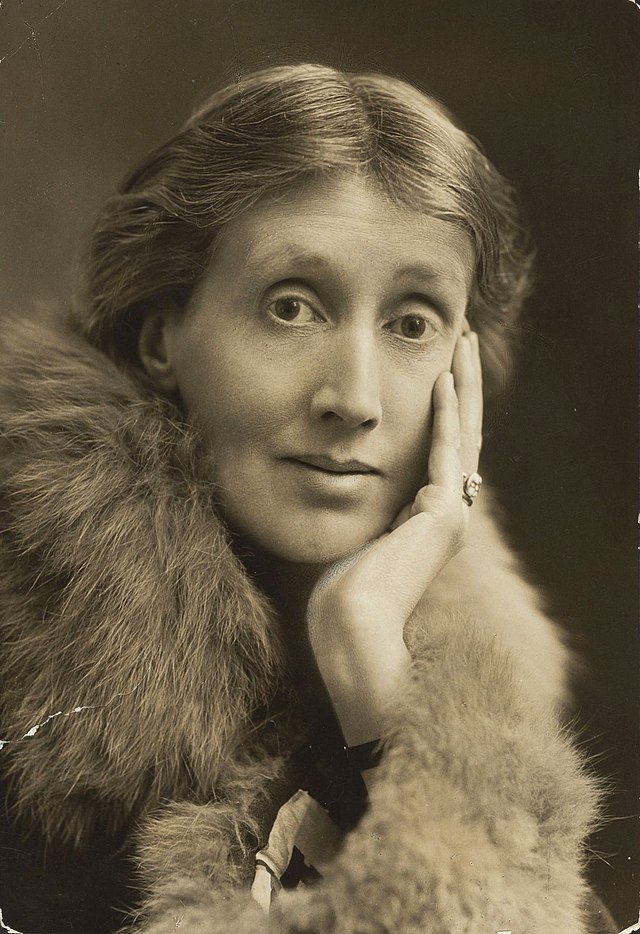
Virginia Woolf's Orlando is a character whose change of sex is physiological as well as psychological. Born a man in the 16th century, after a series of relationships (including being Queen Elizabeth's lover) Orlando wakes up one day to discover that he is now a she. He/she takes this change with equanimity, as she does the inexplicable fact that her lifespan encompasses centuries, not decades. When her story ends it is 1928, and Orlando is still physically only thirty-five years old.
Gender identity and the role of women in society are the principal themes of the first half of the novel. Most major characters exhibit some degree of androgyny in their behavior, attire, or sexual orientation. And Woolf makes a powerful feminist argument when she shows how Orlando's rights and roles become circumscribed when his body morphs into that of a woman, even though her mind and personality have not changed. The prose in this portion of the book is simple and whimsical, with the author often making wry comments about her role as "biographer."
Orlando is born an English nobleman, and serves for a while as a diplomat in Constantinople. But in his heart, he is a poet, and when she returns from the East, Orlando attempts to associate with the famous minds of the day. The novel now assumes a more satirical tone as it lampoons writers, publishers, and critics. But as the centuries roll past, Orlando's life becomes more of an internal dialogue with her own memories as she attempts to find a voice and a purpose. Woolf's language at this point is no longer simple and whimsical, but has become a lush and dreamlike prose poem.
One of the more interesting aspects of this novel is to encounter Virginia Woolf's disparaging view of the 19th century and its literature. She sees the 20th century as only imperfectly able to recapture the social and artistic heights of the 18th century.
Orlando is a fantastic work of the imagination full of relevant commentary on gender roles. It is modeled on the life and work of Woolf's lover Vita Sackville-West, but no doubt reveals much about the author's own personality and internal conflicts.
Other books I have read by Virginia Woolf:
The Voyage Out
Night and Day
Mrs Dalloway
To the Lighthouse
Orlando appears on the following lists:
1001 Books You Must Read Before You Die (1006 & 2010 eds.)
The Western Canon by Harold Bloom
The New Lifetime Reading Plan by Fadiman & Major
Guardian's "1000 Novels Everyone Should Read" in the Science Fiction category
Radcliffe Publishing's "100 Best Novels of the 20th Century"
Readercon's "A Working Canon of Slipstream Writings"
13 Ways of Looking at the Novel by Jane Smiley
First published 1928

"Different though the sexes are, they intermix. In every human being a vacillation from one sex to the other takes place, and often it is only the clothes that keep the male or female likeness, while underneath the sex is the very opposite of what it is above."
Virginia Woolf's Orlando is a character whose change of sex is physiological as well as psychological. Born a man in the 16th century, after a series of relationships (including being Queen Elizabeth's lover) Orlando wakes up one day to discover that he is now a she. He/she takes this change with equanimity, as she does the inexplicable fact that her lifespan encompasses centuries, not decades. When her story ends it is 1928, and Orlando is still physically only thirty-five years old.
Gender identity and the role of women in society are the principal themes of the first half of the novel. Most major characters exhibit some degree of androgyny in their behavior, attire, or sexual orientation. And Woolf makes a powerful feminist argument when she shows how Orlando's rights and roles become circumscribed when his body morphs into that of a woman, even though her mind and personality have not changed. The prose in this portion of the book is simple and whimsical, with the author often making wry comments about her role as "biographer."
Orlando is born an English nobleman, and serves for a while as a diplomat in Constantinople. But in his heart, he is a poet, and when she returns from the East, Orlando attempts to associate with the famous minds of the day. The novel now assumes a more satirical tone as it lampoons writers, publishers, and critics. But as the centuries roll past, Orlando's life becomes more of an internal dialogue with her own memories as she attempts to find a voice and a purpose. Woolf's language at this point is no longer simple and whimsical, but has become a lush and dreamlike prose poem.
One of the more interesting aspects of this novel is to encounter Virginia Woolf's disparaging view of the 19th century and its literature. She sees the 20th century as only imperfectly able to recapture the social and artistic heights of the 18th century.
Orlando is a fantastic work of the imagination full of relevant commentary on gender roles. It is modeled on the life and work of Woolf's lover Vita Sackville-West, but no doubt reveals much about the author's own personality and internal conflicts.
Other books I have read by Virginia Woolf:
The Voyage Out
Night and Day
Mrs Dalloway
To the Lighthouse
Orlando appears on the following lists:
1001 Books You Must Read Before You Die (1006 & 2010 eds.)
The Western Canon by Harold Bloom
The New Lifetime Reading Plan by Fadiman & Major
Guardian's "1000 Novels Everyone Should Read" in the Science Fiction category
Radcliffe Publishing's "100 Best Novels of the 20th Century"
Readercon's "A Working Canon of Slipstream Writings"
13 Ways of Looking at the Novel by Jane Smiley
36Nickelini
I already praised your lovely review on your other thread, so I won't repeat myself. But I see the previous Woolf novels you've read and I'm wondering if you are reading her books in order. If so of course you'll need to go back to Jacob's Room, which I think is underrated.
38StevenTX
>36 Nickelini: Thanks, Joyce. My approach to Woolf, like other authors, has been haphazard. I started with her most prominent novels, To the Lighthouse and then Mrs Dalloway. Then I started taking things chronologically and read her first two. But this year my mortality-driven approach is to read first what I want to read most. I can't say now which one of her books I'll read next, or when, but I certainly intend to read Jacob's Room at some point.
39Nickelini
But this year my mortality-driven approach is to read first what I want to read most.
Ha ha, well said. I keep thinking that I should adopt that plan too.
Ha ha, well said. I keep thinking that I should adopt that plan too.
40NanaCC
>35 StevenTX: Orlando sounds fascinating. Not having read any Woolf before, I don't know where to start.
41baswood
Great review of Orlando I read it many many years ago and I soon realised that I had missed a lot. It is one of those books that I will certainly re-read. Even though I missed an awful lot on my first read (I could not believe that the central character changed sex) I still enjoyed the reading experience, because the prose is so lovely to read.
42Poquette
I tried to read Orlando once upon a time because I was quite enthralled by a movie version I had seen but gave up on it. I think I might eventually give it another try. Thanks for your enlightening précis which gives it some context.
43Nickelini
#42 - Suzanne - yes, the film version is enthralling, isn't it! Reading these posts makes me want to watch it again.
44rebeccanyc
I've never been able to read Virgina Woolf, but I found your review fascinating.
45kidzdoc
Great review of Orlando, Steven. It was interesting to compare it to the one that Rhian (@SandDune) wrote several days ago.
46StevenTX
Byzantium: The Surprising Life of a Medieval Empire by Judith Herrin
First published 2007

BYZANTINE. adj. a. characterized by intrigue; scheming or devious. b. highly complicated; intricate and involved.
Judith Herrin's Byzantium: The Surprising Life of a Medieval Empire is largely an attempt to rehabilitate the image of an empire whose very name has become a pejorative. It meets that goal in an entertaining and enlightening manner, giving readers an understanding of Byzantine life and culture and an appreciation for the empire's important place in our history.
The Byzantine Empire was known to its subjects simply as the Roman Empire, and that's what it was: a continuation of the Rome of Augustus, Hadrian and Marcus Aurelius only with a new capital, a new religion, and an old language. But the forms and institutions of Imperial Rome remained in place for centuries, including its senate, its often fratricidal imperial successions, and its chariot races. From its founding to its fall, the city of Constantinople stood for over 1100 years as the Queen City of Western civilization while the rest of Europe foundered through its Dark Ages.
The book is organized into thematic chapters rather than along a strict chronology, though the themes are ordered in such a way as to follow a general timeline. There are chapters on important and representative places such as the Hagia Sophia cathedral, the Mount Athos monastery, and the fabled city of Trebizond. There are also chapters on institutions such as eunuchs, the military, and the imperial court. And there are chapters focusing on key events and movements such as the iconoclast movement, the working class uprisings in Thessalonike, and Constantinople's special relationship with Venice. There are, of course, pluses and minuses to a non-chronological approach. The story of any particular emperor's reign becomes fragmented, but it is easier to grasp the underlying currents of history.
Herrin gives a very precise answer to the question of why the Byzantine Empire has such a negative reputation and is so often neglected in historical studies. In 1204 the armies of the Fourth Crusade treacherously attacked the Empire and sacked its capital. The attack was instigated by Venetians looking to cripple the empire and monopolize trade in the eastern Mediterranean. To justify this savage attack of Christian against Christian, after the fact the Crusaders invented the myth of Byzantium as an evil empire that somehow deserved to have its churches ransacked, its libraries burnt, and its treasures looted. That myth persists and has led to Byzantium being treated as a dark and irrelevant vestige of Antiquity rather than as a major contributor to Western culture and history.
Among Byzantium's accomplishments are the maintenance of a remarkably stable coinage for over 700 years, the civilizing and Christianizing of the Slavs, and the preservation of Greek philosophy and science. And while Byzantium is closely identified with the Orthodox Church, Herrin shows that it was a cosmopolitan empire of many cultures and religions, home to Greeks, Jews, Arabs, Slavs, Persians, and Armenians. But perhaps Byzantium's greatest glory came in the 7th century when Muslim armies swept out of Arabia overrunning Mesopotamia, Persia, Egypt, North Africa, and Spain. The Arabs tried many times to take Constantinople, but failed, and the empire pushed back, retaking Asia Minor each time. Had Byzantium fallen at that time, the forces of Islam would have faced little opposition in a Europe peopled by wandering pagan tribes and embryonic Christian kingdoms. Constantinople stood as a bulwark against Islamic expansion for eight centuries. For better or worse, Herrin maintains, without the Byzantine Empire there would be no Europe as we know it.
First published 2007

BYZANTINE. adj. a. characterized by intrigue; scheming or devious. b. highly complicated; intricate and involved.
Judith Herrin's Byzantium: The Surprising Life of a Medieval Empire is largely an attempt to rehabilitate the image of an empire whose very name has become a pejorative. It meets that goal in an entertaining and enlightening manner, giving readers an understanding of Byzantine life and culture and an appreciation for the empire's important place in our history.
The Byzantine Empire was known to its subjects simply as the Roman Empire, and that's what it was: a continuation of the Rome of Augustus, Hadrian and Marcus Aurelius only with a new capital, a new religion, and an old language. But the forms and institutions of Imperial Rome remained in place for centuries, including its senate, its often fratricidal imperial successions, and its chariot races. From its founding to its fall, the city of Constantinople stood for over 1100 years as the Queen City of Western civilization while the rest of Europe foundered through its Dark Ages.
The book is organized into thematic chapters rather than along a strict chronology, though the themes are ordered in such a way as to follow a general timeline. There are chapters on important and representative places such as the Hagia Sophia cathedral, the Mount Athos monastery, and the fabled city of Trebizond. There are also chapters on institutions such as eunuchs, the military, and the imperial court. And there are chapters focusing on key events and movements such as the iconoclast movement, the working class uprisings in Thessalonike, and Constantinople's special relationship with Venice. There are, of course, pluses and minuses to a non-chronological approach. The story of any particular emperor's reign becomes fragmented, but it is easier to grasp the underlying currents of history.
Herrin gives a very precise answer to the question of why the Byzantine Empire has such a negative reputation and is so often neglected in historical studies. In 1204 the armies of the Fourth Crusade treacherously attacked the Empire and sacked its capital. The attack was instigated by Venetians looking to cripple the empire and monopolize trade in the eastern Mediterranean. To justify this savage attack of Christian against Christian, after the fact the Crusaders invented the myth of Byzantium as an evil empire that somehow deserved to have its churches ransacked, its libraries burnt, and its treasures looted. That myth persists and has led to Byzantium being treated as a dark and irrelevant vestige of Antiquity rather than as a major contributor to Western culture and history.
Among Byzantium's accomplishments are the maintenance of a remarkably stable coinage for over 700 years, the civilizing and Christianizing of the Slavs, and the preservation of Greek philosophy and science. And while Byzantium is closely identified with the Orthodox Church, Herrin shows that it was a cosmopolitan empire of many cultures and religions, home to Greeks, Jews, Arabs, Slavs, Persians, and Armenians. But perhaps Byzantium's greatest glory came in the 7th century when Muslim armies swept out of Arabia overrunning Mesopotamia, Persia, Egypt, North Africa, and Spain. The Arabs tried many times to take Constantinople, but failed, and the empire pushed back, retaking Asia Minor each time. Had Byzantium fallen at that time, the forces of Islam would have faced little opposition in a Europe peopled by wandering pagan tribes and embryonic Christian kingdoms. Constantinople stood as a bulwark against Islamic expansion for eight centuries. For better or worse, Herrin maintains, without the Byzantine Empire there would be no Europe as we know it.
47baswood
Wow that is interesting about the Byzantine Empire as a bulwark against Muslim expansion. Another history book that I would like to read.
48Nickelini
Yes, that is really interesting. How long is it? Just the title makes me think that it must be 1500 pages of exquisite detail, with long laborious tangents, and hundreds of pages of footnotes. Or am I thinking in a pejorative way?
49AnnieMod
Great review of the Byzantium book.
The sacking of Constantinople at the start of the 13th century weakened the empire to the point of no return (there were internal problems at the time not the last of them being some of their territories escaping back to independence in the previous decades) and allowed the Ottoman Empire to take roots a century/century and a half later and basically to own the peninsula for centuries. Had the 4th Crusade left it alone (and especially not blaming all on good old Byzantium in the century after that), there is a chance that the Ottomans would not have made it past Byzantium and its neighboring countries. Or in the very least a lot more of the knights of the West would have come to help. And without the Ottomans in Europe, the history would have been very different - the always ready to explode Balkans would not have been such a big problem in the 20th century.
Have fun reading the book for the Ottoman empire (saw in the what do you read thread that you are heading that way) :)
The sacking of Constantinople at the start of the 13th century weakened the empire to the point of no return (there were internal problems at the time not the last of them being some of their territories escaping back to independence in the previous decades) and allowed the Ottoman Empire to take roots a century/century and a half later and basically to own the peninsula for centuries. Had the 4th Crusade left it alone (and especially not blaming all on good old Byzantium in the century after that), there is a chance that the Ottomans would not have made it past Byzantium and its neighboring countries. Or in the very least a lot more of the knights of the West would have come to help. And without the Ottomans in Europe, the history would have been very different - the always ready to explode Balkans would not have been such a big problem in the 20th century.
Have fun reading the book for the Ottoman empire (saw in the what do you read thread that you are heading that way) :)
50StevenTX
>48 Nickelini: It's just 338 pages of text and another 50 pages of recommended reading, chronological tables, maps and index. There are no footnotes.
>49 AnnieMod: The author doesn't speculate, that I can recall, about what might have happened if the Crusaders had left Constantinople alone (or if the city had been better defended). She does say that the empire showed remarkable resilience in pulling itself back together after the Latins were driven out, and this makes her point that the empire wasn't totally dependent on the city of Constantinople. There were so many variables in this age with history turning on seemingly random events like the earthquake that toppled defenses in Thrace and allowed the Ottomans to establish a foothold in Europe. But everything's okay now because in 2004 Pope John Paul II apologized for what the Crusaders did in Constantinople.
Yes, I'm starting the Ottoman book. It's twice as big for an empire that lasted half as long.
>49 AnnieMod: The author doesn't speculate, that I can recall, about what might have happened if the Crusaders had left Constantinople alone (or if the city had been better defended). She does say that the empire showed remarkable resilience in pulling itself back together after the Latins were driven out, and this makes her point that the empire wasn't totally dependent on the city of Constantinople. There were so many variables in this age with history turning on seemingly random events like the earthquake that toppled defenses in Thrace and allowed the Ottomans to establish a foothold in Europe. But everything's okay now because in 2004 Pope John Paul II apologized for what the Crusaders did in Constantinople.
Yes, I'm starting the Ottoman book. It's twice as big for an empire that lasted half as long.
52chlorine
Very interesting reviews.
I've read Mrs Dalloway a while back (I think it was the year in which Virginia Woolf came in the public domain in France) and I was quite disappointed, so that turned me off reading other books by her (which I previously wanted to do very much). Then a few months ago one of my bookclub members mentioned her as one of her favourite authors. This and your review of Orlando may finally prompt me to try other books by Woolf.
I've read Mrs Dalloway a while back (I think it was the year in which Virginia Woolf came in the public domain in France) and I was quite disappointed, so that turned me off reading other books by her (which I previously wanted to do very much). Then a few months ago one of my bookclub members mentioned her as one of her favourite authors. This and your review of Orlando may finally prompt me to try other books by Woolf.
53Helenliz
>46 StevenTX: Only 338 pages? I think I missed a trick there. The history of Byzantium I read (by John Julius Norwich) was 3 volumes and 400 to 500 pages each... It's a most intriguing story though and deserves better press than it has. Sounds like a book to look out for.
54StevenTX
>53 Helenliz: There is also A Short History of Byzantium (1997) in which Norwich condenses his own 3-volume history. It's 383 pages of text (but smaller print than the Herrin book), and presented in a more conventional chronological fashion. I hope to make time to read it in the coming months as well.
55rebeccanyc
Very interesting review and discussion. It's always fun to think of what might have been.
56dchaikin
Fun review of Byzantine history and an intriguing review of Bellow's Orlando. Yes, i can relate, even if I haven't ruined a carreer or marriage (although $46 oil is not good for my carreer.) Best of luck with North Korean sabotage.
57StevenTX
The Rise of Endymion by Dan Simmons
First published 1997


The Rise of Endymion is the fourth and final book in the author's Hyperion Cantos. It's not a work that stands alone; you have to read the preceding three novels, and fairly close together, if possible. Nor would you want to miss the conclusion if you've read and enjoyed the first three books in the series. In spectacular fashion it wraps up all the issues, answers all the questions, and revisits most of the characters from the preceding volumes. So there's no need for me to reveal anything further about it.
As for the series as a whole, it is enjoyable, often exciting, and occasionally moving. The characters are largely straightforward and defined by their role in the story--you've met their types before. The author's imagination is better expressed in the dozen or more worlds he details with their vivid landscapes and varied cultures. But most of all there is the interplay between religion and technology as mankind begins its directed evolution into a universe of other dimensions and unlimited possibilities.
I had mixed feelings, however, about the strong religious element in the series, especially the final volume, not just as a component of the plot but as the basis for the revealed workings of the universe. Granted that sufficiently advanced technologies will always seem magical or miraculous, as will the latent powers of the mind, but in this case many of the core elements seem to be deliberate Christian and Buddhist allegories. (I can't be more specific without spoilers.) So I'm not sure what to take away from the series other than the fact that it was fun to read, and had some fantastic ideas, but reflected a set of spiritual values to which I could not relate.
The Rise of Endymion appears on the following lists:
Anatomy of Wonder annotated bibiliography
"100 Greatest Fantasy and Science Fiction" by Alex Carnevale for ThisRecording (as part of "The Hyperion Cantos")
First published 1997


The Rise of Endymion is the fourth and final book in the author's Hyperion Cantos. It's not a work that stands alone; you have to read the preceding three novels, and fairly close together, if possible. Nor would you want to miss the conclusion if you've read and enjoyed the first three books in the series. In spectacular fashion it wraps up all the issues, answers all the questions, and revisits most of the characters from the preceding volumes. So there's no need for me to reveal anything further about it.
As for the series as a whole, it is enjoyable, often exciting, and occasionally moving. The characters are largely straightforward and defined by their role in the story--you've met their types before. The author's imagination is better expressed in the dozen or more worlds he details with their vivid landscapes and varied cultures. But most of all there is the interplay between religion and technology as mankind begins its directed evolution into a universe of other dimensions and unlimited possibilities.
I had mixed feelings, however, about the strong religious element in the series, especially the final volume, not just as a component of the plot but as the basis for the revealed workings of the universe. Granted that sufficiently advanced technologies will always seem magical or miraculous, as will the latent powers of the mind, but in this case many of the core elements seem to be deliberate Christian and Buddhist allegories. (I can't be more specific without spoilers.) So I'm not sure what to take away from the series other than the fact that it was fun to read, and had some fantastic ideas, but reflected a set of spiritual values to which I could not relate.
The Rise of Endymion appears on the following lists:
Anatomy of Wonder annotated bibiliography
"100 Greatest Fantasy and Science Fiction" by Alex Carnevale for ThisRecording (as part of "The Hyperion Cantos")
58Linda92007
Great review of Orlando, Steven. I will confess to never having read anything by Virginia Woolf, but what was that about mortality-driven choices? I think that trying to apply that to the mountain of possibilities would leave me paralyzed with indecision.
59edwinbcn
Interesting to read about Richard Jefferies' science fiction novel. I have three of his books about nature.
61StevenTX
Joseph Andrews by Henry Fielding
Full title, The History of the Adventures of Joseph Andrews and of His Friend Mr. Abraham Adams.
Written in Imitation of the Manner of Cervantes, Author of Don Quixote.
First published 1742


In 1740, Samuel Richardson published his landmark epistolary novel Pamela; or, Virtue Rewarded, in which a lowly servant girl, through her moral rectitude in rejecting her master's lustful advances, not only reforms her master's character but herself ascends to the ranks of the genteel. Henry Fielding parodied Pamela in his first work of prose fiction, Shamela. He then broadened the attack with Joseph Andrews, which satirizes not only the content but the very style of Richardson's novel by importing the comic forms of the Spanish picaresque novel.
Joseph Andrews is the brother of Richardson's heroine, Pamela Andrews. Like his sister, Joseph is a servant in the household of the local gentry, the Booby family. Pamela's master, known in that novel only as "Mr. B," is the nephew of Joseph's mistress, the widowed Lady Booby. Lady Booby is secretly in love with Joseph, and constantly torn between her feelings and the potential shame of having an affair with her footman. To complicate matters, her wicked housekeeper, Mrs. Slipslop, is also lusting after Joseph. But Joseph himself is true to his hometown sweetheart, an orphaned girl named Fanny.
After Lady Booby fires Joseph for his rejection of her overt advances, Joseph, Fanny, and their friend and mentor Abraham Adams go on an extended road journey which forms the bulk of the novel. Adams, a scholarly but impoverished Anglican pastor, is an absent-minded and often deluded comic figure like Quixote. He is constantly the butt of practical jokes and mishaps, having his clothes reduced to scanty rags, chamber pots dumped over his head, etc. Fanny, meanwhile, is so beautiful and shapely that she attracts libertines and potential rapists wherever she goes.
The three penniless wanderers meet a variety of people on their journey, being at times robbed, beaten, jailed, swindled, and starved. At other times they are rescued, nursed, feasted and consoled. Most of the people they meet are hypocrites, especially those of the upper classes. A nobleman might have them hunted like foxes for sport, while a bedraggled peddler would give them his last sixpence. The overriding moral message of the novel is to judge people by what they do, not by what they say, by the amount of wealth they have accumulated, or by their position in society.
Fielding also satirizes the prolixity of Richardson's work. At one point in the middle of an exciting fight scene, the author interjects: "Reader, we would make a simile on this occasion, but for two reasons: the first is, it would interrupt the description, which should be rapid in this part; but that doth not weigh much, many precedents occurring for such an interruption: the second and much the greater reason is, that we could find no simile adequate to our purpose: for indeed, what instance could we bring to set before our reader’s eyes at once the idea of friendship, courage, youth, beauty, strength, and swiftness? all which blazed in the person of Joseph Andrews. Let those, therefore, that describe lions and tigers, and heroes fiercer than both, raise their poems or plays with the simile of Joseph Andrews, who is himself above the reach of any simile."
Notwithstanding Fielding's admonition against interruptions, he does digress frequently in the typical manner of the 18th century novel into the backgrounds of secondary characters. Every character must "tell his story," only some of which are directly relevant to the plot. On the whole, though, Joseph Andrews is a funny, uninhibited novel that, while it may not measure up to the author's masterpiece, Tom Jones, is still both fun to read and a noteworthy milestone in the history of the English novel.
Other works I have read by Henry Fielding:
An Apology for the Life of Mrs Shamela Andrews
The History of Tom Jones, a Foundling
Joseph Andrews appears on the following reading lists:
Harold Bloom's "Western Canon"
1001 Books You Must Read Before You Die, 2006 and 2010 editions
The Guardian's "100 Novels Everyone Must Read"
Full title, The History of the Adventures of Joseph Andrews and of His Friend Mr. Abraham Adams.
Written in Imitation of the Manner of Cervantes, Author of Don Quixote.
First published 1742


In 1740, Samuel Richardson published his landmark epistolary novel Pamela; or, Virtue Rewarded, in which a lowly servant girl, through her moral rectitude in rejecting her master's lustful advances, not only reforms her master's character but herself ascends to the ranks of the genteel. Henry Fielding parodied Pamela in his first work of prose fiction, Shamela. He then broadened the attack with Joseph Andrews, which satirizes not only the content but the very style of Richardson's novel by importing the comic forms of the Spanish picaresque novel.
Joseph Andrews is the brother of Richardson's heroine, Pamela Andrews. Like his sister, Joseph is a servant in the household of the local gentry, the Booby family. Pamela's master, known in that novel only as "Mr. B," is the nephew of Joseph's mistress, the widowed Lady Booby. Lady Booby is secretly in love with Joseph, and constantly torn between her feelings and the potential shame of having an affair with her footman. To complicate matters, her wicked housekeeper, Mrs. Slipslop, is also lusting after Joseph. But Joseph himself is true to his hometown sweetheart, an orphaned girl named Fanny.
After Lady Booby fires Joseph for his rejection of her overt advances, Joseph, Fanny, and their friend and mentor Abraham Adams go on an extended road journey which forms the bulk of the novel. Adams, a scholarly but impoverished Anglican pastor, is an absent-minded and often deluded comic figure like Quixote. He is constantly the butt of practical jokes and mishaps, having his clothes reduced to scanty rags, chamber pots dumped over his head, etc. Fanny, meanwhile, is so beautiful and shapely that she attracts libertines and potential rapists wherever she goes.
The three penniless wanderers meet a variety of people on their journey, being at times robbed, beaten, jailed, swindled, and starved. At other times they are rescued, nursed, feasted and consoled. Most of the people they meet are hypocrites, especially those of the upper classes. A nobleman might have them hunted like foxes for sport, while a bedraggled peddler would give them his last sixpence. The overriding moral message of the novel is to judge people by what they do, not by what they say, by the amount of wealth they have accumulated, or by their position in society.
Fielding also satirizes the prolixity of Richardson's work. At one point in the middle of an exciting fight scene, the author interjects: "Reader, we would make a simile on this occasion, but for two reasons: the first is, it would interrupt the description, which should be rapid in this part; but that doth not weigh much, many precedents occurring for such an interruption: the second and much the greater reason is, that we could find no simile adequate to our purpose: for indeed, what instance could we bring to set before our reader’s eyes at once the idea of friendship, courage, youth, beauty, strength, and swiftness? all which blazed in the person of Joseph Andrews. Let those, therefore, that describe lions and tigers, and heroes fiercer than both, raise their poems or plays with the simile of Joseph Andrews, who is himself above the reach of any simile."
Notwithstanding Fielding's admonition against interruptions, he does digress frequently in the typical manner of the 18th century novel into the backgrounds of secondary characters. Every character must "tell his story," only some of which are directly relevant to the plot. On the whole, though, Joseph Andrews is a funny, uninhibited novel that, while it may not measure up to the author's masterpiece, Tom Jones, is still both fun to read and a noteworthy milestone in the history of the English novel.
Other works I have read by Henry Fielding:
An Apology for the Life of Mrs Shamela Andrews
The History of Tom Jones, a Foundling
Joseph Andrews appears on the following reading lists:
Harold Bloom's "Western Canon"
1001 Books You Must Read Before You Die, 2006 and 2010 editions
The Guardian's "100 Novels Everyone Must Read"
62baswood
Excellent review of Joseph Andrews and one that I will read as you say it is a noteworthy milestone in the history of the English novel. It sounds as though you would miss a lot if you did not realise it was a parody of Samuel Richardson's novel and writing style.
63StevenTX
The Midwich Cuckoos by John Wyndham
First published 1957


Midwich is an ordinary little English village until the strangest thing happens. Late one evening everyone simply falls unconscious. They stay that way for 24 hours, and anyone who steps within a certain radius of the village collapses as well. An aerial photograph shows a strange, ovoid object near the center of town. But the next day, when everyone wakes up, the object is gone. Things seem to be perfectly normal in Midwich until several weeks later when the inhabitants come to the shocking realization: every woman and girl of childbearing age in Midwich is pregnant.
John Wyndham's novels have been described as "cosy apocalypses," and that is certainly the case with The Midwich Cuckoos. Everything is told from the perspective of the village's inhabitants as they decide to keep the existence of a strange brood of children to themselves. The government is not unaware of the happenings in Midwich, but it has reasons of its own for keeping things low key and under wraps. What we have is a story of ordinary people trying to fit extraordinary circumstances into their comfort zones, and largely succeeding for a number of years.
There are manifestations of the Cold War mindset in the novel, but what is particularly interesting is how it speaks almost directly to the problem Europe is currently confronting with a growing Muslim minority that refuses to assimilate and which many see as a threat to the Western way of life. "Can any State, however tolerant, afford to harbour an increasingly powerful minority which it has no power to control?," asks a character at one point. In answer to his own question, he cites the problem of "...your sham idealists: the quite large number of people who profess ideals as a form of premium for other-life insurance, and are content to lay up slavery and destitution for their descendants so long as they are enabled to produce personal copybooks of elevated views at the gate of heaven." A very timely question: Do our principles of personal liberty compel us to tolerate, even empower, those who are expressly intent on destroying us?
The Midwich Cuckoos is occasionally thoughtful, sometimes frightening, and always entertaining--highly recommended.
The novel has been filmed several times, but under the titles "Village of the Damned" and "Children of the Damned," so you may find the plot familiar even if you don't recognize the title.
The copy I read was the inexpensive e-book issued by Rosetta Books. It is full of typos and spacing errors. If you can find a used print copy, I would recommend that instead.
Other books I have read by John Wyndham:
The Day of the Triffids
The Midwich Cuckoos appears on the following reading lists:
1001 Books You Must Read Before You Die (2006 and 2010 editions)
Anatomy of Wonder annotated bibliography
500 Essential Cult Books under the category "Incredible Worlds"
Bloomsbury Good Reading Guide "100 Must-Read Science Fiction Books"
The Guardian's "1000 Novels Everyone Must Read"
James Wallace Harris's "Classics of Science Fiction"
Phobos's "100 Best Science Fiction Books"
David Pringle's "Greatest Science Fiction Novels"
SF Lists's "Top 100 Sci-Fi Books"
First published 1957


Midwich is an ordinary little English village until the strangest thing happens. Late one evening everyone simply falls unconscious. They stay that way for 24 hours, and anyone who steps within a certain radius of the village collapses as well. An aerial photograph shows a strange, ovoid object near the center of town. But the next day, when everyone wakes up, the object is gone. Things seem to be perfectly normal in Midwich until several weeks later when the inhabitants come to the shocking realization: every woman and girl of childbearing age in Midwich is pregnant.
John Wyndham's novels have been described as "cosy apocalypses," and that is certainly the case with The Midwich Cuckoos. Everything is told from the perspective of the village's inhabitants as they decide to keep the existence of a strange brood of children to themselves. The government is not unaware of the happenings in Midwich, but it has reasons of its own for keeping things low key and under wraps. What we have is a story of ordinary people trying to fit extraordinary circumstances into their comfort zones, and largely succeeding for a number of years.
There are manifestations of the Cold War mindset in the novel, but what is particularly interesting is how it speaks almost directly to the problem Europe is currently confronting with a growing Muslim minority that refuses to assimilate and which many see as a threat to the Western way of life. "Can any State, however tolerant, afford to harbour an increasingly powerful minority which it has no power to control?," asks a character at one point. In answer to his own question, he cites the problem of "...your sham idealists: the quite large number of people who profess ideals as a form of premium for other-life insurance, and are content to lay up slavery and destitution for their descendants so long as they are enabled to produce personal copybooks of elevated views at the gate of heaven." A very timely question: Do our principles of personal liberty compel us to tolerate, even empower, those who are expressly intent on destroying us?
The Midwich Cuckoos is occasionally thoughtful, sometimes frightening, and always entertaining--highly recommended.
The novel has been filmed several times, but under the titles "Village of the Damned" and "Children of the Damned," so you may find the plot familiar even if you don't recognize the title.
The copy I read was the inexpensive e-book issued by Rosetta Books. It is full of typos and spacing errors. If you can find a used print copy, I would recommend that instead.
Other books I have read by John Wyndham:
The Day of the Triffids
The Midwich Cuckoos appears on the following reading lists:
1001 Books You Must Read Before You Die (2006 and 2010 editions)
Anatomy of Wonder annotated bibliography
500 Essential Cult Books under the category "Incredible Worlds"
Bloomsbury Good Reading Guide "100 Must-Read Science Fiction Books"
The Guardian's "1000 Novels Everyone Must Read"
James Wallace Harris's "Classics of Science Fiction"
Phobos's "100 Best Science Fiction Books"
David Pringle's "Greatest Science Fiction Novels"
SF Lists's "Top 100 Sci-Fi Books"
64baswood
I don't think I have read The Midwich Cuckoos, but I am now looking forward to doing so.
65ELiz_M
>63 StevenTX: Ha! I've not heard the phrase "cozy apocalypse" before, but how apt.
66kidzdoc
Fabulous review of what sounds like a fascinating book, Steven! The book's title was unfamiliar to me, but I heard of Children of the Damned. The Midwich Cuckoos definitely goes on the wish list.
67LolaWalser
"Children of the damned" is pretty great (George Sanders in the main role). Unlike the American thinly-veiled Communist scare invasion movies, the alien threat feels truly "from outer space".
Wyndham is dated in some ways but to me still infinitely more enjoyable than almost any old sf. Do you plan to read more of his, Steven? The chrysalids is another of his big classics, but I also found The trouble with lichen interesting for the unusual attempt to address feminism. It also features the only truly major female character I've come across in his books so far.
Only one other novel of his I've read, The web, has an important female character, but the book overall isn't particularly successful. Still, that one is worth mentioning if only for the central relationship so far unique in my reading experience--an older man and a young, attractive woman going through adventure in an isolated, savage, dangerous setting, not only are "only friends", they are completely equal in the situation, sharing the perils and cooperating to get away. He's not her boss, mentor, lover, or a stand-in for father, uncle, brother. She's not subordinate, a "pupil", a damsel, a stand-in for daughter, or secretly lusted after. Just two people trying to help each other survive and get the heck out of a horrific mess.
Remarkable!
Wyndham is dated in some ways but to me still infinitely more enjoyable than almost any old sf. Do you plan to read more of his, Steven? The chrysalids is another of his big classics, but I also found The trouble with lichen interesting for the unusual attempt to address feminism. It also features the only truly major female character I've come across in his books so far.
Only one other novel of his I've read, The web, has an important female character, but the book overall isn't particularly successful. Still, that one is worth mentioning if only for the central relationship so far unique in my reading experience--an older man and a young, attractive woman going through adventure in an isolated, savage, dangerous setting, not only are "only friends", they are completely equal in the situation, sharing the perils and cooperating to get away. He's not her boss, mentor, lover, or a stand-in for father, uncle, brother. She's not subordinate, a "pupil", a damsel, a stand-in for daughter, or secretly lusted after. Just two people trying to help each other survive and get the heck out of a horrific mess.
Remarkable!
68StevenTX
>67 LolaWalser: I will probably be reading two more of his novels: Chocky and The Chrysalids, but I have no idea when.
69valkyrdeath
>67 LolaWalser: What was his attitude about feminism in Trouble with Lichen? Most of the Wyndham reading I did was when I was a kid so I can't remember the details. The only one I read in recent years was Consider Her Ways and Others, and I couldn't quite get what his own opinion was on it. The woman in the future society talks about how 20th century women were held back by society, but the woman from the 20th century who had found herself there argued against it and stated it wasn't like that at all.
70LolaWalser
>69 valkyrdeath:
Hi, sorry, didn't see the question before. That's not easy to answer without giving away major plot points! and two, I genuinely am not entirely sure about how Wyndham regarded feminism. My impression was overall a favourable one, the more so because other Wyndham's books I had read (including his biggest hits--The Midwich cuckoos, The Chrysalids, The day of the triffids) dealt with female characters, when they existed at all, in standard "traditional" fashion. It was therefore pleasantly surprising to find him creating a major female character who was a hero of a science fiction tale pretty much in the same way as his male characters had been (and although she does get a "romance" with some very "traditional" overtones, it proceeds far more realistically, even being roundly rejected at first.) The plot concerns a development in cosmetic industry and therefore targets directly the image of women, the exploitation and manipulation of that image, the pressure on women to be "feminine" and nothing else etc. There is much room for alternative interpretations here and I hesitate to push one over another.
What you say about "Consider her ways" interests me a lot (I have it), I might have more to add after I read it, sounds like it could clear up some points.
(Don't worry, Steven, not in your thread! :))
Hi, sorry, didn't see the question before. That's not easy to answer without giving away major plot points! and two, I genuinely am not entirely sure about how Wyndham regarded feminism. My impression was overall a favourable one, the more so because other Wyndham's books I had read (including his biggest hits--The Midwich cuckoos, The Chrysalids, The day of the triffids) dealt with female characters, when they existed at all, in standard "traditional" fashion. It was therefore pleasantly surprising to find him creating a major female character who was a hero of a science fiction tale pretty much in the same way as his male characters had been (and although she does get a "romance" with some very "traditional" overtones, it proceeds far more realistically, even being roundly rejected at first.) The plot concerns a development in cosmetic industry and therefore targets directly the image of women, the exploitation and manipulation of that image, the pressure on women to be "feminine" and nothing else etc. There is much room for alternative interpretations here and I hesitate to push one over another.
What you say about "Consider her ways" interests me a lot (I have it), I might have more to add after I read it, sounds like it could clear up some points.
(Don't worry, Steven, not in your thread! :))
71valkyrdeath
>70 LolaWalser: Thanks. I've been meaning to read John Wyndham again, so I may well start with that one. Checking my list now, I realise it was way back in 2006 when I read Consider Her Ways, so even that isn't too recent, so my memory of the details is probably a bit hazy. I'd be interested to know what you think of it. And I'll stop hijacking this thread now!
In regards to The Midwich Cuckoos, it must have had an impact on me, since I read that book as a kid and can still remember it quite clearly.
In regards to The Midwich Cuckoos, it must have had an impact on me, since I read that book as a kid and can still remember it quite clearly.
72StevenTX
>70 LolaWalser:, >71 valkyrdeath: - Please, hijack all you want. It's an interesting discussion.
73lyzard
Just noting that Village Of The Damned and Children Of The Damned are two different films: the first is an adaptation of The Midwich Cuckoos, the second is a sequel to that film (lifting the premise of the book but not directly related to it).
I haven't read Wyndham recently enough to comment on his writing but I was somewhat bothered that in Village Of The Damned the perspective on this cosmic rape stayed entirely with the men and their reactions; I can't remember if that reflects the novel's POV.
I haven't read Wyndham recently enough to comment on his writing but I was somewhat bothered that in Village Of The Damned the perspective on this cosmic rape stayed entirely with the men and their reactions; I can't remember if that reflects the novel's POV.
74LolaWalser
>73 lyzard:
Good catch, yes, "Village..." is the adaptation of the book. It's been a while since I read it last, but IIRC the women's reactions aren't dwelt on nor is there a pronounced sense of the event as "rape"--partly no doubt due to tendency to understatement, and to the avoidance of sex in a book of that vintage.
Good catch, yes, "Village..." is the adaptation of the book. It's been a while since I read it last, but IIRC the women's reactions aren't dwelt on nor is there a pronounced sense of the event as "rape"--partly no doubt due to tendency to understatement, and to the avoidance of sex in a book of that vintage.
75DieFledermaus
Glad you enjoyed Joseph Andrews - I liked both that one and Shamela, although I also liked Pamela. Abraham Adams brawling and being hypocritical was very amusing.
The Midwich Cuckoos sounds interesting and I also liked the phrase "cozy apocalypse". I didn't realized that Village/Children of the Damned was based on a book. I have The Chrysalids already, so will probably read that one first.
>67 LolaWalser: - an older man and a young, attractive woman going through adventure in an isolated, savage, dangerous setting, not only are "only friends", they are completely equal in the situation, sharing the perils and cooperating to get away. He's not her boss, mentor, lover, or a stand-in for father, uncle, brother. She's not subordinate, a "pupil", a damsel, a stand-in for daughter, or secretly lusted after.
Heh, yeah, that's still out of the ordinary. Sometime I find myself rooting against a couple getting together or the introduction of romance into a story because it's so predictable (even if it's not otherwise a horrible relationship).
The Midwich Cuckoos sounds interesting and I also liked the phrase "cozy apocalypse". I didn't realized that Village/Children of the Damned was based on a book. I have The Chrysalids already, so will probably read that one first.
>67 LolaWalser: - an older man and a young, attractive woman going through adventure in an isolated, savage, dangerous setting, not only are "only friends", they are completely equal in the situation, sharing the perils and cooperating to get away. He's not her boss, mentor, lover, or a stand-in for father, uncle, brother. She's not subordinate, a "pupil", a damsel, a stand-in for daughter, or secretly lusted after.
Heh, yeah, that's still out of the ordinary. Sometime I find myself rooting against a couple getting together or the introduction of romance into a story because it's so predictable (even if it's not otherwise a horrible relationship).
76StevenTX
Nausea by Jean-Paul Sartre
First published 1938
English translation by Lloyd Alexander 1959
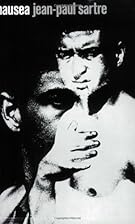

In a life devoid of belief, stripped of illusion, and skeptical about the impressions of the senses, what can one actually know? What should one do? If life has no meaning, why even bother to live? "I exist--the world exists--and I know that the world exists. That's all." This is the conclusion of Antoine Roquentin, a French writer who chronicles his intellectual and emotional struggles in Sartre's novel Nausea.
Roquentin's crisis begins with the unsettling feeling that the objects of everyday life are not as they appear to be; they are even threatening. He feels manipulated by them. "Objects should not touch because they are not alive.... But they touch me, it is unbearable. I am afraid of being in contact with them as though they are living beasts." This fear produced in Roquentin a vertiginous feeling he calls Nausea.
As the days pass, the diarist's feeling shift. There are spells of normalcy when the Nausea does not strike him. He continues his work, researching the life of an 18th century French diplomat. But at one point he encounters a document that invalidates everything he has learned about his subject. It was all a pretense established for the sake of the man's legacy. History is nothing but lies. Its truths are forever hidden, if they existed at all. The past is meaningless. Roquentin's life's work is pointless.
Eventually Roquentin questions even his own right to exist. He sinks further into despair and Nausea as he wanders the streets of the port city where he has been working. He clings to the one incontrovertible fact: "I exist." And as for the rest of the world, "things are entirely what they appear to be--and behind them . . . there is nothing."
Many of Roquentin's ideas are expressed in his dialogues with a fellow library patron whom he knows only as the Self-Taught Man. This gentleman educates himself simply by reading the contents of the public library, shelf by shelf, in alphabetical order. He accepts everything, questions nothing, and is the novel's spokesman for conventional wisdom and community values. One of the novel's most interesting passages is when the Self-Taught Man defends humanism, insisting that there is a natural moral law. Roquentin refutes this with view that there is only the self in a life devoid of meaning or purpose.
Nausea is one of the key texts of Existentialism. Its message is simple and powerful. The prose--which includes Roquentin's dreams, hallucinations and occasional paranoid imaginings--is vivid and occasionally disturbing. This is an important novel which challenges our beliefs and perceptions, and is highly recommended.
Other works I have read by Jean-Paul Sartre:
No Exit and Three Other Plays
Nausea appears on the following reading lists:
1001 Books You Must Read Before You Die (2006 and 2010 editions)
500 Essential Cult Books in the category "Cult Classics"
The reading list from How to Read a Book
Harold Bloom's Western Canon
Cult Fiction Reader's Guide "Must Reads"
Dalkey Archive's "Literary Works All Students Should Read"
Rough Guide to Cult Fiction "Essential Reading"
A Lifetime's Reading by Philip Ward
First published 1938
English translation by Lloyd Alexander 1959

In a life devoid of belief, stripped of illusion, and skeptical about the impressions of the senses, what can one actually know? What should one do? If life has no meaning, why even bother to live? "I exist--the world exists--and I know that the world exists. That's all." This is the conclusion of Antoine Roquentin, a French writer who chronicles his intellectual and emotional struggles in Sartre's novel Nausea.
Roquentin's crisis begins with the unsettling feeling that the objects of everyday life are not as they appear to be; they are even threatening. He feels manipulated by them. "Objects should not touch because they are not alive.... But they touch me, it is unbearable. I am afraid of being in contact with them as though they are living beasts." This fear produced in Roquentin a vertiginous feeling he calls Nausea.
As the days pass, the diarist's feeling shift. There are spells of normalcy when the Nausea does not strike him. He continues his work, researching the life of an 18th century French diplomat. But at one point he encounters a document that invalidates everything he has learned about his subject. It was all a pretense established for the sake of the man's legacy. History is nothing but lies. Its truths are forever hidden, if they existed at all. The past is meaningless. Roquentin's life's work is pointless.
Eventually Roquentin questions even his own right to exist. He sinks further into despair and Nausea as he wanders the streets of the port city where he has been working. He clings to the one incontrovertible fact: "I exist." And as for the rest of the world, "things are entirely what they appear to be--and behind them . . . there is nothing."
Many of Roquentin's ideas are expressed in his dialogues with a fellow library patron whom he knows only as the Self-Taught Man. This gentleman educates himself simply by reading the contents of the public library, shelf by shelf, in alphabetical order. He accepts everything, questions nothing, and is the novel's spokesman for conventional wisdom and community values. One of the novel's most interesting passages is when the Self-Taught Man defends humanism, insisting that there is a natural moral law. Roquentin refutes this with view that there is only the self in a life devoid of meaning or purpose.
Nausea is one of the key texts of Existentialism. Its message is simple and powerful. The prose--which includes Roquentin's dreams, hallucinations and occasional paranoid imaginings--is vivid and occasionally disturbing. This is an important novel which challenges our beliefs and perceptions, and is highly recommended.
Other works I have read by Jean-Paul Sartre:
No Exit and Three Other Plays
Nausea appears on the following reading lists:
1001 Books You Must Read Before You Die (2006 and 2010 editions)
500 Essential Cult Books in the category "Cult Classics"
The reading list from How to Read a Book
Harold Bloom's Western Canon
Cult Fiction Reader's Guide "Must Reads"
Dalkey Archive's "Literary Works All Students Should Read"
Rough Guide to Cult Fiction "Essential Reading"
A Lifetime's Reading by Philip Ward
77baswood
Great review of Nusea Steven. Such a long time since I read it that your review surprised me. Another book to re-read.
78StevenTX
Phaedo by Plato
Translated by Henry Cary
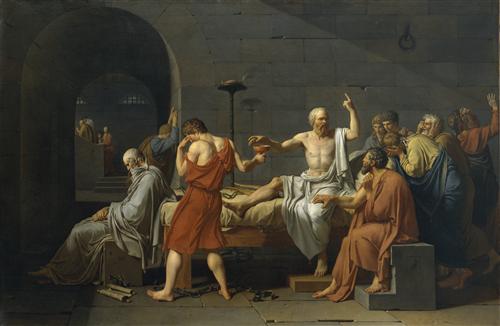
The friends of Socrates have gathered in the philosopher's cell on the last day of his life. At sundown he must drink the cup of hemlock to carry out the death sentence passed upon him by the leaders of Athens. Socrates astounds his companions by appearing perfectly content--even pleased--that he will die. He explains that he is entirely convinced that his soul is immortal, and that as soon as his body dies it will be going to reside with the gods in perpetual bliss. His friends ask how he can be so sure of the soul's immortality, so that becomes the subject of his final dialogue. Phaedo sits at his right hand, taking no part in the conversation, but he will be the one who later relates what happens.
Socrates bases his case for the immortality of the soul on four arguments. All four are surprisingly weak, and rest on assumptions and comparisons that simply do not hold. In one case, for example, he argues that since the soul is what gives us life, it is in its nature to not be dead just as it is the nature of fire to not be cold or for ice to not be hot. But turn the argument around and you must conclude that fire can never go out, and ice can never melt, because such would be contrary to their natures.
What is particularly interesting here--aside from the poignant death scene--is the complex theology of Socrates's vision of the afterlife. After death, he explains, the soul descends to the depths of the earth where it is judged. Those who are so bad as to be beyond redemption "a suitable destiny hurls into Tartarus, whence they never come forth." Those who have lived a spotless life and freed themselves from the demands of the body (i.e. philosophers) "arrive at the pure abode above, and dwell on the upper parts of the earth. And among these, they who have sufficiently purified themselves by philosophy shall live without bodies, throughout all future time, and shall arrive at habitations yet more beautiful than these which it is neither easy to describe."
Souls that are guilty of sins or the weaknesses of the flesh, however, pass through a sort of purgatory until they have earned the forgiveness of those against whom they have transgressed. Once they have paid their penalty, the wayward souls are returned to earth to be reborn in new bodies, usually those of "animals having the same habits as those they have given themselves up to during life." Those who have been guilty of "injustice, tyranny and rapine, will be clothed in the species of wolves, hawks and kites!" While those who have lived better lives will be reborn, if not as men, then as "civilized and peaceable kind of animals, such as bees perhaps, or wasps, or ants." (Personally I find the penalty for tyranny and rapine more appealing than the reward for hard work and suffering.)
One reviewer has suggested that since Plato was (as stated in the dialogue) absent from Socrates's death cell due to illness, he had only an imperfect idea of what Socrates actually said and has substituted his own ideas for those of his mentor. Perhaps that explains why the logic is so weak and the theology so speculative. But what I found most fascinating is that, present in Classical Greece, was the future Christian notion of Heaven, Hell, and Purgatory along with an Eastern concept of cycles of reincarnation and purification.
Translated by Henry Cary
The friends of Socrates have gathered in the philosopher's cell on the last day of his life. At sundown he must drink the cup of hemlock to carry out the death sentence passed upon him by the leaders of Athens. Socrates astounds his companions by appearing perfectly content--even pleased--that he will die. He explains that he is entirely convinced that his soul is immortal, and that as soon as his body dies it will be going to reside with the gods in perpetual bliss. His friends ask how he can be so sure of the soul's immortality, so that becomes the subject of his final dialogue. Phaedo sits at his right hand, taking no part in the conversation, but he will be the one who later relates what happens.
Socrates bases his case for the immortality of the soul on four arguments. All four are surprisingly weak, and rest on assumptions and comparisons that simply do not hold. In one case, for example, he argues that since the soul is what gives us life, it is in its nature to not be dead just as it is the nature of fire to not be cold or for ice to not be hot. But turn the argument around and you must conclude that fire can never go out, and ice can never melt, because such would be contrary to their natures.
What is particularly interesting here--aside from the poignant death scene--is the complex theology of Socrates's vision of the afterlife. After death, he explains, the soul descends to the depths of the earth where it is judged. Those who are so bad as to be beyond redemption "a suitable destiny hurls into Tartarus, whence they never come forth." Those who have lived a spotless life and freed themselves from the demands of the body (i.e. philosophers) "arrive at the pure abode above, and dwell on the upper parts of the earth. And among these, they who have sufficiently purified themselves by philosophy shall live without bodies, throughout all future time, and shall arrive at habitations yet more beautiful than these which it is neither easy to describe."
Souls that are guilty of sins or the weaknesses of the flesh, however, pass through a sort of purgatory until they have earned the forgiveness of those against whom they have transgressed. Once they have paid their penalty, the wayward souls are returned to earth to be reborn in new bodies, usually those of "animals having the same habits as those they have given themselves up to during life." Those who have been guilty of "injustice, tyranny and rapine, will be clothed in the species of wolves, hawks and kites!" While those who have lived better lives will be reborn, if not as men, then as "civilized and peaceable kind of animals, such as bees perhaps, or wasps, or ants." (Personally I find the penalty for tyranny and rapine more appealing than the reward for hard work and suffering.)
One reviewer has suggested that since Plato was (as stated in the dialogue) absent from Socrates's death cell due to illness, he had only an imperfect idea of what Socrates actually said and has substituted his own ideas for those of his mentor. Perhaps that explains why the logic is so weak and the theology so speculative. But what I found most fascinating is that, present in Classical Greece, was the future Christian notion of Heaven, Hell, and Purgatory along with an Eastern concept of cycles of reincarnation and purification.
79FlorenceArt
Hi! I'm a bit late to your thread but I've been reading your reviews for a few days, and being impressed by all the lists you kep track of! I agree with you about the weakness of Plato's arguments. I have been reading Gorgias myself. I keep getting angry at Plato, but to be honest some of the things I am angry for are not his fault, especially the fact that if so many of his books have survived to reach us, it is in part due to the fact that he was co-opted as a kind of proto-Christian, and therefore his books were more likely to be preserved than other works by his contemporaries which were lost forever.
80baswood
But what I found most fascinating is that, present in Classical Greece, was the future Christian notion of Heaven, Hell, and Purgatory along with an Eastern concept of cycles of reincarnation and purification.
Thats interesting
Thats interesting
81dchaikin
An education here, as usual, but of books i've actually heard of. Very nice to read your take on Nausea. And curious about Phaedo. Socrates's "Chritianity" (or Christianity's Scorates) doesn't shock me so much, although very interesting. But i'm surprised Socrates took such an unambiguous stand.
82chlorine
Very interesting review of La nausée. I have read several books by Sartre but not yet this one, and you make me feel I should. It would be a good suggestion for my book club also!
Do you by any chance remember the titles of the three other plays that were bundled with No exit?
Do you by any chance remember the titles of the three other plays that were bundled with No exit?
83StevenTX
>82 chlorine: I don't remember all the titles, but I do keep a log of everything I've read. The three other plays were: The Flies (Les Mouches), The Respectful Prostitute (La Putain respecteuse), and Dirty Hands (Les Mains sales).
85avaland
>57 StevenTX: >63 StevenTX: Nice reviews of the Dan Simmons and Wyndham books. I've not read either, but I certainly enjoyed what you had to say about both.
86StevenTX
>81 dchaikin: ...but of books i've actually heard of. Is my switch to more conventional reading this year disappointing anyone? (No naughty pictures either, at least so far, but I doubt that bothers anyone.) I've thought about this a lot since your comment, and maybe I should put some weird and obscure reading back into the mix just to keep things lively. I need a few "...not my cup of tea..." and "...not something I would ever read..." comments from time to time to keep my motivation.
87SassyLassy
Loved your "weird and obscure reading" but even if you are currently reading more so called "conventional" books, they may still be new books for many, and your reviews are still top notch. I do understand the "...not my cup of tea..." and "...not something I would ever read..." comments from time to time to keep my motivation need though. Whatever you're reviewing, there will be lots of us following.
88baswood
Another vote for the weird and obscure books...........and erm the naughty pictures, but you will have to go some to beat Ridgewaygirl's thread; utterly shocking.
89StevenTX
Song of Solomon by Toni Morrison
First published 1978


Just some brief comments on this one since it has already been well-reviewed...
I found the folkloric but realistic approach in Song of Solomon to be much more powerful than the magical realism of Beloved. Its message about a search for identity by uncovering one's past is also more universal. The importance of names, language and literacy in both understanding oneself and relating to the community is universal as well.
Of course race is a major theme, as the characters' confused identities, hidden pasts, and interpersonal conflicts are mostly the consequences of slavery and its legacy. But apart from two or three anonymous and innocuous characters, there are no white characters in the novel. Racism is always in the past or an assumption; what we see instead are the conflicts between African Americans who try either to live within or reject the prevailing system of materialist values, to embrace or reject their past, and to celebrate their uniqueness or be ashamed of it.
Song of Solomon is one of the best novels I've read. Toni Morrison's writing talents are such that she can make any scene, no matter how mundane, come alive as a window into the souls of her characters.
Other works I have read by Toni Morrison:
The Bluest Eye
Beloved
Song of Solomon appears on the following reading lists:
Donald Barthelme's Syllabus
Bauer's The Well Educated Mind
Bloom's The Western Canon and Novelists and Novels
1001 Books You Must Read Before You Die (2006 and 2010 eds.)
"Going Further" from The New Lifetime Reading Plan
Guardian's "1000 Novels Everyone Should Read" (Family & Self category)
"The Greatest Novels of All Time" from The Observer (2003)
"Century's Top 100 Novels" by Radcliffe Publishing Course
The Reading List: Contemporary Fiction "Most Important"
"100 Greatest Modern Novels" by Alex Carnevale for This Recording
First published 1978


Just some brief comments on this one since it has already been well-reviewed...
I found the folkloric but realistic approach in Song of Solomon to be much more powerful than the magical realism of Beloved. Its message about a search for identity by uncovering one's past is also more universal. The importance of names, language and literacy in both understanding oneself and relating to the community is universal as well.
Of course race is a major theme, as the characters' confused identities, hidden pasts, and interpersonal conflicts are mostly the consequences of slavery and its legacy. But apart from two or three anonymous and innocuous characters, there are no white characters in the novel. Racism is always in the past or an assumption; what we see instead are the conflicts between African Americans who try either to live within or reject the prevailing system of materialist values, to embrace or reject their past, and to celebrate their uniqueness or be ashamed of it.
Song of Solomon is one of the best novels I've read. Toni Morrison's writing talents are such that she can make any scene, no matter how mundane, come alive as a window into the souls of her characters.
Other works I have read by Toni Morrison:
The Bluest Eye
Beloved
Song of Solomon appears on the following reading lists:
Donald Barthelme's Syllabus
Bauer's The Well Educated Mind
Bloom's The Western Canon and Novelists and Novels
1001 Books You Must Read Before You Die (2006 and 2010 eds.)
"Going Further" from The New Lifetime Reading Plan
Guardian's "1000 Novels Everyone Should Read" (Family & Self category)
"The Greatest Novels of All Time" from The Observer (2003)
"Century's Top 100 Novels" by Radcliffe Publishing Course
The Reading List: Contemporary Fiction "Most Important"
"100 Greatest Modern Novels" by Alex Carnevale for This Recording
90FlorenceArt
Thank you for the review! It reminds me that I should have read Toni Morrison a long time ago. I tried to read Beloved, but it turned out that I had ordered the wrong edition from Amazon and I sent it back (I think it was a large print edition), which of course is a very poor excuse for not reading it, but somehow I never ordered it again, and then I watched the movie on TV but that's no excuse either. Anyway, I should probably read The Song of Solomon instead.
91chlorine
Thanks for the review.
I was perplexed for a while by the fact that Toni Morrison was a woman and black when I thought she was a white male, and then I noticed that I confuse her for some reason with Jim Harrison. :/
This shows that I have many things to learn concerning american litterature. I have yet to read any book by Toni Morrison. This book seems like a nice choice from your review.
I was perplexed for a while by the fact that Toni Morrison was a woman and black when I thought she was a white male, and then I noticed that I confuse her for some reason with Jim Harrison. :/
This shows that I have many things to learn concerning american litterature. I have yet to read any book by Toni Morrison. This book seems like a nice choice from your review.
92NanaCC
>89 StevenTX:. LT says that I have Song of Solomon but I can't find it. Your review made me want to move it to the top of the TBR. It was the "Song of Solomon is one of the best novels I've read." comment that prompted the mad search. I'll keep looking, and buy it if not found.
93japaul22
Song of Solomon is also my favorite of the 5 or so novels of hers that I've read. I enjoyed your observations.
94baswood
Looking forward to getting to Song of Solomon one day.
95StevenTX
The Third Policeman by Flann O'Brien
Written 1939-40
First published posthumously 1967
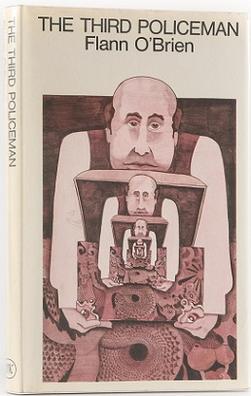
In this bizarre dark comedy the narrator can't give us his name because he has forgotten it. All we know about him is that he has a wooden leg and has devoted his life to the study of the works of and about a scientist-philosopher named de Selby. While some of de Selby's manuscripts are utterly undecipherable, it is at least known that he believed night was a recent phenomenon caused by the intrusion of a noxious pollutant called "dark air." He also devoted much of his life to studying how to dilute water. The narrator has prepared a manuscript about de Selby which will be his own life's work, but he is desperately short of the the funds it will take to subsidize its publication--desperate enough to resort to robbery, even murder.
While the narrator may not know his own name, he does know that his soul's name is Joe, and the two carry on an ongoing conversation during their travels and adventures. They have much to discuss, including a trio of obese policemen who are obsessed with bicycle thefts, but also possess the uncanny means to manipulate time and space.
The Third Policeman is a marvelous, often funny, occasionally unsettling, wildly imaginative absurdist fantasy.
Other works I have read by Flann O'Brien:
At Swim-Two-Birds
The Third Policeman appears on the following reading lists:
500 Essential Cult Books in the category "One of a Kind"
501 Must-Read Books in the category "Modern Fiction"
Donald Barthelme's Syllabus
Harold Bloom's Western Canon
1001 Books You Must Read Before You Die (2006 & 2010 editions)
Cult Fiction Reader's Guide "Must Reads"
Guardian's "1001 Novels Everyone Should Read" under Fantasy & Science Fiction
Modern Fantasy: 100 Best Novels 1946-1987
Tom Moran's "100 Best English Language Novels of the 20th Century"
Rough Guide to Cult Fiction
St. Mark's Bookshop "Additional 100"
Good Reading Guide to World Fiction
Fantasy and Horror fantasy bibilography
Written 1939-40
First published posthumously 1967
In this bizarre dark comedy the narrator can't give us his name because he has forgotten it. All we know about him is that he has a wooden leg and has devoted his life to the study of the works of and about a scientist-philosopher named de Selby. While some of de Selby's manuscripts are utterly undecipherable, it is at least known that he believed night was a recent phenomenon caused by the intrusion of a noxious pollutant called "dark air." He also devoted much of his life to studying how to dilute water. The narrator has prepared a manuscript about de Selby which will be his own life's work, but he is desperately short of the the funds it will take to subsidize its publication--desperate enough to resort to robbery, even murder.
While the narrator may not know his own name, he does know that his soul's name is Joe, and the two carry on an ongoing conversation during their travels and adventures. They have much to discuss, including a trio of obese policemen who are obsessed with bicycle thefts, but also possess the uncanny means to manipulate time and space.
The Third Policeman is a marvelous, often funny, occasionally unsettling, wildly imaginative absurdist fantasy.
Other works I have read by Flann O'Brien:
At Swim-Two-Birds
The Third Policeman appears on the following reading lists:
500 Essential Cult Books in the category "One of a Kind"
501 Must-Read Books in the category "Modern Fiction"
Donald Barthelme's Syllabus
Harold Bloom's Western Canon
1001 Books You Must Read Before You Die (2006 & 2010 editions)
Cult Fiction Reader's Guide "Must Reads"
Guardian's "1001 Novels Everyone Should Read" under Fantasy & Science Fiction
Modern Fantasy: 100 Best Novels 1946-1987
Tom Moran's "100 Best English Language Novels of the 20th Century"
Rough Guide to Cult Fiction
St. Mark's Bookshop "Additional 100"
Good Reading Guide to World Fiction
Fantasy and Horror fantasy bibilography
96StevenTX
The Awakening by Kate Chopin
First published 1899.

Edna Pontellier is the young wife of a rising New Orleans financier and the mother of two happy children. She has a fashionable house in the city and spends her summer at a beach resort on Grand Isle on the Louisiana Gulf Coast. But one summer the attentions of a younger man convince her that she is not destined to spend her life as one of those "women who idolized their children, worshiped their husbands, and esteemed it a holy privilege to efface themselves as individuals...."
Even before returning to New Orleans, "Mrs. Pontellier was beginning to realize her position in the universe as a human being, and to recognize her relations as an individual to the world within and about her." She begins to spend her time in activities she finds pleasurable and fulfilling, not in routine social calls or the duties of housekeeper and mother. Her husband is dismayed; "he could not see that she was becoming herself and daily casting aside that fictitious self which we assume like a garment with which to appear before the world."
Unfortunately for Edna, the blossoming of her sense of self is accompanied by her first genuine experience with love, and it is an intoxicating mixture that is driving her too hard and fast to stay within the bounds of propriety, even in permissive New Orleans society.
The Awakening is a beautifully written and powerful short novel about a woman's quest for independence and fulfillment.
The Awakening appears on the following reading lists:
Bauermeister's "500 Great Books by Women"
Harold Bloom's Novelists and Novels and The Western Canon
1001 Books You Must Read Before You Die (2006 & 2010 eds.)
Burt's The Novel 100
The College Board's "101 Books for the College Bound"
Guardian's "1000 Novels Everyone Should Read"in the category "Family and Self"
Radcliffe Publishing "100 Best Novels of the 20th Century" (even though it is 19th century)
Smiley's 13 Ways of Looking at the Novel
Good Reading Guide to World Fiction
First published 1899.

Edna Pontellier is the young wife of a rising New Orleans financier and the mother of two happy children. She has a fashionable house in the city and spends her summer at a beach resort on Grand Isle on the Louisiana Gulf Coast. But one summer the attentions of a younger man convince her that she is not destined to spend her life as one of those "women who idolized their children, worshiped their husbands, and esteemed it a holy privilege to efface themselves as individuals...."
Even before returning to New Orleans, "Mrs. Pontellier was beginning to realize her position in the universe as a human being, and to recognize her relations as an individual to the world within and about her." She begins to spend her time in activities she finds pleasurable and fulfilling, not in routine social calls or the duties of housekeeper and mother. Her husband is dismayed; "he could not see that she was becoming herself and daily casting aside that fictitious self which we assume like a garment with which to appear before the world."
Unfortunately for Edna, the blossoming of her sense of self is accompanied by her first genuine experience with love, and it is an intoxicating mixture that is driving her too hard and fast to stay within the bounds of propriety, even in permissive New Orleans society.
The Awakening is a beautifully written and powerful short novel about a woman's quest for independence and fulfillment.
The Awakening appears on the following reading lists:
Bauermeister's "500 Great Books by Women"
Harold Bloom's Novelists and Novels and The Western Canon
1001 Books You Must Read Before You Die (2006 & 2010 eds.)
Burt's The Novel 100
The College Board's "101 Books for the College Bound"
Guardian's "1000 Novels Everyone Should Read"in the category "Family and Self"
Radcliffe Publishing "100 Best Novels of the 20th Century" (even though it is 19th century)
Smiley's 13 Ways of Looking at the Novel
Good Reading Guide to World Fiction
97FlorenceArt
>95 StevenTX: Wow, weird! I think I'll add this to my wishlist.
98baswood
The Third Policeman weird but not obscure.
The Awakening looks to be a worthwhile read and I note it was published before the turn of the century and so probably pushed the boundaries a little for its subject matter of a woman seeking independence.
The Awakening looks to be a worthwhile read and I note it was published before the turn of the century and so probably pushed the boundaries a little for its subject matter of a woman seeking independence.
99StevenTX
The Lost Honor of Katharina Blum by Heinrich Böll
First published 1974
English translation by Leila Vennewitz 1975

Katharina Blum has murdered a reporter; we are told that at the beginning of the novel. What the author then unfolds, step-by-step, are the events that led this young woman, a seemingly happy and well-liked domestic servant and part-time waitress, to invite the reporter into her apartment, kill him with a pistol, then drive to the home of a police officer and turn herself in.
That the true villain in the novel will be the reporter's newspaper is obvious even before you start the first chapter. The author's disclaimer says, in part, "Should the description of certain journalistic practices result in a resemblance of to the practices of the Bild-Zeitung, such resemblance is neither intentional nor fortuitous, but unavoidable." Bild-Zeitung (now simply called Bild) was, and still is, Germany's most popular tabloid newspaper. Böll shows in the novel how the newspaper deliberately misquotes interviewees, twists stories, and manufactures lies to sensationalize its stories. In the process it callously destroys reputations, ruins careers, breaks up families, and drives some people to acts of desperation and violence.
But while the author shows us lies and distortions from one source, are we really being told the truth? It's intriguing that there are still unanswered questions and unexplained events when we finally see Katharina off to prison. Can the truth of things in a complex network of people, relationships and events ever be fully known? That's the question we are left with at the end of this fascinating and fast-paced little novel.
The Lost Honor of Katharina Blum appears on the following reading lists:
500 Essential Cult Books under "Cult Classics"
1001 Books You Must Read Before You Die (2006 & 2010 eds.)
Rough Guide to Cult Fiction
Rough Guide to Classic Novels
Good Reading Guide to World Fiction
First published 1974
English translation by Leila Vennewitz 1975

Katharina Blum has murdered a reporter; we are told that at the beginning of the novel. What the author then unfolds, step-by-step, are the events that led this young woman, a seemingly happy and well-liked domestic servant and part-time waitress, to invite the reporter into her apartment, kill him with a pistol, then drive to the home of a police officer and turn herself in.
That the true villain in the novel will be the reporter's newspaper is obvious even before you start the first chapter. The author's disclaimer says, in part, "Should the description of certain journalistic practices result in a resemblance of to the practices of the Bild-Zeitung, such resemblance is neither intentional nor fortuitous, but unavoidable." Bild-Zeitung (now simply called Bild) was, and still is, Germany's most popular tabloid newspaper. Böll shows in the novel how the newspaper deliberately misquotes interviewees, twists stories, and manufactures lies to sensationalize its stories. In the process it callously destroys reputations, ruins careers, breaks up families, and drives some people to acts of desperation and violence.
But while the author shows us lies and distortions from one source, are we really being told the truth? It's intriguing that there are still unanswered questions and unexplained events when we finally see Katharina off to prison. Can the truth of things in a complex network of people, relationships and events ever be fully known? That's the question we are left with at the end of this fascinating and fast-paced little novel.
The Lost Honor of Katharina Blum appears on the following reading lists:
500 Essential Cult Books under "Cult Classics"
1001 Books You Must Read Before You Die (2006 & 2010 eds.)
Rough Guide to Cult Fiction
Rough Guide to Classic Novels
Good Reading Guide to World Fiction
100dchaikin
>86 StevenTX: - :)
>89 StevenTX: "I found the folkloric but realistic approach in Song of Solomon to be much more powerful than the magical realism of Beloved. "
Very much the opposite for me. I found them equally serious. Song of Solomon came across to as more playful and fun - there is what i might call a Quentin Torentino-ish rye aspect to it. But Beloved, maybe because i found it more sincere, i guess i'm just very attached to it and the style of complexity i found in it. Not that we need to agree on this...
The Third Policeman sounds like the title of a thriller or mystery. I'm a bit fascinated by it.
The Awakening sounds terriffic.
Seems like you have been enjoying your reading lately.
>89 StevenTX: "I found the folkloric but realistic approach in Song of Solomon to be much more powerful than the magical realism of Beloved. "
Very much the opposite for me. I found them equally serious. Song of Solomon came across to as more playful and fun - there is what i might call a Quentin Torentino-ish rye aspect to it. But Beloved, maybe because i found it more sincere, i guess i'm just very attached to it and the style of complexity i found in it. Not that we need to agree on this...
The Third Policeman sounds like the title of a thriller or mystery. I'm a bit fascinated by it.
The Awakening sounds terriffic.
Seems like you have been enjoying your reading lately.
101StevenTX
>98 baswood: The Awakening... was published before the turn of the century and so probably pushed the boundaries a little for its subject matter of a woman seeking independence.
Its forerunner in that respect was the play A Doll's House by Henrik Ibsen first published and performed in 1879. It's disturbing to read even today.
>100 dchaikin: I guess I just have trouble appreciating magical realism (though I love surrealism).
My reading may have been enjoyable lately, but as you and Bas have pointed out, it has been deficient in obscurity. For the next three weeks, though, it may be nonexistent as I will be taking two long road trips, first to my wife's home town west of San Antonio, then to Cincinnati. I don't know how much reading, if any, I will get done, but I certainly won't be keeping up my recent pace. I still need to decide which books to take with me.
Its forerunner in that respect was the play A Doll's House by Henrik Ibsen first published and performed in 1879. It's disturbing to read even today.
>100 dchaikin: I guess I just have trouble appreciating magical realism (though I love surrealism).
My reading may have been enjoyable lately, but as you and Bas have pointed out, it has been deficient in obscurity. For the next three weeks, though, it may be nonexistent as I will be taking two long road trips, first to my wife's home town west of San Antonio, then to Cincinnati. I don't know how much reading, if any, I will get done, but I certainly won't be keeping up my recent pace. I still need to decide which books to take with me.
103DieFledermaus
>95 StevenTX: - I have The Third Policeman somewhere on the pile, but can't really find anything in the pile right now. I knew it was weird, but I didn't know it was this weird.
I mean, this -
the narrator can't give us his name because he has forgotten it...he believed night was a recent phenomenon...He also devoted much of his life to studying how to dilute water. The narrator has prepared a manuscript about de Selby which will be his own life's work, but he is desperately short of the the funds it will take to subsidize its publication--desperate enough to resort to robbery, even murder.
makes me want to run off and read it right now. Great review.
Hope you have a good trip and time to get some reading in
I mean, this -
the narrator can't give us his name because he has forgotten it...he believed night was a recent phenomenon...He also devoted much of his life to studying how to dilute water. The narrator has prepared a manuscript about de Selby which will be his own life's work, but he is desperately short of the the funds it will take to subsidize its publication--desperate enough to resort to robbery, even murder.
makes me want to run off and read it right now. Great review.
Hope you have a good trip and time to get some reading in
104SassyLassy
>103 DieFledermaus: I have the same problem with The Third Policeman and also with The Awakening. Frustrating indeed.
105rebeccanyc
Enjoying catching up with all your reading, but especially >95 StevenTX: The Third Policeman because Flann O'Brien is definitely an author I've been meaning to read. I have it and At Swim, Two Birds on my TBR -- would you recommend either to read first, or doesn't it matter?
106SassyLassy
Based on the Recent News (additions by other members) on my home page, you have solved the obscurity dilemma on your road trip and will be posting more of your great reviews. I didn't mind the deviation into the less obscure, as I like catching up with all your reading.
107StevenTX
>106 SassyLassy: Sorry, I thought by unchecking "connections" for all my collections these mass additions wouldn't show up. Actually I only bought one book and read one book.
108StevenTX
The Return of Tarzan by Edgar Rice Burroughs
Serialized 1913, first book publication 1915
The Return of Tarzan picks up the story from Tarzan of the Apes and carries it to a conclusion such that the two novels should best be read back-to-back as parts of the same work. Once again we encounter a Tarzan far removed from the illiterate savage portrayed in the movies. As the story opens, he is a passenger on an ocean liner returning him from America to France where he plans to spend the rest of his days. He is bored, with little to do but drink absinthe and smoke cigarettes. But Tarzan soon finds himself in the middle of an intrigue involving a beautiful Russian married to a French count, and a pair of evil Russian spies who attempt to use the naive Tarzan to frame the count and his wife. His adventures will carry Tarzan to Paris, to Algeria, and eventually back to the jungles of his birth where he discovers clues leading him to a lost city of gold.
What makes Tarzan an appealing hero is his realistic fallibility. He is a boisterous, impetuous and occasionally foolish 22-year old. He can be selfish, greedy, and self-indulgent. While his heart may belong to Jane (who Tarzan believes is lost to him because she is to marry his cousin), his eyes and hands are far from immune to the charms of a Russian countess, an Arab dancing girl, or a pagan priestess. Another plus to the novel is that much (but not all) of the racism which characterized the first Tarzan novel is gone. Tarzan discovers that not all Africans are craven cannibals, and he even befriends and joins a tribe of proud, courageous hunters. He also learns that while some Arabs are thieves and slavers, others are honest and caring, and had duty not carried him elsewhere he would have gladly accepted a Bedouin tribe's offer of a home and a wife.
On the negative side, the reader must prepare for one remarkable coincidence after another. Every character in the novel will be separately shipwrecked, marooned, thrown overboard, or in some other manner cast ashore at exactly the same spot on the African coast, in some cases more than once. But Tarzan novels are something you read for fun, not for realism. Nonetheless there is occasionally a serious side to the novel. The attempt to frame the French count and his Russian bride is clearly a reference to, and commentary on, France's Dreyfus Affair. It's also noteworthy that among the corrupting influences of civilization which Tarzan, the "noble savage," escapes is that of religion. As if to emphasize this, La, the priestess of the lost city of Opar, makes the comment: "The more one knows of one's religion, the less one believes."
The Return of Tarzan is fun, escapist reading and highly recommended for those who have enjoyed its predecessor, Tarzan of the Apes.
Serialized 1913, first book publication 1915
The Return of Tarzan picks up the story from Tarzan of the Apes and carries it to a conclusion such that the two novels should best be read back-to-back as parts of the same work. Once again we encounter a Tarzan far removed from the illiterate savage portrayed in the movies. As the story opens, he is a passenger on an ocean liner returning him from America to France where he plans to spend the rest of his days. He is bored, with little to do but drink absinthe and smoke cigarettes. But Tarzan soon finds himself in the middle of an intrigue involving a beautiful Russian married to a French count, and a pair of evil Russian spies who attempt to use the naive Tarzan to frame the count and his wife. His adventures will carry Tarzan to Paris, to Algeria, and eventually back to the jungles of his birth where he discovers clues leading him to a lost city of gold.
What makes Tarzan an appealing hero is his realistic fallibility. He is a boisterous, impetuous and occasionally foolish 22-year old. He can be selfish, greedy, and self-indulgent. While his heart may belong to Jane (who Tarzan believes is lost to him because she is to marry his cousin), his eyes and hands are far from immune to the charms of a Russian countess, an Arab dancing girl, or a pagan priestess. Another plus to the novel is that much (but not all) of the racism which characterized the first Tarzan novel is gone. Tarzan discovers that not all Africans are craven cannibals, and he even befriends and joins a tribe of proud, courageous hunters. He also learns that while some Arabs are thieves and slavers, others are honest and caring, and had duty not carried him elsewhere he would have gladly accepted a Bedouin tribe's offer of a home and a wife.
On the negative side, the reader must prepare for one remarkable coincidence after another. Every character in the novel will be separately shipwrecked, marooned, thrown overboard, or in some other manner cast ashore at exactly the same spot on the African coast, in some cases more than once. But Tarzan novels are something you read for fun, not for realism. Nonetheless there is occasionally a serious side to the novel. The attempt to frame the French count and his Russian bride is clearly a reference to, and commentary on, France's Dreyfus Affair. It's also noteworthy that among the corrupting influences of civilization which Tarzan, the "noble savage," escapes is that of religion. As if to emphasize this, La, the priestess of the lost city of Opar, makes the comment: "The more one knows of one's religion, the less one believes."
The Return of Tarzan is fun, escapist reading and highly recommended for those who have enjoyed its predecessor, Tarzan of the Apes.
109SassyLassy
>107 StevenTX: No problem, I actually like seeing the additions. The additions don't seem to have any relation to connections other than people with similar libraries, so I often see titles I would not otherwise know about, as I might not have any group connections with those libraries.
I always liked the second Tarzan, but haven't read it for years... time for a refresher.
I always liked the second Tarzan, but haven't read it for years... time for a refresher.
110baswood
The return of Tarzan is on my list for this year. I know I am going to enjoy it.
111StevenTX
Plagiarism, inspiration, or accidental similarity?
In H. G. Wells' 1895 novel The Time Machine, an unnamed Traveler builds a machine with which he travels alone to the far future. There he discovers a race of people called the Eloi. They are diminutive in size but physically beautiful, healthy and content. But they are also complacent and unfeeling. When a young female Eloi falls in a river, none of her companions makes any attempt to save her, and they are indifferent to her fate. The Traveler, at the risk of his own life, saves her. At first she is bewildered that anyone should have made the effort on her behalf, but eventually she learns love and compassion from the Traveler and becomes his devoted companion until he is forced to abandon her. Her name is Weena.
Fifteen years earlier the English writer Percy Greg had published a now obscure novel titled Across the Zodiac: The Story of a Wrecked Record. In this novel an unnamed Traveler builds a spacecraft with which he travels alone to Mars. He discovers that the planet is populated by a highly advanced humanoid race. They are diminutive in size but physically beautiful, healthy and content. But they are also complacent and unfeeling. When a young female Martialist (Greg's name for Martians) falls off a cliff onto a narrow, crumbling ledge, none of her companions makes any attempt to save her, and they are indifferent to her fate. The Traveler, at the risk of his own life, saves her. At first she is bewildered that anyone should have made the effort on her behalf, but eventually she learns love and compassion from the Traveler and becomes his wedded companion until he is forced to abandon her. Her name is Eveena.
If H. G. Wells borrowed from Percy Greg, he wasn't the only one to do so. Across the Zodiac contains the first known use of the term "astronaut," only it is used as a name for the space ship, not its occupant.
In H. G. Wells' 1895 novel The Time Machine, an unnamed Traveler builds a machine with which he travels alone to the far future. There he discovers a race of people called the Eloi. They are diminutive in size but physically beautiful, healthy and content. But they are also complacent and unfeeling. When a young female Eloi falls in a river, none of her companions makes any attempt to save her, and they are indifferent to her fate. The Traveler, at the risk of his own life, saves her. At first she is bewildered that anyone should have made the effort on her behalf, but eventually she learns love and compassion from the Traveler and becomes his devoted companion until he is forced to abandon her. Her name is Weena.
Fifteen years earlier the English writer Percy Greg had published a now obscure novel titled Across the Zodiac: The Story of a Wrecked Record. In this novel an unnamed Traveler builds a spacecraft with which he travels alone to Mars. He discovers that the planet is populated by a highly advanced humanoid race. They are diminutive in size but physically beautiful, healthy and content. But they are also complacent and unfeeling. When a young female Martialist (Greg's name for Martians) falls off a cliff onto a narrow, crumbling ledge, none of her companions makes any attempt to save her, and they are indifferent to her fate. The Traveler, at the risk of his own life, saves her. At first she is bewildered that anyone should have made the effort on her behalf, but eventually she learns love and compassion from the Traveler and becomes his wedded companion until he is forced to abandon her. Her name is Eveena.
If H. G. Wells borrowed from Percy Greg, he wasn't the only one to do so. Across the Zodiac contains the first known use of the term "astronaut," only it is used as a name for the space ship, not its occupant.
112rebeccanyc
Sounds like a little too much "inspiration" to me!
113StevenTX
Cratylus by Plato
Translated by Benjamin Jowett
Cratylus is an unusual dialogue. In it, Socrates addresses and supports the idea that names and words have some concrete relation to the meaning and properties of the thing being named and are not simply arbitrary sounds and spellings. He proceeds to explain how the names of the gods, of persons, and of various categories of nouns derive from other words with a similar underlying meaning.
For example, Socrates maintains that the name Apollo is simultaneously derived from "apoulon" (purifier), because he is the patron of physicians, "aplous" (sincere), because of his association with oracles, and "aei ballon" (always shooting), because he is an archer. As unlikely as this sounds, some of his other etymologies are far fetched and contrived to the point of being ridiculous. Socrates freely adds or deletes letters and entire syllables to stretch a point, claiming those letters which don't suit his purpose were pure ornamentation and not intended to mean anything. So, are these dozens of derivations nothing but an elaborate satire? If so, of what?
I think the meat of the dialogue is not in the etymologies at all, but in the underlying meanings which Socrates, however fancifully, manages to associate with each word. Many of these meanings are closely linked to the ideas of the thinkers who preceded Socrates, especially Heraclitus.
Heraclitus spoke of "logos" (word or wisdom) as an abstract and pure truth that was independent of human understanding and was the one fixed element in a universe of constant change. Grappling for the underlying meaning and origin of words is a quest for logos. But with wisdom comes the understanding that the universe is in perpetual flux. Thus Socrates defines "phronesis" (wisdom) as derived from "phoras kai rhou noesis" (perception of wisdom and flux). A consistent theme of the dialogue is that our concepts of virtue, justice, good, and wisdom all derive from words signifying motion and change.
Other pre-Socratic philosophers such as Leucippus and Democritus developed the theory that all matter is comprised of indivisible bodies called atoms. In this dialogue, Socrates attempts to apply the atomist theory to language. Throughout the dialogue he defines words in terms of other words, but he eventually admits that we come to a list of basic words that he calls "original names," those which date to the invention of language itself. Why does "phusodes" mean windy and "leios" mean level, instead of the other way round? Though he admits that his theory is "wild and ridiculous," Socrates speculates that the sound of letters themselves suggests meaning. The letter "rho" suggests movement because the tongue is agitated in its pronunciation. "Delta" suggests binding because of the pressure of the tongue against the palate. "Lambda" implies smoothness, and so on.
Cratylus is far from being the most important of Plato's dialogues, and the endless definitions make it rather tedious to read, but it shows how Plato and others built upon the ideas of their predecessors in sometimes surprising fashion, and it leads to fascinating speculation about the links between the basic concepts of philosophy and the language we use every day.
Translated by Benjamin Jowett
Cratylus is an unusual dialogue. In it, Socrates addresses and supports the idea that names and words have some concrete relation to the meaning and properties of the thing being named and are not simply arbitrary sounds and spellings. He proceeds to explain how the names of the gods, of persons, and of various categories of nouns derive from other words with a similar underlying meaning.
For example, Socrates maintains that the name Apollo is simultaneously derived from "apoulon" (purifier), because he is the patron of physicians, "aplous" (sincere), because of his association with oracles, and "aei ballon" (always shooting), because he is an archer. As unlikely as this sounds, some of his other etymologies are far fetched and contrived to the point of being ridiculous. Socrates freely adds or deletes letters and entire syllables to stretch a point, claiming those letters which don't suit his purpose were pure ornamentation and not intended to mean anything. So, are these dozens of derivations nothing but an elaborate satire? If so, of what?
I think the meat of the dialogue is not in the etymologies at all, but in the underlying meanings which Socrates, however fancifully, manages to associate with each word. Many of these meanings are closely linked to the ideas of the thinkers who preceded Socrates, especially Heraclitus.
Heraclitus spoke of "logos" (word or wisdom) as an abstract and pure truth that was independent of human understanding and was the one fixed element in a universe of constant change. Grappling for the underlying meaning and origin of words is a quest for logos. But with wisdom comes the understanding that the universe is in perpetual flux. Thus Socrates defines "phronesis" (wisdom) as derived from "phoras kai rhou noesis" (perception of wisdom and flux). A consistent theme of the dialogue is that our concepts of virtue, justice, good, and wisdom all derive from words signifying motion and change.
Other pre-Socratic philosophers such as Leucippus and Democritus developed the theory that all matter is comprised of indivisible bodies called atoms. In this dialogue, Socrates attempts to apply the atomist theory to language. Throughout the dialogue he defines words in terms of other words, but he eventually admits that we come to a list of basic words that he calls "original names," those which date to the invention of language itself. Why does "phusodes" mean windy and "leios" mean level, instead of the other way round? Though he admits that his theory is "wild and ridiculous," Socrates speculates that the sound of letters themselves suggests meaning. The letter "rho" suggests movement because the tongue is agitated in its pronunciation. "Delta" suggests binding because of the pressure of the tongue against the palate. "Lambda" implies smoothness, and so on.
Cratylus is far from being the most important of Plato's dialogues, and the endless definitions make it rather tedious to read, but it shows how Plato and others built upon the ideas of their predecessors in sometimes surprising fashion, and it leads to fascinating speculation about the links between the basic concepts of philosophy and the language we use every day.
114baswood
Have you read Across the Zodiac? and if so was the writing on a par with H G Wells.
Enjoyed your excellent explanation of Cratylus
Enjoyed your excellent explanation of Cratylus
115NanaCC
Just catching up, and I nteresting reading, as usual, Steven.
The Time Machine is more than shockingly similar to Across the Zodiac. Have you come across discussion about it? What is the consensus?
The Time Machine is more than shockingly similar to Across the Zodiac. Have you come across discussion about it? What is the consensus?
116StevenTX
>114 baswood: I'm in the middle of reading Across the Zodiac and have been for some time, precisely because the writing is NOT on a par with that of H. G. Wells. It is a novel of brilliant, thought-provoking ideas bogged down in domestic detail and plodding prose. I'll have much more to say about it when I finish it.
>115 NanaCC: I did a lot of Googling but could only come up with the statement that Percy Greg was a major influence on H. G. Wells (and Edgar Rice Burroughs). He does, however, have a Martian crater named after him.
>115 NanaCC: I did a lot of Googling but could only come up with the statement that Percy Greg was a major influence on H. G. Wells (and Edgar Rice Burroughs). He does, however, have a Martian crater named after him.
117StevenTX
Blindness by Henry Green
First published 1926


Henry Green wrote most of Blindness, his first novel, while still a student at Eton College. It was published in 1926 but received little notice. It wasn't until after Green's death in 1973 that the novel was reprinted. It is a work showing both promise and immaturity.
The story follows John Haye, a youth whose age and upper class background are similar to the author's, who is blinded by a freak accident while on holiday from school. Previously something of a loner and indifferent student, John quickly resolves that he will make himself into a writer. For companionship he turns to Joan Entwhistle, the daughter of a defrocked, gin-soaked minister and a girl whose whose education and experience are so limited that the two struggle to find a subject of conversation.
Blindness is told largely through interior monologue, with the perspective shifting from character to character, sometimes in mid-chapter. In addition to John and Joan, the characters whose thoughts we surveil include John's stepmother (the mistress of the estate) and his old nurse. It is the style--reminiscent of Virginia Woolf's--more than the content that makes this novel noteworthy. The story strikes out in many directions but never gives us sense of reconciliation or insight. We actually spend surprisingly little time with John himself, so neither the subject of his blindness nor that of his decision to become a writer is satisfactorily explored. And while most of the prose is quite fine, there are some rather sophomoric passages, such as when a house feels sad because it isn't loved or loved in and when the sunset sky was "enjoying herself after the boredom of being blue all day."
Blindness will appeal chiefly to Henry Green fans, but readers looking for something with the feel of Downton Abbey might want to consider it as well.
Blindness appears on the following reading lists:
1001 Books You Must Read Before You Die
Other works I have read by Henry Green:
Loving
First published 1926


Henry Green wrote most of Blindness, his first novel, while still a student at Eton College. It was published in 1926 but received little notice. It wasn't until after Green's death in 1973 that the novel was reprinted. It is a work showing both promise and immaturity.
The story follows John Haye, a youth whose age and upper class background are similar to the author's, who is blinded by a freak accident while on holiday from school. Previously something of a loner and indifferent student, John quickly resolves that he will make himself into a writer. For companionship he turns to Joan Entwhistle, the daughter of a defrocked, gin-soaked minister and a girl whose whose education and experience are so limited that the two struggle to find a subject of conversation.
Blindness is told largely through interior monologue, with the perspective shifting from character to character, sometimes in mid-chapter. In addition to John and Joan, the characters whose thoughts we surveil include John's stepmother (the mistress of the estate) and his old nurse. It is the style--reminiscent of Virginia Woolf's--more than the content that makes this novel noteworthy. The story strikes out in many directions but never gives us sense of reconciliation or insight. We actually spend surprisingly little time with John himself, so neither the subject of his blindness nor that of his decision to become a writer is satisfactorily explored. And while most of the prose is quite fine, there are some rather sophomoric passages, such as when a house feels sad because it isn't loved or loved in and when the sunset sky was "enjoying herself after the boredom of being blue all day."
Blindness will appeal chiefly to Henry Green fans, but readers looking for something with the feel of Downton Abbey might want to consider it as well.
Blindness appears on the following reading lists:
1001 Books You Must Read Before You Die
Other works I have read by Henry Green:
Loving
118StevenTX
Interview with the Vampire by Anne Rice
First published 1976


I had every expectation that I would like Interview with the Vampire: It is both very popular and critically well received. The subject matter interested me; I had enjoyed Dracula immensely. And I had recently vacationed in New Orleans, the novel's principal setting. But, instead, I found it dreary and lacking in suspense. Nor did I gain much from its existentialist theme, and it took me weeks to get through the book at a few pages a day. Yet considering all the endorsements it has received, I'm fully prepared to blame my failure to enjoy it on the reader and not on the work. So I won't say anything more about the novel, and may even give Anne Rice another try some time.
Interview with the Vampire appears on the following reading lists:
500 Essential Cult Books in the category "Incredible Worlds"
501 Must-Read Books in the category "Modern Fiction"
1001 Books You Must Read Before You Die (2006 and 2010 editions)
The Modern Library: 200 Best Novels in English Since 1950
Cult Fiction Reader's Guide "Must Reads"
The Rough Guide to Cult Fiction
The Salon.com Reader's Guide to Contemporary Authors "Most Recommended"
First published 1976


I had every expectation that I would like Interview with the Vampire: It is both very popular and critically well received. The subject matter interested me; I had enjoyed Dracula immensely. And I had recently vacationed in New Orleans, the novel's principal setting. But, instead, I found it dreary and lacking in suspense. Nor did I gain much from its existentialist theme, and it took me weeks to get through the book at a few pages a day. Yet considering all the endorsements it has received, I'm fully prepared to blame my failure to enjoy it on the reader and not on the work. So I won't say anything more about the novel, and may even give Anne Rice another try some time.
Interview with the Vampire appears on the following reading lists:
500 Essential Cult Books in the category "Incredible Worlds"
501 Must-Read Books in the category "Modern Fiction"
1001 Books You Must Read Before You Die (2006 and 2010 editions)
The Modern Library: 200 Best Novels in English Since 1950
Cult Fiction Reader's Guide "Must Reads"
The Rough Guide to Cult Fiction
The Salon.com Reader's Guide to Contemporary Authors "Most Recommended"
119Nickelini
I read Interview with the Vampire a year or so ago and my reaction was similar to yours. I don't think it's aged very well. I read a few other books by the author back in the early 90s and they seemed to get worse with each book.
120AnnieMod
>118 StevenTX:
I liked it when I read it ~15 years ago. But it is an early example of a genre that had seen a lot of good fiction since then and if one reads it now for the first time, it had not aged well, not at all. It is almost boring compared to everything else available...
I liked it when I read it ~15 years ago. But it is an early example of a genre that had seen a lot of good fiction since then and if one reads it now for the first time, it had not aged well, not at all. It is almost boring compared to everything else available...
121ursula
I'm another who read Interview with the Vampire a looong time ago, and I enjoyed it, but I got bored with the rest of the series. So if you didn't like that one, reading more is probably not the answer.
122baswood
Perhaps the films better than the book in this instance
http://www.imdb.com/title/tt0110148/?ref_=nv_sr_1
http://www.imdb.com/title/tt0110148/?ref_=nv_sr_1
123japaul22
I keep meaning to get to Henry Green since he sounds like he'd be right up my alley, so to speak. Thanks for the reminder!
I also read Interview with a Vampire in the 90s when I was in high school and I loved it then, but can't imagine it suiting my taste now. And I also remember the subsequent books being pretty bad, so I'm not sure it's worth it to keep going with Anne Rice.
I also read Interview with a Vampire in the 90s when I was in high school and I loved it then, but can't imagine it suiting my taste now. And I also remember the subsequent books being pretty bad, so I'm not sure it's worth it to keep going with Anne Rice.
124StevenTX
Across the Zodiac: The Story of a Wrecked Record by Percy Greg
First published 1880

Across the Zodiac is a remarkable and influential early science fiction novel that would still be widely read if the author's prose and storytelling abilities had been up to the level of his imagination and scientific insight.
The novel begins with a framing story of a manuscript discovered inside a recent meteorite. When deciphered it proves to be the memoir of an unnamed European man who has secretly built a spacecraft and journeyed to Mars. The spacecraft, named the "Astronaut" (possibly the first use of this term in English), is a tapered steel and concrete cylinder propelled by means of "apergic rays," an invisible force that pushes against the Earth or other body. The details of the spacecraft's construction, its method of refreshing the air, the method of navigation, the weightlessness of space, and the flight path taken to Mars are all impressively thought out and convincing.
The Traveler arrives on Mars to find a thriving civilization of humanoids who closely resemble himself, being only smaller in stature. Eventually the Traveler learns the Martian language and begins his prolonged education into the history and culture of the Martian race. (In the novel the adjective used is "Martial," and the people are called "Martialists.")
The Martians have put into effect ideas that were just in the formative stages in 1880. They use electric lighting exclusively. They drive electric automobiles or fly in dirigibles powered by electric motors. They record and play back music and speech on gramophones. Among their method of communications is something we would call a fax machine. Their favorite recreation is to go to a motion picture theater where sound is synchronized with images.
The author's political agenda becomes apparent when Mars's history and institutions come under scrutiny. Centuries ago, Mars turned to Communism. "Every man was as idle as the envy and jealousy of his neighbours would allow," and the standard of living fell to that of the poorest. Women were given full equality with men, which destroyed the family bond. Children then had to be raised by the State in creches, and there they learned nothing but the law of self-interest. Eventually Communism was overthrown, but the Martian people remained motivated by nothing but greed and personal security. With no religion to teach them morality, it was every man for himself. Women became scarcely more than slaves, rarely allowed to venture outside the house in their concealing robes and veils.
The Traveler falls in with a group who secretly practice a monotheistic religion and prefer what, to him, is a more conventional family life. He joins the group and marries his host's daughter, but he must keep his allegiance to the outlawed group a secret, and when the planet's ruler gives the Traveler five additional brides, he must accept them. All this time he is under tremendous pressure from the Martian government to reveal the secret of his apergic rays so the Martians can construct spacecraft of their own, but he obstinately refuses, knowing that the technologically advanced but acquisitive and morally bankrupt Martians will use his secret to invade and plunder the Earth.
Percy Greg was an early master of what we now call "world building." He provides a vast amount of detail about Martian culture--their language and its syntax, their currency, how they plant and harvest crops, the fabrics they use, etc. Unfortunately the amount of such information is overwhelming and leaves very little in the way of plot for much of the novel. The final chapters are action-packed, but it's a long slog to get there through prose that is stiff and formal even by 19th century standards.
Across the Zodiac is a novel I would strongly recommend to readers interested in the development of the science fiction genre or in utopian/dystopian literature. You will see obvious influences on H. G. Wells and others. But this is not a book for those seeking the caliber of entertainment provided by Wells or Jules Verne.
First published 1880

Across the Zodiac is a remarkable and influential early science fiction novel that would still be widely read if the author's prose and storytelling abilities had been up to the level of his imagination and scientific insight.
The novel begins with a framing story of a manuscript discovered inside a recent meteorite. When deciphered it proves to be the memoir of an unnamed European man who has secretly built a spacecraft and journeyed to Mars. The spacecraft, named the "Astronaut" (possibly the first use of this term in English), is a tapered steel and concrete cylinder propelled by means of "apergic rays," an invisible force that pushes against the Earth or other body. The details of the spacecraft's construction, its method of refreshing the air, the method of navigation, the weightlessness of space, and the flight path taken to Mars are all impressively thought out and convincing.
The Traveler arrives on Mars to find a thriving civilization of humanoids who closely resemble himself, being only smaller in stature. Eventually the Traveler learns the Martian language and begins his prolonged education into the history and culture of the Martian race. (In the novel the adjective used is "Martial," and the people are called "Martialists.")
The Martians have put into effect ideas that were just in the formative stages in 1880. They use electric lighting exclusively. They drive electric automobiles or fly in dirigibles powered by electric motors. They record and play back music and speech on gramophones. Among their method of communications is something we would call a fax machine. Their favorite recreation is to go to a motion picture theater where sound is synchronized with images.
The author's political agenda becomes apparent when Mars's history and institutions come under scrutiny. Centuries ago, Mars turned to Communism. "Every man was as idle as the envy and jealousy of his neighbours would allow," and the standard of living fell to that of the poorest. Women were given full equality with men, which destroyed the family bond. Children then had to be raised by the State in creches, and there they learned nothing but the law of self-interest. Eventually Communism was overthrown, but the Martian people remained motivated by nothing but greed and personal security. With no religion to teach them morality, it was every man for himself. Women became scarcely more than slaves, rarely allowed to venture outside the house in their concealing robes and veils.
The Traveler falls in with a group who secretly practice a monotheistic religion and prefer what, to him, is a more conventional family life. He joins the group and marries his host's daughter, but he must keep his allegiance to the outlawed group a secret, and when the planet's ruler gives the Traveler five additional brides, he must accept them. All this time he is under tremendous pressure from the Martian government to reveal the secret of his apergic rays so the Martians can construct spacecraft of their own, but he obstinately refuses, knowing that the technologically advanced but acquisitive and morally bankrupt Martians will use his secret to invade and plunder the Earth.
Percy Greg was an early master of what we now call "world building." He provides a vast amount of detail about Martian culture--their language and its syntax, their currency, how they plant and harvest crops, the fabrics they use, etc. Unfortunately the amount of such information is overwhelming and leaves very little in the way of plot for much of the novel. The final chapters are action-packed, but it's a long slog to get there through prose that is stiff and formal even by 19th century standards.
Across the Zodiac is a novel I would strongly recommend to readers interested in the development of the science fiction genre or in utopian/dystopian literature. You will see obvious influences on H. G. Wells and others. But this is not a book for those seeking the caliber of entertainment provided by Wells or Jules Verne.
125dchaikin
>113 StevenTX: this is a really special post. Just saying. It sounds like a tough thing to read, but it sounds very important. Your post has given me some thought provoking essential info. So thanks. If fills in some background to what I learned in The Swerve.
>118 StevenTX: no, IWaV sucks. But don't tell anyone I said that. The movie has one pretty hot scene.
>117 StevenTX: & >124 StevenTX:- too obscure for me, but I enjoyed your reviews.
>118 StevenTX: no, IWaV sucks. But don't tell anyone I said that. The movie has one pretty hot scene.
>117 StevenTX: & >124 StevenTX:- too obscure for me, but I enjoyed your reviews.
126StevenTX
>125 dchaikin: Thanks, Dan. Would you say I should read The Swerve before I read Lucretius? (Not that this will happen anytime soon... I first have to finish Plato. Then there's Aristotle.) Your voice added to the chorus convinces me I am finished with Anne Rice (at least the vampire stuff). The unread volumes of that series on my shelf will go back to the used book store whence they came to make room for something else. But I'll definitely watch the movie when I can.
127dchaikin
You don't need to read The Swerve. It's just fun - for people like me who don't know the story Lucretius and his rediscovery and his atheist atomic modern-day-science-friendly philosophy. It's not like amazing or deep, more like trivia. Lucretious is, of course, the point. Not sure that's an answer.
128StevenTX
Pellucidar by Edgar Rice Burroughs
Serialized 1915, first book publication 1923


The conclusion of At the Earth's Core left American David Innes safely back on the surface of the outer world, but 500 miles beneath his feet, in the neolithic world of Pellucidar, the ruthless reptilian Mahars still enslaved humans and feasted on their flesh. More importantly, David had been tricked into leaving behind his beloved Dian the Beautiful, and he could only assume she had fallen into the hands of his archenemy, Hooja the Sly One. So back to the Earth's core he goes, only this time carrying a load of rifles, ammunition, and books on topics from shipbuilding to agriculture.
Pellucidar (which, perhaps confusingly, is the second novel in the series of the same name) doesn't have the charm and suspense of its predecessor. It has some very imaginative scenes and plot twists, but introduces us to very little that is fresh, surprising, or intense. It is a less serious work that may have been targeted at a younger audience. There are no caustic comments about religion, no observations about the scantiness of female attire, and no gory scenes of ritual vivisection. If you want to dig for any sort of social or political message in the novel you may find it significant that the economic model David Innes tries to follow in modernizing his Pellucidarian domain is basically a communist one.
This is a fun, action-packed novel, but chiefly recommended for those who want to forge ahead and read the entire series.
Serialized 1915, first book publication 1923


The conclusion of At the Earth's Core left American David Innes safely back on the surface of the outer world, but 500 miles beneath his feet, in the neolithic world of Pellucidar, the ruthless reptilian Mahars still enslaved humans and feasted on their flesh. More importantly, David had been tricked into leaving behind his beloved Dian the Beautiful, and he could only assume she had fallen into the hands of his archenemy, Hooja the Sly One. So back to the Earth's core he goes, only this time carrying a load of rifles, ammunition, and books on topics from shipbuilding to agriculture.
Pellucidar (which, perhaps confusingly, is the second novel in the series of the same name) doesn't have the charm and suspense of its predecessor. It has some very imaginative scenes and plot twists, but introduces us to very little that is fresh, surprising, or intense. It is a less serious work that may have been targeted at a younger audience. There are no caustic comments about religion, no observations about the scantiness of female attire, and no gory scenes of ritual vivisection. If you want to dig for any sort of social or political message in the novel you may find it significant that the economic model David Innes tries to follow in modernizing his Pellucidarian domain is basically a communist one.
This is a fun, action-packed novel, but chiefly recommended for those who want to forge ahead and read the entire series.
129baswood
It looks like I will have to read Across the Zodiac especially as its free on the net, but I will be prepared for the long slog. The religious/political aspects seem interesting.
In contrast Pellucidar will be light entertainment, but it's got to be read.
In contrast Pellucidar will be light entertainment, but it's got to be read.
130StevenTX
Can You Forgive Her? by Anthony Trollope
First published 1864 (Vol. 1) and 1865 (Vol. 2)


The "You" referred to in the title of Can You Forgive Her? is the reader. The "Her" is Alice Vavasor, 24 years old, heiress of a modest fortune from her deceased mother's estate, and largely left to her own devices by her negligent father. What we may or may not forgiver her for is the series of choices she will make--most of which she will regret--when faced with marriage proposals from two men. One of the men is wealthy, trustworthy, respectable, and caring. He offers her a life of quiet retirement at his country seat in what he admits is the ugliest part of England. The other man, her cousin, is a fiery, ambitious risk-taker who has made and lost several fortunes. He is honest enough to admit that he is courting Alice chiefly for her money which he needs to support a run for Parliament.
Alice is not the only woman who faces a choice between a man who is boring but respectable and one who is exciting but a scamp. Her widowed aunt, Mrs. Greenow, is considering remarriage, and her appearances are a continuous source of comic relief. Alice's distant cousin, Lady Glencora Palliser, is in a more serious situation. She has been forced by her family into a loveless marriage with Plantagenet Palliser, a rising politician who wants her only for her wealth and to breed an heir. But she is still madly in love with a dashing but penniless rascal and can't trust herself not to run off with him at the first opportunity.
"What should a woman do with her life?... A woman’s life is important to her,—as is that of a man to him,—not chiefly in regard to that which she shall do with it. The chief thing for her to look to is the manner in which that something shall be done." True to the sense of this observation, Trollope delves into the motivations of each of his characters. Alice is far from being the only one who needs our forgiveness by the time the story is done. Forgiveness is a regular motif, in fact, as characters are regularly tasked with forgiving one another or, in some cases, denying that forgiveness.
Trollope uses an interesting technique to engage the reader directly with Alice and the other characters. Repeated authorial remarks like "I am inclined to think that Mr Grey knew what he was about" invite us to judge the characters apart from the author's intentions and to disagree with his conclusions. Midway through the novel Trollope admits his own sympathies on the matter, but implies that he can not tell us how to judge Alice, only hope that we will agree with him: "And you also must forgive her before we close the book, or else my story will have been told amiss." Of course in judging Alice we are judging her creator. Only a confident author would stand his work up in this manner, and I think Trollope's confidence is not misplaced.
About half of the novel takes place in London. As two of the major characters are involved with Parliament, English politics naturally come in for some degree of comment, and we are shown seats in Parliament being won through the buying of votes among the working classes. But the social message and satire of Can You Forgive Her? do not run very deep, and Trollope's depiction of London of the 1860s pales by comparison with that of Dickens. Trollope is much more in his element writing about the leisurely lives and often comical social adventures of the country gentry, and this where much of the novel plays out. The remaining scenes comprise two picturesque visits to Switzerland.
Can You Forgive Her? is the first of six "Palliser Novels." While the Palliser family is secondary in this story, Lady Glencora Palliser is by far the novel's most engaging character. Her freethinking attitudes seem to presage those of this century. Alice is more a source of frustration--"slappable," some would call her. In the end, though, it isn't so much whether her friends can forgive her, or even whether the reader can forgive her, but can she forgive herself? And isn't that the crux of it for us all?
Other works I have read by Anthony Trollope:
The Chronicles of Barsetshire (6 novels)
First published 1864 (Vol. 1) and 1865 (Vol. 2)


The "You" referred to in the title of Can You Forgive Her? is the reader. The "Her" is Alice Vavasor, 24 years old, heiress of a modest fortune from her deceased mother's estate, and largely left to her own devices by her negligent father. What we may or may not forgiver her for is the series of choices she will make--most of which she will regret--when faced with marriage proposals from two men. One of the men is wealthy, trustworthy, respectable, and caring. He offers her a life of quiet retirement at his country seat in what he admits is the ugliest part of England. The other man, her cousin, is a fiery, ambitious risk-taker who has made and lost several fortunes. He is honest enough to admit that he is courting Alice chiefly for her money which he needs to support a run for Parliament.
Alice is not the only woman who faces a choice between a man who is boring but respectable and one who is exciting but a scamp. Her widowed aunt, Mrs. Greenow, is considering remarriage, and her appearances are a continuous source of comic relief. Alice's distant cousin, Lady Glencora Palliser, is in a more serious situation. She has been forced by her family into a loveless marriage with Plantagenet Palliser, a rising politician who wants her only for her wealth and to breed an heir. But she is still madly in love with a dashing but penniless rascal and can't trust herself not to run off with him at the first opportunity.
"What should a woman do with her life?... A woman’s life is important to her,—as is that of a man to him,—not chiefly in regard to that which she shall do with it. The chief thing for her to look to is the manner in which that something shall be done." True to the sense of this observation, Trollope delves into the motivations of each of his characters. Alice is far from being the only one who needs our forgiveness by the time the story is done. Forgiveness is a regular motif, in fact, as characters are regularly tasked with forgiving one another or, in some cases, denying that forgiveness.
Trollope uses an interesting technique to engage the reader directly with Alice and the other characters. Repeated authorial remarks like "I am inclined to think that Mr Grey knew what he was about" invite us to judge the characters apart from the author's intentions and to disagree with his conclusions. Midway through the novel Trollope admits his own sympathies on the matter, but implies that he can not tell us how to judge Alice, only hope that we will agree with him: "And you also must forgive her before we close the book, or else my story will have been told amiss." Of course in judging Alice we are judging her creator. Only a confident author would stand his work up in this manner, and I think Trollope's confidence is not misplaced.
About half of the novel takes place in London. As two of the major characters are involved with Parliament, English politics naturally come in for some degree of comment, and we are shown seats in Parliament being won through the buying of votes among the working classes. But the social message and satire of Can You Forgive Her? do not run very deep, and Trollope's depiction of London of the 1860s pales by comparison with that of Dickens. Trollope is much more in his element writing about the leisurely lives and often comical social adventures of the country gentry, and this where much of the novel plays out. The remaining scenes comprise two picturesque visits to Switzerland.
Can You Forgive Her? is the first of six "Palliser Novels." While the Palliser family is secondary in this story, Lady Glencora Palliser is by far the novel's most engaging character. Her freethinking attitudes seem to presage those of this century. Alice is more a source of frustration--"slappable," some would call her. In the end, though, it isn't so much whether her friends can forgive her, or even whether the reader can forgive her, but can she forgive herself? And isn't that the crux of it for us all?
Other works I have read by Anthony Trollope:
The Chronicles of Barsetshire (6 novels)
131StevenTX
The Death of Grass by John Christopher
First published 1956
U.S. title: No Blade of Grass
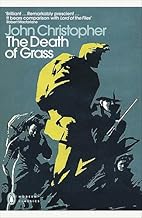

It starts with a plant virus in the rice fields of China. One seasons's rice shortages are made up by imports from abroad. The virus resists all efforts to eradicate it. The next season there is no rice crop at all. Famine ensues, and social order begins to break down as the disease spreads throughout Asia. The world's scientists make hopeful progress, but just as they are about to declare victory, a new strain emerges, one that attacks not only rice, but all species of grass: wheat, oats, barley, corn... And within a few seasons the infestation is worldwide. Fields once green become barren, and livestock perish for lack of fodder. There is still hope, however, that food reserves will last until a cure for the virus can be found.
The story of what happens next is told from the perspective of John Custance, an engineer who lives in London with his wife and two children. His best friend, a government public relations specialist, has inside information and warns John when the grain shipments from Australia and America are about to be cut off. Facing starvation, London's millions are about to become a ravenous mob. Together the two men set off with their families on a journey to Westmoreland, hundreds of miles away, where they hope to find shelter at John's brother's farm.
The disintegration of social order is swift and complete, to the dismay of those who thought Britons were somehow a special race able to face any adversity with equanimity and good cheer. John and others like him find it surprisingly easy to abandon all their previous notions of right and wrong in the face of a desperate struggle to survive.
Another reviewer has pointed out that Christopher's science is faulty when he assumes that a plague afflicting all grasses would leave pastures barren and livestock without food--broadleaf weeds would immediately move in and provide ample nourishment for animals. Other reviewers question whether men would go so quickly from being model citizens to savage animals, even before the food shortages had begun to be felt. These are valid criticisms, but they don't detract from questions the novel raises about the fragility of our civilization and the depth of our social and moral values.
The Death of Grass is a tense and disturbing story of eco-catastrophe and survival. Part of its original intent may have been to show Englishmen that they weren't such a special breed after all, but in other respects this excellent novel is no less relevant than it was when it was written almost 60 years ago.
The Death of Grass appears on the following reading lists:
Abe Books' "50 Essential Science Fiction Books"
Phobos's "100 Best Science Fiction Books"
James Wallace Harris's "Classics of Science Fiction"
Science Fiction: The 100 Best Novels by David Pringle
First published 1956
U.S. title: No Blade of Grass

It starts with a plant virus in the rice fields of China. One seasons's rice shortages are made up by imports from abroad. The virus resists all efforts to eradicate it. The next season there is no rice crop at all. Famine ensues, and social order begins to break down as the disease spreads throughout Asia. The world's scientists make hopeful progress, but just as they are about to declare victory, a new strain emerges, one that attacks not only rice, but all species of grass: wheat, oats, barley, corn... And within a few seasons the infestation is worldwide. Fields once green become barren, and livestock perish for lack of fodder. There is still hope, however, that food reserves will last until a cure for the virus can be found.
The story of what happens next is told from the perspective of John Custance, an engineer who lives in London with his wife and two children. His best friend, a government public relations specialist, has inside information and warns John when the grain shipments from Australia and America are about to be cut off. Facing starvation, London's millions are about to become a ravenous mob. Together the two men set off with their families on a journey to Westmoreland, hundreds of miles away, where they hope to find shelter at John's brother's farm.
The disintegration of social order is swift and complete, to the dismay of those who thought Britons were somehow a special race able to face any adversity with equanimity and good cheer. John and others like him find it surprisingly easy to abandon all their previous notions of right and wrong in the face of a desperate struggle to survive.
Another reviewer has pointed out that Christopher's science is faulty when he assumes that a plague afflicting all grasses would leave pastures barren and livestock without food--broadleaf weeds would immediately move in and provide ample nourishment for animals. Other reviewers question whether men would go so quickly from being model citizens to savage animals, even before the food shortages had begun to be felt. These are valid criticisms, but they don't detract from questions the novel raises about the fragility of our civilization and the depth of our social and moral values.
The Death of Grass is a tense and disturbing story of eco-catastrophe and survival. Part of its original intent may have been to show Englishmen that they weren't such a special breed after all, but in other respects this excellent novel is no less relevant than it was when it was written almost 60 years ago.
The Death of Grass appears on the following reading lists:
Abe Books' "50 Essential Science Fiction Books"
Phobos's "100 Best Science Fiction Books"
James Wallace Harris's "Classics of Science Fiction"
Science Fiction: The 100 Best Novels by David Pringle
132rebeccanyc
Interesting reviews of Can You Forgive Her?, which I've read, and The Death of Grass, which I haven't.
133baswood
The death of Grass or No Blade of Grass is one that I have never heard of, but I see it is included in some lists and has garnered 40 reviews on LT. It wouldn't matter to me if Christopher got the science wrong as this it would seem is not the point of the book.
134avaland
Interesting reading, Stephen! I just mentioned to Michael about the Percy Greg as I know he will be interested to read your review.
135japaul22
Great review of Can You Forgive Her?. I read it recently too, and, yes, Lady Glencora does stand out as the most interesting character. I'm hoping she's present in the subsequent novels in the series.
136rebeccanyc
>135 japaul22: I'm almost finished the next book in the series, Phineas Finn, and Glencora is a minor character in it. So far, it's hard to tell why it's called the Palliser series, as neither she nor her husband have been major characters in the two books I've read/am reading.
137lyzard
Stick around... :)
(Although one might equally question the "Barchester Novels" label. In both cases a set of related books got tagged with a popular signifier; not much new under the sun in the world of publishing!)
(Although one might equally question the "Barchester Novels" label. In both cases a set of related books got tagged with a popular signifier; not much new under the sun in the world of publishing!)
138StevenTX
Under the Skin by Michel Faber
First published 2000

This is a very good book about seeing the world from another's perspective. Some will find it disturbing, but its horrors are tempered by humor and irony. I don't have time just now to write a review of it, and I'll be out of commission for the next day or two due to oral surgery tomorrow morning, but it would be almost impossible to say much about it without spoilers that would take away much of the experience of reading it.
First published 2000

This is a very good book about seeing the world from another's perspective. Some will find it disturbing, but its horrors are tempered by humor and irony. I don't have time just now to write a review of it, and I'll be out of commission for the next day or two due to oral surgery tomorrow morning, but it would be almost impossible to say much about it without spoilers that would take away much of the experience of reading it.
140dchaikin
Wishing you well Steve. Terrific review of Can you forgive her?. Not sure i want to know happens if we suddenly run out of food, so not sure i'd want to read The Death of Grass, but interesting still.
141StevenTX
>140 dchaikin: Thanks, Dan. I'm sure your flu was worse than my extraction and bone graft, but at least you (presumably) came away with all your parts. I turned out to be allergic to the pain medicine they prescribed, so I haven't been able to concentrate on reading. Tonight the grandkids arrive for a week of spring break spoiling, so the prospects for finishing anything in the near future are dim as well.
142StevenTX
When you can't focus on reading, and can't afford to go book shopping, the next best thing is to compile lists of books. Or in this case, lists of lists of books.
Last year I learned from someone in Club Read about a list of "50 Incredibly Tough Books for Extreme Readers" on Flavorwire.com. I've been exploring that site and have found a number of other lists that interest me. They are shown below along with my percentage and count of books I have read from each. I've linked each list to its source in case you want to explore them.
All but four of the lists are by the same editor, Emily Temple, and you will find a lot of similarity and overlap between them. Infinite Jest, for example, appears on at least five of her lists.
74% (37 of 50) - The 50 Greatest British Novels of the 19th Century
64% (32 of 50) - 50 Works of Fiction in Translation that Every English Speaker Should Read
64% (16 of 25) - 25 Big Novels that Are Worth Your Time
60% (15 of 25) - 25 Great Works of Erotic Literature
58% (29 of 50) - 50 Incredibly Tough Books for Extreme Readers
50% (25 of 50) - 50 Incredible Novels Under 200 Pages
48% (24 of 50) - 50 Sexy Books to Get You in the Mood for Valentine's Day | 1
46% (23 of 50) - 50 Best Southern Novels Ever Written
44% (22 of 50) - 50 Sci-Fi/Fantasy Novels that Everyone Should Read
44% (22 of 50) - 50 Great Dark Books for the Dark Days of Winter
44% (22 of 50) - 50 Essential Cult Novels
37% (19 of 51) - The 50 Books that Everyone Needs to Read, 1963-2013
32% (8 of 25) - 25 Genre Novels that Should Be Classics
28% (14 of 50) - The 50 Scariest Books of All Time
26% (13 of 50) - 50 Great Books You'll Never Read in School
26% (13 of 50) - 50 Essential Mystery Novels that Everyone Should Read
Last year I learned from someone in Club Read about a list of "50 Incredibly Tough Books for Extreme Readers" on Flavorwire.com. I've been exploring that site and have found a number of other lists that interest me. They are shown below along with my percentage and count of books I have read from each. I've linked each list to its source in case you want to explore them.
All but four of the lists are by the same editor, Emily Temple, and you will find a lot of similarity and overlap between them. Infinite Jest, for example, appears on at least five of her lists.
74% (37 of 50) - The 50 Greatest British Novels of the 19th Century
64% (32 of 50) - 50 Works of Fiction in Translation that Every English Speaker Should Read
64% (16 of 25) - 25 Big Novels that Are Worth Your Time
60% (15 of 25) - 25 Great Works of Erotic Literature
58% (29 of 50) - 50 Incredibly Tough Books for Extreme Readers
50% (25 of 50) - 50 Incredible Novels Under 200 Pages
48% (24 of 50) - 50 Sexy Books to Get You in the Mood for Valentine's Day | 1
46% (23 of 50) - 50 Best Southern Novels Ever Written
44% (22 of 50) - 50 Sci-Fi/Fantasy Novels that Everyone Should Read
44% (22 of 50) - 50 Great Dark Books for the Dark Days of Winter
44% (22 of 50) - 50 Essential Cult Novels
37% (19 of 51) - The 50 Books that Everyone Needs to Read, 1963-2013
32% (8 of 25) - 25 Genre Novels that Should Be Classics
28% (14 of 50) - The 50 Scariest Books of All Time
26% (13 of 50) - 50 Great Books You'll Never Read in School
26% (13 of 50) - 50 Essential Mystery Novels that Everyone Should Read
143rebeccanyc
Wow! Definitely will have to come back and check out some of those lists! I"m impressed by your percentages of reading!
144Poquette
>142 StevenTX: Another post of yours that I have marked. Thanks for the list. Like you, I love lists, although I mostly troll them out of curiosity. I did check out "50 Incredibly Tough Books for Extreme Readers" and was pleased to see that I have actually read five of them, several are among my as yet unread books, but the bulk I hope never to read. This is probably an unfortunate commentary on me. I do have a high tolerance for difficult books, but some are just out of the question.
145ursula
>142 StevenTX: Some more fun lists! I like those, will be checking out the rest, so far I've just peeked at the Big Novels Worth Your Time and the Books You'll Never Read in School.
146AlisonY
>142 StevenTX:: loving these lists! Also enjoying catching up on your reviews. I hope to read my first Flann O'Brien at some point this year, and glad to see that you seem to be enjoying his books.
147StevenTX
Tanar of Pellucidar by Edgar Rice Burroughs
First published 1929

The third novel of the Pellucidar series introduces a new hero. Tanar is a native of the world inside our world where the sun never sets and time has no meaning. As the story begins, Tanar is a captive on board a pirate ship. There he meets the beautiful Stellara, presumed to be the daughter of the pirate's king and the intended bride of the ship's ferocious but loutish captain. Tanar and Stellara fall in love, of course, but their romance will be the typical Burroughs affair of concealed love, misunderstanding, unwarranted jealousy, rejection, and reconciliation. They will be shipwrecked, chased, captured, entombed, separated, abducted, etc., all the while exploring exotic and bizarre lands, meeting strange new races and dangerous creatures, and making a variety of friends and enemies.
The writings of Edgar Rice Burroughs are not exactly known for their progressive attitudes on race and gender, so it may come as a surprise to some readers to find the Pellucidar series in particular extolling some radical social ideas. The first book, At the Earth's Core, condemns religion. In the second volume, Pellucidar, the protagonists introduce a barter economy in which capital is abolished and no man is permitted to profit from the labor of another. Now, in Tanar of Pellucidar, Burroughs promotes free love and the abolition of marriage. He does this by describing a pair of neighboring islands, Amiocap and Hime.
Amiocap is a happy land where marriage doesn't exist. Amiocapians of both sexes express their feelings openly. If a woman likes a man, she simply tells him so and asks if he would like to mate with her. Couples form and break up on a regular basis with no rancor or jealousy because everyone is open and honest. Domestic violence and murder are unknown in Amiocap.
On Hime, mating is strictly within the confines of marriage, and marriage is for life. Every marriage soon turns sour, and every home becomes a battleground with husband, wife, and children all throwing rocks at one another. The only way out of marriage is murder, so few Himeans die a natural death.
In other respects, Tanar of Pellucidar is a lively and creative story. The second book of the Pellucidar series was a bit of a letdown, but this one returns to the form of the original with fresh new lands and adversaries. The only downside to the novel is its rather abrupt ending in which Tanar and Stellara are left to their own devices to pave the way for a sequel in which an entirely new team of explorers will descend from our world into the hidden realm of Pellucidar.
First published 1929
The third novel of the Pellucidar series introduces a new hero. Tanar is a native of the world inside our world where the sun never sets and time has no meaning. As the story begins, Tanar is a captive on board a pirate ship. There he meets the beautiful Stellara, presumed to be the daughter of the pirate's king and the intended bride of the ship's ferocious but loutish captain. Tanar and Stellara fall in love, of course, but their romance will be the typical Burroughs affair of concealed love, misunderstanding, unwarranted jealousy, rejection, and reconciliation. They will be shipwrecked, chased, captured, entombed, separated, abducted, etc., all the while exploring exotic and bizarre lands, meeting strange new races and dangerous creatures, and making a variety of friends and enemies.
The writings of Edgar Rice Burroughs are not exactly known for their progressive attitudes on race and gender, so it may come as a surprise to some readers to find the Pellucidar series in particular extolling some radical social ideas. The first book, At the Earth's Core, condemns religion. In the second volume, Pellucidar, the protagonists introduce a barter economy in which capital is abolished and no man is permitted to profit from the labor of another. Now, in Tanar of Pellucidar, Burroughs promotes free love and the abolition of marriage. He does this by describing a pair of neighboring islands, Amiocap and Hime.
Amiocap is a happy land where marriage doesn't exist. Amiocapians of both sexes express their feelings openly. If a woman likes a man, she simply tells him so and asks if he would like to mate with her. Couples form and break up on a regular basis with no rancor or jealousy because everyone is open and honest. Domestic violence and murder are unknown in Amiocap.
On Hime, mating is strictly within the confines of marriage, and marriage is for life. Every marriage soon turns sour, and every home becomes a battleground with husband, wife, and children all throwing rocks at one another. The only way out of marriage is murder, so few Himeans die a natural death.
In other respects, Tanar of Pellucidar is a lively and creative story. The second book of the Pellucidar series was a bit of a letdown, but this one returns to the form of the original with fresh new lands and adversaries. The only downside to the novel is its rather abrupt ending in which Tanar and Stellara are left to their own devices to pave the way for a sequel in which an entirely new team of explorers will descend from our world into the hidden realm of Pellucidar.
149edwinbcn
Glad to see you enjoyed The Death of Grass by John Christopher.
150StevenTX
Consider Phlebas by Iain M. Banks
First published 1986


No sooner did I bid farewell to houseguests and get over dental surgery than I come down with a cold, so my reading plans are in shambles. I finally managed to finish a book, but my head is too stuffy right now for me to write the review it deserves.
Consider Phlebas is the first of Banks's "Culture" novels--not a continuous story but a collection of novels and stories set in the same universe. (I can't say the same "future," as the present work takes place in Earth's Middle Ages, though Earth plays no part it in.)
The Culture is a loose association of worlds (many of them vast artificial constructs) which have achieved the complete satisfaction of material want through advanced technology and a heavy dependence on artificial intelligence. The Culture's members place their fate in the hands of sentient machines both vastly more intelligent and powerful than their humanoid creators, and this has many outside the Culture worried. One of these is Bora Horza Gobuchul, the novel's protagonist. When an aggressive non-humanoid theocracy makes war against the Culture, Horza sides with the theocrats even though he has no interest in their religion.
To call Consider Phlebas "action packed" would be an understatement. Yet Banks makes this novel as thoughtful as it is fun to read. I am eager to read further in the series and to learn more about the workings of the Culture.
The promise and threat of machine intelligence is obviously fertile ground for modern SF writers, and theocracies are a timely topic as well. Early this year I finished the "Hyperion Cantos," a series of four novels by Dan Simmons, in which religion and artificial intelligence battle each other until finally achieving a sort of synthesis.
First published 1986


No sooner did I bid farewell to houseguests and get over dental surgery than I come down with a cold, so my reading plans are in shambles. I finally managed to finish a book, but my head is too stuffy right now for me to write the review it deserves.
Consider Phlebas is the first of Banks's "Culture" novels--not a continuous story but a collection of novels and stories set in the same universe. (I can't say the same "future," as the present work takes place in Earth's Middle Ages, though Earth plays no part it in.)
The Culture is a loose association of worlds (many of them vast artificial constructs) which have achieved the complete satisfaction of material want through advanced technology and a heavy dependence on artificial intelligence. The Culture's members place their fate in the hands of sentient machines both vastly more intelligent and powerful than their humanoid creators, and this has many outside the Culture worried. One of these is Bora Horza Gobuchul, the novel's protagonist. When an aggressive non-humanoid theocracy makes war against the Culture, Horza sides with the theocrats even though he has no interest in their religion.
To call Consider Phlebas "action packed" would be an understatement. Yet Banks makes this novel as thoughtful as it is fun to read. I am eager to read further in the series and to learn more about the workings of the Culture.
The promise and threat of machine intelligence is obviously fertile ground for modern SF writers, and theocracies are a timely topic as well. Early this year I finished the "Hyperion Cantos," a series of four novels by Dan Simmons, in which religion and artificial intelligence battle each other until finally achieving a sort of synthesis.
151StevenTX
Zofloya, or The Moor by Charlotte Dacre
First published 1806
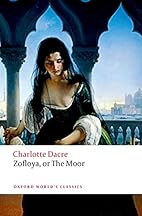
Charlotte King was born in 1772, the daughter of a moneylender named Jacob Rey who used the assumed name of John King in his business dealings. Charlotte became a writer in her 20s, using at least four pseudonyms including that of "Charlotte Dacre" for her most enduring work, Zofloya, or The Moor. Little is known about her private life except that she gave birth to three children before marrying for the first and only time at age 43. The mystery and elusiveness surrounding her life is only appropriate for the author of a minor Gothic masterpiece.
Zofloya, or The Moor is set in late 15th century Venice. We are introduced to the happy and noble family of the Marchese di Loredani. His wife, the euphoniously-named Laurina di Loredani, is a model of physical and spiritual beauty. They have two children, the proud and dashing Lorenzo and the stunning, raven-tressed Victoria. Victoria, they admit, is rather spoiled and demanding, but with proper instruction she will surely grow out of it and be as virtuous as her mother.
But Laurina's virtue is put to the test by a libertine houseguest who makes it his goal to seduce her. When he succeeds, the family falls apart, and one mistake after another plunges the father into grief and the two children into wickedness.
Victoria takes her mother's infidelity as a sign that all morality is bogus. She lives only to please herself, and is still enough the spoiled child to believe that what she wants she should have, no matter the cost. She becomes increasingly ruthless in pursuit of the object of her passions, but it isn't until midway through the novel that Victoria contemplates murder and accepts the offered help of a family servant, Zofloya.
Zofloya is a disenfranchised Muslim from Spain. His background, as well as the historical sketch which accompanies it, is very similar to that of the Moorish characters in Jan Potocki's novel The Manuscript Found in Saragossa, portions of which were first published just months before Zofloya, or The Moor appeared. Dacre and Potocki appear to have drawn inspiration from the same contemporary sources. There are other similarities between the two novels.
Zofloya's aid, and his interest in Victoria, are at first easily explained. But, gradually, as Victoria entangles herself deeper into a web of crime, the Moor's actions and powers begin to seem supernatural. The pledges he draws cleverly from his victim soon leave little doubt that he is Satan himself.
Zofloya, or The Moor is soundly rooted in the Gothic tradition, with numerous allusions to two giant works of that genre, Ann Radcliffe's The Mysteries of Udolpho and M. G. Lewis's The Monk. The resemblance to the latter is much stronger, as we are treated to gory scenes of murder and combat, moldering corpses, dungeons, insane ravings, and supernatural apparitions.
Victoria is one of several females who are honest about their sexual desires and nonchalant about the institution of marriage in a manner uncharacteristic of the time. But she refuses to be a sympathetic heroine. "Do I repent me of that which I have done? No,--I regret only the state to which circumstances have reduced me." In his fine introduction to the Oxford World's Classics edition of the novel, Kim Ian Michasiw asserts that it is this defiance which has cost Zofloya, the Moor its place in the literary canon. "A mother-hating triple murderess who dreams of sexual congress with a demon of colour has not been judged a proper model for the young reader either in the last century or in this. And the woman author who created such a being... can scarcely deserve shelf space next to Mansfield Park or Vilette."
After leading the reader down a treacherous slope of lust, revenge, violence and insanity, Dacre closes with a brief lesson on repentance and redemption from an angel representing a god that has scarcely been mentioned heretofore. The Marquis de Sade closed some of his works in similar fashion to make them publishable, and didn't fool anyone either. Zofloya, or The Moor is pure sensationalism from the pen of a talented young lady who apparently dozed through her geography lessons but was otherwise well-read. A more introspective Victoria di Loredani might have made a worthy female counterpart to Faust or Victor Frankenstein, but instead she is purely, astonishingly, wicked.
First published 1806
Charlotte King was born in 1772, the daughter of a moneylender named Jacob Rey who used the assumed name of John King in his business dealings. Charlotte became a writer in her 20s, using at least four pseudonyms including that of "Charlotte Dacre" for her most enduring work, Zofloya, or The Moor. Little is known about her private life except that she gave birth to three children before marrying for the first and only time at age 43. The mystery and elusiveness surrounding her life is only appropriate for the author of a minor Gothic masterpiece.
Zofloya, or The Moor is set in late 15th century Venice. We are introduced to the happy and noble family of the Marchese di Loredani. His wife, the euphoniously-named Laurina di Loredani, is a model of physical and spiritual beauty. They have two children, the proud and dashing Lorenzo and the stunning, raven-tressed Victoria. Victoria, they admit, is rather spoiled and demanding, but with proper instruction she will surely grow out of it and be as virtuous as her mother.
But Laurina's virtue is put to the test by a libertine houseguest who makes it his goal to seduce her. When he succeeds, the family falls apart, and one mistake after another plunges the father into grief and the two children into wickedness.
Victoria takes her mother's infidelity as a sign that all morality is bogus. She lives only to please herself, and is still enough the spoiled child to believe that what she wants she should have, no matter the cost. She becomes increasingly ruthless in pursuit of the object of her passions, but it isn't until midway through the novel that Victoria contemplates murder and accepts the offered help of a family servant, Zofloya.
Zofloya is a disenfranchised Muslim from Spain. His background, as well as the historical sketch which accompanies it, is very similar to that of the Moorish characters in Jan Potocki's novel The Manuscript Found in Saragossa, portions of which were first published just months before Zofloya, or The Moor appeared. Dacre and Potocki appear to have drawn inspiration from the same contemporary sources. There are other similarities between the two novels.
Zofloya's aid, and his interest in Victoria, are at first easily explained. But, gradually, as Victoria entangles herself deeper into a web of crime, the Moor's actions and powers begin to seem supernatural. The pledges he draws cleverly from his victim soon leave little doubt that he is Satan himself.
Zofloya, or The Moor is soundly rooted in the Gothic tradition, with numerous allusions to two giant works of that genre, Ann Radcliffe's The Mysteries of Udolpho and M. G. Lewis's The Monk. The resemblance to the latter is much stronger, as we are treated to gory scenes of murder and combat, moldering corpses, dungeons, insane ravings, and supernatural apparitions.
Victoria is one of several females who are honest about their sexual desires and nonchalant about the institution of marriage in a manner uncharacteristic of the time. But she refuses to be a sympathetic heroine. "Do I repent me of that which I have done? No,--I regret only the state to which circumstances have reduced me." In his fine introduction to the Oxford World's Classics edition of the novel, Kim Ian Michasiw asserts that it is this defiance which has cost Zofloya, the Moor its place in the literary canon. "A mother-hating triple murderess who dreams of sexual congress with a demon of colour has not been judged a proper model for the young reader either in the last century or in this. And the woman author who created such a being... can scarcely deserve shelf space next to Mansfield Park or Vilette."
After leading the reader down a treacherous slope of lust, revenge, violence and insanity, Dacre closes with a brief lesson on repentance and redemption from an angel representing a god that has scarcely been mentioned heretofore. The Marquis de Sade closed some of his works in similar fashion to make them publishable, and didn't fool anyone either. Zofloya, or The Moor is pure sensationalism from the pen of a talented young lady who apparently dozed through her geography lessons but was otherwise well-read. A more introspective Victoria di Loredani might have made a worthy female counterpart to Faust or Victor Frankenstein, but instead she is purely, astonishingly, wicked.
152AlisonY
>151 StevenTX: that sounds really good. Your review was great, and very interesting to hear about the author's colourful background: so emancipated for the period she lived in.
On the wish list...
On the wish list...
153FlorenceArt
>151 StevenTX: What a fascinating author and fun review! I don't think I will read the book, but I feel I should read Udolpho some day. I already read The Monk and was not very impressed I must say.
154rebeccanyc
>151 StevenTX: That sounds like fun!
155SassyLassy
>151 StevenTX: I do love a good Gothic tale. Great review.
156StevenTX
The Conquest of Plassans by Émile Zola
First published 1874
English translation by Helen Constantine 2014
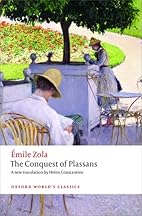

The Conquest of Plassans was the fourth novel Émile Zola wrote in his Rougon-Macquart saga and falls sixth in Zola's own recommended reading order. It takes place entirely in the town of Plassans (modeled on Aix-en-Provence) and centers on a couple who represent both the legitimate Rougon line of the family and the illegitimate Macquart line. François Mouret is of the Macquart line and is living a life of comfortable early retirement after a career as a merchant. His wife and first cousin Marthe is from the Rougon family which is still a dominant political and social force in Plassans. The Rougon's are Bonapartists, and support the ruling party of Emperor Napoleon III. Mouret, however, is a Republican and an atheist. Thus it surprises everyone when he decides to rent some vacant rooms in his large house to a priest and his mother.
Abbé Faujas is a figure of ridicule when he first arrives in Plassans with his unkempt appearance, shabby clothing, and hint of scandal. But he also has mysterious political connections with the ruling party and ambitions which go beyond mere clerical service. Gradually he begins asserting himself, winning over public opinion with good works while manipulating others to secure more personal power. He and his mother begin taking over the Mouret household as well, his key move being the conversion of Marthe to Catholicism. The wedge Faujas drives between husband and wife threatens the mental stability of both, and with their mutual grandmother already confined to an asylum, any misstep by either starts rumors of hereditary insanity.
Plassans and the Mouret household can both be seen as metaphors for France under the rule of Napoleon III, which Zola saw as sanctioning materialism and selfish ambition under a veneer of religious piety. Many of the intrigues, however, happen within and between various factions of the Bonapartist establishment, and it is difficult at times to keep straight among the town leaders which character represents what. The most compelling plot line is that of Marthe Mouret, whose newly-kindled passion for religion is confused with her passion for Abbé Faujas himself. But overall The Conquest of Plassans is one of Zola's less successful and less essential novels. One thing missing from this novel that you will find in most of Zola's other works are the passages of lavish visual description which showcase his writing prowess. The three Mouret children are introduced here who will feature in subsequent novels of the series, but they play only a minor role, so The Conquest of Plassans can't be considered essential from the standpoint of continuity.
So while The Conquest of Plassans is a good novel and one you would certainly want to include if you are considering reading the entire Rougon-Macquart series, it's one you can easily pass over if you only want to hit the high points of Zola's works.
Other works I have read by Émile Zola:
Thérèse Raquin
The Fortune of the Rougons
The Kill
Money
The Dream
Pot Luck
The Ladies' Paradise
The Sin of Father Mouret
The Belly of Paris
Germinal
First published 1874
English translation by Helen Constantine 2014

The Conquest of Plassans was the fourth novel Émile Zola wrote in his Rougon-Macquart saga and falls sixth in Zola's own recommended reading order. It takes place entirely in the town of Plassans (modeled on Aix-en-Provence) and centers on a couple who represent both the legitimate Rougon line of the family and the illegitimate Macquart line. François Mouret is of the Macquart line and is living a life of comfortable early retirement after a career as a merchant. His wife and first cousin Marthe is from the Rougon family which is still a dominant political and social force in Plassans. The Rougon's are Bonapartists, and support the ruling party of Emperor Napoleon III. Mouret, however, is a Republican and an atheist. Thus it surprises everyone when he decides to rent some vacant rooms in his large house to a priest and his mother.
Abbé Faujas is a figure of ridicule when he first arrives in Plassans with his unkempt appearance, shabby clothing, and hint of scandal. But he also has mysterious political connections with the ruling party and ambitions which go beyond mere clerical service. Gradually he begins asserting himself, winning over public opinion with good works while manipulating others to secure more personal power. He and his mother begin taking over the Mouret household as well, his key move being the conversion of Marthe to Catholicism. The wedge Faujas drives between husband and wife threatens the mental stability of both, and with their mutual grandmother already confined to an asylum, any misstep by either starts rumors of hereditary insanity.
Plassans and the Mouret household can both be seen as metaphors for France under the rule of Napoleon III, which Zola saw as sanctioning materialism and selfish ambition under a veneer of religious piety. Many of the intrigues, however, happen within and between various factions of the Bonapartist establishment, and it is difficult at times to keep straight among the town leaders which character represents what. The most compelling plot line is that of Marthe Mouret, whose newly-kindled passion for religion is confused with her passion for Abbé Faujas himself. But overall The Conquest of Plassans is one of Zola's less successful and less essential novels. One thing missing from this novel that you will find in most of Zola's other works are the passages of lavish visual description which showcase his writing prowess. The three Mouret children are introduced here who will feature in subsequent novels of the series, but they play only a minor role, so The Conquest of Plassans can't be considered essential from the standpoint of continuity.
So while The Conquest of Plassans is a good novel and one you would certainly want to include if you are considering reading the entire Rougon-Macquart series, it's one you can easily pass over if you only want to hit the high points of Zola's works.
Other works I have read by Émile Zola:
Thérèse Raquin
The Fortune of the Rougons
The Kill
Money
The Dream
Pot Luck
The Ladies' Paradise
The Sin of Father Mouret
The Belly of Paris
Germinal
157rebeccanyc
I read an earlier (1957) translation of The Conquest of Plassans, under the awful title of A Priest in the House, but I bought this version when I saw it in a store and may eventually read it, even though, as you note, it isn't one of his best.
158dchaikin
Hoping you are approaching better health. That was a really fun review of Zofloya. And That was a great review of the Zola, even if the book wasn't your favorite in the series. I was intrigued by your review of Consider Phlebas, even if I had to remind myself I don't normally like scifi. Anyway enjoyed catching up.
159Poquette
Very much enjoyed your recent reviews of Consider Phlebas, Zofloya, the Moor (which I do not remember hearing of before and I appreciate your introduction) and The Conquest of Plassans. You make them sound very interesting indeed, especially since I probably won't get to them.
160baswood
I enjoyed your entertaining review of Zofloya, or the Moor but as gothic is not my favourite genre I probably would enjoy your review more than the book.
161StevenTX
In the Heart of the Country by J. M. Coetzee
First published 1977

The title of In the Heart of the Country may not have been an intentional reference to Conrad's Heart of Darkness, but the two stories are each a bleak journey into physical, social and spiritual isolation. In the Heart of the Country is set in the author's South Africa and narrated by a woman named Magda, the daughter and apparently only child of a widowed rancher. They live on the arid veldt where rain is an event almost as rare as a visitor from the outside world. Their only companions are the black maid and farmhands they employ but scarcely know. Magda, by her own description, is a thin, ugly and lonely young woman whose days are as barren as the land she lives on.
On the very first pages of the novel we learn that Magda is an unreliable narrator. She gives us several contradictory descriptions of her father bringing his new bride to their house, an event that may never have happened at all. There are other instances throughout the book of episodes being retold several times with different outcomes. Magda admits that many of her memories may be manufactured from conjecture or dreams, but inevitably it is her sanity which is in doubt.
Magda's self-pity turns to despair and a feverish longing for the life of companionship and sexual fulfillment that she knows will never be hers, even though it is largely her own fears and inhibitions which deny her the life she wants. She puts all the blame on her father, fantasizing his death even as she dreams of being sexually used by him. Then her fantasies extend to the African workers whose seemingly carefree and sensual lives she begins to envy. "I can never be the rapture of pure self that they are," she writes.
Colonialism and apartheid are obviously at the root of Magda's despair and instability, but the novel goes deeper than just being a condemnation of racism and exploitation. It is also a sympathetic look at those, like Magda, who feel themselves trapped in and blamed for a system they did not create and do not uphold. Speaking to Hendrik, a black farmhand, Magda complains, "You are so bitter that you are completely blinded. I am not simply one of the whites, I am I! I am I, not a people. Why have I to pay for other people's sins?"
On another level altogether, In the Heart of the Country is also a lament on behalf of those whose literacy and understanding condemns them to a life of introspection and confrontation with their inner darkness. Magda writes that she is "alas forever set off from them by the babble of words within me that fabricate and refabricate me as something else, something else.... Would that I had never learned to read."
In the Heart of the Country is a searing journey into a mind torn and twisted by an uncaring parent, an unforgiving land, and a heritage of injustice. It is a violent and visceral story of hopeless despair and emotional self-mortification. The novel also reflects its author's plight, for those who have the gift for telling the story must bear the burden of telling it, even though it consumes them.
Other works I have read by J. M. Coetzee:
Dusklands
Waiting for the Barbarians
Life & Times of Michael K
The Master of Petersburg
Disgrace
First published 1977

The title of In the Heart of the Country may not have been an intentional reference to Conrad's Heart of Darkness, but the two stories are each a bleak journey into physical, social and spiritual isolation. In the Heart of the Country is set in the author's South Africa and narrated by a woman named Magda, the daughter and apparently only child of a widowed rancher. They live on the arid veldt where rain is an event almost as rare as a visitor from the outside world. Their only companions are the black maid and farmhands they employ but scarcely know. Magda, by her own description, is a thin, ugly and lonely young woman whose days are as barren as the land she lives on.
On the very first pages of the novel we learn that Magda is an unreliable narrator. She gives us several contradictory descriptions of her father bringing his new bride to their house, an event that may never have happened at all. There are other instances throughout the book of episodes being retold several times with different outcomes. Magda admits that many of her memories may be manufactured from conjecture or dreams, but inevitably it is her sanity which is in doubt.
Magda's self-pity turns to despair and a feverish longing for the life of companionship and sexual fulfillment that she knows will never be hers, even though it is largely her own fears and inhibitions which deny her the life she wants. She puts all the blame on her father, fantasizing his death even as she dreams of being sexually used by him. Then her fantasies extend to the African workers whose seemingly carefree and sensual lives she begins to envy. "I can never be the rapture of pure self that they are," she writes.
Colonialism and apartheid are obviously at the root of Magda's despair and instability, but the novel goes deeper than just being a condemnation of racism and exploitation. It is also a sympathetic look at those, like Magda, who feel themselves trapped in and blamed for a system they did not create and do not uphold. Speaking to Hendrik, a black farmhand, Magda complains, "You are so bitter that you are completely blinded. I am not simply one of the whites, I am I! I am I, not a people. Why have I to pay for other people's sins?"
On another level altogether, In the Heart of the Country is also a lament on behalf of those whose literacy and understanding condemns them to a life of introspection and confrontation with their inner darkness. Magda writes that she is "alas forever set off from them by the babble of words within me that fabricate and refabricate me as something else, something else.... Would that I had never learned to read."
In the Heart of the Country is a searing journey into a mind torn and twisted by an uncaring parent, an unforgiving land, and a heritage of injustice. It is a violent and visceral story of hopeless despair and emotional self-mortification. The novel also reflects its author's plight, for those who have the gift for telling the story must bear the burden of telling it, even though it consumes them.
Other works I have read by J. M. Coetzee:
Dusklands
Waiting for the Barbarians
Life & Times of Michael K
The Master of Petersburg
Disgrace
162baswood
Great review of In the Heart of the Country I think I might have to interrupt my Doris Lessing reading to catch up with this book.
163AlisonY
>161 StevenTX: great review. Disgrace was my first one of his books (read a few months ago), and it troubled and perplexed me in equal measure. Coetzee doesn't seem to be afraid of putting the reader into uncomfortable places, but somehow he draws you like a moth to a flame. In the Heart of the Country sounds like it would both disturb and engage me. Ping - on the wish list.
164StevenTX
Herland by Charlotte Perkins Gilman
First published 1915


Herland is a remarkable utopian vision of an entirely female but essentially sexless society. The novel follows a team of three male Americans exploring an unnamed continent who first hear native rumors of a land ruled entirely by women hidden in a virtually unreachable mountain valley. They mount a second expedition equipped with a biplane with which they are able to surmount the mountain barrier and reach the country they call Herland. The three men are at first taken captive by surprisingly powerful older women. They are kindly treated but kept prisoner until they can learn the language of Herland. They find that their women captors are as eager to learn about the outside world as they are to unlock the secrets of this strange, all-female society.
Herland's history began some 2,000 years ago when it was a typical ancient kingdom. But while most of the adult males were away fighting a war, a volcanic eruption formed a mountain wall forever sealing the country from the rest of the world. Slaves rose up, killing the remaining male population and seizing the women. But a counter revolt by the women exterminated the slaves, leaving a land populated only by women. For years the population steadily dwindled until, miraculously, a woman gave birth to a daughter by parthenogenesis. Her offspring proved able to reproduce asexually as well, and eventually the entire valley was repopulated with the descendants of this one "Great Over Mother."
The explorers find Herland a paradise beyond their experience. Every bit of ground is like a parkland, immaculately maintained, free of pests, and groomed to produce as much food or usable material as possible. The villages are bright, cheerful, and spotless. The women are all extraordinarily intelligent and active, curious, kind, and even-tempered. They can barely understand the concepts of crime, poverty, or private property. Without sexuality or pair bonding, the focus of the Herland society is on motherhood. But it is a collective motherhood which manifests itself in education and emotional development of the young rather than personal attachment. One of the hardest things for the explorers to grasp is that in a society of women there should be no concept of home and family.
After the explorers reach Herland and begin their education, there is very little plot to the novel. It is basically an examination of the society of Herland and, by contrast, a condemnation of all other human cultures. The society that Gilman creates is an immensely appealing utopia without blemish. It is, of course, an unattainable one unless we should manage to re-engineer our own species to be without gender. And one question that comes to mind is whether it is the female nature which makes Herland function so well, or simply the absence of sex.
Reviews of Herland on its centenary this year (2015) have not failed to make note of the author's unapologetic racism (something not apparent in the novel itself). But Herland is still very much worth reading, as it is full of Gilman's startlingly progressive ideas on such things as religion, patriotism, and eugenics. Despite the lack of plot action I was fascinated throughout and disappointed when it came to an end.
Herland appears on the following recommended reading lists:
David Brin's "Greatest Science Fiction and Fantasy Tales"
Guardian's "1000 Novels Everyone Should Read"
James Wallace Harris's "Classics of Science Fiction"
Fantasy and Horror Key Works of Fantasy
New York Public Library's "Books of the Century"
First published 1915


Herland is a remarkable utopian vision of an entirely female but essentially sexless society. The novel follows a team of three male Americans exploring an unnamed continent who first hear native rumors of a land ruled entirely by women hidden in a virtually unreachable mountain valley. They mount a second expedition equipped with a biplane with which they are able to surmount the mountain barrier and reach the country they call Herland. The three men are at first taken captive by surprisingly powerful older women. They are kindly treated but kept prisoner until they can learn the language of Herland. They find that their women captors are as eager to learn about the outside world as they are to unlock the secrets of this strange, all-female society.
Herland's history began some 2,000 years ago when it was a typical ancient kingdom. But while most of the adult males were away fighting a war, a volcanic eruption formed a mountain wall forever sealing the country from the rest of the world. Slaves rose up, killing the remaining male population and seizing the women. But a counter revolt by the women exterminated the slaves, leaving a land populated only by women. For years the population steadily dwindled until, miraculously, a woman gave birth to a daughter by parthenogenesis. Her offspring proved able to reproduce asexually as well, and eventually the entire valley was repopulated with the descendants of this one "Great Over Mother."
The explorers find Herland a paradise beyond their experience. Every bit of ground is like a parkland, immaculately maintained, free of pests, and groomed to produce as much food or usable material as possible. The villages are bright, cheerful, and spotless. The women are all extraordinarily intelligent and active, curious, kind, and even-tempered. They can barely understand the concepts of crime, poverty, or private property. Without sexuality or pair bonding, the focus of the Herland society is on motherhood. But it is a collective motherhood which manifests itself in education and emotional development of the young rather than personal attachment. One of the hardest things for the explorers to grasp is that in a society of women there should be no concept of home and family.
After the explorers reach Herland and begin their education, there is very little plot to the novel. It is basically an examination of the society of Herland and, by contrast, a condemnation of all other human cultures. The society that Gilman creates is an immensely appealing utopia without blemish. It is, of course, an unattainable one unless we should manage to re-engineer our own species to be without gender. And one question that comes to mind is whether it is the female nature which makes Herland function so well, or simply the absence of sex.
Reviews of Herland on its centenary this year (2015) have not failed to make note of the author's unapologetic racism (something not apparent in the novel itself). But Herland is still very much worth reading, as it is full of Gilman's startlingly progressive ideas on such things as religion, patriotism, and eugenics. Despite the lack of plot action I was fascinated throughout and disappointed when it came to an end.
Herland appears on the following recommended reading lists:
David Brin's "Greatest Science Fiction and Fantasy Tales"
Guardian's "1000 Novels Everyone Should Read"
James Wallace Harris's "Classics of Science Fiction"
Fantasy and Horror Key Works of Fantasy
New York Public Library's "Books of the Century"
165rebeccanyc
Just catching up with your reading and your always interesting reviews.
166baswood
>164 StevenTX: The women are all extraordinarily intelligent and active, curious, kind, and even-tempered. huh Utopia indeed.
Herland is on my list to read.
Herland is on my list to read.
167kidzdoc
Great review of In the Heart of the Country, Steven. I've read and enjoyed several of Coetzee's books, especially Disgrace, The Life and Times of Michael K, Waiting for the Barbarians and Summertime, but I haven't read and don't own the one you read. Onto the wishlist it goes.
Nice review of Herland as well.
Nice review of Herland as well.
168StevenTX
Yes by Thomas Bernard
First published in German 1978
English translation by Ewald Osers 1991

The reclusive scientist who narrates this stream-of-consciousness novel tells us in the opening sentence that he is suffering from an "emotional and mental sickness." But is he really sick, or has he just failed to divert himself from the bitter truth that life has no meaning or purpose?
The plot of the novel is very simple. The scientist is attempting to unburden himself of his fears about his mental condition to his only friend, a real estate agent, when he is interrupted by the arrival of a couple who want to see some nearby property. The buyers are a Swiss engineer nearing retirement and his companion, a younger Persian woman who gave up a career in the arts years ago for the sake of her Swiss lover. The engineer winds up buying a miserable piece of property at full price and building a horrible concrete house, all with the apparent intention of tormenting the helpless Persian woman. The narrator and the woman go on several walks together in the woods, during which time they say almost nothing to each other.
The plot is almost meaningless, which is part of the novel's message. It only deepens the air of helpless despair as a background for passages like the following existentialist credo:
Other works I have read by Thomas Bernhard:
Correction
First published in German 1978
English translation by Ewald Osers 1991

The reclusive scientist who narrates this stream-of-consciousness novel tells us in the opening sentence that he is suffering from an "emotional and mental sickness." But is he really sick, or has he just failed to divert himself from the bitter truth that life has no meaning or purpose?
The plot of the novel is very simple. The scientist is attempting to unburden himself of his fears about his mental condition to his only friend, a real estate agent, when he is interrupted by the arrival of a couple who want to see some nearby property. The buyers are a Swiss engineer nearing retirement and his companion, a younger Persian woman who gave up a career in the arts years ago for the sake of her Swiss lover. The engineer winds up buying a miserable piece of property at full price and building a horrible concrete house, all with the apparent intention of tormenting the helpless Persian woman. The narrator and the woman go on several walks together in the woods, during which time they say almost nothing to each other.
The plot is almost meaningless, which is part of the novel's message. It only deepens the air of helpless despair as a background for passages like the following existentialist credo:
“We brood about what we should have done differently or better or what perhaps we should not have done, because we are doomed to do so, but it does not lead anywhere. The disaster was inevitable, is what we then say and for a while, if only a short while, we are quiet. Then we start all over again asking questions and probing and probing until we have gone half crazy. We constantly look for someone responsible, or for several persons responsible, in order to make things bearable for ourselves for at least a moment, and naturally, if we are honest, we invariably end up with ourselves. We have reconciled to the fact that we have to exist, even though most of the time against our will, because we have no other choice, and only because we have again and again reconciled ourselves to this fact, every day and every moment anew, can we progress at all. And where we are progressing to, we have, if we are honest, known all our lives, to death, except that most of the time we are careful not to admit it. And because we have that certainty of doing nothing other than progressing towards death and because we realize what that means, we try to employ all kinds of aids to divert us from that realization, and thus, if we only look closely, we see in this world nothing except people continually and all their lives engaged in such a diversion…. Everything about everybody is nothing but diversion from death.”Bernhard's signature style of long, flowing sentences with no paragraph or chapter breaks is perfect for this kind of narration. It conveys the scientist's obsessive mental condition, yet, because of frequent repetitions and minimal dialogue, is quite easy to read. There are strong similarities between Yes and Sartre's Nausea, even to the point that the narrator experiences vertigo when contemplating everyday objects. With its relentless nihilism this is not a book everyone will enjoy, but it is a fine expression of existential despair.
Other works I have read by Thomas Bernhard:
Correction
169StevenTX
>163 AlisonY: - I think a big difference between Disgrace and In the Heart of the Country is that the former has a very unsympathetic narrator, while the latter has a sympathetic but unreliable one. There is harsh realism on one side, surrealism on the other. Both, as you say, take you into uncomfortable places.
>166 baswood: - Herland makes a nice contrast with other utopian works. It is one of the few that has no underclass of slaves, subhumans, or machines to do the dirty work. Most people will focus on the feminist aspects of it, but it is also an expression of a form of communism featuring eugenics and collective child-rearing--the same elements that you find in many dystopias.
>166 baswood: - Herland makes a nice contrast with other utopian works. It is one of the few that has no underclass of slaves, subhumans, or machines to do the dirty work. Most people will focus on the feminist aspects of it, but it is also an expression of a form of communism featuring eugenics and collective child-rearing--the same elements that you find in many dystopias.
170FlorenceArt
>168 StevenTX: Thomas Bernhard is one of the many authors I discovered through LT, although I have yet to read him. Sounds like a rewarding if not easy read.
171baswood
Save me from that existentialist despair. I don't think I will read Thomas Bernard's book.
172StevenTX
Pereira Declares: A Testimony by Antonio Tabucchi
First published in Italian 1994
English translation by Patrick Creagh 1995

Pereira is a newspaperman in Lisbon in 1938. Under Portugal's right-wing dictatorship, newspapers are expected to show their loyalty by supporting Portugal's volunteers on the Nationalist side in the Spanish Civil War and by praising Portugal's unofficial allies, fascist Germany and Italy. But as the editor of the culture page, Pereira considers himself aloof from all of that. He is concerned with affairs of the body and the soul, not with politics, and is content to publish his translations of French short stories and the obituaries of great writers.
That trouble is headed Pereira's way is hinted by the construction of the novel itself. It is as though a skeptic were reading a testimony dictated by Pereira, interjecting "Pereira declares this" and "Pereira declares that" every so often. Pereira's priest and his doctor warn the editor that he won't be able to stay neutral forever. And, sure enough, when the assistant editor he hires turns out to be something other than what he claims to be, Pereira's hand is forced.
Much of the appeal of this short novel is in the character of Pereira himself. He is an honest, unassuming, paunchy widower who loves his omelets and his lemonade. Like so many of us, he rationalizes against giving up the food he loves for the sake of his heart and his waistline. Similarly he rationalizes against giving up his placid comforts to take a stand on behalf of what he believes.
Most novels about life under a dictatorship are tragic and depressing, but Pereira Declares manages to not only have a serious message, but to be light and uplifting at the same time. This brilliant look at life in Europe on the eve of World War II is highly recommended.
Pereira Declares appears on the following recommended reading lists:
1001 Books You Must Read before You Die (2006 & 2010 editions)
501 Must-Read Books in the category Modern Fiction
Harenberg: Das Buch der 1000 Bücher
Dalkey Archives Advisors' Favorite Novels in Translation
First published in Italian 1994
English translation by Patrick Creagh 1995

Pereira is a newspaperman in Lisbon in 1938. Under Portugal's right-wing dictatorship, newspapers are expected to show their loyalty by supporting Portugal's volunteers on the Nationalist side in the Spanish Civil War and by praising Portugal's unofficial allies, fascist Germany and Italy. But as the editor of the culture page, Pereira considers himself aloof from all of that. He is concerned with affairs of the body and the soul, not with politics, and is content to publish his translations of French short stories and the obituaries of great writers.
That trouble is headed Pereira's way is hinted by the construction of the novel itself. It is as though a skeptic were reading a testimony dictated by Pereira, interjecting "Pereira declares this" and "Pereira declares that" every so often. Pereira's priest and his doctor warn the editor that he won't be able to stay neutral forever. And, sure enough, when the assistant editor he hires turns out to be something other than what he claims to be, Pereira's hand is forced.
Much of the appeal of this short novel is in the character of Pereira himself. He is an honest, unassuming, paunchy widower who loves his omelets and his lemonade. Like so many of us, he rationalizes against giving up the food he loves for the sake of his heart and his waistline. Similarly he rationalizes against giving up his placid comforts to take a stand on behalf of what he believes.
Most novels about life under a dictatorship are tragic and depressing, but Pereira Declares manages to not only have a serious message, but to be light and uplifting at the same time. This brilliant look at life in Europe on the eve of World War II is highly recommended.
Pereira Declares appears on the following recommended reading lists:
1001 Books You Must Read before You Die (2006 & 2010 editions)
501 Must-Read Books in the category Modern Fiction
Harenberg: Das Buch der 1000 Bücher
Dalkey Archives Advisors' Favorite Novels in Translation
173StevenTX
Dangling Man by Saul Bellow
First published 1944

In Chicago in 1942 a young man named Joseph applies for induction into the Army. Anticipating a quick enlistment, he quits his job. But his Canadian birth proves to be a problem for the Army. His application is deferred and, month after month, he is left dangling. He can't get his job back--or any job--because of his imminent induction, so he starts keeping a diary as he lives precariously off his wife's meager income.
Joseph is an intellectual, a former communist, and an introspective man of strong feelings. He also has more than his share of personal pride, and being an able-bodied man unemployed during wartime puts an enormous chip on his shoulder. "I feel I am a sort of human grenade whose pin has been withdrawn," he writes. "I know I am going to explode and I am continually anticipating the time...." Joseph's diary alternates between accounts of his short-tempered run-ins with wife, family, friends and neighbors and calm ruminations on the purpose of life itself. In particular he muses on the contradictory expectations of our personal and social selves. "Great pressure is brought to bear to make us undervalue ourselves," he writes, "On the other hand civilization teaches that each of us is an inestimable prize."
Dangling Man was Saul Bellow's first novel, and the author himself has described it as an "apprentice work." Like many first novels it shows a lack of patience by the author as he launches straight into direct statements of his ideas without developing them through characters and plot. Plot, in fact, is minimal. What we see is largely Joseph's gradual emotional deterioration as he awaits his induction. His philosophical self-examination never provides him with the solace he seeks, only with questions he can't answer. On the plus side, Joseph, despite his short fuse, is one Bellow's more appealing protagonists. And the novel provides a vivid picture of life in the boarding houses that were home to many urban Americans before and during World War II. This was the life that so many veterans were eager to put behind them in the great suburban building boom that followed the war.
Other works I have read by Saul Bellow:
The Adventures of Augie March
Seize the Day
Herzog
Henderson the Rain King
Humboldt's Gift
First published 1944

In Chicago in 1942 a young man named Joseph applies for induction into the Army. Anticipating a quick enlistment, he quits his job. But his Canadian birth proves to be a problem for the Army. His application is deferred and, month after month, he is left dangling. He can't get his job back--or any job--because of his imminent induction, so he starts keeping a diary as he lives precariously off his wife's meager income.
Joseph is an intellectual, a former communist, and an introspective man of strong feelings. He also has more than his share of personal pride, and being an able-bodied man unemployed during wartime puts an enormous chip on his shoulder. "I feel I am a sort of human grenade whose pin has been withdrawn," he writes. "I know I am going to explode and I am continually anticipating the time...." Joseph's diary alternates between accounts of his short-tempered run-ins with wife, family, friends and neighbors and calm ruminations on the purpose of life itself. In particular he muses on the contradictory expectations of our personal and social selves. "Great pressure is brought to bear to make us undervalue ourselves," he writes, "On the other hand civilization teaches that each of us is an inestimable prize."
Dangling Man was Saul Bellow's first novel, and the author himself has described it as an "apprentice work." Like many first novels it shows a lack of patience by the author as he launches straight into direct statements of his ideas without developing them through characters and plot. Plot, in fact, is minimal. What we see is largely Joseph's gradual emotional deterioration as he awaits his induction. His philosophical self-examination never provides him with the solace he seeks, only with questions he can't answer. On the plus side, Joseph, despite his short fuse, is one Bellow's more appealing protagonists. And the novel provides a vivid picture of life in the boarding houses that were home to many urban Americans before and during World War II. This was the life that so many veterans were eager to put behind them in the great suburban building boom that followed the war.
Other works I have read by Saul Bellow:
The Adventures of Augie March
Seize the Day
Herzog
Henderson the Rain King
Humboldt's Gift
174rebeccanyc
I enjoyed Pereira Declares too, and thanks for the review of the Bellow, who I've never read.
175kidzdoc
Three great reviews, Steven; thanks for psting them. I also loved Pereira Declares, and Dangling Man is already on my wish list after an earlier review of it.
176StevenTX
Thanks for your visit and your kind comments, everyone. I'll be taking a cruise out of Istanbul for the next two weeks and probably won't have Internet access, so I'll see you when I get back. I have lots of reading options on my Kindle for the long flights and airport layovers.
178rebeccanyc
Have a great trip!
179kidzdoc
Have a great time, Steven! I'll be very interested to hear about your trip when you return.
180StevenTX
I'm back from a very nice vacation trip to Istanbul and the Aegean. Istanbul is a beautiful and amazing city, both exotic and welcoming. On our cruise around the Aegean most of our sightseeing was devoted to archaeological sites. My one disappointment was that my health deterred me from attempting to climb to the Acropolis in Athens, but I spent a nice morning in the museum of Byzantine art instead. I was able, however, to tour Ephesus, Pergamon, the Labyrinth of Knossos (undoubtedly the model for the airports at Frankfurt and Toronto), Philippi, and other sites. My favorite stop of all, however, was Troy.
The only reading I managed to do on the trip was on the flights to and from. On the way over I read Redshirts by John Scalzi, an intriguing work of metafiction addressing the way minor characters are used and expended in fiction and film. On the way back I made an attempt at some Plato, but fatigue and distractions forced me to switch to the lightest work at hand, The Son of Tarzan. It was basically more of the same with a new ape man, but its one redeeming feature was the novel's delightfully feisty heroine, Meriem, a teenage captive rescued by Tarzan's son, Korak. Before long she's swinging through the trees, taunting lions, and fearlessly battling the enemy. If anyone's dying to see a full review of either book, I'll post one; otherwise I'll just move along.
The only reading I managed to do on the trip was on the flights to and from. On the way over I read Redshirts by John Scalzi, an intriguing work of metafiction addressing the way minor characters are used and expended in fiction and film. On the way back I made an attempt at some Plato, but fatigue and distractions forced me to switch to the lightest work at hand, The Son of Tarzan. It was basically more of the same with a new ape man, but its one redeeming feature was the novel's delightfully feisty heroine, Meriem, a teenage captive rescued by Tarzan's son, Korak. Before long she's swinging through the trees, taunting lions, and fearlessly battling the enemy. If anyone's dying to see a full review of either book, I'll post one; otherwise I'll just move along.
182Helenliz
That sounds like a fabulous trip. I can understand not doing much reading with that lot to distract you.
183StevenTX
Aleriel by W. S. Lach-Szyrma
First part, "Aleriel: A Voice from Another World," serialized 1865, revised and published in book form 1874
Second part, "Letters from the Planets," serialized 1887-1893

W. S. Lach-Szyrma was an Anglican clergyman of Polish extraction living in Cornwall. He was chiefly a writer of local history, but a desire to reconcile the ideas of science and religion led him to write Aleriel, which he describes as a purely allegorical tale. Aleriel is a work in two parts, published decades apart and radically different in form and theme.
In the first part, the narrator (an unnamed Cornish vicar) describes a visitation by a winged stranger named Aleriel. The visitor appears to be an angel but is actually an inhabitant of the planet Venus. He has come alone to Earth through some form of spiritual projection. He describes Venus as a planet where Man has never fallen and is thus sinless and immortal. By means of induced dreams he gives the narrator a vision of the religious observances on his planet. There is some grand imagery here, but no ideas of much interest except perhaps to theologians.
The second part of the work, "Letters from the Planets," is a series of letters transmitted by various means from Alerial to his clergyman friend describing the former's visits to various worlds of the solar system. Instead of using teleportation, Alerial and his four companions are now traveling inside a spaceship, or "ether-car," that resembles a miniature submarine. It is propelled by an anti-gravity engine, steered by powerful magnets, and armored with a substance that allows it to fly even into the outer atmosphere of the sun. Alerial pays brief visits to our Moon, Mercury, the Sun, Mars, and a moonlet orbiting a moon of Jupiter. Each of these places is, or has been, inhabited. Mars is described most extensively. The Martians (and Lach-Szyrma may have been the first to use that term) are technologically more advanced even than the Venusians, and live in great floating cities that migrate the canals of Mars to stay perpetually in the summer.
In "Letters from the Planets," religion is present but only in the background. Lach-Szyrma appears to be trying to show that Creation takes many forms in many places, and that what some consider supernatural and therefore inconsistent with science is simply a manifestation of conditions our science has yet to explore. I'm not sure that he makes much headway with this idea, but he does throw out some ideas that seem quite advanced for the time. He proposes, for example, that we quit relying upon fossil fuels for energy and turn to renewable sources like geothermal and tide-powered generators. He also suggests that the invention of the telephone makes it possible for nations to revert to the pure democracy of Athens with citizens voting directly on laws rather than indirectly by means of representation. He concludes with a proposal that we attempt to communicate with other planets using huge arrays of beacons to beam shapes and symbols into the night sky. (Naturally the symbol he suggests we start with is the cross.)
Aleriel is a work I would chiefly recommend to those studying religious science fiction and fantasy. It is otherwise of only minor interest, though the second part does have a few nice notions and some pretty illustrations.

Aleriel's ether car approaching Mercury

A Martian city floats upon a canal

The view from a tiny moon of one of Jupiter's larger moons
First part, "Aleriel: A Voice from Another World," serialized 1865, revised and published in book form 1874
Second part, "Letters from the Planets," serialized 1887-1893

W. S. Lach-Szyrma was an Anglican clergyman of Polish extraction living in Cornwall. He was chiefly a writer of local history, but a desire to reconcile the ideas of science and religion led him to write Aleriel, which he describes as a purely allegorical tale. Aleriel is a work in two parts, published decades apart and radically different in form and theme.
In the first part, the narrator (an unnamed Cornish vicar) describes a visitation by a winged stranger named Aleriel. The visitor appears to be an angel but is actually an inhabitant of the planet Venus. He has come alone to Earth through some form of spiritual projection. He describes Venus as a planet where Man has never fallen and is thus sinless and immortal. By means of induced dreams he gives the narrator a vision of the religious observances on his planet. There is some grand imagery here, but no ideas of much interest except perhaps to theologians.
The second part of the work, "Letters from the Planets," is a series of letters transmitted by various means from Alerial to his clergyman friend describing the former's visits to various worlds of the solar system. Instead of using teleportation, Alerial and his four companions are now traveling inside a spaceship, or "ether-car," that resembles a miniature submarine. It is propelled by an anti-gravity engine, steered by powerful magnets, and armored with a substance that allows it to fly even into the outer atmosphere of the sun. Alerial pays brief visits to our Moon, Mercury, the Sun, Mars, and a moonlet orbiting a moon of Jupiter. Each of these places is, or has been, inhabited. Mars is described most extensively. The Martians (and Lach-Szyrma may have been the first to use that term) are technologically more advanced even than the Venusians, and live in great floating cities that migrate the canals of Mars to stay perpetually in the summer.
In "Letters from the Planets," religion is present but only in the background. Lach-Szyrma appears to be trying to show that Creation takes many forms in many places, and that what some consider supernatural and therefore inconsistent with science is simply a manifestation of conditions our science has yet to explore. I'm not sure that he makes much headway with this idea, but he does throw out some ideas that seem quite advanced for the time. He proposes, for example, that we quit relying upon fossil fuels for energy and turn to renewable sources like geothermal and tide-powered generators. He also suggests that the invention of the telephone makes it possible for nations to revert to the pure democracy of Athens with citizens voting directly on laws rather than indirectly by means of representation. He concludes with a proposal that we attempt to communicate with other planets using huge arrays of beacons to beam shapes and symbols into the night sky. (Naturally the symbol he suggests we start with is the cross.)
Aleriel is a work I would chiefly recommend to those studying religious science fiction and fantasy. It is otherwise of only minor interest, though the second part does have a few nice notions and some pretty illustrations.

Aleriel's ether car approaching Mercury

A Martian city floats upon a canal

The view from a tiny moon of one of Jupiter's larger moons
184reva8
>183 StevenTX: Great review, and those illustrations are delightful.
185StevenTX
Gorgias by Plato
Written circa 380 BCE
Translated by Benjamin Jowett
In this early dialogue, Socrates enters into a debate with Gorgias, a teacher of rhetoric, and two of Gorgias's students, Polus and Callicles. The initial subject of the debate is rhetoric and whether it makes men just. The nature of the debate shifts, however, to the broader questions of the nature of good and evil and how a man should live. It concludes with some speculation by Socrates on the nature of the afterlife.
The opening debate of the dialogue is between Socrates and Gorgias himself. In a respectful tone, Socrates asks Gorgias if his art of persuasion is the source of knowledge or simply belief without knowledge. When Gorgias admits to the latter, Socrates further presses the rhetorician to agree that rhetoric "is the artificer of persuasion which creates belief about the just and unjust, but gives no instruction about them." Socrates moves on to dismiss rhetoric altogether as simply ignoble flattery "because it aims at pleasure without any thought of the best."
Socrates next debates with Polus over whether rhetoric should be considered an "art" comparable to medicine or gymastics. He concludes that rhetoric is to justice as cookery is to medicine. The first is simply an exercise in creating pleasure, the second strives to create good.
Gorgias's other student, Callicles, now steps in, and the debate heats up as it broadens well beyond the subject of rhetoric. Callicles dismisses Socrates's assumptions about what is good and just, in particular the philosopher's idea that pleasure is somehow ignoble. Callicles insists that suffering is evil and pleasure is good, therefore a life devoted to self-gratification and the pursuit of power is a good life. Socrates counters with the argument that justice is based on temperance, and it is better to be the one who suffers injustice than the one who practices it. The scope of the debate extends into politics, where Callicles maintains that it is best that the strong and talented have dominion over the weak as well as a greater share of wealth. Socrates argues that to crave more than one needs is the source of unhappiness.
With Callicles still defiant, Socrates concludes with his personal theory of the afterlife. Zeus, he says, has set up a panel of immortals who will judge men naked (i.e. irrespective of their station in life) and consign their souls either to the Blessed Isles or the punishments of Tartarus. For those whose sins are minor, the punishment will be temporary, while for the incorrigibles it will last for eternity.
Socrates's position in his debate with Callicles bears a striking resemblance to the ethical principles of the New Testament just as his theory of a Last Judgment parallels the Catholic notion of Heaven, Hell, and Purgatory. The values of Christianity were clearly nothing new to the Greek world.
The "Last Judgment" passage seems to me to weaken rather than bolster Socrates's position on temperance and justice. If goodness and justice were truly better than pleasure and power, why introduce the unprovable idea of a system of punishments and rewards? Still, both from a philosophical and an historical standpoint, Gorgias is an important and rewarding reading experience. As Socrates says, "we are arguing about the way of human life; and to a man who has any sense at all, what question can be more serious than this?"
Written circa 380 BCE
Translated by Benjamin Jowett
In this early dialogue, Socrates enters into a debate with Gorgias, a teacher of rhetoric, and two of Gorgias's students, Polus and Callicles. The initial subject of the debate is rhetoric and whether it makes men just. The nature of the debate shifts, however, to the broader questions of the nature of good and evil and how a man should live. It concludes with some speculation by Socrates on the nature of the afterlife.
The opening debate of the dialogue is between Socrates and Gorgias himself. In a respectful tone, Socrates asks Gorgias if his art of persuasion is the source of knowledge or simply belief without knowledge. When Gorgias admits to the latter, Socrates further presses the rhetorician to agree that rhetoric "is the artificer of persuasion which creates belief about the just and unjust, but gives no instruction about them." Socrates moves on to dismiss rhetoric altogether as simply ignoble flattery "because it aims at pleasure without any thought of the best."
Socrates next debates with Polus over whether rhetoric should be considered an "art" comparable to medicine or gymastics. He concludes that rhetoric is to justice as cookery is to medicine. The first is simply an exercise in creating pleasure, the second strives to create good.
Gorgias's other student, Callicles, now steps in, and the debate heats up as it broadens well beyond the subject of rhetoric. Callicles dismisses Socrates's assumptions about what is good and just, in particular the philosopher's idea that pleasure is somehow ignoble. Callicles insists that suffering is evil and pleasure is good, therefore a life devoted to self-gratification and the pursuit of power is a good life. Socrates counters with the argument that justice is based on temperance, and it is better to be the one who suffers injustice than the one who practices it. The scope of the debate extends into politics, where Callicles maintains that it is best that the strong and talented have dominion over the weak as well as a greater share of wealth. Socrates argues that to crave more than one needs is the source of unhappiness.
With Callicles still defiant, Socrates concludes with his personal theory of the afterlife. Zeus, he says, has set up a panel of immortals who will judge men naked (i.e. irrespective of their station in life) and consign their souls either to the Blessed Isles or the punishments of Tartarus. For those whose sins are minor, the punishment will be temporary, while for the incorrigibles it will last for eternity.
Socrates's position in his debate with Callicles bears a striking resemblance to the ethical principles of the New Testament just as his theory of a Last Judgment parallels the Catholic notion of Heaven, Hell, and Purgatory. The values of Christianity were clearly nothing new to the Greek world.
The "Last Judgment" passage seems to me to weaken rather than bolster Socrates's position on temperance and justice. If goodness and justice were truly better than pleasure and power, why introduce the unprovable idea of a system of punishments and rewards? Still, both from a philosophical and an historical standpoint, Gorgias is an important and rewarding reading experience. As Socrates says, "we are arguing about the way of human life; and to a man who has any sense at all, what question can be more serious than this?"
186baswood
Enjoyed your review and thoughts on Gorgias by Plato
Surprise Surprise! You are the only reader of Aleriel on LT. Is this a kindle read or do you have a hard copy of the book?
Surprise Surprise! You are the only reader of Aleriel on LT. Is this a kindle read or do you have a hard copy of the book?
187StevenTX
>186 baswood: Alerial is on the Kindle. It is one of the e-books in the Ron Miller series.
188dchaikin
I'm a month behind and just catching up. Your trip sounds like an amazing experience and lines up nicely with your reading of Plato. What was particularly special about Troy?
>185 StevenTX: reviews like this make me really want to read Plato. Maybe I can fit this in next year, or whenever i finally get past the OT.
I don't think i have the patience for Herland or Yes, but Pereira Declares has a lot if appeal. And, i can envision working through Bellow and dealing with the flaws in Dangling Man. Not that you need my thoughts on these. These are all great reviews.
>185 StevenTX: reviews like this make me really want to read Plato. Maybe I can fit this in next year, or whenever i finally get past the OT.
I don't think i have the patience for Herland or Yes, but Pereira Declares has a lot if appeal. And, i can envision working through Bellow and dealing with the flaws in Dangling Man. Not that you need my thoughts on these. These are all great reviews.
189rebeccanyc
just catching up, and sounds like an amazing trip. It must be fabulous to see Troy!
190StevenTX
>190 StevenTX: What was particularly special about Troy? Mostly just the fact that it was Troy, the city whose legends are the wellspring of Western literature. The site itself is not impressive as far as archaeological sites go--stone foundations and some walls (but they are the walls). It takes a knowledgeable guide to make sense of it all, but fortunately we had one.
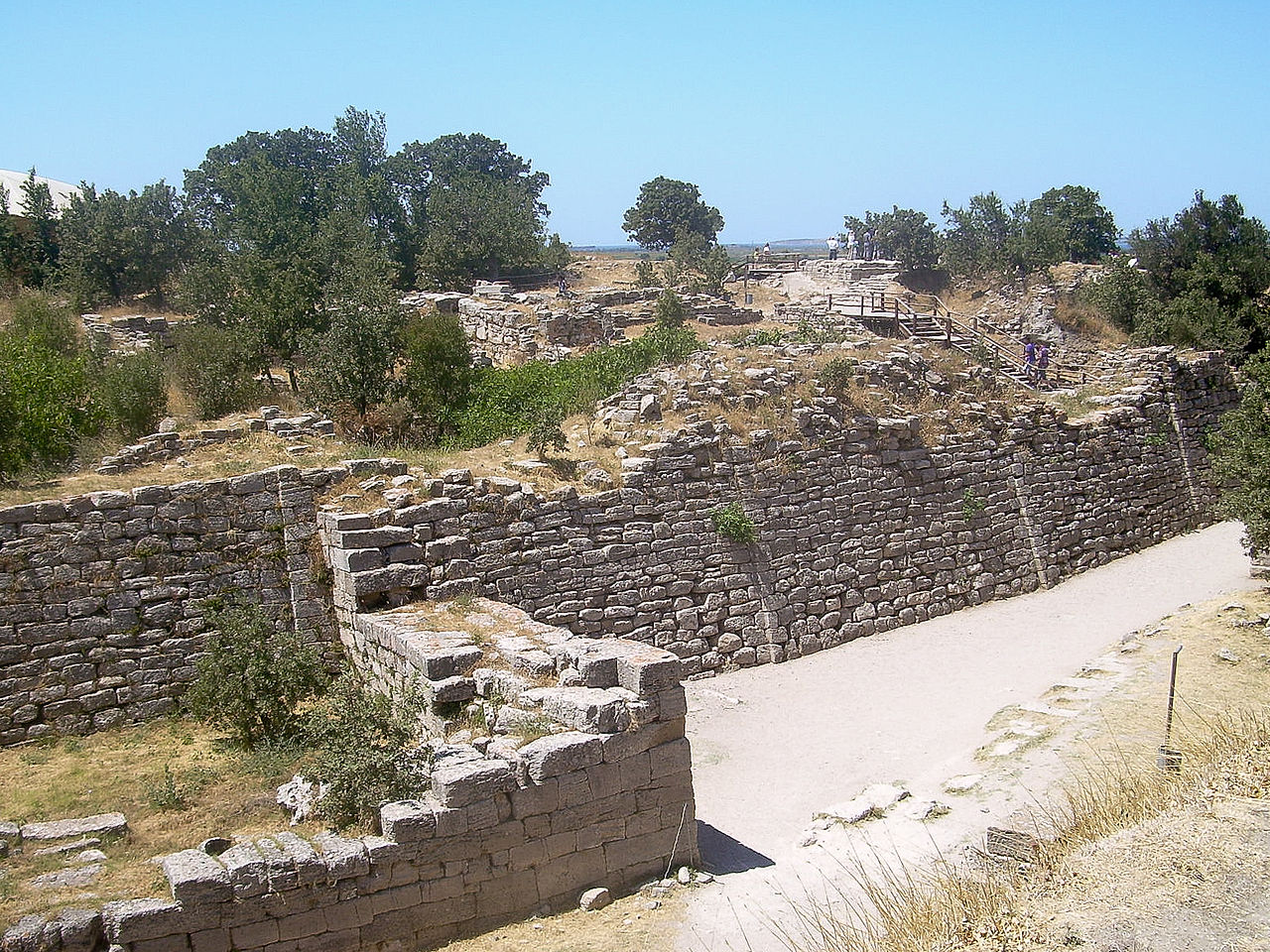
Troy consists of at least nine separate cities, one on top of the other, representing continuous occupation from 3000 BCE to 500 CE. These are the walls of Troy VII, the city of Priam. It's hard to get a sense of scale from this Wikipedia photo, but they are 10-12 feet high. Among the ruins found at this level are the remnants of ramshackle dwellings constructed in what had previously been public spaces--evidence that the population of the countryside had been evacuated to within the city walls during a prolonged siege.
On the way to Troy, driving through the beautiful countryside along the Dardanelles near the port of Çanakkale, I had one of those moments. Coming over a hill I saw, out in the strait, a rectangle of white. It was obviously the sail of a Greek galley making its way through the narrows. I strained to see the oars at work, only to be jolted back into the 21st century by the realization that the white rectangle was just the superstructure of a cargo ship. That night aboard our ship I told a friend about my momentary illusion. His jaw dropped because exactly the same thing had happened to him.
Troy consists of at least nine separate cities, one on top of the other, representing continuous occupation from 3000 BCE to 500 CE. These are the walls of Troy VII, the city of Priam. It's hard to get a sense of scale from this Wikipedia photo, but they are 10-12 feet high. Among the ruins found at this level are the remnants of ramshackle dwellings constructed in what had previously been public spaces--evidence that the population of the countryside had been evacuated to within the city walls during a prolonged siege.
On the way to Troy, driving through the beautiful countryside along the Dardanelles near the port of Çanakkale, I had one of those moments. Coming over a hill I saw, out in the strait, a rectangle of white. It was obviously the sail of a Greek galley making its way through the narrows. I strained to see the oars at work, only to be jolted back into the 21st century by the realization that the white rectangle was just the superstructure of a cargo ship. That night aboard our ship I told a friend about my momentary illusion. His jaw dropped because exactly the same thing had happened to him.
193StevenTX
"On Ancient Medicine" by Hippocrates of Kos
Translated by Charles Darwin Adams

Hippocrates lived during the latter stages of the Greek "Golden Age." The "ancient medicine" he addresses in this essay refers chiefly to the beliefs of the Pythagorean school from a century earlier. This school of thought attempted to reduce all issues of science and medicine to a consideration of four basic elements: earth, air, fire, and water. Their approach to treating disease was first to hypothesize a cause in these terms, then try to bring the patient back into balance. Hippocrates maintains that the body operates on much more complex principles, and that disease can only be treated through observation and experience, not theory.
Hippocrates traces the origin of medicine itself to the development of cooking and other forms of food preparation. Remarkably, he depicts human society evolving from savagery to civilization, acquiring knowledge through trial and error rather than as a gift from the gods. People who ate unmilled grain and raw meat "became exposed to strong pains and diseases, and to early deaths." Our forebears gradually discovered the advantages of food preparation, "They boiled, they roasted, they mixed, they diluted those things which are strong and of intense qualities with weaker things, fashioning them to the nature and powers of man.... To such a discovery and investigation what more suitable name could one give than that of Medicine?"
The author does not talk much about specific diseases and treatments in this piece, but discusses chiefly the general idea of treating illness with a gentler diet designed to correct various imbalances in the internal organs. It is his logical and empirical approach to the subject which is most interesting.
Translated by Charles Darwin Adams

Hippocrates lived during the latter stages of the Greek "Golden Age." The "ancient medicine" he addresses in this essay refers chiefly to the beliefs of the Pythagorean school from a century earlier. This school of thought attempted to reduce all issues of science and medicine to a consideration of four basic elements: earth, air, fire, and water. Their approach to treating disease was first to hypothesize a cause in these terms, then try to bring the patient back into balance. Hippocrates maintains that the body operates on much more complex principles, and that disease can only be treated through observation and experience, not theory.
Hippocrates traces the origin of medicine itself to the development of cooking and other forms of food preparation. Remarkably, he depicts human society evolving from savagery to civilization, acquiring knowledge through trial and error rather than as a gift from the gods. People who ate unmilled grain and raw meat "became exposed to strong pains and diseases, and to early deaths." Our forebears gradually discovered the advantages of food preparation, "They boiled, they roasted, they mixed, they diluted those things which are strong and of intense qualities with weaker things, fashioning them to the nature and powers of man.... To such a discovery and investigation what more suitable name could one give than that of Medicine?"
The author does not talk much about specific diseases and treatments in this piece, but discusses chiefly the general idea of treating illness with a gentler diet designed to correct various imbalances in the internal organs. It is his logical and empirical approach to the subject which is most interesting.
195baswood
Do you feel any different when reading the Greek philosophers and other classics after your visit to Greece. Do you get a sense of place or atmosphere in your reading?
196StevenTX
>195 baswood: I'm not sure that my having been to Greece will influence my reading of philosophy, but it would certainly make a difference if I were to re-read someone like Homer or Thucydides. Living in a flat place it's hard for me to visualize how vertical the landscape is until I actually had to climb some of it.
I had been undecided about reading Hippocrates, but having visited sites associated with him on the island of Kos I felt it was appropriate to at least sample his work. I'll be alternating his treatises with the dialogues of Plato and the works of Xenophon since the three were roughly contemporary.
I had been undecided about reading Hippocrates, but having visited sites associated with him on the island of Kos I felt it was appropriate to at least sample his work. I'll be alternating his treatises with the dialogues of Plato and the works of Xenophon since the three were roughly contemporary.
197rebeccanyc
I am impressed with your reading of the Greek philosophers, and I learn a lot from reading your reviews.
198StevenTX
Meno by Plato
Translated by Benjamin Jowett
Meno, a fresh acquaintance of Socrates and student of the sophist Gorgias, begins the dialog abruptly with this question. "Can you tell me, Socrates, whether virtue is acquired by teaching or by practice; or if neither by teaching nor by practice, then whether it comes to man by nature, or in what other way?"
Socrates begins, as usual, by feigning complete ignorance on the subject, even as to the meaning of "virtue." He asks Meno to define the term. The young man can do no better than to produce a litany of qualities that demonstrate virtue. "How fortunate I am," replies Socrates sarcastically, "When I ask you for one virtue, you present me with a swarm of them." By means of various examples, Socrates instructs Meno to seek to define concepts as a whole rather than as a collection of parts. But the two are still unable to come up with a satisfactory definition of virtue.
Socrates then takes another tack and tries to reach a definition by means of hypothesis and analysis, using Meno's original question as a starting point. "Let the first hypothesis be that virtue is or is not knowledge,--in that case will it be taught or not?" This leads to an opportunity for Socrates to ridicule his rivals the sophists, but also to a more interesting discussion of good men who have bad or undistinguished sons. Surely if virtue was something that could be taught then men like Themistocles, Pericles and Thucydides would have had exemplary sons. Yet they did not.
Exploring the nature of knowledge, Socrates has Meno call one of his young slaves. Socrates asks the boy some basic questions about geometry. The boy shows that he understands the concept of a square and how to compute its area, but fails to calculate the area properly when the dimensions of the square are doubled. By asking questions, Socrates eventually guides the boy to the right answers. We see this as simply a clever method of teaching by asking leading questions. But Socrates insists that it proves that the knowledge was present in the boy all along, and simply had to be brought to the surface. This, in turn, demonstrates that the soul is immortal, and the revealed knowledge was something acquired in a previous incarnation.
On the question of how a man acquires virtue, Socrates eventually resorts to a sort of philosophical deus ex machina and declares that "virtue is neither natural nor acquired but an instinct given by God to the virtuous." He pleas another appointment and leaves without having revisited the definition of virtue itself. Its conclusion won't satisfy those who were hoping for a useful answer to Meno's question, but as a lesson in philosophical examination the Meno dialogue is a brilliant but humorous display of logical thinking and exposition.
Translated by Benjamin Jowett
Meno, a fresh acquaintance of Socrates and student of the sophist Gorgias, begins the dialog abruptly with this question. "Can you tell me, Socrates, whether virtue is acquired by teaching or by practice; or if neither by teaching nor by practice, then whether it comes to man by nature, or in what other way?"
Socrates begins, as usual, by feigning complete ignorance on the subject, even as to the meaning of "virtue." He asks Meno to define the term. The young man can do no better than to produce a litany of qualities that demonstrate virtue. "How fortunate I am," replies Socrates sarcastically, "When I ask you for one virtue, you present me with a swarm of them." By means of various examples, Socrates instructs Meno to seek to define concepts as a whole rather than as a collection of parts. But the two are still unable to come up with a satisfactory definition of virtue.
Socrates then takes another tack and tries to reach a definition by means of hypothesis and analysis, using Meno's original question as a starting point. "Let the first hypothesis be that virtue is or is not knowledge,--in that case will it be taught or not?" This leads to an opportunity for Socrates to ridicule his rivals the sophists, but also to a more interesting discussion of good men who have bad or undistinguished sons. Surely if virtue was something that could be taught then men like Themistocles, Pericles and Thucydides would have had exemplary sons. Yet they did not.
Exploring the nature of knowledge, Socrates has Meno call one of his young slaves. Socrates asks the boy some basic questions about geometry. The boy shows that he understands the concept of a square and how to compute its area, but fails to calculate the area properly when the dimensions of the square are doubled. By asking questions, Socrates eventually guides the boy to the right answers. We see this as simply a clever method of teaching by asking leading questions. But Socrates insists that it proves that the knowledge was present in the boy all along, and simply had to be brought to the surface. This, in turn, demonstrates that the soul is immortal, and the revealed knowledge was something acquired in a previous incarnation.
On the question of how a man acquires virtue, Socrates eventually resorts to a sort of philosophical deus ex machina and declares that "virtue is neither natural nor acquired but an instinct given by God to the virtuous." He pleas another appointment and leaves without having revisited the definition of virtue itself. Its conclusion won't satisfy those who were hoping for a useful answer to Meno's question, but as a lesson in philosophical examination the Meno dialogue is a brilliant but humorous display of logical thinking and exposition.
199StevenTX
The Forbidden Kingdom by J. J. Slauerhoff
First published in Dutch 1932
English translation by Paul Vincent 2012
Also translated as The Forbidden Realm


The Forbidden Kingdom is an unusual and unpredictable novel that centers on the Portuguese colony of Macau (near Hong Kong) and the life of Luis Vaz de Camões, author of Portugal's national epic, The Lusiads. After a prologue which depicts the founding of Macao, the novel focuses on the life of Camões, beginning at the point when a love affair with a member of the royal household results in his being sent into exile. The story does not faithfully follow the life of the real Camões, but it does eventually lead to his being stranded by shipwreck at Macao.
Midway through the novel the narrative abruptly shifts to the 20th century with the story of an unnamed Irish radio operator whose peregrinations likewise lead to his being stranded at Macao. The stories of the two then merge as though they were a single individual living simultaneously in the 16th and 20th centuries. They experience the same dangers and privations, both become increasingly alienated from society, and they both lose their senses of identity and humanity.
Slauerhoff writes in a mixture of first and third person that appears almost random, and the line between dream and reality is often as blurred as the line between the two characters, yet the novel is very easy to read in its recent translation. There is a sense of constantly teetering on the edge of an abyss that is unfathomable and unknowable. In geographic terms the abyss is China, a vast and alien empire that is indifferent to the fate of the puny European colony perched on its shore. In metaphysical terms, however, the abyss is the dark subconscious where identity evaporates and time is meaningless.
The Forbidden Kingdom bears a strong thematic resemblance to Conrad's Heart of Darkness, while the plot device of merging two characters from the 16th and 20th centuries is similar to that used by Virginia Woolf in Orlando. It is not a landmark work of fiction, but The Forbidden Kingdom does provide fascinating insight into aspects of Portugal's colonial empire and the lives of the traders and missionaries who first ventured to the other side of the world.
First published in Dutch 1932
English translation by Paul Vincent 2012
Also translated as The Forbidden Realm


The Forbidden Kingdom is an unusual and unpredictable novel that centers on the Portuguese colony of Macau (near Hong Kong) and the life of Luis Vaz de Camões, author of Portugal's national epic, The Lusiads. After a prologue which depicts the founding of Macao, the novel focuses on the life of Camões, beginning at the point when a love affair with a member of the royal household results in his being sent into exile. The story does not faithfully follow the life of the real Camões, but it does eventually lead to his being stranded by shipwreck at Macao.
Midway through the novel the narrative abruptly shifts to the 20th century with the story of an unnamed Irish radio operator whose peregrinations likewise lead to his being stranded at Macao. The stories of the two then merge as though they were a single individual living simultaneously in the 16th and 20th centuries. They experience the same dangers and privations, both become increasingly alienated from society, and they both lose their senses of identity and humanity.
Slauerhoff writes in a mixture of first and third person that appears almost random, and the line between dream and reality is often as blurred as the line between the two characters, yet the novel is very easy to read in its recent translation. There is a sense of constantly teetering on the edge of an abyss that is unfathomable and unknowable. In geographic terms the abyss is China, a vast and alien empire that is indifferent to the fate of the puny European colony perched on its shore. In metaphysical terms, however, the abyss is the dark subconscious where identity evaporates and time is meaningless.
The Forbidden Kingdom bears a strong thematic resemblance to Conrad's Heart of Darkness, while the plot device of merging two characters from the 16th and 20th centuries is similar to that used by Virginia Woolf in Orlando. It is not a landmark work of fiction, but The Forbidden Kingdom does provide fascinating insight into aspects of Portugal's colonial empire and the lives of the traders and missionaries who first ventured to the other side of the world.
201kidzdoc
Very nice reviews as always, Steven. I'll certainly look for On Ancient Medicine, and The Forbidden Kingdom sounds particularly interesting as well.
202rebeccanyc
I enjoyed The Forbidden Kingdom too when I read it about a year ago.
204StevenTX
I need to do an extensive amount of work on my LT catalog that will involve adding books I previously deleted, adding works that are embedded inside omnibuses, and probably moving my wife's books to a separate account. I don't want to flood everyone's "Recent News" section with all that activity as I have in the past. The only way I know to prevent it is to make my catalog "private," so I have done so. This is just a temporary measure, and as far as I know it will not affect "Talk," so you shouldn't see anything different unless you try to browse my collections.
205StevenTX
Amelia by Henry Fielding
First published 1751

Amelia was Henry Fielding's final novel and his most conventional one. It is a moral tale concerning the troubles and triumphs of a married couple, William and Amelia Booth. Booth is an English soldier, an infantry officer with no fortune of his own who dares to love and marry Amelia Harris, a stunningly beautiful middle class girl from a prosperous family. Amelia's family does not react well to the match, and, when Amelia's mother dies, a sister cheats Amelia out of her inheritance by means of a fraudulent will.
We learn of the Booths' early history as William tells his life story in Newgate prison in the opening chapters. He has been arrested for assault when he was actually trying to help a person who was being mugged on a London street. The person he is telling this to is a female fellow prisoner, Miss Matthews, who manages to seduce Booth before the two of them are released. Booth's infidelity is a secret guilt which will hang over him for the rest of the book.
Amelia, meanwhile, is not only faithful to her wayward husband, but completely innocent of any impure thoughts. Her beauty attracts many would-be seducers--most of them men that Booth considers his friends--but she remains unwary and oblivious to their intentions. One of her friends, in frustration, declares Amelia to be "the most confounded prude on earth." Booth is a good-hearted man, but not so flawless as his wife. As a discharged officer on half-pay he barely has enough money to support his growing family, yet he wastes most of his resources through profligate spending and gambling. He is deeply in debt and constantly on the run from the bailiff while his wife is the intended prey of his lecherous friends. At every turn their one true friend, a cleric named Dr. Harrison, delivers a sermon appropriate to Booth's most recent failings.
Aside from its moral lessons on adultery, gambling, dueling, and other sins, the novel attacks some of the social ills of the day: inequality, a corrupt justice system, a Parliament out of touch with the needs of the people, and the lack of religious piety even among the clergy. But these are more asides than themes. One of the more entertaining debates, however, is on whether women should be educated. "Education" in this context means being taught Greek and Latin so they could memorize the ancient classics. Fielding documents the debate but doesn't appear to take sides.
Amelia is a good novel but not in the same class as Fielding's earlier works. It lacks humor and is often preachy. It does give a nice picture of some aspects of life in mid-18th century London, but Fielding doesn't dig as deeply as we might like into the institutions he criticizes. This may be one of the best novels before Dickens and Gaskell to portray the corruption and poverty of urban England, but you have to wade through a lot of sentimentality and moralizing to glean a sense of the times.
Other works I have read by Henry Fielding:
Shamela
Joseph Andrews
Tom Jones
First published 1751

Amelia was Henry Fielding's final novel and his most conventional one. It is a moral tale concerning the troubles and triumphs of a married couple, William and Amelia Booth. Booth is an English soldier, an infantry officer with no fortune of his own who dares to love and marry Amelia Harris, a stunningly beautiful middle class girl from a prosperous family. Amelia's family does not react well to the match, and, when Amelia's mother dies, a sister cheats Amelia out of her inheritance by means of a fraudulent will.
We learn of the Booths' early history as William tells his life story in Newgate prison in the opening chapters. He has been arrested for assault when he was actually trying to help a person who was being mugged on a London street. The person he is telling this to is a female fellow prisoner, Miss Matthews, who manages to seduce Booth before the two of them are released. Booth's infidelity is a secret guilt which will hang over him for the rest of the book.
Amelia, meanwhile, is not only faithful to her wayward husband, but completely innocent of any impure thoughts. Her beauty attracts many would-be seducers--most of them men that Booth considers his friends--but she remains unwary and oblivious to their intentions. One of her friends, in frustration, declares Amelia to be "the most confounded prude on earth." Booth is a good-hearted man, but not so flawless as his wife. As a discharged officer on half-pay he barely has enough money to support his growing family, yet he wastes most of his resources through profligate spending and gambling. He is deeply in debt and constantly on the run from the bailiff while his wife is the intended prey of his lecherous friends. At every turn their one true friend, a cleric named Dr. Harrison, delivers a sermon appropriate to Booth's most recent failings.
Aside from its moral lessons on adultery, gambling, dueling, and other sins, the novel attacks some of the social ills of the day: inequality, a corrupt justice system, a Parliament out of touch with the needs of the people, and the lack of religious piety even among the clergy. But these are more asides than themes. One of the more entertaining debates, however, is on whether women should be educated. "Education" in this context means being taught Greek and Latin so they could memorize the ancient classics. Fielding documents the debate but doesn't appear to take sides.
Amelia is a good novel but not in the same class as Fielding's earlier works. It lacks humor and is often preachy. It does give a nice picture of some aspects of life in mid-18th century London, but Fielding doesn't dig as deeply as we might like into the institutions he criticizes. This may be one of the best novels before Dickens and Gaskell to portray the corruption and poverty of urban England, but you have to wade through a lot of sentimentality and moralizing to glean a sense of the times.
Other works I have read by Henry Fielding:
Shamela
Joseph Andrews
Tom Jones
206AlisonY
>205 StevenTX: I really enjoyed your review - I haven't read any of Henry Fielding's work, and this sounds like the sort of book I might enjoy.
207Nickelini
>205 StevenTX: That sounds like the type of book I expect from the 18th century: It lacks humor and is often preachy, you have to wade through a lot of sentimentality and moralizing to glean a sense of the times . My actual experience is that 18th c lit can be lots of fun and not prudish or dry (eg: Candide). I want to read more from the era, but don't think I'll read this one any time soon. Great review!
208dchaikin
Catching up and taking in the latest reminder that I might actually like reading Plato.
>199 StevenTX: Never heard of The Forbidden Kingdom, but it sounds great. Nice review. I took a double take thinking I missed the lists that book is on at the end, but apparently that wasn't what led you to it.
>204 StevenTX: just means I can't thumb your reviews, but nice to know why they all disappeared.
>205 StevenTX: happy to read your review and then not read the book. : )
>199 StevenTX: Never heard of The Forbidden Kingdom, but it sounds great. Nice review. I took a double take thinking I missed the lists that book is on at the end, but apparently that wasn't what led you to it.
>204 StevenTX: just means I can't thumb your reviews, but nice to know why they all disappeared.
>205 StevenTX: happy to read your review and then not read the book. : )
209StevenTX
>208 dchaikin: Actually The Forbidden Kingdom is on the 1001 Books list, and that's why I owned and read it. I just failed to make note of the fact when I posted the review. But I'm getting ready to ditch all this list tracking anyway, and there will be no mention of it when I start a new thread. The problem with making a reading plan is that as soon as I target a certain group of books, I get an irresistible urge to read stuff that isn't part of the plan.
My account is back to Public again, but I didn't get a chance to finish the project I was planning. Once I changed my account status some of my books seemed to have disappeared. They don't show up when I searched for them, but when I export my data to Excel they are still there. Switching the account back to Public didn't help, so I've notified the LT authorities.
We got 3 to 7 inches of rain last night, so there is more flooding. My neighborhood is fine, but they are doing rescues close enough I can hear the helicopters.
My account is back to Public again, but I didn't get a chance to finish the project I was planning. Once I changed my account status some of my books seemed to have disappeared. They don't show up when I searched for them, but when I export my data to Excel they are still there. Switching the account back to Public didn't help, so I've notified the LT authorities.
We got 3 to 7 inches of rain last night, so there is more flooding. My neighborhood is fine, but they are doing rescues close enough I can hear the helicopters.
210dchaikin
I'll miss your lists, but totally understand how they can just be too much.
Haven't been watching the news, but these repeated huge storm fronts that stretch hundreds of miles are insane. We got the south end of the same storm this am. Very sad about those affected by the flooding.
Haven't been watching the news, but these repeated huge storm fronts that stretch hundreds of miles are insane. We got the south end of the same storm this am. Very sad about those affected by the flooding.
211StevenTX
My wife just took this picture not far from our house. Not many soccer games being played in this park today.

You may have seen film on the news of a person being rescued by hovercraft and a policeman being lifted out of his car by helicopter. That was just upstream from this park.

You may have seen film on the news of a person being rescued by hovercraft and a policeman being lifted out of his car by helicopter. That was just upstream from this park.
213StevenTX
>212 dchaikin: Yes, and it's your turn tonight. But they say this is the last of it.
215rebeccanyc
>211 StevenTX: Wow! Hope it doesn't get closer than that!
216NanaCC
Mother Nature has been very angry the last couple of years. There seem to have been so many disasters. Stay safe.
218StevenTX
The sun is out, the rain is over, and there are nothing but clear skies in the forecast.
Now come the mosquitoes. Fortunately I have a way of dealing with them: https://www.youtube.com/watch?v=XZubL4mZ5n0
May was a wet month for us in more ways than one. The city in which I live voted by a large majority to legalize the sale of alcoholic beverages. We voted several years ago to legalize the sale of beer and wine and the serving of alcohol in restaurants. This latest measure authorizes the retail sale of distilled spirits. Prohibition is finally over!
Now come the mosquitoes. Fortunately I have a way of dealing with them: https://www.youtube.com/watch?v=XZubL4mZ5n0
May was a wet month for us in more ways than one. The city in which I live voted by a large majority to legalize the sale of alcoholic beverages. We voted several years ago to legalize the sale of beer and wine and the serving of alcohol in restaurants. This latest measure authorizes the retail sale of distilled spirits. Prohibition is finally over!
220AlisonY
>218 StevenTX: You're kidding me!! Woo hoo - party time for Steven this summer :)
I'm still trying to get my head around the fact that you've not been able to pop to the shops for a bottle of wine up until now... Welcome to enjoying a good book with a nice glass of something beside you.
I'm still trying to get my head around the fact that you've not been able to pop to the shops for a bottle of wine up until now... Welcome to enjoying a good book with a nice glass of something beside you.
221StevenTX
>220 AlisonY: I'm still trying to get my head around the fact that you've not been able to pop to the shops for a bottle of wine up until now...
Yes, until the recent changes it was about an hour's round trip by car to the nearest liquor store. Liquor laws in the US are complex, but in Texas and many other states it is the municipality that decides what can be sold or served. The recent wave of liberalization has been driven mostly by greed for sales tax revenue. Yet it is still easier here to buy and carry an assault rifle than it is a bottle of wine.
Yes, until the recent changes it was about an hour's round trip by car to the nearest liquor store. Liquor laws in the US are complex, but in Texas and many other states it is the municipality that decides what can be sold or served. The recent wave of liberalization has been driven mostly by greed for sales tax revenue. Yet it is still easier here to buy and carry an assault rifle than it is a bottle of wine.
222Nickelini
>221 StevenTX: That's just wow. I had no idea that sort of thing existed anymore.
223StevenTX
Phineas Finn by Anthony Trollope
First published 1869


The title character of Phineas Finn is a handsome and sociable Irishman. At the beginning of the novel he is 25 and studying law in London while being supported on a slender allowance from his father, a doctor back in Ireland. It is Phineas's ambition, however, to serve in Parliament. (At this time, the 1860s, Ireland was part of the U.K.) With the help of some political friends and an unexpected aristocratic patron, Phineas wins a seat representing his home borough. But Members of Parliament aren't paid, and Phineas must face the unpleasant necessity of finding a way to support himself.
Of course one alternative to working for one's money is to marry for it. The dilemma of whether to marry for love, for money, or for social position is a common one in 19th century fiction, and Phineas's romantic conundrums are the principal subject of the novel. But the focus isn't entirely on Phineas. Each of his female acquaintances is a major character in her own right, and through them Trollope gives a very sympathetic portrayal of problems of women who had limited range to exercise their talents and interests and were often helplessly at the mercy of a domineering father or husband. As in some of Trollope's other novels, the women in Phineas Finn are his deepest and most interesting characters.
The second major theme of the novel is the political debate in Britain over electoral reform. Phineas enters Parliament as a Liberal and a supporter of what would become the Reform Act of 1867. This act extended voting rights to the urban working class, but proposals for further reforms such as the introduction of a secret ballot failed after much debate. I found the novel to be a painless introduction to some of the workings of the British parliamentary system and its history.
Phineas Finn is the second novel in Trollope's Palliser series, but it stands alone quite well. Some of the characters from the first novel, Can You Forgive Her?, make an appearance, but their role is secondary, and nothing demands that you know their history.
Phineas Finn is an enjoyable and informative novel that I would recommend to anyone who enjoys 19th century fiction, and especially to anyone interested in British political history. The characters are generally likable, and their moral and marital dilemmas are still relevant. Trollope doesn't always wrap things up in a conventional happy ending, and knowing this keeps the reader in suspense about Phineas's fate to the very end.
Other works I have read by Anthony Trollope:
The entire Chronicles of Barset (6 novels)
Can You Forgive Her? (Palliser #1)
First published 1869


The title character of Phineas Finn is a handsome and sociable Irishman. At the beginning of the novel he is 25 and studying law in London while being supported on a slender allowance from his father, a doctor back in Ireland. It is Phineas's ambition, however, to serve in Parliament. (At this time, the 1860s, Ireland was part of the U.K.) With the help of some political friends and an unexpected aristocratic patron, Phineas wins a seat representing his home borough. But Members of Parliament aren't paid, and Phineas must face the unpleasant necessity of finding a way to support himself.
Of course one alternative to working for one's money is to marry for it. The dilemma of whether to marry for love, for money, or for social position is a common one in 19th century fiction, and Phineas's romantic conundrums are the principal subject of the novel. But the focus isn't entirely on Phineas. Each of his female acquaintances is a major character in her own right, and through them Trollope gives a very sympathetic portrayal of problems of women who had limited range to exercise their talents and interests and were often helplessly at the mercy of a domineering father or husband. As in some of Trollope's other novels, the women in Phineas Finn are his deepest and most interesting characters.
The second major theme of the novel is the political debate in Britain over electoral reform. Phineas enters Parliament as a Liberal and a supporter of what would become the Reform Act of 1867. This act extended voting rights to the urban working class, but proposals for further reforms such as the introduction of a secret ballot failed after much debate. I found the novel to be a painless introduction to some of the workings of the British parliamentary system and its history.
Phineas Finn is the second novel in Trollope's Palliser series, but it stands alone quite well. Some of the characters from the first novel, Can You Forgive Her?, make an appearance, but their role is secondary, and nothing demands that you know their history.
Phineas Finn is an enjoyable and informative novel that I would recommend to anyone who enjoys 19th century fiction, and especially to anyone interested in British political history. The characters are generally likable, and their moral and marital dilemmas are still relevant. Trollope doesn't always wrap things up in a conventional happy ending, and knowing this keeps the reader in suspense about Phineas's fate to the very end.
Other works I have read by Anthony Trollope:
The entire Chronicles of Barset (6 novels)
Can You Forgive Her? (Palliser #1)
224NanaCC
>223 StevenTX: Great review of Phineas Finn, Steven. I just finished the third book in The Chronicles of Barsetshire, Doctor Thorne, so have a long way to go to catch up with you, but I will eventually get there. Trollope is wonderful in my opinion.
225FlorenceArt
>223 StevenTX: I still haven't read Trollope, and this one sounds like it could be a good start. Thank you! I just downloaded it from Gutenberg, so now it's waiting on my iPad with several of its brothers...
226StevenTX
I originally posed this question as part of my review of Phineas Finn, then decided it was best addressed separately:
On more than one occasion in the novel Trollope makes the point that men and women differ completely in what they want to hear about their lovers' past romantic affairs. Men, he says, want to believe that they are they first man their girlfriend has ever loved. They prefer women who are inexperience and (by implication) virginal. If a woman has had other romantic involvements, the man doesn't want to hear about them.
Women, on the other had according to Trollope, prefer their lovers to have had previous relationships, and they want to learn every detail about them. A woman likes to feel that she has triumphed over her rivals, and the deeper the previous relationship and the more beautiful the previous girlfriend, the more she relishes her victory.
What do you think about this? Ladies, would you enjoy hearing that your partner left a Scarlett Johannson for you?
On more than one occasion in the novel Trollope makes the point that men and women differ completely in what they want to hear about their lovers' past romantic affairs. Men, he says, want to believe that they are they first man their girlfriend has ever loved. They prefer women who are inexperience and (by implication) virginal. If a woman has had other romantic involvements, the man doesn't want to hear about them.
Women, on the other had according to Trollope, prefer their lovers to have had previous relationships, and they want to learn every detail about them. A woman likes to feel that she has triumphed over her rivals, and the deeper the previous relationship and the more beautiful the previous girlfriend, the more she relishes her victory.
What do you think about this? Ladies, would you enjoy hearing that your partner left a Scarlett Johannson for you?
227Nickelini
>226 StevenTX: What year was that book written in? I can only speak for myself, but in my experience (which includes 26 years of monogamy), none of that is true for 21st century adults. People are individuals -- some want details, some don't, and it's not divided along gender lines.
228StevenTX
>227 Nickelini: Phineas Finn was published in 1869, and must've been written in just the preceding months as it reflects political events of 1867.
Obviously among the upper class in those days it was of great importance that a man's bride be chaste and faithful so he could be assured that the son to whom he would pass his title and estate was his own. There was no such constraint placed upon a man, but I think Trollope is engaging in wishful thinking when he says a man's promiscuity is not only more tolerated but actually preferred by women. Still, I wanted to hear what others thought about this.
Of course there is no mention of actual sex in the book, and only once is it implied that extra-marital sex might actually exist. We are supposed to believe that Phineas and all his friends are virgins until their wedding nights, and that the furthest they have gone is a kiss on the lips to seal their engagement. But I think we are expected to read between the lines.
Obviously among the upper class in those days it was of great importance that a man's bride be chaste and faithful so he could be assured that the son to whom he would pass his title and estate was his own. There was no such constraint placed upon a man, but I think Trollope is engaging in wishful thinking when he says a man's promiscuity is not only more tolerated but actually preferred by women. Still, I wanted to hear what others thought about this.
Of course there is no mention of actual sex in the book, and only once is it implied that extra-marital sex might actually exist. We are supposed to believe that Phineas and all his friends are virgins until their wedding nights, and that the furthest they have gone is a kiss on the lips to seal their engagement. But I think we are expected to read between the lines.
229rebeccanyc
nice review of Phineas Finn, which I also enjoyed. I'm a little ahead of you with the Palliser series, so next up for me is Phineas Redux.
As to your question, I agree with Joyce (>228 StevenTX:) that everyone is an individual and wants a different level of detail.
And I agree with you that we should read between the lines with Trollope.
As to your question, I agree with Joyce (>228 StevenTX:) that everyone is an individual and wants a different level of detail.
And I agree with you that we should read between the lines with Trollope.
230baswood
I am not sure that many people would have similar views on sex to a 19th century novelist (unless they are still living in the 19th century). Perhaps today people would be more interested in their partner's current romantic affairs.
231StevenTX
I spent last week in Ohio visiting family and now have to catch up on some medical appointments I've been putting off, so June continues to be a very light reading month for me. Nothing beats a good Edgar Rice Burroughs tale when you are trying to read in a noisy and uncomfortable environment, so that is what I chose for my recent reading. I selected two books of his which were first published in 1916 and are now having their centennial--or they would be if this was 2016 as I apparently thought it was when I decided to read them. Oh well; they were both fun even if a bit premature. Reviews follow.
232StevenTX
Beyond Thirty by Edgar Rice Burroughs
Written in 1915, serialized in 1916
First book publication (posthumously) in 1955
Retitled The Lost Continent for paperback publication in 1963

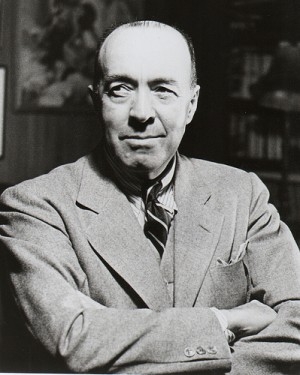
Beyond Thirty was written at a time when the nations of Europe were waging desperate war while the United States maintained a rigid policy of isolation. Edgar Rice Burroughs extrapolated this state of affairs two hundred years into the future. The nations of the New World have now become one Republic of Pan America and for two centuries have sealed themselves off from all contact with the warlike peoples of Europe and Asia. The American navy patrols the 30th and 175th meridians, though there has been no contact with the East since a submarine attack in 1972. The Eastern Hemisphere has been wiped from the maps, and any mention of it, even in fiction, is prohibited.
It is now 2116, and Lt. Jefferson Turck, age 21, is in command of the aero-submarine Coldwater patrolling the 30th meridian in the North Atlantic. Turck is one of a new breed of officers who would love to see the interdiction lifted so he can explore the Old World and see whether the World War still rages. An embittered subordinate takes advantage of Turck's heretical ideas to sabotage the ship and abandon Turck and two other sailors in a small boat off the English Channel while making it look like Turck has deserted his command.
Finding the south coast of England in rubble and infested with tigers, Turck makes his way by sea to London, hoping to find what is left of European civilization. Instead he finds nothing but lions, elephants, and savage tribes of men speaking a degenerate form of English. He also finds and rescues a beautiful and feisty maiden named Victory who proclaims herself the Queen of Grabritin. It isn't long before he deduces that "Grabritin" is "Great Britain," and that these savages and a few ruins are all that is left of what was once the greatest city on the planet. The lions and tigers are the descendants of escaped zoo animals.
The adventures of Lt. Turck and Victory are typical Burroughs fare: abduction, escape, love, rejection, misunderstanding, betrayal, and last-second rescue. The post-apocalyptic world he creates is actually quite believable, and Victory is one of his bolder and more appealing heroines. The one flaw in the novel is that Burroughs cuts it off short by rushing through the last two chapters. There is enough potential in the story to have built an entire series of novels on the idea, but reality would soon catch up with the author. Once the United States entered World War I the premise of the novel no longer held.

This is the Frank Frazetta painting used as artwork for the cover of the first paperback release in 1963 under the title The Lost Continent. It's a fairly faithful depiction of Turck and Victory in 22nd century London except for two details. Victory is overdressed, and I don't seem to remember there being any mountain ranges towering over London.
Written in 1915, serialized in 1916
First book publication (posthumously) in 1955
Retitled The Lost Continent for paperback publication in 1963
Beyond Thirty was written at a time when the nations of Europe were waging desperate war while the United States maintained a rigid policy of isolation. Edgar Rice Burroughs extrapolated this state of affairs two hundred years into the future. The nations of the New World have now become one Republic of Pan America and for two centuries have sealed themselves off from all contact with the warlike peoples of Europe and Asia. The American navy patrols the 30th and 175th meridians, though there has been no contact with the East since a submarine attack in 1972. The Eastern Hemisphere has been wiped from the maps, and any mention of it, even in fiction, is prohibited.
It is now 2116, and Lt. Jefferson Turck, age 21, is in command of the aero-submarine Coldwater patrolling the 30th meridian in the North Atlantic. Turck is one of a new breed of officers who would love to see the interdiction lifted so he can explore the Old World and see whether the World War still rages. An embittered subordinate takes advantage of Turck's heretical ideas to sabotage the ship and abandon Turck and two other sailors in a small boat off the English Channel while making it look like Turck has deserted his command.
Finding the south coast of England in rubble and infested with tigers, Turck makes his way by sea to London, hoping to find what is left of European civilization. Instead he finds nothing but lions, elephants, and savage tribes of men speaking a degenerate form of English. He also finds and rescues a beautiful and feisty maiden named Victory who proclaims herself the Queen of Grabritin. It isn't long before he deduces that "Grabritin" is "Great Britain," and that these savages and a few ruins are all that is left of what was once the greatest city on the planet. The lions and tigers are the descendants of escaped zoo animals.
The adventures of Lt. Turck and Victory are typical Burroughs fare: abduction, escape, love, rejection, misunderstanding, betrayal, and last-second rescue. The post-apocalyptic world he creates is actually quite believable, and Victory is one of his bolder and more appealing heroines. The one flaw in the novel is that Burroughs cuts it off short by rushing through the last two chapters. There is enough potential in the story to have built an entire series of novels on the idea, but reality would soon catch up with the author. Once the United States entered World War I the premise of the novel no longer held.

This is the Frank Frazetta painting used as artwork for the cover of the first paperback release in 1963 under the title The Lost Continent. It's a fairly faithful depiction of Turck and Victory in 22nd century London except for two details. Victory is overdressed, and I don't seem to remember there being any mountain ranges towering over London.
233StevenTX
Tarzan and the Jewels of Opar by Edgar Rice Burroughs
Serialized 1916
First book publication 1918
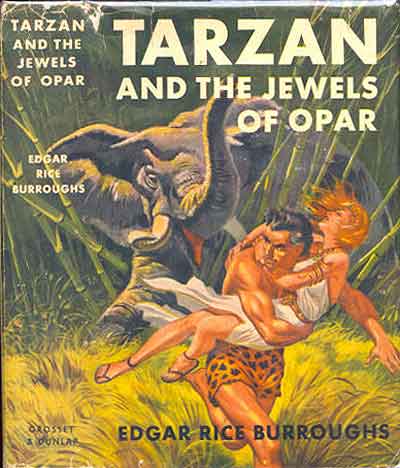
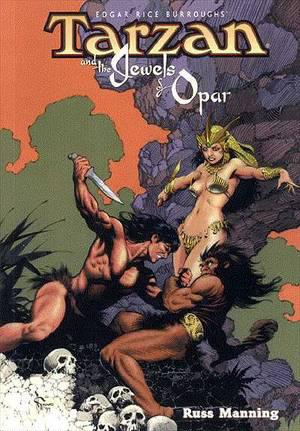
Having turned the savage ape man into a cultured English lord in the first volume of the Tarzan series, Edgar Rice Burroughs was obviously pressed for a reason to have Tarzan revisit his primitive jungle haunts and habits with each successive story. In Tarzan and the Jewels of Opar a blow on the head gives Tarzan amnesia and causes him to revert to the life of his adopted ape clan, forgetting all his subsequent life including his wife Jane (who of course has been abducted by bad guys and desperately needs rescuing). Tarzan receives his blow on the head while making a return visit to the lost city of Opar to replenish his stock of gold and jewels. This leads to his running afoul of La, the beautiful and mostly naked priestess-queen of Opar who is still so much in love with Tarzan that she almost doesn't want to kill him.
Tarzan and the Jewels of Opar is a lively novel filled with treacherous Europeans, sly Arabs, noble Africans, lovely damsels in distress, ferocious beasts, desperate battles, hair-breadth escapes, chance encounters, and the assurance that Love and Justice will triumph in the end. It is one of the better Tarzan stories and not to be missed by anyone who has enjoyed its predecessors.

This Frank Frazetta painting is an accurate depiction of one of the scenes of the novel except that Jane's attire and hairstyle are not those of the 1910s. Tarzan, in this scene, has amnesia and does not realize it is his own wife he is saving from the lion. To him she's just your average blonde out for a nocturnal stroll in the African jungle.
Serialized 1916
First book publication 1918
Having turned the savage ape man into a cultured English lord in the first volume of the Tarzan series, Edgar Rice Burroughs was obviously pressed for a reason to have Tarzan revisit his primitive jungle haunts and habits with each successive story. In Tarzan and the Jewels of Opar a blow on the head gives Tarzan amnesia and causes him to revert to the life of his adopted ape clan, forgetting all his subsequent life including his wife Jane (who of course has been abducted by bad guys and desperately needs rescuing). Tarzan receives his blow on the head while making a return visit to the lost city of Opar to replenish his stock of gold and jewels. This leads to his running afoul of La, the beautiful and mostly naked priestess-queen of Opar who is still so much in love with Tarzan that she almost doesn't want to kill him.
Tarzan and the Jewels of Opar is a lively novel filled with treacherous Europeans, sly Arabs, noble Africans, lovely damsels in distress, ferocious beasts, desperate battles, hair-breadth escapes, chance encounters, and the assurance that Love and Justice will triumph in the end. It is one of the better Tarzan stories and not to be missed by anyone who has enjoyed its predecessors.

This Frank Frazetta painting is an accurate depiction of one of the scenes of the novel except that Jane's attire and hairstyle are not those of the 1910s. Tarzan, in this scene, has amnesia and does not realize it is his own wife he is saving from the lion. To him she's just your average blonde out for a nocturnal stroll in the African jungle.
234FlorenceArt
Fun reviews! You make me want to read those books.
235baswood
I remember Tarzan and the Jewels of Opar as being one of my favourites of the series. I wish I still had that old four square paperback. I am looking forward to reading it next year.
I have never heard of Beyond Thirty but your review tells me why it has sunk into obscurity.
I have never heard of Beyond Thirty but your review tells me why it has sunk into obscurity.
236StevenTX
The Conquest of the Moon by Andre Laurie
First published 1887 as Les exilés de la Terre, Séléne Company Limited
Anonymous English translation 1889


If it's too difficult to travel all the way from the earth to the moon, the obvious alternative is to bring the moon closer to the earth. This is what Norbert Mauny, a brilliant young French astronomer, manages to do. He travels to the Sudan where he has identified a mountain that consists almost entirely of iron pyrite. He wraps the mountain in miles of wire and then uses current generated by solar power to turn it into a giant electromagnet. His goal is to bring the moon briefly into physical contact with the earth so explorers and prospectors can probe and exploit our sister world's mineral resources.
But two things upset Mauny's plans. First, the Mahdist War, a revolt led by an Islamist fanatic, threatens his supplies, his workforce, and eventually his life. Second, he has failed to account for the fact that magnetic attraction works both ways. Mauny will find himself marooned on the moon along with his consumptive sweetheart Gertrude, an English baronet, a bumbling butler, three con-men, and a malignant dwarf with strange hypnotic powers.
Andre Laurie (whose real name was Paschal Grousset) was a friend and collaborator with Jules Verne. The Conquest of the Moon could easily be mistaken for one of Verne's novels, and, in fact, makes reference to the events in Verne's own From the Earth to the Moon. Laurie's ideas about moving the moon around would have Kepler and Newton spinning in their graves, but in other respects the novel shows remarkable scientific insight and imagination.
The Conquest of the Moon is recommended for anyone who enjoys the works of Jules Verne. The historical context of the Mahdist War adds appeal to this charming and ingenious tale. The edition I read is part of the new e-book "Conquest of Space" series by Ron Miller. It has numerous scanning errors but is very nicely illustrated with engravings from the original edition.


First published 1887 as Les exilés de la Terre, Séléne Company Limited
Anonymous English translation 1889


If it's too difficult to travel all the way from the earth to the moon, the obvious alternative is to bring the moon closer to the earth. This is what Norbert Mauny, a brilliant young French astronomer, manages to do. He travels to the Sudan where he has identified a mountain that consists almost entirely of iron pyrite. He wraps the mountain in miles of wire and then uses current generated by solar power to turn it into a giant electromagnet. His goal is to bring the moon briefly into physical contact with the earth so explorers and prospectors can probe and exploit our sister world's mineral resources.
But two things upset Mauny's plans. First, the Mahdist War, a revolt led by an Islamist fanatic, threatens his supplies, his workforce, and eventually his life. Second, he has failed to account for the fact that magnetic attraction works both ways. Mauny will find himself marooned on the moon along with his consumptive sweetheart Gertrude, an English baronet, a bumbling butler, three con-men, and a malignant dwarf with strange hypnotic powers.
Andre Laurie (whose real name was Paschal Grousset) was a friend and collaborator with Jules Verne. The Conquest of the Moon could easily be mistaken for one of Verne's novels, and, in fact, makes reference to the events in Verne's own From the Earth to the Moon. Laurie's ideas about moving the moon around would have Kepler and Newton spinning in their graves, but in other respects the novel shows remarkable scientific insight and imagination.
The Conquest of the Moon is recommended for anyone who enjoys the works of Jules Verne. The historical context of the Mahdist War adds appeal to this charming and ingenious tale. The edition I read is part of the new e-book "Conquest of Space" series by Ron Miller. It has numerous scanning errors but is very nicely illustrated with engravings from the original edition.


237reva8
>232 StevenTX: I am really enjoying your reviews of Burroughs and of Andre Laurie. Thanks for posting all these marvellous covers and illustrations as well!
238FlorenceArt
>236 StevenTX: That sounds like fun!
239SassyLassy
>236 StevenTX: Love the premise for this book. It sounds wonderful. It would be interesting to see the Mahdi in fiction too; I've only read about them in serious ways (unless Flashman encountered them... I'm not sure about that).
Great pictures. How did you ever find the book?
Great pictures. How did you ever find the book?
240StevenTX
Thanks, >237 reva8: and >238 FlorenceArt:.
>239 SassyLassy: How did you ever find the book? I believe it was baswood who discovered the series of seminal works of science fiction being published electronically by Baen Books under the editorship of artist Ron Miller.
>239 SassyLassy: How did you ever find the book? I believe it was baswood who discovered the series of seminal works of science fiction being published electronically by Baen Books under the editorship of artist Ron Miller.
241weird_O
Wow! What a thread! How inspiring! I started keeping track of the books I was reading 5 years ago. I collected a few "read these" kinds of lists and compiled them to help me focus. I connected with LT just in March. I got very little to contribute, but I sure am learning a lot. I appreciate the read of your reading, your lists, and the reviews. Thank you!
242StevenTX
>241 weird_O: Thanks! But my profile picture is certainly no match for yours. Welcome to LT and Club Read.
243StevenTX
Just in case someone is interested, I've used the CK "Publisher's Series" field to identify all the books in the "Ron Miller's Classics of Science Fiction" series. I've included all the books in the series except four that no one on LT owns--one is an anthology of stories, the other three are young-adult books. The list is here.
Note that many of the books on the list are available as free ebooks, and in the case of some translated works there may be better translations available than the ones included in the Ron Miller edition.
Note that many of the books on the list are available as free ebooks, and in the case of some translated works there may be better translations available than the ones included in the Ron Miller edition.
244LolaWalser
Steven, I just came across this list (actually many pages arranged alphabetically by author) and immediately wondered if you'd seen it--it doesn't seem to feature in your "list of lists" posts above:
Anarchism and science fiction
I mention it for the interesting comments to individual titles--at least I think that angle of analysis would interest you.
Anarchism and science fiction
I mention it for the interesting comments to individual titles--at least I think that angle of analysis would interest you.
245chlorine
> 244 LolaWalser: I knew there was a list of science-fiction books that every socialist should read, according to China Miéville, but I was unaware of a list about anarchy and science-fiction. :) Thanks for the link!
Speaking about anarchy I just watched the movie V for vendetta, strange coincidence!
Speaking about anarchy I just watched the movie V for vendetta, strange coincidence!
246LolaWalser
You're welcome. I think it is considerably longer than Miéville's "socialist" list, but he also gives a "hotlist": http://benbeck.co.uk/anarchysf/hotlist.htm
Interesting to see LT's author L. Timmel Duchamp on it, I didn't realise there was a political, let alone anarchist slant to her work.
Interesting to see LT's author L. Timmel Duchamp on it, I didn't realise there was a political, let alone anarchist slant to her work.
247StevenTX
>244 LolaWalser: That's a great list with some very useful comments. I first had to follow some links on that site to update my political vocabulary. I may even find a niche for myself one of these days.
One of the links was to a science fiction reading list of a group called "Think Galactic" which describes itself as "a pro-woman, pro-queer, and anti-racism group that dreams of a world without oppressive hierarchies."
One of the links was to a science fiction reading list of a group called "Think Galactic" which describes itself as "a pro-woman, pro-queer, and anti-racism group that dreams of a world without oppressive hierarchies."
248LolaWalser
Yes, there's a LOT of stuff if you go looking through the comments. Did you look at the "Possibles" link on the bottom? It has links to LibraryThing works!
I think I'll be getting that book, Mythmakers and Lawbreakers: Anarchist Writers on Fiction. Incidentally, the editor, although named Margaret, seems to be a man.
I think I'll be getting that book, Mythmakers and Lawbreakers: Anarchist Writers on Fiction. Incidentally, the editor, although named Margaret, seems to be a man.
249StevenTX
>248 LolaWalser: Yes I did see the LT links. In fact I was just doing some site searches to see if I could identify the site's creator, Ben Beck, as an LT member but without success.
251StevenTX
Shame by Salman Rushdie
First published 1983


Shame is a family saga depicting the history of modern Pakistan as the intertwined lives of two related families. Members of the two families rise in succession to become, respectively, the president and dictator of the country, so this is a very politically-charged novel. It is also a novel of magical realism. There are bizarre and magical events such as a virgin birth from three wombs, a clairvoyant police officer who arrests people for crimes they are planning to commit, and a mass beheading of turkeys. There is also a metafictional side to the novel. Rushdie interjects episodes from his own life and occasionally speaks directly to the reader, complaining that his characters have their own minds. He also tells us several times that the Pakistan of his novel is a fictional country, thus making sure that we know it isn't.
The largest characters in the book are Iskander Harappa, who represents Zulfikar Ali Bhutto, Pakistan's elected leader from 1971 to 1977, and Raza "Razor Guts" Hyder, who represents General Muhammad Zia-Ul-Haq, dictator from 1977 to 1988. Also appearing is Harappa's daughter, Arjumand, representing Benazir Bhutto, who would become prime minister after the book's publication. In the novel, Rushdie nicknames her "the Virgin Ironpants," but Bhutto appears not to have taken serious offence at this. Rushdie depicts each family as being racked by internal division and plagued by the shame of their past crimes, though it is clear that he favors the liberal political aims of the Harappas/Bhuttos.
I'm sure many of the minor characters represented historical figures or factions as well and would be recognized as such by reader more versed in Pakistan's history. But even without any background in the subject, I found Shame to be both enlightening and entertaining, especially after I had briefed myself with a couple of visits to Wikipedia. The magical realism worked very well--it was clearly allegorical and to a purpose and never descended to silliness. I would recommend Shame for its literary qualities alone, but especially to anyone interested in the modern history of South Asia.
Other works I have read by Salman Rushdie:
Grimus
Midnight's Children
Shame appears on the following recommended reading lists:
1001 Books You Must Read Before You Die (all editions)
The Guardian's "1001 Novels Everyone Must Read" under the category "Nation"
The Bloomsbury Good Reading Guide to World Fiction
First published 1983


Shame is a family saga depicting the history of modern Pakistan as the intertwined lives of two related families. Members of the two families rise in succession to become, respectively, the president and dictator of the country, so this is a very politically-charged novel. It is also a novel of magical realism. There are bizarre and magical events such as a virgin birth from three wombs, a clairvoyant police officer who arrests people for crimes they are planning to commit, and a mass beheading of turkeys. There is also a metafictional side to the novel. Rushdie interjects episodes from his own life and occasionally speaks directly to the reader, complaining that his characters have their own minds. He also tells us several times that the Pakistan of his novel is a fictional country, thus making sure that we know it isn't.
The largest characters in the book are Iskander Harappa, who represents Zulfikar Ali Bhutto, Pakistan's elected leader from 1971 to 1977, and Raza "Razor Guts" Hyder, who represents General Muhammad Zia-Ul-Haq, dictator from 1977 to 1988. Also appearing is Harappa's daughter, Arjumand, representing Benazir Bhutto, who would become prime minister after the book's publication. In the novel, Rushdie nicknames her "the Virgin Ironpants," but Bhutto appears not to have taken serious offence at this. Rushdie depicts each family as being racked by internal division and plagued by the shame of their past crimes, though it is clear that he favors the liberal political aims of the Harappas/Bhuttos.
I'm sure many of the minor characters represented historical figures or factions as well and would be recognized as such by reader more versed in Pakistan's history. But even without any background in the subject, I found Shame to be both enlightening and entertaining, especially after I had briefed myself with a couple of visits to Wikipedia. The magical realism worked very well--it was clearly allegorical and to a purpose and never descended to silliness. I would recommend Shame for its literary qualities alone, but especially to anyone interested in the modern history of South Asia.
Other works I have read by Salman Rushdie:
Grimus
Midnight's Children
Shame appears on the following recommended reading lists:
1001 Books You Must Read Before You Die (all editions)
The Guardian's "1001 Novels Everyone Must Read" under the category "Nation"
The Bloomsbury Good Reading Guide to World Fiction
252rebeccanyc
I've had Shame on the TBR for years, but have yet to read it. Maybe you'll inspire me!
253Nickelini
I studied Shame at university. It was a difficult book, but I'm glad for the experience. All the political allusions pretty much went over my head, although like you said, Wiki did help.
254StevenTX
2015 Mid-Year Statistics
Summary of Books Read
53 - books read
52 - novels
1 - history
Not too bad, but fewer books than I had hoped to read and much less diversity. However, These totals do not include the writings of Plato and Hippocrates I've read which aren't long enough individually to be counted as books, so my non-fiction reading isn't quite as dismal as these numbers make it appear.
Authors
42 - different authors
21 - authors new to me
40 - books by male authors
11 - books by female authors
2 - books by multiple, anonymous or unknown authors
My focus on mostly older works accounts for the dearth of female authors. Actually it isn't as unbalanced as I expected.
Books Read by Author's Nationality
20 - American
15 - English
4 - French
2 - Dutch
2 - Scottish
1 - Irish
1 - German
1 - Greek
1 - South African
1 - Austrian
1 - Italian
1 - Indian
This is the first time in a long time that American authors have dominated my reading. Chiefly this comes from my reading of early science fiction, especially that of Edgar Rice Burroughs.
Books Read by Original Language
44 - English
4 - French
2 - German
1 - Modern Greek
1 - Italian
1 - Dutch
A complete change from last year where I read more books in translation than in English.
Books Read by Decade of First Publication
1 - 1740s
1 - 1750s
1 - 1800s
2 - 1860s
1 - 1870s
6 - 1880s
3 - 1890s
6 - 1910s
3 - 1920s
2 - 1930s
1 - 1940s
4 - 1950s
2 - 1960s
5 - 1970s
2 - 1980s
7 - 1990s
2 - 2000s
4 - 2010s
Once again my reading is nicely spread out over different time periods. My chronological reading of early science fiction accounts for the bump in the 1880s, and Literary Centennials is responsible for the 1910s.
Top 5 Literary Fiction
Song of Solomon
Joseph Andrews
Nausea
Orlando
Can You Forgive Her?
Top 5 Science Fiction
Consider Phlebas
The Death of Grass
The Midwich Cuckoos
After London; or, Wild England
Redshirts
Summary of Books Read
53 - books read
52 - novels
1 - history
Not too bad, but fewer books than I had hoped to read and much less diversity. However, These totals do not include the writings of Plato and Hippocrates I've read which aren't long enough individually to be counted as books, so my non-fiction reading isn't quite as dismal as these numbers make it appear.
Authors
42 - different authors
21 - authors new to me
40 - books by male authors
11 - books by female authors
2 - books by multiple, anonymous or unknown authors
My focus on mostly older works accounts for the dearth of female authors. Actually it isn't as unbalanced as I expected.
Books Read by Author's Nationality
20 - American
15 - English
4 - French
2 - Dutch
2 - Scottish
1 - Irish
1 - German
1 - Greek
1 - South African
1 - Austrian
1 - Italian
1 - Indian
This is the first time in a long time that American authors have dominated my reading. Chiefly this comes from my reading of early science fiction, especially that of Edgar Rice Burroughs.
Books Read by Original Language
44 - English
4 - French
2 - German
1 - Modern Greek
1 - Italian
1 - Dutch
A complete change from last year where I read more books in translation than in English.
Books Read by Decade of First Publication
1 - 1740s
1 - 1750s
1 - 1800s
2 - 1860s
1 - 1870s
6 - 1880s
3 - 1890s
6 - 1910s
3 - 1920s
2 - 1930s
1 - 1940s
4 - 1950s
2 - 1960s
5 - 1970s
2 - 1980s
7 - 1990s
2 - 2000s
4 - 2010s
Once again my reading is nicely spread out over different time periods. My chronological reading of early science fiction accounts for the bump in the 1880s, and Literary Centennials is responsible for the 1910s.
Top 5 Literary Fiction
Song of Solomon
Joseph Andrews
Nausea
Orlando
Can You Forgive Her?
Top 5 Science Fiction
Consider Phlebas
The Death of Grass
The Midwich Cuckoos
After London; or, Wild England
Redshirts
255dchaikin
Had fun catching up, with all those Burroughs etc. Very intrigued by Shame...well, Phineas Finn too. And, as always, love your reviews which are informative and enjoyable to read.
This topic was continued by StevenTX's 2015 Reading Log - Vol. II.

