1gwendetenebre
"Casting the Runes" by M.R. James
Discussion begins July 29.
First published in More Ghost Stories of an Antiquary (1911)

ONLINE VERSIONS
http://www.hypnogoria.com/html/castingtherunes.html
http://amzn.com/B0082UEA9W (free eBook)
BIBLIOGRAPHY
http://www.isfdb.org/cgi-bin/title.cgi?82288
SELECTED PRINT VERSIONS
The Weird: A Compendium of Strange and Dark Stories
Count Magnus and Other Ghost Stories: The Complete Ghost Stories of M. R. James, Volume 1
The Treasury of the Fantastic: Romanticism to Early Twentieth Century Literature
Great Tales of Terror and the Supernatural
The Century's Best Horror Fiction 1901-1950
MISCELLANY
https://en.wikipedia.org/wiki/M._R._James
https://www.youtube.com/watch?v=ii4Jmko_gGQ
http://www.bleedingcool.com/2013/05/07/simon-pegg-and-joe-dante-teaming-up-for-m...
https://www.youtube.com/watch?v=8rPvmFnUCgk
https://www.youtube.com/watch?v=kCp-c_buFlw
http://weirdfictionreview.com/2011/11/m-r-james-and-the-quantum-vampire-by-china...
http://tinyurl.com/qxt5u7x
Discussion begins July 29.
First published in More Ghost Stories of an Antiquary (1911)

ONLINE VERSIONS
http://www.hypnogoria.com/html/castingtherunes.html
http://amzn.com/B0082UEA9W (free eBook)
BIBLIOGRAPHY
http://www.isfdb.org/cgi-bin/title.cgi?82288
SELECTED PRINT VERSIONS
The Weird: A Compendium of Strange and Dark Stories
Count Magnus and Other Ghost Stories: The Complete Ghost Stories of M. R. James, Volume 1
The Treasury of the Fantastic: Romanticism to Early Twentieth Century Literature
Great Tales of Terror and the Supernatural
The Century's Best Horror Fiction 1901-1950
MISCELLANY
https://en.wikipedia.org/wiki/M._R._James
https://www.youtube.com/watch?v=ii4Jmko_gGQ
http://www.bleedingcool.com/2013/05/07/simon-pegg-and-joe-dante-teaming-up-for-m...
https://www.youtube.com/watch?v=8rPvmFnUCgk
https://www.youtube.com/watch?v=kCp-c_buFlw
http://weirdfictionreview.com/2011/11/m-r-james-and-the-quantum-vampire-by-china...
http://tinyurl.com/qxt5u7x
2elenchus
Reading from A Warning To The Curious, the recent edition with an introduction by Ruth Rendell. Apparently this edition borrows the title from an original James title which didn't contain "Runes".
3artturnerjr
Reading it in Ghost Stories of an Antiquary Part 2: More Ghost Stories, alongside Michael Chabon's essay "The Other James" as reprinted in his collection Maps and Legends: Reading and Writing Along the Borderlands (it was originally printed as the introduction to Oxford World's Classics' Casting the Runes and Other Ghost Stories).
4paradoxosalpha
Ah, I read that Chabon essay the last time we were reading James. It's good.
5artturnerjr
>4 paradoxosalpha:
Yeah, I'm looking forward to it. I've enjoyed the other essays I've read in it so far (one on "genre" vs. "literary" fiction and another on Cormac McCarthy's The Road) a great deal.
Yeah, I'm looking forward to it. I've enjoyed the other essays I've read in it so far (one on "genre" vs. "literary" fiction and another on Cormac McCarthy's The Road) a great deal.
6artturnerjr
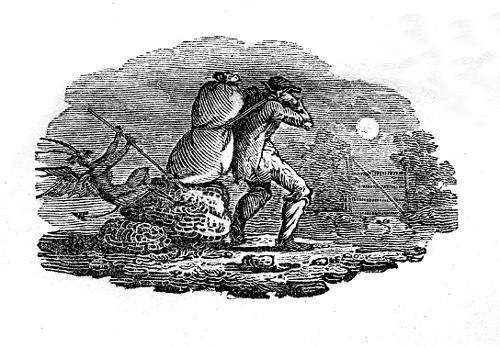
"One was a woodcut of Bewick's... which shows a moonlit road and a man walking along it, followed by an awful demon creature."
7elenchus
I'm familiar with the Golden Bough and its many editions / variants, but the Golden Legend was foreign to me. Apparently a mediaeval manuscript with more editions extant than the Bible before 1501, a "mediaeval best seller".
I found this description of the Golden Legend (Legenda aurea) highly suggestive, given our tale: "Jacobus de Voragine's etymologies had different goals from modern etymologies, and cannot be judged by the same standards. Jacobus de Voragine's etymologies have parallels in Isidore of Seville's Etymologiae, in which linguistically accurate derivations are set out beside allegorical and figurative explanations." {1}
Amusing, too, was this parallel in terms of the manuscript's, ah, "critical review": "The adverse reaction to Legenda aurea under critical scrutiny in the 16th century was led by scholars who reexamined the criteria for judging hagiographic sources and found Legenda aurea wanting." No word as to whether any of these scholars met with an untimely end.
Cheerfully indebted to Mr James for the very handy term incunabula.
{1} I was reminded of another set of highly suggestive and unorthodox etymologies, these imagined by Sun Ra for street corner preaching here in Chicago. I wonder now whether Sonny Blount was acquainted with de Voragine's work.
I found this description of the Golden Legend (Legenda aurea) highly suggestive, given our tale: "Jacobus de Voragine's etymologies had different goals from modern etymologies, and cannot be judged by the same standards. Jacobus de Voragine's etymologies have parallels in Isidore of Seville's Etymologiae, in which linguistically accurate derivations are set out beside allegorical and figurative explanations." {1}
Amusing, too, was this parallel in terms of the manuscript's, ah, "critical review": "The adverse reaction to Legenda aurea under critical scrutiny in the 16th century was led by scholars who reexamined the criteria for judging hagiographic sources and found Legenda aurea wanting." No word as to whether any of these scholars met with an untimely end.
Cheerfully indebted to Mr James for the very handy term incunabula.
{1} I was reminded of another set of highly suggestive and unorthodox etymologies, these imagined by Sun Ra for street corner preaching here in Chicago. I wonder now whether Sonny Blount was acquainted with de Voragine's work.
8elenchus
>6 artturnerjr:
Thanks for that, Art. Am I mistaken, or did Thomas Bewick come up in another of our recent stories?
Thanks for that, Art. Am I mistaken, or did Thomas Bewick come up in another of our recent stories?
9housefulofpaper
Michael Cox provided a note on Harley 3586 in the Oxford World's Classics Casting the Runes and Other Ghost Stories: "Harley 3586 actually consists of two monastic registers (in Latin) from the fourteenth century with which are bound two English letters of the seventeenth century (from Thomas Blount and Thomas Goad). It is difficult to see what the joke is - if there is one - in this reference."
10housefulofpaper
>8 elenchus:
I, for one, have drawn a blank on your Bewick question; although bear in mind that I have a memory like a sieve. Bewick crops up a lo,t though. He is probably the only wood engraver who is anywhere close to being a household name. A book of his engravings is important in the early chapters of Jane Eyre, I seem to remember.
I, for one, have drawn a blank on your Bewick question; although bear in mind that I have a memory like a sieve. Bewick crops up a lo,t though. He is probably the only wood engraver who is anywhere close to being a household name. A book of his engravings is important in the early chapters of Jane Eyre, I seem to remember.
11elenchus
The Miéville essay ("Quantum Vampire") linked under MISCELLANY is quite good, especially relevant here Part 3's discussion of James. Happily indebted to Miéville for the term teratogen, which he deploys with abandon.
Looking forward to comments on the Chabon essay noted in >3 artturnerjr: and >4 paradoxosalpha:.
>10 housefulofpaper:
I have that same computer-like ability to lose / pixellate / fractalise bits of memory, too. I won't have remembered Bewick from Eyre, but when looking up further information on that wood engraving, I happened across a site which made it all seem ... half-familiar. But that's all I got. It may have been from another online discussion, or neurochemical misfiring.
Looking forward to comments on the Chabon essay noted in >3 artturnerjr: and >4 paradoxosalpha:.
>10 housefulofpaper:
I have that same computer-like ability to lose / pixellate / fractalise bits of memory, too. I won't have remembered Bewick from Eyre, but when looking up further information on that wood engraving, I happened across a site which made it all seem ... half-familiar. But that's all I got. It may have been from another online discussion, or neurochemical misfiring.
12artturnerjr
>8 elenchus:
I'm not recalling any other mentions of Bewick, and a search on my Kindle (on which I've been doing most of my recent Deep Ones reading) didn't kick up any references to him other than in this James story. My memory is significantly less than eidetic, however. :)
>10 housefulofpaper:
A book of his engravings is important in the early chapters of Jane Eyre, I seem to remember.
You are correct, sir! A History of British Birds would be the title:
https://en.wikipedia.org/wiki/A_History_of_British_Birds
I'm not recalling any other mentions of Bewick, and a search on my Kindle (on which I've been doing most of my recent Deep Ones reading) didn't kick up any references to him other than in this James story. My memory is significantly less than eidetic, however. :)
>10 housefulofpaper:
A book of his engravings is important in the early chapters of Jane Eyre, I seem to remember.
You are correct, sir! A History of British Birds would be the title:
https://en.wikipedia.org/wiki/A_History_of_British_Birds
13gwendetenebre
The three short letters at the beginning go a long way toward giving the reader a good idea as to Karswell's personality. Don't tell - show! Shrewdly done.
I've got to go back and read this again, but I'm a little confused as to the reason for the "In memory of John Harrington" notice appearing on the train window for Dunning to see. Was this supposed to be a coincidence or did Karswell intend for Dunning to see it? It seems like it's just a plot device to lead Dunning to Henry Harrigton, but James is more cagey than that, so I must be missing something.
I've got to go back and read this again, but I'm a little confused as to the reason for the "In memory of John Harrington" notice appearing on the train window for Dunning to see. Was this supposed to be a coincidence or did Karswell intend for Dunning to see it? It seems like it's just a plot device to lead Dunning to Henry Harrigton, but James is more cagey than that, so I must be missing something.
14elenchus
I found the advert in the trolley a bit odd, but can't deny its effectiveness, and Miéville suggests it's for the reasons you note: show don't tell. Recall it provides the idea of there being 3 months before the full effect is felt, not only for the reader but for the victim ... in the nature of sorcery.
It's part of how James hints at the modern bureaucratic nature of the terror, conveyed along by anonymous letters (think also of the broadsheet handed out and then taken away) and publication. The terror inherent in an Age of Mechanical Reproduction! It fits, too, with James's abiding concern with manuscripts and writing.
This was a great story, it's been years since I've read it and it did not disappoint. I still marvel at the jolt of horror I got when reading of the brief encounter under the pillow. Wow. The emphasis upon the sense of touch is brilliant.
Also interesting that James chooses for his victim to survive, but again it proves effective: first, there's the chance to gaze after the horror, as it slinks along after Karswell (beyond our narrative sight, but not beyond our imagination). Second, it offers the opportunity to loop back to Harrington's gibberings just before his death, and despite his successful escape, Dunning is still very much affected by these!
It's part of how James hints at the modern bureaucratic nature of the terror, conveyed along by anonymous letters (think also of the broadsheet handed out and then taken away) and publication. The terror inherent in an Age of Mechanical Reproduction! It fits, too, with James's abiding concern with manuscripts and writing.
This was a great story, it's been years since I've read it and it did not disappoint. I still marvel at the jolt of horror I got when reading of the brief encounter under the pillow. Wow. The emphasis upon the sense of touch is brilliant.
Also interesting that James chooses for his victim to survive, but again it proves effective: first, there's the chance to gaze after the horror, as it slinks along after Karswell (beyond our narrative sight, but not beyond our imagination). Second, it offers the opportunity to loop back to Harrington's gibberings just before his death, and despite his successful escape, Dunning is still very much affected by these!
15gwendetenebre
>14 elenchus:
The give-and-take broadsheet bit was another (deliberately?) confusing part. Is Karswell in league with others? Are they all out to get Dunning or is he not the only target?
I still liked the story very much. The part in which Dunning is looking for his chance to hand the cursed paper off to Karswell in the train car is positively Hitchcockian.
I also liked the image of Karswell being stalked by the whatever-it-is (man-sized or dog-like - or both?) as he gets on the boat at the end. I'm reminded a bit of the steadily approaching menace in "Whistle and I'll Come to You, My Lad". This works much better than the giant demon forced into Tourneur's CURSE OF THE DEMON/NIGHT OF THE DEMON, although I'm surprised at how much of the story was successfully translated into the film overall.
The give-and-take broadsheet bit was another (deliberately?) confusing part. Is Karswell in league with others? Are they all out to get Dunning or is he not the only target?
I still liked the story very much. The part in which Dunning is looking for his chance to hand the cursed paper off to Karswell in the train car is positively Hitchcockian.
I also liked the image of Karswell being stalked by the whatever-it-is (man-sized or dog-like - or both?) as he gets on the boat at the end. I'm reminded a bit of the steadily approaching menace in "Whistle and I'll Come to You, My Lad". This works much better than the giant demon forced into Tourneur's CURSE OF THE DEMON/NIGHT OF THE DEMON, although I'm surprised at how much of the story was successfully translated into the film overall.
16elenchus
The broadsheet and the advertisement in the trolley glass both are key aspects of Karswell's magic: personal contact must be made, and seemingly involves a degree of complicity on the part of the victim. It's the same in the traincar at the end: Dunning can't simply hide the paper in Karswell's baggage, though he contemplates that. No, he must openly offer it to Karswell, and in return Karswell must accept it.
I find that to be a crucial element of the terror. You may not know it, in fact, you need not know it, but you are complicit in your own fate! The moral seems to be: "Be mindful of what you do, you're playing with powers far beyond your capability." But also (and this is the great twist): "Oh, but of course there's only so much care you can take, since in fact you don't know the rules and at any time might very well trigger something inadvertently."
I find that to be a crucial element of the terror. You may not know it, in fact, you need not know it, but you are complicit in your own fate! The moral seems to be: "Be mindful of what you do, you're playing with powers far beyond your capability." But also (and this is the great twist): "Oh, but of course there's only so much care you can take, since in fact you don't know the rules and at any time might very well trigger something inadvertently."
17Crypto-Willobie
I read the advertisement as Karswell taunting Dunning. The boat-train business rather reminded me of a Sherlock Homes story, but I suppose their influence was ubiquitous.
I'm pretty sure I read this about 20 yrs ago but didn't remember it at all. And of course I immediately began to wonder if Karswell was meant as portrait of Aleister Crowley. Not knowing whether James knew anything of Crowley I cast an inter-net and found that though various writers seem pretty confident that it is, that Joshi (?) dismisses the idea, claiming that Karswell is based on one Oscar Browning (who James disliked). See here: http://www.hippocampuspress.com/warnings-to-the-curious-sheaf-of-criticism-on-m.... .
However, before I was warned off the notion I happened to notice that taking every other letter from Karswell -- K R W L -- gives more or less the same consonants found in CRoWLey; and for what it's worth (even less, I suppose) the other letters in Karswell (A, S, E, L) are all found in Aleister. A crude runic cipher?
Even if there is something in this it wouldn't have to mean that Karswell was meant to be absolutely identified with Crowley. Many "based-on" characters are really composites of several people. Just a thought ..
I'm pretty sure I read this about 20 yrs ago but didn't remember it at all. And of course I immediately began to wonder if Karswell was meant as portrait of Aleister Crowley. Not knowing whether James knew anything of Crowley I cast an inter-net and found that though various writers seem pretty confident that it is, that Joshi (?) dismisses the idea, claiming that Karswell is based on one Oscar Browning (who James disliked). See here: http://www.hippocampuspress.com/warnings-to-the-curious-sheaf-of-criticism-on-m.... .
However, before I was warned off the notion I happened to notice that taking every other letter from Karswell -- K R W L -- gives more or less the same consonants found in CRoWLey; and for what it's worth (even less, I suppose) the other letters in Karswell (A, S, E, L) are all found in Aleister. A crude runic cipher?
Even if there is something in this it wouldn't have to mean that Karswell was meant to be absolutely identified with Crowley. Many "based-on" characters are really composites of several people. Just a thought ..
18paradoxosalpha
>17 Crypto-Willobie:
"Julian Karswell" (note the meter) does seem to vaguely allude to Aleister Crowley, although I don't think the Beast was yet of a form that might be characterized as "stout" in 1911. Still, in England of that day, he was likely the pre-eminent example of a black magician among the reading public. (See The "Rosicrucian" Scandal for one context of public notice, although it wasn't until the 1920s that the English yellow press made him into "The Wickedest Man in the World" and "A Man We'd Like to Hang.")
Karswell setting himself up in an old abbey is more of an allusion to Francis Dashwood (a paleo-Thelemite conspicuously absent from Crowley's writings); Crowley just bought a nice house in Scotland. Other than the occasional exotic initial capital, Crowley's grammar and prose style is above reproach. Overall, I find it credible that James based Karswell on Oscar Browning while gesturing toward Crowley for the benefit of the reader.
H.R. Wakefield wrote another story of homicidal sorcery more than 20 years after the James tale, called "He cometh and he passeth by ...." In that case, the villain Oscar Clinton is unmistakably premised on Crowley, and I have previously suspected that Wakefield story of standing in the same relation to "Casting the Runes" as "The Dunwich Horror" does to Arthur Machen's "Great God Pan." Joshi clearly agrees with me!
"Julian Karswell" (note the meter) does seem to vaguely allude to Aleister Crowley, although I don't think the Beast was yet of a form that might be characterized as "stout" in 1911. Still, in England of that day, he was likely the pre-eminent example of a black magician among the reading public. (See The "Rosicrucian" Scandal for one context of public notice, although it wasn't until the 1920s that the English yellow press made him into "The Wickedest Man in the World" and "A Man We'd Like to Hang.")
Karswell setting himself up in an old abbey is more of an allusion to Francis Dashwood (a paleo-Thelemite conspicuously absent from Crowley's writings); Crowley just bought a nice house in Scotland. Other than the occasional exotic initial capital, Crowley's grammar and prose style is above reproach. Overall, I find it credible that James based Karswell on Oscar Browning while gesturing toward Crowley for the benefit of the reader.
H.R. Wakefield wrote another story of homicidal sorcery more than 20 years after the James tale, called "He cometh and he passeth by ...." In that case, the villain Oscar Clinton is unmistakably premised on Crowley, and I have previously suspected that Wakefield story of standing in the same relation to "Casting the Runes" as "The Dunwich Horror" does to Arthur Machen's "Great God Pan." Joshi clearly agrees with me!
19artturnerjr
A very, very artfully crafted tale. In Supernatural Horror in Literature, Lovecraft speaks of James being "gifted with an almost diabolic power of calling horror by gentle steps from the midst of prosaic daily life". "Casting the Runes" epitomizes this as much as any James tale I have yet read. The thing about this slow, steady approach is that it enables what I like to think of as a "depth charge" effect that you see in the very finest exponents of the horror genre. Here's how it worked for me with this tale: I finished reading the story right before I went to sleep (always an, um, interesting choice for a horror tale). Started drifting off, and about half an hour later, when I was just on the edge of unconsciousness, awoke and said to myself, "My God! What was in Karswell's heap of coats? It's July in the story - why does he even have a heap of coats?" Pow!
>14 elenchus:
It's part of how James hints at the modern bureaucratic nature of the terror, conveyed along by anonymous letters (think also of the broadsheet handed out and then taken away) and publication. The terror inherent in an Age of Mechanical Reproduction!
That's an excellent point. For all its antiquarian touches, this is a very modern horror story.
I still marvel at the jolt of horror I got when reading of the brief encounter under the pillow. Wow.
Oh yeah, that got to me, too. The description ("What he touched was, according to his his account, a mouth, with teeth, and with hair about it, and, he declares, not the mouth of a human being"*), and the not-insignificant fact that he encounters it in bed, recalled to me the folkloric vagina dentata.**
*The sentence that follows is a killer, too: "I do not think it is any use to guess what he said or did; but he was in a spare room with the door locked and his ear to it before he was clearly conscious again" (!).
** https://en.wikipedia.org/wiki/Vagina_dentata
>14 elenchus:
It's part of how James hints at the modern bureaucratic nature of the terror, conveyed along by anonymous letters (think also of the broadsheet handed out and then taken away) and publication. The terror inherent in an Age of Mechanical Reproduction!
That's an excellent point. For all its antiquarian touches, this is a very modern horror story.
I still marvel at the jolt of horror I got when reading of the brief encounter under the pillow. Wow.
Oh yeah, that got to me, too. The description ("What he touched was, according to his his account, a mouth, with teeth, and with hair about it, and, he declares, not the mouth of a human being"*), and the not-insignificant fact that he encounters it in bed, recalled to me the folkloric vagina dentata.**
*The sentence that follows is a killer, too: "I do not think it is any use to guess what he said or did; but he was in a spare room with the door locked and his ear to it before he was clearly conscious again" (!).
** https://en.wikipedia.org/wiki/Vagina_dentata
20elenchus
>19 artturnerjr: That's an excellent point. For all its antiquarian touches, this is a very modern horror story.
It is a good point, and it's not mine: should have clarified I cribbed it from Miéville's essay.
It is a good point, and it's not mine: should have clarified I cribbed it from Miéville's essay.
21gwendetenebre
>17 Crypto-Willobie:
I read the advertisement as Karswell taunting Dunning.
A good explanation. I'll accept that!
>19 artturnerjr:
"My God! What was in Karswell's heap of coats? It's July in the story - why does he even have a heap of coats?
Yet another good question. James seems to have summoned an environment in which thinly veiled supernatural threat is everywhere. This reminds of Ramsey Campbell's work.
I read the advertisement as Karswell taunting Dunning.
A good explanation. I'll accept that!
>19 artturnerjr:
"My God! What was in Karswell's heap of coats? It's July in the story - why does he even have a heap of coats?
Yet another good question. James seems to have summoned an environment in which thinly veiled supernatural threat is everywhere. This reminds of Ramsey Campbell's work.
22mstrust
Good point about it being July. I wondered why he was carrying such a bundle of coats but didn't note the month.
I believe this is just the second James story I've read, after The Tractate Middoth and it's superb. At times I forgot that it was a modern story, at other times it gave such a closed feeling that it seemed like Dunning was locked in the house in the middle of nowhere. Dunning was so isolated in his terror that Henry's appearance was like a life preserver that I thought would be jerked away at the last minute. I don't know what the reader is to make of Dunning's desire to save Karswell from the situation he created. Most likely to prove that Dunning was a gentle man who was driven to his actions, but it made me question Dunning's sanity. ; )
It seems that this story has been re-written by several authors, performed for radio and filmed a couple of times. I was surprised to see that it was the basis for "Drag Me To Hell".
I believe this is just the second James story I've read, after The Tractate Middoth and it's superb. At times I forgot that it was a modern story, at other times it gave such a closed feeling that it seemed like Dunning was locked in the house in the middle of nowhere. Dunning was so isolated in his terror that Henry's appearance was like a life preserver that I thought would be jerked away at the last minute. I don't know what the reader is to make of Dunning's desire to save Karswell from the situation he created. Most likely to prove that Dunning was a gentle man who was driven to his actions, but it made me question Dunning's sanity. ; )
It seems that this story has been re-written by several authors, performed for radio and filmed a couple of times. I was surprised to see that it was the basis for "Drag Me To Hell".
23paradoxosalpha
If one is to believe William Seabrook (see Witchcraft: Its Power in the World Today), the efficacy of magical curses depends on the victim's awareness of their existence. Harrington knew that Karswell was after him, and the odd gaslighting of Dunning seems to have been intended to achieve that aim.
24elenchus
>19 artturnerjr: It's July in the story - why does he even have a heap of coats?"
Well, a current July forecast for the English Channel is high temps in the range 19-23 Centigrade (66-75 Fahrenheit), lows 13-15 C (55-60 F) with storms likely. So the coats don't seem out of place to me. Plus I take it Karswell was fleeing, and would take something like a good coat since he would not be back.
ETA Checking the story, I see I inferred Karswell was fleeing for a boat to the Continent (Croydon Station to the boats for England's south coast), but that's never stated. Still, a boat or ship in July, and if he's headed north it would be even worse weather.
Well, a current July forecast for the English Channel is high temps in the range 19-23 Centigrade (66-75 Fahrenheit), lows 13-15 C (55-60 F) with storms likely. So the coats don't seem out of place to me. Plus I take it Karswell was fleeing, and would take something like a good coat since he would not be back.
ETA Checking the story, I see I inferred Karswell was fleeing for a boat to the Continent (Croydon Station to the boats for England's south coast), but that's never stated. Still, a boat or ship in July, and if he's headed north it would be even worse weather.
25gwendetenebre
>24 elenchus:
Aha! Very good!
And I can't help but add:

Even though that monster is one of the coolest-looking ever, I'd love to see how Tourneur's film would have worked without it. I'm sure the effect would have been much more in the manner of Val Lewton, with whom Tourneur produced such classics as THE LEOPARD MAN and CAT PEOPLE. I also thoroughly enjoyed the performance by Niall MacGinnis as Karswell:

>22 mstrust:
I don't know what the reader is to make of Dunning's desire to save Karswell from the situation he created. Most likely to prove that Dunning was a gentle man who was driven to his actions, but it made me question Dunning's sanity. ; )
True! "This is the 21st: he will have a day." is all that need be said, I guess.
Aha! Very good!
And I can't help but add:

Even though that monster is one of the coolest-looking ever, I'd love to see how Tourneur's film would have worked without it. I'm sure the effect would have been much more in the manner of Val Lewton, with whom Tourneur produced such classics as THE LEOPARD MAN and CAT PEOPLE. I also thoroughly enjoyed the performance by Niall MacGinnis as Karswell:

>22 mstrust:
I don't know what the reader is to make of Dunning's desire to save Karswell from the situation he created. Most likely to prove that Dunning was a gentle man who was driven to his actions, but it made me question Dunning's sanity. ; )
True! "This is the 21st: he will have a day." is all that need be said, I guess.
26artturnerjr
>21 gwendetenebre:
James seems to have summoned an environment in which thinly veiled supernatural threat is everywhere.
Yeah, exactly. James' tales are set in this universe where so many little things are slightly, incorrigibly off. Did you ever have a painting or a framed print that you were trying to hang on a wall that just did not want to sit there where it was supposed to? That, try as you might, you just couldn't get to look right? That would fit right in in a James tale.
This reminds of Ramsey Campbell's work.
From an online interview with Campbell*:
Q: Are there particular weird influences you care to point to in terms of your own work, besides Lovecraft? Anyone you think readers might be surprised by?
A: My first editor – August Derleth of Arkham House – advised me to reacquaint myself with the ghostly tales of M. R. James in the interests of restraint, and I saw how James conveyed more terror with a single sentence or even sometimes a solitary phrase than most writers achieve in a paragraph; he’s still unequalled at showing just enough to suggest far worse.
* http://weirdfictionreview.com/2011/12/the-weird-an-interview-with-ramsey-campbel...
James seems to have summoned an environment in which thinly veiled supernatural threat is everywhere.
Yeah, exactly. James' tales are set in this universe where so many little things are slightly, incorrigibly off. Did you ever have a painting or a framed print that you were trying to hang on a wall that just did not want to sit there where it was supposed to? That, try as you might, you just couldn't get to look right? That would fit right in in a James tale.
This reminds of Ramsey Campbell's work.
From an online interview with Campbell*:
Q: Are there particular weird influences you care to point to in terms of your own work, besides Lovecraft? Anyone you think readers might be surprised by?
A: My first editor – August Derleth of Arkham House – advised me to reacquaint myself with the ghostly tales of M. R. James in the interests of restraint, and I saw how James conveyed more terror with a single sentence or even sometimes a solitary phrase than most writers achieve in a paragraph; he’s still unequalled at showing just enough to suggest far worse.
* http://weirdfictionreview.com/2011/12/the-weird-an-interview-with-ramsey-campbel...
27housefulofpaper
Re. Karswell's pile of coats: yes the weather can be unpredictable in the UK (unseasonably cool with brief but heavy showers here in southern England today); or Karswell could have been heading for a mountainous region in Europe; or James could have been signalling that Karswell is a flashily vulgar or eccentric dresser - i.e. not quite a gentleman; or there's something fiery in his nature (hellfire? Or like an Arabian ifrit? I noticed the film Night of the Demon picked up on hints in the story and specifically made the summoned entity a "fire demon").
I have trouble assessing this story in isolation, to be honest. I devoured a paperback edition of the collected ghost stories about 20 years ago, and like the Sherlock Holmes stories it's hard to separate individual stories from the general impression they make as a whole. On top of that, I think I saw the film (on TV) before reading any M R James stories...so the original and the adaptation are bound up in my mind - insofar as the effect they have is concerned. Obviously there are differences in character, motivation, etc.
James wrote these stories to be read aloud, of course, but the opening pages are noticeably conversational and casual (for a Victorian Cambridge don, that is!); of course that makes the contrast all the greater when the story gets into its stride.
To talk about the film again for a moment - I read somewhere (possibly Jonathan Rigby's English Gothic that Tourneur did always intend the monster to be seen, but only for a couple of frames, and only at the film's climax. If you watch Karswell's death scene, the demon that picks him up and claws him to pieces doesn't look like the prop we've seen in all the demon's previous appearances. It's mammalian, hairy, and has glowing eyes. It looks both more primitive and more uncanny than the familiar prop. To be honest it's like something out of Häxan.
The film also brings in the idea of "collateral damage" when the demon attacks (Karswell does not want to be trapped in the train carriage with Holden (the Dunning character)). The updated TV version uses this idea too.
I have trouble assessing this story in isolation, to be honest. I devoured a paperback edition of the collected ghost stories about 20 years ago, and like the Sherlock Holmes stories it's hard to separate individual stories from the general impression they make as a whole. On top of that, I think I saw the film (on TV) before reading any M R James stories...so the original and the adaptation are bound up in my mind - insofar as the effect they have is concerned. Obviously there are differences in character, motivation, etc.
James wrote these stories to be read aloud, of course, but the opening pages are noticeably conversational and casual (for a Victorian Cambridge don, that is!); of course that makes the contrast all the greater when the story gets into its stride.
To talk about the film again for a moment - I read somewhere (possibly Jonathan Rigby's English Gothic that Tourneur did always intend the monster to be seen, but only for a couple of frames, and only at the film's climax. If you watch Karswell's death scene, the demon that picks him up and claws him to pieces doesn't look like the prop we've seen in all the demon's previous appearances. It's mammalian, hairy, and has glowing eyes. It looks both more primitive and more uncanny than the familiar prop. To be honest it's like something out of Häxan.
The film also brings in the idea of "collateral damage" when the demon attacks (Karswell does not want to be trapped in the train carriage with Holden (the Dunning character)). The updated TV version uses this idea too.
28gwendetenebre
>27 housefulofpaper:
The big demon that is on all the posters and which comes shambling down the train tracks was added at the request of the film's distributors, but you must be right about those last frames. I'll have to watch it again, but your referencing HAXAN rings a bell. Thanks for reminding me about Rigby's English Gothic. I'll have to order it. I have his American Gothic, which is fantastic, despite the microscopic print.
The big demon that is on all the posters and which comes shambling down the train tracks was added at the request of the film's distributors, but you must be right about those last frames. I'll have to watch it again, but your referencing HAXAN rings a bell. Thanks for reminding me about Rigby's English Gothic. I'll have to order it. I have his American Gothic, which is fantastic, despite the microscopic print.
29gwendetenebre
And a happy 153rd birthday to M.R. James.
30CliffBurns
A quick note to fellow "Weird" fiction fans: a noted biographer of M.R. James is currently searching for crowd-sourced funding for a project she's researching on James' notebooks. If you'd like to donate a few $$ to a worthy cause and help keep James' name alive, please do:
https://www.gofundme.com/f/help-with-the-montague-rhodes-james-podcast?utm_campa...
https://www.gofundme.com/f/help-with-the-montague-rhodes-james-podcast?utm_campa...

