Reading the oldies (pre-1994): would you give this book to a child? v. 3
This is a continuation of the topic Reading the oldies (pre-1994): would you give this book to a child? v. 2.
This topic was continued by Reading the oldies (pre-1994): would you give this book to a child? v. 4.
Talk Science Fiction Fans
Join LibraryThing to post.
This topic is currently marked as "dormant"—the last message is more than 90 days old. You can revive it by posting a reply.
1LolaWalser
The impetus for this thread arose in this discussion: Science Fiction for Children?
I explained what I was aiming to explore in the first post in the first instalment of the thread:
Reading the oldies (pre-1994): would you give this book to a child?
In brief, the focus of the thread is character representation in science fiction and fantasy published before 1994. The analyses, at least those produced by me, are NOT meant to be reviews--be prepared, for instance, to see literary, pioneering, technical etc. aspects of the work neglected, while any number of what may seem minor points could be discussed in detail.
Everyone is invited to contribute, whether you adopt the format I follow (in which case your information will be added to the summaries) or not.
Discussion of the premises or how they affect any given title, situation etc. is always welcome.
The summary of links to the first block of twenty titles is here.
Second block of titles, numbers 21-40.
The numbers are links to posts; the titles are touchstones. Asterisks (*) indicate authors awarded the "Grand Master" title by the Science Fiction and Fantasy Writers of America.
21. The Syndic by C. M. Kornbluth
22. Odd John by Olaf Stapledon
23. The jaws that bite, the claws that catch by Michael G. Coney
24. The psychopath plague by Steven G. Spruill
25. Barefoot in the head by Brian Aldiss*
26. Bill, the Galactic Hero by Harry Harrison*
27. Virgin planet by Poul Anderson*
28. West of the sun by Edgar Pangborn
29. Journey by Marta Randall
30. Mockingbird by Walter Tevis
31. The pursuit of the screamer by Ansen Dibell
32. Earthlight by Arthur C. Clarke*
33. Shadows in the sun by Chad Oliver
34. The Napoleons of Eridanus by Pierre Barbet
35. Slan by A. E. Van Vogt*
36. Mutant by Henry Kuttner
37. The men in the jungle by Norman Spinrad
38. Little Fuzzy by H. Beam Piper
39. Star King by Jack Vance*
40. The black star passes by John W. Campbell
I explained what I was aiming to explore in the first post in the first instalment of the thread:
Reading the oldies (pre-1994): would you give this book to a child?
In brief, the focus of the thread is character representation in science fiction and fantasy published before 1994. The analyses, at least those produced by me, are NOT meant to be reviews--be prepared, for instance, to see literary, pioneering, technical etc. aspects of the work neglected, while any number of what may seem minor points could be discussed in detail.
Everyone is invited to contribute, whether you adopt the format I follow (in which case your information will be added to the summaries) or not.
Discussion of the premises or how they affect any given title, situation etc. is always welcome.
The summary of links to the first block of twenty titles is here.
Second block of titles, numbers 21-40.
The numbers are links to posts; the titles are touchstones. Asterisks (*) indicate authors awarded the "Grand Master" title by the Science Fiction and Fantasy Writers of America.
21. The Syndic by C. M. Kornbluth
22. Odd John by Olaf Stapledon
23. The jaws that bite, the claws that catch by Michael G. Coney
24. The psychopath plague by Steven G. Spruill
25. Barefoot in the head by Brian Aldiss*
26. Bill, the Galactic Hero by Harry Harrison*
27. Virgin planet by Poul Anderson*
28. West of the sun by Edgar Pangborn
29. Journey by Marta Randall
30. Mockingbird by Walter Tevis
31. The pursuit of the screamer by Ansen Dibell
32. Earthlight by Arthur C. Clarke*
33. Shadows in the sun by Chad Oliver
34. The Napoleons of Eridanus by Pierre Barbet
35. Slan by A. E. Van Vogt*
36. Mutant by Henry Kuttner
37. The men in the jungle by Norman Spinrad
38. Little Fuzzy by H. Beam Piper
39. Star King by Jack Vance*
40. The black star passes by John W. Campbell
2LolaWalser
A basic analysis of representation in the first forty works and their authors.
There were 40 titles by 39 unique authors (Brian Aldiss had two books). Please correct or add information.
AUTHOR DIVERSITY
Women: 3/39 ; 7.7% (Norton; Randall; Dibell)
Persons of colour (PoC): 0/39 ; 0%
Relative minority, sexual orientation: 2/39 ; 5.1% (Gerrold; Clarke)
Other relative minority: 0/39 ; 0%
REPRESENTATIONS OF DIVERSITY IN THE WORKS
a) Main characters
Women: 2/40 ; 5% (Panshin; Randall)
PoC: 4/40 ; 10% (Norton; Heinlein; Panshin; Randall)
Relative minority, sexual orientation: 1/40 ; 2.5% (Gerrold)
Other relative minority: 0/40 ; 0%
b) Works with any appearance of:
Women: 36/40 ; 90% (none in Norton; Lem; Clarke; Campbell)
PoC: 16/40 ; 40% (Leiber; Norton; Williamson; Brunner; Heinlein; Panshin; Clement; Leinster; Wyndham; Stapledon; Spruill; Harrison; Pangborn; Tevis; Spinrad; Piper)
Relative minority, sexual orientation: 6/40 ; 15% (Leiber; Brunner; Gerrold, Farmer, Moorcock; Randall)
Other relative minority: 2/40 ; 5% (Moorcock; Stapledon)
Note: I was unhappy with section c) Type of role/agency; tolerance of diversity, I'm afraid there's no way to quantify adequately these features across such different texts. I think they are better addressed in discussion.
The following segments answer more straightforward questions, so I'm keeping them:
RELATIVE SEXUAL MINORITIES
What are the attitudes to non-heterosexual characters and behaviour?
--Positive/tending to positive: 2/40 ; 5% (Gerrold; Randall)
--Negative/tending to negative: 4/40; 10% (Leiber; Farmer; Brunner; Moorcock)
OTHER RELATIVE MINORITIES
What are the attitudes to characters in other discriminated-against categories?
--Positive/tending to positive: 1/40 ; 2.5% (Stapledon)
--Negative/tending to negative: 1/40 ; 2.5% (Moorcock)
In the second block (titles 21-40) I started noting, on @artturnerjr 's suggestion, whether the text passes the Bechdel test (BT), and the reverse (r-BT).
Although most of the books in this block had at least one female character (18/20, or 90%), only seven (7/20, or 35%) pass BT (minus the two women-less books, it's 7/18, or 39%).
In contrast, ALL passed the r-BT, i.e. in ALL of them male characters spoke with other male characters about topics other than women.
There were 40 titles by 39 unique authors (Brian Aldiss had two books). Please correct or add information.
AUTHOR DIVERSITY
Women: 3/39 ; 7.7% (Norton; Randall; Dibell)
Persons of colour (PoC): 0/39 ; 0%
Relative minority, sexual orientation: 2/39 ; 5.1% (Gerrold; Clarke)
Other relative minority: 0/39 ; 0%
REPRESENTATIONS OF DIVERSITY IN THE WORKS
a) Main characters
Women: 2/40 ; 5% (Panshin; Randall)
PoC: 4/40 ; 10% (Norton; Heinlein; Panshin; Randall)
Relative minority, sexual orientation: 1/40 ; 2.5% (Gerrold)
Other relative minority: 0/40 ; 0%
b) Works with any appearance of:
Women: 36/40 ; 90% (none in Norton; Lem; Clarke; Campbell)
PoC: 16/40 ; 40% (Leiber; Norton; Williamson; Brunner; Heinlein; Panshin; Clement; Leinster; Wyndham; Stapledon; Spruill; Harrison; Pangborn; Tevis; Spinrad; Piper)
Relative minority, sexual orientation: 6/40 ; 15% (Leiber; Brunner; Gerrold, Farmer, Moorcock; Randall)
Other relative minority: 2/40 ; 5% (Moorcock; Stapledon)
Note: I was unhappy with section c) Type of role/agency; tolerance of diversity, I'm afraid there's no way to quantify adequately these features across such different texts. I think they are better addressed in discussion.
The following segments answer more straightforward questions, so I'm keeping them:
RELATIVE SEXUAL MINORITIES
What are the attitudes to non-heterosexual characters and behaviour?
--Positive/tending to positive: 2/40 ; 5% (Gerrold; Randall)
--Negative/tending to negative: 4/40; 10% (Leiber; Farmer; Brunner; Moorcock)
OTHER RELATIVE MINORITIES
What are the attitudes to characters in other discriminated-against categories?
--Positive/tending to positive: 1/40 ; 2.5% (Stapledon)
--Negative/tending to negative: 1/40 ; 2.5% (Moorcock)
In the second block (titles 21-40) I started noting, on @artturnerjr 's suggestion, whether the text passes the Bechdel test (BT), and the reverse (r-BT).
Although most of the books in this block had at least one female character (18/20, or 90%), only seven (7/20, or 35%) pass BT (minus the two women-less books, it's 7/18, or 39%).
In contrast, ALL passed the r-BT, i.e. in ALL of them male characters spoke with other male characters about topics other than women.
3LolaWalser
Since you're all fans, I doubt the numbers so far seem particularly surprising.
The majority of authors (92%) are white men, and mostly (94%) heterosexual (as far as I know), with two exceptions.
All three women are also white, and (AFAIK--I hope this phrase can be taken for granted in the future) also heterosexual.
Or, since "unorthodox" sexual orientation or gender fluidity may be difficult to ascertain for authors in the past, perhaps it's better to phrase it in terms of what we lack--which is positive knowledge that they are/might have been in a sexual or gender relative minority.
Or is that adopting a white- and heteronormative stance? That, basically, everyone we don't know differently about is white, heterosexual, cis-gendered...?
Hm, well, not sure how best to frame this then... "AFAIK" could be it.
On the diversity within the works, as far as general observations go there's little new to add. This batch didn't improve on the previous one in terms of numbers or attitudes represented.
Let's imagine that for some ungodly reason these forty titles are the only books at your disposal, and as your kids are growing up, this is all the printed entertainment they can look forward to.
The little girl can expect to read one (1) book in which a young girl is the central character, and one moreover who is capable, intelligent etc. (She will end up (at about fourteen) in a sexual relationship with a male, but at least one her age or so.)
Other narratives involve women mostly as secondary and minor characters, practically all subservient in some way, and mostly sexualised, frequently crudely, even brutally. There's a story in which only one woman gets to play a little part, but only so she can get abused and raped. (She doesn't even get to do anything that helps the hero, nor does the event further the plot--the outrage only serves to underline (unnecessarily, since there are other examples) that a certain character is monstrously cruel. Everything that happens would have happened whether she existed or not.) There are stories in which women are explicitly demeaned and humiliated, in character or in abstract, just for being women. There are stories with explicit misogynistic and sexist messages. (In contrast, there are no stories in which the male sex is so treated, because that's NOT how the male sex is viewed and treated, "in real life".) And there are stories with no women, even no mention of women, at all. Even projected into far future, onto strange new worlds.
I really expect that most people would baulk at uncritically presenting such a set of books to a girl. But--and this is a crucial point--if we'd feel uncomfortable about subjecting girls to such visions of women, why on earth and how on earth is it acceptable for boys?
This, again, is to me the heart of the problem of sustained, ever-perpetuated misogyny. Obviously, this is not the only or most important source of mediatic--therefore cultural--misogyny (I don't know that there is one "most" important--religion, custom, media, law are ALL important and all work together), but it's one of those things that get at us most early, and deeply.
The non-white kid, as long as he's a boy, fares somewhat better, especially if he's willing to use any hint, however slight, that a character is non-white. The numbers are still derisory--that white boy isn't letting go off his toys so easily. And there are stereotypes to contend with in almost every instance where any characters of colour appear.
The kid who is in a minority of some kind (vis-à-vis literature anyway) may or may not find some encouragement in Stapledon's story, where characters physically inferior are mental giants and seem to be "the best" of humanity (but this is not unambiguous...) Your sexually "unorthodox" kid may similarly find encouragement in two stories in which non-heterosexuality is treated with generosity and acceptance of it as a human variation equal to any other... but there are double the number of titles in which it is written of derogatorily.
Here too I want to emphasise that it's not only about what is there for any kid who's not a straight white boy, but also about what visions of others, what habits of thought, what prejudices the straight white boy will absorb.
And, well, I guess the answer too lies in this literature...
Speaking of which, it may have been interesting to group dates of publication (which often means dates of copyright--I'm not very strict about the difference, basically my interest is "when did this story come into existence", in whatever form, as long as a date is certifiable), to see whether any "trends" (dare one hope, "progress"?) can be tied to given decades, but after all decades are as arbitrary as anything...
I can say that the earliest story is Campbell's The black star passes (1930), and the most recent Douglas Adams' Mostly harmless (1992). Most titles (12) were published in the 1960s, and the average date of publication is 1963.
The majority of authors (92%) are white men, and mostly (94%) heterosexual (as far as I know), with two exceptions.
All three women are also white, and (AFAIK--I hope this phrase can be taken for granted in the future) also heterosexual.
Or, since "unorthodox" sexual orientation or gender fluidity may be difficult to ascertain for authors in the past, perhaps it's better to phrase it in terms of what we lack--which is positive knowledge that they are/might have been in a sexual or gender relative minority.
Or is that adopting a white- and heteronormative stance? That, basically, everyone we don't know differently about is white, heterosexual, cis-gendered...?
Hm, well, not sure how best to frame this then... "AFAIK" could be it.
On the diversity within the works, as far as general observations go there's little new to add. This batch didn't improve on the previous one in terms of numbers or attitudes represented.
Let's imagine that for some ungodly reason these forty titles are the only books at your disposal, and as your kids are growing up, this is all the printed entertainment they can look forward to.
The little girl can expect to read one (1) book in which a young girl is the central character, and one moreover who is capable, intelligent etc. (She will end up (at about fourteen) in a sexual relationship with a male, but at least one her age or so.)
Other narratives involve women mostly as secondary and minor characters, practically all subservient in some way, and mostly sexualised, frequently crudely, even brutally. There's a story in which only one woman gets to play a little part, but only so she can get abused and raped. (She doesn't even get to do anything that helps the hero, nor does the event further the plot--the outrage only serves to underline (unnecessarily, since there are other examples) that a certain character is monstrously cruel. Everything that happens would have happened whether she existed or not.) There are stories in which women are explicitly demeaned and humiliated, in character or in abstract, just for being women. There are stories with explicit misogynistic and sexist messages. (In contrast, there are no stories in which the male sex is so treated, because that's NOT how the male sex is viewed and treated, "in real life".) And there are stories with no women, even no mention of women, at all. Even projected into far future, onto strange new worlds.
I really expect that most people would baulk at uncritically presenting such a set of books to a girl. But--and this is a crucial point--if we'd feel uncomfortable about subjecting girls to such visions of women, why on earth and how on earth is it acceptable for boys?
This, again, is to me the heart of the problem of sustained, ever-perpetuated misogyny. Obviously, this is not the only or most important source of mediatic--therefore cultural--misogyny (I don't know that there is one "most" important--religion, custom, media, law are ALL important and all work together), but it's one of those things that get at us most early, and deeply.
The non-white kid, as long as he's a boy, fares somewhat better, especially if he's willing to use any hint, however slight, that a character is non-white. The numbers are still derisory--that white boy isn't letting go off his toys so easily. And there are stereotypes to contend with in almost every instance where any characters of colour appear.
The kid who is in a minority of some kind (vis-à-vis literature anyway) may or may not find some encouragement in Stapledon's story, where characters physically inferior are mental giants and seem to be "the best" of humanity (but this is not unambiguous...) Your sexually "unorthodox" kid may similarly find encouragement in two stories in which non-heterosexuality is treated with generosity and acceptance of it as a human variation equal to any other... but there are double the number of titles in which it is written of derogatorily.
Here too I want to emphasise that it's not only about what is there for any kid who's not a straight white boy, but also about what visions of others, what habits of thought, what prejudices the straight white boy will absorb.
And, well, I guess the answer too lies in this literature...
Speaking of which, it may have been interesting to group dates of publication (which often means dates of copyright--I'm not very strict about the difference, basically my interest is "when did this story come into existence", in whatever form, as long as a date is certifiable), to see whether any "trends" (dare one hope, "progress"?) can be tied to given decades, but after all decades are as arbitrary as anything...
I can say that the earliest story is Campbell's The black star passes (1930), and the most recent Douglas Adams' Mostly harmless (1992). Most titles (12) were published in the 1960s, and the average date of publication is 1963.
4LolaWalser
Up next: Dorsai! by Gordon R. Dickson
6iansales
>4 LolaWalser: You might better off reading the first of the trilogy Tactics of Mistake. Dorsai! was published first, albeit under the title The Genetic General, but there are two books preceding it.
7LolaWalser
>6 iansales:
Since the focus here is on representation, the only way chronological sequence could matter is if there is character development. I haven't finished, but it's clear off the bat that in this case any "preceding" books don't matter--Dorsai! follows the career of the hero from boyhood on. Moreover, there's a strong emphasis on action, while the characters are rather "set". Right now I'd bet that's a standing feature. No doubt the hero still has some things to learn, but he has consistently expressed the character given him on basically page 1, through page 190 (so far). (In fact, that would seem to be part of the book's "genetic" theme--but I don't want to anticipate...)
I should repeat that the collection of books I'm reading for this thread wasn't assembled for any special purpose and that the idea is to see what kind of data emerges from reading as "randomly" as possible in the circumstances. That said, when I originally built "the pile", I identified any sequences as far as I could, in order to ensure that I don't read out of order (as I was piling books I took care that the last in sequence go toward the bottom etc). However, some sequences are incomplete (for example, I think I remember missing one of Vance's "Demon Princes" books) and I'm not making a special effort to complete them. If there's a break in the middle, and if it looks as if the missing volume could dramatically affect the impression of the character, I'll probably read only up to the break.
To keep things "random", I have a rule that I can't go looking for a specific title, but I can buy anything I run into shopping for books in the ordinary course of things.
Since the focus here is on representation, the only way chronological sequence could matter is if there is character development. I haven't finished, but it's clear off the bat that in this case any "preceding" books don't matter--Dorsai! follows the career of the hero from boyhood on. Moreover, there's a strong emphasis on action, while the characters are rather "set". Right now I'd bet that's a standing feature. No doubt the hero still has some things to learn, but he has consistently expressed the character given him on basically page 1, through page 190 (so far). (In fact, that would seem to be part of the book's "genetic" theme--but I don't want to anticipate...)
I should repeat that the collection of books I'm reading for this thread wasn't assembled for any special purpose and that the idea is to see what kind of data emerges from reading as "randomly" as possible in the circumstances. That said, when I originally built "the pile", I identified any sequences as far as I could, in order to ensure that I don't read out of order (as I was piling books I took care that the last in sequence go toward the bottom etc). However, some sequences are incomplete (for example, I think I remember missing one of Vance's "Demon Princes" books) and I'm not making a special effort to complete them. If there's a break in the middle, and if it looks as if the missing volume could dramatically affect the impression of the character, I'll probably read only up to the break.
To keep things "random", I have a rule that I can't go looking for a specific title, but I can buy anything I run into shopping for books in the ordinary course of things.
8iansales
>7 LolaWalser: I hadn't realised you were using an existing list. True, the Dorsai trilogy follows the people rather than an individual, and in that respect reading it in order would make no difference.
9LolaWalser
Hm, not sure what you mean by "list"--you mean how I determined the sequence of related titles? Some I looked up online, some conveniently had that info on/in the books themselves (Book n of the XYZ saga etc.)... LT has series info too, for the Dorsai, for instance:
http://www.librarything.com/series/Childe+Cycle
I didn't originally register that Dorsai! was part of a "cycle". Now that I've read the afterword in my book (by one Sandra Miesel), which discusses (and spoilers) multiple titles, it would still seem Dorsai! is the best starting point (given that a certain character from it jumps back in time in other books)--but perhaps I'm misunderstanding how the whole thing works.
At any rate, I'll stick to discussing this one book as a standalone.
In a sec...
http://www.librarything.com/series/Childe+Cycle
I didn't originally register that Dorsai! was part of a "cycle". Now that I've read the afterword in my book (by one Sandra Miesel), which discusses (and spoilers) multiple titles, it would still seem Dorsai! is the best starting point (given that a certain character from it jumps back in time in other books)--but perhaps I'm misunderstanding how the whole thing works.
At any rate, I'll stick to discussing this one book as a standalone.
In a sec...

11LolaWalser
No. 41

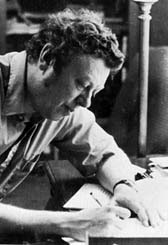
Dorsai! by Gordon R. Dickson
Publication date: 1959 ; Story date: 24th century
A young professional soldier's career from cadet to superman.
Main character: Donal Graeme, PoC
Secondary characters: William of Ceta, merchant prince; Hendrik Galt, Dorsai marshal; Anea Marlivana, female, "Select of Kultis"; Sayona the Bond, male, elder of Kultis; ArDell Montor, male, social statistician.
Minor characters (in order of appearance): Eachan Khan Graeme, Donal's father; Mor Graeme, Donal's brother; Ian and Kensie Graeme, twins, Donal's uncles; Donal's mother; Hugh Killien, Galt's adjutant; Skuak; Morphy; Tage Lee, Senior Groupmen; Russ Lludrow, Captain, possibly PoC?; Elvine Rhy, female, Galt's niece-in-law; Allmin Clay Andresen, Junior Captain; Coa Benn, female, Andresen's First Officer; Ordovya, Gun Maintenanceman, male; Bannerman, Captain, male; Coruna El Man, Captain, male; Genéve bar-Colmain, General, male; other named and unnamed male characters; two unnamed female characters.
Representation of women: There are only two female characters of any note, and both are clichés, pure cardboard. Of Anea, "Select of Kultis" (sounds like a fancy tangerine), the elder Sayona says:
The original plan had been to marry Anea off to William, to whom she was sold on a ten-year contract (which, somewhat perplexingly, involved him dragging her around in his entourage like an ornamental pet--but strictly platonically). Anea is supposed to be the acme of genetic perfection but Dickson's characterisation stubbornly betrays her as a petulant, immature twit. It doesn't help that she appears only sporadically for a few seconds, in repetitious scenes in which she and Donal meet only to dig themselves deeper in silly misunderstanding--which is all her fault, since each time she goes off in a huff.
By the end of the book she recognises Donal's incredible greatness (as does everyone else) and surrenders all responsibility to him, even that of expression, for instance:
Elvine Rhy fares even worse. She's there only to want Donal, who doesn't want her, cuts her down with a word ("Goodbye", but delivered Dorsai-fashion with such cold murderous rage it can perm a hair at fifty yards), and then, we're told, she marries one of his officers--just to be close to Donal.
But while these are bad enough, I resent the treatment of First Officer Coa Benn the most.
Coa Benn has no lines at all, and does nothing at all. I included her in the character list because she is physically present, named, titled, and things do happen to her, briefly, in one paragraph.
For some reason she exists, the ONLY female soldier (officer at that) in the narrative. Captain Andresen mentions to Donal "his First" and then Coa herself appears, a woman "in her forties".
Shortly afterwards she is disposed of in an attack which kills Andresen and some others, and leaves her wounded/unconscious/dying in her space suit.
Exit First Officer Benn, literally "fridged", with nary a line, action, and never to return, leaving the floor and command to Donal.
I can't help juxtaposing this character with Heinlein's female Navy officers in Starship troopers. I don't mean there is necessarily a connection, just that it LOOKS like a reaction, deliberate or not.
Where Heinlein had women as a normal and even favoured part of the Navy personnel, Dickson sticks this ONE--and MUTE--female character in a Navy uniform only to knock her out and literally freeze out.
Why? What was the point? Why is she there? Why is she a "she", when every. single. freaking. other soldier, officer etc. is male?
So maybe I'm paranoid, but this looks to me like a deliberate sneer, mocking ridicule of Heinlein's more or less positive, egalitarian view, or some instance of it anyway.
ETA: on rechecking publication dates, I see Starship Troopers came out in December 1959, so I acknowledge my suspicion as unfounded, but I'm leaving it in because the contrast in two works is still remarkable.
Representation of race and ethnicity: Many of the Dorsai, including Donal, are described as "dark", "dark in coloring", and, in combination with the occurence of Arab/Turkish sounding names (Kamal, El-Man, Khan...) I pictured them sort of Arab-ish, Middle Eastern-like... is that sufficient to label them PoC?
Russ Lludrow, not a Dorsai, is described as "very dark of skin and eye", which, again, may not be decisive but at least encourages imagining the character as PoC.
Book covers don't help. Most seem to limit Donal's "darkness" to his hair. I think this German version agrees most with the idea that he's (visibly) non-white:

Representation of minorities: None.
Bechdel test (BT) and reverse Bechdel test (r-BT): BT test fail, r-BT passed multiple times with many solid conversations.
Would I give this book to a kid: Tolerate rather than give, but within the parameters of the thread, that's a yes.

Dorsai! by Gordon R. Dickson
Publication date: 1959 ; Story date: 24th century
A young professional soldier's career from cadet to superman.
Main character: Donal Graeme, PoC
Secondary characters: William of Ceta, merchant prince; Hendrik Galt, Dorsai marshal; Anea Marlivana, female, "Select of Kultis"; Sayona the Bond, male, elder of Kultis; ArDell Montor, male, social statistician.
Minor characters (in order of appearance): Eachan Khan Graeme, Donal's father; Mor Graeme, Donal's brother; Ian and Kensie Graeme, twins, Donal's uncles; Donal's mother; Hugh Killien, Galt's adjutant; Skuak; Morphy; Tage Lee, Senior Groupmen; Russ Lludrow, Captain, possibly PoC?; Elvine Rhy, female, Galt's niece-in-law; Allmin Clay Andresen, Junior Captain; Coa Benn, female, Andresen's First Officer; Ordovya, Gun Maintenanceman, male; Bannerman, Captain, male; Coruna El Man, Captain, male; Genéve bar-Colmain, General, male; other named and unnamed male characters; two unnamed female characters.
Representation of women: There are only two female characters of any note, and both are clichés, pure cardboard. Of Anea, "Select of Kultis" (sounds like a fancy tangerine), the elder Sayona says:
"You were designed--if you'll forgive the harsh word--to react at full maturity to whatever man in the galaxy stood out above all others. (...) Surely you see that the oldest and greatest of the female instincts is to find and conserve the strength of the strongest male she can discover."
The original plan had been to marry Anea off to William, to whom she was sold on a ten-year contract (which, somewhat perplexingly, involved him dragging her around in his entourage like an ornamental pet--but strictly platonically). Anea is supposed to be the acme of genetic perfection but Dickson's characterisation stubbornly betrays her as a petulant, immature twit. It doesn't help that she appears only sporadically for a few seconds, in repetitious scenes in which she and Donal meet only to dig themselves deeper in silly misunderstanding--which is all her fault, since each time she goes off in a huff.
By the end of the book she recognises Donal's incredible greatness (as does everyone else) and surrenders all responsibility to him, even that of expression, for instance:
But the knowing within her was quietly and completely certain that Donal knew, and would know what should and should not be said.
Elvine Rhy fares even worse. She's there only to want Donal, who doesn't want her, cuts her down with a word ("Goodbye", but delivered Dorsai-fashion with such cold murderous rage it can perm a hair at fifty yards), and then, we're told, she marries one of his officers--just to be close to Donal.
But while these are bad enough, I resent the treatment of First Officer Coa Benn the most.
Coa Benn has no lines at all, and does nothing at all. I included her in the character list because she is physically present, named, titled, and things do happen to her, briefly, in one paragraph.
For some reason she exists, the ONLY female soldier (officer at that) in the narrative. Captain Andresen mentions to Donal "his First" and then Coa herself appears, a woman "in her forties".
Shortly afterwards she is disposed of in an attack which kills Andresen and some others, and leaves her wounded/unconscious/dying in her space suit.
Coa, {Donal} noted, as he removed her, more gently than the others, seemed dazed and unknowing. There were no broken bones about her, but she appeared to have been pinched, or crushed on one side by just a touch of what had killed the others. Her suit was tight and intact. He thought she might make it, after all. (...)
"See to the First Officer," he ordered. "Do we have anything in the way of a medic aboard?"
"No live medic, sir. We're too small to rate one. Freeze unit, though."
"Freeze her, then."
Exit First Officer Benn, literally "fridged", with nary a line, action, and never to return, leaving the floor and command to Donal.
I can't help juxtaposing this character with Heinlein's female Navy officers in Starship troopers. I don't mean there is necessarily a connection, just that it LOOKS like a reaction, deliberate or not.
Where Heinlein had women as a normal and even favoured part of the Navy personnel, Dickson sticks this ONE--and MUTE--female character in a Navy uniform only to knock her out and literally freeze out.
Why? What was the point? Why is she there? Why is she a "she", when every. single. freaking. other soldier, officer etc. is male?
So maybe I'm paranoid, but this looks to me like a deliberate sneer, mocking ridicule of Heinlein's more or less positive, egalitarian view, or some instance of it anyway.
ETA: on rechecking publication dates, I see Starship Troopers came out in December 1959, so I acknowledge my suspicion as unfounded, but I'm leaving it in because the contrast in two works is still remarkable.
Representation of race and ethnicity: Many of the Dorsai, including Donal, are described as "dark", "dark in coloring", and, in combination with the occurence of Arab/Turkish sounding names (Kamal, El-Man, Khan...) I pictured them sort of Arab-ish, Middle Eastern-like... is that sufficient to label them PoC?
Russ Lludrow, not a Dorsai, is described as "very dark of skin and eye", which, again, may not be decisive but at least encourages imagining the character as PoC.
Book covers don't help. Most seem to limit Donal's "darkness" to his hair. I think this German version agrees most with the idea that he's (visibly) non-white:

Representation of minorities: None.
Bechdel test (BT) and reverse Bechdel test (r-BT): BT test fail, r-BT passed multiple times with many solid conversations.
Would I give this book to a kid: Tolerate rather than give, but within the parameters of the thread, that's a yes.
12LolaWalser
Up next: Quest of the three worlds by Cordwainer Smith
13Lyndatrue
>12 LolaWalser: This ought to be interesting. I know you aren't really interested in adding books other than at random, but I selfishly wish you'd picked Ria instead (Felix C. Forrest is another pseudonym of Linebarger). As with many things from that era, I'm not sure how well Smith has weathered the years. It's nice to know that there's someone out there that made PKD look conventional.
I'm now officially holding my breath.
I'm now officially holding my breath.
14LolaWalser
>13 Lyndatrue:
I don't remember its details, but I loved Norstrilia. I was very impressed with the style, intelligence and humour of the writing. I would buy anything he wrote.
Other books of his I have are all, I think, story collections. I'll have to check what is Instrumentality of mankind, and if it's long enough to pass as a novel...
I don't remember its details, but I loved Norstrilia. I was very impressed with the style, intelligence and humour of the writing. I would buy anything he wrote.
Other books of his I have are all, I think, story collections. I'll have to check what is Instrumentality of mankind, and if it's long enough to pass as a novel...
15Lyndatrue
>14 LolaWalser: Those are all short stories. His other Forrest novel, Carola, is the only work of his I haven't read. One of these days I'll break down and buy it (the smallest offer I've seen is $350). I wish that his daughter could be persuaded to reissue that work. Then again, perhaps it's encumbered in some way with the publisher.
I just realized that two of my favorite authors had very similar lives, and backgrounds. James Tiptree, Jr. (Alice Sheldon) also worked for the government in similar situations to Linebarger.
I just realized that two of my favorite authors had very similar lives, and backgrounds. James Tiptree, Jr. (Alice Sheldon) also worked for the government in similar situations to Linebarger.
16iansales
>9 LolaWalser: Dickson was probably out of his depth. He claimed to be writing a "Cycle", with a trilogy which explained how humanity split into various Splinter Cuiltures, a trilogy set after the split, and a trilogy that brought the Splinter Cultures back together. The three Dorsai books - Tactics of Mistake, Soldier, Ask Not and Dorsai! - are the middle trilogy. Only one book of the first trilogy was written, Necromancer, and it's not very good. Two-thirds of the final trilogy did appear - The Final Enctclopedia and Chantry Guild, but they're also not worth reading. But the Dorsai books are sort of fun, albeit not very sophisticated and a bit dated. Unfortunately, Dickson was a bit too much in love with his theory of history and spends far too much time in each book discussing it.
17LolaWalser
>16 iansales:
From Miesel's afterword (a short essay in effect) I got some idea about/that there was a larger scope to what Dickson wanted to do with the entire cycle, but based on this one book I think your assessment (out of depth) is exactly right. To borrow from Gertrude Stein, "there is no there there".
He hit on a pleasant rhythm and it reads easily enough, but in the end... it's about nothing.
From Miesel's afterword (a short essay in effect) I got some idea about/that there was a larger scope to what Dickson wanted to do with the entire cycle, but based on this one book I think your assessment (out of depth) is exactly right. To borrow from Gertrude Stein, "there is no there there".
He hit on a pleasant rhythm and it reads easily enough, but in the end... it's about nothing.
18paradoxosalpha
>11 LolaWalser: Book covers don't help. Most seem to limit Donal's "darkness" to his hair.
SF book cover art that whitens important characters is infuriating. The case that leaps to mind for me is Brackett's Eric John Stark. Here's an unusually tanned example on the jacket of The Book of Skaith:
 .
.
(The timid look of the character Gerrith on the right is also a sop to assumed reader prejudice. She's a powerful and preternaturally confident character in the story.)
“If you look at my books, you’ll find that most of my central characters aren’t white. You don’t see it on the cover, because they refuse to put people of color on book jackets. But I’ve always done that deliberately because most people in the world aren’t white. Why in the future would we assume they are?” --Ursula Le Guin
SF book cover art that whitens important characters is infuriating. The case that leaps to mind for me is Brackett's Eric John Stark. Here's an unusually tanned example on the jacket of The Book of Skaith:
 .
.(The timid look of the character Gerrith on the right is also a sop to assumed reader prejudice. She's a powerful and preternaturally confident character in the story.)
“If you look at my books, you’ll find that most of my central characters aren’t white. You don’t see it on the cover, because they refuse to put people of color on book jackets. But I’ve always done that deliberately because most people in the world aren’t white. Why in the future would we assume they are?” --Ursula Le Guin
19LolaWalser
>18 paradoxosalpha:
Yes! I noticed the same previously regarding Rite of passage: http://www.librarything.com/topic/187540#5053348
One should note that many times covers don't seem to have ANY or only very tenuous connection to the text, but it's nevertheless evident that when it comes to character depiction, "white" is the default. (Somewhat similar to how, whether there's any mention of a woman's costume in the text or not, if there's a woman on the cover she'll be wearing something skimpy/form-revealing...)
Another thing that strikes me, considering that most of this literature is by American authors, is that people of colour of African origin appear rarely compared to "other" PoC (I think it's worth mentioning that this label only makes sense in a North American context), especially in bigger roles.
Consider: of the PoC in "main character" roles, we had Heinlein's Johnny who is Latino, Panshin's Mia Havero of Indian/Spanish origin, Randall's Mish Kennerin and (some of) her children who have unspecified far-Eastern physiognomy, and in Norton (whom I haven't read), the characters IIRC, are of Southern Asian extraction. And yes, now Donal also.
Yes! I noticed the same previously regarding Rite of passage: http://www.librarything.com/topic/187540#5053348
One should note that many times covers don't seem to have ANY or only very tenuous connection to the text, but it's nevertheless evident that when it comes to character depiction, "white" is the default. (Somewhat similar to how, whether there's any mention of a woman's costume in the text or not, if there's a woman on the cover she'll be wearing something skimpy/form-revealing...)
Another thing that strikes me, considering that most of this literature is by American authors, is that people of colour of African origin appear rarely compared to "other" PoC (I think it's worth mentioning that this label only makes sense in a North American context), especially in bigger roles.
Consider: of the PoC in "main character" roles, we had Heinlein's Johnny who is Latino, Panshin's Mia Havero of Indian/Spanish origin, Randall's Mish Kennerin and (some of) her children who have unspecified far-Eastern physiognomy, and in Norton (whom I haven't read), the characters IIRC, are of Southern Asian extraction. And yes, now Donal also.
20LolaWalser
The following contains extensive spoilers. If there's any chance you might read this book, I urge you not to read the post--yes, for once I care enough to want to save you all the mad surprises. :)
No. 42


The quest of the three worlds by Cordwainer Smith (né Paul Linebarger)
Publication date: 1966 ; Story date: unspecified future
Main character: Casher O'Neill, possibly PoC?
Secondary characters: Phillip Vincent, Hereditary Dictator of Pontoppidan; Genevieve, Phillip-Vincent's niece; D'alma, dog-woman; Rankin Meiklejohn, the Administrator on Henriada; Gosigo, Meiklejohn's servant, male, PoC; T'ruth, turtle-girl; Celalta, ex-Lady of the Instrumentality; Samm; Folly; Finsternis, erstwhile humans turned into components of a spaceship.
Minor characters: Eunice, T'ruth's servant; Murray Madigan, T'ruth's master; John Joy Tree, Go-Captain; Colonel Wedder, dictator of Mizzer; Trihaep, Casher's mother; Howard, citizen of Kermesse Dorgüeil, Ch-tikkik, bird-woman; other named and unnamed male, female and indeterminate characters.
Representation of women: No other book so far had had this many remarkable female characters. That said, the portrayals of practically all of them uphold or at least echo female stereotypes. And that said, I must emphasise that the odd nature of the narrative--largely allegorical--makes analysis of these characters unusually complicated. I shall try to look at the superficial level first--what we see--and then, as far as I can, determine if and how the stereotypes are undermined by other, more or less hidden meanings.
There are three female characters cast in roles explicitly subservient to male characters, and who repeatedly stress their submissive position in relation to their "lord and master"--a formula and variations thereof used at least a dozen times (a few times by male characters too--Casher turns out to be another of those annoying "messiah"/"enlightened" types). Two other female characters become wives to one man, a situation we are urged to believe is absolutely loving and harmonious, but which, all things considered (such as that the two women had borne and care for 35 children, as well as are only seen busy preparing dinner for this crowd) I wouldn't care to describe as desirable, a worthwhile life goal or even a pleasant fantasy. (Giving birth to quintuplets... twice? Smith liked cats a lot. Sadly, human women aren't cats... yet.)
The three "servants" demand special attention. D'alma is an "underperson", a modified dog, and as such is still considered an animal by the "true" men, and could be abused or killed by them with impunity. Externally lowly, she is actually exalted by her religion--her doggish tendency to love is conflated with the openly Christian teachings. She recognises someone of the same faith in Casher when his own allegiances are still unclear to him, and later on gives him some vague but essential support.
Celalta is someone who once enjoyed high authority as a "Lady of the Instrumentality", the latter being some mysterious entity controlling and governing all the worlds. For unknown reasons she abandoned all of that and turned up in Kermesse Dorgüeil (loosely understood, rather than translated, as "Riot of Pride") just in time for Casher to see her dance in public, and then literally drag away (she resists but not for long) to where they, in mytho-speak, ascend together to the skies. Casher's apotheosis apparently needed this female counterpart.
The thing that annoys me regarding Celalta is that although they are on the same plane, with the same powers, working as a team, she still calls him "lord and master". The narrator refers to Casher a couple of times as Celalta's "lover and master". Why "master"? What is there to master, what "mastering" is there going on? It's depressing to see how far sexism reaches--up to and including astral planes!
T'ruth I left for the end because she presents the biggest problems. On the stormy planet Henriade, the perennially drunk Administrator tasks Casher with killing her, the housekeeper of Beauregard, for no special reason other than hate--and her name sure gives the reader some ideas...
Here is how she first appears to Casher:
T'ruth is, actually, quite indescribable. Although she has the appearance of a little girl aged 10-13, she is a modified turtle, and has lived 906 years already, looking forward to living another 99000. Although she is an underperson, she commands gigantic powers. Although a little girl, and a turtle, and a servant created to love and serve her master, the ancient cataleptic Murray Madigan, she is ALSO imprinted with the personality, memory and capabilities of Madigan's extraordinary wife, Lady Agatha Madigan, hypnotist, witch, the Hechizera {sic} of Henriade, who may have been the real "power behind the throne".
In the longest episode in the book, Casher lurches from grappling with one aspect of T'ruth to another, which includes erotic attraction to a little girl in a blue shift through which her panty line is discernible (yes, it went to that detail)--but is she a little girl, and is the lust he is feeling sexual lust or some other kind of desire?
It finally resolves thus:
I'm afraid the answer is "both". Yes, T'ruth may be a seeker's Beloved, Sophia and whatnot, but she exists in the body of a little girl. Visually, that is what registers. Casher slowly comprehends the true nature of his desire/need for her, but until we get to that point we experience his turmoil as sexual.
In addition, the relationship between T'ruth and her master is, if anything, more problematic. T'ruth takes Casher to see how she ministers to her master Madigan, kept alive by her tender care, but awaking only for a few minutes every few years, to spare life. Smith doesn't recoil from letting us know how far this care extends--which is to every part of his body (T'ruth cleans out his rectum), and in every way including sexual (she gives him a handjob--"his bit of fun" as she puts it).
This is what it means to love someone completely, inside and out.
And that's all fine by me, but I'm bothered that T'ruth was modified into a child. There's a clear implication that Madigan created her to serve him sexually ("They took me when I was a happy little girl, enchanted by the voice and the glance and the touch of my master...") as well as in every other way. Giving her the personality of his wife must mean that he cared for that wife--and yet surely SHE couldn't have been "somewhere between ten and thirteen"? Why immortalize her in a child...
I don't know how to neutralise the skeeviness surrounding this character, and that's the t'ruth.
@paradoxosalpha, this whole thing is much more up your alley. If you've read the book or even if you haven't, I'm sure you could comment on the erotic imagery in religious quests far better than I can.
Representation of race and ethnicity: The driver Gosigo looks "like a Hindu" and is elsewhere described as "brown". Casher himself, hailing from a world that is a thinly-disguised Egypt, could be/probably is? more Arab-looking than Irish, name notwithstanding. His mother's name is Trihaep, which to me sounds ancient Egyptian. The preface in my book states that "Casher O'Neill" was derived from Qasr el Nil, a street in Cairo, and O'Neill picked because the author wanted something associating to adventurousness--and apparently he thought Irish does it.
Other humans who get physical descriptions are all described as white.
Representation of minorities: None sexual. There is an "idiot boy" in Kaheer whom Casher restores to health. Cripes, this one's putting me through my paces too--is it a negative representation of disability if someone is turned from dis- to abled? Heeelp.
I would tend to think yes. I think it's more encouraging to see a disabled character coping or being treated with kindness and fairness, than to see their disability magically erased.
Hey, if the latter could happen in the real world--excellent. But as it can't...
Bechdel test (BT) and reverse Bechdel test (r-BT): There's a minuscule, technical BT pass between T'ruth and Eunice.
Yes, that's a BT pass, and I quote it to tell you that never in any of the books was a reverse BT THAT basic. Including this one--lots of solid r-BT passes with real conversations.
Would I give this book to a kid? To an older kid, yes.
No. 42


The quest of the three worlds by Cordwainer Smith (né Paul Linebarger)
Publication date: 1966 ; Story date: unspecified future
Main character: Casher O'Neill, possibly PoC?
Secondary characters: Phillip Vincent, Hereditary Dictator of Pontoppidan; Genevieve, Phillip-Vincent's niece; D'alma, dog-woman; Rankin Meiklejohn, the Administrator on Henriada; Gosigo, Meiklejohn's servant, male, PoC; T'ruth, turtle-girl; Celalta, ex-Lady of the Instrumentality; Samm; Folly; Finsternis, erstwhile humans turned into components of a spaceship.
Minor characters: Eunice, T'ruth's servant; Murray Madigan, T'ruth's master; John Joy Tree, Go-Captain; Colonel Wedder, dictator of Mizzer; Trihaep, Casher's mother; Howard, citizen of Kermesse Dorgüeil, Ch-tikkik, bird-woman; other named and unnamed male, female and indeterminate characters.
Representation of women: No other book so far had had this many remarkable female characters. That said, the portrayals of practically all of them uphold or at least echo female stereotypes. And that said, I must emphasise that the odd nature of the narrative--largely allegorical--makes analysis of these characters unusually complicated. I shall try to look at the superficial level first--what we see--and then, as far as I can, determine if and how the stereotypes are undermined by other, more or less hidden meanings.
There are three female characters cast in roles explicitly subservient to male characters, and who repeatedly stress their submissive position in relation to their "lord and master"--a formula and variations thereof used at least a dozen times (a few times by male characters too--Casher turns out to be another of those annoying "messiah"/"enlightened" types). Two other female characters become wives to one man, a situation we are urged to believe is absolutely loving and harmonious, but which, all things considered (such as that the two women had borne and care for 35 children, as well as are only seen busy preparing dinner for this crowd) I wouldn't care to describe as desirable, a worthwhile life goal or even a pleasant fantasy. (Giving birth to quintuplets... twice? Smith liked cats a lot. Sadly, human women aren't cats... yet.)
The three "servants" demand special attention. D'alma is an "underperson", a modified dog, and as such is still considered an animal by the "true" men, and could be abused or killed by them with impunity. Externally lowly, she is actually exalted by her religion--her doggish tendency to love is conflated with the openly Christian teachings. She recognises someone of the same faith in Casher when his own allegiances are still unclear to him, and later on gives him some vague but essential support.
Celalta is someone who once enjoyed high authority as a "Lady of the Instrumentality", the latter being some mysterious entity controlling and governing all the worlds. For unknown reasons she abandoned all of that and turned up in Kermesse Dorgüeil (loosely understood, rather than translated, as "Riot of Pride") just in time for Casher to see her dance in public, and then literally drag away (she resists but not for long) to where they, in mytho-speak, ascend together to the skies. Casher's apotheosis apparently needed this female counterpart.
The thing that annoys me regarding Celalta is that although they are on the same plane, with the same powers, working as a team, she still calls him "lord and master". The narrator refers to Casher a couple of times as Celalta's "lover and master". Why "master"? What is there to master, what "mastering" is there going on? It's depressing to see how far sexism reaches--up to and including astral planes!
T'ruth I left for the end because she presents the biggest problems. On the stormy planet Henriade, the perennially drunk Administrator tasks Casher with killing her, the housekeeper of Beauregard, for no special reason other than hate--and her name sure gives the reader some ideas...
Here is how she first appears to Casher:
The door did open.
A little girl stood there.
He knew her. He had always known her. She was his sweetheart, come back out of his childhood. She was the sister he had never had. She was his own mother, when young. She was at the marvelous age, somewhere between ten and thirteen, where the child--as the phrase goes--"becomes an old child and not a raw grown-up".
She was kind, calm, intelligent, expectant, quiet, inviting, unafraid.
T'ruth is, actually, quite indescribable. Although she has the appearance of a little girl aged 10-13, she is a modified turtle, and has lived 906 years already, looking forward to living another 99000. Although she is an underperson, she commands gigantic powers. Although a little girl, and a turtle, and a servant created to love and serve her master, the ancient cataleptic Murray Madigan, she is ALSO imprinted with the personality, memory and capabilities of Madigan's extraordinary wife, Lady Agatha Madigan, hypnotist, witch, the Hechizera {sic} of Henriade, who may have been the real "power behind the throne".
In the longest episode in the book, Casher lurches from grappling with one aspect of T'ruth to another, which includes erotic attraction to a little girl in a blue shift through which her panty line is discernible (yes, it went to that detail)--but is she a little girl, and is the lust he is feeling sexual lust or some other kind of desire?
It finally resolves thus:
"Kiss me!" she commanded.
He put his arm around her. She felt like a big little girl. She lifted her face. She thrust her lips up toward him. She stood on tiptoe.
He kissed her the way a man might kiss a picture or a religious object. The heat and fierceness had gone out of his hopes. He had not kissed a girl, but power--tremendous power and wisdom put into a single slight form.
I'm afraid the answer is "both". Yes, T'ruth may be a seeker's Beloved, Sophia and whatnot, but she exists in the body of a little girl. Visually, that is what registers. Casher slowly comprehends the true nature of his desire/need for her, but until we get to that point we experience his turmoil as sexual.
In addition, the relationship between T'ruth and her master is, if anything, more problematic. T'ruth takes Casher to see how she ministers to her master Madigan, kept alive by her tender care, but awaking only for a few minutes every few years, to spare life. Smith doesn't recoil from letting us know how far this care extends--which is to every part of his body (T'ruth cleans out his rectum), and in every way including sexual (she gives him a handjob--"his bit of fun" as she puts it).
This is what it means to love someone completely, inside and out.
And that's all fine by me, but I'm bothered that T'ruth was modified into a child. There's a clear implication that Madigan created her to serve him sexually ("They took me when I was a happy little girl, enchanted by the voice and the glance and the touch of my master...") as well as in every other way. Giving her the personality of his wife must mean that he cared for that wife--and yet surely SHE couldn't have been "somewhere between ten and thirteen"? Why immortalize her in a child...
I don't know how to neutralise the skeeviness surrounding this character, and that's the t'ruth.
@paradoxosalpha, this whole thing is much more up your alley. If you've read the book or even if you haven't, I'm sure you could comment on the erotic imagery in religious quests far better than I can.
Representation of race and ethnicity: The driver Gosigo looks "like a Hindu" and is elsewhere described as "brown". Casher himself, hailing from a world that is a thinly-disguised Egypt, could be/probably is? more Arab-looking than Irish, name notwithstanding. His mother's name is Trihaep, which to me sounds ancient Egyptian. The preface in my book states that "Casher O'Neill" was derived from Qasr el Nil, a street in Cairo, and O'Neill picked because the author wanted something associating to adventurousness--and apparently he thought Irish does it.
Other humans who get physical descriptions are all described as white.
Representation of minorities: None sexual. There is an "idiot boy" in Kaheer whom Casher restores to health. Cripes, this one's putting me through my paces too--is it a negative representation of disability if someone is turned from dis- to abled? Heeelp.
I would tend to think yes. I think it's more encouraging to see a disabled character coping or being treated with kindness and fairness, than to see their disability magically erased.
Hey, if the latter could happen in the real world--excellent. But as it can't...
Bechdel test (BT) and reverse Bechdel test (r-BT): There's a minuscule, technical BT pass between T'ruth and Eunice.
"And you know what I want, Eunice," said T'ruth to the servant.
"Yes, ma'am," said the maid, disappearing.
Yes, that's a BT pass, and I quote it to tell you that never in any of the books was a reverse BT THAT basic. Including this one--lots of solid r-BT passes with real conversations.
Would I give this book to a kid? To an older kid, yes.
21LolaWalser
Up next: The Super Barbarians by John Brunner
22Lyndatrue
>20 LolaWalser: Fascinating piece (I read every word). Thanks.
I'm now curious. I see you have McCaffrey's The Ship Who Sang, and may or may not have read it. I'd be fascinated to see how or where that book fit in your appraisals (in the context of this thread). Maybe in a part three?
I'm now curious. I see you have McCaffrey's The Ship Who Sang, and may or may not have read it. I'd be fascinated to see how or where that book fit in your appraisals (in the context of this thread). Maybe in a part three?
23LolaWalser
>22 Lyndatrue:
Thank you, I'm afraid with the kind of focus adopted in the thread I was bound to do injustice to a story as layered as this one. I don't really have the wherewithal to tackle the religious aspect--not least because I am personally profoundly biased against religion, especially Christianity.
In short, whatever repulses me is likely to be attractive to anyone sympathetic to Christianity, and consequently it's inevitable that we would judge characters very differently.
In their eyes, the inclination to servitude shown (most notably) by the three main female characters may seem praiseworthy and something that elevates them even higher than Casher and T'ruth's master Madigan.
For my part, I prefer to limit myself to pointing out that this master-servant dynamic exists, and that it involves, stereotypically, women/female avatars serving men/male avatars.
I haven't read any McCaffrey so her books must be in the pile, but no idea when they'll turn up...
Thank you, I'm afraid with the kind of focus adopted in the thread I was bound to do injustice to a story as layered as this one. I don't really have the wherewithal to tackle the religious aspect--not least because I am personally profoundly biased against religion, especially Christianity.
In short, whatever repulses me is likely to be attractive to anyone sympathetic to Christianity, and consequently it's inevitable that we would judge characters very differently.
In their eyes, the inclination to servitude shown (most notably) by the three main female characters may seem praiseworthy and something that elevates them even higher than Casher and T'ruth's master Madigan.
For my part, I prefer to limit myself to pointing out that this master-servant dynamic exists, and that it involves, stereotypically, women/female avatars serving men/male avatars.
I haven't read any McCaffrey so her books must be in the pile, but no idea when they'll turn up...
24Lyndatrue
>23 LolaWalser: His relationship with his eldest daughter is deeply problematic, although she may not have seen it that way. Reading her brief memories on her web site is interesting.
http://www.cordwainer-smith.com/remember.htm
I have little use for religion, and even less patience for those bound by it. It's instructive to know about it when reading many authors, but I'm grateful to have been raised to be able to think for myself.
http://www.cordwainer-smith.com/remember.htm
I have little use for religion, and even less patience for those bound by it. It's instructive to know about it when reading many authors, but I'm grateful to have been raised to be able to think for myself.
25LolaWalser
>24 Lyndatrue:
That was very interesting, thanks! I read a little about him when I read Norstrilia (which I really should add to the pile--I only remember liking it a lot), and he certainly comes across as a very interesting person.
I hope the daughter is doing well (seems she's the little girl in the picture I posted?), being in her seventies... I see the "Rediscovery" award seems to have stopped in 2012.
(I like "This is no time to fear. It is much too interesting." so much I just might order it to wear around the house.)
And I see what you mean by the prices of his hardcopy books--dang! Why not reissue them even in small runs, just so the readership grows? In these days of cheap publishing it can't be bank-breaking to release a thousand (five hundred? two hundred!) copies every now and then.
That was very interesting, thanks! I read a little about him when I read Norstrilia (which I really should add to the pile--I only remember liking it a lot), and he certainly comes across as a very interesting person.
I hope the daughter is doing well (seems she's the little girl in the picture I posted?), being in her seventies... I see the "Rediscovery" award seems to have stopped in 2012.
(I like "This is no time to fear. It is much too interesting." so much I just might order it to wear around the house.)
And I see what you mean by the prices of his hardcopy books--dang! Why not reissue them even in small runs, just so the readership grows? In these days of cheap publishing it can't be bank-breaking to release a thousand (five hundred? two hundred!) copies every now and then.
26LolaWalser
The following contains spoilers.
No. 43

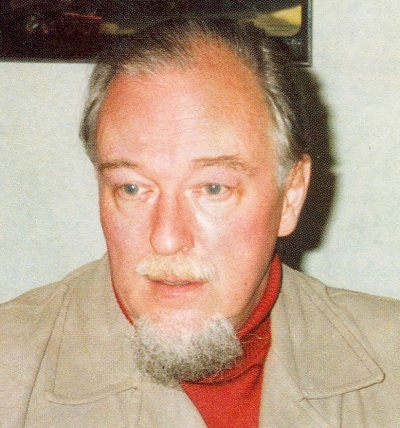
The Super Barbarians by John Brunner
Publication date: 1962 ; Story date: unspecified future
After decades of defeat, Earthmen hit against their alien conquerors, the Vorra, from within the alien planet.
Main character: Gareth Shaw
Secondary characters: Shavarri, Lord Pwill's 9th wife; Lord Pwill; Marijane Lee, resistance fighter; Judge Olafsson, chief of Earthmen on Qallavarra; Hans Kramer, shopkeeper; Lady Llaq, Lord Pwill's senior wife.
Minor characters: Swallo, Pwills' gatekeeper, male; Dwerri, Pwills' whipmaster, male; Pwill Heir Apparent; Forrel, space officer, Pwill junior's friend; Kramer's wife; Ken Lee, Marijane's brother, resistance fighter; Gustav, resistance fighter; Shavarri's maid; old Vorra shaman; George, resistance fighter, black; other mostly unnamed Vorra and Earthmen.
Lady Cosra of House Shugurra isn't directly seen but her actions are important to the plot.
Representation of women: For a slight story set in a barbarian, feudal, patriarchal, polygynous society that disdains education in general and especially that of women, it's not half bad. I'd even say it's one of the better representations of women I've come across here, at least as far concerns their personalities and not roles.
Marijane Lee, the only Earthwoman active in the plot (Kramer's wife is only seen on her deathbed), is eighteen and attractive to Gareth, despite seeing her as "mannish" looking because of the way she walks, fights and for the general lack of airs and graces (and dubious hygiene, difficult to sustain in the Earthmen ghetto). But thankfully the latent romantic plot is very much on the back-burner. Rather we see Marijane fighting along with others--she even seems to be the leader of her squad.
Shavarri is ambitious and clever and ends being oddly sympathetic when she could easily have been a stereotype of backbiting plotting bitch. You really see her point of view. It's also nice--and novel--to see Gareth gaining respect for her whom he initially underestimated for being a cooped up and illiterate seraglio female.
This kind of disinterested (i.e. non-sexual) sympathy, let alone respect, shown to a woman by a man seems to be a very rare thing in these books. Funnily enough we get something like a comment on that in the book too...
Lady Llaq, Gareth's direct employer, is plainly a formidable character herself, but her role's very slight.
Overall, though, it's a world where women are subservient to men and act only through men, in the usual "harem politics" pattern.
Since Marijane's the only female character of note among the Earthmen, the sheer gender disparity hints that there too not all are equally "equal".
Representation of race and ethnicity: One thing I noticed about Brunner is that he always seems to remember the diversity of humans, in however slight a fashion. On entering Acre, the human enclave on Qallavarra and therefore seat of the resistance, Gareth notices "skins of familiar Earthly shades from blond through tan to chocolate", in contrast to the uniformly sallow colour of the Vorra population.
One minor character, resistance fighter George, is "blacker than night". It's not much but it's there. Hallelujah!
Representation of minorities: None.
Bechdel test (BT) and reverse Bechdel test (r-BT): BT fail; lots of solid r-BT passes.
Would I give this book to a kid: yes.
No. 43

The Super Barbarians by John Brunner
Publication date: 1962 ; Story date: unspecified future
After decades of defeat, Earthmen hit against their alien conquerors, the Vorra, from within the alien planet.
Main character: Gareth Shaw
Secondary characters: Shavarri, Lord Pwill's 9th wife; Lord Pwill; Marijane Lee, resistance fighter; Judge Olafsson, chief of Earthmen on Qallavarra; Hans Kramer, shopkeeper; Lady Llaq, Lord Pwill's senior wife.
Minor characters: Swallo, Pwills' gatekeeper, male; Dwerri, Pwills' whipmaster, male; Pwill Heir Apparent; Forrel, space officer, Pwill junior's friend; Kramer's wife; Ken Lee, Marijane's brother, resistance fighter; Gustav, resistance fighter; Shavarri's maid; old Vorra shaman; George, resistance fighter, black; other mostly unnamed Vorra and Earthmen.
Lady Cosra of House Shugurra isn't directly seen but her actions are important to the plot.
Representation of women: For a slight story set in a barbarian, feudal, patriarchal, polygynous society that disdains education in general and especially that of women, it's not half bad. I'd even say it's one of the better representations of women I've come across here, at least as far concerns their personalities and not roles.
Marijane Lee, the only Earthwoman active in the plot (Kramer's wife is only seen on her deathbed), is eighteen and attractive to Gareth, despite seeing her as "mannish" looking because of the way she walks, fights and for the general lack of airs and graces (and dubious hygiene, difficult to sustain in the Earthmen ghetto). But thankfully the latent romantic plot is very much on the back-burner. Rather we see Marijane fighting along with others--she even seems to be the leader of her squad.
Shavarri is ambitious and clever and ends being oddly sympathetic when she could easily have been a stereotype of backbiting plotting bitch. You really see her point of view. It's also nice--and novel--to see Gareth gaining respect for her whom he initially underestimated for being a cooped up and illiterate seraglio female.
This kind of disinterested (i.e. non-sexual) sympathy, let alone respect, shown to a woman by a man seems to be a very rare thing in these books. Funnily enough we get something like a comment on that in the book too...
"The Under-lady is as gracious as she is intelligent," I said. She stared at me for a moment, and then laughed.
"You Earthmen are so strange!" she said. "Never did I expect to hear any man compliment me for intelligence. At most a clever woman might hope for a word of praise for some single notion of hers, but not to be called intelligent."
Lady Llaq, Gareth's direct employer, is plainly a formidable character herself, but her role's very slight.
Overall, though, it's a world where women are subservient to men and act only through men, in the usual "harem politics" pattern.
Since Marijane's the only female character of note among the Earthmen, the sheer gender disparity hints that there too not all are equally "equal".
Representation of race and ethnicity: One thing I noticed about Brunner is that he always seems to remember the diversity of humans, in however slight a fashion. On entering Acre, the human enclave on Qallavarra and therefore seat of the resistance, Gareth notices "skins of familiar Earthly shades from blond through tan to chocolate", in contrast to the uniformly sallow colour of the Vorra population.
One minor character, resistance fighter George, is "blacker than night". It's not much but it's there. Hallelujah!
Representation of minorities: None.
Bechdel test (BT) and reverse Bechdel test (r-BT): BT fail; lots of solid r-BT passes.
Would I give this book to a kid: yes.
27LolaWalser
Up next: To your scattered bodies go by Philip José Farmer
Incidentally, I hope my "up nexts" aren't deterring anyone from participating--jump in any time, I'm only advertising them in case anyone wants to read along.
Incidentally, I hope my "up nexts" aren't deterring anyone from participating--jump in any time, I'm only advertising them in case anyone wants to read along.
28Lyndatrue
>26 LolaWalser: You are a hideously expensive habit, my dear. I am now off to purchase The Shockwave Rider from the local bookstore. I read Barbarians perhaps a few years after it came out, and liked it, and found Marijane memorable enough that your brief description reminded me of how much I always liked Brunner.
For those following along, if you don't read another Brunner book, you should at least read this excellent predictor (Shockwave Rider) of the Cyberpunk movement that followed. Brunner always wrote characters that were *people*, rather than mere cardboard cutouts.
ETA: I am now completely hypnotized. I await your review of Farmer.
For those following along, if you don't read another Brunner book, you should at least read this excellent predictor (Shockwave Rider) of the Cyberpunk movement that followed. Brunner always wrote characters that were *people*, rather than mere cardboard cutouts.
ETA: I am now completely hypnotized. I await your review of Farmer.
29LolaWalser
Gack! I hope I don't cause anyone expensive disappointments! :)
I hope it's clear all comparisons in the thread are relative to titles in the thread, and therefore all positive and negative criticism too--it could easily seem too much or too harsh, by other standards.
Brunner always wrote characters that were *people*, rather than mere cardboard cutouts.
I agree, going by what I read of him so far.
I hope it's clear all comparisons in the thread are relative to titles in the thread, and therefore all positive and negative criticism too--it could easily seem too much or too harsh, by other standards.
Brunner always wrote characters that were *people*, rather than mere cardboard cutouts.
I agree, going by what I read of him so far.
30Lyndatrue
>29 LolaWalser: I've already read Shockwave. As with many books I read in earlier times, it long ago vanished out of my library. I want to read it again, and I want to keep it.
Besides, it's only money. Books aren't bad for your health, as some other habits are.
I've probably read close to 80% of the books you've looked at, or at least other books by those authors. I'm amazed to realize that this is version three on this thread.
Besides, it's only money. Books aren't bad for your health, as some other habits are.
I've probably read close to 80% of the books you've looked at, or at least other books by those authors. I'm amazed to realize that this is version three on this thread.
31LolaWalser
Books aren't bad for your health, as some other habits are.
That's my mantra too, although any stranger taking a peek at my apartment might want to differ. :)
That's my mantra too, although any stranger taking a peek at my apartment might want to differ. :)
32anglemark
A local second-hand bookseller died after dusting his books, inhaling so much dust that it triggered a lethal system shock...
33LolaWalser
uh-oh...
And to think I abide by my guru Quentin Crisp's observation: "after four years the dust doesn't get any worse"...!
The future, it looks dusty, not to say ashen.
And to think I abide by my guru Quentin Crisp's observation: "after four years the dust doesn't get any worse"...!
The future, it looks dusty, not to say ashen.
34Maddz
I've just moved house - let's the dust bunnies have largely stayed with the books. I'd sooner read than do house work...
36LolaWalser
The following contains spoilers.
No. 44

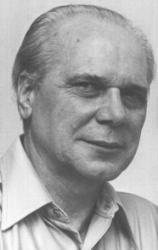
To your scattered bodies go by Philip José Farmer
Publication date: 1971 ; Story date: 70th century
Every human being that ever existed, from pre-history onwards, gets resurrected on the banks of a giant river.
Main character: Captain Sir Richard Francis Burton (the link is author touchstone)
Secondary characters: Peter Frigate; Monat Grrautut, non-human alien, male; Kazz, Stone Age "subhuman", male; Alice Hargreaves; Lev Ruach, Jewish; Herman Göring; John Collop
Minor characters: Men: Galeazzi; Filipo Rocco; Brontich; Babich; Giunta, 19th century Triestines, Burton's co-locals and contemporaries; John de Greystock; Tullius Hostilius; Robert Spruce; Roger Agneau; Mysterious Stranger; Loga; Thanabur, far future humans, "Ethicals"; Dov Targoff, Israeli; Steinborg, doctor; John Sevier; Ville Ahonen; other named and unnamed male characters. Women: Gwenafra, child; Maria Tucci; Rosa Nalini; Caterina Capone; Fiorenza Fiorri, Triestine co-locals and contemporaries of Burton; Loghu, Frigate's mate; Tanya Kauwitz, Ruach's mate, ditched for Esther Rodriguez; Willfreda Allport, Burton's mate; Mary Rutherfurd; Fatima, Kazz's mate; other unnamed female characters.
Representation of women: In brief, women aren't people like men are people, women are things. Things to pursue, fuck, own, kill, and then start fresh with new ones. That's just what the world is like, see? Even given a second (or two hundredth) shot at life, in your twenty-five year old body, healed of all ills and restored from all imperfections, in practically infinite space and with no worry about food, for women there's just no escaping the fatality of dehumanization, of second-classness, of mattering only insofar any given woman matters to some man.
Yes, I am a little testy. This book is more or less in the same rape-o-rama vision that Flesh was, and I think I have at least half a dozen more books by Farmer in the pile. If there's a trend, I'll be needing antidotes.
Only one female character, Alice Hargreaves (Lewis Carroll's little friend and model for Alice in Wonderland), has a role of some size--as Burton's love interest. I liked her personality; she's pointedly intelligent, can cope, and at first was shown even as a valuable soldier (a good archer). It was also nice to see her sticking to her principles (about not sleeping with Burton although under the influence of a drug they spent one wild night together), and her search for her husband and sons in the ocean of humanity, while barely mentioned, gave a touching side to her character and situation.
Then it all goes to hell after Burton's party is captured by Göring's forces. Practically all the women are killed, and Alice is, we are told, raped by at least Göring and one of his adjutants. Göring keeps her for a week and then hands over to the other man. When Burton sees her after this ordeal, she collapses weeping into his arms, quite different from the cool collected woman she was before, and to top it all--now she meekly and wordlessly moves in with Burton. In effect, the abuse she suffered finally bent her to his will. She tells him she will make him a good wife, or rather a good mate, as there's no one around to marry them. And I want to vomit all over the author's best Italian shoes, while he's wearing them.
Mind you, Alice is the BEST female character around by a good mile. Burton's interim squeeze Willfreda, with whom he takes up in frustration because Alice wouldn't have him, suffers the indignity of being insulted as a whore and then patronisingly excused for having being one--besides, the "resurrection" not only cleansed her from the nasty infections of her trade, it restored her hymen. Yes, for unknown reasons all the women are resurrected as "virgins", betraying the author's notion of a hymen as some kind of a lid on a can, with a clearly demarcated "before" and "after" state.
Other women get no lines at all, with what little communication they make being related indirectly. They also have a lifespan shorter than a paper napkin's. In some instances it seems Farmer simply forgot about them, as with Fatima, the Turkish woman we are told falls in lust with the hairy caveman, and then never mentioned, or forgot what he ever intended to do with them (for instance Gwenafra, the kid who joins the party at the beginning, proving important to Alice as a companion and to Burton as a pupil, travels along with them for two thirds, and then gets killed and disposed in three words, never to be mentioned again).
In the last part Burton is alone, dying and resurrecting on "Suicide Express" 777 times and so all his previous companions are ditched for others--all of whom are male.
As a last note on the treatment of female characters, among the far future humans, dubbed "Ethicals", little seems to have improved. Burton awakes in the company of twelve of them, six men and six women. Wonderful, numerical parity at important events--in the 70th century! Unfortunately, we soon get not at all subtle hints that sexism still rules. Of the twelve, only two men, Loga and Thanabur, are named and only men speak with Burton.
Obviously. It's not possible a woman could have anything to say, or dare say it, if she weren't someone's wife (who can shut up a wife?), or for some crazy reason hadn't been invested with HIGH authority.
It gets better:
Representation of race and ethnicity: We are told from the start the mass of humanity is diverse; Burton notices black people, Asians etc. as well as a non-human alien. That said, none of the speaking characters or indeed most of the characters who are part of the central plot seem to be other than white. Lev Ruach is a stereotypical European Jew, skinny, big nosed, and obsessed with dietary rules. He's also careful to pick only Jewish girlfriends, explaining to Burton that when there's an argument and he inevitably gets called a "kike", it would be impossible to take from Gentiles. I've never heard of Jews insulting each other with that slur, and I'm calling Gentile bollocks on that. Dov Targoff is a stereotypical sabra, a throwback to "heroic age" Hebrews, and full of "rational" deadly hatred of Arabs.
Stereotypes abound. The Triestines are Italian-lazy and go off to enjoy la dolce vita rather than settle down to work on Burton's boat. The Red Indians do their Red Indian thing etc. One gets the feeling Farmer means well enough, but falls on his face all over the place.
Representation of minorities: None in character. At one point Frigate asks Burton about his much rumoured-about homosexual experiences, but Burton is evasive and replies--for the express purpose of scandalizing Alice--with scabrous tales of his visits to male brothels in Karachi and the goings-on there. We don't hear any details, but Alice eventually blanches and leaves the company in disgust. I'm chalking this up as a negative mention of alternative sexuality, seeing how it's used to cause discomfort and grief.
The notion of resurrecting in "perfect" bodies is a common eschatological fantasy, too humanly understandable, I think, to be reproached for some insensitivity to the disabled. If we're gonna resurrect in another shot at life, damn right we'd want bodies as "perfect" as possible.
Bechdel test (BT) and reverse Bechdel test (r-BT): We know Alice and Gwenafra, at a minimum, communicate, but we don't get any conversations. BT fail; lots of solid r-BT passes.
Would I give this book to a kid? Frankly, no, I would not go an inch out of my way to give this book to anyone. It's a bad book beyond the problems with representation, the central concept is fascinating, but the execution is deplorable, the structure ramshackle, the characterization poor, the ideas half-baked at best. Whatever heart strings Farmer thought he was zinging with the endless reappearances of fucking Hermann Göring, for instance, just never gave a persuasive melody. As a redemption of a Nazi, it has less point and poignancy than The Producers spoofing the Nazis. As a sketch of a sociological experiment, it's ridiculous.
To me it's interesting chiefly for its interest in R. F. Burton, hardly a feat, given his general extraordinariness.
I'd tolerate it if I saw it in an older kid's hands, but I might have something to say. Partial yes, then. But again! Endless stream of crap like this is bloody suffocating.
No. 44

To your scattered bodies go by Philip José Farmer
Publication date: 1971 ; Story date: 70th century
Every human being that ever existed, from pre-history onwards, gets resurrected on the banks of a giant river.
Main character: Captain Sir Richard Francis Burton (the link is author touchstone)
Secondary characters: Peter Frigate; Monat Grrautut, non-human alien, male; Kazz, Stone Age "subhuman", male; Alice Hargreaves; Lev Ruach, Jewish; Herman Göring; John Collop
Minor characters: Men: Galeazzi; Filipo Rocco; Brontich; Babich; Giunta, 19th century Triestines, Burton's co-locals and contemporaries; John de Greystock; Tullius Hostilius; Robert Spruce; Roger Agneau; Mysterious Stranger; Loga; Thanabur, far future humans, "Ethicals"; Dov Targoff, Israeli; Steinborg, doctor; John Sevier; Ville Ahonen; other named and unnamed male characters. Women: Gwenafra, child; Maria Tucci; Rosa Nalini; Caterina Capone; Fiorenza Fiorri, Triestine co-locals and contemporaries of Burton; Loghu, Frigate's mate; Tanya Kauwitz, Ruach's mate, ditched for Esther Rodriguez; Willfreda Allport, Burton's mate; Mary Rutherfurd; Fatima, Kazz's mate; other unnamed female characters.
Representation of women: In brief, women aren't people like men are people, women are things. Things to pursue, fuck, own, kill, and then start fresh with new ones. That's just what the world is like, see? Even given a second (or two hundredth) shot at life, in your twenty-five year old body, healed of all ills and restored from all imperfections, in practically infinite space and with no worry about food, for women there's just no escaping the fatality of dehumanization, of second-classness, of mattering only insofar any given woman matters to some man.
Yes, I am a little testy. This book is more or less in the same rape-o-rama vision that Flesh was, and I think I have at least half a dozen more books by Farmer in the pile. If there's a trend, I'll be needing antidotes.
Only one female character, Alice Hargreaves (Lewis Carroll's little friend and model for Alice in Wonderland), has a role of some size--as Burton's love interest. I liked her personality; she's pointedly intelligent, can cope, and at first was shown even as a valuable soldier (a good archer). It was also nice to see her sticking to her principles (about not sleeping with Burton although under the influence of a drug they spent one wild night together), and her search for her husband and sons in the ocean of humanity, while barely mentioned, gave a touching side to her character and situation.
Then it all goes to hell after Burton's party is captured by Göring's forces. Practically all the women are killed, and Alice is, we are told, raped by at least Göring and one of his adjutants. Göring keeps her for a week and then hands over to the other man. When Burton sees her after this ordeal, she collapses weeping into his arms, quite different from the cool collected woman she was before, and to top it all--now she meekly and wordlessly moves in with Burton. In effect, the abuse she suffered finally bent her to his will. She tells him she will make him a good wife, or rather a good mate, as there's no one around to marry them. And I want to vomit all over the author's best Italian shoes, while he's wearing them.
Mind you, Alice is the BEST female character around by a good mile. Burton's interim squeeze Willfreda, with whom he takes up in frustration because Alice wouldn't have him, suffers the indignity of being insulted as a whore and then patronisingly excused for having being one--besides, the "resurrection" not only cleansed her from the nasty infections of her trade, it restored her hymen. Yes, for unknown reasons all the women are resurrected as "virgins", betraying the author's notion of a hymen as some kind of a lid on a can, with a clearly demarcated "before" and "after" state.
Other women get no lines at all, with what little communication they make being related indirectly. They also have a lifespan shorter than a paper napkin's. In some instances it seems Farmer simply forgot about them, as with Fatima, the Turkish woman we are told falls in lust with the hairy caveman, and then never mentioned, or forgot what he ever intended to do with them (for instance Gwenafra, the kid who joins the party at the beginning, proving important to Alice as a companion and to Burton as a pupil, travels along with them for two thirds, and then gets killed and disposed in three words, never to be mentioned again).
In the last part Burton is alone, dying and resurrecting on "Suicide Express" 777 times and so all his previous companions are ditched for others--all of whom are male.
As a last note on the treatment of female characters, among the far future humans, dubbed "Ethicals", little seems to have improved. Burton awakes in the company of twelve of them, six men and six women. Wonderful, numerical parity at important events--in the 70th century! Unfortunately, we soon get not at all subtle hints that sexism still rules. Of the twelve, only two men, Loga and Thanabur, are named and only men speak with Burton.
Loga talked, with occasional interruptions from some of the others. The yellow-haired woman broke in most often, and after a while Burton deduced from her attitude and Loga's that she was either his wife or she held a high position.
Obviously. It's not possible a woman could have anything to say, or dare say it, if she weren't someone's wife (who can shut up a wife?), or for some crazy reason hadn't been invested with HIGH authority.
It gets better:
Another man interrupted at times. When he did, there was a concentration and respect from others that led Burton to believe he was the head of this group.
Representation of race and ethnicity: We are told from the start the mass of humanity is diverse; Burton notices black people, Asians etc. as well as a non-human alien. That said, none of the speaking characters or indeed most of the characters who are part of the central plot seem to be other than white. Lev Ruach is a stereotypical European Jew, skinny, big nosed, and obsessed with dietary rules. He's also careful to pick only Jewish girlfriends, explaining to Burton that when there's an argument and he inevitably gets called a "kike", it would be impossible to take from Gentiles. I've never heard of Jews insulting each other with that slur, and I'm calling Gentile bollocks on that. Dov Targoff is a stereotypical sabra, a throwback to "heroic age" Hebrews, and full of "rational" deadly hatred of Arabs.
Stereotypes abound. The Triestines are Italian-lazy and go off to enjoy la dolce vita rather than settle down to work on Burton's boat. The Red Indians do their Red Indian thing etc. One gets the feeling Farmer means well enough, but falls on his face all over the place.
Representation of minorities: None in character. At one point Frigate asks Burton about his much rumoured-about homosexual experiences, but Burton is evasive and replies--for the express purpose of scandalizing Alice--with scabrous tales of his visits to male brothels in Karachi and the goings-on there. We don't hear any details, but Alice eventually blanches and leaves the company in disgust. I'm chalking this up as a negative mention of alternative sexuality, seeing how it's used to cause discomfort and grief.
The notion of resurrecting in "perfect" bodies is a common eschatological fantasy, too humanly understandable, I think, to be reproached for some insensitivity to the disabled. If we're gonna resurrect in another shot at life, damn right we'd want bodies as "perfect" as possible.
Bechdel test (BT) and reverse Bechdel test (r-BT): We know Alice and Gwenafra, at a minimum, communicate, but we don't get any conversations. BT fail; lots of solid r-BT passes.
Would I give this book to a kid? Frankly, no, I would not go an inch out of my way to give this book to anyone. It's a bad book beyond the problems with representation, the central concept is fascinating, but the execution is deplorable, the structure ramshackle, the characterization poor, the ideas half-baked at best. Whatever heart strings Farmer thought he was zinging with the endless reappearances of fucking Hermann Göring, for instance, just never gave a persuasive melody. As a redemption of a Nazi, it has less point and poignancy than The Producers spoofing the Nazis. As a sketch of a sociological experiment, it's ridiculous.
To me it's interesting chiefly for its interest in R. F. Burton, hardly a feat, given his general extraordinariness.
I'd tolerate it if I saw it in an older kid's hands, but I might have something to say. Partial yes, then. But again! Endless stream of crap like this is bloody suffocating.
37LolaWalser
Up next: Who? by Algis Budrys
38LolaWalser
Ha, looking at the reviews of the Farmer now... there's one person who apparently didn't realise RFB was real, and not a brilliant invention of Farmer's. Oh my ears and whiskers.
39LolaWalser
Thumbed clong's! I am not alone!
ETA: Vous aussi, hubertguillaud!
ETA: Uh oh, just got spoiled on the second book...
ETA: thumb also, nwhyte... with you totally on the Göring thing being "bizarre"... don't think he got the effect he wanted there...
ETA: choppy and awkward it is, TadAD, thumbs up
ETA: Gwendydd, I feel the one star, but can't agree with the details of criticisms, and it sounds like this reviewer too didn't know much about Burton...
ETA: poingu, my new imaginary friend... thumbs up, totally with you on all
ETA: Vous aussi, hubertguillaud!
ETA: Uh oh, just got spoiled on the second book...
ETA: thumb also, nwhyte... with you totally on the Göring thing being "bizarre"... don't think he got the effect he wanted there...
ETA: choppy and awkward it is, TadAD, thumbs up
ETA: Gwendydd, I feel the one star, but can't agree with the details of criticisms, and it sounds like this reviewer too didn't know much about Burton...
ETA: poingu, my new imaginary friend... thumbs up, totally with you on all
40Lyndatrue
>39 LolaWalser: Ah, you wicked woman, you. I had to go glance at the reviews, just to see what you were speaking of. I'm supposed to be outside, mowing (a job I tend to put off as long as possible, because boring). Instead, you forced me to read reviews, and get whiplash with the head nodding up and down.
Here's my advice, which you may take as you will. Throw the rest of the Farmer books in the paper recycle. I got my revenge some years ago by ripping each and every book (including the one you just read), and putting the pages in the recycle. I believe that I've only ever destroyed perhaps two other books in my life (not counting those infected with the dreaded book mold), and never taken more pleasure in doing so.
Then again, Scientology is still a thing, and I find that amazing, also (just watched Going Clear again).
Just to give added insight into the ever self-centered Farmer (you may suspect I don't like him much), you might spend two or three minutes reading this interview in a fanzine from 1978:
http://www.dragonsdomain.co.uk/fanzines/alphalogSF/alphalogSF%206.pdf
It runs from pages 9 through 12.
Now I have to go and scrub my brain.
Here's my advice, which you may take as you will. Throw the rest of the Farmer books in the paper recycle. I got my revenge some years ago by ripping each and every book (including the one you just read), and putting the pages in the recycle. I believe that I've only ever destroyed perhaps two other books in my life (not counting those infected with the dreaded book mold), and never taken more pleasure in doing so.
Then again, Scientology is still a thing, and I find that amazing, also (just watched Going Clear again).
Just to give added insight into the ever self-centered Farmer (you may suspect I don't like him much), you might spend two or three minutes reading this interview in a fanzine from 1978:
http://www.dragonsdomain.co.uk/fanzines/alphalogSF/alphalogSF%206.pdf
It runs from pages 9 through 12.
Now I have to go and scrub my brain.
41LolaWalser
What, disrupt "the pile", my precious sanctum sanctorum?! But what about the karmic price, the ire of great Dormammu?! :)
Thanks for the link, I enjoyed that. Pffft, I LOVED Space: 1999, it's what entranced me in the first place... when I was six!
I'll soldier on... Farmer's haven't been the worst examples I've seen, by far. Only it depresses me so much more when I think this was/is children's and youth fare...
But I'm thinking it would be a good thing to start a different thread, one expressly for suggestions of sf that DOESN'T exhibit discriminatory attitudes--therefore probably exclusively new, late 20th/contemporary sf.
Thanks for the link, I enjoyed that. Pffft, I LOVED Space: 1999, it's what entranced me in the first place... when I was six!
I'll soldier on... Farmer's haven't been the worst examples I've seen, by far. Only it depresses me so much more when I think this was/is children's and youth fare...
But I'm thinking it would be a good thing to start a different thread, one expressly for suggestions of sf that DOESN'T exhibit discriminatory attitudes--therefore probably exclusively new, late 20th/contemporary sf.
42LolaWalser
No. 45


Who? by Algis Budrys
Publication date: 1958 ; Story date: contemporary?
After an accident, Soviets save an American physicist working on a top secret project and return him to the Allies... somewhat changed.
Main character: Lucas Martino, physicist
Secondary characters: Shawn Rogers, chief of security; Finchley, FBI agent; Anastas Azarin, Soviet chief of security
Minor characters: Edmund Starke, Martino's high school physics teacher; Lucas Maggiore, Martino's uncle; Barbara Costa, waitress; Edith Chester Hayes; Susan Hayes, Edith's 11 yo daughter; Angela DiFillipo; Francis Heywood, Martino's roommate at MIT ; Yung, staff assistant to Azarin; Dr. Kothu, male, PoC; Eddie Bates, Soviet sleeper agent; other named and unnamed characters, mostly male.
Representation of women: It's very noticeable that women are absent from the spheres of government, science, technology--there's not a single female character in any capacity present anywhere where men do the business of governing, studying (science), researching, spying etc. But the few women who do appear, albeit only in standard female roles of love interests and helpers, are characterised with a sympathy and even depth I'm not used to seeing here (indeed not too much of it in any kind of literature, from that period and later).
At eighteen, Martino's in love with his co-worker in his uncle's coffeeshop, but that interferes with his plan to find a specific sort of girl, a temporary and remote girlfriend who won't place too many (or any) demands on him while he's preparing for MIT. His awkwardness and hesitation scotch his chances with Barbara, and they remain just friends (although it's nice to see that friendship too is possible between two young people). Saddened and angry at himself, he approaches the next girl he sees, Edith, and although he doesn't find her attractive at all, proceeds to mire himself in a pointless--and platonic!--relationship which fizzles out after he moves to Boston. Interestingly, although at first Edith comes across as passive and basically as pathetic as she appears to Martino (she too is a newcomer, lonely, grateful for his or almost any kind of attention because she's not used to getting much), their awkward friendship makes sense, given the circumstances. And I'm very grateful to Budrys that he didn't turn her into a second-best dispenser of sexual relief or something. Martino gets himself "stuck" with her in a way, but it's his fault, and at least he doesn't degrade her by treating her like a toy.
Twenty years later we see him coming to Edith to apologise for having thought of her "as a problem and not a person". The agents spying on their conversation comment on Martino:
Edith rises to the occasion, showing her character, but her little daughter's fright at Martino's appearance sends him away.
Curiously, even the very minor role of Greenwich Village passerby Angela DiFillipo, who's there only to testify to her brief encounter with Martino as he ran past her, strikes some unusual notes (among the "usual"):
Now what's interesting is that these traits of confidence, self-assuredness, and even a "mannish" handshake, aren't seen as off-putting; on the contrary, as Angela is leaving, Rogers thinks to himself, "there's a kind of girl who wouldn't get upset if her man was in my kind of business."
Call it a pathetic crumb, that's more than I'm used to.
Representation of race and ethnicity: Dr. Kothu's brown skin is mentioned a few times, and "brown men" or "little brown men" appears a few times in reference to Manchuria--it's not clear whether the Chinese are meant or some Asian Soviets; at any rate, that's all as far as explicit mention of non-whites goes. Yung is described as "Asiatic". These are small roles in terms of appearance and lines, but Kothu's is very important.
While there are quite a few other named and unnamed characters taking action in plot and dialogue, such physical descriptions as occur indicate only whites.
Representation of minorities: Martino's accident certainly "disabled" him in a way, and especially, "othered". We see characters reacting to his appearance in various ways, from shock or fright or indifference. To Edith, for instance, it doesn't matter because she remembers the way he used to be.
Bechdel test (BT) and reverse Bechdel test (r-BT): BT fail; lots of solid r-BT passes.
Would I give this book to a kid: Yes. Not sure it would interest greatly a small kid, but you never know what might catch their imagination.
It is, though, much more a spy novel(ette) in the meditative manner, rather than sf.


Who? by Algis Budrys
Publication date: 1958 ; Story date: contemporary?
After an accident, Soviets save an American physicist working on a top secret project and return him to the Allies... somewhat changed.
Main character: Lucas Martino, physicist
Secondary characters: Shawn Rogers, chief of security; Finchley, FBI agent; Anastas Azarin, Soviet chief of security
Minor characters: Edmund Starke, Martino's high school physics teacher; Lucas Maggiore, Martino's uncle; Barbara Costa, waitress; Edith Chester Hayes; Susan Hayes, Edith's 11 yo daughter; Angela DiFillipo; Francis Heywood, Martino's roommate at MIT ; Yung, staff assistant to Azarin; Dr. Kothu, male, PoC; Eddie Bates, Soviet sleeper agent; other named and unnamed characters, mostly male.
Representation of women: It's very noticeable that women are absent from the spheres of government, science, technology--there's not a single female character in any capacity present anywhere where men do the business of governing, studying (science), researching, spying etc. But the few women who do appear, albeit only in standard female roles of love interests and helpers, are characterised with a sympathy and even depth I'm not used to seeing here (indeed not too much of it in any kind of literature, from that period and later).
At eighteen, Martino's in love with his co-worker in his uncle's coffeeshop, but that interferes with his plan to find a specific sort of girl, a temporary and remote girlfriend who won't place too many (or any) demands on him while he's preparing for MIT. His awkwardness and hesitation scotch his chances with Barbara, and they remain just friends (although it's nice to see that friendship too is possible between two young people). Saddened and angry at himself, he approaches the next girl he sees, Edith, and although he doesn't find her attractive at all, proceeds to mire himself in a pointless--and platonic!--relationship which fizzles out after he moves to Boston. Interestingly, although at first Edith comes across as passive and basically as pathetic as she appears to Martino (she too is a newcomer, lonely, grateful for his or almost any kind of attention because she's not used to getting much), their awkward friendship makes sense, given the circumstances. And I'm very grateful to Budrys that he didn't turn her into a second-best dispenser of sexual relief or something. Martino gets himself "stuck" with her in a way, but it's his fault, and at least he doesn't degrade her by treating her like a toy.
Twenty years later we see him coming to Edith to apologise for having thought of her "as a problem and not a person". The agents spying on their conversation comment on Martino:
He's lived behind walls all his life. They all sound like this. They know enough to split the world open like a rotten orange, and they've been allowed to mature to the age of sixteen.
Edith rises to the occasion, showing her character, but her little daughter's fright at Martino's appearance sends him away.
Curiously, even the very minor role of Greenwich Village passerby Angela DiFillipo, who's there only to testify to her brief encounter with Martino as he ran past her, strikes some unusual notes (among the "usual"):
Angela DiFillipo was an attractive young brunette, a trifle on the thin side... She came in confidently, and sat down without any trace of nervousness. Rogers imagined that in ordinary circumstances, she was a calm, self-assured type... she shook {his hand} firmly, almost mannishly, and smiled back without giving him the feeling that she was trying to make an impression on him.
Now what's interesting is that these traits of confidence, self-assuredness, and even a "mannish" handshake, aren't seen as off-putting; on the contrary, as Angela is leaving, Rogers thinks to himself, "there's a kind of girl who wouldn't get upset if her man was in my kind of business."
Call it a pathetic crumb, that's more than I'm used to.
Representation of race and ethnicity: Dr. Kothu's brown skin is mentioned a few times, and "brown men" or "little brown men" appears a few times in reference to Manchuria--it's not clear whether the Chinese are meant or some Asian Soviets; at any rate, that's all as far as explicit mention of non-whites goes. Yung is described as "Asiatic". These are small roles in terms of appearance and lines, but Kothu's is very important.
While there are quite a few other named and unnamed characters taking action in plot and dialogue, such physical descriptions as occur indicate only whites.
Representation of minorities: Martino's accident certainly "disabled" him in a way, and especially, "othered". We see characters reacting to his appearance in various ways, from shock or fright or indifference. To Edith, for instance, it doesn't matter because she remembers the way he used to be.
Bechdel test (BT) and reverse Bechdel test (r-BT): BT fail; lots of solid r-BT passes.
Would I give this book to a kid: Yes. Not sure it would interest greatly a small kid, but you never know what might catch their imagination.
It is, though, much more a spy novel(ette) in the meditative manner, rather than sf.
43DugsBooks
> 18 Ursula Le Guin did a radio interview recently on NPR. I heard a portion and it was pretty good - strongly opined lady and sounding healthy.
http://www.npr.org/2015/08/29/435549081/ursula-k-le-guin-steers-her-craft-into-a...
>36 LolaWalser: Great, entertainingly written review!
::edited in link::
http://www.npr.org/2015/08/29/435549081/ursula-k-le-guin-steers-her-craft-into-a...
>36 LolaWalser: Great, entertainingly written review!
::edited in link::
45AnnieMod
>36 LolaWalser:
Now you make me go and reread this one because I liked it when I read it (ok - I was 14 at the time but still) :)
Now you make me go and reread this one because I liked it when I read it (ok - I was 14 at the time but still) :)
46LolaWalser
Well, at least it's short! :)
My post didn't do justice to its themes, I've looked now at the reviews here and a few make it sound (justifiably I think) more interesting than I bothered to convey.
ETA: Um, I'm referring to the reviews of Budrys here, not Farmer.
My post didn't do justice to its themes, I've looked now at the reviews here and a few make it sound (justifiably I think) more interesting than I bothered to convey.
ETA: Um, I'm referring to the reviews of Budrys here, not Farmer.
47AnnieMod
Yeah but I tend to continue with the rest of the series in such cases :) I really had not read it since way back when and back then my appreciation of SF was flawed - not enough books read, not enough books read, period :)
48LolaWalser
>47 AnnieMod:
Oh, sorry, I thought you were talking about Budrys, not Farmer! Errrgh! :)
I take no responsibility for that case...
Oh, sorry, I thought you were talking about Budrys, not Farmer! Errrgh! :)
I take no responsibility for that case...
49AnnieMod
>48 LolaWalser: Yeah, figured that one at some point - cross-web and so on. Budrys is on my list -- I am not sure I had never read him (my best suspicion is lack of translations but who knows).
50LolaWalser
The following contains spoilers.
No. 46


The Witches of Karres by James H. Schmitz
Publication date: 1966 ; Story date: far future
A magical encounter transforms the life of a fairly ordinary young man.
Main character: Captain Pausert
Secondary characters: Goth; The Leewit; Maleen, sisters, witches; Toll and Threbus, witches, mother and father of the previous; Sunnat, head of a spaceship outfitting firm, female; Sedmon the Sixth, the ruler of Uldune; Hulik do Eldel, agent of the Central Imperial Intelligence, female; Vezzarn, spacer and agent for hire, male; Laes Yango, dealer, male.
Minor characters: Illyla Onswud, Pausert's fiancée;Councillor Onswud, Illyla's father; Councillor Rapport; Bazim and Filish, Sunnat's business partners, male; Olimy, witch, male; Lord Cheel, prince of the Lyrd-Hyrier; Hantis, a Nartheby Sprite, female? Other named and unnamed mostly male characters.
Representation of women: This could be the most enjoyable book so far from the point of view of female representation. The three witches and their mother are all remarkably gifted and competent, distinctive and important to the plot. It is fascinating that a woman is the head of a spaceship engineering concern. My favourite character, for how she is represented, is Hulik the spy--shows a few signs of weakness and of course is very pretty, but throughout she is a perfect professional and is treated as such by her employer and others. No obnoxious flirting from any side mars her interactions with the Sedmon, Vezzarn, Pausert, all of whom she deals with at length and no differently than a man would.
The young witches Goth and Maleen, who seem about 10 and 14, respectively, both make some noises about marrying the pleasant Captain Pausert once they get to "the marrying age", which seems to be about 16... It's not dwelt on unduly, and as this is only the first of a series, and it looks as if characters recur, it seems too early to tell how one might feel about this. The witches do seem preternaturally mature and capable for their age; Goth at least is shown as essential to Pausert, giving him instruction, support and protection.
Representation of race and ethnicity: The characters and their worlds are very colourful, but there doesn't seem to be any specific reference to non-white people.
Representation of minorities: None.
Bechdel test (BT) and reverse Bechdel test (r-BT): There are several BT passes between the witch sisters, but it's notable that none are as lengthy and "solid" as the r-BT passes.
Would I give this book to a kid: yes.
No. 46


The Witches of Karres by James H. Schmitz
Publication date: 1966 ; Story date: far future
A magical encounter transforms the life of a fairly ordinary young man.
Main character: Captain Pausert
Secondary characters: Goth; The Leewit; Maleen, sisters, witches; Toll and Threbus, witches, mother and father of the previous; Sunnat, head of a spaceship outfitting firm, female; Sedmon the Sixth, the ruler of Uldune; Hulik do Eldel, agent of the Central Imperial Intelligence, female; Vezzarn, spacer and agent for hire, male; Laes Yango, dealer, male.
Minor characters: Illyla Onswud, Pausert's fiancée;Councillor Onswud, Illyla's father; Councillor Rapport; Bazim and Filish, Sunnat's business partners, male; Olimy, witch, male; Lord Cheel, prince of the Lyrd-Hyrier; Hantis, a Nartheby Sprite, female? Other named and unnamed mostly male characters.
Representation of women: This could be the most enjoyable book so far from the point of view of female representation. The three witches and their mother are all remarkably gifted and competent, distinctive and important to the plot. It is fascinating that a woman is the head of a spaceship engineering concern. My favourite character, for how she is represented, is Hulik the spy--shows a few signs of weakness and of course is very pretty, but throughout she is a perfect professional and is treated as such by her employer and others. No obnoxious flirting from any side mars her interactions with the Sedmon, Vezzarn, Pausert, all of whom she deals with at length and no differently than a man would.
The young witches Goth and Maleen, who seem about 10 and 14, respectively, both make some noises about marrying the pleasant Captain Pausert once they get to "the marrying age", which seems to be about 16... It's not dwelt on unduly, and as this is only the first of a series, and it looks as if characters recur, it seems too early to tell how one might feel about this. The witches do seem preternaturally mature and capable for their age; Goth at least is shown as essential to Pausert, giving him instruction, support and protection.
Representation of race and ethnicity: The characters and their worlds are very colourful, but there doesn't seem to be any specific reference to non-white people.
Representation of minorities: None.
Bechdel test (BT) and reverse Bechdel test (r-BT): There are several BT passes between the witch sisters, but it's notable that none are as lengthy and "solid" as the r-BT passes.
Would I give this book to a kid: yes.
51LolaWalser
Up next: Grass by Sheri S. Tepper
53LolaWalser
>52 SimonW11:
Thanks, good to know. I must admit I'd be reluctant to pick up the sequels if not by Schmitz.
Thanks, good to know. I must admit I'd be reluctant to pick up the sequels if not by Schmitz.
54SimonW11
>53 LolaWalser: They would in any case not fall under this threads remit being 21st Century Novels.
55LolaWalser
The following contains spoilers.
No. 47


Grass by Sheri S. Tepper
Publication date: 1989 ; Story date: unspecified future
An Earthwoman bound by religious convention finds freedom on planet Grass.
Main character: Marjorie Westriding Yrarier
Secondary characters: Roderigo Yrarier, husband of Marjorie; Stella Yrarier, their daughter; Brother Mainoa; Sylvan bon Damfels, male; Persun Pollut, male; Rillibee Chime, male; Roald Few; Father James; Father Sandoval, Dr. Lees Bergrem, female; Highbones, male.
Minor characters: Diamante, Emeraude and Amethyste bon Damfels, sisters; Stavenger and Rowena bon Damfels, parents of the previous; Shevlok bon Damfels, male; Janetta bon Maukerden; Eugenie Le Fevre, Roderigo's mistress; Carlos Yrarier; Jhamlees Zoe, male; Ducky Johns, female; Anthony Yrarier; Jandra Jellico, female, legless; James Jellico; other named and unnamed male and female characters.
Representation of women: The background situation is one of male dominance, especially on Terra and among "Old Catholics". The non-religious world of Grass is shown as accommodating somewhat more complex relationships, but in essence not that different--the aristocratic "bon" women, while able to enjoy pre- and extra-marital affairs, are still subservient to their husbands, and the "commoner" town boasts the usual whorehouses and madams.
The characterization of women is divided between excellent and awful. In Marjorie Westriding we get a rare female central POV (tempered, though, by much more democratic sharing of focus with other characters than in any of the books with male central characters) and a great intelligent and inquisitive, self-motivated, courageous hero. Then again, she is also a long-suffering uncomplaining wife, bearing her husband's infidelity and hideous moods, and even crass flaunting of a mistress, in silence.
Marjorie is the most conspicuous "strong" female character. Dr. Lees Bergrem, a superbly talented scientist, appears on stage later as the only female professional not in a traditional female "support" capacity (professionals of the latter kind would be the "madam" Ducky Johns and Roderigo Yrarier's assistant/secretary).
In contrast to these, a number of (mostly minor) female characters are stereotypical and/or suffer extreme violence, including sexual violence. While male characters get attacked and wounded and killed too, sexual violence, including the most horrific reduction to literally mindless sexual toys, is "reserved" for women.
Representation of race and ethnicity: No characters are described as anything other than white; ethnicity in our terms doesn't exist (one planet=one people type of thing). There are sentient non-human species past and present against whom the humans assess their own being.
Representation of minorities: While no single character is described as gay, homosexual practices among the "Sanctified" Green Brothers are mentioned casually, with no negative overtones.
The character named "Saint Teresa" is actually a male; not sure what this means, but as he's Ducky Johns' friend, I suppose conventionally (whores keeping diverse company etc.) this could mean that some kind of sexual "other" is being signalled? Sorry for being dense, if anyone knows, please advise.
Disability: Jandra Jellico is described as being legless from childhood (no mention if through accident or congenital) and wheeling around in a "half-person". The condition doesn't preclude her doing whatever she likes, including being married etc.
Many of the bons (aristocrats) have been invalided through hunt and wear prosthetics etc.
Bechdel test (BT) and reverse Bechdel test (r-BT): Several BT passes, my favourite being the exchange between Marjorie and Lees Bergrem where they work out the puzzle of the plague. But, as usual, solid r-BT passes are much more numerous.
Would I give this book to a kid: to an older kid, yes, but with misgivings over the treatment of Diamante and Janetta, whoafter enduring sexual abuse end up irrevocably with the minds of toddlers, if that. This is really no different than what Vance did in Star King, except that in that case that was the sole female character of note, while Tepper provides important counterbalance.
But I still dislike the idea of having any female characters--and female characters exclusively--treated as no more than things, and I wouldn't go out of my way to recommend any book with such treatment.
No. 47


Grass by Sheri S. Tepper
Publication date: 1989 ; Story date: unspecified future
An Earthwoman bound by religious convention finds freedom on planet Grass.
Main character: Marjorie Westriding Yrarier
Secondary characters: Roderigo Yrarier, husband of Marjorie; Stella Yrarier, their daughter; Brother Mainoa; Sylvan bon Damfels, male; Persun Pollut, male; Rillibee Chime, male; Roald Few; Father James; Father Sandoval, Dr. Lees Bergrem, female; Highbones, male.
Minor characters: Diamante, Emeraude and Amethyste bon Damfels, sisters; Stavenger and Rowena bon Damfels, parents of the previous; Shevlok bon Damfels, male; Janetta bon Maukerden; Eugenie Le Fevre, Roderigo's mistress; Carlos Yrarier; Jhamlees Zoe, male; Ducky Johns, female; Anthony Yrarier; Jandra Jellico, female, legless; James Jellico; other named and unnamed male and female characters.
Representation of women: The background situation is one of male dominance, especially on Terra and among "Old Catholics". The non-religious world of Grass is shown as accommodating somewhat more complex relationships, but in essence not that different--the aristocratic "bon" women, while able to enjoy pre- and extra-marital affairs, are still subservient to their husbands, and the "commoner" town boasts the usual whorehouses and madams.
The characterization of women is divided between excellent and awful. In Marjorie Westriding we get a rare female central POV (tempered, though, by much more democratic sharing of focus with other characters than in any of the books with male central characters) and a great intelligent and inquisitive, self-motivated, courageous hero. Then again, she is also a long-suffering uncomplaining wife, bearing her husband's infidelity and hideous moods, and even crass flaunting of a mistress, in silence.
Marjorie is the most conspicuous "strong" female character. Dr. Lees Bergrem, a superbly talented scientist, appears on stage later as the only female professional not in a traditional female "support" capacity (professionals of the latter kind would be the "madam" Ducky Johns and Roderigo Yrarier's assistant/secretary).
In contrast to these, a number of (mostly minor) female characters are stereotypical and/or suffer extreme violence, including sexual violence. While male characters get attacked and wounded and killed too, sexual violence, including the most horrific reduction to literally mindless sexual toys, is "reserved" for women.
Representation of race and ethnicity: No characters are described as anything other than white; ethnicity in our terms doesn't exist (one planet=one people type of thing). There are sentient non-human species past and present against whom the humans assess their own being.
Representation of minorities: While no single character is described as gay, homosexual practices among the "Sanctified" Green Brothers are mentioned casually, with no negative overtones.
The character named "Saint Teresa" is actually a male; not sure what this means, but as he's Ducky Johns' friend, I suppose conventionally (whores keeping diverse company etc.) this could mean that some kind of sexual "other" is being signalled? Sorry for being dense, if anyone knows, please advise.
Disability: Jandra Jellico is described as being legless from childhood (no mention if through accident or congenital) and wheeling around in a "half-person". The condition doesn't preclude her doing whatever she likes, including being married etc.
Many of the bons (aristocrats) have been invalided through hunt and wear prosthetics etc.
Bechdel test (BT) and reverse Bechdel test (r-BT): Several BT passes, my favourite being the exchange between Marjorie and Lees Bergrem where they work out the puzzle of the plague. But, as usual, solid r-BT passes are much more numerous.
Would I give this book to a kid: to an older kid, yes, but with misgivings over the treatment of Diamante and Janetta, who
But I still dislike the idea of having any female characters--and female characters exclusively--treated as no more than things, and I wouldn't go out of my way to recommend any book with such treatment.
56LolaWalser
Up next: The voyage of the Space Beagle by A. E. van Vogt
57Lyndatrue
I'm sure that most people following along on the adventure in this thread already know about this site, but just in case, I wanted to share it.
http://weneeddiversebooks.org/
I'm not soft-hearted, but some of the handwritten notes on their ever changing banner make me want to fix things.
I found that site in a serendipitous moment from another thread here on LT, about the Amazon book store. It was a moment's amusement, but I kept reading, and encountered the following headline, which was so painful to parse that I read the article just to understand what on earth they could possible mean.
"Scholastic, We Need Diverse Books Highlight 75 Titles"
It's about the fourth article down on the page, and is actually a reference to the web site entitled "We Need Diverse Books" but I suppose they accomplished their mission with that title, since I stopped to read.
Quoting from the article (which sadly, has no date):
Scholastic Reading Club and We Need Diverse Books have jointly created a special edition Scholastic Reading Club flyer highlighting 75 books for grades 4-8 that feature diverse characters and storylines. The books, from a range of publishers, were chosen by Scholastic editors and We Need Diverse Books and consist of "award-winning titles, beloved classics and new releases" that include "race and ethnicity, multiculturalism, different religions, LGBTQ stories, individuals with disabilities and more."
The Scholastic blog is also informative (and is dated November 2, 2015, so this is all very recent):
http://oomscholasticblog.com/post/first-look-scholastic-reading-club-weneeddiver...
http://weneeddiversebooks.org/
I'm not soft-hearted, but some of the handwritten notes on their ever changing banner make me want to fix things.
I found that site in a serendipitous moment from another thread here on LT, about the Amazon book store. It was a moment's amusement, but I kept reading, and encountered the following headline, which was so painful to parse that I read the article just to understand what on earth they could possible mean.
"Scholastic, We Need Diverse Books Highlight 75 Titles"
It's about the fourth article down on the page, and is actually a reference to the web site entitled "We Need Diverse Books" but I suppose they accomplished their mission with that title, since I stopped to read.
Quoting from the article (which sadly, has no date):
Scholastic Reading Club and We Need Diverse Books have jointly created a special edition Scholastic Reading Club flyer highlighting 75 books for grades 4-8 that feature diverse characters and storylines. The books, from a range of publishers, were chosen by Scholastic editors and We Need Diverse Books and consist of "award-winning titles, beloved classics and new releases" that include "race and ethnicity, multiculturalism, different religions, LGBTQ stories, individuals with disabilities and more."
The Scholastic blog is also informative (and is dated November 2, 2015, so this is all very recent):
http://oomscholasticblog.com/post/first-look-scholastic-reading-club-weneeddiver...
58LolaWalser
Yes--there was a thread about that initiative somewhere on LT--not in this group, though. It's really not that hard to understand...
Am running very late with the next installment, here's a nice pikchur by way of apology and intermission relief:

59RobertDay
Well, we've probably all seen the Grumpy Cat meme, but you have given us the Grumpy Giant Mutant Raspberry!
60LolaWalser
How dare you call the brain-bat a grumpy raspberry---I hope you're wearing a helmet, sir!
62LolaWalser
No. 48


The voyage of the Space Beagle by A. E. van Vogt
Publication date: 1939 ; Story date: unspecified future
The adventures of a multidisciplinary scientific expedition--in SPAAAAAAAAACE!
Main character, POV character: Elliott Grosvenor, "Nexialist"
Secondary characters, minor characters, named and unnamed characters: 180 military officers and men, and 804 scientists--all male, and with one named exception, that of Japanese archaeologist Korita, presumably all or most of white European origin.
Of the four alien species encountered, two seem to be all-male, and two genderless.
Representation of female characters: None. Women, or rather the lack of, come up only at one point when it is mentioned that men are on drugs relieving the need for sexual gratification.
Representation of race and ethnicity: The only non-European character is also the only character whose ethnicity is mentioned, several times (almost every time he appears)--a telling detail, as to what sort of assumptions, whose POV we're getting etc.
Representation of any kind of minority: Are you kidding, obviously all 984 men are heterosexuals in top condition.
Bechdel test (BT) and reverse Bechdel test (r-BT): BT fail, r-BT is basically the whole book, lots of dialogue.
Would I give this book to a kid: yes.


The voyage of the Space Beagle by A. E. van Vogt
Publication date: 1939 ; Story date: unspecified future
The adventures of a multidisciplinary scientific expedition--in SPAAAAAAAAACE!
Main character, POV character: Elliott Grosvenor, "Nexialist"
Secondary characters, minor characters, named and unnamed characters: 180 military officers and men, and 804 scientists--all male, and with one named exception, that of Japanese archaeologist Korita, presumably all or most of white European origin.
Of the four alien species encountered, two seem to be all-male, and two genderless.
Representation of female characters: None. Women, or rather the lack of, come up only at one point when it is mentioned that men are on drugs relieving the need for sexual gratification.
Representation of race and ethnicity: The only non-European character is also the only character whose ethnicity is mentioned, several times (almost every time he appears)--a telling detail, as to what sort of assumptions, whose POV we're getting etc.
Representation of any kind of minority: Are you kidding, obviously all 984 men are heterosexuals in top condition.
Bechdel test (BT) and reverse Bechdel test (r-BT): BT fail, r-BT is basically the whole book, lots of dialogue.
Would I give this book to a kid: yes.
63LolaWalser
Up next: Martians, go home by Fredric Brown
64LolaWalser
No. 49


Martians, go home by Fredric Brown
Publication date: 1954 ; Story date: 1964
One billion annoying little green men invade Earth.
Main character: Luke Devereaux, science fiction writer
Secondary characters: Margie, Luke's wife; Dr. Ellicott Snyder
Minor characters: Carter Benson; Hiram Pedro Oberdorfer; Steve Gresham; Ralph Forbes; Miss Kowalski and Mrs. Johnston; Bugassi and M'Carthi, male, African. And others, mostly male.
Representation of women: Margie's gorgeous, sexy, smart and supportive, as befits a supporting character. Other men envy Luke on her account. Not much can be said about Miss Kowalski and Mrs. Johnston, who are present for one scene at Ralph Forbes' seminar, but as they are the only other named women, thought I'd give them that much of a mention.
Representation of race and ethnicity: It all went uneventfully until the last few pages, where we suddenly visit Africa and two natives of the Moparobi tribe who either speak broken English or whose language for some reason translates into broken English--"Make big juju." etc.
Oh and they are cannibals. Well, this is a humorous book, so I suppose it's a question of how far your sense of humour can cushion the slings and arrows. But, you know--business as usual.
There's a white hillbilly earlier in the book talkin' 'bout his "paw an' maw" that some would no doubt see as a corresponding white cartoon savage... Anyway, thankfully it's short, I'm just saying what's there.
Representation of any kind of a minority: No.
Bechdel test (BT) and reverse Bechdel test (r-BT): BT fail, lots of r-BT passes.
Would I give this book to a kid: the tone is "grown-up", with lots of oblique and not at all oblique jokes concerning things sexual, so it would depend. Yes to older.


Martians, go home by Fredric Brown
Publication date: 1954 ; Story date: 1964
One billion annoying little green men invade Earth.
Main character: Luke Devereaux, science fiction writer
Secondary characters: Margie, Luke's wife; Dr. Ellicott Snyder
Minor characters: Carter Benson; Hiram Pedro Oberdorfer; Steve Gresham; Ralph Forbes; Miss Kowalski and Mrs. Johnston; Bugassi and M'Carthi, male, African. And others, mostly male.
Representation of women: Margie's gorgeous, sexy, smart and supportive, as befits a supporting character. Other men envy Luke on her account. Not much can be said about Miss Kowalski and Mrs. Johnston, who are present for one scene at Ralph Forbes' seminar, but as they are the only other named women, thought I'd give them that much of a mention.
Representation of race and ethnicity: It all went uneventfully until the last few pages, where we suddenly visit Africa and two natives of the Moparobi tribe who either speak broken English or whose language for some reason translates into broken English--"Make big juju." etc.
Oh and they are cannibals. Well, this is a humorous book, so I suppose it's a question of how far your sense of humour can cushion the slings and arrows. But, you know--business as usual.
There's a white hillbilly earlier in the book talkin' 'bout his "paw an' maw" that some would no doubt see as a corresponding white cartoon savage... Anyway, thankfully it's short, I'm just saying what's there.
Representation of any kind of a minority: No.
Bechdel test (BT) and reverse Bechdel test (r-BT): BT fail, lots of r-BT passes.
Would I give this book to a kid: the tone is "grown-up", with lots of oblique and not at all oblique jokes concerning things sexual, so it would depend. Yes to older.
66LolaWalser
The following contains spoilers.
No. 50


Clans of the Alphane Moon by Philip K. Dick
Ingmar Bergman on marriage--in SPAAAAAAAAAAACE!
Publication date: 1964 ; Story date: unspecified future
Main character: Chuck Rittersdorf, CIA programmer
Secondary characters: Dr. Mary Rittersdorf, psychotherapist, Chuck's ex; Bunny Hentman, male, TV comedian; Lord Running Clam, telepathic slime mould from Ganymede ("it"); Joan Trieste, policewoman, Psi; Gabriel Baines, "Pare" (paranoid schizophrenic); Annette Golding, "Poly" (polymorphous schizophrenic); Howard Straw, "Mans" (manic aggressive); Ignaz Ledebur, "Heeb" (hebephrenic).
Minor characters: Ingred Hibbler, "Ob-Com" (obsessive-compulsive); Elsie, Ignaz Ledebur's "current" wife; Omar Diamond, "Skitz" (schizoid); Dino Watters, "Dep" (depressive); Sarah Apostoles, "Heeb"; Jack Elwood, Chuck's boss; Dan Mageboom, CIA agent, simulacrum; Jacob Simion, "Heeb"; Calv Dark, male, Hentman's writer; Thursday Jones, male, black, Hentman's writer; Patricia Weaver, starlet; RBX 303, alien, "Alphane" ("it").
Representation of women:
First, my throwaway comment about the cover above? I thought it was just the artist providing a bit of random fan-service. But it turns out there's an actual breast/nipple agenda, in the book!
Pretty much every single woman is introduced in the terms of her breasts and nipples. Every woman gets her breasts zoomed in on, commented etc. The fashion of the times is breast augmentation and "nipple dilation", plus going topless.
This comes up so crassly I thought it might be a joke, an ironic poke at male fantasies--this book is more overtly humorous than any of Dick's I've read so far--and if anyone agrees that it's ironic, please share, I'd much prefer to interpret it that way. In evidence for this interpretation, let me quote from the amazing script-within-the-script (which I think is BRILLIANT if truly commenting on itself--my bolding):
I'm sure Dick was doing all this deliberately, ironically--he was too brilliant not to. Obviously he knew he was manipulating perceptions through representation, obviously he was conscious of every exaggerated, grotesque flick he used to paint Chuck's monstrous ex.
Patricia Weaver, the starlet with "fifty pound" breasts (one hopes at least collectively and not per/), says something that sounds like she'd been reading this thread ;):
The irony, of course, is that as she's uttering this Patty's sitting in a wildly exotic slinky number revealing one augmented naked breast, complete. The joke may very well be on women.
As for the most important female character, Mary Rittersdorf, her treatment beggars description because the book is very much about Chuck's perception of her--utterly biased, utterly unreliable, and subject to change. Everything is stacked to make her as unsympathetic as humanly possible. We get Chuck's side of the "story" of their failed six-year marriage, beginning with:
Everyone else agrees with Chuck's opinions about her, which is best summed up in the description given by the seers on the Alphane moon: "a female monster."
The only bit of counterbalance is what little Mary confides in Dan Mageboom about her reasons for pushing Chuck to action, to better himself, and that is that she feared he was doomed to sink into mental illness. That motive, however, gets completely undermined and directly denied in the last few pages, when it is revealed that Chuck is, appearances notwithstanding, including his coolly-planned murder of Mary, in fact normal, while the sick one is Mary herself. So much for being a brilliant therapist!
She is reduced to begging Chuck for support while she prepares to languish in the Alphane moon's terrible reservation of the "Deps" or depressives (the worst "clan" of the free-range mentally sick of them all).
That meltdown is in such a stark contrast to how Mary behaved throughout the book that I don't know what to think of it.
To sum up somehow: it's a book about the hell of a personal relationship, with the man and the woman engaged in total war, and we as spectators are placed on the man's "side", which is lucky, because HE "wins" and the "female monster" is beaten into the ground. MRAs rejoice!
Representation of race and ethnicity: One of Bunny Hentman's writers, Thursday Jones is a "Negro". Small role, unexceptional. No other Terran characters seem to be other than white etc.
Representation of any kind of minority: Beside the drama of Chuck's and Mary's relationship, the second big theme of the book and what gives the former its background and furnishes deep commentary, in a way, is the character and the treatment of the mentally ill.
The premise is that the Terran mental hospital on Alphane moon got cut off from Earth's oversight for 25 years, during which time the patients took over, multiplied, and loosely organised enough to present a unified front to later Terran intervention. Although their various illnesses constantly endanger and compromise their balance, living free outside a hospital setting, without overseers, gives them pride and dignity.
Well, relatively. Different "clans" composed of people with different diagnoses organise their environment to different levels of what would appear to be civilization. The most active, creative clan is that of manic aggressives who live in "Da Vinci Heights". They seem to be the productive engine, but are also brutal, hostile and dangerous.
Paranoiacs, "Pares", highly organised and watchful people whose dominant affect is hate, live in Adolfville. Depressives wallow in the Cotton Mather Estate and "Polys", a flavour of schizophrenics who seem to be the only nice people around, live in Hamlet Hamlet.
The names of the clans' settlements derive from famous figures supposedly afflicted by the corresponding disease, so it's embarrassing to note that the hebephrenics gather in "Gandhitown". Grossly unfair to the historical Gandhi, I think. It should be noted that Dick describes "Hebes" as saintly visionaries, but they also basically live in shitty slums, stare into space with mouths stupidly gaping, and smell like goats.
There's a conflation of personality/mood disorder, personality type, and character, that makes me uncertain about the overall positivity of Dick's vision. If you are mentally ill, are you your mental illness? If you have some personality quirk, are you that quirk?
Bechdel test (BT) and reverse Bechdel test (r-BT): BT fail, many r-BT passes.
Would I give this book to a kid: no.
No. 50

Clans of the Alphane Moon by Philip K. Dick
Ingmar Bergman on marriage--in SPAAAAAAAAAAACE!
Publication date: 1964 ; Story date: unspecified future
Main character: Chuck Rittersdorf, CIA programmer
Secondary characters: Dr. Mary Rittersdorf, psychotherapist, Chuck's ex; Bunny Hentman, male, TV comedian; Lord Running Clam, telepathic slime mould from Ganymede ("it"); Joan Trieste, policewoman, Psi; Gabriel Baines, "Pare" (paranoid schizophrenic); Annette Golding, "Poly" (polymorphous schizophrenic); Howard Straw, "Mans" (manic aggressive); Ignaz Ledebur, "Heeb" (hebephrenic).
Minor characters: Ingred Hibbler, "Ob-Com" (obsessive-compulsive); Elsie, Ignaz Ledebur's "current" wife; Omar Diamond, "Skitz" (schizoid); Dino Watters, "Dep" (depressive); Sarah Apostoles, "Heeb"; Jack Elwood, Chuck's boss; Dan Mageboom, CIA agent, simulacrum; Jacob Simion, "Heeb"; Calv Dark, male, Hentman's writer; Thursday Jones, male, black, Hentman's writer; Patricia Weaver, starlet; RBX 303, alien, "Alphane" ("it").
Representation of women:
First, my throwaway comment about the cover above? I thought it was just the artist providing a bit of random fan-service. But it turns out there's an actual breast/nipple agenda, in the book!
Pretty much every single woman is introduced in the terms of her breasts and nipples. Every woman gets her breasts zoomed in on, commented etc. The fashion of the times is breast augmentation and "nipple dilation", plus going topless.
This comes up so crassly I thought it might be a joke, an ironic poke at male fantasies--this book is more overtly humorous than any of Dick's I've read so far--and if anyone agrees that it's ironic, please share, I'd much prefer to interpret it that way. In evidence for this interpretation, let me quote from the amazing script-within-the-script (which I think is BRILLIANT if truly commenting on itself--my bolding):
With difficulty Chuck said, "Is--is his only motive for murdering his wife the fact that she's a shrew? That she browbeats him?"
"No!" Jones shouted, leaping up. You're right; we need a stronger motivation and I think I've got it. There's this girl. Ziggy's got a mistress on the side. An interplan female spy--beautiful and sexy--you get it? And his wife won't give him a divorce."
Dark said, "Or maybe his wife has discovered this girl friend and has--"
"Wait", Bunny said. "What are we getting here, a psychological drama, or a comedy skit? It's getting too messy."
"Right", Jones said, nodding. "We stick just to showing what a monster the wife is."
I'm sure Dick was doing all this deliberately, ironically--he was too brilliant not to. Obviously he knew he was manipulating perceptions through representation, obviously he was conscious of every exaggerated, grotesque flick he used to paint Chuck's monstrous ex.
Patricia Weaver, the starlet with "fifty pound" breasts (one hopes at least collectively and not per/), says something that sounds like she'd been reading this thread ;):
Patty said, "It's almost one of those awful parts where a girl is just brought in to stand and look sexy, and not really do anything. I don't just want to come in wearing a tight open-bodice dress and be an ornament. I'm an actress; I want lines."
The irony, of course, is that as she's uttering this Patty's sitting in a wildly exotic slinky number revealing one augmented naked breast, complete. The joke may very well be on women.
As for the most important female character, Mary Rittersdorf, her treatment beggars description because the book is very much about Chuck's perception of her--utterly biased, utterly unreliable, and subject to change. Everything is stacked to make her as unsympathetic as humanly possible. We get Chuck's side of the "story" of their failed six-year marriage, beginning with:
Because, by being so successful in her own career, Mary could not resist feeling contempt, which had grown over years, for him.
Everyone else agrees with Chuck's opinions about her, which is best summed up in the description given by the seers on the Alphane moon: "a female monster."
The only bit of counterbalance is what little Mary confides in Dan Mageboom about her reasons for pushing Chuck to action, to better himself, and that is that she feared he was doomed to sink into mental illness. That motive, however, gets completely undermined and directly denied in the last few pages, when it is revealed that Chuck is, appearances notwithstanding, including his coolly-planned murder of Mary, in fact normal, while the sick one is Mary herself. So much for being a brilliant therapist!
She is reduced to begging Chuck for support while she prepares to languish in the Alphane moon's terrible reservation of the "Deps" or depressives (the worst "clan" of the free-range mentally sick of them all).
That meltdown is in such a stark contrast to how Mary behaved throughout the book that I don't know what to think of it.
To sum up somehow: it's a book about the hell of a personal relationship, with the man and the woman engaged in total war, and we as spectators are placed on the man's "side", which is lucky, because HE "wins" and the "female monster" is beaten into the ground. MRAs rejoice!
Representation of race and ethnicity: One of Bunny Hentman's writers, Thursday Jones is a "Negro". Small role, unexceptional. No other Terran characters seem to be other than white etc.
Representation of any kind of minority: Beside the drama of Chuck's and Mary's relationship, the second big theme of the book and what gives the former its background and furnishes deep commentary, in a way, is the character and the treatment of the mentally ill.
The premise is that the Terran mental hospital on Alphane moon got cut off from Earth's oversight for 25 years, during which time the patients took over, multiplied, and loosely organised enough to present a unified front to later Terran intervention. Although their various illnesses constantly endanger and compromise their balance, living free outside a hospital setting, without overseers, gives them pride and dignity.
Well, relatively. Different "clans" composed of people with different diagnoses organise their environment to different levels of what would appear to be civilization. The most active, creative clan is that of manic aggressives who live in "Da Vinci Heights". They seem to be the productive engine, but are also brutal, hostile and dangerous.
Paranoiacs, "Pares", highly organised and watchful people whose dominant affect is hate, live in Adolfville. Depressives wallow in the Cotton Mather Estate and "Polys", a flavour of schizophrenics who seem to be the only nice people around, live in Hamlet Hamlet.
The names of the clans' settlements derive from famous figures supposedly afflicted by the corresponding disease, so it's embarrassing to note that the hebephrenics gather in "Gandhitown". Grossly unfair to the historical Gandhi, I think. It should be noted that Dick describes "Hebes" as saintly visionaries, but they also basically live in shitty slums, stare into space with mouths stupidly gaping, and smell like goats.
There's a conflation of personality/mood disorder, personality type, and character, that makes me uncertain about the overall positivity of Dick's vision. If you are mentally ill, are you your mental illness? If you have some personality quirk, are you that quirk?
Bechdel test (BT) and reverse Bechdel test (r-BT): BT fail, many r-BT passes.
Would I give this book to a kid: no.
67LolaWalser
Up next: Sentinels from space by Eric Frank Russell
(I promise to quit yelling in SPAAAAAAAAAAAAAAAAAACE! From the next time. :))
(I promise to quit yelling in SPAAAAAAAAAAAAAAAAAACE! From the next time. :))
68LolaWalser
Ahahahahahaha the reviews of "Clans"! One reviewer finds the ending "surprisingly upbeat"! Oh that gave me a belly laugh...
Another--"humor comes more to the fore than usual"--yes, same observation I made, and I don't think I've read quite as much as fans would...
Another thinks that "waspish vindictive women" are Dick's "trademark", it's interesting I didn't quite notice before "Simulacrum" and this one... (hmm, was there such a character in "Martian time-slip"--wait, yes! THERE WAS! but who? Also a psychiatrist? Some "competent" woman anyway...)
Ah, someone else would seem to agree that this ending wasn't "decently pulled off".
Another--"humor comes more to the fore than usual"--yes, same observation I made, and I don't think I've read quite as much as fans would...
Another thinks that "waspish vindictive women" are Dick's "trademark", it's interesting I didn't quite notice before "Simulacrum" and this one... (hmm, was there such a character in "Martian time-slip"--wait, yes! THERE WAS! but who? Also a psychiatrist? Some "competent" woman anyway...)
Ah, someone else would seem to agree that this ending wasn't "decently pulled off".
69LolaWalser
Interesting article with a particularly hilarious mention of "Clans..."
Rambling, offensive – and unbeatable: beam me up, old-school sci-fi
Maybe... but I'm not sure I agree with this
No more misogyny and misanthropy?
I think I understand better what she means by the loss of "anarchic power", but I'd say that what is gained through an awareness of expanded humanity is worth infinitely more.
But the weakest idea here, I think, is that about the beauty of "genius's unedited ravings". If only it were a question of all "geniuses"!
Rambling, offensive – and unbeatable: beam me up, old-school sci-fi
In that wild west era, plots could go anywhere or nowhere. A typical plot development, in Philip K Dick's Clans of the Alphane Moon, has a hero crushed by divorce and failure, contemplating suicide in his crappy apartment. At the last moment, he's interrupted by his neighbour, a telepathic slime mould. Having rudely flowed under the door, it says, "I couldn't help overhearing …" Then it offers the man a job and says it will find him a replacement wife. Off it goes, and soon a teenage girl arrives at the door. She is completely content to be fixed up with a much-older suicidal loser by an alien slime mould. Her breasts are exhaustively described.
This takes three pages, and is not buoyed by any particular grace or style. It's ridiculous; it's offensive. And it has an effect you simply cannot produce with a book that is well written.
Maybe... but I'm not sure I agree with this
Nowadays, we all live in a science-fictional world. Computers are our boon companions; our food is invented in a laboratory. So it's unsurprising that science fiction has moved into the mainstream. Respectable literary authors dabble in it. Science-fiction novels are nominated for major awards. The average reader is no longer a mind-blown teen who will accept any unpleasantness in exchange for cool ideas. The average reader is the average reader. So editors are acquiring books according to criteria that were formerly incidental to the genre – quality, readability, plots that make sense. The twisted misogyny is gone, and with it the bracing misanthropy. The cool ideas are still there, but a certain anarchic power has been lost.
As a literary author who's just written a work of crossover SF myself, I'm not hypocrite enough to claim that these developments are entirely negative. But I hope fans of the new SF will look back to some of the weirder, more socially unacceptable books of the past. A crafted work of literature is a beautiful thing; a genius's unedited ravings, however, is a thing both beautiful and rare.
No more misogyny and misanthropy?
I think I understand better what she means by the loss of "anarchic power", but I'd say that what is gained through an awareness of expanded humanity is worth infinitely more.
But the weakest idea here, I think, is that about the beauty of "genius's unedited ravings". If only it were a question of all "geniuses"!
70Lyndatrue
>68 LolaWalser: I'm a fan of PKD, but I tossed Clans after the first 20-30 pages, long ago. I'd say that PKD always had at least a bit of the quiet misogyny that you noted in your review (the physical alteration of women is only one symptom). He got better as he aged. I would say that his work from the seventies is his best.
He was married five times; that alone seems a commentary.
Still, PDK is one of my favorites, flaws and all.
I would say that Harlan Ellison is probably the only author I have blinders on for (as in, he might be a jerk in real life, but he's never written anything that I didn't like, or love).
ETA: I read the review you posted in >69 LolaWalser:, and found the comments below it to be the best part (including the deserved praise for Ursula K. Le Guin).
He was married five times; that alone seems a commentary.
Still, PDK is one of my favorites, flaws and all.
I would say that Harlan Ellison is probably the only author I have blinders on for (as in, he might be a jerk in real life, but he's never written anything that I didn't like, or love).
ETA: I read the review you posted in >69 LolaWalser:, and found the comments below it to be the best part (including the deserved praise for Ursula K. Le Guin).
71LolaWalser
>70 Lyndatrue:
Oh, I admire Dick a lot. It's been more than fifteen years since I read the Valis trilogy, but I count it as one of the more remarkable reading experiences I've had.
I gather from the reviews that "Clans..." had a messy origin, from a story published ten years earlier, and that it is regarded as something written very much "for the fans" of pulp, which would explain the incessant breast commentary, at least...
Oh, I admire Dick a lot. It's been more than fifteen years since I read the Valis trilogy, but I count it as one of the more remarkable reading experiences I've had.
I gather from the reviews that "Clans..." had a messy origin, from a story published ten years earlier, and that it is regarded as something written very much "for the fans" of pulp, which would explain the incessant breast commentary, at least...
72LolaWalser
ETA: I read the review you posted in >69 LolaWalser: LolaWalser:, and found the comments below it to be the best part (including the deserved praise for Ursula K. Le Guin).
Oh yes, the point about Le Guin is excellent.
Which, again. It's not about annihilating the over-represented viewpoint of the "spotty, psychotically misogynistic teenage male"--it's about recognising the power and genius of other type of people.
(Edit: added quote marks to indicate phrase is in the article.)
Oh yes, the point about Le Guin is excellent.
Which, again. It's not about annihilating the over-represented viewpoint of the "spotty, psychotically misogynistic teenage male"--it's about recognising the power and genius of other type of people.
(Edit: added quote marks to indicate phrase is in the article.)
73LolaWalser
The following contains spoilers.
No. 51


Sentinels from space by Eric Frank Russell
Publication date: 1951 ; Story date: unspecified future
Main character David Raven, agent of the "paranormals" on Earth
Secondary characters: Carson, male, Raven's director; Leina, female, Raven's co-agent; Emmanuel Thorstern, colonist rebel from Venus; Charles and Mavis, paranormal agents on Venus.
Minor characters: More than two dozen named and unnamed Terrans, mutant or not--all male.
Representation of women: In a word--terrible. As with many of these books, especially of this vintage, it's 1950 in space forever. But this one packs some extra obnoxiousness, given the premise.
We're in a world where humans have colonized Venus and Mars, and are preparing to "jaunt" to farther planets too. Mutants are common and new ones, with new superpowers, are being discovered daily. Moreover, the universe contains other forms of life, more highly evolved, such as the "paranormals" (the "sentinels" of the title) who are pure mind, communicate telepathically between planets, and can "wear" human bodies at will.
The paranormals are present as one female-male couple on every planet, their job being to monitor humanity and its progress. In this role they exist in physical bodies but without any of the physical needs of actual humans.
Why are they gendered? It's never explained, but given the way Leina and Mavis are written, I'm guessing that some yin-yanging gender essentialist principle is invoked, supposedly to provide the active males with the passive females' "support". The "girls" (who are actually female avatars rather than real women) sit on their butts, fetch things from the kitchen, nag and complain and even (Mavis) throw a two-page crying tantrum for no discernible reason except to provide the menz cues to (MORE) sneering about the irrationality of the female--even when "she" is supposed to be just a mind.
Whenever either Leina or Mavis are mentioned there's disparaging, misogynist commentary. It became so that, after having deplored the utter lack of real female characters (there's not a single woman among upward of two dozen Terran characters on Earth or the colonies), I was just regretting these two existed. It's the difference between a book with no female characters and no or very little obnoxious commentary on women (for example, recently The voyage of the Space Beagle) and a book where there are barely some female characters--and then they are used for misogynist wisdom-farting.
Examples:
Etc.--won't bother with longer examples.
Representation of race and ethnicity: None.
Representation of any kind of minority: None.
Bechdel test (BT) and reverse Bechdel test (r-BT): BT fail, plenty of solid r-BT passes--although for once it is notable that men "converse" about women... if only to sneer.
Would I give this book to a kid: not in a hurry. Actually, no to younger.
I've been thinking--again--about how I need to discuss this question periodically, because it's the point of the whole thing, and yet I've been skating over it because in every single instance it's just mine (seeing as I'm the one doing most of these) subjective take.
But let's remember--the question is just shorthand (that fits in the thread title) for "Would you care to see attitudes toward women, non-whites, non-straights, the disabled etc. present in this book propagated further in history?"
The fact is that almost every time the answer, at least in my case, would be no. No bloody NO all the way.
But I'm trying to illustrate some intersection between the individual and the general. No single book is going to ruin anyone. This book alone isn't going to make anyone an asshole, it just... encourages assholery. As do so many other.
This is why individually it's hard for me to say no.
No. 51


Sentinels from space by Eric Frank Russell
Publication date: 1951 ; Story date: unspecified future
Main character David Raven, agent of the "paranormals" on Earth
Secondary characters: Carson, male, Raven's director; Leina, female, Raven's co-agent; Emmanuel Thorstern, colonist rebel from Venus; Charles and Mavis, paranormal agents on Venus.
Minor characters: More than two dozen named and unnamed Terrans, mutant or not--all male.
Representation of women: In a word--terrible. As with many of these books, especially of this vintage, it's 1950 in space forever. But this one packs some extra obnoxiousness, given the premise.
We're in a world where humans have colonized Venus and Mars, and are preparing to "jaunt" to farther planets too. Mutants are common and new ones, with new superpowers, are being discovered daily. Moreover, the universe contains other forms of life, more highly evolved, such as the "paranormals" (the "sentinels" of the title) who are pure mind, communicate telepathically between planets, and can "wear" human bodies at will.
The paranormals are present as one female-male couple on every planet, their job being to monitor humanity and its progress. In this role they exist in physical bodies but without any of the physical needs of actual humans.
Why are they gendered? It's never explained, but given the way Leina and Mavis are written, I'm guessing that some yin-yanging gender essentialist principle is invoked, supposedly to provide the active males with the passive females' "support". The "girls" (who are actually female avatars rather than real women) sit on their butts, fetch things from the kitchen, nag and complain and even (Mavis) throw a two-page crying tantrum for no discernible reason except to provide the menz cues to (MORE) sneering about the irrationality of the female--even when "she" is supposed to be just a mind.
Whenever either Leina or Mavis are mentioned there's disparaging, misogynist commentary. It became so that, after having deplored the utter lack of real female characters (there's not a single woman among upward of two dozen Terran characters on Earth or the colonies), I was just regretting these two existed. It's the difference between a book with no female characters and no or very little obnoxious commentary on women (for example, recently The voyage of the Space Beagle) and a book where there are barely some female characters--and then they are used for misogynist wisdom-farting.
Examples:
He eyed her serenely. "It seems a woman remains a woman." {Leina warned him of approaching danger.}
{Charles to David}: "Mavis got a call from Leina. As usual they gabbed an hour about personal matters before Leina remembered she'd come through to tell us you were in the Fantome. It seems she'd sooner you had kept to your proper job."
"Females remain females throughout the whole of eternity", Raven offered. {}
"Naturally we're pleased to see you, " said Mavis, speaking vocally for the pleasure of feeling her tongue wag.{}
"I propose to offer more." Charles glanced sidewise. "How about you, Mavis?"
"Count me out. I intend to follow Leina's example and keep watch. After all, that's what we're here for. Somebody has to do it while you mulish males go gallivanting around."
Raven said, "You're dead right. Keeping watch is all-important. I'm thankful to you fair maidens. Us bullheads are left free for pernicious interfering."
Etc.--won't bother with longer examples.
Representation of race and ethnicity: None.
Representation of any kind of minority: None.
Bechdel test (BT) and reverse Bechdel test (r-BT): BT fail, plenty of solid r-BT passes--although for once it is notable that men "converse" about women... if only to sneer.
Would I give this book to a kid: not in a hurry. Actually, no to younger.
I've been thinking--again--about how I need to discuss this question periodically, because it's the point of the whole thing, and yet I've been skating over it because in every single instance it's just mine (seeing as I'm the one doing most of these) subjective take.
But let's remember--the question is just shorthand (that fits in the thread title) for "Would you care to see attitudes toward women, non-whites, non-straights, the disabled etc. present in this book propagated further in history?"
The fact is that almost every time the answer, at least in my case, would be no. No bloody NO all the way.
But I'm trying to illustrate some intersection between the individual and the general. No single book is going to ruin anyone. This book alone isn't going to make anyone an asshole, it just... encourages assholery. As do so many other.
This is why individually it's hard for me to say no.
74LolaWalser
Up next: Sign of the labrys by Margaret St. Clair
75LolaWalser
No. 52


Sign of the labrys by Margaret St. Clair
Publication date: 1963 ; Story date: unspecified future
After a global cataclysm cave-bound humanity seeks better life through witchcraft.
Main character, POV character, first-person narrator: Sam Sewell, male
Secondary characters: Kyra, female; Despoina, female
Minor characters: Clifford Ames, FBY agent; Ross, Despoina's ally; Cindy Ann, VIP dweller on level G; Nipho, male; "Ratty", male; dark-skinned woman on level G--possibly PoC?; other mostly unnamed mostly male characters.
Representation of women: What a difference a girl makes. Certainly, this is the story of a young man named Sam, who descended into the underworld in order to discover/retrieve his true self, but the two women who help him along are characters of consequence. Worth noting is a sentiment I have rarely if at all come across so far, a man being proud of his connection to a woman (spoiler, though:Sam about Kyra, "Mrs. Prometheus--I felt proud to be related to her." )
In that connection, it's also worth noting that the roleKyra played in directing and then controlling the cataclysm is of importance rare for a female character .
Breast lovers rejoice, dang Crete and its topless women fashions are in again--this time though there's a bit more sense to it, as we're in the middle of a very mythological story. Still, nipples. Good with or without context. Oh and there's a buck naked man at one point too. Mythology and its sexy monkeys.
Representation of race and ethnicity: Sam runs into a "dark-skinned" woman on his descent to level H, with the briefest of exchanges; she appears again (maybe just in a hallucination).
Representation of any kind of minority: None.
Bechdel test (BT) and reverse Bechdel test (r-BT): BT fail, r-BT passes several times.
Would I give this book to a kid: yes.


Sign of the labrys by Margaret St. Clair
Publication date: 1963 ; Story date: unspecified future
After a global cataclysm cave-bound humanity seeks better life through witchcraft.
Main character, POV character, first-person narrator: Sam Sewell, male
Secondary characters: Kyra, female; Despoina, female
Minor characters: Clifford Ames, FBY agent; Ross, Despoina's ally; Cindy Ann, VIP dweller on level G; Nipho, male; "Ratty", male; dark-skinned woman on level G--possibly PoC?; other mostly unnamed mostly male characters.
Representation of women: What a difference a girl makes. Certainly, this is the story of a young man named Sam, who descended into the underworld in order to discover/retrieve his true self, but the two women who help him along are characters of consequence. Worth noting is a sentiment I have rarely if at all come across so far, a man being proud of his connection to a woman (spoiler, though:
In that connection, it's also worth noting that the role
Breast lovers rejoice, dang Crete and its topless women fashions are in again--this time though there's a bit more sense to it, as we're in the middle of a very mythological story. Still, nipples. Good with or without context. Oh and there's a buck naked man at one point too. Mythology and its sexy monkeys.
Representation of race and ethnicity: Sam runs into a "dark-skinned" woman on his descent to level H, with the briefest of exchanges; she appears again (maybe just in a hallucination).
Representation of any kind of minority: None.
Bechdel test (BT) and reverse Bechdel test (r-BT): BT fail, r-BT passes several times.
Would I give this book to a kid: yes.
76LolaWalser
Up next: The drought by J. G. Ballard
77LolaWalser
No. 53


The drought by J. G. Ballard
Publication date: 1965 ; Story date: contemporary, +10 years
The world dries up.
Main character: Dr Charles Ransom
Secondary characters: Quilter, hydrocephalous "idiot"; Catherine Austen, zookeeper; Philip Jordan; Richard Foster Lomax; Miranda Lomax, Richard's sister; Judith Ransom, Charles' estranged wife; Mrs. Quilter
Minor characters: Howard Johnstone, preacher; Vanessa and Julia Johnstone, his daughters; Whitman, zookeeper; Captain Hendry; Mr Jordan, Philip's foster-father, black ("negro"); other named and unnamed mostly male characters.
Representation of women: Mrs. Quilter and Miranda are both described as grotesque, witch-like creatures, but, despite their appearance and the fear they cause him, Ransom "admires" Mrs. Quilter and finds Miranda "beautiful". Catherine and Judith, the "positive" female forces, are considered, treated in text, as complete human beings and not sex objects. A couple direct observations about women are interesting in this regard:
and
The final vision of Catherine on a separate journey (in the probably platonic company of young Philip Jordan), prodding on her lions with a whip, is rather magnificent.
Representation of race and ethnicity: Mr Jordan, Philip's adopted father-figure, is a black man. He makes a fleeting appearance with little reflection on the action, although it is of great importance to Philip's character. His race is mentioned only as description.
Representation of any kind of minority: In Quilter or "Quilty", Mrs. Quilter's "idiot", "insane", "but not stupid" son, we have for the first time what could be described as a "disabled" character not just of importance (like Moorcock's idiot "real" Jesus), but in a role of significant size. The grotesqueness of his appearance and perversity of behaviour owes, I think, a lot more to the symbolic scheme Ballard had constructed drawing from The Tempest and The Odyssey (Quilty is explicitly referred to as "Caliban", just as Philip Jordan is called "Ariel", etc.) than to some venting of prejudice. However, the result is still a fairly stereotypical association of mental disability with some sort of evil, perversity, ruination etc.
And yet there's a twist to it--grotesque as they may be, Miranda and Quilter and their uncanny children nevertheless seem to be accepted by Ransom as "legitimate" humanity. They are allowed to continue, to exist--only the "androgynous", sexless (or fruitlessly sexed) brother has no place in the future society.
Which perhaps makes some negative point about homosexuality, if you take the hints about Richard Lomax for what they seem to mean.
Bechdel test (BT) and reverse Bechdel test (r-BT): BT fail; many solid r-BT passes.
Would I give this book to a kid: yes.


The drought by J. G. Ballard
Publication date: 1965 ; Story date: contemporary, +10 years
The world dries up.
Main character: Dr Charles Ransom
Secondary characters: Quilter, hydrocephalous "idiot"; Catherine Austen, zookeeper; Philip Jordan; Richard Foster Lomax; Miranda Lomax, Richard's sister; Judith Ransom, Charles' estranged wife; Mrs. Quilter
Minor characters: Howard Johnstone, preacher; Vanessa and Julia Johnstone, his daughters; Whitman, zookeeper; Captain Hendry; Mr Jordan, Philip's foster-father, black ("negro"); other named and unnamed mostly male characters.
Representation of women: Mrs. Quilter and Miranda are both described as grotesque, witch-like creatures, but, despite their appearance and the fear they cause him, Ransom "admires" Mrs. Quilter and finds Miranda "beautiful". Catherine and Judith, the "positive" female forces, are considered, treated in text, as complete human beings and not sex objects. A couple direct observations about women are interesting in this regard:
Watching (Catherine), Ransom reflected that however isolated a man might be, women at least remained his companions, but an isolated woman was isolated absolutely.
and
Woman's role in time was always tenuous and uncertain.
The final vision of Catherine on a separate journey (in the probably platonic company of young Philip Jordan), prodding on her lions with a whip, is rather magnificent.
Representation of race and ethnicity: Mr Jordan, Philip's adopted father-figure, is a black man. He makes a fleeting appearance with little reflection on the action, although it is of great importance to Philip's character. His race is mentioned only as description.
Representation of any kind of minority: In Quilter or "Quilty", Mrs. Quilter's "idiot", "insane", "but not stupid" son, we have for the first time what could be described as a "disabled" character not just of importance (like Moorcock's idiot "real" Jesus), but in a role of significant size. The grotesqueness of his appearance and perversity of behaviour owes, I think, a lot more to the symbolic scheme Ballard had constructed drawing from The Tempest and The Odyssey (Quilty is explicitly referred to as "Caliban", just as Philip Jordan is called "Ariel", etc.) than to some venting of prejudice. However, the result is still a fairly stereotypical association of mental disability with some sort of evil, perversity, ruination etc.
And yet there's a twist to it--grotesque as they may be, Miranda and Quilter and their uncanny children nevertheless seem to be accepted by Ransom as "legitimate" humanity. They are allowed to continue, to exist--only the "androgynous", sexless (or fruitlessly sexed) brother has no place in the future society.
Which perhaps makes some negative point about homosexuality, if you take the hints about Richard Lomax for what they seem to mean.
Bechdel test (BT) and reverse Bechdel test (r-BT): BT fail; many solid r-BT passes.
Would I give this book to a kid: yes.
78LolaWalser
Up next: The listeners by James E. Gunn
79LolaWalser
No. 54

The Listeners by James E. Gunn
Radio astronomers search for signs of extraterrestrial intelligent life.
Publication date: 1968-72 ; Story date: years 2025, 2027, 2028, 2058, 2118
Main character: Robert MacDonald
Secondary characters: Bob Adams; Charley Saunders; Olsen, male; George Thomas; Jeremiah Jones; William Mitchell; Andrew White, POTUS, black; John White, black, Andrew's son; Bobby MacDonald, Robert's son, possibly PoC.
Minor characters: Maria MacDonald, Robert's wife, possibly PoC; Lily, Robert's secretary; Judith Jones, Jeremiah's daughter; Mary, Bobby's love interest; Dr. Lessenden, male; Johnson, sailor; other named and unnamed mostly male characters.
Representation of women: Dismal. In a story about a scientific project spanning a century and a half not a single female scientist, technician, professional of any kind (except a personal secretary) exists--and this beginning with the year 2025, all the way through the epilogue's 2118. The only hint that the observatory has some technical female staff appears on page 89 in my book: in a computer room "...men and women worked at desks..."
Furthermore, the few female characters of any kind present are eye-watering sexist stereotypes and Gunn treats them like shit (how intentionally I can't tell).
MacDonald's wife Maria, the most beautiful woman he or anyone who meets her has ever seen, is deeply depressed because the husband works so much (she, on the other hand, as far as the reader can tell does nothing at all except spend a lot of time in bed looking alluring) and tries to kill herself. MacDonald blames himself for being selfish, i.e. keeping her all to himself, so they promptly have a baby--or, rather, Maria has it, of course--a son--of course.
Gunn is capable of writing things like this:
Gotta say, for all the times I've come across the "women can't drive" thing, I've never yet heard that looks make a difference. If anything, James Bond movies taught me that the hottest ladies have the maddest driving skills. But there you go.
MacDonald's trusty secretary Lily is subjected to a protracted humiliating "I'm just a stupid girl/oh what can a poor spinster do" treatment. We are never told her surname (only men are introduced with full names and referred to by their surnames), but her age and singleness are a running theme for some reason (I suspect Gunn simply not knowing there's anything else one could say or think about female characters).
The boss would like her to come to a party at his house, to which Lily self-deprecatingly answers:
Once at the party, the boss benevolently tells her to go and "find a man"; some years later we read the boss benevolently "married her off to a congressman".
At the same party, we overhear at length men talking with each other about the Important Things, work and science and stuff, speculating headily about how to solve problems, philosophising etc.--and then, for contrast, we are treated to snippets of what the ladies are saying to each other, to wit:
and
The general atmosphere at the Institute sums it all up:
As a memoir of the seventies, this may be right on target. Projected into 2025 and beyond, it's bloody irksome!
MacDonald Junior, Bobby, takes up after his old man in more ways than one. Creepily, he gets stuck on a girl who not only looks like his mum--"olive skin", dark hair, most beautiful woman he ever saw etc.--but is also, what a coincidence!, called Mary. And like his dad, who carefully analysed whether his wife remained beautiful over the twenty years they were together, Bobby is extremely judgemental when it comes to girls:
Poor Bobby. How many spoiled, flawed girls it must have taken before he hit on perfection.
But, in 2058, this Mary is showing ambition other than housekeeping, being on the way to graduate study in xenopsychology. A century or two more and beautiful women may improve their driving too.
Judith Jones is just one man's daughter and another man's girlfriend.
In 2118, Bob MacDonald III or IV mentions that he hasn't got a son, he's got a daughter... it's some kind of break in the lineage, but... she IS on the staff of the Project... be still my heart. Not only is professional emancipation on the horizon somewhere in the 22nd century, fathers may start feeling their daughters "continue" them as much as sons. Or something.
Representation of race and ethnicity: The good news is that in 1972 Gunn had imagined a black president of the United States; the bad news is that he's a black stereotype. I might even skip the mention of the "Afro" he sports, but the fact that he talks about black men, including his own son, as "brothers", that he's gotten fat from too many "chicken dinners" (yes, because obviously hamburgers would have kept him lean), that he came up "from the ghetto" and daydreams about "ghetto" days, that he thinks too many blacks are going soft on welfare etc... well, okay, you get the picture, but let's concentrate on the positive.
Black POTUS: it's nice that Gunn has lived long enough to see it happen, and twenty years earlier than his story predicted.
Beside the President and his son, a "black astronomer" asks a question in the epilogue.
The mentions of a Chinese and Russian ambassadors are stereotypical.
Representation of any kind of minority: None.
Bechdel test (BT) and reverse Bechdel test (r-BT): Although we are told women are talking to other women, there's no reported dialogue. And, fwiw, the two snippets given both involve mentions of husbands. BT fail, lots of solid r-BT passes.
Would I give this book to a kid: unless we ran out of all the other books in the world first, not really. Actually, definitely no to younger. Yes to mature older if they had an interest in the topic.
I thought it was a badly written book quite apart from the stereotypes: bloated, repetitive, with consistently poor characterization and unfortunate stylistic choices (all those pretentious quotations, down to having a suicidal woman leave one for her pompous husband as a farewell note. Would have been terrific as a sarcastic gesture, though!)

The Listeners by James E. Gunn
Radio astronomers search for signs of extraterrestrial intelligent life.
Publication date: 1968-72 ; Story date: years 2025, 2027, 2028, 2058, 2118
Main character: Robert MacDonald
Secondary characters: Bob Adams; Charley Saunders; Olsen, male; George Thomas; Jeremiah Jones; William Mitchell; Andrew White, POTUS, black; John White, black, Andrew's son; Bobby MacDonald, Robert's son, possibly PoC.
Minor characters: Maria MacDonald, Robert's wife, possibly PoC; Lily, Robert's secretary; Judith Jones, Jeremiah's daughter; Mary, Bobby's love interest; Dr. Lessenden, male; Johnson, sailor; other named and unnamed mostly male characters.
Representation of women: Dismal. In a story about a scientific project spanning a century and a half not a single female scientist, technician, professional of any kind (except a personal secretary) exists--and this beginning with the year 2025, all the way through the epilogue's 2118. The only hint that the observatory has some technical female staff appears on page 89 in my book: in a computer room "...men and women worked at desks..."
Furthermore, the few female characters of any kind present are eye-watering sexist stereotypes and Gunn treats them like shit (how intentionally I can't tell).
MacDonald's wife Maria, the most beautiful woman he or anyone who meets her has ever seen, is deeply depressed because the husband works so much (she, on the other hand, as far as the reader can tell does nothing at all except spend a lot of time in bed looking alluring) and tries to kill herself. MacDonald blames himself for being selfish, i.e. keeping her all to himself, so they promptly have a baby--or, rather, Maria has it, of course--a son--of course.
Gunn is capable of writing things like this:
She handled the car skilfully for a woman, Mitchell thought, particularly for a beautiful woman.
Gotta say, for all the times I've come across the "women can't drive" thing, I've never yet heard that looks make a difference. If anything, James Bond movies taught me that the hottest ladies have the maddest driving skills. But there you go.
MacDonald's trusty secretary Lily is subjected to a protracted humiliating "I'm just a stupid girl/oh what can a poor spinster do" treatment. We are never told her surname (only men are introduced with full names and referred to by their surnames), but her age and singleness are a running theme for some reason (I suspect Gunn simply not knowing there's anything else one could say or think about female characters).
The boss would like her to come to a party at his house, to which Lily self-deprecatingly answers:
"What would I be doing at a party with all the brains?"
"We want you to come. Maria asked particularly. It isn't all shop talk, you know. And there are never enough women. You might strike it off with one of the young bachelors."
"At my age, Mr. MacDonald? You're just trying to get rid of me."
Once at the party, the boss benevolently tells her to go and "find a man"; some years later we read the boss benevolently "married her off to a congressman".
At the same party, we overhear at length men talking with each other about the Important Things, work and science and stuff, speculating headily about how to solve problems, philosophising etc.--and then, for contrast, we are treated to snippets of what the ladies are saying to each other, to wit:
"And I told Charley," said a woman to two other women in the corner, "if I had a dime for every dirty diaper I've changed, I sure wouldn't be sitting here in Puerto Rico--"
and
"It's the night's work that gets me," said someone's wife. "The kids up all day, and then he wants me to be there to greet him when he gets home at dawn. Brother!"
The general atmosphere at the Institute sums it all up:
Girls bustled down the halls with coffee pots, and men stood near the water fountain, talking earnestly.
As a memoir of the seventies, this may be right on target. Projected into 2025 and beyond, it's bloody irksome!
MacDonald Junior, Bobby, takes up after his old man in more ways than one. Creepily, he gets stuck on a girl who not only looks like his mum--"olive skin", dark hair, most beautiful woman he ever saw etc.--but is also, what a coincidence!, called Mary. And like his dad, who carefully analysed whether his wife remained beautiful over the twenty years they were together, Bobby is extremely judgemental when it comes to girls:
(Bobby) liked her right off--which was unusual because he almost always noticed a flaw which spoiled a girl for him.
Poor Bobby. How many spoiled, flawed girls it must have taken before he hit on perfection.
But, in 2058, this Mary is showing ambition other than housekeeping, being on the way to graduate study in xenopsychology. A century or two more and beautiful women may improve their driving too.
Judith Jones is just one man's daughter and another man's girlfriend.
In 2118, Bob MacDonald III or IV mentions that he hasn't got a son, he's got a daughter... it's some kind of break in the lineage, but... she IS on the staff of the Project... be still my heart. Not only is professional emancipation on the horizon somewhere in the 22nd century, fathers may start feeling their daughters "continue" them as much as sons. Or something.
Representation of race and ethnicity: The good news is that in 1972 Gunn had imagined a black president of the United States; the bad news is that he's a black stereotype. I might even skip the mention of the "Afro" he sports, but the fact that he talks about black men, including his own son, as "brothers", that he's gotten fat from too many "chicken dinners" (yes, because obviously hamburgers would have kept him lean), that he came up "from the ghetto" and daydreams about "ghetto" days, that he thinks too many blacks are going soft on welfare etc... well, okay, you get the picture, but let's concentrate on the positive.
Black POTUS: it's nice that Gunn has lived long enough to see it happen, and twenty years earlier than his story predicted.
Beside the President and his son, a "black astronomer" asks a question in the epilogue.
The mentions of a Chinese and Russian ambassadors are stereotypical.
Representation of any kind of minority: None.
Bechdel test (BT) and reverse Bechdel test (r-BT): Although we are told women are talking to other women, there's no reported dialogue. And, fwiw, the two snippets given both involve mentions of husbands. BT fail, lots of solid r-BT passes.
Would I give this book to a kid: unless we ran out of all the other books in the world first, not really. Actually, definitely no to younger. Yes to mature older if they had an interest in the topic.
I thought it was a badly written book quite apart from the stereotypes: bloated, repetitive, with consistently poor characterization and unfortunate stylistic choices (all those pretentious quotations, down to having a suicidal woman leave one for her pompous husband as a farewell note. Would have been terrific as a sarcastic gesture, though!)
80LolaWalser
Up next: City of the Chasch by Jack Vance
Hm, how is this pronounced? I'd go for "Hash", anyone know better?
Hm, how is this pronounced? I'd go for "Hash", anyone know better?
82Lyndatrue
>81 paradoxosalpha: You've done me one better, then. I've read about 20 or 30 pages of a novel, and then deliberately ripped it apart, one page at a time. I don't even remember which one it was. I just remember how happy it made me.
It was years ago, when I was kinder. Now I'd probably just light it on fire...
Believe it or not, the bad writing bothered me even more than the misogyny.
It was years ago, when I was kinder. Now I'd probably just light it on fire...
Believe it or not, the bad writing bothered me even more than the misogyny.
83LolaWalser
>81 paradoxosalpha:, >82 Lyndatrue:
Heh, you don't say. Trawling on the Internet now (I like to keep my ignorance as pure as possible before reading), I am tantalized by the hints that he wrote a story titled The misogynist--oh look, a touchstone... Hm, nothing useful alas.
Believe it or not, the bad writing bothered me even more than the misogyny.
And the faults are so juvenile--both for Gunn's age and profession...
Oh, I forgot to quote in the "Race and ethnicity" this gem--it's from the epilogue, humanity is rushing off to Puerto Rico to receive the reply from the aliens:
I hooted; I cringed for the author.
Heh, you don't say. Trawling on the Internet now (I like to keep my ignorance as pure as possible before reading), I am tantalized by the hints that he wrote a story titled The misogynist--oh look, a touchstone... Hm, nothing useful alas.
Believe it or not, the bad writing bothered me even more than the misogyny.
And the faults are so juvenile--both for Gunn's age and profession...
Oh, I forgot to quote in the "Race and ethnicity" this gem--it's from the epilogue, humanity is rushing off to Puerto Rico to receive the reply from the aliens:
An outrigger canoe was paddled all the way from Samoa by a dozen proud Polynesians to demonstrate that they still revered and were capable of the feats of their ancestors.
I hooted; I cringed for the author.
84LolaWalser
Oh, WOW, the whole story "The misogynist" (it's claimed it's the whole story) is available on a site called "Fathers for life". I don't want to link that site or copy the story (have not read it yet either) but Gunn's intro (again--I'm assuming this is for real--apologies if I fell for a hoax or something) is, um... interesting in itself... Excerpt (the bolding is mine):
(...)
"The Misogynist" was my first story in Galaxy. Astounding, the hero of my youth, had published two earlier stories, but Galaxy was a new magazine which already had published stories like Fritz Leiber's "Coming Attraction," Pohl and Kornblut's "Gravy Planet" (book title: The Space Merchants), and Alfred Bester's "The Demolished Man" – different stories all, but all the kind of stories I wanted to write. For the next four years Galaxy would get first look at what I wrote.
The sale of "The Misogynist," along with two other stories the same month to Astounding and to Planet Stories, persuaded me to give up a job editing paperback books and return to full-time writing; during the, next three years I wrote or laid the foundations for my first nine books.
"The Misogynist" has been reprinted eleven times (twelve counting this one), including six foreign translations. It led off and set the tone for my collection of short stories for Bantam, Future Imperfect. It has brought more income per word (or per hour expended, with the exception of the novelization of The Immortal, which I wrote in seven days) than anything I have written. I can hear Horace Gold saying now, "Good science fiction never dies."
"The Misogynist" has a property shared by a few other stories: Many people remember it, but few know who wrote it. Occasionally I have described the story to a group and had some longtime writer or reader exclaim, "Did you write that story?" One writer told me recently that he relates the story at parties and leaves the impression that he wrote it.
Finally, I have used "The Misogynist" for nearly twenty years in my fiction writing classes as an example of the way idea turns into story. (The last time I read it aloud I was attacked by student members of the women's lib.)
I have a good record of the way the story was created. First came the idea: I wrote the story in 1951, but the idea itself occurred to me in the fall of 1950. My first son was a year old and still not sleeping at night, and the tensions of attending graduate school, writing a thesis, and rocking a child had brought out certain differences of opinion between my wife and me. Like many a man without sisters, I had always thought women were sort of soft men, arranged in a delightfully different way. But one day I thought: men and women don't think alike; they are so different, in fact, that they might as well be different species. And then I thought: Women are aliens. I wrote that down on a note card so I wouldn't forget it, a card I still have and show to my classes: Women are aliens.
I had an idea, but I didn't know what to do with it. An idea can go in many different directions: adventure, romance, intrigue, character development . . . and in various lengths from short short to novel. I visualized it as a satire and as a short story, but I couldn't think of a way to get into it. For six months I would pull the idea out of the recesses on my mind, look it over to see if it had sprouted any mechanisms, and tuck it away again.
Suddenly it came to me – a way of telling the story, a method of narration. I would use a narrator, like Ring Lardner's in "Haircut," who knows less about what is going on in the story than the reader. The protagonist would be an amateur humorist (men and women don't agree about humor, you know), and the narrator's admiration for the protagonist and his lack of understanding of the protagonist's seriousness would keep the story moving through an exposition of the alien qualities of women and then would result in the betrayal of the protagonist to his wife and lead to the final turn of events which would open up the story.
As I tell my students, a story is nothing without an idea, but it is equally true that an idea is nothing without a way of telling it. Occasionally, when they come together, they may produce a story like "The Misogynist."
—James Gunn
86LolaWalser
I've read the story now and must say I can see where someone would be sorely tempted to pie him...
The thing is, as egregious as the story is, a slick operator could have still spun it as "just fiction", invented character or something, but Gunn here squarely owns the "women are aliens" idea as his own intimate feeling, so there's really little to distance him from "the misogynist"... and little did he care.
The thing is, as egregious as the story is, a slick operator could have still spun it as "just fiction", invented character or something, but Gunn here squarely owns the "women are aliens" idea as his own intimate feeling, so there's really little to distance him from "the misogynist"... and little did he care.
87EnsignRamsey
>80 LolaWalser: I'd assume "Chash" but that's just me. I haven't read that particular book but I have a feeling you're going to find Vance's treatment of women rather dismal.
88LolaWalser
>87 EnsignRamsey:
It was dismal indeed in the previous book of his I've read, Star King. It's a pity because he's an interesting writer. Hope springs eternal though, I have lots of his books in the pile.
So, "Ch" as in Charles? Okay, I like it, definitely more unusual than "hash".
It was dismal indeed in the previous book of his I've read, Star King. It's a pity because he's an interesting writer. Hope springs eternal though, I have lots of his books in the pile.
So, "Ch" as in Charles? Okay, I like it, definitely more unusual than "hash".
89iansales
>88 LolaWalser: I've always pronounced it "Chash", with "ch" as in "church" or "Charles". I've also always pronounced the last word of his Servants of the Wankh as "wank", as in, er, "wank"...
91LolaWalser
No. 55


City of the Chasch by Jack Vance
Publication date: 1968 ; Story date: unspecified future
An Earthman crash lands and has adventures on an alien planet.
Main character: Adam Reith
Secondary characters: Traz, male; Anakho, male; Ylin-Ylan, "The Flower of Cath" etc., female
Minor characters: Baojian, caravan master, male; Naga Goho, male; Emmink, dray master, male; Bruntego, male; Jad Piluna, male; a couple of Priestesses of the Female Mystery; a Kruthe girl; Paul Waunder; other named and unnamed mostly male characters.
Representation of women: When the best thing one can say is that the only female character of note at least didn't get raped this time, that really shouldn't be taken as much of a compliment. Once again Vance just can't be arsed to create a decent female character, although this time he manages to introduce more than one woman (still not good at even naming them).
But that, as it turns out, may be more a curse than a blessing, given what these women are like.
To begin with, the Kruthe tribe which picks up our hero out of the wreckage is staunchly misogynistic:
While the contempt for women is freely expressed, at least one is also feared--the office of the butcher is held by a "six-feet tall" woman; she also has the duty of "gelding" lawbreakers etc.
Perhaps unsurprisingly, given their atrocious situation, Kruthe women are described as "a spiritless group", and one anonymous girl who catches Reith's eye certainly seems spiritless and passive to the point one might suspect lobotomy. In a friendly ouverture, Reith just grabs her ("would be pretty if not so joyless") as she's passing by and "pulls on his knee". She perks up enough that the next time she shows up with hair combed. Reith correctly interprets this and starts teaching her kissing, which might have progressed had she not, at that moment, been killed in his arms. To be fair to the murderer, Jad Piluna, his actual target was Reith--not that he considered murdering the girl any sort of waste. Such are the ways of the savage warriors, y'know.
In the entire book there is only one hint that maybe, somewhere on the planet, at least one group exists that doesn't treat women like shit:
The only named female character (but named multiply, having a host of ceremonial, private and "secret" names), Ylin-Ylan to us, has only one salient characteristic: extraordinary beauty. When Reith first sees her she is the captive of a couple of scary-looking priestesses who are taking her as ritual sacrifice for a feast at their "Seminary ofFugly Man-Hatin' Probably Lesbians! And Worse! Female Mystery". Ylin-Ylan is a damsel in distress cubed--three times does Reith save her from getting raped by three different groups of villains. She's astonished that he doesn't see her as his slave and therefore promptly clings to him in eternal love, telling him ALL her names.
Although well-born and presumably privileged, Ylin-Ylan is no less passive than the anonymous Kruthe girl (Vance actually uses the word at least once to describe her, and not in a disapproving fashion), but it's really hard to pin any further characteristics on her, so little does she do or say. Still, that doesn't stop Reith's Dirdirman companion, Anakho, from declaring that she's a "troublemaker, vain and self-willed!"
To which Reith "fervently" replies that he'd suspect her of "stupidity" were she not vain. Apparently, beautiful women are vain as a matter of course--and good for them for that. As for "self-willed", it's anyone's guess what poor Ylin-Ylan could have done to merit that epithet--wiped her own ass? Going by apparent standards on Chasch for female behaviour, it would seem that just standing upright is a notable feat--at least for the GOOD girls.
Those creepy priestesses, now...
Reith must break into their craggy nest to get Ylin-Ylan back. There he witnesses a horrible orgy:
(The italics above are in the text.)
Happily for Ylin-Ylan and manhood in general, Reith disrupts the proceedings, releases the imprisoned men, and the ensuing carnage puts an end to the Priestesses of the Female Mystery.
Representation of race and ethnicity: Once again Vance creates a superficially colourful world, where much of the "colour" is merely cosmetic. This time, however, there are more true, non-human aliens around although we don't enter into communication with any, nor are any individually named. Human characters are strongly in the forefront, with pale blond people once again being the most common. In addition, as before, vaguely "Asian" people seem to be Vance's "go-to" villain (the Illanth men who kidnap Ylin-Ylan and set to gang-rape her are horsemen with "yellow" skin and "raven black" hair; Naga Goho and his Gnashters seem to be of a similar kind), although it should be noted Ylin-Ylan herself is classified as "Golden Yao" and seems to belong to an ethnic group produced by the mixing of "proto-Mongoloid" and "proto-Caucasoid" people.
Representation of any kind of minority: If it pleases anyone to think of the priestesses as lesbians, I think Vance wouldn't have said you were a million miles off the track. If it pleases anyone to think of lesbians as those priestesses--get stuffed. :)
The disabled character is a horny "cretin" about to rape the lovely maid of Cath.
You know, it's stuff like this that makes me appreciate the usual "None" in this rubric...
Bechdel test (BT) and reverse Bechdel test (r-BT): BT fail, lots of solid r-BT passes.
Would I give this book to a kid: no.


City of the Chasch by Jack Vance
Publication date: 1968 ; Story date: unspecified future
An Earthman crash lands and has adventures on an alien planet.
Main character: Adam Reith
Secondary characters: Traz, male; Anakho, male; Ylin-Ylan, "The Flower of Cath" etc., female
Minor characters: Baojian, caravan master, male; Naga Goho, male; Emmink, dray master, male; Bruntego, male; Jad Piluna, male; a couple of Priestesses of the Female Mystery; a Kruthe girl; Paul Waunder; other named and unnamed mostly male characters.
Representation of women: When the best thing one can say is that the only female character of note at least didn't get raped this time, that really shouldn't be taken as much of a compliment. Once again Vance just can't be arsed to create a decent female character, although this time he manages to introduce more than one woman (still not good at even naming them).
But that, as it turns out, may be more a curse than a blessing, given what these women are like.
To begin with, the Kruthe tribe which picks up our hero out of the wreckage is staunchly misogynistic:
Without his emblem the tribesman was a man without a face, without prestige or function. He was in fact what Reith presently learned himself to be: a helot, or a woman, the word in the Kruthe language being the same.
While the contempt for women is freely expressed, at least one is also feared--the office of the butcher is held by a "six-feet tall" woman; she also has the duty of "gelding" lawbreakers etc.
Perhaps unsurprisingly, given their atrocious situation, Kruthe women are described as "a spiritless group", and one anonymous girl who catches Reith's eye certainly seems spiritless and passive to the point one might suspect lobotomy. In a friendly ouverture, Reith just grabs her ("would be pretty if not so joyless") as she's passing by and "pulls on his knee". She perks up enough that the next time she shows up with hair combed. Reith correctly interprets this and starts teaching her kissing, which might have progressed had she not, at that moment, been killed in his arms. To be fair to the murderer, Jad Piluna, his actual target was Reith--not that he considered murdering the girl any sort of waste. Such are the ways of the savage warriors, y'know.
In the entire book there is only one hint that maybe, somewhere on the planet, at least one group exists that doesn't treat women like shit:
On another occasion a troop of nomads halted to watch them pass: tall men and tall women with faces painted blue. Traz identified them as cannibals and stated that the women fought in battle on an even footing with the men.
The only named female character (but named multiply, having a host of ceremonial, private and "secret" names), Ylin-Ylan to us, has only one salient characteristic: extraordinary beauty. When Reith first sees her she is the captive of a couple of scary-looking priestesses who are taking her as ritual sacrifice for a feast at their "Seminary of
Although well-born and presumably privileged, Ylin-Ylan is no less passive than the anonymous Kruthe girl (Vance actually uses the word at least once to describe her, and not in a disapproving fashion), but it's really hard to pin any further characteristics on her, so little does she do or say. Still, that doesn't stop Reith's Dirdirman companion, Anakho, from declaring that she's a "troublemaker, vain and self-willed!"
To which Reith "fervently" replies that he'd suspect her of "stupidity" were she not vain. Apparently, beautiful women are vain as a matter of course--and good for them for that. As for "self-willed", it's anyone's guess what poor Ylin-Ylan could have done to merit that epithet--wiped her own ass? Going by apparent standards on Chasch for female behaviour, it would seem that just standing upright is a notable feat--at least for the GOOD girls.
Those creepy priestesses, now...
Reith must break into their craggy nest to get Ylin-Ylan back. There he witnesses a horrible orgy:
...two hundred women who moved back and forth, half-dancing, half-lurching, in a state of entranced frenzy. They wore black pantaloons, black boots, and were elsewhere naked, with even the hair shaved from their heads. Many were without breasts, displaying a pair of angry red scars: these women, the most active, marched and trooped, bodies glistening with sweat and oil. (...) Below the platform, in a row of low cages, a dozen naked men stood crouched. These men produced the harsh chant Reith had heard from the hills. When one faltered, jets of flame spurted from the floor beneath him, and he once more screamed his loudest. (...)
How they hated men!, thought Reith. A troupe of entertainers appeared on the stage--tall emaciated clown-men with skins bleached white, eyebrows painted high and black. In horrified fascination Reith watched them cavort and caper and with earnest zest defile themselves, while the priestesses called out in delight.
When the clown-men retired a mime appeared; he wore a wig of long blonde hair, a mask with wide eyes and a smiling red mouth, to simulate a beautiful woman. Reith thought, They hate not only men, but love and youth and beauty!
As the mime expatiated his shocking message, a curtain to the back of the platform drew back revealing a huge naked cretin, hairy of body and limb, in a state of intense erotic excitement. He worked to gain entry into a cage of thin glass rods, but could not puzzle out the working of the latch. In the cage cowered a girl wearing a gown of thin gauze: the Flower Of Cath.
(The italics above are in the text.)
Happily for Ylin-Ylan and manhood in general, Reith disrupts the proceedings, releases the imprisoned men, and the ensuing carnage puts an end to the Priestesses of the Female Mystery.
Representation of race and ethnicity: Once again Vance creates a superficially colourful world, where much of the "colour" is merely cosmetic. This time, however, there are more true, non-human aliens around although we don't enter into communication with any, nor are any individually named. Human characters are strongly in the forefront, with pale blond people once again being the most common. In addition, as before, vaguely "Asian" people seem to be Vance's "go-to" villain (the Illanth men who kidnap Ylin-Ylan and set to gang-rape her are horsemen with "yellow" skin and "raven black" hair; Naga Goho and his Gnashters seem to be of a similar kind), although it should be noted Ylin-Ylan herself is classified as "Golden Yao" and seems to belong to an ethnic group produced by the mixing of "proto-Mongoloid" and "proto-Caucasoid" people.
Representation of any kind of minority: If it pleases anyone to think of the priestesses as lesbians, I think Vance wouldn't have said you were a million miles off the track. If it pleases anyone to think of lesbians as those priestesses--get stuffed. :)
The disabled character is a horny "cretin" about to rape the lovely maid of Cath.
You know, it's stuff like this that makes me appreciate the usual "None" in this rubric...
Bechdel test (BT) and reverse Bechdel test (r-BT): BT fail, lots of solid r-BT passes.
Would I give this book to a kid: no.
92LolaWalser
Up next: The gods themselves by Isaac Asimov
93LolaWalser
The following contains SPOILERS.
No. 56

The gods themselves by Isaac Asimov
Publication date: 1972 ; Story date: 2100; then +25 years
Energy differential between parallel universes provides unlimited energy--and poses ultimate danger.
Main characters: Earth: Peter Lamont, physicist; Para-Universe: Dua, The Emotional, female; Luna: Benjamin Allan Denison, radiochemist.
Secondary characters: Myron Bronowski, linguist; Odeen, The Rational, male; Tritt, The Parental, male; Losten, a Hard One, male; Selene Lindstrom, tourist guide, The Intuitionist, female; Barron Neville, physicist.
Minor characters: Frederick Hallam, radiochemist; Tracy, technician, male; G. C. Kantrowitsch, scientist, male; Diderick Van Klemens, scientist; Henry Garrison, scientist; Senator Burt, male; Joshua Chen, lobbyist, 3/4 Chinese; Luiz Montez, scientist, male; Konrad Gottstein; Doral, The Emotional, female, Dua's childhood friend; other named and unnamed mostly male characters.
Representation of women: Well, I wasn't expecting much, based on what I've read of Asimov's so far (quite a few stories), and the first part vindicated that: there's not a single female character in the cast on Earth in the 22nd century, among scientists or politicians.
The second part is set in the para-Universe where two "males" and one "female" individual form triads in order to procreate and, secondarily, form a unified single individual. In a very stereotypical, not to say hackneyed move, it seems that all the "Emotionals" are female and all the "Rationals" are male--but Asimov does throw a curveball of sorts by making the "Parentals", those who conceive, incubate and take care of children, also male. Disappointingly, the final integration of the triad into a "Hard One" seems to result uniformly in males, or at least individuals who are referred to only in the male gender.
Dua is an odd, complicated sort of "Emotional" who exhibits strong "Rational" characteristics--curiosity, love of learning, interest in science etc. Rationality combined with her strong altruism and compassion leads her to assume the critical role of communicating with Earth and warning of the danger the "free" energy exchange has created.
(I must say I'd never have thought Asimov, of all people, could write what I'd find a touching and, gasp!, sexy relationship, but so it is--I totally loved the triad-forming, shape-changing, energy-feeding aliens of the para-Universe who "melt" into each other.)
In the last, third part of the book, Selene Lindstrom gets a lot of exposure (not least thanks to a see-through blouse and then general inclination to nudity among the Lunarites) and she is important, thanks to her quasi-magical intuition for science. But despite that great, unusual gift, she's just an "assistant" to "real", accredited scientists--all male of course.
So, in sum, we get the standard "golden age" picture of women/female avatars: at best (and if at all present), as helpers and catalysts, subservient or even subsumed, as Dua is, to or into a "male" personality.
Representation of race and ethnicity: One minor character on Earth, Joshua Chen, is described as 3/4 Chinese.
Representation of any kind of minority: Arguably, the para-people, their genders and sexuality aren't comparable to human at all. However, given that Asimov did choose to use the male/female binary terms in describing this species, I think the reader is justified in drawing parallels to human relationships, if we imagine, say, a "triad" in our circumstances as a polyamorous union. Tritt, referred to as male, first approaches Odeen, also referred to as male, and they practice marginal "melting" à deux, which is very pleasurable, only not "fruitful". Once Dua joins them, she acts, we find out, as the conduit of Odeen's "seed" to Tritt.
Odeen expresses love for Tritt as well as for Dua. I think we can justifiably conclude the story results friendly to alternative sexuality... at least somewhat.
Bechdel test (BT) and reverse Bechdel test (r-BT): On re-checking, the conversation between Dua and Doral about "dirty" things, which takes place in Dua's memory, is a BT pass. Lots of solid r-BT passes--but note also that for once there is MUCH talk between "male" characters about a female one (Dua).
Would I give this book to a kid: yes.
No. 56

The gods themselves by Isaac Asimov
Publication date: 1972 ; Story date: 2100; then +25 years
Energy differential between parallel universes provides unlimited energy--and poses ultimate danger.
Main characters: Earth: Peter Lamont, physicist; Para-Universe: Dua, The Emotional, female; Luna: Benjamin Allan Denison, radiochemist.
Secondary characters: Myron Bronowski, linguist; Odeen, The Rational, male; Tritt, The Parental, male; Losten, a Hard One, male; Selene Lindstrom, tourist guide, The Intuitionist, female; Barron Neville, physicist.
Minor characters: Frederick Hallam, radiochemist; Tracy, technician, male; G. C. Kantrowitsch, scientist, male; Diderick Van Klemens, scientist; Henry Garrison, scientist; Senator Burt, male; Joshua Chen, lobbyist, 3/4 Chinese; Luiz Montez, scientist, male; Konrad Gottstein; Doral, The Emotional, female, Dua's childhood friend; other named and unnamed mostly male characters.
Representation of women: Well, I wasn't expecting much, based on what I've read of Asimov's so far (quite a few stories), and the first part vindicated that: there's not a single female character in the cast on Earth in the 22nd century, among scientists or politicians.
The second part is set in the para-Universe where two "males" and one "female" individual form triads in order to procreate and, secondarily, form a unified single individual. In a very stereotypical, not to say hackneyed move, it seems that all the "Emotionals" are female and all the "Rationals" are male--but Asimov does throw a curveball of sorts by making the "Parentals", those who conceive, incubate and take care of children, also male. Disappointingly, the final integration of the triad into a "Hard One" seems to result uniformly in males, or at least individuals who are referred to only in the male gender.
Dua is an odd, complicated sort of "Emotional" who exhibits strong "Rational" characteristics--curiosity, love of learning, interest in science etc. Rationality combined with her strong altruism and compassion leads her to assume the critical role of communicating with Earth and warning of the danger the "free" energy exchange has created.
(I must say I'd never have thought Asimov, of all people, could write what I'd find a touching and, gasp!, sexy relationship, but so it is--I totally loved the triad-forming, shape-changing, energy-feeding aliens of the para-Universe who "melt" into each other.)
In the last, third part of the book, Selene Lindstrom gets a lot of exposure (not least thanks to a see-through blouse and then general inclination to nudity among the Lunarites) and she is important, thanks to her quasi-magical intuition for science. But despite that great, unusual gift, she's just an "assistant" to "real", accredited scientists--all male of course.
So, in sum, we get the standard "golden age" picture of women/female avatars: at best (and if at all present), as helpers and catalysts, subservient or even subsumed, as Dua is, to or into a "male" personality.
Representation of race and ethnicity: One minor character on Earth, Joshua Chen, is described as 3/4 Chinese.
Representation of any kind of minority: Arguably, the para-people, their genders and sexuality aren't comparable to human at all. However, given that Asimov did choose to use the male/female binary terms in describing this species, I think the reader is justified in drawing parallels to human relationships, if we imagine, say, a "triad" in our circumstances as a polyamorous union. Tritt, referred to as male, first approaches Odeen, also referred to as male, and they practice marginal "melting" à deux, which is very pleasurable, only not "fruitful". Once Dua joins them, she acts, we find out, as the conduit of Odeen's "seed" to Tritt.
Odeen expresses love for Tritt as well as for Dua. I think we can justifiably conclude the story results friendly to alternative sexuality... at least somewhat.
Bechdel test (BT) and reverse Bechdel test (r-BT): On re-checking, the conversation between Dua and Doral about "dirty" things, which takes place in Dua's memory, is a BT pass. Lots of solid r-BT passes--but note also that for once there is MUCH talk between "male" characters about a female one (Dua).
Would I give this book to a kid: yes.
94LolaWalser
Up next: The mind parasites by Colin Wilson
95LolaWalser
The following contains spoilers.
No. 57

The mind parasites by Colin Wilson
Publication date: 1967 ; Story date: 1994-2018
A group of exceptionally gifted men discover mankind harbours an enemy in its own mind.
Main character, POV character: Gilbert Austin, historian
Secondary characters: Wolfgang Reich, archaeologist; Sigmund Fleishman, psychologist; Holcroft, psychologist.
Minor characters: Baumgart, personal secretary, male, homosexual; Obafeme Gwambe, dictator of Africa, black; dozens of named and unnamed male characters; a nurse, female.
Representation of women: There are scattered objectifying mentions of various wives, a secretary, a girlfriend, and only one mention of a woman among the several dozen of "leading scientists" recruited to the cause. She is named--Sigrid Elgström--but doesn't appear in the narrative otherwise between the naming and the news that she, along with twenty other named (male) scientists, committed suicide.
The only female character who utters any "lines" is an anonymous nurse.
The book, however, betrays a lot about the presumably prevailing contemporary attitudes to women in the discussions about sex and sexuality. (For someone who was thirtyish in the sixties, Wilson seems sadly straitlaced.)
Someone's unmarried 35-year old secretary is, with no evidence given, deemed "neurotic and sexually frustrated"; the "shock of desire" the newly sensitized narrator (Austin) feels when he sees her lipstick-stained cigarette is, weirdly, taken as evidence of her hunger. Probing further around the cigarette, Austin marvels:
So, she regards it as "perfectly normal"--but he knows better. Since (he also notes) the woman is, in fact, efficiently working at that moment and not in some kind of sexual frenzy (she doesn't even make a pass at him--he's the one getting hot and bothered like a schoolboy over her cigarette) one might ask what exactly is the problem? Having a sexual drive? Having a sexual drive while female? Ooo, that's an oldie but goldie--the SCARY SCARY horniness of women.
That something in that vein is taken for disturbing gets further confirmed:
Female infidelity is taken as another sign of sexual "abnormality":
But the passage concerning Fleishman's wife takes the cake in the "male chauvinist pig" stakes:
There's the naively revealed assumption that one could feel tenderly only about a young and new wife (THIRTY years younger! married only a YEAR AGO!), but that pales next to the apparent utter lack of a sense of transgression vis-à-vis a human being--because she's a woman, and as a wife a man's belonging. It is obvious that neither the characters nor the author think of this as an outrage, or that the woman in question ought to be informed, let alone asked for permission for this "possession".
Representation of race and ethnicity: A couple Turkish archaeologists have minor presence at the beginning; in the latter part of the narrative there appears the black African Obafeme Gwambe who murders the presumably democratically elected president of the "United States of Africa". So, yes, the only black character of some relief is a villain, whose rule parallels that of the neo-Nazis. Even worse, Wilson seems to damn all black militancy of the sixties by association.
Representation of any kind of minority: At the very start there's a casual reference to Karol Weissman's secretary, Baumgart, living with a man--"(he is a homosexual)"--that I'd have taken for a positive mention of homosexuality at least in the sense that it's not explicitly negative, but the same parts that reveal typical contemporary judgements of female sexuality point to a decidedly negative view of whatever isn't heterosexuality (and of the stodgiest, plainest, booooringest kind imaginable...)
The enemy of Austin and his group, Felix Hazard, whose mind is, in Fleishman's assessment, "like a newly opened grave", is reputedly "paid a regular sum by a Berlin nightclub that catered for perverts, simply to come and sit there for a stated number of hours every month and be admired by the clientele."
I'm afraid this book made me lose all interest in the work that made Wilson's fame, The outsider, I can't believe someone this square and naive at 36 could have written anything worthwhile at 21. This was at one time "England's most controversial intellectual"?! You gotta be kidding.
Bechdel test (BT) and reverse Bechdel test (r-BT): BT fail, tons of r-BT passes.
Would I give this book to a kid: yes to an older one, with discussion.
No. 57

The mind parasites by Colin Wilson
Publication date: 1967 ; Story date: 1994-2018
A group of exceptionally gifted men discover mankind harbours an enemy in its own mind.
Main character, POV character: Gilbert Austin, historian
Secondary characters: Wolfgang Reich, archaeologist; Sigmund Fleishman, psychologist; Holcroft, psychologist.
Minor characters: Baumgart, personal secretary, male, homosexual; Obafeme Gwambe, dictator of Africa, black; dozens of named and unnamed male characters; a nurse, female.
Representation of women: There are scattered objectifying mentions of various wives, a secretary, a girlfriend, and only one mention of a woman among the several dozen of "leading scientists" recruited to the cause. She is named--Sigrid Elgström--but doesn't appear in the narrative otherwise between the naming and the news that she, along with twenty other named (male) scientists, committed suicide.
The only female character who utters any "lines" is an anonymous nurse.
The book, however, betrays a lot about the presumably prevailing contemporary attitudes to women in the discussions about sex and sexuality. (For someone who was thirtyish in the sixties, Wilson seems sadly straitlaced.)
Someone's unmarried 35-year old secretary is, with no evidence given, deemed "neurotic and sexually frustrated"; the "shock of desire" the newly sensitized narrator (Austin) feels when he sees her lipstick-stained cigarette is, weirdly, taken as evidence of her hunger. Probing further around the cigarette, Austin marvels:
She apparently lived with this high-tension sexual current, and regarded it as perfectly normal.
So, she regards it as "perfectly normal"--but he knows better. Since (he also notes) the woman is, in fact, efficiently working at that moment and not in some kind of sexual frenzy (she doesn't even make a pass at him--he's the one getting hot and bothered like a schoolboy over her cigarette) one might ask what exactly is the problem? Having a sexual drive? Having a sexual drive while female? Ooo, that's an oldie but goldie--the SCARY SCARY horniness of women.
That something in that vein is taken for disturbing gets further confirmed:
(Reich) discovered that about fifty per cent of the women, and thirty-five per cent of the men at A.I.U. were 'sexually overcharged'.
Female infidelity is taken as another sign of sexual "abnormality":
Even women, whose main instinct has always been to marry and raise children, seem to be succumbing to this rising tide of sexual abnormality and the number of divorce cases in which the husband accuses the wife of infidelity has been rising rapidly.
But the passage concerning Fleishman's wife takes the cake in the "male chauvinist pig" stakes:
Fleishman looked his old self again. His wife, who brought us in some coffee, and was obviously trying to control her hostility to Reich and myself, looked at him with amazement, and obviously revised her ideas about us. It was interesting, incidentally, to note that Fleishman's obvious tenderness for her--she was thirty years his junior, and had only married him a year ago--communicated itself to Reich and myself, so that we looked at her with proprietary fondness that combined lust and an intimate knowledge of her body. She had simply dropped into our telepathic circle, and become, in a sense, the wife of all three of us. (I should also note that the lust expressed by Reich and myself was not the usual male desire to possess a strange female, for we had already, so to speak, possessed her through Fleishman.)
There's the naively revealed assumption that one could feel tenderly only about a young and new wife (THIRTY years younger! married only a YEAR AGO!), but that pales next to the apparent utter lack of a sense of transgression vis-à-vis a human being--because she's a woman, and as a wife a man's belonging. It is obvious that neither the characters nor the author think of this as an outrage, or that the woman in question ought to be informed, let alone asked for permission for this "possession".
Representation of race and ethnicity: A couple Turkish archaeologists have minor presence at the beginning; in the latter part of the narrative there appears the black African Obafeme Gwambe who murders the presumably democratically elected president of the "United States of Africa". So, yes, the only black character of some relief is a villain, whose rule parallels that of the neo-Nazis. Even worse, Wilson seems to damn all black militancy of the sixties by association.
Representation of any kind of minority: At the very start there's a casual reference to Karol Weissman's secretary, Baumgart, living with a man--"(he is a homosexual)"--that I'd have taken for a positive mention of homosexuality at least in the sense that it's not explicitly negative, but the same parts that reveal typical contemporary judgements of female sexuality point to a decidedly negative view of whatever isn't heterosexuality (and of the stodgiest, plainest, booooringest kind imaginable...)
(A man) decides that the ordinary sexual act is unsatisfying, and tries to devise ways of making it more interesting: that is to say, he explores sexual perversions. Reich discovered, by a little discreet questioning, that a great many of the unmarried executives at the A.I.U. had a reputation for 'peculiar' sexual tastes.
The enemy of Austin and his group, Felix Hazard, whose mind is, in Fleishman's assessment, "like a newly opened grave", is reputedly "paid a regular sum by a Berlin nightclub that catered for perverts, simply to come and sit there for a stated number of hours every month and be admired by the clientele."
I'm afraid this book made me lose all interest in the work that made Wilson's fame, The outsider, I can't believe someone this square and naive at 36 could have written anything worthwhile at 21. This was at one time "England's most controversial intellectual"?! You gotta be kidding.
Bechdel test (BT) and reverse Bechdel test (r-BT): BT fail, tons of r-BT passes.
Would I give this book to a kid: yes to an older one, with discussion.
96LolaWalser
Up next: Venus equilateral by George O. Smith
97Lyndatrue
>95 LolaWalser: I just briefly perused the Wikipedia page for Wilson. He saw himself as the natural successor to Shaw and Camus. Considering what you just wrote about the work above, I'd say that they'd like to return briefly to the living so as to disavow the relationship.
I'd guess that Wilson had a higher opinion of himself than might have been justified.
https://en.wikipedia.org/wiki/The_Outsider_%28Colin_Wilson%29
I only read a bit of this article, but it was enough to disturb me.
As an aside, it always disturbed me to know how trivializing the message of Pygmalion was, when translated to "My Fair Lady" (of stage and screen). I've always loved Shaw's response to the efforts to sweeten the ending of the play:
https://en.wikipedia.org/wiki/Pygmalion_%28play%29
I'd guess that Wilson had a higher opinion of himself than might have been justified.
https://en.wikipedia.org/wiki/The_Outsider_%28Colin_Wilson%29
I only read a bit of this article, but it was enough to disturb me.
As an aside, it always disturbed me to know how trivializing the message of Pygmalion was, when translated to "My Fair Lady" (of stage and screen). I've always loved Shaw's response to the efforts to sweeten the ending of the play:
https://en.wikipedia.org/wiki/Pygmalion_%28play%29
98LolaWalser
>97 Lyndatrue:
I only commented on a few isolated aspects of the book, but the rest doesn't impress significantly more. It's such a sophomoric idea--negative thoughts are malignant aliens, tap into your "Life Force" (that's Shavian, as well as the misogyny) and become a calm omniscient, omnipotent deity.
As for Camus... I take it Wilson took one look at existentialism and never recovered. :) But what an idea to confront them Shaw... awww, poor chicken.
I only commented on a few isolated aspects of the book, but the rest doesn't impress significantly more. It's such a sophomoric idea--negative thoughts are malignant aliens, tap into your "Life Force" (that's Shavian, as well as the misogyny) and become a calm omniscient, omnipotent deity.
As for Camus... I take it Wilson took one look at existentialism and never recovered. :) But what an idea to confront them Shaw... awww, poor chicken.
99justifiedsinner
>97 Lyndatrue: The trivialization of Pygmalion started even earlier than that. Herbert Beerbohm Tree (who played Higgins) tossed flowers to Mrs Patrick Campbell (who played Eliza) and romanticized the ending on the first nights performance. Shaw (who directed) walked out in disgust and went back to his room to read Shakespear (sic).
100LolaWalser
Re: Shaw, in my teens he was a hero to me because I was afraid of sex as much as he was, but in retrospect there's little worthwhile to pick from him regarding women, sex or gender relations.
101Lyndatrue
>99 justifiedsinner: Trust me. I know the whole of this. I admired Shaw, but was devastated when I realized that I'd discovered Camus just in time for him to die.
I love this thread. It's fascinating to see things I'd read years ago revisited, and to see the occasional drop in comments from folks (which means that I'm not the only quiet addict).
I nearly posted a review of Ria here, with attempts to follow @LolaWalser's style, but it would have meant another read, and taking notes, and I am so easily distracted with other books. It's a fascinating book, told from Ria's viewpoint, and the complexity of being human is there, always. It isn't science fiction. My review of it is not helpful, either, since I could think of no way to write it without spoiling it for others.
I love this thread. It's fascinating to see things I'd read years ago revisited, and to see the occasional drop in comments from folks (which means that I'm not the only quiet addict).
I nearly posted a review of Ria here, with attempts to follow @LolaWalser's style, but it would have meant another read, and taking notes, and I am so easily distracted with other books. It's a fascinating book, told from Ria's viewpoint, and the complexity of being human is there, always. It isn't science fiction. My review of it is not helpful, either, since I could think of no way to write it without spoiling it for others.
102Lyndatrue
>100 LolaWalser: I have to agree about Shaw. He's light years above Colin Wilson intellectually, but I gave Shaw up long before I turned 20. I still love Camus.
103LolaWalser
>101 Lyndatrue:
Lynda, please feel free to comment on books in any way you prefer. There's a "spoiler" tag ("spoiler" in angular brackets) too, if you think it's necessary.
For myself, I prefer to approach books knowing as little as possible, but that one in particular seems so rare I may never see it "in the wild".
Lynda, please feel free to comment on books in any way you prefer. There's a "spoiler" tag ("spoiler" in angular brackets) too, if you think it's necessary.
For myself, I prefer to approach books knowing as little as possible, but that one in particular seems so rare I may never see it "in the wild".
104LolaWalser
>102 Lyndatrue:
It's incredible to me now how much Shaw meant to me. I copied by hand the introduction to Pygmalion into my diary; I translated The man of destiny into Italian and Croatian, for myself (unpublished, of course), I read the entire Bodley Head edition of his works AND all the letters I could find! Do you know how many letters that maniac sent in his life?! Tens of thousands!
But it was all based on a huge misunderstanding... of everything.
To be sure, the wit remains; so does the basic decency of a 19th century social justice warrior--and that's a lot.
It's incredible to me now how much Shaw meant to me. I copied by hand the introduction to Pygmalion into my diary; I translated The man of destiny into Italian and Croatian, for myself (unpublished, of course), I read the entire Bodley Head edition of his works AND all the letters I could find! Do you know how many letters that maniac sent in his life?! Tens of thousands!
But it was all based on a huge misunderstanding... of everything.
To be sure, the wit remains; so does the basic decency of a 19th century social justice warrior--and that's a lot.
105Lyndatrue
>103 LolaWalser: When a book is so difficult to get, I don't know that I see the merit in writing a long review. It would have to be long, since I don't believe all the various motifs addressed in the book would deserve less. I found my copy some years ago, in a used bookstore, for perhaps half what copies are going for now (around $25-$30), and bought it as a curiosity. I knew it wasn't science fiction, and think I didn't read it for almost a year.
I was stunned by it. Does Forrest capture the viewpoint of Ria? I think that he does, and it's so rare that it happens that it deserves recognition. I don't know that he's always successful in this, although I loved "The Lady Who Sailed the Soul" (although I'm ambivalent about it). It's interesting how different he is, writing as Forrest, from his work as Cordwainer Smith. Granted that he was older, and that may have had quite a bit to do with it. Ria was 1947, and Carola was 1948 (the other book by Forrest).
There was a brief diversion as a mystery writer in 1949 Atomsk, and then he became Cordwainer Smith, and that was the end of it.
He became prolific after WWII, and turned out dozens of works, printed in multiple magazines, and then republished in collections. I often remind people that sometimes *when* you read something is as significant as the item itself. Can you honestly read "The Women Men Don't See" now, knowing that Tiptree is actually Alice Sheldon, in the same way as I read it, long ago, when no one outside of a VERY tiny circle knew otherwise?
I could (but will refrain) write a treatise on the interesting effects when someone writes from a pseudonymous perspective.
I was stunned by it. Does Forrest capture the viewpoint of Ria? I think that he does, and it's so rare that it happens that it deserves recognition. I don't know that he's always successful in this, although I loved "The Lady Who Sailed the Soul" (although I'm ambivalent about it). It's interesting how different he is, writing as Forrest, from his work as Cordwainer Smith. Granted that he was older, and that may have had quite a bit to do with it. Ria was 1947, and Carola was 1948 (the other book by Forrest).
There was a brief diversion as a mystery writer in 1949 Atomsk, and then he became Cordwainer Smith, and that was the end of it.
He became prolific after WWII, and turned out dozens of works, printed in multiple magazines, and then republished in collections. I often remind people that sometimes *when* you read something is as significant as the item itself. Can you honestly read "The Women Men Don't See" now, knowing that Tiptree is actually Alice Sheldon, in the same way as I read it, long ago, when no one outside of a VERY tiny circle knew otherwise?
I could (but will refrain) write a treatise on the interesting effects when someone writes from a pseudonymous perspective.
106justifiedsinner
>100 LolaWalser: What fascinates me about Shaw and his contemporaries like Wells, Henry Salt and others is that they are in many ways the first moderns. The issues they the same we are dealing with today - feminism, income equality, animal rights, vegetarianism etc. Put any of these late Victorians into contemporary society and they would understand it immediately (even if it would appall them). Put Jane Austen in the same situation and she would be utterly bewildered.
Shaw ideology, particularly his fake feminism, have not stood the test of time but he is still a fascinating character. I particularly like the contrast with his 'friend' Wells. Both were exploiters of women but Wells was a philanderer while Shaw was an asexual flirt.
Shaw ideology, particularly his fake feminism, have not stood the test of time but he is still a fascinating character. I particularly like the contrast with his 'friend' Wells. Both were exploiters of women but Wells was a philanderer while Shaw was an asexual flirt.
107LolaWalser
>106 justifiedsinner:
Put any of these late Victorians into contemporary society and they would understand it immediately (even if it would appall them). Put Jane Austen in the same situation and she would be utterly bewildered.
Interesting thought. I have trouble with imagining historical "what if" scenarios, as they suppose the neglect of a myriad details, but I think I can see how that would be where technology is concerned. Not so sure about culture, though.
For instance, I can't help feeling that Austen would grasp the idea and consequences of female equality much better than either Shaw or Wells (but I must say I'm far less acquainted with the latter's opinions on that subject; mostly I've read his speculative/sci-fi stuff).
One of the reasons, imo, that her work remains so astonishingly relevant is that her characters have a timeless quality. Modern women (and men, maybe) can see themselves in her characters, if and despite operating under those constraints of time and place.
Shaw's, otoh, come across as terribly dated. Although, maybe it's not fair to compare them, as Shaw is so different to Austen--he was a hectoring teacher above all, interested in intellectuality and promoting ideas far more than in mimesis. (I always wonder just how creative this prodigious producer really was. And it always stuns me anew that he thought he was comparable to Shakespeare--and favourably!!) But, mainly, I'd say the biggest difference between the two is that Shaw viewed women in the light of Nietzschean misogyny (its negativity somewhat tempered with Ibsenian drive to just treatment, even if the latter was grounded on patronizing role of education-by-men), while Austen seems to have genuinely felt and thought "women are people", not inherently inferior to men.
As for Wells, I just remembered I discussed a title of his, which seems to express how he viewed women eloquently enough... (It is LITTLE WARS: A Game for Boys from twelve years of age to one hundred and fifty and for that more intelligent sort of girl who likes boys' games and books. Assuming he chose it and all, of course.)
Put any of these late Victorians into contemporary society and they would understand it immediately (even if it would appall them). Put Jane Austen in the same situation and she would be utterly bewildered.
Interesting thought. I have trouble with imagining historical "what if" scenarios, as they suppose the neglect of a myriad details, but I think I can see how that would be where technology is concerned. Not so sure about culture, though.
For instance, I can't help feeling that Austen would grasp the idea and consequences of female equality much better than either Shaw or Wells (but I must say I'm far less acquainted with the latter's opinions on that subject; mostly I've read his speculative/sci-fi stuff).
One of the reasons, imo, that her work remains so astonishingly relevant is that her characters have a timeless quality. Modern women (and men, maybe) can see themselves in her characters, if and despite operating under those constraints of time and place.
Shaw's, otoh, come across as terribly dated. Although, maybe it's not fair to compare them, as Shaw is so different to Austen--he was a hectoring teacher above all, interested in intellectuality and promoting ideas far more than in mimesis. (I always wonder just how creative this prodigious producer really was. And it always stuns me anew that he thought he was comparable to Shakespeare--and favourably!!) But, mainly, I'd say the biggest difference between the two is that Shaw viewed women in the light of Nietzschean misogyny (its negativity somewhat tempered with Ibsenian drive to just treatment, even if the latter was grounded on patronizing role of education-by-men), while Austen seems to have genuinely felt and thought "women are people", not inherently inferior to men.
As for Wells, I just remembered I discussed a title of his, which seems to express how he viewed women eloquently enough... (It is LITTLE WARS: A Game for Boys from twelve years of age to one hundred and fifty and for that more intelligent sort of girl who likes boys' games and books. Assuming he chose it and all, of course.)
108justifiedsinner
I think Nietzschean misogyny is a little harsh. Shaw's ideal woman was a female version of himself who would use men for the purposes of propagation and then have nothing to do with them (their role in forwarding the Life Force having ended). I believe that Shaw thought that his ideal woman was superior to any man. Unfortunately, except for his emotionally withholding mother, he never found that ideal women. The women in his plays are some of the strongest women characters in drama. Most are more like Lady Cicely Waynflete than Eliza Dolittle.
Wells seemed to believe in feminism since it was a necessary condition for free love of which he was a vigorous practitioner. I have not read Anne Veronica so I cant really comment on his characterization of women but none of the books of his that I have read have memorable female characters.
Austen seems to me to accept the status quo whereas most of the late Victorian intellectuals wanted to change it. Women, to Austen, may not be inferior to men but she is happy to accept that they are financially dependent on them. I think she would be horrified by Emma Goldman or Marie Stopes.
The whole nature of human relationships started to change in late Victorian times (between men and women, employee and employer and, as A. S. Byatt noted, between parents and children) and is still playing out now.
Wells seemed to believe in feminism since it was a necessary condition for free love of which he was a vigorous practitioner. I have not read Anne Veronica so I cant really comment on his characterization of women but none of the books of his that I have read have memorable female characters.
Austen seems to me to accept the status quo whereas most of the late Victorian intellectuals wanted to change it. Women, to Austen, may not be inferior to men but she is happy to accept that they are financially dependent on them. I think she would be horrified by Emma Goldman or Marie Stopes.
The whole nature of human relationships started to change in late Victorian times (between men and women, employee and employer and, as A. S. Byatt noted, between parents and children) and is still playing out now.
109LolaWalser
Nietzsche is everywhere in Shaw, in direct influence and natural affinity (the same streak that made Shaw look benevolently upon Mussolini--and Hitler for a while--adore Wagner, and applaud eugenics.) Believing women to be superior is usually just another form of misogyny, e.g. the cult of the Virgin. It's as much an exaggeration as insisting on female inferiority, and made for the same reasons: to prescribe and circumscribe the place women ought to occupy, the roles they ought to play.
I really can't see that Shaw thought of any woman as his equal, let alone potentially superior; although, to be fair, he had similarly low opinion of men unlike himself. That's his problem, as a man and writer--he had only one recipe for humankind, embodied, of course, in himself to near perfection. He gave women credit for being the better hunting animal--and himself for being the higher-evolved sort of man women can't catch, that's all.
The women in his plays are some of the strongest women characters in drama.
It depends on what one sees as strength, or what one thinks makes a good dramatic character. I'd agree that his women tend to be strong-minded, and there are many I have loved, but in retrospect, they strike me as largely unreal. (Then again, this is probably true of all his characters.)
Austen seems to me to accept the status quo whereas most of the late Victorian intellectuals wanted to change it.
I don't know enough about Austen's life and times to judge, but it seems to me an odd way of looking at people from different periods and in such different circumstances as were those of an 18th century woman--a politically disenfranchised individual forced into a straitjacket of social convention, with little formal education and less independence, and two men who, despite economic troubles in early life, had every freedom to dispose of their bodies as they liked and managed to impose themselves as leading intellectuals in what was then the greatest empire and most advanced society on earth.
Were there many women of Austen's class and situation up in arms about changing the "status quo"? I don't know. Would Wells and Shaw have succeeded the way they did if they had been women--in their time or Austen's? Don't know either--but I doubt it.
I can say that with passing time Austen's intelligence and quality of mind have gained hugely in my estimation, which is not true (rather the opposite) for Shaw.
I really can't see that Shaw thought of any woman as his equal, let alone potentially superior; although, to be fair, he had similarly low opinion of men unlike himself. That's his problem, as a man and writer--he had only one recipe for humankind, embodied, of course, in himself to near perfection. He gave women credit for being the better hunting animal--and himself for being the higher-evolved sort of man women can't catch, that's all.
The women in his plays are some of the strongest women characters in drama.
It depends on what one sees as strength, or what one thinks makes a good dramatic character. I'd agree that his women tend to be strong-minded, and there are many I have loved, but in retrospect, they strike me as largely unreal. (Then again, this is probably true of all his characters.)
Austen seems to me to accept the status quo whereas most of the late Victorian intellectuals wanted to change it.
I don't know enough about Austen's life and times to judge, but it seems to me an odd way of looking at people from different periods and in such different circumstances as were those of an 18th century woman--a politically disenfranchised individual forced into a straitjacket of social convention, with little formal education and less independence, and two men who, despite economic troubles in early life, had every freedom to dispose of their bodies as they liked and managed to impose themselves as leading intellectuals in what was then the greatest empire and most advanced society on earth.
Were there many women of Austen's class and situation up in arms about changing the "status quo"? I don't know. Would Wells and Shaw have succeeded the way they did if they had been women--in their time or Austen's? Don't know either--but I doubt it.
I can say that with passing time Austen's intelligence and quality of mind have gained hugely in my estimation, which is not true (rather the opposite) for Shaw.
110LolaWalser
No. 58
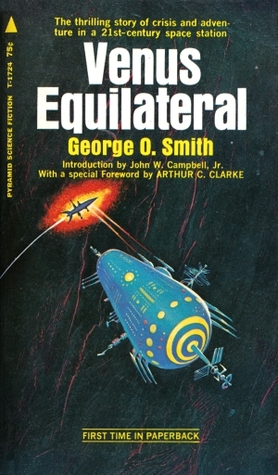

Venus Equilateral by George O. Smith
Publication date: 1942 ; Story date: unspecified future
Innovation and adventure on a communications relay space station.
Main character: Don Channing, director of Venus Equilateral, engineer
Secondary characters: Walter Franks, engineer; Arden Channing, Don's wife and ex-secretary; Mark Kingman, lawyer, Channing's nemesis; Wes Farrell, physicist; Keg Johnson, businessman.
Minor characters: Allison "Hellion" Murdoch, surgeon, physicist, space pirate, male; Jim Baler, engineer; Barney Carroll, engineer; Christine Baler, Jim's sister; Chuck Thomas, engineer; Dr. MacLain, male; Francis Burbank, nincompoop; Michael Warren, maintenance; Timmy Harris, 13 year old; Doug Ferris, reporter; Ling Kai Chaing, captain of Lady of Cathay, male; Ling Wey, engineer, male; other named and unnamed male characters; Jeanne, Walt Franks' secretary; Linna Johnson, Keg's wife; Jen, nurse, female.
Representation of women: The women are very few (relative to how many male characters there are) and exclusively secretaries, telephone operators, nurses, wives, and a guy's sister. That said, within the severe limitations on their presence and significance, they don't do too badly (it could be worse...)
Arden Channing, in particular, is present in every story as an intelligent, if non-expert voice--several times it is she who contributes some idea that provides the solution to the problem. The dynamics between her and her ex-boss/husband and his colleagues are reminiscent of screwball comedy, and you know what, that's not my least favourite mode of gender relations of all we've seen so far. (It's much nicer being Nick's Nora in the 1930s than some space jock's Barbarella in the 1970s.)
Only once is this soured by a "of course, women are illogical" claptrap--inexplicably right after Christine Baler (another smart but not-expert woman) says something illuminating and helpful. It's as if "woman being smart" MUST be followed by a piece of sexist catechism, just to keep the world in balance.
So, it's mixed, but overall, for what small role women play at all, far from the direst ever.
Representation of race and ethnicity: Two Chinese men make contact with V.E. briefly, heard not seen. There are also extraterrestrial aliens in this world, but not much is revealed about them (except that they, too, have male bosses with female secretaries). Nobody else seems to be anything other than white.
Representation of any kind of minority: None.
Bechdel test (BT) and reverse Bechdel test (r-BT): BT fail, tons of solid r-BT passes.
Would I give this book to a kid: yes. I quite enjoyed it; love that wide-eyed, relentlessly optimistic MacGyverishness of gizmotastic early sci-fi.

Venus Equilateral by George O. Smith
Publication date: 1942 ; Story date: unspecified future
Innovation and adventure on a communications relay space station.
Main character: Don Channing, director of Venus Equilateral, engineer
Secondary characters: Walter Franks, engineer; Arden Channing, Don's wife and ex-secretary; Mark Kingman, lawyer, Channing's nemesis; Wes Farrell, physicist; Keg Johnson, businessman.
Minor characters: Allison "Hellion" Murdoch, surgeon, physicist, space pirate, male; Jim Baler, engineer; Barney Carroll, engineer; Christine Baler, Jim's sister; Chuck Thomas, engineer; Dr. MacLain, male; Francis Burbank, nincompoop; Michael Warren, maintenance; Timmy Harris, 13 year old; Doug Ferris, reporter; Ling Kai Chaing, captain of Lady of Cathay, male; Ling Wey, engineer, male; other named and unnamed male characters; Jeanne, Walt Franks' secretary; Linna Johnson, Keg's wife; Jen, nurse, female.
Representation of women: The women are very few (relative to how many male characters there are) and exclusively secretaries, telephone operators, nurses, wives, and a guy's sister. That said, within the severe limitations on their presence and significance, they don't do too badly (it could be worse...)
Arden Channing, in particular, is present in every story as an intelligent, if non-expert voice--several times it is she who contributes some idea that provides the solution to the problem. The dynamics between her and her ex-boss/husband and his colleagues are reminiscent of screwball comedy, and you know what, that's not my least favourite mode of gender relations of all we've seen so far. (It's much nicer being Nick's Nora in the 1930s than some space jock's Barbarella in the 1970s.)
Only once is this soured by a "of course, women are illogical" claptrap--inexplicably right after Christine Baler (another smart but not-expert woman) says something illuminating and helpful. It's as if "woman being smart" MUST be followed by a piece of sexist catechism, just to keep the world in balance.
So, it's mixed, but overall, for what small role women play at all, far from the direst ever.
Representation of race and ethnicity: Two Chinese men make contact with V.E. briefly, heard not seen. There are also extraterrestrial aliens in this world, but not much is revealed about them (except that they, too, have male bosses with female secretaries). Nobody else seems to be anything other than white.
Representation of any kind of minority: None.
Bechdel test (BT) and reverse Bechdel test (r-BT): BT fail, tons of solid r-BT passes.
Would I give this book to a kid: yes. I quite enjoyed it; love that wide-eyed, relentlessly optimistic MacGyverishness of gizmotastic early sci-fi.
111LolaWalser
Up next: uh-oh, Ishmael by Barbara Hambly... a Star Trek novel!
This will be interesting... I'm not a fan. In fact, to date I have managed to sit through one (1) original Star Trek episode from start to finish, the one with Tribbles.
This will be interesting... I'm not a fan. In fact, to date I have managed to sit through one (1) original Star Trek episode from start to finish, the one with Tribbles.
112Maddz
Ah, The Trouble With Tribbles... I seem to recall a later episode - More Trouble With Tribbles, but I think that was in one of the later reboots.
To my mind, most Star Trek spin-offery is fairly formulaic. Over the years, Paramount has tightened up on story lines and characterisation. Early Trek novels, especially by (well) known authors, was a lot looser. Ishmael was one of the more reasonable ones, as was The Romulan Way, both of which I used to own. The only Trek novelisations to have made the latest culling are the 2 by John M Ford, The Final Reflection and How Much For Just the Planet?, which are both very good (and will remain in my library because I am a big fan of Ford...)
Rumour has that it was those last two novels which caused the clamp down by Paramount...
To my mind, most Star Trek spin-offery is fairly formulaic. Over the years, Paramount has tightened up on story lines and characterisation. Early Trek novels, especially by (well) known authors, was a lot looser. Ishmael was one of the more reasonable ones, as was The Romulan Way, both of which I used to own. The only Trek novelisations to have made the latest culling are the 2 by John M Ford, The Final Reflection and How Much For Just the Planet?, which are both very good (and will remain in my library because I am a big fan of Ford...)
Rumour has that it was those last two novels which caused the clamp down by Paramount...
113RobertDay
>112 Maddz: That wouldn't surprise me. I only have 'How much...' as the sole representative novel in my collection of Star Trek spinoffery, and that's because it was described to me as "a fine comic novel that happens to be set in the Star Trek universe".
Paramount's sniffyness over, and micro-management of, The Franchise, is probably one of the major contributory factors in its losing popularity over the years.
Paramount's sniffyness over, and micro-management of, The Franchise, is probably one of the major contributory factors in its losing popularity over the years.
114Maddz
When you cone down to it, TFR is actually a cold war thriller set in the Star Trek universe. It is reminiscent of The Scholars of Night.
115LolaWalser
Star Trekiana!--all Klingon to me. ;)
No. 59

Ishmael by Barbara Hambly
Publication date: 1985 ; Story date: 23rd century in space and 1867 on Earth
Amnesiac Mr. Spock gets stuck in pioneer Seattle in 1867.
Main character: Mr. Spock
Secondary characters: Aaron Stemple, lumber mill owner; Jason, Jeremy and Joshua Bolt, brothers, settlers; Biddy Cloom; Sarah Gay; Captain James T. Kirk; Maria Kellogg, Star Base Commander; Dr. McCoy
Minor characters: Uhura; Sulu; Chekov; Dr. Aurelia Steiner; Trae, male, Vulcan historian; Captain Clancey; Lottie Hatfield, saloon owner; Candy Pruitt; other named and unnamed male and female characters, human and alien.
Representation of women: Hambly assumes an openly feminist position, noticing frequently the injustice of discrimination forced on women, and not only on 19th century Earth--Commander Kellogg, for instance, makes a wry remark about the Klingons' prejudice against women. Spock, suffering from amnesia but with logic and (one supposes) basic instincts intact, at first inadvertently and then deliberately counters the sexism of the Wild West men whose society he's thrown into, while the women, Lottie, Candy, Sarah and Biddy, are each shown to possess not only minds but a sense of being in charge of their lives, responsible to their own principles and nothing else.
Representation of race and ethnicity: Lottie has a Chinese bar boy, Wu Sin (no lines) and there is a mention of the Chinese community in Seattle, as well as in San Francisco. The Star Trek universe teems with aliens; notably, the (unnamed) science officer who replaces Spock in his absence is both a "she" and has tentacles. Dr. Steiner, also, is rather less human than her name might indicate. What is diversity gets explicit mention in the exchange between Stemple and Spock as they walk through San Francisco, Stemple exclaiming about the "variety" and Spock responding, "They are all human."
Ack, how could I forget--Uhura, of course, is black/PoC, as Hambly faithfully records several times.
Stemple is Jewish, we are (subtly) given to understand. He passes Spock as his nephew named "Ishmael Marx"; does not eat pork. Uhm, somewhat unfortunately perhaps, he is also very fond of money and tight fisted, but I think we are meant to blame his wretched, destitute youth, not "genes".
Representation of any kind of minority: None.
Bechdel test (BT) and reverse Bechdel test (r-BT): Despite having more female characters, and more important female characters than I'm used to seeing here, there is only one BT pass (a few words between Biddy and Sarah about Sarah's trip). Women get to "talk" quite a bit, but mostly to/with men. There are significantly more r-BT passes.
Would I give this book to a kid: yes.
Whew! Considering this had THREE things I dislike with some heat--Star Trek, Wild West and AMNESIA dangnabbit (god how I hate amnesia...), it wasn't half bad. But I like Mr. Spock, who doesn't.
Also. WOULD ANYONE KNOW. There's a mention on page 57 (Pocket Science Fiction) of "Metebelis crystals". Is this a Doctor Who shoutout? I dimly remember the word as something Doctor-Whoish... maybe.
Oh, and would you believe it--darn Tribbles get a mention. Full score for my one episode viewing.
No. 59

Ishmael by Barbara Hambly
Publication date: 1985 ; Story date: 23rd century in space and 1867 on Earth
Amnesiac Mr. Spock gets stuck in pioneer Seattle in 1867.
Main character: Mr. Spock
Secondary characters: Aaron Stemple, lumber mill owner; Jason, Jeremy and Joshua Bolt, brothers, settlers; Biddy Cloom; Sarah Gay; Captain James T. Kirk; Maria Kellogg, Star Base Commander; Dr. McCoy
Minor characters: Uhura; Sulu; Chekov; Dr. Aurelia Steiner; Trae, male, Vulcan historian; Captain Clancey; Lottie Hatfield, saloon owner; Candy Pruitt; other named and unnamed male and female characters, human and alien.
Representation of women: Hambly assumes an openly feminist position, noticing frequently the injustice of discrimination forced on women, and not only on 19th century Earth--Commander Kellogg, for instance, makes a wry remark about the Klingons' prejudice against women. Spock, suffering from amnesia but with logic and (one supposes) basic instincts intact, at first inadvertently and then deliberately counters the sexism of the Wild West men whose society he's thrown into, while the women, Lottie, Candy, Sarah and Biddy, are each shown to possess not only minds but a sense of being in charge of their lives, responsible to their own principles and nothing else.
Representation of race and ethnicity: Lottie has a Chinese bar boy, Wu Sin (no lines) and there is a mention of the Chinese community in Seattle, as well as in San Francisco. The Star Trek universe teems with aliens; notably, the (unnamed) science officer who replaces Spock in his absence is both a "she" and has tentacles. Dr. Steiner, also, is rather less human than her name might indicate. What is diversity gets explicit mention in the exchange between Stemple and Spock as they walk through San Francisco, Stemple exclaiming about the "variety" and Spock responding, "They are all human."
Ack, how could I forget--Uhura, of course, is black/PoC, as Hambly faithfully records several times.
Stemple is Jewish, we are (subtly) given to understand. He passes Spock as his nephew named "Ishmael Marx"; does not eat pork. Uhm, somewhat unfortunately perhaps, he is also very fond of money and tight fisted, but I think we are meant to blame his wretched, destitute youth, not "genes".
Representation of any kind of minority: None.
Bechdel test (BT) and reverse Bechdel test (r-BT): Despite having more female characters, and more important female characters than I'm used to seeing here, there is only one BT pass (a few words between Biddy and Sarah about Sarah's trip). Women get to "talk" quite a bit, but mostly to/with men. There are significantly more r-BT passes.
Would I give this book to a kid: yes.
Whew! Considering this had THREE things I dislike with some heat--Star Trek, Wild West and AMNESIA dangnabbit (god how I hate amnesia...), it wasn't half bad. But I like Mr. Spock, who doesn't.
Also. WOULD ANYONE KNOW. There's a mention on page 57 (Pocket Science Fiction) of "Metebelis crystals". Is this a Doctor Who shoutout? I dimly remember the word as something Doctor-Whoish... maybe.
Oh, and would you believe it--darn Tribbles get a mention. Full score for my one episode viewing.
116LolaWalser
Up next: The space-born by E. C. Tubb
117RobertDay
>115 LolaWalser: 'Metebelis crystals' - if that's not a deliberate Dr.Who reference, it's one stupendously huge coincidence. I'm no Whovian, you understand, having only watched the show since episode 1 (!), but you'll find it relates to the adventure 'Planet of the Spiders', where Jon Pertwee regenerated into Tom Baker.
http://en.wikipedia.org/wiki/Planet_of_the_Spiders
http://en.wikipedia.org/wiki/Planet_of_the_Spiders
118SimonW11
Interviewed Hambly for a podcast once and we talked about that book. She is a Tom Baker fan. She modeled one of her heros after him.
119LolaWalser
>117 RobertDay:
Oh that's sweet. Funny, I have yet to see that one, I remembered it dimly as something to do with Jo Grant (did the Doctor give her a present of the crystals?)--and I see they mention her last story, The Green Death.
Here's the excerpt from Hambly, then, to commemorate the occasion:
ETA: >118 SimonW11:
Ha! That's great!
Oh that's sweet. Funny, I have yet to see that one, I remembered it dimly as something to do with Jo Grant (did the Doctor give her a present of the crystals?)--and I see they mention her last story, The Green Death.
Here's the excerpt from Hambly, then, to commemorate the occasion:
Kellogg leaned back in her armchair and slung a casual knee over its arm. The dim colors of the lamplight and fire gleamed on the gold of her tunic. "I'll bet you Metebelis crystals to little green apples that they didn't, though. (...)"
ETA: >118 SimonW11:
Ha! That's great!
120LolaWalser
Wow, Star Trek/Doctor Who crossover--and by a Star Trek writer no less--isn't this supposed to be a big thing? ;)
ETA: I just remembered the reason I remembered "Metebelis" (or something like it)--four-five years ago, when I discovered old Who, I visited this kooky fan forum where people argued, among other things, about who when how pronounced "Metebelis" correctly. Threads went on for PAGES.
I also picked up more info on the colour of actual 1950s/60s police boxes than I could possibly need in this lifetime or universe.
ETA: I just remembered the reason I remembered "Metebelis" (or something like it)--four-five years ago, when I discovered old Who, I visited this kooky fan forum where people argued, among other things, about who when how pronounced "Metebelis" correctly. Threads went on for PAGES.
I also picked up more info on the colour of actual 1950s/60s police boxes than I could possibly need in this lifetime or universe.
121SimonW11
the big influence on that Ishmael was a TV series called Here Come the Brides.
https://en.wikipedia.org/wiki/Here_Come_the_Brides.
There are other TV western characters showing up as well
Including cameos by two of Carter boys from Bonanza.
https://en.wikipedia.org/wiki/Here_Come_the_Brides.
There are other TV western characters showing up as well
Including cameos by two of Carter boys from Bonanza.
122LolaWalser
>121 SimonW11:
Omg, she just plunked Spock into the middle of a TV series! Neat.
I did think of Seven brides for seven brothers, but I'd never heard of this.
Love Joan Blondell--good to see she was working (and looking SWELL!) into the seventies.
Omg, she just plunked Spock into the middle of a TV series! Neat.
I did think of Seven brides for seven brothers, but I'd never heard of this.
Love Joan Blondell--good to see she was working (and looking SWELL!) into the seventies.
123LolaWalser
No. 60


The space-born by E. C. Tubb
Population control on a generation ship demands special measures.
Publication date: 1956 ; Story date: 23rd century
Main character: Jay West, psych-policeman
Secondary characters: Gregson, chief of Psycho; Quentin, Captain; Mallick, chief of Genetics; George Curtway; Merrill, psych-policeman; Susan Curtway, George's daughter, maternity ward attendant
Minor characters: Sam Aldway, troublemaker; Conway, chief psychologist; Bosco, leader of "Barbarians"; other named and unnamed exclusively male characters
Representation of women: Period-standard. No women seem to be in the position of leadership or to do any kind of work other than related to child-rearing--and women, exclusively, are the ones doing that work. Susan is pretty, under eighteen (just about to turn "marriageable"), wearing a form-fitting pink halter and shorts (but everyone wears shorts). She's not stupid (the Builders of the ship put in place a strict eugenic programme that bred for high intelligence and ability) but the only thoughts she has are about sex, marriage, babies.
There are some women among the "Barbs", people who rebelled against the ship's code, but they don't get more than a mention.
In one place Tubb writes of "equality between the sexes" but that happens to concern the duelling arena, where mixed pairs are allowed. Jay watches a "comedy" number where a woman thrashes a man and then picks him up and takes off with him--he guesses a marital dispute has been settled.
Representation of race and ethnicity: Nobody seems to be anything other than white or Anglo of some kind, but the absence of description (I think only Susan's "raven hair" gets a mention), I suppose, makes this an educated guess rather than necessity (i.e. there's little to stop you from imagining the characters as, say, black.)
Representation of any kind of minority: None.
Bechdel test (BT) and reverse Bechdel test (r-BT): BT fail, lots of r-BT passes.
Would I give this book to a kid: Yes, but I'd have some things to say about eugenics for sure.


The space-born by E. C. Tubb
Population control on a generation ship demands special measures.
Publication date: 1956 ; Story date: 23rd century
Main character: Jay West, psych-policeman
Secondary characters: Gregson, chief of Psycho; Quentin, Captain; Mallick, chief of Genetics; George Curtway; Merrill, psych-policeman; Susan Curtway, George's daughter, maternity ward attendant
Minor characters: Sam Aldway, troublemaker; Conway, chief psychologist; Bosco, leader of "Barbarians"; other named and unnamed exclusively male characters
Representation of women: Period-standard. No women seem to be in the position of leadership or to do any kind of work other than related to child-rearing--and women, exclusively, are the ones doing that work. Susan is pretty, under eighteen (just about to turn "marriageable"), wearing a form-fitting pink halter and shorts (but everyone wears shorts). She's not stupid (the Builders of the ship put in place a strict eugenic programme that bred for high intelligence and ability) but the only thoughts she has are about sex, marriage, babies.
There are some women among the "Barbs", people who rebelled against the ship's code, but they don't get more than a mention.
In one place Tubb writes of "equality between the sexes" but that happens to concern the duelling arena, where mixed pairs are allowed. Jay watches a "comedy" number where a woman thrashes a man and then picks him up and takes off with him--he guesses a marital dispute has been settled.
Representation of race and ethnicity: Nobody seems to be anything other than white or Anglo of some kind, but the absence of description (I think only Susan's "raven hair" gets a mention), I suppose, makes this an educated guess rather than necessity (i.e. there's little to stop you from imagining the characters as, say, black.)
Representation of any kind of minority: None.
Bechdel test (BT) and reverse Bechdel test (r-BT): BT fail, lots of r-BT passes.
Would I give this book to a kid: Yes, but I'd have some things to say about eugenics for sure.
124LolaWalser
As this thread moved more slowly, I'll do the sum-up after the next five or ten titles, rather than after these twenty.
Up next: The Callahan touch by Spider Robinson
Up next: The Callahan touch by Spider Robinson
125Maddz
The next one was actually published in 1996, so I don't think it counts as an oldie for the purpose of this thread. It's also part of a series - #6, to be precise. Enjoy reading it, though.
126LolaWalser
>125 Maddz:
It says copyright 1993 for this one. Does it matter greatly it's not the first? I don't remember exactly but I think I don't have any other Spider Robinson...
It says copyright 1993 for this one. Does it matter greatly it's not the first? I don't remember exactly but I think I don't have any other Spider Robinson...
127Maddz
They're technically stand-alone novels, but it kind of helps to have read the earlier ones as there are a number of recurring characters and back-story. It's not like TLotR, for example, where the next book carries on from where the preceding left off.
I should also warn you there are a number of excrutiating puns and shaggy dog stories involved which might not be your cup of tea. It is meant to be humourous.
I should also warn you there are a number of excrutiating puns and shaggy dog stories involved which might not be your cup of tea. It is meant to be humourous.
128LolaWalser
Yeah, I can tell from the cover. I used to love that space-bar stuff.
Incidentally, someone made a "series" called "Mary's place" where this is #1.
Incidentally, someone made a "series" called "Mary's place" where this is #1.
129Maddz
Probably right. The, er, sister establishment to Callahan's is Mary's Place (which, incidentally, is not a bar so there may be age-appropriate issues there...) IIRC, the eponymous Mary makes her initial appearance in Lady Slings the Booze. Although science fiction, it's not technically a space bar, as it's set on contemporary Earth.
It has more in common with Tales from Gavagan's Bar than, say, the Mos Eisley cantina (or 'Tales from the Liberator Popular Front' which is a fan published space bar collection set in the Blake's 7 universe).
It has more in common with Tales from Gavagan's Bar than, say, the Mos Eisley cantina (or 'Tales from the Liberator Popular Front' which is a fan published space bar collection set in the Blake's 7 universe).
130Lyndatrue
>124 LolaWalser: Oh dear. I used to love Spider. I owned a whole lot of everything he'd written, and Callahan's Crosstime Saloon was a book I literally wore out (I replaced it in the early eighties). I loved the sequel, Time Travelers Strictly Cash as well. Ah, but then he married. I'm not sure what about being married, or happy, there was, but he was just different.
Perhaps he caught the disease that many authors seem to find (repeating oneself seems to bring in the cash). Who can say? He went from being clever, to writing things that seemed to be almost soft porn (remember that I'm really old-fashioned, and take that with a grain of salt). I would say that my review of Stardance (his first effort with his wife) would be termed damning with faint praise.
Ah well. Everything changes. Everything.
I would honestly suggest that at least the first two books would be necessary to get the overall picture of Callahan's, but then again, I gave up on that world some time ago. Life is too short.
Perhaps he caught the disease that many authors seem to find (repeating oneself seems to bring in the cash). Who can say? He went from being clever, to writing things that seemed to be almost soft porn (remember that I'm really old-fashioned, and take that with a grain of salt). I would say that my review of Stardance (his first effort with his wife) would be termed damning with faint praise.
Ah well. Everything changes. Everything.
I would honestly suggest that at least the first two books would be necessary to get the overall picture of Callahan's, but then again, I gave up on that world some time ago. Life is too short.
131LolaWalser
The following contains spoilers.
No. 61


The Callahan touch by Spider Robinson
Publication date: 1993 ; Story date: 1988
A motley group of friends make themselves at home in an unusual bar.
Main character, POV character: Jake Stonebender
Secondary characters: Sam Webster; Ernie Shea AKA Duck, Fir Darrig/pooka hybrid; Jonathan Crawford, gay; Fast Eddie; Long-Drink McGonnagle; Isham Latimer, black; Tanya Latimer, Isham's wife, black, blind; Mike Callahan; the cluricaune; Zoey Berkowitz, Jake's girlfriend; "Mac", artificial intelligence.
Minor characters: Tom Hauptman, assistant bartender; Tommy Janssen; Suzy Maser; Susie Maser (no lines); Slippery Joe Maser, husband to Suzy AND Susie; Shorty Steinitz; Noah Gonzalez; Maureen and Willard Hooker, married couple; Mary Kay and Jordin Kare, married couple; Merry and Les Moore, married couple; Ralph von Wau Wau, talking dog; Pyotr, vampire; Marty and Dave Matthias, gay married couple; Bill Gerrity, transvestite; John Killian; Dorothy, lesbian.
Representation of women: There are fewer women than men and, until Zoey shows up in the last third or so of the book, they participate proportionately less in the talk and action. However, sexism is directly addressed at least twice and Robinson clearly wants to send the message that the sexes are equal and that women deserve respect.
Representation of race and ethnicity: The Latimers are the only people explicitly described as black. Racism is addressed explicitly. A white character tells of an event that revealed, to his shame, his bias, and he toasts ironically "unconscious racism: one of the nastiest kind". A fairy creature, the cluricaune, invades the bar and taunts Tanya Latimer with racist insults, but is quickly defused--in part because nobody seems to feel his insults can be taken seriously.
Representation of any kind of minority: Tanya Latimer is an ex-cop who has been blinded on duty, but her disability is pointedly shown not to hamper or diminish her. She captures the cluricaune first.
There's a transvestite--and also a vampire and a talking dog. ;)
There are at least three gay men, one of which, Jonathan Crawford, is the first person on whom we see how the magic of Mary's Place works, how the broken are mended and souls restored. Jonathan is haunted by a nightmarish conviction that he has unleashed AIDS, and the regret of having neglected his partner of 28 years for his work. This is discussed with intelligence and unreserved compassion.
There is a lesbian, Dorothy, who's a mechanic--which looks stereotypical until Zoey shows up, a straight, conventionally pretty woman, but 41, and pregnant, and also a mechanic.
Bechdel test (BT) and reverse Bechdel test (r-BT): BT fail, with multiple r-BT passes. However, since most of the conversation involves a large group of people, individual interactions are largely shared at least tacitly.
Would I give this book to a kid: yes. It is unique so far in the theme of unlimited love and tolerance for all forms of humanity (including that of imaginary, supernatural and alien characters), and uncommonly warm in execution. It is somewhat dated, creaky here and there, and not at all subtle--but I can't doubt its sincerity.
The vocabulary includes an instance of "nigger" and "faggot" (first ironic, from Tanya Latimer, as she remarks to the cluricaune that at least he didn't call her that; second as self-introduction from John Crawford, still in the grip of self-hatred) and there's a love song with a long, poetic but unmistakable (well--depending on experience, I suppose) description of cunnilingus. And yes, indeed, I'd give this book to the same kid to whom I would not have given Jack Vance.
No. 61

The Callahan touch by Spider Robinson
Publication date: 1993 ; Story date: 1988
A motley group of friends make themselves at home in an unusual bar.
Main character, POV character: Jake Stonebender
Secondary characters: Sam Webster; Ernie Shea AKA Duck, Fir Darrig/pooka hybrid; Jonathan Crawford, gay; Fast Eddie; Long-Drink McGonnagle; Isham Latimer, black; Tanya Latimer, Isham's wife, black, blind; Mike Callahan; the cluricaune; Zoey Berkowitz, Jake's girlfriend; "Mac", artificial intelligence.
Minor characters: Tom Hauptman, assistant bartender; Tommy Janssen; Suzy Maser; Susie Maser (no lines); Slippery Joe Maser, husband to Suzy AND Susie; Shorty Steinitz; Noah Gonzalez; Maureen and Willard Hooker, married couple; Mary Kay and Jordin Kare, married couple; Merry and Les Moore, married couple; Ralph von Wau Wau, talking dog; Pyotr, vampire; Marty and Dave Matthias, gay married couple; Bill Gerrity, transvestite; John Killian; Dorothy, lesbian.
Representation of women: There are fewer women than men and, until Zoey shows up in the last third or so of the book, they participate proportionately less in the talk and action. However, sexism is directly addressed at least twice and Robinson clearly wants to send the message that the sexes are equal and that women deserve respect.
Representation of race and ethnicity: The Latimers are the only people explicitly described as black. Racism is addressed explicitly. A white character tells of an event that revealed, to his shame, his bias, and he toasts ironically "unconscious racism: one of the nastiest kind". A fairy creature, the cluricaune, invades the bar and taunts Tanya Latimer with racist insults, but is quickly defused--in part because nobody seems to feel his insults can be taken seriously.
Representation of any kind of minority: Tanya Latimer is an ex-cop who has been blinded on duty, but her disability is pointedly shown not to hamper or diminish her. She captures the cluricaune first.
There's a transvestite--and also a vampire and a talking dog. ;)
There are at least three gay men, one of which, Jonathan Crawford, is the first person on whom we see how the magic of Mary's Place works, how the broken are mended and souls restored. Jonathan is haunted by a nightmarish conviction that he has unleashed AIDS, and the regret of having neglected his partner of 28 years for his work. This is discussed with intelligence and unreserved compassion.
There is a lesbian, Dorothy, who's a mechanic--which looks stereotypical until Zoey shows up, a straight, conventionally pretty woman, but 41, and pregnant, and also a mechanic.
Bechdel test (BT) and reverse Bechdel test (r-BT): BT fail, with multiple r-BT passes. However, since most of the conversation involves a large group of people, individual interactions are largely shared at least tacitly.
Would I give this book to a kid: yes. It is unique so far in the theme of unlimited love and tolerance for all forms of humanity (including that of imaginary, supernatural and alien characters), and uncommonly warm in execution. It is somewhat dated, creaky here and there, and not at all subtle--but I can't doubt its sincerity.
The vocabulary includes an instance of "nigger" and "faggot" (first ironic, from Tanya Latimer, as she remarks to the cluricaune that at least he didn't call her that; second as self-introduction from John Crawford, still in the grip of self-hatred) and there's a love song with a long, poetic but unmistakable (well--depending on experience, I suppose) description of cunnilingus. And yes, indeed, I'd give this book to the same kid to whom I would not have given Jack Vance.
132LolaWalser
Up next: Memoirs found in a bathtub by Stanislaw Lem
133LolaWalser
Lol! I've been reading the reviews of the Robinson on Goodreads, this one's my favourite (complete):
some weird people show up. then they make friends with a computer.
Dang, I forgot the AI.
*off to add*
some weird people show up. then they make friends with a computer.
Dang, I forgot the AI.
*off to add*
134tardis
>131 LolaWalser: Spider is a lovely man. He and his late wife, Jeanne, were frequent guests at our local cons because they lived relatively close (only one province away). Some of my friends are tuckerized (derived from Wilson Tucker, a pioneering American science fiction writer, who made a practice of using his friends' names for minor characters in his stories) in one of his books. He never met a pun he didn't like, though.
135LolaWalser
>134 tardis:
That's great to hear! I saw on Goodreads that the music and musicians he mentions in this book are derived from his real life friends too.
He never met a pun he didn't like, though.
Ohh, I can believe that! :)
That's great to hear! I saw on Goodreads that the music and musicians he mentions in this book are derived from his real life friends too.
He never met a pun he didn't like, though.
Ohh, I can believe that! :)
136Lyndatrue
>134 tardis: Late wife?!?!? Ah, that's sad. I cannot forget how much Spider loved her. She seemed a good soul.
137MyriadBooks
I saw Spider and Jeanne at an author event once, and it was amazing. They played off each other so beautifully.
This was, lord, ten years ago now. Looks like the Library of Congress still has the video and transcript archived:
http://www.loc.gov/today/cyberlc/feature_wdesc.php?rec=3997
This was, lord, ten years ago now. Looks like the Library of Congress still has the video and transcript archived:
http://www.loc.gov/today/cyberlc/feature_wdesc.php?rec=3997
139LolaWalser
No. 62


Memoirs found in a bathtub by Stanislaw Lem
A would-be secret agent lost in the labyrinthine Cosmic Command building tries to discover what is his Mission.
Publication date: 1971; Story date: unspecified contemporary/future, before the 32nd century
Main character: the secret agent, male
Other characters: Male: General Kashenblade; Lieutenant Blanderdash; Dasherblar, decoder; Blassenkash, Undereavesdropper; various monks and priests in the Theological Division; Father Orfini; Major Erms; Captain Prandtl; Antheus Kappril, custodian; the admiral; the second secret agent; the doctor; Sempriaq, Senior Cremator; Professor Dolt; Professor Klapperschlang; Professor Deluge.
Female: a girl. Anonymous secretaries, a receptionist, and a nurse.
Representation of women: Women rarely figure in Lem's books, and when they appear at all, they are relegated to the bog-standard stereotypical roles--sex interests, family, minor assistants... and usually merely denoted in passing. It's very rare for a woman to speak in Lem's books or do anything notable or interesting. This one's no different. The female staff of the nightmarish Building is typically invoked in collective terms, and utterly impersonal otherwise.
Etc. There is only one line in the book uttered by a female character; a receptionist tells the Agent: "But you have no appointment."
Just a few pages before the end the Agent stumbles into a room where a girl, "sweet sixteen and scared", is sitting under a dark painting. The Agent attempts to rape her. Since the Agent is struggling to understand what is going on in a coded Universe, in which he has grown to suspect everything of harbouring hidden messages, it is highly significant that the girl is interpreted as "someone-to-violate". I'm afraid I have to conclude, Lem's overt satirical intention notwithstanding, that there is here, as in Cordwainer Smith, an unspoken assumption that "little girls" are indeed meant for deflowering--never mind if forcible.
Representation of race and ethnicity: None.
Representation of any kind of minority: None.
Bechdel test (BT) and reverse Bechdel test (r-BT): BT fail; lots of solid r-BT passes.
Would I give this book to a kid: to an older one, yes.


Memoirs found in a bathtub by Stanislaw Lem
A would-be secret agent lost in the labyrinthine Cosmic Command building tries to discover what is his Mission.
Publication date: 1971; Story date: unspecified contemporary/future, before the 32nd century
Main character: the secret agent, male
Other characters: Male: General Kashenblade; Lieutenant Blanderdash; Dasherblar, decoder; Blassenkash, Undereavesdropper; various monks and priests in the Theological Division; Father Orfini; Major Erms; Captain Prandtl; Antheus Kappril, custodian; the admiral; the second secret agent; the doctor; Sempriaq, Senior Cremator; Professor Dolt; Professor Klapperschlang; Professor Deluge.
Female: a girl. Anonymous secretaries, a receptionist, and a nurse.
Representation of women: Women rarely figure in Lem's books, and when they appear at all, they are relegated to the bog-standard stereotypical roles--sex interests, family, minor assistants... and usually merely denoted in passing. It's very rare for a woman to speak in Lem's books or do anything notable or interesting. This one's no different. The female staff of the nightmarish Building is typically invoked in collective terms, and utterly impersonal otherwise.
... I would stumble into rest rooms where secretaries hastily renewed their make-up... (...)
The secretaries were all busy putting on lipstick and stirring coffee. (...)
As I entered, two secretaries were stirring their coffee, and a third arranged sandwiches on a plate. (...)
One of the secretaries was knitting, the other worked on a ham sandwich and a cup of coffee.(...)
...somewhere in some office a bored secretary stirred her coffee...(...)
Etc. There is only one line in the book uttered by a female character; a receptionist tells the Agent: "But you have no appointment."
Just a few pages before the end the Agent stumbles into a room where a girl, "sweet sixteen and scared", is sitting under a dark painting. The Agent attempts to rape her. Since the Agent is struggling to understand what is going on in a coded Universe, in which he has grown to suspect everything of harbouring hidden messages, it is highly significant that the girl is interpreted as "someone-to-violate". I'm afraid I have to conclude, Lem's overt satirical intention notwithstanding, that there is here, as in Cordwainer Smith, an unspoken assumption that "little girls" are indeed meant for deflowering--never mind if forcible.
Representation of race and ethnicity: None.
Representation of any kind of minority: None.
Bechdel test (BT) and reverse Bechdel test (r-BT): BT fail; lots of solid r-BT passes.
Would I give this book to a kid: to an older one, yes.
140LolaWalser
Up next: Ole Doc Methuselah by L. Ron Hubbard
141DugsBooks
>1 LolaWalser: Great thread and improving with every post! I just skimmed over most of it before posting but will be back to linger when I have more time.
I recently read Star Wars The Force Awakens {yes I like to challenge myself now and then! } and I noticed Mr. Foster's vocabulary used in the novel had me reaching for a dictionary almost on a few occasions. He aimed the book at YA or younger but I liked the way he didn't dumb down the words {in his narration at least I believe } in any way that I could detect.
That made me think of your topic and wondered if there were any way to rate books as vocabulary builders? or is that built into classifications like YA or whatever. I was prompted by your "would you recommend this to a kid" designation.
The Force Awakens follows the movie almost word for word, btw, but I did pick up on something I missed at the end of the movie.
::edited in:: and the Ron Hubbard books I have read all stayed at the 6th grade level vocabulary I believe, so they could be translated easier?
quote from one of his novels "You are a good boy Johnny Goodboy".
I recently read Star Wars The Force Awakens {yes I like to challenge myself now and then! } and I noticed Mr. Foster's vocabulary used in the novel had me reaching for a dictionary almost on a few occasions. He aimed the book at YA or younger but I liked the way he didn't dumb down the words {in his narration at least I believe } in any way that I could detect.
That made me think of your topic and wondered if there were any way to rate books as vocabulary builders? or is that built into classifications like YA or whatever. I was prompted by your "would you recommend this to a kid" designation.
The Force Awakens follows the movie almost word for word, btw, but I did pick up on something I missed at the end of the movie.
::edited in:: and the Ron Hubbard books I have read all stayed at the 6th grade level vocabulary I believe, so they could be translated easier?
quote from one of his novels "You are a good boy Johnny Goodboy".
142LolaWalser
>141 DugsBooks:
Great thread and improving with every post!
Wow, THANK you, kind sir, such fulsome praise isn't all that common around here! Don't forget to look at vols. 1 & 2 then! :))) (Links are all up there in >1 LolaWalser:. There will be a quiz. With birching.)
Errrm, the vocabulary question sort of throws me... No--wait--I believe there are some measures for doing exactly what you say, grading the vocabulary--lexiles or something? I noticed threads about those on LT but I've no clue as to what and how one does with them (and, clearly, it's probably language-specific).
https://en.wikipedia.org/wiki/Lexile
But you may want to search Talk for those threads or ask the librarians or something...
I should only mention, as far as these "Would you give..." threads go, it's not about technical difficulties so much (or ever), but about social and cultural attitudes apparently promoted by the books (therefore raising the question of whether we care to see them reinforced and propagated etc.)
Great thread and improving with every post!
Wow, THANK you, kind sir, such fulsome praise isn't all that common around here! Don't forget to look at vols. 1 & 2 then! :))) (Links are all up there in >1 LolaWalser:. There will be a quiz. With birching.)
Errrm, the vocabulary question sort of throws me... No--wait--I believe there are some measures for doing exactly what you say, grading the vocabulary--lexiles or something? I noticed threads about those on LT but I've no clue as to what and how one does with them (and, clearly, it's probably language-specific).
https://en.wikipedia.org/wiki/Lexile
But you may want to search Talk for those threads or ask the librarians or something...
I should only mention, as far as these "Would you give..." threads go, it's not about technical difficulties so much (or ever), but about social and cultural attitudes apparently promoted by the books (therefore raising the question of whether we care to see them reinforced and propagated etc.)
143Lyndatrue
>142 LolaWalser: I'll add my chorus of admiration and thanks, and wanted to say that you've affected my reading as well. I recently finished a novel (Implied Spaces) by Walter Jon Williams, and I was very conscious of the female characters in them, and their contribution to the work. I'd say they were better than many of the things you've reviewed, but I'd have liked it to still be more.
Ugh. I just now looked at the reviews, and it reminds me of why I seldom look at LT reviews for anything I've read, am about to read, or may consider reading in the future. There were one or two that were okay, but quite a few that don't grasp the idea of a review not being a synopsis. Ah, well.
I don't always agree with your opinion of a work (rare, but it happens), but it's always insightful, and provocative. I await your review of L Ron's book; it should be interesting.
Back to Camus; I'm revisiting Resistance, Rebellion, and Death, which is a work I hadn't read in more than 40 years. I wonder where our modern day Albert Camus is? We really need one.
Ugh. I just now looked at the reviews, and it reminds me of why I seldom look at LT reviews for anything I've read, am about to read, or may consider reading in the future. There were one or two that were okay, but quite a few that don't grasp the idea of a review not being a synopsis. Ah, well.
I don't always agree with your opinion of a work (rare, but it happens), but it's always insightful, and provocative. I await your review of L Ron's book; it should be interesting.
Back to Camus; I'm revisiting Resistance, Rebellion, and Death, which is a work I hadn't read in more than 40 years. I wonder where our modern day Albert Camus is? We really need one.
144LolaWalser
>143 Lyndatrue:
Thanks, Lynda--I must say I always hear about affecting someone's reading with trepidation, especially if it results in a negative judgement, so I feel I should mention once again these analyses don't necessarily (or even usually) reflect what I'd consider my FULL opinion, a proper review, of a book.
For example, this latest one, Lem's "Memoirs..." I thought was a brilliant book for a whole page of reasons, but at the same time there's no question that his work time after time reflects uncritically a misogynistic, sexist, heteronormative society.
I'd love to hear about it when you DON'T agree with me, btw.
Thanks, Lynda--I must say I always hear about affecting someone's reading with trepidation, especially if it results in a negative judgement, so I feel I should mention once again these analyses don't necessarily (or even usually) reflect what I'd consider my FULL opinion, a proper review, of a book.
For example, this latest one, Lem's "Memoirs..." I thought was a brilliant book for a whole page of reasons, but at the same time there's no question that his work time after time reflects uncritically a misogynistic, sexist, heteronormative society.
I'd love to hear about it when you DON'T agree with me, btw.
145LolaWalser
I can't read this book. The writing's so relentlessly bad I ran out of excoriation energy in four double pages. It's so bad it's miles beyond parody and ridicule. Have I called something badly-written before? Yes--I remember I laughed at Piers Anthony and Van Vogt. I was young and inexperienced and had no idea how horribly language can be abused yet. I laughed at this too, and I love to laugh--but not steadily for 190 pages.
Instead of the usual, here are just a few examples (I was finally defeated on page 15).
The problems started off the bat, with the very first paragraph:
"Wasn't thinking what he was doing" may be the typesetter's fault, but in retrospect it describes beautifully what I now believe was the writer's own state of mind. Not thinking what he was doing--not thinking for a bleeding second.
The character is working out "formulas" for "cellular radiation" (twaddle) "in his head as usual", which tells us he's a genius, but he also must be an idiot if it makes him forget to keep his damn rocket ship on course. At this point I know that reading this guy's sentences will feel like getting punched in the kidneys while being tickled all over at the same time.
Then he sees the "asteroid planet". Oh for fuck's sake--is it an asteroid, OR is it a planet? This is why kids think adults are idiots.
Then he "de-translates" speed. I guess he wanted to be original with this word choice but it only makes me think Hubbard didn't know what "translation" means--or maybe "speed".
Here I first took a break. Unfortunately, the book didn't magically morph into something readable. Ole Doc has an alien companion/servant/handyman called Hippocrates, who feeds "solely on gypsum", is one meter tall, and weighs half a metric ton. Just what one wants around on a "rocket ship"... why not pick up a portable black hole next...
Hubbard has terrific problems with the topography of his scenes and the flow of action. Actually, scratch that--he just flings words around any which way, leaving the problems to the reader.
Ole Doc grabs the fishing rod he keeps above navigation control (where else?) and goes fishing in the pleasant brook in the pleasant meadow. A young woman comes stumbling across the meadow in his general direction. An Earthman is pursuing her. Hippocrates is observing the goings-on from the top of the ship, intending to blast the Earthman away, but, unfortunately, all three characters line up so that he can't shoot the Earthman without shooting the others. Blast!
Never fear, the genius doc casually "twitches" his wrist and catches the Earthman's lip with the fishing hook, then drags him into the brook. The girl, who has a rare gift for long-term stumbling, finally "threw herself in a collapse at Ole Doc's feet". The Earthman is dispatched with a dose from the ray gun, "just back of the medulla oblongata". He got it, one surmises, in the neck. "Just back of the medulla oblongata" is a phrase MADE to drive anatomists crazy. Back where, back of what, in what plane and direction?
The Earthman is hypnotized and the unconscious girl manhandled by Hippocrates like a sack, but somehow manages to revive and inform them that somewhere there's also her father. The alien fetches him on the door of a compartment. Ole Doc contemplates the wounded man:
All this, and no need to examine the bumps on the skull either! Eat your hearts out, psychologists. The style hardly needs commenting, but I can't resist displaying it some more:
The "her" above presumably refers to the girl. She was last seen flat on her back on another operating table, but, if I'm reading the scene correctly, she must have got down and up and the Doc is gesturing her out of the premises, into "the main salon". Waving a hand back, professional imperiousness, thrusting her along... phrase upon awful, idiotic phrase.
And this uncertainty about what is happening where to whom is everywhere. Hubbard's text, like his heroine, "stumbles" constantly. The man is placed on the operating table and we know that the "meters on the wall" are supposedly "counting" HIS respiration, pulse and haemoglobin, but it could have been the wall's, for all the care Hubbard shows for the writing.
Finally, the paragraph that did me in, on page 15:
The character wears gauntlets on the first page; presumably he's taken them off at some point. It's unclear when he could have donned the black silk dressing gown, but even more unclear why you'd wear a garment like that with furred boots. I can't help wondering what's between his top and the boots. Or shall I say "just back of the dressing gown"? Maybe it's not a dressing gown, maybe it's a caftan, in which case boots might seem less outlandish... a sort of Fu Manchu get-up?
But all this is trivial (comical, yes), compared to "His youthful eyes drifted inwards." That, my friends, was the coup de grâce and I can't recover. The book died then and there, or I to it. No fine surgeon's hands can bring this baby back to life.
Funeral is black silk dressing gowns only; please wear furred boots and gauntlets, anything else optional.



Instead of the usual, here are just a few examples (I was finally defeated on page 15).
The problems started off the bat, with the very first paragraph:
Ole Doc Methuselah wasn't thinking what he was doing or he never would have landed on Spico that tempestuous afternoon. He had been working out some new formulas for cellular radiation--in his head as usual, he never could find his log tables--and the act of also navigating his rocket ship must have been too much for him. He saw the asteroid planet, de-translated his speed and landed.
"Wasn't thinking what he was doing" may be the typesetter's fault, but in retrospect it describes beautifully what I now believe was the writer's own state of mind. Not thinking what he was doing--not thinking for a bleeding second.
The character is working out "formulas" for "cellular radiation" (twaddle) "in his head as usual", which tells us he's a genius, but he also must be an idiot if it makes him forget to keep his damn rocket ship on course. At this point I know that reading this guy's sentences will feel like getting punched in the kidneys while being tickled all over at the same time.
Then he sees the "asteroid planet". Oh for fuck's sake--is it an asteroid, OR is it a planet? This is why kids think adults are idiots.
Then he "de-translates" speed. I guess he wanted to be original with this word choice but it only makes me think Hubbard didn't know what "translation" means--or maybe "speed".
Here I first took a break. Unfortunately, the book didn't magically morph into something readable. Ole Doc has an alien companion/servant/handyman called Hippocrates, who feeds "solely on gypsum", is one meter tall, and weighs half a metric ton. Just what one wants around on a "rocket ship"... why not pick up a portable black hole next...
Hubbard has terrific problems with the topography of his scenes and the flow of action. Actually, scratch that--he just flings words around any which way, leaving the problems to the reader.
Ole Doc grabs the fishing rod he keeps above navigation control (where else?) and goes fishing in the pleasant brook in the pleasant meadow. A young woman comes stumbling across the meadow in his general direction. An Earthman is pursuing her. Hippocrates is observing the goings-on from the top of the ship, intending to blast the Earthman away, but, unfortunately, all three characters line up so that he can't shoot the Earthman without shooting the others. Blast!
Never fear, the genius doc casually "twitches" his wrist and catches the Earthman's lip with the fishing hook, then drags him into the brook. The girl, who has a rare gift for long-term stumbling, finally "threw herself in a collapse at Ole Doc's feet". The Earthman is dispatched with a dose from the ray gun, "just back of the medulla oblongata". He got it, one surmises, in the neck. "Just back of the medulla oblongata" is a phrase MADE to drive anatomists crazy. Back where, back of what, in what plane and direction?
The Earthman is hypnotized and the unconscious girl manhandled by Hippocrates like a sack, but somehow manages to revive and inform them that somewhere there's also her father. The alien fetches him on the door of a compartment. Ole Doc contemplates the wounded man:
He felt a twinge of pity for the old man. He was proud of face, her father, grey of hair and very high and noble of brow. He was a big man, the kind of man who would think big thoughts and fight and die for the ideals.
All this, and no need to examine the bumps on the skull either! Eat your hearts out, psychologists. The style hardly needs commenting, but I can't resist displaying it some more:
He stepped to the port and waved a hand back to the main salon. There was a professional imperiousness about it which thrust her along with invisible force. Out of her sight now, Ole Doc allowed Hippocrates to place the body on the multi-trayed operating table.
Under the gruesome flicker of ultra-violet, the wounded man looked even nearer death. The meters on the wall counted respiration and pulse and haemoglobin and all needles hovered in red while the big dial, with exaggerated and inexorable calm, swept solemnly down toward black.
The "her" above presumably refers to the girl. She was last seen flat on her back on another operating table, but, if I'm reading the scene correctly, she must have got down and up and the Doc is gesturing her out of the premises, into "the main salon". Waving a hand back, professional imperiousness, thrusting her along... phrase upon awful, idiotic phrase.
And this uncertainty about what is happening where to whom is everywhere. Hubbard's text, like his heroine, "stumbles" constantly. The man is placed on the operating table and we know that the "meters on the wall" are supposedly "counting" HIS respiration, pulse and haemoglobin, but it could have been the wall's, for all the care Hubbard shows for the writing.
Finally, the paragraph that did me in, on page 15:
Ole Doc hummed absently and put his hands behind his head. His black silk dressing gown rustled. His youthful eyes drifted inwards. He thrust his furred boots out before him. The humming stopped. He sat up. His fine surgeon's hands doubled into fists and with twin blows upon the table he propelled himself to his feet.
The character wears gauntlets on the first page; presumably he's taken them off at some point. It's unclear when he could have donned the black silk dressing gown, but even more unclear why you'd wear a garment like that with furred boots. I can't help wondering what's between his top and the boots. Or shall I say "just back of the dressing gown"? Maybe it's not a dressing gown, maybe it's a caftan, in which case boots might seem less outlandish... a sort of Fu Manchu get-up?
But all this is trivial (comical, yes), compared to "His youthful eyes drifted inwards." That, my friends, was the coup de grâce and I can't recover. The book died then and there, or I to it. No fine surgeon's hands can bring this baby back to life.
Funeral is black silk dressing gowns only; please wear furred boots and gauntlets, anything else optional.


146LolaWalser
Up next: Strata by Terry Pratchett
147Lyndatrue
>145 LolaWalser: Thank you, thank you, thank you. I've always loathed the man and his writing. I love and admire fine writing. It caused me to put up with some of Gene Wolfe's later works, even though he'd gone down the path of sequelitis (yes, it is too a word, I just made it one).
I have no black silk dressing gown, but I do have a black sweatshirt, and some threadbare black denim jeans. Those will have to do.
I have no black silk dressing gown, but I do have a black sweatshirt, and some threadbare black denim jeans. Those will have to do.
148LolaWalser
I didn't realize it was the Scientology guy ("author of Dianetics" on the front cover telling me nothing) until after I started reading and flipped to the back cover to check what if anything they said about the author. I've no idea what attracted the masses to him but it sure as hell can't be the beauty of his prose. And, really, I do try to discount stylistic failings and ineptness here, I do. But there are limits.
149LolaWalser
Although, maybe someone who's managed to read the whole thing can explain--is Ole Doc some sort of humanoid-looking creature who CAN turn his eyes "inwards"? Whose eyes can actually drift inwards? It sounds mad and obviously wouldn't excuse the general literary badness, but... I don't know, one could claim a sort of Van Vogtian impressionistic haze of imagery or some such.
But I'm placing my chips on Simply Horrible Writing.
But I'm placing my chips on Simply Horrible Writing.
150RobertDay
Thirty-five years ago, I read Hubbard's 'Battlefield Earth' (I refuse to touchstone it to limit the infection) because I had been told that it was so bad, it was good. (Or at least, funny.)
I was misled. It was so bad, it was BAD. And laugh? I never thought I'd start.
I was misled. It was so bad, it was BAD. And laugh? I never thought I'd start.
151paradoxosalpha
Hubbard's doctrinal writings for Scientology are far less intelligible than his awful prose for narrative fiction. Of course, when it comes to sacred writ, unintelligibility can be an asset.
152lorax
I read somewhere that Hubbard just typed out whatever came into his head (on a roll of paper, no less, so he wouldn't be slowed down to change sheets), and didn't do anything like going back to edit so that a story was coherent.
153andyl
>150 RobertDay:
Yes but it wasn't his worst work - that must by Mission Earth. Even a teenage me thought that was crap.
Yes but it wasn't his worst work - that must by Mission Earth. Even a teenage me thought that was crap.
154LolaWalser
>152 lorax:
I totally believe that. I don't even know how else one could achieve this mess...
>151 paradoxosalpha:
Point!
>150 RobertDay:, >153 andyl:
Worse than this? *shudder* I'll just take that on y'all's word.
I totally believe that. I don't even know how else one could achieve this mess...
>151 paradoxosalpha:
Point!
>150 RobertDay:, >153 andyl:
Worse than this? *shudder* I'll just take that on y'all's word.
155LolaWalser
No. 63

Strata by Terry Pratchett
Publication date: 1981 ; Story date: unspecified far future
A trio of accidental companions follows a mysterious stranger's lead to a disc-shaped world.
Main character: Kin Arad, human, female, PoC?, Company executive
Secondary characters: Marco Farfarer, kung, male; Silver, shand, female
Minor characters: Jago Jalo, human, male; Joel Chenge, human, male, PoC?; Bjorne Chang, human, male; Sphandor, demon, male; Azrifel, demon, male; Frane Hendry, human, male; Nicol Plante, human, female; Abu Ibn Infra, human, male; other mostly male human and alien characters; neuter alien.
Representation of women: In a word, great. There's a fairly large majority of men/males overall, but of the main three characters two are women, one human, one alien. All three interact with each other on an equal standing, with no stereotypical male-female dynamics or sexist clichés. And, for the first time since Panshin, iirc, the main character is a woman, no apologies, no reservations. The emphasis is completely on adventure and discovery.
Representation of race and ethnicity: This is a bit of a puzzler. When we first meet Kin, her skin is "midnight black". However, it turns out pigmentation is just another facet of the phenotype one can manipulate in this future. A little later Kin chooses to be silver. Skin colour, it seems, has become a matter of cosmetic choice--but unlike in, say, Jack Vance's worlds, it's not a superficially applied dye.
"Race", then, has no sense in this future, but because Kin appears as a black person at least at first, from our-world reader's point of view I'd count her character as more of a positive than neutral instance of an (arguably) PoC character.
Joel Chenge's face is "brown". While this needn't mean he's PoC, especially given the custom of changing one's phenotype, it does make for a more diverse-appearing cast than usual.
The alien species are described with some humour, but with respect, despite any extremely unusual and non-human traits.
Representation of any kind of minority: None.
Bechdel test (BT) and reverse Bechdel test (r-BT): Well, for once there are solid BT passes throughout--AND no r-BT passes! At least, none in reported dialogue.
Would I give this book to a kid: yes, with pleasure.

Strata by Terry Pratchett
Publication date: 1981 ; Story date: unspecified far future
A trio of accidental companions follows a mysterious stranger's lead to a disc-shaped world.
Main character: Kin Arad, human, female, PoC?, Company executive
Secondary characters: Marco Farfarer, kung, male; Silver, shand, female
Minor characters: Jago Jalo, human, male; Joel Chenge, human, male, PoC?; Bjorne Chang, human, male; Sphandor, demon, male; Azrifel, demon, male; Frane Hendry, human, male; Nicol Plante, human, female; Abu Ibn Infra, human, male; other mostly male human and alien characters; neuter alien.
Representation of women: In a word, great. There's a fairly large majority of men/males overall, but of the main three characters two are women, one human, one alien. All three interact with each other on an equal standing, with no stereotypical male-female dynamics or sexist clichés. And, for the first time since Panshin, iirc, the main character is a woman, no apologies, no reservations. The emphasis is completely on adventure and discovery.
Representation of race and ethnicity: This is a bit of a puzzler. When we first meet Kin, her skin is "midnight black". However, it turns out pigmentation is just another facet of the phenotype one can manipulate in this future. A little later Kin chooses to be silver. Skin colour, it seems, has become a matter of cosmetic choice--but unlike in, say, Jack Vance's worlds, it's not a superficially applied dye.
"Race", then, has no sense in this future, but because Kin appears as a black person at least at first, from our-world reader's point of view I'd count her character as more of a positive than neutral instance of an (arguably) PoC character.
Joel Chenge's face is "brown". While this needn't mean he's PoC, especially given the custom of changing one's phenotype, it does make for a more diverse-appearing cast than usual.
The alien species are described with some humour, but with respect, despite any extremely unusual and non-human traits.
Representation of any kind of minority: None.
Bechdel test (BT) and reverse Bechdel test (r-BT): Well, for once there are solid BT passes throughout--AND no r-BT passes! At least, none in reported dialogue.
Would I give this book to a kid: yes, with pleasure.
156LolaWalser
Up next: The silver eggheads by Fritz Leiber
157LolaWalser
No. 64

The silver eggheads by Fritz Leiber
Publication date: 1958 ; Story date: unspecified future
Destruction of mechanical "wordmills" raises the possibility of bringing back "real" writers.
Main character: Gaspard de la Nuit, wordmill author
Secondary characters: Zane Gort, robot, independent author; Nurse Bishop, female; Heloise Ibsen, wordmill author; Miss Blushes, robot, female, censor; Horatio Flaxman, publisher; Cullingham, male, publisher.
Minor characters: Homer Hemingway, wordmill author; Miss Jackson, nurse; Joe Zangwell, night guard; Gil Hart, gangster; Miss Willow, femmiquin (mechanical prostitute); other named and unnamed mostly male characters; thirty "eggheads", mostly male.
Representation of women: Leiber satirizes some sexist clichés, especially those regarding male stereotypes, but uses many other regarding women. Nurse Bishop and Heloise Ibsen are both lively, self-determined characters--perhaps too self-determined for some. Gaspard was Heloise's browbeaten lover and then he falls for Nurse Bishop who, he tells himself, bullies and berates him. Cullingham is another with a taste for the masterful dame; Heloise wins him over with promises of whipping and assorted cruelties. Miss Blushes, the female robot, is literally painted pink and has stereotypical female mannerisms. The lecture on robot sexuality that her boyfriend Zane gives makes it clear the same sort of stereotypes are used to gender robots as humans--robot girls are smaller, weaker, more fragile, prone to hysteria; "men" have the gift for deep thinking etc.
It's notable that the thirty "eggheads", i.e. preserved disembodied brains of famous authors from the past, are mostly male; only "several" belonged to women.
Representation of race and ethnicity: No specific mention of anyone other than white, but Leiber's robots are a metaphor for blacks. The robots are a "race" who have gone through a struggle for rights and citizenship; the idea of, for example, human/robot intercourse is described as "interraciality" etc. There is anti-robot prejudice and getting called a robot or tin-lover is a slur, and of course the worst slur for the robots themselves is "tin niggers", which occurs several times.
As this is at least the third time I encounter this metaphor (the previous instances that I recall are in Simak's City, and in Tevis' Mockingbird--let's also mention the one-line joke in Pratchett's Strata, where a mechanical being sarcastically employs "slave talk" (sho' enuff, sah)--a character actually tells him/her to quit the "slave-talk"), I'm beginning to wonder whether anyone explored it in depth--I mean, I'm beginning to think there IS a depth here to explore.
Representation of any kind of minority: Homosexuals get unflattering mentions as pansies, swishes, old hairy lesbians. Gaspard notes his outfit has been called "sissified". Contemplating his official dustjacket author photo, where he's bending over a skimpily dressed girl, Gaspard recalls the photo session and how in reality the model, a Miss Frisky Trisket, was a lesbian who complained about his bad breath and kept making advances to "the mannish lady photographer". I'd have liked to follow that subplot, but, alas...
Would I give this book to a kid: no to younger, and probably only tolerate in the hands of an older one. It's a dated curiosity which, I think, has more historical than entertainment value.

The silver eggheads by Fritz Leiber
Publication date: 1958 ; Story date: unspecified future
Destruction of mechanical "wordmills" raises the possibility of bringing back "real" writers.
Main character: Gaspard de la Nuit, wordmill author
Secondary characters: Zane Gort, robot, independent author; Nurse Bishop, female; Heloise Ibsen, wordmill author; Miss Blushes, robot, female, censor; Horatio Flaxman, publisher; Cullingham, male, publisher.
Minor characters: Homer Hemingway, wordmill author; Miss Jackson, nurse; Joe Zangwell, night guard; Gil Hart, gangster; Miss Willow, femmiquin (mechanical prostitute); other named and unnamed mostly male characters; thirty "eggheads", mostly male.
Representation of women: Leiber satirizes some sexist clichés, especially those regarding male stereotypes, but uses many other regarding women. Nurse Bishop and Heloise Ibsen are both lively, self-determined characters--perhaps too self-determined for some. Gaspard was Heloise's browbeaten lover and then he falls for Nurse Bishop who, he tells himself, bullies and berates him. Cullingham is another with a taste for the masterful dame; Heloise wins him over with promises of whipping and assorted cruelties. Miss Blushes, the female robot, is literally painted pink and has stereotypical female mannerisms. The lecture on robot sexuality that her boyfriend Zane gives makes it clear the same sort of stereotypes are used to gender robots as humans--robot girls are smaller, weaker, more fragile, prone to hysteria; "men" have the gift for deep thinking etc.
It's notable that the thirty "eggheads", i.e. preserved disembodied brains of famous authors from the past, are mostly male; only "several" belonged to women.
Representation of race and ethnicity: No specific mention of anyone other than white, but Leiber's robots are a metaphor for blacks. The robots are a "race" who have gone through a struggle for rights and citizenship; the idea of, for example, human/robot intercourse is described as "interraciality" etc. There is anti-robot prejudice and getting called a robot or tin-lover is a slur, and of course the worst slur for the robots themselves is "tin niggers", which occurs several times.
As this is at least the third time I encounter this metaphor (the previous instances that I recall are in Simak's City, and in Tevis' Mockingbird--let's also mention the one-line joke in Pratchett's Strata, where a mechanical being sarcastically employs "slave talk" (sho' enuff, sah)--a character actually tells him/her to quit the "slave-talk"), I'm beginning to wonder whether anyone explored it in depth--I mean, I'm beginning to think there IS a depth here to explore.
Representation of any kind of minority: Homosexuals get unflattering mentions as pansies, swishes, old hairy lesbians. Gaspard notes his outfit has been called "sissified". Contemplating his official dustjacket author photo, where he's bending over a skimpily dressed girl, Gaspard recalls the photo session and how in reality the model, a Miss Frisky Trisket, was a lesbian who complained about his bad breath and kept making advances to "the mannish lady photographer". I'd have liked to follow that subplot, but, alas...
Would I give this book to a kid: no to younger, and probably only tolerate in the hands of an older one. It's a dated curiosity which, I think, has more historical than entertainment value.
158LolaWalser
Up next: Undersea fleet by Frederik Pohl and Jack Williamson
159LolaWalser
The following contains spoilers.
No. 65


Undersea fleet by Frederik Pohl and Jack Williamson
Publication date: 1956 ; Story date: unspecified future
Cadets of the Sub-Sea Academy engage in battle against humanoid Trenchermen and their tame sea serpents.
Main character, POV character: Jim Eden, cadet
Secondary characters: David Craken, cadet; Roger Fairfane, cadet captain; Bob Eskow, cadet; Eladio Angel, cadet, PoC?; Joe Trencher, leader of the undersea humanoids, PoC; Gideon Park, Crakens' helper, black.
Minor characters: Jason Craken, David's father; Maeva, female, PoC; Stewart Eden, Jim's uncle; Lieutenant Blighman, coach of the cadets; Lieutenant Saxon, medical officer; other named and unnamed male characters.
Representation of women: There's only one and she appears late and says very little, but she rides a sea serpent and saves everyone, so she officially rocks hard.
Representation of race and ethnicity: Eladio is from Peru and described as "dark". The submarine humanoids have evolved from Polynesians. Gideon Park is a black man and somewhat of a stereotype--the "loyal" (adjective used at least twice) family "helper" (not called a servant but hard to see how he's not one) who grins a lot etc. Overall, this is still more notably positive PoC representation, in terms of percentage and kind, than seen usually. Remarkably, Joe Trencher and his troops aren't demonised, and Maeva's a crucial figure.
Representation of any other kind of minority: None.
Bechdel test (BT) and reverse Bechdel test (r-BT): BT fail; lots of r-BT passes.
Would I give this book to a kid: yes.
No. 65


Undersea fleet by Frederik Pohl and Jack Williamson
Publication date: 1956 ; Story date: unspecified future
Cadets of the Sub-Sea Academy engage in battle against humanoid Trenchermen and their tame sea serpents.
Main character, POV character: Jim Eden, cadet
Secondary characters: David Craken, cadet; Roger Fairfane, cadet captain; Bob Eskow, cadet; Eladio Angel, cadet, PoC?; Joe Trencher, leader of the undersea humanoids, PoC; Gideon Park, Crakens' helper, black.
Minor characters: Jason Craken, David's father; Maeva, female, PoC; Stewart Eden, Jim's uncle; Lieutenant Blighman, coach of the cadets; Lieutenant Saxon, medical officer; other named and unnamed male characters.
Representation of women: There's only one and she appears late and says very little, but she rides a sea serpent and saves everyone, so she officially rocks hard.
Representation of race and ethnicity: Eladio is from Peru and described as "dark". The submarine humanoids have evolved from Polynesians. Gideon Park is a black man and somewhat of a stereotype--the "loyal" (adjective used at least twice) family "helper" (not called a servant but hard to see how he's not one) who grins a lot etc. Overall, this is still more notably positive PoC representation, in terms of percentage and kind, than seen usually. Remarkably, Joe Trencher and his troops aren't demonised, and Maeva's a crucial figure.
Representation of any other kind of minority: None.
Bechdel test (BT) and reverse Bechdel test (r-BT): BT fail; lots of r-BT passes.
Would I give this book to a kid: yes.
160LolaWalser
Up next: The Galactic Rejects by Andrew J. Offutt
This topic was continued by Reading the oldies (pre-1994): would you give this book to a child? v. 4.
Join to post

